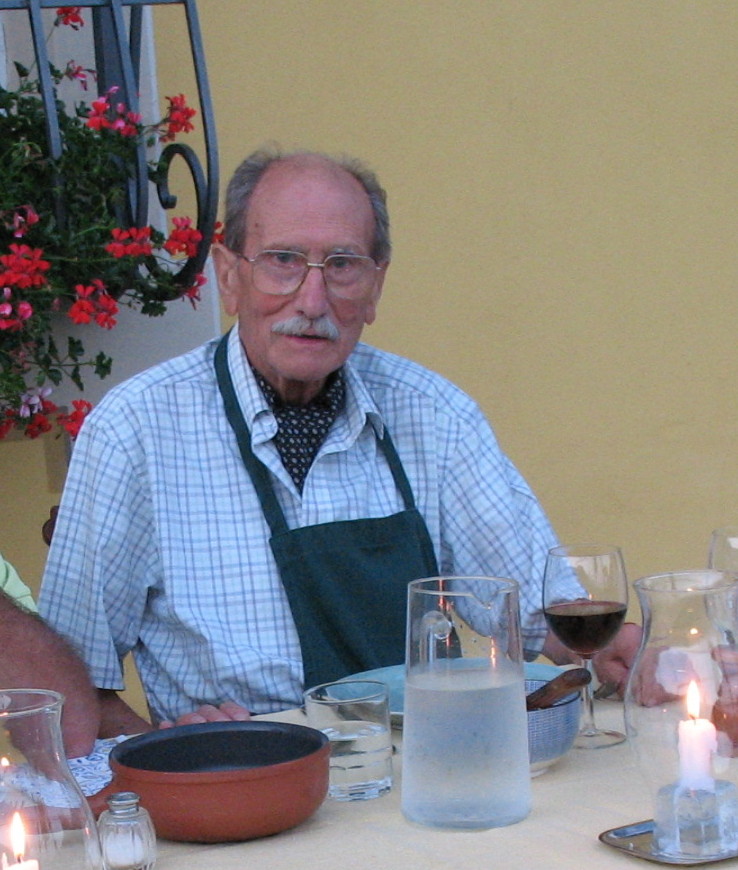
This week we said goodbye to a dear old friend, Rainiero Cesarini. He was 87 and had been sick in the hospital for two months, so his death was a great sadness, if not a surprise. But what a life he’d had!
He was born before the invention of Life Savers, zippers, crossword puzzles, toasters, Band Aids and bras. The Italy of his youth was a much poorer country than today and was soon to be ensnared with the other Allies against Germany and Austria in World War One.
Rainiero was a boy as Mussolini and the fascists rose to power in Italy*; he served in World War II as a member of the Alpini, the highly trained and regarded Alpine mountain fighting units of the Italian Army. They are famous for their bravery and stubborn refusal to give up. They are also admired for their jaunty hats festooned with a long feather.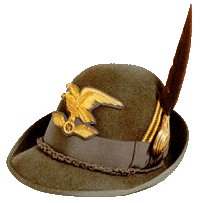
Rainiero enjoyed a much happier fate than that of his fellow Alpini who went to Russia, most of whom died there: he was captured by the British in Libya. Not long before his death he told the Captain about his experiences: there were more than 100,000 Italian prisoners, and the British certainly didn’t have the manpower or resources to organize them all immediately. Basically they were told by the British to organize themselves, which they did, building their own prisoner-of war camps and settling in. After some amount of time they were taken to Alexandria and thence by boat across the perilous Mediterranean to Great Britain.
Rainiero went to a farm to work, where he was treated with kindness and respect; he remained friends with his farm family for the rest of his life. A chef by profession he lived and worked in England after the war, no doubt partly due to the good treatment he received at the hands of the British; he and his wife raised their daughter Amanda there.** When his working days were over he and his family moved back to Italy.
His death and his experiences make one think about what Rapallo and Santa must have been like during those war years. It was only 65 or so years ago, but it’s impossible to imagine. The people were impoverished; the Partigiani were hiding in the hills and, when caught, being lined up against a wall and shot – you can still see the wall in Rapallo, pocked with bullet holes. The German army retreated up the boot, the Allies following, and destruction was left in the wake. Song birds were prized not for their music but for the protein they provided.
What a change from those days to today, when Rapallo and Santa are havens for old folks and tourists, where everything is beautiful, there’s plenty to eat, health care is universal (sort of – that’s for another day), everyone chatters on cell phones, and people drive like maniacs.
I may not be accurate with this history – if not, please tell me! And do try for a moment to picture yourself living when Rainiero did, and imagine all the changes that took place in his long lifetime, beginning with zippers and bras, and ending with iPods. What a journey.
* Italy was not well-pleased by her treatment as a second-rate ally during the peace forged at Versailles. Though she had fought next to the other allies, she did not reap any of the rewards. Mussolini was able to take advantage of this dissatisfaction during his rise to power.
** The Captain was especially struck by the fact that Rainiero chose not to repatriate. The invitation to stay in England was made to many Italian prisoners-of-war, but the majority of them chose to return home.
 An Ex-Expatriate
I knew Senior Roy all my life. He & my Zio were in Russia together. When my mother & father moved from Rapallo to London in the 60’s Senior Roy took them both under his wing (Also so that he could report back to my Nonno!). And after my father’s passing, Senior Roy would always pop into Via Savanga to check that I was ok, chat, share a very small glass and ask after my mum.
In every sense, a true Gentleman.
Davide, what a wonderful story! Why am I not surprised that ‘Senior Roy’ helped your parents? He was always generous to one and all – as you say, a true Gentleman. Thank you for sharing your memories. I’ll pass them on to Rainiero’s daughter Amanda when we return to Italy in a few weeks.
What an absolutely charming-looking gent. He seemed to be one of those people whose good nature is reflected by his outer appearance.
His life story is fascinating, as is the accompanying history lesson – no wonder his loss has been mourned by so many. Thanks for sharing a lovely friendship with us.