There are many things we miss about Italy when we are in the States (just as there are things we miss about the States when in Italy). Aside from missing friends, a lot of our pangs for Italy have to do with food, especially bread. Good bread is available here, but it is quite expensive. At home in Italy we routinely visit one of two bakeries for our daily loaf, as well as for assorted pizza treats, and sweeties to accompany tea.
The first bakery we fell in love with in Rapallo is called Paneficio Campo (Via Trieste) and is owned and operated by Nino and Maddallena and their three daughters. They are originally from Calabria, and are true artists with their rustic loaves. The Captain, who has spent no small amount of time on his bread recipes, has dubbed Nino a Genius.
Our ‘local’ bakery,Panificio Schenone Giorgio on Via Betti, is closer to our house, and makes killer pizzette, which are excellent for a before dinner treat. They also make very nice ciabatta, the shoe-shaped loaf which originated in Liguria, but which is now common throughout the boot. We don’t know the proprietors, but it is clearly a family operation.
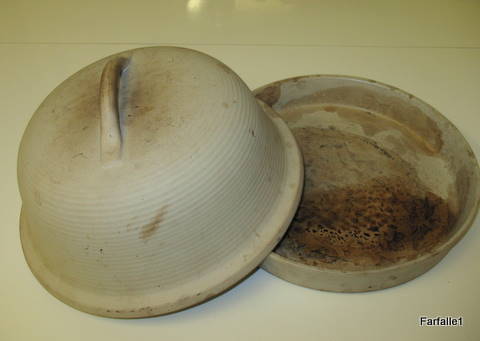
What to do about bread while in America? Easy! We make our own. Last year we discovered the wonderful La Cloche Covered Baker, a domed ceramic baking pot which we bought from King Arthur Flour. (You can see from the photo above it’s received a lot of use).
How’s the bread that’s cooked in La Cloche? Fantastic!
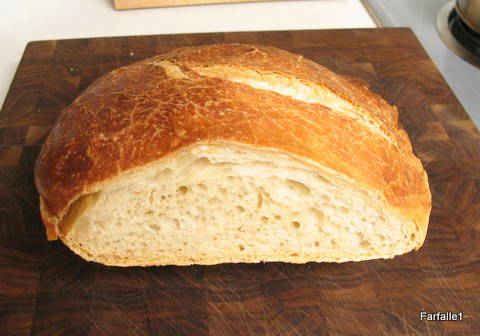
The loaf above was made from a very simple bread recipe (with a surprise ingredient) developed and given to us by Sherri Harris, about whom you’ve previously read in these pages. The recipe is over on the right, called ‘No-Knead Bread (Almost).‘ Also on the right is another recipe which was sent along with the cloche by King Arthur (himself! really!!): ‘Rustic Hearth Bread.’
Making your own bread is such a pleasure. If one didn’t want the expense of the cloche there is surely something one could substitute: perhaps a heat-proof bowl upside down on a tile-lined baking sheets? The house smells wonderful during and after bread-baking, and nothing tastes better than a warm slab of fresh bread with a lot of butter on top. Oh yum!
Buon appetito!
 An Ex-Expatriate
Grazie, Strudel – proveremo fare questi pani. Pero, dobiamo tradure le ricette… a presto.
FORZA BELLA, PROVA.
Pane casareccio
Materia prima: farina di grano tenero, acqua, lievito naturale, lievito di birra, nessun coadiuvante tecnologico e nessun
additivo.Tecnologia di lavorazione: il lievito proveniente dalla panificazione
precedente viene sciolto in acqua tiepida salata e versato nella farina. Si impasta bene e si lascia fermentare tutta la notte. La mattina
successiva si aggiunge altra farina e si impasta bene fino ad ottenere un’amalgama morbida e compatta. Si lascia in riposo poi dopo
breve rimpasto si taglia un pezzo di pasta da conservare per la panificazione
successiva e si formano i pezzi a forma oblunga del peso di 500 gr. circa. Si incide con taglio la parte superiore e si lascia lievitare
per 2/3 ore al caldo. Si cuoce nel forno, riscaldato con fuoco di legna o di tipo industriale.
Pane casareccio di Genzano
Materia prima: farina di grano tenero, acqua, lievito naturale, sale, nessun coadiuvante tecnologico e nessun additivo.
Tecnologia di lavorazione: la farina viene impastata, con il lievito
stemperato in acqua tiepida, sale, nell’impastatrice. Si lascia lievitare
per un’ora circa, poi si reimpasta ancora e si formano le pagnotte e i filoni dal peso variabile da 0,5 a 2,5 kg, i quali vengono messi in cassoni
di legno con teli di canapa spolverati di cruschello o tritello. Si lascia in riposo per la seconda alzata in ambiente caldo per altri 40
minuti. Si inforna a forno caldo, che può essere riscaldato a legna o a riscaldamento indiretto.
Area di produzione: in tutto il territorio del comune di Genzano.
Note: il profumo e la fragranza del pane di Genzano vanno attribuiti
all’uso del lievito acido e alla qualità/varietà dei cereali impiegati. Il lievito naturale, cioè l’impasto della lavorazione precedente fatta acidificare, ricco di fermenti vivi, conserva al pane la sua fragranza anche per diversi giorni dopo la cottura. Proprio perché è un alimento “vivo”, non sopporta il sottovuoto né tanto meno il contatto con la plastica.
Strudel, what is Pagnotta Nera Casareccia al Forno a Legna? I tried to look it up, but had no success. And don’t apologize for your English – it’s excellent. You should see my Italian, if you want a good laugh…
Dear Farfalle, hat tip for your bakeries in Rapallo, I ‘ll go and give a look to them, but with a skeptical eye. In my opinion (and my opinion matters, when it comes to make a decent coffee and taste a lump of bread) the art of bakery ends in Florence. But even in the Center South of Italy I doubt you can find anymore the Pagnotta Nera Casareccia al Forno a Legna, of which the Prince of Talleyerand would have said ‘who haven’t tasted the real Pagnotta Casareccia, theycannot know what the doucesse of vivre was’. (P.s. I apologize for the the bad English, but .. Gail Fortescue says: how much u gonna pay for corrections?
Strudel says: couple of kicks in your ass)