Years ago a friend offered me a plane ticket to California, but I had other Big Plans and turned him down. What a mistake. Recently we spent a week in and around San Francisco, and I fell in love – not in San Francisco, but with San Francisco.
Here’s what’s right about San Francisco: almost everything. It’s a big city without a huge population (+/- 808,000 in 2008, according to Wikipedia), conveniently contained in only 47 square miles (for comparison, Manhattan has a population of +/- 1,621,000 on 23 square miles; Chicagoland, 9.5 million, 81 square miles).
Ocean. Bays. There’s lots of water in and around San Francisco.
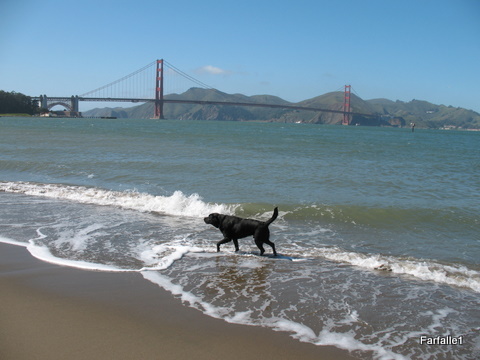
Where there is water there will be bridges, and San Francisco has two that are magnificent: the famous Golden Gate Bridge:
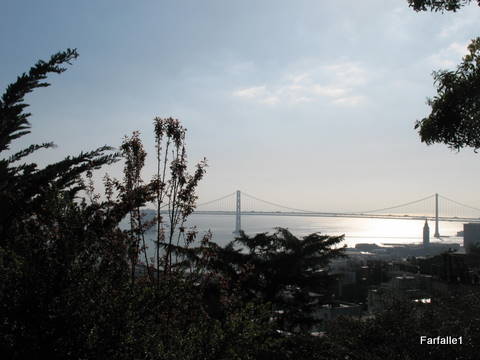
and the graceful Bay Bridge (which is in the process of being rebuilt):
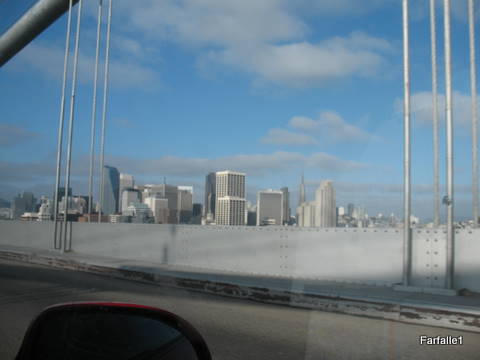
Crossing the Bay Bridge from Berkeley to San Francisco gives one a lovely view of the latter:
Most of San Francisco was destroyed by a post-earthquake fire in April, 1906. Here’s what the downtown looked like in the aftermath of that catastrophe (photo taken by H.D. Chadwick and housed in the National Archives):

Much of the city was rebuilt, obviously, but there are still some lovely juxtapositions of old and new:

San Francisco has a terrific public transportation system. The BART (Bay Area Rapid Transit) trains run all over the place, and buses will take you wherever the Bart won’t. The most famous form of public transportation is the cable cars but we fell in love with the trolley buses – in addition to hundreds of modern trolleys, there are retired trolley cars from around the world. Our hearts leapt when we saw the familiar yellow of a Milano car. It made us wonder for a moment where we were.
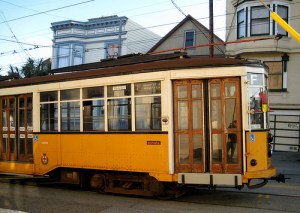 (photo by Paul Fisk)
Food is famously important to Californians, and especially to San Franciscans. We ate out three nights in a row, and each meal was prepared perfectly. The Slanted Door in the restored Ferry Building on the old pier serves fusion Vietnamese food. Our only complaint was that the noise level was so high we left with our ears ringing. If you enjoy shopping, the Ferry Building is worth a daytime visit as well. Dosa, on famous Filmore in San Francisco, serves South Indian cuisine that is out of this world. The Wood Tavern, in Berkeley, serves chops, steaks and so forth in a small building with an intimate feel. All three of these restaurants were packed; reservations are a good idea. It was hard to leave the area knowing we had sampled only three of the hundreds of wonderful restaurants available… guess we’ll have to go back some day.
Cultural activities abound in the Bay area – we were not there long enough to scratch the surface of what’s available, but both the California Academy of Sciences in Golden Gate Park and the Asian Art Museum were so engaging that a half-day visit to each lasted all day, and we did not see half of either (you do the math!). For a guide to such things, click here. The Academy of Sciences, for instance, is one of at least three science museums in the area. Music, theater, film, art – it’s all widely available. Because of the diversity of the population there are countless cultural experiences to be discovered.
Visiting California itself is a bit like going to another country. We had to make a stop at an Agricultural Inspection station so our car could be examined for unwanted pests. We understood why when we drove through the vast San Joaquin Valley, 27,280 square miles of mostly agricultural land with a few cities here and there. That’s equal to about 20% of the whole of Italy (116,345 square miles). The area is sometimes justifiably referred to as “the salad bowl of America.”

In the photo above, what looks like a carpet of wildflowers is actually a quilt of blooming fruit and nut trees. What looks like a river is the California Canal, part of a vast irrigation system that brings the water of California’s rivers and mountains to the valley. In addition to fruit and nut trees there is vast acreage in cotton and vegetables (the J.G. Boswell cotton farm is the largest in the world at 150,000 acres).
In addition to agriculture, there is a thriving oil business in the San Joachin valley; there are six fields with reserves in excess of 100,000,000 barrels.

We saw enormous herds of cattle and fewer, but equally large, flocks of sheep. The drive through the Valley was long and bucolic, if, perhaps, a bit dull.
And lest you think Californians are not serious about the environment:
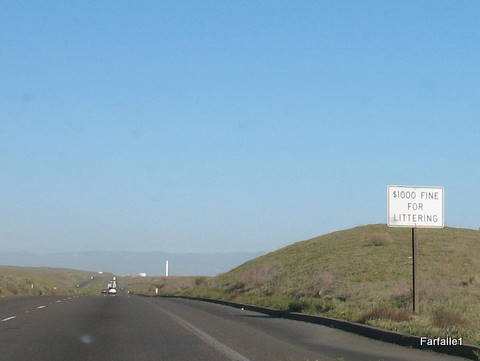
How this might be enforced I’m not quite sure…
California is also really serious about alternative energy. Near Palm Springs we drove through a huge wind farm. I couldn’t stop taking pictures, so please bear with me if I show you three of them instead of just one:
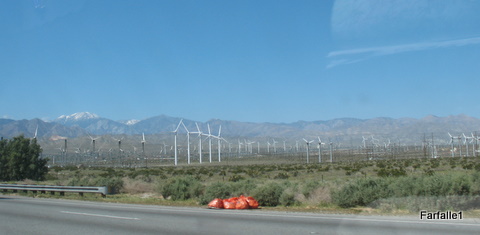

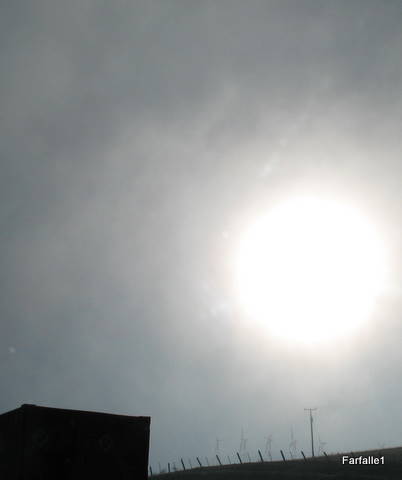
In 1995 California’s three main wind farms produced 30% of the world’s wind-generated energy.
Here’s what’s bad about California: the roads and the drivers.
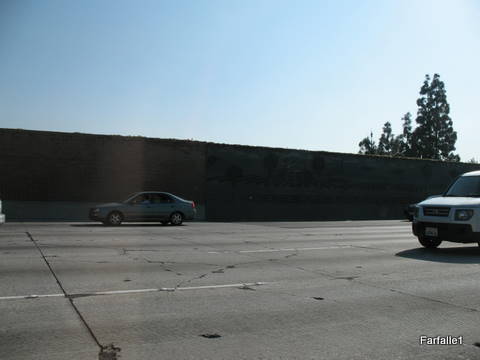
A lot of the roads looked like the one above, with broken or uneven pavement. It made for a noisy and bumpy ride. The drivers, though, are worse than the roads. It seems to be a matter of pride never to drive less than 20 miles over the speed limit. The fellow driving the truck below passed us on the right, cut in front of us about 2 car lengths ahead, and jammed on his brakes. We hit him, but fortunately damage to our car was minimal (nil to his truck) and no one was hurt.
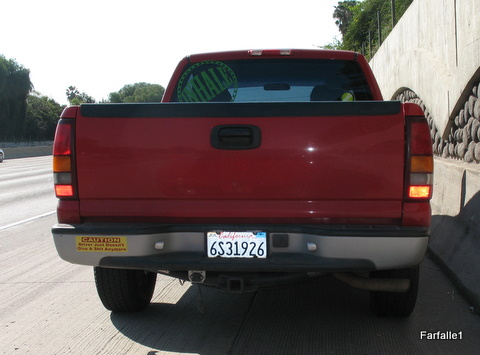
The advice on the rear window (‘Inhale’) might perfect for a party, but maybe not for the highway. Curious about that bumper sticker? It says, ‘Caution, driver no longer gives a shit.’ Evidently.
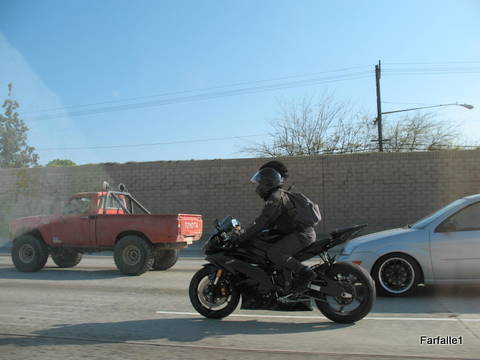
Not everyone on California roads is irritating though. This Gladiator cyclist gave us a cheerful wave when he saw my camera:
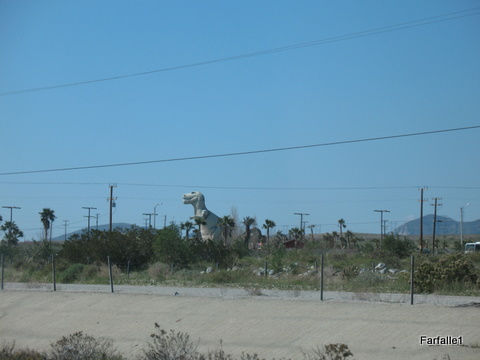
We had two unusual wildlife sightings as we drove along, one reptilian and one ursine:

This has been a long post, and I apologize for the large number of photos. It was hard to choose which of the 300+ I took to share with you. As you can tell, we had a terrific trip to California; I now understand why it is always one of three destinations on the itinerary of visiting Italians. It will be on mine again.
 it’s infinite, they’re probably multiplying as you read. It’s hard for the Captain and me to imagine the pleasure anyone would take from living in a metal box in the desert, but there must be a lot to it we don’t understand, as many seem happy to be doing it. Most of the license plates were from cold northern climes, and perhaps that is all the explanation that’s required. It was interesting to see that quite a few of these mobile homes are now generating their own power with solar panels and small windmills mounted on the roofs.
 The streets of
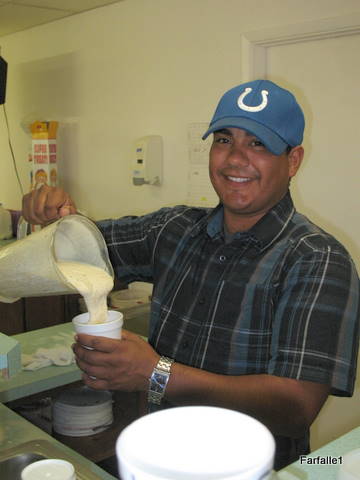
 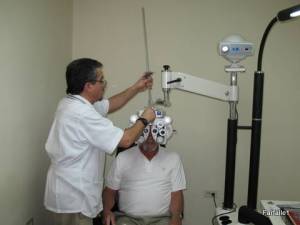 nal manner. We each received a very thorough eye exam, including the test for glaucoma. Several space-age looking machines stared deeply into our eyes and provided the rough corrections we each needed. Then we were ushered into a different room where our prescriptions were fine-tuned. Dr. Robles spent a very long time with the Captain who required two different kinds of glasses – one pair for regular life, and another with different focal lengths for working at the computer.
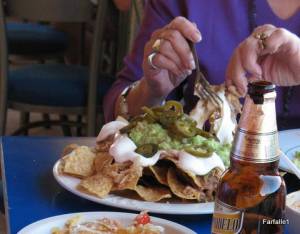 The restaurant where we sat on a second-floor balcony and ate some of the best nachos that have ever been constructed. Yes! That’s pulled beef under the guacamole and sour cream – yum!
 This man, seen from our luncheon eyrie, was selling fresh strawberries. We bought some, forgetting that we probably couldn’t carry them back across the border. We later gave them to a passer-by.
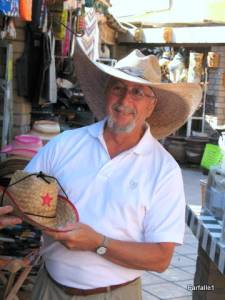 You can’t visit Mexico without trying on a great big hat…
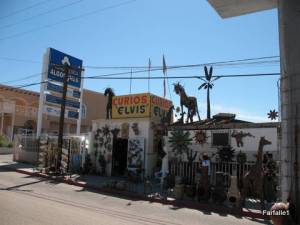 We didn’t buy anything from Elvis, but it’s kind of reassuring to know that the King still lives… in Los Algodones…
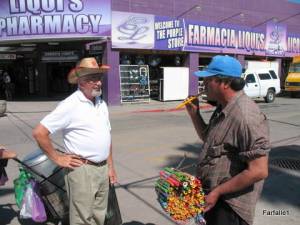 No, we didn’t buy a whistle, either, though it was extremely tempting.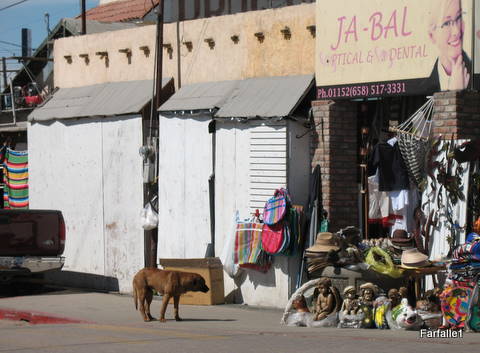


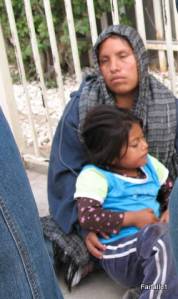 Because there were only three beggars and because, sad expressions aside, they looked reasonably healthy, we assumed that it was some kind of controlled concession. But we still couldn’t walk by and do nothing… could you?
 There are many date farms in the area, specializing in
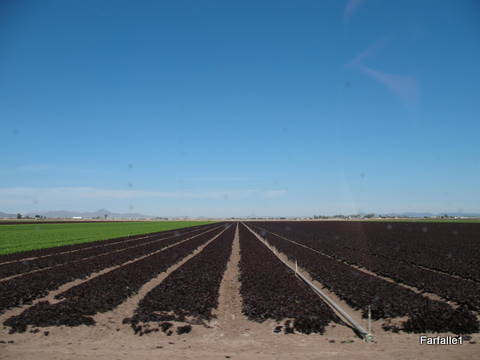
  Then it was back past the miles of lettuce farms. I bet half the lettuce eaten in the US comes from this part of the world. Our friends from Tennessee say they eat the lettuce shipped by these growers. Here is what a really BIG red and green lettuce garden looks like:
 We were pretty tired out after our day’s exertions. After a delicious dinner with our friends we crossed one last seamless border, and tumbled into bed in the Cocopah Indian Nation – at the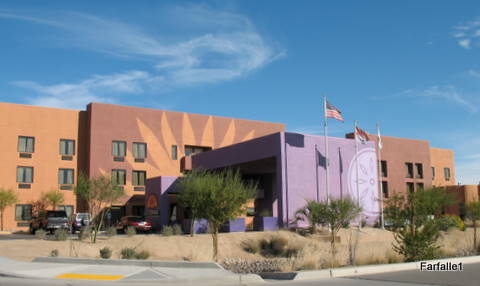
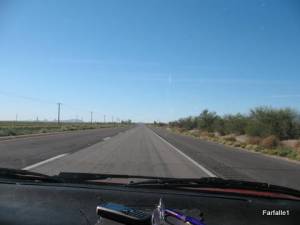 “Desolate” is a word that popped into our heads more than once on the four-hour drive from home to Yuma, in the very southwest corner of Arizona. (

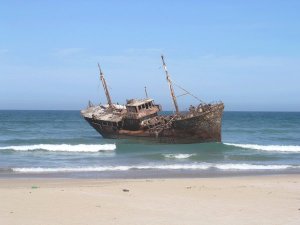 (photo courtesy of
  For starches people selected spaghetti, tortillas (2), spicy raman, potatoes and Asian sticky rice.
 An Ex-Expatriate
