• Contact
  • Elaborations
    • A Policeman’s View
    • Driving School Diary
    • Great Danes
    • IVA charged on Tassa Rifiuti
    • Nana
    • Old trains and Old weekends
    • The peasant, the virgin, the spring and the ikon
    • Will Someone Please, Please Take Me to Scotland??
  • Recipes
    • ‘Mbriulata
    • *Baked Barley and Mushroom Casserole*
    • *Captain’s Boston Baked Beans*
    • *Cherry Tart*
    • *Crimson Pie*
    • *Louise’s Birthday Cake*
    • *Melanzane alla Parmigiana* – Eggplant Parmesan
    • *Penne with Cabbage and Cream
    • *Pizzoccheri della Valtellina*
    • *Pumpkin Ice Cream*
    • *Risotto alla Bolognese*
    • *Rolled Stuffed Pork Roast* on the rotisserie
    • *Shrimp and Crayfish Tail Soup*
    • *Spezzatino di Vitello*
    • *Stuffed Grape Leaves*
    • *Swordfish with Salsa Cruda*
    • *Tagliarini with Porcini Mushrooms*
    • *Tagliatelli al Frutti di Mare*
    • *Tzatziki*
    • 10th Tee Apricot Bars
    • Adriana’s Fruit Torta
    • Artichoke Parmigiano Dip
    • Best Brownies in the World
    • Clafoutis
    • Cod the Way Sniven Likes It
    • Cold Cucumber Soup
    • Crispy Tortillas with Pork and Beans
    • Easy spring or summer pasta
    • Fagioli all’ucelleto
    • Fish in the Ligurian Style
    • Hilary’s Spicy Rain Forest Chop
    • Insalata Caprese
    • Kumquat and Cherry Upside Down Cake
    • Lasagna Al Forno con Sugo Rosato e Formaggi
    • Lemon Meringue Pie
    • Leo’s Bagna Cauda
    • Leo’s Mother’s Stuffed Eggs
    • Louis’s Apricot Chutney
    • Mom’s Sicilian Bruschetta
    • No-Knead Bread (almost)
    • Nonna Salamone’s Famous Christmas Cookies
    • Pan-fried Noodles, with Duck, Ginger, Garlic and Scallions
    • Pesto
    • Pesto
    • Pickle Relish
    • Poached Pears
    • Polenta Cuncia
    • Pumpkin Sformato with Fonduta and Frisee
    • Rustic Hearth Bread
    • Sicilian Salad
    • Soused Hog’s Face
    • Spotted Dick
    • Swedish Tea Wreaths
    • The Captain’s Salsa Cruda
    • Tomato Aspic
    • Vongerichten’s Spice-Rubbed Chicken with Kumquat-Lemongrass Dressing
    • Winter Squash or Pumpkin Gratin
    • Zucchini Raita

An Ex-Expatriate

~ and what she saw

An Ex-Expatriate

Monthly Archives: June 2009

Under attack?

27 Saturday Jun 2009

Posted by farfalle1 in Crime, Law and order, Uncategorized

≈ 9 Comments

Tags

misdemeanors, pranks, property damage

Lately we’ve felt a bit like we’re under attack.

First it was the Attack of the Teen-Age Firebombers.  Well, ok, that’s overstating it: it was just little fire-crackers.  But it was almost midnight, I Firecrackerswas up alone, and they made a big flash of light and then a loud bang when they landed on the front terrace.  And there were 17 of them, which seems excessive, and that doesn’t count the dozen that were set off in our mailbox.  I finally woke up the Captain who went outside and shook his fist and shouted at the departing figures, lads from a nearby settlement we surmise.  That was harmless, all in all, but it was unsettling because they were not throwing the flash booms anywhere except at our house.

A week or so later we went to our parcheggio to find that our sweet little Mini had been ‘keyed’ from stem to stern.  It wasn’t casual, because it’s very clear that whoever did it started on the front fender and decided he wasn’t going deep enough, so he started over, deeper, and did the full length of the car, ending at the back of the rear fender.  We have insurance, but that’s hardly the point – it’s the wanton defacement that is upsetting.  Were we singled out?  Who knows.  The trattoria across the street had over 150 guests that evening, and some of them were pretty drunk by the time they left.  But we have no way of knowing who did the deed or when.

The most recent insult is a large stone that was thrown on our roof from the road above.  That sounds harmless enough, and in fact it was harmless.  But our roof, like most of them here, is made of clay tiles, and it is reasonable to assume that if you throw a large rock from above it will break some of the tiles, leading to the inconvenience, expense and risk (it’s a high roof) of repairs.  We were lucky that either the rock was too small or the tiles too strong for any damage to occur.

RinoNonetheless, I’m feeling paranoid.  It’s always such a shock to see or suffer from an act that is just purely mean.  It happens the world over, I guess.  The firecrackers were probably just kids goofing around.  But the car and the rock are on a different order – those were done with intent to damage. And I’m thinking about surveillance cameras…  what a way to live.  Or maybe… maybe we’ll call Cugino Rino in Genova.  He has a menacing laugh that would scare the devil – we’ll just get him to come over here and laugh around the neighborhood a little, and then no one will dare harm us or our property again!
GPL

22 Monday Jun 2009

Posted by farfalle1 in American habits and customs, Driving in Italy, Driving in the U.S., Italy, Liguria, Travel, Uncategorized

≈ 7 Comments

Tags

Bi-fuel cars, Chevrolet Matis, Ecocentives, fuel efficiency, GPL, LPG

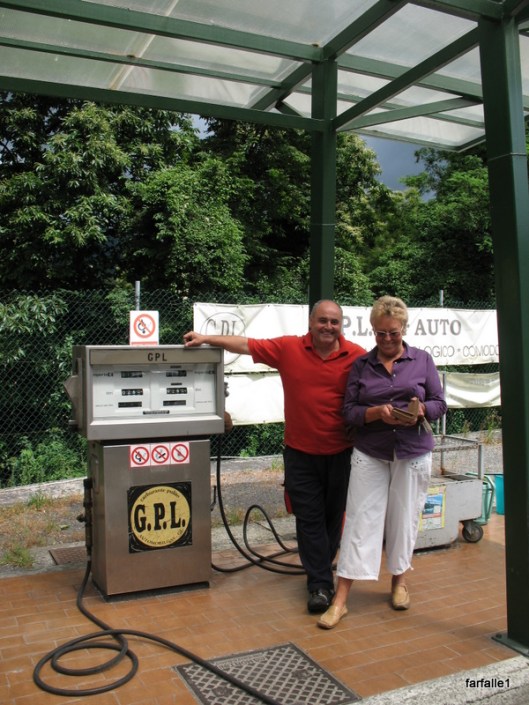
GPL in Italy is what we call LPG in the U.S.: liquid propane gas, and cars fit to take it are widely available here (Chevrolet, Fiat, Mazda, Opel,  Peugeot, Renault).

Quick disclaimer:  I’m not a gear-head or an engineer.  My understanding of internal combustion engines is on a par with that of my sister, who once described the reason her car was in the shop as “a loose screw in an oil place.”

Unfortunately, a visit to fueleconomy.gov, a U.S. site, informs us that one of the disadvantages of LPG as an auto fuel in the U.S. is that no new passenger cars fitted for its use are commercially available (though kits to retrofit are).  It is more commonly used there for fleets, taxis, and forklifts (there are about 600,000 LPG vehicles in operation in the U.S. today out of 240,000,000 total vehicles (+/- 2.5%).  As a corollary to this, the fuel itself is not widely available at ordinary filling stations.  And I have to ask, why??

The U.S. is one of the largest producers of LPG, which is a petroleum product (learn all about it here).  It was first developed by Dr. Walter Snelling in 1910 (the first automobiles that ran on propane appeared in 1913).  Though it is a petroleum product, it burns up to 40% cleaner than gasoline, emitting far fewer hydrocarbons, and it is less costly than gas.

Look at this happy woman:

GPL

She is my friend Anita, and she is happy because she has just filled her bi-fuel Chevy Matis with GPL.  Bi-fuel?  It means her new car runs on either conventional gas or, with the flip of a switch, GPL.  She is happy because there is still money in her wallet after filling her car.  One reason is because her GPL costs about E .57 per liter instead of the E 1.39 for gasoline. (The man who pumped the GPL is smiling because he likes having his picture taken.)

Here are two more reasons she’s smiling.  When she took her old Volvo wagon off the road the Italian government said Thank You For Taking That Big Polluting Monster Off Our Roads by giving her E 1,500.  Then she was rewarded with about another E 3,500 when she chose to buy her bi-fuel Chevrolet Matis. (Other car manufacturers in Italy also offer ‘ecocentives’ to those who purchase bi-fuel cars.)

GPL-1

The only trick is to find a station that sells GPL – it’s easier to do here, where there are at least 19 dealers in Liguria, than in the U.S., where you seldom see it sold.  But if you can’t find a station, no worries – you can still drive on conventional fuel.

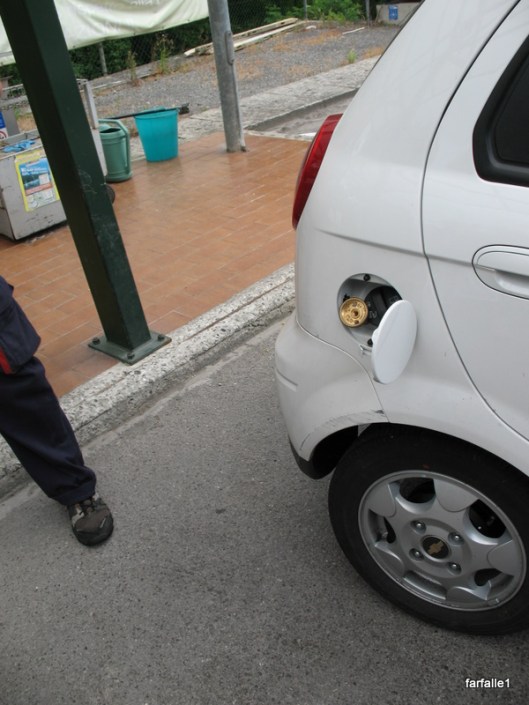
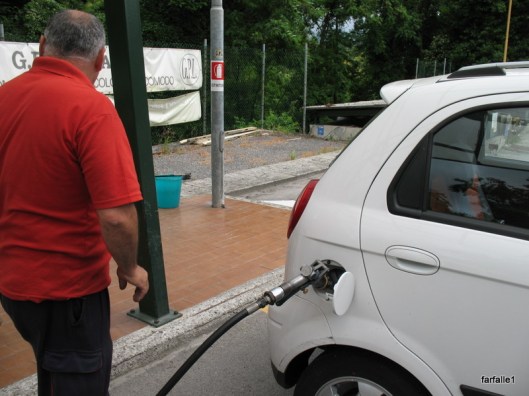
There’s a special adaptor that couples with the GPL fuel receiver of the car – brass!  Very pretty.  And after the car has been fueled, very cold.  The smiling man simply took the adapter, screwed it in, and then attached the pump nozzle to the adapter.  It didn’t take any longer to fuel with GPL than with regular fuel.

GPL-3

I’m surprised more is not done with this fuel in the U.S., where efforts seem to be going instead to ethanol blends and bio-diesel.  I learned here that if you purchase a hybrid, diesel or dedicated alternative fuel vehicle (what a mouthful), you may be eligible for a tax credit of up to $4,000, which is nothing to sneeze at.  There is no reward in the U.S. for purchasing a bi-fuel car.  Nor is there a reward that I could find for removing a heavily polluting, inefficient vehicle from American roads.  An alternative in the U.S. to LPG is compressed natural gas, or CNG, which burns even cleaner than LPG, but takes up much more room.  (Again, new cars are not available with CNG, but retro-fit kits are.)  Isn’t it odd that American auto manufacturers haven’t paid more attention to a  cleaner technology that’s been around since the beginning of car time?  Oh, wait a minute.  Thinking about those yo-yo’s, maybe it isn’t so surprising after all.

Not Your Same Old Zucchini

18 Thursday Jun 2009

Posted by farfalle1 in Food, Indian recipes, Uncategorized

≈ 6 Comments

Tags

Indian food, raita, zucchini

indian dinner zucch 001

This week we had a confluence of two happy conditions.  The first is that the Captain loves to cook, and we both love to eat, Indian food. The second is that it is the start of Zucchini Season here in Liguria.  Our plants are just beginning to flower, but our friends are already picking their first zukes and cukes.

There was a joke in the town in Connecticut where we lived for many years.  It said that the only time you had to lock your car was when you went downtown in August because if you didn’t someone would throw in a bushel of bat-sized zucchini.  It certainly is a prolific plant (though we’ve suffered off-and-on mildew problems here in Rapallo), and the puzzle is always to find new ways to serve this summer staple.  It’s always great on the grill, but you don’t want to fire that up only for zucchini.  Zucchini cake is good, but doesn’t use up enough of the vegetable.

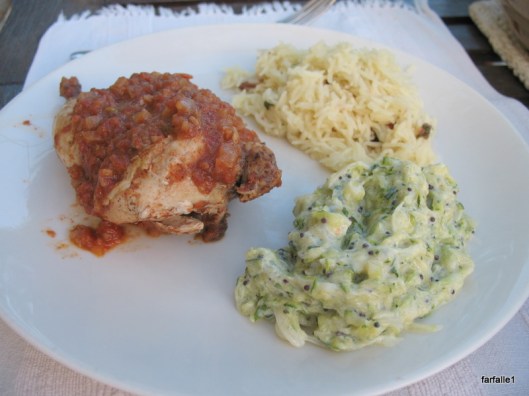
What to do?  The Captain googled ‘zucchini Indian’ and found a terrific Madhur Jaffrey recipe at recipezaar.com.  Like every good cook I know, though, he tweaked it to produce the gorgeous zucchini raita seen at the front of the plate above.  (The other two items are Murgh Khoobani, game hens braised in fragrant apricot sauce from Julie Sahni‘s book Classic Indian Cooking; and basmati rice with raisins, saffron and mint).

Although this recipe calls for cayenne pepper, you can leave it out altogether if you hate hot pepper, or you can add it in any amount you like to suit your appetite for heat.  You can find the recipe by clicking here, or over on the right under Recipes.

Whence thy egg?

14 Sunday Jun 2009

Posted by farfalle1 in Animals in Italy, Birds in Italy, Food, Italian habits and customs, Italy, Uncategorized

≈ 8 Comments

Tags

chickens, eggs, hens, Italian eggs

rhodeislandredWhen we lived in Connecticut we had a ‘flock’ of hens.  I use the term loosely; we had three hens.  Ever since my grandmother told stories about making little rubbers for her chickens so their feet feet wouldn’t get wet, I wanted to raise chickens.  It seemed more interactive than dolls, and less responsibility than actual children.
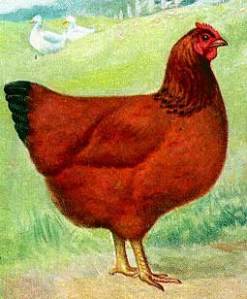
Our flock began with a gift of two small banty hens from a friend, which we augmented with the purchase of a Rhode Island Red and a Barred Plymouth Rock.  Oh, they were lovely.  One of the banties became despondent and went under the hen-house to die, but the other three lived with us until we gave them away upon leaving Connecticut, and they gave us just the right number of delicious small blue (the banty) and large brown (the other two) eggs.  BARROCK1

In the U.S. the provenance of the eggs one buys is something of a mystery, as is their age.  In a commercial operation, the eggs are washed and sanitized immediately, and then are sprayed with a thin coat of mineral oil ‘to preserve freshness,’ according to the USA Poultry & Egg Export Council.  The quotation marks are mine, because I suspect it is done more to give the eggs a longer shelf life than for any other reason.  When you buy a carton of eggs in the U.S., you have no idea where they’ve come from, unless the name of the farm is on the carton itself.  And even then you have no way of knowing if the hens were caged or free-range, or what they were fed.  (This is true: leftover bits of chicken at a processing plant are ground up and used as chicken feed.  Blcch.)  Fancier/organic egg producers are likely to advertise their practices on their cartons, but otherwise you’re left in the dark.

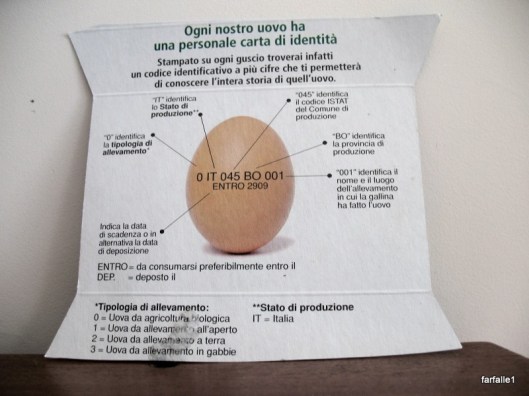
Here in Italy every commercially sold egg comes with a code stamped on it.

Egg ID

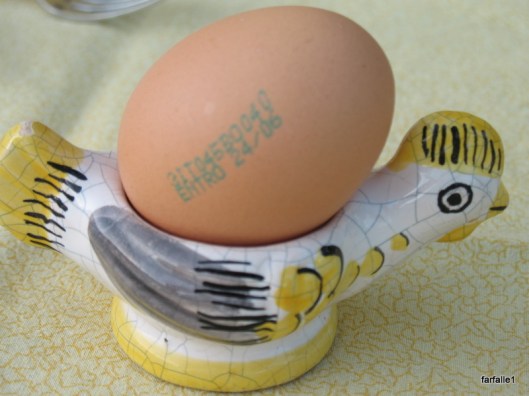
The first number identifies the life style of the producing hens: 0=biologic (what we might call ‘organic’ in the U.S.)  1 = living in the open (‘free range’)  2 = raised on the ground (something between free range and a cage) and 3 = caged.  The next two letters give the country of origin of the eggs; the next three numbers correspond to the town where the egg was laid; the next two letters are the provincial code of the town; the last three numbers identify the name of the producer (not the hen, the farmer).   So, no mystery about your egg here.  Of course, not all eggs are equally legible.

egg in cup

This one is pretty clear (oh, busted! Now you know we buy eggs from unhappy cage-raised hens in the province of Bolzano.  Shame on us.)  Sometimes the printing is quite smudged so you have no idea what it says.  Note also that there is a use-by date stamped under all the other info.

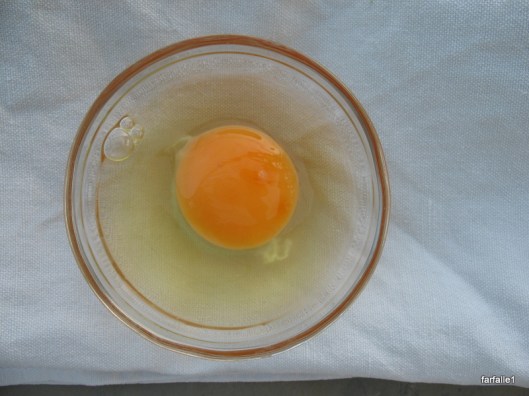
I haven’t been able to find out what Italian hens eat, but the yolks of their eggs are a rich red-yellow, almost orange.  When we go back to the egg in bowlStates the relatively pale yellow yolks seem anemic to us.  But I must say, even our own flock of Connecticut hens produced the pale American yolk.  It must be something in the Italian diet … even for the chickens.
We always feel good about buying eggs here.  The laying date is stamped on the egg box (they’re sold in quantities of 4, 6 or 10, an odd mix of metric and imperial measurement).  The egg itself will tell us exactly where it comes from.  Italian eggs are not sold from refrigerated cases.  They sit out on the shelf, proud to be fresh enough to do so.

Good as the eggs in the market are, though, the best egg is the one with no identifying marks, save perhaps a little bit of hay or something worse stuck to it, the egg your neighbor gives you.

Every Inch

10 Wednesday Jun 2009

Posted by farfalle1 in gardening, Italian habits and customs, Italian men, Liguria, People, Rapallo, Uncategorized

≈ 2 Comments

Tags

Cliff gardening, Rick Gush

It has always amazed me how every square inch of space in Italy seems to be put to some kind of good use.  There are 60 million people living in Italy, a population density of 515 people per square mile.  In the US the population density per square mile is 80.  No wonder roads, houses, cars and people there are large – there’s enough space for everything and everyone.  But here in Italy every square inch must give the most it can.  You realize this particularly if you’re out walking on a woodsy mountainside and suddenly notice overgrown stone walls: the land on those mountains was important enough that people put in hundreds of hours of labor to terrace and farm them.

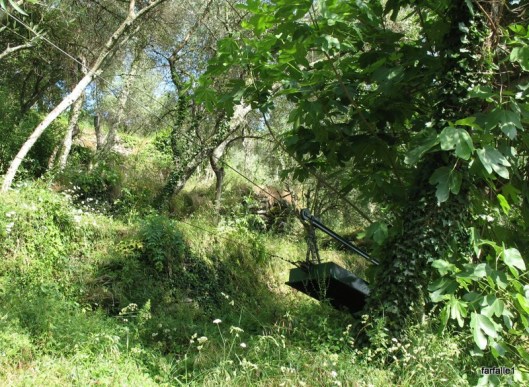
Now agri-business has arrived in Italy, too, and some of the farming land on the really steep and inaccessible mountains has gone wild.  But individuals will squeeze an enormous amount of production from whatever land is available to them.  And they have devised some very clever inventions to make the job easier.  It’s not uncommon to see a small cable and carrier system stretching across a wooded valley from one hillside to another – a way to transport cut wood.  Or to see the same thing coming down the olive-studded hill to a road below – a way to get the harvested olives to a waiting Ape (the little three-wheeled workhorse truck named for bees, because that’s what the two-stroke engine sounds like).

cable system (2)

People practice intensive gardening here – a lot of the garden maintenance is done by hand, so rows to do not have to be widely spaced to accommodate a tiller.  Down the hill in Rapallo I have watched an elderly gentleman prepare and plant his garden this spring – he did it all by hand.  First he turned the dirt with a spade, then he put in mounds of fertilizer (probably cow manure from the farm up the road), then he forked it all in by hand, and finally he was ready to plant.

garden squares-1aIsn’t it tidy and pretty?  If you get out your magnifying lens you might just be able to spot the man himself in the midst of his tomato stakes behind the tree in the center.  Or you can just take my word for it that he’s there.
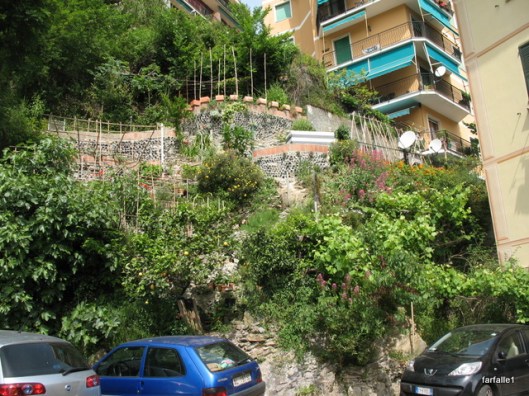
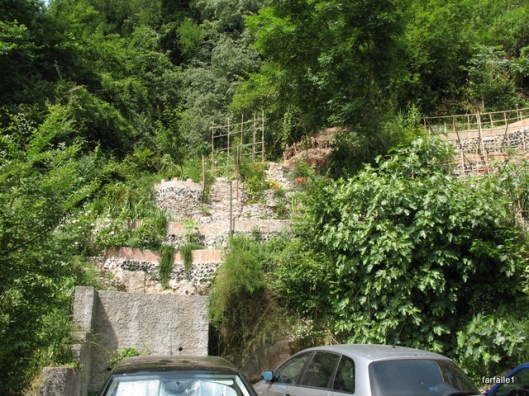
The prize for getting the most out of every inch, though, goes to this man’s neighbor a bit farther down the road, another American transplant by the name of Rick Gush.  Rick is the guy that if you give him a sow’s ear he’s going to give you a purse the next time you meet.  He’s the guy who’s never even heard of the box everyone else is trying to think outside of.  Every time we meet Rick we learn of some new  job he once had.  An incomplete list of his accomplishments includes adventure game designer (Kyrandia, Lands of Lore), psychic soil analyst (easier than it sounds, he says, if you live in Las Vegas, as he did at the time), intimacy counselor (“those that can’t do, teach,” he says), artist, uranium miner, gardener and garden writer.  He took all the disparate skills suggested by these activities and put them to work in building his hillside garden.

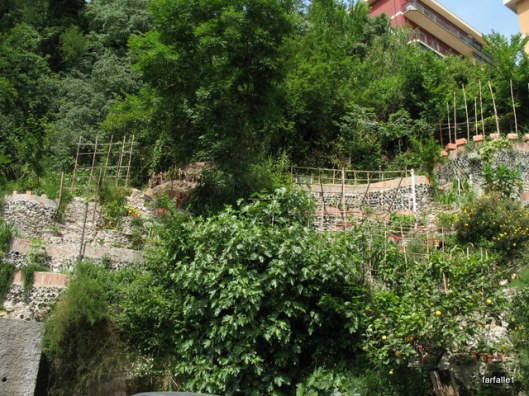
The steep, stony land, a cliff really, behind his and his wife Marisa’s apartment building had gone completely to seed.  Over the last few years Rick has terraced it and built walls of cement and old wine bottles laid on their sides with the bottoms facing out.  Sounds weird, but it’s really pretty and a very clever way to recycle hundreds of wine bottles.  And being a fanciful fellow he has put turrets on the walls.

Rick's garden

This is a view of the right side of the garden.  There are grapes on the right and a big fig tree on the left, with a smaller lemon between them.  There’s a set of steps, invisible in the photo, above the blue car roof.  Above you can see flowers, bean poles, tomato poles and satellite dishes. Just below the uppermost wall there is a very pretty curved arbor with a flowering vine  growing over it.

Rick's garden-1

This is the left, and more recently constructed part of the garden.  More turrets, the big fig, and more poles to support cukes, squash and pumpkins.

Rick's garden-3

This pictures shows the amount of wall building Rick has done, but it’s hard to see the details of the plants.  This is a garden in the true spirit of Italy – there’s not one centimeter wasted, and, best of all, it’s beautiful.  There’s been an addition since I took this photo – up on the top fascia now sits a small, gleaming white greenhouse – heated by manure.  (To read more about Rick and his cliff garden, click here.)

Rick strangles thin air-1

Smoke

05 Friday Jun 2009

Posted by farfalle1 in Customs, gardening, Italian habits and customs, Italy, Uncategorized

≈ 6 Comments

Tags

agricultural burning, agricultural fires, brush burning in Italy

Native Americans knew how to use smoke to force rodents to flee their desert burrows; once they emerged the Indians killed and ate them.  We’re feeling a bit that way – like the rodents, that is, not Native Americans.

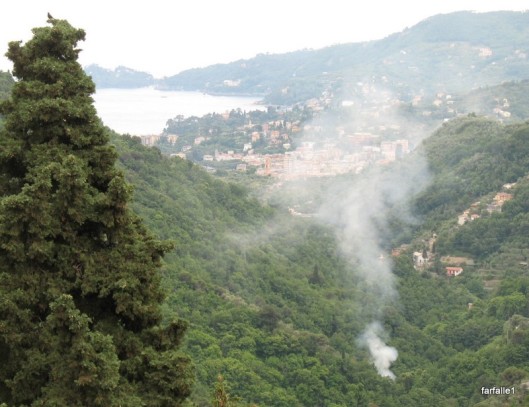
fire in the valley2

Italy is a burning country.  Visit Tuscany in late October or November and you will find a shroud of smoke from agricultural fires over the landscape.  Coming from a part of New England where one needed a permit from the Fire Marshall to do any burning on one’s property, it was a shock to us to see how many fires there are, almost every day, dotting the hills and mountains around us.  After a year, though, we understood.  It is such a verdant, lush country, there is simply no way to compost or keep up with the excess growth that needs to be removed. (According to the European Commission, agriculture is responsible for 9% of the world’s total greenhouse gas emissions (though to be fair, agriculture also serves as a G.G. sink).  A large percentage of those emissions come from methane and manure – turns out all those cow-fart jokes were based on fact after all)

Burning becomes delicate when you live amongst others.  It’s best if you or your neighbors burn on a day that is not dry and windy.  A day without a thermal inversion is good – then the smoke goes up instead of around and around.  And most of all, it’s really nice if you burn so your smoke doesn’t go right into your neighbors’ windows.

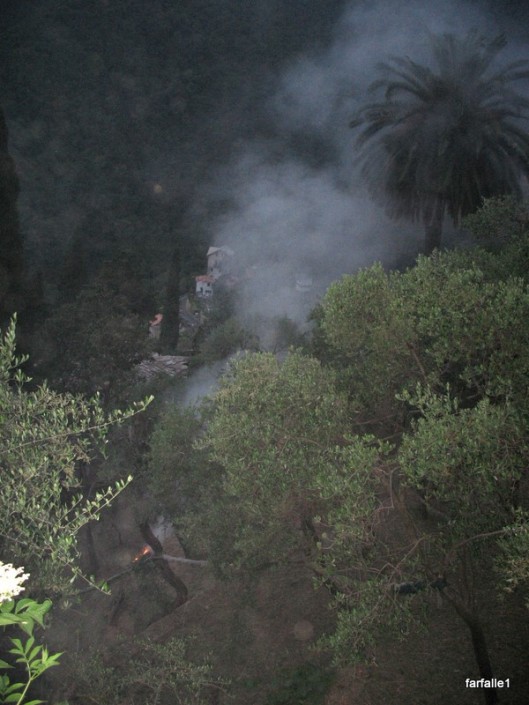
sandro's evening fire

Our neighbor Sandro has recently cut his grass, using, as everyone else does, a weed whacker rather than a mower.  It’s back-breaking, dirty, unpleasant work, and I’m happy to say Sandro does it once or twice a year, whether he needs to or not.  Oh meow! Of course the grass and weeds were up to his waist, which made his job even nastier.  Then, because there were so many whackings (can’t really call them ‘clippings’ in this case), he had to rake them into piles, and then he burned them.  Right under our terrace.  Ordinarily this wouldn’t bother us one whit, but that day we had an inversion, and the slight air movement we did have brought the smoke from his fire right into our house, never mind our yard where we had been hoping to work ourselves.  It started at 9:30 a.m. and he lit his last fire at 8:30 p.m.

There was a strange principle of physics at work that day: we were able to receive most of the smoke from two separate fires, one on either side of our terrace.  How this happens is not quite clear to me.  I think there’s probably a formula, something like:  NI = (e) SD + (w) SD +T / square root H, where ‘e’ is east, ‘w’ is west, SD is smoke diffusion, T is temperature, H is humidity and NI is neighbor irritability.  Risking the Bad Neighbor Award the Captain took our longest hose and put out one of the fires. Our eyes were still watering, and our throats were scratchy the next day.

I’m hoping to be able to get out in our own garden tomorrow.  I’ve got a big brush pile that needs burning.

We’ve got mail!

01 Monday Jun 2009

Posted by farfalle1 in Italian bureaucracy, Italian habits and customs, Italy, Uncategorized

≈ 6 Comments

Tags

il postino, Italian mail service

The Captain found Il Postino  and showed him where our mailbox is.  He turned out to be a very sweet man who said, “I’m so sorry, I don’t know this zone, I didn’t know where your box was.”  Sigh.  The next day the missing mail appeared in our seemingly invisible mailbox, and all is well.  For a time.

We’re getting a new mail man in two weeks.

Enter your email address to follow this blog and receive notifications of new posts by email.

Join 114 other subscribers

rss

Subscribe in a reader

Search the Blog

A. Useful Links

  • bab.la language dictionary
  • Bus schedules for Tigullio
  • Conversions
  • English-Italian, Italian-English Dictionary
  • Expats Moving and Relocation Guide
  • Ferry Schedule Rapallo, Santa Margherita, Portofino, San Frutuoso
  • Italian Verbs Conjugated
  • Piazza Cavour
  • Rapallo's Home Page – With Link to the Month's Events
  • Slow Travel
  • The Informer – The Online Guide to Living in Italy
  • Transportation Planner for Liguria
  • Trenitalia – trains! Still the most fun way to travel.

C. Elaborations

  • A Policeman’s View
  • Driving School Diary
  • IVA refunds due for past Rifiuti tax payements
  • Nana
  • Old trains and old weekends
  • The peasant, the Virgin, the spring and the ikon
  • Will Someone Please, Please Take Me to Scotland?

D. Good Recipes - Best of the Week winners are starred

  • 'Mbriulata
  • *Baked Barley and Mushroom Casserole*
  • *Captain’s Boston Baked Beans*
  • *Crimson Pie*
  • *Louise’s Birthday Cake*
  • *Melanzane alla Parmigiana*
  • *Penne with Cabbage and Cream
  • *Pizzoccheri della Valtellina*
  • *Pumpkin Ice Cream*
  • *Risotto alla Bolognese*
  • *Rolled Stuffed Pork Roast*
  • *Spezzatini di Vitello*
  • *Stuffed Grape Leaves*
  • *Stuffed Peaches (Pesche Ripiene)*
  • *Swordfish with Salsa Cruda*
  • *Tagliarini with Porcini Mushrooms*
  • *Tagliatelli al Frutti di Mare*
  • *Three P's Pasta*
  • *Tzatziki*
  • 10th Tee Oatmeal Apricot Bars
  • Adriana’s Fruit Torta
  • Aspic
  • Bagna-calda
  • Best Brownies in the World
  • Clafoutis
  • Cold cucumber soup
  • Crispy Tortillas with Pork and Beans
  • Easy spring or summer pasta
  • Fish in the Ligurian Style
  • Hilary's Spicy Rain Forest Chop
  • Insalata Caprese
  • Lasagna al forno
  • Lasagna al Forno con Sugo Rosato e Formaggi
  • Lemon Meringue Pie
  • Leo’s Bagna Cauda
  • Leo’s Mother’s Stuffed Eggs
  • Louis’s apricot chutney
  • Mom's Sicilian Bruschetta
  • No-Knead (almost) Bread
  • Nonna Salamone's Christmas Cookies
  • Pan Fried Noodles with Duck, Ginger, Garlic and Scallions
  • Pesto, the classic and original method
  • Pesto, the modern, less authentic method
  • Pickle Relish
  • Poached pears
  • Poached Pears
  • Polenta Cuncia
  • Recipes from Paradise by Fred Plotkin
  • Rustic Hearth Bread
  • Shrimp and Crayfish Tail Soup
  • Sicilian salad
  • Slow Food Liguria
  • Slow Food Piemonte and Val d'Aosta
  • Spinach with Garlic, Pine Nuts and Raisins
  • Stuffed Eggs, Piemontese Style
  • The Captain’s Salsa Cruda
  • Tomato Aspic
  • Zucchini Raita

E. Blogroll

  • 2 Baci in a Pinon Tree
  • Aglio, Olio & Peperoncino
  • An American in Rome
  • Bella Baita View
  • Debra & Liz's Bagni di Lucca Blog
  • Expat Blog
  • Food Lovers Odyssey
  • Italian Food Forever
  • L’Orto Orgolioso
  • La Avventura – La Mia Vita Sarda
  • La Cucina
  • La Tavola Marche
  • Rubber Slippers in Italy
  • Southern Fried French
  • Status Viatoris
  • Tour del Gelato
  • Weeds and Wisdom

Photographs

  • A Day on the Phoenix Light Rail Metro
  • Apache Trail in the Snow
  • Aquileia and Croatia
  • Birds on the Golf Course
  • Bridge Art
  • Canadair Fire Fighters
  • Cats of Italy
  • Cloudy day walk from Nozarego to Portofino
  • Fiera del Bestiame e Agricultura
  • Football Finds a Home in San Maurizio
  • Hiking Dogs
  • Mercatino dei Sapori – Food Fair!
  • Moto Models
  • Olive pressing
  • Rapallo Gardens
  • Rapallo's Festa Patronale
  • Ricaldone and the Rinaldi Winery
  • Rice Fields
  • Sardegna ~ Arbatax and Tortoli
  • Sardegna ~ San Pietro above Baunei
  • Sardegna ~ The Festa in Baunei
  • Scotland, including Isle of Skye
  • Slow Food 2008 Salone del Gusto
  • The Cat Show and the Light Rail Fair
  • The desert in bloom
  • Trip to Bavaria

Pages

  • Fagioli all’ucelleto

Archives

Recent Posts

  • A Superior Visit
  • Fun at the Ranch Market
  • The MAC
  • Welcome Tai Chi
  • Bingo Fun for Ferals
June 2009
M T W T F S S
1234567
891011121314
15161718192021
22232425262728
2930  
« May   Jul »

Member of The Internet Defense League

Blog at WordPress.com.

  • Subscribe Subscribed
    • An Ex-Expatriate
    • Join 114 other subscribers
    • Already have a WordPress.com account? Log in now.
    • An Ex-Expatriate
    • Subscribe Subscribed
    • Sign up
    • Log in
    • Report this content
    • View site in Reader
    • Manage subscriptions
    • Collapse this bar
 

Loading Comments...