In April the town of L’Aquila and neighboring towns were devasted by a terrible earthquake. Almost 300 died, hundreds more were injured and tens of thousands were left homeless. Events such as the L’Aquila earthquake and the 1997 quake in Umbria that severely damaged the cathedral in Assissi are catastrophic seismic events that draw attention to a more mundane fact: Italy is a falling down kind of place.
In an April article in the Times, Mark Henderson, Science Editor, wrote: “Italy is on one of the most seismically active regions of Europe, where the African tectonic plate pushes up against the Eurasian plate. The situation is further complicated by a microplate beneath the Adriatic Sea that is moving northeast, pulling apart the rocks that make up the Apennine mountain range running down the country’s spine. The result, according to John McCloskey, Professor of Geophysics at the University of Ulster, is an “extremely complicated geology” in which “the entire country is crisscrossed by lots of faults”. … Professor Bob Holdsworth, of Durham University, said that in the Apennines “recently created mountains are now slowly collapsing due to a complex large-scale interaction between plate tectonic forces and gravity.””
It takes a lot less than seismic activity to get Italy’s hillsides and cliffs rocking and rolling; sometimes all it takes is a good rainstorm, or a heavy truck passing by. It’s not uncommon to see stone cliffsides along roads held in place with huge expanses of heavy cable netting. Frequently the cables are precautionary. Are they necessary? You betcha.
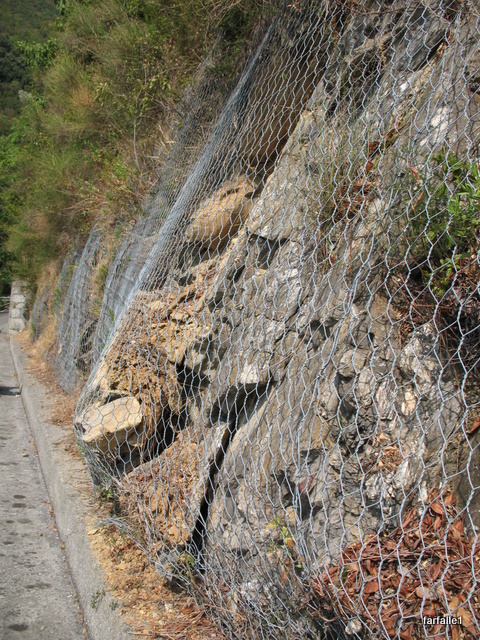
This bulging net is along the road that leads to San Maurizio di Monti, much of which is netted. There are frequent rock slides here; last January our neighbor Turi came out of his house one morning and found a whole hill in his driveway.
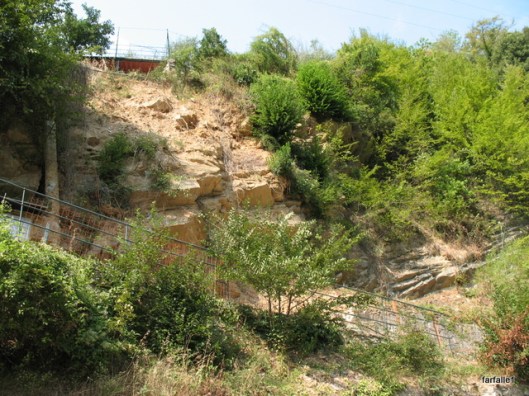
It’s all cleaned up now, but a friend who met him shortly after his discovery described him as grey and shaking – imagine if he’d been in his car on his drive when the side of the hill gave way!
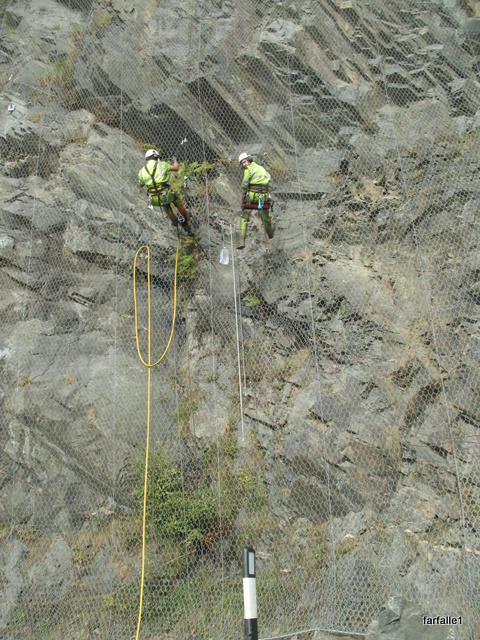
Several years ago we watched men installing nets on the rock cliffs above Punta Chiappa in Camogli. I didn’t have a camera with me then, but it looked pretty much like these men whom we saw in Scotland last week – a cross between rock climbing and web-weaving… not a job I would enjoy, that’s for sure.
These are the road signs that alert drivers to the danger of possible rock falls. I find them hopelessly confusing; there’s something about the positive/negative of the black and white that just doesn’t say ‘Cliff’ or ‘Falling Rocks’ ; to me they look more like ships in deep space or something from chemistry class, or perhaps a video game (I think it’s the hexagonal ‘rocks’ – they just aren’t that tidy in real life).

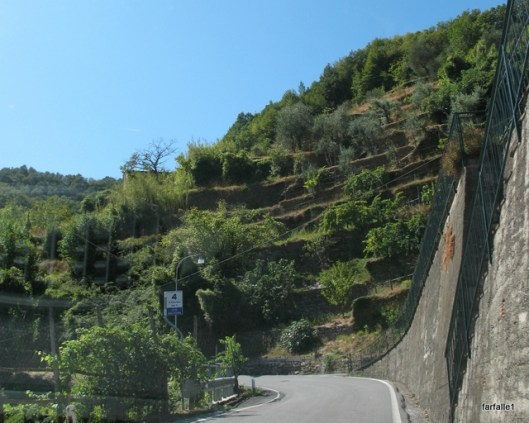
In addition to the nets there’s another thing that helps keep the hillsides well behaved: it’s all the terracing that’s been done. Those walls, built by hand over centuries, serve a purpose beyond giving people a bit of flat land on which to grow things – they actually help hold the ground in place, and in a place where the earth is always wanting to move, that’s a good thing.





 According to a 2006 article in the
 Another big difference between here and there is the number of cleaning products. (The French gentleman above lives in Italy, too. Here his name is Mastro Lindo.)
  In the States we used amonia in the water to wash the tile floors, window cleaner for the windows, and, if we were feeling really fancy, some kind of spray on the dust cloths. We also had special polish for the wooden furniture, which we polished once or twice a year. Here there is an endless parade of cleaning products, each aimed at a very specific task – one to clean porcelain basins, another to clean tile floors and walls, another to clean stone, another to clean wooden floors, polish for furniture, window cleaners, anti-calcium cleaners (liquid for topical use, powder to add to the clothes washer) – it’s quite confusing to know exactly what to get. (According to the Corriere article, when Unilever tried to market a one-cleaner-does-it-all product it was a complete flop.) In desperation I’ve begun to
  An Ex-Expatriate
