Tags
Chestnut mill, Chestnuts, Giovanni Pendola, Italian frantoio, Italian molino, N.S. della Cipressa, Old Italian mill, Olive mill, Wheat mill
Sometimes it happens in Italy that you’re walking down a street, a lane, or a path in the country, and you come upon something that sends you back, in your mind’s eye, a few hundred years. “I can just imagine,” you say to yourself, “what it would have been like to be alive when this place was new and bustling with life.”

It happened to me not long ago when I took a walk with a friend. We came to the old and interesting Complesso Molitorio (Mill complex), which lies on a sentiero (walking path) that connects San Maurizio di Monti to Rapallo along the San Francesco torrente (fast flowing stream), on the opposite side of the narrow valley from the paved road. The sentiero is not particularly well known, and does not appear on the trails map for this area. To reach it from San Maurizio you walk down what begins as an ever more narrow residential street, which finally turns itself into a path. From Rapallo the route begins on a paved street but soon takes the form of an old mule path which climbs and winds through the forest. According to the website lacipresse.it, the path is known as “Strada Antica di Monti,” a part of the “Antica Via del Sale” (The Old Salt Road – why there was a Salt Road here I have not been able to learn).
The Mill complex is comprised of four buildings, three of which you can see in the photo above. The large building in front was constructed in the 17th century and was an olive mill. A wheat mill was housed in the smaller building on the left; and the small building up above the others was a chestnut mill. The fourth building, not much more than a room really, is behind the large main building, and was used for collecting the refuse of the olive pressing.
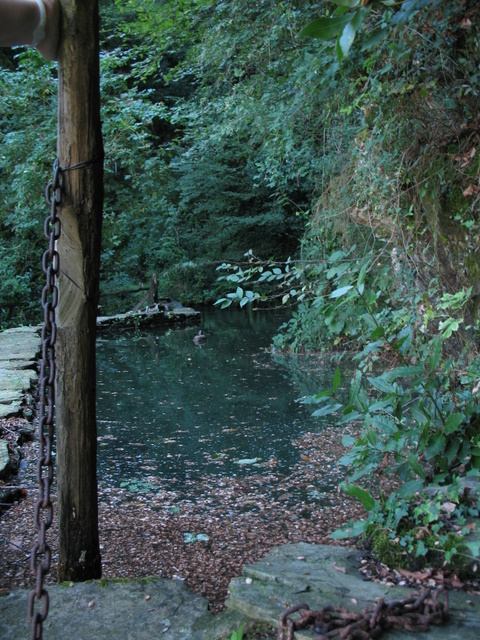
The San Francesco feeds a mill pond above the highest building:
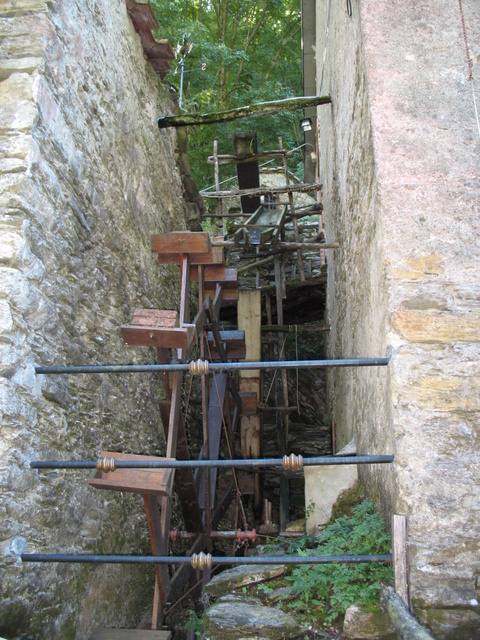
The water can be directed down an earth and stone canal to tumble into the waterwheels that powered the various milling operations:
The oldest structure in the complex is the old stone bridge that crosses the San Francesco, built in the Roman style, quite possibly during Roman days.
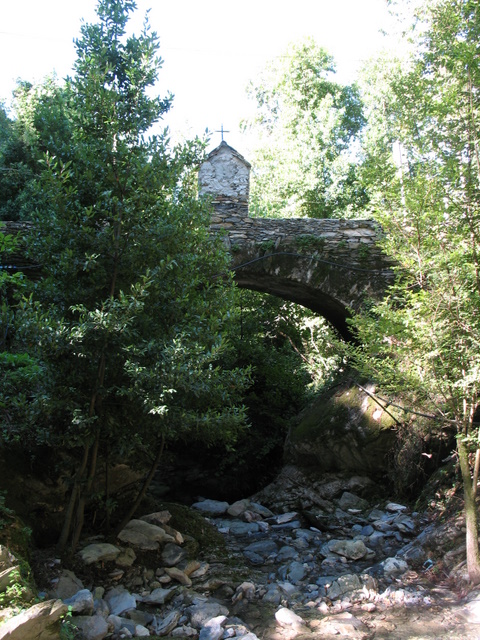
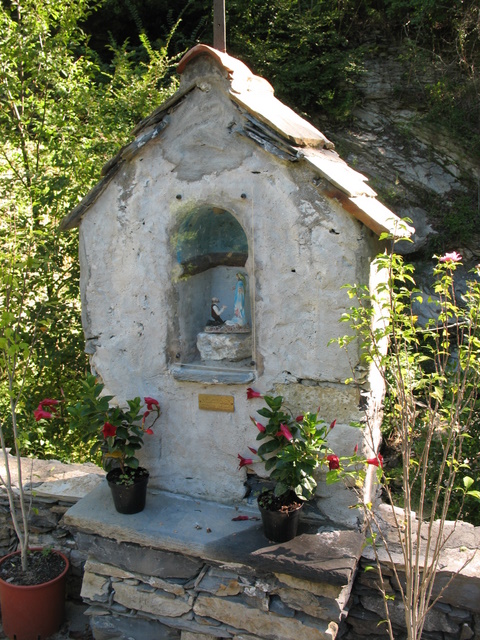
The little chapel on the bridge, a recent addition, honors the Madonna of Montallegro and is called Nostra Signora della Cipressa. According to the story, there was a chestnut tree that stood nearby. One day, during the plague years, the tree suddenly died – in just the one day! The belief is that the tree, through the intercession of the Madonna, absorbed the deadly disease and rendered it harmless, thereby saving the citizens of San Maurizio di Monti. (For more about the Madonna of Montallegro and the plague, see here).
There have been several re-structurings of various elements of the complex, including one in the early 18th century, one in the 1920’s, and another in the early years of this century . During the recent renovations the large building was turned into a museum, Il Museo della Civilta’ Contadina “Cap. G. Pendola” – the Museum of Rural Culture (named in honor of Giovanni Pendola, a heroic Captain in Garibaldi‘s Army). In it you will find old implements that farmers employed to wrest a livelihood from these steep hills, as well as accouterments of the mills themselves. It is open on the third Sunday of each month from 3 – 5 p.m., at which time a very well informed docent can explain the uses of the various tools, and tell about each of the buildings. (The renovations in 2001 won Second Prize in the 2003 Concorso “Ama il nostro paese” – love our country – sponsored by the City of Rapallo and the Rapallo Lions Club. In 2006 the Complex was designated a National Monument.)
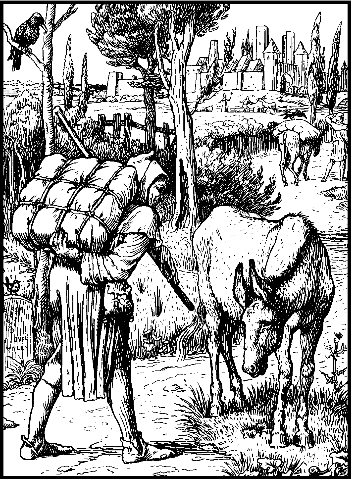
Some centuries before our mill, but I like the image!
Although the mill was still functioning as late as 1940, it is much more fun to imagine what it would have been like in, say, 1750. You’ve gathered all the chestnuts in your part of the woods, have dried them over a smoky fire and have thrashed them out of their husks.
Now you put them in barrels that are firmly strapped, one on each side, to your mule. Slowly and carefully the two of you make your way up the path, your mule finding a careful foothold between the upturned stones on the steep parts of the road. You hear the mill before you see it; the water is rushing down the canal and the big wheel is squeaking a little as it turns. When you get a little closer you can hear the big gears groaning and clicking as they engage. There are a lot of other people there with their chestnuts, too. Chestnut flour is a staple, and a good crop might form the basis of your family’s diet for much of the year. (For an interesting article on historical food uses of chestnuts, look here.) While at the mill you have a chance to exchange gossip with neighbors you haven’t seen for a while and to catch up on the news of the town below. After you’ve left your chestnuts to be ground into flour, you might continue up on the mountain to give thanks at Montallegro for a good harvest, and to ask the Madonna to protect you through the short winter ahead.
There’s another great story associated with the mills. The present owner’s grandfather, the Giovanni Pendola for whom the Museum is named, was the owner of the mill in 1907 when he went to Genova to take aid to the victims of a cholera epidemic there. He contracted the disease himself, and died soon afterwards. His true love, a lady named Caterina who was, they say, still beautiful, lost her will to leave her house when she received the news of his death. Then, taken by an irresistible urge for freedom, she became a wild creature of the woods.
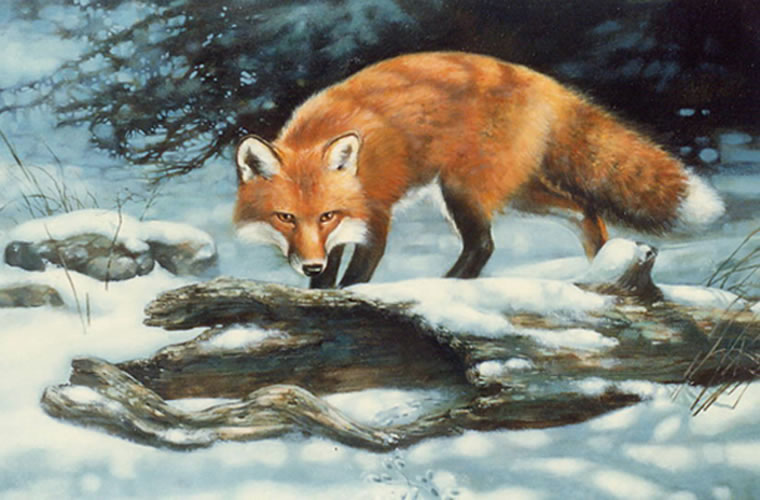
Painting by Patrick Soper, soperstudio.com
Still today, disguised as a fox with a soft tawny tail, she wanders during the coldest days, “those of winter when the cold north wind blows, or when windy gusts blow the last dry leaves, and the bare, rattling branches of trees reach to the sky like imploring arms.” The tradition says that if you meet this fox and look into her eyes, you may lose your memory or be swallowed up by the woods.
If you’d like to see some more pictures of the mill, click here. Click on ‘slideshow.’
Many thanks to the website lacipresse.it, from which I learned the content of this post.
 An Ex-Expatriate
i loved the chapel!!!!!!!!!!!!!! lovely!!!!!!
thanks…
Great post! It is so much fun to just wander around discovering new things.
I agree, Debra – and it’s amazing there’s still new stuff to discover every day, even on the same old walks!
I love that story of the lady fox. Living in 1750…not so sure about that. Going without indoor plumbing…! We are just so spoiled these days!!
Rowena, one of the pics I didn’t post was of the outdoor hole that evidently served as ‘plumbing’ back in the day. Ugh. Not so bad on a warm sunny day, but when it’s raining and 5 degrees? No thanks! Don’t you sometimes wonder if people will look back at us in 200 years and chuckle at how primitive we are/were?
I’d love to draw there.
It’s pretty picturesque, Pat – you’d make some great drawings, I’m sure.
It is the Salt Road because in the old times salt was made from sea water and taken inland on mulebacks on these roads. This actual road dates back from Roman times, linkink the Riviera to the interior.
Thank you, Agostino – I was so hoping someone would answer that for me. It seemed the logical explanation, but I didn’t realize salt was made here. I’ve seen the salt production in Sicily, but was there much captured here? Did they use the same evaporation process that is used in Sicily?
I don’t know about the process (probably the same as in Sicily), but where today there is the Rapallo harbor, there once was the mouth of the Boate river. This was probably a swamp (all of the lower part of Rapallo is said to have been a ReaPalus – an Evil Swamp). Anyway, in the historical center there is still the Saline Gate, looking at that area. Saline are the sea salt extraction plants (“salt evaporation pons”), as used in Sicily, and probably salt was extracted here and brought to the inner valleys. Hence the salt road. The Saline Gate survives, but nowadays it faces a road and a car parking.
I don’t know where the Saline Gate is! I will look for it (I know the Ezra Pound gate…) – thank you so much for telling me this, and for another piece of the Rapallo history. If I lived to be 1,000 I would never know it all. I have seen the salt extraction in Sicily – it is quite a huge operation there. I imagine it would have been on a smaller scale in Rapallo?
What a delight to walk the ancient path again with you . And this time to get inside! What fascinating things are in that museum space!
I completely agree with Daria’s comment about graceful nostalgia – I walked with you through this posting. How enriched my life has been by your tenure in Italy! Heartfelt thanks –
Thanks, Pidge. I never get tired of taking that particular walk into town. Some day I should try to do it in the Up direction – maybe I could find a mule somewhere?
Thankyou for sharing such an interesting walk with us.
You’re welcome! Thanks for coming along…
That’s just a wonderful thing. I envy you. Are you never tempted to buy it and convert it to live in?
You know life in Italy didn’t change very fast for the poor over all those centuries. Even into mid-20th century there were those who lived as if it were 1550.
Oh Judith, no! We’ve done one restoration here, and one construction in the US, and that might just be enough for us! It’s actually owned by the grandson of the man for whom the museum was named, the one who died in 1907. He (the grandpa) lived in the main building, but he may have been the last one to do so. After the initial restructuring there was an adorable 2-room B&B on the upstairs floor, but it seems maybe they don’t do that any more. They will prepare and serve dinner with advance booking.
Carine farfalle,
when I saw butterflies connected to expat content, I knew it was something for me. Briefly, I am a Croatian, ex-Italian language teacher, now TV journalist living temporarily in Arizona. Just starting to learn the art of blogging on my Arizona 4 Outsiders. It is my wish to make a site as friendly and nice like this one – simple and classy outlook with human touch between the lines, useful to expats and interesting to natives. Exactly as you give the real flavor of Italy to anyone who doesn’t know the country and a graceful touch of nostalgy to us who know and love it. Thank you for good moments.
Gosh, thank you! I’ve checked out your blog, and it’s excellent. There’s nothing as instructive as seeing your homeland through the eyes of visitors… I like that you don’t skip over the Big Issues (i.e., The Wall). I’ll be following your adventures in Phoenix.