Going to the bank in Italy is never a casual affair. For starters, you have to remember when your branch is open, and try to get there early so the line will not be too long. Typically the banks are open most of the morning and an hour or two in the afternoon. Drive through banking?
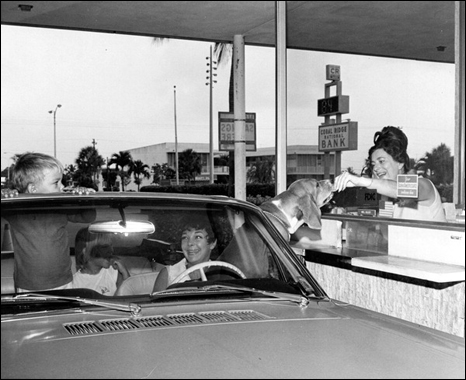 Not for you in Italy, and certainly not for your dog.
Though come to think of it, there is an element of drive-through banking that exists here. You know those plastic tubes that you put your transaction in if you’re at a drive-through bank bay away from the teller’s window? There’s some sort of pneumatic whoosh and the plastic tube is whisked away to the desk of the person who can take care of your business. A minute or two later it arrives back with another whoosh, containing your receipt. Well, when you want to enter many banks here you step into something that looks like a person-sized version of that plastic tube. One side of the tube slides open, you step into the tube, the open side closes, you stand there trying not to panic, and then, finally, the bank side of the tube opens and you are in the lobby. Phew! At least you don’t have to do the whooshing bits.
Once safely inside you take a number and wait your turn. With luck your wait will not be more than 5 or 10 minutes. You can do all the usual things at an Italian bank, it just takes longer. People don’t use checks in Italy as much as in the U.S. Frequently if you have a bill to pay you will go to the bank and pay what you owe directly into the other person’s account. Which of course means that if I owe you money, you will give me your account number. Why thank you! Many times bills come with a payment/deposit form (called a ‘bollo’) attached, which has the payee’s bank info and the amount owed already printed on it. Here’s what a blank one looks like (click on the image to see it in a more legible form):
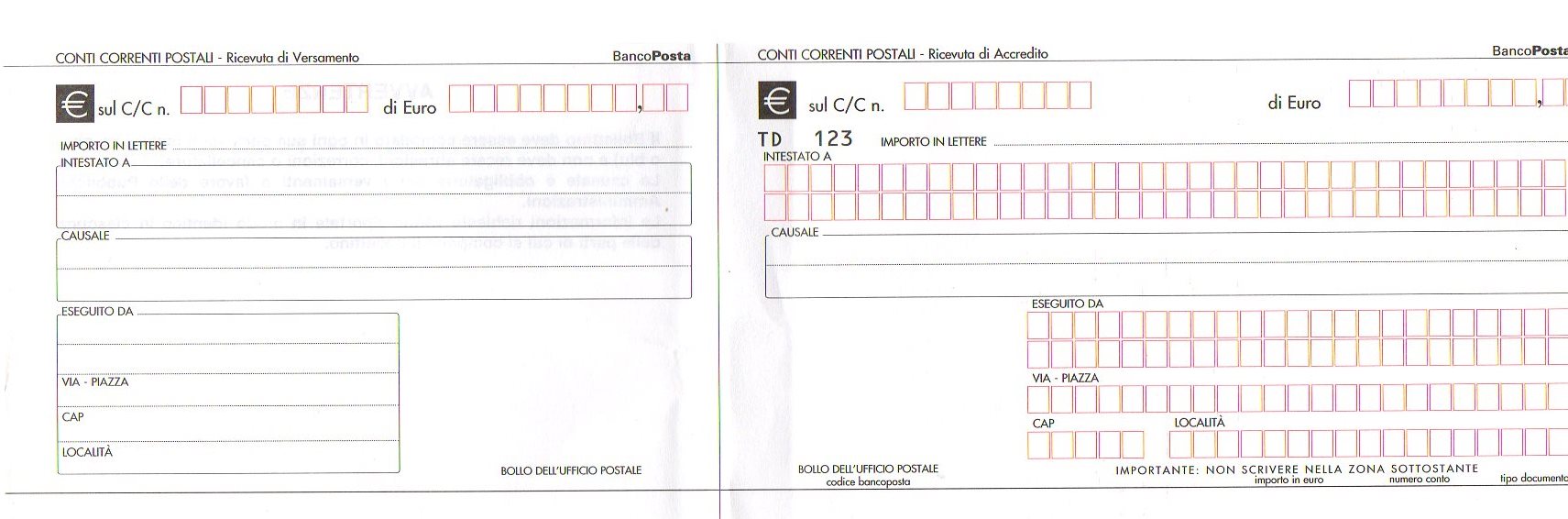 You or the bank employee fill in the right side, which includes payee’s bank account #, amount to be paid, reason for payment (!), name and address of payee. The part on the left is your receipt and proof of payment.
I watched a bank employee (let’s call him Carlo) dealing with a check the man in front of me had evidently deposited. First Carlo stamped the check. Then he ran it through some kind of scanning machine. Then he took his scissors and nipped one corner off the check. Then he paper-clipped it to a large form, signed the form and stamped it, and put it on top of his to-do pile. I was there to make a deposit in the checking account which is, mysteriously, in only my husband’s name. It led to this very amusing exchange:
Me: “I’d like to make a versamento (deposit) and this is my account number.”
Carlo: “Is your account in this bank?”
Me: “No, it’s in the Zoagli branch.”
Carlo. “Ah. Zoagli.” big sigh.
Me: “Is there a problem?”
Carlo, haltingly: “No, no…” followed by much tapping at his keyboard. A long pause. “Captain Captain is the name on the account?”
Me, delighted: “Yes! That’s the account.”
very long pause
Carlo: “The address is That Wee Village Road, #27?”
Me: “That’s right.” longer pause, worried (both of us).
Carlo: “This account has a masculine name; you are a woman.”
Me: seeing the light (and rather glad he noticed): “Ah yes… that is my husband’s account.”
Carlo, in great relief: “Good, good, alright then. Your husband. You are the wife.” Paper in machine, tap-tap-tap, paper out, my signature, his signature, stamp, stamp.
Success!
Here are some of the quirky (to us) things about Italian banks. 1) Various branches of the same bank are not necessarily connected to each other electronically. They are always happier if you do your banking in your particular branch. 2) Should you write a check to someone, it is not returned to you canceled after it has been cashed. Nor is it returned to your bank. It stays in whichever bank your payee deposited it. Which means if you need to capture proof that you’ve paid someone, you need to know where he stashed the loot. 3) A mortgage is readily available, especially if you can prove that you already have the money to pay it all back. 4) The Post Office is also a bank, and judging from what we see in the lobby, it does more business with banking than with mail. But you can’t buy a stamp at your bank. 5) Sometimes other agencies serve as banks – for instance, we pay our vehicle insurance and tax bills at the Automobile Club of Italy. 6) Sometimes one bank will be an agent for a particular vender, so you can pay your bill at that bank for no charge or a small charge, whereas paying it at a different bank will carry a larger charge.
But for all their quirks, and for all the waiting and complications and charges, we have always found the people who work in the banks to be invariably patient and helpful. We are not always good at explaining what we want, and we frequently don’t know the correct words, but the bank employees work with us for as long as it takes to make us satisfied customers. And not just for us foreigners; they are courteous and helpful to everyone. I expect that is part of what makes for the long waits…
 An Ex-Expatriate
To supplement the comment by Anonymous: The wealth and profit of the banks in Italy have, in my estimation, a pernicious effect in keeping Italian business practices far behind the times and, thus, a very dampening effect on economic growth. With all customer charges set by the government, competition does not exist. And with bank profits, rather than economic vigor, the goal (though it is but a short-sighted one) there is no need for competition. If the goals were economic advancement and stimulation of an economy that is close to if not in recession, then the approach would change. I suppose that it will change some day but, like all practices here that involve a government that has been evolving its regulatory involvement in the economy for 2000 years, it will be very slow indeed.
I didn’t realize the customer charges were set by the government. Knowing what we know about ‘the government’ is it any surprise the charges are high? I guess that makes the government and the banks c-c?
Oh my god. I don’t even want to THINK about banking in Italy. I have enough trouble with the post office! And I find that fact that you can’t bring your purse with you into the branch crazy! Maybe I will be brave enough to try again soon, but my elementary Italian just doesn’t cut it when I’m trying to bring the right paperwork and forms.
We had so much help when we started, Natalie; it made all the difference. And you make a great point – I forgot to mention the part about having to leave your purse in a locker before entering – though I’ve seen plenty of women ignore that command and be admitted anyway.
Italian banks are the most profitable in Europe because of all the niggling charges and protection from potential foreign bank competition. Their customers don’t know any different so don’t complain.
Well, we’ve noticed the charges and don’t much like them… but also don’t know what we could do about it. I bet they’re also profitable because they are awfully careful about lending…
well said and sad but true .. I had a girlfriend once who lived in London and she was visiting me in NC … she was quite surprised by the drive thru ATM and bank.. needless to say that 45 mile drive each way to Bank of America is made a lot easier knowing I can go at any time day or night
We are spoiled in the US with the ease of banking… although a 45-mile drive isn’t easy. Are you living on a farm far, far from civilization?
No I recently moved to Ohio and apparently there is no Bank of America in Ohio
That is really, really inconvenient for you…