What we’ve been regarding as an A-#1 headache this week turns out to be a bicycle race with an impressive pedigree. As Wikipedia succinctly puts it:
The origins of the Giro are similar to those of the Tour de France, a competition between two newspapers: La Gazzetta dello Sport and Corriere della Sera. La Gazzetta wished to boost its circulation by holding a professional road race based upon the Tour de France and similar to the Corriere della Sera-organized car rally. On August 7th, 1908 the newspaper’s founder Eugenio Camillo Costamagna, director Armando Cougnet and its editor Tullio Morgagni announced the inaugural Giro d’Italia to be held in 1909.
On May 13th, 1909 at 02:53 am 127 riders started the first Giro d’Italia from Loreto Place in Milan. The race was split into eight stages covering 2448 kilometres, 49 riders finished with Italian Luigi Ganna winning the inaugural event having won three individual stages and the General Classification. Ganna received 5325 Lira as a winner’s prize with all riders in the classification receiving 300 lira (at the time the Giro’s director received 150 lira a month salary).

Luigi Ganna
The race has continued, with interruptions for wars, ever since and has, like so many sporting events, become ever bigger and more commercialized. Wikipedia gives an exhaustive account of the race, its various elements and many of its winners here. Two of the three cyclists with the most wins (5) are Italians Alfredo Bindi and Fausto Coppi.
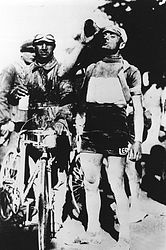
Alfredo Bindi
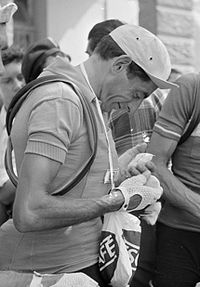
Fausto Coppi
Belgian Eddie Merckx also won five races.
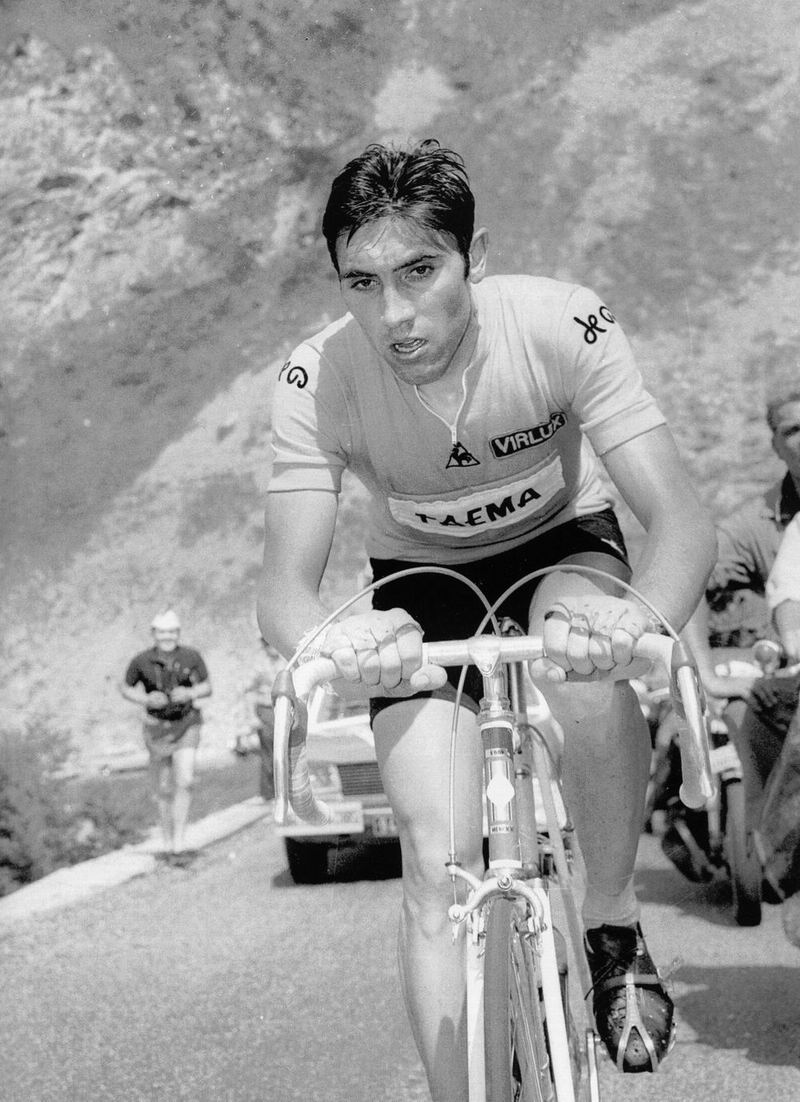
Eddy Merckx
The Giro d’Italia is one of the three jewels in the crown of the overseeing agency, the UCI (Union Cycliste Internationale). The other two are the Tour de France (est. 1903) and the Vuelta a Espana (est. 1935). These three races comprise the Grand Tour of professional bike-racing. (The UCI season consists of twenty-seven races held world-wide over a ten-month period.) Until 1960 The Italian race began and ended in Milano, the home of the Gazetto dello Sport; since then the city of departure has varied annually. For a while the finish city also changed, but since 1990 it has, again, been Milano. Since 1965 there have been nine starts outside Italy, and in 2012 the race will begin in Denmark.
So it’s a very big deal that the Giro is not only passing through Rapallo, but actually stopping here overnight, and then passing through again tomorrow on a route from Genova Quarto to Livorno. Most of the downtown of Rapallo was closed to traffic in the afternoon and will be again tomorrow.
And this is where the A#1 headache comes in. We’ve been unable to find any definitive announcement of which roads are closed during which hours. The Captain had an errand in Sestri Levante, about forty minutes to the south on the coast road, the Via Aurelia. When he went into town this morning he asked a policeman if he’d be able to get through and out of town mid-afternoon. “No Problem!” was the reply. Unfortunately when he set out he found the road was closed, so he couldn’t go. The Aurelia was also closed where it enters town, as was the other road that connects Santa Margherita and Rapallo. Bleachers have been erected, and no doubt there’s been no end of festivities, speech-making and shirt-presenting. But anyone who wants to get anywhere that involves traversing Rapallo is pretty much out of luck. And because so many streets have been closed and cleared of all parked vehicles, there is no where to park even a scooter. It is, to say the least, inconvenient. BUT, it is a very big deal, kind of like having the Super Bowl or the World Series or the World Cup in your home stadium. So we shouldn’t complain… well, maybe just a little.
This edition of the Giro has been described as one of the most difficult in many years. In honor of the 150th anniversary of Italy’s Unification the route encompasses the whole boot:
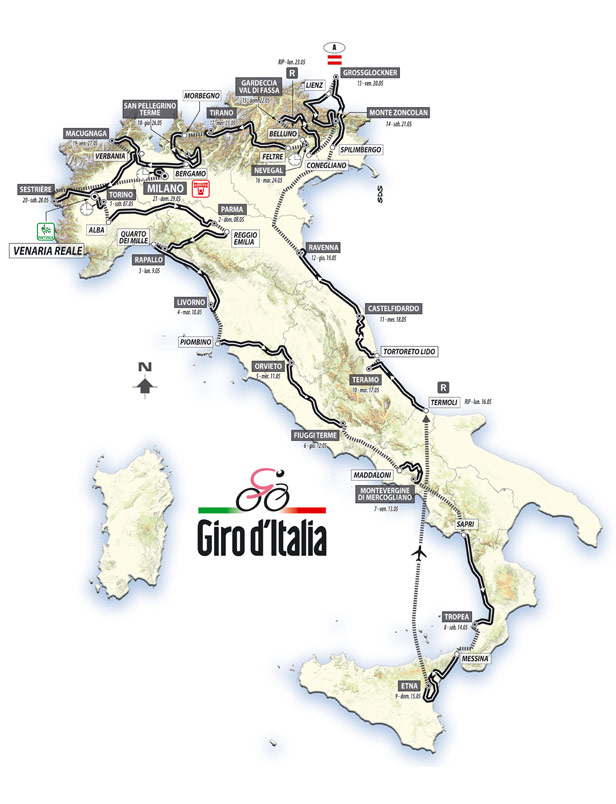
Note there is even a jog to Sicily, where the cyclists will bike up Mount Etna. The entire route covers 3,524.5 km (2190 miles) in 21 stages, which range individually in distance from 12.7 km. to 244 km. The normal day appears to be in the neighborhood of 200 km. I can’t imagine. Twenty-three teams left Torino on the 7th of May, and presumably all twenty-three will finish in Milano on May 29.
Not only can I not imagine pedaling two hundred plus km in one day, I can’t imagine the kind of planning that has to go into carrying off an event that involves so many people moving over such a great distance over so many days. As disorganized as Italy sometimes seems, it takes logistical genius to carry off this race, road closures, grand-stands, publicity and all.
So we wish them well, and, to be honest, we wish them well on their way. It’s great they came to Rapallo, and it will be great to be able to drive out of town again.
For some lovely photos of Stages One and Two of the race, click here.
Addendum: It’s a terribly dangerous sport. Five to ten racers die in race-related accidents every decade, according to Wikipedia. Sadly, the list of names grew by one yesterday when Belgium’s Wouter Weylandt died of a skull fracture coming down the hill into Chiavari. There is an account of the incident here. So, no – there was no merriment in Rapallo last night and the podium ceremony was cancelled. I suppose these young men know the risks when they undertake the sport, but surely each of them believes a deadly accident could never happen to him. It’s seems such a terrible waste of a young life. Expatriate joins all the others who are greatly saddened by this death, and whose hearts go out to the victim’s family.
 An Ex-Expatriate
The famous Giro d`Italia it is a fun sport very popular indeed in Italy! It can be also challenging involving : pure endurance but you get to socialize with your team which makes it even more interesting and seethe cities as you pass them by ! It actually started (before it became fomal with the competition between the 2 Italian magazines) informally in small Italian country sides where children to pass their time used to race with each other until it became later on in the years to come the famous : Giro d`Italia!
We see so many cyclists on the road where we live – it’s clear it’s a huge sport here. I hadn’t thought of the socializing aspect amongst team members, but it makes sense. Wouldn’t it have been fun to see one of those early races in the countryside??!
We saw them in our home town the next day and the mood was very somber. Cycling is almost as big as soccer here and these guys are absolute heroes. I once cycled 210 km in one day (on an old, 3 gear Holland bicycle with full camping gear and tools loaded on the back) so have an idea what it means to cycle this sort of distance. Doing it one day is hard enough, but doing it day in, day out is amazing.
You’re an iron man, Heiko! 210 km?! On a 3-speed???!!! I’m impressed. I once cycled about 30 km with 12 gears and no gear and thought I would die. They are incredible athletes for sure. I think I read somewhere that Lance Armstrong’s heart is about twice the size of that of an average adult male… all that pumping.
I was much younger than I am now… and the route was best described as mildly undulating…
Still… I am impressed!
So you’re back in Italy? I hope to see you around town sometime 🙂
Chelsea
We got back a week ago. It’s been non-stop work getting things back in shape – grass 3′ tall, weeds everyway, blah blah. But what weather we’ve been having – it’s been perfect! Shall we meet for a cafe? gelatto?
Gosh – I wasn’t aware that those bikers crashed into one another – it sounds a bit like Nascar! I hope the remainder of the race progresses safely – and that Italy wins!! (compensation for all those road closures…)
Oh it’s so sad, Pidge. I hate it when athletes die – it seems so pointless somehow. Further proof, if we needed it, that bike riding can be dangerous. Somehow in light of Weylandt’s death the road closures seem immaterial. And yes – Viva Italia!
Is Eddie the Belgian rider who died during the race? It can be a dangerous sport. We would like to watch part of the race, but the traffic would be too much of a headache. We were ar Forte dei Marmi on the weekend and saw the road closure signs.
No, Eddie Merckx won his races in the 1970’s (in addition to his Giro victories, he won the Tour de France 5 times and the Vuelta a Espana once).
It’s a sad event this year for Giro d’italia. Belgian cyclist Wouter Weylandt died in a crash during the third stage yesterday.
Thank you for alerting me, Jennifer; I’ve put an addendum on the blog post. It’s so sad for all concerned.