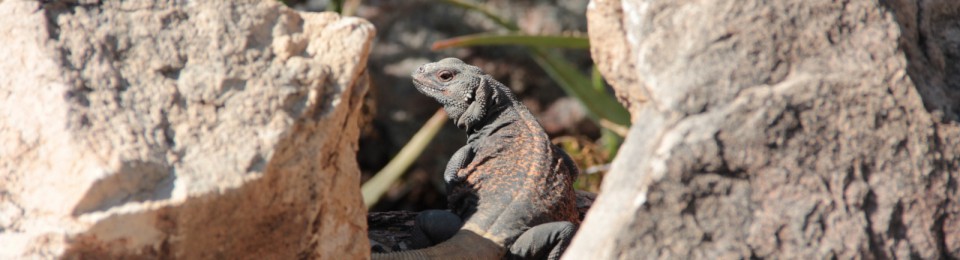
No, the Captain still has my heart. But just recently the fruit of the Passion Fruit made my taste buds sit up and say Howdy. How did I live this long without eating this delectable item?

Angela and I were exploring some of the back regions of Chiavari when we came upon the vine pictured above. From a distance I thought it was a strange looking kumquat with particularly large fruit; but when we got closer and saw the flowers that were also on the vine I knew right away what it was, even though I’d never seen the fruit before.
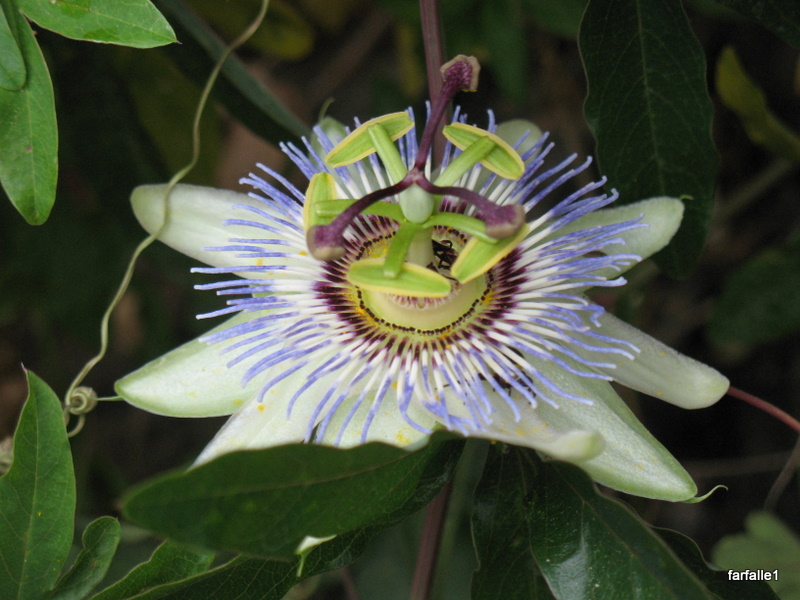
There’s no confusing this flower with any other in the world! It looks like a cross between a spaceship and a freshman beanie; why ever did it evolve in such a peculiar manner? No doubt there are good reasons for all its elements, but if there ever were a committee-designed flower, this is it. I can even imagine the committee.
Goddess 1, chair of the committee: We need a new flower.
Goddess 2: Let’s keep it simple, just some nice creamy petals.
Goddess 1: A good plan.
Goddess 3: I’m from Hawaii, I’d like to give it a hint of grass skirt.
Goddess 1: Well okay, we’ll put that on top of the petals. A’ole pilikia!
Goddess 4: I’m completely crazy, I want to add some green whirly-gigs with yellow pads. Have I told you about the time aliens abducted me?? They told me to add the whirly-gigs so they can communicate with me.
Goddess 1, in an aside: Girls, she is totally nuts, we’d better humor her. Aloud: of course we’ll add whirly-gigs. Live long and prosper.
Goddess 1, again: Uh oh. We’ve left out the most important part! We’ve left off the anther. How are we going to get bees without anthers? We’ve got to have anthers. We’ll put them on top of everything, that way our flower’s sure to be pollinated.
Well that’s one way it could’ve happened I suppose, though I’m not sure Mr. Darwin would approve.
I first met the flowers of the Passion Fruit about ten years ago, rampaging along the fence of the house we were renting at the time. A gardening friend later told me, “Don’t plant that.” Evidently it is one of the thugs of the plant world, cheerfully twining around, strangling and generally taking over anything in its path. And for some reason I haven’t seen or thought of it from that day to the day Angela and I encountered the very healthy vine in Chiavari.
Had I eaten the fruit ten years ago I surely would have found a spot in our garden for this treasure to run amok. What a treat! Sweet, succulent, juicy… why have I never seen it for sale in the markets?
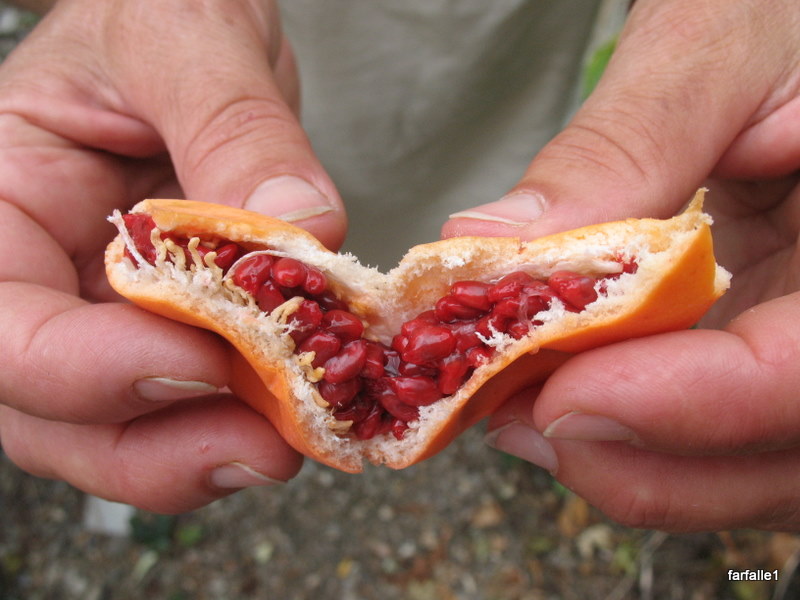 Yes, it’s seedy – it’s pretty much nothing but seeds inside (guess those anthers really do the job well), but the seeds are a pleasure to eat. They’re not particularly hard or crunchy or unpleasant, the way pomegranate seeds are. They’re just delicious; it’s the only way I can think to describe them.
Passion Fruit is native to Brazil, where it grows in a purple-skinned variety. There seems to be some question about where the orange/yellow variety originated. It’s a much-used fruit in Australia, New Zealand and Hawaii, among other places, and is a good source of vitamins A and C, and, if you eat the seeds, an excellent source of dietary fiber.
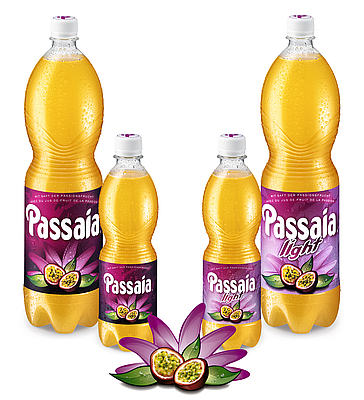
Image courtesy of Passaia
The juice is frequently extracted and used to flavor other juices and sauces. If you’ve drunk a soft-drink called Passaia in Switzerland, you’ve drunk Passion Fruit juice. Unfortunately the flavor of the juice degrades with heating, though it keeps well in a frozen form.
About its thuggish character? All too true! It can grow fifteen to twenty feet in one year; though it is a short lived perennial (only five to seven years), it can cover quite a bit of territory in that time. (Let’s see, 17 X 7 = 119 feet, that is a lot… maybe that’s why I don’t see much of it in Italian terrace gardens.) You can learn more about Passion Fruit varieties, propagation and cultivation here if you’re inclined to try growing some yourself. Me? I think I’ll just go back to the vine in Chiavari when I get a hankering for that yummy taste – there was no shortage of fruit on those vines.
 An Ex-Expatriate
I have just discovered i have this sort of fruit in my front yard in Port stephens Australia
Lol, this is a great post. I’m Australian and we eat passionfruit all the time, but it is most commonly the kind with purple skin and yellow flesh.
I was ecstatic to discover this orange skinned variety with bright red pulp you picture in your story. The flesh is sweeter than the purple kind, with none of the acid. I’ve set about trying to find more about it and discovered your post. Thank you kindly. It was most amusing. I especially like your description of the passion flower. I agree entirely with the goddess’ discussion, and your summation of Darwin’s concerns. Keep up the good work.
Thank you Susan! I didn’t know about the purple skinned, yellow-fleshed variety – must look it up. Wouldn’t mind visiting Australia and NZ one day either. Thanks for dropping by…
My pleasure! We’d love to have you down under!
I have some of these in my front yard. I was expecting a purple variety but i got these instead lol
Greetings; I planted a clipping from my husbands Auntie ten years ago and now it is all over the yard. I understand it is called passion because the flower resembles the crown of Christ and the passion for us from Father God to give his only Son for our sins.
I have eaten the fruit fresh but would like to find some way to preserve it. Any ideas?
I’ve never eaten one myself, but here’s a site that might get you started cooking with yours: http://australianfood.about.com/od/discoveraussienzfood/tp/Top10PassionfruitRecipes.htm
Buon Appetito!
And here are a bunch of links to methods for preserving the fruit: https://www.google.com/search?q=how+to+preserve+passion+fruit&oq=how+to+preserve+passion+fruit&aqs=chrome..69i57j0l3j69i64l2.3716j0&sourceid=chrome&ie=UTF-8
Thanks for educating me about an ingestible I’ve never tried! I want to meet Goddess 4, especially if she’s got a basket of passion fruit with her…
You’re welcome!
What fun! And now I am entirely curious to taste passion fruit. Do you suppose it got its name because eating it arouses the passions – or because the flower articulates its sexuality so openly? Whatever – I thoroughly enjoyed your goddesses!
Pidge
Good question – I have no idea where the name came from. I didn’t feel any, well, *different* after eating a few, so maybe it is the flowers. Or just its rampant character. Or… ?
John and I are chuckling here in Vermont!! Go goddesses!
Gawd I hate committee work!
That’s one strange looking passionfruit. We have the purple variety here in Australia as well as a mottled greenish skinned one. There is much more juice in ours than the one you show. The flavour is mostly in the juice. The seeds don’t have much flavour at all. In fact it drives me nuts when my husband crunches them every morning when he eats his passionfruit yoghurt. The fruit is very popular in Australia, where it is used on all kinds of sweet desserts including pavlova. The flowers are amazing. There is also a red flowering passionfruit vine that doesn;t get fruit, but is very beautiful. Happy passionfruit eating!
Hmmm. Well I wonder if these yellowy ones just grow without much juice, or if we found old fruit or…? I don’t know! It sure has a great flavor; I can only think that juicier would be even better.
Never laughed outloud so heartily in a long time! Those goddesses!
In case you don’t want to go all the way to Chiavari, lots of orange eggs trailing on my fences!
Oh I’m glad it gave you a chuckle – I so enjoyed that part of our outing. Am now trying to find out more about castle history for another chapter. Thank you!