Tags
Autostrada, Italian Autostrada, Radar Speed Control in Italy, Speed control in Italy, Speed limits in Italy, Speeding in Italy, Tutor
 Some years ago speed limits came to the Italian Autostrada system, as they have to most major European highways (even most of the Autobahn!). While this makes some people, the Captain amongst them, sad, it has proved not to be such a bad thing after all. The limit on the Autostrada, unless otherwise noted, is 130 kmh, or 80.77 mph, which is not exactly crawling.
But leave it to Italy to monitor speed in a slightly different way. Rather than waste endless fuel and manpower by putting police cruisers with radar and officers in chase vehicles on the roads, the Autostrada has installed a speed monitoring system called Tutor (because it’s supposed to teach you to slow down). It doesn’t actually measure your speed at a given point, though. What it does is measure how long it takes you to get from one Tutor camera to another, some distance down the road. Stop for a cup of coffee between the two cameras and you can go as fast as you like while on the highway! What a concept. Of course if you don’t want to stop, then you have to drive at a speed that averages out to the limit or just slightly over. But still, that leaves some room for testing the capabilities of your new Ferrari or blowing the cobwebs out of your original Fiat 500.
It’s all done through a sophisticated camera -> computer -> camera -> police computer system, which is explained (in English) on this web site. If I understand it correctly. your car’s tags are photographed by camera 1, and stored in the server; they are then matched up with another photograph taken by camera 2, and the server figures out your average speed. If it’s too high, you’ll receive a highly unpleasant piece of mail from the Road Police.
I’m making fun of this a little, but the system has proved to be effective. The Tutor brochure, thoughtfully provided by the Autostrada, has a compelling graph that shows a death rate in 1999 of 1.14 (per thousand? per km of total Autostrada? not noted on the graph, alas), which was reduced in 2009 to .32. That’s a handsome 72% decline. Roads in general went from 1.38 deaths to .83 – a not nearly so impressive 40% (but it’s all good). In fairness it has to be said, too, that cars themselves are much safer now than in 1999.
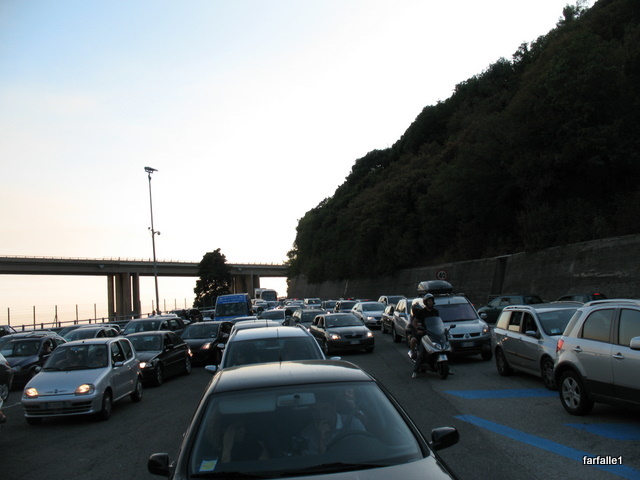 As the above photo of stalled traffic on the A10 suggests, the Autostrada system gets a lot of use: 4 million people a day travel on the system; in 2008, 915 million vehicles used the roads. Anyone who has ever driven on the Autostrada on any day other than Sunday will not be surprised to learn that trucks account for 19% of the vehicles and 24% of the kilometers traveled on the system (2008). 45% of the fatal accidents involve a truck.
Does it surprise you to hear that Italy has fewer road fatalities per 100,000 population (8.7) than the U.S. (12.3)? Or, if you prefer, 12 fatalities per 100,000 vehicles in Italy compared to 15 per 100,000 in the U.S. It actually didn’t surprise me. After living and driving in both countries I will take crazy Italian drivers over crazy U.S. drivers any day. Italians drive fast, often, but they drive well, and while they may seem aggressive at times, it is usually a sporting sort of aggression (‘Let’s race! Isn’t this fun?’) rather than an angry aggression (‘Get out of my lane! I hate you!’).
What I have noticed more than anything here in Italy is a shared concern for safety; if someone stops on the side of the road he will follow the rules that require putting on a reflective vest and setting up a reflective warning triangle. If there is damage on the road a warning sign is quickly put up. One time the Captain and I drove back from Ikea with an oversize load sticking out the back of our car – we didn’t flag it correctly, and another motorist had something to say about that. We snuck home with our tails between our legs (we didn’t know the rule at that time). There is a sense of cooperation in road matters that I never feel in the U.S. Here we have not ‘my’ lane and ‘your’ lane – rather we have ‘our’ road, and if one of us needs a bit of the other’s lane, well, that’s okay. I’ll move over for you happily without getting all territorial about it. I think in the U.S. we’re a bit more protective of ‘our’ space – maybe because we have so much more of it and can afford to be.
And speaking of sporting… the Autostrada, in its philosophy of full disclosure, wants you to know where the Tutor cameras are. Warning signs alert you when you pass one. And if you want to plan your coffee breaks to maximize your speed thrills on your journey, check out this site for a map of Tutor cameras before you leave home.
Buon viaggio!
Tutor map: http://www.autostrade.it/en/assistenza-al-traffico/tutor.html?initPosAra=3_4
 An Ex-Expatriate
Yes these italians have the art of driving down pat. I like watching how the MotH gets up close and starts flicking his lights if the car ahead is moving too slow. He may not say something but I know what he’s thinking….In the name of God, Italy and Europe GO!
Oh no! You’ve married a flicker! As a person ‘of a certain age’ I’m often the one being flicked at. There’s something in the Italian male psyche that says, ‘no one may be in front of me’ I think. For all of that I think there are a lot of good drivers here. Watching someone thread between two obstacles with, perhaps, 20 cm on either side of his vehicle just leaves me in awe.
Tell the Captain that Pete has a sporty, fast Aprilia. If you get back to New England, he’ll give him a ride worthy of a Formula 1 race. He’s just been admitted to the CT Bar, and since lawyer jobs disappeared while he was studying to be one, there’s plenty of time for cycling. Cheers.
I’ll pass the message on for sure. An Aprillia – lucky man. Even that, I fear, will not be enough to get the Captain back to New England, though. What a pity about the lawyer jobs – maybe you could reverse the Captain’s order of work and now become an airline pilot? Cheers back atcha’.
Would let him wear the red, white, and black leather racing jacket, and he is owed a ride. Doing enough legal work to keep busy and learn the ropes, not sure flying is an option, will hold out and see what the economy does.
Tempting for the ride, but… Glad there’s enough work to keep you engaged and learning. Still recommend flying.
I learned from a newspaper article that the leading cause of fatal autostrada accidents is the all-too-frequent lane reduction. Thus I stopped trying to get ahead of that slow truck before the road was reduced to one lane. There’s always another truck anyway.
I didn’t know that, but it’s certainly easy to believe. And you’re right about the trucks – so many!
I find driving at high speed anywhere to be terrifying! So the more skilled the driver is, the better for us all. Let’s hear it for the skilled Italians!
I agree with you about Italian drivers, they drive too fast and take too many risks, but mostly they are very skillful drivers and handle their cars as though they were born driving. We also found Spanish drivers extremely well behaved, something that surprised us a lot.
I find the Italian drivers to be of two personalities – one type follow all the rules and are very considerate; the other type doesn’t want anyone in front of him, ever. But I agree with you, they are all skillful. I found it much more difficult to get a license here than in the U.S. – maybe Italians are just better educated about driving.
When I was in Spain recently, I tackled a pedestrian crossing as we would here in Italy; you know, as long as the pedestrian is not directly in front of you car it is still ok to carry on driving. Well, I got a very shouty dressing down from an unimpressed Spaniard. Most surprising, as when I left Spain in 2003 I felt sure I would never find a country where the driving standard was worse! Italy has proved me wrong!
Citizen Police, they’re everywhere! Always ready to yell at us. Bah. I wouldn’t have guessed driving in Spain to be particularly orderly…