
Tags
Bird-feeding, Feeding Birds, Hunting in Italy, Hunting songbirds in Italy, Illegal hunting in Italy, Trapping songbirds in Italy
Somehow it’s hard to think of chickens and turkeys as birds. Sure, they have feathers, but we never see a flock of them high overhead, migrating south for the winter, their clucking stirring our own restlessness. Nor do we startle them when we take a walk in the woods. We don’t listen for their sweet morning calls and try to identify exactly what chicken it is we’re hearing. Wait! Is that a Rhode Island Red or an Ameraucana? Hand me my binoculars!
No. Chickens and turkeys are ambulatory food for the most part.
Songbirds, however, are not. One of the pleasures of being here in Arizona is watching the birds that come to our feeder every day.
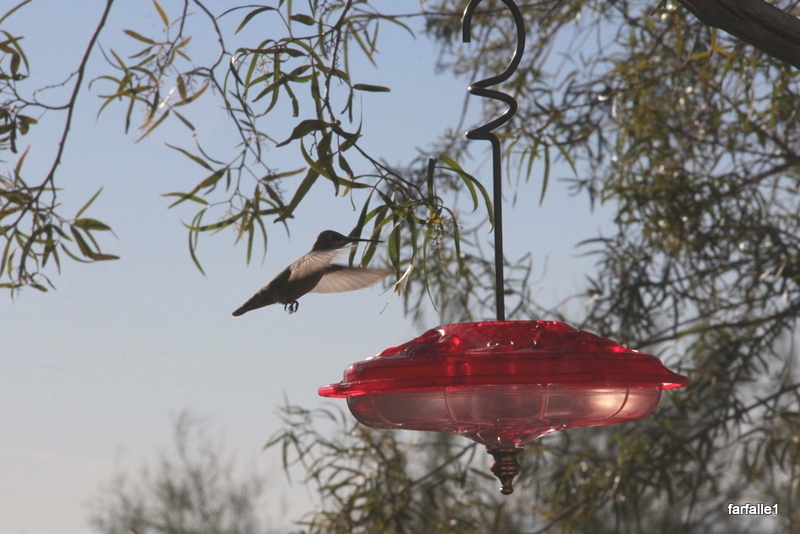
Anna's hummingbird, noisy and aggressive
We don’t get anything terribly exotic (and we have yet to see a chicken) – many purple finches, the ubiquitous Anna’s hummingbird, Abert’s towhee , Gila peckers, Cactus wrens, and, on the ground below, Inca doves and the amusing Gambel’s quail, which makes a bweep-bweeping sound, reminiscent of burbling water, while it wanders around beneath the feeder.
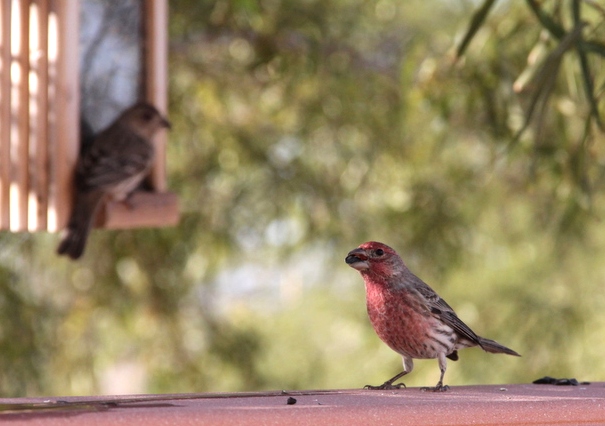
Male finch enjoying a seed while female thinks about it
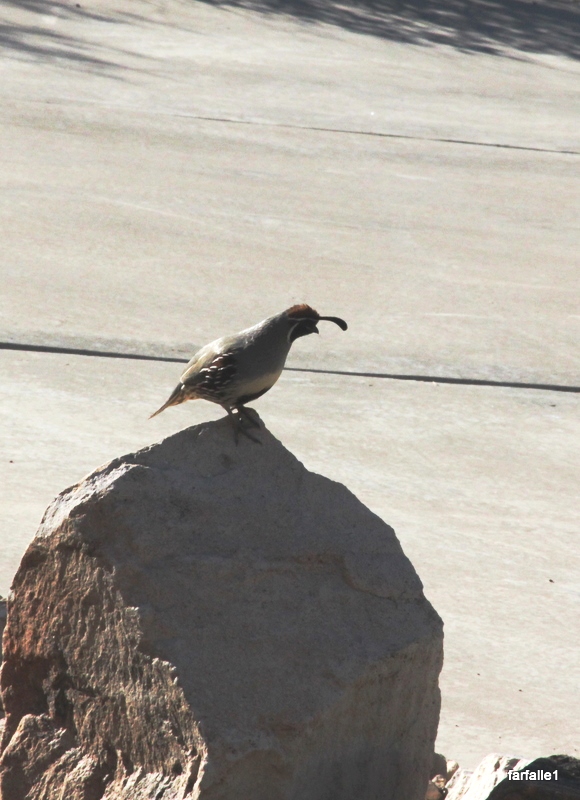
Gambel's quail, males conveniently carry bulls eye on their breasts
It’s a pleasure we don’t enjoy in Italy. Not because there are no songbirds – there are. We get huge amusement and satisfaction from the merli (a sort of black robin with the unfortunate Latin name Turdus merula, called ‘merlo’ in the singular) which are curious and companionable, and which have the beautiful song typical to thrushes. We seldom work outside in spring or summer without an appreciative audience of merli. But bird-feeding as a hobby does not seem to exist in Italy, at least not in our part of the country. I have never seen a bird-feeder at anyone’s house, and I have never seen bird feed for sale.
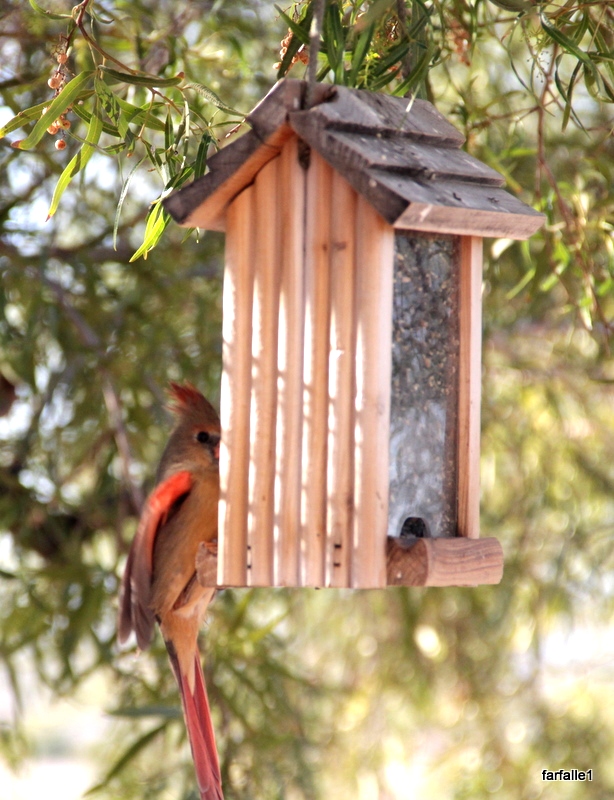
Male cardinal
Instead in Italy there is a sizable, though fortunately shrinking, trade in trapping and killing wild birds. The CABS (Committee Against Bird Slaughter) web site has a great deal of information about the illegal trapping of birds which occurs, in Italy, mostly in the north (Lombardia), the southern Italian coast, Sardinia and Sicily. There are a couple of good reasons why this illicit activity continues. One is that it is a matter of long tradition to trap songbirds, and Italy is nothing if not wed to her traditions. In earlier times songbirds were an important source of protein for hungry Italians. Another reason is that some restaurants persist in serving songbirds, though you will never see them on the menu.
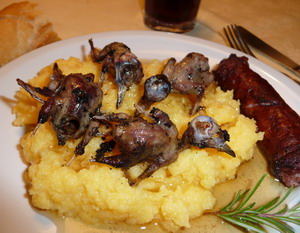
Little birds with polenta, photo courtesy of CABS
Happily, CABS reports that hunting songbirds is truly on the wane in northern Italy, a trend we can only hope (or I can only hope, anyway) will continue.
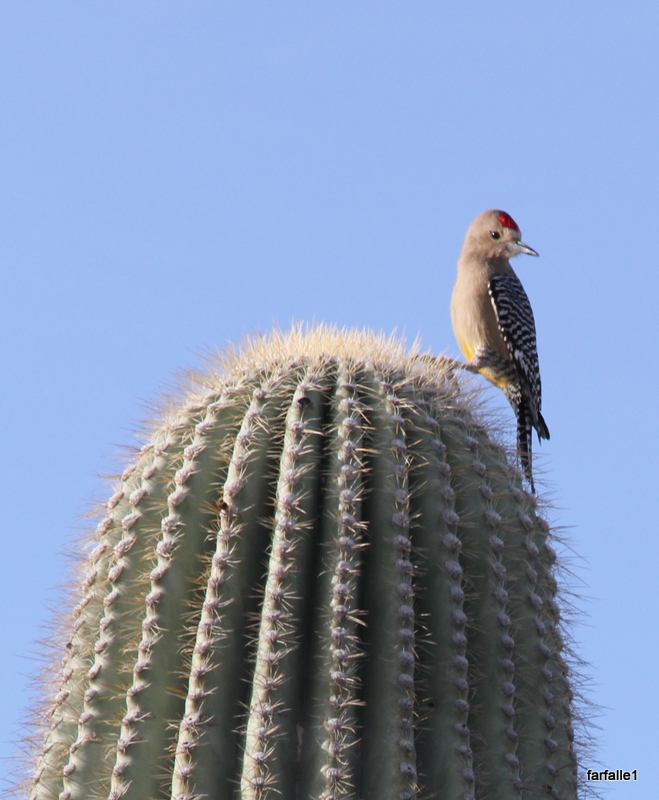
Gila woodpecker atop a nearby cactus
Hunting for sport is as popular in the U.S. as it is in Italy. In 2006, according to the U.S. Fish and Wildlife Service, 2.3 million people hunted migratory birds such as doves or waterfowl. Such hunting is highly regulated; hunters must have appropriate licenses and stamps, and can hunt only certain birds in certain places at certain times. Sport hunters in both countries are generally dedicated and law-abiding conservationists, interested in protecting the populations of the species they like to hunt. In a perfectly counter-intuitive bit of logic, sometimes bird populations must be ‘culled’ in order to protect the well-being of the species. It makes no sense to me, but if the people at Audubon say it’s true, it must be true. Mustn’t it?
No doubt there is illegal hunting in the U.S., but it is difficult to get away with it. Some years ago when we lived in Connecticut a man of our acquaintance became very angry at the number of messy geese on his pond and lawn. He got out his rifle, stood on the back porch and shot one, no doubt hoping to scare away the others. His neighbors heard the shot and came running to find out what was wrong, so he was caught red-handed. He did not go to prison, but he did have a reprimand and a sizable fine. Even worse, he became known locally as ‘Goose Killer’ – and it was not the sort of affectionate and admiring nickname that, say, ‘Speedy’ is.
The illegal taking of birds in Italy is of a different order entirely. According to CABS, ‘millions’ of birds are taken every year, hundreds of thousands of them in Northern Italy. They are sometimes taken with guns, as in the wholesale slaughter of migrating birds videoed here (supposedly ‘legal,’ but against the very EU regulations Italy signed on to uphold), and frequently taken in any of several various types of traps, all of which are illegal (bow, snap, snare, cage and nets).
It’s hard to understand what the appeal or pleasure is in trapping or shooting songbirds. It’s not as if they’re particularly challenging prey, or especially meaty. The declining number of traps in Italy attest to the gradual change of attitude towards this cruel practice; but it remains a big problem.
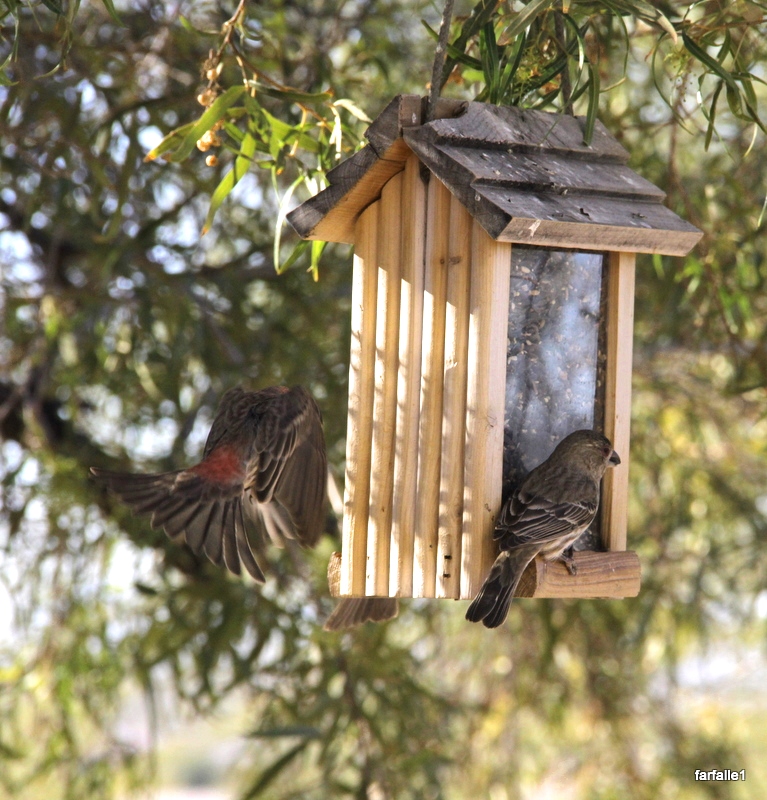
Male finches 'discuss' seating while a female thinks about it all
According to Wikipedia 55 million Americans are bird-watching hobbyists. They spend $3 billion a year on seed and $800,000 million on bird feeders and other accessories. Maybe there’s an opportunity here to help the struggling Italian economy. Don’t kill the birds, feed them. Photograph them. Enjoy them. Encourage touristic bird-watching trips. And when the irresistible blood lust of the hunter comes over you, go down to Signore Marrone’s farm and bag a few chickens.
 An Ex-Expatriate
During WWII, cats were often called….roof rabbits.
And prepared in much the same way as the ground variety.
Oh dear. I guess I’m not surprised – if one is hungry enough everything must start looking delicious, and no doubt cat would be tasty enough (though I imagine the WWII cats were as hungry as the people and were, perhaps, a bit stringy). In some cultures puppies are still a delicious meal, but I don’t want to visit there. Once in San Francisco we saw a Chinese restaurant immediately adjacent to a veterinary clinic; it gave us (excuse me) pause.
Hey, did you guys ever visit the Italian market in Waterbury? They have packets of tiny birds in their freezer case, and freshly dressed rabbits in the meat case. With the wonderful cheeses, homemade pasta and sausage, the place is aromatic, bustling, and maybe a bit of Italy? Can’t feed our birds here because the bear population never seems to hibernate … and the pack of feral cats prowl down from the upper meadow, where a neighbor covers his deck with bird-seed. Not sure how he can bear the strident chorus – not all song-birds are created equal. Cheers, girl-friend.
And cheers back to you, anonymous girlfriend! No, I don’t think I did visit the Waterbury market. We did used to get the occasional rabbit from a market in Torrington. I’ve always been surprised that rabbit isn’t more popular in the States. Lots of little bones, yes, but it really does taste like chicken. Bears? Feral cats? There must be coyotes in the mix, too, and if I read the Norfolk Library newsletter correctly, perhaps the occasional wolf?
Really enjoyed this – except the birds baked into a polenta pie. How revolting! Never knew that female purple finches are so very thoughtful.
They do think a lot; think, ruminate and ponder. Then they drop the seed in their beak and have to pull out a fresh one.
In the US in the early 1900’s, the case against ‘Southern European’ immigrants (read Italian) included their uncivilized habit of shooting and eating robins. It was somewhat true, of course, but the anti-immigrant finger-pointers conveniently forgot their own cultural peculiarities, just as they do today. One simple reason the Italians would have learned to eat birds was protein. Poverty among the peasantry was deadly serious, and the short stature of many Italians in the past was due to lack of protein in their diet.
Spot on – songbirds were an important part of the Italian diet back in the day. Also, I suspect for many, during WWII. It is perhaps, though, a tradition that could be rethought. Hunger is not (so far!) one of present-day Italy’s nightmares. Other things, yes; hunger, no. So far.
How interesting! I know the “Second” War left thousands starving in Italy and any food at all acceptable. What about dogs, cats, mice and rats ? Surely they were eaten during and after the War. What’s become of that tradition? Songbirds are more “wild” and hence more acceptable? Americans have a plethora of wild game so songbirds become irrelevant as food? Or are we Americans simply more sentimental then Italians?
At any rate I thoroughly enjoyed your post!
Thanks for a great piece, Louise, interesting and thought-provoking. Birds are all such beautiful and amazing creatures, regardless of which category (song or food or whatever) any given culture puts them in. I must admit that I have sworn off eating any birds, domestic or wild, and your piece makes me all the happier that I have.