There were a pair of exotic insects creeping along the stems of the lemon tree last week – or so I thought. On closer inspection it proved to be something sadder:
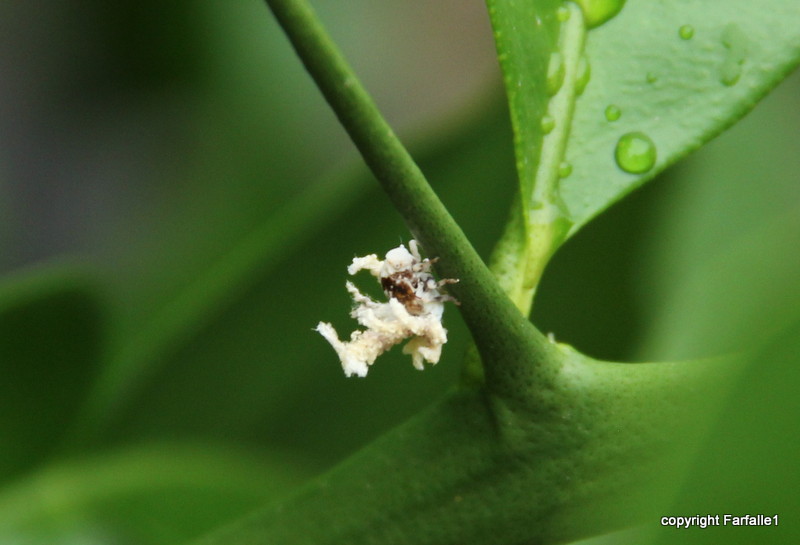
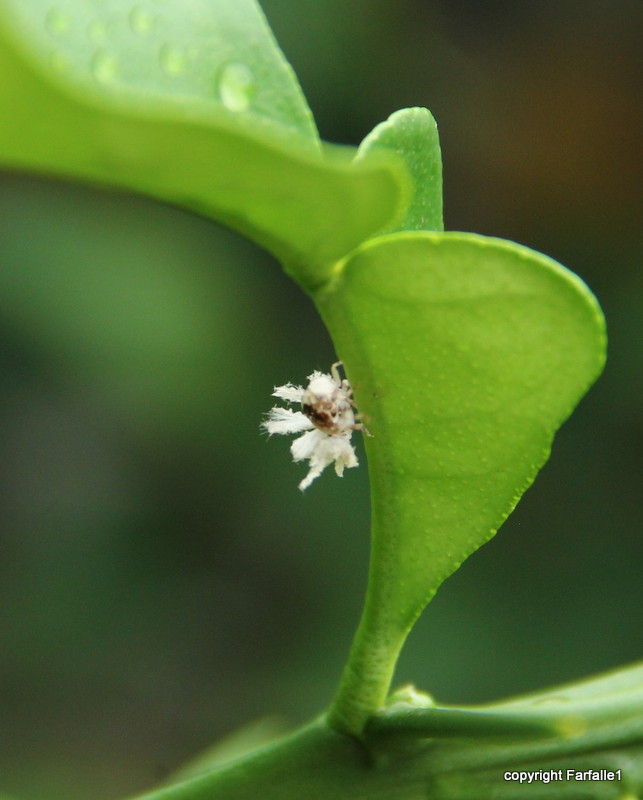
I’m pretty sure these are bugs that have been infected with a cruel yet beautiful fungus, which one I do not know. There seem to be a lot of fungi that infect various animals and insects; in fact there’s research being done in the use of fungi to control unwanted pests.
It was sad to see these two little critters, though. Such an infection doesn’t end well for the host, as you might imagine. And while it’s hard to tell exactly who is under the disease, I suspect they are small bees – and we need all the bees we have.
 An Ex-Expatriate
Oh my word! Bug expert Trish has come back loaded with info on what or whom we might seeing in your shots. I hope you enjoy her response to my query as much as I did!:
Did your friend get a really good look at these insects? To me, they look a little like woolly aphids or woolly adelgids. These insects put out some bizarre and fascinating waxy wool that often masks the insect itself and may help with moisture regulation. A good example is the alder woolly aphid. Check out these two photos:
Earlier this summer, you may have noticed fluffy, pale bluish-white beech blight aphids in flight. As early as July but by September and October they gather in masses on beech trees, sometimes making branches appear snow-covered. I get a kick out of this short video of the beech blight aphids “dancing.” http://www.youtube.com/watch?v=iX-UXLviqxI The behavior is thought to be a defense mechanism.
That said, there are some really wild entomopathogenic fungi and perhaps that is what your friend is observing. Take a look at this fungus-infected weevil, for example: http://farm9.staticflickr.com/8523/8537546961_826c1e5eb0_z.jpg
Earlier this spring, I got a bunch of photos of flies in the family Rhagionidae. The person who took the pictures found them dead and flattened against leaf surfaces. The fungus ended up to be Furia ithacensis. Check this out:
http://blog.mycology.cornell.edu/2007/06/26/furia-ithacensis/
One last interesting thing: Sometimes frass shields are mistaken for fungi! Have you seen insects with frass “umbrellas”? Some of our local tortoise beetles are great examples. Here’s a picture: http://bugguide.net/node/view/663427/bgimage. It does seem like it might be a major “turn off” for predators, doesn’t it?
Oh, the world of insects!
What a wonderful (and fascinating) response. I’m still unsure what I saw. The ?’s were definitely larger than aphids, and they appeared to have a striped tail, as do some bees. On the other hand, the white stuff on them looked a lot more like the ‘wool’ of the aphids than like the fungi in the other examples. I guess we’ll never know for sure. I’ve looked at hundreds of photos and not found exactly what I saw – but given the number of insect species I guess that’s hardly surprising. The study of bugs sure has a varied and difficult vocabulary – I wonder if it’s harder to learn than Italian. Probably not as it’s mostly based on Latin, I suppose. I really enjoy reading Trish’s analyses of the bug pictures – I’m afraid it only encourages me to take more… Please thank her for me?
Bug expert Trish has been both thanked and marveled at!
How fascinating! I have my fingers crossed for egg excretion.
We have trees that grow great fungal excesses – they look like tumors.
It breaks my heart when nature’s natural rhythms are disrupted.
Let us know about egg excretion!
Take a look at Hilary’s note – she has a bug expert up her sleeve who has a bunch of suggestions… The thing about the disruption of nature’s natural rhythms is that often it is very… natural.
I’ve once again turned to my bug expert for her best guess as to what your photos reveal…stay tuned.
I was hoping you might… I suspect the fungus Cordyceps, but was no where near sure enough to put it in.
As my learned son says: “no bees, no us”! Back to the bugs, is it possible that the bugs have excreted eggs? I seem to remember from when I was in school (last century) that some bugs excrete egg masses. Then again, I can be all wet. Beautiful pictures!!!
Bees! I know! We can’t live without them, but we’re not doing them any favors right now I think. Egg excretion is a possibility that hadn’t occurred to me – I’ll do some noodlin’ googlin’ around and see what that might look like… thanks for the idea, and for continuing to read this blog.