Spotted this in Milano this week – had never seen one before. Do you know what it is?

27 Sunday Oct 2013
Posted in Mystery Photo, Uncategorized
Spotted this in Milano this week – had never seen one before. Do you know what it is?
21 Monday Oct 2013
Posted in Liguria, San Maurizio di Monti, Uncategorized
Tags
“We believe, with Rudyard Kipling, that smells are surer than sounds or sights to make the heartstrings crack.” ~ Charles Weiss, 1959 interview on CBS’s To Tell the Truth.
My friend Taffy and I used to fantasize about ‘smellavison’ when we were young – wouldn’t it be great if we could smell all the things we were watching on that small flickering box? Actually, I fantasized about television, period, because we didn’t have one, but Taffy was nice enough to let me come over and watch with her pretty frequently.
Well ha, ha! It turns out that we weren’t the only ones with such an idea. 1959’s Battle of the Smellies pitted Mike Todd, Jr.’s film ‘The Scent of Mystery’ against Walter Reade, Jr.’s ‘Behind the Great Wall.’ The former featured Hans Laube’s technique, called ‘Smell-O-Vision,’ of releasing scents from tubes connected to the movie theatre seats. The projectionist could control the timing and release of the various aromas.
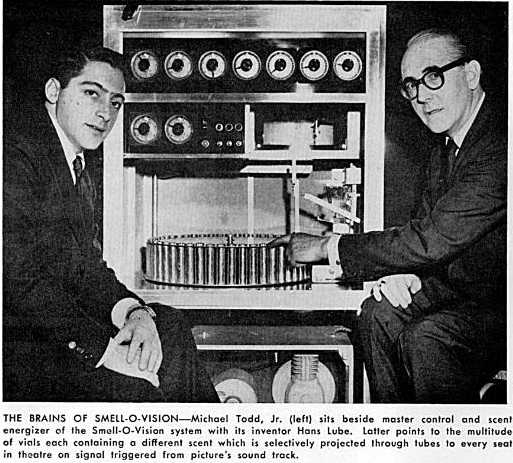
courtesy of http://www.extremetech.com
‘Behind the Great Wall’ used Charles Wesiss’s process, called AromaRama, to broadcast smells through the theatre’s air conditioning system.
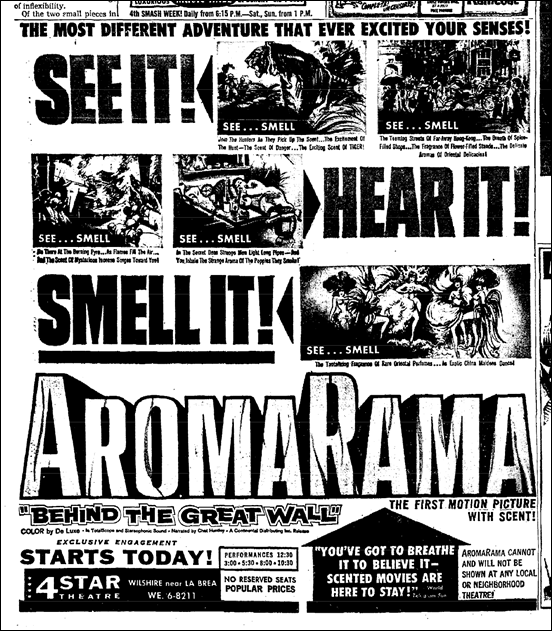
From the L.A. Times
Both systems had drawbacks, and these were the only two films released with scent dispersal systems. Later efforts included the use of scratch-and-sniff cards to add the sense of smell to film. (You can learn more about this movie history and some of the amusing problems it encountered, in this article.)
What does this have to do with Rapallo? Only that so many times as I ride my scooter from San Maurizio into town I wish that I could record the scents for this blog. Invariably the first smell is something delicious that Rosa is cooking up at the Trattoria across the street – rabbit stew? roasted veal? Rarely it is a very unpleasant smell: stoccafisso (which I’m sure smells divine to people who like stoccafisso, of which I am not one. We have a friend, a stock-fish lover, who declares it smells like a baby’s breath. I beg to differ. Fortunately it is a seasonal dish, served only in the cold winter months).
Farther along the road our old neighbors have fired up the wood stove which still provides their heat and their means of cooking. The smell of a late-fall woodfire is enough to make me want to go right home and curl up with a good book and a cup of tea. Farther down someone else is burning a brush pile. This smells slightly different that the wood fire, more punky, no doubt because a lot of what’s burning is green. When we first moved here there was a lot of plastic burning, but I’m happy to report that there is very little of that any more. That is a truly distressing aroma – you can feel your cells dividing in misery.
One of our neighbors hasn’t harvested his grapes yet; they hang, deep purple and slightly withered, from the wires running between rustic wooden posts. The smell of over-ripe grapes is sweet with an almost, but not quite, overlay of decay. It’s no wonder I can hear the hum of bees over the scooter’s engine (well, not really – but I can sure see the bees) – they love the sugar produced by grapes beginning to ferment on the vine.
About half way down the hill there’s a house with a superb garden. I’ve never seen the whole thing, but what’s visible from, and hanging over, the road is gorgeous. Flowers, figs, fruit trees – there is always something in bloom at that house, and as often as not I pick up a sweet floral scent, sometimes lavender, sometimes lemon, sometimes something unidentifiable. It lifts the heart.
Via Betti, the famous Via Betti – about as wide as a U.S. single-lane road, it is the Rapallo end of the road we live on, and it serves as a major access road over the mountain to the valley on the other side. Traffic adventures are a daily occurrence, but it is something one gets used to. Something I will never get used to or take for granted is the gorgeous smell of baking bread that wafts over the street from Panificio Schenone Giorgio. Warm and yeasty, it makes me instantly starving.
Now in the heart of Rapallo I take a left and continue along the river towards the Castello. Ah yes, the waste treatment plant. That smells like old wet newspapers that have sat overlong in a cellar. It’s not a garbagey smell, but it’s definitely nothing you would confuse with the smells from the bakery. Then on to the sea with all its inherent smells: a little salty, a little fishy, a little like a fresh breeze. Our part of the Mediterranean does not have the astringent salt smell I associate with the Atlantic off New England, but if your eyes were closed you would still know you were next to the sea.
And that is why I wish this blog could be brought to you with smellavision. The scents of Liguria are as evocative as the sights and sounds, and yet they cannot be shared in the same way. Maybe someday they will, though – according to a Scientific American article in 2011, scientists have developed a programmable odor-emitting device capable of reproducing 10,000 scents. How I would love to program this short article to give you the smells that define where we live. And I’d be interested to hear what are the smells that say ‘home’ to you.
13 Sunday Oct 2013
Posted in Building, Building in Italy, Liguria, Rapallo, Uncategorized
Tags
Building restructuring in Italy, Decorated houses in Liguria, Decorative building painting, Exterior painting Liguria, Re-doing a building in Italy
One of the big condominium/bank buildings in Rapallo has been undergoing a face-lift since March of this year. What a job! It’s not just a question of applying a fresh coat of paint. All the old stucco is being removed from the stone building underneath, new stucco applied and, finally, painted.
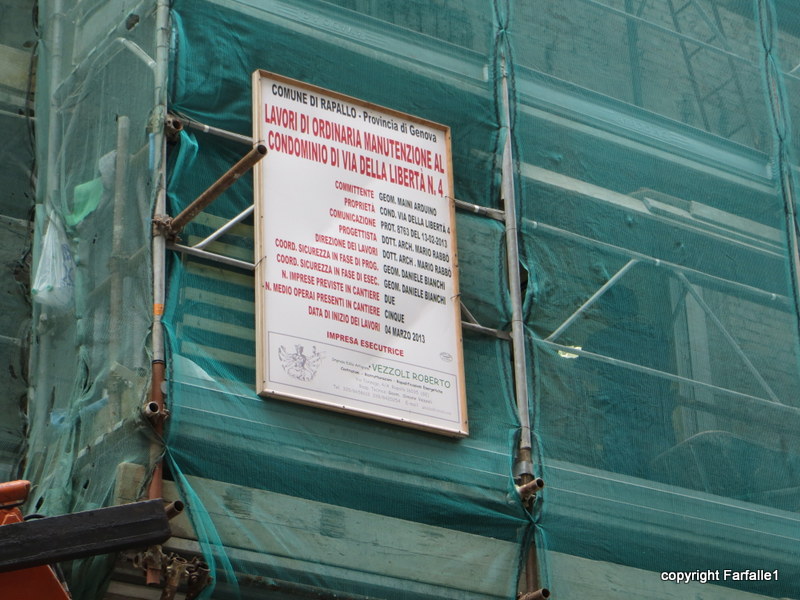
One of the fun things about building repair and restructuring in Italy is that the work permit must be prominently placed for all to enjoy. It details the ownership of the property, the people responsible for the job, when the work commenced and, often, when it will be finished – which is always, always a joke. They were clever enough to leave the last off the sign for this project, seen above. Even so, they are moving right along.
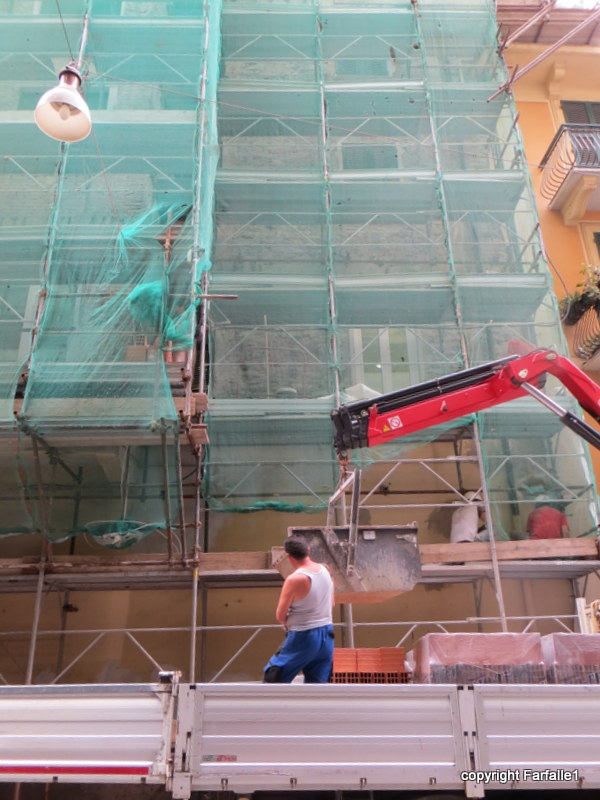
A delivery of brick blocks is being made above. It’s hard to see through the protective netting placed around the work, but if you squint you can make out the stucco still on the building at the bottom, and the stone under-facade up above. The lower floor is made from huge cut granite blocks; the upper floors, which will be covered by the stucco, are made of the smaller stones that are so abundant here, and of which most older buildings are made. The new blocks will probably be used to repair gaps that have occurred in the stonework during the removal of the stucco, and perhaps for some window work, or perhaps some interior walls. (Clearly I don’t know!)
Interestingly the scaffolding is required for any work done on a building over 10 meters in height – that’s 32.8 feet, not all that tall. It’s not cheap; the scaffolding company has to be licensed and insured, and has to have gotten approval for the ‘project’ of installing the scaffolding for each particular job. Additionally they have to install at least one copper cable lightening rod. So there’s no scampering up a tall ladder to do the work yourself if your house is over 10 meters tall.
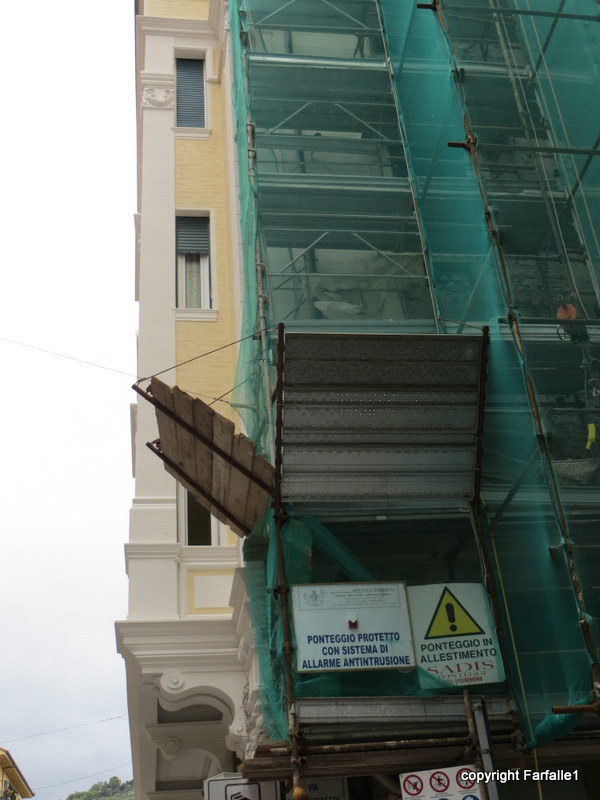
The completed work is visible on the left, work still in progress on the right.
Here is the south side of the building, all finished (note the large stones on the lower level):

It’s rather plain, isn’t it? There are very strict rules about changing any aspect of the exterior of buildings in Liguria. For instance, when we restructured our house we wanted to put two small balconies on the south side, one outside of each bedroom. Permission denied: it would alter the appearance of the structure too much. Likewise above, even if they had wanted to do some fanciful painting on the new stucco, they would not have been permitted to. It has to be made to look the way it looked before the work began, in materials, color and design. While this adds enormously to the expense of a project, it means that old buildings retain their original character – which we think is an excellent idea.
We were fortunate when we did our house – there was no original color left on the exterior, though some of the original designs could still be made out. A neighbor recalled that it had once been yellow, so Speedy chose a pleasing shade of yellow and went to see the town architect. “Yes,” she opined, “that house looks like it might have been yellow.” So we got the color we wanted; wasn’t it lucky we wanted yellow? We did sneak in one little addition that wasn’t part of the original exterior painting:
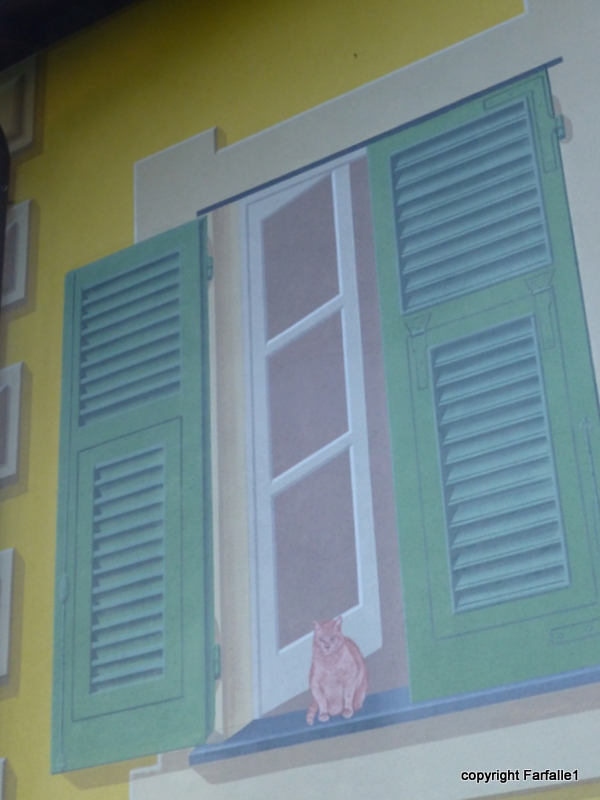
The false window is original, the false Luciano is not. Photo by Hilary Hatch.
By the way, the bank that occupies the ground floor of the office building described above has one of the greatest names ever for a bank: Banco di Chiavari e della Riviera Ligure (Bank of Chiavari and of the Ligurian Riviera). Once upon a time they put out a quite beautiful annual calendar, a real work of art. In fact, that is one of the reasons why we chose them to be our bank. Alas, the calendar has gone the way of so many ‘extras’ in the last years, but the great name remains on all their buildings, in spite of the bank having become a part of a very dull sounding much larger bank: Banco Popolare.
So, the next time you have to touch up the trim around your windows, or even paint your whole house, thank your lucky stars you don’t live in Ligura, where painting your house can be an enormous undertaking – unless of course you do. (Then thank your lucky stars that you live in a little piece of paradise.) Thank you to our friends who are surviving a house-painting as I type , complete with scaffolding and lightening rod; they provided the details on legal requirements for this kind of work.
09 Wednesday Oct 2013
Posted in Italian food, Italian men, Rapallo, Uncategorized
Yesterday Angela and I toddled down to her beach to enjoy some unexpectedly fine sunshine and to dangle our feet in the rather chilly sea. As we chatted about this and that we watched a couple of men fishing for octopus.
The gear they used was real DIY material. A thick piece of cardboard, about the size of a shirt cardboard, around which was wrapped a good bit of nylon filament. Their method was to throw the baited line out as far as they could, and then reel it in, ever hopeful that they would find an octopus firmly attached to the bait. We watched for an hour or so, but none of the resident octopi obliged, and our friends left disappointedly empty-handed.
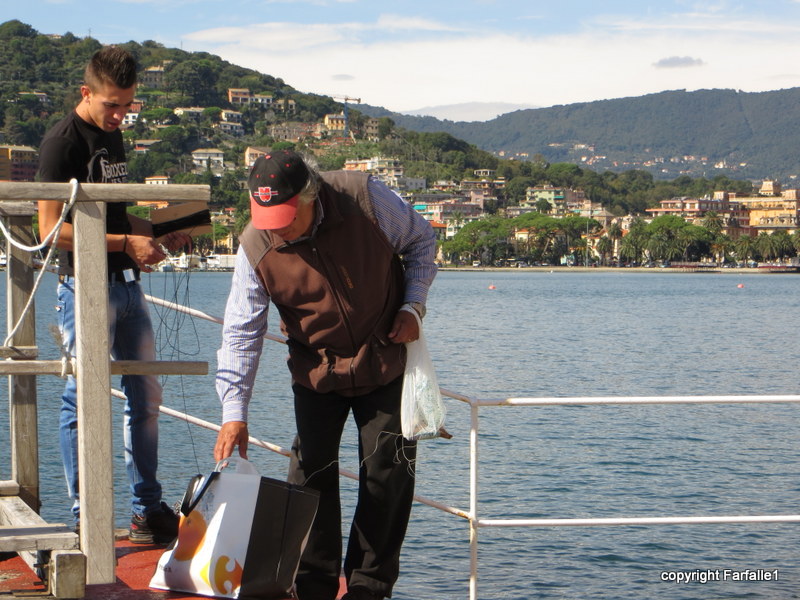
Here is Paolo, pulling in his line. You would think he’d end up with a hopeless snarl of nylon, but he never did.
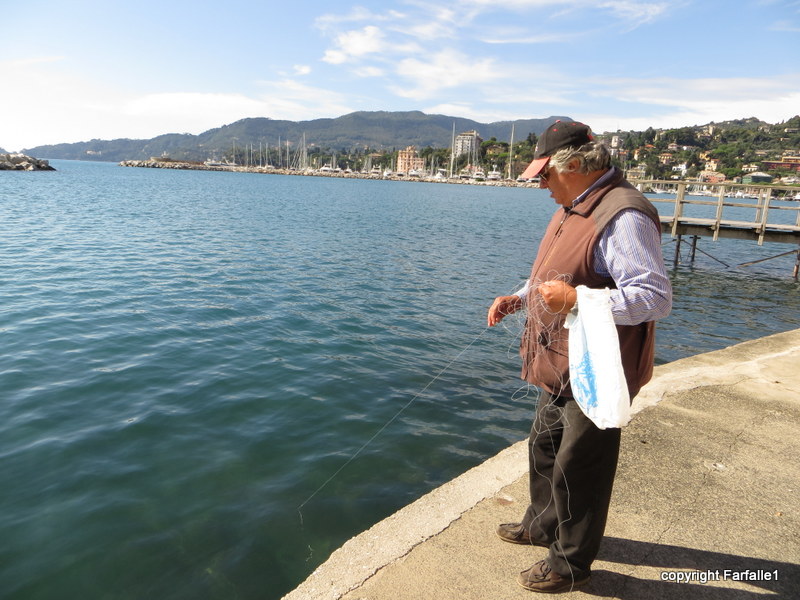
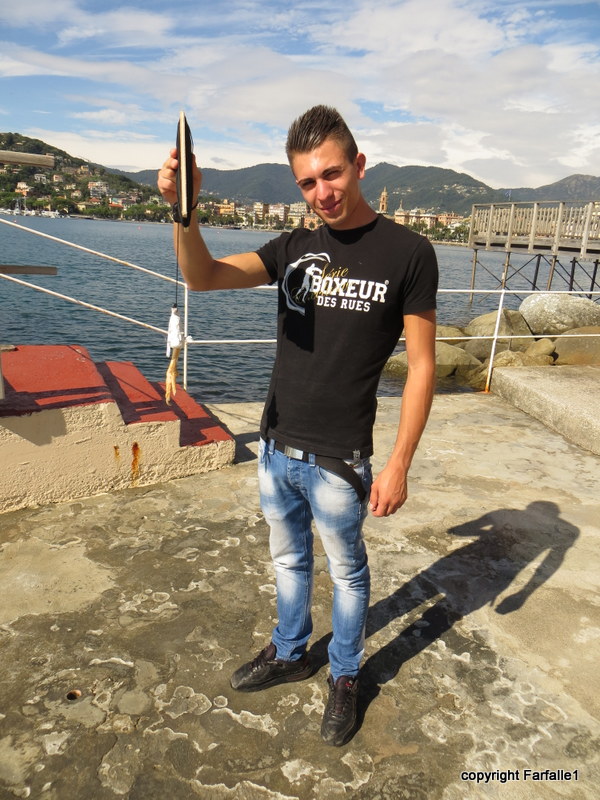
And this is Giuseppe, showing off the bait: a chicken’s foot! Evidently it is irresistible to an octopus.
Paolo spent some time giving Giuseppe instruction in the finer points of octopus fishing as they prepared to try their luck in a different spot:
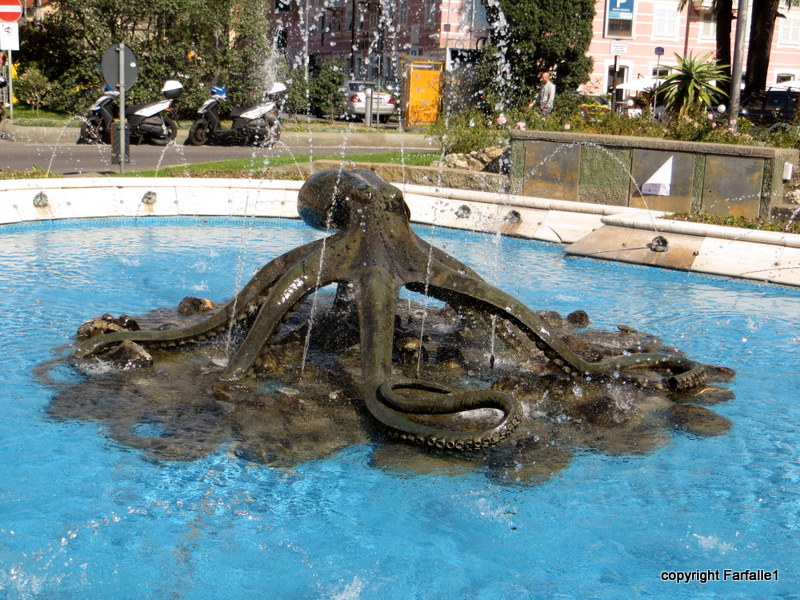
There is a beautiful fountain across the street from the castello which, happily for me, was in operation the day we met Paolo and Giuseppe. It was dry for much of the summer, but whatever the problem was, it seems to have been fixed, as you can see:
Thanks to IFLS I learned that today is World Octopus Day. This poster will tell you more than you ever wanted to know about octopuses (click on it it see it larger). What it fails to mention is how absolutely delicious octopus is, especially when served in the Ligurian style with boiled potatoes.

Poster credit: National Aquarium, Baltimore
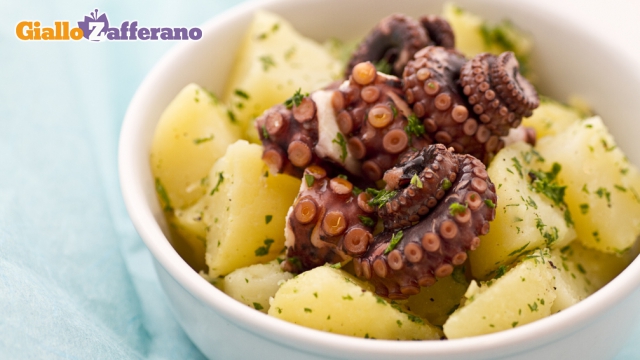
Photo credit: Giallo Zaffarano
Happy World Octopus Day everyone!
02 Wednesday Oct 2013
Posted in Hiking in Italy, Humor, Uncategorized
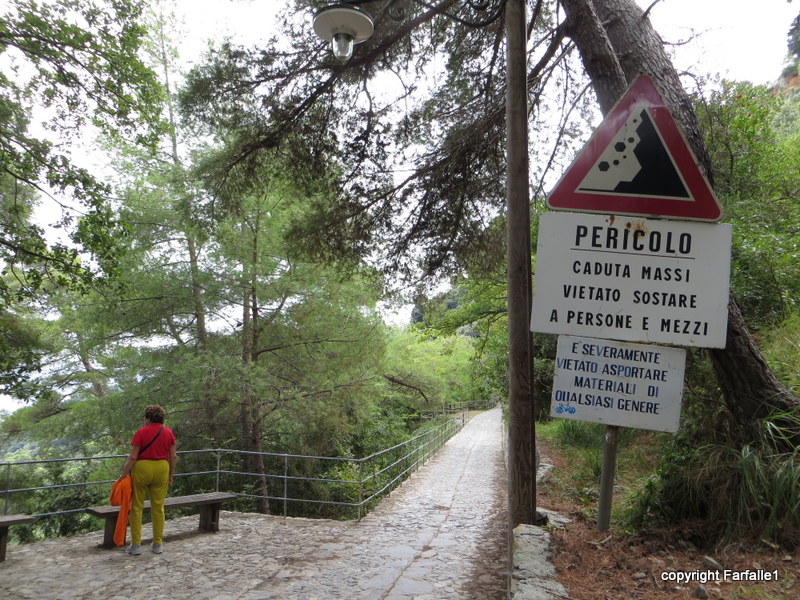
On the beautiful walk from Nozarego, above Santa Margherita, to Portofino we came upon this very confusing place. The top sign says “DANGER – Rockfall – It is prohibited for both people and vehicles to stop.” The one beneath it says “It is severely prohibited to carry off material of any sort.” Then they, whomever they are, thoughtfully provided benches and, farther along the path, a pull-out for vehicles which also offers a splendid view.
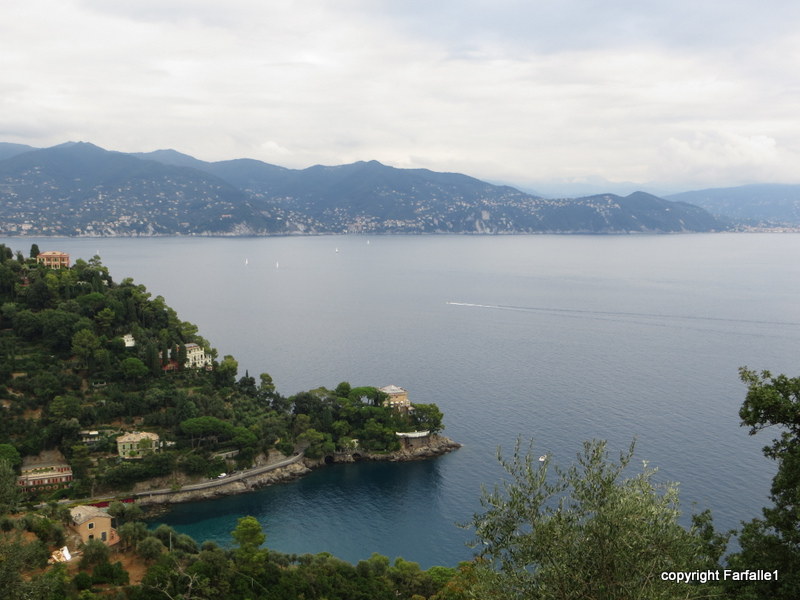
How can one NOT stop to take it all in? I think my head is going to explode.
 An Ex-Expatriate