• Contact
  • Elaborations
    • A Policeman’s View
    • Driving School Diary
    • Great Danes
    • IVA charged on Tassa Rifiuti
    • Nana
    • Old trains and Old weekends
    • The peasant, the virgin, the spring and the ikon
    • Will Someone Please, Please Take Me to Scotland??
  • Recipes
    • ‘Mbriulata
    • *Baked Barley and Mushroom Casserole*
    • *Captain’s Boston Baked Beans*
    • *Cherry Tart*
    • *Crimson Pie*
    • *Louise’s Birthday Cake*
    • *Melanzane alla Parmigiana* – Eggplant Parmesan
    • *Penne with Cabbage and Cream
    • *Pizzoccheri della Valtellina*
    • *Pumpkin Ice Cream*
    • *Risotto alla Bolognese*
    • *Rolled Stuffed Pork Roast* on the rotisserie
    • *Shrimp and Crayfish Tail Soup*
    • *Spezzatino di Vitello*
    • *Stuffed Grape Leaves*
    • *Swordfish with Salsa Cruda*
    • *Tagliarini with Porcini Mushrooms*
    • *Tagliatelli al Frutti di Mare*
    • *Tzatziki*
    • 10th Tee Apricot Bars
    • Adriana’s Fruit Torta
    • Artichoke Parmigiano Dip
    • Best Brownies in the World
    • Clafoutis
    • Cod the Way Sniven Likes It
    • Cold Cucumber Soup
    • Crispy Tortillas with Pork and Beans
    • Easy spring or summer pasta
    • Fagioli all’ucelleto
    • Fish in the Ligurian Style
    • Hilary’s Spicy Rain Forest Chop
    • Insalata Caprese
    • Kumquat and Cherry Upside Down Cake
    • Lasagna Al Forno con Sugo Rosato e Formaggi
    • Lemon Meringue Pie
    • Leo’s Bagna Cauda
    • Leo’s Mother’s Stuffed Eggs
    • Louis’s Apricot Chutney
    • Mom’s Sicilian Bruschetta
    • No-Knead Bread (almost)
    • Nonna Salamone’s Famous Christmas Cookies
    • Pan-fried Noodles, with Duck, Ginger, Garlic and Scallions
    • Pesto
    • Pesto
    • Pickle Relish
    • Poached Pears
    • Polenta Cuncia
    • Pumpkin Sformato with Fonduta and Frisee
    • Rustic Hearth Bread
    • Sicilian Salad
    • Soused Hog’s Face
    • Spotted Dick
    • Swedish Tea Wreaths
    • The Captain’s Salsa Cruda
    • Tomato Aspic
    • Vongerichten’s Spice-Rubbed Chicken with Kumquat-Lemongrass Dressing
    • Winter Squash or Pumpkin Gratin
    • Zucchini Raita

An Ex-Expatriate

~ and what she saw

An Ex-Expatriate

Category Archives: Animals in the U.S.

Why I Golf

22 Monday Dec 2014

Posted by farfalle1 in Animals in the U.S., Golf, Rapallo, Uncategorized

≈ 10 Comments

Tags

Animals on golf courses, Golf course scenery, Golf course wildlife

Speedy took up golf in about 1999 when a knee injury prematurely ended his tennis career. After several years of diletanttish play he became rather more serious when we moved to Italy. The course in Rapallo is beautiful, and Speedy made some lovely friends there. He became even more serious in his pursuit of good play when he finished all the hard physical work of redoing our home. In no time at all golf became his ‘work,’ a job to which he dedicated 5 days every week, a schedule to which he still adheres, both in Italy and here in Arizona.

What’s a poor Expatriate to do? The term ‘golf widow’ suddenly had a compelling resonance for me. The obvious solution was to take up the game myself, thereby giving myself an opportunity to share in my husband’s passion AND to have some quality time with him every week.

Here is what I quickly learned.  Golf is a tremendously difficult game. It’s no big deal to learn the basics, but to be able to apply them with any consistency is nigh on impossible. In addition, once one becomes interested in improving, the old brain kicks in and plays one trick after another. It’s just plain hard. Or, as the sage said, “It’s a cruel game.”

I also learned that it’s a game I’ll never feel passionate about; it’s difficult for me to stay engaged with something that offers such paltry rewards compared to the time and effort demanded. I’m not a good golfer, and never will be; Speedy says I could be good if I were willing to practice every day. Oh well.

However, here is what I love about golf: golf courses. Once a scoffer, I used to think that golf courses were a tremendous waste of resources, both of land and of money. But you know, you won’t find many better places to walk than a well-maintained golf course. And walk we do. For a while at our old golf course we would split a golf cart, each walking 9 holes; but now, both here and in Italy, we walk all 18 holes. There are frequently lovely views and, if there’s water present, as there almost always is, there will be an interesting variety of animals and birds.

Here, in no particular order, is an album of photos of wildlife and vistas snapped between and around tees and greens. While it may be true that ‘golf is a good walk spoiled,’ it remains true that it is a Good Walk. While I’m an ambivalent golfer, I am passionate about the walking.

First, let’s set the scene. Here’s the view down the 7th fairway in Rapallo with the remnants of a 16th century monastery on the other side of the green:
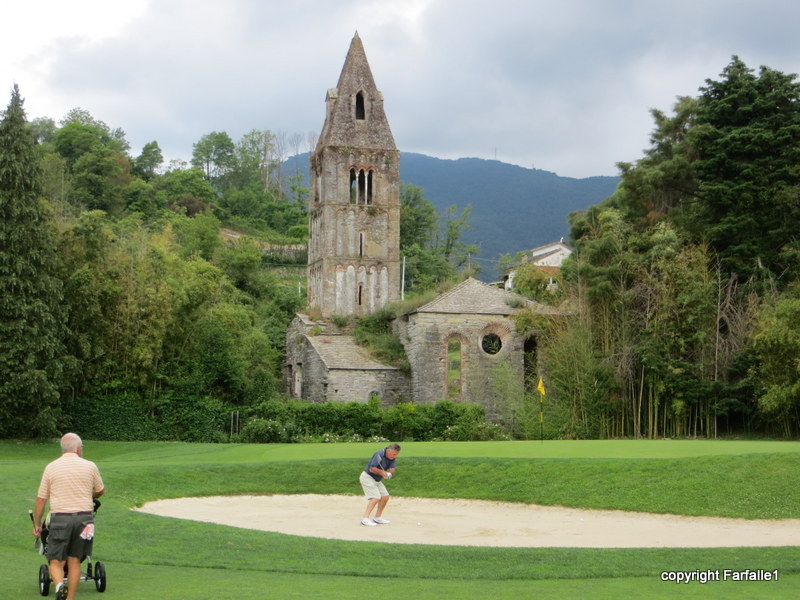
Giammi hits from the sand at #7; valle Christi

Painted Mountain in Mesa has a forest of palm trees:
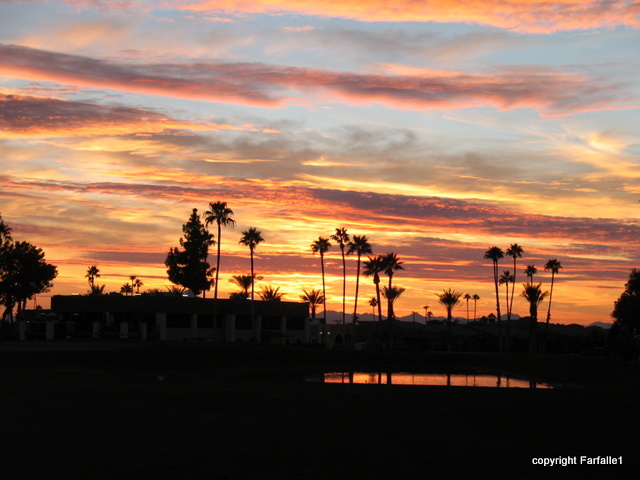
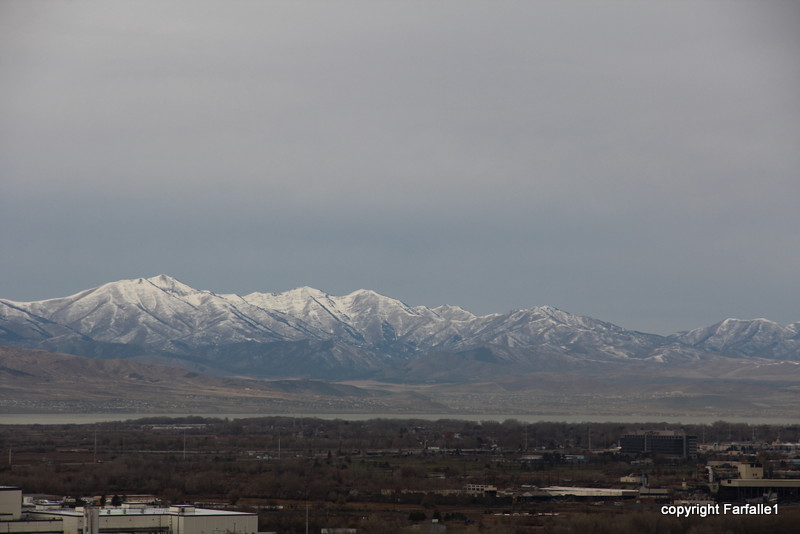
sunset over painted mountain golf courseOver Thanksgiving we visited friends in Utah. How can anyone concentrate on a golf game when these are the views the course offers?

view from Provo golf course-001view on provo golf courseLake Utah and mountains-001I didn’t even try to play that day.

Now for some fauna:
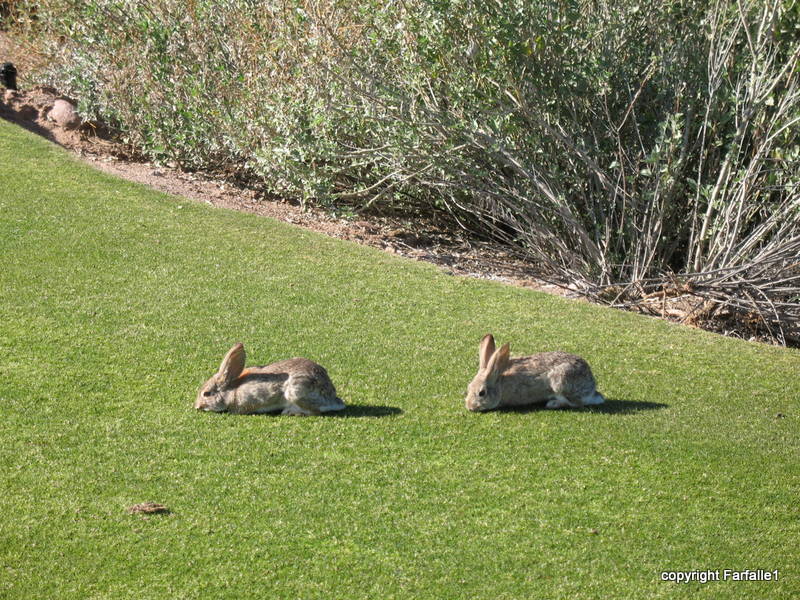
Rabbits at Painted Mountain
Rabbits at Painted Mountain

IMG_4387

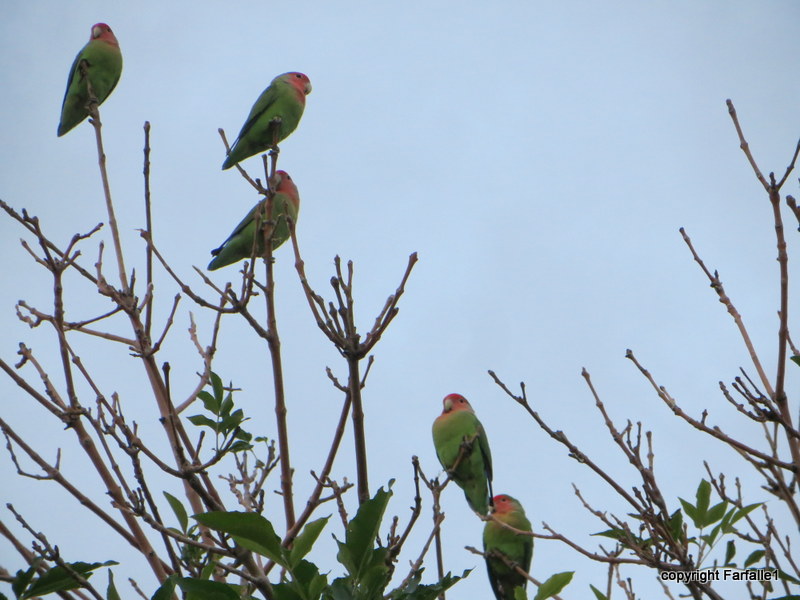
Peach faced lovebirds at Painted Mountain
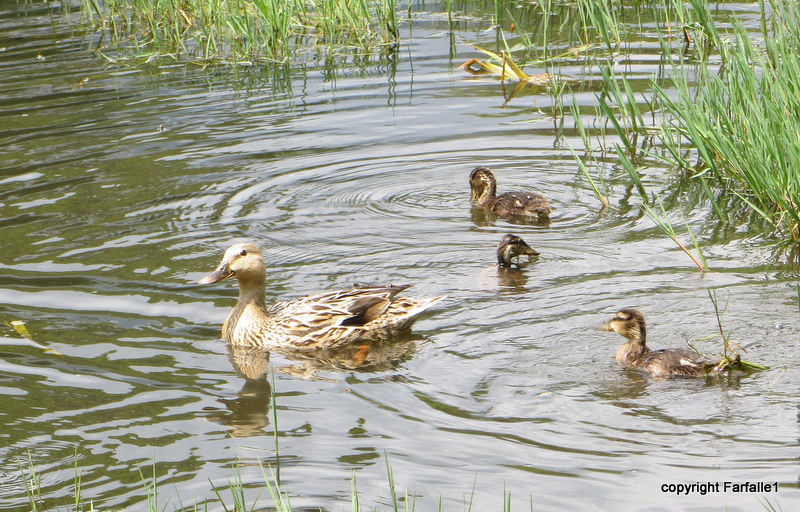
Mama duck with her babies, Rapallo
Mama duck with her babies, Rapallo

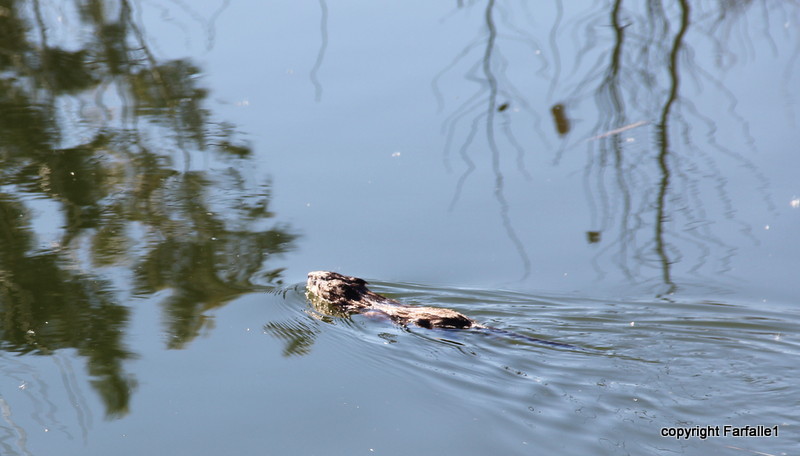
A muskrat (?) in Utah
A muskrat (?) in Utah

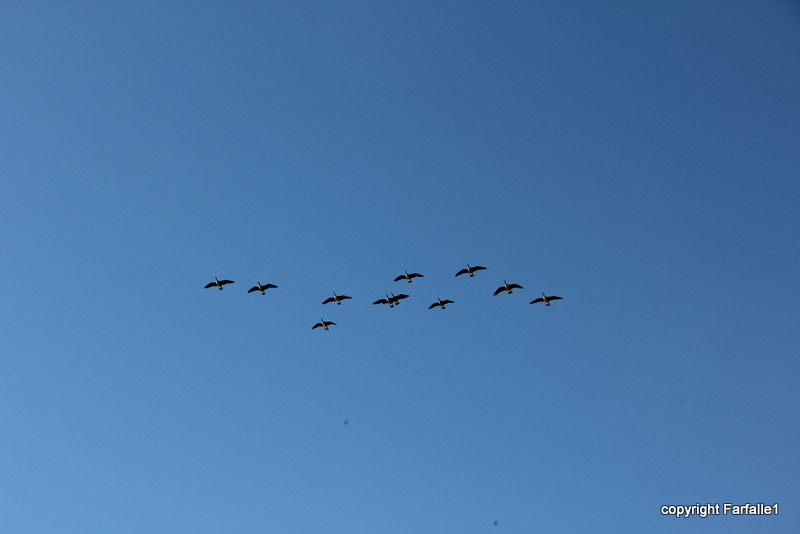
Geese overhead in Utah

Geese overhead in Utah

Remember when geese used to migrate? Now they just hang around the golf courses year-round, which makes for interesting footing if your ball lands near the water.
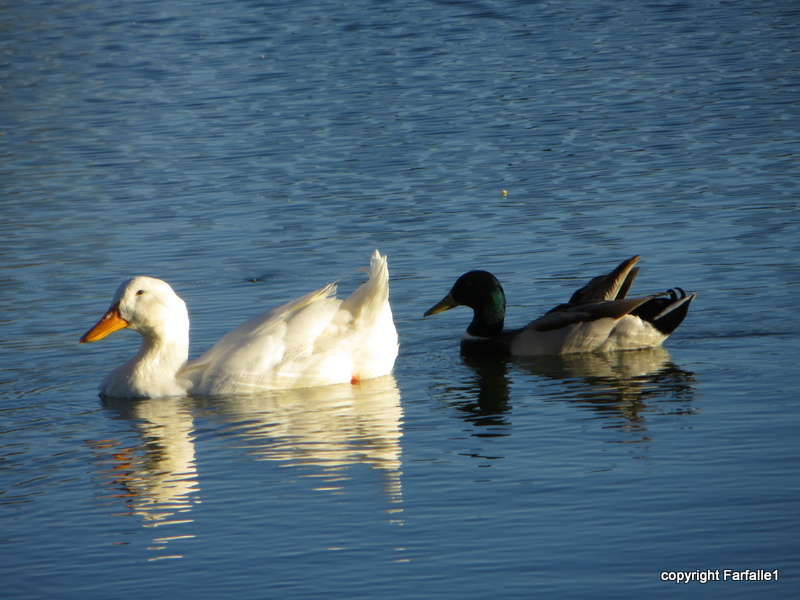
Goose and mallard, Mountain Brook

Goose and mallard, Mountain Brook

This white goose has been protecting the male mallard with a broken wing for several weeks now. They are inseparable.

True love, mallard style, Mountain Brook

True love

Speaking of inseparable, it’s getting to be that time of year. Is there any place on earth where mallards don’t thrive?

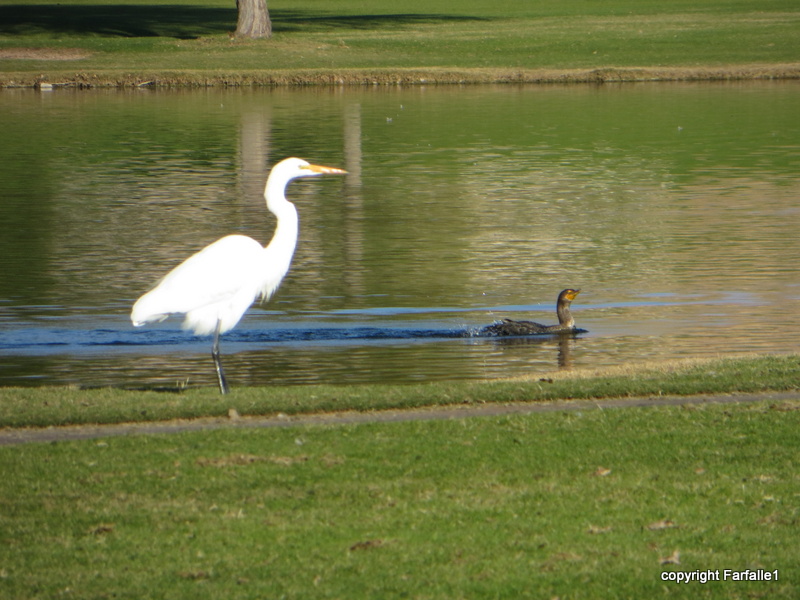
A blue heron and an egret are resident at Mountain Brook and can be found fishing in the course ponds every day.
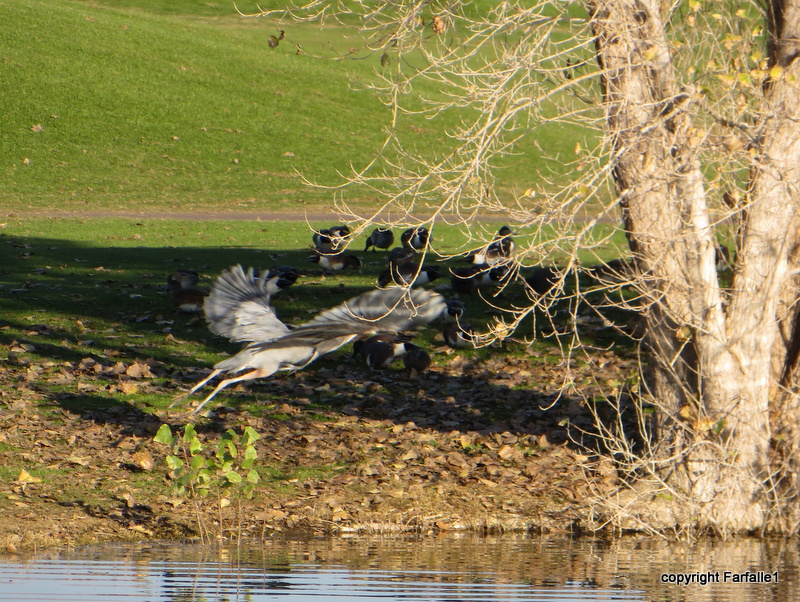
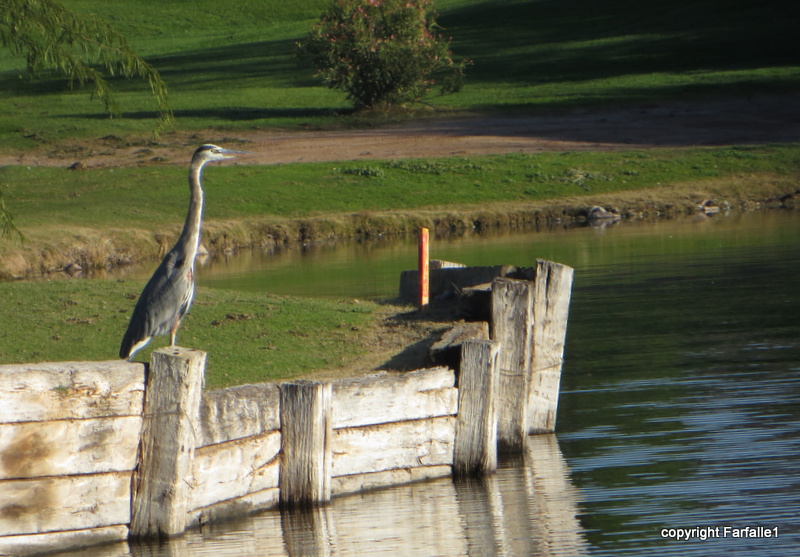
great blue flies away great blue fishing white egret and duck

Sometimes your scribe is just not quite quick enough trying to catch an action shot:
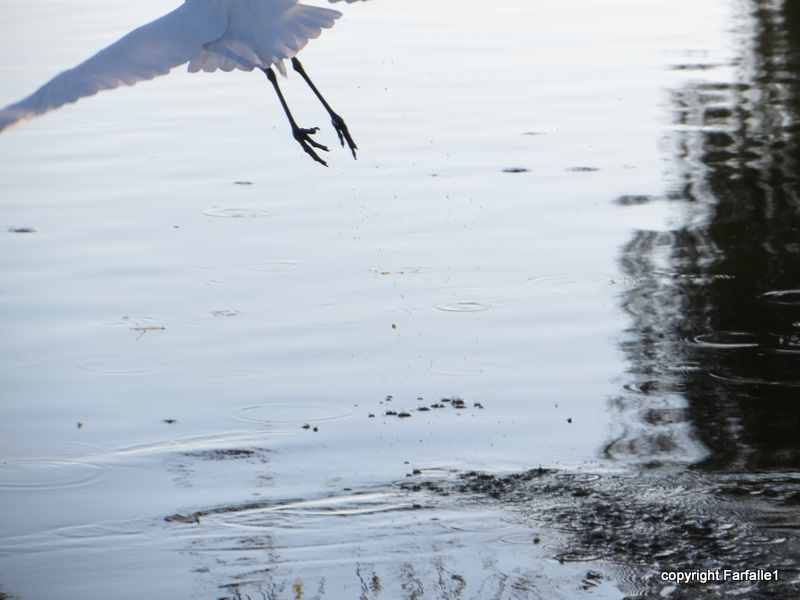
egret leaves

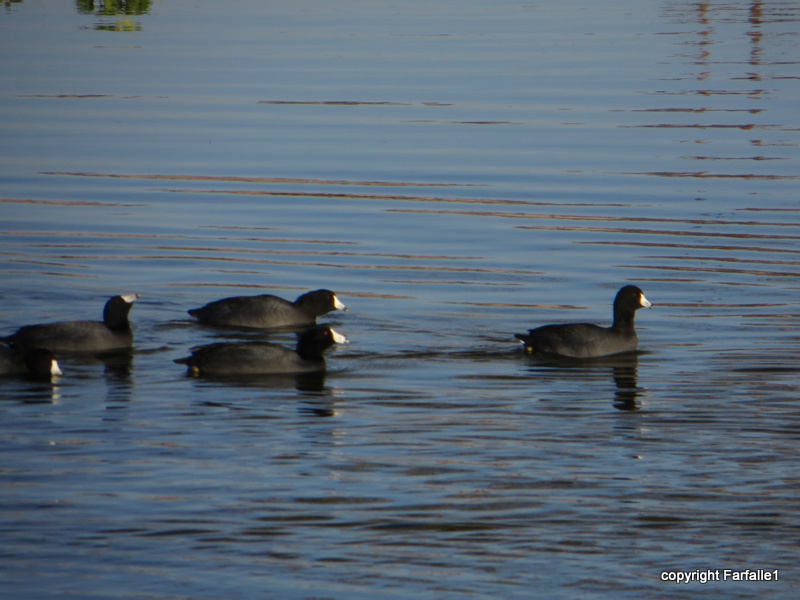
coots-001

Coots at Mountain Brook

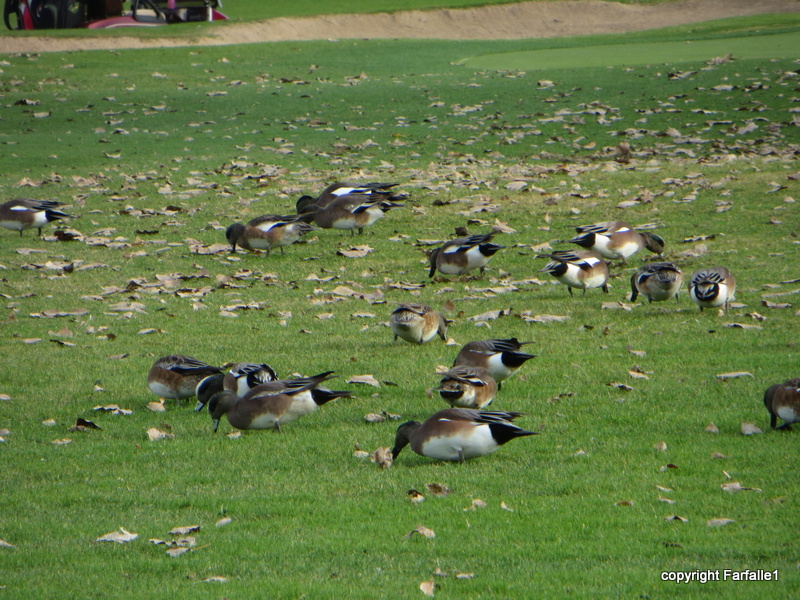
widgeons-002

Widgeons at Mountain Brook


cormorants and widgeons

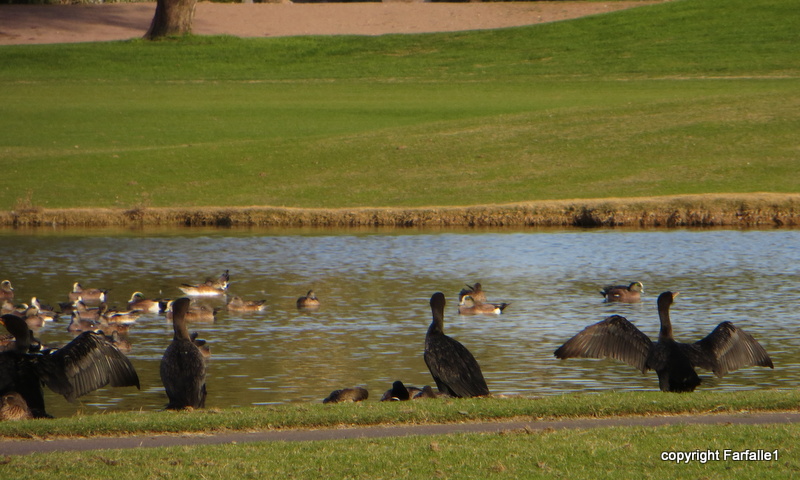
Cormorants dry their wings pondside at Mountain Brook

hawk on a wire

Hawk on a Mountain Brook wire – hunting for rabbits?
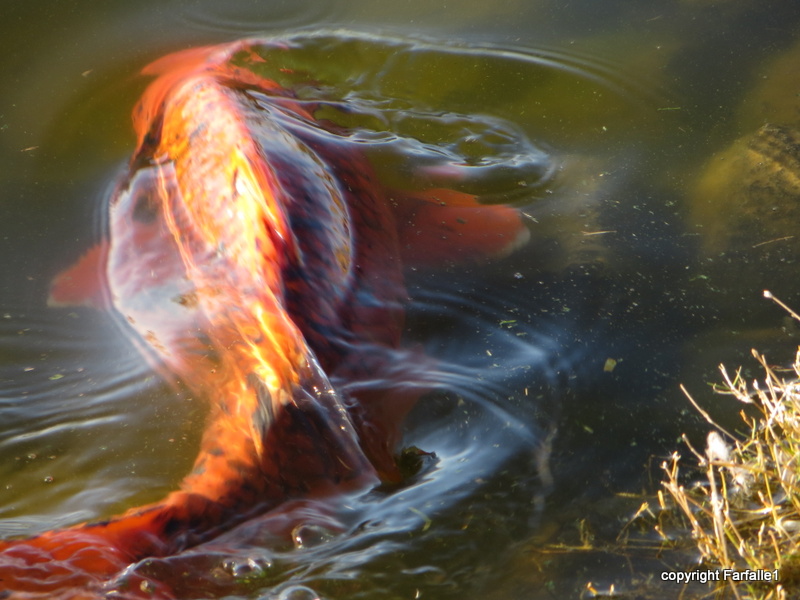
Large gold carp

Large gold carp at Mountain Brook

Deer come to the course 'meadows' in the early evening

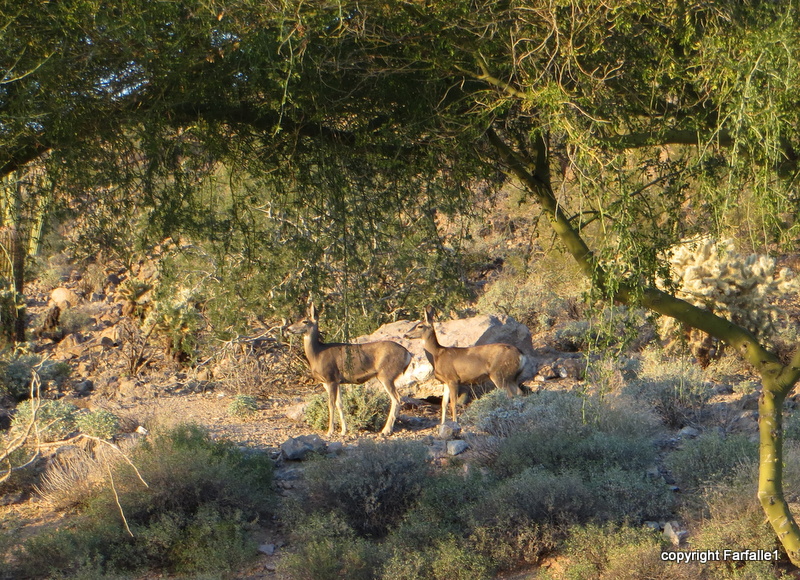
Deer come to the course ‘meadows’ in the early evening

Perhaps the rarest sighting of all occurred this very evening – I saw reindeer. No, I really did! And I was able to get a photo of them.
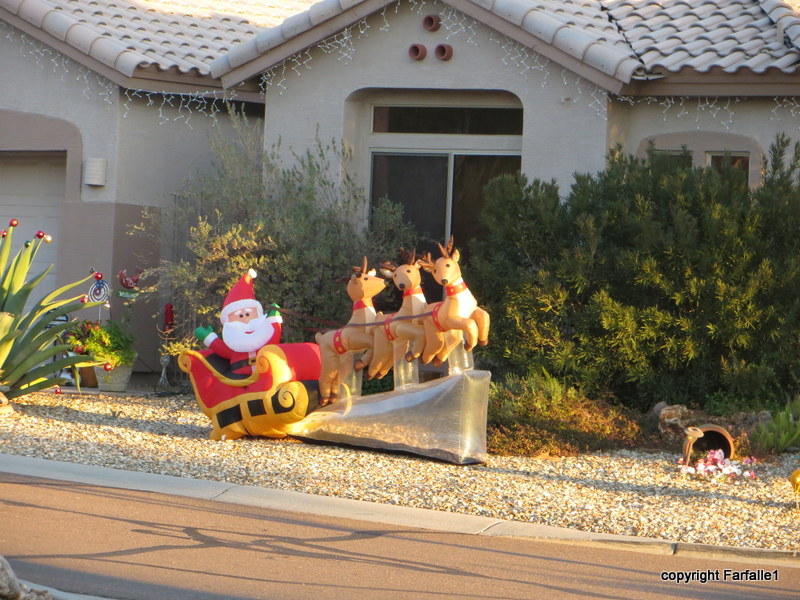
MERRY CHRISTMAS TO ALL AND TO ALL A GOOD NIGHT!
MERRY CHRISTMAS TO ALL AND TO ALL A GOOD NIGHT!

When this grew up…

10 Wednesday Dec 2014

Posted by farfalle1 in Animals in the U.S., Arizona, Photographs

≈ 2 Comments

Tags

Giant swallowtails, Swallowtail butterflies, Swallowtail caterpillar

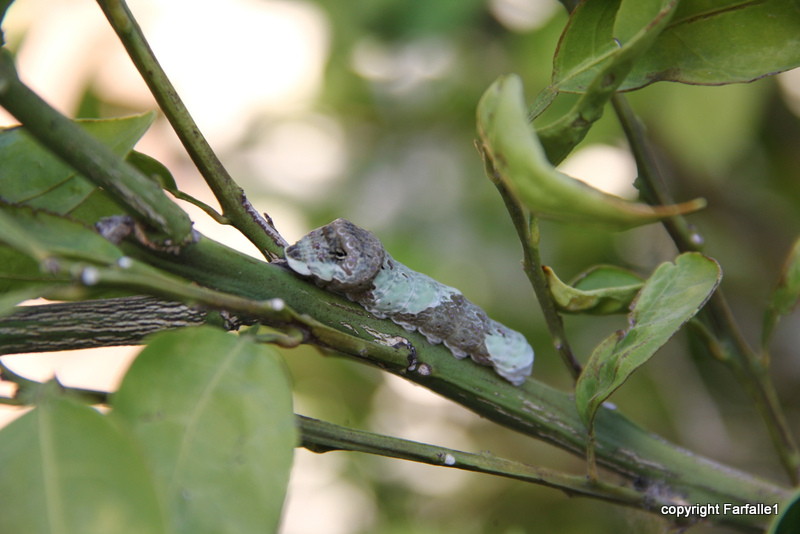
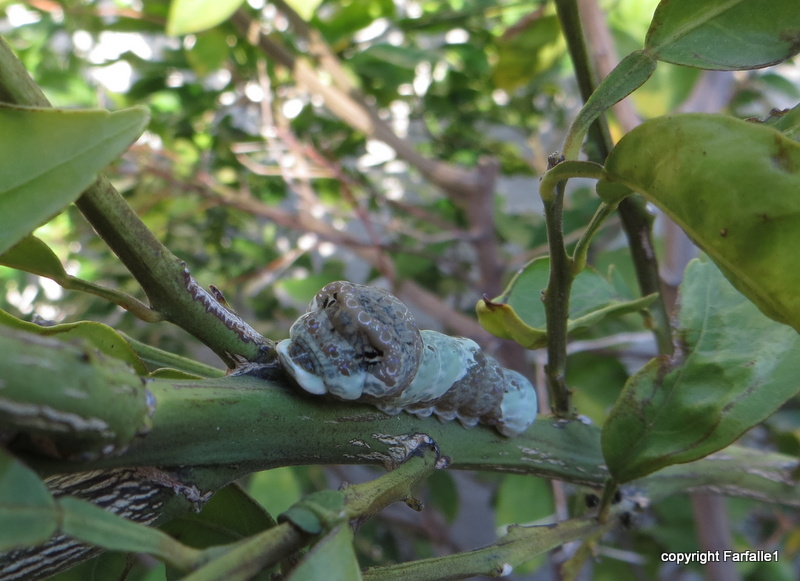
weird bug-005

weird bug on orange tree

When this grew up it became this:

Photo copyright Jim P. Brock, 2008

Photo copyright Jim P. Brock, 2008

or perhaps it looked more like this:

Photo copyright Carol Adams

Photo copyright Carol Adams

If you’d like to read about Giant Swallowtails, click here. If you’d like an article on their increase in New England, click here. If you’re wondering why I’m telling you this, it’s because this caterpillar dined on our grapefruit tree for several days before disappearing, no doubt to begin his metamorphose. It looks like he’s covered with fungus, doesn’t it? But that’s just His Special Look.

Many thanks to Trish and Hilary for the identification.

Spring in the Desert

03 Saturday May 2014

Posted by farfalle1 in Animals in the U.S., Arizona, Desert, Uncategorized

≈ 8 Comments

Tags

Arizona lizards, Cactus flowers


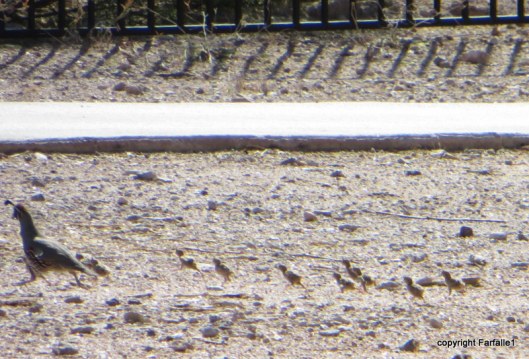
This year Speedy and I stayed longer than usual in Arizona, which means we got to see late spring as we’ve never been able to before. Long-time readers may remember a couple of years ago when a mama quail laid a clutch of eggs in our flower pot and then neglected to come sit on them. That was an adventure which, happily, has not been repeated. We’ve always left before the quaillettes hatch – this is what we’ve missed:

freshly tatched quail

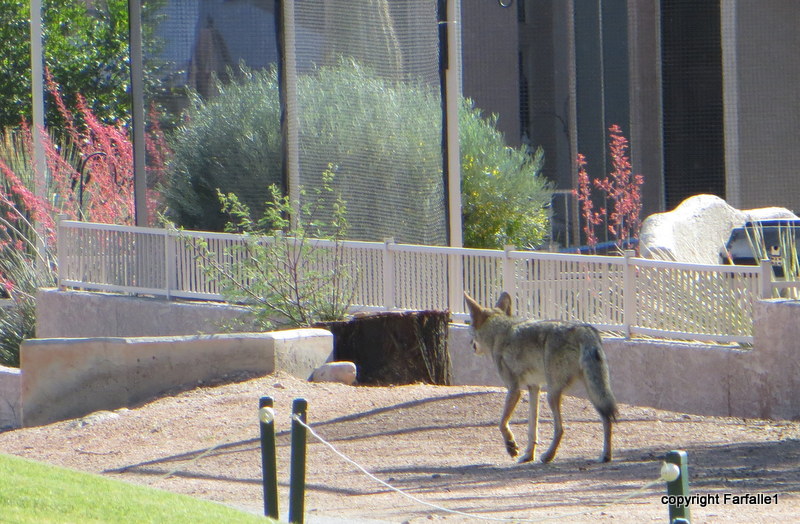
Apologies for the poor quality of the picture; the birds were quite a distance away, and they run faster than you can imagine (they look like a mass of commas chasing a close parenthesis) – which is a good thing because look who was out searching for them:

coyote-001

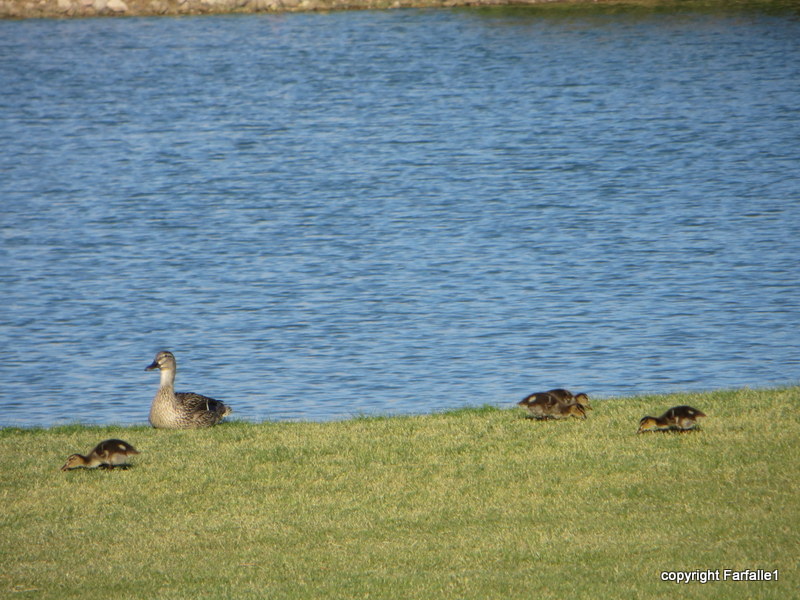
If he couldn’t snatch the baby quail I bet he would be satisfied with a meal of ducklings:

ducklings

This clutch started out numbering 13 fluffy yellow chicks, and is now down to 8.

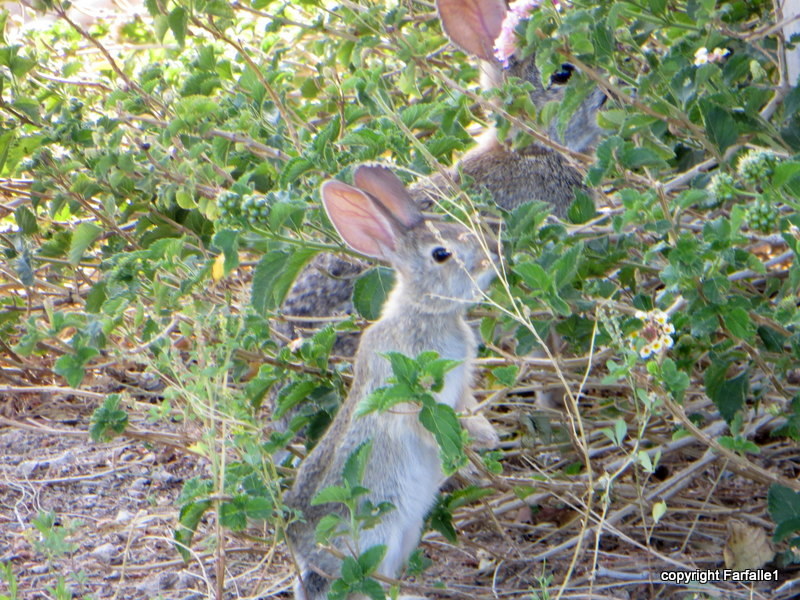
If mammals are more to his liking, there are plenty of these adorable babies around. They have grown quickly in the last couple of weeks:

baby bunny

Why is it baby bunnies are so cute? We KNOW they would love to come in the garden and eat everything that’s there, but still they are irresistable.

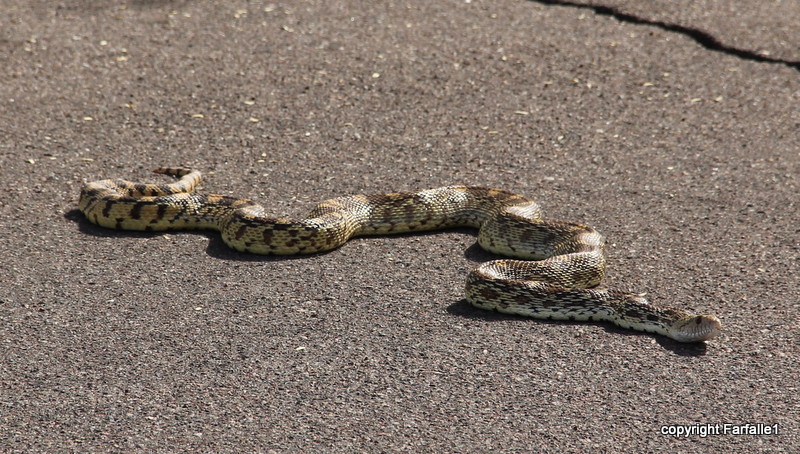
Warm Spring weather brings out the snakes and lizards. I have yet to see a rattle snake, though a good month ago this gopher snake was in our neighborhood:

gopher snake
They are quite large but harmless, unless you happen to be a small rodent. We’re happy to see them as it means the population of chipmunks and pack rats will decline.

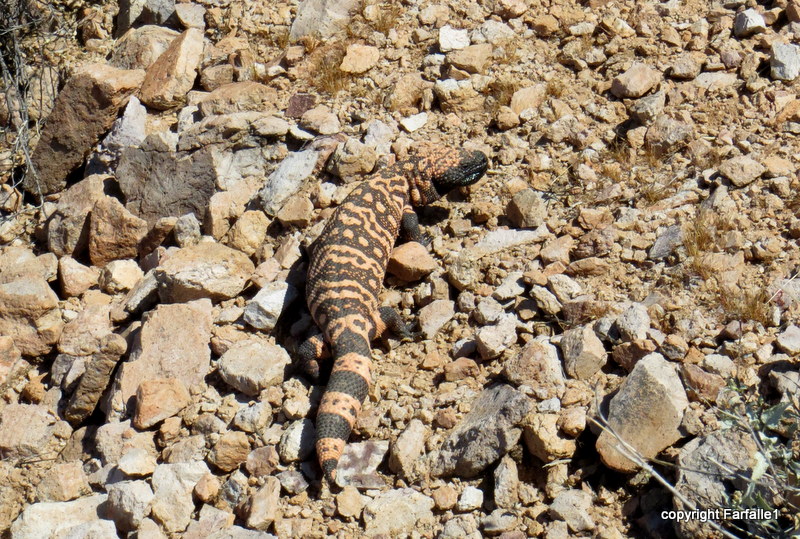
Gila monsters are not uncommon, but they are shy, so my hiking buddy and I were delighted to see this fine fellow last weekend.  In all the many hikes we’ve taken together this is only the second time we’ve seen a Gila.

gila monster

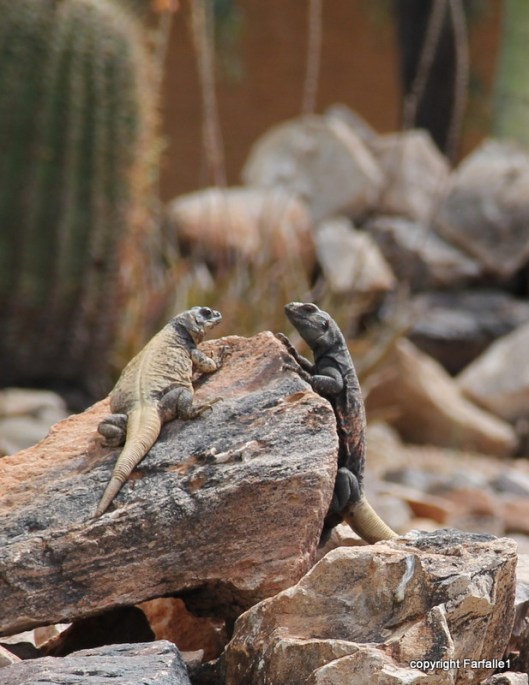
Chuckwallas live in the rock pile next to our house, so we see them on almost a daily basis. They can be quite fearless and let us get rather close; but somehow I don’t want to get too close! Their tails look like they were taken from some other lizards and glued on to the end of tailless chuckwallas, they just don’t look like they belong to that animal.

chuckwallas-002

A couple of days ago Speedy noticed a pair of smaller lizards on the rock wall out in front. I was not able to get very close to them, but I think one of them, at least, is a Mountain Spiney Lizard – and it’s the first time we’ve seen one.

mountain spiney lizard-002

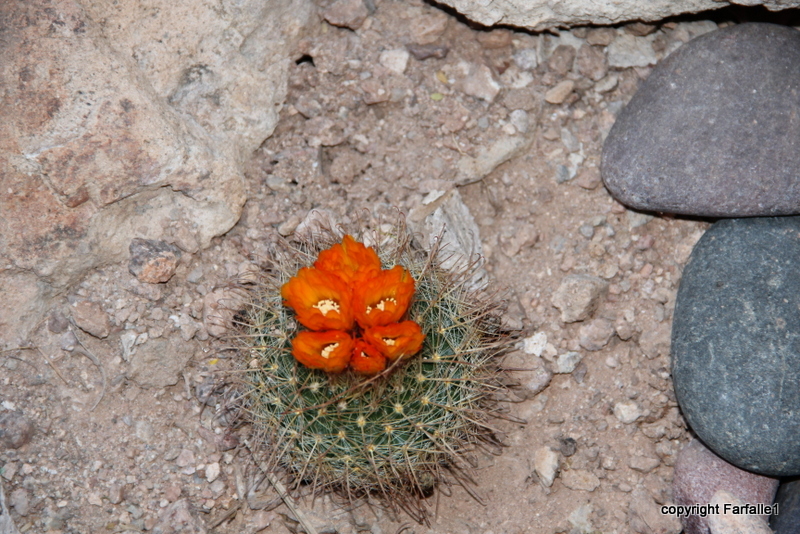
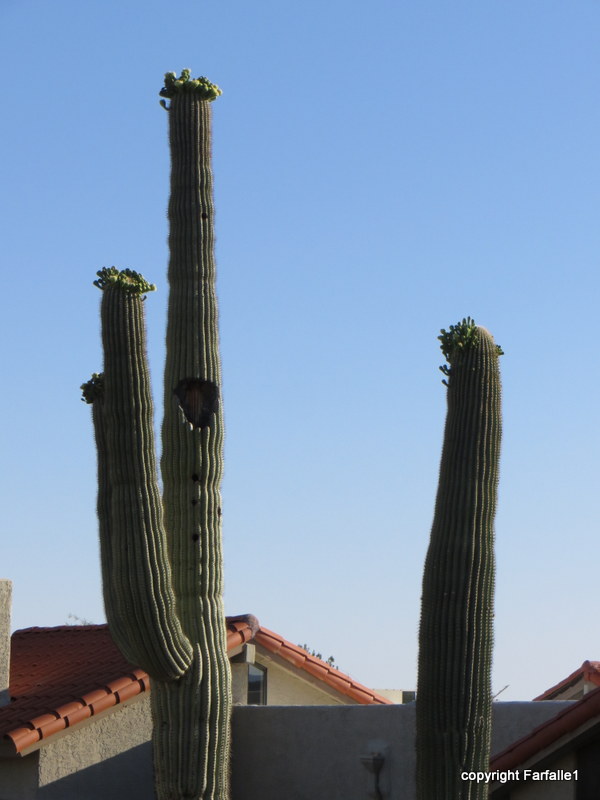
The cactus have been blooming for some time, but this year we’ve had another first-time treat: we’ve been able to see the saguaro bloom. One thing that amuses us – frequently a very small cactus will put out a disproportionately large flower.

little cactus in bloom orange bedroom cactus flower

The saguaros, which are huge, put out disproportionately small flowers – from a distance they look like your grandmother 10 minutes after her departure from the beauty parlor, before the perm has relaxed. If their flowers were in proportion to those of the wee cactuses they would be about 3 feet across (I would like to see that). At any rate, I’m thrilled to have finally seen these flowers in person.

IMG_2849

cactus wren on saguaro flower

Spring is lovely no matter where you find yourself. But with the temperatures creeping up towards 100 F Speedy and I find it is time to head east… waaayyy east. Next stop: Rapallo, and a different kind of Spring. See you there!

Finding Momo in Tempe

12 Saturday Apr 2014

Posted by farfalle1 in Animals in the U.S., Books, Dogs, Uncategorized

≈ 4 Comments

Tags

Andrew Knapp, Find Momo, Maddie, Maddie On Things, Momo, Theron Humphrey

How many hundreds have books been written about dogs by the people who love them? It seems like everyone who has ever had a dog has written a book, or at least a story or a poem, about him, but that turns out not to be true. Stanley Coren estimates in Psychology Today that there are at least 725 million dogs on the planet, so the percentage of people who publish accounts of their dogs is actually rather small. The percentage of dogs who allow strangers to fondle them on book tours is arguably even smaller.

One such productive human is Andrew Knapp who has made a playful hide-and-seek photography book called Find Momo about his patient dog. While Momo is not as adept at hiding as is Waldo, he is at least 100 times cuter. He’s also real, a real border collie to be exact, and he enjoys peeking out from hiding places while Andrew takes his portrait. In some of the pictures he is easy to find, in others not so easy to find.

It all began innocently enough when a man adopted a dog (hear how it changed his life in his TEDx talk here). Andrew, like anyone with a camera (or iPhone) and a dog put the two together. Noticing that when he played stick with Momo the dog preferred to hide rather than bring the stick back, he decided to take pictures of his hard-to-see pooch when he was hiding. What started as a game became an urban landscape project in Ontario and then became a voyage of discovery, actual and metaphorical (really, listen to the TEDx talk, it’s inspiring). Andrew began posting his photos of Momo on Instagram, where he now has more than 150,000 followers, and created a website for the project. Now he has made his first book, and the second is in development.

Andrew and Momo stopped at Changing Hands Bookstore in nearby Tempe recently during their book-tour and I took the opportunity to go and meet a pooch I felt I already knew from his on-line personality. Both he and Andrew turned out to be as delightful in person as they seem on the screen and the page. I arrived in time for the Q & A, and Momo was already working the crowd as Andrew met fans and signed copies of his book for them. Andrew KnappI have not been to many book-signings, and I learned a couple of things from this one. First, get there at the appointed time. If you’re 20 minutes late you’ll miss most of the content. Second, get there on time, if you’re 20 minutes late there will be no books left. Third, if you have to be 20 minutes late, go anyway because it’s a lot of fun to meet other people who like the same authors and books you do. It was great fun to watch Momo play with anyone who asked – as stars go, he is decidedly accessible: Momo, his toy, his book momo's little fan fallsmomo and fans-001Louise and Momo-006This one shows Momo doing what he likes to do best: hide! momo hidesIf you’ve enjoyed meeting Momo and visiting his sites, you might also like to know about Maddie the Coon Hound, whose human, Theron Humphrey, photographs her upon things. What a delight it was to discover that Momo and Maddie are acquainted. In this photo taken by Andrew Knapp and/or Theron Humprey you can see each dog doing what s/he does best.

There are a lot of dogs, and a lot of books about dogs. The happy news is that there’s always room for one more good one.

Hikin’ Dogs

11 Saturday Jan 2014

Posted by farfalle1 in Animals in the U.S., Dogs, Hiking dogs, Photographs

≈ 4 Comments

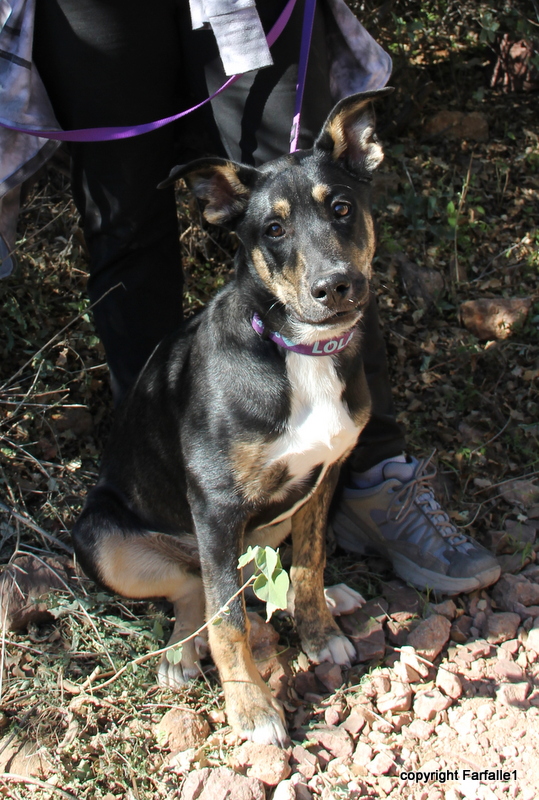
Lola rescue dog-001

Meet Lola, a lovely rescue dog on her very first hike. She was a little worried about the whole thing, but seemed to be enjoying it.

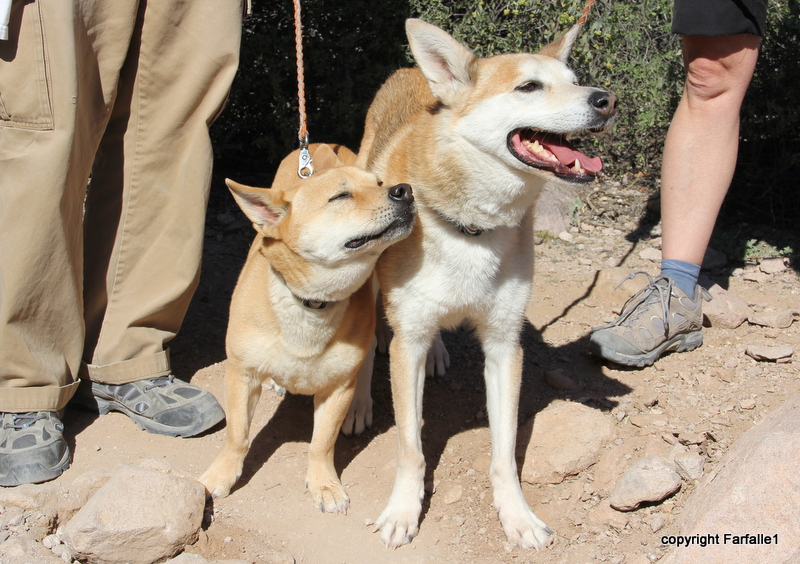
Some hiking friends are with us for the weekend, and we went to the very beautiful, but very crowded, Peralta Trail that leads to Fremont Saddle. It’s not a difficult trail, so it attracts everybody – young people, old people, families. Also it’s a very dog-friendly hike (not a lot of cholla waiting to prick paw pads). My usual hiking buddy doesn’t much enjoy making this trek with me because I HAVE to stop and photograph so many dogs – just can’t resist.

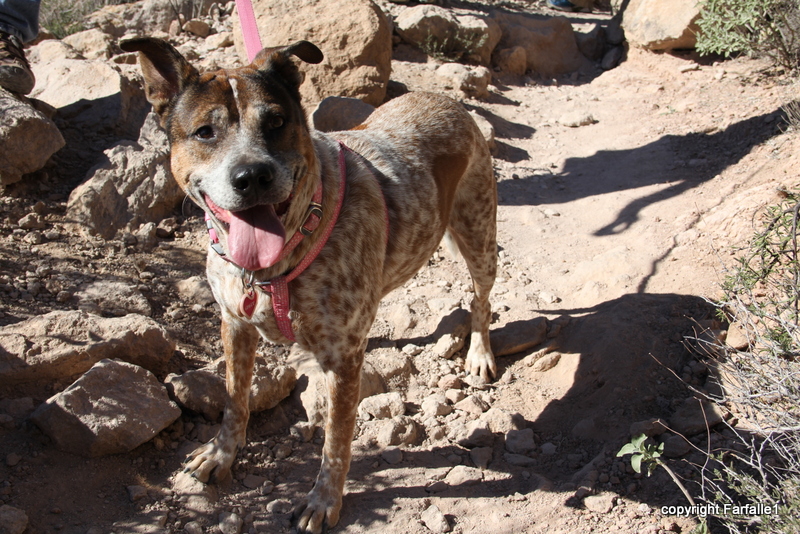
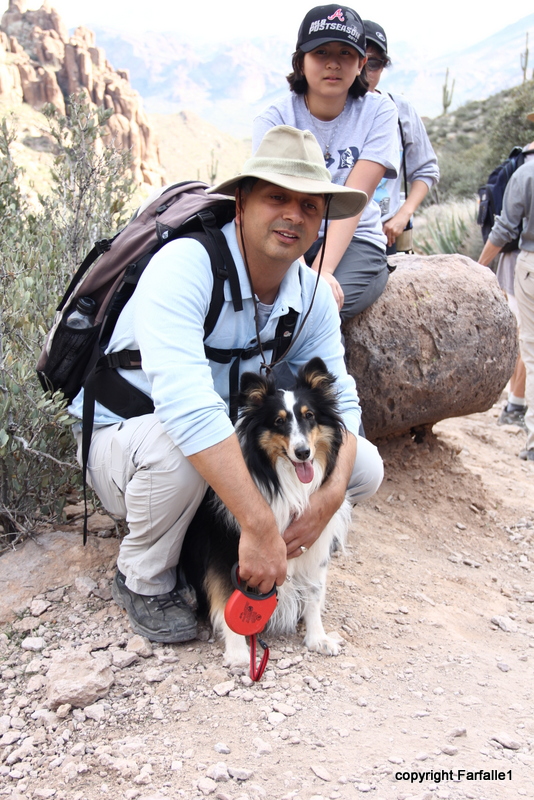
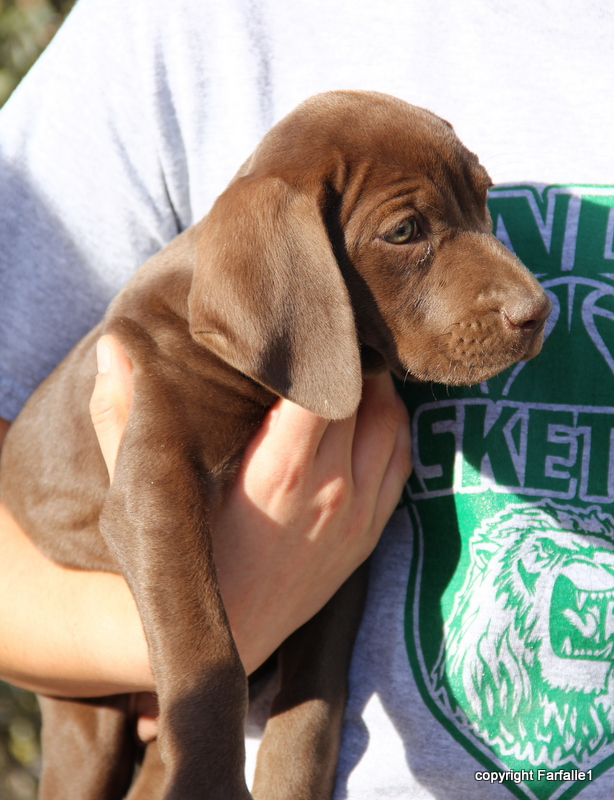
Here’s a small gallery of some of the hikin’ dogs we met today:

Zenzie-001

This is Lola’s friend, and the one dog whose name I can’t remember (and thought I would never forget because it begins with a ‘Z’). Speedy and I have decided to call him Zanzie.

Frankie and Georgie

Here are Frankie and… no, not Johnnie, Frankie and Georgie.

Ginger-001

“You’re speckled!” I said to Ginger, and her human companion said, “Why thank you” – clearly a woman with a good sense of humor.

Pickadilly

Pickadilly was the only long-haired dog we saw on this walk.

Key-001

Key was the last dog we encountered. At 9 weeks she is certainly the youngest hikin’ dog I’ve ever met, and is too irresistable not to include (cross between a Lab and a German Pointer). Hikin’ Dog regulations do not allow inclusion of dogs that are being carried. But though she is not technically a hikin’ dog, her companion assured me she had done some of the trail, just not the steep parts, so she slipped in under the Cute Exemption.

Things That Fly

21 Thursday Mar 2013

Posted by farfalle1 in Animals in the U.S., Birds in the U.S., Golf, Photographs, Uncategorized

≈ 7 Comments

Tags

Birds on golf courses, Painted Mountain Golf Course, SNJ Trainer

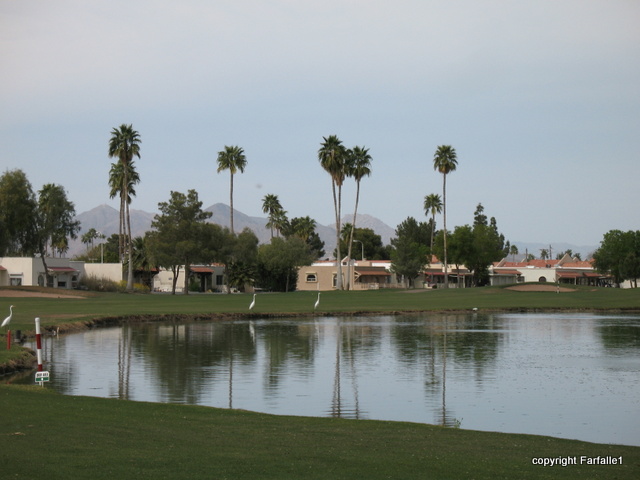
egrets around pond-001

First hole at Painted Mountain Golf Course

When I was growing up we didn’t think much about golf in our family – it was a rich man’s sport and we weren’t rich.  We knew some people who played golf, and some of the boys in my circle of friends caddied on weekends (which made me very envious, because they got $5.00 a round, much better than baby-sitting paid in those days) (girls couldn’t caddy).  There was a lovely golf course in our town, the property of the small liberal arts college there, but we were not members.

Later, when I was a young adult and well into adulthood, I thought golf was the stupidest game in the world.  For starters, you didn’t hit a moving ball – what fun could that be?  Then there was the enormous waste of space – think of all the people who could live on those lovely greenswards.  Criminal!  Later still I reviled the game for the waste of water and energy to maintain the courses, and for the chemicals that are liberally applied to keep the grass so thick and green.  On a much more superficial level I found the clothing worn by golfers hilarious.  White shoes and belts, men in pink trousers (Sheriff Joe would love it) – definitely all fashion ‘don’ts.’

Now I’m an old fart and a seasoned golfer of some three years and I’ve changed my tune.  Speedy, the cause of my descent into the world of golf, and I usually walk when we play; after all, it is meant to be exercise, and a round of golf gives us a good four mile hike.  The game is much more challenging than I ever imagined, and much more fun (on the days when it’s not infuriating). Here in Arizona all the golf courses are watered with ‘reclaimed’ water – not stuff you want to drink.

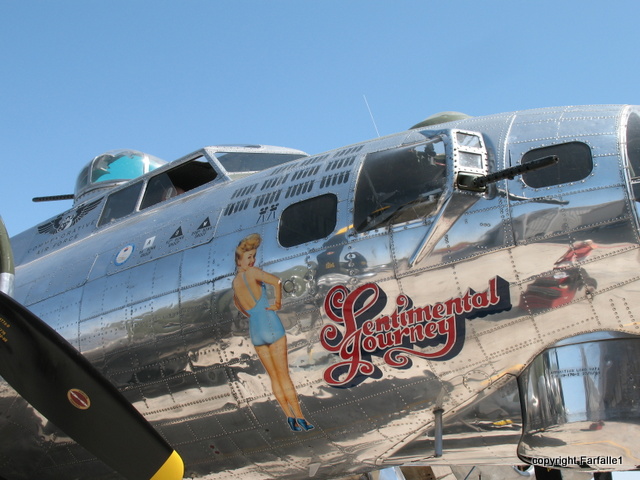
But best of all, for me, is being outdoors for a four-hour stretch, looking at the flowers, the trees, the water (as long as I’m not looking for my ball in the water) and most of all, the things that fly over and around our golf course.  I won’t even bore you with the jets landing at Phoenix Sky Harbor Airport – they are a near constant, though still high enough that their noise is not intrusive; or with the numerous helicopters that fly around – MD Helicopters and Boeing both manufacture whirly-birds, which are frequently given test runs above Mesa.  Of more interest are the historic planes that fly from nearby Falcon Field where there is a museum operated by the Commemorative Air Force.

B-17 Flying Fortress (Sentimental Journey)

Here she is on the ground at the Air Museum:

IMG_2353

bi-plane

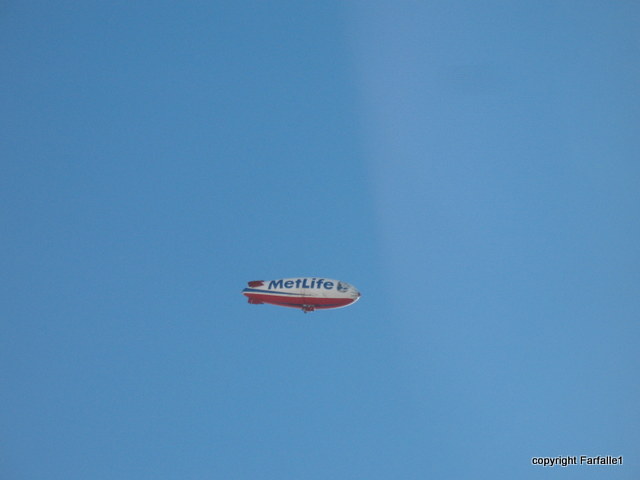
MetLive blimp over golf course-001
This last is not housed at Falcon Field.  The Metlife blimps don’t have permanent homes, but rather stay near the events they are covering. (You can read all about them here.)

But I love the birds we see around the golf course even more than the flyers with engines.  As I began to prepare this post I realized that I’ve got far too many photos of golf course birds to put here, so I’ve made an album which you can see by clicking here (then click ‘slide show’).  I’m not even remotely confident about my bird ID’s, so feel free to correct me.

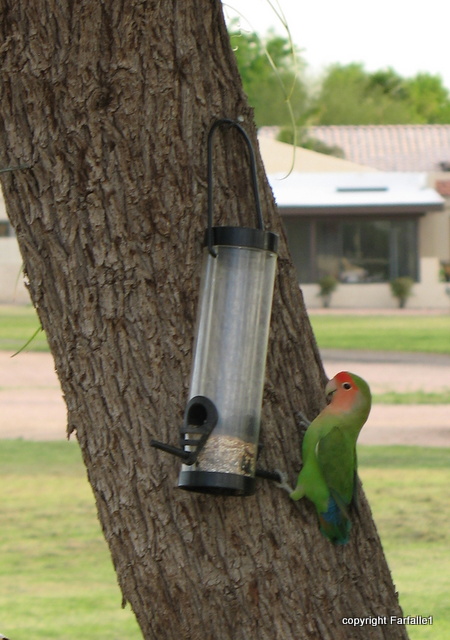
The two birds I love seeing the most are the peach-faced lovebirds which are native to arid regions of Africa and the Phoenix area.  They are popular pet birds, and some most have escaped around here; clearly they’ve been successful in adapting to Arizona life.  They are colorful and congregate in groups; they are tremendously chatty.  It’s not at all unusual to be lining up your golf shot and have a lovebird zoom in front of you about three feet away. Doesn’t this guy have an impish expression??

lovebirds on feeder-008

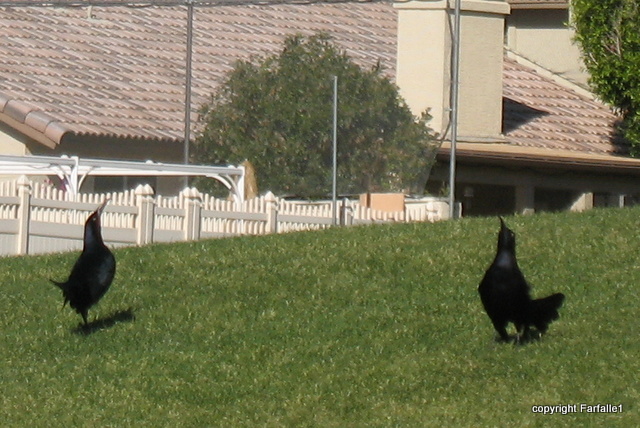
My other favorite to watch is the Great-tailed (or Boat-tailed) Grackle. The female is a rather dull brown-black in color, but the male is glossy black and proud of it.  They stalk around in a show-offy kind of way, and frequently stop and put their heads up in the air as if they were smelling something (if it’s Painted Mountain and 5 p.m. they’re smelling BBQ).

boat tailed grackles-001

This week I got to see what I take to be the mating display of the male. He sat on a tree branch as normal as could be.  Then he ruffled out all his breast feathers, as if he were taking a deep breath, which he then held for a moment as he opened his beak.  At last he spoke – or rather sqawked, because that is the sound they make.  He alternated between the usual squawk and a sort of whistle.  The Cornell Ornithology Lab has a terrific web site where you can hear a lot of different birds, including the grackle – but I have to say, I think the ones on our golf course have a lot more raucaus call than those the lab recorded.

Here are a couple of other bird pictures which I hope will encourage you to look at the rest in the web album.

coots graze-002

The coots are very entertaining as well, mostly because they are called coots, and when they get in your way you can say, “Watch out, you coots!”

ducklings-10

Is there any place in the world where mallards are not at home?

Things that fly – the sky is full of them, and so are the golf-course ponds.  There is always something wonderful to look at to distract you from actually playing the game.

We Bought a Basil Plant, We Got Birds – Guest Post by Speedy

05 Thursday Apr 2012

Posted by farfalle1 in Animals in the U.S., Birds in the U.S., Uncategorized

≈ 12 Comments

Tags

Gambel's quail, Quail egg incubation, Quail eggs

Along about mid-December, during a relatively warm spell, we got optimistic and bought a basil plant to keep outdoors.  It was all downhill from there.  The weather not only slowly changed but this winter, most unusually, we had  six Pacific cold fronts come through.  We’ve had weather, including temperatures below freezing, thunderstorms with hail, and high winds.  There were very warm spells in between but it was all too much for our little basil plant.

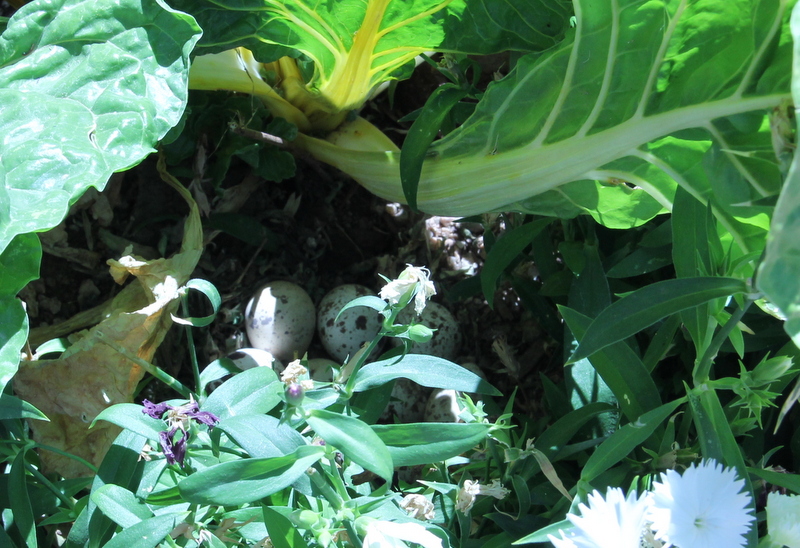
We planted it  in a large, deep terra cotta pot, along with some mixed flowers–which did very well indeed.  This pot is about three feet from the sliding glass door that gives entry to the kitchen from our deck.  The basil withered and slowly disappeared.  But, lo!, it disappeared not only from the dwindles but because in its spot arose a number of huge Swiss Chard leaves which took over the whole back half of the pot.  Well, cool, we love Swiss Chard.  In fact, your regular author bought a nice bundle of same yesterday and then went out to harvest the enormous leaves (that had clearly come from seeds in the basil cup) to make up a nice mess of greens to go with our fried cod.

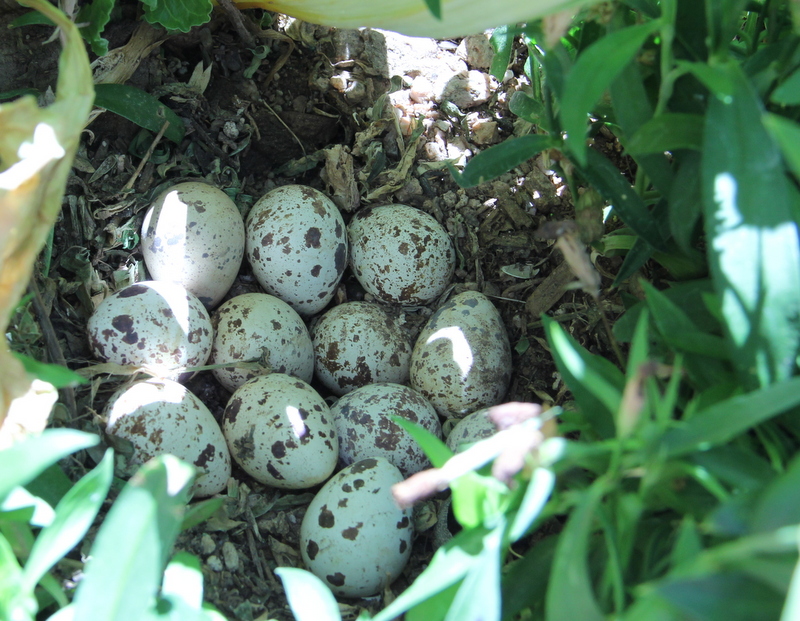
She found she could not bring herself to do so.  Under the shade of the chard, in an ingeniously arranged bowl in the earth, she found seven Gambel’s quail eggs.  Now, why in the world would a quail select a flower pot, just a few feet from our kitchen, as her nesting spot?  Hummmmmmm. It might make sense.  The coyotes use the field next to us as their primary market of delicacies, among which have to be the scores of quail that live there.  We hear their howls during the middle of the night. Smart mother Quail!  Her nest is in a fenced courtyard!

From that moment until now, there has been no sighting of mother quail, even at 3 AM when I got up to check.  But, wait!   Fern told me that there were seven eggs.  I found nine this morning.  There were ten at midday and a check just now showed eleven eggs.  Something very fishy is in the works.

Seeking knowledge, that I did not readily find on the Internet, I telephoned the East Valley Wildlife Center, to which I was referred by the Arizona Humane Society.

All OK!  The rig is that a Gambel’s hen does not sit and incubate her eggs until they are all laid–usually about fifteen of them.  Only then is it time to get to the sedentary part–with help yet.  Dad does his duty and sits as well.  The incubation period is 21-23 days.  And when they hatch, the chicks, after drying off for a short while, are ready to march off, under the watchful eyes of the proud parents.

We may have to delay our return to Italy.  The suspense of not knowing the results of this extraordinary act of creation would be more than we could handle.


Yes, you counted correctly.  We’re up to twelve.  Stay tuned…

Dirty Dogs

07 Tuesday Feb 2012

Posted by farfalle1 in Animals in the U.S., Dogs, Uncategorized

≈ 5 Comments

Tags

Auto Dog Wash, Dog Wash, gold canyon arizona

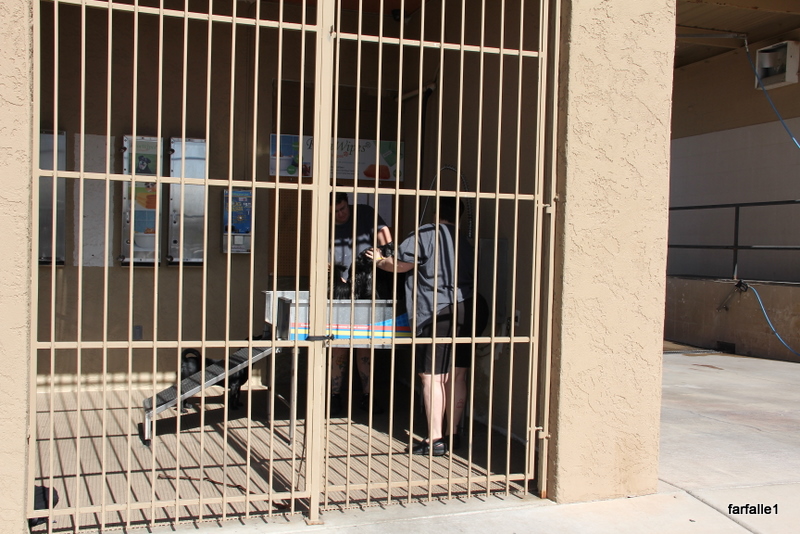
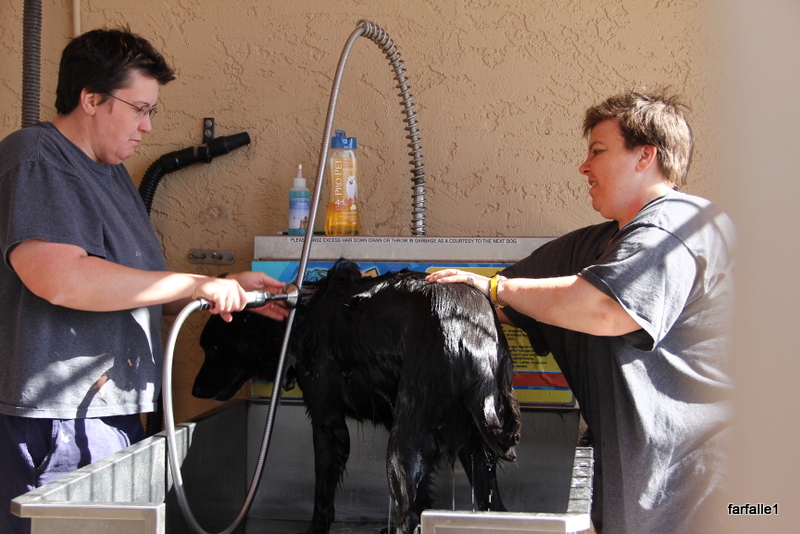
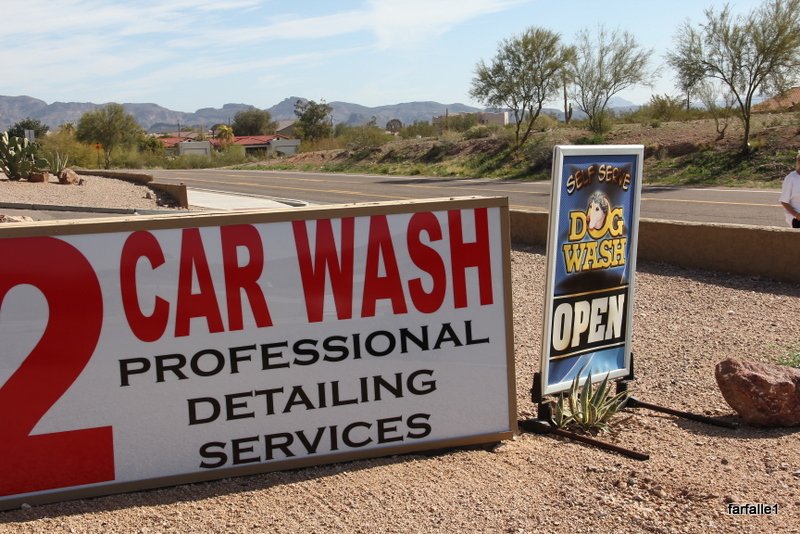
If it’s a slow day in Gold Canyon, Arizona, as frequently happens, you can just amble down the street to the local Dog Wash. You heard me, pardner, I said ‘dog wash.’

It is nothing if not entertaining to watch pooches in various degrees of dinginess, walk the plank and into the sink.

The dog wash provides everything you need, including shampoo, water, towels and even a blow dryer. At $5.00 a pop it is probably a lot cheaper than taking Bowser to the groomer. The sign suggests that Miss Kitty might like a bath as well, but anyone who has ever shared living quarters with a cat knows better.

It’s not nice to chuckle over some other critter’s misery, but it’s hard to keep a straight face when watching the normally bouncy Bowser put on a long-suffering and patient face. You can almost hear him thinking, can’t you? ‘Why are they doing this to me??? I thought they loved me!’ You can also see immediately that the expression ‘hangdog’ originated in the Dog Wash.

Never fear, handsome Bowser, when you are all fluffed and buffed your cheerful disposition will return. You will frolic around happily, play with your mistress, and then run out to the desert where you will find a nice big cow plop to roll in. Then you know what will happen? It’s back to the dog wash for you! And maybe this time mistress will wash the Honda, too.

PS… if you’d like to see some photos of Arizona Hiking Dogs and their people, click here.

Songbirds: Friends or Food?

04 Wednesday Jan 2012

Posted by farfalle1 in Animals in Italy, Animals in the U.S., Birds in Italy, Crime, Customs, Italy, Uncategorized

≈ 10 Comments

Tags

Bird-feeding, Feeding Birds, Hunting in Italy, Hunting songbirds in Italy, Illegal hunting in Italy, Trapping songbirds in Italy

Somehow it’s hard to think of chickens and turkeys as birds.  Sure, they have feathers, but we never see a flock of them high overhead, migrating south for the winter, their clucking stirring our own restlessness.  Nor do we startle them when we take a walk in the woods.  We don’t listen for their sweet morning calls and try to identify exactly what chicken it is we’re hearing.  Wait!  Is that a Rhode Island Red or an Ameraucana?  Hand me my binoculars!

No.  Chickens and turkeys are ambulatory food for the most part.

Songbirds, however, are not.  One of the  pleasures of being here in Arizona is watching the birds that come to our feeder every day.

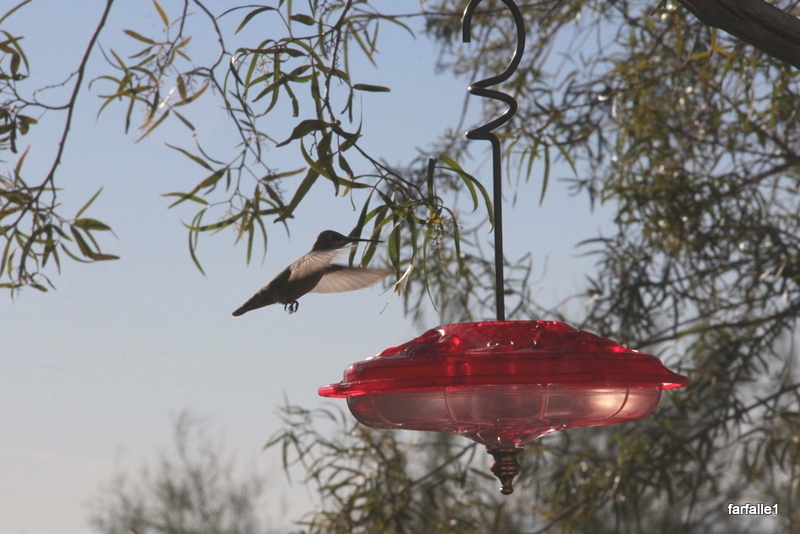
Anna's hummingbird, noisy and aggressive

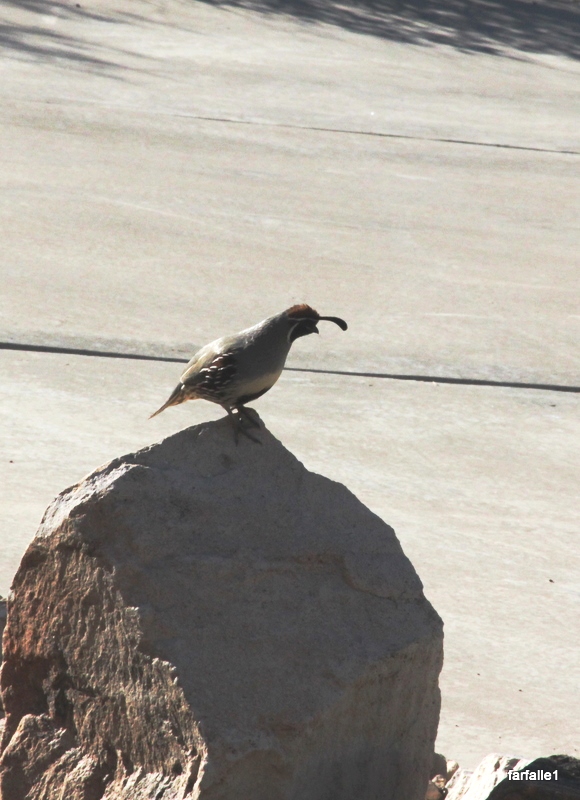
We don’t get anything terribly exotic (and we have yet to see a chicken) –  many purple finches, the ubiquitous Anna’s hummingbird, Abert’s towhee , Gila peckers, Cactus wrens, and, on the ground below, Inca doves and the amusing Gambel’s quail, which makes a bweep-bweeping sound, reminiscent of burbling water, while it wanders around beneath the feeder.

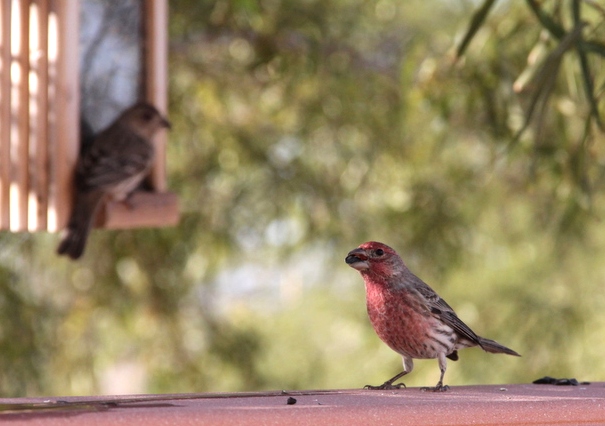
Male finch enjoying a seed while female thinks about it

Gambel's quail, males conveniently carry bulls eye on their breasts

It’s a pleasure we don’t enjoy in Italy.  Not because there are no songbirds – there are.  We get huge amusement and satisfaction from the merli (a sort of black robin with the unfortunate Latin name Turdus merula, called ‘merlo’ in the singular) which are curious and companionable, and which have the beautiful song typical to thrushes.  We seldom work outside in spring or summer without an appreciative audience of merli.  But bird-feeding as a hobby does not seem to exist in Italy, at least not in our part of the country.  I have never seen a bird-feeder at anyone’s house, and I have never seen bird feed for sale.

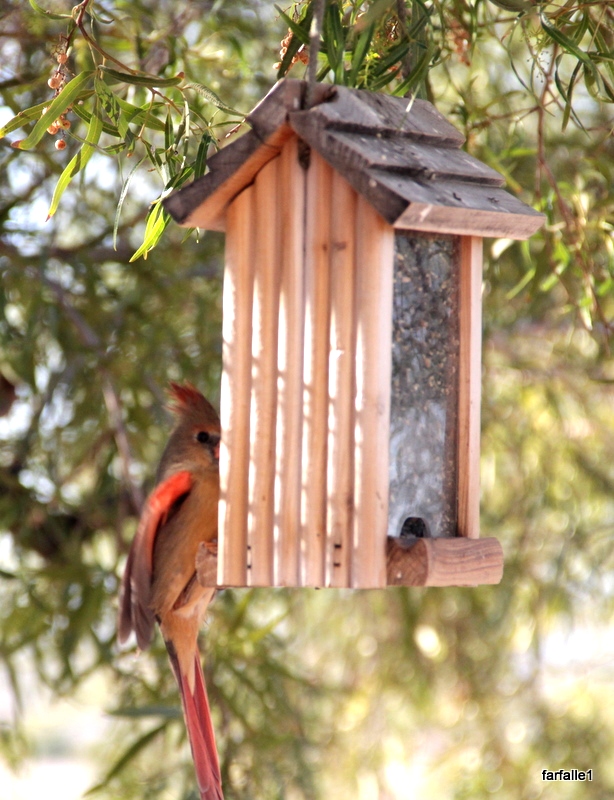
Male cardinal

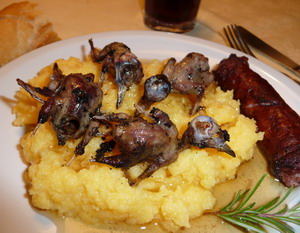
Instead in Italy there is a sizable, though fortunately shrinking, trade in trapping and killing wild birds.  The CABS (Committee Against Bird Slaughter) web site has a great deal of information about the illegal trapping of birds which occurs, in Italy, mostly in the north (Lombardia), the southern Italian coast, Sardinia and Sicily.  There are a couple of good reasons why this illicit activity continues.  One is that it is a matter of long tradition to trap songbirds, and Italy is nothing if not wed to her traditions.  In earlier times songbirds were an important source of protein for hungry Italians. Another reason is that some restaurants persist in serving songbirds, though you will never see them on the menu.

Little birds with polenta, photo courtesy of CABS

Happily, CABS reports that hunting songbirds is truly on the wane in northern Italy, a trend we can only hope (or I can only hope, anyway) will continue.

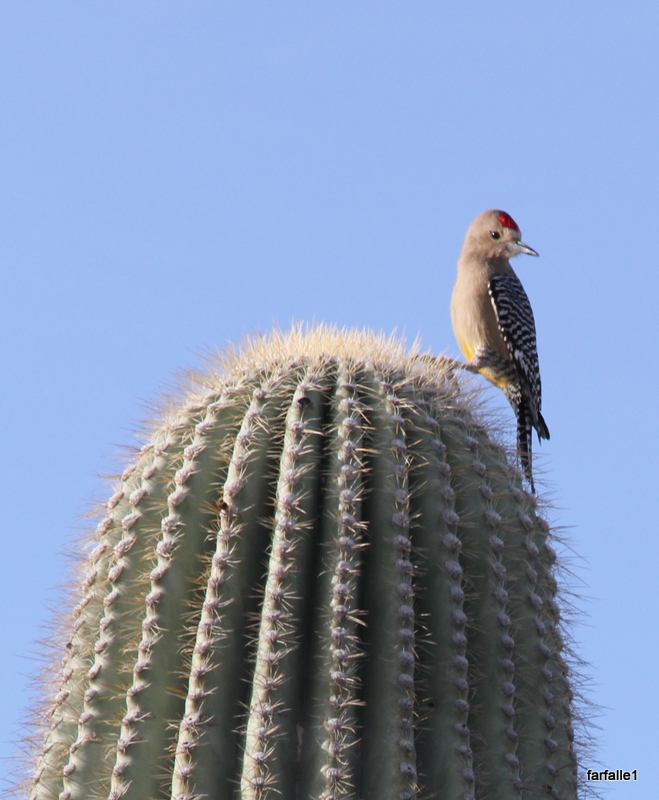
Gila woodpecker atop a nearby cactus

Hunting for sport is as popular in the U.S. as it is in Italy.  In 2006, according to the U.S. Fish and Wildlife Service, 2.3 million people hunted migratory birds such as doves or waterfowl.  Such hunting is highly regulated; hunters must have appropriate licenses and stamps, and can hunt only certain birds in certain places at certain times.  Sport hunters in both countries are generally dedicated and law-abiding conservationists, interested in protecting the populations of the species they like to hunt.  In a perfectly counter-intuitive bit of logic, sometimes bird populations must be ‘culled’ in order to protect the well-being of the species.  It makes no sense to me, but if the people at Audubon say it’s true, it must be true.  Mustn’t it?

No doubt there is illegal hunting in the U.S., but it is difficult to get away with it.  Some years ago when we lived in Connecticut a man of our acquaintance became very angry at the number of messy geese on his pond and lawn.  He got out his rifle, stood on the back porch and shot one, no doubt hoping to scare away the others.  His neighbors heard the shot and came running to find out what was wrong, so he was caught red-handed.  He did not go to prison, but he did have a reprimand and a sizable fine.  Even worse, he became known locally as ‘Goose Killer’ – and it was not the sort of affectionate and admiring nickname that, say, ‘Speedy’ is.

The illegal taking of birds in Italy is of a different order entirely.  According to CABS, ‘millions’ of birds are taken every year, hundreds of thousands of them in Northern Italy.  They are sometimes taken with guns, as in the wholesale slaughter of migrating birds videoed here (supposedly ‘legal,’ but against the very EU regulations Italy signed on to uphold), and frequently taken in any of several various types of traps, all of which are illegal (bow, snap, snare, cage and nets).

It’s hard to understand what the appeal or pleasure is in trapping or shooting  songbirds.  It’s not as if they’re particularly challenging prey, or especially meaty.  The declining number of traps in Italy attest to the gradual change of attitude towards this cruel practice; but it remains a big problem.

Male finches 'discuss' seating while a female thinks about it all

According to Wikipedia 55 million Americans are bird-watching hobbyists.  They spend $3 billion a year on seed and $800,000 million on bird feeders and other accessories.  Maybe there’s an opportunity here to help the struggling Italian economy.  Don’t kill the birds, feed them. Photograph them.   Enjoy them.  Encourage touristic bird-watching trips. And when the irresistible blood lust of the hunter comes over you, go down to Signore Marrone’s farm and bag a few chickens.

Cluck!

11 Sunday Dec 2011

Posted by farfalle1 in Animals in the U.S., Arizona, Photographs, Uncategorized

≈ 8 Comments

Tags

Chicken coops, chickens, hens, Raising hens, Tour de Coops, Valley Permaculture Alliance

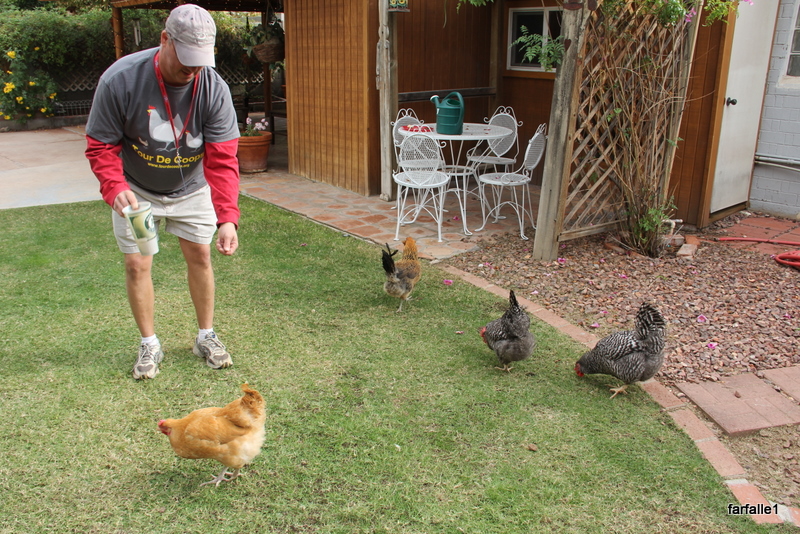
Chicken people are happy people.  My intrepid friend Mrs. H and I learned this when we went to downtown Phoenix last weekend for the third annual Tour de Coops. That’s right, downtown Phoenix! Urban agriculture is alive and well in the Valley of the Sun, in part due to the efforts of the Valley Permaculture Alliance, under whose auspices the Tour is sponsored.

Twenty-one generous chicken farmers opened their coops to several hundred visitors, all of whom probably asked the same tiresome questions. How many chickens do you have? (anywhere from three to a dozen or so); how old are your chickens? (anywhere from six months to eleven years); do you eat your chickens? (yes. no.);  how many eggs do you get a day? (in general about two eggs for every three chickens);  what are the names of your chickens? (way too many to list; some of my favorites were  Itchy, Lafawndut, St. Alfonso’s Pancake Breakfast, Waffles, Tika, Roti and Catchatori); is it really fun to have chickens in the back yard? (YES!)


The Tour was meticulously organized. Tourists registered at one of two starting points where they were given a muslin shopping bag containing water and chick feed (thank you Fresh Foods and Nutrena) and a thirty-two page directory of the Coops on the tour which was a model of clarity. Each coop location had its own page with a map indicating its location and a brief description of the coop and its inhabitants.

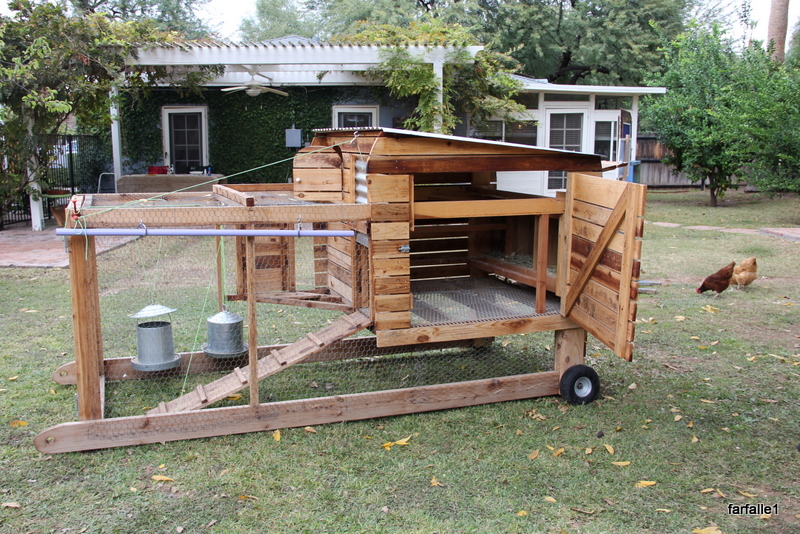
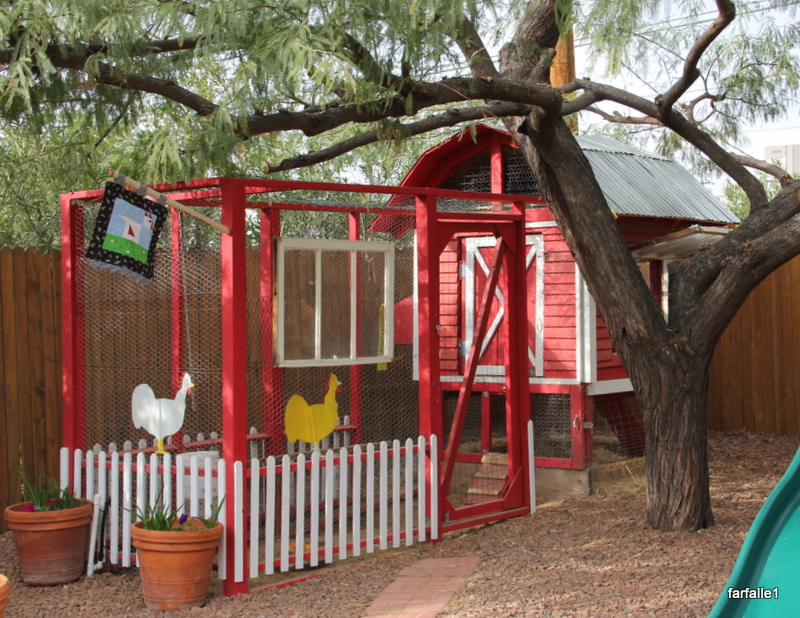
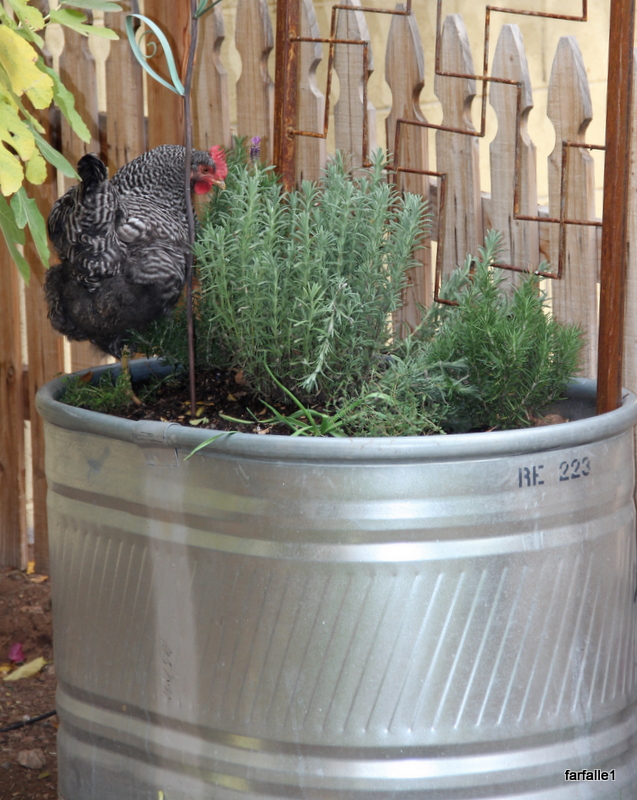
Mrs. H and I did not have time or energy (mostly energy) to visit all twenty-one coops, but were mightily impressed by the ones we did see. Coops come in all sizes and shapes, and are as diverse as the people who devise them. The first coop we visited was belonged to Maggie and Bjorn Olson. It was the only portable coop we saw:

The Van Slyke coop is renowned for its chandelier:

The Poulins pay homage to their roots in Vermont and New York with their barn-like coop:


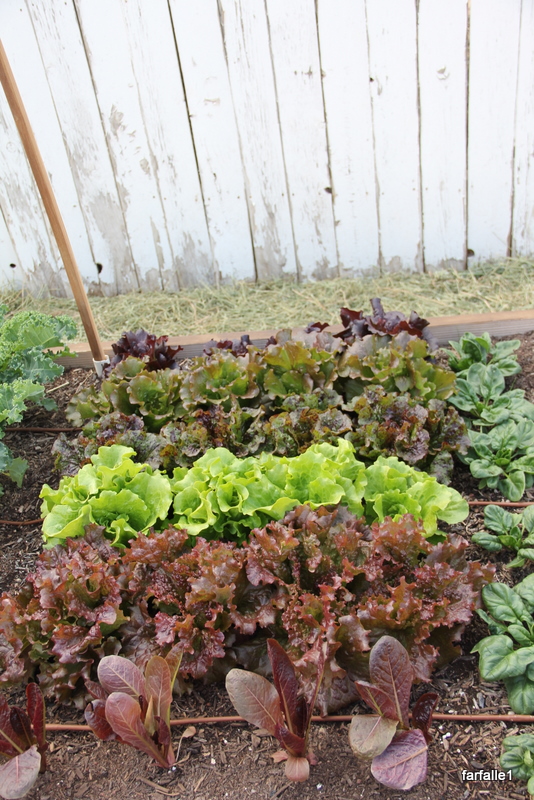
As diverse as the Chicken People are, they all share an interest in sustainable living and in gardening (what else are you going to do with the chicken poop?). Whether on the ground or in raised beds, the veggies these families are growing are uniformly robust and appetizing.

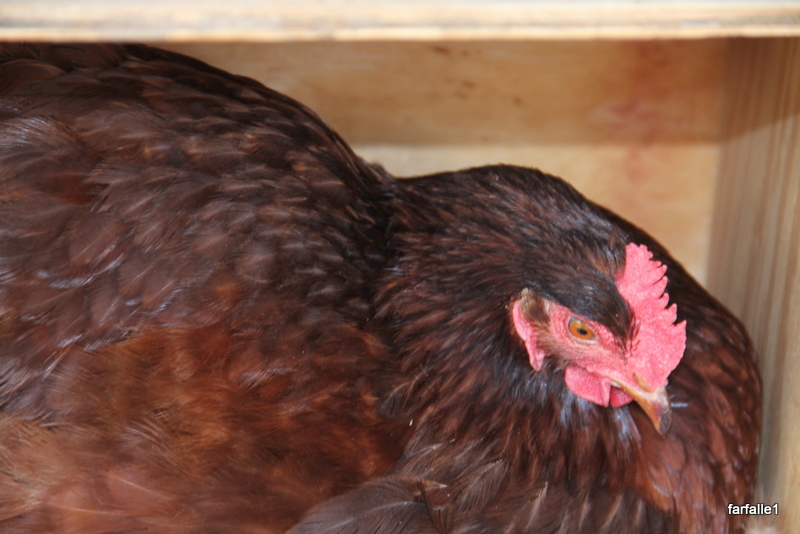
But I digress. Let’s get back to the hens and their houses. Each coop we saw had several nesting boxes where the girls take turns laying their eggs. By the way, egg production is the impetus for a huge amount of self-congratulatory clucking. The Taylors were dealing with a broody hen in one of their boxes:


Every now and then a hen just decides that she must sit on her egg(s) and will peck at anyone who tries to remove them. Fortunately hens are not the smartest birds in the world, and a plastic egg or even a golf ball will satisfy a broody bird. (This is, in fact, the genesis of all those plastic eggs that children receive at Easter. They are hatched from other plastic eggs by broody hens. The chocolate inside them, as we all know, is from the bunnies. But again, I digress.)

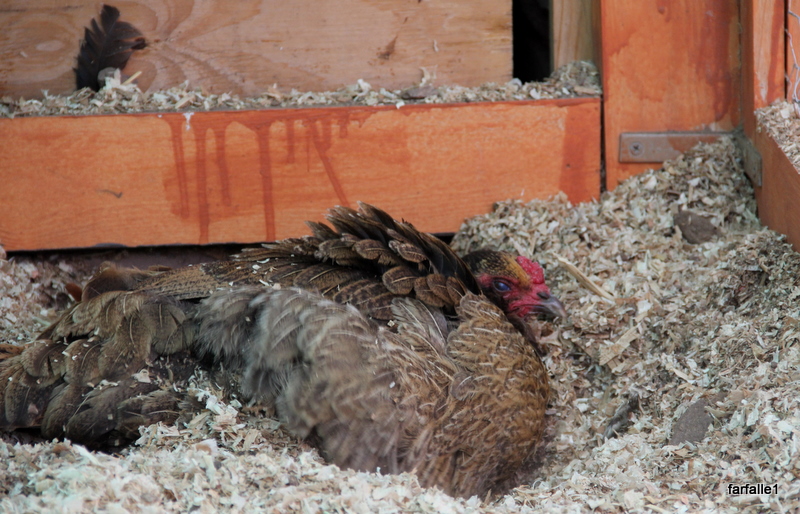
Each coop has an integral yard outside the structure itself. Like all of us, hens like to move around and need a little space in which to do so. They like to take dirt, dust, or sawdust baths to clean themselves – they fluff around in the dirt, the what-ever-it-is they want to get rid of sticks to the dirt, and then they groom out the whole business from their feathers.

Most of the owners let their hens out to ‘free-range’ for at least part of the day. Depending on the neighborhood they may or may not need supervision. Watchful chicken parents are not worried about gangs or drugs; those close to the city worry about the peregrine falcons that now hunt from the tall buildings.

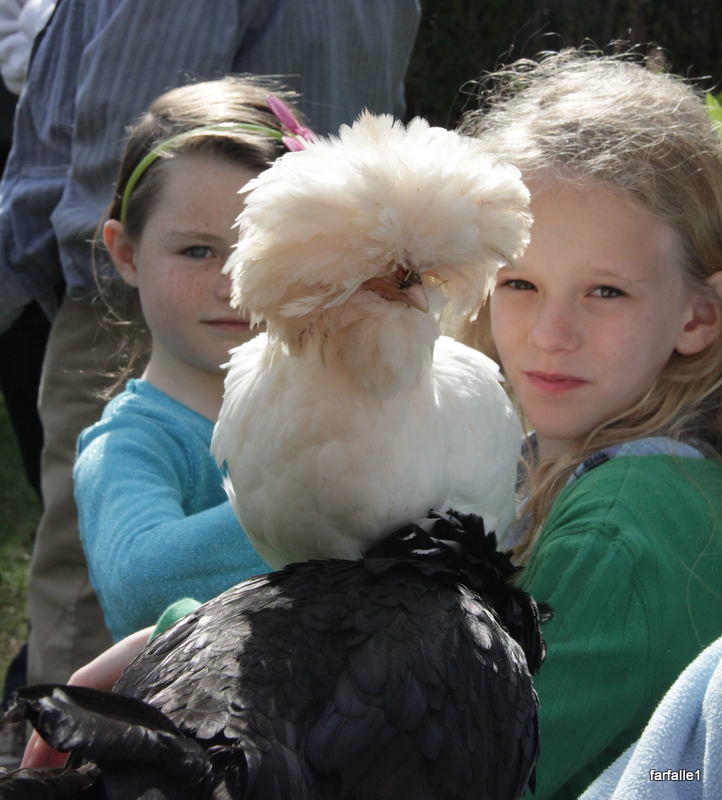
We saw quite a variety of chicken breeds. The most common were probably the Barred Rocks, the Ameraucana, and the Buff Orpingtons. At the Perry house we saw exotic and silly looking polish hens:

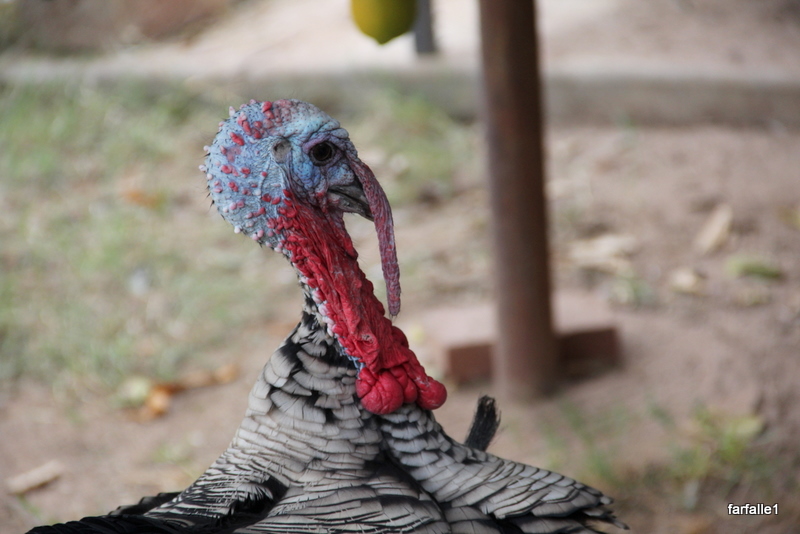
And at the Olesen house we admired a pair of turkeys. They turn blue when they’re upset or uneasy. Probably the combination of all the guests and the proximity to both Thanksgiving and Christmas ruffled their feathers.

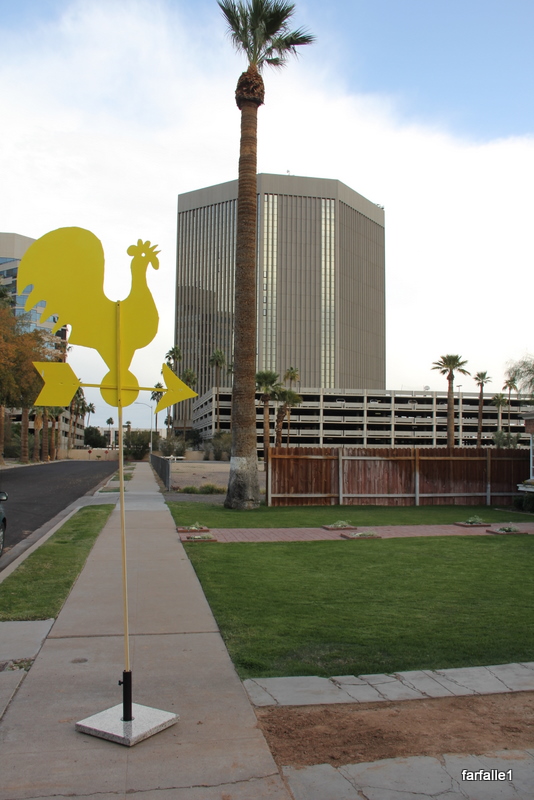
I’d like to say a few more words about the organization of the Tour, because it really impressed us. Each house was identified by a large yellow chicken cut-out sign, which was very helpful as we drove down unknown streets hunting for house numbers.

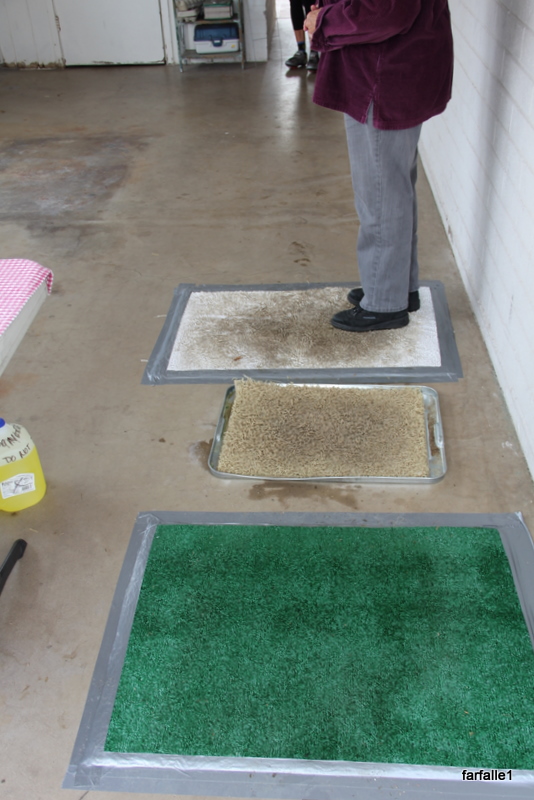
Volunteers staffed a table in front of every house to check visitor bracelets and to ensure that every visitor stepped through the foot bath and used the hand sanitizer.

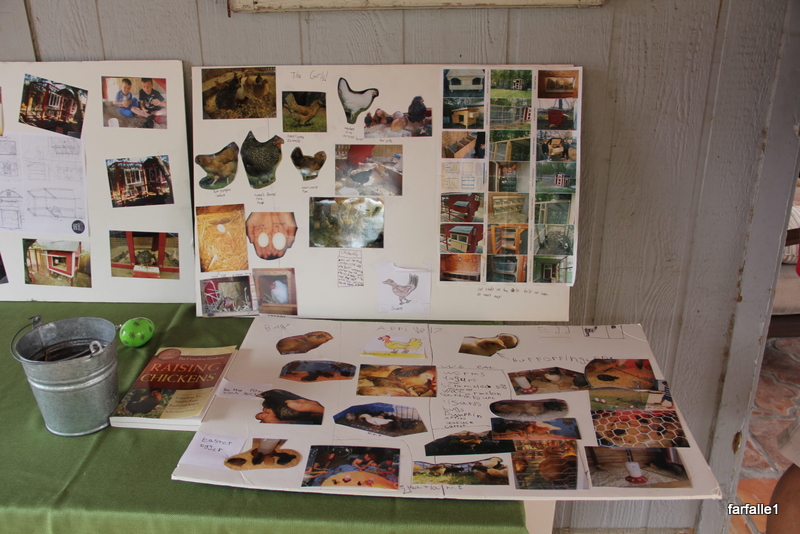
All the owners were on hand to talk about their hens, and many had posters describing the various chicken breeds present. Some of these posters were made by grown-ups, some by children, and at the Williams house the hens did all the work.


If you are interested in more photographs from the Tour de Coops, pop on over here and select the slide show option.

If you are interested in more information on the Valley Permaculture Alliance (“committed to promoting the conscious design of cultivated urban ecosystems to include diversity, stability and resilience”), visit their web-site here, where you can find out more about their mission and the many classes they offer in its service.

← Older posts
Newer posts →

Enter your email address to follow this blog and receive notifications of new posts by email.

Join 114 other subscribers

rss

Subscribe in a reader

Search the Blog

A. Useful Links

  • bab.la language dictionary
  • Bus schedules for Tigullio
  • Conversions
  • English-Italian, Italian-English Dictionary
  • Expats Moving and Relocation Guide
  • Ferry Schedule Rapallo, Santa Margherita, Portofino, San Frutuoso
  • Italian Verbs Conjugated
  • Piazza Cavour
  • Rapallo's Home Page – With Link to the Month's Events
  • Slow Travel
  • The Informer – The Online Guide to Living in Italy
  • Transportation Planner for Liguria
  • Trenitalia – trains! Still the most fun way to travel.

C. Elaborations

  • A Policeman’s View
  • Driving School Diary
  • IVA refunds due for past Rifiuti tax payements
  • Nana
  • Old trains and old weekends
  • The peasant, the Virgin, the spring and the ikon
  • Will Someone Please, Please Take Me to Scotland?

D. Good Recipes - Best of the Week winners are starred

  • 'Mbriulata
  • *Baked Barley and Mushroom Casserole*
  • *Captain’s Boston Baked Beans*
  • *Crimson Pie*
  • *Louise’s Birthday Cake*
  • *Melanzane alla Parmigiana*
  • *Penne with Cabbage and Cream
  • *Pizzoccheri della Valtellina*
  • *Pumpkin Ice Cream*
  • *Risotto alla Bolognese*
  • *Rolled Stuffed Pork Roast*
  • *Spezzatini di Vitello*
  • *Stuffed Grape Leaves*
  • *Stuffed Peaches (Pesche Ripiene)*
  • *Swordfish with Salsa Cruda*
  • *Tagliarini with Porcini Mushrooms*
  • *Tagliatelli al Frutti di Mare*
  • *Three P's Pasta*
  • *Tzatziki*
  • 10th Tee Oatmeal Apricot Bars
  • Adriana’s Fruit Torta
  • Aspic
  • Bagna-calda
  • Best Brownies in the World
  • Clafoutis
  • Cold cucumber soup
  • Crispy Tortillas with Pork and Beans
  • Easy spring or summer pasta
  • Fish in the Ligurian Style
  • Hilary's Spicy Rain Forest Chop
  • Insalata Caprese
  • Lasagna al forno
  • Lasagna al Forno con Sugo Rosato e Formaggi
  • Lemon Meringue Pie
  • Leo’s Bagna Cauda
  • Leo’s Mother’s Stuffed Eggs
  • Louis’s apricot chutney
  • Mom's Sicilian Bruschetta
  • No-Knead (almost) Bread
  • Nonna Salamone's Christmas Cookies
  • Pan Fried Noodles with Duck, Ginger, Garlic and Scallions
  • Pesto, the classic and original method
  • Pesto, the modern, less authentic method
  • Pickle Relish
  • Poached pears
  • Poached Pears
  • Polenta Cuncia
  • Recipes from Paradise by Fred Plotkin
  • Rustic Hearth Bread
  • Shrimp and Crayfish Tail Soup
  • Sicilian salad
  • Slow Food Liguria
  • Slow Food Piemonte and Val d'Aosta
  • Spinach with Garlic, Pine Nuts and Raisins
  • Stuffed Eggs, Piemontese Style
  • The Captain’s Salsa Cruda
  • Tomato Aspic
  • Zucchini Raita

E. Blogroll

  • 2 Baci in a Pinon Tree
  • Aglio, Olio & Peperoncino
  • An American in Rome
  • Bella Baita View
  • Debra & Liz's Bagni di Lucca Blog
  • Expat Blog
  • Food Lovers Odyssey
  • Italian Food Forever
  • L’Orto Orgolioso
  • La Avventura – La Mia Vita Sarda
  • La Cucina
  • La Tavola Marche
  • Rubber Slippers in Italy
  • Southern Fried French
  • Status Viatoris
  • Tour del Gelato
  • Weeds and Wisdom

Photographs

  • A Day on the Phoenix Light Rail Metro
  • Apache Trail in the Snow
  • Aquileia and Croatia
  • Birds on the Golf Course
  • Bridge Art
  • Canadair Fire Fighters
  • Cats of Italy
  • Cloudy day walk from Nozarego to Portofino
  • Fiera del Bestiame e Agricultura
  • Football Finds a Home in San Maurizio
  • Hiking Dogs
  • Mercatino dei Sapori – Food Fair!
  • Moto Models
  • Olive pressing
  • Rapallo Gardens
  • Rapallo's Festa Patronale
  • Ricaldone and the Rinaldi Winery
  • Rice Fields
  • Sardegna ~ Arbatax and Tortoli
  • Sardegna ~ San Pietro above Baunei
  • Sardegna ~ The Festa in Baunei
  • Scotland, including Isle of Skye
  • Slow Food 2008 Salone del Gusto
  • The Cat Show and the Light Rail Fair
  • The desert in bloom
  • Trip to Bavaria

Pages

  • Fagioli all’ucelleto

Archives

Recent Posts

  • A Superior Visit
  • Fun at the Ranch Market
  • The MAC
  • Welcome Tai Chi
  • Bingo Fun for Ferals
December 2025
M T W T F S S
1234567
891011121314
15161718192021
22232425262728
293031  
« Jul    

Member of The Internet Defense League

Blog at WordPress.com.

  • Subscribe Subscribed
    • An Ex-Expatriate
    • Join 114 other subscribers
    • Already have a WordPress.com account? Log in now.
    • An Ex-Expatriate
    • Subscribe Subscribed
    • Sign up
    • Log in
    • Report this content
    • View site in Reader
    • Manage subscriptions
    • Collapse this bar
 

Loading Comments...