• Contact
  • Elaborations
    • A Policeman’s View
    • Driving School Diary
    • Great Danes
    • IVA charged on Tassa Rifiuti
    • Nana
    • Old trains and Old weekends
    • The peasant, the virgin, the spring and the ikon
    • Will Someone Please, Please Take Me to Scotland??
  • Recipes
    • ‘Mbriulata
    • *Baked Barley and Mushroom Casserole*
    • *Captain’s Boston Baked Beans*
    • *Cherry Tart*
    • *Crimson Pie*
    • *Louise’s Birthday Cake*
    • *Melanzane alla Parmigiana* – Eggplant Parmesan
    • *Penne with Cabbage and Cream
    • *Pizzoccheri della Valtellina*
    • *Pumpkin Ice Cream*
    • *Risotto alla Bolognese*
    • *Rolled Stuffed Pork Roast* on the rotisserie
    • *Shrimp and Crayfish Tail Soup*
    • *Spezzatino di Vitello*
    • *Stuffed Grape Leaves*
    • *Swordfish with Salsa Cruda*
    • *Tagliarini with Porcini Mushrooms*
    • *Tagliatelli al Frutti di Mare*
    • *Tzatziki*
    • 10th Tee Apricot Bars
    • Adriana’s Fruit Torta
    • Artichoke Parmigiano Dip
    • Best Brownies in the World
    • Clafoutis
    • Cod the Way Sniven Likes It
    • Cold Cucumber Soup
    • Crispy Tortillas with Pork and Beans
    • Easy spring or summer pasta
    • Fagioli all’ucelleto
    • Fish in the Ligurian Style
    • Hilary’s Spicy Rain Forest Chop
    • Insalata Caprese
    • Kumquat and Cherry Upside Down Cake
    • Lasagna Al Forno con Sugo Rosato e Formaggi
    • Lemon Meringue Pie
    • Leo’s Bagna Cauda
    • Leo’s Mother’s Stuffed Eggs
    • Louis’s Apricot Chutney
    • Mom’s Sicilian Bruschetta
    • No-Knead Bread (almost)
    • Nonna Salamone’s Famous Christmas Cookies
    • Pan-fried Noodles, with Duck, Ginger, Garlic and Scallions
    • Pesto
    • Pesto
    • Pickle Relish
    • Poached Pears
    • Polenta Cuncia
    • Pumpkin Sformato with Fonduta and Frisee
    • Rustic Hearth Bread
    • Sicilian Salad
    • Soused Hog’s Face
    • Spotted Dick
    • Swedish Tea Wreaths
    • The Captain’s Salsa Cruda
    • Tomato Aspic
    • Vongerichten’s Spice-Rubbed Chicken with Kumquat-Lemongrass Dressing
    • Winter Squash or Pumpkin Gratin
    • Zucchini Raita

An Ex-Expatriate

~ and what she saw

An Ex-Expatriate

Category Archives: Arizona

Not Enough of Most Things, Too Much of Some

12 Wednesday Feb 2014

Posted by farfalle1 in Arizona, Eating out in Arizona, Health and health care, Uncategorized

≈ 12 Comments

Tags

Feeding America, Feeding the Hungry, Food Bank, Food Banks, Hungry Children, United Food Bank

Food Bank. What pops into your head when you hear those words? For me it’s an image of a small room, probably part of a church or social agency, shelves lining the walls laden with boxes and tins of food, some dusty, some out-of-date. In my imagination it’s open a few days a month, and a stream of hungry people trudge in and out, arriving empty-handed and leaving with a brown paper bag of food. Other more fortunate people have bought extra when they did their own marketing and dropped it off, or a local group had a food drive and donated the gleanings to the Food Bank, or someone cleaned out her cupboards and got rid of unwanted items.

Well no, Expatriate. That’s not quite how it is. You may remember reading about the great fun we have picking fruit for the food bank on winter Fridays. It was the subject of a post here at just about this time last year. This year a group of us pickers had the great good fortune to be given a tour of the United Food Bank (for whom we pick), an operation that is almost the exact opposite of my imagined picture.

Here we are outside the United Food Bank warehouse. Yes, you read that correctly, warehouse.
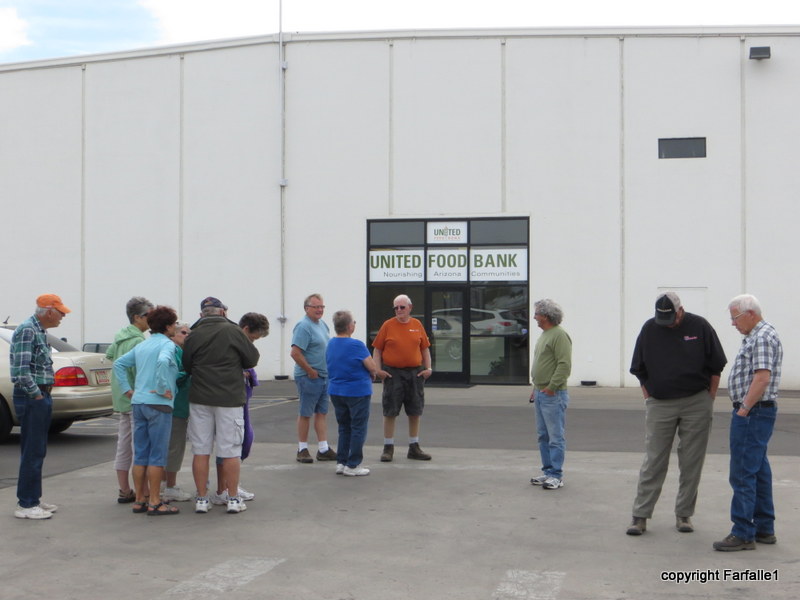
United Food Bank Tour

The United Food Bank serves almost one-quarter of the state of Arizona:
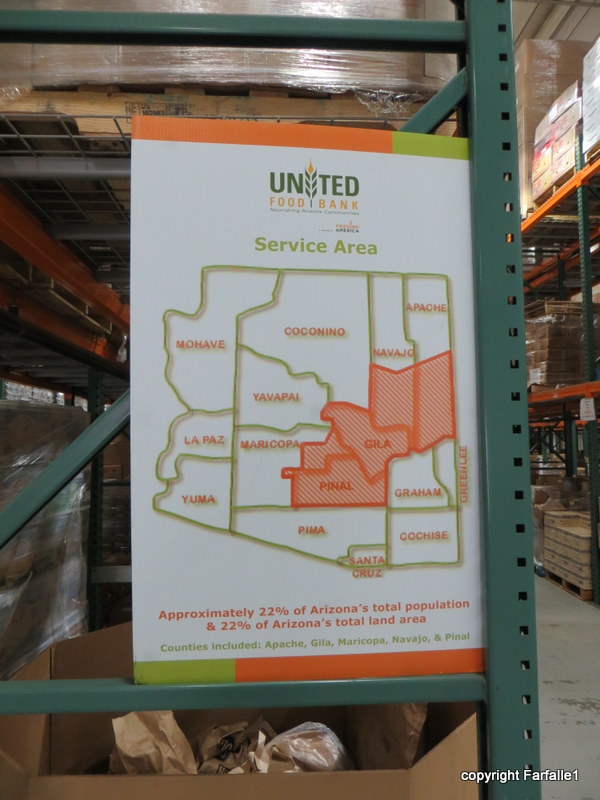
United Food Bank Tour service area

It was organized in 1983 as a joint venture among East Valley cities and their respective United Ways to gather and distribute food to organizations; today they serve upwards of 200 food banks in the region. They do not distribute food to individuals from this warehouse, but instead organize and ship it to those who do.

Here is Melissa, one of only about twenty-four paid employees who handle this large business. She is explaining to us why our fruit-picking operation is in jeopardy (I’ll tell you later).
United Food Bank Tour melissa explains Some of the astonishing facts she told us are:

1. 1 in 5 Arizona residents lives in poverty, 1 in every 4 children under the age of 18 lives in poverty (Arizona is tied as the worst state in the union when when it comes to child hunger, and the 5th worst for overall food insecurity rates).

2. 1 in 4 children, 1 in 5 adults, and 1 in 7 seniors in Arizona struggle with hunger.

3. More than 888,000 individual Arizonans receive emergency food assistance every year.

4. United Food Bank distributes over 51,100 meals every single day of the year through its affiliated food banks.

5. That works out to almost 1.5 million pounds of food every month, which are some 500,000 pounds fewer than the need.

6. The greatest influx of assistance to the Food Bank comes in November and December. The greatest need occurs in the summer, when the children do not receive a daily meal at school.

Speaking of school, the Food Bank has a terrific program called the Backpack Program. It was developed when the FB discovered that many children had nothing to eat between school meals on Friday and Monday. Each backpack is filled with nutritional food that is child-friendly, non-perishable, and easily prepared. The schools identify the children at greatest risk of weekend hunger, and invite them to take home a full backpack on Friday and return it empty when they come back to school on Monday.

United Food Bank Tour backpack program

Where does the food come from, I hear you ask. A variety of sources. Some is donated by food companies and stores:
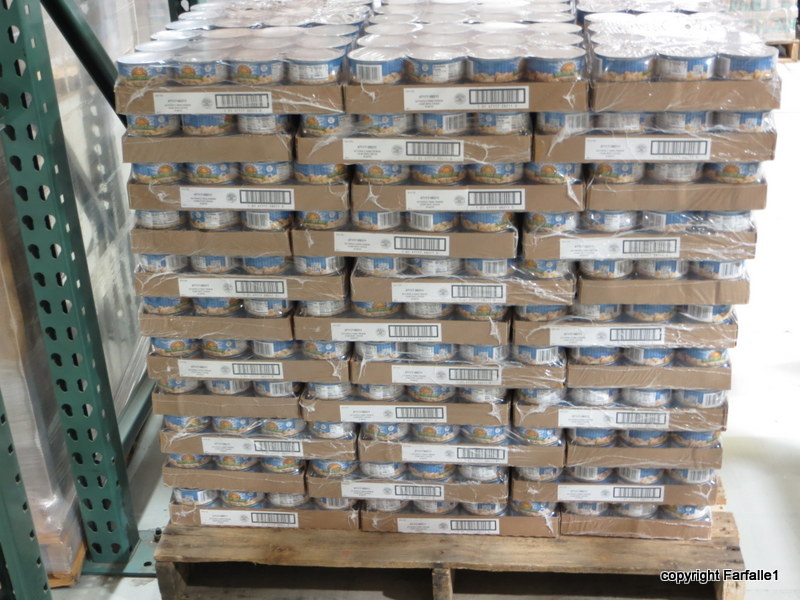
United Food Bank Tour palette of food-001

Some comes from food drives run by Scouts, Churches and so forth:
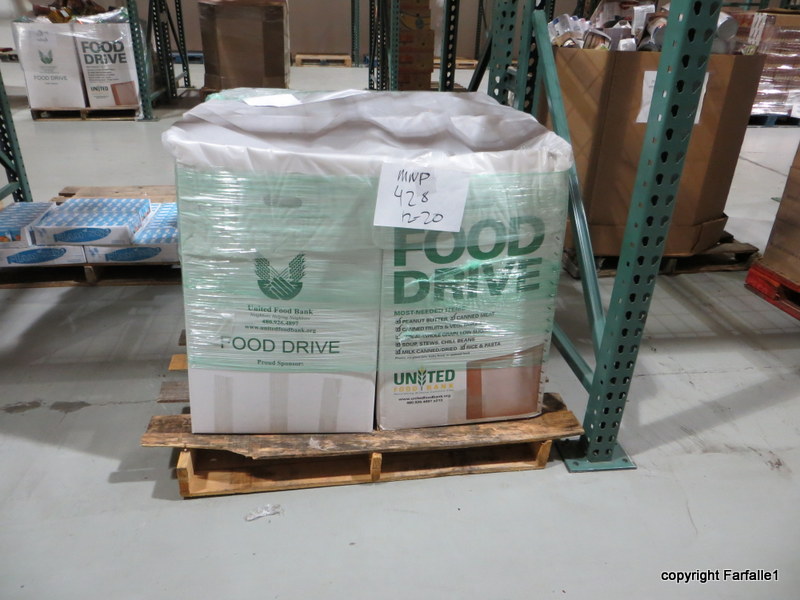
food drive box

And a lot is flat-out purchased by the Food Bank. United Food Bank is a member of Feeding America, a national organization. Using the leverage of large purchasing, Feeding America and its affiliates are able to buy large quantities of food from producers at greatly reduced prices.  In fact, this poster illustrates a startling fact:
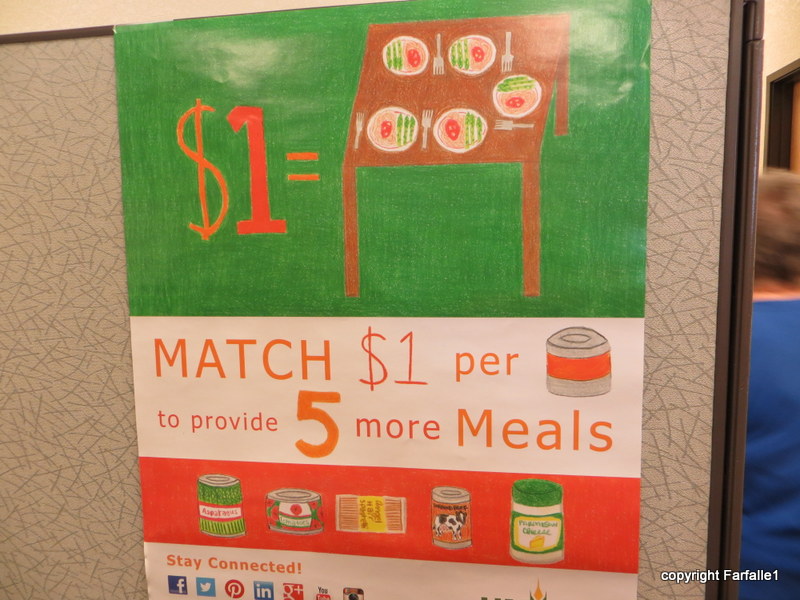
United Food Bank Tour what $1 will do

That’s right! The Food Banks are able to cobble together 5 meals from a $1 donation. Amazing, especially when you consider that you and I pay .79 for just a liter of water at the supermarket.

You might be wondering how a mere 20 or so employees can move such a vast quantity of food over such a large area. The anwer: volunteers.  Here are two, who scampered off before I could get their names:
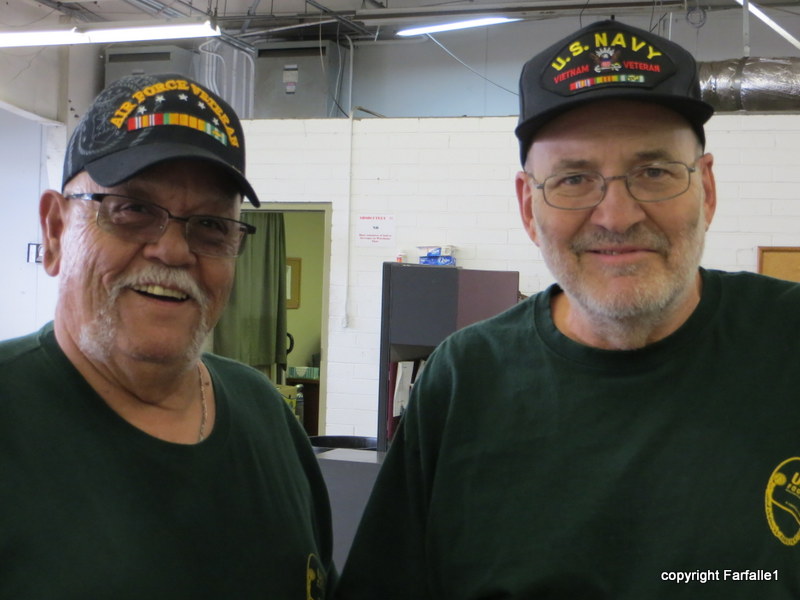
United Food Bank Tour volunteers

Other volunteers come courtesy of Sheriff Joe Arpaio and his infamous Tent City (not all reviews of Tent City are as negative as the one I’ve linked to). We saw several inmates in their signature pink skivvies and striped suits, but I was asked not to photograph them (I really wanted to). Last year volunteers provided over 51,000 hours of work, equivalent of another 25 full-time employees.

When the food comes in it is stored in either the regular warehouse:
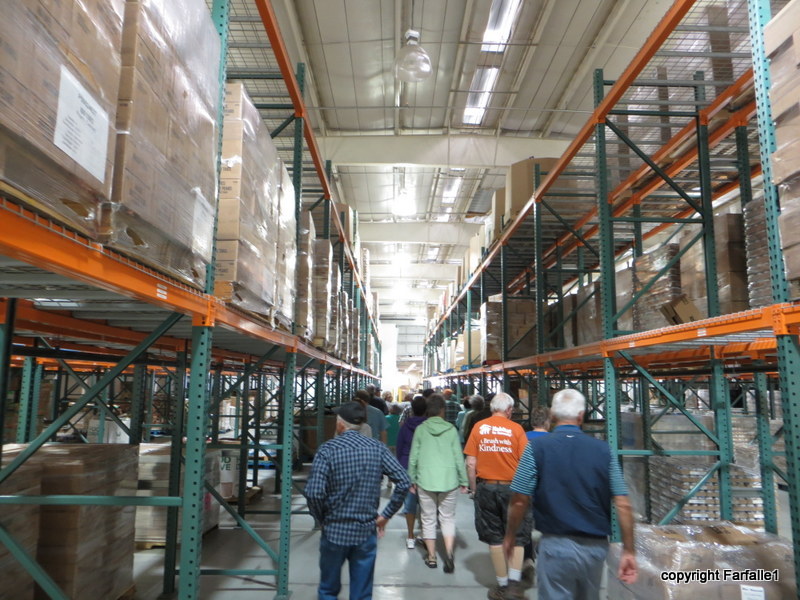
United Food Bank Tour warehouse

or in the cold storage room:

United Food Bank Tour cold storage-001Then ‘orders’ from the various food banks are put together on palettes ready to be delivered (the pink slips identify the food bank recipient):
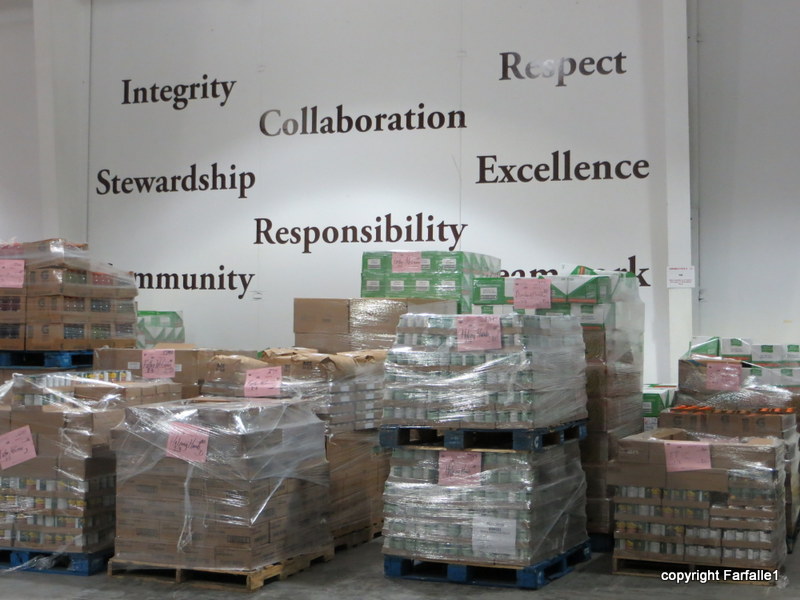
United Food Bank Tour waiting to be delivered

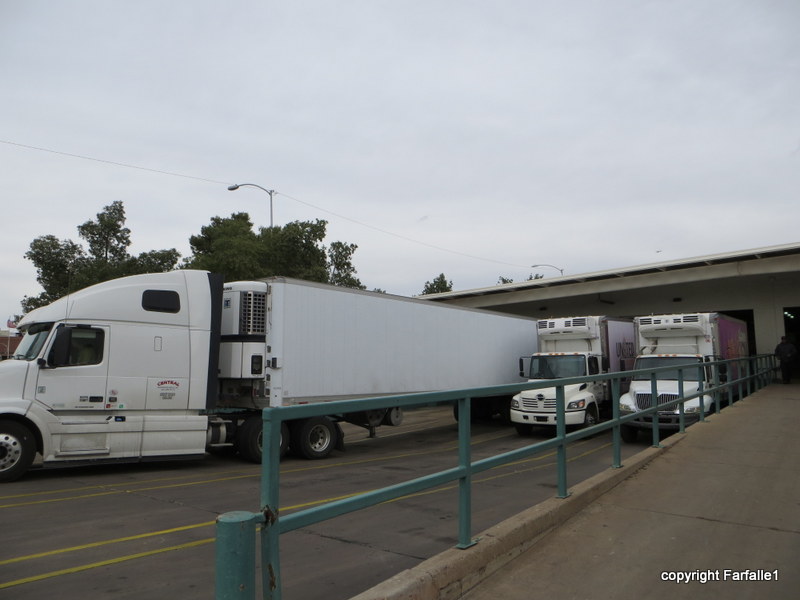
The trucks that pick up food from large suppliers reload and take the palettes off to the local food banks:
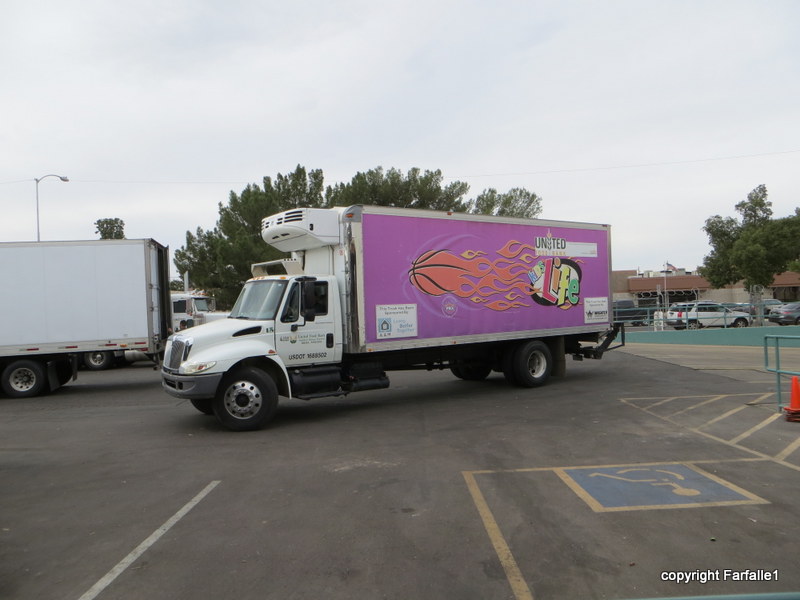
United Food Bank Tour colorful truck

United Food Bank Tour loading docks-001

Remember up above I mentioned that the fruit-picking program is in jeopardy? Here’s the reason:

United Food Bank Tour bad fruit-002

Bad fruit! That’s right, just as the old saw says, one bad apple, or in this case grapefruit, spoils the whole carton. Our group is extremely careful to put only perfect fruit into the boxes. One little puncture and the fruit is useless. Our pickers look at each piece, and a team of checkers stays at the bins and re-examines every piece. That is why one of our team leaders, Bev, is so proud of the boxes of fruit we pick, which do NOT look like the fruit above. Here she is with one of the six bins of fruit we picked.
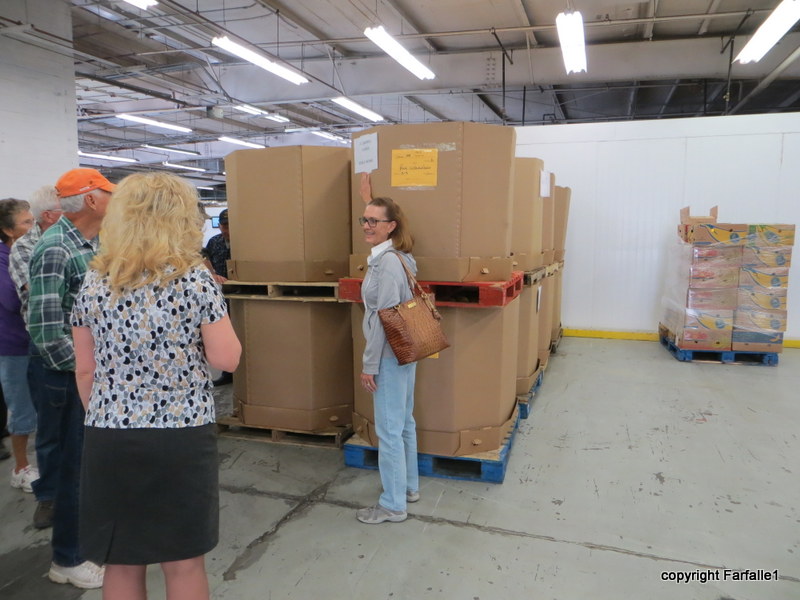
United Food Bank Tour Bev and some of our boxes

You might imagine that having a bad carton of fruit is a pity and a waste, but not such a big deal. Magnify it by many cartons and it becomes a big deal. The cartons alone cost about $25, and if there’s rotten wet fruit in them, they are ruined and have to be discarded. Then there’s the problem of the bad fruit. Last year it cost the food bank $18,000 to have the bad fruit trucked away and discarded. That is money they would have far preferred to put into meals.

There’s also the question of quantity. There is simply a lot more grapefruit in the Valley than the food banks here can use. Another food bank is working with a local juicer to turn excess fruit into delicious juice. The drawback is that the juicer will work only with professional gleaners, not with volunteers (I imagine it might have something to do with quality control). So far United Food Bank is working only with volunteer pickers.

Up until last year our United Food Bank, through Feeding America, was able to send our excess fruit north to Washington and Oregon in exchange for their excess apples and potatoes. Unfortunately the Arizona citrus has been attacked by a scale disease which is not yet present in the northern states – and they don’t want it. As a precaution they are no longer accepting our excess fruit.

So you can see, the whole thing is very complex. As a casual observer it seems to me that United Food Bank is doing a superb job at getting as much food as possible out to the people who need it the most. The sad fact of the matter is that there are more hungry people in Arizona (and in the rest of America, too) than there is food to feed them. Here, in pie charts (what could be more appropriate?) is a breakdown of income and expenses for UFB:

United Food Bank Tour pie charts

I asked Melissa what was the more useful contribution, food or money. Both, she said, although the money is more flexible.  Some of each is certainly a winning combination. The most needed items in food banks (in addition to cash) are: peanut butter, canned meat, canned fruit and veggies, cereal (whole grain and low sugar preferred), soups, stews, chili, beans, pasta and rice, and milk, either canned or dried.

So it turns out my preconceptions of what a food bank is and does were pretty wrong. There’s nothing sad about it – it’s positive for the people who work and volunteer at food banks, it’s positive for the people who donate food and money, and most of all, it’s positive for the food recipients. Often it is the catalyst that helps them get back on their feet after a run of bad luck. For a hungry child it might provide the zip to do better in school and, therefore, in life itself. If you want to find a food bank near you (if you’re in the U.S.) where you can either volunteer or drop off a bag of food or a check, you can find one here.

Just a humorous note to end. Like every large organization, United Food Bank has Rules and Regulations, especially in the warehouse area where forklifts are zipping back and forth. As in other matters, they are very organized, posting all the rules on a Wall of Don’ts. I don’t know why it amused me so, but it did. Do not pass go! Do not collect $200!
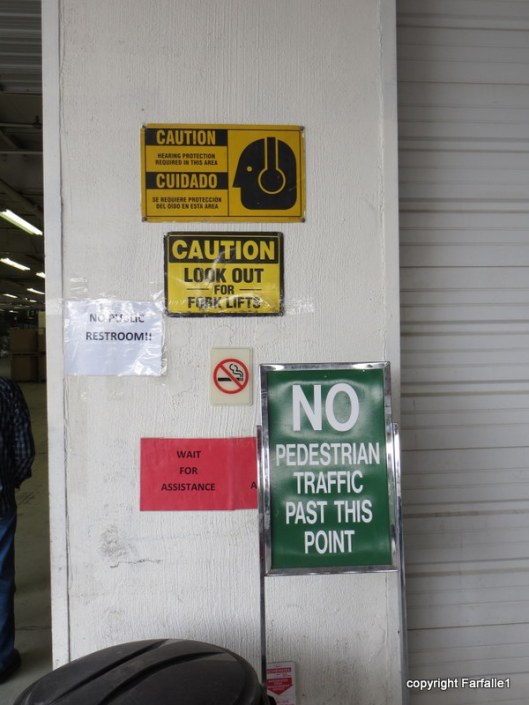
United Food Bank Tour wall of no-no's

PS – thanks to the United Food Bank brochures for facts, figures and concise language describing their programs, which I have shamelessly copied.
Virga at Sunset

17 Sunday Nov 2013

Posted by farfalle1 in Arizona, Uncategorized, Weather

≈ 8 Comments

Tags

Streams of light, sunset

dramatic clouds Gold Canyon-001

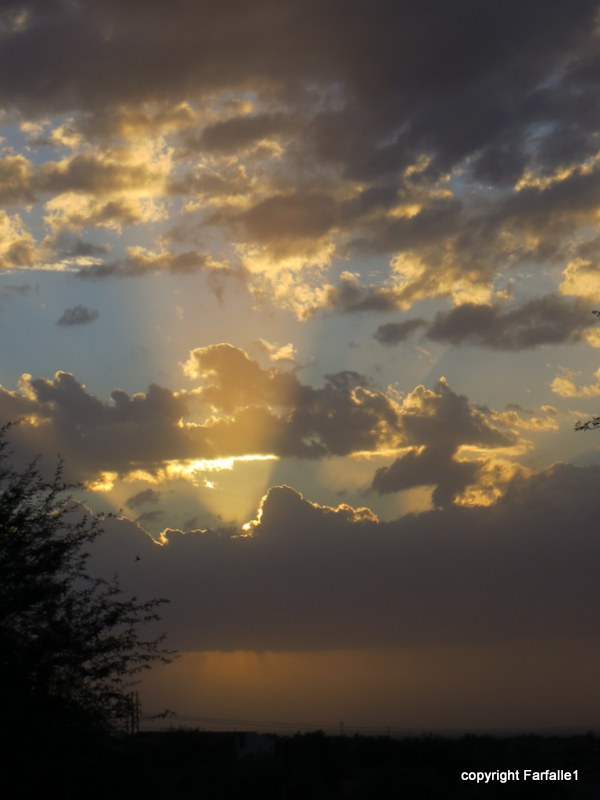
Virga, which is very common here in the southwest U.S., is a shaft of rain which evaporates before it reaches the ground. You can see short streaks of it under the lower cloud in the photo above.  The sky is frequently beautiful here in Arizona at sunset, but not usually quite as dramatic as this one. You’ll see it more clearly if you click on the photo. The snail has landed!

Our Neighborhood – Donald’s Bench

25 Monday Feb 2013

Posted by farfalle1 in Arizona, Portraits of people, Uncategorized

≈ 8 Comments

Tags

Donald, Gold Canyon, Mental illness

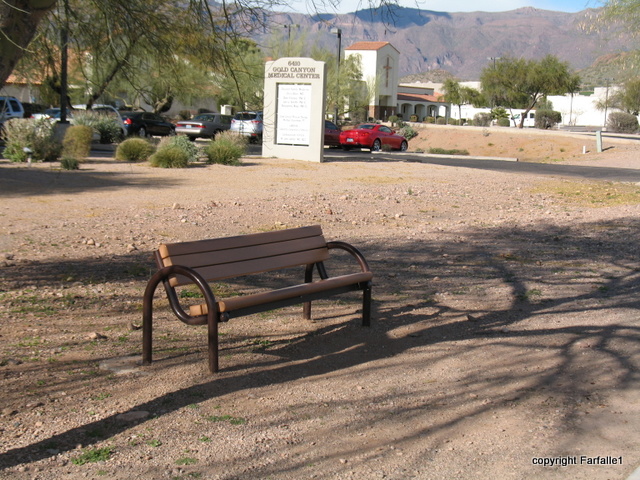
Donald's benchDonald has a mental illness, though I can’t tell you specifically which one.  In much the same way the church bells of San Maurizio mark the passage of our days there, Donald’s presence on his bench tells us that things are in order in this small corner of the world.

He arrives from his home sometime in the middle part of the morning and sits for his morning shift.  Late in the morning he walks along the busy four-lane highway to the supermarket about two miles distant and buys some food which he carries back in a plastic sack to his bench for his daily picnic.  Sometime in the mid-afternoon Donald takes himself home.  When he’s not actually present on his bench during the day, Donald leaves his warm jacket, a bag and a bottle of soda to mark his territory.

He’s a friendly, if remote, man;  I put him somewhere in his mid-50’s or early 6o’s, though it’s quite impossible to know for sure.  Passers-by almost always offer Donald a pleasant greeting (augmented sometimes with a treat if they know him), and if he’s not completely engaged in an interior dialogue  he returns the greeting cordially, while at the same time not inviting further chat.  Donald has a deep and musical voice; to receive a greeting from him is to hear a hymn.

So many elements contribute to the emotional content of our neighborhoods and give us the sense of ‘home.’  Donald makes such a contribution for us.  When he was absent for a few days last week we worried – influenza?  did he move away?  He returned this week and suddenly all was right with the world. Thank you, Donald.

Lakeside stroll

12 Tuesday Feb 2013

Posted by farfalle1 in Arizona, Birds in the U.S., Uncategorized

≈ 6 Comments

Tags

Great blue heron, Lake Tempe, Tempe Lake

When one thinks of Arizona, lakes are not the first things that pop into one’s head. In fact, though, there are quite a few lakes in the State – from the large Roosevelt Lake created by the Theodore Roosevelt Dam in 1911 to the hundreds of teeny lakes that dot the many golf courses in the region.  It’s a disorienting but not unusual sight to see a large pick-up hauling a big motor boat along a desert highway.

Recently Speedy and I took ourselves and a picnic lunch to Tempe Town Lake, formed by a dam on the same Salt River that creates Roosevelt Lake, but some 80 miles closer to Phoenix.  In fact Tempe is just a stone’s throw from downtown Phoenix, and is the home of Arizona State University.

Tempe Art Center and bridge

It is also home to the beautiful Tempe Center for the Arts, completed in 2007, just in time for Speedy’s and my arrival in Arizona.  It was a concert by the Ridge Trio that took us to the Art Center with our sack of food, and a very civilized time of it we had, sitting in metal park seats and watching the passing scene on the broad sidewalk between us and the lake.  Over two million people use the park each year, and we saw a fine cross-section of them: Dads with cameras and babies; boyfriends with cameras and beautiful girl friends; fitness enthusiasts speed-walking; young men practicing complex moves with a plastic sword; roller-bladers; co-eds jogging together; couples jogging together; solitary people jogging; and of course my favorite: dog walkers.  The largest dog we saw was Sally, a seven-year old Great Dane with one blue eye and one brown eye:

Great Dane Sally

She was a very friendly girl, and I must say, it’s always a pleasure to meet someone who outweighs me by a good thirty pounds.

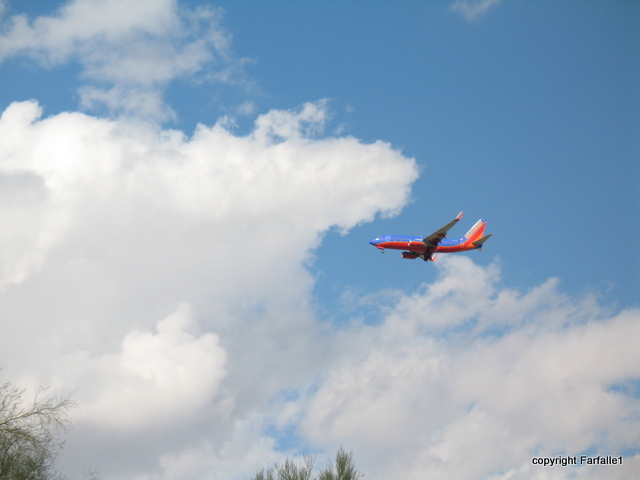
The Tempe Town Lake lies smack between the approaches to Sky Harbor Airport’s two runways; Speedy recalls many landings using the Salt River as his visual guide.  Here’s a Southwest Air flight bringing happy visitors to a place presumably warmer than the place they left:

SW arriving

Between our picnic and the concert we took a little walk along the lake side and over the beautiful pedestrian suspension bridge that spans the western edge of the lake.

Tempe bridge

I realized that with a little ingenuity one could probably make a similar bridge with tools and supplies found right in one’s garage.  For starters you’d need some heavy duty wire to use for suspending your walkway (note the pretty pattern in the pavement).  Then you’d need some big bolts and some bit cotter pins.

Tempe bridge bolts

Tempe bridge cotter pin

What could be difficult about that?

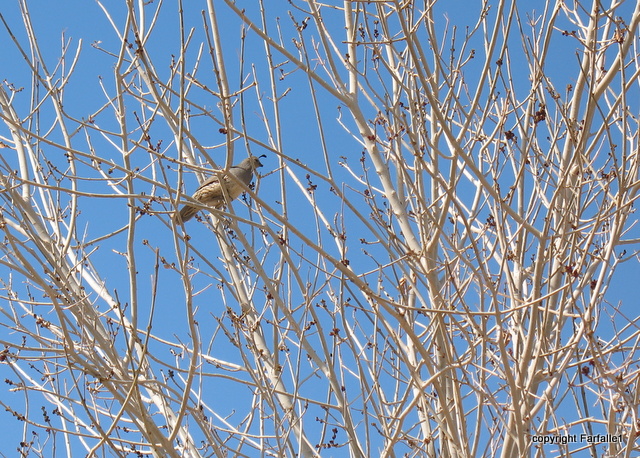
The stroll along the far bank of the lake was a veritable nature walk.  While it may not be as festive as a partridge in a pear tree, it’s a treat to see a Gambel’s quail in any kind of tree:

quail in tree-002

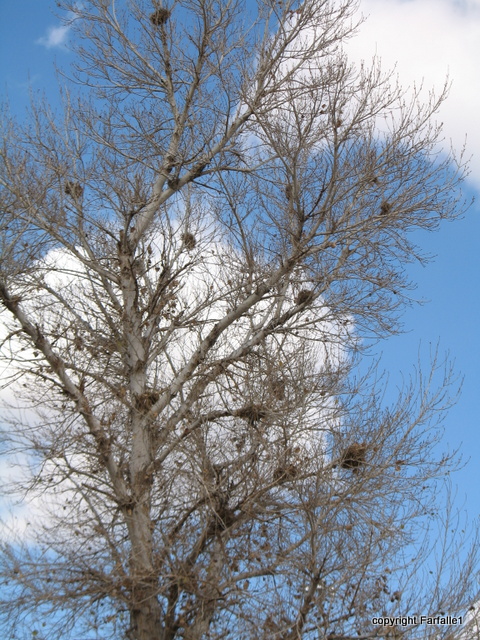
An adjoining tree was chock-a-block full of nests – but whose?

nests in treeSpeedy’s sharp eye caught the best treat of all.  He saw what looked like a large water bird fly in and land on a dock.

great blue heron eating a fishSure enough, there it was! A fine, healthy great blue heron  But it looked so peculiar – why?  On closer inspection we discovered that it had caught one of the many talapia stocked in the lake and was trying to swallow it.  We could watch for only five or ten minutes as our concert hour was fast approaching; we don’t know if there was a happy ending for the heron; there certainly wasn’t for the fish.

great blue heron eating a fish-011

great blue heron eating a fish-017It seems impossible that such a big fish could fit down that narrow neck, but we’ll never know for sure.

If nothing else our walk showed us how adept the birds are at adapting to whatever development we throw at them.  What treats we had on our short walk!

That Special Light

26 Saturday Jan 2013

Posted by farfalle1 in Arizona, Italy, Photographs, Rapallo, Uncategorized

≈ 14 Comments

Tags

Magic of light

There’s something almost tangible about the light in Italy sometimes.  It’s hard to capture in photographs, but here are four examples:

gorgeous light 001C

magic light on fall golf course path

late light in Sostegno

last light on Rapallo-002

It’s as if you could actually slice through the light and, if you were very careful and lucky, bring it home with you.  There must be something in the atmosphere – smoke? magic? – that makes whatever you are looking at absolutely delicious.  Yellow light in Italy becomes golden; clouds are silver; roads seem to be bronze ribbons.

Arizona specializes in light too, but it’s a completely different kind of light, hard and hot.  The best time to see light in Arizona (or anywhere, I suppose) is early in the morning and in the evening; during those hours, even here, everything one looks at becomes softer.

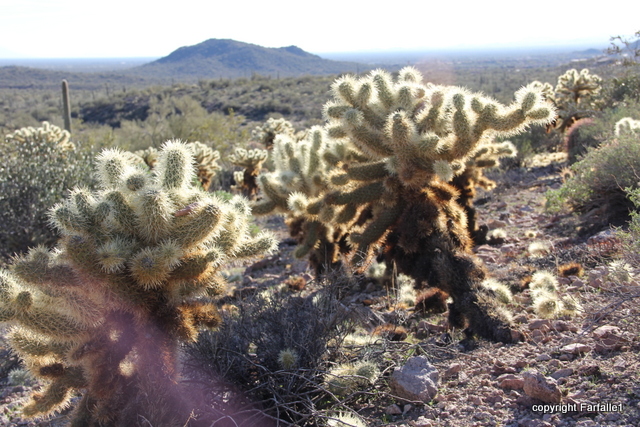
It seems to me that the cacti catch the light very dramatically.  It’s not the soft light of Italy we see here, but the sharp western light, held for a moment, reflected in the many spines of the plants and transformed into something more benign and gentle.  They seem to glow:

cholla light

Cholla

Hackberry Trail light in cholla

Hedgehog

Teddy Bear Cholla

Teddy Bear Cholla

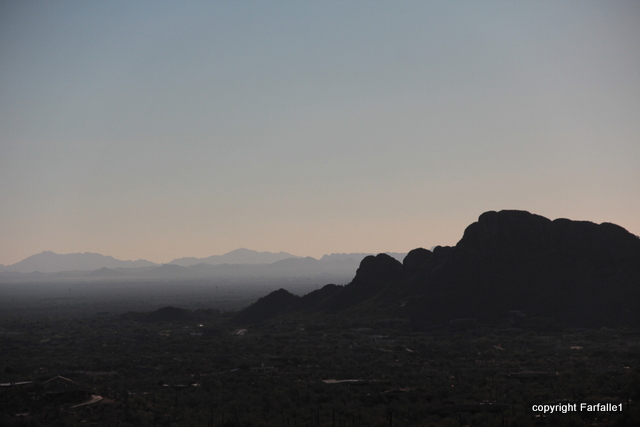
As evening falls in the desert the air above gets very clear, but down below the smog from the nearby city is evident.  It’s almost the same effect as a smoky evening after a field has been burned as happens all over Italy in the autumn. But, lovely as it is, knowing it is the result of smog and construction dust makes it so much less romantic.

view from Peralta Trail dinosaur

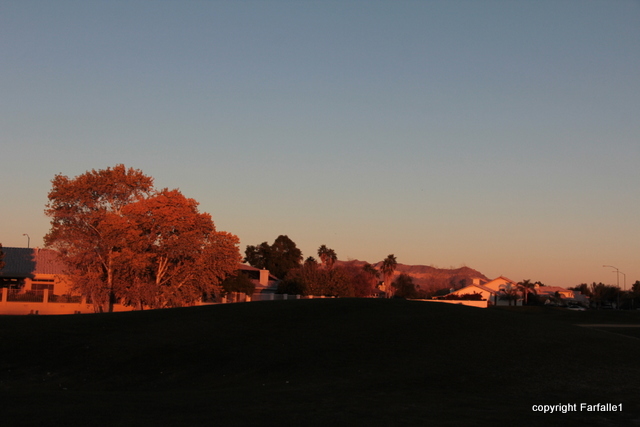
In the built-up areas and neighborhoods around the Valley of the Sun there are plenty of non-native trees, and they can be pretty spectacular in the waning light.

sunset over course - too red it was yellower

You can almost imagine yourself in New England in October, can’t you?  But no, this is Arizona, land of sharp things (about which more in the next post).

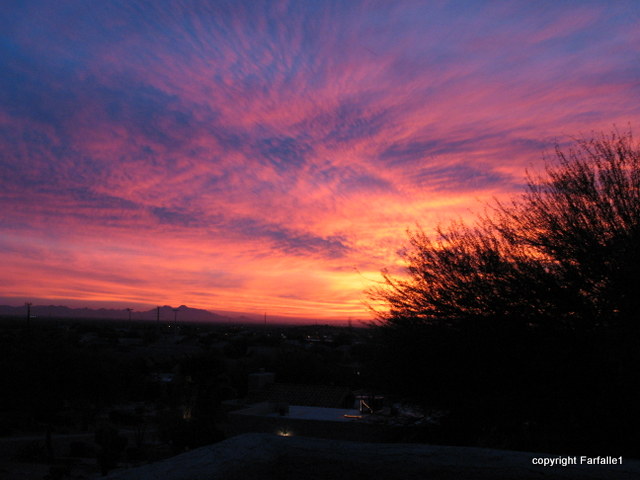
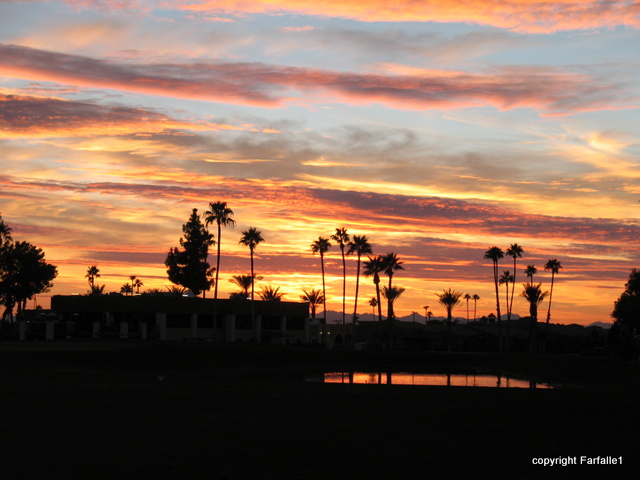
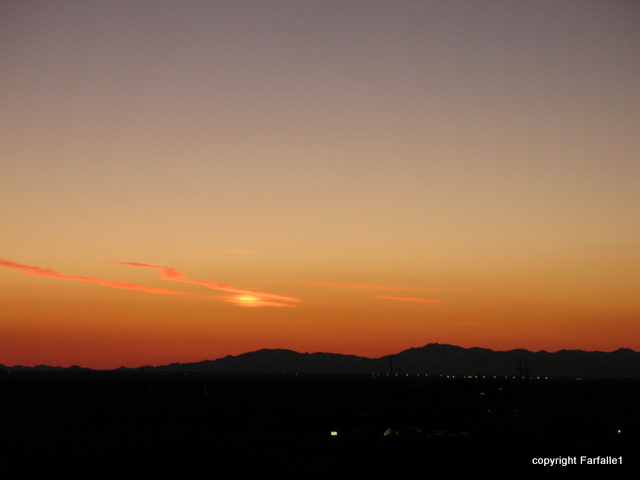
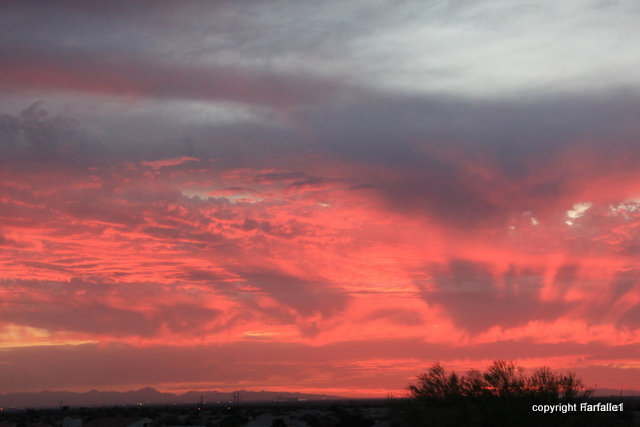
One thing Arizona has that we don’t have in our little corner of Italy is Big Sky. And with Big Sky come Dramatic Sunsets – we never get such violent skies in Rapallo, maybe because we’re on the wrong side of the Monte di Portofino.  But here in Gold Canyon, if there are any clouds in the sky we are in for a treat at sunset:

beautiful sunset

sunset over painted mountain golf course

Sunset at Painted Mountain Golf Course

sunset

Gold Canyon with the first glimmers of city lights in the distance

sunset-1

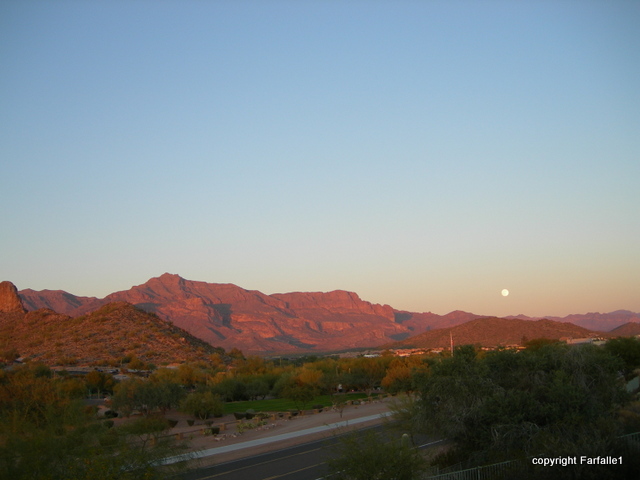
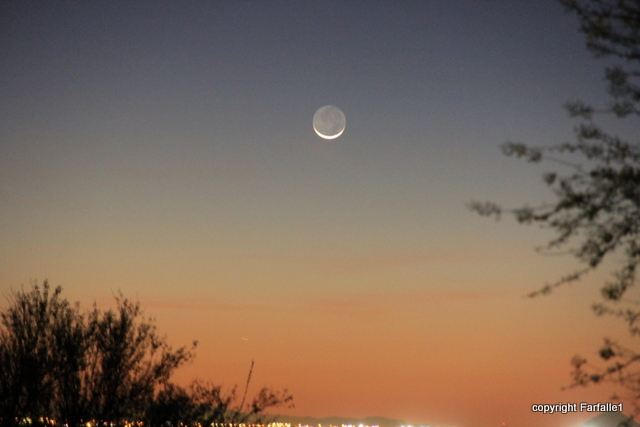
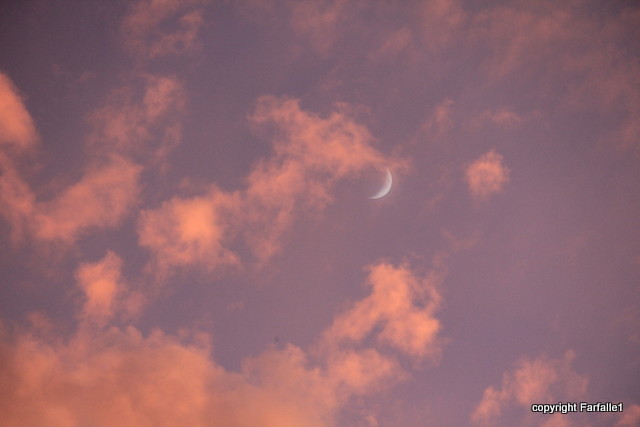
And even if there are no clouds, the midnight blue night sky is a perfect backdrop for stars, planets and especially the moon, sights that we often don’t notice when we’re in Italy.

sunset moon

MoonRise12-1-09 by Laura

Photo taken by my friend Laura

moon and city lights


moon setting over Phoenix

sunset moon-002

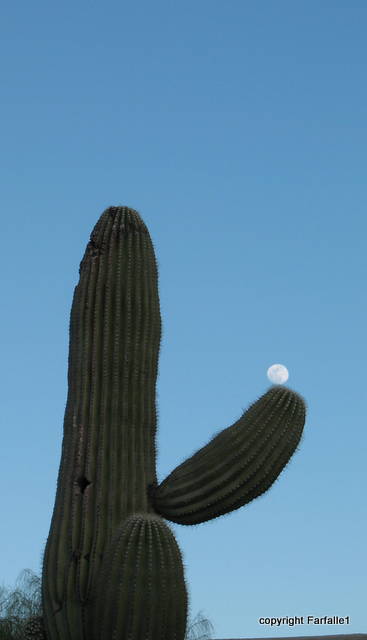
And I just couldn’t resist this one because it’s fun:

moon over cactus-1

Light: it’s around us all the time, but we seldom notice it.  Physicists may tell us that “light is simply a name for a range of electromagnetic radiation that can be detected by the human eye.”  But it can be so much more than that: all it takes is a special moment, a special angle, an unusual tableau for us to stop and say, ‘Oh.  It is so beautiful!’

Saguaro

04 Tuesday Dec 2012

Posted by farfalle1 in Arizona, Hiking in Arizona, Uncategorized

≈ 7 Comments

Tags

Saguaro cactus

Reavis cheerful band of saguaro

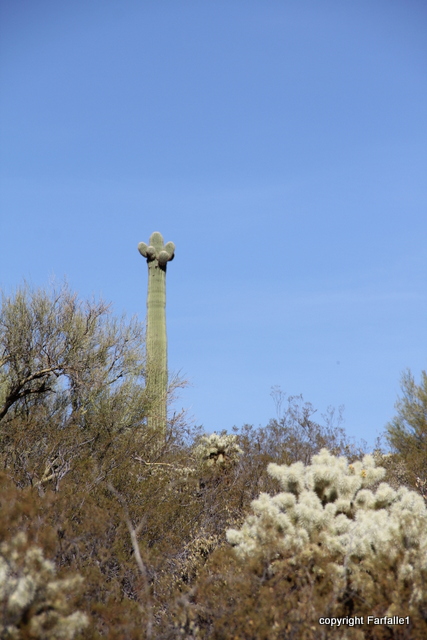
Pronounced Sah-Wha’-Roh,  this beautiful cactus is probably the most recognized symbol of the American southwest (along with the rattle-snake).  Native to the Sonoran Desert, the saguaro often grows  in ‘forests’ like the one seen above.

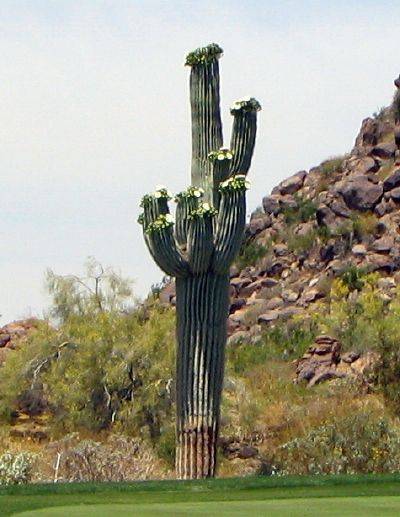
It’s a slow-growing critter.  Night-blooming flowers form  in bunches on the tops of the arms from April through June, and the resultant red fruit produces seeds to make more little saguaros. The flowers (the saguaro is the State Flower of Arizona) are pollinated mostly by bats, and often stay open into the morning hours.

photo courtesy of Phoenix.about.com

photo courtesy of Phoenix.about.com

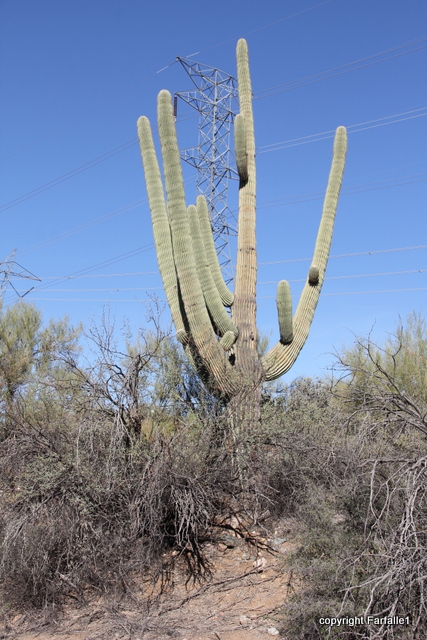
The first arms don’t form on a saguaro until the plant is about seventy years old, so when you see a big one with a lot of arms, you know it’s old.  They can live for one hundred fifty years or more.

Saguaro babies like to begin their lives in the shade of nearby shrubs which give them protection from passing animals.

Reavis baby sugauro

Once they’re old enough they’ll put out their first stubby little arms:

Reavis new arms

And if they’re lucky and get enough water and nutrients over the years, they will grow into the giant specimens that can be seen in the Tucson -Phoenix area, southern California and down into Mexico. Here’s a picture of one that began its life long before the electricity running behind it was harnessed.
Reavis Old cactus

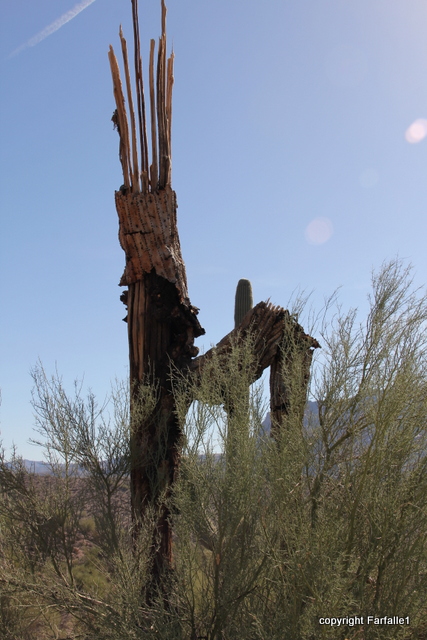
Eventually, like all of us, these giants succumb to to illness or just plain old age:

Reavis dead saguaro-001

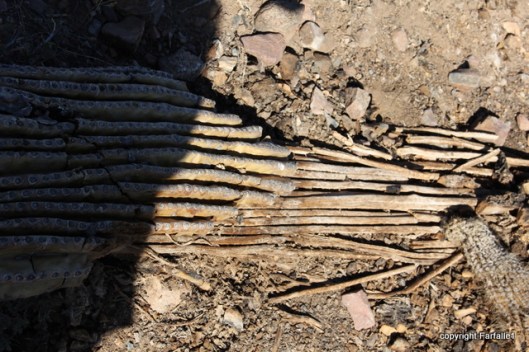
It’s then that they share the secret of their interior architecture. Their bodies and arms are full of long pipes that hold any scarce water the plant is able to absorb during the rainy season. When they die, they look like a bundle of old bamboo sticks on the ground.
Reavis saguaro bones

Birds like to nest in the saguaro, and for reasons I can’t quite fathom, hunters like to shoot them, so you often seen them with holes of one sort or another.
Victim of too many errant shots on the golf course

Victim of too many errant shots on the golf course

When a hole is made in its skin, the saguaro heals on the inside by forming a sort of wooden bowl that keeps the hot dry air out. The Gila Woodpeckers like to make fresh nest holes every year in the cactus. Other birds, such as cactus wrens, flickers and finches then can use this bowl as a nesting site.

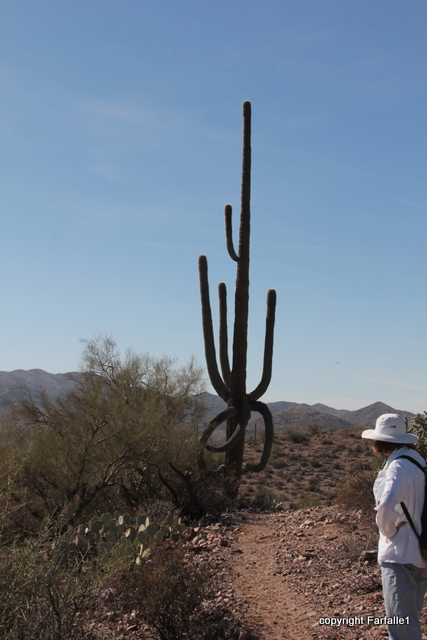
While most of the saguaros lift their arms in surrender, every now and then you come upon a comedian.

Reavis weird cactus

It’s hard to imagine what would make those lower arms form in that way. Can you come up with a good caption for the photo?

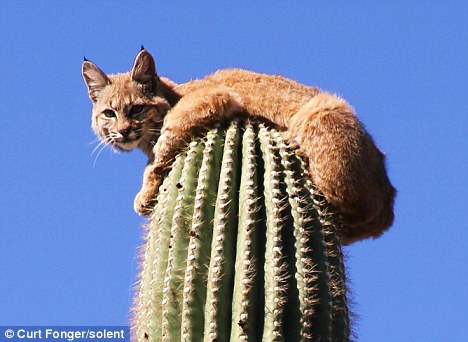
In 2011 Curt Fonger made some wonderful photographs right here in Gold Canyon of a bobcat which had climbed to the top of a saguaro to avoid being caught by a mountain lion. You can read the story here and see other photos.

photo copyright Curt Fonger/solent

photo copyright Curt Fonger/solent

I love seeing the saguaros on hikes, but if I ever start talking to them, I’ll know it’s time to hang up my hiking boots.

Hard Landing

25 Sunday Nov 2012

Posted by farfalle1 in American habits and customs, Arizona, Customs, Italian habits and customs, Rapallo, Travel, Uncategorized

≈ 6 Comments

Tags

culture shock

Once again, as every year, culture shock has blind-sided me.  Yes, it is gorgeous here (see above) and yes, it is warm (even hot) and dry.  But it’s not Italy, is it?  Sounds so obvious, but somehow it takes me aback annually.  In fairness, I have to say that there will be a repeat of culture shock, in reverse, when we return to Rapallo in April or May.

But just what is the shock?  Size is one thing – everything is so darn big here.  When it comes to living quarters, I like that.  When it comes to servings when eating out I don’t.  Cars? no.  Sense of humor? yes.  Noise is another thing: there are non-stop sounds in Rapallo; scooters dash up and down the mountain, dogs bark non-stop, the rooster who can’t tell time crows his ignorance, diners clink their cutlery against their plates at Rosa’s and even, if they’ve had enough, break into song or begin to cheer loudly. Over at Case di Noe someone has fired up a brush-cutter, and every half hour the church bells remind us what time it is. (Speedy has addressed this part of the problem by down-loading chimes to sound the hours on the computer – not the same as the jazzy bell concert San Maurizio gives us each Sunday, but better than nothing.)

There are plenty of noisy places in the U.S., but we don’t happen to be in one of them.  Our neighborhood has forty homes, of which probably one-third are occupied now, it being still early in ‘the season.’  The family with small children who lived across the street have moved – how we miss their constant activity and cheerful little voices.  If we listen carefully we can hear the hum of traffic from the highway that’s about a mile away.  When the birds visit our feeders they are likely to squabble.  The humming birds sound like teeny little power saws when they zoom in and out.  But mostly it’s just very quiet and peaceful.  That’s nice, it really is, it’s just such a change.

The biggest change, though, and the hardest to adapt to, is the societal difference.  Italians are out and about for a good part of the day.  One must shop daily, the passagiata awaits at the end of the day.  There are friends and family to visit and ‘news’ to be discussed endlessly.  The silence in our neighborhood is but a reflection of a larger silence that I think of as particularly American.  People are afraid to discuss ‘issues’ for fear that they will offend or anger the person to whom they’re speaking. Somehow Italians have found a way to express differences without letting it get personal, and without letting it get in the way of friendships.  Here people are afraid to make eye contact with strangers, unlikely to greet strangers on the street (any one of whom may be carrying a weapon, concealed or otherwise, at least here in the wild west), and uncomfortable with the idea of discomfort.

Of course Italy is far from perfect.  But part of culture shock, I think, is the tendency to idealize the place one has left, to look back through the fuzzy lens of rosy glasses, while looking at present circumstances with the critical lens of a microscope.

I’m not asking for sympathy, believe me.  We are terribly fortunate to be able to enjoy life in two such diverse places, and yes, we are Thankful that we are able to (’tis the season).  I’m just saying that the transition is, for me at any rate, difficult, but difficult in an interesting way, not a painful way.  So please, stick with me for a while?  Pretty soon I’ll have my feet under me again and will share some more of the excitement of life in a most peculiar state.

Sinagua

24 Tuesday Apr 2012

Posted by farfalle1 in Arizona, Desert, Hiking in Arizona, Uncategorized

≈ 12 Comments

Tags

Native American Monuments, Petroglyphs, Pueblos, Rock Art, Sacred Mountain, Tuzigoot

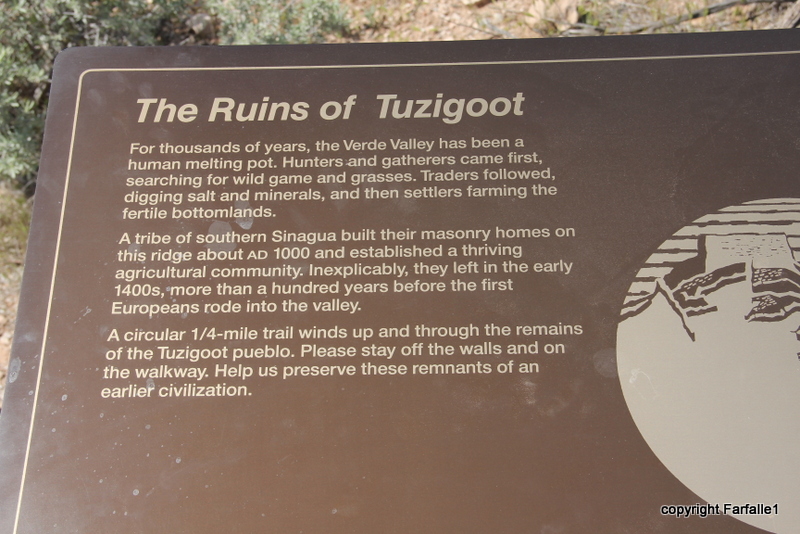
It means ‘without water’ and if you’ve spent time in the Arizona desert, you know it’s appropriate.  The Sinagua were a group  of Indians who lived in the Verde Valley from about 1000 to 1400 AD or so.  What became of them is a mystery, though one theory is that they left their own pueblos and were absorbed into other tribes, perhaps after a long period of drought.

Photo of National Park Services informational sign.

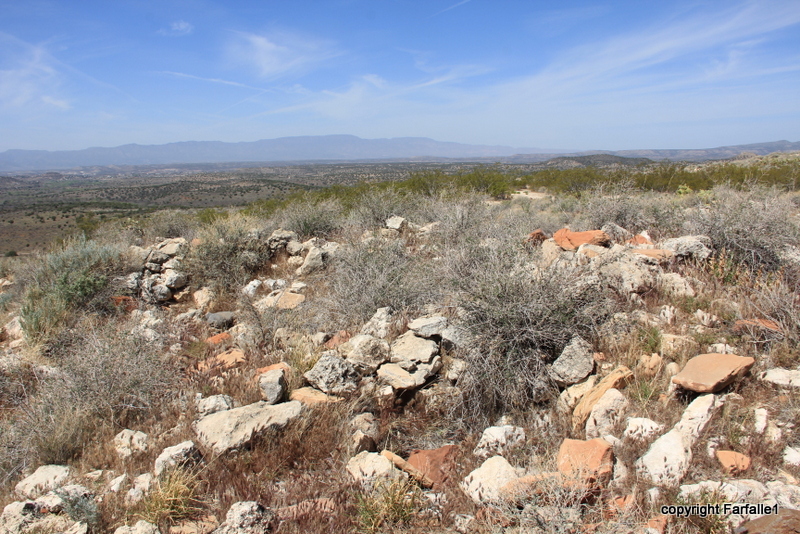
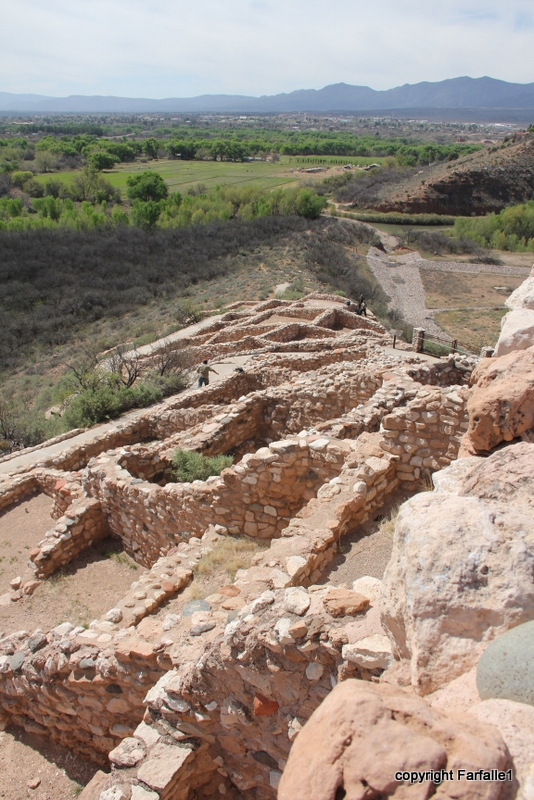
Tuzigoot,  a fascinating restored Sinagua pueblo, is a National Monument near Sedona, overseen by the National Parks Service . (It’s also a wonderful word and fun to shout at unsuspecting strangers.)  At nearby Sacred Mountain you can see what the remains of Tuzigoot probably looked like before the Civil Works Administration put people to work on the site in the 1930’s.

It takes a lot of work and study to get from that to this:

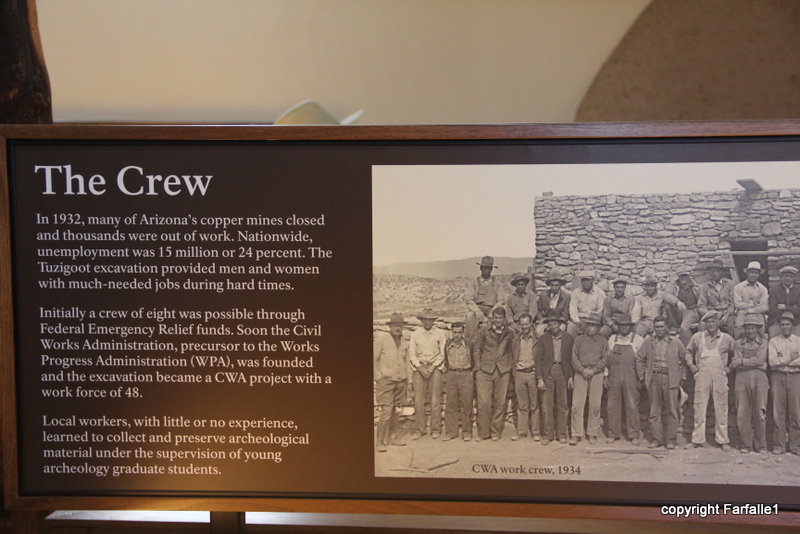
During the Great Depression there were plenty of people looking for work in the region after the copper mines shut down.  From a work group of eight, the excavation party grew to forty-eight men who learned to be archologists by working this site without previous experience.

Photo of National Park Services informational sign.

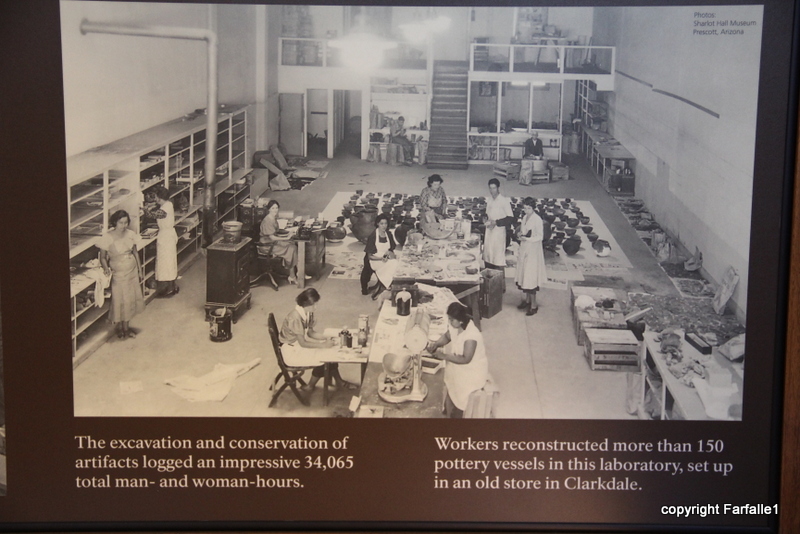
Fussy work is women’s work.  The ladies got to take the zillions of pieces of pottery and so forth that were found at the site and piece them together.

Photo of National Park Services informational sign.

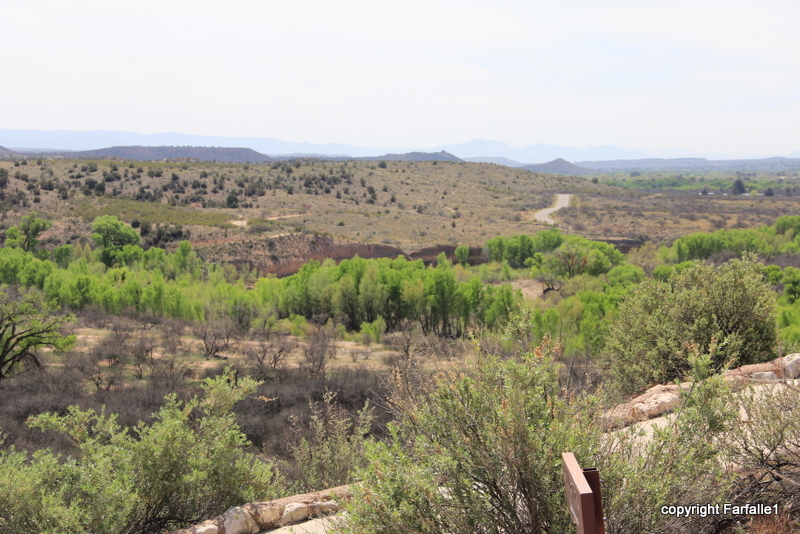
The appeal of the Verde Valley to the Indians is obvious – water!

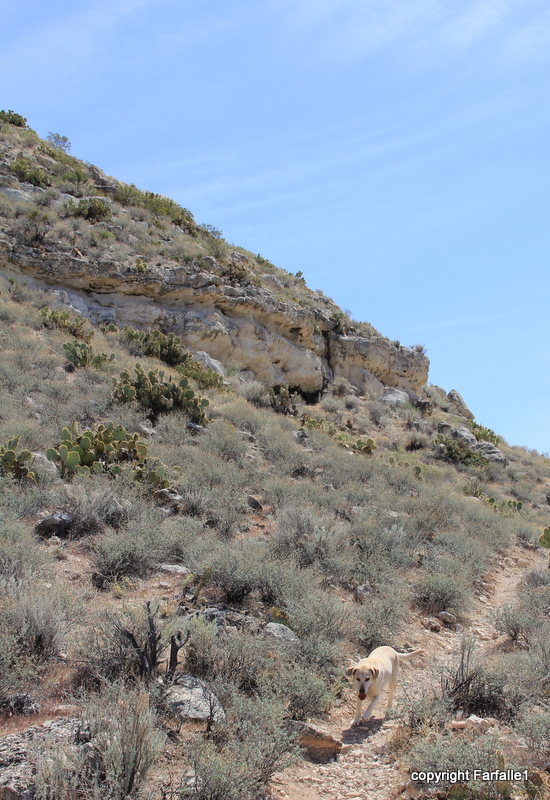
It’s not hard to figure out where the river is.  The Indians lived on hilltops – I assume for security – but irrigated and gardened in the flats below.  More fussy women’s work – carrying water from the river to the pueblos above.  Here’s the path they may have taken at Sacred Mountain.

Not steep-steep, but give me a faucet with running hot and cold any day!

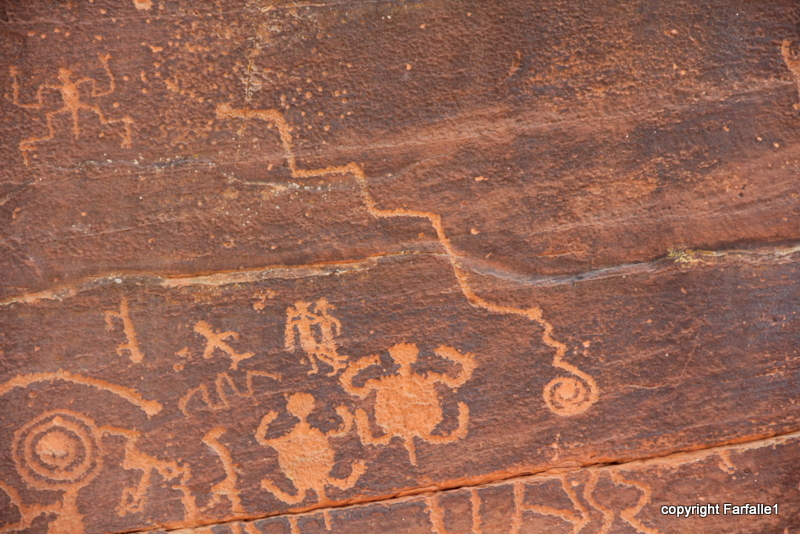
While the Sinagua didn’t read and write by our definitions of those acts, they certainly had a sophisticated method of communication: petroglyphs.  Found all over the southwest they presumably gave information about people, places, hunting, planting – all the important aspects of the Indians’ lives.

V Bar V petroglyphs

The guide at the  V Bar V petroglyph site, adjacent to  Sacred Mountain,  told us that one interpretation of this design is that the ladder shape traced the seasons of the year, culminating in the summer monsoons, depicted as a swirling circle. The sun hits different parts of the ladder at different seasons, so it may have served as a calendar. Maybe. The guide reminded us constantly that we have no way of knowing for sure what any of the petroglyphs mean.

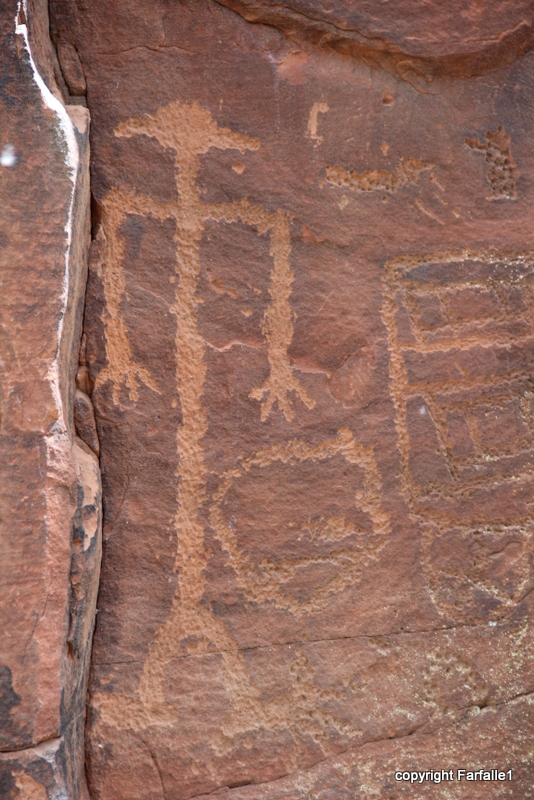
V Bar V petroglyphs

The one above, the guide told us, may represent a woman, with the big circle under her left hand representing the new baby.  The oddly-shaped head may be showing hair coils, a feminine rather than masculine style.  On the other hand, our host returned to the site a couple of weeks later and filed this report: ” A week or so ago I went back tot he V Bar V with a friend from A. High School who was here on vacation with her family.  The fellow who was explaining the petroglyphs told a different story about he figure you included in your blog.  In his version, the figure is a shaman. The circle figure is a demon.  Just to the right of the shaman is a crack in the rock which the guide explained as being the entrance to the underworld.  He explained the story as the shaman sending the demon down into the underworld.  As he said, “Ask me any question.  If I don’t’ know the answer, I’ve gotten pretty good at making something up.””


Photo courtesy of JBH

This rock is fascinating.  Each afternoon the sun strikes the forward carved piece, placing a shadow on the rock behind; the shadow has the exact configuration of the nearby San Francesco Peaks – it’s a map! This photo was taken by our friend and host JBH.

About fifty Sinagua pueblo sites have been identified in the Verde Valley region, an area that encompasses the National Park sites of Montezuma Castle and Montezuma Well. (By the way, Montezuma wasn’t born until a century after the Sinagua left, and as far as anyone knows he never lived in the eponymous castle or drank from the well.)  One wonders how many other sites there may be awaiting discovery. I’m already looking forward to exploring again next year!

Not Your Nana’s Quilt

31 Saturday Mar 2012

Posted by farfalle1 in Arizona, Arts and crafts, Photographs, Uncategorized

≈ 16 Comments

Tags

Arizona Quilters Guild Show, Quilting, Quilts

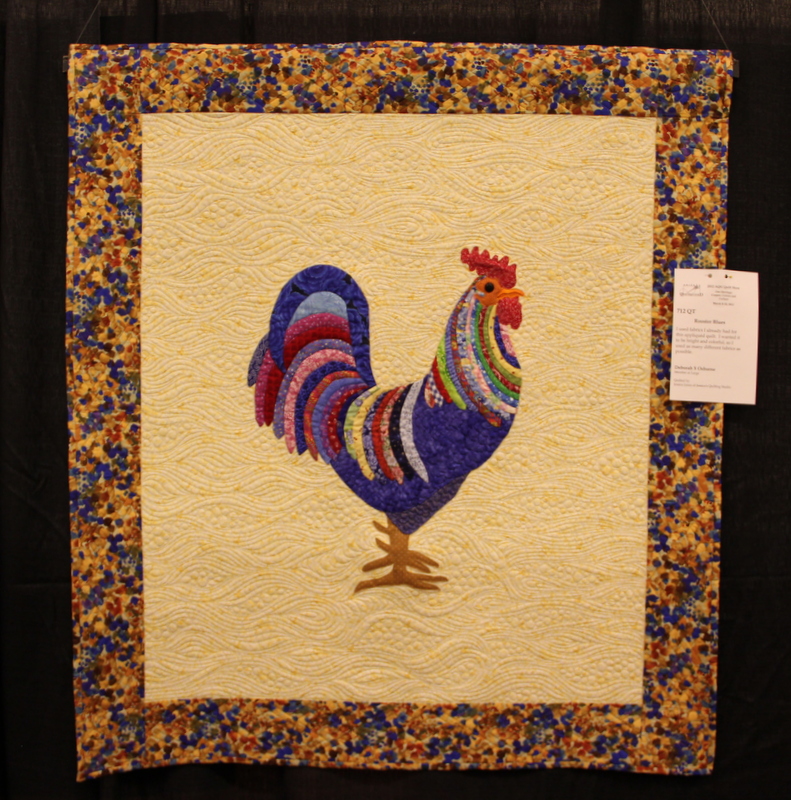
Rooster Blues by Deobrah Osborne

I don’t know about you, but when I think of a quilt I think of a very cozy bedcover, perhaps blocks of colored fabric stitched together and then attached to a bottom with some fluffy  filling between.  I think of cups of hot chocolate and snuggling on cold nights. I think of a bed.  I think wrong.

Havasu Stitchers Truck Quilt, 2003

A couple of weeks ago my friend Mrs. S, about whom you’ve read in these pages, and her friend M invited me to accompany them to a quilt show.  Not just any show, this was the annual exhibit of the Arizona Quilters Guild, this year titled “Our Heritage 2012: Copper, Cotton and Culture.”  I learned more about quilting and quilters in one day than I had in my entire previous life; and I learned that what I learned  is but a drop in the bucket of what there is to know.

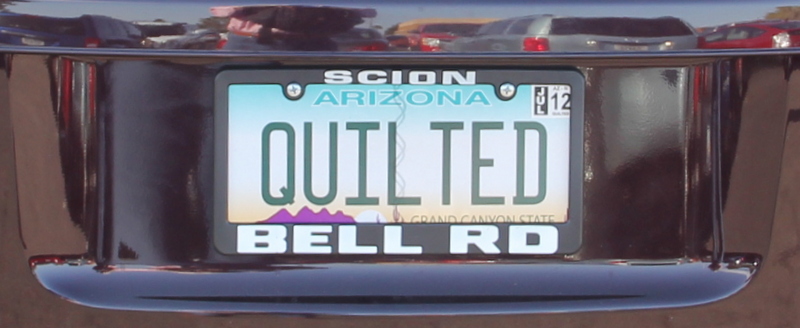
My notion that quilting was a crafty sometimes occupation, something to while away a snowy afternoon, for instance, was laid to rest in the parking lot, before we ever went into the show itself.


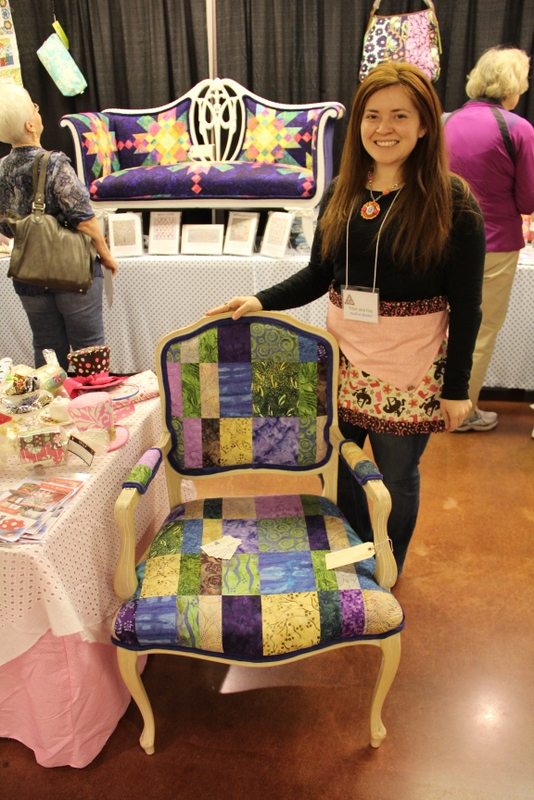
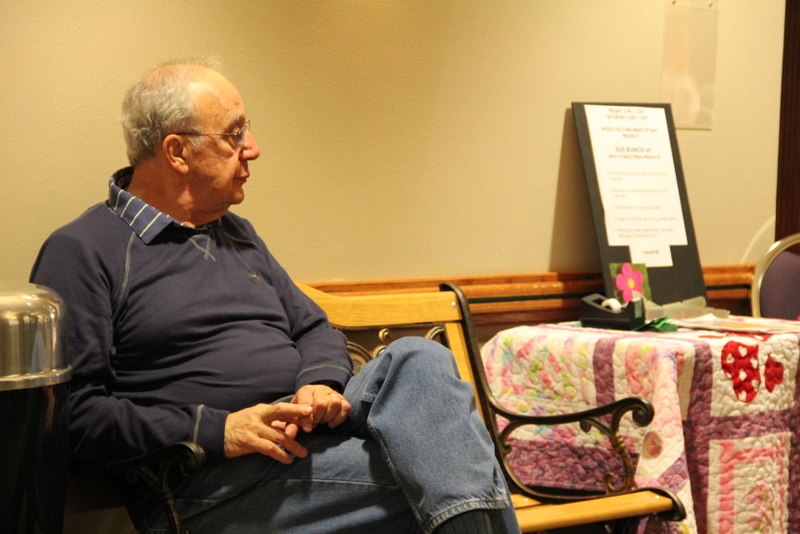
These ladies are serious; and yes, they are mostly ladies.  I did see one gentleman at the exhibit:

My gut instinct is that he was not a quilter himself.

Anyway, the exhibit took up several very large rooms of the Mesa Convention Center.  Three hundred and twenty quilts were exhibited in seventeen different categories and thirty-five vendors were eager to sell  us  items from  $  .10 to $10,000.  Actually I didn’t see anything for $.10, but there must have been something.  A short length of thread, perhaps.

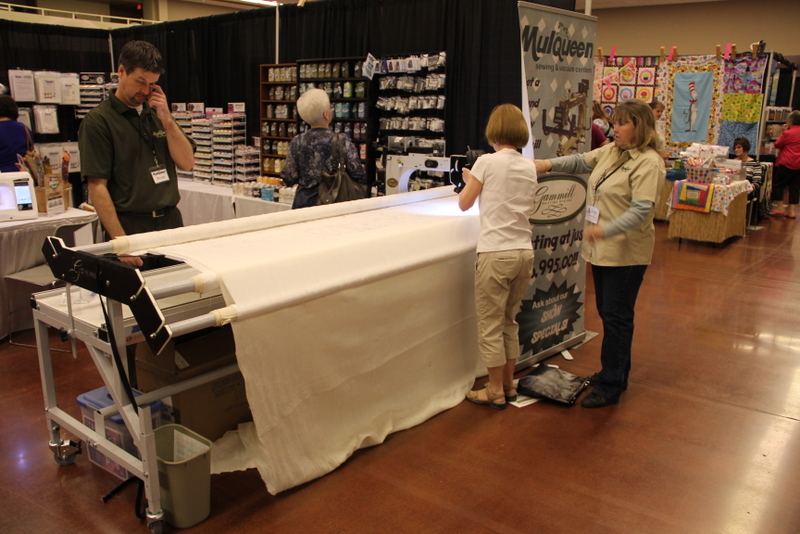
In my innocent universe, quilts are made by people with some leftover fabric, batting for the filling, and a needle and thread.  In essence this is still true, but of the quilts we saw, only thirty-seven were hand-quilted.  Most quilting is done by machine these days, either by an item that looks like a home sewing machine and will sit comfortably on your home work-table , or by what’s called a long-arm machine, which will set you back a minimum of $7,000 and requires  about fifteen feet of arm room:

These computer-driven machines can take a particular quilting stitch design and scale it up or down to fit the specific quilt’s spacing, and they can do quilting that would give the hand-quilter nightmares.

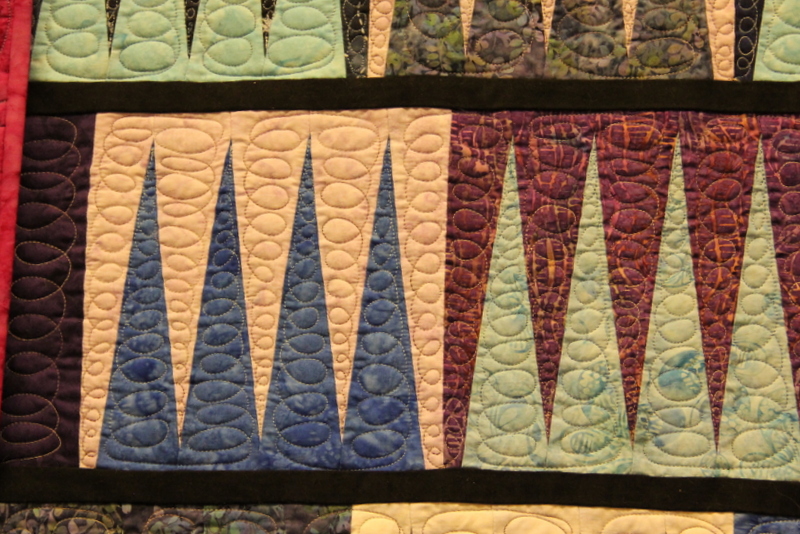
Look at the density of stitches in this close-up:

Jerome I by Margot McDonnell

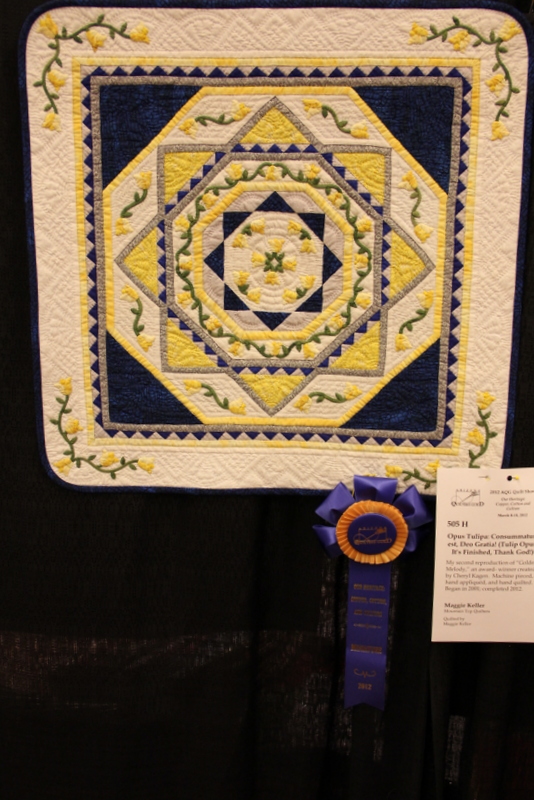
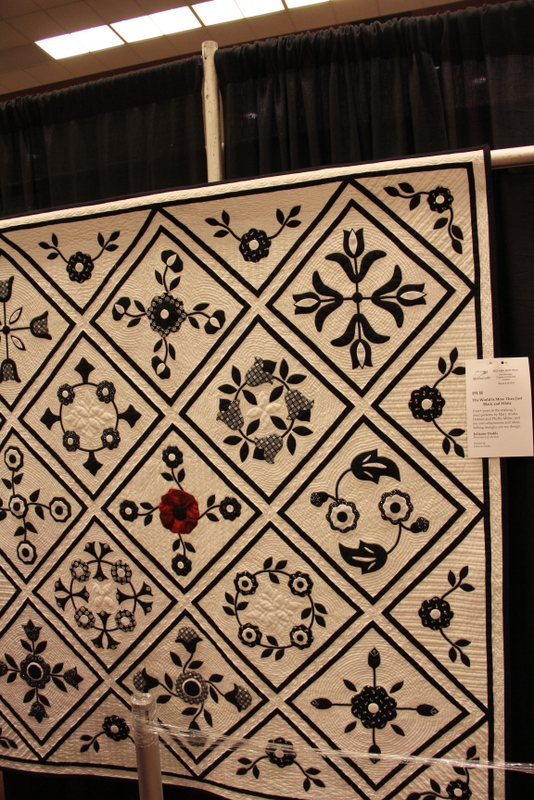
The hand-quilted pieces look different; to my eye they are gentler and softer, a bit plumper.  But the quilting is every bit as complex and dense as some of the machine work.  The difference is how long it takes to do it by hand – several years compared to several days or weeks.  Here are two quilts that are hand-stitched:

Opus Tulipa: Consummatum est, Deo Gratia! (Tulip Opus: It's Finished, Thank God!) by Maggie Keller

The World is More than Just Black and White, by Julianne Dodds

This one took Julianne Dodds more than four years to make.  I’m surprised it took less than forty.

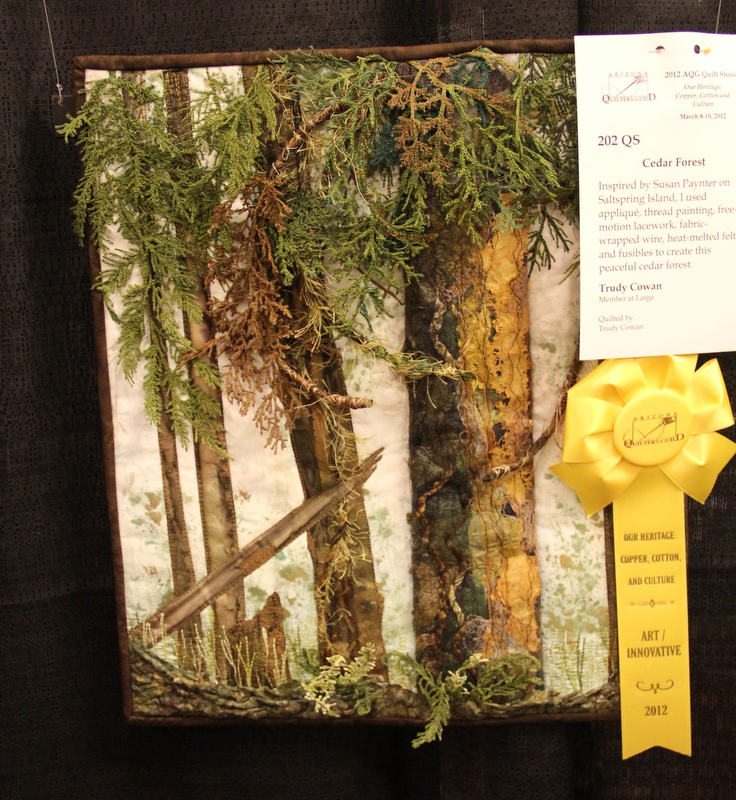
So much more than mere stitchery goes into making a quilt.  Each begins with the design or concept which will dictate the fabric chosen.  Nowadays quilts are not cloth alone; buttons, sequins and all manner of things are added.

Cedar Forest by Trudy Cowan

Trudy Cowan used applique, thread painting, free-motion lacework, fabric-wrapped wire, heat-melted felt and fusibles to create her Cedar Forest. (I can’t even tell you what some of those things are!)

There were two ‘challenges’ that really illustrated for me the amount of creativity that goes into modern quilt-making.  One challenge was called Quilting  Makes the Quilt; entrants had to make the same quilt from the same fabric. The creativity came only through how they quilted it.

American Eagle, by Amy Monahan

Can you see the eagle in the center of the quilt above?

Quilting Makes the Quilt - Susie, by Susie Seckel

They look quite different, considering they’re made from the same cloth and are pieced into the same design.

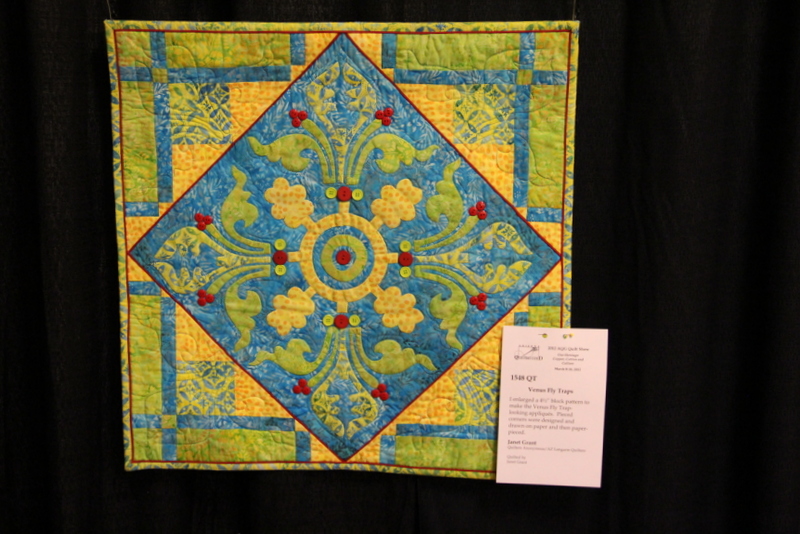
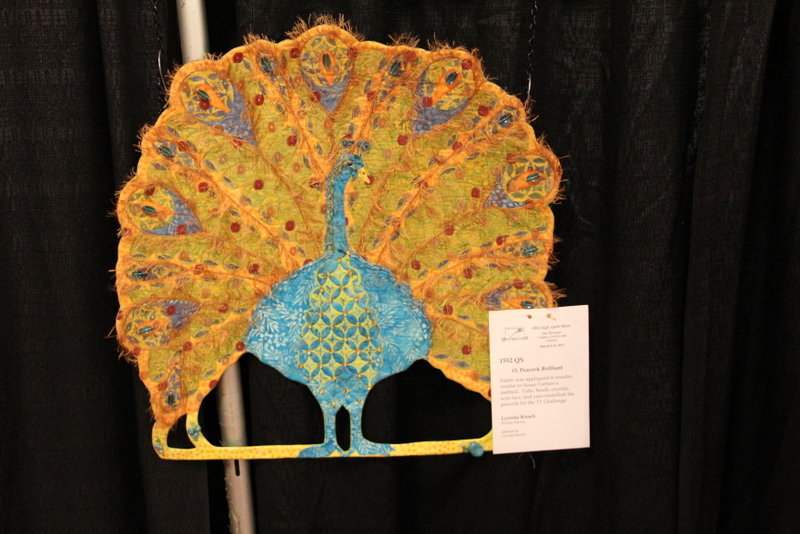
In another challenge, which I particularly liked, the quilters were given the same fabric and could make whatever they wished.  Here are a few of the results:

Venus Fly Traps by Janet Grant

Life is a Beach, by Fran Pritzl

O, Peacock Brilliant, by Lynnita Knoch

Hard to imagine curling up with a cup of tea and a good mystery with this last one, but isn’t it fun??!

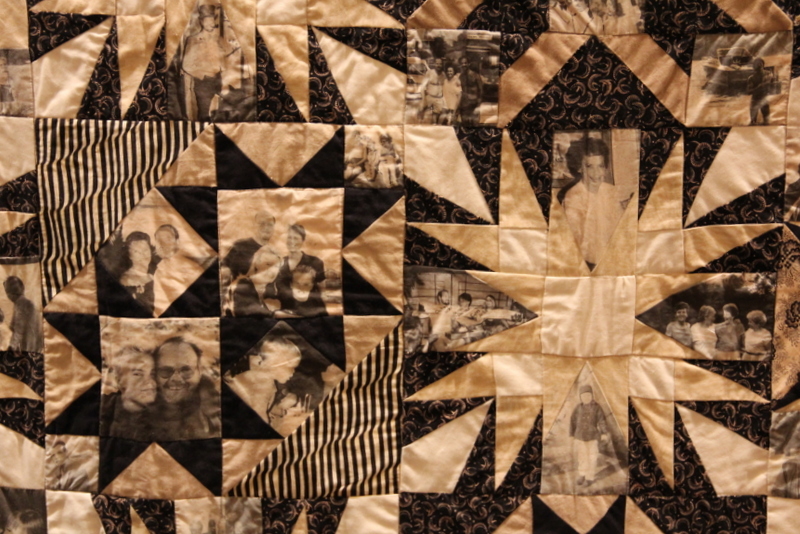
There were so many quilts I fell in love with, I can’t possibly show them all to you.  There were four that especially caught my imagination, though.    The first I liked because the sentiment is so dear.  Danielle Mariani transferred photographs and hand-written messages from paper to fabric (the magic of technology!) and pieced a memory quilt for her father’s 60th birthday.

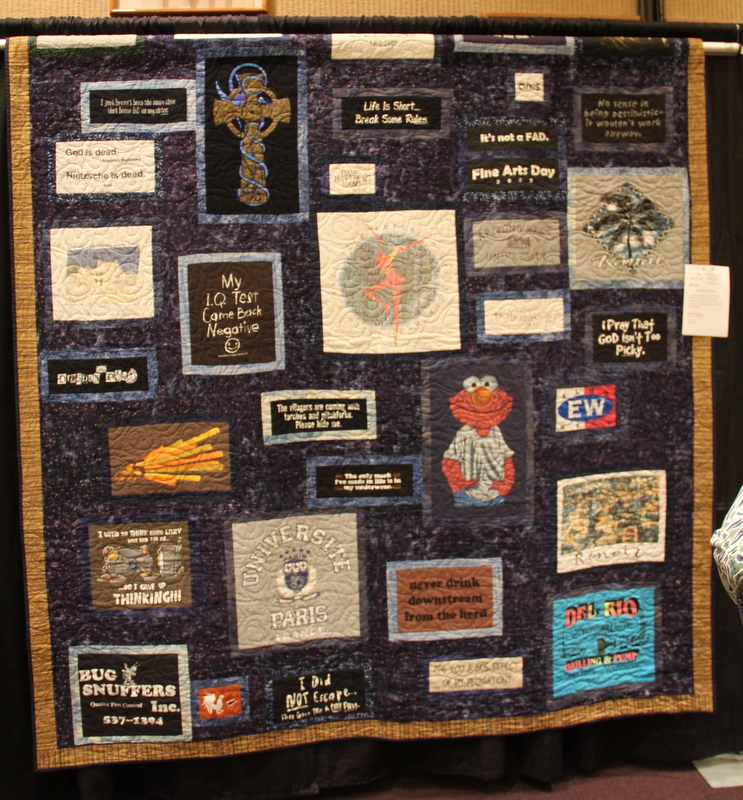
Linda Marley used a bunch of her son’s old tee-shirts to make him an amusing  quilt:

His Early Years by Linda Marley

I loved the tranquility of the egret, and the way the colors moved from one to another. There are also some other fun pond animals to be found in the details here.

Sanctuary by Dennie Sullivan

Arizona celebrated her centennial this year, and this did not go unnoticed by the state’s quilters, many of whom paid tribute to the youngest continental state in the union.

Arizona Valentine by Vicki Bohnhoff

This amusing quilt features Betty Boop driving across the Arizona map.  There are quilted flaps that lift up with information about the location underneath.

All Roads Lead to a Quilt Show, by Alicia French

There are some more photos of quilts in this web-album (but I promise, all three hundred and twenty are not there).

The exhibit opened my eyes to modern quilt-making – it is definitely not what it used to be.  It also made me realize that I will never, ever, in a million years have the patience to be any kind of quilter. My non-quilted hat is off to the ladies who are.

Two of My Favorite Things: Bookstores and Food

12 Monday Mar 2012

Posted by farfalle1 in Arizona, Books, Food, Restaurants, Uncategorized

≈ 9 Comments

Tags

Changing Hands Bookstore, Crazy lady, MedFresh Grill, Old Town Books, Phoenix Light Rail, Turkish food

Our friend Mrs. H. recently found a terrific website about restaurants near the stops of the Phoenix Light Rail system.  David Bickford writes generously, entertainingly and cogently about the various eateries, reviewing both food and general ambiance.

While Mam was still here Mrs. H. had the brilliant idea of reading up on some of the stops of the rail and then making a lunchtime field trip. I liked this idea a lot as it combined two activities I really like: riding the light rail, and eating.  Bickford indexes his reviews by restaurant type and by location, so Mam and I spent considerable time poring over the restaurants from the Sycamore Street station to Mill and the ASU campus.

Logo courtesy of Yelp.com

It was our considered opinion that we should visit the MedFresh Grill on Mill Street, because it is the only Turkish restaurant in the Valley, according to both Bickford and the proprietors of the eatery.  Three falafal and chicken kabab plates later we knew we had made the right choice.  It was delicious food, freshly prepared and humbly served.  The falafals were crispy-crisp on the outside, tender on the inside and hot. What I remember most vividly is the very creamy garlic sauce on the side of my plate – it was mostly smushed garlic, but somehow it was made creamy, perhaps by the addition of… cream?  some kind of light, fresh cheese?

Before settling in to overeat we strolled down and then back up Mill Street, the commercial street at the heart of the ASU campus.  There you can find the usual assortment of collegy stores – headshops, music shops, outfitters, and so forth. But you also find what is becoming rarer and rarer these days: a bookstore!

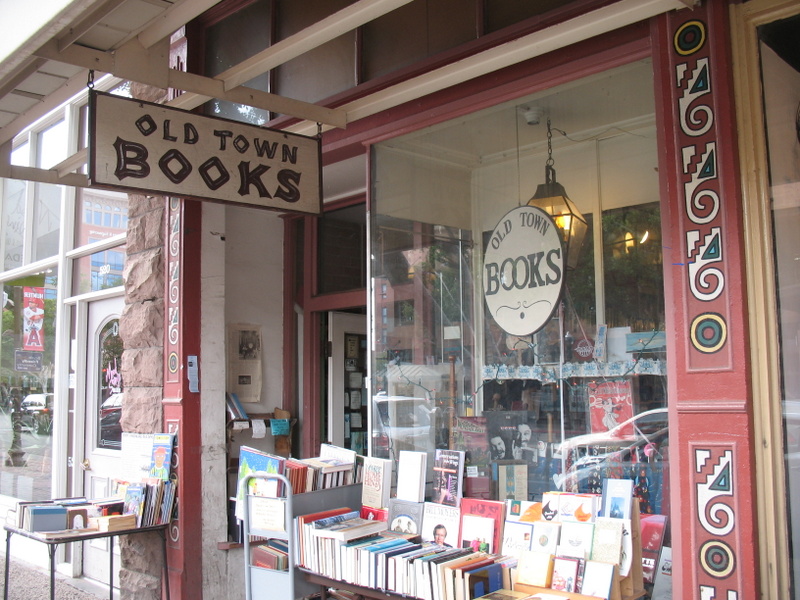
Old Town Books (the proprietors of which can be seen in the top photo above) has been in this location for about twenty years, and outlived Borders, the mega-bookstore that used to be down the street (now Urban Outfitters).  Mrs. H. noticed a copy of a very important book on golf that Speedy didn’t have yet; I was able to pick it up for $4, and he swears it has added 20 yards to his drive!  Mrs. H. found a lovely book of photographs of houses along the James River.  Oddly enough, Mam had grown up along that very river, and was able to tell Mrs. H. odd scraps of news about some of the homes pictured.

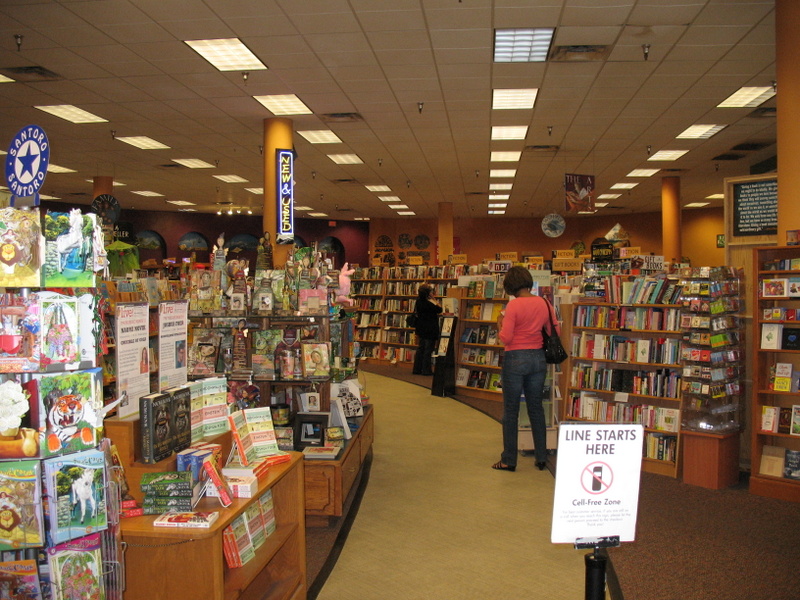
So.  Independent Booksellers.  What are the odds they’ll survive?  My guess is the odds are good, at least for the foreseeable future.  Many of them sell both new and used books, sometimes side by side, as in this bookstore that we visited on our way home.

Some serve niche subjects, religion or mysteries, for example.   All are owned and/or operated by people who are passionate about books and who seem always to have the time to interrupt whatever they’re doing and talk about them.

Amazon and Googlebooks are challenging the big box bookstores such as Borders (now in bankruptcy) and Barnes and Noble (rumored to be for sale).  But the smaller indies have stock that is not always readily available online, and have devoted patrons who want to keep their neighborhood bookstores afloat.  The Book-Buyer’s Guide to New, Used and Antiquarian Bookstores in the Phoenix Valley lists no fewer than 36 stores.  Some are open by chance or by appointment (Machine Age); some have large staffs and come close to looking like a big box store (Changing Hands).

Then there are the hybrids, the stores we access online but which seem to be independents.  You can find them at thriftbooks.com (free shipping!) or abebooks.com.  Both sites list the book I bought Speedy for pretty much what I paid for it.  The thriftbooks site is more forgiving of bad spelling (is it Pinnick or Penick??) than abebooks.  And of course all the local indies have web-sites, though they don’t list all their book stock.

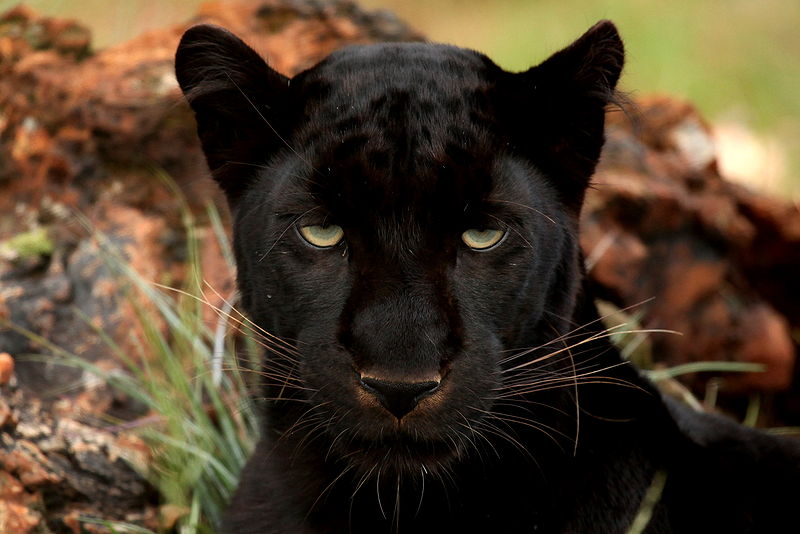
The bottom line?  There’s nothing more pleasurable then setting out to find some good food and coming across a good bookstore at the same time.  And if you go to your local bookstore rather than sitting at home with your computer  you may well have an adventure.  We did (we always do when we ride the Light Rail).  We met a well-groomed and neatly turned out woman carrying a cat in a handsome carrier.  I engaged her in conversation about her pet, a gleaming black puss with yellow eyes.

“He’s a leopard,” she told me.

“Really?!” I replied, thinking surely she meant ‘panther.’

We bantered back and forth, me asking questions and she answering them. By  the time we parted I had learned that she had found her kitty in the desert, the runt of a litter, and that scientists had dumped the kittens out in the desert after creating them by hybridizing a leopard with a schnauser, a pig and some other animal none of us can remember!   To say we were amazed to learn about this scientific accomplishment is an understatement.  We will never have such an animal because they cost $10,000 if you buy them, if you can find them.  Our new friend counted herself extremely lucky to have found hers in the wild.

But I digress, as usual.  Bookstores and restaurants – you’re almost sure to be entertained and satisfied if you visit ones you’ve never been to before.  Just watch out for the panthers.

Photo courtesy of Wikipedia

← Older posts
Newer posts →

Enter your email address to follow this blog and receive notifications of new posts by email.

Join 114 other subscribers

rss

Subscribe in a reader

Search the Blog

A. Useful Links

  • bab.la language dictionary
  • Bus schedules for Tigullio
  • Conversions
  • English-Italian, Italian-English Dictionary
  • Expats Moving and Relocation Guide
  • Ferry Schedule Rapallo, Santa Margherita, Portofino, San Frutuoso
  • Italian Verbs Conjugated
  • Piazza Cavour
  • Rapallo's Home Page – With Link to the Month's Events
  • Slow Travel
  • The Informer – The Online Guide to Living in Italy
  • Transportation Planner for Liguria
  • Trenitalia – trains! Still the most fun way to travel.

C. Elaborations

  • A Policeman’s View
  • Driving School Diary
  • IVA refunds due for past Rifiuti tax payements
  • Nana
  • Old trains and old weekends
  • The peasant, the Virgin, the spring and the ikon
  • Will Someone Please, Please Take Me to Scotland?

D. Good Recipes - Best of the Week winners are starred

  • 'Mbriulata
  • *Baked Barley and Mushroom Casserole*
  • *Captain’s Boston Baked Beans*
  • *Crimson Pie*
  • *Louise’s Birthday Cake*
  • *Melanzane alla Parmigiana*
  • *Penne with Cabbage and Cream
  • *Pizzoccheri della Valtellina*
  • *Pumpkin Ice Cream*
  • *Risotto alla Bolognese*
  • *Rolled Stuffed Pork Roast*
  • *Spezzatini di Vitello*
  • *Stuffed Grape Leaves*
  • *Stuffed Peaches (Pesche Ripiene)*
  • *Swordfish with Salsa Cruda*
  • *Tagliarini with Porcini Mushrooms*
  • *Tagliatelli al Frutti di Mare*
  • *Three P's Pasta*
  • *Tzatziki*
  • 10th Tee Oatmeal Apricot Bars
  • Adriana’s Fruit Torta
  • Aspic
  • Bagna-calda
  • Best Brownies in the World
  • Clafoutis
  • Cold cucumber soup
  • Crispy Tortillas with Pork and Beans
  • Easy spring or summer pasta
  • Fish in the Ligurian Style
  • Hilary's Spicy Rain Forest Chop
  • Insalata Caprese
  • Lasagna al forno
  • Lasagna al Forno con Sugo Rosato e Formaggi
  • Lemon Meringue Pie
  • Leo’s Bagna Cauda
  • Leo’s Mother’s Stuffed Eggs
  • Louis’s apricot chutney
  • Mom's Sicilian Bruschetta
  • No-Knead (almost) Bread
  • Nonna Salamone's Christmas Cookies
  • Pan Fried Noodles with Duck, Ginger, Garlic and Scallions
  • Pesto, the classic and original method
  • Pesto, the modern, less authentic method
  • Pickle Relish
  • Poached pears
  • Poached Pears
  • Polenta Cuncia
  • Recipes from Paradise by Fred Plotkin
  • Rustic Hearth Bread
  • Shrimp and Crayfish Tail Soup
  • Sicilian salad
  • Slow Food Liguria
  • Slow Food Piemonte and Val d'Aosta
  • Spinach with Garlic, Pine Nuts and Raisins
  • Stuffed Eggs, Piemontese Style
  • The Captain’s Salsa Cruda
  • Tomato Aspic
  • Zucchini Raita

E. Blogroll

  • 2 Baci in a Pinon Tree
  • Aglio, Olio & Peperoncino
  • An American in Rome
  • Bella Baita View
  • Debra & Liz's Bagni di Lucca Blog
  • Expat Blog
  • Food Lovers Odyssey
  • Italian Food Forever
  • L’Orto Orgolioso
  • La Avventura – La Mia Vita Sarda
  • La Cucina
  • La Tavola Marche
  • Rubber Slippers in Italy
  • Southern Fried French
  • Status Viatoris
  • Tour del Gelato
  • Weeds and Wisdom

Photographs

  • A Day on the Phoenix Light Rail Metro
  • Apache Trail in the Snow
  • Aquileia and Croatia
  • Birds on the Golf Course
  • Bridge Art
  • Canadair Fire Fighters
  • Cats of Italy
  • Cloudy day walk from Nozarego to Portofino
  • Fiera del Bestiame e Agricultura
  • Football Finds a Home in San Maurizio
  • Hiking Dogs
  • Mercatino dei Sapori – Food Fair!
  • Moto Models
  • Olive pressing
  • Rapallo Gardens
  • Rapallo's Festa Patronale
  • Ricaldone and the Rinaldi Winery
  • Rice Fields
  • Sardegna ~ Arbatax and Tortoli
  • Sardegna ~ San Pietro above Baunei
  • Sardegna ~ The Festa in Baunei
  • Scotland, including Isle of Skye
  • Slow Food 2008 Salone del Gusto
  • The Cat Show and the Light Rail Fair
  • The desert in bloom
  • Trip to Bavaria

Pages

  • Fagioli all’ucelleto

Archives

Recent Posts

  • A Superior Visit
  • Fun at the Ranch Market
  • The MAC
  • Welcome Tai Chi
  • Bingo Fun for Ferals
December 2025
M T W T F S S
1234567
891011121314
15161718192021
22232425262728
293031  
« Jul    

Member of The Internet Defense League

Blog at WordPress.com.

  • Subscribe Subscribed
    • An Ex-Expatriate
    • Join 114 other subscribers
    • Already have a WordPress.com account? Log in now.
    • An Ex-Expatriate
    • Subscribe Subscribed
    • Sign up
    • Log in
    • Report this content
    • View site in Reader
    • Manage subscriptions
    • Collapse this bar
 

Loading Comments...