• Contact
  • Elaborations
    • A Policeman’s View
    • Driving School Diary
    • Great Danes
    • IVA charged on Tassa Rifiuti
    • Nana
    • Old trains and Old weekends
    • The peasant, the virgin, the spring and the ikon
    • Will Someone Please, Please Take Me to Scotland??
  • Recipes
    • ‘Mbriulata
    • *Baked Barley and Mushroom Casserole*
    • *Captain’s Boston Baked Beans*
    • *Cherry Tart*
    • *Crimson Pie*
    • *Louise’s Birthday Cake*
    • *Melanzane alla Parmigiana* – Eggplant Parmesan
    • *Penne with Cabbage and Cream
    • *Pizzoccheri della Valtellina*
    • *Pumpkin Ice Cream*
    • *Risotto alla Bolognese*
    • *Rolled Stuffed Pork Roast* on the rotisserie
    • *Shrimp and Crayfish Tail Soup*
    • *Spezzatino di Vitello*
    • *Stuffed Grape Leaves*
    • *Swordfish with Salsa Cruda*
    • *Tagliarini with Porcini Mushrooms*
    • *Tagliatelli al Frutti di Mare*
    • *Tzatziki*
    • 10th Tee Apricot Bars
    • Adriana’s Fruit Torta
    • Artichoke Parmigiano Dip
    • Best Brownies in the World
    • Clafoutis
    • Cod the Way Sniven Likes It
    • Cold Cucumber Soup
    • Crispy Tortillas with Pork and Beans
    • Easy spring or summer pasta
    • Fagioli all’ucelleto
    • Fish in the Ligurian Style
    • Hilary’s Spicy Rain Forest Chop
    • Insalata Caprese
    • Kumquat and Cherry Upside Down Cake
    • Lasagna Al Forno con Sugo Rosato e Formaggi
    • Lemon Meringue Pie
    • Leo’s Bagna Cauda
    • Leo’s Mother’s Stuffed Eggs
    • Louis’s Apricot Chutney
    • Mom’s Sicilian Bruschetta
    • No-Knead Bread (almost)
    • Nonna Salamone’s Famous Christmas Cookies
    • Pan-fried Noodles, with Duck, Ginger, Garlic and Scallions
    • Pesto
    • Pesto
    • Pickle Relish
    • Poached Pears
    • Polenta Cuncia
    • Pumpkin Sformato with Fonduta and Frisee
    • Rustic Hearth Bread
    • Sicilian Salad
    • Soused Hog’s Face
    • Spotted Dick
    • Swedish Tea Wreaths
    • The Captain’s Salsa Cruda
    • Tomato Aspic
    • Vongerichten’s Spice-Rubbed Chicken with Kumquat-Lemongrass Dressing
    • Winter Squash or Pumpkin Gratin
    • Zucchini Raita

An Ex-Expatriate

~ and what she saw

An Ex-Expatriate

Category Archives: Customs

Porchetta

05 Tuesday Aug 2014

Posted by farfalle1 in Customs, Food, Italian festas, Italian food, Italian recipes, Liguria, Rapallo, San Maurizio di Monti, Uncategorized

≈ 12 Comments

Tags

Comitato Fuochi, Festa di San Maurizio

Festa at San Maurizio porchetto-002San Maurizio’s wonderful Comitato Fuochi put on a weekend-long shindig a couple of weeks ago, their Summer Festival. This doughty group of volunteers was first formed in 1903. In the early days the Committee divided our frazione into three districts.   In the 1940’s the three districts became two, and in the 1980’s the two became one; since 2006 the group has been particularly active. Working with the town of Rapallo they helped organize the construction of the soccer field where they now hold their events. In the intervening years they have added several permanent and temporary structures so events can be held in all weather.

The main purpose of the group is to have a Festa in honor of our frazione’s patron saint, San Maurizio each September. One of the highlights of the annual Festa Patronale is the fireworks display; this, of course, costs money, and part of the reason for the other four annual Festas (Carnivale, Spring, Summer, Chestnuts) is to raise money for the main event.

The weekend festa is comprised of food and entertainment. Being old farts we didn’t make it down to the soccer field to enjoy the entertainment.
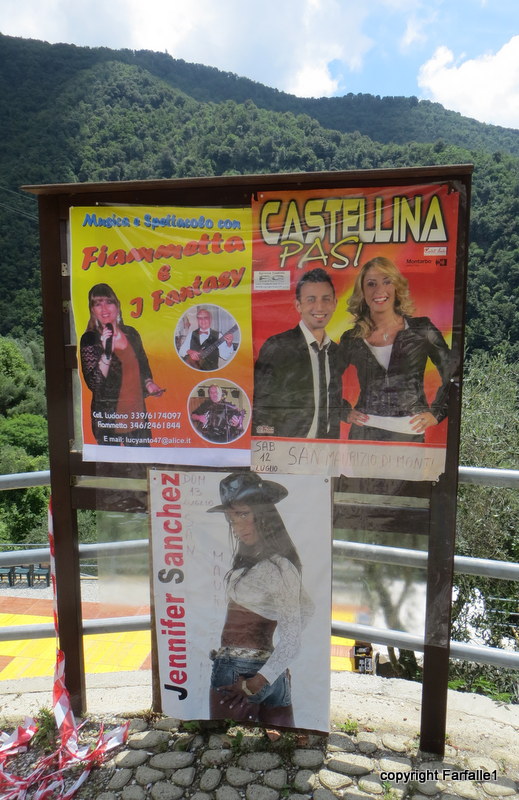
Festa at San Maurizio the talent

In fact, sadly the Friday night show was rained out. We did, however, stop in for lunch on Sunday, not knowing what we would find on the menu. To our delight we found trofie al pesto (a traditional Ligurian pasta), totani (small fried squid) and porchetta, seen above, amongst other things.

Wikipedia describes porchetta as “a savoury, fatty, and moist boneless pork roast of Italian culinary tradition. The body of the pig is gutted, deboned, arranged carefully with layers of stuffing, meat, fat, and skin, then rolled, spitted, and roasted, traditionally over wood. Porchetta is usually heavily salted in addition to being stuffed with garlic, rosemary, fennel, or other herbs, often wild. Porchetta has been selected by the Italian Ministero delle Politiche Agricole, Alimentari e Forestali as a prodotto agroalimentare tradizionale (“traditional agricultural-alimentary product”, one of a list of traditional Italian foods held to have cultural relevance).” The dish originated in central Italy, but is now popular throughout the country. You can frequently find it at weekly markets at a special truck, and it turns up often at festas like ours as well. This particular porchetta came from Tuscany, from Montepulciano to be exact. And it was delicious, according to Speedy (I ate the totani, which was also really, really good).

Festa at San Maurizio where pork was fromI asked Speedy to write down the story of his introduction to porchetta to share with you. This is what he said, “I first learned about Porchetta and its charms back in the 1970’s when I was flying cargo from New York to Rome.  Without flight attendants and the access to First Class fare which was available to crews on passenger flights, the guys and I would arrive in Rome famished–and with the usual thirst that follows long flights.  One day I asked one of the agents meeting the flight where was the best place to stop to take care of this problem on the way to the crew hotel in central Rome.  He suggested telling the taxi driver to take the Via del Mare where we would find one of those open-sided trucks that are, in fact, full kitchens that serve the food out on paper from a high counter that runs the length of the vehicle–this is the Italian version of a Truck Stop.  And, the ground in front would, in fact, be crawling with huffing trucks.  Anyway, we would get slabs of steaming porchetta on thick slices of crusty, chewy bread and a small glass of frascati for about a dollar.  For a couple more glasses of frascati one had to put out another quarter or so.” It is a very happy memory for him!

Image courtesy of Charcouterie Ltd.

A porchetta-like dish is not hard to make at home. You can find many recipes on the internet, for example this one from Epicurious or this one from Bon Appetit. My own favorite, natch, is Speedy’s own recipe for rolled, stuffed pork roast, which is very porchetta-like. But for the true porchetta experience you have to come to Italy and visit one of the many stands or festas where it is served. I recommend the ones at San Maurizio. You won’t find a harder-working group of volunteers any where and the food is always great. Here are a few more photos of our visit to the tent and there are more over here if you are interested.

One of my favorite poems from the book Unleashed: Poems by Writers’ Dogs (1999) is this one by a yellow lab, whose writer companion I don’t remember. The poem goes something like this:

Ya gonna eat that?
Ya gonna eat that?
Ya gonna eat that?
I’ll eat that!

Festa at San Maurizio

I love how they keep the porchetta swaddled up in a sheet – keeps the flies off.

Festa at San Maurizio the gang

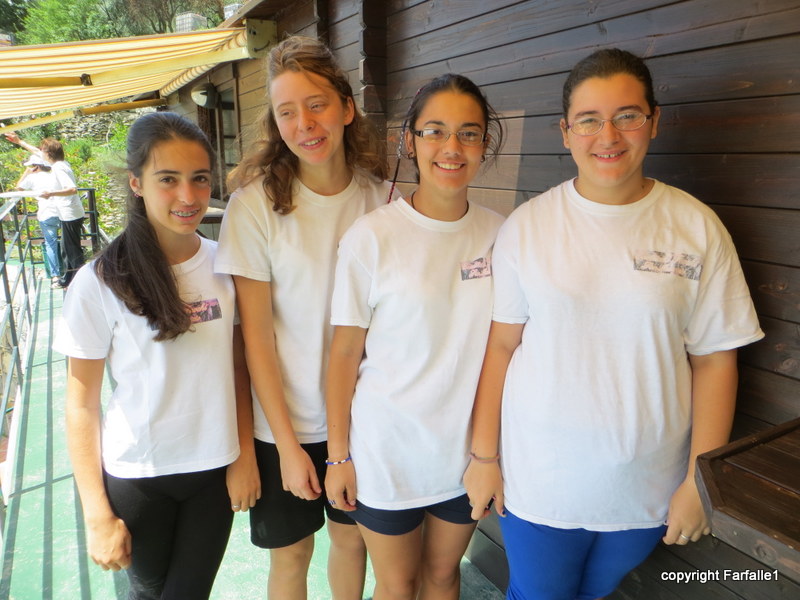
These girls are run off their feet when things get busy, but they never mess up an order.Festa at San Maurizio the waitresses
Hard Landing

25 Sunday Nov 2012

Posted by farfalle1 in American habits and customs, Arizona, Customs, Italian habits and customs, Rapallo, Travel, Uncategorized

≈ 6 Comments

Tags

culture shock

Once again, as every year, culture shock has blind-sided me.  Yes, it is gorgeous here (see above) and yes, it is warm (even hot) and dry.  But it’s not Italy, is it?  Sounds so obvious, but somehow it takes me aback annually.  In fairness, I have to say that there will be a repeat of culture shock, in reverse, when we return to Rapallo in April or May.

But just what is the shock?  Size is one thing – everything is so darn big here.  When it comes to living quarters, I like that.  When it comes to servings when eating out I don’t.  Cars? no.  Sense of humor? yes.  Noise is another thing: there are non-stop sounds in Rapallo; scooters dash up and down the mountain, dogs bark non-stop, the rooster who can’t tell time crows his ignorance, diners clink their cutlery against their plates at Rosa’s and even, if they’ve had enough, break into song or begin to cheer loudly. Over at Case di Noe someone has fired up a brush-cutter, and every half hour the church bells remind us what time it is. (Speedy has addressed this part of the problem by down-loading chimes to sound the hours on the computer – not the same as the jazzy bell concert San Maurizio gives us each Sunday, but better than nothing.)

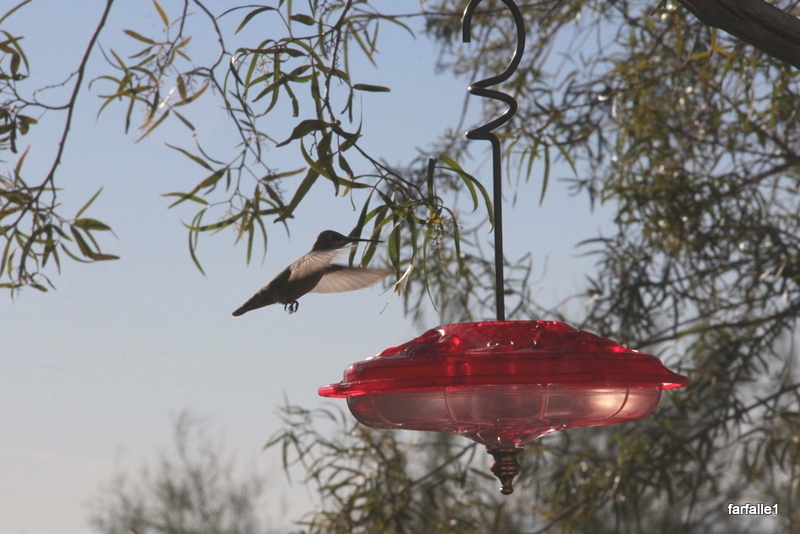
There are plenty of noisy places in the U.S., but we don’t happen to be in one of them.  Our neighborhood has forty homes, of which probably one-third are occupied now, it being still early in ‘the season.’  The family with small children who lived across the street have moved – how we miss their constant activity and cheerful little voices.  If we listen carefully we can hear the hum of traffic from the highway that’s about a mile away.  When the birds visit our feeders they are likely to squabble.  The humming birds sound like teeny little power saws when they zoom in and out.  But mostly it’s just very quiet and peaceful.  That’s nice, it really is, it’s just such a change.

The biggest change, though, and the hardest to adapt to, is the societal difference.  Italians are out and about for a good part of the day.  One must shop daily, the passagiata awaits at the end of the day.  There are friends and family to visit and ‘news’ to be discussed endlessly.  The silence in our neighborhood is but a reflection of a larger silence that I think of as particularly American.  People are afraid to discuss ‘issues’ for fear that they will offend or anger the person to whom they’re speaking. Somehow Italians have found a way to express differences without letting it get personal, and without letting it get in the way of friendships.  Here people are afraid to make eye contact with strangers, unlikely to greet strangers on the street (any one of whom may be carrying a weapon, concealed or otherwise, at least here in the wild west), and uncomfortable with the idea of discomfort.

Of course Italy is far from perfect.  But part of culture shock, I think, is the tendency to idealize the place one has left, to look back through the fuzzy lens of rosy glasses, while looking at present circumstances with the critical lens of a microscope.

I’m not asking for sympathy, believe me.  We are terribly fortunate to be able to enjoy life in two such diverse places, and yes, we are Thankful that we are able to (’tis the season).  I’m just saying that the transition is, for me at any rate, difficult, but difficult in an interesting way, not a painful way.  So please, stick with me for a while?  Pretty soon I’ll have my feet under me again and will share some more of the excitement of life in a most peculiar state.

A disturbing event…

06 Sunday May 2012

Posted by farfalle1 in Crime, Customs, Uncategorized

≈ 8 Comments

Tags

Bicycle Thief, Crime in Italy, Petty Crime in Italy

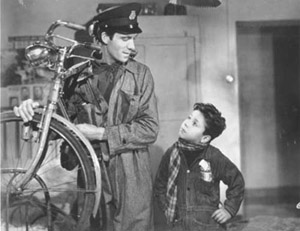
Still from the 1948 De Sica film “The Bicycle Thief,” courtesy of filmnight.org

You know how sometimes something happens in the wink of an eye, and you’re left with your mouth hanging open and an endless loop of ‘I should haves’ playing in your brain? That’s what happened to us last evening.

We parked at the train station on the way to a friend’s house for dinner. As we approached the section reserved for parked motor scooters I saw a large man who  looked… well, he just looked suspicious. So I stopped and watched him. He was bent over a very expensive bicycle that was chained to the metal railing of the parking lot, next to some old junky old bikes. As I watched he went snick, snick, the chain, which was very thin, fell away from the bike, and he began to turn. Then he saw me watching.

The man I saw was using a much smaller tool. Photo courtesy superstock.com

“E il mio bici! E il mio!” he said, brandishing his chain cutter. This pegged him immediately as a non-Italian. ‘Bici’ (pronounced bee-chee) is feminine because it’s short for ‘bicicleta,’ a feminine noun.

‘ I bet. E la tua adesso,’ I thought to myself as he hopped on and pedaled off. Speedy hadn’t noticed what was going on and had walked ahead a little, but turned back when he sensed my absence. By now the thief, because surely he was a thief, was pedaling out of the parking lot.

I felt so stupidly helpless. There I was with a camera in my purse, but my hands full of umbrealla and a focaccia in tinfoil. If only I had gotten a photo of the ladro! But I didn’t, and it’s been driving me nuts ever since.

When we arrived at the dinner party we told our hostess and the other guests what had happened. “What should we do?” I asked, “Should we call the police?”

“Eh, beh!” said one friend. “What are the police going to do? When the thieves broke through my wall and stole my safe the police didn’t come for three days, even though I called immediately.” So last night, on advice of all present, we did nothing. Besides, I had an ace up my sleeve.

I knew our friend the policeman would be coming by for a visit this afternoon, so I decided to wait and ask him, which I did. He just shrugged. “It happens every day,” he said. “There’s nothing to do.” So there’s an end to it. I’m not sure I could identify the thief if I saw him; everyone says it’s good I didn’t take his photo as he might have become violent (I disagree, but…). It just doesn’t sit right with me, though.

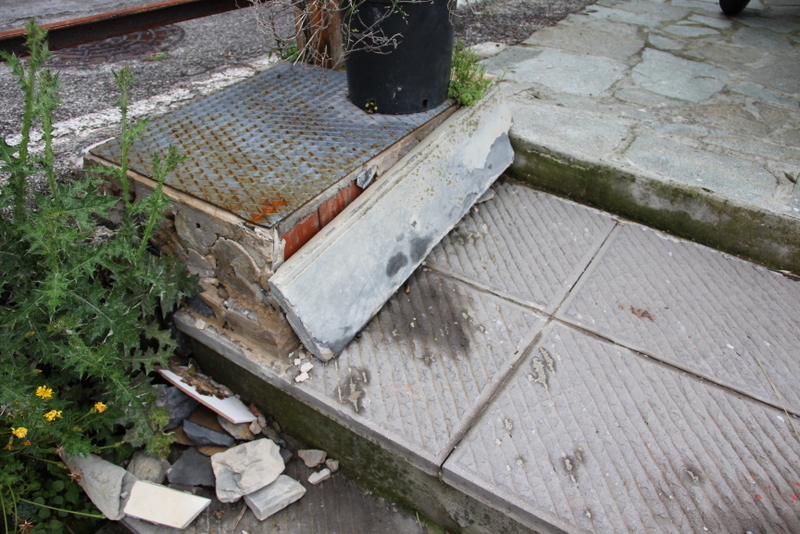
Putting this together with two other incidents that have occurred since we returned has taken a bit of the shine off our joy at being reunited with Rapallo. The first thing we saw when we got home was that someone had destroyed the facing around the sewer pozetta (box) that Speedy had worked hard at making attractive.

Evidently a very large, heavy something was brought down on the heavy, solid metal cover over the box; it has a big rusty dent in the top. All the facing stones popped out of their cement base from the force of the blow. Well, maybe it was an accident (though honestly, it didn’t look like one).

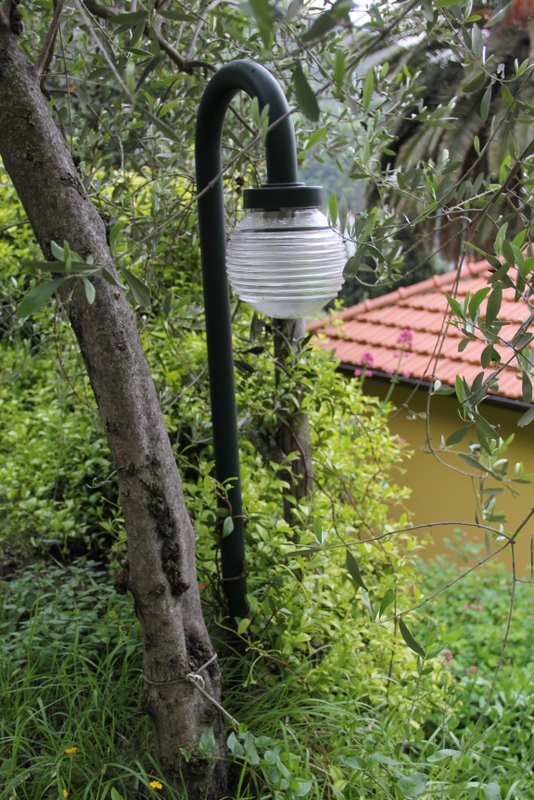
Then we realized that none of our outdoor lights were functioning. Why not? Probably water got into the lines, we surmised, because it has been exceptionally rainy of late. But no. On further examination today I realized that the light bulbs have been stolen. Three lightbulbs.  How lame is that??!  And note that in order to take them someone had to go to the trouble of unscrewing and removing the glass globes.  We were lucky, I think, that they replaced them – yet more work!

It all got me thinking about how different some things are in the States.  What I sometimes don’t feel so much here is a sense of all of us in a community looking out for each other’s welfare. The police evidently have so much to do that something like a stolen bicycle just doesn’t register on their crime-meters. (I’m not being sarcastic, there’s an enormous amount of crime here it seems, and the police have to jump through hoops to follow correct procedure. Read about it here.) If we don’t look out for our fellow citizens, who will? I was guilty last night for not doing something, anything; the police are guilty for not caring about petty crime; the thieves are guilty for breaking the social contract, and we’re all guilty for looking the other way when we see something wrong.  It’s all  disturbing, and I hate that I’m part of the problem. I’m not in favor of armed vigilantes prowling neighborhoods (ahem), but I certainly think we should all take an interest in looking out for each other.*

Am I crazy?

*Disclaimer.  Having had a good rant, I have to say that our neighbors are very kind about keeping an eye on our house when we’re not at home, and even when we are.  I’m sure they’ve saved us no end of problems with their watchfulness.  Are they the exception that proves the rule?

Songbirds: Friends or Food?

04 Wednesday Jan 2012

Posted by farfalle1 in Animals in Italy, Animals in the U.S., Birds in Italy, Crime, Customs, Italy, Uncategorized

≈ 10 Comments

Tags

Bird-feeding, Feeding Birds, Hunting in Italy, Hunting songbirds in Italy, Illegal hunting in Italy, Trapping songbirds in Italy

Somehow it’s hard to think of chickens and turkeys as birds.  Sure, they have feathers, but we never see a flock of them high overhead, migrating south for the winter, their clucking stirring our own restlessness.  Nor do we startle them when we take a walk in the woods.  We don’t listen for their sweet morning calls and try to identify exactly what chicken it is we’re hearing.  Wait!  Is that a Rhode Island Red or an Ameraucana?  Hand me my binoculars!

No.  Chickens and turkeys are ambulatory food for the most part.

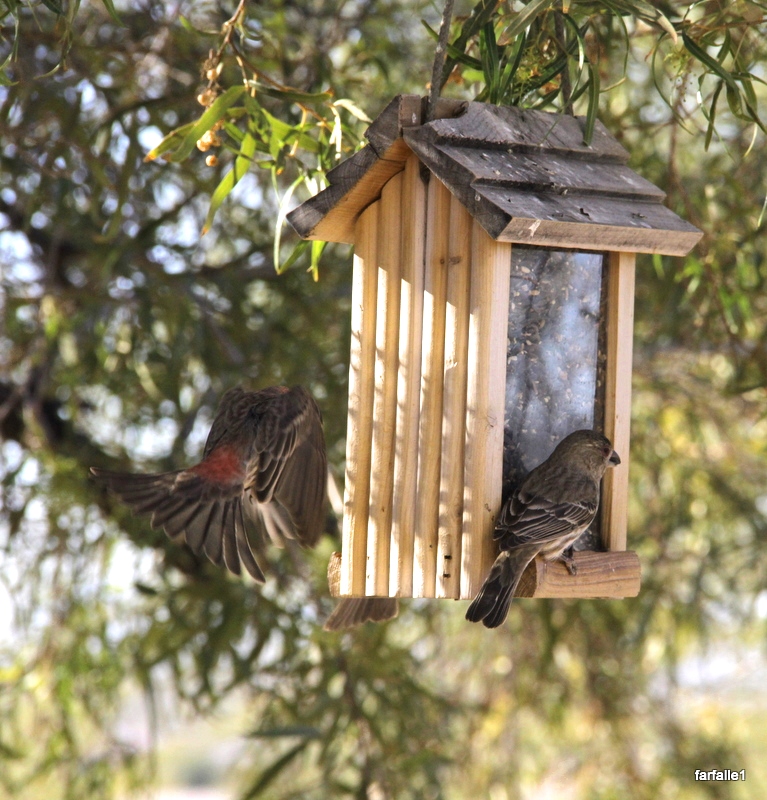
Songbirds, however, are not.  One of the  pleasures of being here in Arizona is watching the birds that come to our feeder every day.

Anna's hummingbird, noisy and aggressive

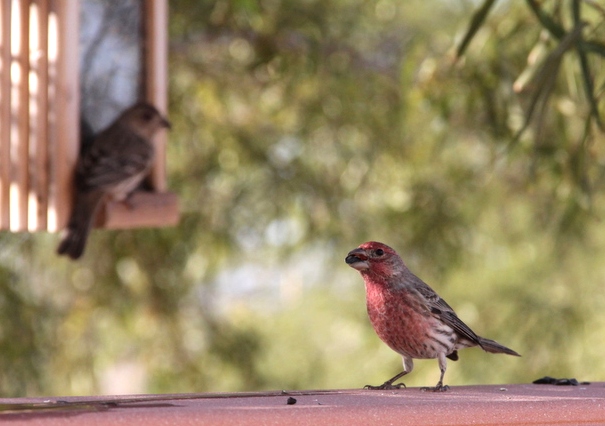
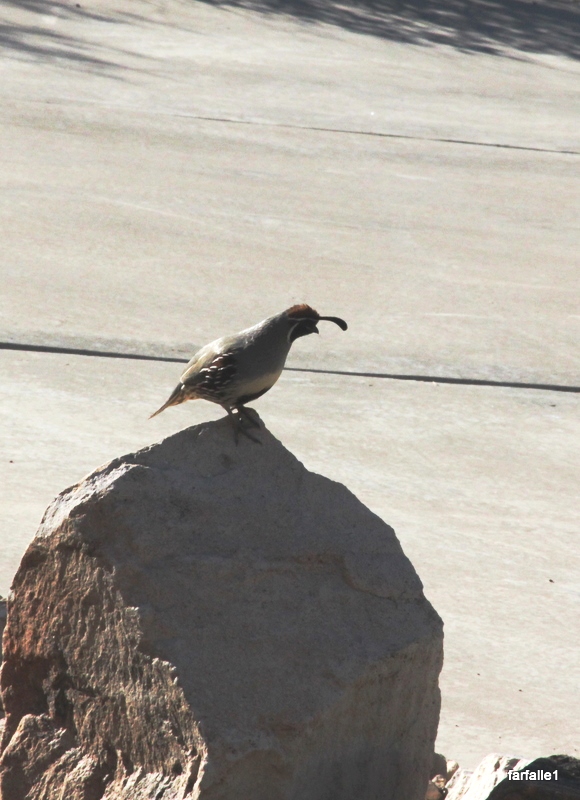
We don’t get anything terribly exotic (and we have yet to see a chicken) –  many purple finches, the ubiquitous Anna’s hummingbird, Abert’s towhee , Gila peckers, Cactus wrens, and, on the ground below, Inca doves and the amusing Gambel’s quail, which makes a bweep-bweeping sound, reminiscent of burbling water, while it wanders around beneath the feeder.

Male finch enjoying a seed while female thinks about it

Gambel's quail, males conveniently carry bulls eye on their breasts

It’s a pleasure we don’t enjoy in Italy.  Not because there are no songbirds – there are.  We get huge amusement and satisfaction from the merli (a sort of black robin with the unfortunate Latin name Turdus merula, called ‘merlo’ in the singular) which are curious and companionable, and which have the beautiful song typical to thrushes.  We seldom work outside in spring or summer without an appreciative audience of merli.  But bird-feeding as a hobby does not seem to exist in Italy, at least not in our part of the country.  I have never seen a bird-feeder at anyone’s house, and I have never seen bird feed for sale.

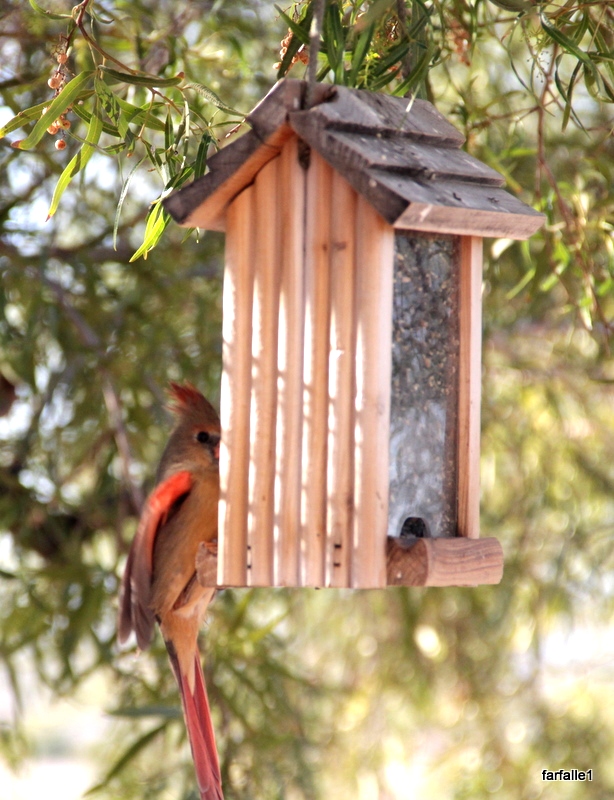
Male cardinal

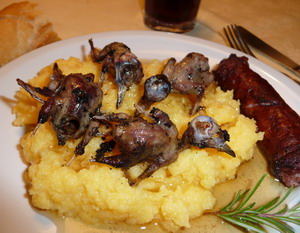
Instead in Italy there is a sizable, though fortunately shrinking, trade in trapping and killing wild birds.  The CABS (Committee Against Bird Slaughter) web site has a great deal of information about the illegal trapping of birds which occurs, in Italy, mostly in the north (Lombardia), the southern Italian coast, Sardinia and Sicily.  There are a couple of good reasons why this illicit activity continues.  One is that it is a matter of long tradition to trap songbirds, and Italy is nothing if not wed to her traditions.  In earlier times songbirds were an important source of protein for hungry Italians. Another reason is that some restaurants persist in serving songbirds, though you will never see them on the menu.

Little birds with polenta, photo courtesy of CABS

Happily, CABS reports that hunting songbirds is truly on the wane in northern Italy, a trend we can only hope (or I can only hope, anyway) will continue.

Gila woodpecker atop a nearby cactus

Hunting for sport is as popular in the U.S. as it is in Italy.  In 2006, according to the U.S. Fish and Wildlife Service, 2.3 million people hunted migratory birds such as doves or waterfowl.  Such hunting is highly regulated; hunters must have appropriate licenses and stamps, and can hunt only certain birds in certain places at certain times.  Sport hunters in both countries are generally dedicated and law-abiding conservationists, interested in protecting the populations of the species they like to hunt.  In a perfectly counter-intuitive bit of logic, sometimes bird populations must be ‘culled’ in order to protect the well-being of the species.  It makes no sense to me, but if the people at Audubon say it’s true, it must be true.  Mustn’t it?

No doubt there is illegal hunting in the U.S., but it is difficult to get away with it.  Some years ago when we lived in Connecticut a man of our acquaintance became very angry at the number of messy geese on his pond and lawn.  He got out his rifle, stood on the back porch and shot one, no doubt hoping to scare away the others.  His neighbors heard the shot and came running to find out what was wrong, so he was caught red-handed.  He did not go to prison, but he did have a reprimand and a sizable fine.  Even worse, he became known locally as ‘Goose Killer’ – and it was not the sort of affectionate and admiring nickname that, say, ‘Speedy’ is.

The illegal taking of birds in Italy is of a different order entirely.  According to CABS, ‘millions’ of birds are taken every year, hundreds of thousands of them in Northern Italy.  They are sometimes taken with guns, as in the wholesale slaughter of migrating birds videoed here (supposedly ‘legal,’ but against the very EU regulations Italy signed on to uphold), and frequently taken in any of several various types of traps, all of which are illegal (bow, snap, snare, cage and nets).

It’s hard to understand what the appeal or pleasure is in trapping or shooting  songbirds.  It’s not as if they’re particularly challenging prey, or especially meaty.  The declining number of traps in Italy attest to the gradual change of attitude towards this cruel practice; but it remains a big problem.

Male finches 'discuss' seating while a female thinks about it all

According to Wikipedia 55 million Americans are bird-watching hobbyists.  They spend $3 billion a year on seed and $800,000 million on bird feeders and other accessories.  Maybe there’s an opportunity here to help the struggling Italian economy.  Don’t kill the birds, feed them. Photograph them.   Enjoy them.  Encourage touristic bird-watching trips. And when the irresistible blood lust of the hunter comes over you, go down to Signore Marrone’s farm and bag a few chickens.

Diving for Pearls in Zoagli

05 Monday Sep 2011

Posted by farfalle1 in Customs, Italian habits and customs, Italian men, Uncategorized

≈ 10 Comments

Tags

Cliff diving, Diving in Zoagli, High diving, Zoagli

(click on any photo to see a larger, clearer image)

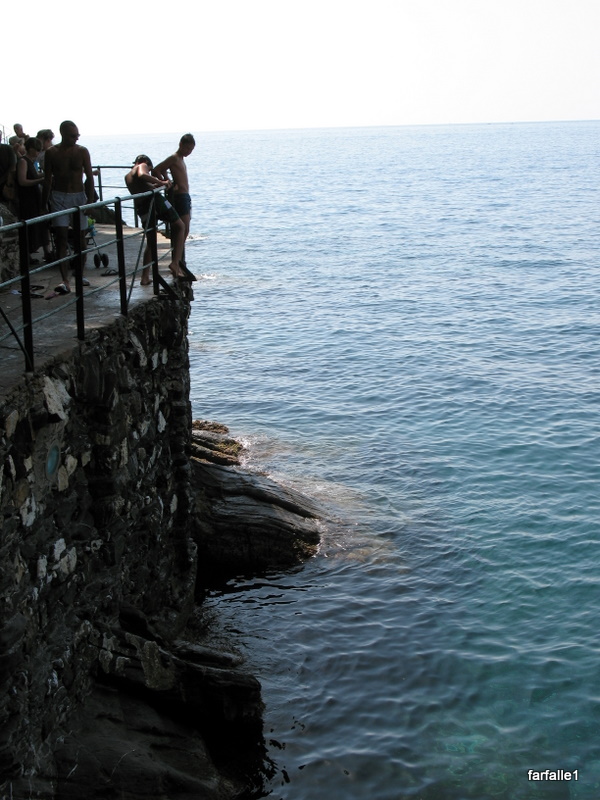
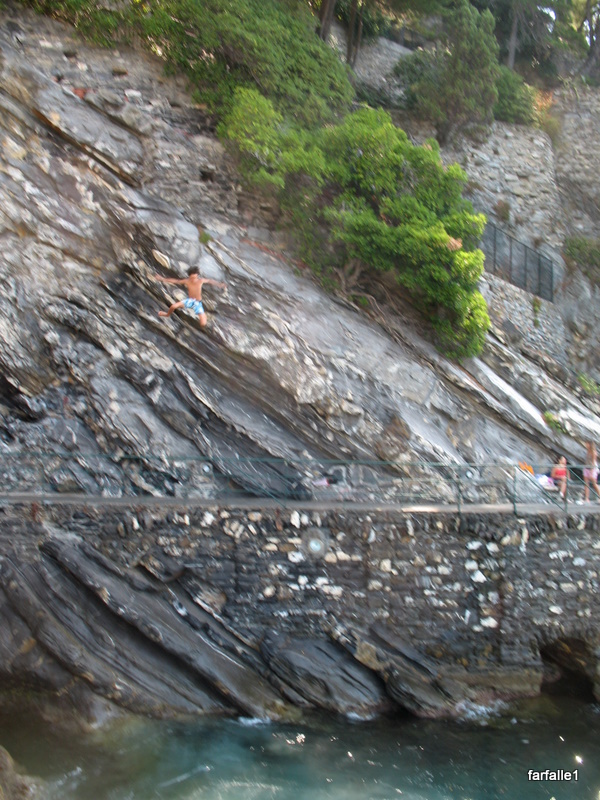
Nah, I’m just kidding, they don’t really dive for pearls in Zoagli, at least I don’t think they do. But they certainly do dive.  The young neophytes start from the passagiata walk, a gorgeous path that has been constructed where the sheer, steep cliffs meet the rock strewn sea:


And if you think mothers object to their children jumping from a great height into what looks like a pile of rocks, guess again.  Mom jumps too!


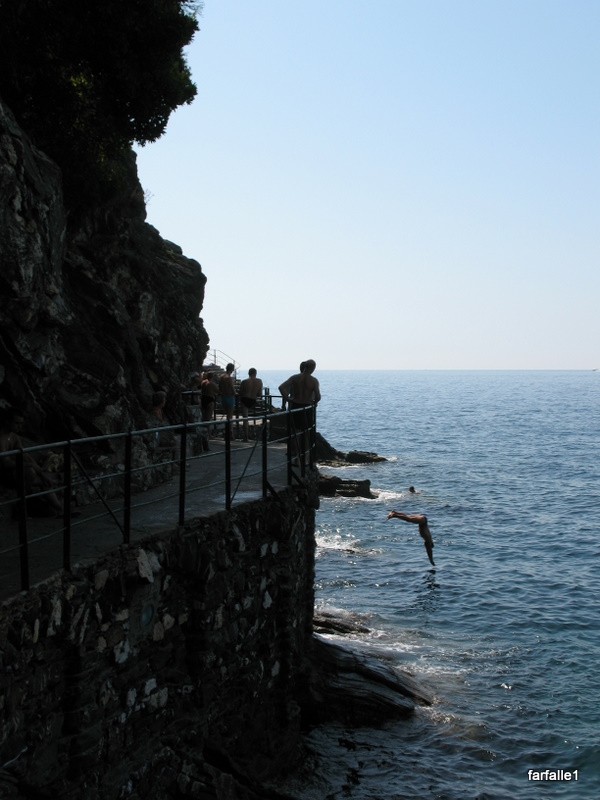
Once they’ve mastered the low dive, they move up to the medium dive.  This young man dove from the ledge above the heads of the three people standing farthest along the sidewalk; he not only had to clear the sidewalk, he had to get far enough out to miss the rocks just below the walk.


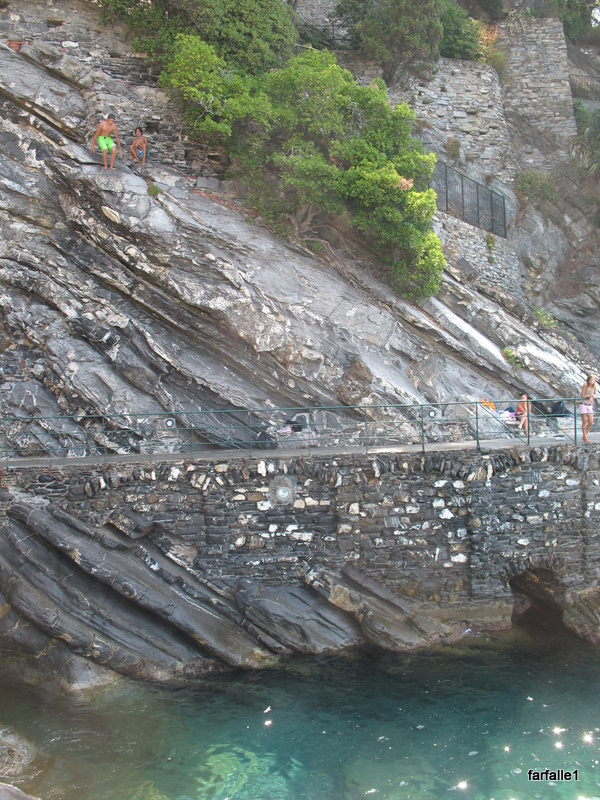
Then there’s the…. High Dive.

See the boy in the green trunks with his friend about twenty feet above the passagiata?  This stops my heart every time I see it – there’s no margin for error in this jump.

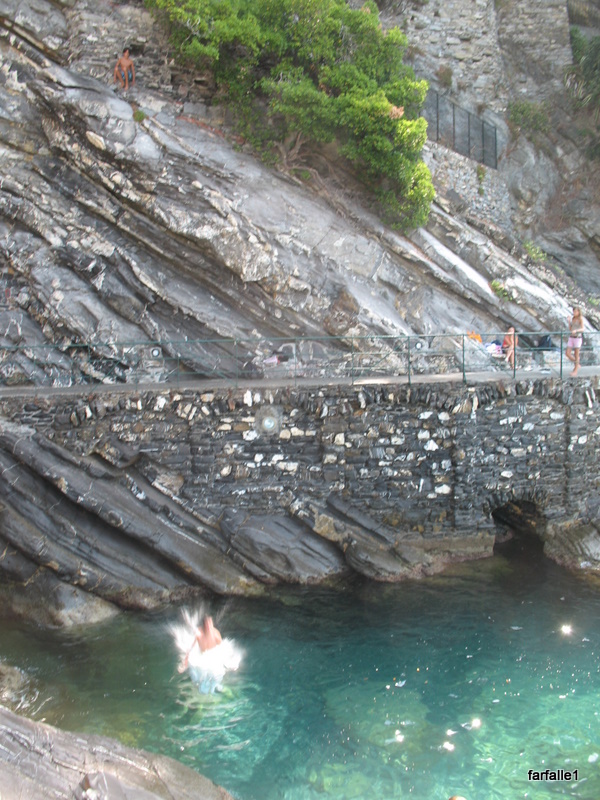
And there he goes!

The photo is out of focus because the whole thing makes me so nervous my hands shake.  But look!  He’s arrived safe and sound!

Jumping from the high rocks seems to be a rite of passage for Zoagli teenagers (mostly boys, though I’ve seen girls jump too).  It makes me kind of glad I didn’t grow up on a rocky sea coast.  No.  It makes me very glad I didn’t grow up on a rocky sea coast!

Shhhh

01 Monday Aug 2011

Posted by farfalle1 in American habits and customs, Arizona, Customs, Italian festas, Italian habits and customs, Italy, Uncategorized

≈ 13 Comments

Tags

How to Listen, Julian Treasure, Listening, Noise, Noise Pollution, Sound

The Captain always teases me by saying, “You know I never listen;” and I tease back by saying, “True.  We have the perfect arrangement for living in Italy – you speak and I listen.”  (He’s much better at speaking the language than I.)

While the captain may be teasing, it seems true to me that often people really don’t listen to others (I include myself in this group). The reasons are many – self-involvement, disinterest, hearing impairment, multi-tasking, language challenges, etc., etc.

The TED website recently put up a talk by sound specialist Julian Treasure which I found fascinating. He talks about why people don’t listen, and how we can all improve our listening skills.  It’s a short video, just over seven minutes – here, take a look.

https://ted.com/talks/view/id/1200

One of the things that has always struck me about Italy is the non-stop noise, at least where we live.  As I type this it’s 10:30 at night and there’s a festa down the street a way with live music – very loud live music.  Driving bass, banging drums and a songstress who is, alas, a bit flat.  It’s not my taste in music, to be honest, but I don’t really resent it being forced on us (at least not until after 11 p.m. – last night the live music went til midnight and I did get a bit cranky).  It happens only a few times a year up here. The amazing thing to me is that no one complains or seems to mind.

But if it’s not live music, there is always some other kind of aural stimulation – scooters and cycles tearing up and down the mountain; the bus slowly groaning its way up, merrily tootling its horn at every curve (a necessary precaution on these narrow roads) and then loudly sighing and chuffing at each stop; church bells from our village, from Montallegro and, if the wind is right, from the Rapallo Cathedral; ambulance and police sirens; cruise ship horns; airplanes overhead; dogs barking; cocks crowing at all hours; birds; children shouting (a particularly cheerful noise, that) and always, always conversation.  Conversation as an art form is alive and well in this courteous country.  Finding three minutes of silence daily, as recommended by Mr. Treasure (can that really be his name??) is a challenge here.  Every now and then one of us awakens at 3 or 4 a.m., and we are struck by the relative silence – it is such a rarity.

In contrast the U.S. seems much quieter in general (not the cities, to be sure).  The example the Captain likes to give is this:  when Italy won the World Cup (European football) in 2006 the racket from Rapallo was amazing – horns blasted, cars tore through the center of town with kids hanging out waving flags and shouting, ships in the harbor blew their horns – it was an explosion of celebratory sound.  In 2008 when the Arizona Cardinals (American football) won the game that sent them to the Super Bowl we stuck our heads outside right after the game.  Our Arizona neighborhood was as silent as a tomb, the town was silent; and we were a mere forty miles from the stadium where the game was played.  No one was out and about because anyone not at the game was surely inside watching it on TV – but afterwards there was no public demonstration of glee.  And if someone’s party is noisy in the U.S. it takes the neighbors no time at all to call the police and complain.

So, is it harder to listen in Italy, where there is so much more ambient noise?  Though the Captain might well disagree,  I don’t really think so.  But as we know, he doesn’t listen anyway…

So Sorry!

28 Monday Mar 2011

Posted by farfalle1 in American habits and customs, Customs, Italian habits and customs, Italian women, Uncategorized

≈ 6 Comments

Tags

Apologizing

Photo courtesy of dreamstime.com

The other day I followed a woman out of Costco, each of us pushing our heavily laden carts.  She moved away from the door and paused; I walked past her with my cart.  After I was past she said to me, “Oh, I’m sorry!”  It took me a full beat to figure out what she was talking about; evidently she felt by stopping she had somehow put herself in my way.  She hadn’t.  And she certainly didn’t owe me an apology.

This incident was preceded by no fewer than three other women apologizing for passing nearby in the aisles of the store.  What is it with American women? When did we become so apologetic for taking up a little space? For existing? It’s driving me nuts!  Women, answer this question honestly:  If you’re walking down the street and a person bumps into you, do you immediately say, “I’m sorry?”

I’m pretty sure that doesn’t happen so much in Italy!  Granted, if an Italian of either gender bumps into you, or you into him, there will follow a two-minute scusi-fest.  But space is always shared in Italy, be it on the narrow roads or in the narrow shopping aisles.  Simply being in close proximity to another is not a misdemeanor. I’ve never had the feeling that my Italian women friends feel they must apologize if they’re taking up a patch of ground that someone else might wish to occupy.  Perhaps it’s simply that Americans have a much larger sense of ‘personal space’ than do Italians.  There’s more space in the U.S. for everything, so perhaps we Americans create larger ‘me-mine’ zones than do residents of more crowded countries.

I first noticed this apology trend about 10 years ago.  Three women friends and I took a vacation together in California.  We made a pact at the very start of the holiday that whoever said, “I’m sorry” would put a quarter in the kitty.  It worked pretty well, and I think we all finished the holiday feeling we were a much less ‘sorry’ bunch.  And how rich the kitty was! Maybe that experience overly sensitized me.

It’s just that I hate to hear women apologizing when they have no reason to. And yes, it seems to be only women – certainly not men, and rarely young people.  And it seems to be happening more and more here in America.

Ladies – Stop It!  You have every right to be exactly where you are.    Please, if you catch yourself apologizing for passing close to someone else or when someone else bumps into you,  put a quarter in a kitty and save up for a treat for yourself (I hope a very small treat).

Parli Italiano?

28 Friday Jan 2011

Posted by farfalle1 in Customs, Italian bureaucracy, Italian habits and customs, Italy, Law and order, Uncategorized

≈ 14 Comments

Tags

Assimilation, Cultural assimilation, Italian language law

Illustration courtesy of Tile Hill Wood School

Italy has passed a new law that requires immigrants to offer proof of proficiency in the Italian language and to have a basic understanding of Italian culture.  Wow!  Can you imagine that happening in the U.S.?  Here are the details as set out by Baker and McKenzie in their website:

On June 10, 2010, the Italian Government enacted a new decree… that introduces substantial new developments for what concerns immigration permits. Once fully enforced, these new provisions will apply to all non-EU citizens who enter Italy for the first time with a stay permit having a duration of at least 1 year or more. Purpose of the new law is to guarantee that foreigners, who will be living in Italy for a long period of time, integrate in the community where they live and conditions the renewal of the stay permit to a series of new obligations that must be fulfilled by the foreigner.

The main aspects of this new law may be summarized as follows:

a) upon presenting an application for a stay permit, for whatever reason this may be (work; study; humanitarian reasons, etc.), the foreigner will be required to execute an agreement according to which he/she undertakes, in the following 2 years, to acquire sufficient knowledge of the Italian language (lev. A2) as well as Italian civic culture and lifestyle.

b) in order to help the foreigner acquire the knowledge mentioned above, the Italian Republic will sponsor adequate projects and in any case will hold courses of civic culture free of charge.

c) upon execution of the agreement mentioned above in a, the foreigner will be granted 16 credits. If he/she does not participate in the courses of Italian civic culture, mentioned above in b, he/she automatically looses 15 credits.

d) credits may be increased (to a maximum of 30 credits) if the foreigner participates in courses or acquires certificates, diplomas or degrees. Instead, credits may be lost if the foreigner incurs in criminal sanctions or even serious breach of administrative and tax laws.

e) the Immigration Office (Sportello Unico per l’Immigrazione), via the documentation that must be provided by the foreigner him/herself, will verify if he/she has acquired the 30 credits necessary to sustain a test, organized by the Immigration Office, to ascertain knowledge of the Italian language and Italian culture.

f) if the foreigner acquires 30 credits and passes the test mentioned above, his/her stay permit is renewed. An extension of one year, for the fulfillment of obligations deriving from the agreement, may be granted in the event that the foreigner has not acquired 30 credits at the end of the first 2-year period. Instead, with 0 or less credits, the foreigner will not receive renewal of his/her stay permit and will be forced to leave the country.

Leave it to Italy to make the process incredibly complicated.  Credits?  Pluses and minuses?  Why not just give the exam and then issue a card proving successful completion?  I know why!  It would require only a testing room at the Questura, instead of numerous teachers, classes, etc.  I can’t help but think that Italy herself is in love with all the layers of bureaucracy that make the rest of us wring our hands.  Surely it could have been designed more simply.

Two things strike me particularly about this law:  The first is that it applies only to non-EU immigrants.  I suspect it had to be written that way to appease Brussels, but it does rather favor those immigrants coming from the new eastern members of the Union (Bulgaria, Cyprus, Estonia, Greece, Latvia, Lithuania, Poland, Romania, Slovakia and Slovenia) over those from the Middle East and Africa, to say nothing of those coming from the U.S., Canada and South America.  Fair?  Not really, but then perhaps that isn’t the point.

The second is that while the government will sponsor courses in civic culture, it is up to the immigrant to keep track of all those pesky credits and present himself at the Immigration Office in a timely fashion – another example of people being given responsibility for their own record-keeping (as discussed in this old post). Come to think of it, maybe this is a good introduction for the new arrival to this do-it-yourself feature of Italian life.

What would happen if a similar law were passed in the U.S?  Well, first of all, such a law never would be passed because it would be deemed discriminatory.  But if through some strange course of events it were, what a hue and cry there would be!  There are whole pockets of immigrant populations scattered about the country who have maintained a strong ‘foreign’ cultural identity.  The Captain’s own grandmother lived in Illinois for 60 years and never learned to speak English.  No one came after her waving a language law.

What it boils down to for an immigrant is the conflict between assimilation into a new culture, and maintaining one’s own, often very different, cultural identity.  Personally I think it’s an excellent idea to learn the language, geography and history of the country to which one moves.  I’m just not sure passing a law to make it mandatory (for some) is the best way to go about getting it done.  And I’m quite unclear on what the actual motivation behind this particular Italian law might be, though I have some suspicions, based on no clear evidence at all.

Mobster Caught by a Plate of Spaghetti

18 Wednesday Aug 2010

Posted by farfalle1 in Crime, Customs, Italian men, Italian women, Uncategorized

≈ 14 Comments

Mobster undone by love of mamma’s cooking

Fugitive Camorra clan suspect captured while tucking in

17 August, 17:10

Mobster undone by love of mamma's cooking

(ANSA) – Naples, August 17 – A suspected member of the Neapolitan mafia, the Camorra, has been arrested by Italian police after being unable to resist his mother’s culinary delights.

Rosario Scognamillo, a 39-year-old suspected of being a high-ranking member of the Grimaldi Camorra clan, was captured by agents Monday while having lunch at his mother’s home.The man, who is accused of criminal association related to drugs trafficking, had been on the run since May. He may have thought his return home would not be noticed with many Italians relaxing on their summer holidays at the moment.

The above was in the English section of the morning’s ANSA web-site. Could there be anything that speaks more clearly of the Italian male’s love of his mother and her cooking?  I imagine she was doing his laundry while he ate, before heading over to the hideout to give it a good clean.

We have frequently been struck by the way Italian parents serve their children.  It is sweet and loving, but we’re not sure it’s doing Italian boys any favors.  According to an NBC report, more than half of Italian men between 25 and 35 years old still live with their parents.  The young women I know tell me they do not want Italian husbands – they are too spoiled.  I wonder if the same thing is going on in the US?

In any case, it certainly makes the job easier for the police, doesn’t it?

Where there’s fire, there’s smoke…

04 Friday Jun 2010

Posted by farfalle1 in Customs, Italian bureaucracy, Italian habits and customs, Uncategorized

≈ 7 Comments

Tags

agricultural burning

At least that seems to be the case in Italy.  And there are plenty of fires. About a year ago I wrote about our neighbors’ smoke and how distressing it was.  Things have not improved.

The other day the Captain returned from a day at his labors to find a very unhappy Expatriate.  Our neighbors below began burning about 7 in the morning, and continued non-stop until 8 that evening.  We wouldn’t mind a bit if they would move their burn pile, but they persist in burning immediately below our terrace… to the point that we suspect they are doing it on purpose (oh how suspicious we are!).  The smoke envelops and seeps into the house and soon everything smells smoky and some of us get sore throats.

The Captain, after barking down at the neighbor and receiving some barking in return, decided that Enough was Enough.  The next day he visited a friend at the Police Station and was given the supposed rules for burning.  They are strict to say the least: one may burn between midnight and 6 a.m.  One may not burn less than 50 meters from another building.  One may not burn at all in July and August.  And my favorite: one may not produce any smoke from one’s fire.  Amen to that impossible rule!

Photo courtesy of http://www.skyblu.wordpress.com

Regulation in hand the Captain sought out our neighbor S.  It is his land that surrounds us, and his cuttings that are burned under our noses, though it is not he who does the actual burning.  That is done by his brother-in-law and sister.  The Captain waggled the rules under Sandro’s nose and said, “Listen.   We don’t care if you burn from dawn to dusk, but please just move your pile so that our house is not engulfed in smoke for days at a time.”  “I’m not the one burning,” replied S helpfully.  “I know,” said the Captain, “but you are the family’s representative aren’t you?”  Bingo.

Photo courtesy of http://www.lucanianews24.it

S took a look at the regulations and said, “Ah, but these don’t apply to us because we have an ulivetto, and we are allowed to burn whenever we want to maintain the orchard.  And it’s not the police, but the Forestale (forest rangers) who regulate this kind of burning.”  We’ll see about that, thought the Captain, and the next day marched down to the office of the Forestale in Rapallo, only to find that they receive the public only on Fridays from 9 to 11 a.m.

Except they don’t.  He returned on Friday, and the office was locked up tight as a drum.  Numbers for the Chief are posted, both cell and fax, and the Captain tried to send messages to both, but thus far we have heard nothing in response.

So we find ourselves in the midst of another Italian conundrum.  Who does regulate the burning?  What are our rights and responsibilities as neighbors and as burners ourselves?  A friend has suggested that it may be even more complicated than we think: there may be European Union regulations that come into play.  How exciting!  Maybe we can start an international incident.  In the meantime, there has been less burning down below since the great kerfuffle, and we have been able to enjoy the early summer breezes wafting through open windows.

← Older posts

Enter your email address to follow this blog and receive notifications of new posts by email.

Join 114 other subscribers

rss

Subscribe in a reader

Search the Blog

A. Useful Links

  • bab.la language dictionary
  • Bus schedules for Tigullio
  • Conversions
  • English-Italian, Italian-English Dictionary
  • Expats Moving and Relocation Guide
  • Ferry Schedule Rapallo, Santa Margherita, Portofino, San Frutuoso
  • Italian Verbs Conjugated
  • Piazza Cavour
  • Rapallo's Home Page – With Link to the Month's Events
  • Slow Travel
  • The Informer – The Online Guide to Living in Italy
  • Transportation Planner for Liguria
  • Trenitalia – trains! Still the most fun way to travel.

C. Elaborations

  • A Policeman’s View
  • Driving School Diary
  • IVA refunds due for past Rifiuti tax payements
  • Nana
  • Old trains and old weekends
  • The peasant, the Virgin, the spring and the ikon
  • Will Someone Please, Please Take Me to Scotland?

D. Good Recipes - Best of the Week winners are starred

  • 'Mbriulata
  • *Baked Barley and Mushroom Casserole*
  • *Captain’s Boston Baked Beans*
  • *Crimson Pie*
  • *Louise’s Birthday Cake*
  • *Melanzane alla Parmigiana*
  • *Penne with Cabbage and Cream
  • *Pizzoccheri della Valtellina*
  • *Pumpkin Ice Cream*
  • *Risotto alla Bolognese*
  • *Rolled Stuffed Pork Roast*
  • *Spezzatini di Vitello*
  • *Stuffed Grape Leaves*
  • *Stuffed Peaches (Pesche Ripiene)*
  • *Swordfish with Salsa Cruda*
  • *Tagliarini with Porcini Mushrooms*
  • *Tagliatelli al Frutti di Mare*
  • *Three P's Pasta*
  • *Tzatziki*
  • 10th Tee Oatmeal Apricot Bars
  • Adriana’s Fruit Torta
  • Aspic
  • Bagna-calda
  • Best Brownies in the World
  • Clafoutis
  • Cold cucumber soup
  • Crispy Tortillas with Pork and Beans
  • Easy spring or summer pasta
  • Fish in the Ligurian Style
  • Hilary's Spicy Rain Forest Chop
  • Insalata Caprese
  • Lasagna al forno
  • Lasagna al Forno con Sugo Rosato e Formaggi
  • Lemon Meringue Pie
  • Leo’s Bagna Cauda
  • Leo’s Mother’s Stuffed Eggs
  • Louis’s apricot chutney
  • Mom's Sicilian Bruschetta
  • No-Knead (almost) Bread
  • Nonna Salamone's Christmas Cookies
  • Pan Fried Noodles with Duck, Ginger, Garlic and Scallions
  • Pesto, the classic and original method
  • Pesto, the modern, less authentic method
  • Pickle Relish
  • Poached pears
  • Poached Pears
  • Polenta Cuncia
  • Recipes from Paradise by Fred Plotkin
  • Rustic Hearth Bread
  • Shrimp and Crayfish Tail Soup
  • Sicilian salad
  • Slow Food Liguria
  • Slow Food Piemonte and Val d'Aosta
  • Spinach with Garlic, Pine Nuts and Raisins
  • Stuffed Eggs, Piemontese Style
  • The Captain’s Salsa Cruda
  • Tomato Aspic
  • Zucchini Raita

E. Blogroll

  • 2 Baci in a Pinon Tree
  • Aglio, Olio & Peperoncino
  • An American in Rome
  • Bella Baita View
  • Debra & Liz's Bagni di Lucca Blog
  • Expat Blog
  • Food Lovers Odyssey
  • Italian Food Forever
  • L’Orto Orgolioso
  • La Avventura – La Mia Vita Sarda
  • La Cucina
  • La Tavola Marche
  • Rubber Slippers in Italy
  • Southern Fried French
  • Status Viatoris
  • Tour del Gelato
  • Weeds and Wisdom

Photographs

  • A Day on the Phoenix Light Rail Metro
  • Apache Trail in the Snow
  • Aquileia and Croatia
  • Birds on the Golf Course
  • Bridge Art
  • Canadair Fire Fighters
  • Cats of Italy
  • Cloudy day walk from Nozarego to Portofino
  • Fiera del Bestiame e Agricultura
  • Football Finds a Home in San Maurizio
  • Hiking Dogs
  • Mercatino dei Sapori – Food Fair!
  • Moto Models
  • Olive pressing
  • Rapallo Gardens
  • Rapallo's Festa Patronale
  • Ricaldone and the Rinaldi Winery
  • Rice Fields
  • Sardegna ~ Arbatax and Tortoli
  • Sardegna ~ San Pietro above Baunei
  • Sardegna ~ The Festa in Baunei
  • Scotland, including Isle of Skye
  • Slow Food 2008 Salone del Gusto
  • The Cat Show and the Light Rail Fair
  • The desert in bloom
  • Trip to Bavaria

Pages

  • Fagioli all’ucelleto

Archives

Recent Posts

  • A Superior Visit
  • Fun at the Ranch Market
  • The MAC
  • Welcome Tai Chi
  • Bingo Fun for Ferals
December 2025
M T W T F S S
1234567
891011121314
15161718192021
22232425262728
293031  
« Jul    

Member of The Internet Defense League

Blog at WordPress.com.

  • Subscribe Subscribed
    • An Ex-Expatriate
    • Join 114 other subscribers
    • Already have a WordPress.com account? Log in now.
    • An Ex-Expatriate
    • Subscribe Subscribed
    • Sign up
    • Log in
    • Report this content
    • View site in Reader
    • Manage subscriptions
    • Collapse this bar
 

Loading Comments...