There are many dining differences between the U.S. and Italy, but some of them are rather subtle. The food is the first and most obvious, with the dining hour a close second. Holding the fork in the left hand to eat after cutting food is also the common Italian practice, as it is in much of Europe… much more efficient than the American practice of shifting the fork from right hand to left to cut meat, say, then shifting it back again to the right to eat politely.
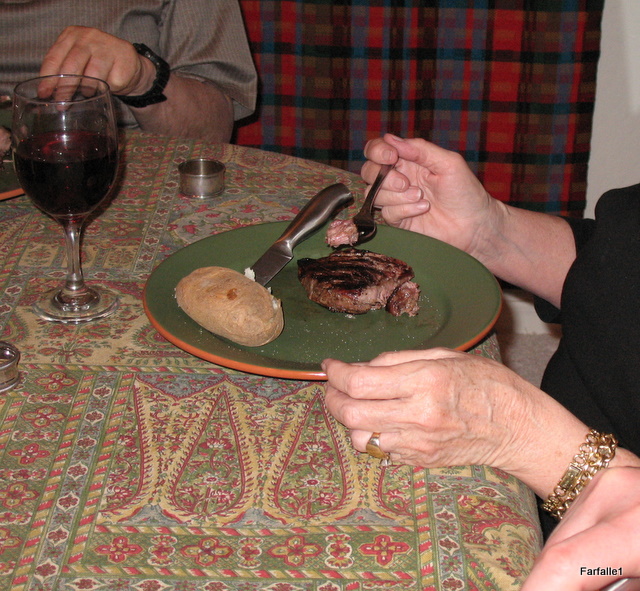
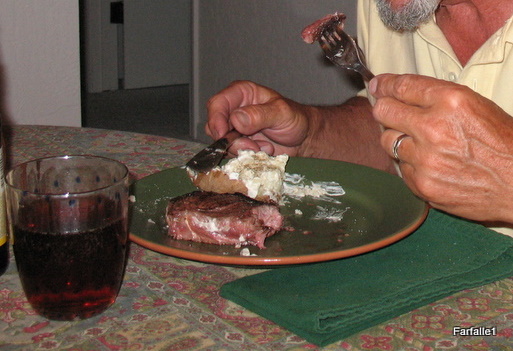
How much more sensible to just spear it with that fork, saw off a hunk, and ahhhhhhh.
There are otherItalian dining customs that we have learned about only slowly. The hands on the table for instance; in the U.S. it is considered polite to keep your non-working hand in your lap and your elbows off the table. In Italy this is highly suspect – just what do you have in your hand that you don’t want your fellow diners to see? No. The unoccupied hand should rest, fist gently closed on the edge of the table, where everyone can see what you’re up to. It’s not unusual to see people rest the whole arm on the table, from near elbow to fist. Our hand model in the first photo above is illustrating a hybrid of the two practices, eating with her fork in her right hand (American) but resting her left paw on the table (Italian).
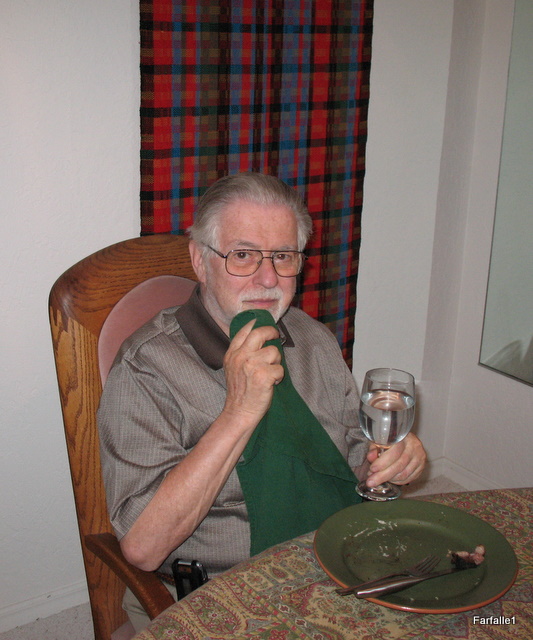
Thirsty? Hang on a second. Don’t just pick up your glass and drink; you’ll get food residue on your glass. Instead you want to wipe your mouth with your napkin, then take a sip. Then wipe your mouth again.
Perish the thought you should get an itchy scalp during a meal. In Italy it is considered bad manners to touch the hair while eating. I’m not exactly sure why this is so. It’s not like you’re running your fingers through your hair and then sticking out your hand to shake with someone else (we see golfers do this all the time at the end of matches – ick!). But then, I’m not sure manners always make a great deal of sense.
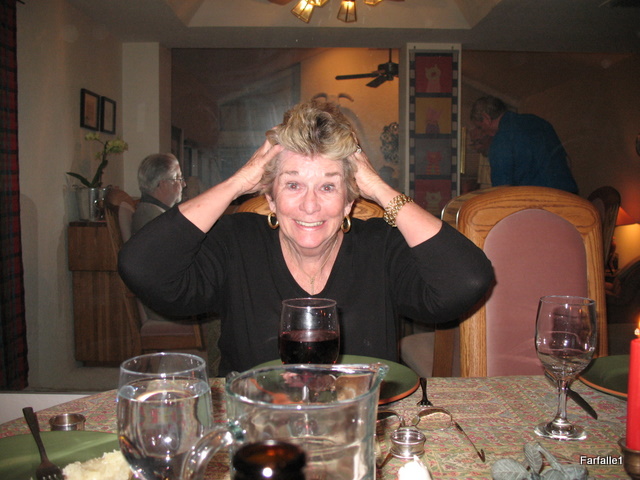
(It’s no wonder our patient model wants to pull her hair out – this is about the 6th time I’ve said to her, “Wait! Wait! Let me take a picture of that!” Makes it hard to enjoy the food…)
Dinner’s done and it’s time to clear the table. In the U.S. it is not unusual to make multiple trips to the kitchen carrying two items at a time – it’s not polite to stack plates, we were taught. I’m happy to say that this work-inducing custom does not exist in Italy. Everyone, from the very talented waiters in restaurants to the maid serving a fancy private dinner, will stack the plates before staggering out to the kitchen with them: another triumph of common sense!

Time for fruit. Wait! Don’t pick up that fruit with your hands! In Italy we cut our fruit with knives and forks, and eat it with forks. And it’s best not to eat the skin – just cut that off as well. You never know what might be on it, even if it has been well washed. It is a joy to watch an Italian delicately separate the skin from, say, a pear, and tidily eat – it’s an art form. This is a skill I have not yet mastered. I still like to eat my apples the American way, cut in quarters and enjoyed from the hand.
Care for a cafe? Well, okay. I won’t join you, because I don’t care for it myself, but I’d be happy to make you some. Just remember that in Italy, coffee after dinner means espresso. Period. It does not mean cappuccino, which typically is drunk only in the morning, or any of the other myriad Italian coffee styles. It means a short, dark and very strong espresso.
I’m grateful to the students in my adult ESL classes of a few years ago for teaching me these niceties. There are probably a lot of other customs of Italian dining I’ve omitted – any additions, fellow bloggistas?
 According to a 2006 article in the
 Another big difference between here and there is the number of cleaning products. (The French gentleman above lives in Italy, too. Here his name is Mastro Lindo.)
  In the States we used amonia in the water to wash the tile floors, window cleaner for the windows, and, if we were feeling really fancy, some kind of spray on the dust cloths. We also had special polish for the wooden furniture, which we polished once or twice a year. Here there is an endless parade of cleaning products, each aimed at a very specific task – one to clean porcelain basins, another to clean tile floors and walls, another to clean stone, another to clean wooden floors, polish for furniture, window cleaners, anti-calcium cleaners (liquid for topical use, powder to add to the clothes washer) – it’s quite confusing to know exactly what to get. (According to the Corriere article, when Unilever tried to market a one-cleaner-does-it-all product it was a complete flop.) In desperation I’ve begun to

 Oh! The things we take for granted in the United States, things like peanut butter and pickle relish. Neither of these items is readily available in Rapallo, and usually we don’t miss them very much. But watch out – the 4th of July is just around the corner. You can’t get through the 4th of July without a hot dog or a brat, and according to me, you can’t eat either without pickle relish on top.
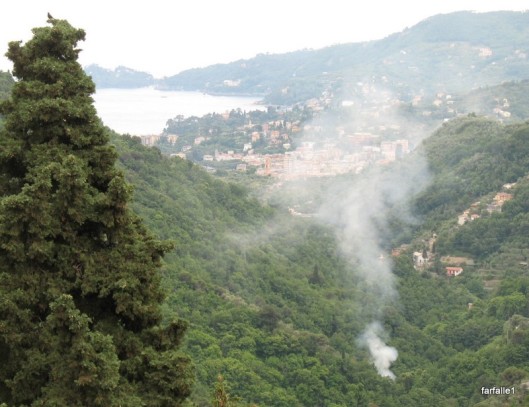
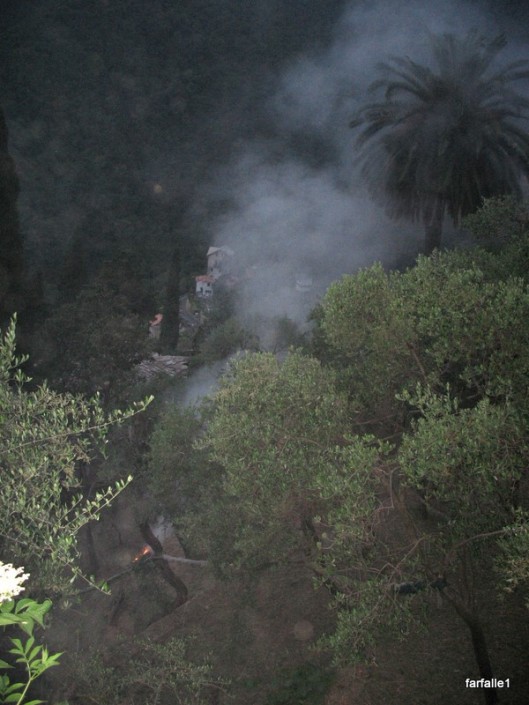
 SD +T / square root H, where ‘e’ is east, ‘w’ is west, SD is smoke diffusion, T is temperature, H is humidity and NI is neighbor irritability. Risking the Bad Neighbor Award the Captain took our longest hose and put out one of the fires. Our eyes were still watering, and our throats were scratchy the next day.
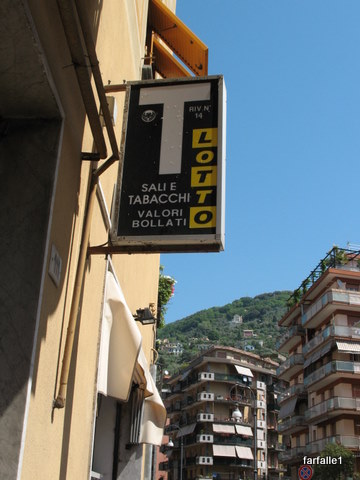 “Don’t forget to pick up some matches,” I reminded the Captain when he was headed out to market for dinner the other day.
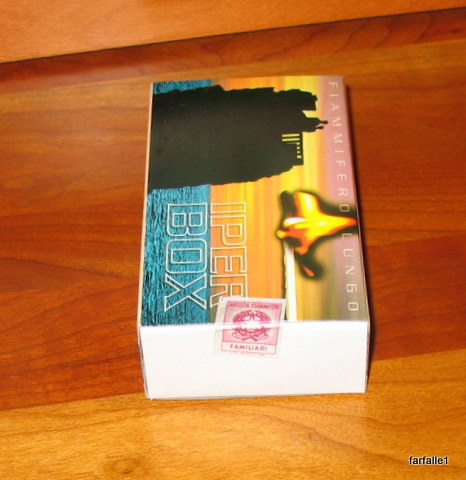 like the ones that come on liquor bottles in the U.S. No doubt the State gets a nice profit from the whole enterprise; they get to set the price and to tack on a tax. One kitchen-sized box of matches cost E1.
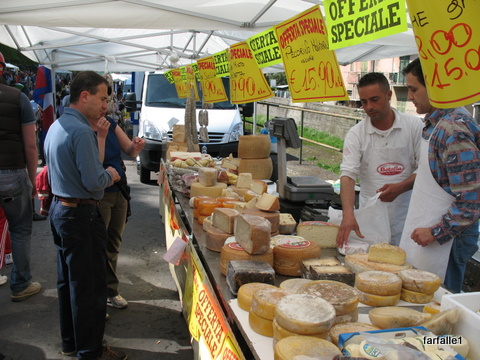
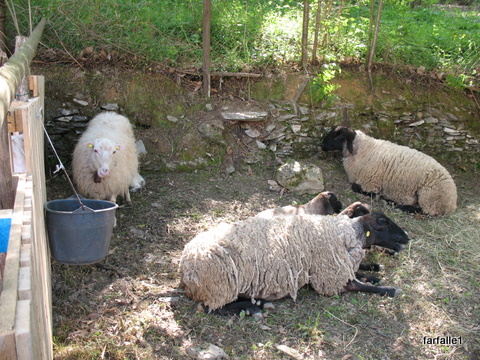
 It is a small fair, held along the banks of the Torrente San Maria, and it is always a delight. The big tree and shrub fair comes to Rapallo in January. This April fair is for buying chicks, ducks, turkeys, geese, goats and sheep; for buying flower plants; and for dreaming about a new piece of equipment for your farm. It also gives the local woodsmen a chance to compete in various wood-cutting skills, felling temporary trees and limbing downed trees (this is the only competition I’ve seen at an Italian fair yet).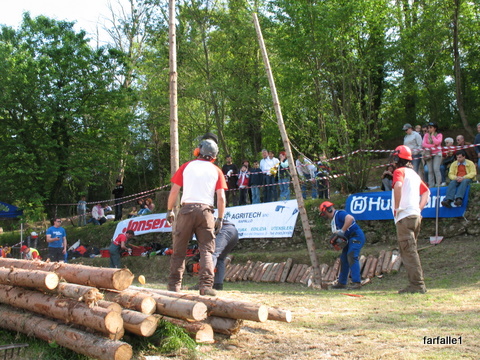
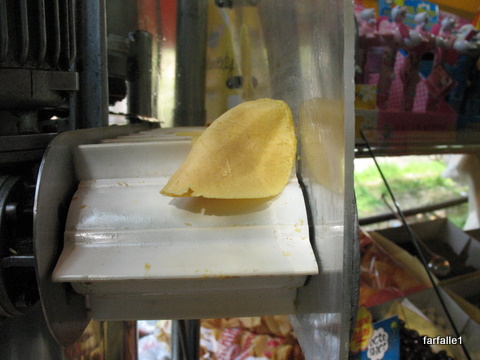
 One of our favorites is the man who sells a sweet wafer from Tuscany. The machine that makes the wafer is so complex, the product so simple. It reminds us a bit of an elaborate tortilla-press. Best of all, the vendor gives samples of his product, a delicate, slightly anise-flavored treat, Tuscany’s sweet answer to the potato chip.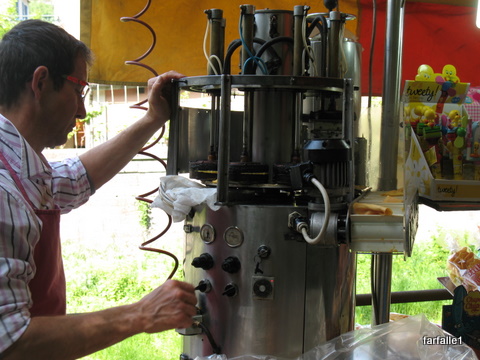

 An Ex-Expatriate
