• Contact
  • Elaborations
    • A Policeman’s View
    • Driving School Diary
    • Great Danes
    • IVA charged on Tassa Rifiuti
    • Nana
    • Old trains and Old weekends
    • The peasant, the virgin, the spring and the ikon
    • Will Someone Please, Please Take Me to Scotland??
  • Recipes
    • ‘Mbriulata
    • *Baked Barley and Mushroom Casserole*
    • *Captain’s Boston Baked Beans*
    • *Cherry Tart*
    • *Crimson Pie*
    • *Louise’s Birthday Cake*
    • *Melanzane alla Parmigiana* – Eggplant Parmesan
    • *Penne with Cabbage and Cream
    • *Pizzoccheri della Valtellina*
    • *Pumpkin Ice Cream*
    • *Risotto alla Bolognese*
    • *Rolled Stuffed Pork Roast* on the rotisserie
    • *Shrimp and Crayfish Tail Soup*
    • *Spezzatino di Vitello*
    • *Stuffed Grape Leaves*
    • *Swordfish with Salsa Cruda*
    • *Tagliarini with Porcini Mushrooms*
    • *Tagliatelli al Frutti di Mare*
    • *Tzatziki*
    • 10th Tee Apricot Bars
    • Adriana’s Fruit Torta
    • Artichoke Parmigiano Dip
    • Best Brownies in the World
    • Clafoutis
    • Cod the Way Sniven Likes It
    • Cold Cucumber Soup
    • Crispy Tortillas with Pork and Beans
    • Easy spring or summer pasta
    • Fagioli all’ucelleto
    • Fish in the Ligurian Style
    • Hilary’s Spicy Rain Forest Chop
    • Insalata Caprese
    • Kumquat and Cherry Upside Down Cake
    • Lasagna Al Forno con Sugo Rosato e Formaggi
    • Lemon Meringue Pie
    • Leo’s Bagna Cauda
    • Leo’s Mother’s Stuffed Eggs
    • Louis’s Apricot Chutney
    • Mom’s Sicilian Bruschetta
    • No-Knead Bread (almost)
    • Nonna Salamone’s Famous Christmas Cookies
    • Pan-fried Noodles, with Duck, Ginger, Garlic and Scallions
    • Pesto
    • Pesto
    • Pickle Relish
    • Poached Pears
    • Polenta Cuncia
    • Pumpkin Sformato with Fonduta and Frisee
    • Rustic Hearth Bread
    • Sicilian Salad
    • Soused Hog’s Face
    • Spotted Dick
    • Swedish Tea Wreaths
    • The Captain’s Salsa Cruda
    • Tomato Aspic
    • Vongerichten’s Spice-Rubbed Chicken with Kumquat-Lemongrass Dressing
    • Winter Squash or Pumpkin Gratin
    • Zucchini Raita

An Ex-Expatriate

~ and what she saw

An Ex-Expatriate

Category Archives: Food

The Strangest Dinner

12 Tuesday Apr 2011

Posted by farfalle1 in Desserts, English food, Food, Uncategorized

≈ 6 Comments

Tags

Food from Books, Granny's Cod, Literary cuisine, Literary food, Soused Hog's Face, Spotted Dick

It’s Sniven’s fault. It was he who encouraged us to come to Gold Canyon, and he who put the Captain back in touch with Captain Harris after many years.  Sniven makes an almost-annual visit to the Southwest, and being a democratic fellow he divides his time; one year he stays in what he amusingly calls ‘The Harris Hovel,’ and the next he stays with us.  Once he took a year off and it completely confused all of us to the point that we didn’t know where he should stay.  During his visits the five of us are very likely to gather for the evening meal and a catch-up of the day’s activities.  Also, perhaps, some gin. Not the game.

This year one of the evening conversations turned to the Aubrey-Maturin series of nautical tales set during the Napoleonic Wars, written by Patrick O’Brian.  The three gentlemen around our table had all enjoyed reading the books enormously, and began to reminisce about various elements.  “What on earth,” asked Sniven, “is Soused Hog’s Face?” referring to a dish that appears in Master and Commander. Research ensued, and the assembled group decided that nothing would do but that we would try it.

Unfortunately an actual hog’s face, while readily available, was nothing either of the principal cooks wished to tackle (what to do with the teeth?).  But the Captain found an acceptable recipe which called for ‘pork,’ and he took on the job.  It turns out there is more onion than anything else in this gelled dish.  It also turns out it is absolutely delicious, and is perfect for a hot summer meal.

(An interesting post-script: we served leftover Face to Italian friends a couple of days later.  Marguerita said, “But we make exactly this dish in Bari, but without the onions.”)


The discussion then turned to amusing English dessert nomenclature, specifically Boiled Baby and Spotted Dick.  Both, it turns out, are puddings, and neither difficult to make.  We opted for Spotted Dick on the theory that it was somehow funnier, and I volunteered to make it.  It is served under a ‘lashing’ of custard, not shown here, but happily consumed at our meal.


Sniven wasn’t done with us, though.  Years ago his adored Granny from Nova Scotia used to make him some kind of milky, custardy dried cod dish.  (She served it with dulse, which the kindly Sniven inflicted on us (I mean ‘brought to us’) several years ago; we went without this year.)  Mrs. Harris, of whom I’ve spoken in other posts, is an amazing cook and has an encyclopedic knowledge of food, food history and food preparations.  She took on the chef-detective task of replicating a food memory from long ago.  I’m not a great fan of  baccala, the Italian name for dried salted cod;  in fact I hate it, so I was pretty sure I wouldn’t enjoy Granny’s dish.  I could not have been more wrong, which simply proves the theory that the addition of cream and butter makes anything divine.


So that was our Very Strange Dinner:  first course: Cod in the style of Granny; second course: Soused Hog’s Face à la Maturin and Aubrey, served with a nondescript salad; dessert: Spotted Dick.

Somehow it all worked.  It brought to mind those enormous menus we read about from the 17th century and 18th centuries, where the meal would begin with fish, travel through foul to meat, and end with some extraordinarily complex dessert, all washed down by barrels of ale (if you want some fine examples, dip into the Diary of Samuel Pepys).

It was, to be sure, about the strangest dinner any of has eaten, at least in its joining of disparate components.  The pity is that Sniven has taken himself back to the shores of Maryland where he resides with beautiful Judith, and we are unlikely to be doing much more experimenting with odd menus in the next little while.

You can find the recipe for the Cod here, the Soused Hog’s Face here, and the Spotted Dick here.
Sunnies

19 Saturday Feb 2011

Posted by farfalle1 in Food, Uncategorized

≈ 4 Comments

Tags

Hulling sunflowers, Sunflower seeds, Sunflowers

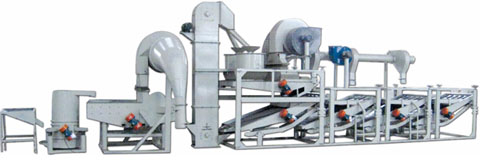
Today I met a Canadian man who grows sunflowers, flax and other grains and vegetables on quite a large scale.  He and his family also have a business that cleans the seeds and hulls them.  Then they ship them off all around the world.

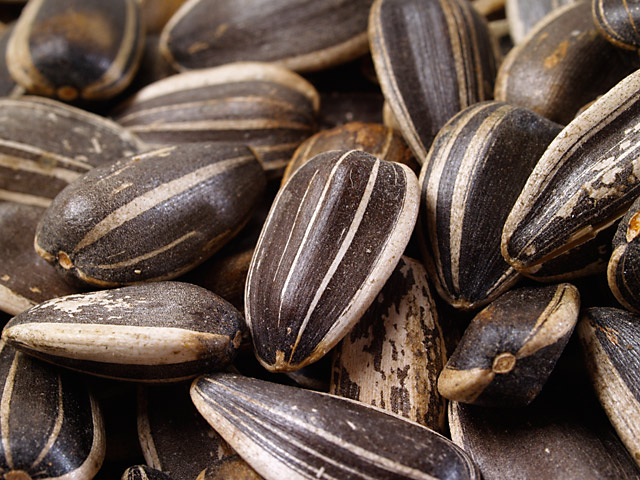
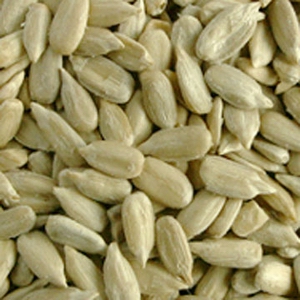
I never thought about how a sunflower might get hulled – I just know that sometimes I buy them salted with the shells on for nibbling, and sometimes with the shells off for bread-making.  That turns out to be two different varieties of sunflower.

My new acquaintance described the hulling procedure this way:  The seeds are fired against the side of a round ceramic receptacle – not too hard, because you don’t want to damage the kernel.  The hull cracks and everything is sent on its merry way on a vibrating belt (to help seed separate from hull) to another part of the machine where the hull is blown away.  Then there’s a weighing and color sorting part of the machine that the seeds pass through.  Any seed retaining its hull is routed back to the ceramic chamber for another percussive meeting with the sides and another shuddering journey on the conveyor belt.

I don’t know if my friend’s hulling machine looks anything like the one above; it’s probably something similar.  Who would ever have imagined when noshing on the humble sunflower that it had had such an adventure?

Photo courtesy of infinitetrends.in

Photo courtesy of vt-fiddle.com

Win, Win, Win

13 Sunday Feb 2011

Posted by farfalle1 in American habits and customs, Food, Uncategorized

≈ 10 Comments

Tags

Citrus-picking, Fruit-picking, Grapefruit, Lori Wegner, Terry Parsons, United Food Bank, Volunteering, Volunteerism

My last post was hard to write because it was about a very disturbing subject.  What better antidote than to tell you about something really positive?

Are you sick of hearing me say, “We’re in Arizona?”  (Will it make you feel any better if I tell you the temperature was 27 F a few mornings ago (-2 C)?)  One of the things the Phoenix valley is famous for is its citrus orchards.  There are far fewer now than there once were, as many have been ripped out to make room for housing developments, but some of the developments saved as many trees as possible and built the houses among them.

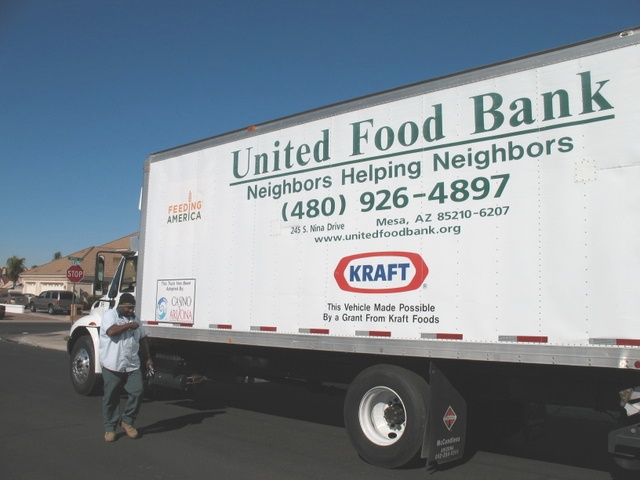
Such is the case in a lovely development in Mesa where I was recently fortunate enough to join a bunch of volunteers who were picking citrus for the United Food Bank, which acquires, stores and distributes food through partner social service agencies.  Many of the houses in this development have ten or more fruit trees in their yards.  I guess there’s only so much grapefruit a family can eat. And yes – it’s mostly grapefruit.  Why?  Grapefruit is faster-growing and more productive than the other citruses, so more grapefruit trees were planted than orange or lemon (or tangerine, or tangelo, or…)

Here’s how it works.  The United Food Bank coordinator has teams of people who gather at a staging area and then carpool to wherever we’re picking.  Our team leader is the indefatigable Terry Parsons, who happens to be a neighbor.

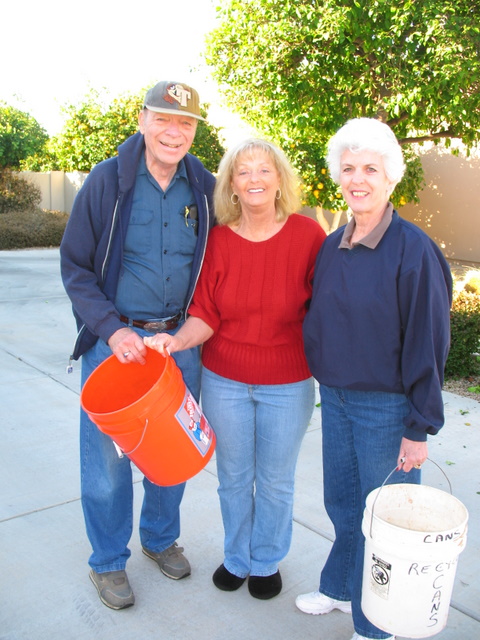
On this particular day we began picking at the home of Lori Wegner (seen below with a couple of hardy pickers).  That was a good thing, because she puts out great goodies.  It turns out that most of the homeowners put out great goodies; at a subsequent house we were invited to take whatever we wanted from an outdoor fridge, which included soft drinks, water and beer.

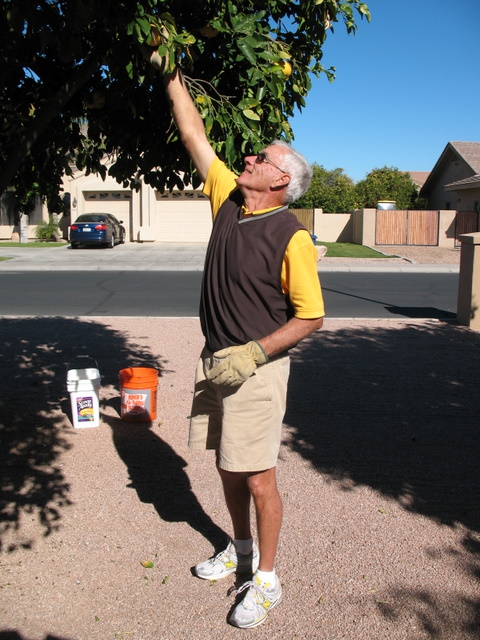
Picking is not especially easy work.  In fact I can’t imagine doing it all day long; I’m pooped after two and a half or three hours.  There are three basic jobs in the picking operation.  The first is just to hand-pick whatever is easily accessible, and that is what I try to do because it is the least back-breaking approach.  But one must be sly and quick to be successful, because others also want to do this work, and most of the fruit is not low-hanging.

The higher-up fruit is reached with long poles with a curved prong at the end.  You put the prong around the stem of the fruit and drag or jerk down; then you duck because the fruit may well land on your head.  In any event it will eventually land on the ground  where the third kind of work is required: stooping down to pick the fruit up and put it in pails.  The pails fill up pretty fast, and they are heavy.

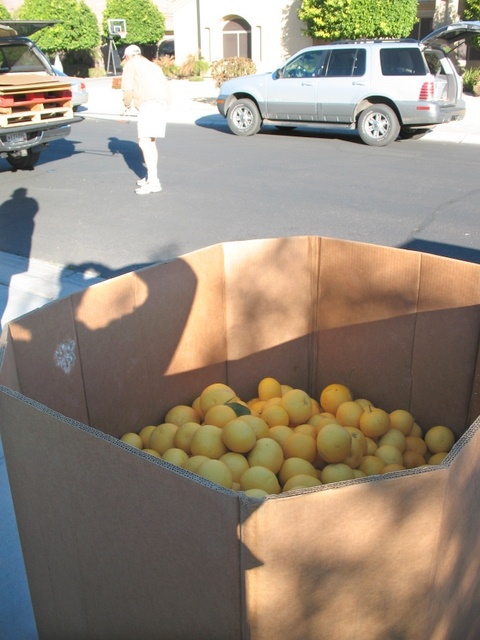
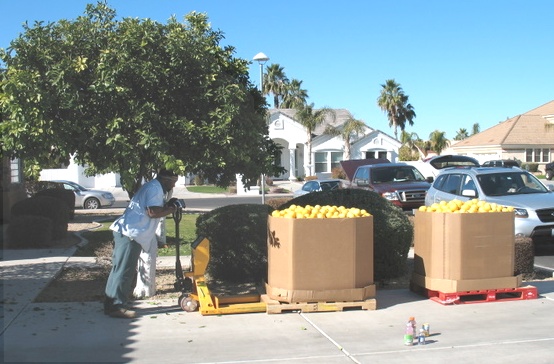
Someone who is not me (my aching back!) then carries the pails and dumps the fruit into huge cardboard bins that other volunteers have assembled on palettes.

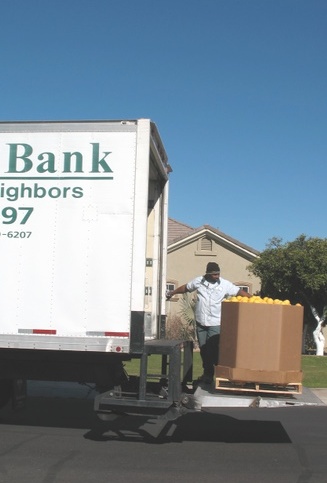
At the end of the morning the Food Bank truck miraculously appears and a man with a small fork lift picks up the bins and puts them into the truck.

Once they arrive at the food bank there are other volunteers who sort the fruit; that which is not suitable for consumption is sent to the squeezing station where it is turned into juice.

Terry told me that there is an even larger food bank in the area that sends semi-trucks of citrus up to Oregon where they have no citrus, and comes back full of surplus Oregon apples.  How clever that is!  (It got me thinking about all the untended olive trees in Liguria – could volunteers pick the olives for oil which could be sold to benefit the food banks?  Or the oil given to hospitals or to the food banks themselves?)

So – who wins the citrus lottery?  First the homeowner.  She has more fruit than she knows what to do with and has to pay someone to come and remove it from her trees if the volunteers don’t do it.  She also will get a small tax write-off for the value of the fruit, if she wants one.  The second winner is the Food Bank and by extension the hungry people whom it feeds.  (I  wonder if some of them say, “Oh no, not more grapefruit!”)  The third, and biggest, winners are the volunteers.  They get to be outdoors in the lovely weather with a group of jolly others, to see parts of town and lovely homes they otherwise might not see,  to eat delicious snacks, and they get to feel really good about doing something helpful for others.  And no one at all loses.

Swedish Tea Wreath

28 Tuesday Dec 2010

Posted by farfalle1 in American recipes, Food, Holidays, Swedish food, Swedish recipes

≈ 2 Comments

Tags

Christmas baking, holiday baking


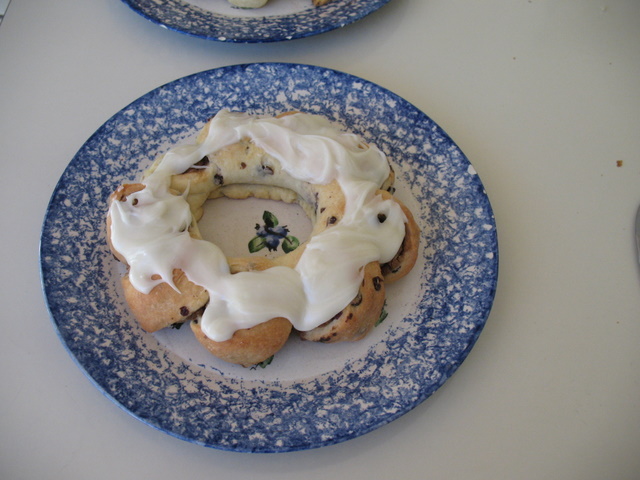
Between traveling to the States for a lengthy visit, flying to Tennessee for a familial visit and negotiating the madness that is Christmas here, it has been a busy time for the Captain and yours truly.  We took some time out to enjoy cooking special holiday treats, though, such as the cookies the Captain learned to make at his mother’s knee, and the Swedish Coffee Cake we’ve enjoyed on Christmas mornings for the past few years.  Be warned: you may want to make an appointment with your cardiologist before embarking on this recipe.

I found the recipe at about.com, where it is called Swedish Tea Log, by Linda Larsen.  We’ve made very few changes – why mess with success? – but have changed the shape to give it a more Christmasy appearance.  Every year I say to myself that the frosting is too thick and should be runnier and applied more sparingly.  I’ve adapted the recipe to accommodate that opinion.

There’s no reason not to make this yummy treat any time of the year.  Everyone loves it, which makes it well worth the little bit of extra effort (really time, more than effort) it takes to make.

Click here for the recipe, invite some friends over for tea and have fun!

Focaccia col Formaggio

23 Tuesday Nov 2010

Posted by farfalle1 in Food, Italy, Liguria, Photographs, Uncategorized

≈ 14 Comments

Tags

Cheese focaccia, Focaccia, Focaccia col Formaggio, Recco, Ristorante Vitturin

In all of Italy it is the province of Liguria that is most famous for focaccia, the exquisitely delicious flat, oily bread.  In all of Liguria, the town of Recco is most famous for its focaccia.  And in Recco, one of the most famous places to find focaccia col formaggio is Ristorante Vitturin 1860.  Yes, the date at the end of the name is the date the restaurant was established.  As they proudly state on their business cards: ” ‘Il piu antico di Recco’, 150 anni e non sentirli” (the oldest in Recco, 150 years and we don’t feel it).

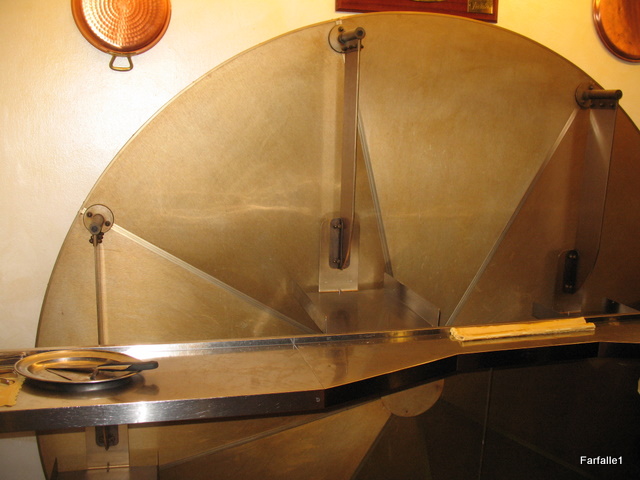
Before leaving  for the States we met our Genovese cousins at Vitturin to enjoy some seafood and some of the restaurant’s well-known focaccia col formaggio (quite unlike the more usual bready styles of focaccia).  Once inside the restaurant we were amazed to see the enormous paddle-wheel apparatus that delivers meals from the kitchens below to the diners above.

There are about eight of these trays mounted on the wheel; obviously they must stay horizontal as the wheel turns – it is a most ingenious system and must save a million steps a day for the wait staff.

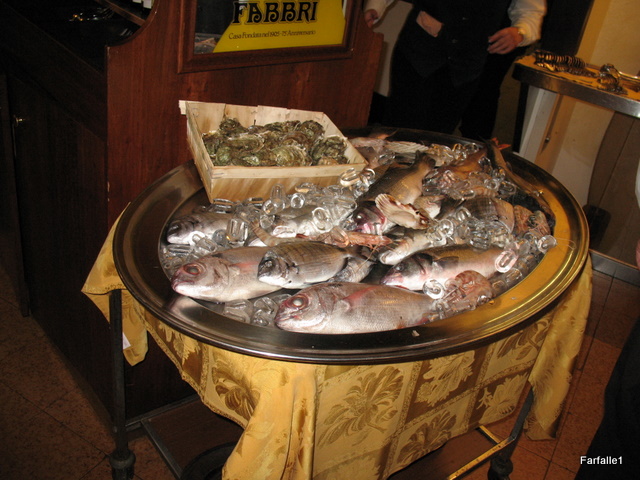
Fish and focaccia are the main events at Vitturin; they give the merest nod in the direction of meat.  This big platter of fish would entice any diner.

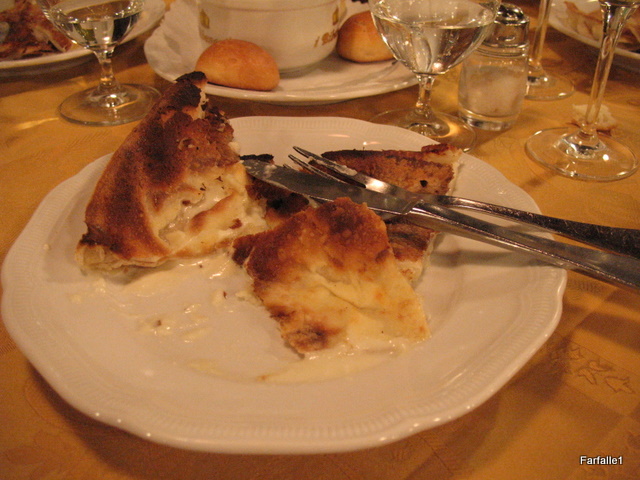
Here is a close-up of my partly devoured focaccia col formaggio:

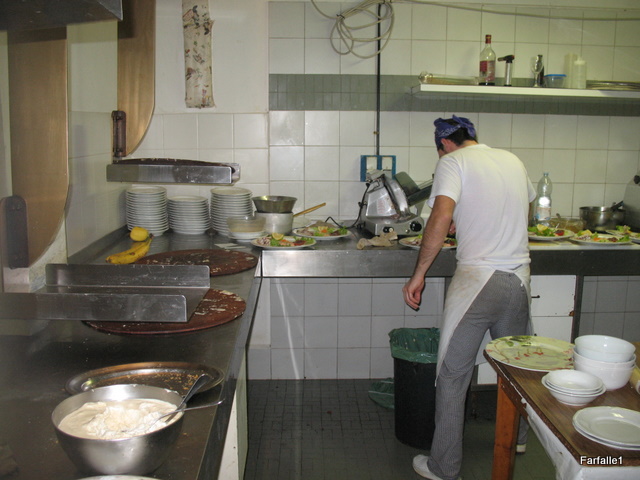
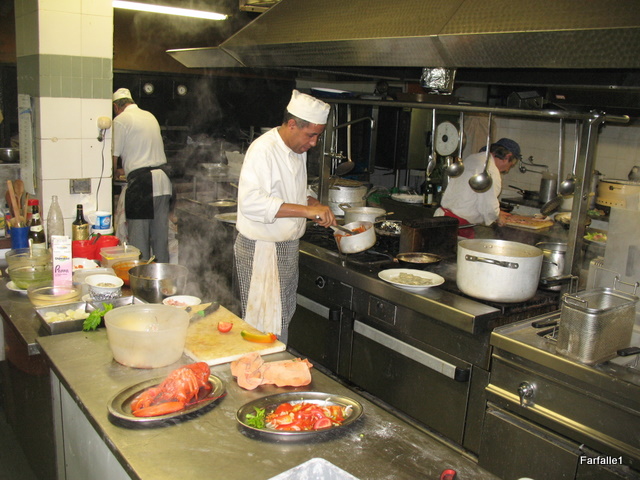
What was the highlight of the evening?  It was a long visit to the kitchens below the restaurant proper.  The Captain asked the Maitre D’ if we could see what the delivery wheel looked like down below, and he immediately escorted us to the nether regions.  There we saw the wheel looking much as it did above – plates of steaming food going up, empty plates coming down.

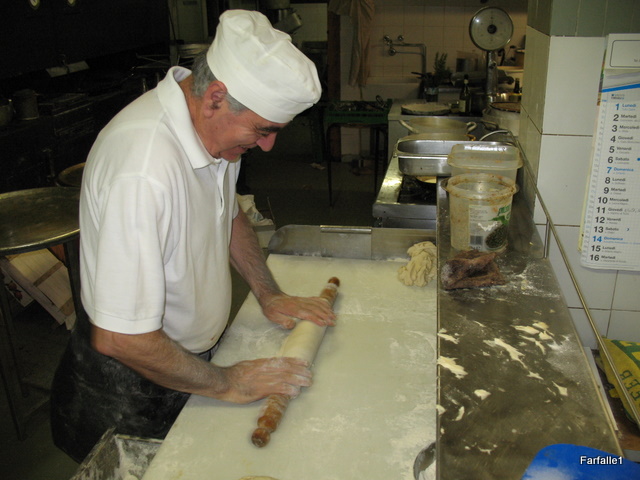
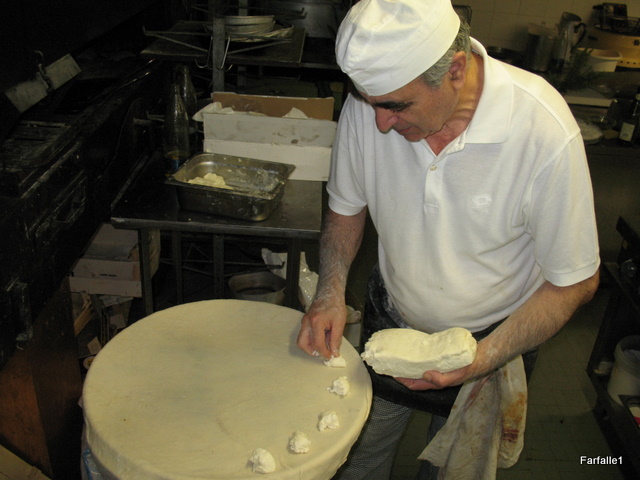
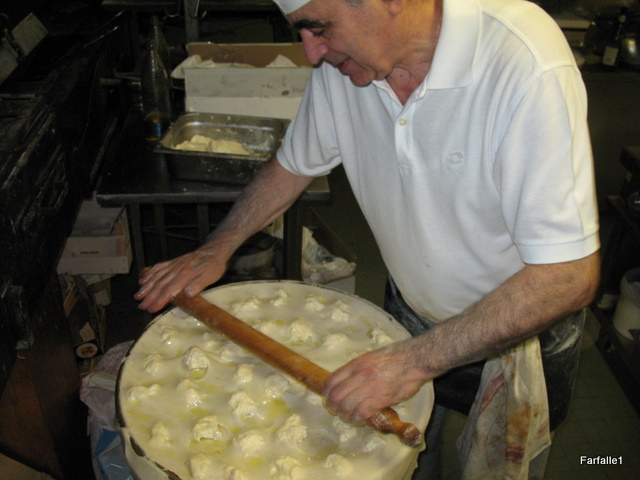
Over on one side of the kitchen we met Filippo, who makes, he proudly told us, about 120 focaccia col formaggio every evening.  He begins by mixing his dough in the early afternoon and letting it rest.  When he’s ready to make a focaccia he takes a big knob of dough and rolls it out.

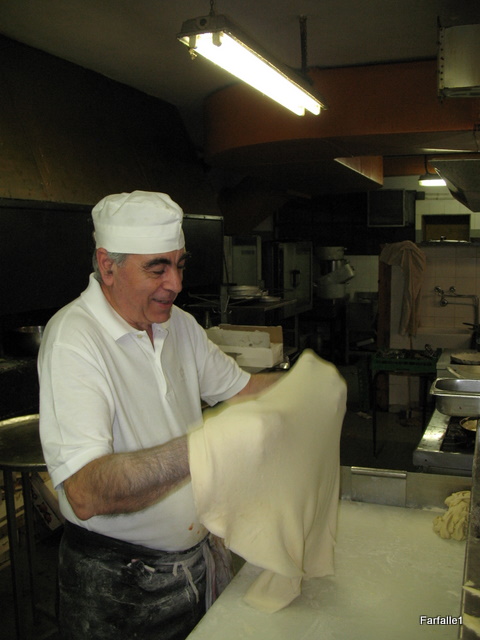
When the dough is thin enough he picks it up in his hands and does the stretching maneuver we associate with pizza-makers.

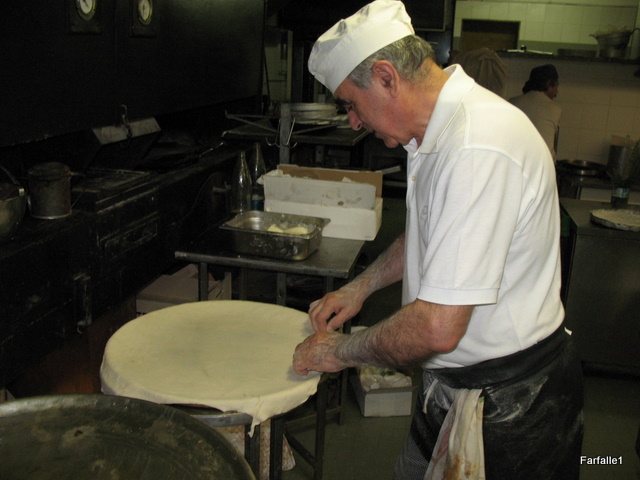
He puts it on the large round focaccia pan and puts dabs of stracchino cheese on top, about 750 grams for a regular focaccia, up to 1500 grams for a large size (that’s more than a pound for the regular, and about 3 pounds for a large). (!)

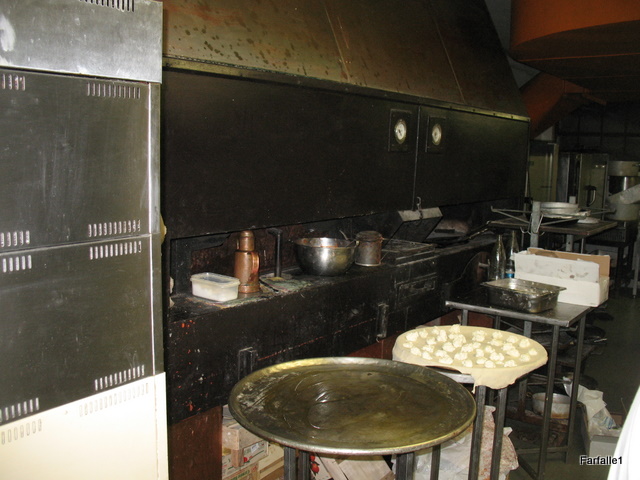
(It’s pretty hard to see in the photo, but that’s the old wood-fired stove in the background.  The restaurant now uses an electric oven.)

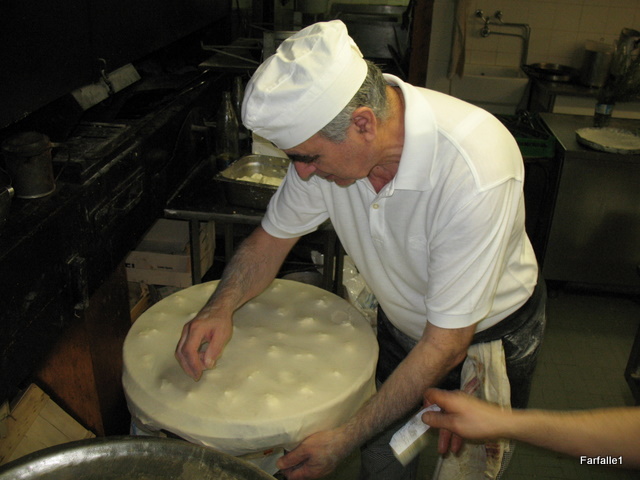
Then Filippo rolls out another sheet of dough, just the way he did for the bottom of the focaccia, and puts it over the cheese.  With a quick, nipping movement he tears some holes in the top layer of dough over some of the cheese knobs.

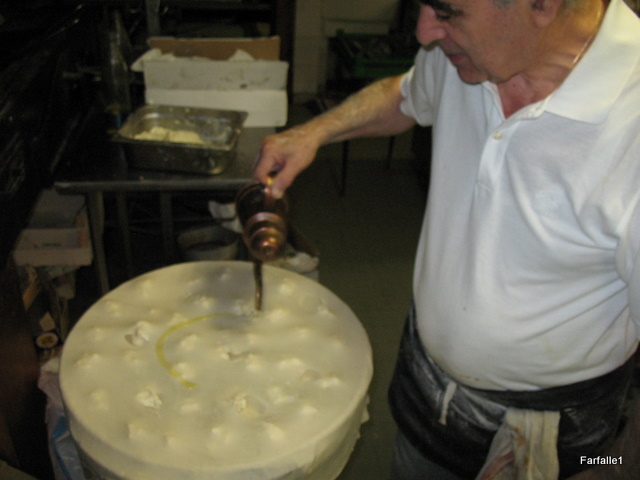
The final ingredients are put on top – a sprinkling of salt and a nice drizzle of olive oil.

All that remains is to trim the excess dough and pop the whole thing in a very hot oven.

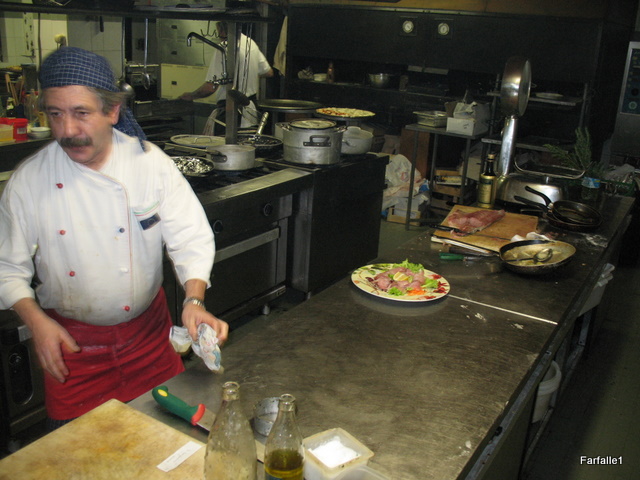
It was such a treat to be able to nose around the kitchen.  Everyone was clearly proud of the operation, and with good reason.  It was all orderly, clean and efficient.

Oh yum – a lobster!

They all move so fast; there were not a great many people down there, and they were putting out well over a hundred dinners.

As we were leaving the kitchen the dish-washer called us over and presented us with a little bowl of appetizers, and gave me a hearty handshake and a Buona Notte.  She was so cheerful, and so happy to see us.  We felt very welcome at Vitturin, both upstairs and down.

Stuffed Eggs Piemontese Style

28 Thursday Oct 2010

Posted by farfalle1 in Food, Italian recipes, Piemonte, Uncategorized

≈ 4 Comments

Tags

Deviled Eggs, Egg recipes, stuffed eggs

A stuffed egg is a wonderful thing. Eggs in general have suffered a lot of bad press from the cholesterol police, but for some of us they remain irresistible. I’ve always been a passionate enjoyer of stuffed eggs. My recipe is simple – it calls for the boiled eggs, mayo, a bit of mustard, and a parsley sprig on top for decoration.

On a recent visit to Piemonte our friend Leo taught me his recipe for stuffed eggs. It is a different animal altogether, not nearly as cloying as my recipe; no doubt it is healthier.

Here’s what you’ll need:

Eggs, as many as you want
A big handful of fresh Italian (flat) parsley, leaves only
2 or 3 anchovies
a piece of bread, broken into pieces and soaked in milk
olive oil
vinegar

The first step is to hard-boil the eggs, of course, then peel them, slice in half and remove the yolks.  Put half the yolks in a bowl, and save the other half for some other use (or salt and pepper them and eat them in the kitchen when no one is looking).

Next finely chop the parsley together with the anchovies and the bread, from which you’ve squeezed the excess milk.  Your mixture will look something like this:
Note the mezaluna – if you haven’t got one in your kitchen you may want to consider getting one and learning how to use it – it can really cut down chopping time.  Plus it’s loads of fun to use.

Smush the egg yolks with a fork and add to them the parsley mixture.

Mix in enough oil to make a nice clumpy filling for the eggs, and add just a dash of vinegar to brighten the flavor.  Nibble a bit and add salt and pepper to taste.
The rest you know.  Fill the eggs, arrange on a plate and serve.  My plate above was rather plain; Leo later decorated it with sage leaves and it looked a lot prettier.

Like all ‘deviled’ eggs these have mysterious evaporative properties; just look away for a moment and you’ll discover half of them are gone!

When in Rome…

12 Sunday Sep 2010

Posted by farfalle1 in Food, Italian recipes

≈ 10 Comments

Tags

Spinach recipe, Spinach with raisins

The Ristorante Da Meo Patacca was a great favorite of the TWA crews years ago when the Captain was flying to Rome frequently. One of the most popular dishes of that discerning group of eaters was spinach prepared with garlic, pine nuts and raisins. Yes, raisins. Yum.

The recipe is simplicity itself. The quantities listed will make enough (barely) for two; adapt as required for your table.

2-3 Tablespoons raisins
1/2 kilo (1 lb) fresh spinach
2 Tablespoons olive oil
1 garlic clove, crushed
2-3 Tablespoons pine nuts

First put the raisins in a cup with some warm water and let them soak for a while – 15 minutes to half an hour should be sufficient.

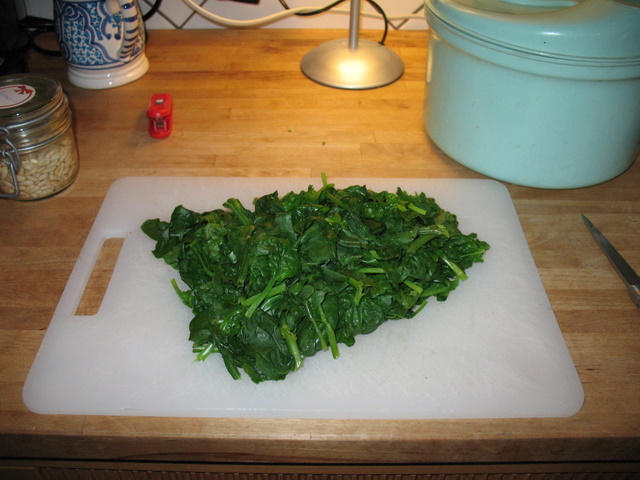
Wash the spinach well and put it in a big stock pot with a little bit of water. Cover and bring to a boil, flipping the leaves around frequently so they cook evenly. Cook them only until they are wilted and dark green; do not finish cooking them. Pour into a colander and let sit for a while or, if you’re in a rush, press the remaining liquid out with a wooden spoon.

Wipe out the stock pot with a paper towel, put it back on the stove and put in the olive oil. Put the garlic in the oil and cook until it is nicely browned, then remove it.

Add the pine nuts to the oil and cook until only just beginning to turn brown.

Toss in the spinach and the raisins and cook, stirring frequently, until the spinach is cooked to the degree you like it. Add salt and pepper to taste.

It couldn’t be easier, and it is absolutely delicious. The raisins are a wonderful surprise.

Gara di Pesto

08 Sunday Aug 2010

Posted by farfalle1 in Food, Italian recipes, Liguria, Rapallo, Uncategorized

≈ 13 Comments

Tags

Fred Plotkin, Giancarlo Dughera, Latte Tigullio, Marcello Ghizzo, Pesto, RapalloExpo, Recipes from Paradise, Roberto Ciccarelli

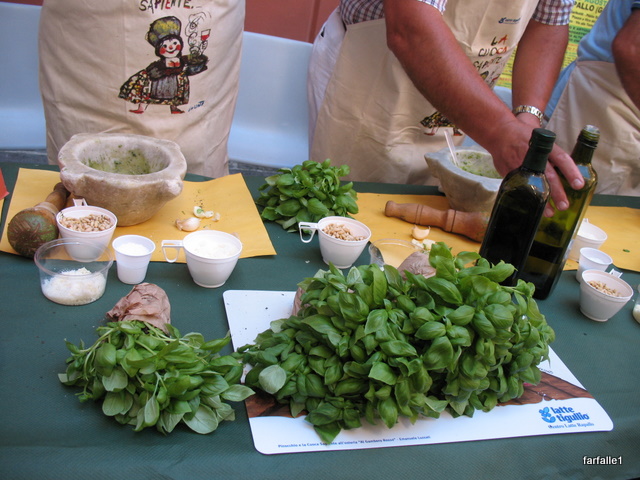
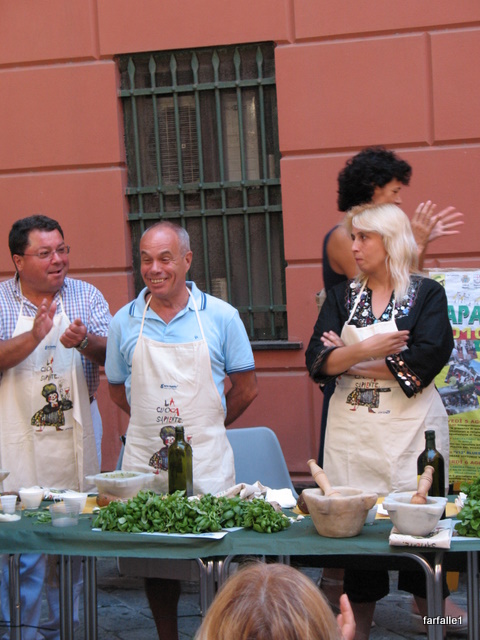
6 contestants, each with mortar and pestle; 7 ingredients; 20 minutes; and 2 judges:  that’s all that was required for the 3rd annual Gara di Pesto al Mortaio which took place Saturday afternoon as part of RapalloExpo 2010.

This four-day event featured a street market with more stalls than usual, conferences on various aspects of food production (bees and honey!), entertainment, and my favorite: the pesto cook-off.  It’s not really a cook-off, of course, because pesto isn’t cooked; so perhaps ‘competition’ would be a better word, though that hardly conveys the sense of excitement as a small crowed watched the very physical preparation of Liguria’s signature sauce.

Fred Plotkin, in his wonderful book Recipes from Paradise (Little, Brown and Company, 1997) gives 16  pesto recipes, including one for tourists, and one for people who are physically impaired and must use a food processor.  (Impairment is the only excuse for using a processor, according to Mr. Plotkin, because the delicate perfumes and flavors of the ingredients will be compromised by the harsh treatment of the metal blades.)

No, mortar and pestle is the only way to make pesto.  And there are only 7 ingredients in the classic Ligurian pesto (since Liguria is the home of pesto, it goes without saying that Ligurian pesto is the only one worthy of consideration).    The 7 ingredients needed are coarse sea salt, basil leaves (preferably small), garlic, pinoli, Pecorino Romano cheese, Parmigiano-Reggiano cheese and olive oil.  (Mr. Plotkin’s rendition of the classic dish can be found here.)

Chef Mario (pictured below), president of the Association of Chefs for the Genova region and Chef of Ristorante Da Mario in Rapallo was joined in the judging duties by a gentleman from Genova who is, if I understood correctly, somehow involved in the oversight of Pesto making in the region.

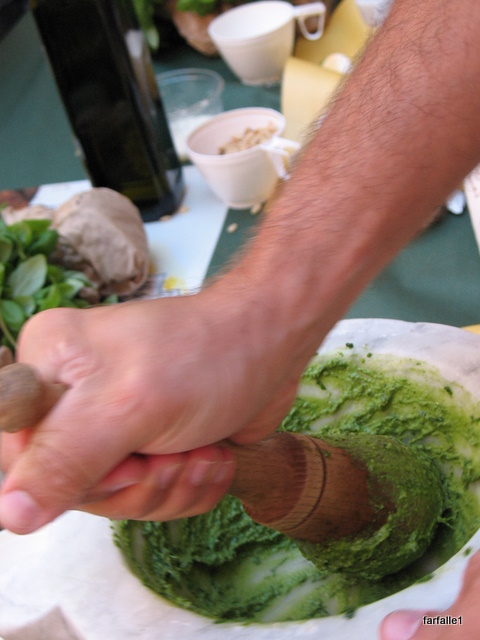
Pesto is made by putting a little bit of sea salt in the mortar, and carefully but enthusiastically adding the other ingredients and grinding it all into a thick paste.  The finished product looks like this:

The contestants made only a small amount of pesto, enough for the judges to taste to reach their decision.

The first to finish was this lady, though sadly she did not win first place:

So who did win?  Well, third place went to Marcello Ghizzo, center below:

and the second prize was awarded to Giancarlo Dughera:

The grand 1st place finisher was Roberto Ciccarelli:

What were the prizes?  There was something that looked like a large gym bag, an apron, and various condiments from Latte Tugullio, the local company that generously sponsors many civic events.  Oddly, included in the prizes were jars of… pesto!

The carton pictured above is a milk product called  Prescinsêua (pronounced pray-zhun-sieu), also called Quagliata Genovese.  It is a basic Ligurian ingredient made of fermented milk, not too different from clabbered cream or, perhaps, sour cream.  Some people use Prescinsêua in their pesto-making.

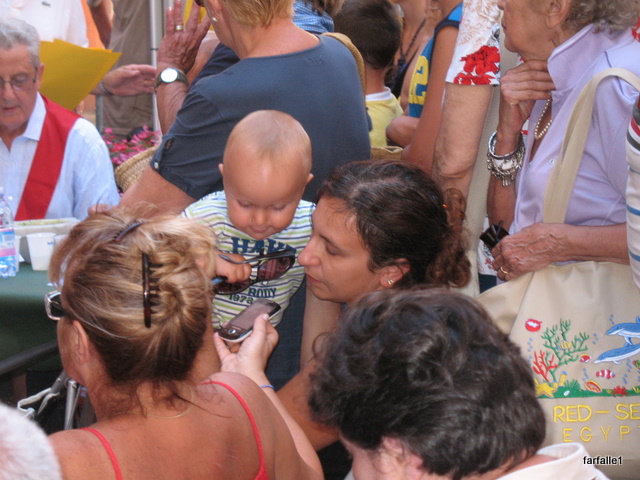
It was a lovely event.  Everyone from participants to audience to judges were good-humored.  Finally, here are a couple of pictures of the audience, because what’s a Gara without a crowd?

Rice addendum

02 Wednesday Jun 2010

Posted by farfalle1 in Food, Rice

≈ Leave a comment

There are a couple of great books out there about rice in all its mysterious variety.  We have and have used Seductions of Rice by Jeffrey Alford and Naomi Duguid (2003) – it is exhaustive to say the least, and a great addition to any cookbook collection. Alford and Duguid travel the world for their food research, and they take gorgeous photographs as well.  I don’t think they missed a grain of rice in their studies.  Another, which I have not seen, is The Rice Book by Sri Owen.  Written in 1993 it has a lot of great reviews and has gone on my Amazon wish list.

The Best Thing We Ate – Shrimp and Crayfish Tail Soup

01 Thursday Apr 2010

Posted by farfalle1 in Food, Indian recipes, Uncategorized

≈ Leave a comment

Tags

Crayfish Soup, Lobster Tail Soup, Shrimp Soup, Soup

Some years ago the Captain found a restaurant (Indonesian? Malaysian?) not far from his London layover hotel, The Kensington Hilton (located in Hammersmith, not Kensington at all).  He has never forgotten the soup he enjoyed that night at dinner.  Recently he found a package of frozen crayfish tails and he thought, Aha! Now is the time to try to recreate that magical soup.

It was initially scheduled for a few weeks ago, but to his horror he found that the cans of tomato pieces he had bought contained oregano.  That flavor was definitely not part of his taste memory of this particular soup, so a quick menu change ensued.

Finally, though, the perfect opportunity presented itself, and on a recent Friday he produced the divine soup pictured above.  With a bit of piquancy, a bit of cream and a bit of heat it is easy to see why he never forgot this particular dish.

The crayfish tails tasted to me of lobster, so I think they could easily be substituted if crayfish tails are not available.  You can find the recipe here or over on the right under recipes.

← Older posts
Newer posts →

Enter your email address to follow this blog and receive notifications of new posts by email.

Join 114 other subscribers

rss

Subscribe in a reader

Search the Blog

A. Useful Links

  • bab.la language dictionary
  • Bus schedules for Tigullio
  • Conversions
  • English-Italian, Italian-English Dictionary
  • Expats Moving and Relocation Guide
  • Ferry Schedule Rapallo, Santa Margherita, Portofino, San Frutuoso
  • Italian Verbs Conjugated
  • Piazza Cavour
  • Rapallo's Home Page – With Link to the Month's Events
  • Slow Travel
  • The Informer – The Online Guide to Living in Italy
  • Transportation Planner for Liguria
  • Trenitalia – trains! Still the most fun way to travel.

C. Elaborations

  • A Policeman’s View
  • Driving School Diary
  • IVA refunds due for past Rifiuti tax payements
  • Nana
  • Old trains and old weekends
  • The peasant, the Virgin, the spring and the ikon
  • Will Someone Please, Please Take Me to Scotland?

D. Good Recipes - Best of the Week winners are starred

  • 'Mbriulata
  • *Baked Barley and Mushroom Casserole*
  • *Captain’s Boston Baked Beans*
  • *Crimson Pie*
  • *Louise’s Birthday Cake*
  • *Melanzane alla Parmigiana*
  • *Penne with Cabbage and Cream
  • *Pizzoccheri della Valtellina*
  • *Pumpkin Ice Cream*
  • *Risotto alla Bolognese*
  • *Rolled Stuffed Pork Roast*
  • *Spezzatini di Vitello*
  • *Stuffed Grape Leaves*
  • *Stuffed Peaches (Pesche Ripiene)*
  • *Swordfish with Salsa Cruda*
  • *Tagliarini with Porcini Mushrooms*
  • *Tagliatelli al Frutti di Mare*
  • *Three P's Pasta*
  • *Tzatziki*
  • 10th Tee Oatmeal Apricot Bars
  • Adriana’s Fruit Torta
  • Aspic
  • Bagna-calda
  • Best Brownies in the World
  • Clafoutis
  • Cold cucumber soup
  • Crispy Tortillas with Pork and Beans
  • Easy spring or summer pasta
  • Fish in the Ligurian Style
  • Hilary's Spicy Rain Forest Chop
  • Insalata Caprese
  • Lasagna al forno
  • Lasagna al Forno con Sugo Rosato e Formaggi
  • Lemon Meringue Pie
  • Leo’s Bagna Cauda
  • Leo’s Mother’s Stuffed Eggs
  • Louis’s apricot chutney
  • Mom's Sicilian Bruschetta
  • No-Knead (almost) Bread
  • Nonna Salamone's Christmas Cookies
  • Pan Fried Noodles with Duck, Ginger, Garlic and Scallions
  • Pesto, the classic and original method
  • Pesto, the modern, less authentic method
  • Pickle Relish
  • Poached pears
  • Poached Pears
  • Polenta Cuncia
  • Recipes from Paradise by Fred Plotkin
  • Rustic Hearth Bread
  • Shrimp and Crayfish Tail Soup
  • Sicilian salad
  • Slow Food Liguria
  • Slow Food Piemonte and Val d'Aosta
  • Spinach with Garlic, Pine Nuts and Raisins
  • Stuffed Eggs, Piemontese Style
  • The Captain’s Salsa Cruda
  • Tomato Aspic
  • Zucchini Raita

E. Blogroll

  • 2 Baci in a Pinon Tree
  • Aglio, Olio & Peperoncino
  • An American in Rome
  • Bella Baita View
  • Debra & Liz's Bagni di Lucca Blog
  • Expat Blog
  • Food Lovers Odyssey
  • Italian Food Forever
  • L’Orto Orgolioso
  • La Avventura – La Mia Vita Sarda
  • La Cucina
  • La Tavola Marche
  • Rubber Slippers in Italy
  • Southern Fried French
  • Status Viatoris
  • Tour del Gelato
  • Weeds and Wisdom

Photographs

  • A Day on the Phoenix Light Rail Metro
  • Apache Trail in the Snow
  • Aquileia and Croatia
  • Birds on the Golf Course
  • Bridge Art
  • Canadair Fire Fighters
  • Cats of Italy
  • Cloudy day walk from Nozarego to Portofino
  • Fiera del Bestiame e Agricultura
  • Football Finds a Home in San Maurizio
  • Hiking Dogs
  • Mercatino dei Sapori – Food Fair!
  • Moto Models
  • Olive pressing
  • Rapallo Gardens
  • Rapallo's Festa Patronale
  • Ricaldone and the Rinaldi Winery
  • Rice Fields
  • Sardegna ~ Arbatax and Tortoli
  • Sardegna ~ San Pietro above Baunei
  • Sardegna ~ The Festa in Baunei
  • Scotland, including Isle of Skye
  • Slow Food 2008 Salone del Gusto
  • The Cat Show and the Light Rail Fair
  • The desert in bloom
  • Trip to Bavaria

Pages

  • Fagioli all’ucelleto

Archives

Recent Posts

  • A Superior Visit
  • Fun at the Ranch Market
  • The MAC
  • Welcome Tai Chi
  • Bingo Fun for Ferals
December 2025
M T W T F S S
1234567
891011121314
15161718192021
22232425262728
293031  
« Jul    

Member of The Internet Defense League

Blog at WordPress.com.

  • Subscribe Subscribed
    • An Ex-Expatriate
    • Join 114 other subscribers
    • Already have a WordPress.com account? Log in now.
    • An Ex-Expatriate
    • Subscribe Subscribed
    • Sign up
    • Log in
    • Report this content
    • View site in Reader
    • Manage subscriptions
    • Collapse this bar
 

Loading Comments...