• Contact
  • Elaborations
    • A Policeman’s View
    • Driving School Diary
    • Great Danes
    • IVA charged on Tassa Rifiuti
    • Nana
    • Old trains and Old weekends
    • The peasant, the virgin, the spring and the ikon
    • Will Someone Please, Please Take Me to Scotland??
  • Recipes
    • ‘Mbriulata
    • *Baked Barley and Mushroom Casserole*
    • *Captain’s Boston Baked Beans*
    • *Cherry Tart*
    • *Crimson Pie*
    • *Louise’s Birthday Cake*
    • *Melanzane alla Parmigiana* – Eggplant Parmesan
    • *Penne with Cabbage and Cream
    • *Pizzoccheri della Valtellina*
    • *Pumpkin Ice Cream*
    • *Risotto alla Bolognese*
    • *Rolled Stuffed Pork Roast* on the rotisserie
    • *Shrimp and Crayfish Tail Soup*
    • *Spezzatino di Vitello*
    • *Stuffed Grape Leaves*
    • *Swordfish with Salsa Cruda*
    • *Tagliarini with Porcini Mushrooms*
    • *Tagliatelli al Frutti di Mare*
    • *Tzatziki*
    • 10th Tee Apricot Bars
    • Adriana’s Fruit Torta
    • Artichoke Parmigiano Dip
    • Best Brownies in the World
    • Clafoutis
    • Cod the Way Sniven Likes It
    • Cold Cucumber Soup
    • Crispy Tortillas with Pork and Beans
    • Easy spring or summer pasta
    • Fagioli all’ucelleto
    • Fish in the Ligurian Style
    • Hilary’s Spicy Rain Forest Chop
    • Insalata Caprese
    • Kumquat and Cherry Upside Down Cake
    • Lasagna Al Forno con Sugo Rosato e Formaggi
    • Lemon Meringue Pie
    • Leo’s Bagna Cauda
    • Leo’s Mother’s Stuffed Eggs
    • Louis’s Apricot Chutney
    • Mom’s Sicilian Bruschetta
    • No-Knead Bread (almost)
    • Nonna Salamone’s Famous Christmas Cookies
    • Pan-fried Noodles, with Duck, Ginger, Garlic and Scallions
    • Pesto
    • Pesto
    • Pickle Relish
    • Poached Pears
    • Polenta Cuncia
    • Pumpkin Sformato with Fonduta and Frisee
    • Rustic Hearth Bread
    • Sicilian Salad
    • Soused Hog’s Face
    • Spotted Dick
    • Swedish Tea Wreaths
    • The Captain’s Salsa Cruda
    • Tomato Aspic
    • Vongerichten’s Spice-Rubbed Chicken with Kumquat-Lemongrass Dressing
    • Winter Squash or Pumpkin Gratin
    • Zucchini Raita

An Ex-Expatriate

~ and what she saw

An Ex-Expatriate

Category Archives: Food

At the Table

10 Wednesday Mar 2010

Posted by farfalle1 in Customs, Food, Italian habits and customs, Uncategorized

≈ 11 Comments

Tags

American Table Manners, Eating in Italy, Italian Eating Customs, Italian Table Manners

There are many dining differences between the U.S. and Italy, but some of them are rather subtle.  The food is the first and most obvious, with the dining hour a close second. Holding the fork in the left hand to eat after cutting food is also the common Italian practice, as it is in much of Europe… much more efficient than the American practice of shifting the fork from right hand to left to cut meat, say, then shifting it back again to the right to eat politely.
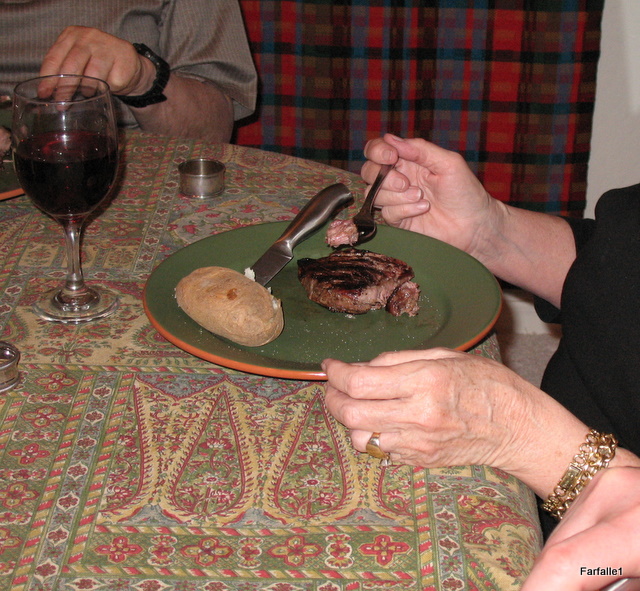
How much more sensible to just spear it with that fork, saw off a hunk, and ahhhhhhh.
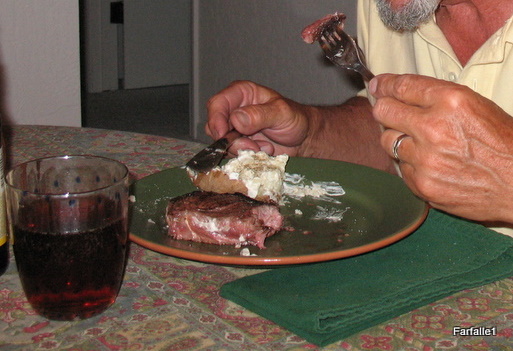
There are otherItalian dining customs that we have learned about only slowly.  The hands on the table for instance; in the U.S. it is considered polite to keep your non-working hand in your lap and your elbows off the table.  In Italy this is highly suspect – just what do you have in your hand that you don’t want your fellow diners to see?  No.  The unoccupied hand should rest, fist gently closed on the edge of the table, where everyone can see what you’re up to.  It’s not unusual to see people rest the whole arm on the table, from near elbow to fist.  Our hand model in the first photo above is illustrating a hybrid of the two practices, eating with her fork in her right hand (American) but resting her left paw on the table (Italian).

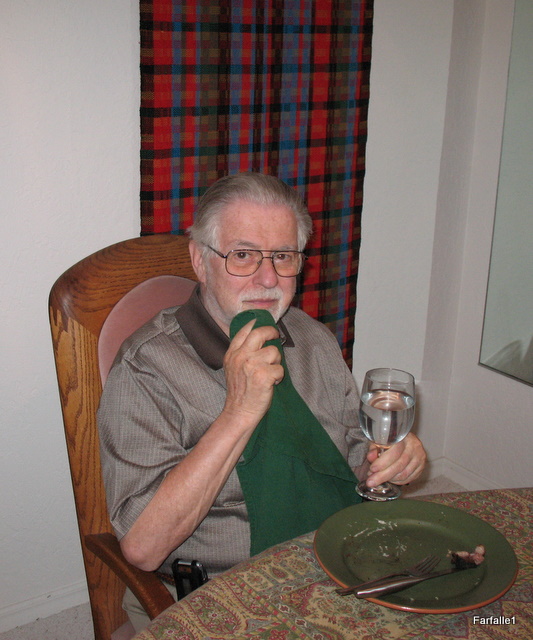
Thirsty?  Hang on a second.  Don’t just pick up your glass and drink; you’ll get food residue on your glass.  Instead you want to wipe your mouth with your napkin, then take a sip.  Then wipe your mouth again.

Perish the thought you should get an itchy scalp during a meal.  In Italy it is considered bad manners to touch the hair while eating.  I’m not exactly sure why this is so.  It’s not like you’re running your fingers through your hair and then sticking out your hand to shake with someone else (we see golfers do this all the time at the end of matches – ick!). But then, I’m not sure manners always make a great deal of sense.
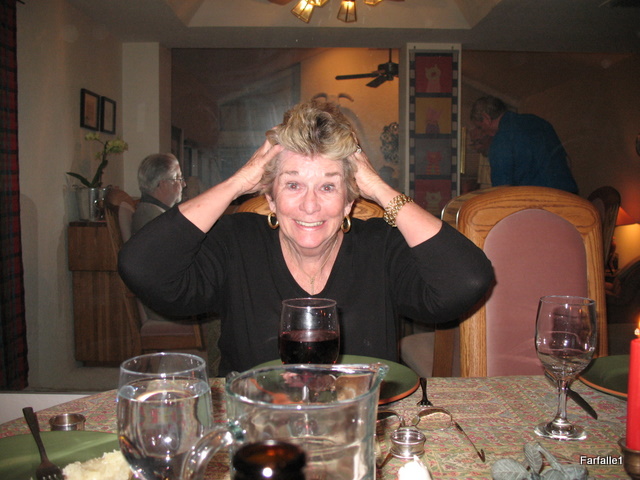

(It’s no wonder our patient model wants to pull her hair out – this is about the 6th time I’ve said to her, “Wait! Wait!  Let me take a picture of that!”  Makes it hard to enjoy the food…)

Dinner’s done and it’s time to clear the table.  In the U.S. it is not unusual to make multiple trips to the kitchen carrying two items at a time – it’s not polite to stack plates, we were taught.  I’m happy to say that this work-inducing custom does not exist in Italy.  Everyone, from the very talented waiters in restaurants to the maid serving a fancy private dinner, will stack the plates before staggering out to the kitchen with them: another triumph of common sense!

Time for fruit.  Wait!  Don’t pick up that fruit with your hands!  In Italy we cut our fruit with knives and forks, and eat it with forks.  And it’s best not to eat the skin – just cut that off as well.  You never know what might be on it, even if it has been well washed.  It is a joy to watch an Italian delicately separate the skin from, say, a pear, and tidily eat – it’s an art form. This is a skill I have not yet mastered.  I still like to eat my apples the American way, cut in quarters and enjoyed from the hand.

Care for a cafe?  Well, okay.  I won’t join you, because I don’t care for it myself, but I’d be happy to make you some.  Just remember that in Italy, coffee after dinner means espresso.  Period.  It does not mean cappuccino, which typically is drunk only in the morning, or any of the other myriad Italian coffee styles.  It means a short, dark and very strong espresso.

I’m grateful to the students in my adult ESL classes of a few years ago for teaching me these niceties. There are probably a lot of other customs of Italian dining I’ve omitted – any additions, fellow bloggistas?

‘Mbriulata

06 Wednesday Jan 2010

Posted by farfalle1 in Food, Italian recipes, Uncategorized

≈ 4 Comments

Tags

'Mbriolata, 'Mbriolate, 'Mbriulata, 'Mbriulate, Sicilian recipes

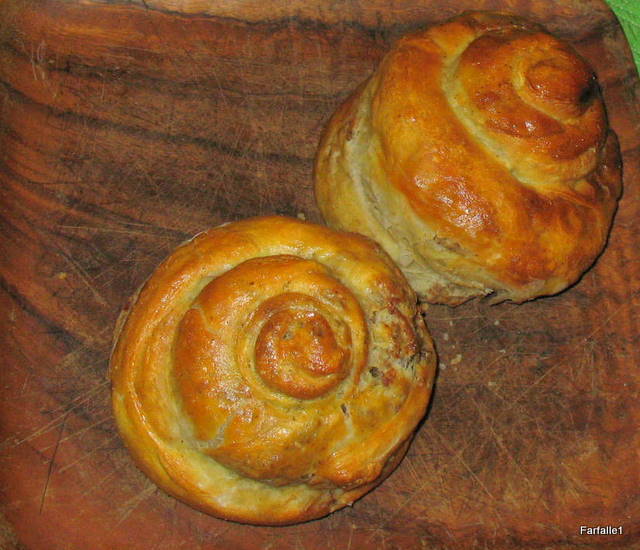
The holiday decorations have been put away for another year, the leftovers have been eaten (including ALL the cookies); now is the season of remorse.  But before embarking on the inevitable diet, let’s revisit one of the greatest holiday treats of all – ‘mbriulate (pronounced um-bree-you-lah’-tay), a cross between pastry and bread, laced with bits of pork, sea salt and heavily peppered.  It is one of those things of which you say to yourself, ‘Oh, I’ll just try one little bite,’ and half an hour later realize that you’ve eaten a whole turban.  It’s impossible to stop!

The Captain’s family is Sicilian, and he learned to make this dish from his mother many years ago.  It is a dish which is found in the Sicilian province of Agrigento and has, most probably, Roman origins. The only other people we know personally who make it are his cousins, who have an interesting variation I’ll tell you about later.  What does ‘mbriulata mean?  We don’t really know, although the cousins surmise it may come from the word ‘miscuglio’ – a mix, a confusion of things, or perhaps from the Italian word ‘imbrogliata,’ a muddle.

Be warned: you will not find this in the AMA guide to heart-healthy eating. But for a special occasion you can not do better than start the meal with ‘mbriulate, either with your drinks beforehand or after you’ve moved to table – and you always want it in the plural. One ‘mbriulata might satisfy a lonely solo reveler, but no more than that.

The Captain’s recipe is simplicity itself, calling only for a filling of pork, Crisco, salt and pepper.  The cousin’s recipe eschews the Crisco (which doesn’t exist in Italy) and adds onions, pitted black olives and bits of cheese.

You can find the recipe for both variations here.

Olive Oil

29 Tuesday Dec 2009

Posted by farfalle1 in American habits and customs, Food, Health and health care, Italian habits and customs, olives

≈ 2 Comments

Tags

olive oil, Olive Oil in Softgels, Puritan's Pride Vitamins, Softgel Olive Oil

Olive Oyl/King Features

We didn’t have a TV when I was growing up (I know! but it’s true!!).  But my best friend Taffy had one, as did other friends, so somehow stray bits and pieces of TV-lands-and-people crept into my brain.  One of these was Popeye and his interestingly shaped girlfriend Olive Oyl.

In fact, I knew this crowd pretty well from the daily comic strip in the North Adams Transcript (Popeye first appeared way back in 1929, and King Features still presents the strip, the creation of Elzie Crisler Segar. Interestingly, Robin Williams’ first movie role was in the 1980 film adaptation (Jules Feiffer, Robert Altman) of the cartoon). I never cared much for Popeye.  Unable to see the kind, generous and lovable character behind his ‘coarse’ speech and fightin’ ways, I avoided him and his cronies (Wimpy, arch-rival Bluto, etc.) for the more mundane Peanuts and Archie.  Talk about Wimpy!

As far as I knew back in those days, olive oil was a misspelled character; we didn’t know anything about olive oil in the mid- to late-20th century New England kitchen, and we certainly didn’t have any in the cupboard.  That all changed sometime in the latter part of the century as Mediterranean cuisine became popular in the States, both for its deliciousness and for its health benefits.  In fact, worldwide consumption of olive oil grew substantially, from 1,779,000 MT in 1990 to 2,553,000 in 2005. Suddenly restaurants were offering little saucers of oil for dipping bread, and connoisseurs were comparing flavors and production methodologies.  Olive oil became a low-key cooking and eating craze. (If you’d like to read an account of our own olive harvest, click here and here.)

Hirts Gardens photo

Italians have been cooking with and consuming olive oil from the year dot. Perhaps it is just their good fortune that natural circumstances gave them a fat product from a tree rather than from a cow. 1 tablespoon of butter contains 12 grams of fat, 8 of which are saturated (bad!) and it has 33 mg of cholesterol; 1 tablespoon of olive oil contains 14 grams of fat, only 2 of which are saturated, and it has no cholesterol at all.  In addition, olive oil contains antioxidenats, beta-caratene and vitamin E.  AND it tastes great and makes everything else taste great too.

Imagine our surprise when we received the wonderful Puritan’s Pride catalog the other day, and discovered that you can now buy olive oil in softgels.  Why on earth would you want to when you can buy a lot of olive oil in a bottle and have the pleasure of consuming it on salads and in sauces?  Pills??  Only, I think, in America! Then consider the economics of the thing.  You can get 300 60-mg softgels of olive oil (just writing it makes me shake my head) for $21.98.  That’s 10 ounces of olive oil for $21.98 – kind of pricey, if you ask me.  In fairness, the same catalog offers a 16 ounce bottle of cold-pressed organic extra-virgin olive oil for $9.63, as well as an olive leaf complex.

photo from China Suppliers.com

It makes me think of all the Futurama stuff we read about when we were kids watching Popeye – we would all zip around with personal jet-packs, and we wouldn’t have to eat food anymore because we’d be getting all our nutrients from pills. What a horrid thought that is! My advice? When in Rome, or anywhere else for that matter, do as the Romans – use lots of olive oil, but use it from a bottle, not from a softgel!

(More info on olive growing and harvesting here and here, and a photo album of the harvest and pressing here.)

CSA

08 Tuesday Dec 2009

Posted by farfalle1 in Food, gardening, Uncategorized

≈ 6 Comments

Tags

Brandon CSA, Community Supported Agriculture, Community Sustainable Agriculture, CSA, Woods Farm, Woods Market

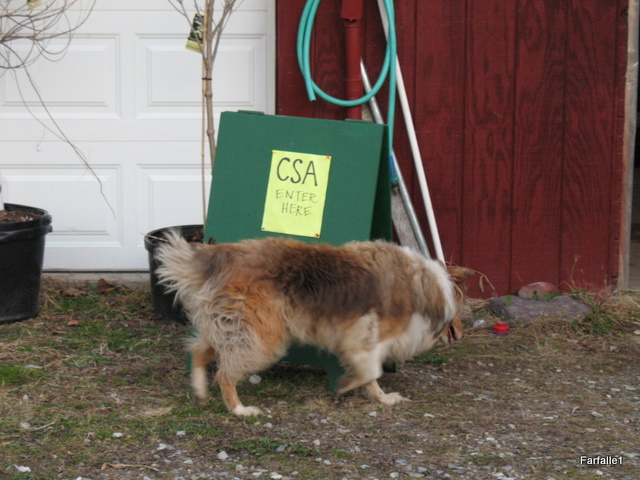
Community Supported Agriculture.  Community Sustainable Agriculture.  Take your pick or make up something else.  Whatever you call it, it is big in the U.S.  My sister in Tennessee and my dear friend in Vermont have both joined their local CSA’s. Even in Arizona, where one thinks more of desert or agri-business than vegetable farms, there are a number of CSA’s.

Here’s how it works.  At the beginning of the growing season community members pay a fee to a local farmer.  The farmer can use the money that’s been paid up front to buy seeds, fertilizer, whatever he needs, without having to take out a bank loan.

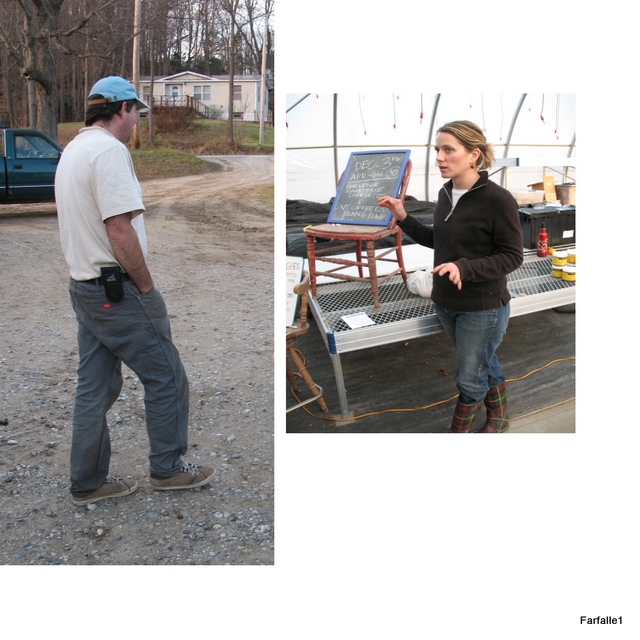
Whatever the farmer harvests, or some portion of it, is then divided by the number of members who joined, and they, the members, can come once (or sometimes twice) a week and pick up their share of produce.  In the case of my friend in Vermont the fee to join was $200 which entitled her to 10 weeks of harvest pick-ups..

Obviously these are fall crops.  My friend’s CSA was organized for autumn vegetables; the people who own the farm also offered a summer CSA for use at their farm stand. Members could buy summer vegetables and everything else the stand sells (meats, cheeses, plants, honey, eggs) during the four summer months at a 10% discount.

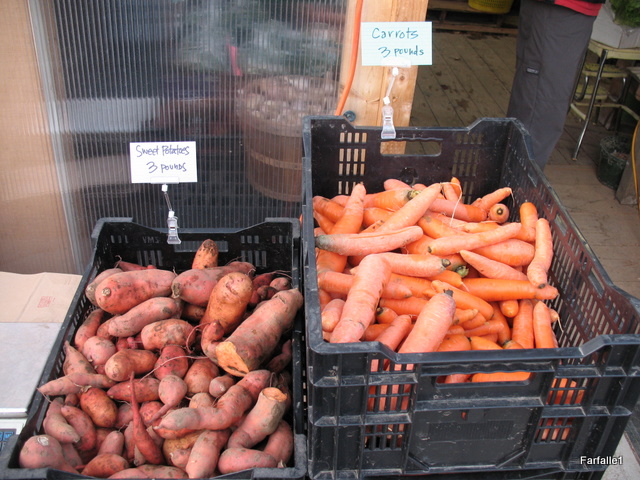
There are probably as many organizational charts and methods of distribution as there are CSA’s.  Mrs. H, here in Arizona, belonged to a CSA for one year; when she went for pick-ups the produce had already been divied up and put in boxes.  She was given a box, over whose contents she had no real say.  My sister in Tennessee went to her pick-up and could tell the farmer what she wanted of the available offerings.  The farmer picked out individual pieces – better, but still not perfect.  The Vermont system seemed best to me; the farmer put a sign above each box of produce announcing the weight of each share.  For instance, each share-holder was entitled to 3 pounds of carrots in the photo above.  She could also take less, or decide not to have carrots at all that week.

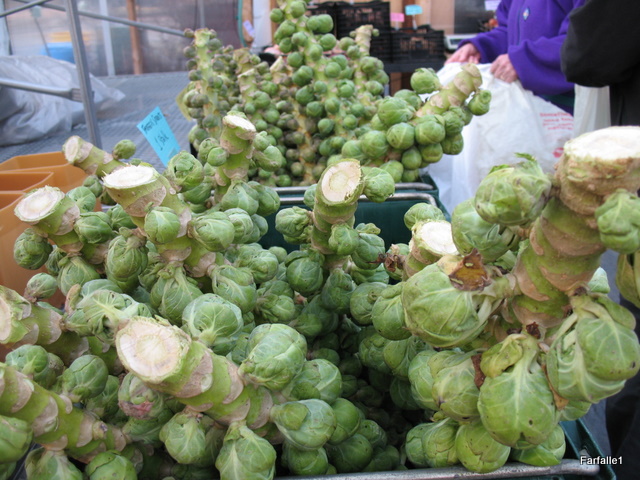
There was a large amount of autumn produce on hand the week that I went with my friend; she staggered out with two full bags of locally grown organic vegetables, including onions, carrots, potatoes, sweet potatoes, kale, brussels sprouts and more.

I was able to speak to the owners/farmers of my Vermont friend’s CSA, Jon and Courtney of Woods Farm in Brandon.

Jon moved to Vermont from Massachusetts in 2000 to farm the fertile river valley; Courtney came for a job on the farm and ta-da, partners in the fields and partners for life.  They have 25 of their own acres of light, productive soil.  In addition they lease 35 acres, 15 of which they put in alfalfa and 5 of which they put into sunflowers (a less than successful operation this year because of excessive rain). This was the first year they offered the summer CSA program at their farm stand – it was more successful than the sunflower crop; they had more subscribers than their goal.

CSA’s appeal to people who are interested in knowing where their food comes from.  There’s been a huge growth of the ‘localvore’ culture in the US, and CSA’s both feed and profit from this movement.  I haven’t seen anything like this in Italy, although there is such a strong tradition of local markets be begin with, there may be no need for such a thing.  But for Americans, who are accustomed to buying veggies that have been trucked in from hundreds, or even thousands, of miles away, the CSA’s offer a winning formula for everyone.

The Best Thing We Ate Last Week – Baked Stuffed Peaches

15 Thursday Oct 2009

Posted by farfalle1 in Desserts, Food, Italian men, Italian recipes, Piemonte

≈ 6 Comments

Tags

Leo, pesche ripiene, Stuffed pea, stuffed peaches

pesche ripiene - stuffed peaches

Our friend Leo made Pesche Ripiene (stuffed peaches) for dessert when we visited in Piemonte last week.  They are amongst the best things I’ve eaten, ever, in my whole life.  And they are easy to make.  In fact, they are so easy I will give you the recipe here rather than send you off to another page for it.

Here’s what you’ll need:  peaches, amaretto (or amaretti) cookies (about 3 per peach half, depending on size of cookies and size of peaches), marsalla, sugar, butter

Cut firm but ripe free-stone yellow peaches in half – Leo recommends Elberta. (They are widely available here but nowadays are not as common in the U.S. as they once were).  Chop up the cookies, add some sugar (+/-  1/2 tsp per peach half), and add enough marsala wine to make the cookie stuffing hold its shape.  Overfill each peach half with the cookie mixture and top with a dab of butter.  Put in a preheated (350) oven and bake until done.  The peaches are delicious with this stuffing, and somehow there is a by-product of excellent caramel sauce that can be drizzled over the top (Leo says it comes from the moisture the peaches throw off mixing with the sugar).

Next time you need an easy dessert and peaches are in season, try making stuffed peaches, and then when everyone tells you how fantastic they are, send a silent thank-you to Leo.

leo

The Best Thing We Ate This Week – Melanzane alla Parmigiana

31 Monday Aug 2009

Posted by farfalle1 in Food, Italian recipes, Uncategorized

≈ 8 Comments

Tags

antipasti, Eggplant alla Parmigiana, Eggplant Parmesan, Eggplant parmigiano, Eggplant recipes, Melanzane parmigiana, Melanzane ricette

antipasti

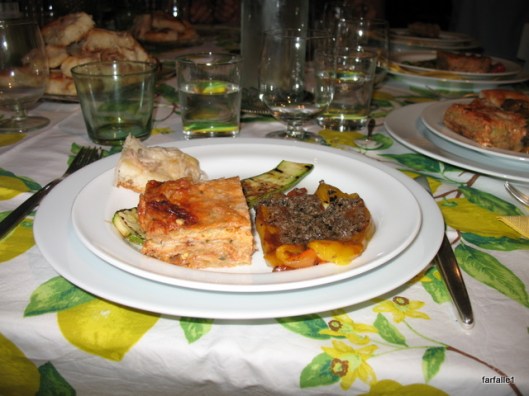
Our new friends G and G invited us to dinner the other night, along with a group of others from our palestra (gym).  What a meal we had!  Giorgio, it turns out, is a superb cook.  For antipasti (pictured above) he served grilled zucchini, onion focaccia, bagna cauda and melanzane alla parmigiana (front left in the photo).  I’ve never been a huge fan of what I think of as ‘eggplant parmesan,’ but Giorgio made his in the form of a light and delicate torta.  There was not an excess of heavily spiced sauce, or great long strings of melted mozzarella, both of which are great in the right places but better omitted here.  No, this was flavorful, but not at all heavy.  In fact, it was so good that it got the nod for The Best Thing We Ate This Week.  Giorgio has been kind enough to share the recipe, which you can find here, or over on the right under Good Recipes.

Tom-Toms

09 Sunday Aug 2009

Posted by farfalle1 in Food, Italian recipes, Uncategorized

≈ 6 Comments

Tags

Basil, Mozzarella, Pasta Recipes, Tomatoes

No, jungle drums aren’t talking – it’s the tomatoes out in the garden and they’re yelling to be picked.  The ripening started a few weeks ago, one here, one there, then a few more; now we have the full chorus, fortissimo, and we can barely keep up.  The Captain has already started canning what we can’t eat.

In addition to his delicious canned sauce, he makes a couple of things with fresh tomatoes that are quick, easy and a joy to eat: insalata caprese:

insalata caprese

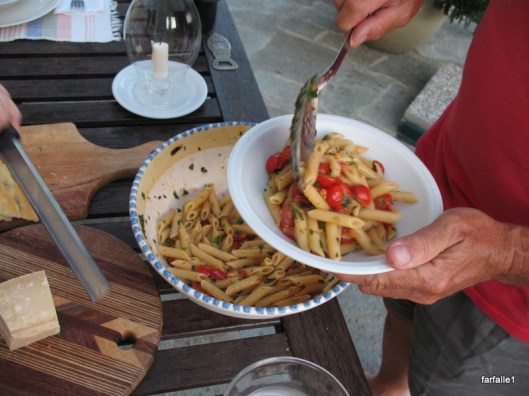
and pasta with a fabulous fresh tomato and herb sauce, about which I wrote a year ago:

pasta fresh tom sauce

The Caprese makes great use of fresh basil, which has also been growing like mad in pots on the terrace (much happier in pots than in the garden).  Which brings to mind another of the Captain’s quick and easy summer treats: the bruschetta that he learned to make from his Sicilian mother:

bruchetti

Recipes for the three dishes above can be found here, here and here and over on the right under ‘Good Recipes’.

Here’s one of my very favorite summer treatments for tomatoes:  go out to the garden with a paring knife and a salt shaker.  Find the plumpest, ripest tomato you can and pick it.  Cut it in half, salt liberally, and eat it right there in the garden.  This is best done on a hot day when the tomato has been gently heated by the sun.  Yum.  Summer tomatoes and basil.  What could be more delicious?

J-E-L-L-Oooooooo

26 Sunday Jul 2009

Posted by farfalle1 in American recipes, Food, Uncategorized

≈ 10 Comments

Tags

aspic, gelatin, Jello, tomato aspic

Usually here in Italy we’ve been able to find any foodstuff that we want.  We might not recognize the name, or the packaging, but by asking friends we’ve been able to find almost everything culinary that we’ve wanted.  And usually when we find it, it looks about the way we’d expect it to. I can imagine being in some really exotic country and buying something that you think is soup, say, only to open it up and find goats’ eyes.  That doesn’t happen here.

virtual-jelloOne thing I’ve never seen here, though, is Jello, the kind of wobbly, luridly colored Jello that we have in the States.  There are ‘budino’ (pudding) mixes – chocolate, lemon and so forth.  But not jello, per se, which is too bad, because it is a really silly, fun food.  (If you want to read a fairly cantankerous and thoroughly amusing history of non-commercial and commercial gelatin, which may or may not have been written by S.R. Brubaker, click here.)  Is there anything more cheerful, than a bowl of cubed up jewel-toned Jello, quaking and shaking?  No, I don’t think so either.  But you won’t be eating it in Rapallo.
Of course one can make one’s own jello with fruit, sugar and unflavored gelatin.  But it’s a little hard to come by red dye #14 or any other of the poisonous dyes that give Jello its unique colors (colors never found in nature!), so the likelihood of achieving true jello-hood at home is remote… it just isn’t jello if it doesn’t look like a false gemstone that’s got the vapors.

For some reason I got a bee in my bonnet about making tomato aspic the other day.  To my shock, many of the recipes I found call for lemon Jello.  Yuck.  Fortunately I found plenty of suggestions for ingredients in other recipes that did not include anything quite so yellow and all of which, of course, call for unflavored gelatin.

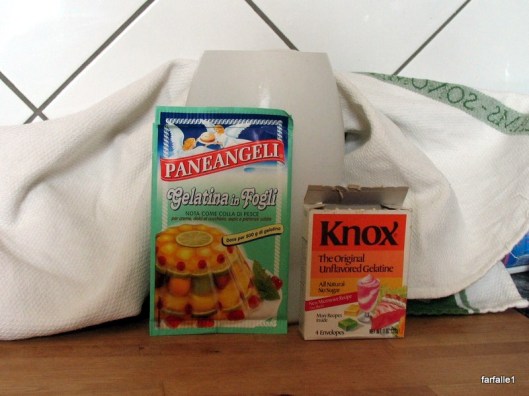
We still had some in the cupboard that moved over from the States with us in ’02 (that’s how often I make aspic), but there wasn’t really enough.  So I went a-hunting for same in the supermarket.  It is plentiful, but the package didn’t look anything like what I’m used to:

tart, beans, gelatina 020

That’s it on the left – Gelatina in Fogli.  Huh?  What are Fogli?  Well, it turns out that in Italy gelatin is one of the foods that looks completely different than it does in the U.S.  Whereas we are accustomed to a grainy powder, here the gelatin comes in thin sheets (‘fogli’ means ‘leaves’ or ‘sheets’):

tart, beans, gelatina 024

In fact, it’s really pretty.  That’s our Knox powder in the saucer, and resting behind it is one of the six fogli that come in an Italian package of gelatin.  Looks like a kind of magical quilt for an elf, doesn’t it?  It’s flexible and doesn’t feel sticky.  Fortunately the directions for using it are very simple.  You put all six sheets in a bowl of cold water and let them soften for 10 minutes.  They get slippery and feel a little slimy, but they hold their shape; it’s kind of fun to play with them a little before using them. Then you add them to a hot mixture and they simply melt away. After that, things go along just as they do with the powdered form of gelatin.  After a while in the fridge you’ve got a nice, firm, gelled whatever-you’ve-made.  One of the fun things about molded food is choosing the shape you want to make it.  Fish is a fish mold?  Certainly!  But how about a little sensory displacement: dessert in a fish mold?  Why not?  Fooling around with shapes is half the fun of the whole endeavor.

So how did the aspic turn out?  Really well!  In fact, to my utter surprise, our Italian friends loved it.  They called it tomato salad, which was generous, and they enjoyed it very much.  We served it with a sauce made of cheese, horseradish, mayonnaise and a little milk.  That thing on the left that looks like a happy face is a slice of cucumber; another is barely visible between the first one and the sauce.  The cucumber as decoration plan did not work out quite as I’d hoped.

aspic 001a

Gelatin makes food that’s playful, and that’s good.  I don’t agree with S.R. Brubaker who says, gelatin is ‘fake food,’ (just one of his salvos against this church social favorite).  It’s no more fake than bread is ‘fake wheat’ after the addition of yeast and heat.  It’s just a process.  The great thing about gelatin is you can put whatever you want in it and it will probably work out pretty well.  It is the amber of the food world, trapping and holding ingredients (let’s hope it’s not, like amber, holding flies).  If you want a rather vague tomato aspic recipe, click here.  In any event, have some jello and have some fun.

Pickle Relish

01 Wednesday Jul 2009

Posted by farfalle1 in American recipes, Customs, Food, Uncategorized

≈ 5 Comments

Tags

4th of July, Brats, Hot dogs, Independence Day, Relish

relishOh! The things we take for granted in the United States, things like peanut butter and pickle relish.  Neither of these items is readily available in Rapallo, and usually we don’t miss them very much.  But watch out – the 4th of July is just around the corner.  You can’t get through the 4th of July without a hot dog or a brat, and according to me, you can’t eat either without pickle relish on top.

The solution to the scarcity problem is obvious: we must make our own.  We made this recipe a couple of years ago and served it at a 4th party, which included many Italian friends.  To our surprise they loved it, to the point of requesting the recipe.  “It will be good with chicken and pork,” one of them said.  I suppose so, though we generally opt for the Captain’s chutney with that kind of meat.  But for a good old ‘Merican hot dog or German brat, nothing beats relish on top, and this recipe makes a relish unlike the vivid green items you can buy in American supermarkets.  We adapted it from a recipe we found on cooks.com.

Dancing hot dog C

(Picture found on web - thank you anonymous artist!)

Happy Independence Day, everyone!  Eat a hot dog!!

Not Your Same Old Zucchini

18 Thursday Jun 2009

Posted by farfalle1 in Food, Indian recipes, Uncategorized

≈ 6 Comments

Tags

Indian food, raita, zucchini

indian dinner zucch 001

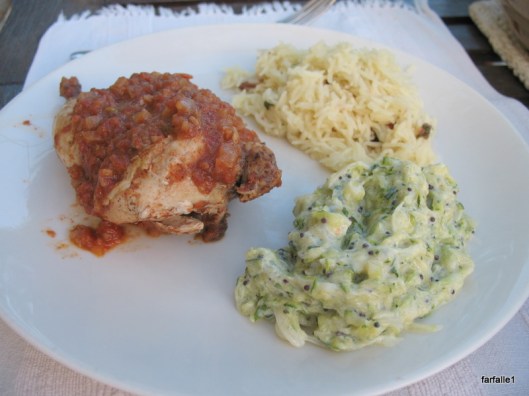
This week we had a confluence of two happy conditions.  The first is that the Captain loves to cook, and we both love to eat, Indian food. The second is that it is the start of Zucchini Season here in Liguria.  Our plants are just beginning to flower, but our friends are already picking their first zukes and cukes.

There was a joke in the town in Connecticut where we lived for many years.  It said that the only time you had to lock your car was when you went downtown in August because if you didn’t someone would throw in a bushel of bat-sized zucchini.  It certainly is a prolific plant (though we’ve suffered off-and-on mildew problems here in Rapallo), and the puzzle is always to find new ways to serve this summer staple.  It’s always great on the grill, but you don’t want to fire that up only for zucchini.  Zucchini cake is good, but doesn’t use up enough of the vegetable.

What to do?  The Captain googled ‘zucchini Indian’ and found a terrific Madhur Jaffrey recipe at recipezaar.com.  Like every good cook I know, though, he tweaked it to produce the gorgeous zucchini raita seen at the front of the plate above.  (The other two items are Murgh Khoobani, game hens braised in fragrant apricot sauce from Julie Sahni‘s book Classic Indian Cooking; and basmati rice with raisins, saffron and mint).

Although this recipe calls for cayenne pepper, you can leave it out altogether if you hate hot pepper, or you can add it in any amount you like to suit your appetite for heat.  You can find the recipe by clicking here, or over on the right under Recipes.

← Older posts
Newer posts →

Enter your email address to follow this blog and receive notifications of new posts by email.

Join 114 other subscribers

rss

Subscribe in a reader

Search the Blog

A. Useful Links

  • bab.la language dictionary
  • Bus schedules for Tigullio
  • Conversions
  • English-Italian, Italian-English Dictionary
  • Expats Moving and Relocation Guide
  • Ferry Schedule Rapallo, Santa Margherita, Portofino, San Frutuoso
  • Italian Verbs Conjugated
  • Piazza Cavour
  • Rapallo's Home Page – With Link to the Month's Events
  • Slow Travel
  • The Informer – The Online Guide to Living in Italy
  • Transportation Planner for Liguria
  • Trenitalia – trains! Still the most fun way to travel.

C. Elaborations

  • A Policeman’s View
  • Driving School Diary
  • IVA refunds due for past Rifiuti tax payements
  • Nana
  • Old trains and old weekends
  • The peasant, the Virgin, the spring and the ikon
  • Will Someone Please, Please Take Me to Scotland?

D. Good Recipes - Best of the Week winners are starred

  • 'Mbriulata
  • *Baked Barley and Mushroom Casserole*
  • *Captain’s Boston Baked Beans*
  • *Crimson Pie*
  • *Louise’s Birthday Cake*
  • *Melanzane alla Parmigiana*
  • *Penne with Cabbage and Cream
  • *Pizzoccheri della Valtellina*
  • *Pumpkin Ice Cream*
  • *Risotto alla Bolognese*
  • *Rolled Stuffed Pork Roast*
  • *Spezzatini di Vitello*
  • *Stuffed Grape Leaves*
  • *Stuffed Peaches (Pesche Ripiene)*
  • *Swordfish with Salsa Cruda*
  • *Tagliarini with Porcini Mushrooms*
  • *Tagliatelli al Frutti di Mare*
  • *Three P's Pasta*
  • *Tzatziki*
  • 10th Tee Oatmeal Apricot Bars
  • Adriana’s Fruit Torta
  • Aspic
  • Bagna-calda
  • Best Brownies in the World
  • Clafoutis
  • Cold cucumber soup
  • Crispy Tortillas with Pork and Beans
  • Easy spring or summer pasta
  • Fish in the Ligurian Style
  • Hilary's Spicy Rain Forest Chop
  • Insalata Caprese
  • Lasagna al forno
  • Lasagna al Forno con Sugo Rosato e Formaggi
  • Lemon Meringue Pie
  • Leo’s Bagna Cauda
  • Leo’s Mother’s Stuffed Eggs
  • Louis’s apricot chutney
  • Mom's Sicilian Bruschetta
  • No-Knead (almost) Bread
  • Nonna Salamone's Christmas Cookies
  • Pan Fried Noodles with Duck, Ginger, Garlic and Scallions
  • Pesto, the classic and original method
  • Pesto, the modern, less authentic method
  • Pickle Relish
  • Poached pears
  • Poached Pears
  • Polenta Cuncia
  • Recipes from Paradise by Fred Plotkin
  • Rustic Hearth Bread
  • Shrimp and Crayfish Tail Soup
  • Sicilian salad
  • Slow Food Liguria
  • Slow Food Piemonte and Val d'Aosta
  • Spinach with Garlic, Pine Nuts and Raisins
  • Stuffed Eggs, Piemontese Style
  • The Captain’s Salsa Cruda
  • Tomato Aspic
  • Zucchini Raita

E. Blogroll

  • 2 Baci in a Pinon Tree
  • Aglio, Olio & Peperoncino
  • An American in Rome
  • Bella Baita View
  • Debra & Liz's Bagni di Lucca Blog
  • Expat Blog
  • Food Lovers Odyssey
  • Italian Food Forever
  • L’Orto Orgolioso
  • La Avventura – La Mia Vita Sarda
  • La Cucina
  • La Tavola Marche
  • Rubber Slippers in Italy
  • Southern Fried French
  • Status Viatoris
  • Tour del Gelato
  • Weeds and Wisdom

Photographs

  • A Day on the Phoenix Light Rail Metro
  • Apache Trail in the Snow
  • Aquileia and Croatia
  • Birds on the Golf Course
  • Bridge Art
  • Canadair Fire Fighters
  • Cats of Italy
  • Cloudy day walk from Nozarego to Portofino
  • Fiera del Bestiame e Agricultura
  • Football Finds a Home in San Maurizio
  • Hiking Dogs
  • Mercatino dei Sapori – Food Fair!
  • Moto Models
  • Olive pressing
  • Rapallo Gardens
  • Rapallo's Festa Patronale
  • Ricaldone and the Rinaldi Winery
  • Rice Fields
  • Sardegna ~ Arbatax and Tortoli
  • Sardegna ~ San Pietro above Baunei
  • Sardegna ~ The Festa in Baunei
  • Scotland, including Isle of Skye
  • Slow Food 2008 Salone del Gusto
  • The Cat Show and the Light Rail Fair
  • The desert in bloom
  • Trip to Bavaria

Pages

  • Fagioli all’ucelleto

Archives

Recent Posts

  • A Superior Visit
  • Fun at the Ranch Market
  • The MAC
  • Welcome Tai Chi
  • Bingo Fun for Ferals
December 2025
M T W T F S S
1234567
891011121314
15161718192021
22232425262728
293031  
« Jul    

Member of The Internet Defense League

Blog at WordPress.com.

  • Subscribe Subscribed
    • An Ex-Expatriate
    • Join 114 other subscribers
    • Already have a WordPress.com account? Log in now.
    • An Ex-Expatriate
    • Subscribe Subscribed
    • Sign up
    • Log in
    • Report this content
    • View site in Reader
    • Manage subscriptions
    • Collapse this bar
 

Loading Comments...