• Contact
  • Elaborations
    • A Policeman’s View
    • Driving School Diary
    • Great Danes
    • IVA charged on Tassa Rifiuti
    • Nana
    • Old trains and Old weekends
    • The peasant, the virgin, the spring and the ikon
    • Will Someone Please, Please Take Me to Scotland??
  • Recipes
    • ‘Mbriulata
    • *Baked Barley and Mushroom Casserole*
    • *Captain’s Boston Baked Beans*
    • *Cherry Tart*
    • *Crimson Pie*
    • *Louise’s Birthday Cake*
    • *Melanzane alla Parmigiana* – Eggplant Parmesan
    • *Penne with Cabbage and Cream
    • *Pizzoccheri della Valtellina*
    • *Pumpkin Ice Cream*
    • *Risotto alla Bolognese*
    • *Rolled Stuffed Pork Roast* on the rotisserie
    • *Shrimp and Crayfish Tail Soup*
    • *Spezzatino di Vitello*
    • *Stuffed Grape Leaves*
    • *Swordfish with Salsa Cruda*
    • *Tagliarini with Porcini Mushrooms*
    • *Tagliatelli al Frutti di Mare*
    • *Tzatziki*
    • 10th Tee Apricot Bars
    • Adriana’s Fruit Torta
    • Artichoke Parmigiano Dip
    • Best Brownies in the World
    • Clafoutis
    • Cod the Way Sniven Likes It
    • Cold Cucumber Soup
    • Crispy Tortillas with Pork and Beans
    • Easy spring or summer pasta
    • Fagioli all’ucelleto
    • Fish in the Ligurian Style
    • Hilary’s Spicy Rain Forest Chop
    • Insalata Caprese
    • Kumquat and Cherry Upside Down Cake
    • Lasagna Al Forno con Sugo Rosato e Formaggi
    • Lemon Meringue Pie
    • Leo’s Bagna Cauda
    • Leo’s Mother’s Stuffed Eggs
    • Louis’s Apricot Chutney
    • Mom’s Sicilian Bruschetta
    • No-Knead Bread (almost)
    • Nonna Salamone’s Famous Christmas Cookies
    • Pan-fried Noodles, with Duck, Ginger, Garlic and Scallions
    • Pesto
    • Pesto
    • Pickle Relish
    • Poached Pears
    • Polenta Cuncia
    • Pumpkin Sformato with Fonduta and Frisee
    • Rustic Hearth Bread
    • Sicilian Salad
    • Soused Hog’s Face
    • Spotted Dick
    • Swedish Tea Wreaths
    • The Captain’s Salsa Cruda
    • Tomato Aspic
    • Vongerichten’s Spice-Rubbed Chicken with Kumquat-Lemongrass Dressing
    • Winter Squash or Pumpkin Gratin
    • Zucchini Raita

An Ex-Expatriate

~ and what she saw

An Ex-Expatriate

Category Archives: Food

Whence thy egg?

14 Sunday Jun 2009

Posted by farfalle1 in Animals in Italy, Birds in Italy, Food, Italian habits and customs, Italy, Uncategorized

≈ 8 Comments

Tags

chickens, eggs, hens, Italian eggs

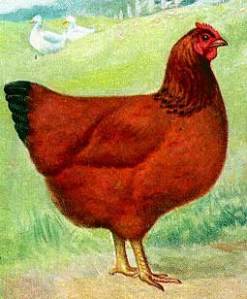
rhodeislandredWhen we lived in Connecticut we had a ‘flock’ of hens.  I use the term loosely; we had three hens.  Ever since my grandmother told stories about making little rubbers for her chickens so their feet feet wouldn’t get wet, I wanted to raise chickens.  It seemed more interactive than dolls, and less responsibility than actual children.

Our flock began with a gift of two small banty hens from a friend, which we augmented with the purchase of a Rhode Island Red and a Barred Plymouth Rock.  Oh, they were lovely.  One of the banties became despondent and went under the hen-house to die, but the other three lived with us until we gave them away upon leaving Connecticut, and they gave us just the right number of delicious small blue (the banty) and large brown (the other two) eggs.  BARROCK1

In the U.S. the provenance of the eggs one buys is something of a mystery, as is their age.  In a commercial operation, the eggs are washed and sanitized immediately, and then are sprayed with a thin coat of mineral oil ‘to preserve freshness,’ according to the USA Poultry & Egg Export Council.  The quotation marks are mine, because I suspect it is done more to give the eggs a longer shelf life than for any other reason.  When you buy a carton of eggs in the U.S., you have no idea where they’ve come from, unless the name of the farm is on the carton itself.  And even then you have no way of knowing if the hens were caged or free-range, or what they were fed.  (This is true: leftover bits of chicken at a processing plant are ground up and used as chicken feed.  Blcch.)  Fancier/organic egg producers are likely to advertise their practices on their cartons, but otherwise you’re left in the dark.

Here in Italy every commercially sold egg comes with a code stamped on it.
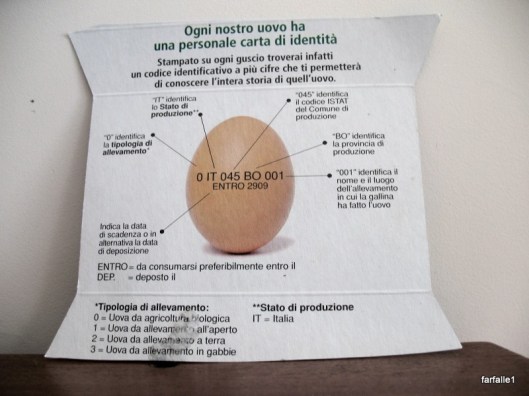
Egg ID

The first number identifies the life style of the producing hens: 0=biologic (what we might call ‘organic’ in the U.S.)  1 = living in the open (‘free range’)  2 = raised on the ground (something between free range and a cage) and 3 = caged.  The next two letters give the country of origin of the eggs; the next three numbers correspond to the town where the egg was laid; the next two letters are the provincial code of the town; the last three numbers identify the name of the producer (not the hen, the farmer).   So, no mystery about your egg here.  Of course, not all eggs are equally legible.
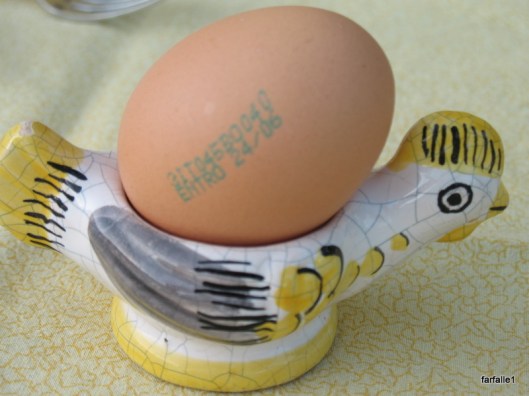
egg in cup

This one is pretty clear (oh, busted! Now you know we buy eggs from unhappy cage-raised hens in the province of Bolzano.  Shame on us.)  Sometimes the printing is quite smudged so you have no idea what it says.  Note also that there is a use-by date stamped under all the other info.

I haven’t been able to find out what Italian hens eat, but the yolks of their eggs are a rich red-yellow, almost orange.  When we go back to the egg in bowlStates the relatively pale yellow yolks seem anemic to us.  But I must say, even our own flock of Connecticut hens produced the pale American yolk.  It must be something in the Italian diet … even for the chickens.
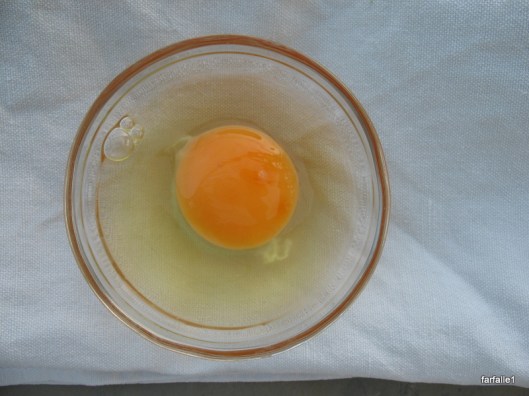
We always feel good about buying eggs here.  The laying date is stamped on the egg box (they’re sold in quantities of 4, 6 or 10, an odd mix of metric and imperial measurement).  The egg itself will tell us exactly where it comes from.  Italian eggs are not sold from refrigerated cases.  They sit out on the shelf, proud to be fresh enough to do so.

Good as the eggs in the market are, though, the best egg is the one with no identifying marks, save perhaps a little bit of hay or something worse stuck to it, the egg your neighbor gives you.
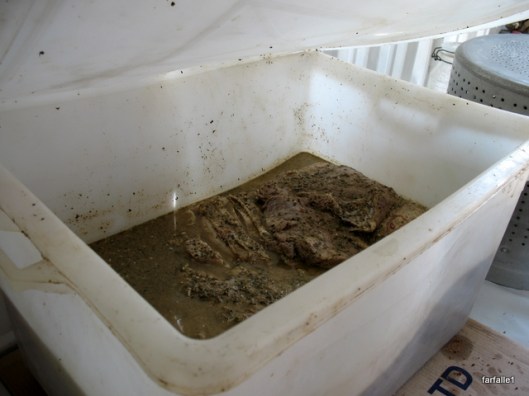
Sgabei

25 Monday May 2009

Posted by farfalle1 in Desserts, Food, Italian habits and customs, Italian holidays, Italian recipes, Liguria, Uncategorized

≈ 4 Comments

Tags

Assado, Sagra, Sgabei

What do “Sgabei!  Gesundheit!!”  and “Who doesn’t love a party?” have in common?  This weekend it was San Maurizio di Monti.

Sgabei (it’s an odd word, pronounced pretty much the way it’s spelled) is a typically Ligurian treat that originated in the Val de Magra on the eastern end of Liguria, on the border with Tuscany. While it is not often found on menus, it is not an unusual offering at a Sagra, a local festival which often involves food and some other kind of entertainment or a sporting event.  Sagras are very popular – it’s a rare weekend when you can’t find a sagra somewhere nearby with its attendant food specialty.

San Maurizio, our little town, just held its third annual Sagra degli Sgabei.  Why Sgabei?  Well, it is a typical food, but also most of the other regional specialties had already been taken by other nearby towns – Santa has fritters, Camoglie has a huge fish fry (fish are cooked in the World’s Largest Fry Pan), and there are several Trofie al Pesto shindigs.  So, for whatever reason, the Comitato Amici di San Maurizio, the volunteers who work hundreds of hours to make it all happen, decided to make Sgabei the main draw of their Sagra.  In addition to the food there were two dance bands, one on Saturday evening, the other on Sunday.

There are always treats other than the signature dish at a Sagra, frequently porchetta, assado and usually some kind of pasta.  Our choices included Trofie al Pesto (also a Ligurian specialty) or Ragu, porchetta, assado, sausages, beer or wine, and of course the highly touted Sgabei themselves.

Assado has its origins in Argentina, where the cowboys would find themselves hungry and far from any source of food… other than their cows.  So they would slaughter a cow and eat it.  Assado is the part of the animal around the stomach – that is, not the guts themselves, but the flesh and muscle that holds them in.  It is marinated, cooked on a big rack near an open fire for about six hours, then sliced off.

sgabei assado marinade

Each Assado chef has his own secret marinade recipe, but it will usually contain at least thyme, salt, pepper, hyssop (which grows wild in the woods here).  My sources tell me that most chefs put something alcoholic in the marinade as well: grappa, wine, or…

sgabei assado

After all those hours cooking the meat is tender (sort of) and ready to be eaten.  A chef with a big knife takes slices from the side away from the flames, and voila – your Assado is ready to serve:

sgabei assado-1

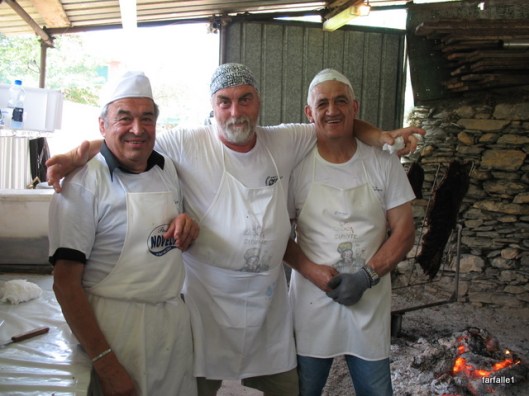
They say that a lot of the tastiness of food has to do with the spirit and energy that the chef puts into the preparation.  That could explain why the Assado at the San Maurizio Sagra was so darned good:

sgabei assado cooks

They told me they are the best, and I believe them.

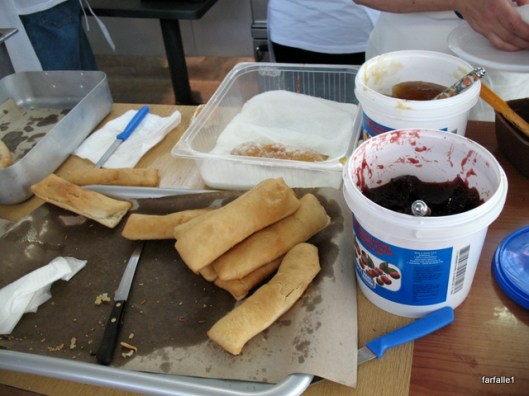
So, what about the famous Sgabei?  A secret: I don’t much care for them.  I’ve never been a great donut lover, and to me Sgabei is simply a torpedo shaped donut that’s been sliced lengthwise and filled with something – in the case of this weekend’s sagra either strachinno (a very runny cheese), cherry jam or Nutello.  No thanks, I’ll pass, though I will take some of that cherry jam.

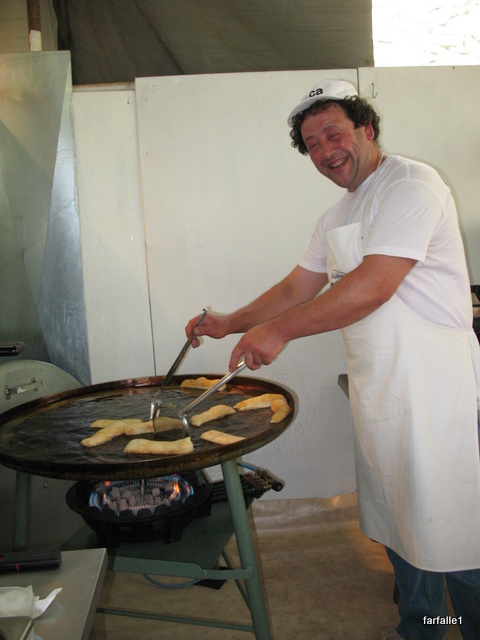
For the same reason that the assado is so good, I’m sure the sgabei are the best this side of Genova:

sgabei cooking

Here’s what they look like before they’ve been stuffed:

sgabei

As Fred McGourty used to say, Highly regarded by people who like that sort of thing.

If you’re interested in reading more about other Sagras, hop over to Rowena’s blog and read her section called 100 Ways to Celebrate Italy (there’s a link about halfway down the front page on the left).  She’s up to 35, which is way more than we’ve been to.

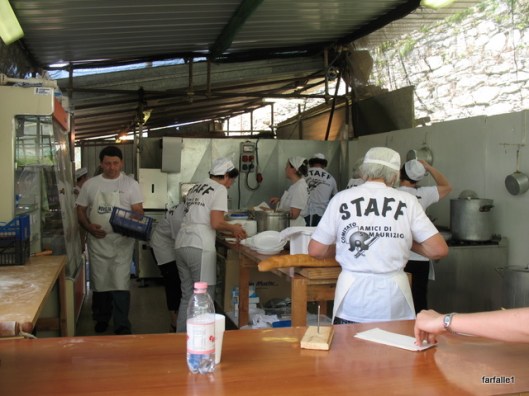
I’d love to know more about the Sagra – what do they do with the money, for instance?  We assume it’s a fund-raiser, but for what?  And most of all, how can I get one of these great Staff tee-shirts??

sgabei kitchen

The Best Thing We Ate This Week – Meat

07 Thursday May 2009

Posted by farfalle1 in Food, Italian habits and customs, Italian holidays, Uncategorized

≈ 4 Comments

Tags

Baked Beans, Boston Baked Beans, Cooked Meats, Grigliata, Italian BBQ, Labor Day, May Day

May 1st is Labor Day all over Europe, and it is a great big holiday in Italy.  Most stores are closed, and everyone celebrates, if not in a Labor Union demonstration or parade, at least with a picnic or BBQ.

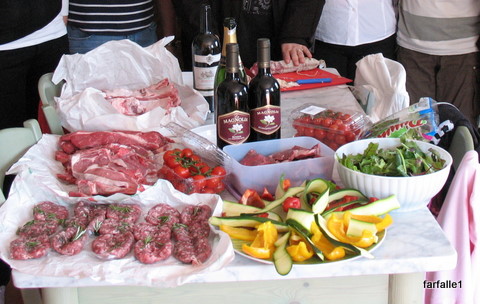
Friends invited us to a ‘grigliata’ – a grilled meats festa – and we agreed faster than it takes to say the word (greel-ye-ah’-ta).  They weren’t kidding when they said ‘meat!’

elenas-le-donne-b

Oh, there were a few vegetables, most of which were used to make the spiedini, what we think of as ka-bobs.  But by and large the meal was about Meat.  Grilled Meat.  And it was the best thing we ate this week.  Pictured above are sausages, sottofilette di vittelone (cutlets of not-still-veal not-quite-beef), some other kind of beef cut, cubed pork for the spiedini, costine (pork ribs), and, just visible at the back of the table, one of the two salami we consumed.  The meat was cooked over a wood fire, which gave it a smoky flavor in addition to the usual BBQ charred flavor that is so good.  And that’s the only recipe for it I can give you.

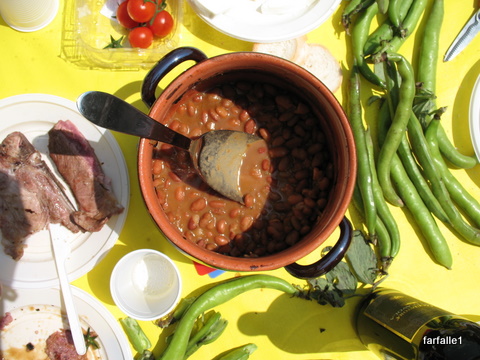
Our contribution was a little odd: the Captain’s Boston Baked Beans. We first served them here a couple of years ago and to our astonishment our Italian friends adored them.  They join Meat in getting the nod this week for best eating.  The recipe is here, or over on the right underelenas-ls-beans Good Recipes.  The beans go splendidly with Meat, especially with the grilled sausages that our friends served.
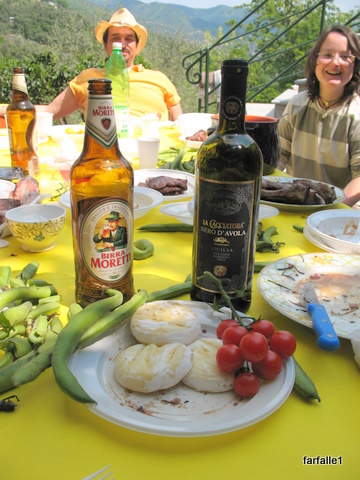
To the right of the bean pot are some fava beans, which are planted in November or December and harvested about now.  They are served with a fresh cheese called Primo Sale.  Fava beans fall into the same category of eating as, say, our Thanksgiving turkey – they are required to be eaten at a certain season, but not everyone adores them.  They are put out on the table as you see them here, and you just unzip them and eat the beans inside.  They’re good in a raw-beany kind of way, but five or six at a sitting is sufficient.

An unexpected treat was a small grilled cheese called Tomina, about three inches across and an inch high.  Our friends put it on the grill and cooked it until  it was slightly brown outside and almost gooey inside.  Cheese (Brie, to be exact) is one of my desert island foods, so I was really impressed with the grilled approach.

For whatever reason my picnic plate kept taking on the appearance of the Italian flag – here are two iterations.  Maybe I’m becoming Italian after all!

elenas-baked-cheese-fava-tomatoes-wine

The first one shows the grilled tomina in addition to one of our hostesses and another guest. The second one looks kind of lame, but the salami was soft and full of flavor. That’s the teeniest little piece of primo sale cheese, and you can see what an unzipped fava looks like too.elenas-salami-primo-sale-fava

It was one of those meals that started early and ended about four hours later. As ever with an Italian meal, it is about the food; but it is also about the conversation, which was wide-ranging and interesting. A good time was certainly had by we two Americans. When we left we felt that we might not eat again until June. But we have.

A Pretty Good Thing We Ate This Week – Lemon Meringue Pie

22 Wednesday Apr 2009

Posted by farfalle1 in American recipes, Desserts, Food, Uncategorized

≈ 2 Comments

Tags

Betty Crocker, Lemon meringue pie, pies

img_9909

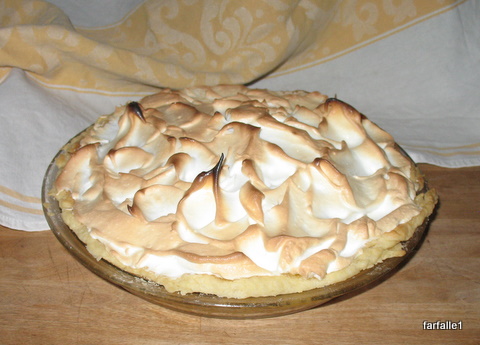
In all honesty the Best Thing We Ate This Week was Louis’s osso buco, served with risotto; I hope to put that recipe up soon.  Meanwhile, we served a lemon meringue pie for dessert to Italian guests, and they seemed to like it (asked for the recipe in fact).  So, though it’s not the Best of the week, it’s one-of-the-better of the week.  If it has any downside it is that it’s very sweet.  But then, that’s what dessert is for, no?

Betty Crocker taught me how to make this pie and I still follow her recipe almost to the letter.  You can find the recipe here.  I like to make my own crusts, but there’s no reason not to buy one if you’re short of time.  It won’t be as good, but it certainly won’t be bad.  Likewise, freshly squeezed lemon juice and freshly grated lemon peel are best, though you can buy bottled juice and dried zest.

By the way, if you haven’t yet made aquaintance with the new breed of microplaners, do so.  They are fantastic tools for grating cheese, zest – whatever you need grated.  We use ours almost daily.  They come in several sizes for different jobs.

My name is Fern, I’ll be your server. Here’s your menu.

02 Monday Mar 2009

Posted by farfalle1 in Food, Uncategorized

≈ 4 Comments

Tags

desert island food

e_shipwreck(photo courtesy of http://www.beady.com/roundtheworld/)

Well, okay, a lot of people did not send in their desert island foods… but the ones that did were imaginative and submitted delicious suggestions. In one case I had to extrapolate the component foods from prepared dishes. Here’s a breakdown:

3 people insisted upon coffee (Illy, please).

Fruit suggestions were prunes, oranges, raspberries and lemons.

2 people opted for chocolate.

Milk got a vote, but cream got two, one for regular and one for ice.

Requested veggies were tomatoes (I know, it’s a fruit, but it seems more vegetably than fruity) and asparagus.

goatFor starches people selected spaghetti, tortillas (2), spicy raman, potatoes and Asian sticky rice.
Meat did not include goat, which is odd when you consider the locale.  However pork, regular and as sausages, and roasting chickens received nods.

Three people requested cheese, all different: monterey jack, saga blue, and cheddar.

One fun-loving soul included popcorn on his list.

(photo courtesy of Kentucky College of Agriculture)

So what’s the conclusion?  No one included foods that would get him voted off the island.  And if we all end up on the same island at the same time we’ll eat really well and have a good time.  Especially since, I am told there is a gin spring and a river of merlot in the landscape…

$26.00

26 Thursday Feb 2009

Posted by farfalle1 in American recipes, Food, Uncategorized

≈ 3 Comments

BOOKS!  Who doesn’t love ’em?  Is there anything better than holding a new (or gently used) book in your hands, flipping through, tasting a paragraph here, devouring an illustration there?  Much as I love bits and bytes, books will always win the race for my heart…

In 1957 the VNSA held their first book sale in Phoenix and raised $900 to benefit the Visiting Nurses (the VN of VNSA). The sale has been held every year since, though since the transfer of Visiting Nurses to a large hospital corporation, the VNSA now stands for Volunteer Nonprofit Service Association.  This year the sale benefited three Valley agencies: Arizona Friends of Foster Children Foundation, Literacy Volunteers of Maricopa County, and Toby House, Inc, an agency that helps adults with severe mental illness.

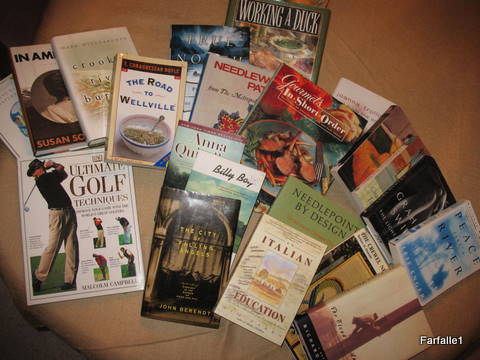
The sale is held in a 50,000 square foot building on the Arizona State Fairgrounds for two days at the beginning of each February (some great pictures of the 2004 event are here).  People line up for entry to the sale hours ahead, some bringing flashlights to read through Friday night in order to be among the first to enter Saturday morning.  Fire regulations dictate how many hundreds may be in the exhibit hall at any one time, so sometimes the wait can be long.  We go on Sunday, when everything is half price and the crowds are somewhat diminished. This year there were over 600,000 items for sale (books, records, cd’s, dvd’s, maps, etc.) and the VNSA expected to raise in excess of $350,000; there was plenty left for us to buy on the second day of the sale.  Here’s what I bought with my $26.00:

books-purchased

Notice that book up at the top, Working a Duck?  What a find.  Written by Melicia Phillips and Sean O. McElroy (Doubleday, 1993, $25.00) it tells you everything you could EVER want to know about preparing and cooking any part of a duck.

The Captain was not thrilled with the Christmas arrival of two more cookbooks.  “Maybe we have enough cookbooks,” was his comment.   Damn, I thought, that leaves only golf for next year.  Oh well.  BUT – he was well pleased with the duck book, because it filled an empty space on the cookbook shelf (right between crabs and eggs).  In fact, can one ever have enough duck recipes?

Ever the culinary adventurer, the Captain dove right in and two nights later served up Fried Noodles with Duck, Ginger, Garlic and Scallions, a recipe with a definite Eastern accent (and I don’t mean Vermont). It takes a bit of preparation, but if you, too, are an adventurer you can find the recipe (slightly changed) here, or over on the right under Recipes.

Just in case the Duck book wasn’t a hit, you’ll notice in the photo above there is also a great big golf book.  One must cover all the bases…

Rustic Bread

12 Thursday Feb 2009

Posted by farfalle1 in American recipes, Food, Uncategorized

≈ 4 Comments

Tags

bread, bread-baking, home-made bread, La Cloche covered baker, no-knead (almost) bread

There are many things we miss about Italy when we are in the States (just as there are things we miss about the States when in Italy).  Aside from missing friends, a lot of our pangs for Italy have to do with food, especially bread.  Good bread is available here, but it is quite expensive.  At home in Italy we routinely visit one of two bakeries for our daily loaf, as well as for assorted pizza treats, and sweeties to accompany tea.

The first bakery we fell in love with in Rapallo is called Paneficio Campo (Via Trieste) and is owned and operated by Nino and Maddallena and their three daughters. They are originally from Calabria, and are true artists with their rustic loaves.  The Captain, who has spent no small amount of time on his bread recipes, has dubbed Nino a Genius.

Our ‘local’ bakery,Panificio Schenone Giorgio on Via Betti, is closer to our house, and makes killer pizzette, which are excellent for a before dinner treat.  They also make very nice ciabatta, the shoe-shaped loaf which originated in Liguria, but which is now common throughout the boot. We don’t know the proprietors, but it is clearly a family operation.

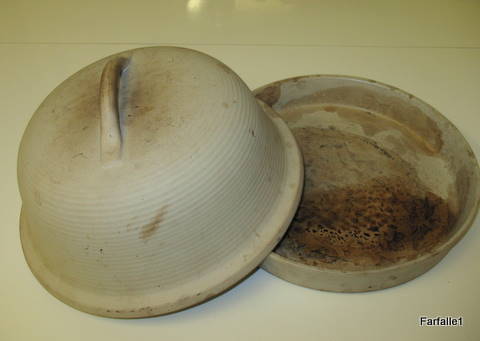
la-cloche-covered-baker1

What to do about bread while in America?  Easy! We make our own.  Last year we discovered the wonderful La Cloche Covered Baker, a domed ceramic baking pot which we bought from King Arthur Flour. (You can see from the photo above it’s received a lot of use).

How’s the bread that’s cooked in La Cloche?  Fantastic!

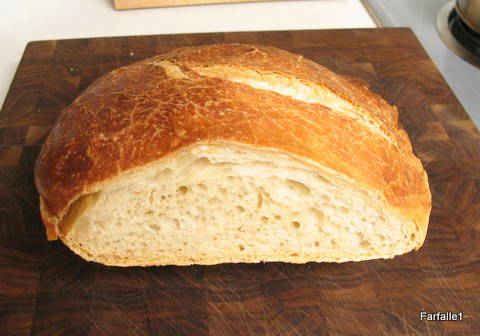
no-knead-almost-bread

The loaf above was made from a very simple bread recipe (with a surprise ingredient) developed and given to us by Sherri Harris, about whom you’ve previously read in these pages.  The recipe is over on the right, called ‘No-Knead Bread (Almost).‘  Also on the right is another recipe which was sent along with the cloche by King Arthur (himself!  really!!): ‘Rustic Hearth Bread.’

Making your own bread is such a pleasure. If one didn’t want the expense of the cloche there is surely something one could substitute: perhaps a heat-proof bowl upside down on a tile-lined baking sheets? The house smells wonderful during and after bread-baking, and nothing tastes better than a warm slab of fresh bread with a lot of butter on top.  Oh yum!

Buon appetito!

Desert Island Food

29 Thursday Jan 2009

Posted by farfalle1 in Food, Uncategorized

≈ 11 Comments

Tags

desert island food, favorite food, silly game

Every now and then the Captain and I play the Desert Island Food game, and I’d like to invite you to play…

You’ve played before, right?  Imagine that you have been marooned on a dessert island (now that’s being an expatriate).  You might be there for a day, a week, or… forever.  You are allowed to take only FOUR foods with you.  What are they?


No fair saying something like ‘vegetables’ – that’s too broad; narrow it down to which vegetable. Your choices can be raw ingredients or some prepared dish (tuna casserole?) (maybe not). You’ll have unlimited water and a fire for cooking. A beverage counts as ‘food.’ Since you’re on an island it’s not inconceivable that you will be able to catch something from time to time, either in the water or on the ground (I’m hoping for a fish or a clam now and then), but you can’t assume that certain foods will always be available. It’s important to consider your health, physical, mental and emotional – you’re likely to be on that island for a long time.

Submit your desert island foods via comments, and in a month I’ll tally them all up and tell you what the most preferred foods are.

Here are mine (for today, anyway) – I bet some of you will be a lot more imaginative and creative, but here goes:

Brie cheese
oranges
spinach
wheat thins

The Best Thing I Ate Last Week

22 Thursday Jan 2009

Posted by farfalle1 in American recipes, Food, Uncategorized

≈ 1 Comment

Tags

eating lobster, how to kill a lobster, lobster

lobster-aftermath

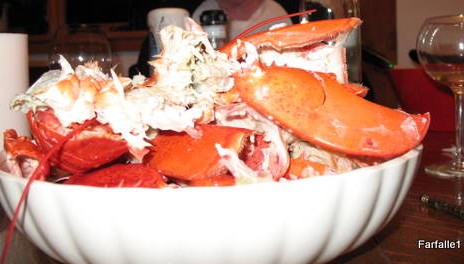
Not much comment required here… the best place in the world to eat the best lobsters in the world is New England, preferably within 100 miles of the coast.  We bought these beauties live, from a tank; each one weighed about 1.5 pounds.

Now the awkward part – how to kill the little dears?  While plunging them headfirst into a large pot of boiling water is the time-honored way, some say that there is a more humane way to do it with a knife, which you can see here, complete with gruesome photos of lobster-cide.  A friend skilled in biology once told me that lobsters have such a basic nervous system there is some doubt about whether they actually feel pain, as we think of it.  Who knows?  Ask a lobster!

The advantage of the quick knife through the brain is, supposedly, instant and relatively painless death.  The benefit of the boiling water method accrues completely to the murderess – one can look the other way and scream while thrusting the beast into the pot.  That way you won’t hear it if it screams.  Surely death by boiling water is also quick?  I have never heard a lobster scream, but then, being a practitioner of the second method, I have a pretty well-developed scream of my own.

However you choose to do in your lobster, serve it with drawn butter and lemon, and put out a big bowl for shells and extra liquid, as well as plenty of napkins. If you’ve never eaten lobster and don’t know how to tackle it, you can find some excellent instruction here.

A note on what you might find within:  if you find some orange stuff you’ve got a female and those are her eggs – considered delicious by many.  The green stuff is the lobster’s liver; while it is yummy, it might not be such a good idea to eat it; the liver is where all the poisons and contaminants of the lobster’s body gather.  The lobster is a bottom-dwelling garbage eater, so what his body considers poison is probably pretty gross.

Is it worth traveling to New England to eat lobster.  Oh yes!  The ‘shedders’ (lobsters who have outgrown their old, hard carapace and are wearing a new one that is still soft) have less meat in relation to the shell size, but the shell is much softer, and some consider the meat sweeter.  Typically a lobster sheds in the summer, so if you want a crusty old fella bursting with meat, eat lobster  in the winter or spring.  Having said that, my two companions had hard-shell lobsters and mine was soft-shelled; you really just never know.

Buon Appetito!

Crispy Tortillas with Pork and Beans

07 Wednesday Jan 2009

Posted by farfalle1 in American recipes, Food, Uncategorized

≈ 2 Comments

Tags

Arizonican food, crispy tortillas, fried tortillas, tortillas

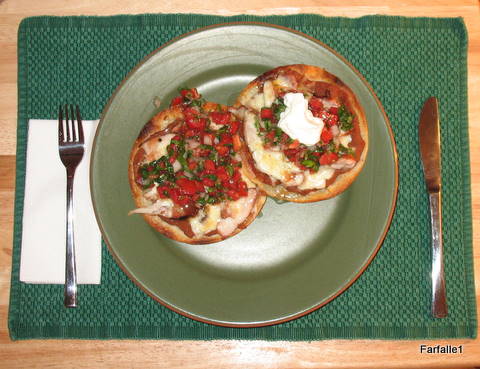
img_77191

While he was working on these tasty goodies I asked the Captain if he would call this Tex-Mex food.  He thought for a while and opined that no, these are Arizonican – so here you have it: the first entry in a whole new food category.

Its best to fry up the tortillas yourself, though you can buy them already crisped. After the frying you will put the toppings on and broil.  Garnish with salsa cruda and, if you like it, sour cream.  I’m of the school that believes there is little in the world that is not improved with the addition of sour cream, but there are those who don’t agree, strange as it may seem. The recipe for what you see above can be found here, or by clicking under recipes over on the right. The recipe for the salsa is here, and also on the right.

There are two great things about this dish: 1) It’s really fun to make and 2) It’s infinitely adaptable to what you have around and what you like to eat. It is only coincidental that these look like pizzas, it does not mean that we are pining for our adopted country.  Well, maybe a little…

← Older posts
Newer posts →

Enter your email address to follow this blog and receive notifications of new posts by email.

Join 114 other subscribers

rss

Subscribe in a reader

Search the Blog

A. Useful Links

  • bab.la language dictionary
  • Bus schedules for Tigullio
  • Conversions
  • English-Italian, Italian-English Dictionary
  • Expats Moving and Relocation Guide
  • Ferry Schedule Rapallo, Santa Margherita, Portofino, San Frutuoso
  • Italian Verbs Conjugated
  • Piazza Cavour
  • Rapallo's Home Page – With Link to the Month's Events
  • Slow Travel
  • The Informer – The Online Guide to Living in Italy
  • Transportation Planner for Liguria
  • Trenitalia – trains! Still the most fun way to travel.

C. Elaborations

  • A Policeman’s View
  • Driving School Diary
  • IVA refunds due for past Rifiuti tax payements
  • Nana
  • Old trains and old weekends
  • The peasant, the Virgin, the spring and the ikon
  • Will Someone Please, Please Take Me to Scotland?

D. Good Recipes - Best of the Week winners are starred

  • 'Mbriulata
  • *Baked Barley and Mushroom Casserole*
  • *Captain’s Boston Baked Beans*
  • *Crimson Pie*
  • *Louise’s Birthday Cake*
  • *Melanzane alla Parmigiana*
  • *Penne with Cabbage and Cream
  • *Pizzoccheri della Valtellina*
  • *Pumpkin Ice Cream*
  • *Risotto alla Bolognese*
  • *Rolled Stuffed Pork Roast*
  • *Spezzatini di Vitello*
  • *Stuffed Grape Leaves*
  • *Stuffed Peaches (Pesche Ripiene)*
  • *Swordfish with Salsa Cruda*
  • *Tagliarini with Porcini Mushrooms*
  • *Tagliatelli al Frutti di Mare*
  • *Three P's Pasta*
  • *Tzatziki*
  • 10th Tee Oatmeal Apricot Bars
  • Adriana’s Fruit Torta
  • Aspic
  • Bagna-calda
  • Best Brownies in the World
  • Clafoutis
  • Cold cucumber soup
  • Crispy Tortillas with Pork and Beans
  • Easy spring or summer pasta
  • Fish in the Ligurian Style
  • Hilary's Spicy Rain Forest Chop
  • Insalata Caprese
  • Lasagna al forno
  • Lasagna al Forno con Sugo Rosato e Formaggi
  • Lemon Meringue Pie
  • Leo’s Bagna Cauda
  • Leo’s Mother’s Stuffed Eggs
  • Louis’s apricot chutney
  • Mom's Sicilian Bruschetta
  • No-Knead (almost) Bread
  • Nonna Salamone's Christmas Cookies
  • Pan Fried Noodles with Duck, Ginger, Garlic and Scallions
  • Pesto, the classic and original method
  • Pesto, the modern, less authentic method
  • Pickle Relish
  • Poached pears
  • Poached Pears
  • Polenta Cuncia
  • Recipes from Paradise by Fred Plotkin
  • Rustic Hearth Bread
  • Shrimp and Crayfish Tail Soup
  • Sicilian salad
  • Slow Food Liguria
  • Slow Food Piemonte and Val d'Aosta
  • Spinach with Garlic, Pine Nuts and Raisins
  • Stuffed Eggs, Piemontese Style
  • The Captain’s Salsa Cruda
  • Tomato Aspic
  • Zucchini Raita

E. Blogroll

  • 2 Baci in a Pinon Tree
  • Aglio, Olio & Peperoncino
  • An American in Rome
  • Bella Baita View
  • Debra & Liz's Bagni di Lucca Blog
  • Expat Blog
  • Food Lovers Odyssey
  • Italian Food Forever
  • L’Orto Orgolioso
  • La Avventura – La Mia Vita Sarda
  • La Cucina
  • La Tavola Marche
  • Rubber Slippers in Italy
  • Southern Fried French
  • Status Viatoris
  • Tour del Gelato
  • Weeds and Wisdom

Photographs

  • A Day on the Phoenix Light Rail Metro
  • Apache Trail in the Snow
  • Aquileia and Croatia
  • Birds on the Golf Course
  • Bridge Art
  • Canadair Fire Fighters
  • Cats of Italy
  • Cloudy day walk from Nozarego to Portofino
  • Fiera del Bestiame e Agricultura
  • Football Finds a Home in San Maurizio
  • Hiking Dogs
  • Mercatino dei Sapori – Food Fair!
  • Moto Models
  • Olive pressing
  • Rapallo Gardens
  • Rapallo's Festa Patronale
  • Ricaldone and the Rinaldi Winery
  • Rice Fields
  • Sardegna ~ Arbatax and Tortoli
  • Sardegna ~ San Pietro above Baunei
  • Sardegna ~ The Festa in Baunei
  • Scotland, including Isle of Skye
  • Slow Food 2008 Salone del Gusto
  • The Cat Show and the Light Rail Fair
  • The desert in bloom
  • Trip to Bavaria

Pages

  • Fagioli all’ucelleto

Archives

Recent Posts

  • A Superior Visit
  • Fun at the Ranch Market
  • The MAC
  • Welcome Tai Chi
  • Bingo Fun for Ferals
December 2025
M T W T F S S
1234567
891011121314
15161718192021
22232425262728
293031  
« Jul    

Member of The Internet Defense League

Blog at WordPress.com.

  • Subscribe Subscribed
    • An Ex-Expatriate
    • Join 114 other subscribers
    • Already have a WordPress.com account? Log in now.
    • An Ex-Expatriate
    • Subscribe Subscribed
    • Sign up
    • Log in
    • Report this content
    • View site in Reader
    • Manage subscriptions
    • Collapse this bar
 

Loading Comments...