• Contact
  • Elaborations
    • A Policeman’s View
    • Driving School Diary
    • Great Danes
    • IVA charged on Tassa Rifiuti
    • Nana
    • Old trains and Old weekends
    • The peasant, the virgin, the spring and the ikon
    • Will Someone Please, Please Take Me to Scotland??
  • Recipes
    • ‘Mbriulata
    • *Baked Barley and Mushroom Casserole*
    • *Captain’s Boston Baked Beans*
    • *Cherry Tart*
    • *Crimson Pie*
    • *Louise’s Birthday Cake*
    • *Melanzane alla Parmigiana* – Eggplant Parmesan
    • *Penne with Cabbage and Cream
    • *Pizzoccheri della Valtellina*
    • *Pumpkin Ice Cream*
    • *Risotto alla Bolognese*
    • *Rolled Stuffed Pork Roast* on the rotisserie
    • *Shrimp and Crayfish Tail Soup*
    • *Spezzatino di Vitello*
    • *Stuffed Grape Leaves*
    • *Swordfish with Salsa Cruda*
    • *Tagliarini with Porcini Mushrooms*
    • *Tagliatelli al Frutti di Mare*
    • *Tzatziki*
    • 10th Tee Apricot Bars
    • Adriana’s Fruit Torta
    • Artichoke Parmigiano Dip
    • Best Brownies in the World
    • Clafoutis
    • Cod the Way Sniven Likes It
    • Cold Cucumber Soup
    • Crispy Tortillas with Pork and Beans
    • Easy spring or summer pasta
    • Fagioli all’ucelleto
    • Fish in the Ligurian Style
    • Hilary’s Spicy Rain Forest Chop
    • Insalata Caprese
    • Kumquat and Cherry Upside Down Cake
    • Lasagna Al Forno con Sugo Rosato e Formaggi
    • Lemon Meringue Pie
    • Leo’s Bagna Cauda
    • Leo’s Mother’s Stuffed Eggs
    • Louis’s Apricot Chutney
    • Mom’s Sicilian Bruschetta
    • No-Knead Bread (almost)
    • Nonna Salamone’s Famous Christmas Cookies
    • Pan-fried Noodles, with Duck, Ginger, Garlic and Scallions
    • Pesto
    • Pesto
    • Pickle Relish
    • Poached Pears
    • Polenta Cuncia
    • Pumpkin Sformato with Fonduta and Frisee
    • Rustic Hearth Bread
    • Sicilian Salad
    • Soused Hog’s Face
    • Spotted Dick
    • Swedish Tea Wreaths
    • The Captain’s Salsa Cruda
    • Tomato Aspic
    • Vongerichten’s Spice-Rubbed Chicken with Kumquat-Lemongrass Dressing
    • Winter Squash or Pumpkin Gratin
    • Zucchini Raita

An Ex-Expatriate

~ and what she saw

An Ex-Expatriate

Category Archives: gardening

Small Tragedy on a Lemon Branch

24 Saturday Aug 2013

Posted by farfalle1 in Animals in Italy, gardening

≈ 9 Comments

Tags

Fungi, Fungus on bees, Fungus on insect

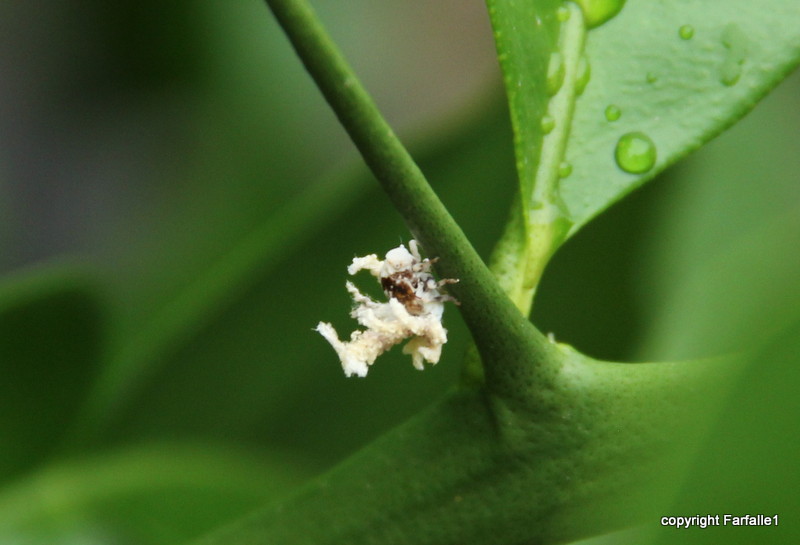
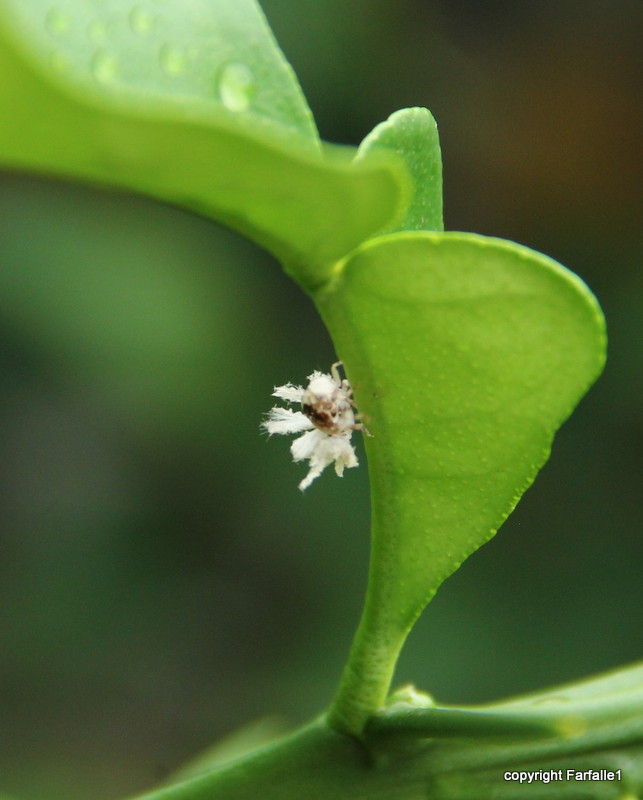
There were a pair of exotic insects creeping along the stems of the lemon tree last week – or so I thought. On closer inspection it proved to be something sadder:

fluffy bug-005

fluffy bug

I’m pretty sure these are bugs that have been infected with a cruel yet beautiful fungus, which one I do not know. There seem to be a lot of fungi that infect various animals and insects; in fact there’s research being done in the use of fungi to control unwanted pests.

It was sad to see these two little critters, though. Such an infection doesn’t end well for the host, as you might imagine. And while it’s hard to tell exactly who is under the disease, I suspect  they are small bees – and we need all the bees we have.

First It Was the Apricots, Now It’s the Plums

08 Sunday Jul 2012

Posted by farfalle1 in gardening, Gardening in Italy, Italian food, Italian gardens, San Maurizio di Monti

≈ 9 Comments

Tags

Plum jam, Plums, yellow plum

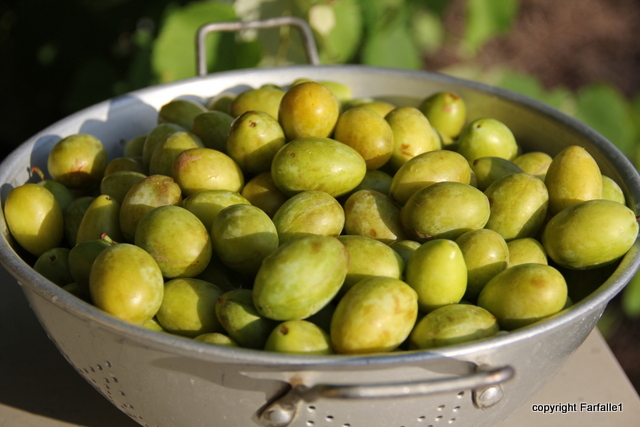
The property we live on came with a bunch of olive trees and some (to us) mystery trees that turned out to be plums of the teeny variety. I’ve had a very hard time figuring out just what type of plums these are (other than very small) – maybe one of you can help?

BEFORE!

BEFORE!

I never gave much thought to plums other than the fact that they came in blue/purple and yellow/green. It turns out there are a great many varieties, from small to large, from early ripening to late. And like so many things in the botanical world, they have wonderful common names: Dennistons’ Superb Plum (it’s ‘reliable’); wouldn’t it be great to be superb and reliable at the same time?  There is the usual smattering of place-name names, mostly British: Warwickshire, Shropshire. My favorite, I guess, is the Blue Tit Plum (‘popular’ (I bet!) and ‘reliable’).*

But losing oneself in the world of plummy nomenclature doesn’t get one any closer to identifying one’s own plums. I never did sort out what we have, other than that they are some sort of very small, early, yellow plum.

AFTER!

In the end it doesn’t matter what they’re called. It’s enough for us to know they make delicious jam.

*Names of plums harvested here.

Mystery Solved…

24 Monday Oct 2011

Posted by farfalle1 in American recipes, Food, gardening, Uncategorized

≈ 8 Comments

Tags

Good food for cold weather, Pumpkin gratin, pumpkin sformata, Squash gratin, Squash sformata


No, not the heinous murder on Via Enrico Toti, about which I told you last week.  That is still under investigation; our friend on the State Police force here in Rapallo has told us they have enlisted the aid of the Vigili del Fuoco, the Guardia Forestale and  the Polizia Provinciale to solve the crime.  No doubt the Guardia di Finanza will be called in at some point too.

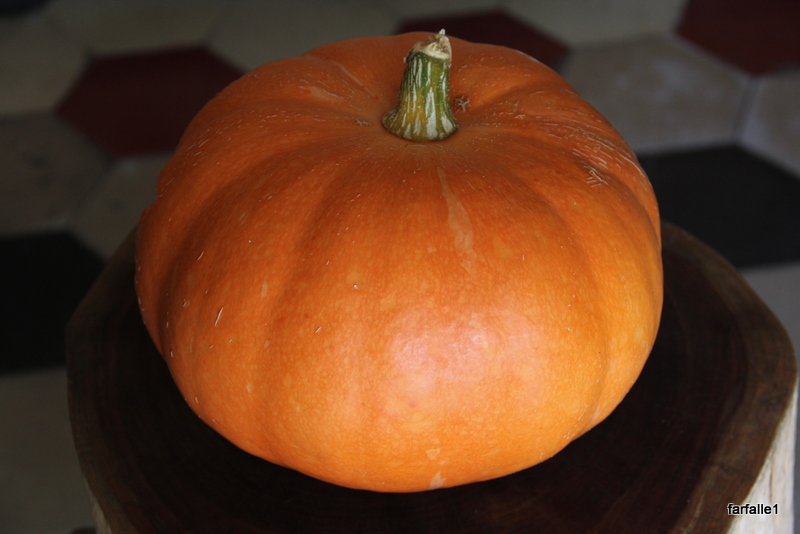
The mystery that is solved, almost to my satisfaction, is the one I told you about on August 18, having to do with a strange vegetable that arrived uninvited both in the compost pile and under a climbing rose.  And am I embarrassed!  You’d think after umpety-bumpteen years of gardening I would recognize a pumpkin when I saw one, but I didn’t recognize these as pumpkins, not at all. And while I’m calling it a pumpkin, I’m still not 100% convinced it is a true pumpkin.

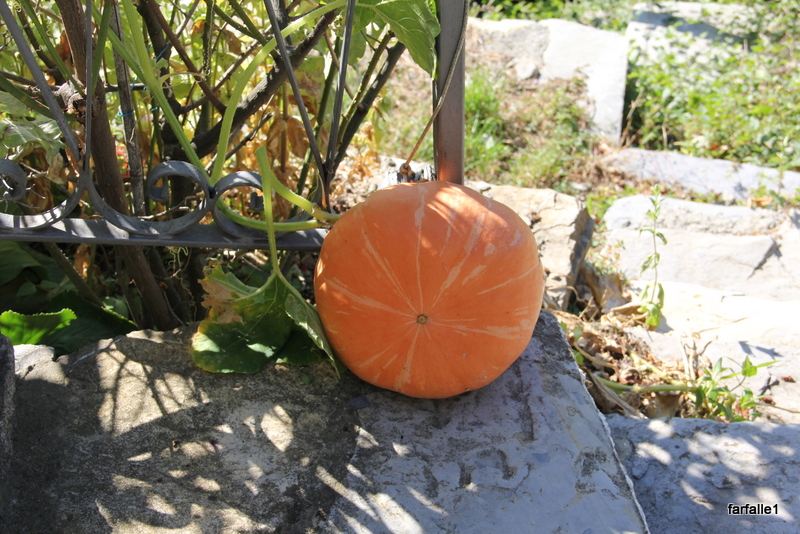
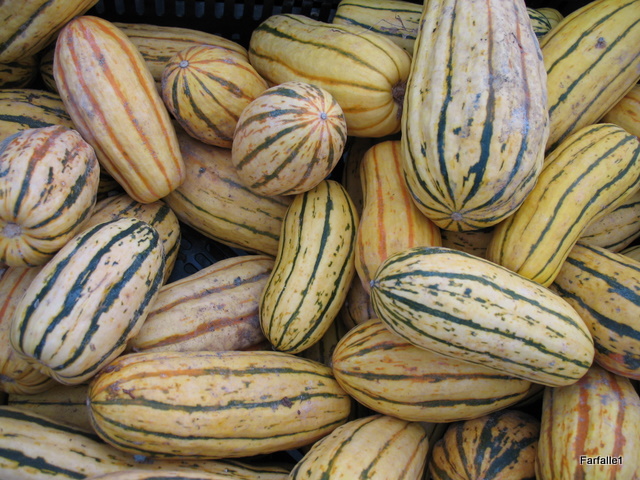
As the strange yellow squash-like orbs of August matured they began to take on a more pumpkiny look – orange skin, though not as orange as a good old New England pumpkin gets.  I find the light stripes highly suspicious:

I never grew a pumpkin before that had this sort of stripes.  It’s almost as if a decorative gourd eloped with a smallish pumpkin and had a couple of dubious, if beautiful, offspring.

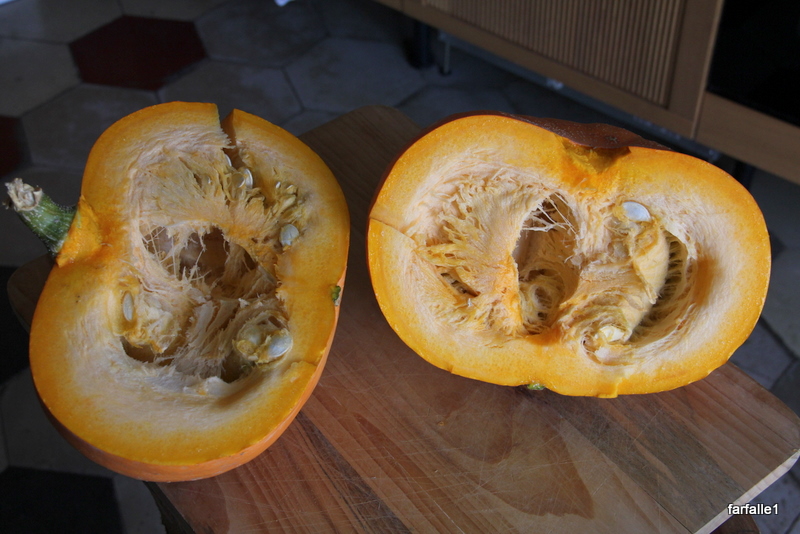
The pumpkins (I’ll call them that for the sake of ease) each weighed about seven pounds.  Inside the one we opened were more seeds than anything else, which is a pumpkiny trait.  But there was not as much non-fibrous flesh as I associate with true pumpkins.

So what did we do with this gorgeous thing?  One night I made a baked squash (pumpkin)  gratin, which used about half of one pumpkin (recipe of Deborah Madison here).  After peeling and cutting it into cubes and boiling briefly I whizzed up the other half in the food processor, and a few nights later made a fabulous sformata of squash (pumpkin), courtesy of Mario Batali (recipe here).

We had company for both these dishes, and they were really well received.  So if you have a squash kicking around, or a pumpkin, or something in between, try one of these autumn/winter dishes – you won’t be disappointed.

That’s one mystery solved.  Now back to Via Toti…

What the…. ??

18 Thursday Aug 2011

Posted by farfalle1 in gardening, Gardening in Italy, Italian gardens

≈ 8 Comments

Tags

hybrid pumpkin, Hybrid squash, mystery plant

Hot as it is outside these days (35 C, or +/- 95F) there is definitely an end-of-season feel in the air.  The birds that were noisily nesting for so long  have abandoned the eaves, the cicadas drone on, but with a new weariness in their thrum.  The sun is setting much earlier, and the shops are full of back-to-school gear.

We’ve been picking and eating tomatoes for a month, and those in the garden which have already set fruit continue to ripen, in spite of the nasty disease that is killing some of their leaves.  No new fruit is forming. The same plight has visited all our viney plants as well – cukes, pumpkins, squash and melons (we have just a few plants of each so each loss is felt all the more).  First the leaves close to the main stem shrivel, then the stem desiccates and the leaves farther along wither and die.  Once the stem dies, the fruit at the end of it stops developing and dies as well.  I don’t know what this malady is, but I notice that we are not the only ones afflicted – all the gardens up and down the mountain are looking pretty sad.

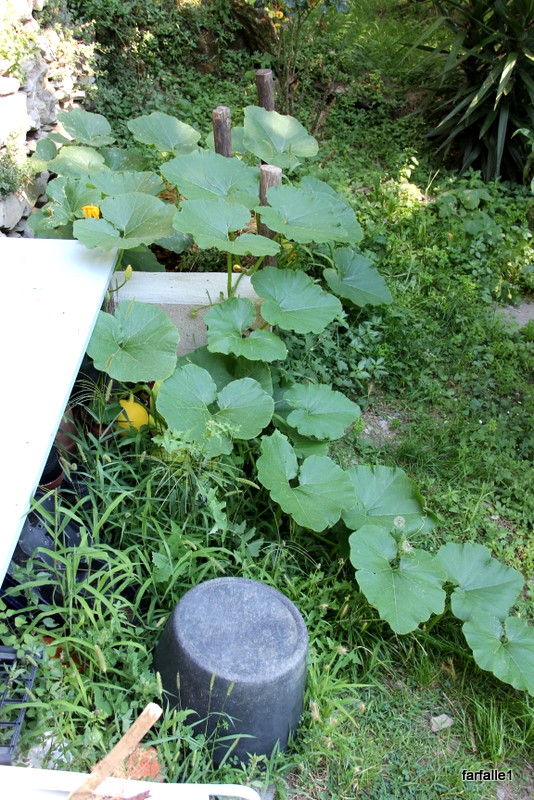
We have had one huge success, though.  The only problem is we have no idea what it is.  A squashy something emerged from the compost pile a while back, and as you can see in the photo above, it is rampaging all around our former orto (abandoned because of lack of sun).  It sure looks healthy, doesn’t it?  No withering leaves here; the worst you can say is there are a few spots of the usual fungus, but even that disease hasn’t been able to get any traction.

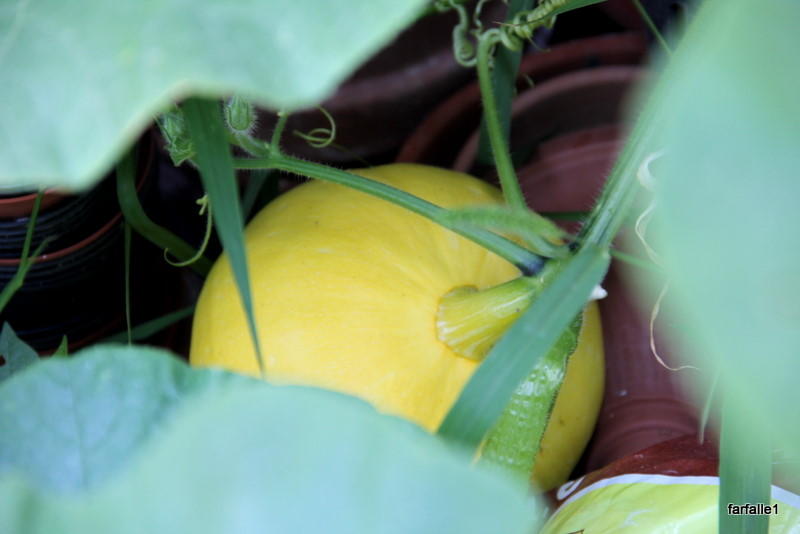
Now it is forming gigantic fruits:

They have the size and shape of rapidly growing pumpkins, but the color of summer squash, which we’ve never grown.  I can only guess that this plant is some kind of hybrid born of the alchemy of a compost pile.  And like so many mutts, this item seems stronger and healthier than all the hot-house sissies that are dying apace in our other gardens.  Bah.  The only problem is, we don’t know if we should carve it or eat it.  Maybe both?  In the meantime, we want to wait and see just how big it will grow, and try to come up with a good name for it – squashkin?  pumpkish? Any ideas?

My New Passion

27 Wednesday Jul 2011

Posted by farfalle1 in Flowers, Food, gardening, Italian flowers, Uncategorized

≈ 17 Comments

Tags

Passion Fruit, Passion Fruit Flowers

No, the Captain still has my heart.  But just recently the fruit of the Passion Fruit made my taste buds sit up and say Howdy.  How did I live this long without eating this delectable item?


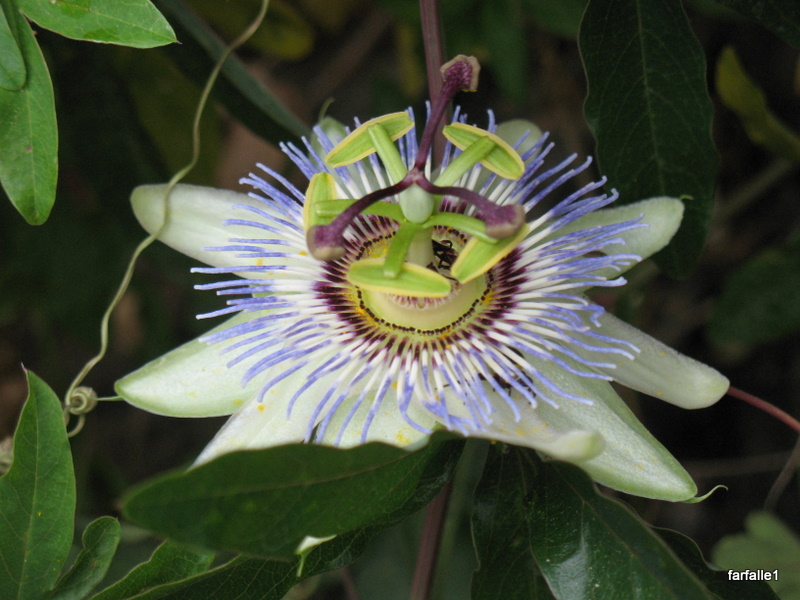
Angela and I were exploring some of the back regions of Chiavari when we came upon the vine pictured above.  From a distance I thought it was a strange looking kumquat with particularly large fruit; but when we got closer and saw the flowers that were also on the vine I knew right away what it was, even though I’d never seen the fruit before.


There’s no confusing this flower with any other in the world!  It looks like a cross between a spaceship and a freshman beanie; why ever did it evolve in such a peculiar manner?  No doubt there are good reasons for all its elements, but if there ever were a committee-designed flower, this is it.  I can even imagine the committee.

Goddess 1, chair of the committee:  We need a new flower.
Goddess 2: Let’s keep it simple, just some nice creamy petals.
Goddess 1:  A good plan.
Goddess 3:  I’m from Hawaii, I’d like to give it a hint of grass skirt.
Goddess 1:  Well okay, we’ll put that on top of the petals.  A’ole pilikia!
Goddess 4: I’m completely crazy, I want to add some green whirly-gigs with yellow pads. Have I told you about the time aliens abducted me??  They told me to add the whirly-gigs so they can communicate with me.
Goddess 1, in an aside: Girls, she is totally nuts, we’d better humor her.  Aloud: of course we’ll add whirly-gigs.  Live long and prosper.
Goddess 1, again:  Uh oh. We’ve left out the most important part!  We’ve left off the anther.  How are we going to get bees without anthers?  We’ve got to have anthers.  We’ll put them on top of everything, that way our flower’s sure to be pollinated.

Well that’s one way it could’ve happened I suppose, though I’m not sure Mr. Darwin would approve.

I first met the flowers of the Passion Fruit about ten years ago, rampaging along the fence of the house we were renting at the time.  A gardening friend later told me, “Don’t plant that.”  Evidently it is one of the thugs of the plant world, cheerfully twining around, strangling and generally taking over anything in its path.  And for some reason I haven’t seen or thought of it from that day to the day Angela and I encountered the very healthy vine in Chiavari.

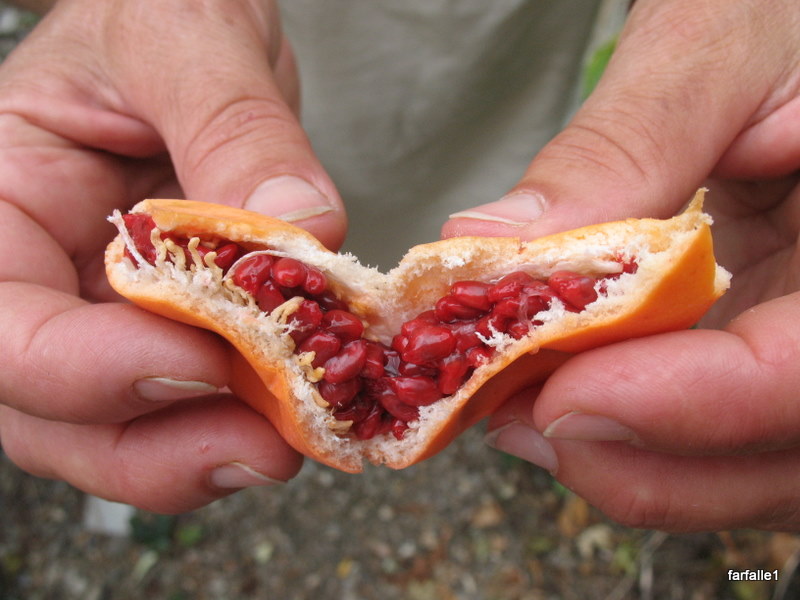
Had I eaten the fruit ten years ago I surely would have found a spot in our garden for this treasure to run amok.  What a treat! Sweet, succulent, juicy… why have I never seen it for sale in the markets?

Yes, it’s seedy – it’s pretty much nothing but seeds inside (guess those anthers really do the job well), but the seeds are a pleasure to eat.  They’re not particularly hard or crunchy or unpleasant, the way pomegranate seeds are.  They’re just delicious; it’s the only way I can think to describe them.

Passion Fruit is native to Brazil, where it grows in a purple-skinned variety.  There seems to be some question about where the orange/yellow variety originated.  It’s a much-used fruit in Australia, New Zealand and Hawaii, among other places, and is a good source of vitamins A and C, and, if you eat the seeds, an excellent source of dietary fiber.

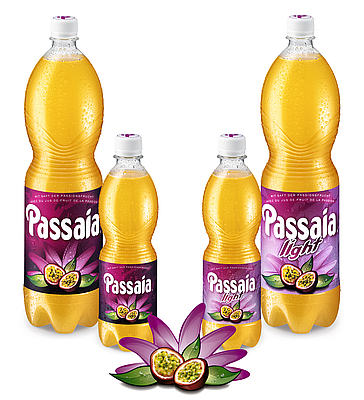
Image courtesy of Passaia

The juice is frequently extracted and used to flavor other juices and sauces.  If you’ve drunk a soft-drink called Passaia in Switzerland, you’ve drunk Passion Fruit juice.  Unfortunately the flavor of the juice degrades with heating, though it keeps well in a frozen form.

About its thuggish character?  All too true!  It can grow fifteen to twenty feet in one year; though it is a short lived perennial (only five to seven years), it can cover quite a bit of territory in that time.  (Let’s see, 17 X 7 = 119 feet, that is a lot… maybe that’s why I don’t see much of it in Italian terrace gardens.)  You can learn more about Passion Fruit varieties, propagation and cultivation here if you’re inclined to try growing some yourself.  Me?  I think I’ll just go back to the vine in Chiavari when I get a hankering for that yummy taste – there was no shortage of fruit on those vines.

Who Knew: Basil

16 Saturday Jul 2011

Posted by farfalle1 in gardening, Italian recipes, Liguria, Uncategorized

≈ 10 Comments

Tags

Basil, Growing Basil, Pesto


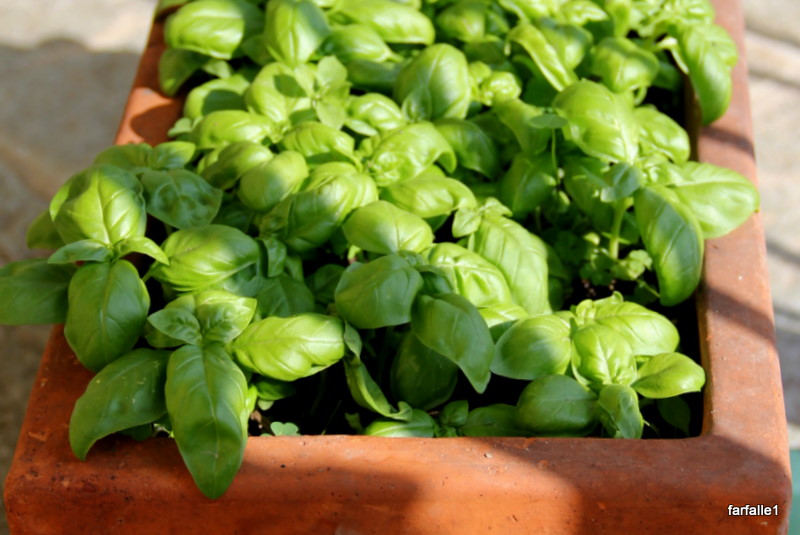
I always thought that basil wanted to grow in full, hot sun, and certainly we’ve always had good luck growing it that way.  But two unimpeachable sources (gnarled old Italian gardeners) have told us in the last week that full, hot sun is only for growing basil for minestra, the vegetable soup many still eat for supper here.  If you want to  make pesto with your basil, you must grow it in partial sun; it will be more tender and better suited to pesto (recipe here).  Who knew?

The Balmy Riviera…

11 Thursday Nov 2010

Posted by farfalle1 in gardening, olives, Weather

≈ 12 Comments

Tags

Hail

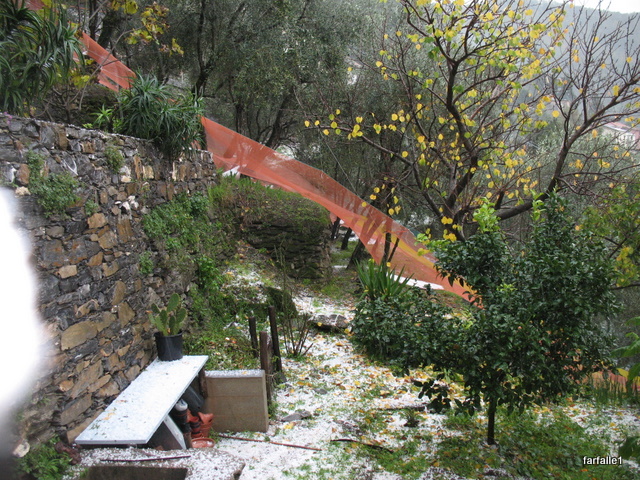
Yesterday and today’s main topic of conversation: the hail storm of yesterday morning.

Fortunately the ‘grandine’ weren’t large enough to do serious damage, but we lost our entire pomegranate crop – both fruits. A grave disappointment. As well a struggling patch of late season lettuce was flattened.

It’s olive picking time again, and our neighbors have put up their nets. As you can see from the photo above, though, so far they have collected only hail, and plenty of it. Though it arrived yesterday morning, it is still in the nets this evening.

I was able to do our olive ‘harvest’ in about two hours today; this is the second year post-pruning that we have not had a crop. However, if you’re interested in reading about and seeing photos of our 2008 harvest, click here and here…  We didn’t have a hail storm that year.

Old Dogs, New Gardening Tricks

19 Saturday Jun 2010

Posted by farfalle1 in gardening, Italian habits and customs, Italy, Liguria, Rapallo, Uncategorized

≈ 6 Comments

Tags

Fascie gardening, Gardening in Narrow Strips

When in Rome, do as the Romans – how many zillions of times have we heard that expression?  Enough to be thoroughly sick of it, for sure.  Wouldn’t you think that after all the repetition the meaning of that irritating nostrum would’ve sunk in?  Well, in terms of the garden, this year it finally did for us… after a mere eight years.

We’ve served our time trying to pry vegetables from the rocky New England soil, and were more or less successful, depending upon how early in the season our enthusiasm flagged.  But New England has nothing on Italy when it comes to rocky soil.  Here it might be more appropriate to call it soily rocks, at least in our mountainous zone.  Doesn’t matter.  Make a cutting of something, anything, drop it in the ground here and it will probably grow very happily.

Which reminds me of a funny digression.  We lived for years in the Icebox of Connecticut, not far from the much larger Torrington, a manufacturing town with a large Italian population.  One day my husband brought a client from Torrington over to see our garden.  This gent, a gnarly, deeply tanned gardening pro took one look at our efforts and said, “You’ve got too many stones in your garden.”  “Well, how should we get them out,” my husband asked.  “That’s easy,” the old fellow replied.  “Every evening send your wife out and tell her to take all the stones out of one row.  Soon enough she will have done the whole garden. Then she can start over.”  I took a dim view of this plan, and it was never put into effect.

Anyway, it was not difficult to adjust to the soil conditions here, and we blithely chose our largest fascia (terrace) for our vegetable garden, and for eight years planted much as we were accustomed to in New England: in rows like this
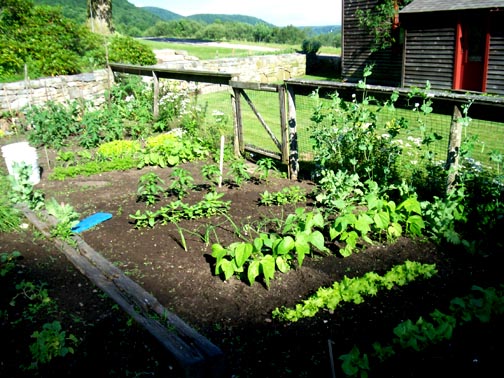
(This is a photo Hatsy Taylor took of her veggie garden in East Canaan, Conn, which she has kindly allowed me to use.)

The problem was that our largest fascia is too shady. (We have six fascie, measuring anywhere from 3′ – 20′ in width; most are about 9′.)  For starters there is a large palm tree that takes a lot of the morning light.  Then we planted an orange tree right in the middle of the space because it is pretty there – more shade.  The house blocks the sun from mid-afternoon on, so all in all our poor veggie garden got about 3 hours of sun a day.  Nonetheless we were able to grow enough tomatoes to make all the sauce we need for a year, as well as a pumpkin or two, some cukes, beans,  lots of herbs, some roses and flowers for cutting.  We were never successful with zucchini, oddly – probably due to the amount of shade.
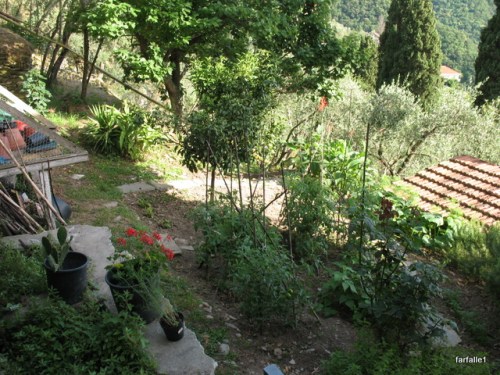
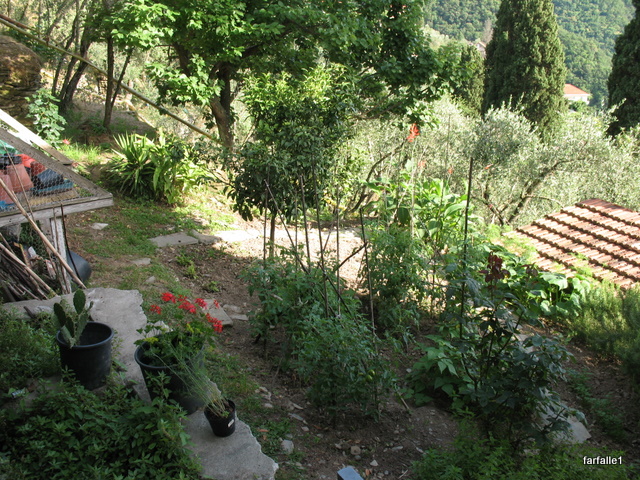
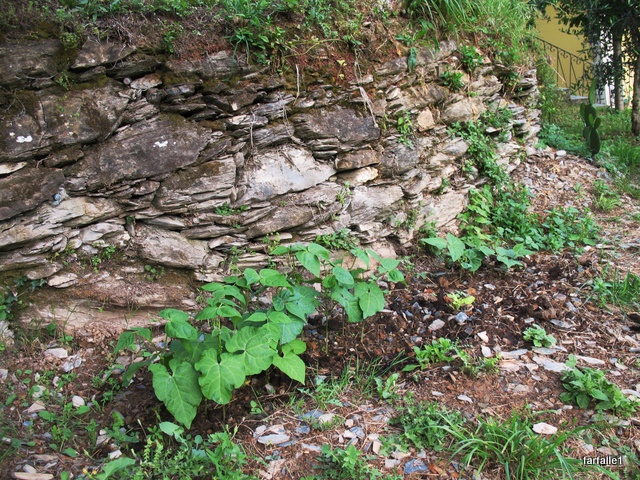
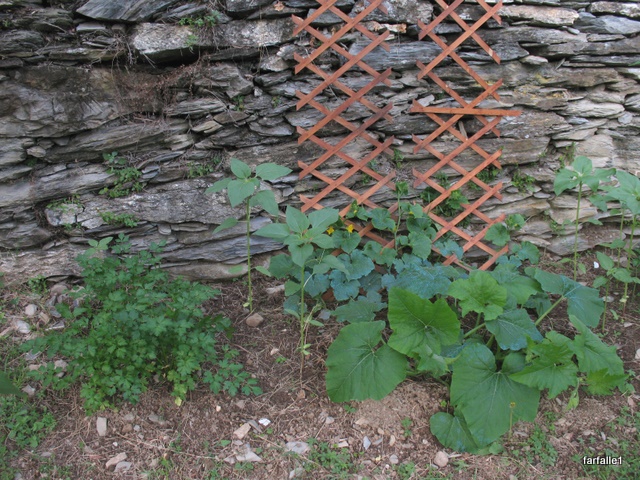
Our neighbors here on the steep slopes of Montallegro use their limited fascia space so intelligently.  They plant narrow strip gardens facing the sun, just in front of the stone wall that supports the fascia above, sometimes even under their olive trees, which make only dappled shade.  It makes so much sense!  The wall behind offers support and holds and reflects the sun’s warmth.  Weeding is ever so much easier (should one actually decide to do it) because every ‘garden’ is one, or at most two, rows deep.

This spring the Captain took a pickax to the land in front of our sunny walls, and we now have four new strip gardens.  On the top level we have two plots of tomatoes.
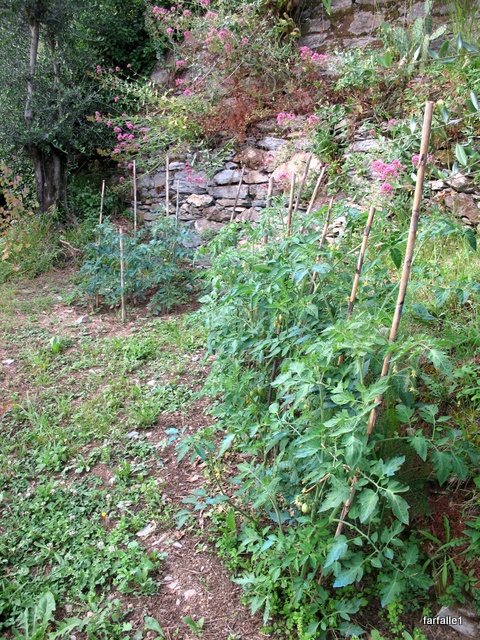
They are growing like crazy  – partly because of all the rain we’ve been getting, but also because they love the warm soil in front of the wall.

The next level down is not so satisfactory.  The ground was stonier than normal, so it was hard to make a good bean bed.  The ones that came up (both bush and pole) are doing fine, but probably only 30% germinated, in spite of a healthy dose of bagged manure. (moo pooh?)
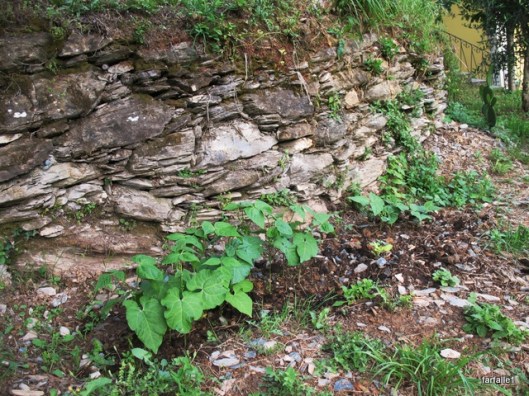
The next level down is my favorite because it is so mixed.  In one spot are three leftover tomato plants.  Then there is a small strip with cucumbers climbing the trellis that used to keep Luciano from wandering off our terrace, with some bushy pumpkins in front.  Parsley flanks these climbers, with some giant sunflowers thrown in just for fun.
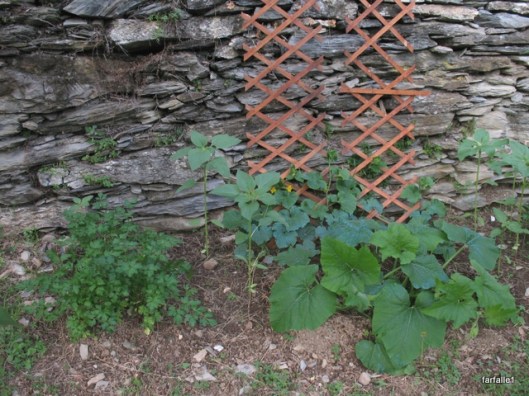
None of it looks like much now, but it’s all growing by leaps and bounds.  Already  teeny tomatoes and cucumbers have formed, and every day each plant looks about 6″ taller.

So, what’s happening with the old garden?  The Captain planted a lot of ground-cover, but the seeds all washed away in the two weeks of rain that followed; we’ll replant, probably in the fall.  He also has constructed an elegant new compost area, and has almost finished a new potting table.  It will be a cool and shady area in which to relax on all those hot summer days we’re waiting for.  Thyme, marjoram, mint, sage and rosemary are still happily ensconced there.  Dill, cilantro and basil like it hot, hot, hot, so they are growing in pots on the terrace.

By the way, there’s another family that’s doing some interesting gardening this summer, but I see that with their luxury of flat space they are using the more traditional layout:
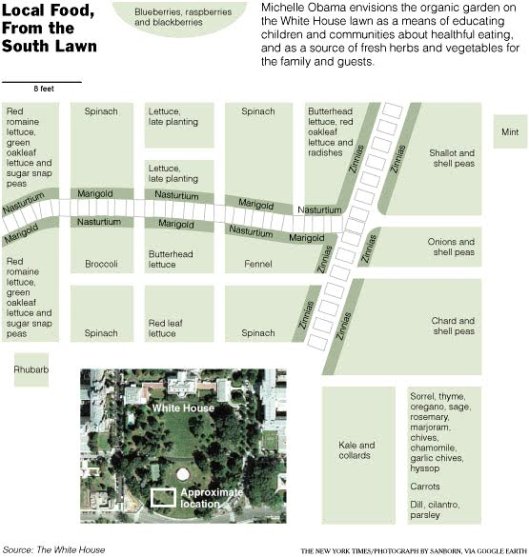
I’m guessing Michelle and Barack have a bit more help with their garden than we do with ours.  Yes, our new garden strips are working really well, but yes, it’s a lot more work to get water to four places instead of just one.  But you know what they say… when in Rome…

CSA

08 Tuesday Dec 2009

Posted by farfalle1 in Food, gardening, Uncategorized

≈ 6 Comments

Tags

Brandon CSA, Community Supported Agriculture, Community Sustainable Agriculture, CSA, Woods Farm, Woods Market

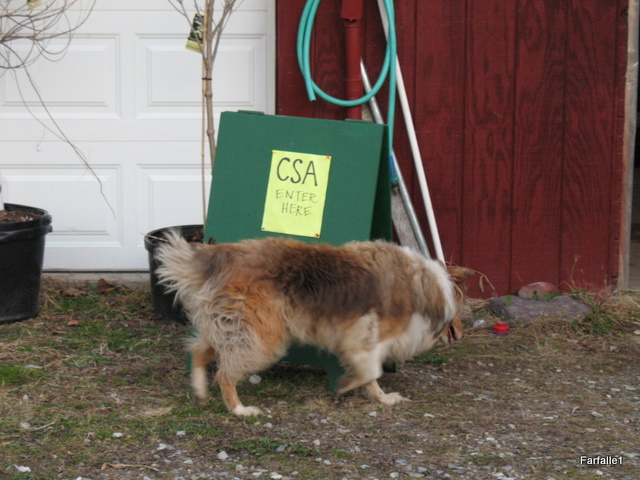
Community Supported Agriculture.  Community Sustainable Agriculture.  Take your pick or make up something else.  Whatever you call it, it is big in the U.S.  My sister in Tennessee and my dear friend in Vermont have both joined their local CSA’s. Even in Arizona, where one thinks more of desert or agri-business than vegetable farms, there are a number of CSA’s.

Here’s how it works.  At the beginning of the growing season community members pay a fee to a local farmer.  The farmer can use the money that’s been paid up front to buy seeds, fertilizer, whatever he needs, without having to take out a bank loan.

Whatever the farmer harvests, or some portion of it, is then divided by the number of members who joined, and they, the members, can come once (or sometimes twice) a week and pick up their share of produce.  In the case of my friend in Vermont the fee to join was $200 which entitled her to 10 weeks of harvest pick-ups..

Obviously these are fall crops.  My friend’s CSA was organized for autumn vegetables; the people who own the farm also offered a summer CSA for use at their farm stand. Members could buy summer vegetables and everything else the stand sells (meats, cheeses, plants, honey, eggs) during the four summer months at a 10% discount.

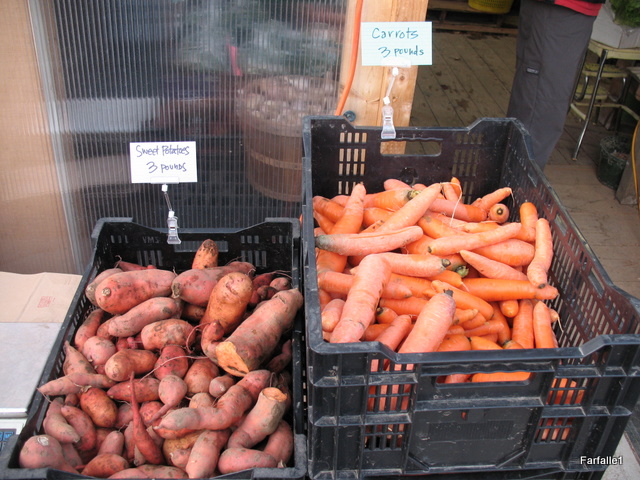
There are probably as many organizational charts and methods of distribution as there are CSA’s.  Mrs. H, here in Arizona, belonged to a CSA for one year; when she went for pick-ups the produce had already been divied up and put in boxes.  She was given a box, over whose contents she had no real say.  My sister in Tennessee went to her pick-up and could tell the farmer what she wanted of the available offerings.  The farmer picked out individual pieces – better, but still not perfect.  The Vermont system seemed best to me; the farmer put a sign above each box of produce announcing the weight of each share.  For instance, each share-holder was entitled to 3 pounds of carrots in the photo above.  She could also take less, or decide not to have carrots at all that week.

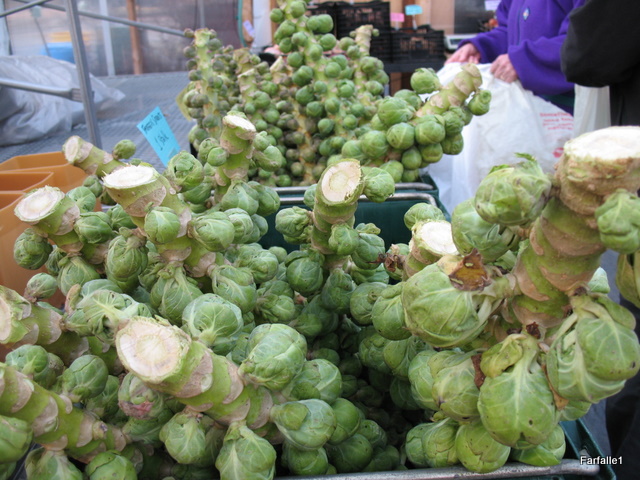
There was a large amount of autumn produce on hand the week that I went with my friend; she staggered out with two full bags of locally grown organic vegetables, including onions, carrots, potatoes, sweet potatoes, kale, brussels sprouts and more.

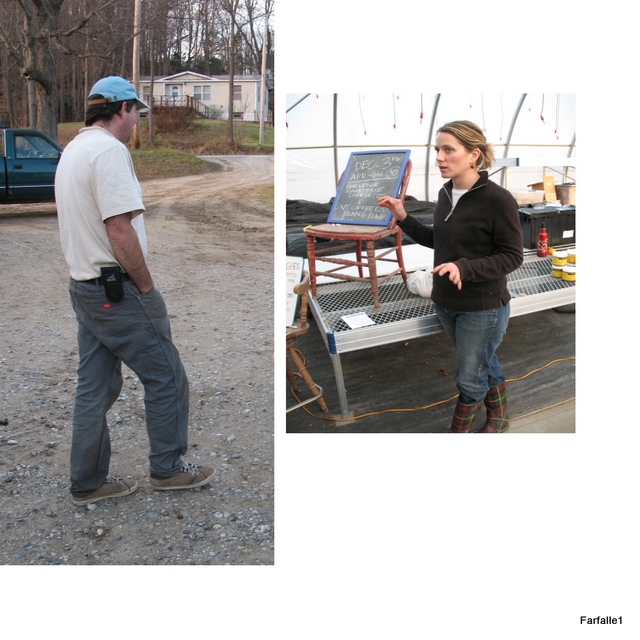
I was able to speak to the owners/farmers of my Vermont friend’s CSA, Jon and Courtney of Woods Farm in Brandon.

Jon moved to Vermont from Massachusetts in 2000 to farm the fertile river valley; Courtney came for a job on the farm and ta-da, partners in the fields and partners for life.  They have 25 of their own acres of light, productive soil.  In addition they lease 35 acres, 15 of which they put in alfalfa and 5 of which they put into sunflowers (a less than successful operation this year because of excessive rain). This was the first year they offered the summer CSA program at their farm stand – it was more successful than the sunflower crop; they had more subscribers than their goal.

CSA’s appeal to people who are interested in knowing where their food comes from.  There’s been a huge growth of the ‘localvore’ culture in the US, and CSA’s both feed and profit from this movement.  I haven’t seen anything like this in Italy, although there is such a strong tradition of local markets be begin with, there may be no need for such a thing.  But for Americans, who are accustomed to buying veggies that have been trucked in from hundreds, or even thousands, of miles away, the CSA’s offer a winning formula for everyone.

Expatriate on the Isle of Skye – part 1, Forres and Inverness

01 Thursday Oct 2009

Posted by farfalle1 in gardening, Travel, Uncategorized

≈ 4 Comments

Tags

Findhorn Community, Forres Scotland, Inverness, Scotland

Scotland with Pidge 233

I’ll try to keep this as short as possible, but when you have visited a place so different from your usual haunts, and so utterly atmospheric and magical, it is hard to be terse.

The background:  My sister spent two weeks on the Isle of Iona, after which I joined her for one-week stay, mostly on the Isle of Skye.  While she was on Iona one of her friends remarked, “Scotland… it’s all about the light.”  I agree, but would add it’s also all about hospitality as an art form.  We had generally good weather, which in Scotland means it isn’t raining.  Of all our days we had only one where it rained on and off all day; the rest of the time was a delightful mix of sun and clouds – which is what makes the light so delicious.

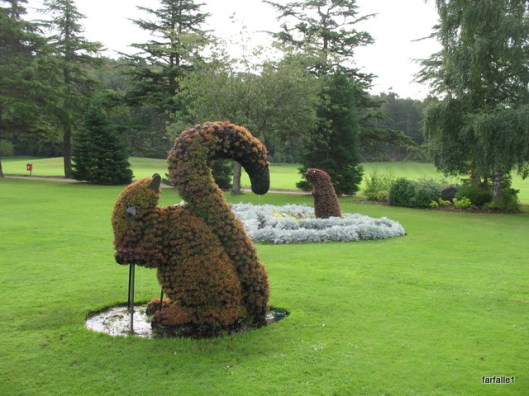
We met up on a Tuesday in Edinborough (not the original plan – for an elaboration of a travel nightmare, click here) and drove immediately to Forres, a little north and east of Inverness, where we found the very comfortable Cluny House B & B.  In true Scottish fashion, when I called to tell owner Susan that we wouldn’t be there the night before (see elaboration…) she was more concerned about our discomfort than about losing one or possibly two nights of rental income.  The village of Forres itself was delightful, featuring an amusing public garden full of ‘topiary’ – which proved to be iron frames in which plants were growing, rather like enormous chia pets.

forres gardens topiary

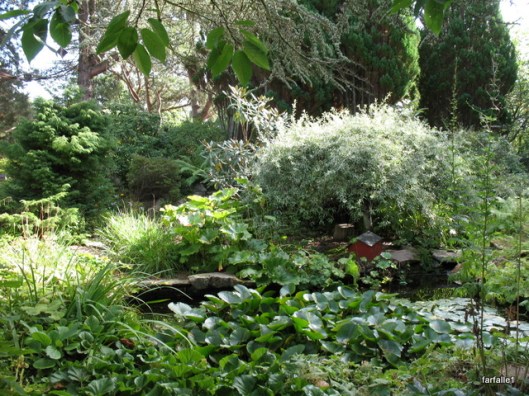
Our main purpose in going to Forres was to position ourselves for a visit to Findhorn, the ecovillage and commune founded in 1962 by Peter and Eileen Caddy in a trailer park.  We had wanted to see the gardens which were, over a period of years, created under rather inimical conditions, and perhaps to get a spiritual taste of the place.  What we found was very much an institution, complete with property management and fund-raising offices prominently placed.  Of gardens we saw only one, though it was quite pretty.

findhorn water garden

Most of the land around the many houses seemed unkempt and there was lots of junk lying around.  The cottage gardens of Findhorn village were much more interesting and far better maintained.  It had the feel of a place that was started for all the right reasons, but, once institutionalized had become somehow less.  We were surprised when Susan told us that the community there does not do much outreach or give programs for area children.  When we visited it made sense.  I’m sure the programs they offer are excellent, and we were there for just half of one day – during which we felt we’d seen all there was to see – no doubt one has to immerse oneself in the community itself to get full benefit.

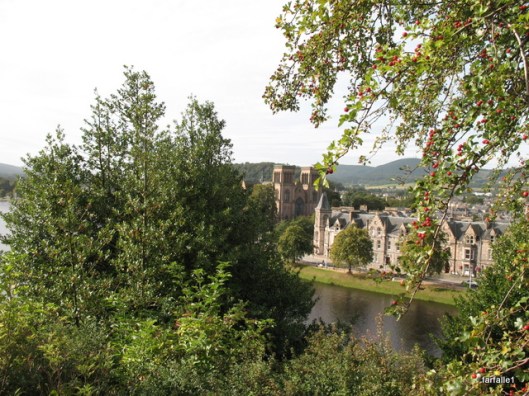
Our next port of call was Inverness, a small bustling city, where we stayed at the Bannerman B&B, another comfortable house where the owner fed us a huge and hugely satisfying breakfast.  Chocolate Lab Hugo was extremely welcoming.  The river Ness, on both sides of which lies the city, is interrupted by three islands that have been turned into a large and inviting forest park.  The city has a 19th century castle on a hill which gives an impressive view of the rest of the city, including the spire-less  cathedral.

inverness view from castle

But our true destination was the Isle of Skye, and that’s where we went next.  I’ll tell you all about that in the next post…

Meanwhile, for a slide show of photos of the whole trip, click here.

← Older posts

Enter your email address to follow this blog and receive notifications of new posts by email.

Join 114 other subscribers

rss

Subscribe in a reader

Search the Blog

A. Useful Links

  • bab.la language dictionary
  • Bus schedules for Tigullio
  • Conversions
  • English-Italian, Italian-English Dictionary
  • Expats Moving and Relocation Guide
  • Ferry Schedule Rapallo, Santa Margherita, Portofino, San Frutuoso
  • Italian Verbs Conjugated
  • Piazza Cavour
  • Rapallo's Home Page – With Link to the Month's Events
  • Slow Travel
  • The Informer – The Online Guide to Living in Italy
  • Transportation Planner for Liguria
  • Trenitalia – trains! Still the most fun way to travel.

C. Elaborations

  • A Policeman’s View
  • Driving School Diary
  • IVA refunds due for past Rifiuti tax payements
  • Nana
  • Old trains and old weekends
  • The peasant, the Virgin, the spring and the ikon
  • Will Someone Please, Please Take Me to Scotland?

D. Good Recipes - Best of the Week winners are starred

  • 'Mbriulata
  • *Baked Barley and Mushroom Casserole*
  • *Captain’s Boston Baked Beans*
  • *Crimson Pie*
  • *Louise’s Birthday Cake*
  • *Melanzane alla Parmigiana*
  • *Penne with Cabbage and Cream
  • *Pizzoccheri della Valtellina*
  • *Pumpkin Ice Cream*
  • *Risotto alla Bolognese*
  • *Rolled Stuffed Pork Roast*
  • *Spezzatini di Vitello*
  • *Stuffed Grape Leaves*
  • *Stuffed Peaches (Pesche Ripiene)*
  • *Swordfish with Salsa Cruda*
  • *Tagliarini with Porcini Mushrooms*
  • *Tagliatelli al Frutti di Mare*
  • *Three P's Pasta*
  • *Tzatziki*
  • 10th Tee Oatmeal Apricot Bars
  • Adriana’s Fruit Torta
  • Aspic
  • Bagna-calda
  • Best Brownies in the World
  • Clafoutis
  • Cold cucumber soup
  • Crispy Tortillas with Pork and Beans
  • Easy spring or summer pasta
  • Fish in the Ligurian Style
  • Hilary's Spicy Rain Forest Chop
  • Insalata Caprese
  • Lasagna al forno
  • Lasagna al Forno con Sugo Rosato e Formaggi
  • Lemon Meringue Pie
  • Leo’s Bagna Cauda
  • Leo’s Mother’s Stuffed Eggs
  • Louis’s apricot chutney
  • Mom's Sicilian Bruschetta
  • No-Knead (almost) Bread
  • Nonna Salamone's Christmas Cookies
  • Pan Fried Noodles with Duck, Ginger, Garlic and Scallions
  • Pesto, the classic and original method
  • Pesto, the modern, less authentic method
  • Pickle Relish
  • Poached pears
  • Poached Pears
  • Polenta Cuncia
  • Recipes from Paradise by Fred Plotkin
  • Rustic Hearth Bread
  • Shrimp and Crayfish Tail Soup
  • Sicilian salad
  • Slow Food Liguria
  • Slow Food Piemonte and Val d'Aosta
  • Spinach with Garlic, Pine Nuts and Raisins
  • Stuffed Eggs, Piemontese Style
  • The Captain’s Salsa Cruda
  • Tomato Aspic
  • Zucchini Raita

E. Blogroll

  • 2 Baci in a Pinon Tree
  • Aglio, Olio & Peperoncino
  • An American in Rome
  • Bella Baita View
  • Debra & Liz's Bagni di Lucca Blog
  • Expat Blog
  • Food Lovers Odyssey
  • Italian Food Forever
  • L’Orto Orgolioso
  • La Avventura – La Mia Vita Sarda
  • La Cucina
  • La Tavola Marche
  • Rubber Slippers in Italy
  • Southern Fried French
  • Status Viatoris
  • Tour del Gelato
  • Weeds and Wisdom

Photographs

  • A Day on the Phoenix Light Rail Metro
  • Apache Trail in the Snow
  • Aquileia and Croatia
  • Birds on the Golf Course
  • Bridge Art
  • Canadair Fire Fighters
  • Cats of Italy
  • Cloudy day walk from Nozarego to Portofino
  • Fiera del Bestiame e Agricultura
  • Football Finds a Home in San Maurizio
  • Hiking Dogs
  • Mercatino dei Sapori – Food Fair!
  • Moto Models
  • Olive pressing
  • Rapallo Gardens
  • Rapallo's Festa Patronale
  • Ricaldone and the Rinaldi Winery
  • Rice Fields
  • Sardegna ~ Arbatax and Tortoli
  • Sardegna ~ San Pietro above Baunei
  • Sardegna ~ The Festa in Baunei
  • Scotland, including Isle of Skye
  • Slow Food 2008 Salone del Gusto
  • The Cat Show and the Light Rail Fair
  • The desert in bloom
  • Trip to Bavaria

Pages

  • Fagioli all’ucelleto

Archives

Recent Posts

  • A Superior Visit
  • Fun at the Ranch Market
  • The MAC
  • Welcome Tai Chi
  • Bingo Fun for Ferals
December 2025
M T W T F S S
1234567
891011121314
15161718192021
22232425262728
293031  
« Jul    

Member of The Internet Defense League

Blog at WordPress.com.

  • Subscribe Subscribed
    • An Ex-Expatriate
    • Join 114 other subscribers
    • Already have a WordPress.com account? Log in now.
    • An Ex-Expatriate
    • Subscribe Subscribed
    • Sign up
    • Log in
    • Report this content
    • View site in Reader
    • Manage subscriptions
    • Collapse this bar
 

Loading Comments...