• Contact
  • Elaborations
    • A Policeman’s View
    • Driving School Diary
    • Great Danes
    • IVA charged on Tassa Rifiuti
    • Nana
    • Old trains and Old weekends
    • The peasant, the virgin, the spring and the ikon
    • Will Someone Please, Please Take Me to Scotland??
  • Recipes
    • ‘Mbriulata
    • *Baked Barley and Mushroom Casserole*
    • *Captain’s Boston Baked Beans*
    • *Cherry Tart*
    • *Crimson Pie*
    • *Louise’s Birthday Cake*
    • *Melanzane alla Parmigiana* – Eggplant Parmesan
    • *Penne with Cabbage and Cream
    • *Pizzoccheri della Valtellina*
    • *Pumpkin Ice Cream*
    • *Risotto alla Bolognese*
    • *Rolled Stuffed Pork Roast* on the rotisserie
    • *Shrimp and Crayfish Tail Soup*
    • *Spezzatino di Vitello*
    • *Stuffed Grape Leaves*
    • *Swordfish with Salsa Cruda*
    • *Tagliarini with Porcini Mushrooms*
    • *Tagliatelli al Frutti di Mare*
    • *Tzatziki*
    • 10th Tee Apricot Bars
    • Adriana’s Fruit Torta
    • Artichoke Parmigiano Dip
    • Best Brownies in the World
    • Clafoutis
    • Cod the Way Sniven Likes It
    • Cold Cucumber Soup
    • Crispy Tortillas with Pork and Beans
    • Easy spring or summer pasta
    • Fagioli all’ucelleto
    • Fish in the Ligurian Style
    • Hilary’s Spicy Rain Forest Chop
    • Insalata Caprese
    • Kumquat and Cherry Upside Down Cake
    • Lasagna Al Forno con Sugo Rosato e Formaggi
    • Lemon Meringue Pie
    • Leo’s Bagna Cauda
    • Leo’s Mother’s Stuffed Eggs
    • Louis’s Apricot Chutney
    • Mom’s Sicilian Bruschetta
    • No-Knead Bread (almost)
    • Nonna Salamone’s Famous Christmas Cookies
    • Pan-fried Noodles, with Duck, Ginger, Garlic and Scallions
    • Pesto
    • Pesto
    • Pickle Relish
    • Poached Pears
    • Polenta Cuncia
    • Pumpkin Sformato with Fonduta and Frisee
    • Rustic Hearth Bread
    • Sicilian Salad
    • Soused Hog’s Face
    • Spotted Dick
    • Swedish Tea Wreaths
    • The Captain’s Salsa Cruda
    • Tomato Aspic
    • Vongerichten’s Spice-Rubbed Chicken with Kumquat-Lemongrass Dressing
    • Winter Squash or Pumpkin Gratin
    • Zucchini Raita

An Ex-Expatriate

~ and what she saw

An Ex-Expatriate

Category Archives: Health and health care

Not Enough of Most Things, Too Much of Some

12 Wednesday Feb 2014

Posted by farfalle1 in Arizona, Eating out in Arizona, Health and health care, Uncategorized

≈ 12 Comments

Tags

Feeding America, Feeding the Hungry, Food Bank, Food Banks, Hungry Children, United Food Bank

Food Bank. What pops into your head when you hear those words? For me it’s an image of a small room, probably part of a church or social agency, shelves lining the walls laden with boxes and tins of food, some dusty, some out-of-date. In my imagination it’s open a few days a month, and a stream of hungry people trudge in and out, arriving empty-handed and leaving with a brown paper bag of food. Other more fortunate people have bought extra when they did their own marketing and dropped it off, or a local group had a food drive and donated the gleanings to the Food Bank, or someone cleaned out her cupboards and got rid of unwanted items.

Well no, Expatriate. That’s not quite how it is. You may remember reading about the great fun we have picking fruit for the food bank on winter Fridays. It was the subject of a post here at just about this time last year. This year a group of us pickers had the great good fortune to be given a tour of the United Food Bank (for whom we pick), an operation that is almost the exact opposite of my imagined picture.

Here we are outside the United Food Bank warehouse. Yes, you read that correctly, warehouse.
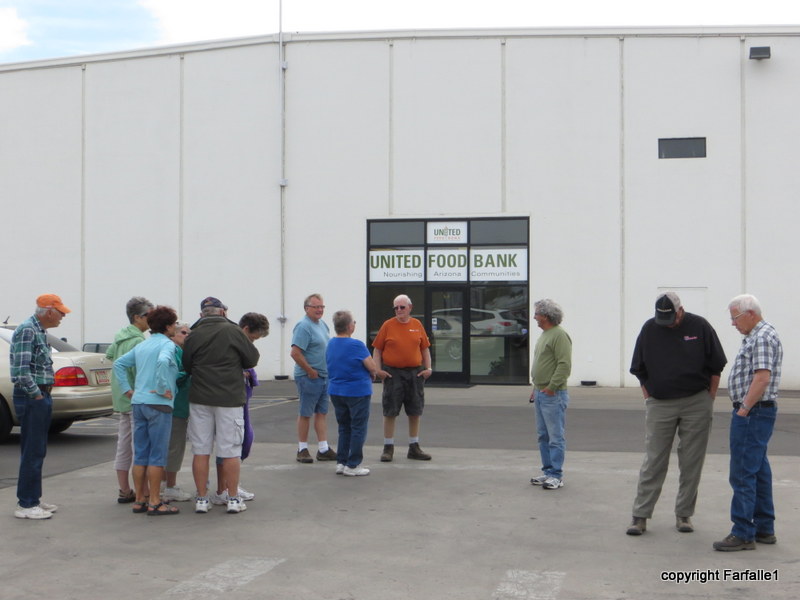
United Food Bank Tour

The United Food Bank serves almost one-quarter of the state of Arizona:
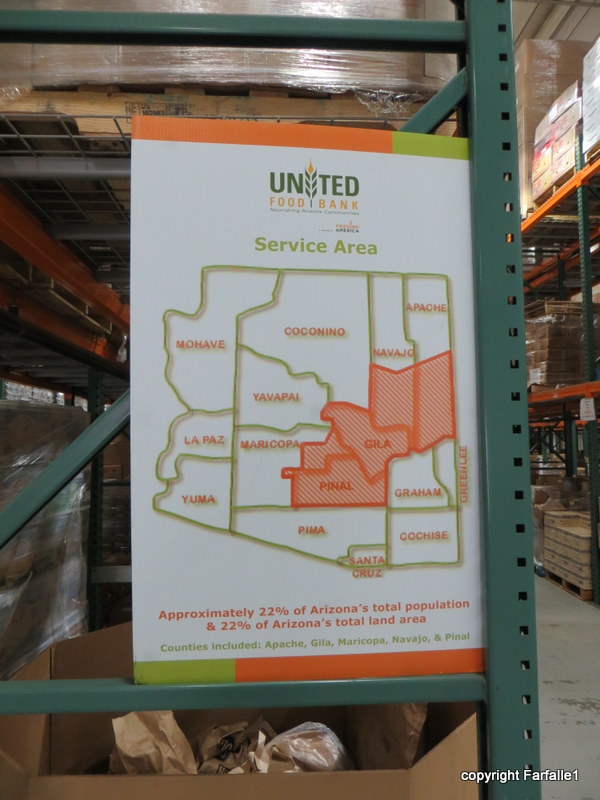
United Food Bank Tour service area

It was organized in 1983 as a joint venture among East Valley cities and their respective United Ways to gather and distribute food to organizations; today they serve upwards of 200 food banks in the region. They do not distribute food to individuals from this warehouse, but instead organize and ship it to those who do.

Here is Melissa, one of only about twenty-four paid employees who handle this large business. She is explaining to us why our fruit-picking operation is in jeopardy (I’ll tell you later).
United Food Bank Tour melissa explains Some of the astonishing facts she told us are:

1. 1 in 5 Arizona residents lives in poverty, 1 in every 4 children under the age of 18 lives in poverty (Arizona is tied as the worst state in the union when when it comes to child hunger, and the 5th worst for overall food insecurity rates).

2. 1 in 4 children, 1 in 5 adults, and 1 in 7 seniors in Arizona struggle with hunger.

3. More than 888,000 individual Arizonans receive emergency food assistance every year.

4. United Food Bank distributes over 51,100 meals every single day of the year through its affiliated food banks.

5. That works out to almost 1.5 million pounds of food every month, which are some 500,000 pounds fewer than the need.

6. The greatest influx of assistance to the Food Bank comes in November and December. The greatest need occurs in the summer, when the children do not receive a daily meal at school.

Speaking of school, the Food Bank has a terrific program called the Backpack Program. It was developed when the FB discovered that many children had nothing to eat between school meals on Friday and Monday. Each backpack is filled with nutritional food that is child-friendly, non-perishable, and easily prepared. The schools identify the children at greatest risk of weekend hunger, and invite them to take home a full backpack on Friday and return it empty when they come back to school on Monday.

United Food Bank Tour backpack program

Where does the food come from, I hear you ask. A variety of sources. Some is donated by food companies and stores:
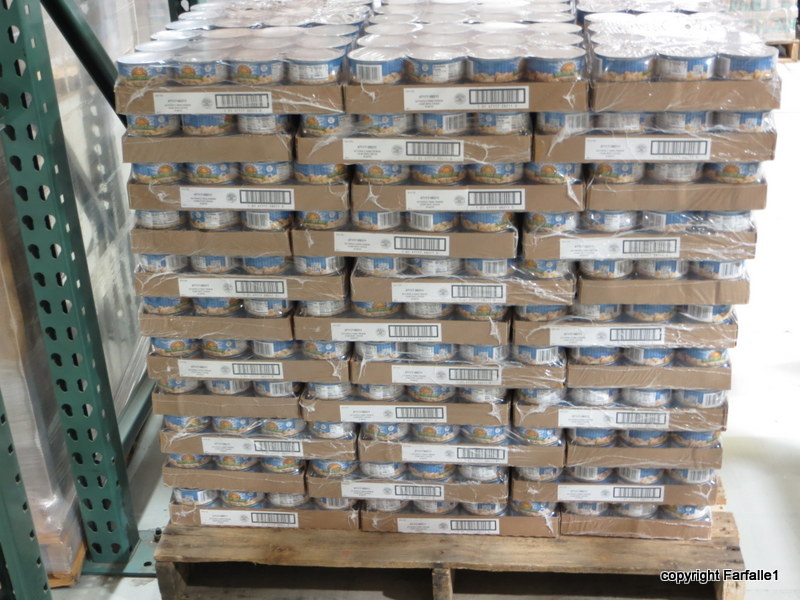
United Food Bank Tour palette of food-001

Some comes from food drives run by Scouts, Churches and so forth:
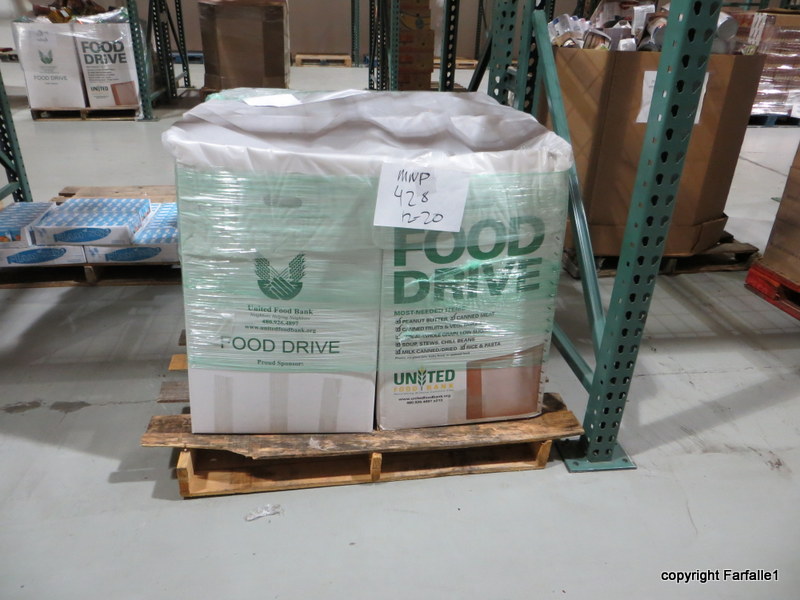
food drive box

And a lot is flat-out purchased by the Food Bank. United Food Bank is a member of Feeding America, a national organization. Using the leverage of large purchasing, Feeding America and its affiliates are able to buy large quantities of food from producers at greatly reduced prices.  In fact, this poster illustrates a startling fact:
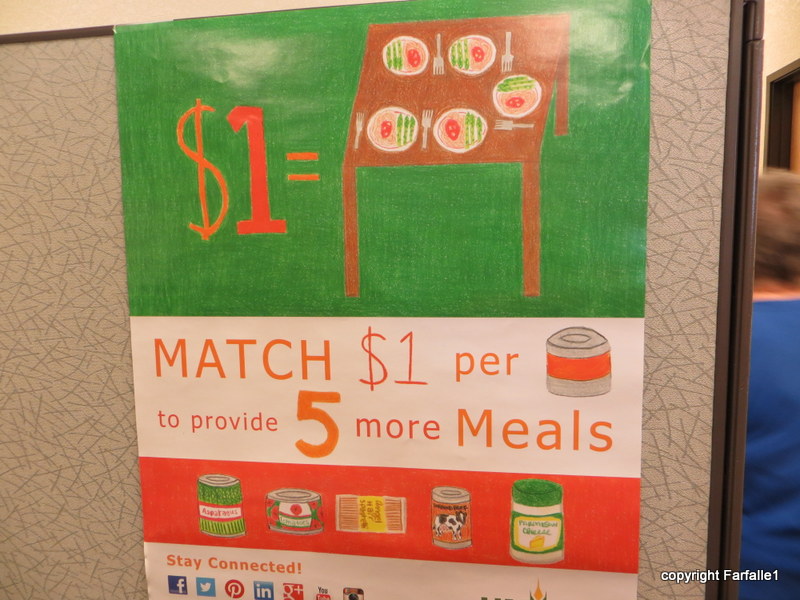
United Food Bank Tour what $1 will do

That’s right! The Food Banks are able to cobble together 5 meals from a $1 donation. Amazing, especially when you consider that you and I pay .79 for just a liter of water at the supermarket.

You might be wondering how a mere 20 or so employees can move such a vast quantity of food over such a large area. The anwer: volunteers.  Here are two, who scampered off before I could get their names:
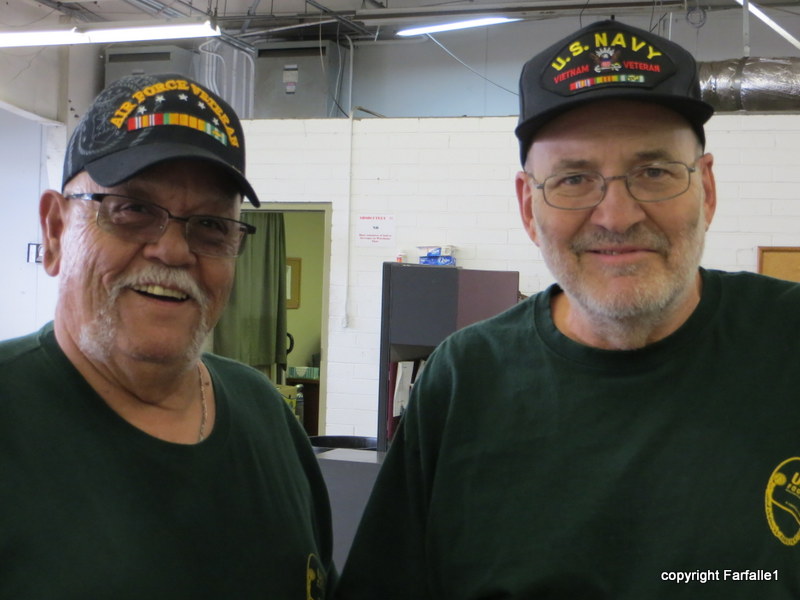
United Food Bank Tour volunteers

Other volunteers come courtesy of Sheriff Joe Arpaio and his infamous Tent City (not all reviews of Tent City are as negative as the one I’ve linked to). We saw several inmates in their signature pink skivvies and striped suits, but I was asked not to photograph them (I really wanted to). Last year volunteers provided over 51,000 hours of work, equivalent of another 25 full-time employees.

When the food comes in it is stored in either the regular warehouse:
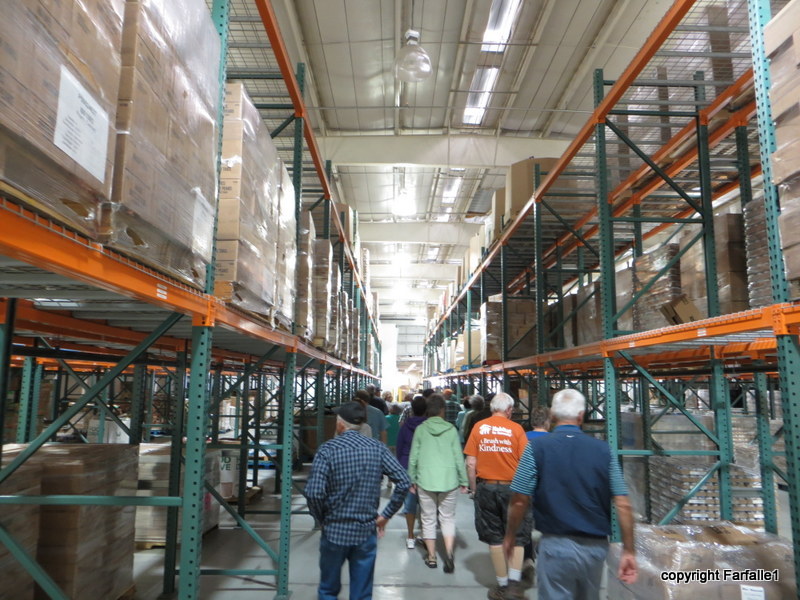
United Food Bank Tour warehouse

or in the cold storage room:

United Food Bank Tour cold storage-001Then ‘orders’ from the various food banks are put together on palettes ready to be delivered (the pink slips identify the food bank recipient):
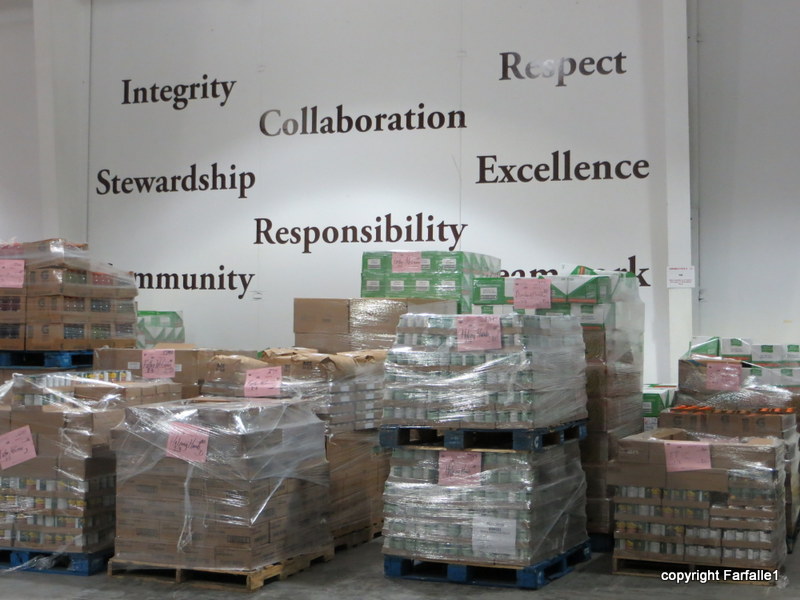
United Food Bank Tour waiting to be delivered

The trucks that pick up food from large suppliers reload and take the palettes off to the local food banks:
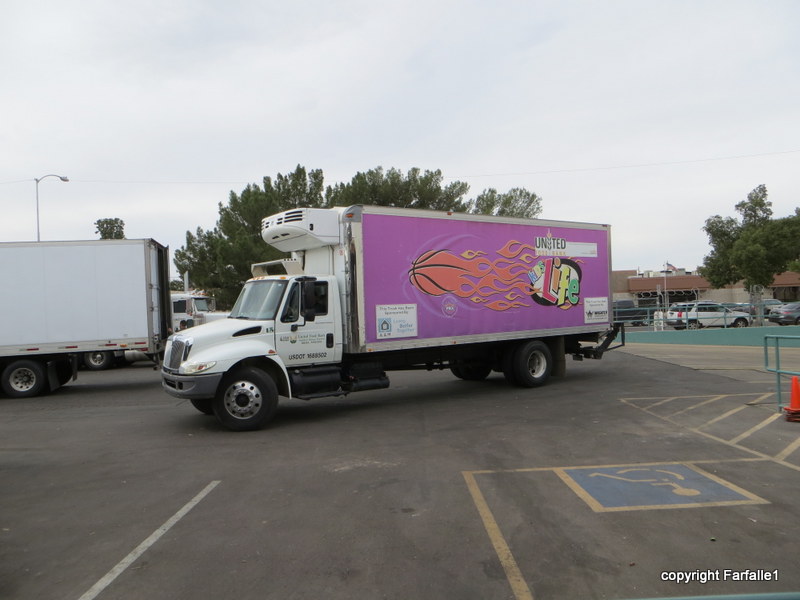
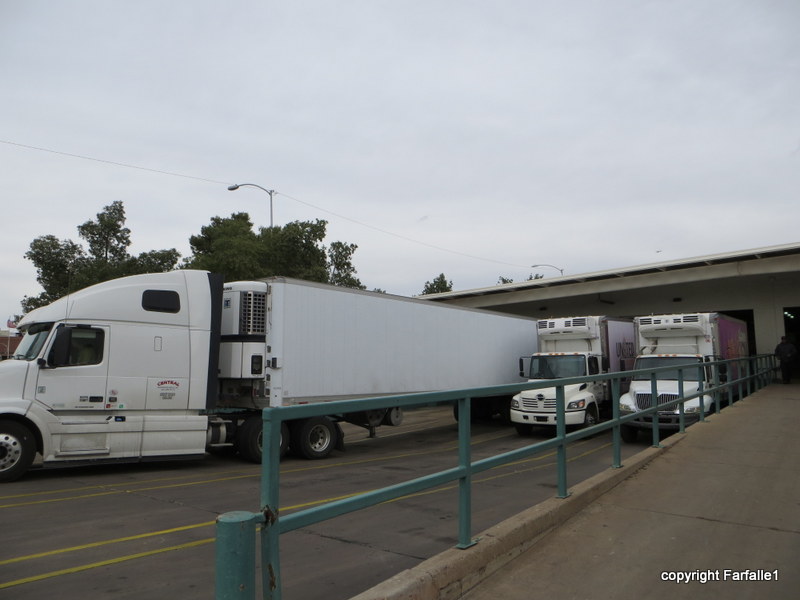
United Food Bank Tour colorful truck

United Food Bank Tour loading docks-001

Remember up above I mentioned that the fruit-picking program is in jeopardy? Here’s the reason:

United Food Bank Tour bad fruit-002

Bad fruit! That’s right, just as the old saw says, one bad apple, or in this case grapefruit, spoils the whole carton. Our group is extremely careful to put only perfect fruit into the boxes. One little puncture and the fruit is useless. Our pickers look at each piece, and a team of checkers stays at the bins and re-examines every piece. That is why one of our team leaders, Bev, is so proud of the boxes of fruit we pick, which do NOT look like the fruit above. Here she is with one of the six bins of fruit we picked.
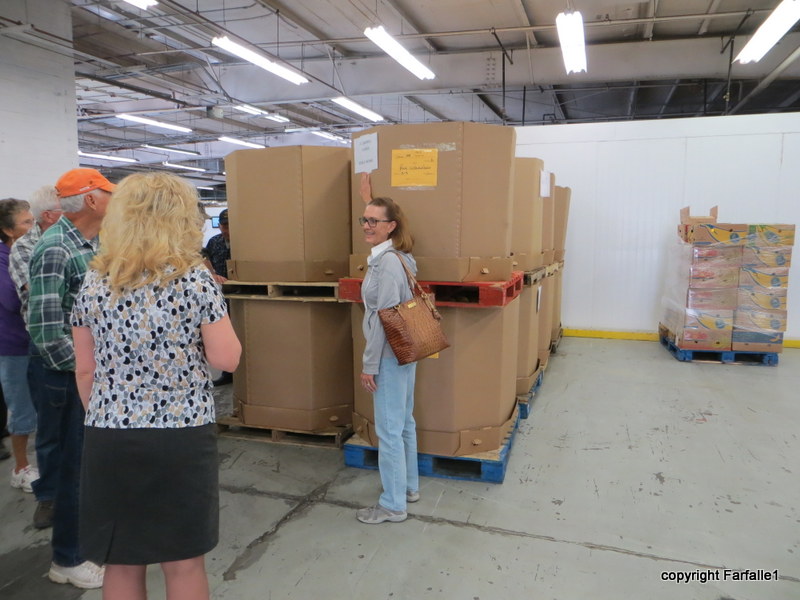
United Food Bank Tour Bev and some of our boxes

You might imagine that having a bad carton of fruit is a pity and a waste, but not such a big deal. Magnify it by many cartons and it becomes a big deal. The cartons alone cost about $25, and if there’s rotten wet fruit in them, they are ruined and have to be discarded. Then there’s the problem of the bad fruit. Last year it cost the food bank $18,000 to have the bad fruit trucked away and discarded. That is money they would have far preferred to put into meals.

There’s also the question of quantity. There is simply a lot more grapefruit in the Valley than the food banks here can use. Another food bank is working with a local juicer to turn excess fruit into delicious juice. The drawback is that the juicer will work only with professional gleaners, not with volunteers (I imagine it might have something to do with quality control). So far United Food Bank is working only with volunteer pickers.

Up until last year our United Food Bank, through Feeding America, was able to send our excess fruit north to Washington and Oregon in exchange for their excess apples and potatoes. Unfortunately the Arizona citrus has been attacked by a scale disease which is not yet present in the northern states – and they don’t want it. As a precaution they are no longer accepting our excess fruit.

So you can see, the whole thing is very complex. As a casual observer it seems to me that United Food Bank is doing a superb job at getting as much food as possible out to the people who need it the most. The sad fact of the matter is that there are more hungry people in Arizona (and in the rest of America, too) than there is food to feed them. Here, in pie charts (what could be more appropriate?) is a breakdown of income and expenses for UFB:

United Food Bank Tour pie charts

I asked Melissa what was the more useful contribution, food or money. Both, she said, although the money is more flexible.  Some of each is certainly a winning combination. The most needed items in food banks (in addition to cash) are: peanut butter, canned meat, canned fruit and veggies, cereal (whole grain and low sugar preferred), soups, stews, chili, beans, pasta and rice, and milk, either canned or dried.

So it turns out my preconceptions of what a food bank is and does were pretty wrong. There’s nothing sad about it – it’s positive for the people who work and volunteer at food banks, it’s positive for the people who donate food and money, and most of all, it’s positive for the food recipients. Often it is the catalyst that helps them get back on their feet after a run of bad luck. For a hungry child it might provide the zip to do better in school and, therefore, in life itself. If you want to find a food bank near you (if you’re in the U.S.) where you can either volunteer or drop off a bag of food or a check, you can find one here.

Just a humorous note to end. Like every large organization, United Food Bank has Rules and Regulations, especially in the warehouse area where forklifts are zipping back and forth. As in other matters, they are very organized, posting all the rules on a Wall of Don’ts. I don’t know why it amused me so, but it did. Do not pass go! Do not collect $200!
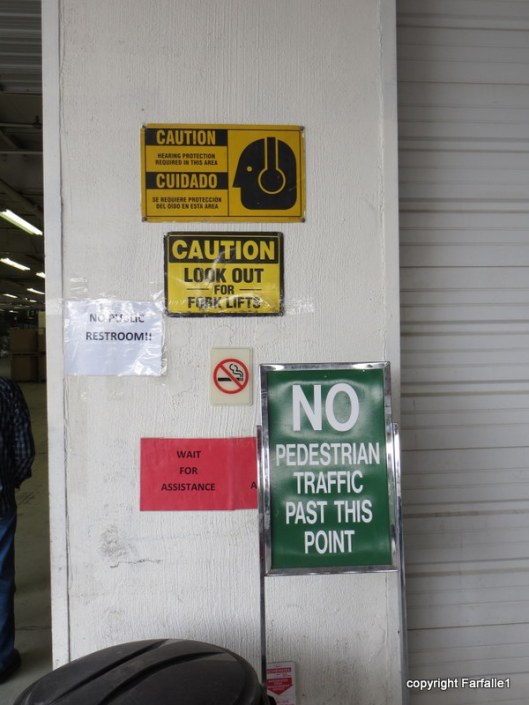
United Food Bank Tour wall of no-no's

PS – thanks to the United Food Bank brochures for facts, figures and concise language describing their programs, which I have shamelessly copied.

Taxi!

15 Sunday Jan 2012

Posted by farfalle1 in Driving in Italy, Health and health care, Italian bureaucracy, Italy, Medical care in Italy, Uncategorized

≈ 13 Comments

Tags

Italian pharmacies, Italian taxis, Monti reforms

Quick!  Take me to the Pharmacy!

Photo courtesy of italyfromtheinside.com

An article in the English edition of ANSA describes a wildcat strike by taxi drivers in Rome.  They are unhappy because the Monti administration, in its package of reforms, wants to loosen requirements to become a cabby.  This is just one of many measures aimed at boosting Italy’s flagging economy and making it possible for young people to find work –  all of which are being offered in tandem with severe austerity measures.

Photo courtesy of tuscantraveller.com

Back in 2007 the Roman taxi drivers were angry, too.  At that time the city wanted to add 1,000 cabs to the stable.  Rome had, at that time, 3 cabs for every 1,000 residents, the fewest of any city in Europe, according to a Marketplace report.

Prime Minister Monti, photo courtesy of The Guardian

Another of the proposed Monti reforms calls for relaxing the regulations around opening a pharmacy.  As things are now it is almost impossible to open a new pharmacy.  A young person can go to school and become a pharmacist, but without family connections to an existing business, finding a position will be difficult (not impossible, but difficult).  But the entrepreneurial pharmacist who wants to open a new drugstore is just plain out of luck.  The number and opening hours of pharmacies are regulated by law according to about.com.  It is also true that if you want to get aspirin or vitamins you will have to go to a pharmacy where you will find them hideously packaged on foil covered cardboard.  Last time I forgot to bring aspirin from the States I paid € 6 for 30 aspirin.  Speedy says that often when viewing the painkiller section of a Walmart store and seeing 500 Iboprofen selling for $6.28, he thinks an Italian seeing the same shelf would need a cardiologist rather than some pills.  Until recently the only place you could buy prepared baby food was at a pharmacy.  Imagine!

While there is a lot wrong with the pharmacy system in Italy (and probably the taxi system as well), there is a lot right.  There is always at least one pharmacy open within shouting distance, and the pharmacists are highly trained, knowledgeable and able to help with minor medical emergencies, saving one a trip to the emergency room.  But the regulations against competition in pharmacies could be relaxed without reducing the requisite training for pharmacists – that would be good for consumers and for young pharmacists.

The larger problem, of which these two issues are representative, is that Italy is a country strangled by bureaucracy and regulations.  There is no place for young people to find work because all the trades and professions are so busy protecting their own interests that they are unwilling to be open, to expand or to share.  That’s bad for all concerned, it seems to me.  Educated young people live with their parents and fruitlessly hunt for jobs; the professions stagnate and suffer gross inefficiencies due to limited scope and size. Speedy reminded me that the current generation of Italians is called the NEETS (not in education, employment or training) generation (15 to 29 years-of-age), of which there are some 2 million.  These NEETS comprise 11.2 % of this age group in Italy compared to 3.6% in Germany, 3.5% in France, 1.7% in the UK, and but .5% in Spain.  All that talent going to waste!  Clearly, this is a socio-economic problem that will have long-lasting effects unless the new government, and the Italian people, can turn around their unique approach to social management.

To an American it seems ludicrous.  In the States it is relatively easy to start a business – all you need is a good idea and either money, or backers with money.  Granted, some 35% of new businesses will fail within the first two years, but at least one has the opportunity to try.  And if only 35% fail it means  that 65% succeed, giving income and occupation to more people and, because of the competition generated, giving better services and lower prices to society in general .

It will be interesting to see how it all plays out in the months ahead.  In the meantime, don’t get sick in Rome – it might be hard to find a cab to take you to the pharmacy.  And if you’re visiting Italy from the States, do bring your own aspirin.

Be Well!

30 Tuesday Aug 2011

Posted by farfalle1 in Health and health care, Medical care in Italy, Rapallo, Uncategorized

≈ 6 Comments

Tags

Ospidale Rapallo N.S. di Montallegro, Rapallo Hospital

(Click on an photo to see a slightly larger, much clearer image.)

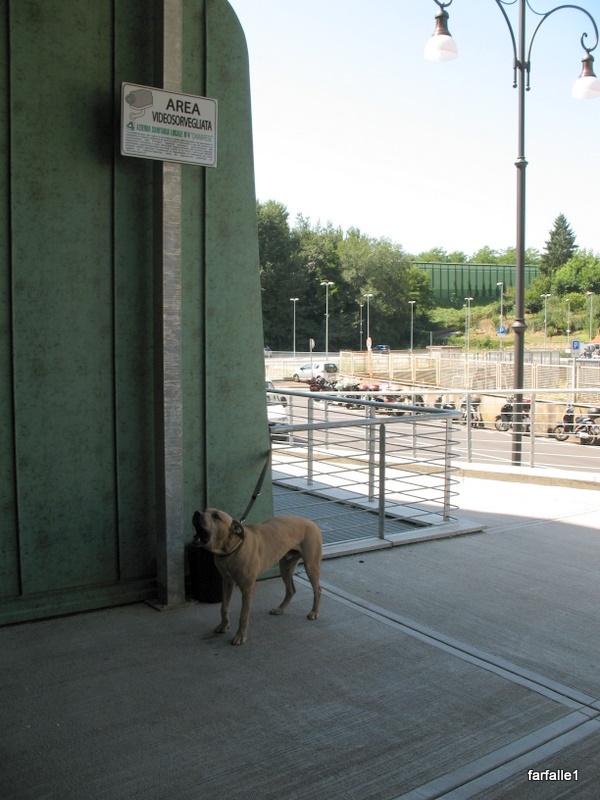
Rapallo has a new hospital, an eerie place because, the two times I’ve been there, it has seemed almost empty of people. I’m accustomed to thinking of hospitals as over-crowded bustling places, but this one isn’t, at least not yet. A beautiful structure in the modern idiom, here is what it looks like from the street:

Evidently it’s one of the few places in Italy where dogs are not welcome. This fellow was singin’ the blues:


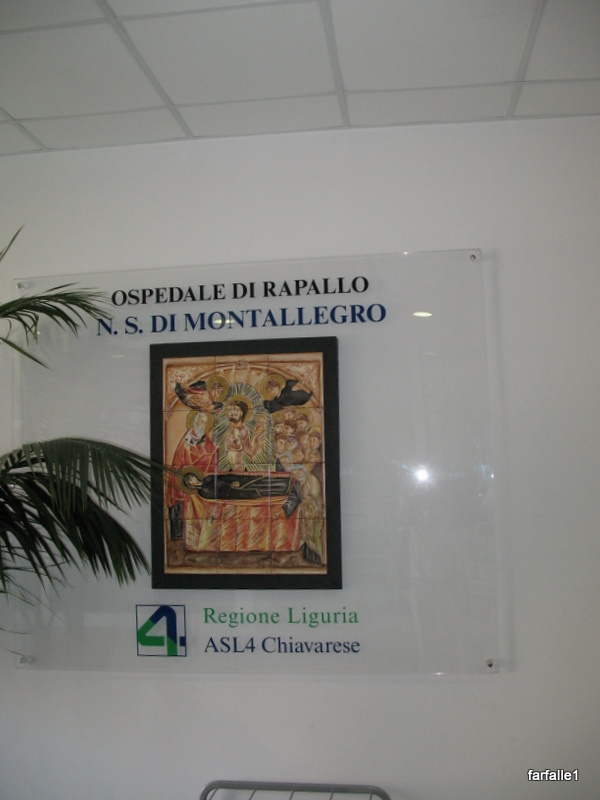
In the foyer of the building you can examine a replica of the ikon from Montallegro – the hospital’s full name is Ospedale di Rapallo N.S. di Montallegro (N.S. means Nostra Signora, Our Lady).


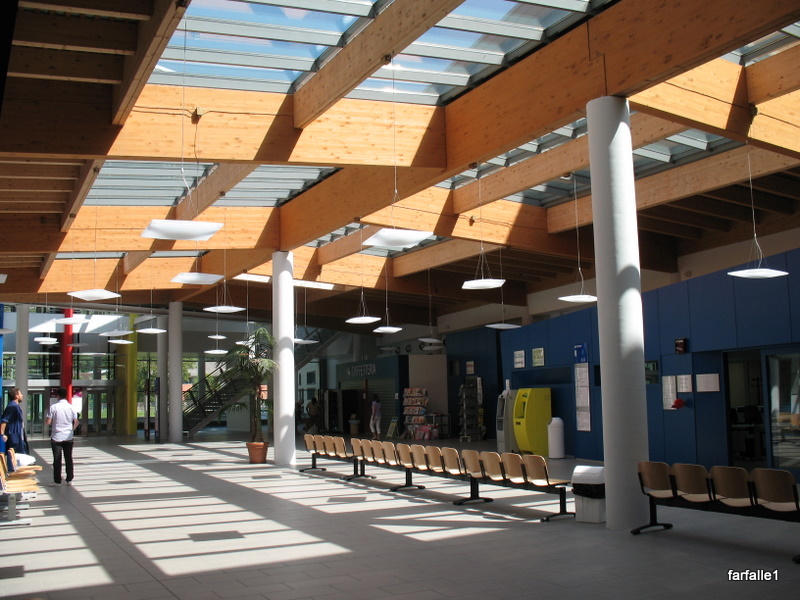
Once past the corridor with the very large and well-appointed gift shop you find yourself in a large interior courtyard, from which you choose to go to either pavilion A or B:


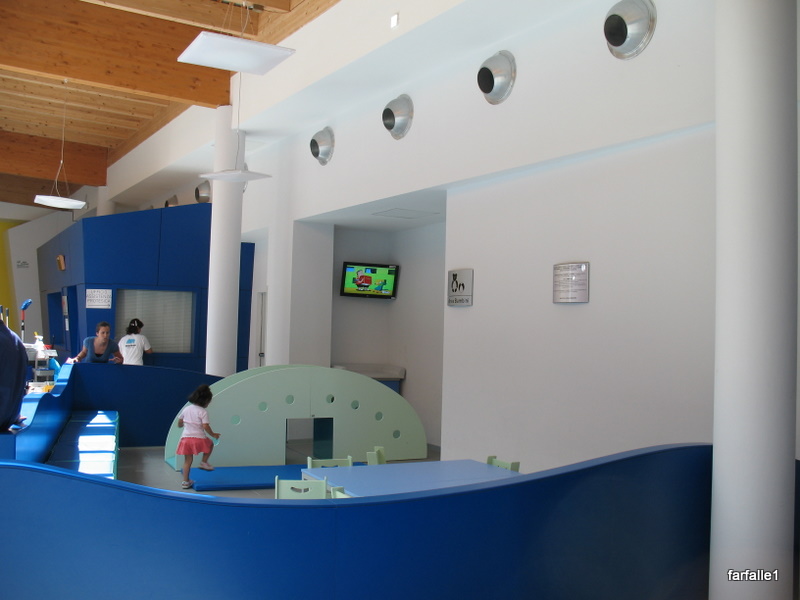
The courtyard contains a large cafeteria, closed the days I was there, and  even a play area for kids:


I was eager to ride in these elevators, but my business was in the other pavilion where the elevators are the more prosaic hidden variety:


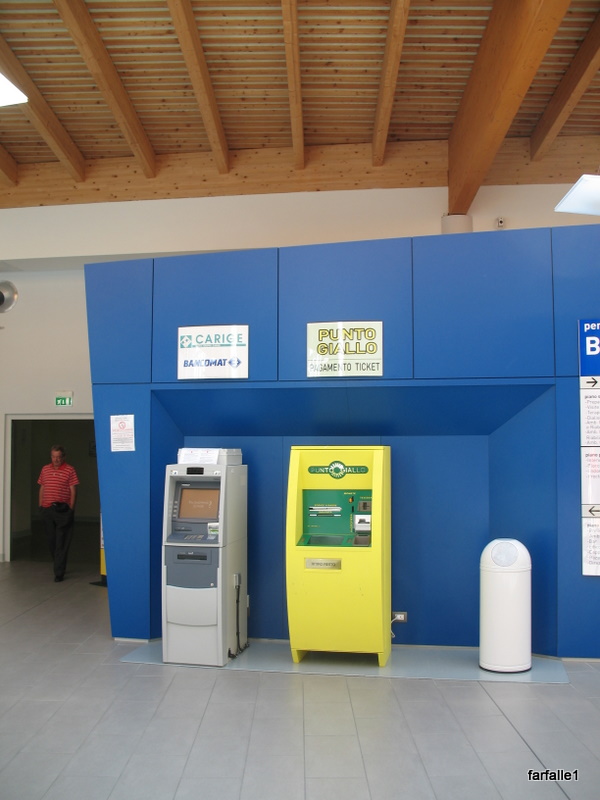
In Italy you pay ‘a ticket’ for medical attention – not always, but frequently. For instance, I went to the hospital for a rather run-of-the-mill test, for which I was charged € 25. If I had not already paid the ticket when I made the appointment at the health services office, I could have paid at the machine on the right. No ticket, no test. If you’re short of cash there is a bancomat (ATM) right there on the left.


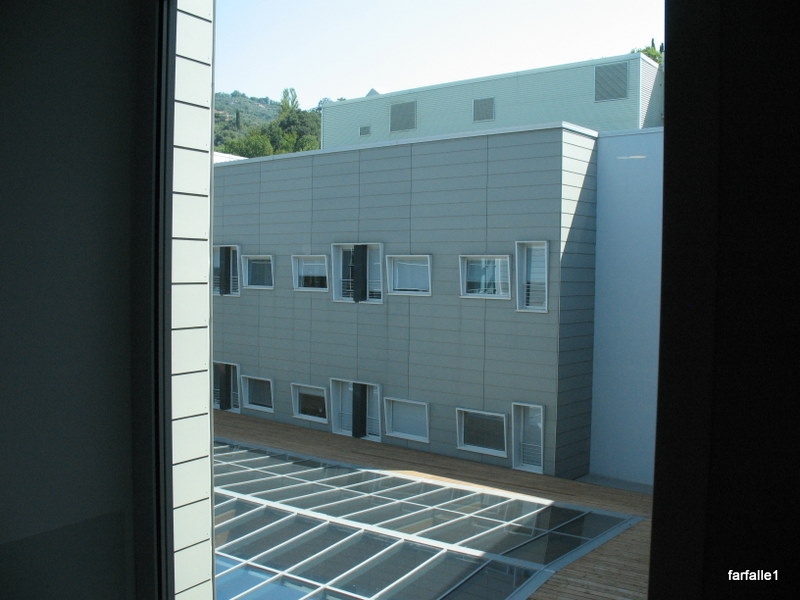
This is what the roof of the central courtyard looks like from above (I was on the third floor):


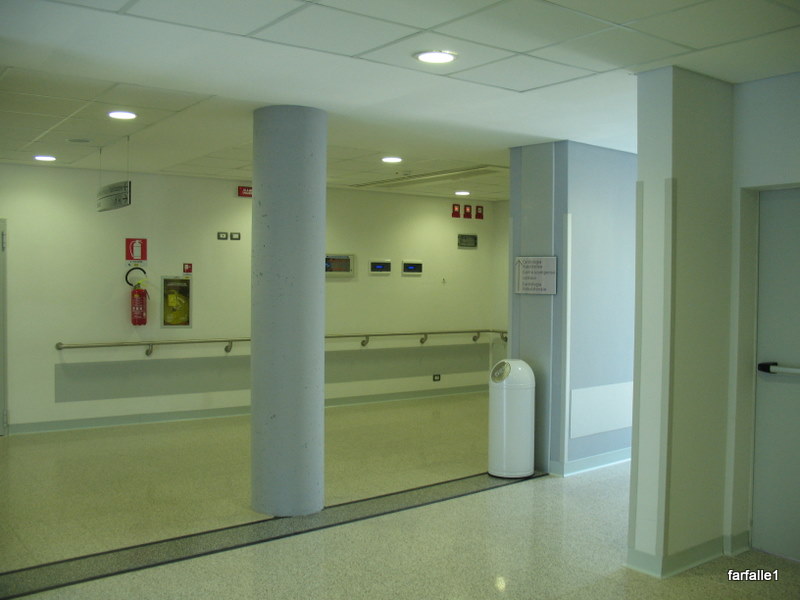
And this is the spookily empty cardio corridor:


There was a handful of people awaiting their tests in an interior waiting room, but no one had to wait more than 10 or 15 minutes, which I think must be some kind of record. When I returned the next day for the second part of my test I didn’t even have time to get my rump in a chair before I was called back to the examining room.

The hospital was constructed over a period of five years at a cost  € 43.9 million, most of which was paid for by the Region of Liguria.  Ours is a region of old folks – 27% of us are ‘vecchi’ – and the hospital has been assigned specialties accordingly: orthopedics (need a hip?) and eyes (how are those cataracts?).  In addition there is a cardiac rehabilitation center and a dialysis unit.  The hospital has 140 beds.

I’m sure this lovely hospital is getting much more use than I saw on my two brief visits, and I’m sure usage will increase over time… if only because, as my friend A. says, they serve the best cup of cafe in Rapallo (when the cafeteria is open, that is)!

It’s Your Responsibility

03 Friday Dec 2010

Posted by farfalle1 in Health and health care, Italian bureaucracy, Italian habits and customs, Italy, Medical care in Italy, Medical care in the U.S., Uncategorized

≈ 4 Comments

Tags

Health care in Italy, Health records in Italy, Health records in the U.S.

In Italy people tend to take much greater responsibility for the little details in life than we do in the United States.

Take bills, for instance.  Certainly we receive many, too many we often think!  But actually, we receive too few in Italy.  There are many obligations which we must remember we owe, track down the amount due, and then pay in a timely fashion.  These include automotive taxes, health insurance (which we pay for because we are not citizens), automotive insurance, other taxes (income and property – of course! – though the property tax on primary residence has been repealed), and various inspections – motor vehicles, gas heater and so forth. Helpful reminders are not forthcoming, and penalties apply for late payment.  We forgot to pay the car tax a couple of years ago and the penalty was substantial – about E 100 if memory serves.  Auto registration and driving licenses  are also on the list of things we must remember to renew without benefit of a reminder.  The Captain has created a great month-by-month calendar on the computer so that we won’t forget what to pay when.

It’s not consistent, though.  For example, we receive bills for the TV tax, the Road Access tax (don’t ask), and the Garbage tax, but not for the various taxes noted above.  Who decides these things?  How do they decide??

And even when help is available its isn’t always, well… helpful.  When we bought our tumbling down house in the hills above Rapallo we were stunned to discover that property tax bills were not forthcoming.  The Captain went right away to the appropriate office for help in figuring out what we should pay for the ICI (property tax, pronounced ‘eetchie’) each year.  They were  helpful, and we were thrilled because it was about € 35 a year – a real bargain!  When the reconstruction of our house was finished our geometra registered the change of house category with the regional property office, which should, one would think, have triggered a change in taxes owed. (A geometra is a cross between an engineer and an architect, in our case the man who designed the reconstruction and oversaw its realization)

We have always asked a ‘commercialista’ (an accountant) to prepare our Italian taxes, and after a couple of years the man who does them was able to calculate our ICI due from information on record about our house, saving us our annual jaunt to the nice lady in the ICI office.  Years passed.  The ICI was repealed for primary residences.  The very year the repeal went into effect we were summoned to the ICI office; we were in arrears.  To make a terribly long story shorter, the ICI office had never updated the valuation of our house, in spite of the category change being registered, so we paid years of taxes on an uninhabited rustico instead of an occupied house.  In addition, the house is in both our names (which are different).  Each year when the Captain went to the office to ask what we owed and later, when the commercialista took over, the figuring was done on the Captain’s share of the tax.  No one realized Farfalle owed tax too.

We were able to negotiate the dismissal of the huge penalties and interest on unpaid taxes since the proper forms had been filed after the work was done.  But still, we owed some six years of taxes at a higher rate for the Captain, and all taxes for Farfalle – it was well over € 1,000, a truly horrid surprise.

Another responsibility people in Italy carry is keeping track of their own health records.  Certainly doctors will have records but if, for instance, you get an X-ray, the film is given to you to carry home, not filed at the doctor’s office or in the hospital or lab where it was made (do they have copies I wonder?  Surely they must).  In fact, all lab results are given to the patient, not sent to the doctor. This is very convenient if you decide to visit another doctor for a second opinion.  But it’s really inconvenient if you go to the doctor and forget to take your files with you!

Vets do the same thing.  Each patient has a ‘libretto’ – a record book of visits, treatments, procedures.  I recently disposed of the late Luciano‘s records (with a bit of a cry) which included some mysterious X-rays I couldn’t recognize.  A paw, perhaps, or maybe a bit of tail. It was easy to keep track of his records – I simply left them all in his cat carrier.  If only I could come up with such a reliable system to keep track of our own records!

We’re in the U.S. now.  The Captain had some blood tests done over a week ago.  They have not been forwarded to his doctor yet, and the lab absolutely refuses to release the results to him.  They treat us like incompetents here.  Inconsistent as things are in Italy, at least we are generally treated like adults.  And while I may not have brought the results of the Captain’s previous blood tests over here with us, I know where I’ve filed them in Italy.  Take that, LabCorp, who can’t manage to get them to an office in the same building within a week!  Why not allow us just a little responsibility… but maybe not quite as much as in Italy?

Olive Oil

29 Tuesday Dec 2009

Posted by farfalle1 in American habits and customs, Food, Health and health care, Italian habits and customs, olives

≈ 2 Comments

Tags

olive oil, Olive Oil in Softgels, Puritan's Pride Vitamins, Softgel Olive Oil

Olive Oyl/King Features

We didn’t have a TV when I was growing up (I know! but it’s true!!).  But my best friend Taffy had one, as did other friends, so somehow stray bits and pieces of TV-lands-and-people crept into my brain.  One of these was Popeye and his interestingly shaped girlfriend Olive Oyl.

In fact, I knew this crowd pretty well from the daily comic strip in the North Adams Transcript (Popeye first appeared way back in 1929, and King Features still presents the strip, the creation of Elzie Crisler Segar. Interestingly, Robin Williams’ first movie role was in the 1980 film adaptation (Jules Feiffer, Robert Altman) of the cartoon). I never cared much for Popeye.  Unable to see the kind, generous and lovable character behind his ‘coarse’ speech and fightin’ ways, I avoided him and his cronies (Wimpy, arch-rival Bluto, etc.) for the more mundane Peanuts and Archie.  Talk about Wimpy!

As far as I knew back in those days, olive oil was a misspelled character; we didn’t know anything about olive oil in the mid- to late-20th century New England kitchen, and we certainly didn’t have any in the cupboard.  That all changed sometime in the latter part of the century as Mediterranean cuisine became popular in the States, both for its deliciousness and for its health benefits.  In fact, worldwide consumption of olive oil grew substantially, from 1,779,000 MT in 1990 to 2,553,000 in 2005. Suddenly restaurants were offering little saucers of oil for dipping bread, and connoisseurs were comparing flavors and production methodologies.  Olive oil became a low-key cooking and eating craze. (If you’d like to read an account of our own olive harvest, click here and here.)

Hirts Gardens photo

Italians have been cooking with and consuming olive oil from the year dot. Perhaps it is just their good fortune that natural circumstances gave them a fat product from a tree rather than from a cow. 1 tablespoon of butter contains 12 grams of fat, 8 of which are saturated (bad!) and it has 33 mg of cholesterol; 1 tablespoon of olive oil contains 14 grams of fat, only 2 of which are saturated, and it has no cholesterol at all.  In addition, olive oil contains antioxidenats, beta-caratene and vitamin E.  AND it tastes great and makes everything else taste great too.

Imagine our surprise when we received the wonderful Puritan’s Pride catalog the other day, and discovered that you can now buy olive oil in softgels.  Why on earth would you want to when you can buy a lot of olive oil in a bottle and have the pleasure of consuming it on salads and in sauces?  Pills??  Only, I think, in America! Then consider the economics of the thing.  You can get 300 60-mg softgels of olive oil (just writing it makes me shake my head) for $21.98.  That’s 10 ounces of olive oil for $21.98 – kind of pricey, if you ask me.  In fairness, the same catalog offers a 16 ounce bottle of cold-pressed organic extra-virgin olive oil for $9.63, as well as an olive leaf complex.

photo from China Suppliers.com

It makes me think of all the Futurama stuff we read about when we were kids watching Popeye – we would all zip around with personal jet-packs, and we wouldn’t have to eat food anymore because we’d be getting all our nutrients from pills. What a horrid thought that is! My advice? When in Rome, or anywhere else for that matter, do as the Romans – use lots of olive oil, but use it from a bottle, not from a softgel!

(More info on olive growing and harvesting here and here, and a photo album of the harvest and pressing here.)

Colpo d’Aria

19 Monday Oct 2009

Posted by farfalle1 in Health and health care, Italian habits and customs, Uncategorized

≈ 10 Comments

Tags

Colpa d'Aria

Oh, the dreaded Colpo d’Aria!  If you’ve suffered a Colpo d’Aria you’ve been struck by some moving air, most probably chilly air, and most probably on your chest or perhaps the back of your neck.  If you live in Italy, it can be deadly; ask any Italian!  I’ve heard Colpo d’Aria blamed for everything from stiff muscles, to inner ear infections, chest colds and even heart attacks.  I have not yet heard anyone say that a Colpo d’Aria caused his cancer, but that, and gum disease, are about the only illnesses for which a stiff breeze has not been held responsible.

Fortunately there is some good treatment available should you fall victim to an evil air current.  The first thing you want to do is go to the pharmacy and get a bastone di zolfo, a stick of sulphur.

bastone di zolfo

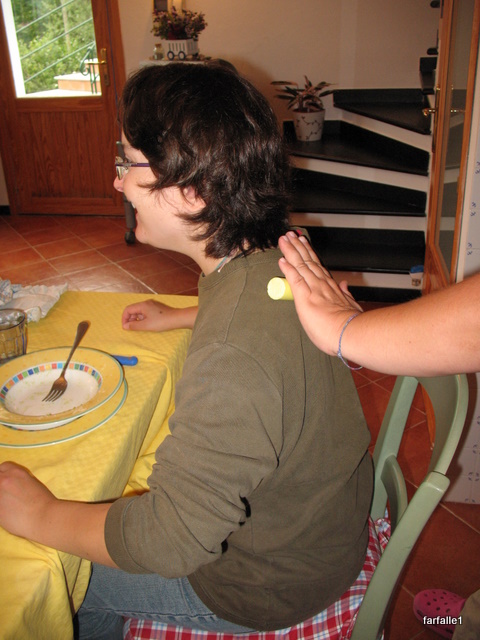
You roll this stick back and forth across the skin of the afflicted area (our model was shy).

bastone di zolfo in use

The great thing about the bastone di zolfo is that when it has outlived its usefulness it crumbles or breaks.  Then you know it’s time to buy a new one.  Evidently the sulphur absorbs… what? moisture? bad vibes? infection?  My guess is moisture, but I wouldn’t swear to it.

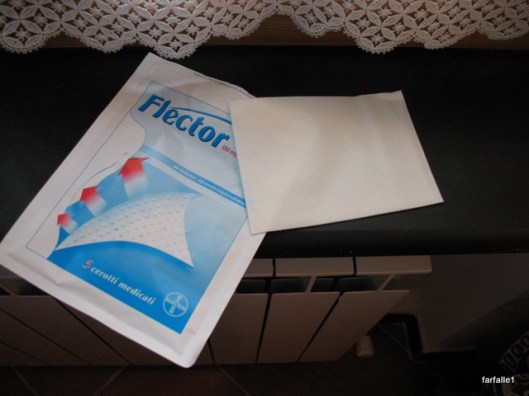
The next line of attack is the Flector patch, a bit of treated rubbery material, about 4″ X 5″,  that is slightly adhesive on one side so it will stick to your skin. It is in the NSAID family of medicine, and delivers a non-steroid anti-inflamatory drug topically. From all reports it also feels good.

flector pads

There are probably as many treatments for Colpa d’Aria as there are sufferers.  My prescription would be a day in bed with an endless supply of hot tea with lemon and honey, and a good trashy novel.  The best line of defense though is always prevention: stay out of drafts!  I grew up sleeping with the windows wide open, and still do – it’s a miracle that I’ve survived so long.  If you live in Italy the only thing worse than a colpa d’aria is a colpa d’aria in the dark.  Many Italians sleep with their windows tightly closed and shuttered.  Also, now that the cool weather has arrived, don’t forget to bundle up when you go out, and remember especially to wear a good warm scarf to protect your chest and neck from the dangerous air currents.

I’m making light of this notion, but I’m not so sure there isn’t a measure of truth in it.  It falls in the category of folk belief, but such beliefs are often based on years of experiential evidence.  I may laugh at the idea of a colpa d’aria harming me, but I have a great collection of scarves and never go out without one in cool weather.  As they say here, ti raccomando!

Near and South of the Border, part two

20 Friday Mar 2009

Posted by farfalle1 in Health and health care, Travel, Uncategorized

≈ 6 Comments

Tags

border crossing, Imperial Date Farm, Los Algodones, Mexican oculists, Mexico, Yuma

Expatriate in Mexico

One day while we were visiting our friends in Yuma we all crossed the border into Los Algodones (the cotton plants), Mexico, so the Captain and I could buy new spectacles.  Why?  Because they (as well as prescription drugs and dentistry) cost about one-third what they do in the U.S., which is a puzzle and a pity.

Do you know how easy it is to get into Mexico?  You walk in.  Some people drive, but we parked on the American side in an immense parking lot, and simply walked in without being stopped or queried by anyone, and without having to show a shred of identification.

Let me back up a bit to tell you that the area around this part of the border with Mexico is one trailer park after another.  I never knew there were so many RV’s in the world, especially since I thought most of them were already planted around Phoenix.  Wrong.  The number of trailers in the south is uncountable – green-camperit’s infinite, they’re probably multiplying as you read.  It’s hard for the Captain and me to imagine the pleasure anyone would take from living in a metal box in the desert, but there must be a lot to it we don’t understand, as many seem happy to be doing it.  Most of the license plates were from cold northern climes, and perhaps that is all the explanation that’s required.  It was interesting to see that quite a few of these mobile homes are now generating their own power with solar panels and small windmills mounted on the roofs.

los-algodones-street1The streets of Los Algodones are nothing but shops for the aforementioned services.  This is the street we entered just after crossing the border.  How to choose which oculist to visit?  We opted for one that was a little deeper in the town, seemed very clean and professional, and didn’t have someone outside exhorting us to come in.  It looked to us like the best choice… is it coincidence that it is called Best Optical?

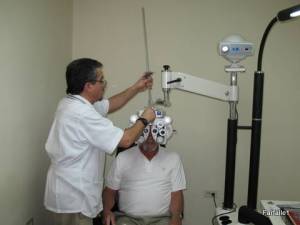
Dr. Manuel Robles and his staff amazed us with their professiolos-algodones-ls-test-2-27-2009-19-35-19nal manner.  We each received a very thorough eye exam, including the test for glaucoma.  Several space-age looking machines stared deeply into our eyes and provided the rough corrections we each needed.  Then we were ushered into a different room where our prescriptions were fine-tuned.  Dr. Robles spent a very long time with the Captain who required two different kinds of glasses – one pair for regular life, and another with different focal lengths for working at the computer.
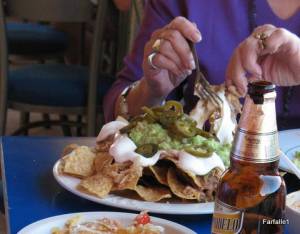
After the exams and the not-so-difficult chore of picking frames (“which ones are least expensive?”) we were shooed away and told to return in two hours.  This gave us a fine opportunity to visit some of the highlights of Los Algodones:

los-algodones-our-food2-2-27-2009-21-00-19The restaurant where we sat on a second-floor balcony and ate some of the best nachos that have ever been constructed.  Yes!  That’s pulled beef under the guacamole and sour cream – yum!

los-algodones-strawberry-man2-2-27-2009-21-20-30This man, seen from our luncheon eyrie, was selling fresh strawberries.  We bought some, forgetting that we probably couldn’t carry them back across the border. We later gave them to a passer-by.
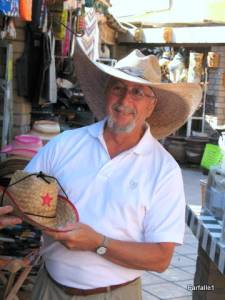
los-algodones-louis-in-big-hat-2-27-2009-20-08-351You can’t visit Mexico without trying on a great big hat…
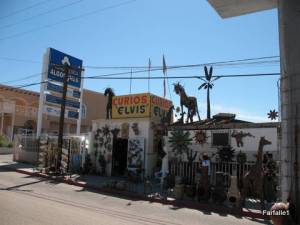
los-algodones-curios-shop-2-27-2009-21-51-321We didn’t buy anything from Elvis, but it’s kind of reassuring to know that the King still lives… in Los Algodones…
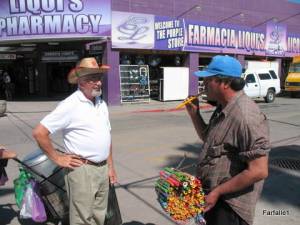
los-algodones-louis-and-flute-man-2-27-2009-22-03-11No, we didn’t buy a whistle, either, though it was extremely tempting.
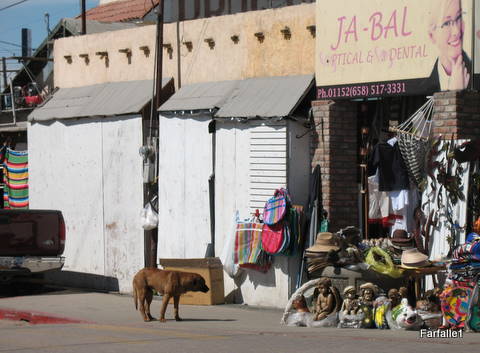
Local fauna.  The first was considering either a purchase or a leg-lift; the second was hiding behind some furniture that was for sale.  We were told if we bought the furniture the kitten could come too – now how would we get her across the border?

los-algodones-dog-and-shop-2-27-2009-22-00-44

los-algodones-hiding-kitten2-2-27-2009-21-37-11

The two hours was up and, having amused ourselves pretty well, we went back to Best Optical and picked up three pairs of beautiful new glasses.  All three were bifocals, and mine get darker as the light gets brighter.  For the three pairs of glasses and the eye exams we payed the princely sum of $125 American.  And that is why so many people cross into Mexico every day.

Then it was time to join the loooong line to re-enter the U.S.

los-algodones-line-for-us-2-27-2009-23-30-07

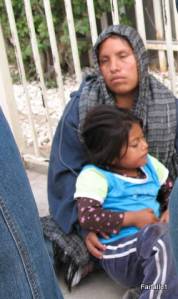
Eventually we arrived within sight of the customs shed (where one is not allowed to take pictures – when I asked the customs official said, “Don’t photograph anything having to do with this border.  If you do someone will yell at you and take away your camera.”  Evidently he mistook me for a toddler.)  Along the end of the route there were three Indian women with children who were begging, and from our observation doing rather well – it’s impossible not to put something in the cup of a woman who looks so sad.

los-algodones-line-for-us-beggars-2-28-2009-00-04-47Because there were only three beggars and because, sad expressions aside, they looked reasonably healthy, we assumed that it was some kind of controlled concession.  But we still couldn’t walk by and do nothing… could you?

After scolding me, the Customs Officer instructed me to take off my dark glasses, riffled my passport and asked a lot of questions about why I had crossed and what I had done whilst in Mexico.  He was cranky.  He was probably tired and sick of cheapskate Americans.

At last we were released back into the United States.  It’s hard to imagine how hard it must be to go anywhere without a passport; it’s something we take for granted, but it bestows great advantages to us.

The drive back took us past several common Yuma-area sights:

date-palms3There are many date farms in the area, specializing in Medjool dates.  We stopped at the Imperial Date Farm where Raul prepared their famous date shake for those of us who like that kind of thing (I don’t):
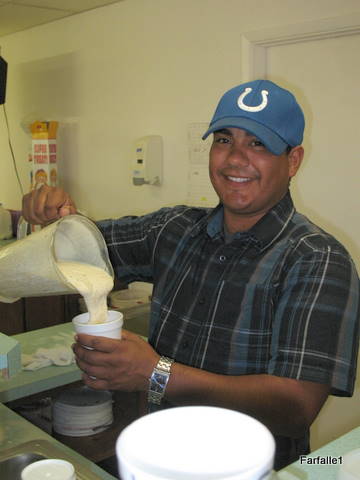
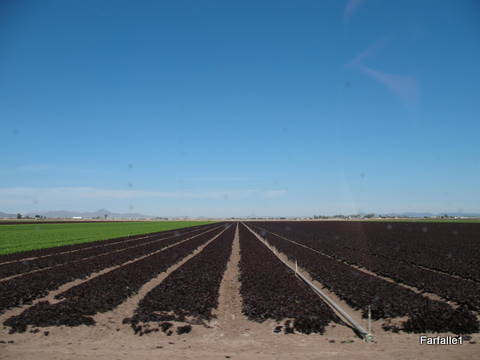
raul-pours-a-date-shakeThen it was back past the miles of lettuce farms.  I bet half the lettuce eaten in the US comes from this part of the world.  Our friends from Tennessee say they eat the lettuce shipped by these growers.  Here is what a really BIG red and green lettuce garden looks like:
lettuce-red-and-greenWe were pretty tired out after our day’s exertions.  After a delicious dinner with our friends we crossed one last seamless border, and tumbled into bed in the Cocopah Indian Nation – at the Cocopah Casino and Hotel.
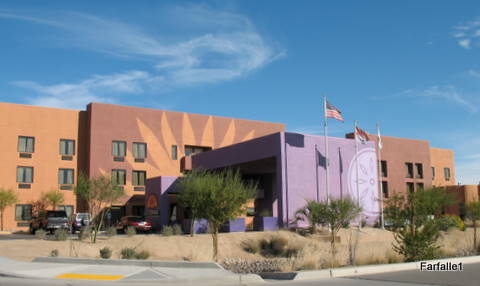
cocopah-hotel-2-28-2009-01-16-23

It was an interesting trip in many ways – and it raised more questions than it answered, about immigration, agri-business, but especially about health care in the U.S. (yes, I count eyes and teeth as part of the equation). Why does a pair of new glasses cost around $200 in one place, and only $30 a few miles away? What kind of sense does that make?

Enter your email address to follow this blog and receive notifications of new posts by email.

Join 114 other subscribers

rss

Subscribe in a reader

Search the Blog

A. Useful Links

  • bab.la language dictionary
  • Bus schedules for Tigullio
  • Conversions
  • English-Italian, Italian-English Dictionary
  • Expats Moving and Relocation Guide
  • Ferry Schedule Rapallo, Santa Margherita, Portofino, San Frutuoso
  • Italian Verbs Conjugated
  • Piazza Cavour
  • Rapallo's Home Page – With Link to the Month's Events
  • Slow Travel
  • The Informer – The Online Guide to Living in Italy
  • Transportation Planner for Liguria
  • Trenitalia – trains! Still the most fun way to travel.

C. Elaborations

  • A Policeman’s View
  • Driving School Diary
  • IVA refunds due for past Rifiuti tax payements
  • Nana
  • Old trains and old weekends
  • The peasant, the Virgin, the spring and the ikon
  • Will Someone Please, Please Take Me to Scotland?

D. Good Recipes - Best of the Week winners are starred

  • 'Mbriulata
  • *Baked Barley and Mushroom Casserole*
  • *Captain’s Boston Baked Beans*
  • *Crimson Pie*
  • *Louise’s Birthday Cake*
  • *Melanzane alla Parmigiana*
  • *Penne with Cabbage and Cream
  • *Pizzoccheri della Valtellina*
  • *Pumpkin Ice Cream*
  • *Risotto alla Bolognese*
  • *Rolled Stuffed Pork Roast*
  • *Spezzatini di Vitello*
  • *Stuffed Grape Leaves*
  • *Stuffed Peaches (Pesche Ripiene)*
  • *Swordfish with Salsa Cruda*
  • *Tagliarini with Porcini Mushrooms*
  • *Tagliatelli al Frutti di Mare*
  • *Three P's Pasta*
  • *Tzatziki*
  • 10th Tee Oatmeal Apricot Bars
  • Adriana’s Fruit Torta
  • Aspic
  • Bagna-calda
  • Best Brownies in the World
  • Clafoutis
  • Cold cucumber soup
  • Crispy Tortillas with Pork and Beans
  • Easy spring or summer pasta
  • Fish in the Ligurian Style
  • Hilary's Spicy Rain Forest Chop
  • Insalata Caprese
  • Lasagna al forno
  • Lasagna al Forno con Sugo Rosato e Formaggi
  • Lemon Meringue Pie
  • Leo’s Bagna Cauda
  • Leo’s Mother’s Stuffed Eggs
  • Louis’s apricot chutney
  • Mom's Sicilian Bruschetta
  • No-Knead (almost) Bread
  • Nonna Salamone's Christmas Cookies
  • Pan Fried Noodles with Duck, Ginger, Garlic and Scallions
  • Pesto, the classic and original method
  • Pesto, the modern, less authentic method
  • Pickle Relish
  • Poached pears
  • Poached Pears
  • Polenta Cuncia
  • Recipes from Paradise by Fred Plotkin
  • Rustic Hearth Bread
  • Shrimp and Crayfish Tail Soup
  • Sicilian salad
  • Slow Food Liguria
  • Slow Food Piemonte and Val d'Aosta
  • Spinach with Garlic, Pine Nuts and Raisins
  • Stuffed Eggs, Piemontese Style
  • The Captain’s Salsa Cruda
  • Tomato Aspic
  • Zucchini Raita

E. Blogroll

  • 2 Baci in a Pinon Tree
  • Aglio, Olio & Peperoncino
  • An American in Rome
  • Bella Baita View
  • Debra & Liz's Bagni di Lucca Blog
  • Expat Blog
  • Food Lovers Odyssey
  • Italian Food Forever
  • L’Orto Orgolioso
  • La Avventura – La Mia Vita Sarda
  • La Cucina
  • La Tavola Marche
  • Rubber Slippers in Italy
  • Southern Fried French
  • Status Viatoris
  • Tour del Gelato
  • Weeds and Wisdom

Photographs

  • A Day on the Phoenix Light Rail Metro
  • Apache Trail in the Snow
  • Aquileia and Croatia
  • Birds on the Golf Course
  • Bridge Art
  • Canadair Fire Fighters
  • Cats of Italy
  • Cloudy day walk from Nozarego to Portofino
  • Fiera del Bestiame e Agricultura
  • Football Finds a Home in San Maurizio
  • Hiking Dogs
  • Mercatino dei Sapori – Food Fair!
  • Moto Models
  • Olive pressing
  • Rapallo Gardens
  • Rapallo's Festa Patronale
  • Ricaldone and the Rinaldi Winery
  • Rice Fields
  • Sardegna ~ Arbatax and Tortoli
  • Sardegna ~ San Pietro above Baunei
  • Sardegna ~ The Festa in Baunei
  • Scotland, including Isle of Skye
  • Slow Food 2008 Salone del Gusto
  • The Cat Show and the Light Rail Fair
  • The desert in bloom
  • Trip to Bavaria

Pages

  • Fagioli all’ucelleto

Archives

Recent Posts

  • A Superior Visit
  • Fun at the Ranch Market
  • The MAC
  • Welcome Tai Chi
  • Bingo Fun for Ferals
December 2025
M T W T F S S
1234567
891011121314
15161718192021
22232425262728
293031  
« Jul    

Member of The Internet Defense League

Blog at WordPress.com.

  • Subscribe Subscribed
    • An Ex-Expatriate
    • Join 114 other subscribers
    • Already have a WordPress.com account? Log in now.
    • An Ex-Expatriate
    • Subscribe Subscribed
    • Sign up
    • Log in
    • Report this content
    • View site in Reader
    • Manage subscriptions
    • Collapse this bar
 

Loading Comments...