Tags

Stone wall and trees on the walk from La Crocetta to Montallegro. The stone wall is interesting because the stones are sunk vertically into the earth.
09 Tuesday Dec 2014
Posted in Hiking in Italy, Photographs
Tags
Stone wall and trees on the walk from La Crocetta to Montallegro. The stone wall is interesting because the stones are sunk vertically into the earth.
30 Wednesday Jul 2014
Posted in Hiking in Italy, Italian history, Rapallo, Uncategorized
I got cabin fever last week and decided to take myself off for a short walk. The short walk soon became a rather long walk as I took a path I’d never taken before, going cross-country to La Crocetta. Why it is called La Crocetta (the cross) I am not sure. It’s probably called that because it’s where we cross over into the next valley. Or it might be that long ago it lay on an important crossroad. Or perhaps it is called that for the small chapel that is built just where the rising road turns a sharp curve and begins its descent into the valley on the other side.
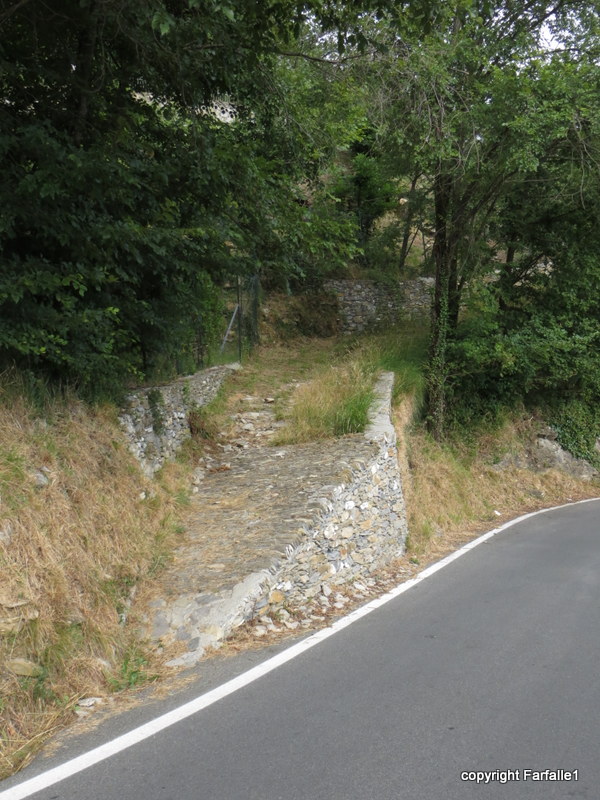
Doesn’t that look impressive? Actually, the walk was shy of two miles each way, but since there was a 919 foot change in elevation I felt extremely virtuous. The first part of the walk was along the road that leads both over the mountain pass (La Crocetta) to the Val Fontanbuona on the other side (take the left fork) and to Montallegro (take the right fork). It was near this very crossroad that I noticed a sign I hadn’t seen before:
Via alla Crocetta – road to La Crocetta – but the road went down and La Crocetta is clearly up. Across the road is a bit of paved walk that runs along the boundary of a recently built home for retired nuns.
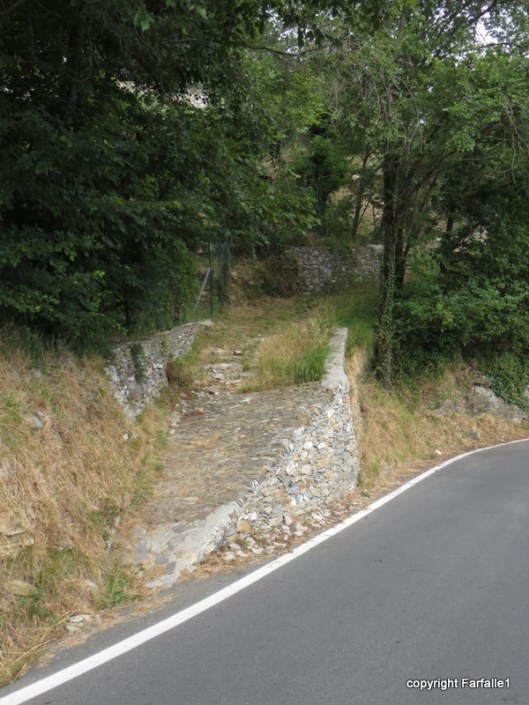
We always assumed it was part of the nuns’ property, but it is directly across the road from the sign and leads away exactly as if it were a continuation of the signed street. This required investigation. The worst that would happen is that my theory that this walking path led to La Crocetta would be mistaken, and I’d have to turn around.
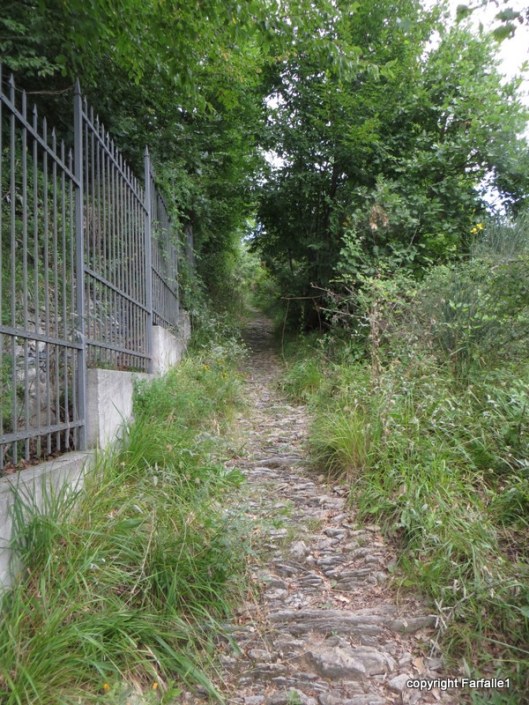
Not far along the path began to narrow.
Walking along the path gave a good view of the Nuns’ home, and I was startled and delighted to see that they, too, have gone solar. That’s quite an array of panels, and as there are fewer than 20 women living there I have to think that they are generating a lot more power than they need. They live rather simply.
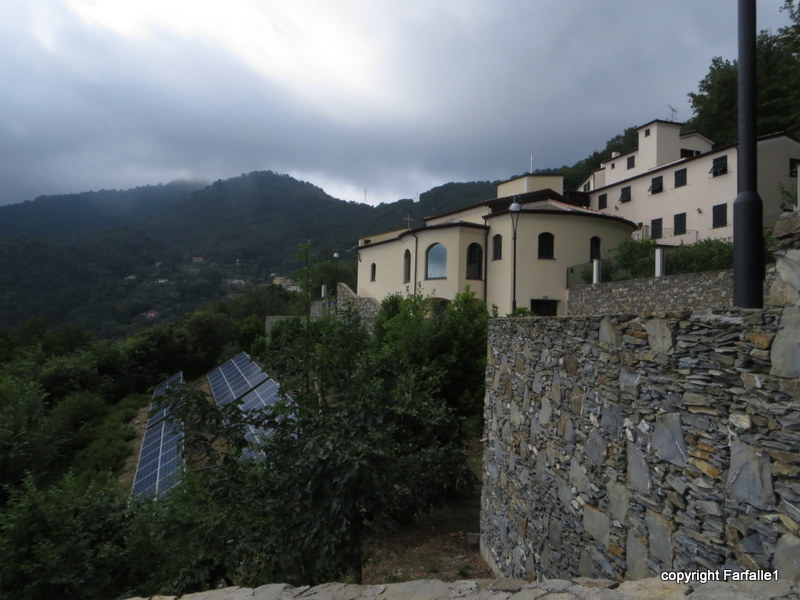 Soon I was walking through the woods with nothing but birdsong to accompany me. Although the road had narrowed considerably, there was no longer any doubt that it was going somewhere, probably La Crocetta. It was built in the same style as all the old roads here, with slim stones set into the earth on their sides, giving a ridged surface. Every now and then a few long stones are laid in for drainage.
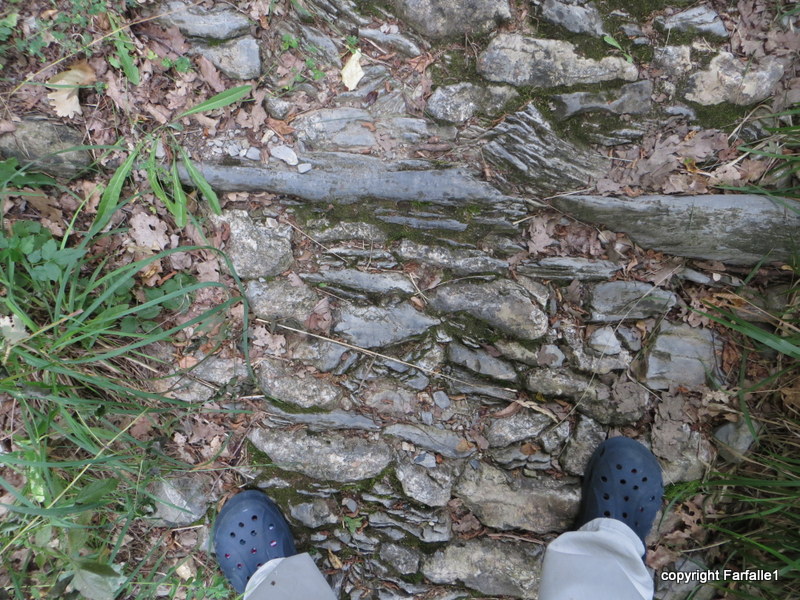 (This is probably as good a time as any to tell you that Crocs are not appropriate foodwear for a walk like this. I must have stopped over a hundred times to hike my socks up.) I have asked many people why the stones are set in this fashion, and no one has ever been able to tell me for sure. My theory, and I’m sure it’s right, is that if the stones were laid flat they could be easily dislodged, and they would also be rather slippery when wet. In addition, the ridges, while uncomfortable for light-soled shoes, would be very effective to help mules and heavily-shod people keep their footing.
I was struck again, as I have been whenever I find myself on these ancient roads, with two thoughts: one, that I was walking on the same route that people had used for hundreds of years, a route whose frequent use was probably abandoned only within the last sixty or seventy years. Over the last decade I have spoken to two elderly people who have recounted walking from the Val Fontanabuona over the mountain to Rapallo, Santa and Portofino to sell vegetables and eggs. They arose in the dark, made the long walk, sold the little they had carried, and then walked back, arriving home after dark. They were little children. The second thought was that there is probably not a square inch of land around here that hasn’t been walked on or explored.
I climbed through the forest for quite a while and finally came upon signs of civilization.
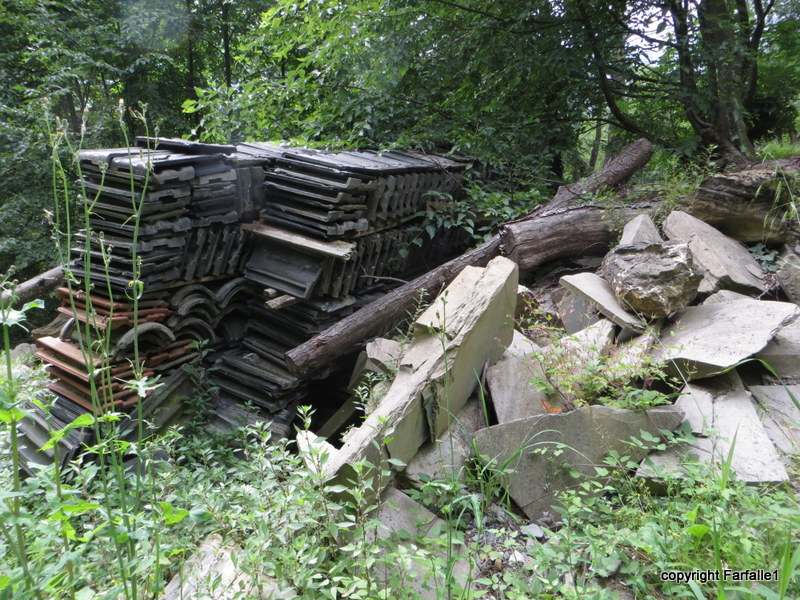
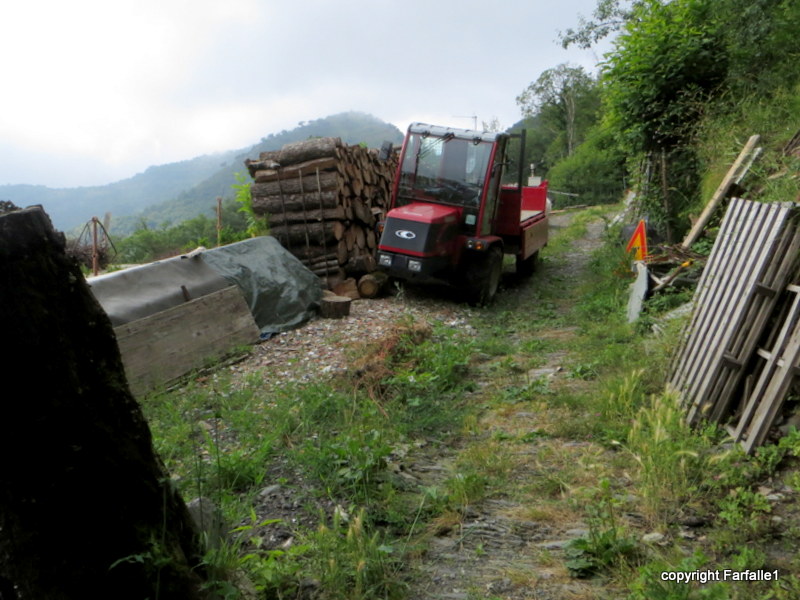 And before much longer I came to some houses. What a view they have of Rapallo and the Gulf!
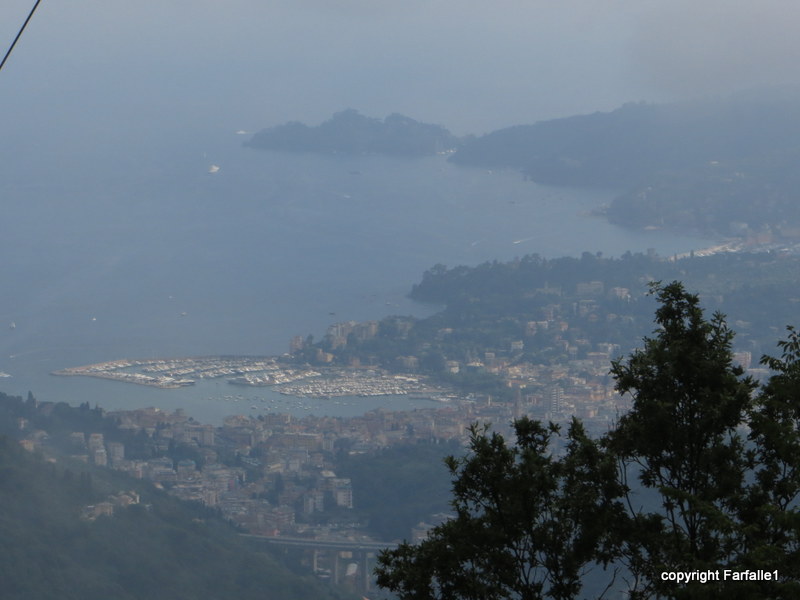 It’s a poor picture – there were a lot of clouds and moisture in the air – but you get the idea. You can see forever from up there. A neighbor passed me in a small ‘furgone’ (one of the narrow pick-up trucks that are prevalent on and suited to our narrow roads) pinned down under a huge, swaying load of hay. I crossed the main road, and took off again in the woods, arriving in another twenty minutes at my objective, La Crocetta.
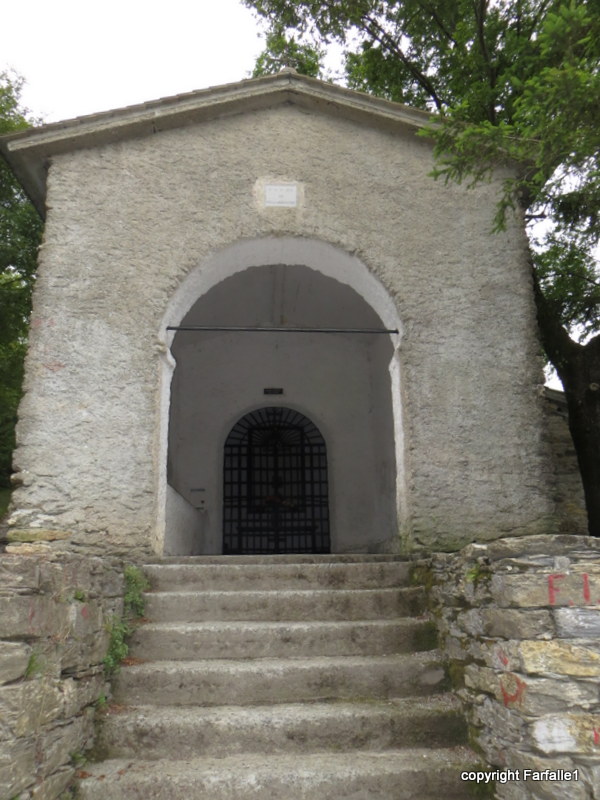 This is a sweet shrine, quite small, always well maintained. From here the road plunges down into the valley on the other side. A well-used hiking trail connects La Crocetta to Montallegro in one direction, and to a well-maintained refuge for hikers on the adjacent peak in the other direction. And of course it also connects to Rapallo on the seldom used path I had just arrived on.
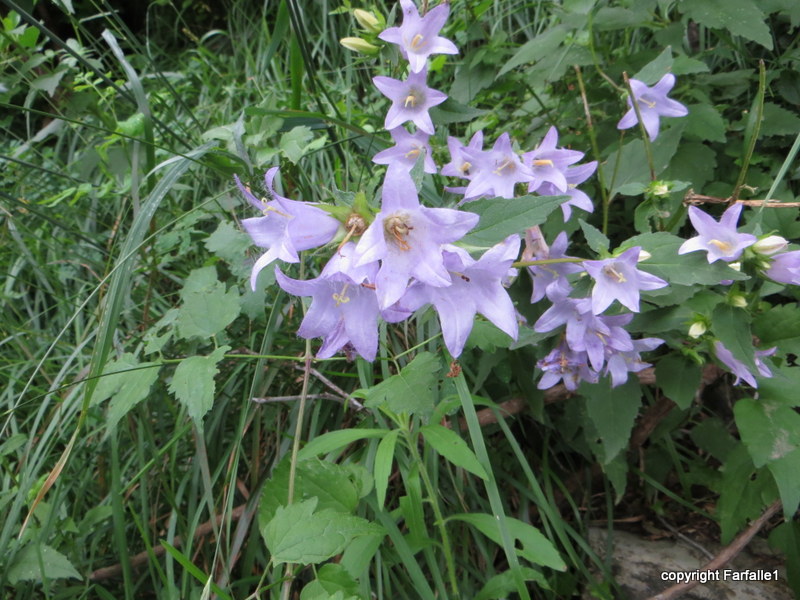
It took longer than I anticipated to make this little trek (all that climbing!) so without lingering I retraced my steps. Isn’t it odd how different everything looks when you’re walking in the opposite direction? On the way down I noticed some wildflowers I hadn’t seen on the way up.

 As evening fell a section of tall new-growth trees felt downright spooky – they were creaking and groaning in the wind. I speeded my pace, hoping a tree wouldn’t fall on me.
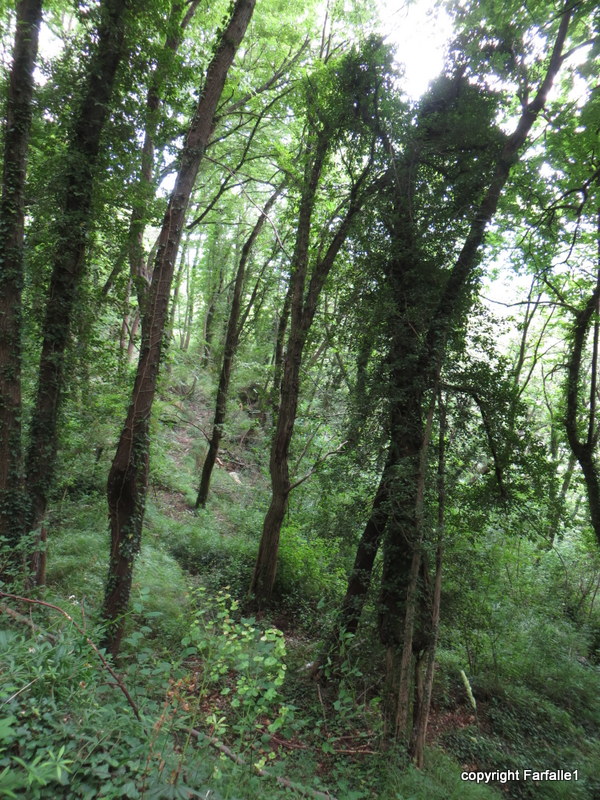 In another spot a little farther on there were a lot of vines, waiting to trip up an inattentive walker.
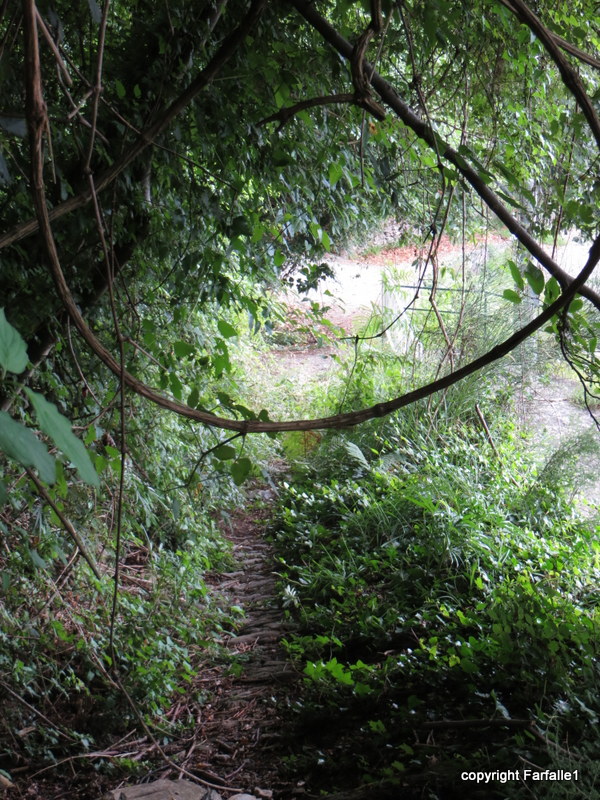 It’s hard to imagine what life was like for people who used these roads as their main highways, who walked by foot or rode on a mule to get where they were going, and did so frequently. The road would have been more open then; a lot of this land was under cultivation until not very long ago. How different their pace of life was! After a walk like this, when one feels cast back in time, it seems more than a little disorienting to return suddenly to modern life. Everything moves so fast, and it’s so noisy. What feels just right, however, is to climb into a hot tub for a good long soak. So that is what I did.
02 Wednesday Oct 2013
Posted in Hiking in Italy, Humor, Uncategorized
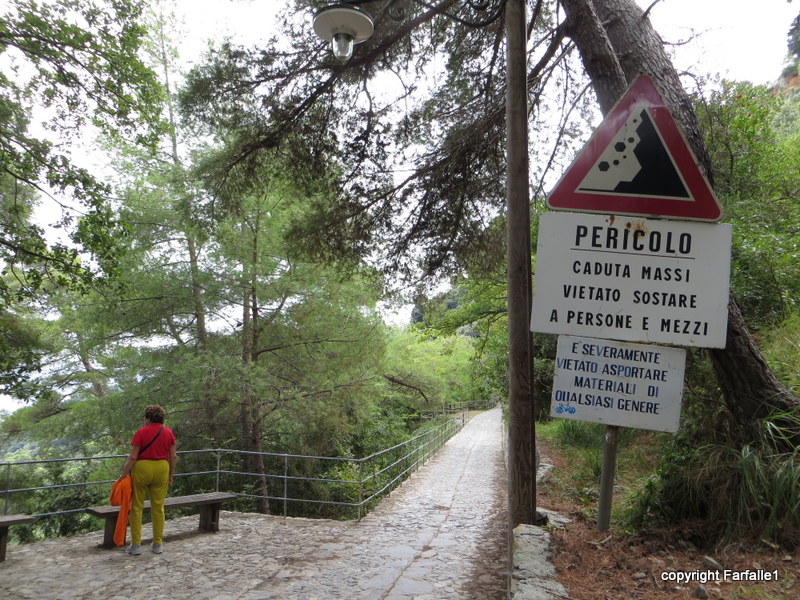
On the beautiful walk from Nozarego, above Santa Margherita, to Portofino we came upon this very confusing place. The top sign says “DANGER – Rockfall – It is prohibited for both people and vehicles to stop.” The one beneath it says “It is severely prohibited to carry off material of any sort.” Then they, whomever they are, thoughtfully provided benches and, farther along the path, a pull-out for vehicles which also offers a splendid view.
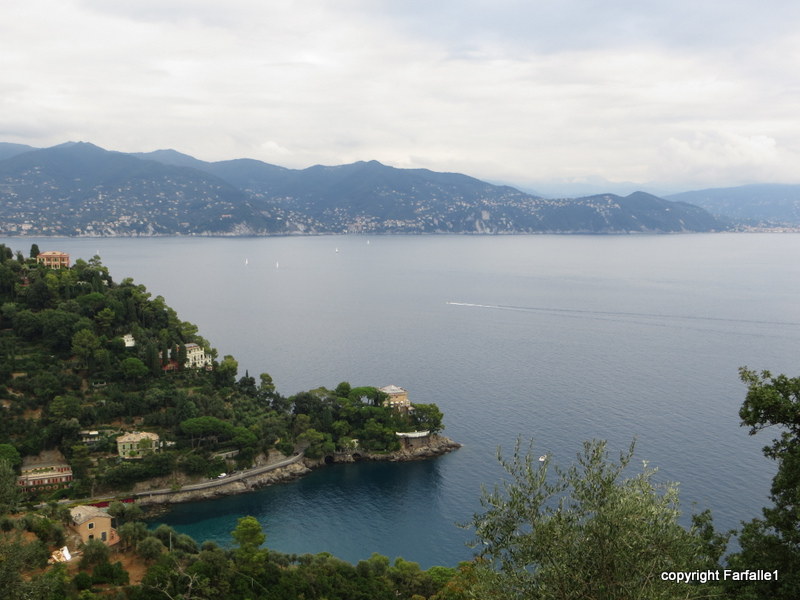
How can one NOT stop to take it all in? I think my head is going to explode.
20 Monday Jun 2011
Posted in Hiking in Italy, Photographs, Uncategorized
Tags
In my last post I told you about the Abby at Tiglieto. Following our visit there Elena, Michela and I took a ring hike through the adjacent Beigua Regional Park. Beigua is the largest park in Liguria and covers a variety of terrain from high mountains to streams to woodlands. We saw just the teeniest corner, but it was enough of a taste to make us want to return for more. Elena’s guidebook suggested it would take us two hours to complete our walk, but it took us four! I guess that’s what happens when two of the three hikers are toting cameras.
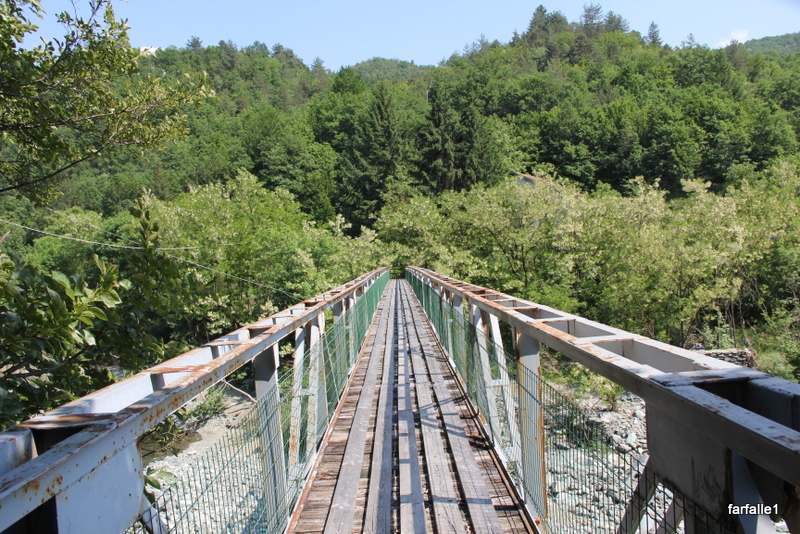
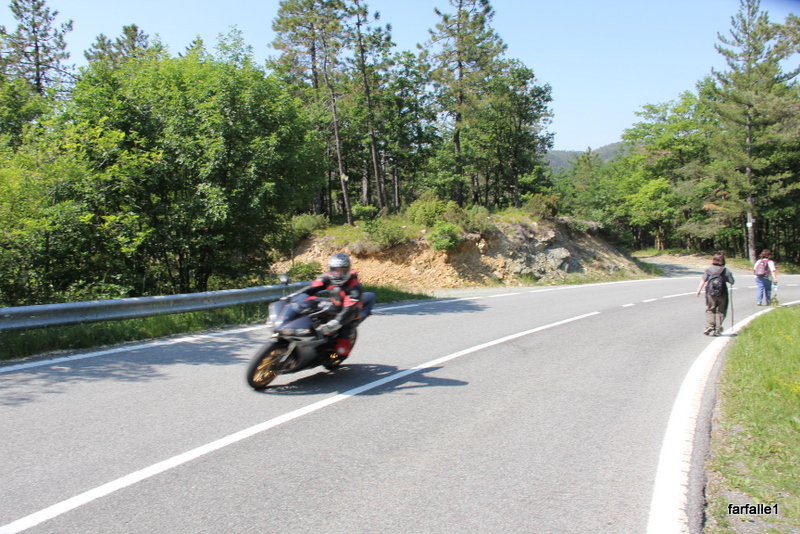
We crossed a number of bridges on our hike, some more rickety than others. One had enough missing boards to be downright worrisome, but most were in fine repair. The curvy, hilly roads in the park are a mecca for bicyclists and motorcyclists, of which we saw many on the occasions when our path crossed the road. Here, in no particular order, are a few photos taken on our hike.
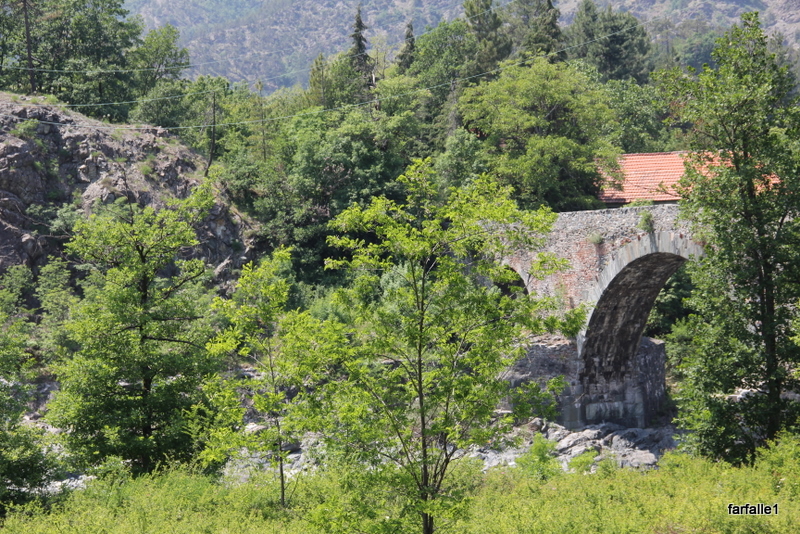
Roman bridge

Beigua's Grand Canyon
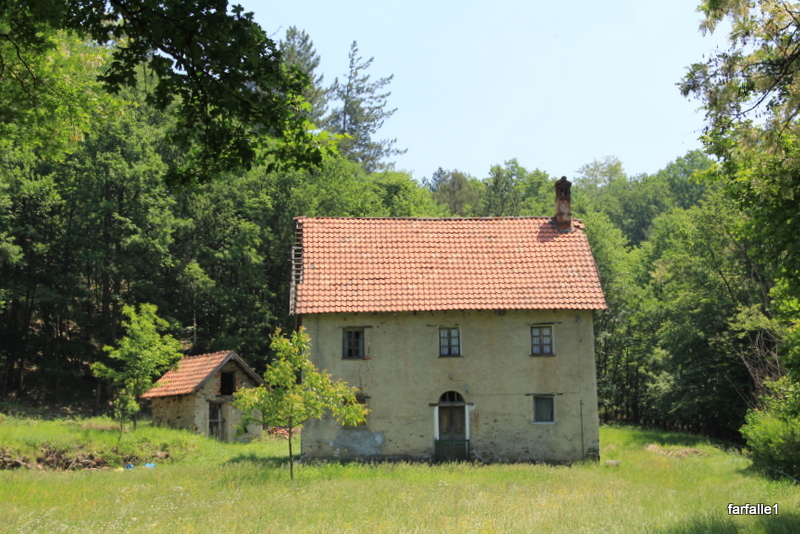

An old oven


Old shrine

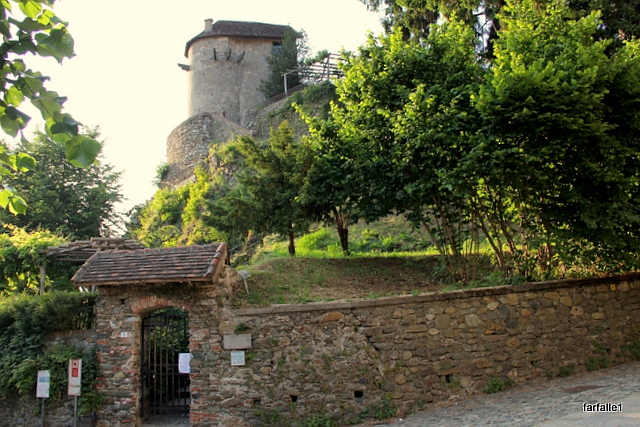
On the way home we stopped in the pretty town of Campo Ligure which features a castle built by Genova’s Spinola family in 1309 (closed by the time we arrived), a spacious central piazza with a 14th century palazzo (also Spinola) and a medieval bridge which has been much restored.
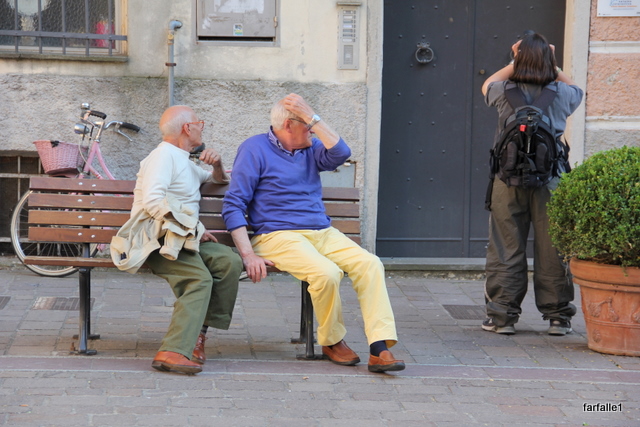
Here are some photos of that brief visit. An amusing event while we were there: a pair of old gents on a bench in the piazza kept staring at Michela as she took pictures – I couldn’t figure out why. It turned out they just wanted to be sure she knew about the medieval bridge and would go there to take photos. In fact, the man in the yellow pants followed us to make sure we did just that!
The highly touted bridge was built over the River Stura in the 9th century and rebuilt several times from the 18th century onwards:
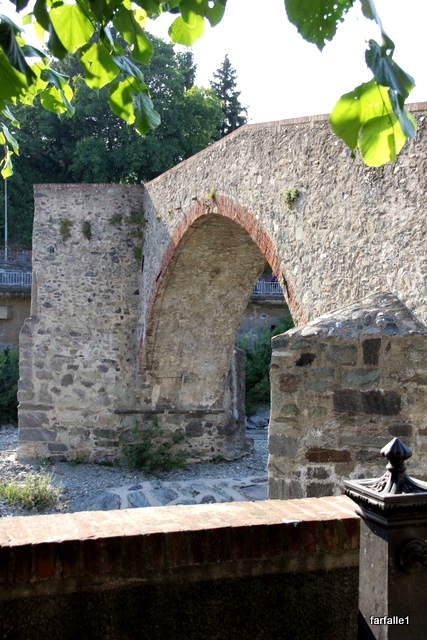
In spite of the rebuilds it still has a pleasingly romanesque shape.
The old center of the town is laced with narrow medieval alleys:
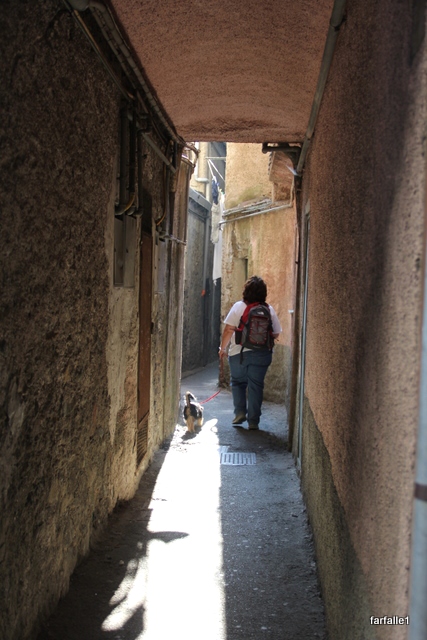
The castle sits atop the hill behind the town:
I’m not sure what purpose this chimney serves, or why it is so deliciously turned. If you know, please tell me:

This nonna and her tow-headed grandson were having excellent fun diverting the water from the lion’s mouth to make their own fountain:

Campo Ligure is a perfect example of what makes Italy such a delightful country to explore. Without be ‘important’ it offers a brief and interesting history lesson, as well as many beautiful little corners to discover.
21 Saturday May 2011
Posted in Flowers, Hiking in Italy, Italian flowers, Photographs, Rapallo, Uncategorized
Tags
It was a beautiful spring day, not too hot, not too cool, when four of us set out to have a walk and a picnic. We left from La Crocetta, the apex of the pass over the mountain on which the Captain and I live, and walked to Montallegro, the pilgrim church about which I’ve written in the past. We didn’t set out to have a wildflower walk, but that’s what we ended up having.
For some of the flowers we were too early:

and for some we were too late:

but for oh so many we were there at just the right moment.
Here’s something I learned from this expedition: I am hopeless at identifying wildflowers. I have two books on the subject, both related to flowers in this area, and I still find it almost impossible.
How I wish this blog had ‘smellovision’ so you could smell the sweet acacia:

These, by the way, are a culinary treat when fried up in a batter. Yum.
And I wish I could attach sound to this so you would hear the wind sighing through the trees. It sounded exactly like a Fellini movie (I’m thinking Amarcord, I guess, which I recommend you see if you haven’t already).
Here is a web album of the gorgeous flowers we found along the path. I identified the ones I was able to, but most of them remain a mystery. If you’d care to help identify, please, feel free! I’d be grateful.
If you’d like a quick video of the trail from La Crocetta to MontAllegro, you can ride along here on a February outing with mountain biker ‘guru63byric.’
Web album of wildflower walk:
 |
| Wildflower Walk from La Crocetta to Montallegro |
02 Friday Jul 2010
Posted in Cats, Hiking in Italy, Italian Churches, Uncategorized
How many steps from San Rocco to Punta Chiappa? I meant to count, but of course lost track somewhere along the way. I can tell you this: the change in elevation is from sea level to 210 meters above sea level; and the last little staircase on the return back up to San Rocco has 206 steps.
But I’m getting ahead of myself…
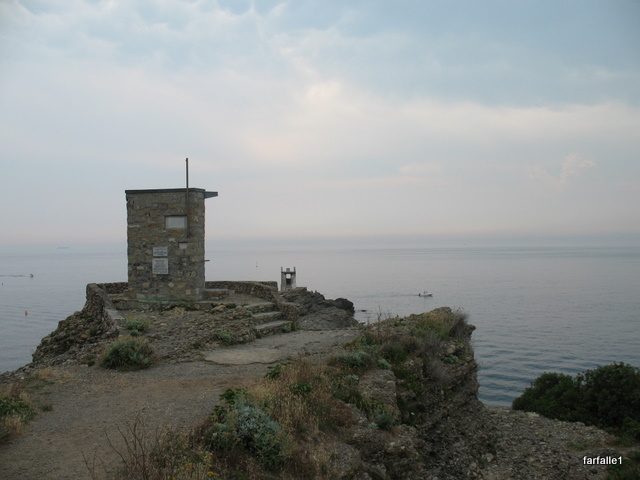
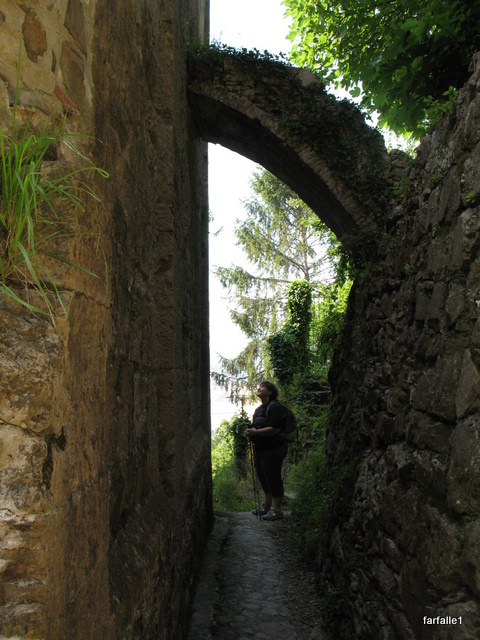
Punta Chiappa is the rocky tip of one side of the Portofino Peninsula. Like San Fruttuoso, which is not far distant, you can get there only by boat or on foot. The difference is that to reach San Fruttuoso by foot takes several hours from either Camogli or Portofino. You can reach Punta Chiappa in about half an hour from San Rocco, the lovely community above Camogli on a delicious woodsy path that has long paved sections and, by someone else’s estimate, 900 steps.
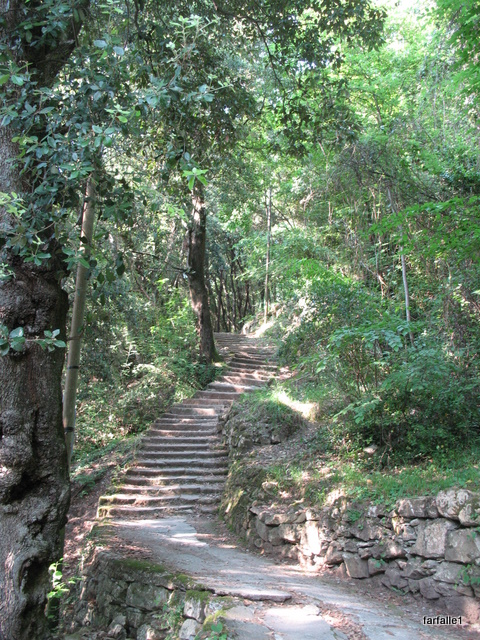
From Punta Chiappa there is a fine view back towards Camogli and the big hills behind it; down the coast to Genova and perhaps, on a clear day, the French Riviera; and to the southeast the continuation of the Portofino peninsula.
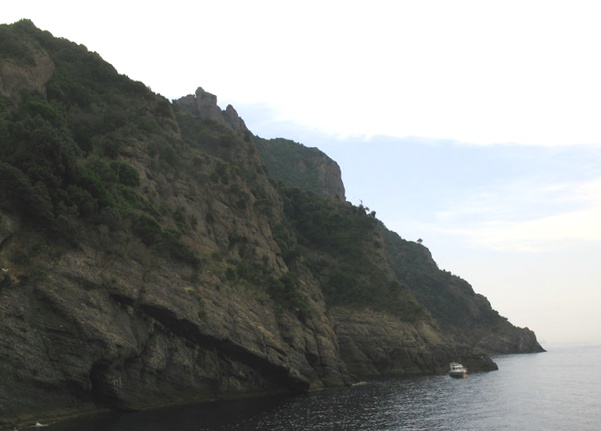
The point itself is made of rock, and plenty of it, although some brave plants have found a foothold there.
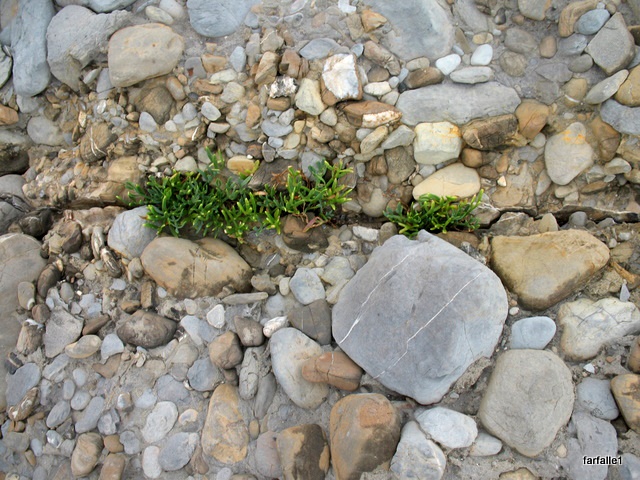
All the beaches on the peninsula feature these beautiful gray rocks with white lines in them.
The day we walked down was hot and steamy, but in the early afternoon the clouds rolled in and thunder began sounding its alarm over the mountains. Nonetheless we set out on our adventure. In fact the storms never materialized, but the cloud cover made the hike down and the looong hike back much more bearable.
There is not a lot of commercial activity at Punta Chiappa. Once upon a time a lot of ship related iron work was done there, but no more. You can still see the small cranes that moved heavy anchors and so forth, mounted on the side of the path. There are several great looking restaurants there. I’ve never eaten at one, but it’s now on my list of things to do. There is also, a bit further on, a restaurant for cats.
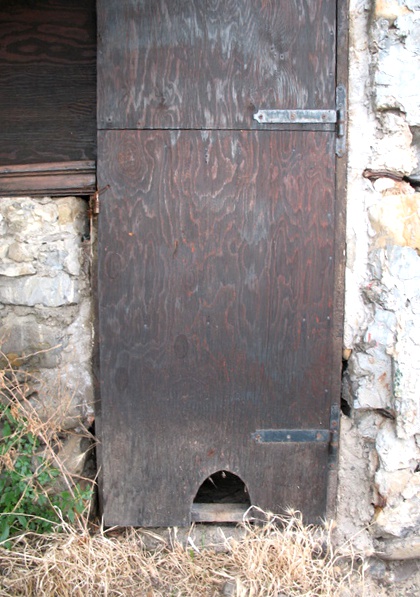 The door is well locked, but the kitties can come and go through the mouse hole below. Inside are several trays full of kuckies – which is what we call cat kibble, because when the cats chew it it sounds like kuckie kuckie kuckie. We saw one of the generous women who keep the restaurant stocked, as well as several satisfied customers who were just leaving.

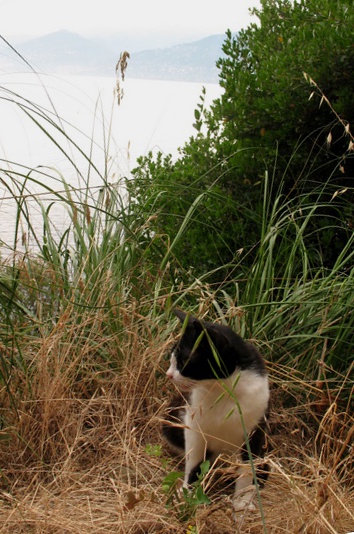
(By the way, if you like pictures of cats, check out the web album Cats of Italy; click the button for a slideshow.)
|
|
| Cats of Italy |
It felt a bit like stepping into a child’s story book when we arrived. There were not many people and there was a magical haze over the sea; boats drifted in and out of visibility, and it was not hard to imagine there were some great pirate adventures happening out there (if you squint you will see a 4-masted sailing ship in the photo below).

We swam a little, and read our books as the ferry and fishing boats trolled back and forth. A sudden movement caught our eyes: a school of sardines skimming across the top of the sea, with a dark shadow not quite breaking the surface behind. A second school appeared and skimmed, followed immediately by the graceful black arc of the back of a dolphin in search of supper. It all happened so fast we weren’t sure we had actually seen it. But we had, and it was wonderful.
Wonderful too was the walk back up to San Rocco. We took a much steeper, but shorter path which brought us in no time to San Nicolo’ di Capodimonte. I know! another San Nicolo’. Am I fated ever to find San Nicolo’ when I am with this particular friend? Evidently so!
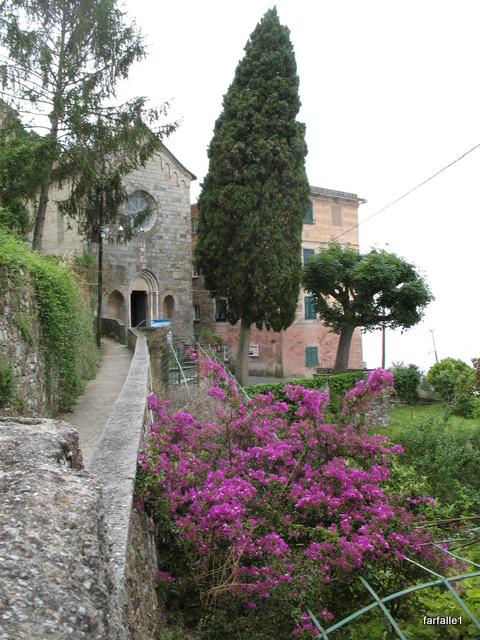
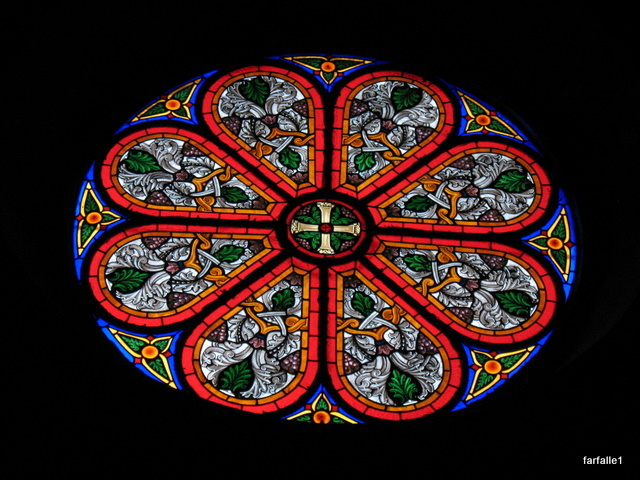
This church, however, is in much better condition than its namesake near Genova. And there is another restoration underway. We saved our visit to the interior for the walk back, and were rewarded with a cool and peaceful respite. This church also is very simple inside, though it boasts a particularly beautiful rose window.
San Nicolo’ di Capodimonte is reputed to have been consecrated in 345 CE, although of course there are no written records to confirm this. The present Romanesque church is supposed to have been built around the year 1000. Like its poor brother church, this San Nicolo’ too passed into private hands in 1860 during the suppression of the churches, which accounts for its lack of interior decoration. In 1865 Cav. Andrea Bozzo bought the church, restored it and built the neighboring residential houses. The church reopened for worship in 1870. After the death of Cav. Bozzo’s son in 1910 the church again became ecclesiastical property.
I can tell you two more items of interest. Although the church is called ‘Capodimonte’ it is nowhere near the top – more like halfway down. The second thing is this, heed my hard-earned advice: if you take this hike, and I hope some day you will, don’t wear sandals!

 An Ex-Expatriate