• Contact
  • Elaborations
    • A Policeman’s View
    • Driving School Diary
    • Great Danes
    • IVA charged on Tassa Rifiuti
    • Nana
    • Old trains and Old weekends
    • The peasant, the virgin, the spring and the ikon
    • Will Someone Please, Please Take Me to Scotland??
  • Recipes
    • ‘Mbriulata
    • *Baked Barley and Mushroom Casserole*
    • *Captain’s Boston Baked Beans*
    • *Cherry Tart*
    • *Crimson Pie*
    • *Louise’s Birthday Cake*
    • *Melanzane alla Parmigiana* – Eggplant Parmesan
    • *Penne with Cabbage and Cream
    • *Pizzoccheri della Valtellina*
    • *Pumpkin Ice Cream*
    • *Risotto alla Bolognese*
    • *Rolled Stuffed Pork Roast* on the rotisserie
    • *Shrimp and Crayfish Tail Soup*
    • *Spezzatino di Vitello*
    • *Stuffed Grape Leaves*
    • *Swordfish with Salsa Cruda*
    • *Tagliarini with Porcini Mushrooms*
    • *Tagliatelli al Frutti di Mare*
    • *Tzatziki*
    • 10th Tee Apricot Bars
    • Adriana’s Fruit Torta
    • Artichoke Parmigiano Dip
    • Best Brownies in the World
    • Clafoutis
    • Cod the Way Sniven Likes It
    • Cold Cucumber Soup
    • Crispy Tortillas with Pork and Beans
    • Easy spring or summer pasta
    • Fagioli all’ucelleto
    • Fish in the Ligurian Style
    • Hilary’s Spicy Rain Forest Chop
    • Insalata Caprese
    • Kumquat and Cherry Upside Down Cake
    • Lasagna Al Forno con Sugo Rosato e Formaggi
    • Lemon Meringue Pie
    • Leo’s Bagna Cauda
    • Leo’s Mother’s Stuffed Eggs
    • Louis’s Apricot Chutney
    • Mom’s Sicilian Bruschetta
    • No-Knead Bread (almost)
    • Nonna Salamone’s Famous Christmas Cookies
    • Pan-fried Noodles, with Duck, Ginger, Garlic and Scallions
    • Pesto
    • Pesto
    • Pickle Relish
    • Poached Pears
    • Polenta Cuncia
    • Pumpkin Sformato with Fonduta and Frisee
    • Rustic Hearth Bread
    • Sicilian Salad
    • Soused Hog’s Face
    • Spotted Dick
    • Swedish Tea Wreaths
    • The Captain’s Salsa Cruda
    • Tomato Aspic
    • Vongerichten’s Spice-Rubbed Chicken with Kumquat-Lemongrass Dressing
    • Winter Squash or Pumpkin Gratin
    • Zucchini Raita

An Ex-Expatriate

~ and what she saw

An Ex-Expatriate

Category Archives: Italian bureaucracy

Revisione

26 Friday Oct 2012

Posted by farfalle1 in Driving in Italy, Italian bureaucracy, Liguria

≈ 9 Comments

Tags

Car inspection in Italy, Vehicle inspection in Italy

For all the ways that life in Italy seems different, there is one thing that is absolutely familiar – vehicle inspection.  That’s kind of surprising, given how many layers of administration there usually are to the simplest of tasks in this bureaucratic nation.  But getting the scooter inspected proved to be very simple.

The first step, of course, was to stop in at our mechanic Simone’s shop so he could give my bike the once-over for any glaring deficiencies.  He felt everything was okay, but encouraged us to tell the examiner that he was our mechanic if there were a problem – we presume that would have eased whatever might have followed.

In the event, it wasn’t necessary as the scoots passed with flying colors.

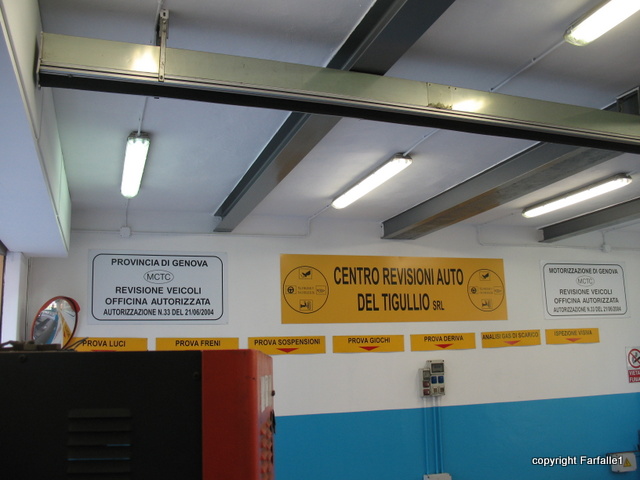
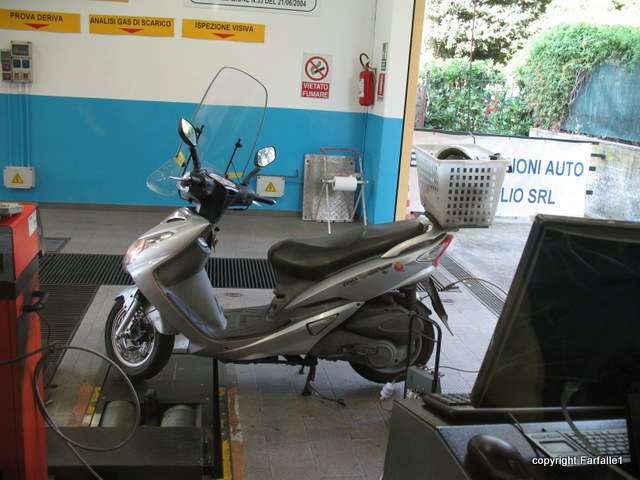
They check all the same things here that they check in the U.S.: lights (luci), brakes (freni), suspension (sospensioni), play in the steering mechanism and the chassis (prova gioca and prova deriva), emissions test (analisi gas di scarico) and finally a visual inspection (ispezione visiva) and in pretty much the same ways: there’s the spinning doodad for testing brakes:

and the pokey thing that goes in the tail pipe:

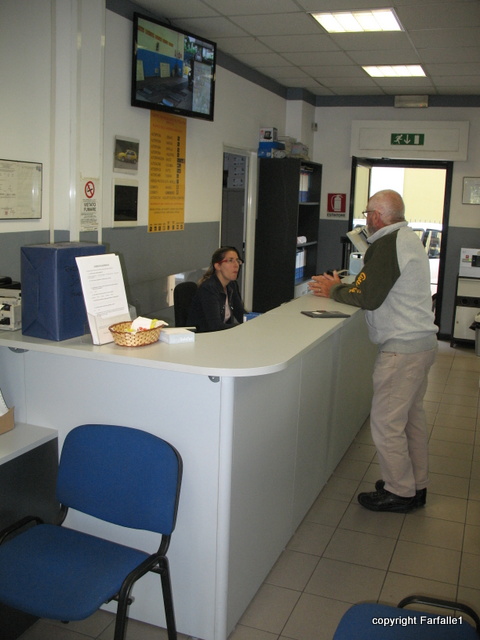
So all in all, it turned out to be not terribly interesting in terms of being ‘different’ – but it’s always fun to visit any Italian office and jaw with the people there.  Here is Speedy discussing this and that with the very cheerful and helpful Francesca:

And wait – there are a few differences.  In Arizona we simply drive up to one of the Testing Stations (after first looking online to see how long the wait might be – always short where we live).  Here we had to call about a week ahead to make an appointment.  To our great satisfaction we didn’t have to wait at all; they were expecting us.

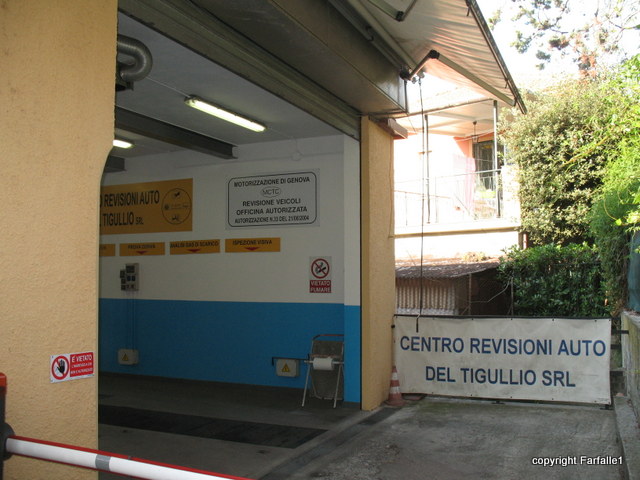
The testing stations in Arizona are rather large; they have to be to accommodate some of the giant trucks that come through.  It’s a tight squeeze for a car to get into the entrance of the Rapallo site (top photo), two 90-degree turns are required.  No 4 X 4’s here, please (although presumably there are other testing stations for all the trucks we see on the roads).

Here’s another difference: cost.  In Arizona we pay $27.75.  Emissions testing there is tied to auto registration: both have to be done every two years.  Everything but the actual emissions test itself can be done online.  It cost us €65.50 (about $85 given the present exchange rate) for the revisione of my scooter, which is also good for two years.

But all in all, it’s one of the simplest of bureaucratic tasks that we undertake here, and the people at the testing center (Francesca and Paolo) are kind and efficient. Here’s a strange fact of automotive life in Italy: you have to be a legal resident here to own a vehicle of any sort.  As a resident of another country you can own a house, but you can’t own a vehicle.  Isn’t that odd?

A(nagrafe) to Zed

19 Thursday Jul 2012

Posted by farfalle1 in Italian bureaucracy, Italian habits and customs, Italy, Law and order, Uncategorized

≈ 12 Comments

Tags

Anagrafe, Gathering social data, Italian bureaucracy, Italian social data

Anagrafe (an-ah-gra-fey) is the office in each comune that keeps track of who’s who and the status of each inhabitant: births, deaths, marriages, divorces, that sort of thing.  This is true, it seems, for both Italians and resident expatriates  (Anagrafe issues our Carte d’Identite).  I’m sure they do other things of which we’re completely unaware.

One such thing was brought to our attention last week when we received a visit from the very affable Piermanlio (a roman name, he told us) who spent two and a half hours grilling  interviewing us.  He works for the Statistics Department of Anagrafe (who knew?) and spends a good part of his life traveling from one expatriate domicile to the next interviewing people.  Then he spends some more time transmitting his data to the main office in Rome (without identity information attached) where it is all, presumably, crunched up and turned into important reports of some sort, which in turn lead to enlightened social policies, new laws and more bureaucracy.

Here are two things you might not be able to tell about Manlio from the above photo:  he is probably one of the most patient and kindest guys in the world; it is hard for him to find shoes because his feet are large.  For this reason he takes exceptionally good care of the shoes he wears. ( I guess that’s three things, but since the last two are so closely related I’m counting them as one.)

The last time the U.S. took the census we won the long-form lottery, and spent about thirty or forty minutes filling in the form with information about our race, gender, education, income and what kind of house we lived in.  Well.  Italy could certainly teach the U.S. something about long forms.

At first we thought Speedy would be the only one interviewed, which was fine by me, as it took ages.  To the surprise of all three of us Manlio was instructed by his computer to interview me when Speedy was done.  What response triggered that, I wonder?  Most of the questions were the same, but there were some amusing differences.    They were all multiple choice questions and all answers were entered immediately into Manlio’s laptop.  If an answer was wildly out of the norm the computer might give Manlio a query sign.  If it was totally ridiculous the system was blocked til a realistic answer was put in.  How do we know?  Speedy answered 8 years old when asked at what age he began working (happens to be true).  Turns out the question meant when he stopped being a student and began to work as an adult.  ‘8 years old’ caused a delicious block.

Here are some of the topics Manlio covered with us during our time together, other than the obvious of age, heritage, race, religion and education.

Do we have relatives living in Italy?  Do we have relatives living outside the US but not in Italy?

In our family, who makes the decisions?  Who does the housework, do we share the burden? Who does the marketing?  Who cooks?  Is it up to the husband to choose who the wife’s friends will be?

Do we like Italian food?  Do we eat it often? Do we eat food of other cuisines?

Are we healthy?  Smoke? Weight? Height? Do we take medicines? (polite Manlio: ‘oh yes?  They’re prescribed, I would assume.’  Us: ‘Of course!’)

Curious omission noted here: no questions about drinking and/or wine!

Do we have a car?  How many TV’s? Motorini?  A video camera? (why a video camera?)  When we watch TV, do we watch in English or Italian or ? Do we have a satellite dish?  More than one?

Do we have a telephone  land line?

Why did we move to Italy?  Who decided that we would move to Italy?  How did mother feel about it (Really!  This was a question for me, the only one of us with an extant mother when we came.)

What language do we use when speaking to each other?

Do we read newspapers, if yes in hard or virtual form? Magazines? Books?  In what language(s)?

Do we follow Italian politics?  Do we talk about politics with friends? Do we feel knowledgable about Italian Politics?  How often do we discuss politics?  Same questions again vis-a-vis the U.S.

What do we do for entertainment: movies? sports? concerts?

I guess one can catch the drift of the kinds of questions being asked and the kind of information they are trying to gather.  There are so many people from all over the world living in Italy now, there’s perhaps not unreasonable concern that the ‘national identity’ might erode.  At the very least there is also interest in knowing if the basic ‘rights’ generally recognized here are being observed by one and all.

I guess my favorite question, one directed to both of us, was: Has anyone in Italy made you feel uncomfortable because you are a foreigner?  How lucky I felt at that moment.  Italians like Americans; they do not necessarily like all the other nationalities represented in the immigrant population.  No.  No one has ever made us feel uncomfortable, I’m happy to say, though I’m certain others have not been so fortunate.

My favorite unasked question: Does your husband still beat you?

I guess it’s not just a cold, hard, statistical office after all.  They care about us, they really care.

Taxing Times

05 Tuesday Jun 2012

Posted by farfalle1 in Italian bureaucracy, Taxes in Italy, Uncategorized

≈ 15 Comments

Tags

Ici, IMU, Italian taxes, IVIE

Just when we think we’re finally getting a handle on the ins-and-outs of Italian bureaucracy, Italian bureaucracy throws us a curve ball. This year it is the in the form of two new taxes.

Well, actually one re-instated tax and one new tax.

The reinstated tax used to be call l’ICI, and it was a modest tax on one’s real estate holdings in Italy. Several years ago then Prime Minister Silvio Berlusconi abolished the tax in an effort to appease voters and gain re-election, in which endeavor he succeeded. If you have been following events in Italy, you know she is in deep financial crisis, and that the new Prime Minister, Mario Monti, is a technocrat.  ” Technically (no pun intended), a technocratic government is one in which the ministers are not career politicians; in fact, in some cases they may not even be members of political parties at all. They are instead supposed to be “experts” in the fields of their respective ministries.” (For a more in-depth explanation of a technocracy, read this article by Joshua A. Tucker, writing for ‘Aljazeera,’ from which the preceding quote is taken.)  Monti has been given the unenviable task of ‘fixing’ the Italian economy, and one of his steps has been to reinstate the ICI, now known as the IMU  (Imposta Municipale Unificata).  It is pronounced exactly as below.

Photo courtesy of http://www.mdahlem.net

Figuring out what one owes for the IMU is not terribly difficult, fortunately. There is a handy-dandy website (Google IMU *your town’s name* to find it) that will tell you just what you owe, and will even print out the F24 form to use when paying it. The first payment is due June 18. The second payment is due in September if you are paying in three installments, or in December if you are paying in two. The tricky part is that part of the tax goes  to the federal government and part goes to municipalities. Rates for the later have not yet been set, and probably won’t be until August; so while you can figure out what you owe and need to pay for June, the second and third installments are still a bit of a mystery. The tax is only slightly higher than the old ICI for first homes. It is a good bit higher for second homes.

Speedy and I have no problem with this tax being stout-hearted believers in paying for civic services, even curtailed as they have become through the austerity measures.  We DO have a big problem with the second tax.

Ivy courtesy of sparkle-and-fadeaway.blogspot.it

The IVIE (Imposta sul valore degli immobili situati all’estero) is a tax on any real property owned in another country.  Designed to catch out the big fish who hide large assets overseas, this tax is sadly also netting all us little minnows.  It is not a particularly small tax either, as it is equal to 0.76% of the value of your property.  The tricky part here (aside from actually paying the damn thing) is knowing what the correct value of the overseas property is.  Fortunately in the U.S. we all have assessed values placed on our homes for tax purposes, so I suppose we could use them.  And one does get a limited amount of credit for real estate taxes paid to the locality of the property in question.

There is yet another tax which is sort of bundled in with the dreaded IVIE (dubbed ‘Poison IVIE’ by The Informer website which, by the way, I highly recommend to anyone living in Italy).  Strictly speaking it is not IVIE, but it feels like it – it is a tax on the value of any money, funds, pensions and so forth that you might have in another country.  For 2011 and 2012 it’s 0.10% of the value of said investments; in 2013 that goes up to 0.15%.  Probably by then no one will have any money left anyway, so never mind.

We understand the reasoning behind these IVIE taxes but they seem hideously unfair to an expatriate.  They are, once again, meant to catch big fish: the wealthy who have secreted their resources in foreign countries or off-shore safe havens, something rich Italians are famous for doing.  The penalties for not reporting/paying are extortionate – 10%-50% the value of the unreported assets.  Many of us “victims” of this tax wish the government huge success so as to alleviate the burden on us in the future.

It is ‘Poison IVIE’ indeed to those of us who are just trying to enjoy a quiet  expatriate life.  At some point Italy will ask just one thing too much of us; our backs will break.  We understand that we all have to do our bit to save the country, but taxing assets in our home country just isn’t right.  And don’t get any ideas, U.S.A. – don’t think you can start taxing our property here in Italy!

What Would Be the Dumbest Thing in the World to Tax?

19 Saturday May 2012

Posted by farfalle1 in Animals in Italy, Cats, Italian bureaucracy, Italian gardens, Italy, Law and order, Taxes in Italy, Uncategorized

≈ 10 Comments

Tags

Silly Taxes, Tax on Pets

Pets.  That would be ridiculous, wouldn’t it?

Real Luciano

Speedy sent me an article he came across  from Reuters (reported by Philip Pullella; edited by Andrew Osborn) about the yahoos in Rome considering a tax on  family pets.  Evidently a parliamentary commission felt that this would be an excellent way to give a little boost to the nation’s diminished coffers.  The outcry was immediate and loud; the proposal was dead by the end of the day.

It got me thinking, though.  Didn’t Italy once tax house windows, and isn’t that why there are so many trompe L’oeuil windows painted on the houses of Liguria, where people are famously tight with their cash?

Tax Evasion Luciano

Probably the idea of taxing pets is not the silliest tax proposal ever made.  A quick Google search turned up an amusing list of the ten most ridiculous taxes ever, written by Jamie Frater.  It turns out that Rome is no stranger to bizarre taxes.  The emperors Nero and Vespasian taxed urine.  Poor Romans fortunate enough to have a pot to piss in paid a tax when they emptied their pots in the common cesspool.

Go ahead, tax my dog Rover – just get rid of the tax on my hat and my beard.  I think my favorite is the one called the Crack Tax: drug dealers in Tennessee were, before the law was declared unconstitutional, supposed to pay a tax, anonymously, on the illegal substances they sold.  If they got caught dealing crystal meth, say, and didn’t have the tax stamp… well, can you imagine?  They’d have been in pretty hot water!

It did give me an idea for another tax the Roman legislators might consider:

Photo courtesy of thedragonpages.blogspot.com

The Intergluteal Cleft Tax would either raise a lot of money or send fashion careening in a new direction.

Not all strange taxes are so amusing.  The poll tax in America was a de facto method of denying voting privileges in the southern states to recently freed slaves.  It was not repealed until 1964.

Anti-Poll Tax sentiment from the U.K.

The way things are going in this election year they may have to pay people to come to the polls instead.  Especially here in Rapallo where only 16,000 of 28,000 possible voters turned out two weeks ago to elect the Mayor.

There will always be taxes, I guess.  And I guess there will always be some silly ones.  I’m just glad that, for the time being anyway, there will be no taxes in Italy for owning a pet.  Speedy suggests that instead of taxing pets perhaps the legislators could tax vegetable gardens….

A nicely laid out garden on Via Betti in Rapallo

Tag, Yard or Garage?

17 Friday Feb 2012

Posted by farfalle1 in American habits and customs, Italian bureaucracy, Uncategorized

≈ 14 Comments

Tags

Private Sales, Tag Sales, Yard Sales

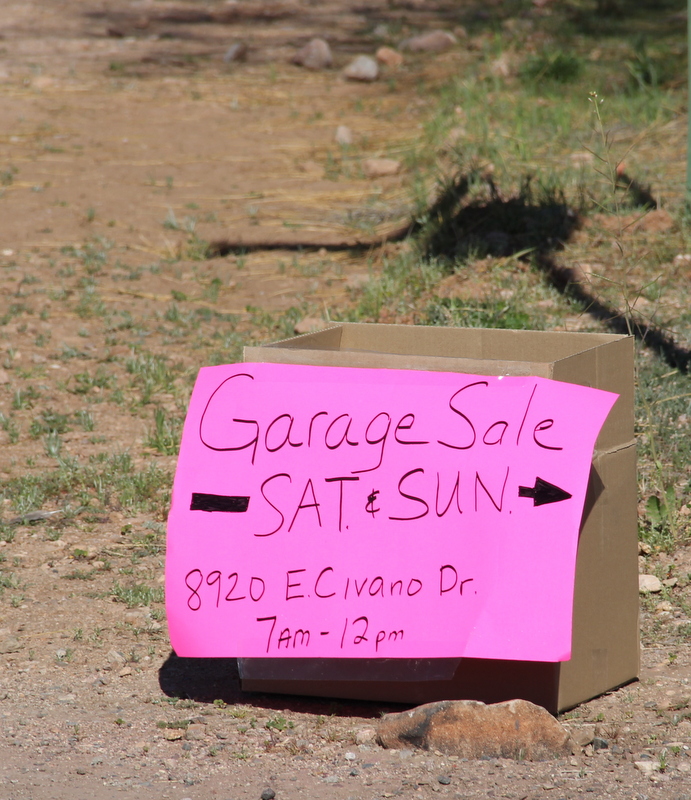
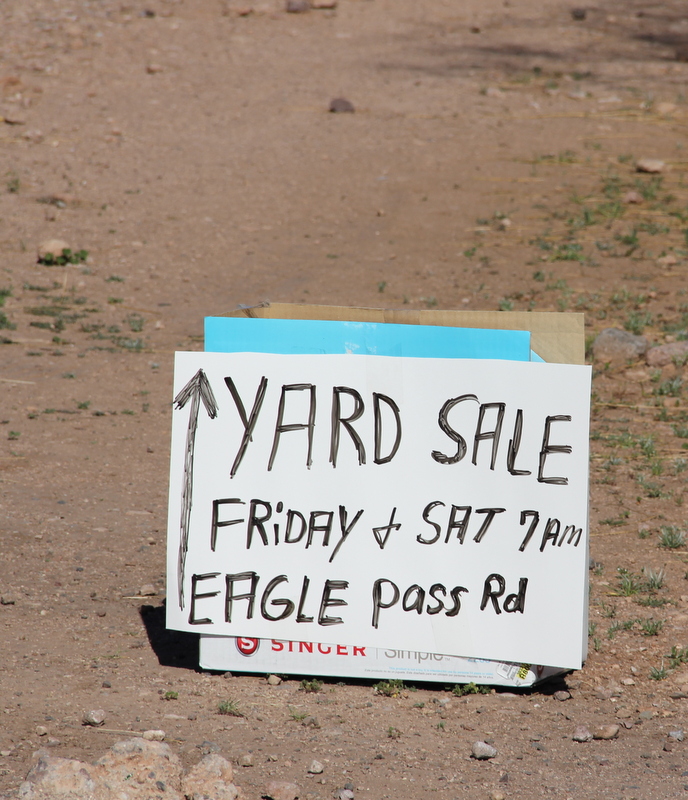
You see all three in home-made advertising signs: Tag Sale, Yard Sale, Garage Sale. They all mean the same thing: the householder has things, stuff, goods, that he no longer wants, and is willing to sell them to you, presumably at a very low cost.

The ‘Yard’ and ‘Garage’ are obviously the location of such sales. Frequently you see signs for Gargage Sales in parts of the country where the weather might be inclement – everywhere except the Southwest. ‘Tag’ refers to the little white sticker that should be affixed to every item announcing its price. It always gives one an uncomfortable feeling if there’s no tag – it means the seller is going to size you up and price the item accordingly. You’ll probably pay more for an untagged item if you’re wearing your mink instead of your blue jeans jacket. In New England, where we used to live, ‘Tag Sale’ was the most frequently used appellation. But whatever you call it, it’s a great thing, and something we don’t see in Italy, unfortunately.

When we’ve asked Italian friends why there are never any tag sales they have told us that they are not legal. Why? Presumably it’s because the State would not be able to collect taxes on such impromptu and unregulated commerce. What a pity. The best we can do in Italy is take our unwanted things to an ‘Usato’ – a store that sells used stuff and, of course, takes a hefty commission for doing so. A visit to the Usato is always loads of fun, there is so much to see, and of all kinds of quality. But it doesn’t have the character of each and every tag sale, which bravely puts the seller’s taste (present or former) on display for all to see. At some tag sales you might see a lot of tools; at another you might find lots of truly ugly art; at another lots of kitchen gear. You never know.

Photo courtesy of L.A. Times

A digression: I used to haunt tag sales, as much for entertainment as anything else (heaven knows we have all the ‘stuff’ we could ever want or need). Years ago I went to a rather up-scale sale in the small Connecticut town where we used to live; I was thrilled when my eye fell on a pressure cooker, a tool our kitchen was without and which I wanted – more from a sentimental wish because my mother frequently used one than from any real need. It was only $5 and was in perfect shape, except for needing a new gasket. I grabbed it, and continued perusing the goods on display. I soon ran into our town’s wealthy dowager, whom I’ll call Lib. When she saw ‘my’ pressure cooker her eyes got big, “Are you going to buy that?” she asked.
“Yes!” I answered with alacrity, and then went on, “Why? Do you want it?”
“I do,” she said.
“I can’t believe you don’t have a pressure cooker, Lib,” I opined.
“Oh I do,” she replied, “I have three. I just really like pressure cookers.”
That was when I recognized that she was a fellow tag-sale junkie, and that there was no need to offer to let her buy ‘my’ pressure cooker.

A friend, when I mentioned all this to her, reminded me that there is also a thing called an ‘estate sale,’ which you see frequently in New England. But all it is is a high-end tag sale: better stuff, higher prices, and an opportunity for the seller to feel that he lives on an estate rather than in a house. Which reminds me another digressive tag sale story I must share. One of my work buddies reported that she went to a terrible tag sale in a neighboring town. On the porch of the house she found a box labeled in big black letters, “Stuff Barb Don’t Want.” We laughed over that for weeks (and still do sometimes) – it had to be the worst presentation and lousiest advertising ever. Definitely not an Estate Sale.

But back to Italy – wouldn’t it be great if people could have tag sales there? It would be a way for the house-holder to both get rid of clutter and to bring in a little cash, always welcome in hard times, which is what we’re having there now. It wouldn’t really hurt the Usato shops, because there will always be people who don’t want the bother of a tag sale. Believe me, it’s a lot of work to have a tag-sale; we’ve had many ourselves (have to get rid of all the junk I’ve bought at tag sales somehow). The lost revenue of taxes would be nothing compared to what is lost every minute through graft and cheating on taxes. And besides – as there are no tag sales now there is no tag sale tax revenue, so there’s nothing to lose except the minuscule amount that the Usato would be turning in.

So my modest proposal to Mr. Monti is this: somewhere in all the financial reforms, tuck in a proposal to allow tag sales. Everyone will win. Heck, if you’re worried about revenue, sell a permit for the sale for E5 or E10. Then it becomes a money-maker, and no doubt the apparatus to sell such permits is already in place. It’s a wonderfully Italian solution – give a bit more freedom, but encumber it with a bit more bureaucracy. Yay!

Taxi!

15 Sunday Jan 2012

Posted by farfalle1 in Driving in Italy, Health and health care, Italian bureaucracy, Italy, Medical care in Italy, Uncategorized

≈ 13 Comments

Tags

Italian pharmacies, Italian taxis, Monti reforms

Quick!  Take me to the Pharmacy!

Photo courtesy of italyfromtheinside.com

An article in the English edition of ANSA describes a wildcat strike by taxi drivers in Rome.  They are unhappy because the Monti administration, in its package of reforms, wants to loosen requirements to become a cabby.  This is just one of many measures aimed at boosting Italy’s flagging economy and making it possible for young people to find work –  all of which are being offered in tandem with severe austerity measures.

Photo courtesy of tuscantraveller.com

Back in 2007 the Roman taxi drivers were angry, too.  At that time the city wanted to add 1,000 cabs to the stable.  Rome had, at that time, 3 cabs for every 1,000 residents, the fewest of any city in Europe, according to a Marketplace report.

Prime Minister Monti, photo courtesy of The Guardian

Another of the proposed Monti reforms calls for relaxing the regulations around opening a pharmacy.  As things are now it is almost impossible to open a new pharmacy.  A young person can go to school and become a pharmacist, but without family connections to an existing business, finding a position will be difficult (not impossible, but difficult).  But the entrepreneurial pharmacist who wants to open a new drugstore is just plain out of luck.  The number and opening hours of pharmacies are regulated by law according to about.com.  It is also true that if you want to get aspirin or vitamins you will have to go to a pharmacy where you will find them hideously packaged on foil covered cardboard.  Last time I forgot to bring aspirin from the States I paid € 6 for 30 aspirin.  Speedy says that often when viewing the painkiller section of a Walmart store and seeing 500 Iboprofen selling for $6.28, he thinks an Italian seeing the same shelf would need a cardiologist rather than some pills.  Until recently the only place you could buy prepared baby food was at a pharmacy.  Imagine!

While there is a lot wrong with the pharmacy system in Italy (and probably the taxi system as well), there is a lot right.  There is always at least one pharmacy open within shouting distance, and the pharmacists are highly trained, knowledgeable and able to help with minor medical emergencies, saving one a trip to the emergency room.  But the regulations against competition in pharmacies could be relaxed without reducing the requisite training for pharmacists – that would be good for consumers and for young pharmacists.

The larger problem, of which these two issues are representative, is that Italy is a country strangled by bureaucracy and regulations.  There is no place for young people to find work because all the trades and professions are so busy protecting their own interests that they are unwilling to be open, to expand or to share.  That’s bad for all concerned, it seems to me.  Educated young people live with their parents and fruitlessly hunt for jobs; the professions stagnate and suffer gross inefficiencies due to limited scope and size. Speedy reminded me that the current generation of Italians is called the NEETS (not in education, employment or training) generation (15 to 29 years-of-age), of which there are some 2 million.  These NEETS comprise 11.2 % of this age group in Italy compared to 3.6% in Germany, 3.5% in France, 1.7% in the UK, and but .5% in Spain.  All that talent going to waste!  Clearly, this is a socio-economic problem that will have long-lasting effects unless the new government, and the Italian people, can turn around their unique approach to social management.

To an American it seems ludicrous.  In the States it is relatively easy to start a business – all you need is a good idea and either money, or backers with money.  Granted, some 35% of new businesses will fail within the first two years, but at least one has the opportunity to try.  And if only 35% fail it means  that 65% succeed, giving income and occupation to more people and, because of the competition generated, giving better services and lower prices to society in general .

It will be interesting to see how it all plays out in the months ahead.  In the meantime, don’t get sick in Rome – it might be hard to find a cab to take you to the pharmacy.  And if you’re visiting Italy from the States, do bring your own aspirin.

Who Knew – Cold Breakfast

24 Wednesday Aug 2011

Posted by farfalle1 in Italian bureaucracy, Italian food, Italian habits and customs, Liguria, Uncategorized

≈ 2 Comments

Tags

B&B's Italy, Breakfast at an Italian B&B, Italian B&Bs, Ligurian regulations

Photo courtesy of mintfoods.com.au

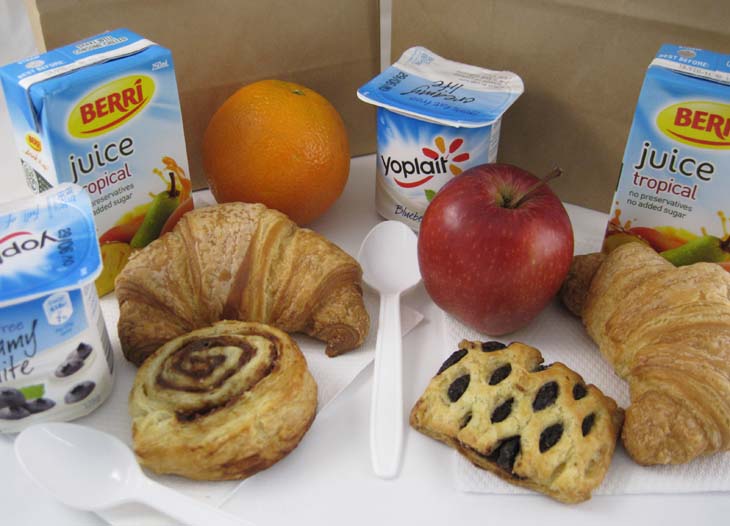
One of the joys, arguably the principal joy, of staying at a B&B is the breakfast part of the equation. We almost always seek out small B&B’s when we travel. Sometimes the decor is plain, sometimes fussy, the beds sometimes too small or not terribly comfortable. We almost always find a level of cleanliness Expatriate could only hope to emulate in her own home. And of course, the best part: breakfast! In Germany and Austria the array of cold sliced meats and cheeses is mouth-watering. In England the FEB (full English breakfast) with fried tomatoes, mushrooms and cold toast in that silly toast-holder is a good reason to get up early.

If you visit Liguria I encourage you to stay at a B&B if that is your preference (and I can even supply the names of a few superb ones), but I must warn you, don’t come anticipating a full cooked breakfast. It’s not that the hosts are lazy or unimaginative; they are simply not permitted to serve anything other than packaged foods for breakfast.  Isn’t that crazy?

There’s a good reason for this sorry state of affairs.  B&B’s are regulated on the regional level in Italy, and there is no inspecting agency to check hygiene and food preparation standards at B&B’s in Liguria.  It’s hard to believe there is a place in Italy where the bureaucracy has declined to put out another tendril, but so it is.  So to protect guests the Ligurian regulations decree that only packaged food can be served.  Ick.  Some (not all) other provinces have such an inspecting agency – and that’s why you can get a ‘real’ breakfast in, say, Tuscany.

So the next time you’re at a B&B and you wonder why your highly anticipated breakfast has turned out to be only buns in a plastic bag, some cookies in a plastic sleeve, cereal in a small box and that’s it… it’s possible that those are the only available permitted foods.  Who knew?

I asked the friend who explained all this to me if eggs were allowed – after all, they come in their own rather elegant packaging.  But one would have to eat the egg raw since cooking is not permitted, and that carries its own risks.  Besides, no self-respecting Italian would eat, or serve, an egg for breakfast. Benvenuto a Rapallo and enjoy your cereal!

Not Quite Ready for Prime Time

30 Thursday Jun 2011

Posted by farfalle1 in Italian bureaucracy, Italian habits and customs, Italian Postal Service, Shopping, Uncategorized

≈ 12 Comments

Tags

Alice, Amazon.it, Mailorder in Italy, Online purchasing in Italy, Telecom Italia, TIM

photo credit: 49th-parallel.blogspot.com

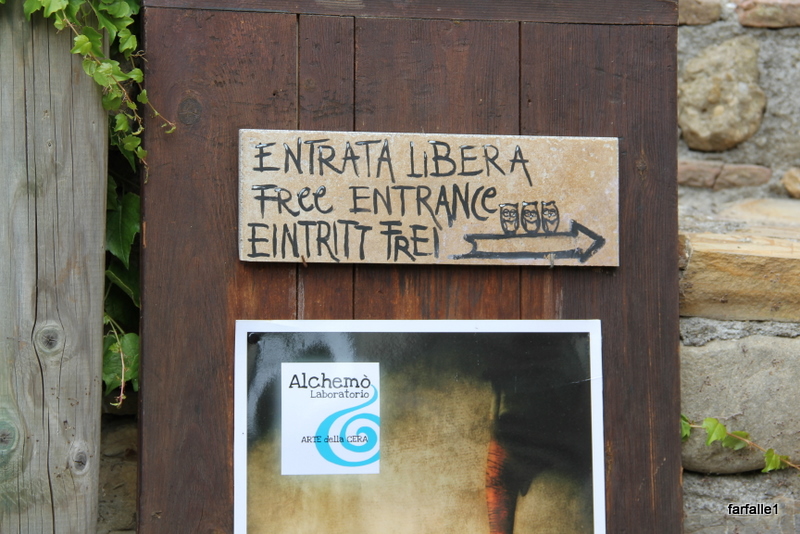
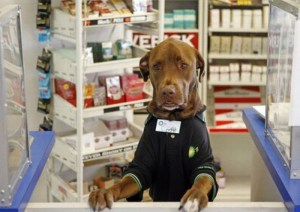
In years past it seemed that Italy embraced the notion of “Service” with some reluctance.  I’m thinking of the bad old days, of how when you entered a shop you were expected to make a purchase – which is why you now sometimes see signs in shop windows that say ‘Entrata Libera’ – that is, you can come in and look around and not feel obligated to buy something.

Combine dubious service ethics with an elastic sense of time and you get a good idea of how your problem with Telecom Italia (fondly known as TIM) might be handled.  An example.  We lost our landline telephone service on a Friday; it was restored the following Monday.  That was bad, but it wasn’t the end of the world thanks to cell phones.  We lost our broadband internet service (winningly named Alice: TIM and Alice, what a pair!) the following Wednesday, for no apparent reason, i.e., no storms, electrical outages, sunspots, aliens, etc.  Since the internet is for us what the aorta is for your heart, the Captain immediately phoned 187, TIM’s appealingly brief help number.  After explaining what had happened to a sympathetic woman he was told that the situation would be rectified in two days.  TWO DAYS??  How about two hours, or, better, two minutes?  Two days was simply not acceptable.  It was also non-negotiable, so we had no alternative but to swallow our frustration and submit.

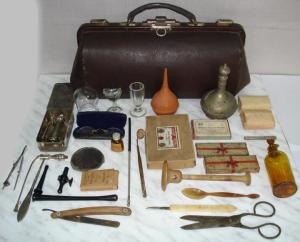
photo credit: ioffer.com

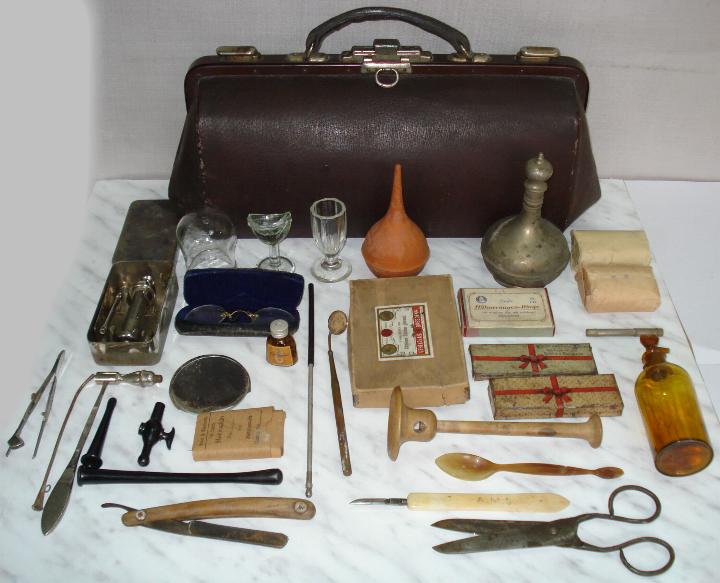
Sure enough, on Saturday morning two cheerful TIM Techs appeared with their tool-laden black bags (they remind me of the doctors who used to make house calls when we were young, black bags bulging with mysterious and disturbing apparatus).  After satisfying themselves that it wasn’t our wifi server at fault they checked the connections outside and did some other line checks.  After a spirited discussion between themselves, which we could barely follow, they told us that the problem was at Centrale, that we were awfully far away from the center of Rapallo, and that therefore the solution was to change our account from a 7 mbs to a 4 mps service.  Okay, that doesn’t make a bit of difference since we receive data generally at only about 1 mps.  The solution just didn’t make sense to me, but it did to them, so that’s what they did and Voila!  The internet came back.  Phew!

Except it didn’t stay with us.  It came and went, seemingly at will.  We would be working away and suddenly our connection would evaporate.  Sometimes it was gone for five minutes, sometimes for five hours.  But it did eventually come back, until it didn’t.  We called TIM. This time the wait was four days.  Fortunately we were away for two of them so we didn’t have to actually murder anyone.  Again the same good-natured duo appeared.  After a lot of thising and thating they went down the street and found a loose connection in the San Maurizio centrale (which is probably a pole with a wire on it, but I couldn’t tell you which pole or which wire).  Hurrah!  The internet was back again!

And it stayed back for two days.  On the third morning it went out for about ten minutes.  We were going nuts at this point, so the Captain called 187 immediately.  At lunch time our friends reappeared.  This time they didn’t even come down the stairs to the house.  They asked if we had the connection now and we admitted we did.  Then they admitted that they had shut it down for ten minutes.  Well thanks for warning us ahead of time!  “It was just ten minutes,” one said.  Well, yes, but how was one to know?

So TIM gets one of my nods for Not Quite Ready for Prime Time – not for lack of service, but for quixotic service.  In fairness, I have to say they are trying.  The Tech guys did come up to see us three times (and for that I credit Trattoria Rosa across the street, where they could enjoy a fine meal after doing their magic) – it’s just that it took three visits to get it straightened out.  After our telephone was restored we received five phone calls over a four-day period to see if we still had our connection.  This is like firmly closing the door of the stable after the return of the horse, a sort of twisted approach to service:  “We’ll make you wait forever to restore your service, but then we’ll pester you to death making sure your service is restored!”

We’re spoiled in the U.S.  If something goes wrong we call, wait on hold for an hour or so, talk to someone (or register an electronic service request), and then the problem gets fixed, and not two days later. Right away. End of story.

My other nod for NYRFPT goes to Amazon.it.  We were thrilled to learn that Amazon had arrived in Italy because we are enthusiastic customers in the U.S., but with the vagaries of mail service here we wondered about order fulfillment.  Our first order, made shortly after we arrived, was a dream.  We ordered an electric toothbrush (at great savings, I might add) and were told delivery would be four days later. Lo and behold!  Four days later our toothbrush arrived.  We could hardly believe it.

So we tried again.  We ordered a weather station for some friends.  Again we were told delivery would be in four days.  Six days later I visited the website and saw that the item had been shipped and was waiting for delivery.  A few days later it was still waiting.  A few days later the web-site (excellent) showed that delivery had been attempted twice.  The only problem was, we were having work done at the house and there was someone here all the time.  No delivery had been attempted, we were quite sure.

The Captain got on the phone again and talked to a terrifically helpful woman. She assured us delivery had been attempted several times, and that they had called us a couple of times about it, but we think she mis-spoke (we have an answering machine and it was empty of Amazon calls).  Maybe the delivery company told Amazon they had tried, but for sure no one came up the hill with a weather station for us.

photo credit: retroclipart.co

The Helpful Woman said she would resolve the problem, and she did, setting up a delivery day (not hour, just day). (By the way, Customer Service ladies in Italy really do look just like this, and they speak on big black phones with fat lines.) We arranged our schedules so someone would be here every minute of the day.  And after all that, the delivery person simply put the package on top of our mailbox without even ringing the bell or announcing his presence in any other way.  The weather station we ordered on May 16 arrived on May 29, almost two weeks later.  It probably still wouldn’t be here if the Captain hadn’t persisted with his phone calls.

The problem is not with Amazon.  They have done enough business in enough countries to know how to do it right.  The problem is with the Italian approach to delivery (or, if you will, ‘service’) which is different than the American, British, or even Amazon approach.  Amazon was extremely responsive and helpful, but their expeditors didn’t help them much.

It will be interesting to see if Amazon.it survives.  As I see it there are two strikes against them: 1) Italians in general are not mail-order, computer-order people and 2) delivery is undependable (which may partially explain #1).  Few of our Italian friends take care of business on the computer.  It’s almost more a curiosity for them, an amusing way to keep in touch if and when they feel like sending an e-mail.  But banking?  Shopping?  No.  And if they do decide to shop online, they may find themselves waiting, waiting, waiting for delivery.
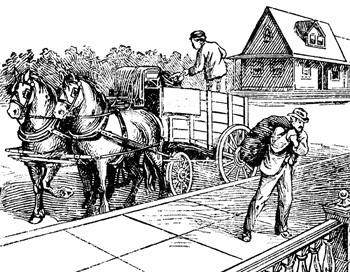
photo credit: etc.usf.edu

And that’s why Amazon is Not Quite Ready for Prime Time in Italy.
Election Day

14 Tuesday Jun 2011

Posted by farfalle1 in Italian bureaucracy, Italian habits and customs, Italy, Rapallo, San Maurizio di Monti, Uncategorized

≈ 4 Comments

Tags

Italian Elections, Referendums in Italy, Voting in Italy

Faithful readers will remember that the Captain became an Italian citizen about a month ago.  As luck would have it, there was an election yesterday, and he is now eligible to vote.  It wasn’t an election for political office, it was referenda on four questions: 1) should the law allowing privatization of the water company stay on the books?  2) should the cost of water be increased?  3) should the law exempting politicians currently in office from being tried in court stay on the books? and 4) should the plans to re-institute nuclear power plants in Italy go forward?

Will it surprise you to hear it was not a simple matter to get into the voting booth?  The Captain started two weeks ago, when he went to the Comune to request his voting card, without which he could not vote.  They were too busy to take care of him that day, and in fact tried very hard to discourage him from voting this time. But as a citizen it is his right to vote, and they were more or less obliged to take care of him, although not at that exact moment.  They grumblingly instructed him to come back a week later, which he did. They were even busier and once again they tried to put him off.  He wouldn’t give up, so they promised they would do the necessary work and then call him to let him know when he could pick up his card.

The polls were open on Sunday and Monday.  Late Sunday afternoon the long-awaited call came, and first thing Monday morning the Captain went back to the Comune where he found… that his card was not ready.  But there was a document that would allow him to vote and it was lacking only one signature.  Fortunately the hand that had to affix the signature was actually in the building, so without too much more delay the Captain received a handsome paper on Comune letterhead, signed by the man in charge of elections, and officially stamped, attesting to his right to vote.

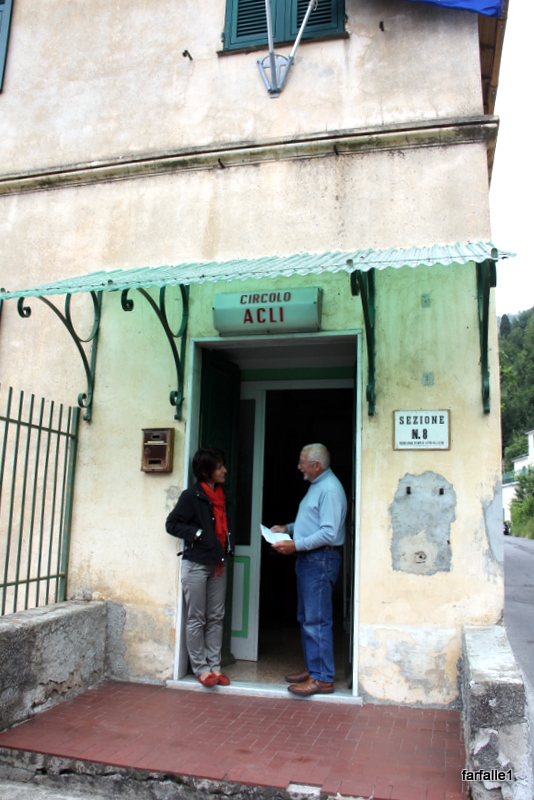
Going to the polls turned out to be one the pleasantest experiences we’ve had in quite a while.  It began outside the former elementary school (now a Catholic social club) where we were warmly welcomed by the secretary of the polling section, Enrica Pedrasi, to whom the Captain explained his mission.

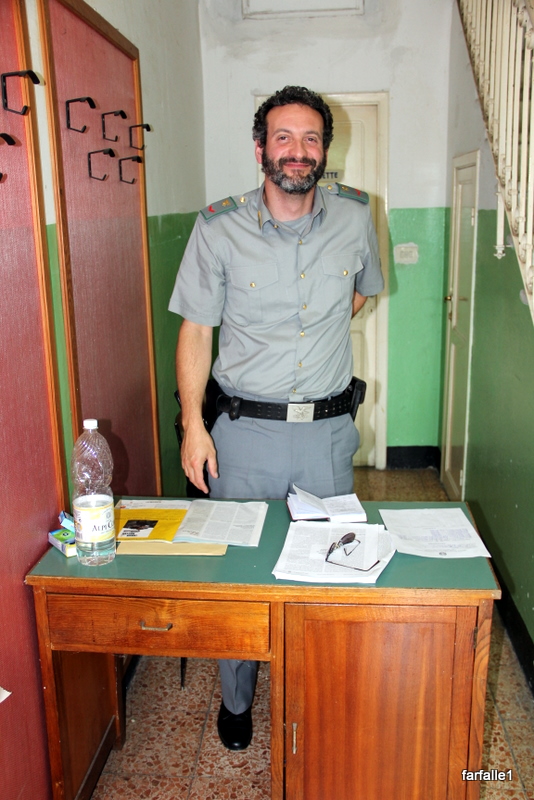
Inside we encountered the genial Gianluca from the Forestiere service. He was one of the people taxed with guarding the ballots from the time they arrived on Saturday until the polling was over on Monday afternoon. There is an armed guard on site at all times to make sure no one monkeys with the ballots.

There was a bit of confusion over the Captain’s document, because it was not the usual voting card, but the President of the polling section, Alberto Tumiati, made a quick phone call to the Comune, and all was well.


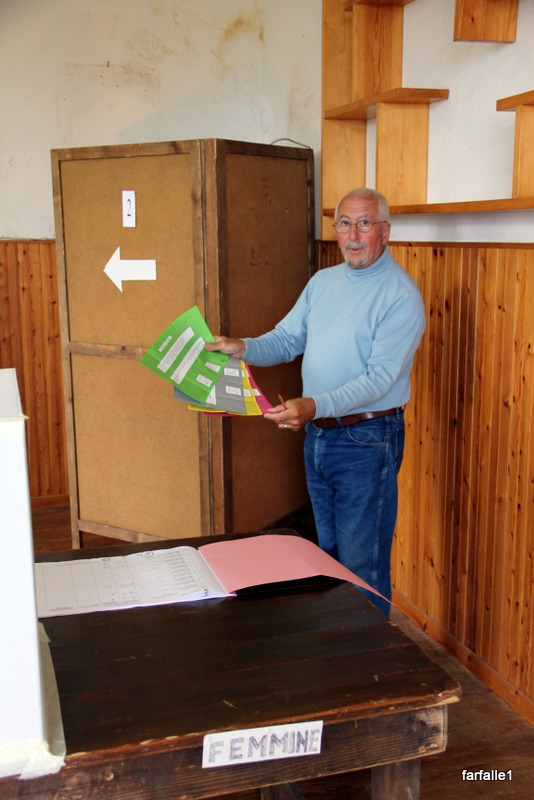
Renata Castagneto, one of the scritore normale of the polling section, entered the Captain’s name in the ledger of eligible voters.  Please note, he has been entered on the ‘maschi’ side.  Women’s names are entered in a different book kept at the other end of the table.  We’re accustomed to seeing alphabetical groupings in the States – it was a surprise to see the gender separation.

Then the Captain was given his ballots.  There was a separate color-coded ballot for each question.  The referendum question was on a strip of paper glued on the top of the paper, instructions were glued below, and two large boxes, one for Si and one for Non were glued at the bottom.

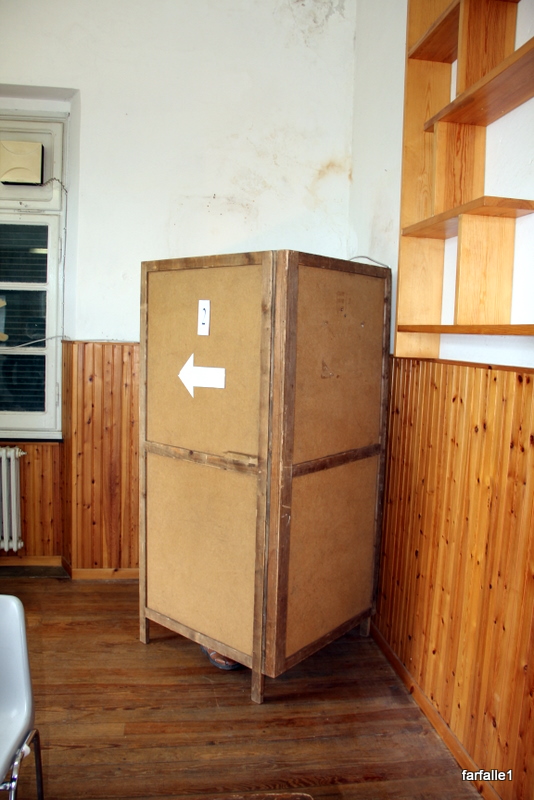
Into the booth he went, and, for the first time, voted as an Italian Citizen.  You can see his shoe in the picture below, peeking out from beneath the voting booth.


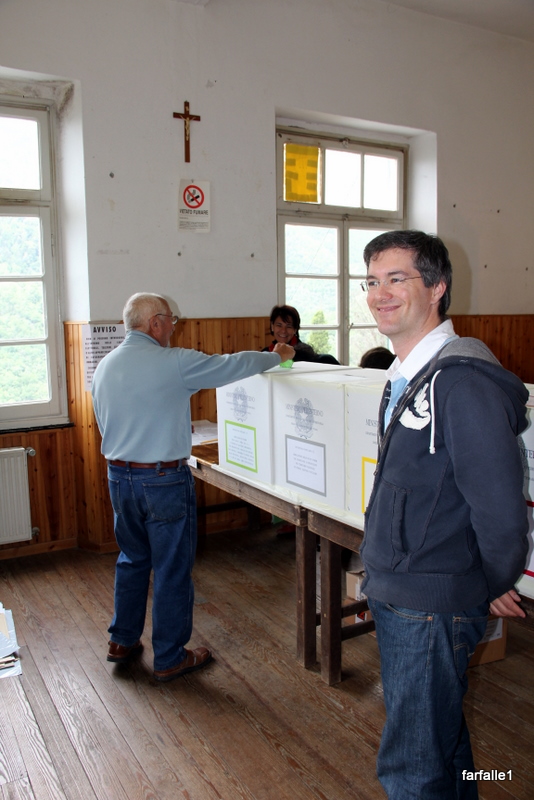
Moments later he emerged with his marked and folded ballots, and deposited each ballot in the appropriately colored box (he reports that it was complicated to fold the ballot correctly – many folds, and one section had to face out).


You can see from the expressions on the faces above that we received a very warm welcome.  In fact a cheer went up when we first walked into the room.  We were told that with the Captain’s appearance the percentage of people voting of those eligible at this voting station now stood at 51% (Rapallo, with its population of 30,000+ has 30 polling districts, each with about 1,000 voters.  Voters must vote at their own polling stations).  Well, that’s nice, we thought.  Then we learned that for the referenda to be effective more than 50% of the eligible voters in the nation must vote.  Little San Maurizio did its part.  There are about 330 eligible voters in the village, and at least 165 turned out.

As I write this the final results are not yet in.  But the evening news indicated that it seems all four referenda were passed – that is, that the laws already in place allowing for nuclear power plants, privatization of the water companies and immunity from prosecution for politicians in office, have all been overturned by popular vote.

Hurray for democracy!

Addendum:  It is the first time in fifteen years that enough voters have turned out to make a referendum valid.  All four popular initiatives passed convincingly (90%), which some see as the beginning of the end for Mr. Berlusconi.  See what the Italian press is saying here (in English).

Renata, Enrica, Alberto… if I have details wrong, please correct me in the comments or in an e-mail, okay?

Hi Pidge!


What the…..???

07 Tuesday Jun 2011

Posted by farfalle1 in Italian bureaucracy, Italy, Uncategorized

≈ 8 Comments

Tags

Italian Postage, Italian Postage Increase, Italian Postal Rates, Italian stamps, Mail in Italy, Mailing a Letter in Italy, Posta Priorita, Stamps in Italy

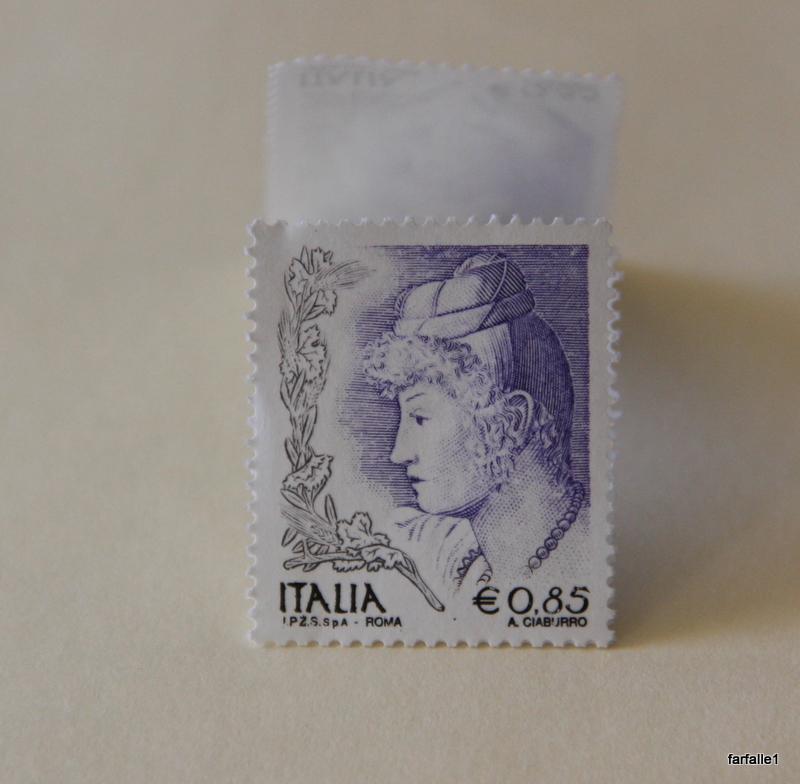
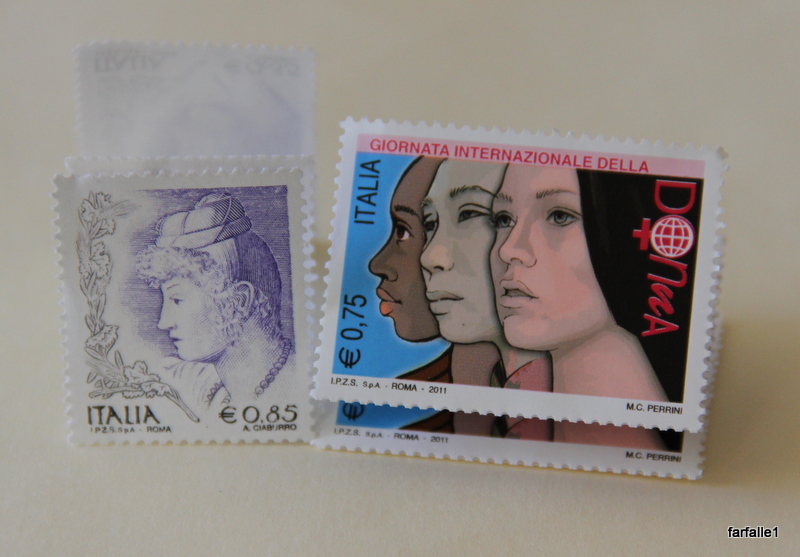
Last November when we left Italy it was possible to put one of these on an envelope and know that sometime in the next five to ten days the letter would arrive in the U.S. of A.

Last week the nice tabaccaio (the man in the cigarette, salt and stamp store) told me I would have to put this on a similar letter to the same destination:

That’s right.  Postage to zone 2, which includes the United States, increased from .85 to 1.60 in December (the patient tabaccaio had to show me the official notice before I was able to believe him).  Factor in the exchange rate and that’s about $2.25.  Can you imagine what would happen if the U.S. Postal Service almost doubled rates from one day to the next?  There would be Congressional hearings at the very least, and quite possibly the streets would be filled with rioting junk-mailers.

So to all dear friends and family who are accustomed to receiving snail mail from me, you’ll be getting only half as much in the future.  Which will still be pretty much the ‘none’ you’re already used to.

Hi, Jay!

← Older posts

Enter your email address to follow this blog and receive notifications of new posts by email.

Join 114 other subscribers

rss

Subscribe in a reader

Search the Blog

A. Useful Links

  • bab.la language dictionary
  • Bus schedules for Tigullio
  • Conversions
  • English-Italian, Italian-English Dictionary
  • Expats Moving and Relocation Guide
  • Ferry Schedule Rapallo, Santa Margherita, Portofino, San Frutuoso
  • Italian Verbs Conjugated
  • Piazza Cavour
  • Rapallo's Home Page – With Link to the Month's Events
  • Slow Travel
  • The Informer – The Online Guide to Living in Italy
  • Transportation Planner for Liguria
  • Trenitalia – trains! Still the most fun way to travel.

C. Elaborations

  • A Policeman’s View
  • Driving School Diary
  • IVA refunds due for past Rifiuti tax payements
  • Nana
  • Old trains and old weekends
  • The peasant, the Virgin, the spring and the ikon
  • Will Someone Please, Please Take Me to Scotland?

D. Good Recipes - Best of the Week winners are starred

  • 'Mbriulata
  • *Baked Barley and Mushroom Casserole*
  • *Captain’s Boston Baked Beans*
  • *Crimson Pie*
  • *Louise’s Birthday Cake*
  • *Melanzane alla Parmigiana*
  • *Penne with Cabbage and Cream
  • *Pizzoccheri della Valtellina*
  • *Pumpkin Ice Cream*
  • *Risotto alla Bolognese*
  • *Rolled Stuffed Pork Roast*
  • *Spezzatini di Vitello*
  • *Stuffed Grape Leaves*
  • *Stuffed Peaches (Pesche Ripiene)*
  • *Swordfish with Salsa Cruda*
  • *Tagliarini with Porcini Mushrooms*
  • *Tagliatelli al Frutti di Mare*
  • *Three P's Pasta*
  • *Tzatziki*
  • 10th Tee Oatmeal Apricot Bars
  • Adriana’s Fruit Torta
  • Aspic
  • Bagna-calda
  • Best Brownies in the World
  • Clafoutis
  • Cold cucumber soup
  • Crispy Tortillas with Pork and Beans
  • Easy spring or summer pasta
  • Fish in the Ligurian Style
  • Hilary's Spicy Rain Forest Chop
  • Insalata Caprese
  • Lasagna al forno
  • Lasagna al Forno con Sugo Rosato e Formaggi
  • Lemon Meringue Pie
  • Leo’s Bagna Cauda
  • Leo’s Mother’s Stuffed Eggs
  • Louis’s apricot chutney
  • Mom's Sicilian Bruschetta
  • No-Knead (almost) Bread
  • Nonna Salamone's Christmas Cookies
  • Pan Fried Noodles with Duck, Ginger, Garlic and Scallions
  • Pesto, the classic and original method
  • Pesto, the modern, less authentic method
  • Pickle Relish
  • Poached pears
  • Poached Pears
  • Polenta Cuncia
  • Recipes from Paradise by Fred Plotkin
  • Rustic Hearth Bread
  • Shrimp and Crayfish Tail Soup
  • Sicilian salad
  • Slow Food Liguria
  • Slow Food Piemonte and Val d'Aosta
  • Spinach with Garlic, Pine Nuts and Raisins
  • Stuffed Eggs, Piemontese Style
  • The Captain’s Salsa Cruda
  • Tomato Aspic
  • Zucchini Raita

E. Blogroll

  • 2 Baci in a Pinon Tree
  • Aglio, Olio & Peperoncino
  • An American in Rome
  • Bella Baita View
  • Debra & Liz's Bagni di Lucca Blog
  • Expat Blog
  • Food Lovers Odyssey
  • Italian Food Forever
  • L’Orto Orgolioso
  • La Avventura – La Mia Vita Sarda
  • La Cucina
  • La Tavola Marche
  • Rubber Slippers in Italy
  • Southern Fried French
  • Status Viatoris
  • Tour del Gelato
  • Weeds and Wisdom

Photographs

  • A Day on the Phoenix Light Rail Metro
  • Apache Trail in the Snow
  • Aquileia and Croatia
  • Birds on the Golf Course
  • Bridge Art
  • Canadair Fire Fighters
  • Cats of Italy
  • Cloudy day walk from Nozarego to Portofino
  • Fiera del Bestiame e Agricultura
  • Football Finds a Home in San Maurizio
  • Hiking Dogs
  • Mercatino dei Sapori – Food Fair!
  • Moto Models
  • Olive pressing
  • Rapallo Gardens
  • Rapallo's Festa Patronale
  • Ricaldone and the Rinaldi Winery
  • Rice Fields
  • Sardegna ~ Arbatax and Tortoli
  • Sardegna ~ San Pietro above Baunei
  • Sardegna ~ The Festa in Baunei
  • Scotland, including Isle of Skye
  • Slow Food 2008 Salone del Gusto
  • The Cat Show and the Light Rail Fair
  • The desert in bloom
  • Trip to Bavaria

Pages

  • Fagioli all’ucelleto

Archives

Recent Posts

  • A Superior Visit
  • Fun at the Ranch Market
  • The MAC
  • Welcome Tai Chi
  • Bingo Fun for Ferals
December 2025
M T W T F S S
1234567
891011121314
15161718192021
22232425262728
293031  
« Jul    

Member of The Internet Defense League

Blog at WordPress.com.

  • Subscribe Subscribed
    • An Ex-Expatriate
    • Join 114 other subscribers
    • Already have a WordPress.com account? Log in now.
    • An Ex-Expatriate
    • Subscribe Subscribed
    • Sign up
    • Log in
    • Report this content
    • View site in Reader
    • Manage subscriptions
    • Collapse this bar
 

Loading Comments...