• Contact
  • Elaborations
    • A Policeman’s View
    • Driving School Diary
    • Great Danes
    • IVA charged on Tassa Rifiuti
    • Nana
    • Old trains and Old weekends
    • The peasant, the virgin, the spring and the ikon
    • Will Someone Please, Please Take Me to Scotland??
  • Recipes
    • ‘Mbriulata
    • *Baked Barley and Mushroom Casserole*
    • *Captain’s Boston Baked Beans*
    • *Cherry Tart*
    • *Crimson Pie*
    • *Louise’s Birthday Cake*
    • *Melanzane alla Parmigiana* – Eggplant Parmesan
    • *Penne with Cabbage and Cream
    • *Pizzoccheri della Valtellina*
    • *Pumpkin Ice Cream*
    • *Risotto alla Bolognese*
    • *Rolled Stuffed Pork Roast* on the rotisserie
    • *Shrimp and Crayfish Tail Soup*
    • *Spezzatino di Vitello*
    • *Stuffed Grape Leaves*
    • *Swordfish with Salsa Cruda*
    • *Tagliarini with Porcini Mushrooms*
    • *Tagliatelli al Frutti di Mare*
    • *Tzatziki*
    • 10th Tee Apricot Bars
    • Adriana’s Fruit Torta
    • Artichoke Parmigiano Dip
    • Best Brownies in the World
    • Clafoutis
    • Cod the Way Sniven Likes It
    • Cold Cucumber Soup
    • Crispy Tortillas with Pork and Beans
    • Easy spring or summer pasta
    • Fagioli all’ucelleto
    • Fish in the Ligurian Style
    • Hilary’s Spicy Rain Forest Chop
    • Insalata Caprese
    • Kumquat and Cherry Upside Down Cake
    • Lasagna Al Forno con Sugo Rosato e Formaggi
    • Lemon Meringue Pie
    • Leo’s Bagna Cauda
    • Leo’s Mother’s Stuffed Eggs
    • Louis’s Apricot Chutney
    • Mom’s Sicilian Bruschetta
    • No-Knead Bread (almost)
    • Nonna Salamone’s Famous Christmas Cookies
    • Pan-fried Noodles, with Duck, Ginger, Garlic and Scallions
    • Pesto
    • Pesto
    • Pickle Relish
    • Poached Pears
    • Polenta Cuncia
    • Pumpkin Sformato with Fonduta and Frisee
    • Rustic Hearth Bread
    • Sicilian Salad
    • Soused Hog’s Face
    • Spotted Dick
    • Swedish Tea Wreaths
    • The Captain’s Salsa Cruda
    • Tomato Aspic
    • Vongerichten’s Spice-Rubbed Chicken with Kumquat-Lemongrass Dressing
    • Winter Squash or Pumpkin Gratin
    • Zucchini Raita

An Ex-Expatriate

~ and what she saw

An Ex-Expatriate

Category Archives: Italian habits and customs

La Transumanza (Till the cows come home…)

04 Monday Nov 2013

Posted by farfalle1 in Italian festas, Italian habits and customs, Italian holidays, Italian men, Liguria, Photographs, Uncategorized

≈ 12 Comments

Tags

Festival of Cows, Santo Stefano, Santo Stefano d'Aveto, Transumanza

Il Secolo XIX calls the transumanza ‘the most spectacular event of the year in the val d’Aveto.’  Not having seen other events there I can’t say if I agree, but this festa, held when the cows are brought down from the high pastures where they’ve spent the summer to the barns and lower land of the valley is charming and fun.

Friends took me with them to Santo Stefano d’Aveto to see the transumanza on a rainy Sunday.  The arrow on the map below points to Santo Stefano; at an elevation of about 3200 feet, ‘low land’ is a relative term.

map of Santa StefanoArrow

We arrived in plenty of time to walk through the small village (population about 1200, probably double that the day we were there) and savor the anticipation. When would the cows arrive??

Not being able to stand the suspense we started walking up the street down which they would come, a walk which provided a sweet view of the town from above.
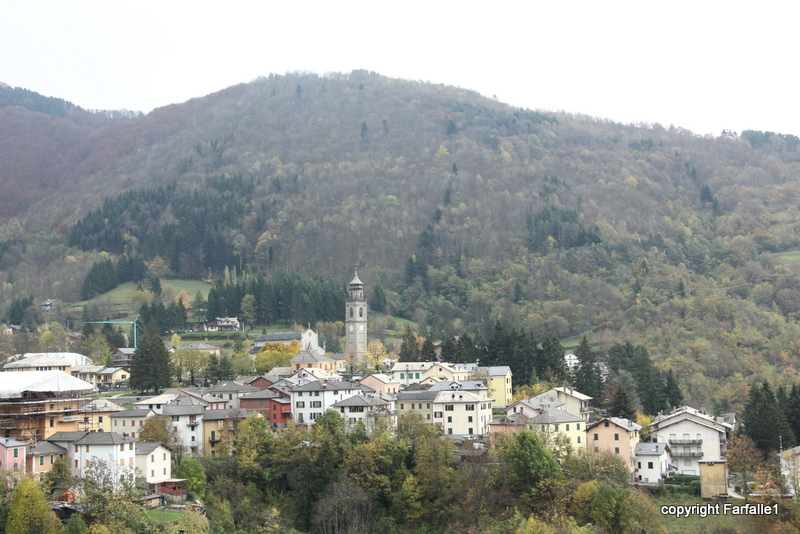
Santo Stefano from above

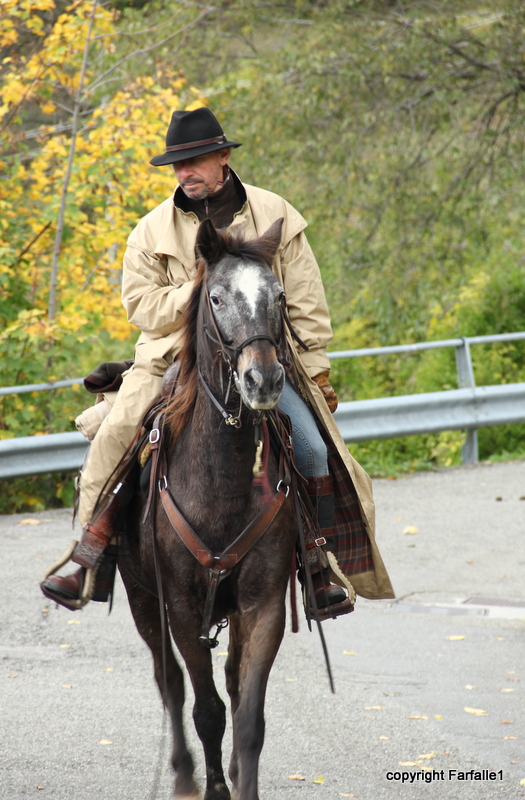
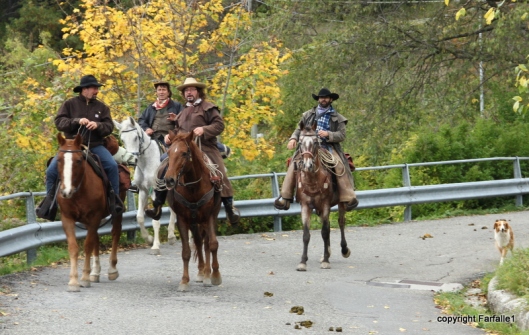
We met and chatted with others whose level of excitement matched our own. When would they arrive? When would they arrive? Finally the first outriders appeared, and it quickly became evident that this had as much to do with costume and play-acting as it did with herd movement. All to the good! The horses were buffed, fluffed and bedecked:

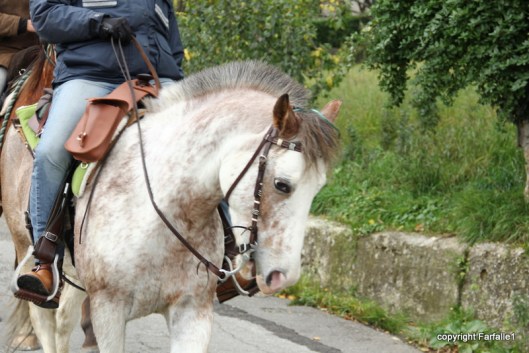
be-ribboned horse

well-trimmed horse

The riders, dressed as gauchos, gave the impression they had spent the summer keeping order among the vast herds on the mountain side:
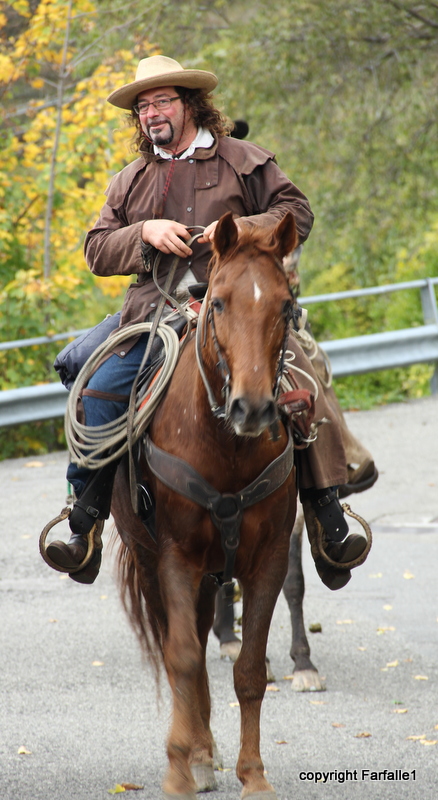
gaucho

more advance riders

a real gaucho

rider

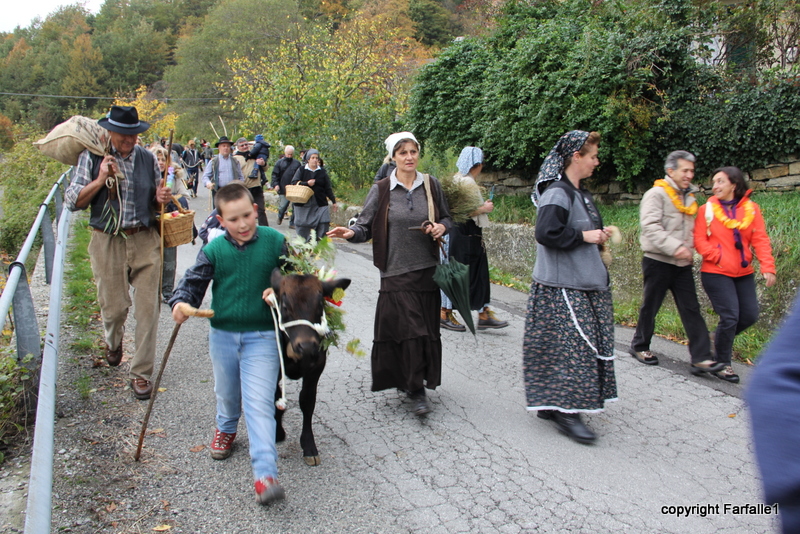
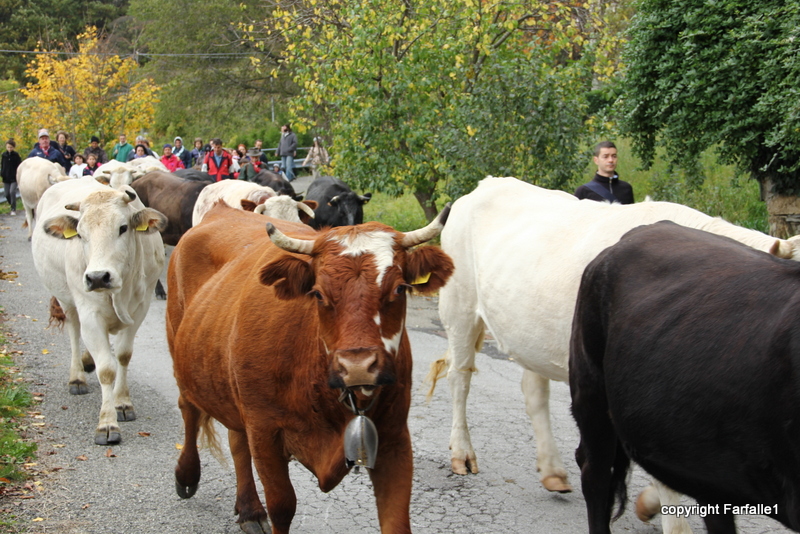
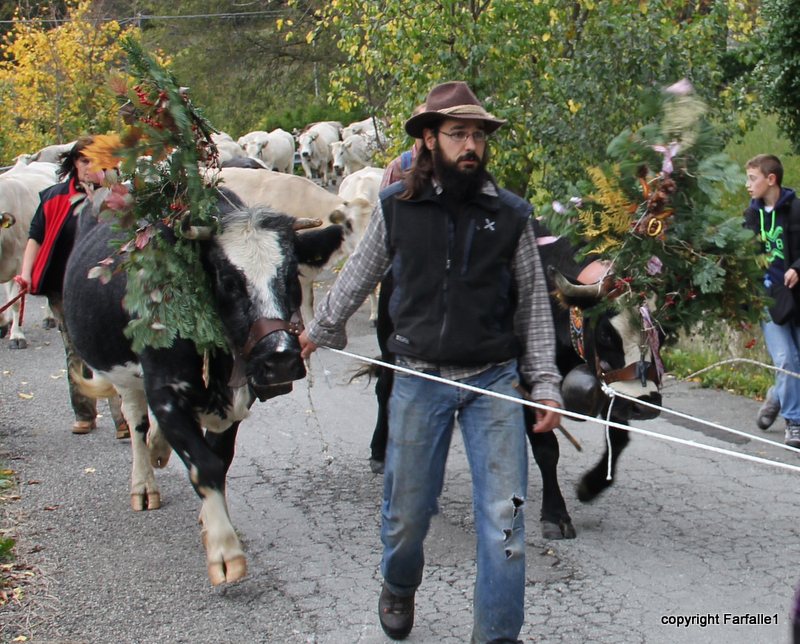
Then the first cows arrived, festooned with flowers and accompanied by a pair of flowery goats.  Many of them moved to the music of their cowbells, a sound we associate much more with Switzerland than with Italy.  Each bell has a slightly different pitch, making the herd an orchestra of happy random dissonance. With them was a group of people dressed as old-timey farmers, brandishing the antique tools of high meadow agriculture.
cows festooned

people in peasant dress

the cows arrive

cows-001

longhorn

And then it was over:

cows-003

The fact that there were perhaps 50 head of cattle made me suspect that those handsome gauchos had not, in fact, been tending the herd all summer.

The cows continued their procession through the village and disappeared up a winding road on the other side of town.  We did what all sensible people do after so much excitement and activity:

Locanda dei Doria menu

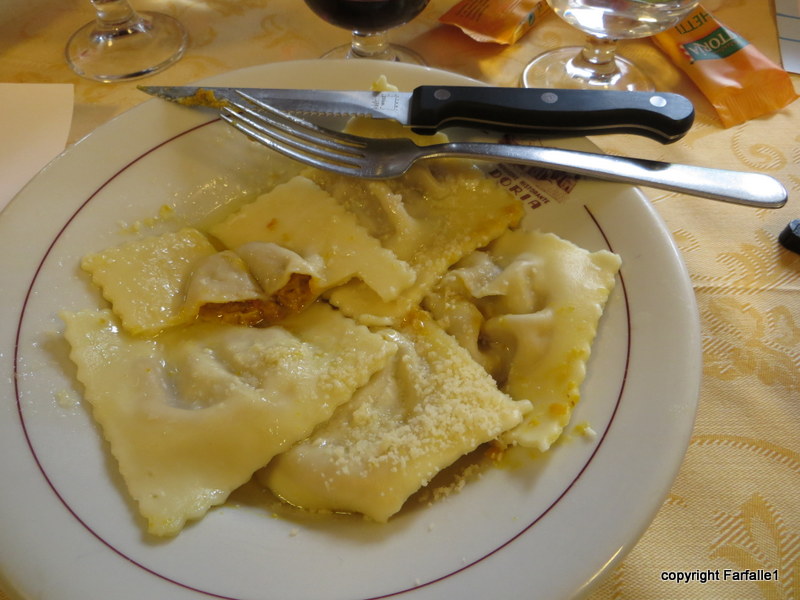
At E18 this huge mid-day meal was a real bargain.  I enjoyed the anti-pasti, followed by the squash stuffed ravioli, veal scallopini with fresh porcini mushrooms and a killer plum tart.
ravioli with pumpkin

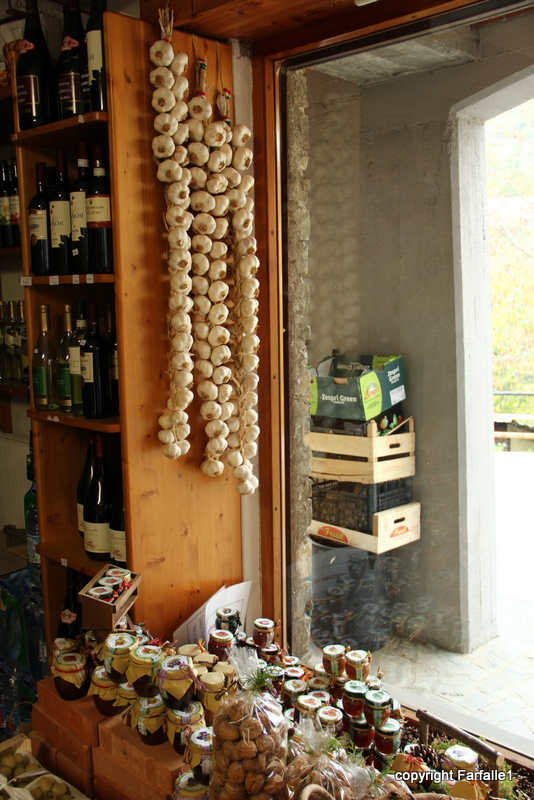
Such a large meal calls for a post-prandial stroll, which we took, admiring the shops (closed at that time of day) along the narrow streets of the old part of town. (Santo Stefano, with a rich history, has been inhabited for centuries. Its first written mention is from the 2nd century BCE at the time of a battle between the Romans and the Ligurians. The castello in the center of town dates from 1164.)  At a time when many small towns are dying for lack of occupation, Santo Stefano has cast itself as a center of ‘bio’ food – what we would call organic.  People from a wide radius make the long windy drive up the mountain to buy fresh locally produced cheese (San Sté cheese has been made in the same way by the same families for several centuries), yogurt, eggs, vegetables and at this time of year chestnuts.  My friends staggered out of a small food shop we found open with bags of locally ground flour, fresh ricotta and other delectables.  I brought Speedy a small basket of ricotta, and I have to say, it is the best either of us has ever eaten.

other chestnuts

garlic in market

You can’t have a good festa without some live music.  A trio of musicians was performing (and clearly enjoying themselves) under the covered arcade in front of the shops on the main street.  If you want to see and hear them you can do so here and here.

Is life in a mountain all fun and games?  I would say not. Farming in what is one of the wettest parts of Italy comes with its own particular set of problems, exacerbated by long cold winters.  But we saw plenty of indication that people still farm there, in spite of the influx of holiday homes.

he took goats up the mountain
Maybe you could call this man ‘before.’  He’s clearly serious about his farming – he was just returning from taking the festive goats up the hill to march with the procession of cows.

Then you could call this man ‘after.’  Giorgio Carpanese has lived all of his 84 years in Santo Stefano d’Aveto.  When I asked him if he had seen an awful lot of changes there in his life he just shook his head with a whimsical look and said, ‘Si.  Si.’

Giorgio Carpanese

Where there’s smoke

04 Thursday Jul 2013

Posted by farfalle1 in Holidays, Italian Churches, Italian habits and customs, Italian holidays, Italy, Rapallo, Uncategorized

≈ 6 Comments

Tags

Festa patronale di Rapallo

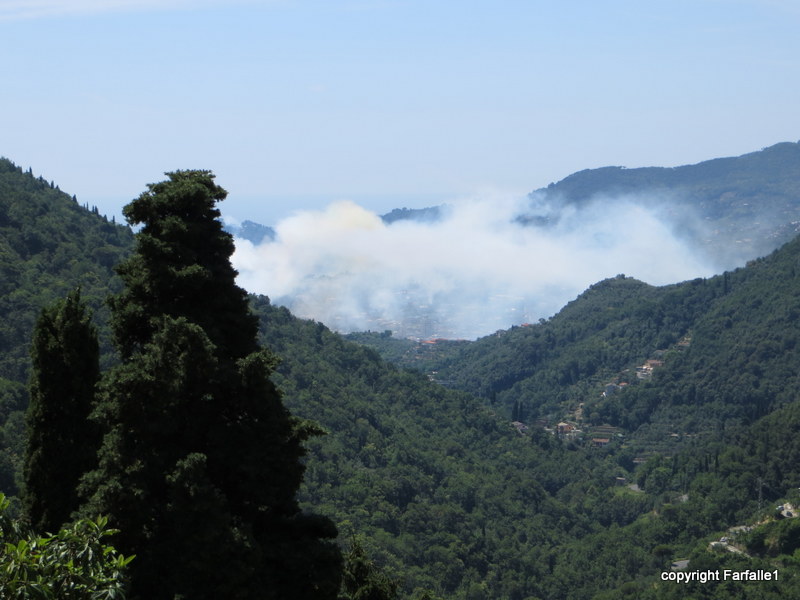
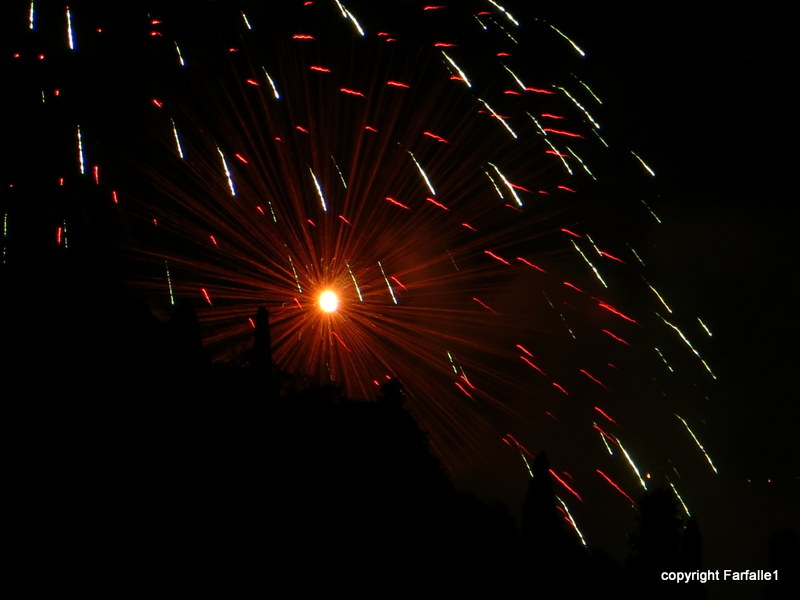
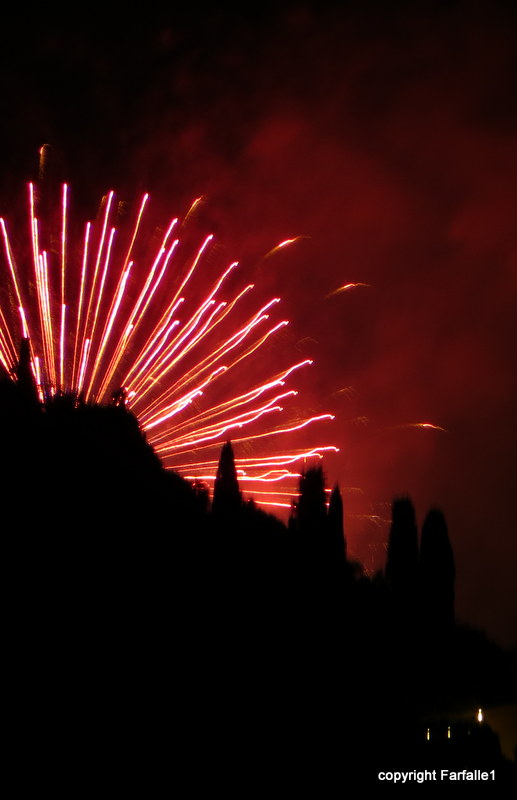
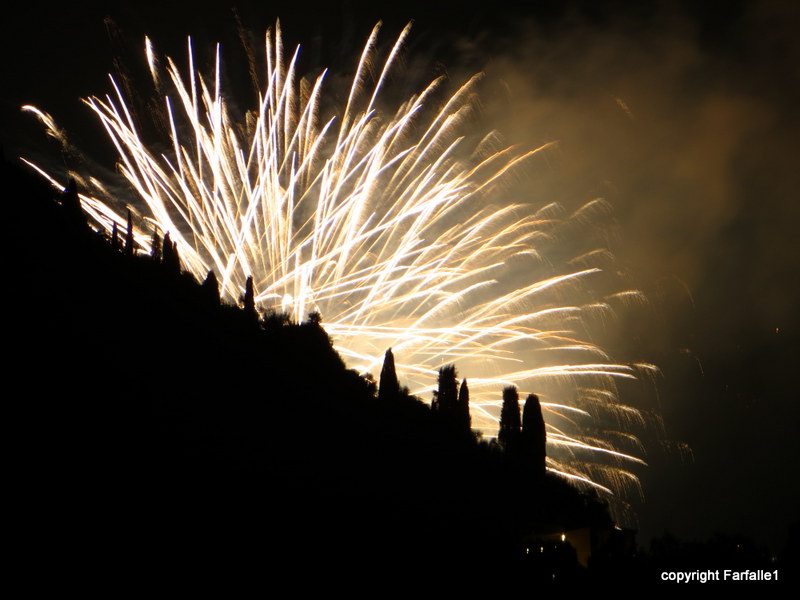
Rapallo just celebrated her Festa Patronale in honor of the Virgin Mary. It is three days of madness in town (you can see some photos of various elements of the celebration, including the parade of crucifixes here) beginning with a huge volley of mortar fire at 8 a.m. on July 1st. This is followed by fireworks presented by the Sestiere at mid-day and evening on the 1st, 2nd and 3rd. Why anyone wants to fire off huge noisy mortars first thing in the morning is beyond me (they do it to greet and salute the Virgin, to let her know the Festa has begun; it closes with another cannonade last thing on the 3rd). But fire them off they do. We were congratulating ourselves for living up above the chaos and thus missing most of the smoke:

fireworks smoke

We were smug too soon, as it turned out. Half an hour later most of the smoke had drifted up our way, but by then it was dissipated enough not to matter.

During the Festa the cathedral in town is brightly lit:

Rapallo cathedral alight

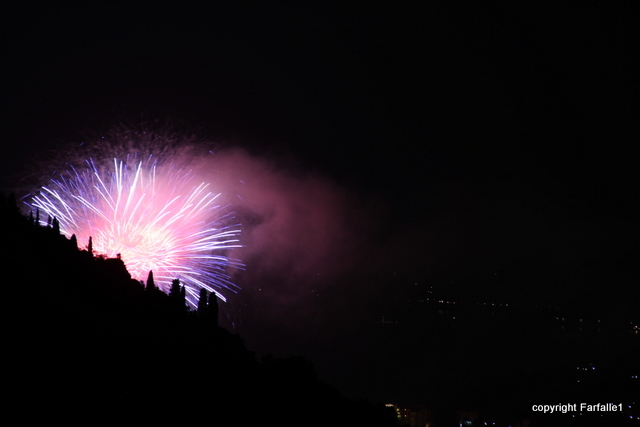
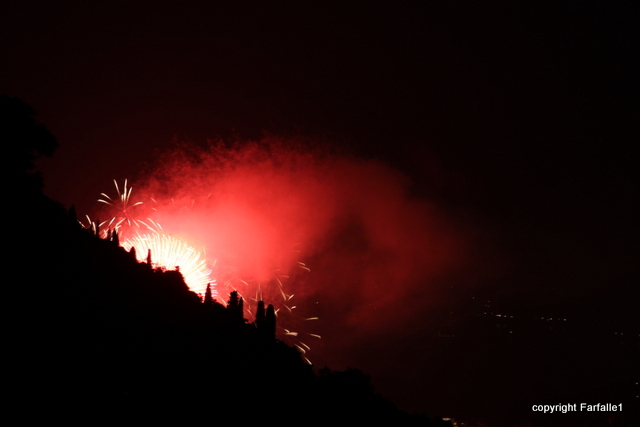
Here are a few shots of the fireworks from rather far away on the night of the 3rd (our house – I just didn’t have the om-pah-pah to join the fray this year) . I like to think of them as our own private 4th of July.

fireworks-004

fireworks-005

fireworks-006

fireworks-008

fireworks-010

If you’re interested in Rapallo’s long relationship with the Virgin you can read about it here.

Happy 4th of July, everyone!

Thank you…

08 Tuesday Jan 2013

Posted by farfalle1 in American habits and customs, Italian habits and customs, Uncategorized

≈ 19 Comments

Tags

e-cards, Etiquette, Thank-you notes, Written cards vs. e-cards

Illustration by Charles Dana Gibson

Illustration by Charles Dana Gibson

This is by way of being a poll.  What I want to know is this: how important in this digital age is the hand-written thank-you note?

My mother taught us always, always, always to write a thank-you note, as soon as possible, for any gift we received.  In fact when we were young and given toys, we weren’t allowed to play with them until the thank-you had been written and approved.  They didn’t have to be fancy.  Here’s an example of a perfectly acceptable thank-you note from those days.

Dear Nana,
Thank you very much for the teddy.  I like it very much.  I have named it Nice.
love,
Fern

That sort of brevity didn’t pass muster as we got older; on the other hand no one was checking over our thank-you’s when we were in high school.  By then we were so well trained no one had to!

Customs of saying thank you differ a lot from country to country.  Here in the States it is customary to call the hostess a day or two after a dinner party and tell her again what a marvelous time you had and how good the food was, how remarkable the other guests.  In Italy that doesn’t happen.  People come, they have a marvelous time, eat great food in exceptional company, say thank you and go home, and that’s enough (although I’ve noticed a creeping post-event thank-you trend amongst friends who have spent time in other countries).

So my question is, are written thank-you’s, birthday cards and so forth out of date and hopelessly old-fashioned now that we can dash off a heart-felt e-mail and subscribe to clever e-card sites?  Please tell me!  We sent out e-Christmas cards this year (again) and I’m feeling a little squirrely about it.  I enjoy so much receiving actual Christmas and birthday cards from other people (any greeting is always welcome).  But I don’t feel the same way about thank-you notes.  Somehow to me  e-mail seems quite a sufficient medium for gratefulness. I’d certainly like to know what you all think about it though (if you think of it at all), and if you tell me… I’ll thank you.

quill pen

Hard Landing

25 Sunday Nov 2012

Posted by farfalle1 in American habits and customs, Arizona, Customs, Italian habits and customs, Rapallo, Travel, Uncategorized

≈ 6 Comments

Tags

culture shock

Once again, as every year, culture shock has blind-sided me.  Yes, it is gorgeous here (see above) and yes, it is warm (even hot) and dry.  But it’s not Italy, is it?  Sounds so obvious, but somehow it takes me aback annually.  In fairness, I have to say that there will be a repeat of culture shock, in reverse, when we return to Rapallo in April or May.

But just what is the shock?  Size is one thing – everything is so darn big here.  When it comes to living quarters, I like that.  When it comes to servings when eating out I don’t.  Cars? no.  Sense of humor? yes.  Noise is another thing: there are non-stop sounds in Rapallo; scooters dash up and down the mountain, dogs bark non-stop, the rooster who can’t tell time crows his ignorance, diners clink their cutlery against their plates at Rosa’s and even, if they’ve had enough, break into song or begin to cheer loudly. Over at Case di Noe someone has fired up a brush-cutter, and every half hour the church bells remind us what time it is. (Speedy has addressed this part of the problem by down-loading chimes to sound the hours on the computer – not the same as the jazzy bell concert San Maurizio gives us each Sunday, but better than nothing.)

There are plenty of noisy places in the U.S., but we don’t happen to be in one of them.  Our neighborhood has forty homes, of which probably one-third are occupied now, it being still early in ‘the season.’  The family with small children who lived across the street have moved – how we miss their constant activity and cheerful little voices.  If we listen carefully we can hear the hum of traffic from the highway that’s about a mile away.  When the birds visit our feeders they are likely to squabble.  The humming birds sound like teeny little power saws when they zoom in and out.  But mostly it’s just very quiet and peaceful.  That’s nice, it really is, it’s just such a change.

The biggest change, though, and the hardest to adapt to, is the societal difference.  Italians are out and about for a good part of the day.  One must shop daily, the passagiata awaits at the end of the day.  There are friends and family to visit and ‘news’ to be discussed endlessly.  The silence in our neighborhood is but a reflection of a larger silence that I think of as particularly American.  People are afraid to discuss ‘issues’ for fear that they will offend or anger the person to whom they’re speaking. Somehow Italians have found a way to express differences without letting it get personal, and without letting it get in the way of friendships.  Here people are afraid to make eye contact with strangers, unlikely to greet strangers on the street (any one of whom may be carrying a weapon, concealed or otherwise, at least here in the wild west), and uncomfortable with the idea of discomfort.

Of course Italy is far from perfect.  But part of culture shock, I think, is the tendency to idealize the place one has left, to look back through the fuzzy lens of rosy glasses, while looking at present circumstances with the critical lens of a microscope.

I’m not asking for sympathy, believe me.  We are terribly fortunate to be able to enjoy life in two such diverse places, and yes, we are Thankful that we are able to (’tis the season).  I’m just saying that the transition is, for me at any rate, difficult, but difficult in an interesting way, not a painful way.  So please, stick with me for a while?  Pretty soon I’ll have my feet under me again and will share some more of the excitement of life in a most peculiar state.

Smoke!

06 Thursday Sep 2012

Posted by farfalle1 in American habits and customs, Italian habits and customs, Uncategorized

≈ 12 Comments

Tags

Smoking in Italy, Smoking in the U.S., Warning labels on cigarette packs

The other day I found an empty cigarette pack along the path.  What struck me immediately was how bold the health warning was:

You probably don’t need a translation, but just in case: it says Smoking Kills (literally it says ‘the smoke kills’ but we know what they mean).  This is the message that an Italian smoker will see every time he flips open his pack to take out a ciggie.

It’s been a long time since I smoked.  I remember the rather tepid warnings that the Surgeon General  placed on cigarette packs in the U.S. some years ago.  Are they different now than they used to be?  Nope.  Here’s the sissy warning a U.S. smoker may or may not take note of each time he lights up:

First, it’s on the side of the box where it’s much less obtrusive.  Second, though it informs us that dire diseases are the caused by smoking, there’s no mention of the ultimate price: death.

Not content with simply telling us that cigarettes will kill us, the Italian packs go on to tell us how on the back:

Fatal lung cancer.  There.  Just in case you were in any doubt – your lung cancer will be fatal.  Smoke these things and you will die sooner than otherwise.

So are all the warnings over the top?  It turns out the answer is a resounding no.  Smoking is enormously costly, in terms of money and of life itself.

Infosearchlab.com reports that more than 443,000 people in the U.S. die annually due to cigarette smoke.  Of these deaths, 50,000 are caused by passive (second-hand) smoking.  In China, 2,000 people die of smoke every day – 1.2 million a year.  According to the Corriere della Sera,  70,000-83,000 Italians die every year due to smoking, which works out to about the same per capita number of deaths annually as the U.S.

It’s such a difficult question, isn’t it?  To what point should a government intrude in the behavior of the citizens?  When does a vice stop being something personal and become something public?  I guess given the prevalence of smoking and the expense of caring for all the people it makes sick, government intervention is advisable.  To paraphrase an old nostrum about punches, your right to smoke ends where my nose begins.

An interesting side-note that Speedy mentioned: as recently as 2005 tobacco companies in Italy were mostly owned by the government.  In an Alice in Wonderland twist, the government was promoting and profiting from the sale of cigarettes at the same time they were instituting dire warnings on packages and limiting where people may smoke.

How much warning is too much?  Clearly the Italians are giving a much harsher warning than the Americans.  Recently a U.S. court of appeals found that a Washington DC lower court’s ruling that graphic warning images must be put on cigarette packs violated Corporations’ right of free speech.  (Don’t get me started on ‘Corporations are people.’) The issue was whether the tobacco companies should be required to put images of things like a man breathing through a hole in his neck on the cigarette packs.  The first court said yes; the appeals court said no.  Supreme court, anyone?  The World Health Organization says that pictures are effective deterrents.  Australia has gone to the extreme.  Beginning in December they old familiar cigarette packaging will be gone, replaced by gross graphic images like this:

Photo courtesy of cbsnews.com

How to reduce the number of people smoking in places like the U.S. then, if you can’t require that disgusting pictures be put on each pack?  High taxes is one way.  According to Huff Post this is the route Indiana has taken.  Placing a minimum price on a pack of cigarettes is another (the theory being that people will not be able to smoke as much if they can no longer buy cheap ‘off’ brands).  This is the approach Italy has taken (with some amount of EU difficulty), though there’s  debate about whether or not this approach is effective.

So how much does it cost to smoke?  Prices have sure gone up since I used to put .35 cents in the vending machine in the basement of my college dorm (it was right next to the candy bar machine, making for a complete, if not well-balanced, meal).  That depends upon where you live.  If you’re in West Virginia you can support your habit for $4.84 a pack.  But if you live in New York the same pack will cost you $12.50.  Here in Italy cigarettes cost about E 5 a pack, about $6.

Do Italians smoke more than Americans?  According to the WHO again, 25% of Italian males aged 25 and older are ‘current smokers.’  In the US it is 34% for the same demographic.  19% of women in both countries aged 15 and older are’ current smokers.’  And we won’t even discuss China.

Our own observations suggest that there is a lot less smoking here than there used to be, though we still see both men and women zooming around on their scooters with a fag clutched in their teeth. And it seems that a lot of young people smoke – I guess it’s still considered cool.  Smoking is not allowed here in any public building – no such thing as a ‘smoking section’ in a restaurant.  If you want to smoke, step outside please.

They say there’s nothing worse than a reformed smoker for being anti-smoking.  As a former 2-pack a day person I guess I qualify.  Here’s the thing though – while I may deplore the fact that smokers cost all of us huge amounts of money every year, and while I will run as fast as I can to get away from your smoke, I’ll never blame you if you’re a smoker.  I remember all too well how much I loved smoking, how it was woven into the fabric of my daily life, and how almost impossible it was to quit.  I still miss it.

A(nagrafe) to Zed

19 Thursday Jul 2012

Posted by farfalle1 in Italian bureaucracy, Italian habits and customs, Italy, Law and order, Uncategorized

≈ 12 Comments

Tags

Anagrafe, Gathering social data, Italian bureaucracy, Italian social data

Anagrafe (an-ah-gra-fey) is the office in each comune that keeps track of who’s who and the status of each inhabitant: births, deaths, marriages, divorces, that sort of thing.  This is true, it seems, for both Italians and resident expatriates  (Anagrafe issues our Carte d’Identite).  I’m sure they do other things of which we’re completely unaware.

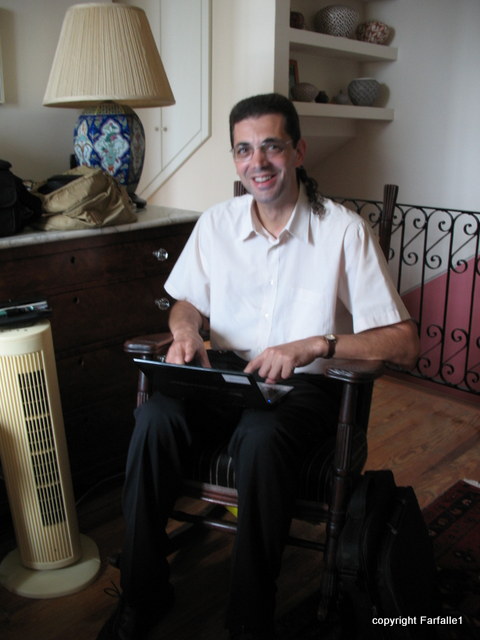
One such thing was brought to our attention last week when we received a visit from the very affable Piermanlio (a roman name, he told us) who spent two and a half hours grilling  interviewing us.  He works for the Statistics Department of Anagrafe (who knew?) and spends a good part of his life traveling from one expatriate domicile to the next interviewing people.  Then he spends some more time transmitting his data to the main office in Rome (without identity information attached) where it is all, presumably, crunched up and turned into important reports of some sort, which in turn lead to enlightened social policies, new laws and more bureaucracy.

Here are two things you might not be able to tell about Manlio from the above photo:  he is probably one of the most patient and kindest guys in the world; it is hard for him to find shoes because his feet are large.  For this reason he takes exceptionally good care of the shoes he wears. ( I guess that’s three things, but since the last two are so closely related I’m counting them as one.)

The last time the U.S. took the census we won the long-form lottery, and spent about thirty or forty minutes filling in the form with information about our race, gender, education, income and what kind of house we lived in.  Well.  Italy could certainly teach the U.S. something about long forms.

At first we thought Speedy would be the only one interviewed, which was fine by me, as it took ages.  To the surprise of all three of us Manlio was instructed by his computer to interview me when Speedy was done.  What response triggered that, I wonder?  Most of the questions were the same, but there were some amusing differences.    They were all multiple choice questions and all answers were entered immediately into Manlio’s laptop.  If an answer was wildly out of the norm the computer might give Manlio a query sign.  If it was totally ridiculous the system was blocked til a realistic answer was put in.  How do we know?  Speedy answered 8 years old when asked at what age he began working (happens to be true).  Turns out the question meant when he stopped being a student and began to work as an adult.  ‘8 years old’ caused a delicious block.

Here are some of the topics Manlio covered with us during our time together, other than the obvious of age, heritage, race, religion and education.

Do we have relatives living in Italy?  Do we have relatives living outside the US but not in Italy?

In our family, who makes the decisions?  Who does the housework, do we share the burden? Who does the marketing?  Who cooks?  Is it up to the husband to choose who the wife’s friends will be?

Do we like Italian food?  Do we eat it often? Do we eat food of other cuisines?

Are we healthy?  Smoke? Weight? Height? Do we take medicines? (polite Manlio: ‘oh yes?  They’re prescribed, I would assume.’  Us: ‘Of course!’)

Curious omission noted here: no questions about drinking and/or wine!

Do we have a car?  How many TV’s? Motorini?  A video camera? (why a video camera?)  When we watch TV, do we watch in English or Italian or ? Do we have a satellite dish?  More than one?

Do we have a telephone  land line?

Why did we move to Italy?  Who decided that we would move to Italy?  How did mother feel about it (Really!  This was a question for me, the only one of us with an extant mother when we came.)

What language do we use when speaking to each other?

Do we read newspapers, if yes in hard or virtual form? Magazines? Books?  In what language(s)?

Do we follow Italian politics?  Do we talk about politics with friends? Do we feel knowledgable about Italian Politics?  How often do we discuss politics?  Same questions again vis-a-vis the U.S.

What do we do for entertainment: movies? sports? concerts?

I guess one can catch the drift of the kinds of questions being asked and the kind of information they are trying to gather.  There are so many people from all over the world living in Italy now, there’s perhaps not unreasonable concern that the ‘national identity’ might erode.  At the very least there is also interest in knowing if the basic ‘rights’ generally recognized here are being observed by one and all.

I guess my favorite question, one directed to both of us, was: Has anyone in Italy made you feel uncomfortable because you are a foreigner?  How lucky I felt at that moment.  Italians like Americans; they do not necessarily like all the other nationalities represented in the immigrant population.  No.  No one has ever made us feel uncomfortable, I’m happy to say, though I’m certain others have not been so fortunate.

My favorite unasked question: Does your husband still beat you?

I guess it’s not just a cold, hard, statistical office after all.  They care about us, they really care.

Happy 4th of July!

04 Wednesday Jul 2012

Posted by farfalle1 in Holidays, Italian Churches, Italian festas, Italian habits and customs, Italian holidays, Rapallo, Uncategorized

≈ 4 Comments

Tags

Festa della Madonna di Montallegro, fireworks

(Click on any photo for a slightly sharper image.)

July 3rd, a quiet night in Rapallo:

Then suddenly all hell broke loose!

July 1, 2 and 3 are the special days Rapallo has set aside to honor the Madonna of Montallegro. It’s crazy in town – huge crowds; lots of noise; a wonderful procession with crosses, bishops and mayors, and children; all culminating in the tradional ‘attack and burning’ of the ancient castello. To give you an idea of the scope and the noise, over the course of the day on Monday, the middle day of the Festa, some 6,000 mortars were fired off.  These are the bright flashes accompanied by an ear-splitting and echoing BOOM that can be heard all through the area.

This year we did not go down into the hub-bub. Instead we stayed ‘quietly’ home and enjoyed a partial show of fireworks. (‘Quiet’ does not exist here on July 1, 2 or 3.)  I love that this happens right before our own traditional Fireworks Day, the 4th of July.  If you’d like to see some photos and read more about the doings in town, read this post from last year.  And if you’re interested in knowing why Rapallo has chosen the Madonna as her patron saint you can read about it here (spoiler: The Blessed Virgin was an early tourist).

Happy Independence Day to one and all!

New Math, Italian Style

05 Saturday Nov 2011

Posted by farfalle1 in Driving in Italy, Italian habits and customs, Uncategorized

≈ 13 Comments

Tags

Autostrada, Italian Autostrada, Radar Speed Control in Italy, Speed control in Italy, Speed limits in Italy, Speeding in Italy, Tutor

Some years ago speed limits came to the Italian Autostrada system, as they have to most major European highways (even most of the Autobahn!).  While this makes some people, the Captain amongst them, sad, it has proved not to be such a bad thing after all.  The limit on the Autostrada, unless otherwise noted, is 130 kmh, or 80.77 mph, which is not exactly crawling.

But leave it to Italy to monitor speed in a slightly different way.  Rather than waste endless fuel and manpower by putting police cruisers with radar and officers in chase vehicles on the roads, the Autostrada has installed a speed monitoring system called Tutor (because it’s supposed to teach you to slow down).  It doesn’t actually measure your speed at a given point, though.  What it does is measure how long it takes you to get from one Tutor camera to another, some distance down the road.  Stop for a cup of coffee between the two cameras and you can go as fast as you like while on the highway!  What a concept.  Of course if you don’t want to stop, then you have to drive at a speed that averages out to the limit or just slightly over.  But still, that leaves some room for testing the capabilities of your new Ferrari or blowing the cobwebs out of your original Fiat 500.

It’s all done through a sophisticated camera -> computer -> camera -> police computer system, which is explained (in English) on this web site.  If I understand it correctly. your car’s tags are photographed by camera 1, and stored in the server; they are then matched up with another photograph taken by camera 2, and the server figures out your average speed.  If it’s too high, you’ll receive a highly unpleasant piece of mail from the Road Police.

I’m making fun of this a little, but the system has proved to be effective. The Tutor brochure, thoughtfully provided by the Autostrada, has a compelling graph that shows a death rate in 1999 of 1.14 (per thousand? per km of total Autostrada? not noted on the graph, alas), which was reduced in 2009 to .32. That’s a handsome 72% decline.  Roads in general went from 1.38 deaths to .83 –  a not nearly so impressive 40% (but it’s all good).  In fairness it has to be said, too, that cars themselves are much safer now than in 1999.

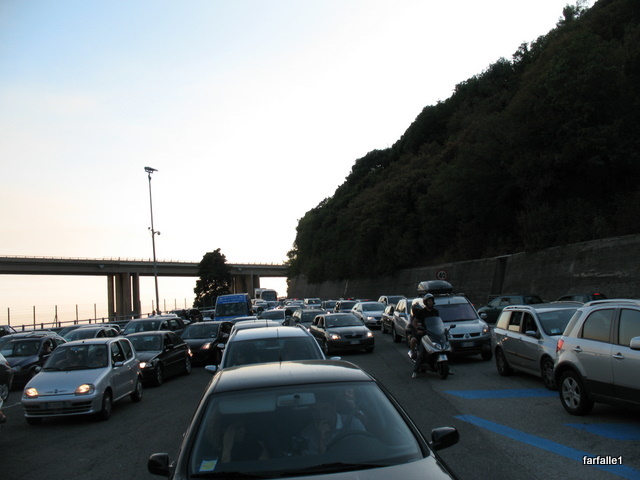
As the above photo of stalled traffic on the A10 suggests, the Autostrada system gets a lot of use: 4 million people a day travel on the system; in 2008, 915 million vehicles used the roads.  Anyone who has ever driven on the Autostrada on any day other than Sunday will not be surprised to learn that trucks account for 19% of the vehicles and 24% of the kilometers traveled on the system (2008).  45% of the fatal accidents involve a truck.

Does it surprise you to hear that Italy has fewer road fatalities per 100,000 population (8.7) than the U.S. (12.3)?  Or, if you prefer, 12 fatalities per 100,000 vehicles in Italy compared to 15 per 100,000 in the U.S. It actually didn’t surprise me.  After living and driving in both countries I will take crazy Italian drivers over crazy U.S. drivers any day.  Italians drive fast, often, but they drive well, and while they may seem aggressive at times, it is usually a sporting sort of aggression (‘Let’s race! Isn’t this fun?’) rather than an angry aggression (‘Get out of my lane! I hate you!’).

What I have noticed more than anything here in Italy is a shared concern for safety; if someone stops on the side of the road he will follow the rules that require putting on a reflective vest and setting up a reflective warning triangle.  If there is damage on the road a warning sign is quickly put up.  One time the Captain and I drove back from Ikea with an oversize load sticking out the back of our car – we didn’t flag it correctly, and another motorist had something to say about that.  We snuck home with our tails between our legs (we didn’t know the rule at that time).  There is a sense of cooperation in road matters that I never feel in the U.S.  Here we have not ‘my’ lane and ‘your’ lane – rather we have ‘our’ road, and if one of us needs a bit of the other’s lane, well, that’s okay.  I’ll move over for you happily without getting all territorial about it.  I think in the U.S. we’re a bit more protective of ‘our’ space – maybe because we have so much more of it and can afford to be.

And speaking of sporting… the Autostrada, in its philosophy of full disclosure, wants you to know where the Tutor cameras are.  Warning signs alert you when you pass one.  And if you want to plan your coffee breaks to maximize your speed thrills on your journey, check out this site for a map of Tutor cameras before you leave home.

Buon viaggio!

Tutor map: http://www.autostrade.it/en/assistenza-al-traffico/tutor.html?initPosAra=3_4

Spunky Old Dame

02 Sunday Oct 2011

Posted by farfalle1 in Italian habits and customs, Italian men, Italian women, Law and order, Uncategorized

≈ 4 Comments

Tags

Crime in Italy, Italian Thief

I loved this story that appeared in the English-speaking part of ANSA news service this weekend:

Woman, 88, sees off thief

‘I would have chased him if it weren’t for my artificial hip’

(ANSA) – Pordenone, September 30 – An 88-year-old Italian woman got rid of a thief in her house Thursday, telling him he should be ashamed of himself and get a job.

The man turned up on her door in the northern city of Aviano posing as an electricity-meter man the morning after she had celebrated her birthday with some friends, Rina Zorzin told Italian TV Friday after receiving the compliments of Mayor Stefano Del Cont Bernard.

“First he asked to see the meter and when I refused he took out a gun, thinking that would frighten me,” she said.

“But nothing scares me any more, at my age, so I jumped onto his back to stop him.

“He grabbed me round the wrists and forced me to sit down”.

Undaunted, Ms Zorzin taunted the would-be thief: “look all you want, look for gold, I’m not giving you anything”.

Then, when the man was looking elsewhere, she managed to get out of the house and shout for help, crying “thief, dirty thief, you ought to be ashamed, go and get a job”.

The would-be thief gave up and took flight, Zorzin said.

“I would have chased after him, too, if it weren’t for my artificial hip,” she told the RAI state TV corporation.

******************************

What I love about the story is that this is the same kind of lady who will cheerfully elbow you out of the way at the meat counter or bus stop.  What I also love about it is that the thief gave up and ran away.  In the U.S. he might well have shot the old woman.

Diving for Pearls in Zoagli

05 Monday Sep 2011

Posted by farfalle1 in Customs, Italian habits and customs, Italian men, Uncategorized

≈ 10 Comments

Tags

Cliff diving, Diving in Zoagli, High diving, Zoagli

(click on any photo to see a larger, clearer image)

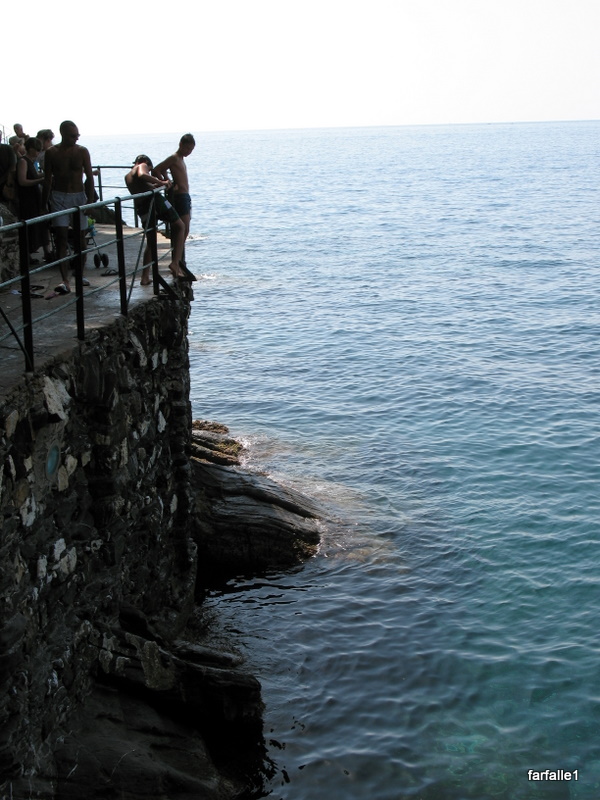
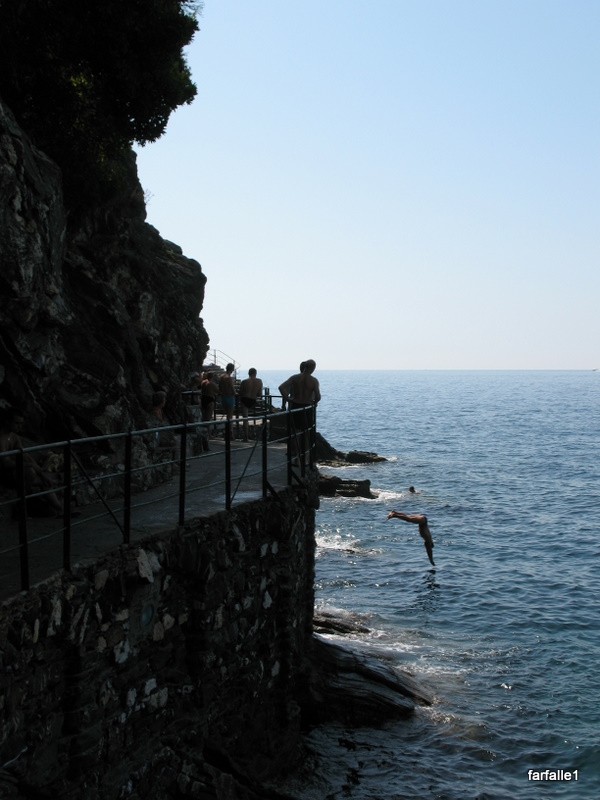
Nah, I’m just kidding, they don’t really dive for pearls in Zoagli, at least I don’t think they do. But they certainly do dive.  The young neophytes start from the passagiata walk, a gorgeous path that has been constructed where the sheer, steep cliffs meet the rock strewn sea:


And if you think mothers object to their children jumping from a great height into what looks like a pile of rocks, guess again.  Mom jumps too!


Once they’ve mastered the low dive, they move up to the medium dive.  This young man dove from the ledge above the heads of the three people standing farthest along the sidewalk; he not only had to clear the sidewalk, he had to get far enough out to miss the rocks just below the walk.


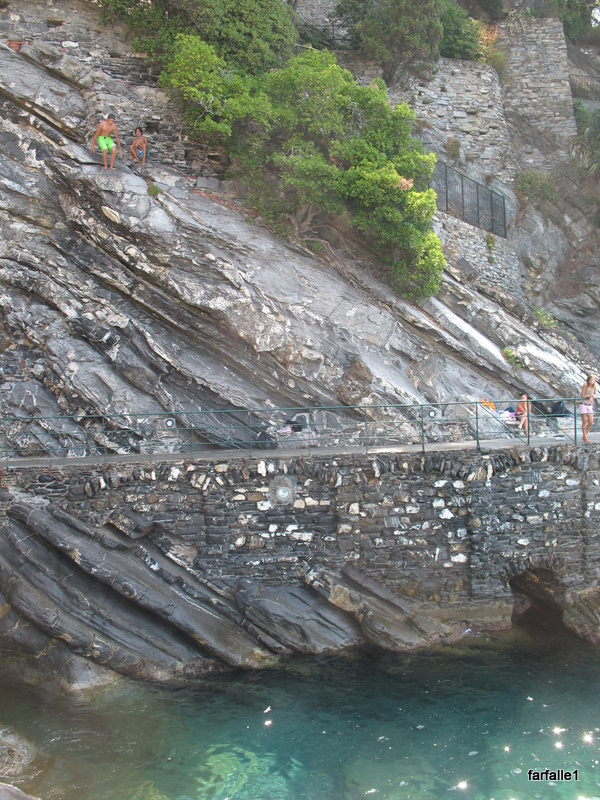
Then there’s the…. High Dive.

See the boy in the green trunks with his friend about twenty feet above the passagiata?  This stops my heart every time I see it – there’s no margin for error in this jump.

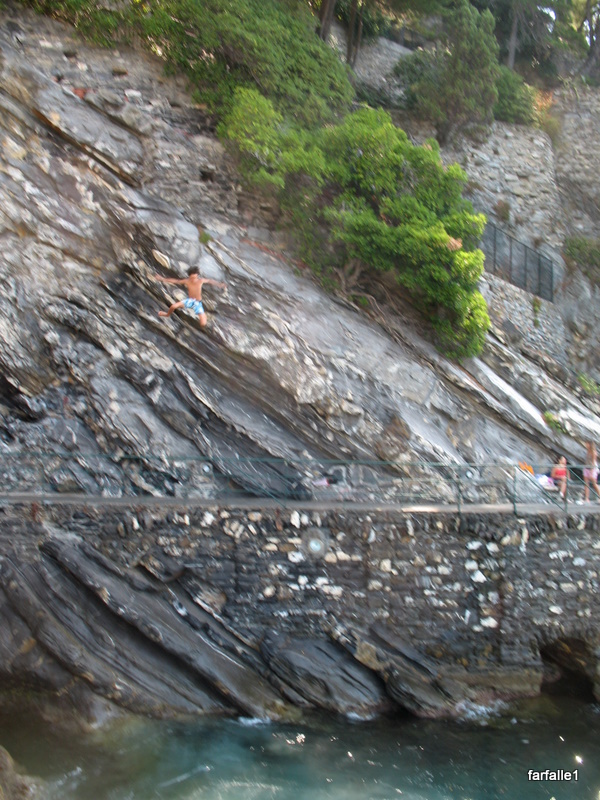
And there he goes!

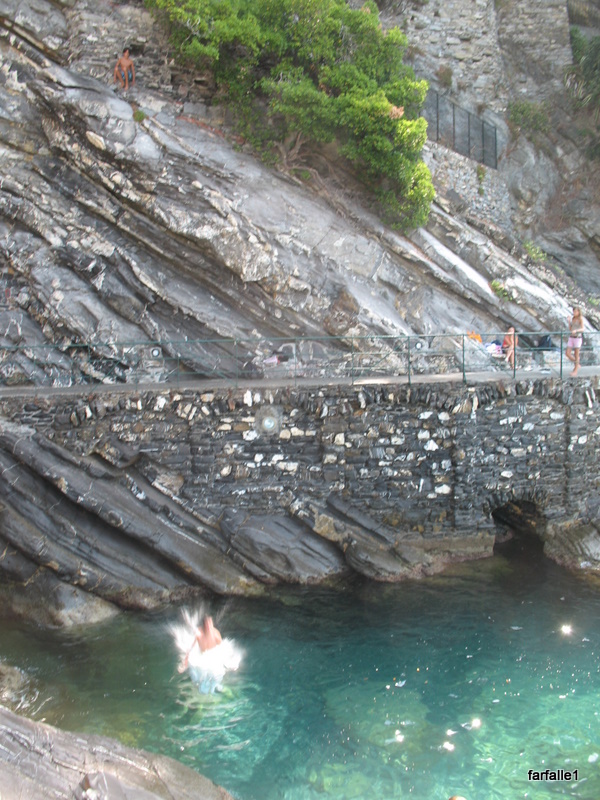
The photo is out of focus because the whole thing makes me so nervous my hands shake.  But look!  He’s arrived safe and sound!

Jumping from the high rocks seems to be a rite of passage for Zoagli teenagers (mostly boys, though I’ve seen girls jump too).  It makes me kind of glad I didn’t grow up on a rocky sea coast.  No.  It makes me very glad I didn’t grow up on a rocky sea coast!

← Older posts

Enter your email address to follow this blog and receive notifications of new posts by email.

Join 114 other subscribers

rss

Subscribe in a reader

Search the Blog

A. Useful Links

  • bab.la language dictionary
  • Bus schedules for Tigullio
  • Conversions
  • English-Italian, Italian-English Dictionary
  • Expats Moving and Relocation Guide
  • Ferry Schedule Rapallo, Santa Margherita, Portofino, San Frutuoso
  • Italian Verbs Conjugated
  • Piazza Cavour
  • Rapallo's Home Page – With Link to the Month's Events
  • Slow Travel
  • The Informer – The Online Guide to Living in Italy
  • Transportation Planner for Liguria
  • Trenitalia – trains! Still the most fun way to travel.

C. Elaborations

  • A Policeman’s View
  • Driving School Diary
  • IVA refunds due for past Rifiuti tax payements
  • Nana
  • Old trains and old weekends
  • The peasant, the Virgin, the spring and the ikon
  • Will Someone Please, Please Take Me to Scotland?

D. Good Recipes - Best of the Week winners are starred

  • 'Mbriulata
  • *Baked Barley and Mushroom Casserole*
  • *Captain’s Boston Baked Beans*
  • *Crimson Pie*
  • *Louise’s Birthday Cake*
  • *Melanzane alla Parmigiana*
  • *Penne with Cabbage and Cream
  • *Pizzoccheri della Valtellina*
  • *Pumpkin Ice Cream*
  • *Risotto alla Bolognese*
  • *Rolled Stuffed Pork Roast*
  • *Spezzatini di Vitello*
  • *Stuffed Grape Leaves*
  • *Stuffed Peaches (Pesche Ripiene)*
  • *Swordfish with Salsa Cruda*
  • *Tagliarini with Porcini Mushrooms*
  • *Tagliatelli al Frutti di Mare*
  • *Three P's Pasta*
  • *Tzatziki*
  • 10th Tee Oatmeal Apricot Bars
  • Adriana’s Fruit Torta
  • Aspic
  • Bagna-calda
  • Best Brownies in the World
  • Clafoutis
  • Cold cucumber soup
  • Crispy Tortillas with Pork and Beans
  • Easy spring or summer pasta
  • Fish in the Ligurian Style
  • Hilary's Spicy Rain Forest Chop
  • Insalata Caprese
  • Lasagna al forno
  • Lasagna al Forno con Sugo Rosato e Formaggi
  • Lemon Meringue Pie
  • Leo’s Bagna Cauda
  • Leo’s Mother’s Stuffed Eggs
  • Louis’s apricot chutney
  • Mom's Sicilian Bruschetta
  • No-Knead (almost) Bread
  • Nonna Salamone's Christmas Cookies
  • Pan Fried Noodles with Duck, Ginger, Garlic and Scallions
  • Pesto, the classic and original method
  • Pesto, the modern, less authentic method
  • Pickle Relish
  • Poached pears
  • Poached Pears
  • Polenta Cuncia
  • Recipes from Paradise by Fred Plotkin
  • Rustic Hearth Bread
  • Shrimp and Crayfish Tail Soup
  • Sicilian salad
  • Slow Food Liguria
  • Slow Food Piemonte and Val d'Aosta
  • Spinach with Garlic, Pine Nuts and Raisins
  • Stuffed Eggs, Piemontese Style
  • The Captain’s Salsa Cruda
  • Tomato Aspic
  • Zucchini Raita

E. Blogroll

  • 2 Baci in a Pinon Tree
  • Aglio, Olio & Peperoncino
  • An American in Rome
  • Bella Baita View
  • Debra & Liz's Bagni di Lucca Blog
  • Expat Blog
  • Food Lovers Odyssey
  • Italian Food Forever
  • L’Orto Orgolioso
  • La Avventura – La Mia Vita Sarda
  • La Cucina
  • La Tavola Marche
  • Rubber Slippers in Italy
  • Southern Fried French
  • Status Viatoris
  • Tour del Gelato
  • Weeds and Wisdom

Photographs

  • A Day on the Phoenix Light Rail Metro
  • Apache Trail in the Snow
  • Aquileia and Croatia
  • Birds on the Golf Course
  • Bridge Art
  • Canadair Fire Fighters
  • Cats of Italy
  • Cloudy day walk from Nozarego to Portofino
  • Fiera del Bestiame e Agricultura
  • Football Finds a Home in San Maurizio
  • Hiking Dogs
  • Mercatino dei Sapori – Food Fair!
  • Moto Models
  • Olive pressing
  • Rapallo Gardens
  • Rapallo's Festa Patronale
  • Ricaldone and the Rinaldi Winery
  • Rice Fields
  • Sardegna ~ Arbatax and Tortoli
  • Sardegna ~ San Pietro above Baunei
  • Sardegna ~ The Festa in Baunei
  • Scotland, including Isle of Skye
  • Slow Food 2008 Salone del Gusto
  • The Cat Show and the Light Rail Fair
  • The desert in bloom
  • Trip to Bavaria

Pages

  • Fagioli all’ucelleto

Archives

Recent Posts

  • A Superior Visit
  • Fun at the Ranch Market
  • The MAC
  • Welcome Tai Chi
  • Bingo Fun for Ferals
December 2025
M T W T F S S
1234567
891011121314
15161718192021
22232425262728
293031  
« Jul    

Member of The Internet Defense League

Blog at WordPress.com.

  • Subscribe Subscribed
    • An Ex-Expatriate
    • Join 114 other subscribers
    • Already have a WordPress.com account? Log in now.
    • An Ex-Expatriate
    • Subscribe Subscribed
    • Sign up
    • Log in
    • Report this content
    • View site in Reader
    • Manage subscriptions
    • Collapse this bar
 

Loading Comments...