• Contact
  • Elaborations
    • A Policeman’s View
    • Driving School Diary
    • Great Danes
    • IVA charged on Tassa Rifiuti
    • Nana
    • Old trains and Old weekends
    • The peasant, the virgin, the spring and the ikon
    • Will Someone Please, Please Take Me to Scotland??
  • Recipes
    • ‘Mbriulata
    • *Baked Barley and Mushroom Casserole*
    • *Captain’s Boston Baked Beans*
    • *Cherry Tart*
    • *Crimson Pie*
    • *Louise’s Birthday Cake*
    • *Melanzane alla Parmigiana* – Eggplant Parmesan
    • *Penne with Cabbage and Cream
    • *Pizzoccheri della Valtellina*
    • *Pumpkin Ice Cream*
    • *Risotto alla Bolognese*
    • *Rolled Stuffed Pork Roast* on the rotisserie
    • *Shrimp and Crayfish Tail Soup*
    • *Spezzatino di Vitello*
    • *Stuffed Grape Leaves*
    • *Swordfish with Salsa Cruda*
    • *Tagliarini with Porcini Mushrooms*
    • *Tagliatelli al Frutti di Mare*
    • *Tzatziki*
    • 10th Tee Apricot Bars
    • Adriana’s Fruit Torta
    • Artichoke Parmigiano Dip
    • Best Brownies in the World
    • Clafoutis
    • Cod the Way Sniven Likes It
    • Cold Cucumber Soup
    • Crispy Tortillas with Pork and Beans
    • Easy spring or summer pasta
    • Fagioli all’ucelleto
    • Fish in the Ligurian Style
    • Hilary’s Spicy Rain Forest Chop
    • Insalata Caprese
    • Kumquat and Cherry Upside Down Cake
    • Lasagna Al Forno con Sugo Rosato e Formaggi
    • Lemon Meringue Pie
    • Leo’s Bagna Cauda
    • Leo’s Mother’s Stuffed Eggs
    • Louis’s Apricot Chutney
    • Mom’s Sicilian Bruschetta
    • No-Knead Bread (almost)
    • Nonna Salamone’s Famous Christmas Cookies
    • Pan-fried Noodles, with Duck, Ginger, Garlic and Scallions
    • Pesto
    • Pesto
    • Pickle Relish
    • Poached Pears
    • Polenta Cuncia
    • Pumpkin Sformato with Fonduta and Frisee
    • Rustic Hearth Bread
    • Sicilian Salad
    • Soused Hog’s Face
    • Spotted Dick
    • Swedish Tea Wreaths
    • The Captain’s Salsa Cruda
    • Tomato Aspic
    • Vongerichten’s Spice-Rubbed Chicken with Kumquat-Lemongrass Dressing
    • Winter Squash or Pumpkin Gratin
    • Zucchini Raita

An Ex-Expatriate

~ and what she saw

An Ex-Expatriate

Category Archives: Italian habits and customs

Who Knew – Cold Breakfast

24 Wednesday Aug 2011

Posted by farfalle1 in Italian bureaucracy, Italian food, Italian habits and customs, Liguria, Uncategorized

≈ 2 Comments

Tags

B&B's Italy, Breakfast at an Italian B&B, Italian B&Bs, Ligurian regulations

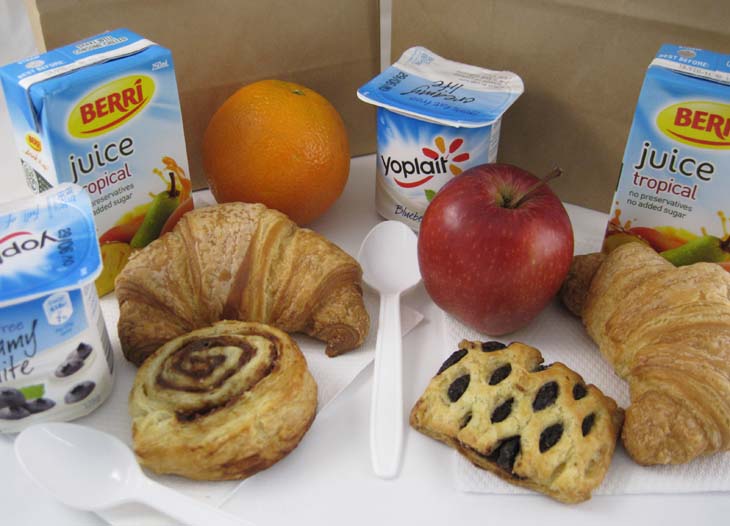
Photo courtesy of mintfoods.com.au

One of the joys, arguably the principal joy, of staying at a B&B is the breakfast part of the equation. We almost always seek out small B&B’s when we travel. Sometimes the decor is plain, sometimes fussy, the beds sometimes too small or not terribly comfortable. We almost always find a level of cleanliness Expatriate could only hope to emulate in her own home. And of course, the best part: breakfast! In Germany and Austria the array of cold sliced meats and cheeses is mouth-watering. In England the FEB (full English breakfast) with fried tomatoes, mushrooms and cold toast in that silly toast-holder is a good reason to get up early.

If you visit Liguria I encourage you to stay at a B&B if that is your preference (and I can even supply the names of a few superb ones), but I must warn you, don’t come anticipating a full cooked breakfast. It’s not that the hosts are lazy or unimaginative; they are simply not permitted to serve anything other than packaged foods for breakfast.  Isn’t that crazy?

There’s a good reason for this sorry state of affairs.  B&B’s are regulated on the regional level in Italy, and there is no inspecting agency to check hygiene and food preparation standards at B&B’s in Liguria.  It’s hard to believe there is a place in Italy where the bureaucracy has declined to put out another tendril, but so it is.  So to protect guests the Ligurian regulations decree that only packaged food can be served.  Ick.  Some (not all) other provinces have such an inspecting agency – and that’s why you can get a ‘real’ breakfast in, say, Tuscany.

So the next time you’re at a B&B and you wonder why your highly anticipated breakfast has turned out to be only buns in a plastic bag, some cookies in a plastic sleeve, cereal in a small box and that’s it… it’s possible that those are the only available permitted foods.  Who knew?

I asked the friend who explained all this to me if eggs were allowed – after all, they come in their own rather elegant packaging.  But one would have to eat the egg raw since cooking is not permitted, and that carries its own risks.  Besides, no self-respecting Italian would eat, or serve, an egg for breakfast. Benvenuto a Rapallo and enjoy your cereal!

Rapallo Goes Green

11 Thursday Aug 2011

Posted by farfalle1 in Italian habits and customs, Rapallo, San Maurizio di Monti, Uncategorized

≈ 6 Comments

Tags

Garbage, Recycling, Refuse


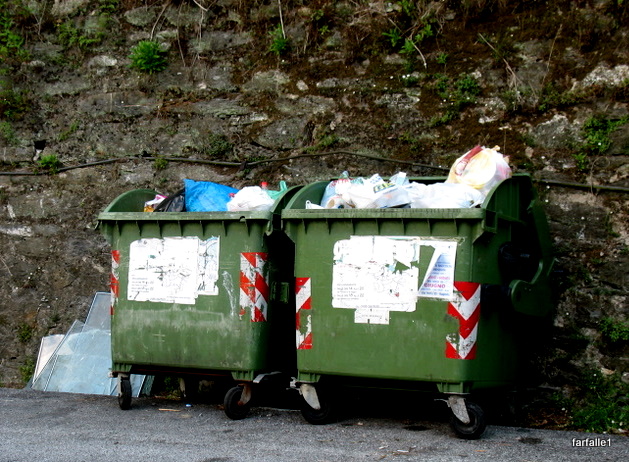
The Captain and I have been faithful recyclers since moving here, but it hasn’t always been easy.  Tossing garbage into the bins up here in San Maurizio (seen above) was a game – how fast could we do a drive-by throw? – but for recycling  glass, plastic, paper and tin we had to take our big plastic bag of recyclables on the scooter, clanking and rattling all the way down into Rapallo proper to find the appropriate bins.  The last, tin, proved especially difficult as we knew of only one receptacle, on a bridge out near the autostrada entrance. Oddly enough, the hole for receiving stuff was large enough to accept a tomato-sauce tin, but not large enough to accept a cat-food tin.  Go figure.

(By the way, the papers glued all over the front of the old bins gave very specific hours when it was permissible to throw away your garbage; basically it was allowed in evening, exact hours dependent upon whether it was summer or winter.  The theory must have been there would be fewer unpleasant aromas if the garbage wasn’t left to cook in the heat of the day.  Needless to say no one paid the least attention to these regulations.)

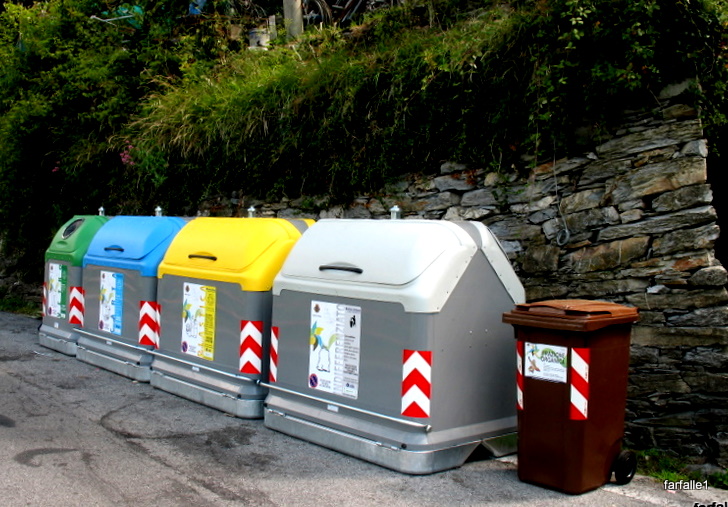
Well, better days are here!  Take a look at these beauties:


Reading from left to right there are bins for Glass; Paper; Plastic AND Metal; and unsorted garbage, for the stubborn old hold-outs who don’t want to recycle.  It’s also for really dirty stuff that isn’t appropriate for recycling, like paper drenched in olive oil (focaccia, anyone?) or the things you just don’t know what to do with, like the mysterious balls of horrible stuff that come out of a vacuum cleaner, or old globs of dried glue. The little brown bin at the end is for vegetable matter.  Up here we would need a bin about 100 times the size of this to accept all the cuttings, prunings and clearings that regularly occur in local gardens.  But it’s a nice gesture and, I suppose, a subtle hint to people to stop burning: too small a container and way to subtle a hint, I’m afraid.

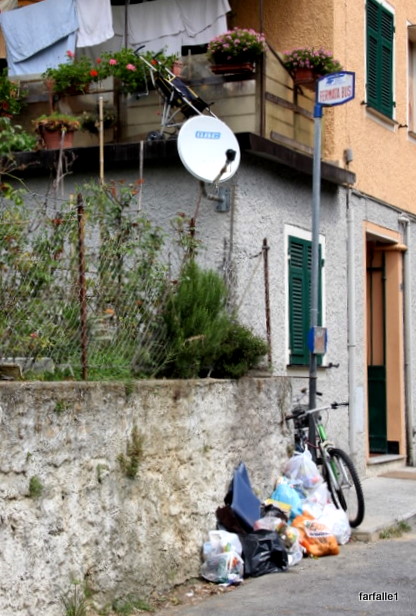
These are our very own San Maurizio di Monti recycling bins, which means the Captain and I no longer have to go down the hill sounding like the tinker of yore when we have cans and bottles to recycle.  What a huge improvement in our lives!  Not everyone’s life improved as much though.  The reason is that though they replaced most of the old bins, they did not replace ALL of them, so some people who used to have conveniently placed bins now have to walk quite a distance to get rid of their rubbish.  Do they like it?  Not at all!  Will they stand for it?  Evidently not.  How do we know?


If they take away your old bin and don’t give you a new one, just put your garbage out on the street – that’ll show ’em.  There’s a certain elegant logic to this approach, but it certainly doesn’t add much to the appeal of Via Betti. We’re watching with interest to see who wins this stand-off, garbage-strewing residents or The Town.

Shhhh

01 Monday Aug 2011

Posted by farfalle1 in American habits and customs, Arizona, Customs, Italian festas, Italian habits and customs, Italy, Uncategorized

≈ 13 Comments

Tags

How to Listen, Julian Treasure, Listening, Noise, Noise Pollution, Sound

The Captain always teases me by saying, “You know I never listen;” and I tease back by saying, “True.  We have the perfect arrangement for living in Italy – you speak and I listen.”  (He’s much better at speaking the language than I.)

While the captain may be teasing, it seems true to me that often people really don’t listen to others (I include myself in this group). The reasons are many – self-involvement, disinterest, hearing impairment, multi-tasking, language challenges, etc., etc.

The TED website recently put up a talk by sound specialist Julian Treasure which I found fascinating. He talks about why people don’t listen, and how we can all improve our listening skills.  It’s a short video, just over seven minutes – here, take a look.

https://ted.com/talks/view/id/1200

One of the things that has always struck me about Italy is the non-stop noise, at least where we live.  As I type this it’s 10:30 at night and there’s a festa down the street a way with live music – very loud live music.  Driving bass, banging drums and a songstress who is, alas, a bit flat.  It’s not my taste in music, to be honest, but I don’t really resent it being forced on us (at least not until after 11 p.m. – last night the live music went til midnight and I did get a bit cranky).  It happens only a few times a year up here. The amazing thing to me is that no one complains or seems to mind.

But if it’s not live music, there is always some other kind of aural stimulation – scooters and cycles tearing up and down the mountain; the bus slowly groaning its way up, merrily tootling its horn at every curve (a necessary precaution on these narrow roads) and then loudly sighing and chuffing at each stop; church bells from our village, from Montallegro and, if the wind is right, from the Rapallo Cathedral; ambulance and police sirens; cruise ship horns; airplanes overhead; dogs barking; cocks crowing at all hours; birds; children shouting (a particularly cheerful noise, that) and always, always conversation.  Conversation as an art form is alive and well in this courteous country.  Finding three minutes of silence daily, as recommended by Mr. Treasure (can that really be his name??) is a challenge here.  Every now and then one of us awakens at 3 or 4 a.m., and we are struck by the relative silence – it is such a rarity.

In contrast the U.S. seems much quieter in general (not the cities, to be sure).  The example the Captain likes to give is this:  when Italy won the World Cup (European football) in 2006 the racket from Rapallo was amazing – horns blasted, cars tore through the center of town with kids hanging out waving flags and shouting, ships in the harbor blew their horns – it was an explosion of celebratory sound.  In 2008 when the Arizona Cardinals (American football) won the game that sent them to the Super Bowl we stuck our heads outside right after the game.  Our Arizona neighborhood was as silent as a tomb, the town was silent; and we were a mere forty miles from the stadium where the game was played.  No one was out and about because anyone not at the game was surely inside watching it on TV – but afterwards there was no public demonstration of glee.  And if someone’s party is noisy in the U.S. it takes the neighbors no time at all to call the police and complain.

So, is it harder to listen in Italy, where there is so much more ambient noise?  Though the Captain might well disagree,  I don’t really think so.  But as we know, he doesn’t listen anyway…

Not Quite Ready for Prime Time

30 Thursday Jun 2011

Posted by farfalle1 in Italian bureaucracy, Italian habits and customs, Italian Postal Service, Shopping, Uncategorized

≈ 12 Comments

Tags

Alice, Amazon.it, Mailorder in Italy, Online purchasing in Italy, Telecom Italia, TIM

photo credit: 49th-parallel.blogspot.com

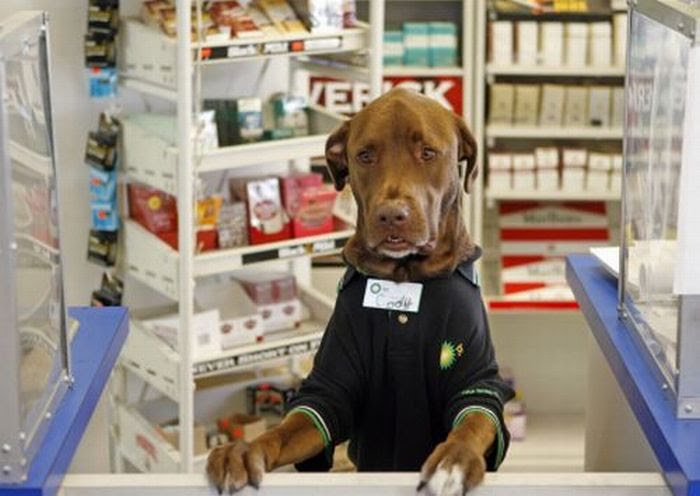
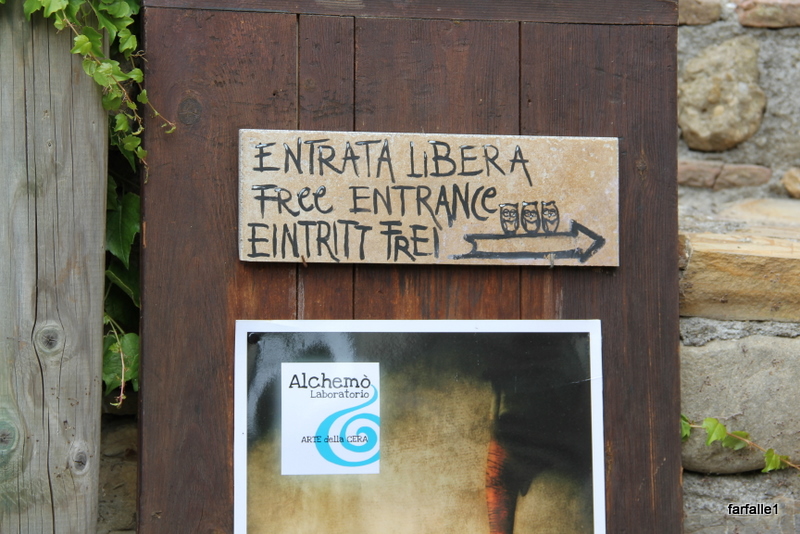
In years past it seemed that Italy embraced the notion of “Service” with some reluctance.  I’m thinking of the bad old days, of how when you entered a shop you were expected to make a purchase – which is why you now sometimes see signs in shop windows that say ‘Entrata Libera’ – that is, you can come in and look around and not feel obligated to buy something.

Combine dubious service ethics with an elastic sense of time and you get a good idea of how your problem with Telecom Italia (fondly known as TIM) might be handled.  An example.  We lost our landline telephone service on a Friday; it was restored the following Monday.  That was bad, but it wasn’t the end of the world thanks to cell phones.  We lost our broadband internet service (winningly named Alice: TIM and Alice, what a pair!) the following Wednesday, for no apparent reason, i.e., no storms, electrical outages, sunspots, aliens, etc.  Since the internet is for us what the aorta is for your heart, the Captain immediately phoned 187, TIM’s appealingly brief help number.  After explaining what had happened to a sympathetic woman he was told that the situation would be rectified in two days.  TWO DAYS??  How about two hours, or, better, two minutes?  Two days was simply not acceptable.  It was also non-negotiable, so we had no alternative but to swallow our frustration and submit.

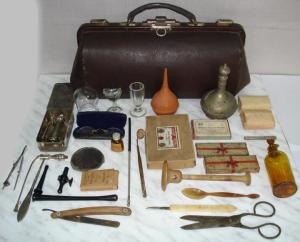
photo credit: ioffer.com

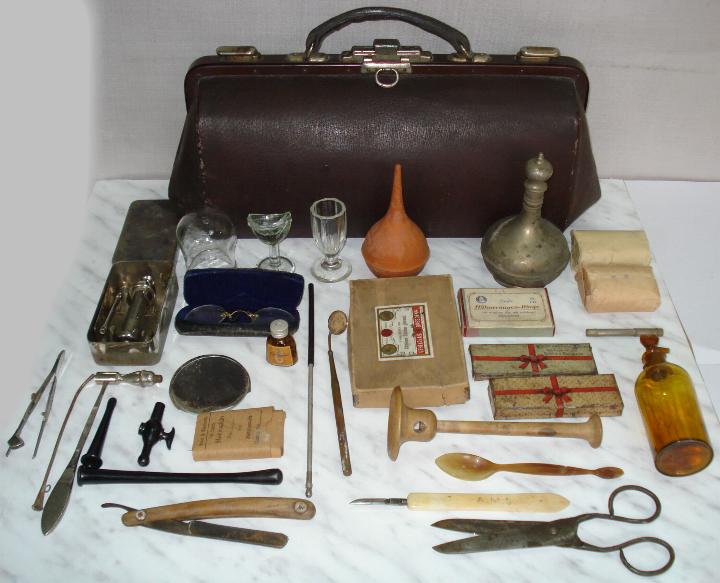
Sure enough, on Saturday morning two cheerful TIM Techs appeared with their tool-laden black bags (they remind me of the doctors who used to make house calls when we were young, black bags bulging with mysterious and disturbing apparatus).  After satisfying themselves that it wasn’t our wifi server at fault they checked the connections outside and did some other line checks.  After a spirited discussion between themselves, which we could barely follow, they told us that the problem was at Centrale, that we were awfully far away from the center of Rapallo, and that therefore the solution was to change our account from a 7 mbs to a 4 mps service.  Okay, that doesn’t make a bit of difference since we receive data generally at only about 1 mps.  The solution just didn’t make sense to me, but it did to them, so that’s what they did and Voila!  The internet came back.  Phew!

Except it didn’t stay with us.  It came and went, seemingly at will.  We would be working away and suddenly our connection would evaporate.  Sometimes it was gone for five minutes, sometimes for five hours.  But it did eventually come back, until it didn’t.  We called TIM. This time the wait was four days.  Fortunately we were away for two of them so we didn’t have to actually murder anyone.  Again the same good-natured duo appeared.  After a lot of thising and thating they went down the street and found a loose connection in the San Maurizio centrale (which is probably a pole with a wire on it, but I couldn’t tell you which pole or which wire).  Hurrah!  The internet was back again!

And it stayed back for two days.  On the third morning it went out for about ten minutes.  We were going nuts at this point, so the Captain called 187 immediately.  At lunch time our friends reappeared.  This time they didn’t even come down the stairs to the house.  They asked if we had the connection now and we admitted we did.  Then they admitted that they had shut it down for ten minutes.  Well thanks for warning us ahead of time!  “It was just ten minutes,” one said.  Well, yes, but how was one to know?

So TIM gets one of my nods for Not Quite Ready for Prime Time – not for lack of service, but for quixotic service.  In fairness, I have to say they are trying.  The Tech guys did come up to see us three times (and for that I credit Trattoria Rosa across the street, where they could enjoy a fine meal after doing their magic) – it’s just that it took three visits to get it straightened out.  After our telephone was restored we received five phone calls over a four-day period to see if we still had our connection.  This is like firmly closing the door of the stable after the return of the horse, a sort of twisted approach to service:  “We’ll make you wait forever to restore your service, but then we’ll pester you to death making sure your service is restored!”

We’re spoiled in the U.S.  If something goes wrong we call, wait on hold for an hour or so, talk to someone (or register an electronic service request), and then the problem gets fixed, and not two days later. Right away. End of story.

My other nod for NYRFPT goes to Amazon.it.  We were thrilled to learn that Amazon had arrived in Italy because we are enthusiastic customers in the U.S., but with the vagaries of mail service here we wondered about order fulfillment.  Our first order, made shortly after we arrived, was a dream.  We ordered an electric toothbrush (at great savings, I might add) and were told delivery would be four days later. Lo and behold!  Four days later our toothbrush arrived.  We could hardly believe it.

So we tried again.  We ordered a weather station for some friends.  Again we were told delivery would be in four days.  Six days later I visited the website and saw that the item had been shipped and was waiting for delivery.  A few days later it was still waiting.  A few days later the web-site (excellent) showed that delivery had been attempted twice.  The only problem was, we were having work done at the house and there was someone here all the time.  No delivery had been attempted, we were quite sure.

The Captain got on the phone again and talked to a terrifically helpful woman. She assured us delivery had been attempted several times, and that they had called us a couple of times about it, but we think she mis-spoke (we have an answering machine and it was empty of Amazon calls).  Maybe the delivery company told Amazon they had tried, but for sure no one came up the hill with a weather station for us.

photo credit: retroclipart.co

The Helpful Woman said she would resolve the problem, and she did, setting up a delivery day (not hour, just day). (By the way, Customer Service ladies in Italy really do look just like this, and they speak on big black phones with fat lines.) We arranged our schedules so someone would be here every minute of the day.  And after all that, the delivery person simply put the package on top of our mailbox without even ringing the bell or announcing his presence in any other way.  The weather station we ordered on May 16 arrived on May 29, almost two weeks later.  It probably still wouldn’t be here if the Captain hadn’t persisted with his phone calls.

The problem is not with Amazon.  They have done enough business in enough countries to know how to do it right.  The problem is with the Italian approach to delivery (or, if you will, ‘service’) which is different than the American, British, or even Amazon approach.  Amazon was extremely responsive and helpful, but their expeditors didn’t help them much.

It will be interesting to see if Amazon.it survives.  As I see it there are two strikes against them: 1) Italians in general are not mail-order, computer-order people and 2) delivery is undependable (which may partially explain #1).  Few of our Italian friends take care of business on the computer.  It’s almost more a curiosity for them, an amusing way to keep in touch if and when they feel like sending an e-mail.  But banking?  Shopping?  No.  And if they do decide to shop online, they may find themselves waiting, waiting, waiting for delivery.
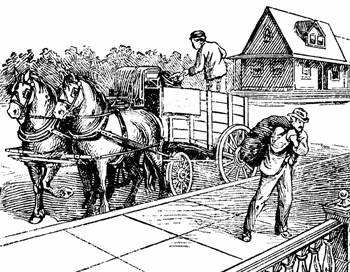
photo credit: etc.usf.edu

And that’s why Amazon is Not Quite Ready for Prime Time in Italy.
Election Day

14 Tuesday Jun 2011

Posted by farfalle1 in Italian bureaucracy, Italian habits and customs, Italy, Rapallo, San Maurizio di Monti, Uncategorized

≈ 4 Comments

Tags

Italian Elections, Referendums in Italy, Voting in Italy

Faithful readers will remember that the Captain became an Italian citizen about a month ago.  As luck would have it, there was an election yesterday, and he is now eligible to vote.  It wasn’t an election for political office, it was referenda on four questions: 1) should the law allowing privatization of the water company stay on the books?  2) should the cost of water be increased?  3) should the law exempting politicians currently in office from being tried in court stay on the books? and 4) should the plans to re-institute nuclear power plants in Italy go forward?

Will it surprise you to hear it was not a simple matter to get into the voting booth?  The Captain started two weeks ago, when he went to the Comune to request his voting card, without which he could not vote.  They were too busy to take care of him that day, and in fact tried very hard to discourage him from voting this time. But as a citizen it is his right to vote, and they were more or less obliged to take care of him, although not at that exact moment.  They grumblingly instructed him to come back a week later, which he did. They were even busier and once again they tried to put him off.  He wouldn’t give up, so they promised they would do the necessary work and then call him to let him know when he could pick up his card.

The polls were open on Sunday and Monday.  Late Sunday afternoon the long-awaited call came, and first thing Monday morning the Captain went back to the Comune where he found… that his card was not ready.  But there was a document that would allow him to vote and it was lacking only one signature.  Fortunately the hand that had to affix the signature was actually in the building, so without too much more delay the Captain received a handsome paper on Comune letterhead, signed by the man in charge of elections, and officially stamped, attesting to his right to vote.

Going to the polls turned out to be one the pleasantest experiences we’ve had in quite a while.  It began outside the former elementary school (now a Catholic social club) where we were warmly welcomed by the secretary of the polling section, Enrica Pedrasi, to whom the Captain explained his mission.

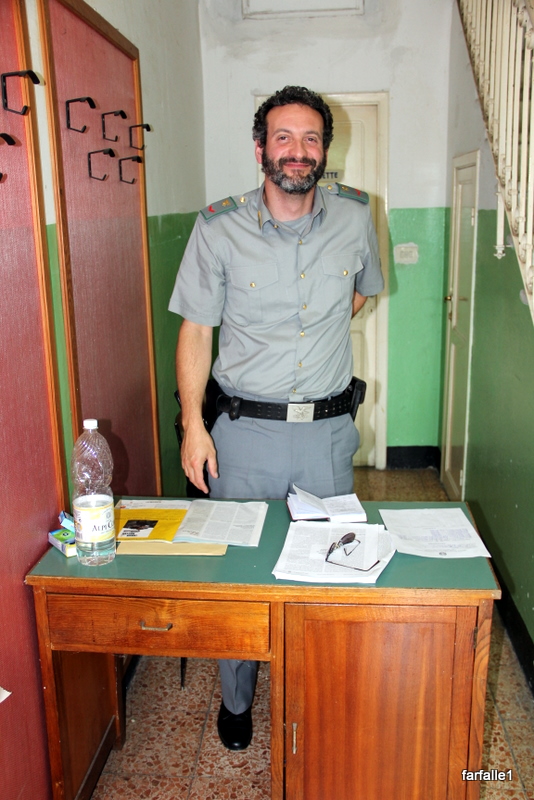
Inside we encountered the genial Gianluca from the Forestiere service. He was one of the people taxed with guarding the ballots from the time they arrived on Saturday until the polling was over on Monday afternoon. There is an armed guard on site at all times to make sure no one monkeys with the ballots.

There was a bit of confusion over the Captain’s document, because it was not the usual voting card, but the President of the polling section, Alberto Tumiati, made a quick phone call to the Comune, and all was well.


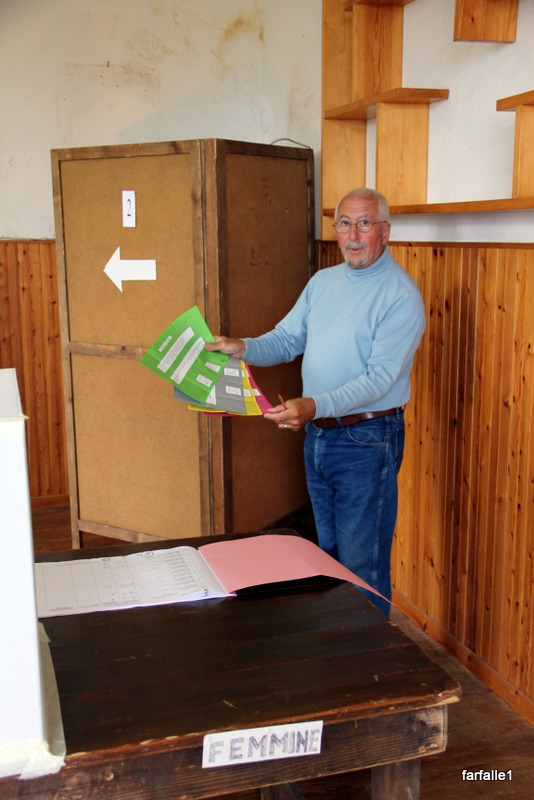
Renata Castagneto, one of the scritore normale of the polling section, entered the Captain’s name in the ledger of eligible voters.  Please note, he has been entered on the ‘maschi’ side.  Women’s names are entered in a different book kept at the other end of the table.  We’re accustomed to seeing alphabetical groupings in the States – it was a surprise to see the gender separation.

Then the Captain was given his ballots.  There was a separate color-coded ballot for each question.  The referendum question was on a strip of paper glued on the top of the paper, instructions were glued below, and two large boxes, one for Si and one for Non were glued at the bottom.

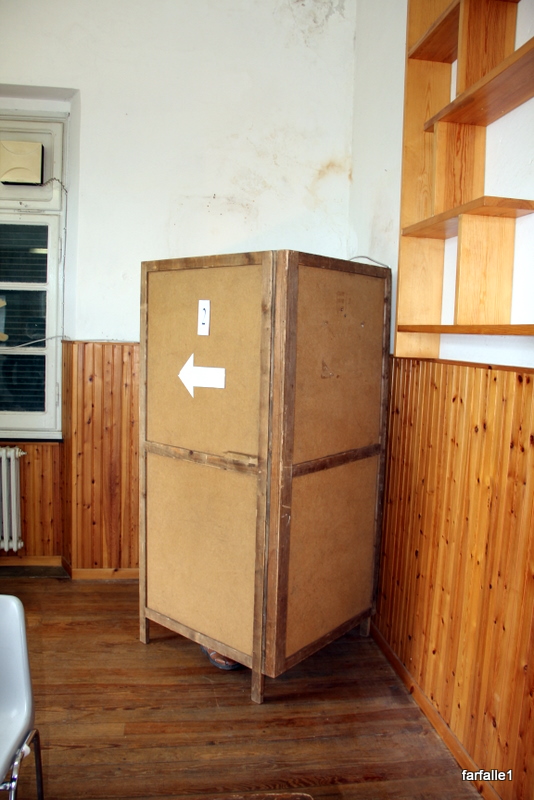
Into the booth he went, and, for the first time, voted as an Italian Citizen.  You can see his shoe in the picture below, peeking out from beneath the voting booth.


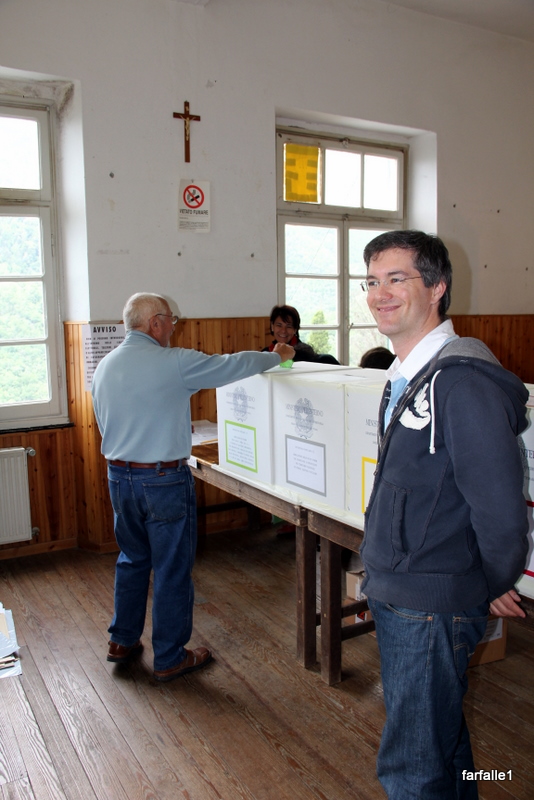
Moments later he emerged with his marked and folded ballots, and deposited each ballot in the appropriately colored box (he reports that it was complicated to fold the ballot correctly – many folds, and one section had to face out).


You can see from the expressions on the faces above that we received a very warm welcome.  In fact a cheer went up when we first walked into the room.  We were told that with the Captain’s appearance the percentage of people voting of those eligible at this voting station now stood at 51% (Rapallo, with its population of 30,000+ has 30 polling districts, each with about 1,000 voters.  Voters must vote at their own polling stations).  Well, that’s nice, we thought.  Then we learned that for the referenda to be effective more than 50% of the eligible voters in the nation must vote.  Little San Maurizio did its part.  There are about 330 eligible voters in the village, and at least 165 turned out.

As I write this the final results are not yet in.  But the evening news indicated that it seems all four referenda were passed – that is, that the laws already in place allowing for nuclear power plants, privatization of the water companies and immunity from prosecution for politicians in office, have all been overturned by popular vote.

Hurray for democracy!

Addendum:  It is the first time in fifteen years that enough voters have turned out to make a referendum valid.  All four popular initiatives passed convincingly (90%), which some see as the beginning of the end for Mr. Berlusconi.  See what the Italian press is saying here (in English).

Renata, Enrica, Alberto… if I have details wrong, please correct me in the comments or in an e-mail, okay?

Hi Pidge!


Citizen Salamone

04 Wednesday May 2011

Posted by farfalle1 in Italian bureaucracy, Italian habits and customs, Italy, Law and order, Uncategorized

≈ 11 Comments

Tags

Italian bureaucracy, Italian citizenship, Trattoria del Sole

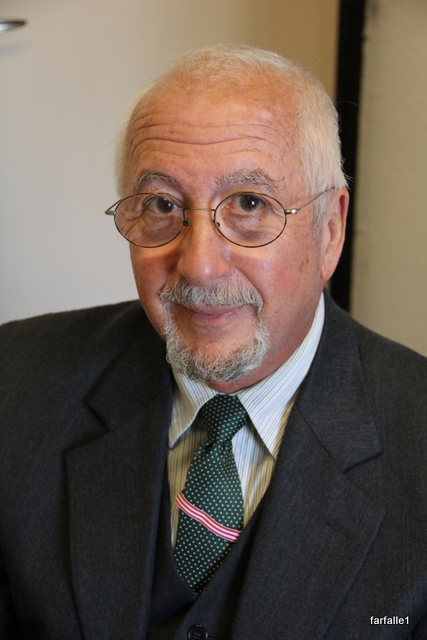
Meet Italy’s newest citizen, The Captain, aka Louis Philip Salamone.


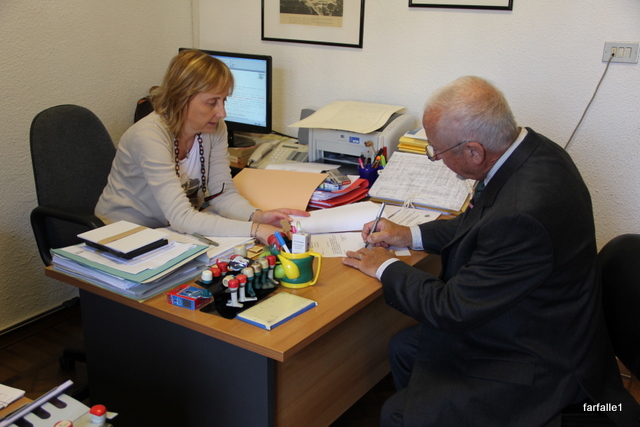
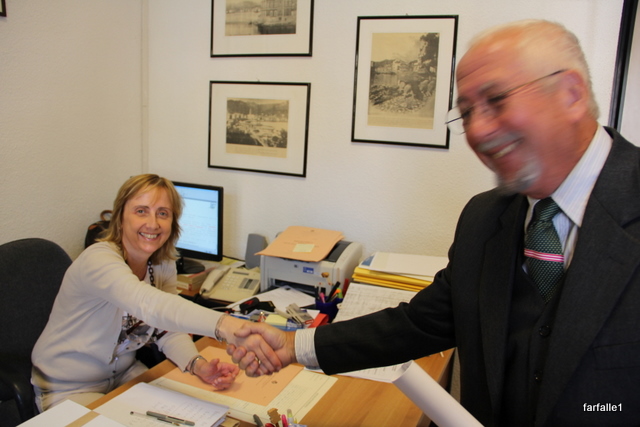
The procedure, I can’t call it a ‘ceremony,’ took place in the office of the head of the Ufficio Stato Civile, Dotoressa De Filippi this morning and was more casual than solemn (I would have liked a bit more ceremony, myself). Nonetheless, for us it was the culmination of several years of work and waiting, and we were both thrilled with the outcome and moved by the Captain’s new status.

At first we were afraid we were headed for a problem, one which has reared its ugly head in past administrative wrestling matches.  Whenever one gets a document, carta d’identita, permesso di sogiorno, etc.,  one must put place of birth on a form.  By place of birth Italian bureaucracy means town or city.  The Captain’s U.S. passport lists place of birth as ‘Wisconsin.’  This led to no end of trouble early in our stay here, but for some reason the good Dotoressa merely shook her head and commenced redoing the various declarations (they had to be further altered to correct the Captain’s misspelled middle name).  Then began the ritual ‘signing of the many forms,’ which occurred no fewer than four times.


Somewhere in the midst of the signing the Captain took an oath to uphold the Constitution and the Laws of Italy.  There was  no hand on heart, no holy book, no blood asked for or given, just a verbal promise to be a good citizen.

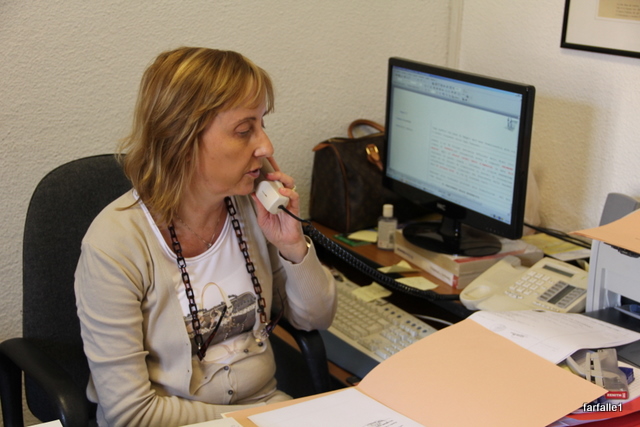
In the midst of all this the phone rang, and our proceedings were interrupted by a long discussion of what the caller’s daughter had to do to get her passport. 


It certainly detracted from the feeling that ours was a special moment, but we quickly got over it.
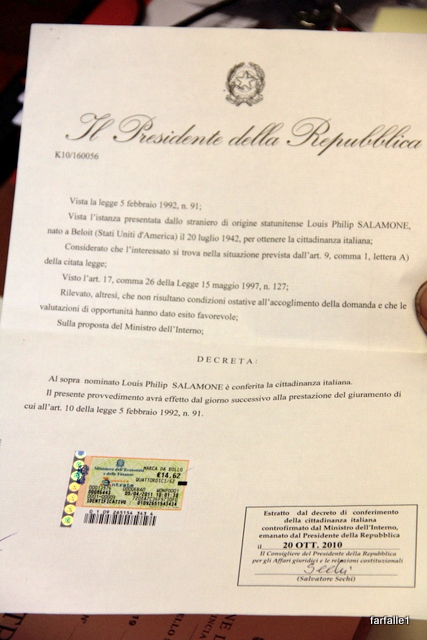
  Then the Dotoressa read a lengthy declaration to the effect that the President of the Republic had accepted the Captain as a citizen and showed us the Presidential decree, a photocopy of which was given to us later.


A quick handshake, and the deed was done.

I thought my Captain looked so handsome in his suit – it’s perhaps only the second time he’s worn it in the ten years we’ve been here.  I wish I could fit into clothes I had ten years ago!  He did not have a red, green and white tie, so he chose a green and white tie which we decorated with a bit of red and white ribbon, a not entirely unItalian thing to do. 

Today was the end of a long road that we began in 2005.  The quest began in the office of the very knowledgable and always helpful Anna Maria Saiano, the head of the Genova branch of the U.S. Consulate.  She led us to Signore Bevilacqua (Mr. Drinkwater!) who sent us to Dotoressa De Filippi in Rapallo.  She was disinclined to give the quantity of help we needed, so we returned to Sig. Bevilacqua in Genova, and he got things going for us.

There are many ways to become a citizen, one of the most common being ‘lineage.’  We had assumed this would be our route as both the Captain’s parents were Sicilian, one by birth, one by blood.  However, because the Captain’s father became an American citizen before the Captain’s birth, in effect renouncing his Italian citizenship, it became more complex.  We would have to go back to the grandparents, born in Sicily not all that long after the unification of the country.  Two world wars have had their way with that island – the odds of finding all the requisite birth certificates were low. 

We resorted to a ‘naturalized’ Citizenship, possible after five years of residence if either of the parents were born in Italy.  There are  other routes to citizenship, which you can read about here.  Gathering all the requisite data took some time, but was not especially difficult: 1) the application 2) Marca di Bollo (stamp) for E14.62  3) Income tax returns for three years  4) Father’s birth certificate  5) Captain’s birth certificate  6) FBI certificate / arrest record (done through fingerprints taken in Genova and sent to the US) 7) our marriage certificate 8) residency certificate proving length of residence in Italy  9) Permesso di Sogiorno  10) notarized copy of passport.  All documents in English required  certified translation, which we were able to procure from an office in nearby Chiavari.  The Captain did the translation himself; the certifying administrator didn’t speak English.

What the Captain didn’t have to do, which aspiring U.S. citizens must, is learn a lot of history and take a difficult test.  I’m happy to tell you that the Captain has read the history of Italy many times over, because it interests him, and I’m sure he could pass tests in both language and history.  But isn’t it interesting that in the U.S. there is a test to prove you are worthy, and in Italy it is simply a question of having the correct papers and forms?  Bureaucracy!  Having watched Craig Ferguson’s (The Late Late Show) citizenship swearing-in on TV I was surprised there was not a bit more pomp and circumstance, and at least an upraised hand when giving the oath. 

Once we filed the application and all the attendant paperwork we simply had to wait.  The State had  two years (actually seven hundred thirty days) in which to process the application and render a decision; they didn’t go too many weeks over.  News of our success reached us when we were in the U.S., and a visit to Dottoressa De Filippi was the first order of business when we got back to Rapallo. We were surprised to learn that the Captain was the twenty-seventh new citizen she had processed already this year.

So it was an exciting and momentous morning for us.  The Captain pursued citizenship for several reasons.  In a way it closes a circle that was opened when his father left Sicily for Ellis Island in 1921.  It makes life here much less complicated: no need to be traipsing off to Genova every few years for permission to remain.  Mostly it just gives official confirmation to something the Captain has known all his life: he is Italian.

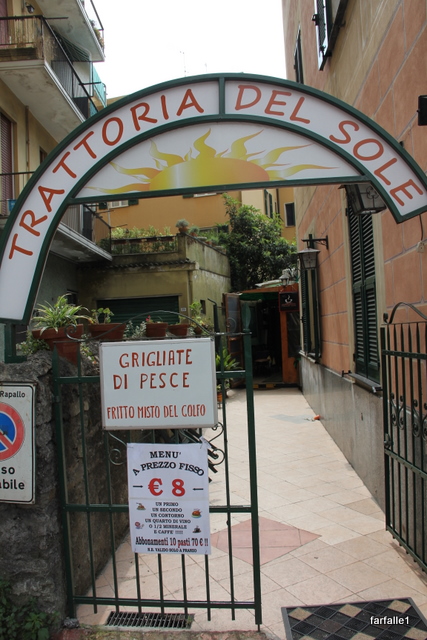
All that remained for us was a quick celebratory lunch at the delightful Trattoria del Sole across from the petrol stations on Via Mamelli where we took advantage of the daily special: penne with funghi; fried achiuge (sardine-like fish), carrots, potatoes, wine, water and coffee, all for the princely sum of E 8 each (Ligurians have the reputation of being tightfisted with their money – who are we to go against type?).


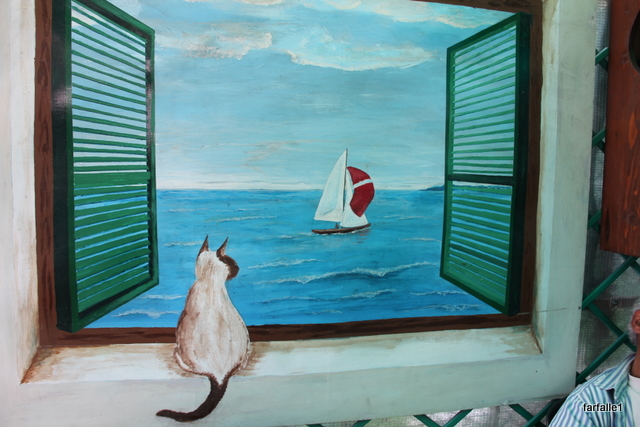
We hadn’t eaten here before, though the place has been beckoning to the Captain for some time, and were charmed to find examples of the owner’s art and crafts on the walls.

So came to a close a festive (for us) and memorable morning. Viva Italia!

So Sorry!

28 Monday Mar 2011

Posted by farfalle1 in American habits and customs, Customs, Italian habits and customs, Italian women, Uncategorized

≈ 6 Comments

Tags

Apologizing

Photo courtesy of dreamstime.com

The other day I followed a woman out of Costco, each of us pushing our heavily laden carts.  She moved away from the door and paused; I walked past her with my cart.  After I was past she said to me, “Oh, I’m sorry!”  It took me a full beat to figure out what she was talking about; evidently she felt by stopping she had somehow put herself in my way.  She hadn’t.  And she certainly didn’t owe me an apology.

This incident was preceded by no fewer than three other women apologizing for passing nearby in the aisles of the store.  What is it with American women? When did we become so apologetic for taking up a little space? For existing? It’s driving me nuts!  Women, answer this question honestly:  If you’re walking down the street and a person bumps into you, do you immediately say, “I’m sorry?”

I’m pretty sure that doesn’t happen so much in Italy!  Granted, if an Italian of either gender bumps into you, or you into him, there will follow a two-minute scusi-fest.  But space is always shared in Italy, be it on the narrow roads or in the narrow shopping aisles.  Simply being in close proximity to another is not a misdemeanor. I’ve never had the feeling that my Italian women friends feel they must apologize if they’re taking up a patch of ground that someone else might wish to occupy.  Perhaps it’s simply that Americans have a much larger sense of ‘personal space’ than do Italians.  There’s more space in the U.S. for everything, so perhaps we Americans create larger ‘me-mine’ zones than do residents of more crowded countries.

I first noticed this apology trend about 10 years ago.  Three women friends and I took a vacation together in California.  We made a pact at the very start of the holiday that whoever said, “I’m sorry” would put a quarter in the kitty.  It worked pretty well, and I think we all finished the holiday feeling we were a much less ‘sorry’ bunch.  And how rich the kitty was! Maybe that experience overly sensitized me.

It’s just that I hate to hear women apologizing when they have no reason to. And yes, it seems to be only women – certainly not men, and rarely young people.  And it seems to be happening more and more here in America.

Ladies – Stop It!  You have every right to be exactly where you are.    Please, if you catch yourself apologizing for passing close to someone else or when someone else bumps into you,  put a quarter in a kitty and save up for a treat for yourself (I hope a very small treat).

Parli Italiano?

28 Friday Jan 2011

Posted by farfalle1 in Customs, Italian bureaucracy, Italian habits and customs, Italy, Law and order, Uncategorized

≈ 14 Comments

Tags

Assimilation, Cultural assimilation, Italian language law

Illustration courtesy of Tile Hill Wood School

Italy has passed a new law that requires immigrants to offer proof of proficiency in the Italian language and to have a basic understanding of Italian culture.  Wow!  Can you imagine that happening in the U.S.?  Here are the details as set out by Baker and McKenzie in their website:

On June 10, 2010, the Italian Government enacted a new decree… that introduces substantial new developments for what concerns immigration permits. Once fully enforced, these new provisions will apply to all non-EU citizens who enter Italy for the first time with a stay permit having a duration of at least 1 year or more. Purpose of the new law is to guarantee that foreigners, who will be living in Italy for a long period of time, integrate in the community where they live and conditions the renewal of the stay permit to a series of new obligations that must be fulfilled by the foreigner.

The main aspects of this new law may be summarized as follows:

a) upon presenting an application for a stay permit, for whatever reason this may be (work; study; humanitarian reasons, etc.), the foreigner will be required to execute an agreement according to which he/she undertakes, in the following 2 years, to acquire sufficient knowledge of the Italian language (lev. A2) as well as Italian civic culture and lifestyle.

b) in order to help the foreigner acquire the knowledge mentioned above, the Italian Republic will sponsor adequate projects and in any case will hold courses of civic culture free of charge.

c) upon execution of the agreement mentioned above in a, the foreigner will be granted 16 credits. If he/she does not participate in the courses of Italian civic culture, mentioned above in b, he/she automatically looses 15 credits.

d) credits may be increased (to a maximum of 30 credits) if the foreigner participates in courses or acquires certificates, diplomas or degrees. Instead, credits may be lost if the foreigner incurs in criminal sanctions or even serious breach of administrative and tax laws.

e) the Immigration Office (Sportello Unico per l’Immigrazione), via the documentation that must be provided by the foreigner him/herself, will verify if he/she has acquired the 30 credits necessary to sustain a test, organized by the Immigration Office, to ascertain knowledge of the Italian language and Italian culture.

f) if the foreigner acquires 30 credits and passes the test mentioned above, his/her stay permit is renewed. An extension of one year, for the fulfillment of obligations deriving from the agreement, may be granted in the event that the foreigner has not acquired 30 credits at the end of the first 2-year period. Instead, with 0 or less credits, the foreigner will not receive renewal of his/her stay permit and will be forced to leave the country.

Leave it to Italy to make the process incredibly complicated.  Credits?  Pluses and minuses?  Why not just give the exam and then issue a card proving successful completion?  I know why!  It would require only a testing room at the Questura, instead of numerous teachers, classes, etc.  I can’t help but think that Italy herself is in love with all the layers of bureaucracy that make the rest of us wring our hands.  Surely it could have been designed more simply.

Two things strike me particularly about this law:  The first is that it applies only to non-EU immigrants.  I suspect it had to be written that way to appease Brussels, but it does rather favor those immigrants coming from the new eastern members of the Union (Bulgaria, Cyprus, Estonia, Greece, Latvia, Lithuania, Poland, Romania, Slovakia and Slovenia) over those from the Middle East and Africa, to say nothing of those coming from the U.S., Canada and South America.  Fair?  Not really, but then perhaps that isn’t the point.

The second is that while the government will sponsor courses in civic culture, it is up to the immigrant to keep track of all those pesky credits and present himself at the Immigration Office in a timely fashion – another example of people being given responsibility for their own record-keeping (as discussed in this old post). Come to think of it, maybe this is a good introduction for the new arrival to this do-it-yourself feature of Italian life.

What would happen if a similar law were passed in the U.S?  Well, first of all, such a law never would be passed because it would be deemed discriminatory.  But if through some strange course of events it were, what a hue and cry there would be!  There are whole pockets of immigrant populations scattered about the country who have maintained a strong ‘foreign’ cultural identity.  The Captain’s own grandmother lived in Illinois for 60 years and never learned to speak English.  No one came after her waving a language law.

What it boils down to for an immigrant is the conflict between assimilation into a new culture, and maintaining one’s own, often very different, cultural identity.  Personally I think it’s an excellent idea to learn the language, geography and history of the country to which one moves.  I’m just not sure passing a law to make it mandatory (for some) is the best way to go about getting it done.  And I’m quite unclear on what the actual motivation behind this particular Italian law might be, though I have some suspicions, based on no clear evidence at all.

It’s Your Responsibility

03 Friday Dec 2010

Posted by farfalle1 in Health and health care, Italian bureaucracy, Italian habits and customs, Italy, Medical care in Italy, Medical care in the U.S., Uncategorized

≈ 4 Comments

Tags

Health care in Italy, Health records in Italy, Health records in the U.S.

In Italy people tend to take much greater responsibility for the little details in life than we do in the United States.

Take bills, for instance.  Certainly we receive many, too many we often think!  But actually, we receive too few in Italy.  There are many obligations which we must remember we owe, track down the amount due, and then pay in a timely fashion.  These include automotive taxes, health insurance (which we pay for because we are not citizens), automotive insurance, other taxes (income and property – of course! – though the property tax on primary residence has been repealed), and various inspections – motor vehicles, gas heater and so forth. Helpful reminders are not forthcoming, and penalties apply for late payment.  We forgot to pay the car tax a couple of years ago and the penalty was substantial – about E 100 if memory serves.  Auto registration and driving licenses  are also on the list of things we must remember to renew without benefit of a reminder.  The Captain has created a great month-by-month calendar on the computer so that we won’t forget what to pay when.

It’s not consistent, though.  For example, we receive bills for the TV tax, the Road Access tax (don’t ask), and the Garbage tax, but not for the various taxes noted above.  Who decides these things?  How do they decide??

And even when help is available its isn’t always, well… helpful.  When we bought our tumbling down house in the hills above Rapallo we were stunned to discover that property tax bills were not forthcoming.  The Captain went right away to the appropriate office for help in figuring out what we should pay for the ICI (property tax, pronounced ‘eetchie’) each year.  They were  helpful, and we were thrilled because it was about € 35 a year – a real bargain!  When the reconstruction of our house was finished our geometra registered the change of house category with the regional property office, which should, one would think, have triggered a change in taxes owed. (A geometra is a cross between an engineer and an architect, in our case the man who designed the reconstruction and oversaw its realization)

We have always asked a ‘commercialista’ (an accountant) to prepare our Italian taxes, and after a couple of years the man who does them was able to calculate our ICI due from information on record about our house, saving us our annual jaunt to the nice lady in the ICI office.  Years passed.  The ICI was repealed for primary residences.  The very year the repeal went into effect we were summoned to the ICI office; we were in arrears.  To make a terribly long story shorter, the ICI office had never updated the valuation of our house, in spite of the category change being registered, so we paid years of taxes on an uninhabited rustico instead of an occupied house.  In addition, the house is in both our names (which are different).  Each year when the Captain went to the office to ask what we owed and later, when the commercialista took over, the figuring was done on the Captain’s share of the tax.  No one realized Farfalle owed tax too.

We were able to negotiate the dismissal of the huge penalties and interest on unpaid taxes since the proper forms had been filed after the work was done.  But still, we owed some six years of taxes at a higher rate for the Captain, and all taxes for Farfalle – it was well over € 1,000, a truly horrid surprise.

Another responsibility people in Italy carry is keeping track of their own health records.  Certainly doctors will have records but if, for instance, you get an X-ray, the film is given to you to carry home, not filed at the doctor’s office or in the hospital or lab where it was made (do they have copies I wonder?  Surely they must).  In fact, all lab results are given to the patient, not sent to the doctor. This is very convenient if you decide to visit another doctor for a second opinion.  But it’s really inconvenient if you go to the doctor and forget to take your files with you!

Vets do the same thing.  Each patient has a ‘libretto’ – a record book of visits, treatments, procedures.  I recently disposed of the late Luciano‘s records (with a bit of a cry) which included some mysterious X-rays I couldn’t recognize.  A paw, perhaps, or maybe a bit of tail. It was easy to keep track of his records – I simply left them all in his cat carrier.  If only I could come up with such a reliable system to keep track of our own records!

We’re in the U.S. now.  The Captain had some blood tests done over a week ago.  They have not been forwarded to his doctor yet, and the lab absolutely refuses to release the results to him.  They treat us like incompetents here.  Inconsistent as things are in Italy, at least we are generally treated like adults.  And while I may not have brought the results of the Captain’s previous blood tests over here with us, I know where I’ve filed them in Italy.  Take that, LabCorp, who can’t manage to get them to an office in the same building within a week!  Why not allow us just a little responsibility… but maybe not quite as much as in Italy?
A Visit to the Bank – Part 2 of Daring Exposé of Italian Banking Practices

19 Tuesday Oct 2010

Posted by farfalle1 in Italian banks, Italian bureaucracy, Italian habits and customs, Uncategorized

≈ 10 Comments

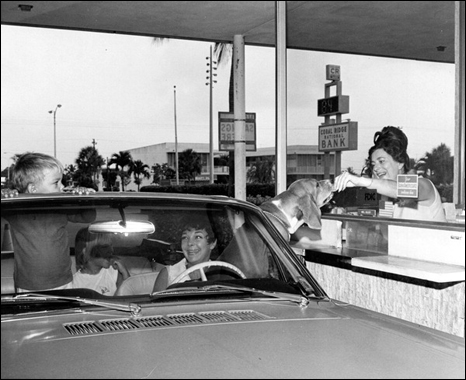
Going to the bank in Italy is never a casual affair.  For starters, you have to remember when your branch is open, and try to get there early so the line will not be too long.  Typically the banks are open most of the morning and an hour or two in the afternoon.  Drive through banking?

Not for you in Italy, and certainly not for your dog.

Though come to think of it, there is an element of drive-through banking that exists here.  You know those plastic tubes that you put your transaction in if you’re at a drive-through bank bay away from the teller’s window?  There’s some sort of pneumatic whoosh and the plastic tube is whisked away to the desk of the person who can take care of your business.  A minute or two later it arrives back with another whoosh, containing your receipt.  Well, when you want to enter many banks here you step into something that looks like a person-sized version of that plastic tube.  One side of the tube slides open, you step into the tube, the open side closes, you stand there trying not to panic, and then, finally, the bank side of the tube opens and you are in the lobby.  Phew!  At least you don’t have to do the whooshing bits.

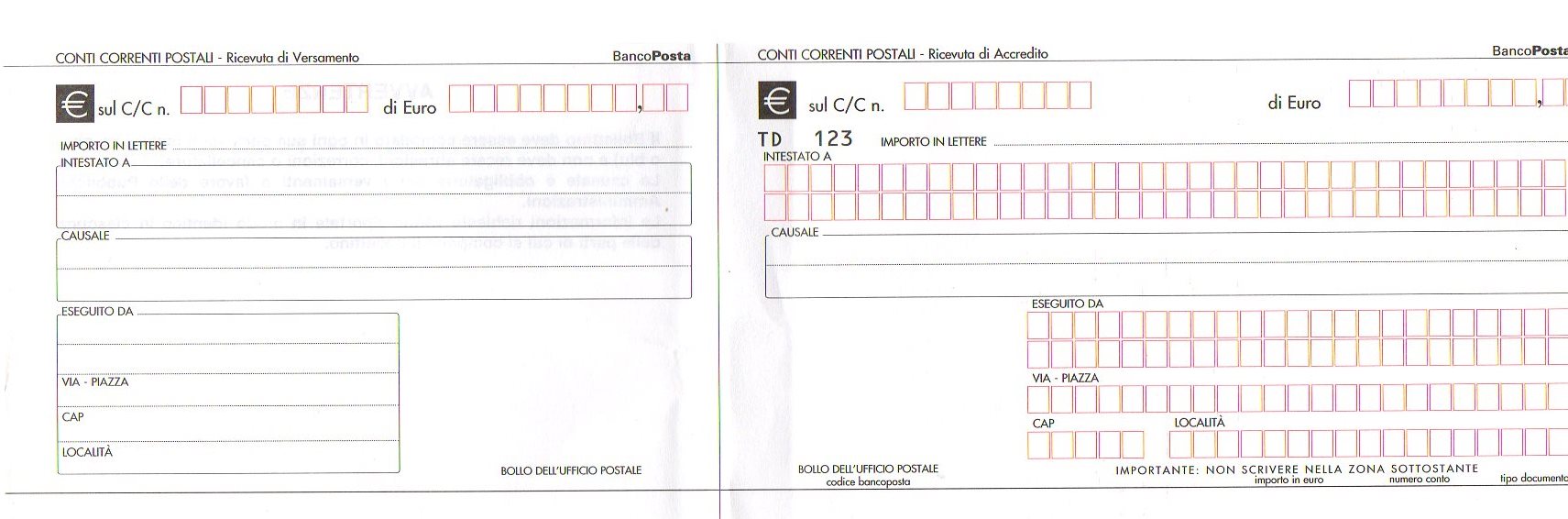
Once safely inside you take a number and wait your turn.  With luck your wait will not be more than 5 or 10 minutes.  You can do all the usual things at an Italian bank, it just takes longer.  People don’t use checks in Italy as much as in the U.S.  Frequently if you have a bill to pay you will go to the bank and pay what you owe directly into the other person’s account.  Which of course means that if I owe you money, you will give me your account number.  Why thank you!  Many times bills come with a payment/deposit form (called a ‘bollo’) attached, which has the payee’s bank info and the amount owed already printed on it.  Here’s what a blank one looks like (click on the image to see it in a more legible form):

You or the bank employee fill in the right side, which includes payee’s bank account #, amount to be paid, reason for payment (!), name and address of payee.  The part on the left is your receipt and proof of payment.

I watched a bank employee (let’s call him Carlo) dealing with a check the man in front of me had evidently deposited.  First Carlo stamped the check.  Then he ran it through some kind of scanning machine.  Then he took his scissors and nipped one corner off the check.  Then he paper-clipped it to a large form, signed the form and stamped it,  and put it on top of his to-do pile.  I was there to make a deposit in the checking account which is, mysteriously, in only my husband’s name.  It led to this very amusing exchange:

Me: “I’d like to make a versamento (deposit) and this is my account number.”

Carlo: “Is your account in this bank?”

Me: “No, it’s in the Zoagli branch.”

Carlo.  “Ah.  Zoagli.”  big sigh.

Me:  “Is there a problem?”

Carlo, haltingly: “No, no…” followed by much tapping at his keyboard.  A long pause.  “Captain Captain is the name on the account?”

Me, delighted: “Yes!  That’s the account.”

very long pause

Carlo: “The address is That Wee Village Road, #27?”

Me:  “That’s right.”    longer pause, worried (both of us).

Carlo: “This account has a masculine name; you are a woman.”

Me: seeing the light (and rather glad he noticed): “Ah yes… that is my husband’s account.”

Carlo, in great relief: “Good, good, alright then. Your husband.  You are the wife.”  Paper in machine, tap-tap-tap, paper out, my signature, his signature, stamp, stamp.

Success!

Here are some of the quirky (to us) things about Italian banks.  1) Various branches of the same bank are not necessarily connected to each other electronically.  They are always happier if you do your banking in your particular branch.  2) Should you write a check to someone, it is not returned to you canceled after it has been cashed.  Nor is it returned to your bank.  It stays in whichever bank your payee deposited it.  Which means if you need to capture proof that you’ve paid someone, you need to know where he stashed the loot.  3) A mortgage is readily available, especially if you can prove that you already have the money to pay it all back.  4) The Post Office is also a bank, and judging from what we see in the lobby, it does more business with banking than with mail.  But you can’t buy a stamp at your bank.  5) Sometimes other agencies serve as banks – for instance, we pay our vehicle insurance and tax bills at the Automobile Club of Italy.  6) Sometimes one bank will be an agent for a particular vender, so you can pay your bill at that bank for no charge or a small charge, whereas paying it at a different bank will carry a larger charge.
But for all their quirks, and for all the waiting and complications and charges, we have always found the people who work in the banks to be invariably patient and helpful.  We are not always good at explaining what we want, and we frequently don’t know the correct words, but the bank employees work with us for as long as it takes to make us satisfied customers.  And not just for us foreigners; they are courteous and helpful to everyone.  I expect that is part of what makes for the long waits…

← Older posts
Newer posts →

Enter your email address to follow this blog and receive notifications of new posts by email.

Join 114 other subscribers

rss

Subscribe in a reader

Search the Blog

A. Useful Links

  • bab.la language dictionary
  • Bus schedules for Tigullio
  • Conversions
  • English-Italian, Italian-English Dictionary
  • Expats Moving and Relocation Guide
  • Ferry Schedule Rapallo, Santa Margherita, Portofino, San Frutuoso
  • Italian Verbs Conjugated
  • Piazza Cavour
  • Rapallo's Home Page – With Link to the Month's Events
  • Slow Travel
  • The Informer – The Online Guide to Living in Italy
  • Transportation Planner for Liguria
  • Trenitalia – trains! Still the most fun way to travel.

C. Elaborations

  • A Policeman’s View
  • Driving School Diary
  • IVA refunds due for past Rifiuti tax payements
  • Nana
  • Old trains and old weekends
  • The peasant, the Virgin, the spring and the ikon
  • Will Someone Please, Please Take Me to Scotland?

D. Good Recipes - Best of the Week winners are starred

  • 'Mbriulata
  • *Baked Barley and Mushroom Casserole*
  • *Captain’s Boston Baked Beans*
  • *Crimson Pie*
  • *Louise’s Birthday Cake*
  • *Melanzane alla Parmigiana*
  • *Penne with Cabbage and Cream
  • *Pizzoccheri della Valtellina*
  • *Pumpkin Ice Cream*
  • *Risotto alla Bolognese*
  • *Rolled Stuffed Pork Roast*
  • *Spezzatini di Vitello*
  • *Stuffed Grape Leaves*
  • *Stuffed Peaches (Pesche Ripiene)*
  • *Swordfish with Salsa Cruda*
  • *Tagliarini with Porcini Mushrooms*
  • *Tagliatelli al Frutti di Mare*
  • *Three P's Pasta*
  • *Tzatziki*
  • 10th Tee Oatmeal Apricot Bars
  • Adriana’s Fruit Torta
  • Aspic
  • Bagna-calda
  • Best Brownies in the World
  • Clafoutis
  • Cold cucumber soup
  • Crispy Tortillas with Pork and Beans
  • Easy spring or summer pasta
  • Fish in the Ligurian Style
  • Hilary's Spicy Rain Forest Chop
  • Insalata Caprese
  • Lasagna al forno
  • Lasagna al Forno con Sugo Rosato e Formaggi
  • Lemon Meringue Pie
  • Leo’s Bagna Cauda
  • Leo’s Mother’s Stuffed Eggs
  • Louis’s apricot chutney
  • Mom's Sicilian Bruschetta
  • No-Knead (almost) Bread
  • Nonna Salamone's Christmas Cookies
  • Pan Fried Noodles with Duck, Ginger, Garlic and Scallions
  • Pesto, the classic and original method
  • Pesto, the modern, less authentic method
  • Pickle Relish
  • Poached pears
  • Poached Pears
  • Polenta Cuncia
  • Recipes from Paradise by Fred Plotkin
  • Rustic Hearth Bread
  • Shrimp and Crayfish Tail Soup
  • Sicilian salad
  • Slow Food Liguria
  • Slow Food Piemonte and Val d'Aosta
  • Spinach with Garlic, Pine Nuts and Raisins
  • Stuffed Eggs, Piemontese Style
  • The Captain’s Salsa Cruda
  • Tomato Aspic
  • Zucchini Raita

E. Blogroll

  • 2 Baci in a Pinon Tree
  • Aglio, Olio & Peperoncino
  • An American in Rome
  • Bella Baita View
  • Debra & Liz's Bagni di Lucca Blog
  • Expat Blog
  • Food Lovers Odyssey
  • Italian Food Forever
  • L’Orto Orgolioso
  • La Avventura – La Mia Vita Sarda
  • La Cucina
  • La Tavola Marche
  • Rubber Slippers in Italy
  • Southern Fried French
  • Status Viatoris
  • Tour del Gelato
  • Weeds and Wisdom

Photographs

  • A Day on the Phoenix Light Rail Metro
  • Apache Trail in the Snow
  • Aquileia and Croatia
  • Birds on the Golf Course
  • Bridge Art
  • Canadair Fire Fighters
  • Cats of Italy
  • Cloudy day walk from Nozarego to Portofino
  • Fiera del Bestiame e Agricultura
  • Football Finds a Home in San Maurizio
  • Hiking Dogs
  • Mercatino dei Sapori – Food Fair!
  • Moto Models
  • Olive pressing
  • Rapallo Gardens
  • Rapallo's Festa Patronale
  • Ricaldone and the Rinaldi Winery
  • Rice Fields
  • Sardegna ~ Arbatax and Tortoli
  • Sardegna ~ San Pietro above Baunei
  • Sardegna ~ The Festa in Baunei
  • Scotland, including Isle of Skye
  • Slow Food 2008 Salone del Gusto
  • The Cat Show and the Light Rail Fair
  • The desert in bloom
  • Trip to Bavaria

Pages

  • Fagioli all’ucelleto

Archives

Recent Posts

  • A Superior Visit
  • Fun at the Ranch Market
  • The MAC
  • Welcome Tai Chi
  • Bingo Fun for Ferals
December 2025
M T W T F S S
1234567
891011121314
15161718192021
22232425262728
293031  
« Jul    

Member of The Internet Defense League

Blog at WordPress.com.

  • Subscribe Subscribed
    • An Ex-Expatriate
    • Join 114 other subscribers
    • Already have a WordPress.com account? Log in now.
    • An Ex-Expatriate
    • Subscribe Subscribed
    • Sign up
    • Log in
    • Report this content
    • View site in Reader
    • Manage subscriptions
    • Collapse this bar
 

Loading Comments...