
• Contact
  • Elaborations
    • A Policeman’s View
    • Driving School Diary
    • Great Danes
    • IVA charged on Tassa Rifiuti
    • Nana
    • Old trains and Old weekends
    • The peasant, the virgin, the spring and the ikon
    • Will Someone Please, Please Take Me to Scotland??
  • Recipes
    • ‘Mbriulata
    • *Baked Barley and Mushroom Casserole*
    • *Captain’s Boston Baked Beans*
    • *Cherry Tart*
    • *Crimson Pie*
    • *Louise’s Birthday Cake*
    • *Melanzane alla Parmigiana* – Eggplant Parmesan
    • *Penne with Cabbage and Cream
    • *Pizzoccheri della Valtellina*
    • *Pumpkin Ice Cream*
    • *Risotto alla Bolognese*
    • *Rolled Stuffed Pork Roast* on the rotisserie
    • *Shrimp and Crayfish Tail Soup*
    • *Spezzatino di Vitello*
    • *Stuffed Grape Leaves*
    • *Swordfish with Salsa Cruda*
    • *Tagliarini with Porcini Mushrooms*
    • *Tagliatelli al Frutti di Mare*
    • *Tzatziki*
    • 10th Tee Apricot Bars
    • Adriana’s Fruit Torta
    • Artichoke Parmigiano Dip
    • Best Brownies in the World
    • Clafoutis
    • Cod the Way Sniven Likes It
    • Cold Cucumber Soup
    • Crispy Tortillas with Pork and Beans
    • Easy spring or summer pasta
    • Fagioli all’ucelleto
    • Fish in the Ligurian Style
    • Hilary’s Spicy Rain Forest Chop
    • Insalata Caprese
    • Kumquat and Cherry Upside Down Cake
    • Lasagna Al Forno con Sugo Rosato e Formaggi
    • Lemon Meringue Pie
    • Leo’s Bagna Cauda
    • Leo’s Mother’s Stuffed Eggs
    • Louis’s Apricot Chutney
    • Mom’s Sicilian Bruschetta
    • No-Knead Bread (almost)
    • Nonna Salamone’s Famous Christmas Cookies
    • Pan-fried Noodles, with Duck, Ginger, Garlic and Scallions
    • Pesto
    • Pesto
    • Pickle Relish
    • Poached Pears
    • Polenta Cuncia
    • Pumpkin Sformato with Fonduta and Frisee
    • Rustic Hearth Bread
    • Sicilian Salad
    • Soused Hog’s Face
    • Spotted Dick
    • Swedish Tea Wreaths
    • The Captain’s Salsa Cruda
    • Tomato Aspic
    • Vongerichten’s Spice-Rubbed Chicken with Kumquat-Lemongrass Dressing
    • Winter Squash or Pumpkin Gratin
    • Zucchini Raita

An Ex-Expatriate

~ and what she saw

An Ex-Expatriate

Category Archives: Italian habits and customs

Olive Oil

29 Tuesday Dec 2009

Posted by farfalle1 in American habits and customs, Food, Health and health care, Italian habits and customs, olives

≈ 2 Comments

Tags

olive oil, Olive Oil in Softgels, Puritan's Pride Vitamins, Softgel Olive Oil

Olive Oyl/King Features

We didn’t have a TV when I was growing up (I know! but it’s true!!).  But my best friend Taffy had one, as did other friends, so somehow stray bits and pieces of TV-lands-and-people crept into my brain.  One of these was Popeye and his interestingly shaped girlfriend Olive Oyl.

In fact, I knew this crowd pretty well from the daily comic strip in the North Adams Transcript (Popeye first appeared way back in 1929, and King Features still presents the strip, the creation of Elzie Crisler Segar. Interestingly, Robin Williams’ first movie role was in the 1980 film adaptation (Jules Feiffer, Robert Altman) of the cartoon). I never cared much for Popeye.  Unable to see the kind, generous and lovable character behind his ‘coarse’ speech and fightin’ ways, I avoided him and his cronies (Wimpy, arch-rival Bluto, etc.) for the more mundane Peanuts and Archie.  Talk about Wimpy!

As far as I knew back in those days, olive oil was a misspelled character; we didn’t know anything about olive oil in the mid- to late-20th century New England kitchen, and we certainly didn’t have any in the cupboard.  That all changed sometime in the latter part of the century as Mediterranean cuisine became popular in the States, both for its deliciousness and for its health benefits.  In fact, worldwide consumption of olive oil grew substantially, from 1,779,000 MT in 1990 to 2,553,000 in 2005. Suddenly restaurants were offering little saucers of oil for dipping bread, and connoisseurs were comparing flavors and production methodologies.  Olive oil became a low-key cooking and eating craze. (If you’d like to read an account of our own olive harvest, click here and here.)

Hirts Gardens photo

Italians have been cooking with and consuming olive oil from the year dot. Perhaps it is just their good fortune that natural circumstances gave them a fat product from a tree rather than from a cow. 1 tablespoon of butter contains 12 grams of fat, 8 of which are saturated (bad!) and it has 33 mg of cholesterol; 1 tablespoon of olive oil contains 14 grams of fat, only 2 of which are saturated, and it has no cholesterol at all.  In addition, olive oil contains antioxidenats, beta-caratene and vitamin E.  AND it tastes great and makes everything else taste great too.

Imagine our surprise when we received the wonderful Puritan’s Pride catalog the other day, and discovered that you can now buy olive oil in softgels.  Why on earth would you want to when you can buy a lot of olive oil in a bottle and have the pleasure of consuming it on salads and in sauces?  Pills??  Only, I think, in America! Then consider the economics of the thing.  You can get 300 60-mg softgels of olive oil (just writing it makes me shake my head) for $21.98.  That’s 10 ounces of olive oil for $21.98 – kind of pricey, if you ask me.  In fairness, the same catalog offers a 16 ounce bottle of cold-pressed organic extra-virgin olive oil for $9.63, as well as an olive leaf complex.

photo from China Suppliers.com

It makes me think of all the Futurama stuff we read about when we were kids watching Popeye – we would all zip around with personal jet-packs, and we wouldn’t have to eat food anymore because we’d be getting all our nutrients from pills. What a horrid thought that is! My advice? When in Rome, or anywhere else for that matter, do as the Romans – use lots of olive oil, but use it from a bottle, not from a softgel!

(More info on olive growing and harvesting here and here, and a photo album of the harvest and pressing here.)

Let’s Buy a Car!!

14 Monday Dec 2009

Posted by farfalle1 in Driving in Italy, Italian habits and customs, Italy

≈ 8 Comments

Tags

Buying a Car in Italy, Nissan Micra, Shopping for a Car in Italy, Test-driving a New Car in Italy

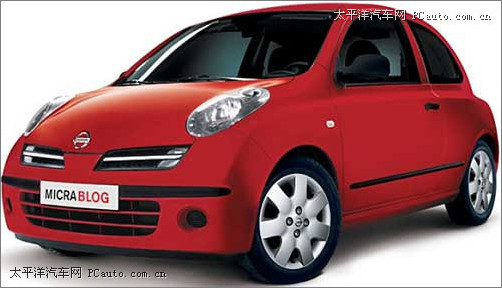
Photo from NissanBlog - thanks!

A few years ago the Captain and I were shopping for an automobile in Italy.  We had bought an aged Peugeout 106 when we first immigrated, and had pretty well beaten it up. We were aching for something that seemed a little more stylish and had a lot more speed.  The Captain has always driven a sports car; it’s one of his Rules.  Being a tall person, I’ve never been in love with squat little two-seaters.  I find them hard to get in and out of, and once in, it’s not always easy to see what’s going on outside your cozy little cockpit.

We looked at every dealer we could find in Chiavari; we looked at Fiats, we looked at Peugeouts, you name it, we looked at it.  Finally we looked at the Nissan Micra and I lost my heart.  This lovely car has the rounded shape I have always defined as ‘cute,’  perhaps even ‘darling,’ certainly ‘irresistable.’  In addition it had some nifty features – a front passenger seat that lifted up for sneaky hidden storage, a key that magically opened the door without having to be inserted in the lock.  It was a dream.  AND, the Captain was willing to compromise on the usual sports car because we sometimes have guests in Italy, and without an unsightly roof rack there is no way to transport either guests or their luggage in a two-seater.

When I say we ‘saw’ all these cars, I am really attacking the issue at its heart.  We saw them; we did not drive them.  We were not invited to drive them.  The Peugeot dealer took us out for a spin, but he insisted on driving.  This concept of look-but-don’t-test-drive was quite foreign to us.  On the other hand, we could see the logic of it given the narrowness of the roads and the nuttiness of some of the people who are navigating them. Still, it left us feeling a bit as if we were buying a pig in a poke.

Nonetheless, a Micra it was to be.  Only problem was, we wanted one right away as we had an actual guest arriving, and there was a road-trip planned, and the old Peugeot 106 was behaving erratically. The Chiavari dealer could not oblige.  The Captain called a dealer he knew in Piemonte who said he could have one for us the next day and the deal was struck over the phone.

Photo courtesy of channel4.com

Ten minutes after he hung up the phone a friend called to inform us that after making us wait for acouple of years, he had decided that yes, he wanted to sell us hisMini Cooper S.  Synchronicity at its worst!

My dream car went the way of all dreams, evaporating in the mist. The Piemonte dealer was gracious and understanding (who would want a Micra if he could have a Mini? that was his reasoning), and the road trip was made in the almost-new Mini.  Getting the darn thing registered in Italy was an amazing and complicated feat, involving a trip to Monaco which had issued the plates (which weren’t really plates, but stickers)… but that’s a story for another day.

Also for another day is the comparison of our car-buying experience with the experience I shared with my friend M several weeks ago as she shopped for a new car in the U.S…. stay tuned.

Colpo d’Aria

19 Monday Oct 2009

Posted by farfalle1 in Health and health care, Italian habits and customs, Uncategorized

≈ 10 Comments

Tags

Colpa d'Aria

Oh, the dreaded Colpo d’Aria!  If you’ve suffered a Colpo d’Aria you’ve been struck by some moving air, most probably chilly air, and most probably on your chest or perhaps the back of your neck.  If you live in Italy, it can be deadly; ask any Italian!  I’ve heard Colpo d’Aria blamed for everything from stiff muscles, to inner ear infections, chest colds and even heart attacks.  I have not yet heard anyone say that a Colpo d’Aria caused his cancer, but that, and gum disease, are about the only illnesses for which a stiff breeze has not been held responsible.

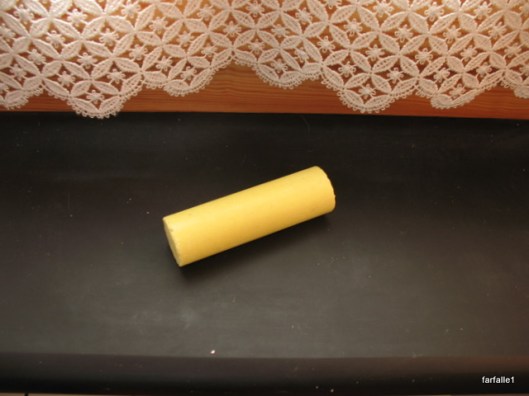
Fortunately there is some good treatment available should you fall victim to an evil air current.  The first thing you want to do is go to the pharmacy and get a bastone di zolfo, a stick of sulphur.

bastone di zolfo

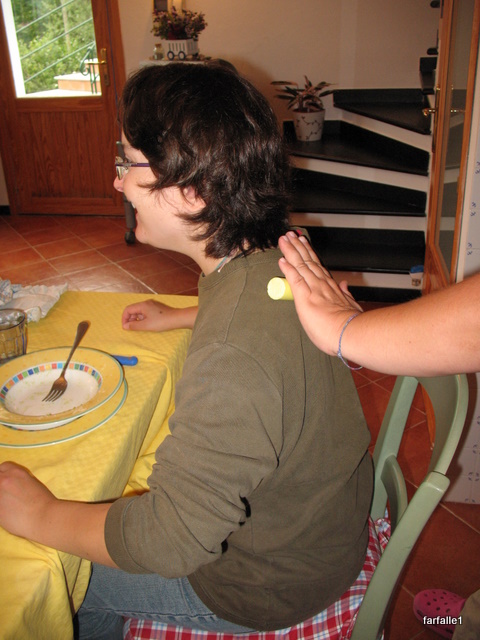
You roll this stick back and forth across the skin of the afflicted area (our model was shy).

bastone di zolfo in use

The great thing about the bastone di zolfo is that when it has outlived its usefulness it crumbles or breaks.  Then you know it’s time to buy a new one.  Evidently the sulphur absorbs… what? moisture? bad vibes? infection?  My guess is moisture, but I wouldn’t swear to it.

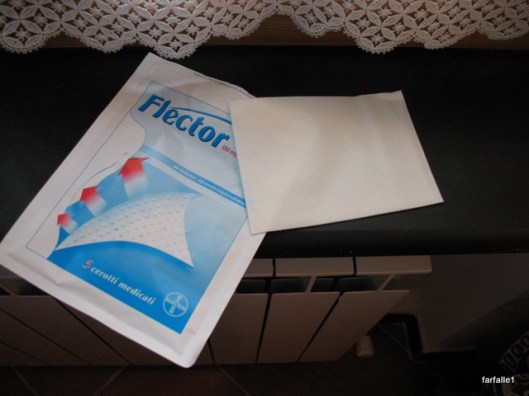
The next line of attack is the Flector patch, a bit of treated rubbery material, about 4″ X 5″,  that is slightly adhesive on one side so it will stick to your skin. It is in the NSAID family of medicine, and delivers a non-steroid anti-inflamatory drug topically. From all reports it also feels good.

flector pads

There are probably as many treatments for Colpa d’Aria as there are sufferers.  My prescription would be a day in bed with an endless supply of hot tea with lemon and honey, and a good trashy novel.  The best line of defense though is always prevention: stay out of drafts!  I grew up sleeping with the windows wide open, and still do – it’s a miracle that I’ve survived so long.  If you live in Italy the only thing worse than a colpa d’aria is a colpa d’aria in the dark.  Many Italians sleep with their windows tightly closed and shuttered.  Also, now that the cool weather has arrived, don’t forget to bundle up when you go out, and remember especially to wear a good warm scarf to protect your chest and neck from the dangerous air currents.

I’m making light of this notion, but I’m not so sure there isn’t a measure of truth in it.  It falls in the category of folk belief, but such beliefs are often based on years of experiential evidence.  I may laugh at the idea of a colpa d’aria harming me, but I have a great collection of scarves and never go out without one in cool weather.  As they say here, ti raccomando!

Vendemia!

10 Thursday Sep 2009

Posted by farfalle1 in Italian habits and customs, Italy, Piemonte, Uncategorized

≈ 14 Comments

Tags

grape harvest, vendemia, Wine, wine grapes

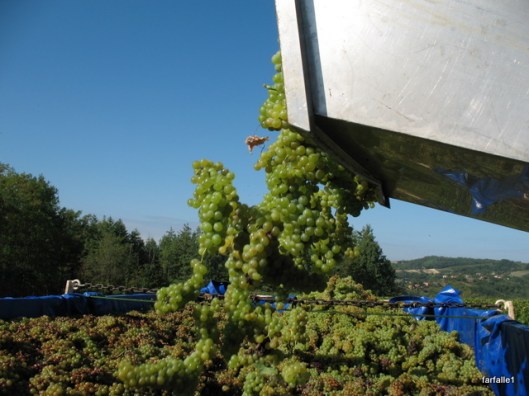
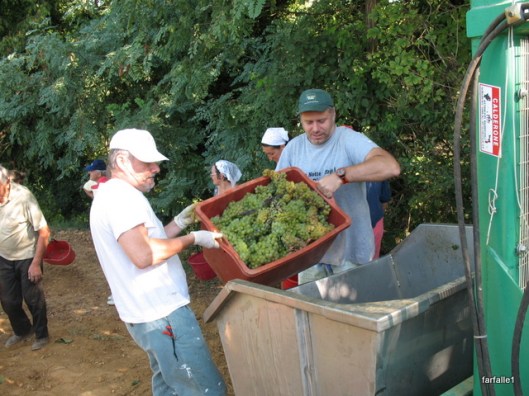
dump 'em

Our cousins invited us to help out at their Vendemia in Piemonte this past weekend, an invitation we eagerly await every year.  The vendemia is the annual grape harvest, and from all reports this is one of the best years ever, in terms of both quantity and quality.  There was lots of rain early in the season, and then it was dry for a couple of weeks, which made the fruit very sweet.

It’s a family affair in a big way.  Our cousins’ extended family includes three generations ranging in age from 17 months to I’m-not-telling (but I would guess early 80’s), probably about 35 people including the children who are too young to pick.

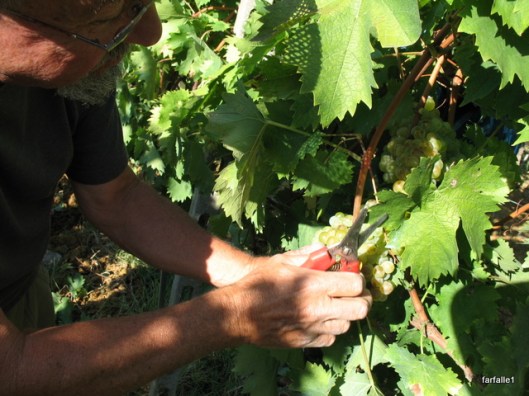
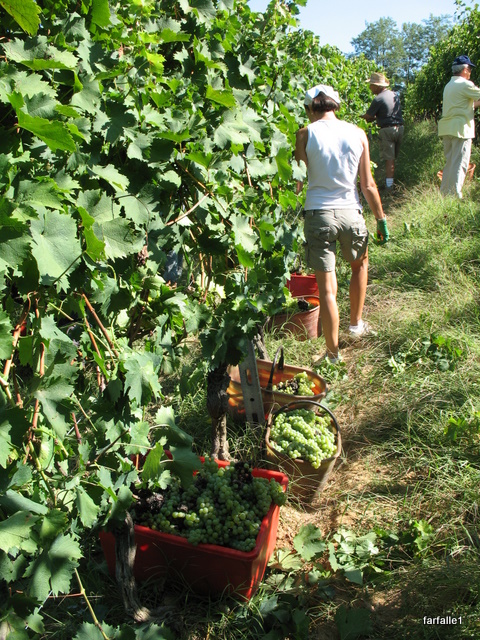
All the grapes are cut from the vine by hand.  Fortunately the vines are well managed, and most of the grapes seem to grow between knee and shoulder height.

cutting grapes

grapes (2)

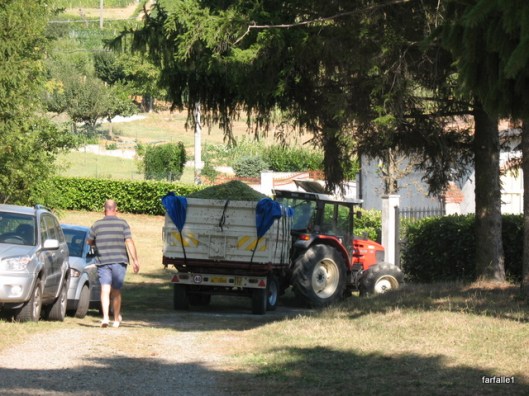
We put the bunches of grapes in plastic buckets which are then emptied into the bucket loader of a small tractor.

grape ferry (2)

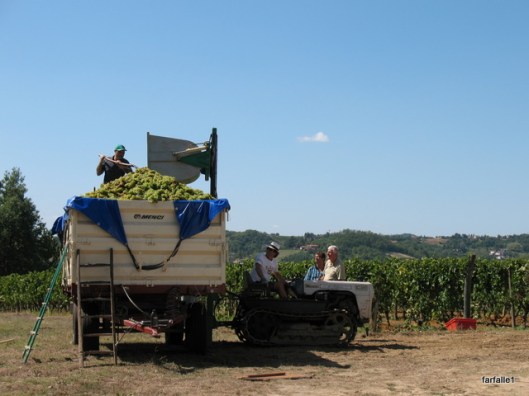
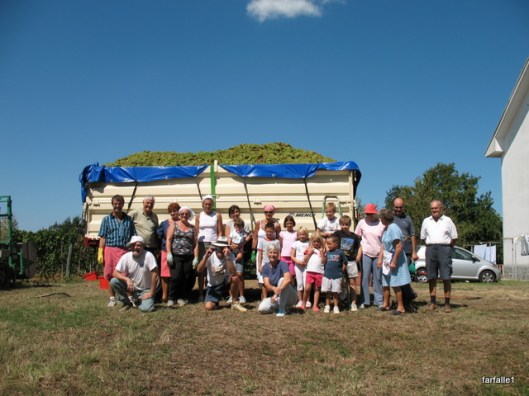
This in turn is dumped into the trailer. With so many willing workers, their vineyard is harvested in about a day and a half. Usually, one of the uncles told me, they collect two medium trailers full of grapes. This year there was a small load, a medium load, and a huge load:

dump 'em (4)

Later in the afternoon the vineyard manager, who takes care of several vineyards in the area, appears with his big tractor and hauls the grapes to the place where they are pressed (in this case Cascina Orsola, some 38 km distant).

tractor (12)

It’s a LOT of work (my estimate is about 250 person-hours) and while everyone loves doing it, they are also very  happy when it’s finished for another year.

Finished! (3)

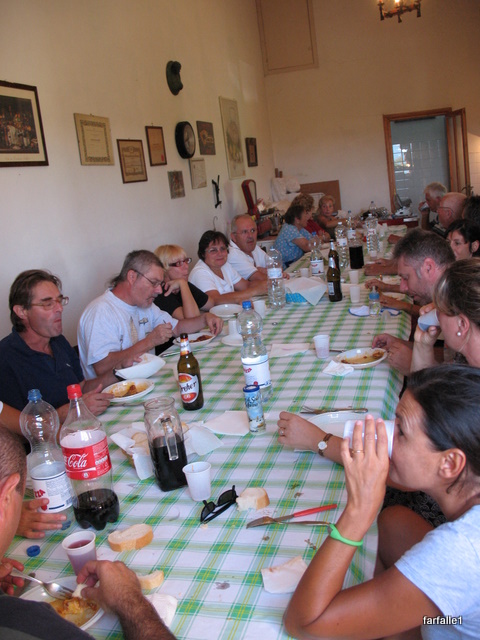
Then comes one of the highlights of the weekend: the communal meal!  The older generation used to have a fish restaurant in Genova, so the cooking is outstanding.  This year they served us the world’s most delicate and light lasagna, roast beef with drippings, french fries, eggplant  that was lemony and garlicky, fruit, cheese and home-baked cake.

adults eat (2)

There are small and medium-sized family owned vineyards all through this part of Piemonte.  I imagine the scenes above are repeated a hundred-fold at this season, each with a different cast of characters and a slightly different view.  This must have been what farming was like back in the days before agri-business took over, both in the US and here.  It’s refreshing that it still exists.

If what ‘they’ say is true, there will be some superb wines coming from this years’ grapes.  So  Salute!  Cincin!  Bottoms up!

Our Clean House

05 Saturday Sep 2009

Posted by farfalle1 in American habits and customs, Customs, Italian habits and customs, Italian women, Italy, Uncategorized

≈ 27 Comments

Tags

house cleaning

cleaningAccording to a 2006 article in the Corriere by Elvira Serra, American women spend an average of 4 hours a week doing housework.  Italian women beat them, hands down. Here are the details:  “80% of Italian women iron everything, including socks and handkerchiefs, 31% have a dishwasher, 2% use scrubbing brushes and 1% have a clothes dryer [Electricity is very costly in Italy, so most people don’t want a clothes dryer]. In the end, Italians devote twenty-one hours a week to household chores, of which five are spent ironing. Cooking is not included in the total.”  So, 21 hours a week for Italian women and 4 for Americans.

These figures don’t tell the whole story, either.  By and large, Italian homes are much smaller than American homes.  The average house size in the U.S. is +/- 2300 square feet.  Here in Italy, the average is 700-1100 square feet.  So Italian women are spending 4 times the hours to take care of half, or less than half, the space.

This got me thinking, of course.  Back when I had a full time job in Connecticut, we hired someone to clean the house.  And wouldn’t you know, Kathy, and later Peg,  came for 4 hours a week and took very good care of our 2700 square foot house.  When we moved to Italy we continued our practice, and Lada cleaned our house for almost four years.  (When her second child arrived, Lada retired… but she worked until 2 weeks before Daniel’s arrival, that’s how great she was.)  Lada worked 4.5 hours a week, and did a terrific job on our 1184 square foot house, but ironing was not included in her job description, just cleaning.

Why does it take so much longer in Italy?  Because in Italy a basic weekly clean includes a lot more than in the States.  In the States the job entailed dusting, vacuuming, cleaning the bathrooms (but not the kitchen – there wasn’t time), and mopping the bathroom and kitchen floors.  When I knew Lada was leaving I watched carefully to learn how to clean in the Italian style.  First she carried all the rugs outside and gave them a good shake, and left them hanging over a railing.  Then she dusted and vacuumed.  In particularly high traffic areas (kitchen, stairs) she first swept, and then vacuumed.  Then she washed all the floors, which meant moving all the light furniture around and then replacing it.  Then she carried the rugs back in and vacuumed them.   The house sparkled.  After Lada retired I took over, and it takes me about 5.5 or 6 hours to do what she did in 4.5.  But I do it all (over two days) because the house looks so nice afterwards.

Mr. CleanAnother big difference between here and there is the number of cleaning products.  (The French gentleman above lives in Italy, too.  Here his name is Mastro Lindo.)  mastrolindoIn the States we used amonia in the water to wash the tile floors, window cleaner for the windows, and, if we were feeling really fancy, some kind of spray on the dust cloths.  We also had special polish for the wooden furniture, which we polished once or twice a year.  Here there is an endless parade of cleaning products, each aimed at a very specific task – one to clean porcelain basins, another to clean tile floors and walls, another to clean stone, another to clean wooden floors, polish for furniture, window cleaners, anti-calcium cleaners (liquid for topical use, powder to add to the clothes washer) – it’s quite confusing to know exactly what to get. (According to the Corriere article, when Unilever tried to market a one-cleaner-does-it-all product it was a complete flop.)  In desperation I’ve begun to make some of my own cleansers, but just the basic ones.  I’m an American cleaner after all, it seems, a 4-hour a week girl.  Even without another job I can’t imagine spending 21 hours a week on household chores.  Nor can I imagine ironing the Captain’s socks!
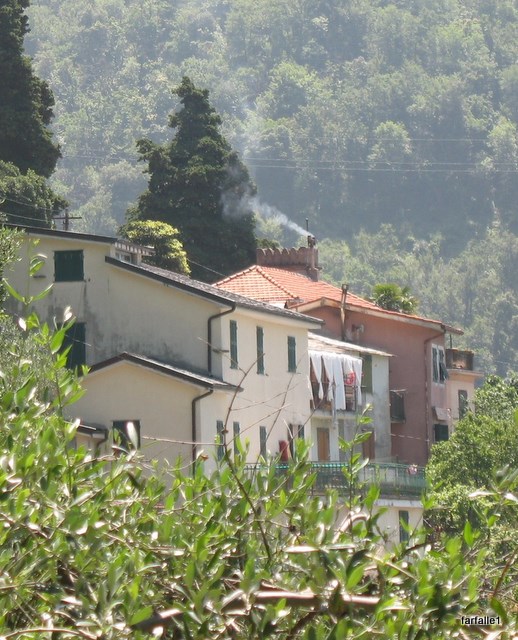
Why do Italian women spend so much time cleaning?  The Corriere article answers:  “Perhaps a British poll can throw some light on the issue. The Discovery Channel Home and Health website asked 2,000 women aged from 18 to 80:  59% said that cleaning their homes made them feel in control of their own lives and 60% found housework “mentally therapeutic”.”  Well, there is a certain zen-like monotony to house cleaning – you do the same old things in the same old way every week, and then you get to do it again the next week and the next.  I guess that’s therapy of a sort.  Me?  I’d rather take my therapy in a swimming pool, at the gym or, better yet, at the dining table!

In the Old Way

27 Thursday Aug 2009

Posted by farfalle1 in Italian habits and customs, Italian men, Italian women, People, Uncategorized

≈ 4 Comments

Tags

cooking with wood, heating with wood, wood fuel

Our neighbors down the street still cook with wood, and, we suspect, heat their home with it as well. Their chimney tells the tale, no matter how warm the day.  Even this week, with temperatures at 37 C,  brushing 100 F, the mid-day smoke has appeared.

cooking with wood-1

We don’t know these neighbors, but every now and then we see them. She is elderly and plump and wears long skirts and a wary expression. He motors ever so slowly up and down the hill in his aged ape, frequently carrying  precariously balanced  fruit boxes with him, fuel for the stove. Where does he get them? I wish I could ask him, but they seem wary of strangers, and to them I suspect we are the strangest of the strange.

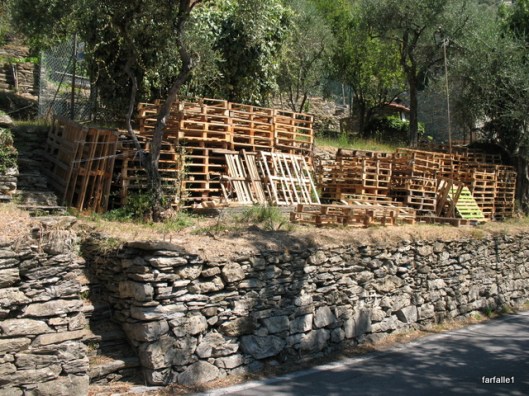
Other neighbors farther down the street seem to be laying in a good store of wood for the winter ahead. At least we are unable to think of any other reason for this massive collection of wooden pallets.

wood pallettes-2

I can’t imagine having to struggle up the narrow stone stairs on the left to carry fuel to my home (if, in fact, the collector lives up there). In fact, I can’t imagine cooking and heating using fruit boxes and wooden pallets for fuel. But our neighbors do it, and I admire them for it – no doubt it’s the way people cooked for years, using whatever fuel was readily at hand.  What a great way to recycle what otherwise might end up in the dump.

Q8 Rip-Off

07 Tuesday Jul 2009

Posted by farfalle1 in Crime, Driving in Italy, Italian bureaucracy, Italian habits and customs, Italian men, Rapallo, Uncategorized

≈ 10 Comments

Tags

gasoline credits in Italy, Grand Theft Gas, Q-8, Rapallo Q-8

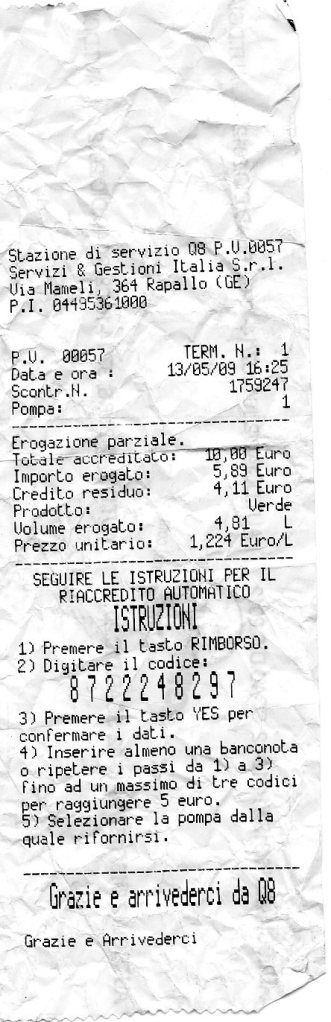
Q-8 receipt

You get what you pay for, right?  Well, sometimes when you buy your gas at Q8 you don’t get anything at all!

Here’s the story.  Way back in May I filled my scooter, which has a small tank, and paid with a E 10 note.  There was a credit remaining of E 4.11.   I wasn’t sure how to use the credit slip, though, even though a thorough explanation is given at the bottom.  My Italian just doesn’t always measure up to the fine print.  I know!  It’s my fault, I should be better at my second language.  But I’m not.  Yet.

Wanting help with this credit receipt, I kept waiting for there to be an attendant at the Q8 station, which is, it seems, a rare event.  Finally about a month ago there was a man there who explained to me that because my credit was less than E 5 I wouldn’t be able to use it without putting in more money.  Huh??  When is a credit not a credit??  When it’s for less than E 5 at Q8, that’s when.

It seemed mighty peculiar to me, but I said ok – and as it happened I already had plenty of gas that day, so I didn’t take advantage of the attendant’s presence and actual willingness to help.  I figured I’d catch him another day.

Fast forward to last week (can you believe how much effort is going into a credit for E 4.11??!).  The door to the attendant’s box was open, so I whizzed in to buy some gas.  There was a young woman there, and I asked her, is it true that I can’t use this credit without adding more money?  “I don’t know,” she said, “Can you come back on Monday when the regular guy will be here?”

“Well, okay,” I replied, but can you give me change for this E 50 so I can pump some gas?  I don’t want to put E 50 in the machine.”

“No,” she answered.  Sooo, I went to the grocery store just behind the Q8, bought a few necessities and returned to the gas station with a crisp E 5 note.  The attendant had fled.

I began the automated process to get gas, and one of the choices indeed was for a receipt number, so I punched in the number on my credit.  Immediately what came up was the original screen suggesting, ‘Go ahead, put some money in here and see if you get lucky.’  At least that’s what I think it said. I really just wanted the credit’s worth, so I tried again.  No luck.  Then I stared around in agony and asked the Gas Goddess to come to my assistance.  Then I punched in the credit code again and got a message that it was invalid.  So I just put in E 5 and got my gas, puzzled as could be.

Today my tank was low again and guess what!  There’s a GAS STRIKE in Italy over the next two days so it will be difficult to buy gas (amusingly, one of the strike issues is ‘long working hours’).  It seemed prudent to fill up, and, to my amazement, the door to the attendant’s box at the Q8 was open again, and sure enough there was a man seated at a desk within.  I went right to him and said I wanted to use my credit to buy gas.  He looked at it and said, “There’s not enough credit on here, you need at least E 5, so you will have to put more money in.” (Can you tell me what difference it makes to an automated system if your credit is for E 4.99 or E 5.01?  It shouldn’t matter one whit.)

I explained that I had tried to do that but that it hadn’t worked.  “Can you help me with this?” I asked – and I was still being extremely polite.  Can you guess what he said?  He said, “No.”  Then he said, “The instructions are written down here.”

“I know,” I said, “but when I put my credit number in it doesn’t work.  Can’t you help?”  Rolling his eyes to the heavens and heaving a mighty sigh he… you think I’m going to say he got up, aren’t you?  No, he didn’t budge his skinny ass.  He punched a few buttons on the computer in front of him and said, “This number is invalid.  Didn’t you take a new receipt when you tried before?”

“No,” I explained (and I was getting a little irritated by now), “I didn’t because there wasn’t one to take.”

“There was,” he assured me, “and you should have taken it.”

“So what you’re telling me is that Q8 has my E 4.11 and I’m not going to get any gas for it?”

“This receipt is invalid.”

“But I didn’t get anything for it.  I’m just giving Q8 my money and not getting any gas in return.”

He gave the final, infuriating, ‘tough shit’ shrug and turned away.  That’s when I crumpled up the receipt (but didn’t throw it at him – I’m so glad because now I can show it to you!) and informed him tartly that I wouldn’t be buying any gas from Q8 ever, ever again.  You know, I don’t think he cared.

As a side note, during the long wait for this story to unwind I received another credit slip from the Shell station in the middle of town, this one for E .94.  The attendant (who is there morning and afternoon, daily) took my slip and applied it to my next gas purchase.  So easy!

May I tell you what would have happened if this had occurred in the U.S.?  1) the attendant would have been there more than ten minutes a week.  2) he would have made at least a cursory effort to help  and 3) he would have believed me and would have made good on the credit.

Now you might say I’m the victim of my own ignorance, and I guess that’s true, but  I think people who are selling things should try to be helpful to customers.  You might call my wish to have the gas credit honored the typical unreasonable American sense of entitlement.  I call it honesty.

Whence thy egg?

14 Sunday Jun 2009

Posted by farfalle1 in Animals in Italy, Birds in Italy, Food, Italian habits and customs, Italy, Uncategorized

≈ 8 Comments

Tags

chickens, eggs, hens, Italian eggs

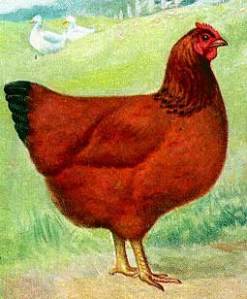
rhodeislandredWhen we lived in Connecticut we had a ‘flock’ of hens.  I use the term loosely; we had three hens.  Ever since my grandmother told stories about making little rubbers for her chickens so their feet feet wouldn’t get wet, I wanted to raise chickens.  It seemed more interactive than dolls, and less responsibility than actual children.
Our flock began with a gift of two small banty hens from a friend, which we augmented with the purchase of a Rhode Island Red and a Barred Plymouth Rock.  Oh, they were lovely.  One of the banties became despondent and went under the hen-house to die, but the other three lived with us until we gave them away upon leaving Connecticut, and they gave us just the right number of delicious small blue (the banty) and large brown (the other two) eggs.  BARROCK1

In the U.S. the provenance of the eggs one buys is something of a mystery, as is their age.  In a commercial operation, the eggs are washed and sanitized immediately, and then are sprayed with a thin coat of mineral oil ‘to preserve freshness,’ according to the USA Poultry & Egg Export Council.  The quotation marks are mine, because I suspect it is done more to give the eggs a longer shelf life than for any other reason.  When you buy a carton of eggs in the U.S., you have no idea where they’ve come from, unless the name of the farm is on the carton itself.  And even then you have no way of knowing if the hens were caged or free-range, or what they were fed.  (This is true: leftover bits of chicken at a processing plant are ground up and used as chicken feed.  Blcch.)  Fancier/organic egg producers are likely to advertise their practices on their cartons, but otherwise you’re left in the dark.

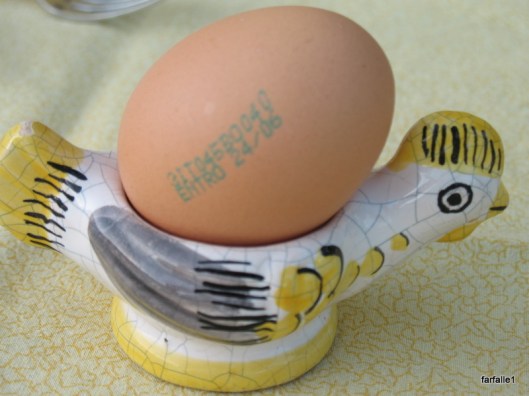
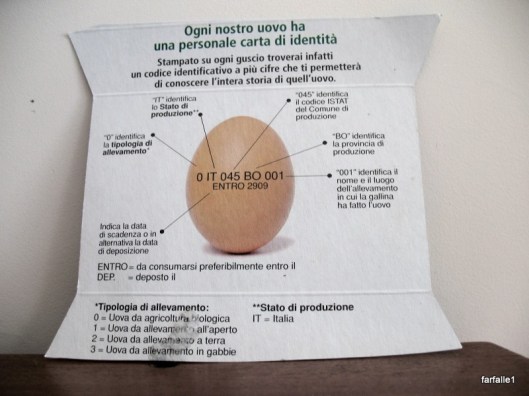
Here in Italy every commercially sold egg comes with a code stamped on it.

Egg ID

The first number identifies the life style of the producing hens: 0=biologic (what we might call ‘organic’ in the U.S.)  1 = living in the open (‘free range’)  2 = raised on the ground (something between free range and a cage) and 3 = caged.  The next two letters give the country of origin of the eggs; the next three numbers correspond to the town where the egg was laid; the next two letters are the provincial code of the town; the last three numbers identify the name of the producer (not the hen, the farmer).   So, no mystery about your egg here.  Of course, not all eggs are equally legible.

egg in cup

This one is pretty clear (oh, busted! Now you know we buy eggs from unhappy cage-raised hens in the province of Bolzano.  Shame on us.)  Sometimes the printing is quite smudged so you have no idea what it says.  Note also that there is a use-by date stamped under all the other info.

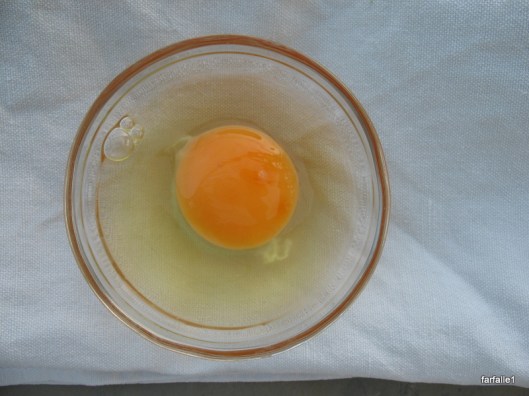
I haven’t been able to find out what Italian hens eat, but the yolks of their eggs are a rich red-yellow, almost orange.  When we go back to the egg in bowlStates the relatively pale yellow yolks seem anemic to us.  But I must say, even our own flock of Connecticut hens produced the pale American yolk.  It must be something in the Italian diet … even for the chickens.
We always feel good about buying eggs here.  The laying date is stamped on the egg box (they’re sold in quantities of 4, 6 or 10, an odd mix of metric and imperial measurement).  The egg itself will tell us exactly where it comes from.  Italian eggs are not sold from refrigerated cases.  They sit out on the shelf, proud to be fresh enough to do so.

Good as the eggs in the market are, though, the best egg is the one with no identifying marks, save perhaps a little bit of hay or something worse stuck to it, the egg your neighbor gives you.

Every Inch

10 Wednesday Jun 2009

Posted by farfalle1 in gardening, Italian habits and customs, Italian men, Liguria, People, Rapallo, Uncategorized

≈ 2 Comments

Tags

Cliff gardening, Rick Gush

It has always amazed me how every square inch of space in Italy seems to be put to some kind of good use.  There are 60 million people living in Italy, a population density of 515 people per square mile.  In the US the population density per square mile is 80.  No wonder roads, houses, cars and people there are large – there’s enough space for everything and everyone.  But here in Italy every square inch must give the most it can.  You realize this particularly if you’re out walking on a woodsy mountainside and suddenly notice overgrown stone walls: the land on those mountains was important enough that people put in hundreds of hours of labor to terrace and farm them.

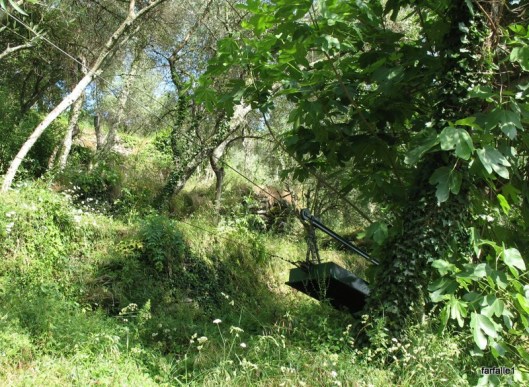
Now agri-business has arrived in Italy, too, and some of the farming land on the really steep and inaccessible mountains has gone wild.  But individuals will squeeze an enormous amount of production from whatever land is available to them.  And they have devised some very clever inventions to make the job easier.  It’s not uncommon to see a small cable and carrier system stretching across a wooded valley from one hillside to another – a way to transport cut wood.  Or to see the same thing coming down the olive-studded hill to a road below – a way to get the harvested olives to a waiting Ape (the little three-wheeled workhorse truck named for bees, because that’s what the two-stroke engine sounds like).

cable system (2)

People practice intensive gardening here – a lot of the garden maintenance is done by hand, so rows to do not have to be widely spaced to accommodate a tiller.  Down the hill in Rapallo I have watched an elderly gentleman prepare and plant his garden this spring – he did it all by hand.  First he turned the dirt with a spade, then he put in mounds of fertilizer (probably cow manure from the farm up the road), then he forked it all in by hand, and finally he was ready to plant.

garden squares-1aIsn’t it tidy and pretty?  If you get out your magnifying lens you might just be able to spot the man himself in the midst of his tomato stakes behind the tree in the center.  Or you can just take my word for it that he’s there.
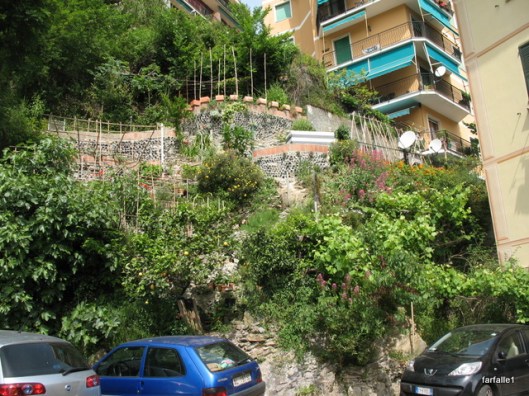
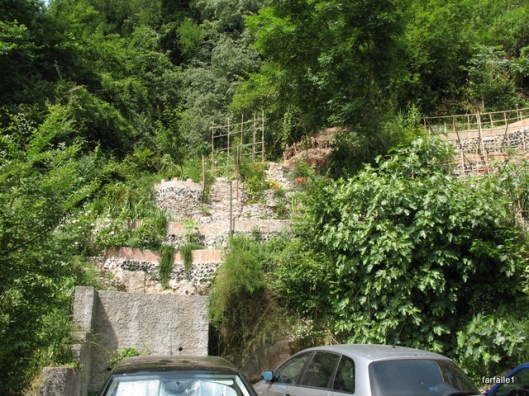
The prize for getting the most out of every inch, though, goes to this man’s neighbor a bit farther down the road, another American transplant by the name of Rick Gush.  Rick is the guy that if you give him a sow’s ear he’s going to give you a purse the next time you meet.  He’s the guy who’s never even heard of the box everyone else is trying to think outside of.  Every time we meet Rick we learn of some new  job he once had.  An incomplete list of his accomplishments includes adventure game designer (Kyrandia, Lands of Lore), psychic soil analyst (easier than it sounds, he says, if you live in Las Vegas, as he did at the time), intimacy counselor (“those that can’t do, teach,” he says), artist, uranium miner, gardener and garden writer.  He took all the disparate skills suggested by these activities and put them to work in building his hillside garden.

The steep, stony land, a cliff really, behind his and his wife Marisa’s apartment building had gone completely to seed.  Over the last few years Rick has terraced it and built walls of cement and old wine bottles laid on their sides with the bottoms facing out.  Sounds weird, but it’s really pretty and a very clever way to recycle hundreds of wine bottles.  And being a fanciful fellow he has put turrets on the walls.

Rick's garden

This is a view of the right side of the garden.  There are grapes on the right and a big fig tree on the left, with a smaller lemon between them.  There’s a set of steps, invisible in the photo, above the blue car roof.  Above you can see flowers, bean poles, tomato poles and satellite dishes. Just below the uppermost wall there is a very pretty curved arbor with a flowering vine  growing over it.

Rick's garden-1

This is the left, and more recently constructed part of the garden.  More turrets, the big fig, and more poles to support cukes, squash and pumpkins.

Rick's garden-3

This pictures shows the amount of wall building Rick has done, but it’s hard to see the details of the plants.  This is a garden in the true spirit of Italy – there’s not one centimeter wasted, and, best of all, it’s beautiful.  There’s been an addition since I took this photo – up on the top fascia now sits a small, gleaming white greenhouse – heated by manure.  (To read more about Rick and his cliff garden, click here.)

Rick strangles thin air-1

Smoke

05 Friday Jun 2009

Posted by farfalle1 in Customs, gardening, Italian habits and customs, Italy, Uncategorized

≈ 6 Comments

Tags

agricultural burning, agricultural fires, brush burning in Italy

Native Americans knew how to use smoke to force rodents to flee their desert burrows; once they emerged the Indians killed and ate them.  We’re feeling a bit that way – like the rodents, that is, not Native Americans.

fire in the valley2

Italy is a burning country.  Visit Tuscany in late October or November and you will find a shroud of smoke from agricultural fires over the landscape.  Coming from a part of New England where one needed a permit from the Fire Marshall to do any burning on one’s property, it was a shock to us to see how many fires there are, almost every day, dotting the hills and mountains around us.  After a year, though, we understood.  It is such a verdant, lush country, there is simply no way to compost or keep up with the excess growth that needs to be removed. (According to the European Commission, agriculture is responsible for 9% of the world’s total greenhouse gas emissions (though to be fair, agriculture also serves as a G.G. sink).  A large percentage of those emissions come from methane and manure – turns out all those cow-fart jokes were based on fact after all)

Burning becomes delicate when you live amongst others.  It’s best if you or your neighbors burn on a day that is not dry and windy.  A day without a thermal inversion is good – then the smoke goes up instead of around and around.  And most of all, it’s really nice if you burn so your smoke doesn’t go right into your neighbors’ windows.

sandro's evening fire

Our neighbor Sandro has recently cut his grass, using, as everyone else does, a weed whacker rather than a mower.  It’s back-breaking, dirty, unpleasant work, and I’m happy to say Sandro does it once or twice a year, whether he needs to or not.  Oh meow! Of course the grass and weeds were up to his waist, which made his job even nastier.  Then, because there were so many whackings (can’t really call them ‘clippings’ in this case), he had to rake them into piles, and then he burned them.  Right under our terrace.  Ordinarily this wouldn’t bother us one whit, but that day we had an inversion, and the slight air movement we did have brought the smoke from his fire right into our house, never mind our yard where we had been hoping to work ourselves.  It started at 9:30 a.m. and he lit his last fire at 8:30 p.m.

There was a strange principle of physics at work that day: we were able to receive most of the smoke from two separate fires, one on either side of our terrace.  How this happens is not quite clear to me.  I think there’s probably a formula, something like:  NI = (e) SD + (w) SD +T / square root H, where ‘e’ is east, ‘w’ is west, SD is smoke diffusion, T is temperature, H is humidity and NI is neighbor irritability.  Risking the Bad Neighbor Award the Captain took our longest hose and put out one of the fires. Our eyes were still watering, and our throats were scratchy the next day.

I’m hoping to be able to get out in our own garden tomorrow.  I’ve got a big brush pile that needs burning.

← Older posts
Newer posts →

Enter your email address to follow this blog and receive notifications of new posts by email.

Join 114 other subscribers

rss

Subscribe in a reader

Search the Blog

A. Useful Links

  • bab.la language dictionary
  • Bus schedules for Tigullio
  • Conversions
  • English-Italian, Italian-English Dictionary
  • Expats Moving and Relocation Guide
  • Ferry Schedule Rapallo, Santa Margherita, Portofino, San Frutuoso
  • Italian Verbs Conjugated
  • Piazza Cavour
  • Rapallo's Home Page – With Link to the Month's Events
  • Slow Travel
  • The Informer – The Online Guide to Living in Italy
  • Transportation Planner for Liguria
  • Trenitalia – trains! Still the most fun way to travel.

C. Elaborations

  • A Policeman’s View
  • Driving School Diary
  • IVA refunds due for past Rifiuti tax payements
  • Nana
  • Old trains and old weekends
  • The peasant, the Virgin, the spring and the ikon
  • Will Someone Please, Please Take Me to Scotland?

D. Good Recipes - Best of the Week winners are starred

  • 'Mbriulata
  • *Baked Barley and Mushroom Casserole*
  • *Captain’s Boston Baked Beans*
  • *Crimson Pie*
  • *Louise’s Birthday Cake*
  • *Melanzane alla Parmigiana*
  • *Penne with Cabbage and Cream
  • *Pizzoccheri della Valtellina*
  • *Pumpkin Ice Cream*
  • *Risotto alla Bolognese*
  • *Rolled Stuffed Pork Roast*
  • *Spezzatini di Vitello*
  • *Stuffed Grape Leaves*
  • *Stuffed Peaches (Pesche Ripiene)*
  • *Swordfish with Salsa Cruda*
  • *Tagliarini with Porcini Mushrooms*
  • *Tagliatelli al Frutti di Mare*
  • *Three P's Pasta*
  • *Tzatziki*
  • 10th Tee Oatmeal Apricot Bars
  • Adriana’s Fruit Torta
  • Aspic
  • Bagna-calda
  • Best Brownies in the World
  • Clafoutis
  • Cold cucumber soup
  • Crispy Tortillas with Pork and Beans
  • Easy spring or summer pasta
  • Fish in the Ligurian Style
  • Hilary's Spicy Rain Forest Chop
  • Insalata Caprese
  • Lasagna al forno
  • Lasagna al Forno con Sugo Rosato e Formaggi
  • Lemon Meringue Pie
  • Leo’s Bagna Cauda
  • Leo’s Mother’s Stuffed Eggs
  • Louis’s apricot chutney
  • Mom's Sicilian Bruschetta
  • No-Knead (almost) Bread
  • Nonna Salamone's Christmas Cookies
  • Pan Fried Noodles with Duck, Ginger, Garlic and Scallions
  • Pesto, the classic and original method
  • Pesto, the modern, less authentic method
  • Pickle Relish
  • Poached pears
  • Poached Pears
  • Polenta Cuncia
  • Recipes from Paradise by Fred Plotkin
  • Rustic Hearth Bread
  • Shrimp and Crayfish Tail Soup
  • Sicilian salad
  • Slow Food Liguria
  • Slow Food Piemonte and Val d'Aosta
  • Spinach with Garlic, Pine Nuts and Raisins
  • Stuffed Eggs, Piemontese Style
  • The Captain’s Salsa Cruda
  • Tomato Aspic
  • Zucchini Raita

E. Blogroll

  • 2 Baci in a Pinon Tree
  • Aglio, Olio & Peperoncino
  • An American in Rome
  • Bella Baita View
  • Debra & Liz's Bagni di Lucca Blog
  • Expat Blog
  • Food Lovers Odyssey
  • Italian Food Forever
  • L’Orto Orgolioso
  • La Avventura – La Mia Vita Sarda
  • La Cucina
  • La Tavola Marche
  • Rubber Slippers in Italy
  • Southern Fried French
  • Status Viatoris
  • Tour del Gelato
  • Weeds and Wisdom

Photographs

  • A Day on the Phoenix Light Rail Metro
  • Apache Trail in the Snow
  • Aquileia and Croatia
  • Birds on the Golf Course
  • Bridge Art
  • Canadair Fire Fighters
  • Cats of Italy
  • Cloudy day walk from Nozarego to Portofino
  • Fiera del Bestiame e Agricultura
  • Football Finds a Home in San Maurizio
  • Hiking Dogs
  • Mercatino dei Sapori – Food Fair!
  • Moto Models
  • Olive pressing
  • Rapallo Gardens
  • Rapallo's Festa Patronale
  • Ricaldone and the Rinaldi Winery
  • Rice Fields
  • Sardegna ~ Arbatax and Tortoli
  • Sardegna ~ San Pietro above Baunei
  • Sardegna ~ The Festa in Baunei
  • Scotland, including Isle of Skye
  • Slow Food 2008 Salone del Gusto
  • The Cat Show and the Light Rail Fair
  • The desert in bloom
  • Trip to Bavaria

Pages

  • Fagioli all’ucelleto

Archives

Recent Posts

  • A Superior Visit
  • Fun at the Ranch Market
  • The MAC
  • Welcome Tai Chi
  • Bingo Fun for Ferals
December 2025
M T W T F S S
1234567
891011121314
15161718192021
22232425262728
293031  
« Jul    

Member of The Internet Defense League

Blog at WordPress.com.

  • Subscribe Subscribed
    • An Ex-Expatriate
    • Join 114 other subscribers
    • Already have a WordPress.com account? Log in now.
    • An Ex-Expatriate
    • Subscribe Subscribed
    • Sign up
    • Log in
    • Report this content
    • View site in Reader
    • Manage subscriptions
    • Collapse this bar
 

Loading Comments...