• Contact
  • Elaborations
    • A Policeman’s View
    • Driving School Diary
    • Great Danes
    • IVA charged on Tassa Rifiuti
    • Nana
    • Old trains and Old weekends
    • The peasant, the virgin, the spring and the ikon
    • Will Someone Please, Please Take Me to Scotland??
  • Recipes
    • ‘Mbriulata
    • *Baked Barley and Mushroom Casserole*
    • *Captain’s Boston Baked Beans*
    • *Cherry Tart*
    • *Crimson Pie*
    • *Louise’s Birthday Cake*
    • *Melanzane alla Parmigiana* – Eggplant Parmesan
    • *Penne with Cabbage and Cream
    • *Pizzoccheri della Valtellina*
    • *Pumpkin Ice Cream*
    • *Risotto alla Bolognese*
    • *Rolled Stuffed Pork Roast* on the rotisserie
    • *Shrimp and Crayfish Tail Soup*
    • *Spezzatino di Vitello*
    • *Stuffed Grape Leaves*
    • *Swordfish with Salsa Cruda*
    • *Tagliarini with Porcini Mushrooms*
    • *Tagliatelli al Frutti di Mare*
    • *Tzatziki*
    • 10th Tee Apricot Bars
    • Adriana’s Fruit Torta
    • Artichoke Parmigiano Dip
    • Best Brownies in the World
    • Clafoutis
    • Cod the Way Sniven Likes It
    • Cold Cucumber Soup
    • Crispy Tortillas with Pork and Beans
    • Easy spring or summer pasta
    • Fagioli all’ucelleto
    • Fish in the Ligurian Style
    • Hilary’s Spicy Rain Forest Chop
    • Insalata Caprese
    • Kumquat and Cherry Upside Down Cake
    • Lasagna Al Forno con Sugo Rosato e Formaggi
    • Lemon Meringue Pie
    • Leo’s Bagna Cauda
    • Leo’s Mother’s Stuffed Eggs
    • Louis’s Apricot Chutney
    • Mom’s Sicilian Bruschetta
    • No-Knead Bread (almost)
    • Nonna Salamone’s Famous Christmas Cookies
    • Pan-fried Noodles, with Duck, Ginger, Garlic and Scallions
    • Pesto
    • Pesto
    • Pickle Relish
    • Poached Pears
    • Polenta Cuncia
    • Pumpkin Sformato with Fonduta and Frisee
    • Rustic Hearth Bread
    • Sicilian Salad
    • Soused Hog’s Face
    • Spotted Dick
    • Swedish Tea Wreaths
    • The Captain’s Salsa Cruda
    • Tomato Aspic
    • Vongerichten’s Spice-Rubbed Chicken with Kumquat-Lemongrass Dressing
    • Winter Squash or Pumpkin Gratin
    • Zucchini Raita

An Ex-Expatriate

~ and what she saw

An Ex-Expatriate

Category Archives: Italy

Tragedies Natural and Man-Made

29 Tuesday May 2012

Posted by farfalle1 in Italy, Uncategorized

≈ 10 Comments

Tags

Brindisi bombing, Earthquake Italy May 2012, Earthquakes in Italy, Italian earthquakes, Melissa Bassi, Murder in Brindisi

I was sitting on our bed this morning about 9 a.m., finishing the chapter in the book I was reading, when I heard the tinkle, tinkle, tinkle of small objects moving, and a millisecond later felt the bed swaying beneath me.  Uh oh, I thought, that sure sounds and feels like an earthquake.  I shouted down to Speedy who was working out on the terrace, but he had felt nothing, so I went back to my book.

Later in town, the friend with whom I was having a cuppa in her apartment near the top of a seven-story building asked me if I had felt the earthquake.  Oh yes.  And no sooner did we start discussing it than we felt an aftershock, much gentler.  This was certainly alarming, as an apartment building is no place to be for an earthquake.  Fortunately for us, that was the end of it.

But the north/central part of the country was not nearly so fortunate.  The 5.8 quake was centered near Modena, right near where the last one occurred, and more buildings, many already weakened by the previous quake, came tumbling down.  Early reports indicate ten people have died, and more are trapped under rubble.

A week ago Sunday morning a 6.0 earthquake centered between Bologna and Mantova killed seven people and did untold damage to buildings.  Italy is no stranger to earthquake; a rocky country covered with ancient buildings made of stone, the effects are often catastrophic.

#1 is Rapallo, #2 is where the 2nd quake hit, and #3 is where the first quake was centered (roughly)

Meanwhile in Brindisi, just a day before the first quake, a bomb went off  outside a girls’ vocational school, killing 16-year-old Melissa Bassi. An only child, she was at the top of her class. I think of her as she might have been earlier in the morning, getting up, getting dressed for school, fixing her hair, putting on make-up, making plans, maybe day-dreaming a little.  And then bam, gone before her life was truly under way.

Italy is in mourning.  These tragedies, perhaps small in the Grand Scheme of Things, are large in the national psyche.  Both instill a sense of fear: on the one hand for the Big One, like the quake that destroyed Aquila in 2009 which killed over three hundred people; and on the other for the return of the ‘years of lead’ in the 1970’s and ’80’s when the Red Brigades terrorized the country.

What these events all have in common is their utter randomness, meaninglessness and ultimate uselessness.  Is that what makes them tragedies?

Already beset by a worsening economic crisis, the recent tragedies have only added to the sense of unease abroad in this beautiful country.

What Would Be the Dumbest Thing in the World to Tax?

19 Saturday May 2012

Posted by farfalle1 in Animals in Italy, Cats, Italian bureaucracy, Italian gardens, Italy, Law and order, Taxes in Italy, Uncategorized

≈ 10 Comments

Tags

Silly Taxes, Tax on Pets

Pets.  That would be ridiculous, wouldn’t it?

Real Luciano

Speedy sent me an article he came across  from Reuters (reported by Philip Pullella; edited by Andrew Osborn) about the yahoos in Rome considering a tax on  family pets.  Evidently a parliamentary commission felt that this would be an excellent way to give a little boost to the nation’s diminished coffers.  The outcry was immediate and loud; the proposal was dead by the end of the day.

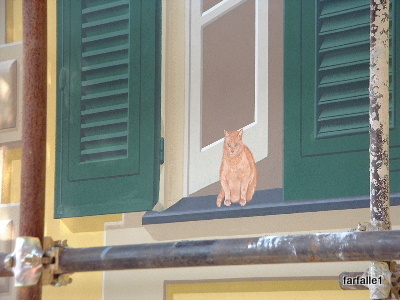
It got me thinking, though.  Didn’t Italy once tax house windows, and isn’t that why there are so many trompe L’oeuil windows painted on the houses of Liguria, where people are famously tight with their cash?

Tax Evasion Luciano

Probably the idea of taxing pets is not the silliest tax proposal ever made.  A quick Google search turned up an amusing list of the ten most ridiculous taxes ever, written by Jamie Frater.  It turns out that Rome is no stranger to bizarre taxes.  The emperors Nero and Vespasian taxed urine.  Poor Romans fortunate enough to have a pot to piss in paid a tax when they emptied their pots in the common cesspool.

Go ahead, tax my dog Rover – just get rid of the tax on my hat and my beard.  I think my favorite is the one called the Crack Tax: drug dealers in Tennessee were, before the law was declared unconstitutional, supposed to pay a tax, anonymously, on the illegal substances they sold.  If they got caught dealing crystal meth, say, and didn’t have the tax stamp… well, can you imagine?  They’d have been in pretty hot water!

It did give me an idea for another tax the Roman legislators might consider:

Photo courtesy of thedragonpages.blogspot.com

The Intergluteal Cleft Tax would either raise a lot of money or send fashion careening in a new direction.

Not all strange taxes are so amusing.  The poll tax in America was a de facto method of denying voting privileges in the southern states to recently freed slaves.  It was not repealed until 1964.

Anti-Poll Tax sentiment from the U.K.

The way things are going in this election year they may have to pay people to come to the polls instead.  Especially here in Rapallo where only 16,000 of 28,000 possible voters turned out two weeks ago to elect the Mayor.

There will always be taxes, I guess.  And I guess there will always be some silly ones.  I’m just glad that, for the time being anyway, there will be no taxes in Italy for owning a pet.  Speedy suggests that instead of taxing pets perhaps the legislators could tax vegetable gardens….

A nicely laid out garden on Via Betti in Rapallo

Taxi!

15 Sunday Jan 2012

Posted by farfalle1 in Driving in Italy, Health and health care, Italian bureaucracy, Italy, Medical care in Italy, Uncategorized

≈ 13 Comments

Tags

Italian pharmacies, Italian taxis, Monti reforms

Quick!  Take me to the Pharmacy!

Photo courtesy of italyfromtheinside.com

An article in the English edition of ANSA describes a wildcat strike by taxi drivers in Rome.  They are unhappy because the Monti administration, in its package of reforms, wants to loosen requirements to become a cabby.  This is just one of many measures aimed at boosting Italy’s flagging economy and making it possible for young people to find work –  all of which are being offered in tandem with severe austerity measures.

Photo courtesy of tuscantraveller.com

Back in 2007 the Roman taxi drivers were angry, too.  At that time the city wanted to add 1,000 cabs to the stable.  Rome had, at that time, 3 cabs for every 1,000 residents, the fewest of any city in Europe, according to a Marketplace report.

Prime Minister Monti, photo courtesy of The Guardian

Another of the proposed Monti reforms calls for relaxing the regulations around opening a pharmacy.  As things are now it is almost impossible to open a new pharmacy.  A young person can go to school and become a pharmacist, but without family connections to an existing business, finding a position will be difficult (not impossible, but difficult).  But the entrepreneurial pharmacist who wants to open a new drugstore is just plain out of luck.  The number and opening hours of pharmacies are regulated by law according to about.com.  It is also true that if you want to get aspirin or vitamins you will have to go to a pharmacy where you will find them hideously packaged on foil covered cardboard.  Last time I forgot to bring aspirin from the States I paid € 6 for 30 aspirin.  Speedy says that often when viewing the painkiller section of a Walmart store and seeing 500 Iboprofen selling for $6.28, he thinks an Italian seeing the same shelf would need a cardiologist rather than some pills.  Until recently the only place you could buy prepared baby food was at a pharmacy.  Imagine!

While there is a lot wrong with the pharmacy system in Italy (and probably the taxi system as well), there is a lot right.  There is always at least one pharmacy open within shouting distance, and the pharmacists are highly trained, knowledgeable and able to help with minor medical emergencies, saving one a trip to the emergency room.  But the regulations against competition in pharmacies could be relaxed without reducing the requisite training for pharmacists – that would be good for consumers and for young pharmacists.

The larger problem, of which these two issues are representative, is that Italy is a country strangled by bureaucracy and regulations.  There is no place for young people to find work because all the trades and professions are so busy protecting their own interests that they are unwilling to be open, to expand or to share.  That’s bad for all concerned, it seems to me.  Educated young people live with their parents and fruitlessly hunt for jobs; the professions stagnate and suffer gross inefficiencies due to limited scope and size. Speedy reminded me that the current generation of Italians is called the NEETS (not in education, employment or training) generation (15 to 29 years-of-age), of which there are some 2 million.  These NEETS comprise 11.2 % of this age group in Italy compared to 3.6% in Germany, 3.5% in France, 1.7% in the UK, and but .5% in Spain.  All that talent going to waste!  Clearly, this is a socio-economic problem that will have long-lasting effects unless the new government, and the Italian people, can turn around their unique approach to social management.

To an American it seems ludicrous.  In the States it is relatively easy to start a business – all you need is a good idea and either money, or backers with money.  Granted, some 35% of new businesses will fail within the first two years, but at least one has the opportunity to try.  And if only 35% fail it means  that 65% succeed, giving income and occupation to more people and, because of the competition generated, giving better services and lower prices to society in general .

It will be interesting to see how it all plays out in the months ahead.  In the meantime, don’t get sick in Rome – it might be hard to find a cab to take you to the pharmacy.  And if you’re visiting Italy from the States, do bring your own aspirin.

Songbirds: Friends or Food?

04 Wednesday Jan 2012

Posted by farfalle1 in Animals in Italy, Animals in the U.S., Birds in Italy, Crime, Customs, Italy, Uncategorized

≈ 10 Comments

Tags

Bird-feeding, Feeding Birds, Hunting in Italy, Hunting songbirds in Italy, Illegal hunting in Italy, Trapping songbirds in Italy

Somehow it’s hard to think of chickens and turkeys as birds.  Sure, they have feathers, but we never see a flock of them high overhead, migrating south for the winter, their clucking stirring our own restlessness.  Nor do we startle them when we take a walk in the woods.  We don’t listen for their sweet morning calls and try to identify exactly what chicken it is we’re hearing.  Wait!  Is that a Rhode Island Red or an Ameraucana?  Hand me my binoculars!

No.  Chickens and turkeys are ambulatory food for the most part.

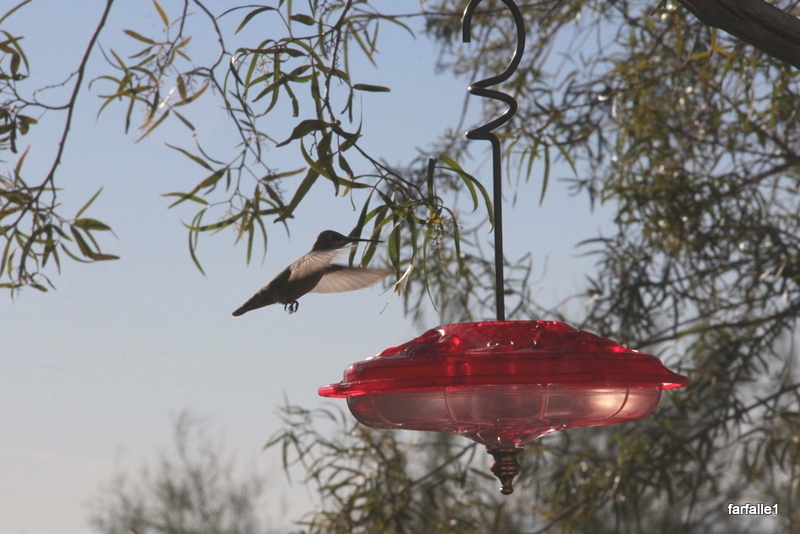
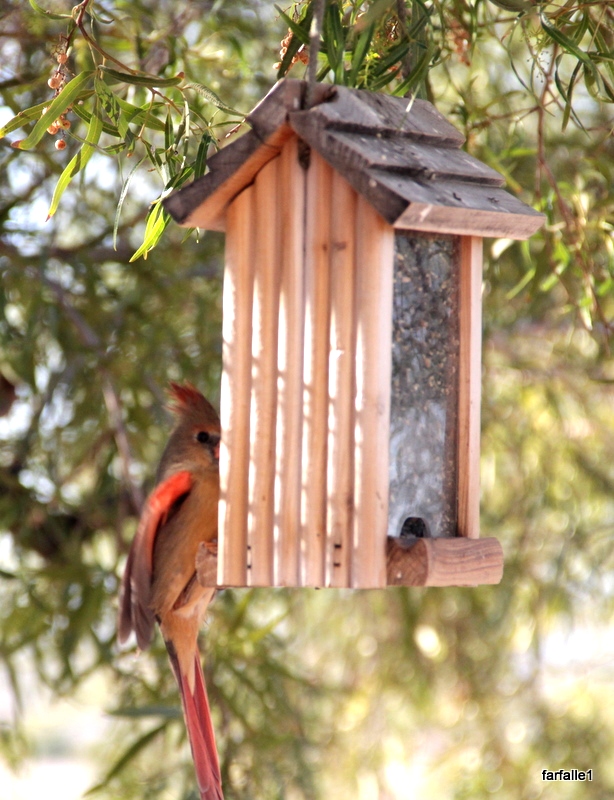
Songbirds, however, are not.  One of the  pleasures of being here in Arizona is watching the birds that come to our feeder every day.

Anna's hummingbird, noisy and aggressive

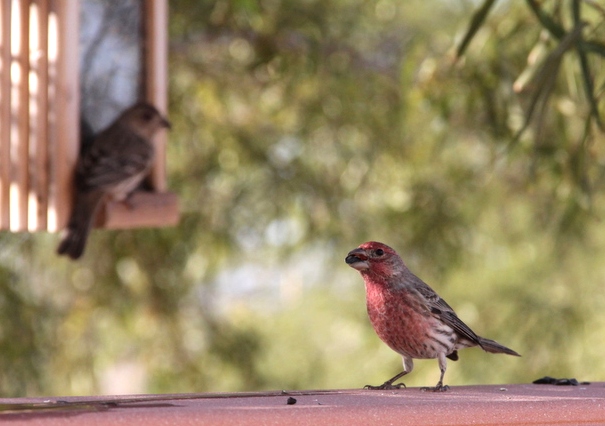
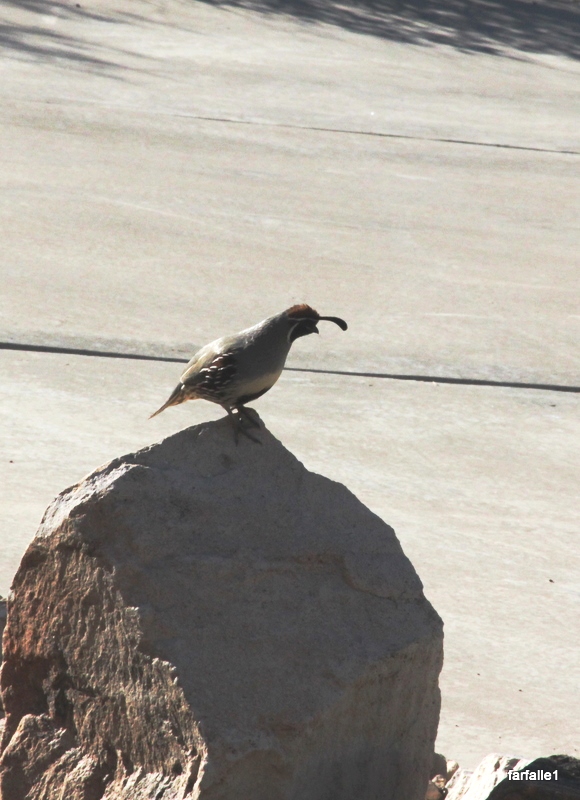
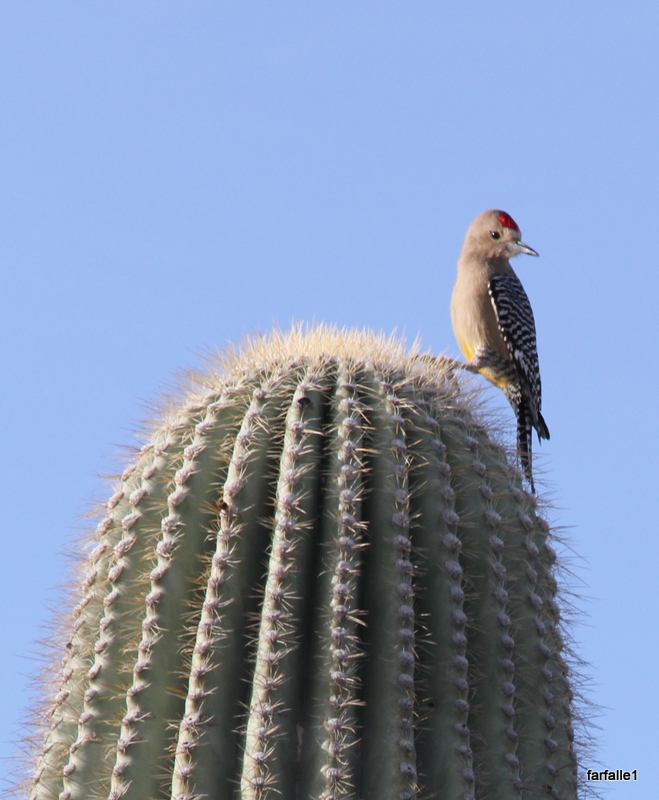
We don’t get anything terribly exotic (and we have yet to see a chicken) –  many purple finches, the ubiquitous Anna’s hummingbird, Abert’s towhee , Gila peckers, Cactus wrens, and, on the ground below, Inca doves and the amusing Gambel’s quail, which makes a bweep-bweeping sound, reminiscent of burbling water, while it wanders around beneath the feeder.

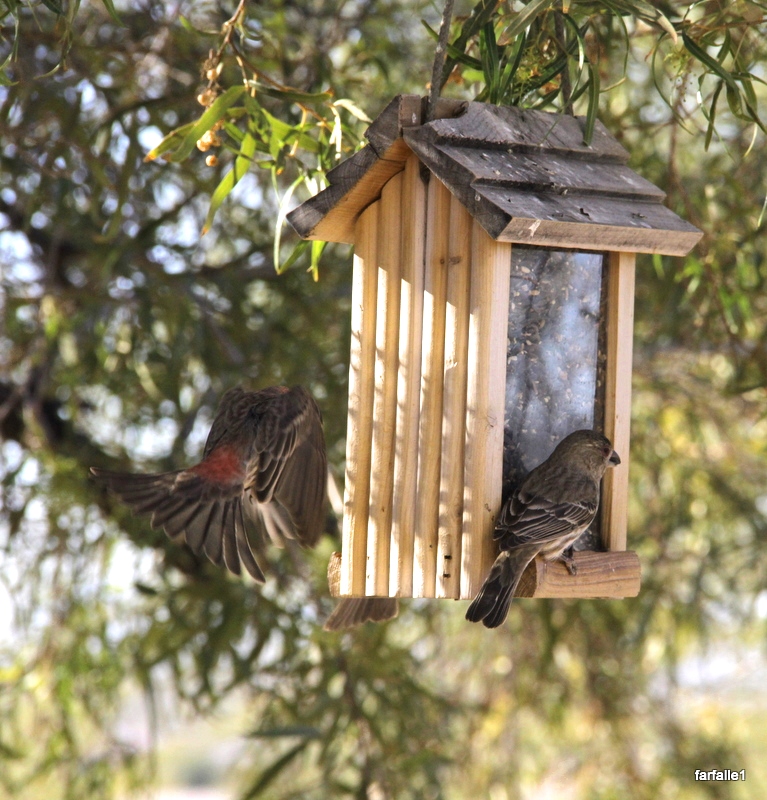
Male finch enjoying a seed while female thinks about it

Gambel's quail, males conveniently carry bulls eye on their breasts

It’s a pleasure we don’t enjoy in Italy.  Not because there are no songbirds – there are.  We get huge amusement and satisfaction from the merli (a sort of black robin with the unfortunate Latin name Turdus merula, called ‘merlo’ in the singular) which are curious and companionable, and which have the beautiful song typical to thrushes.  We seldom work outside in spring or summer without an appreciative audience of merli.  But bird-feeding as a hobby does not seem to exist in Italy, at least not in our part of the country.  I have never seen a bird-feeder at anyone’s house, and I have never seen bird feed for sale.

Male cardinal

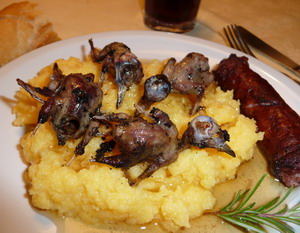
Instead in Italy there is a sizable, though fortunately shrinking, trade in trapping and killing wild birds.  The CABS (Committee Against Bird Slaughter) web site has a great deal of information about the illegal trapping of birds which occurs, in Italy, mostly in the north (Lombardia), the southern Italian coast, Sardinia and Sicily.  There are a couple of good reasons why this illicit activity continues.  One is that it is a matter of long tradition to trap songbirds, and Italy is nothing if not wed to her traditions.  In earlier times songbirds were an important source of protein for hungry Italians. Another reason is that some restaurants persist in serving songbirds, though you will never see them on the menu.

Little birds with polenta, photo courtesy of CABS

Happily, CABS reports that hunting songbirds is truly on the wane in northern Italy, a trend we can only hope (or I can only hope, anyway) will continue.

Gila woodpecker atop a nearby cactus

Hunting for sport is as popular in the U.S. as it is in Italy.  In 2006, according to the U.S. Fish and Wildlife Service, 2.3 million people hunted migratory birds such as doves or waterfowl.  Such hunting is highly regulated; hunters must have appropriate licenses and stamps, and can hunt only certain birds in certain places at certain times.  Sport hunters in both countries are generally dedicated and law-abiding conservationists, interested in protecting the populations of the species they like to hunt.  In a perfectly counter-intuitive bit of logic, sometimes bird populations must be ‘culled’ in order to protect the well-being of the species.  It makes no sense to me, but if the people at Audubon say it’s true, it must be true.  Mustn’t it?

No doubt there is illegal hunting in the U.S., but it is difficult to get away with it.  Some years ago when we lived in Connecticut a man of our acquaintance became very angry at the number of messy geese on his pond and lawn.  He got out his rifle, stood on the back porch and shot one, no doubt hoping to scare away the others.  His neighbors heard the shot and came running to find out what was wrong, so he was caught red-handed.  He did not go to prison, but he did have a reprimand and a sizable fine.  Even worse, he became known locally as ‘Goose Killer’ – and it was not the sort of affectionate and admiring nickname that, say, ‘Speedy’ is.

The illegal taking of birds in Italy is of a different order entirely.  According to CABS, ‘millions’ of birds are taken every year, hundreds of thousands of them in Northern Italy.  They are sometimes taken with guns, as in the wholesale slaughter of migrating birds videoed here (supposedly ‘legal,’ but against the very EU regulations Italy signed on to uphold), and frequently taken in any of several various types of traps, all of which are illegal (bow, snap, snare, cage and nets).

It’s hard to understand what the appeal or pleasure is in trapping or shooting  songbirds.  It’s not as if they’re particularly challenging prey, or especially meaty.  The declining number of traps in Italy attest to the gradual change of attitude towards this cruel practice; but it remains a big problem.

Male finches 'discuss' seating while a female thinks about it all

According to Wikipedia 55 million Americans are bird-watching hobbyists.  They spend $3 billion a year on seed and $800,000 million on bird feeders and other accessories.  Maybe there’s an opportunity here to help the struggling Italian economy.  Don’t kill the birds, feed them. Photograph them.   Enjoy them.  Encourage touristic bird-watching trips. And when the irresistible blood lust of the hunter comes over you, go down to Signore Marrone’s farm and bag a few chickens.

Shhhh

01 Monday Aug 2011

Posted by farfalle1 in American habits and customs, Arizona, Customs, Italian festas, Italian habits and customs, Italy, Uncategorized

≈ 13 Comments

Tags

How to Listen, Julian Treasure, Listening, Noise, Noise Pollution, Sound

The Captain always teases me by saying, “You know I never listen;” and I tease back by saying, “True.  We have the perfect arrangement for living in Italy – you speak and I listen.”  (He’s much better at speaking the language than I.)

While the captain may be teasing, it seems true to me that often people really don’t listen to others (I include myself in this group). The reasons are many – self-involvement, disinterest, hearing impairment, multi-tasking, language challenges, etc., etc.

The TED website recently put up a talk by sound specialist Julian Treasure which I found fascinating. He talks about why people don’t listen, and how we can all improve our listening skills.  It’s a short video, just over seven minutes – here, take a look.

https://ted.com/talks/view/id/1200

One of the things that has always struck me about Italy is the non-stop noise, at least where we live.  As I type this it’s 10:30 at night and there’s a festa down the street a way with live music – very loud live music.  Driving bass, banging drums and a songstress who is, alas, a bit flat.  It’s not my taste in music, to be honest, but I don’t really resent it being forced on us (at least not until after 11 p.m. – last night the live music went til midnight and I did get a bit cranky).  It happens only a few times a year up here. The amazing thing to me is that no one complains or seems to mind.

But if it’s not live music, there is always some other kind of aural stimulation – scooters and cycles tearing up and down the mountain; the bus slowly groaning its way up, merrily tootling its horn at every curve (a necessary precaution on these narrow roads) and then loudly sighing and chuffing at each stop; church bells from our village, from Montallegro and, if the wind is right, from the Rapallo Cathedral; ambulance and police sirens; cruise ship horns; airplanes overhead; dogs barking; cocks crowing at all hours; birds; children shouting (a particularly cheerful noise, that) and always, always conversation.  Conversation as an art form is alive and well in this courteous country.  Finding three minutes of silence daily, as recommended by Mr. Treasure (can that really be his name??) is a challenge here.  Every now and then one of us awakens at 3 or 4 a.m., and we are struck by the relative silence – it is such a rarity.

In contrast the U.S. seems much quieter in general (not the cities, to be sure).  The example the Captain likes to give is this:  when Italy won the World Cup (European football) in 2006 the racket from Rapallo was amazing – horns blasted, cars tore through the center of town with kids hanging out waving flags and shouting, ships in the harbor blew their horns – it was an explosion of celebratory sound.  In 2008 when the Arizona Cardinals (American football) won the game that sent them to the Super Bowl we stuck our heads outside right after the game.  Our Arizona neighborhood was as silent as a tomb, the town was silent; and we were a mere forty miles from the stadium where the game was played.  No one was out and about because anyone not at the game was surely inside watching it on TV – but afterwards there was no public demonstration of glee.  And if someone’s party is noisy in the U.S. it takes the neighbors no time at all to call the police and complain.

So, is it harder to listen in Italy, where there is so much more ambient noise?  Though the Captain might well disagree,  I don’t really think so.  But as we know, he doesn’t listen anyway…

Election Day

14 Tuesday Jun 2011

Posted by farfalle1 in Italian bureaucracy, Italian habits and customs, Italy, Rapallo, San Maurizio di Monti, Uncategorized

≈ 4 Comments

Tags

Italian Elections, Referendums in Italy, Voting in Italy

Faithful readers will remember that the Captain became an Italian citizen about a month ago.  As luck would have it, there was an election yesterday, and he is now eligible to vote.  It wasn’t an election for political office, it was referenda on four questions: 1) should the law allowing privatization of the water company stay on the books?  2) should the cost of water be increased?  3) should the law exempting politicians currently in office from being tried in court stay on the books? and 4) should the plans to re-institute nuclear power plants in Italy go forward?

Will it surprise you to hear it was not a simple matter to get into the voting booth?  The Captain started two weeks ago, when he went to the Comune to request his voting card, without which he could not vote.  They were too busy to take care of him that day, and in fact tried very hard to discourage him from voting this time. But as a citizen it is his right to vote, and they were more or less obliged to take care of him, although not at that exact moment.  They grumblingly instructed him to come back a week later, which he did. They were even busier and once again they tried to put him off.  He wouldn’t give up, so they promised they would do the necessary work and then call him to let him know when he could pick up his card.

The polls were open on Sunday and Monday.  Late Sunday afternoon the long-awaited call came, and first thing Monday morning the Captain went back to the Comune where he found… that his card was not ready.  But there was a document that would allow him to vote and it was lacking only one signature.  Fortunately the hand that had to affix the signature was actually in the building, so without too much more delay the Captain received a handsome paper on Comune letterhead, signed by the man in charge of elections, and officially stamped, attesting to his right to vote.

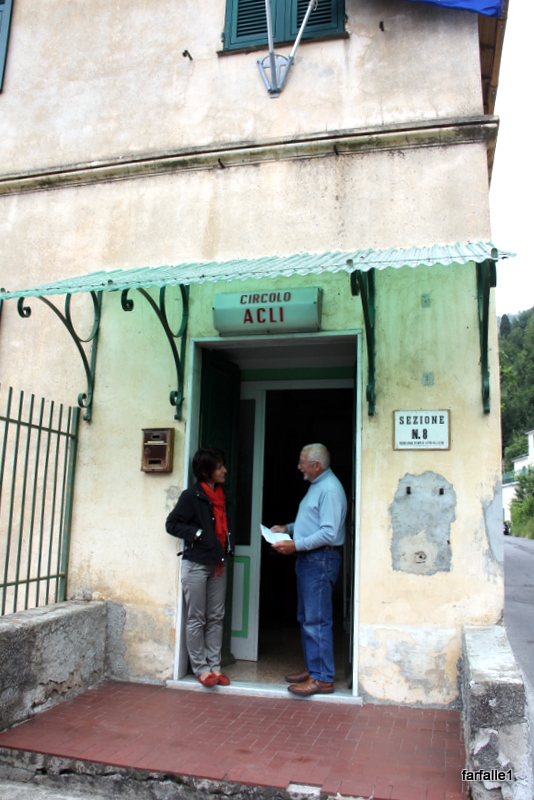
Going to the polls turned out to be one the pleasantest experiences we’ve had in quite a while.  It began outside the former elementary school (now a Catholic social club) where we were warmly welcomed by the secretary of the polling section, Enrica Pedrasi, to whom the Captain explained his mission.

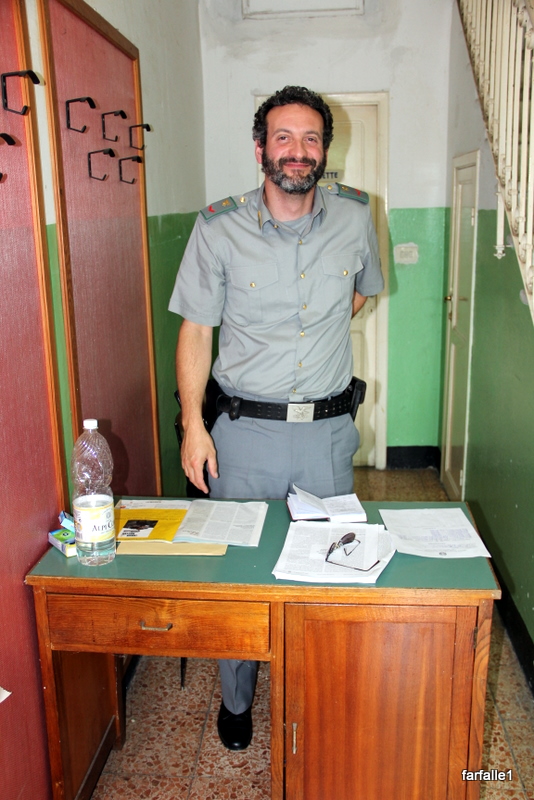
Inside we encountered the genial Gianluca from the Forestiere service. He was one of the people taxed with guarding the ballots from the time they arrived on Saturday until the polling was over on Monday afternoon. There is an armed guard on site at all times to make sure no one monkeys with the ballots.

There was a bit of confusion over the Captain’s document, because it was not the usual voting card, but the President of the polling section, Alberto Tumiati, made a quick phone call to the Comune, and all was well.


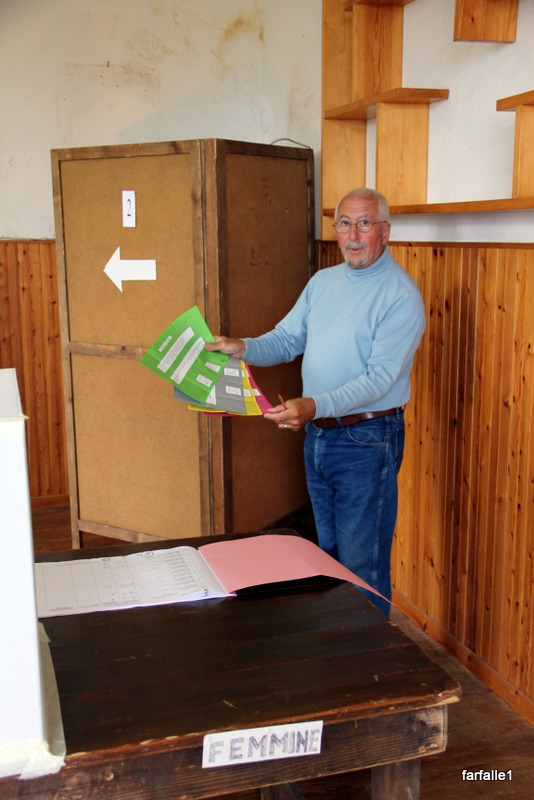
Renata Castagneto, one of the scritore normale of the polling section, entered the Captain’s name in the ledger of eligible voters.  Please note, he has been entered on the ‘maschi’ side.  Women’s names are entered in a different book kept at the other end of the table.  We’re accustomed to seeing alphabetical groupings in the States – it was a surprise to see the gender separation.

Then the Captain was given his ballots.  There was a separate color-coded ballot for each question.  The referendum question was on a strip of paper glued on the top of the paper, instructions were glued below, and two large boxes, one for Si and one for Non were glued at the bottom.

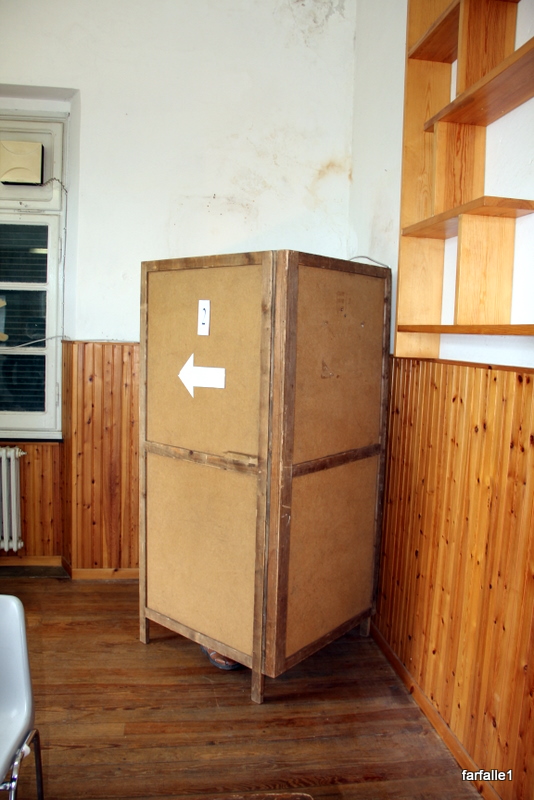
Into the booth he went, and, for the first time, voted as an Italian Citizen.  You can see his shoe in the picture below, peeking out from beneath the voting booth.


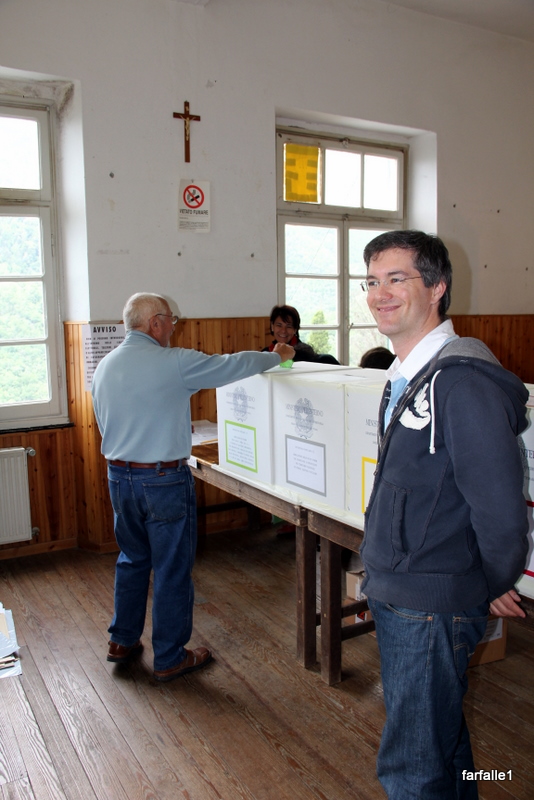
Moments later he emerged with his marked and folded ballots, and deposited each ballot in the appropriately colored box (he reports that it was complicated to fold the ballot correctly – many folds, and one section had to face out).


You can see from the expressions on the faces above that we received a very warm welcome.  In fact a cheer went up when we first walked into the room.  We were told that with the Captain’s appearance the percentage of people voting of those eligible at this voting station now stood at 51% (Rapallo, with its population of 30,000+ has 30 polling districts, each with about 1,000 voters.  Voters must vote at their own polling stations).  Well, that’s nice, we thought.  Then we learned that for the referenda to be effective more than 50% of the eligible voters in the nation must vote.  Little San Maurizio did its part.  There are about 330 eligible voters in the village, and at least 165 turned out.

As I write this the final results are not yet in.  But the evening news indicated that it seems all four referenda were passed – that is, that the laws already in place allowing for nuclear power plants, privatization of the water companies and immunity from prosecution for politicians in office, have all been overturned by popular vote.

Hurray for democracy!

Addendum:  It is the first time in fifteen years that enough voters have turned out to make a referendum valid.  All four popular initiatives passed convincingly (90%), which some see as the beginning of the end for Mr. Berlusconi.  See what the Italian press is saying here (in English).

Renata, Enrica, Alberto… if I have details wrong, please correct me in the comments or in an e-mail, okay?

Hi Pidge!


What the…..???

07 Tuesday Jun 2011

Posted by farfalle1 in Italian bureaucracy, Italy, Uncategorized

≈ 8 Comments

Tags

Italian Postage, Italian Postage Increase, Italian Postal Rates, Italian stamps, Mail in Italy, Mailing a Letter in Italy, Posta Priorita, Stamps in Italy

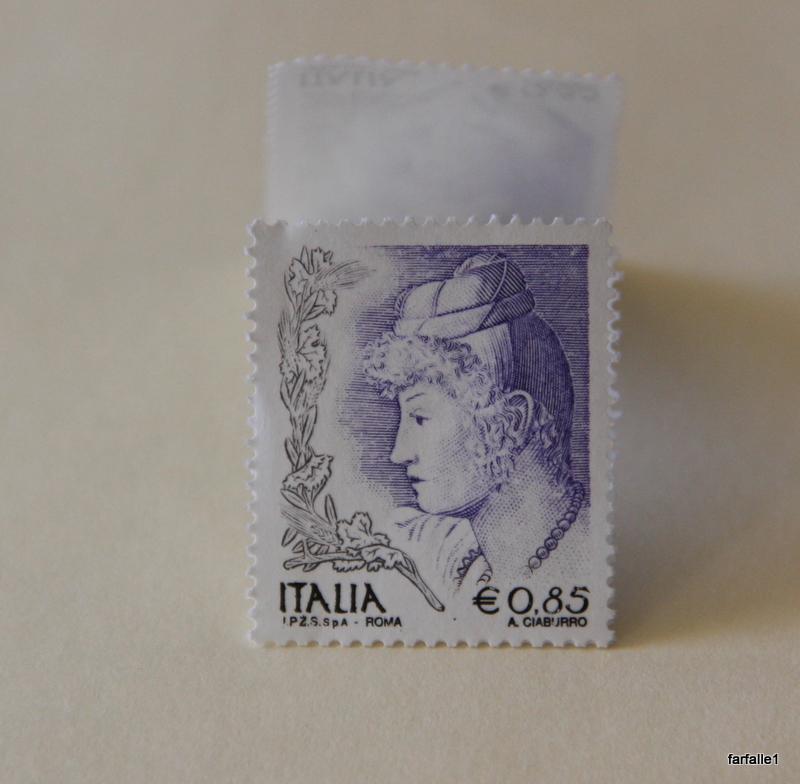
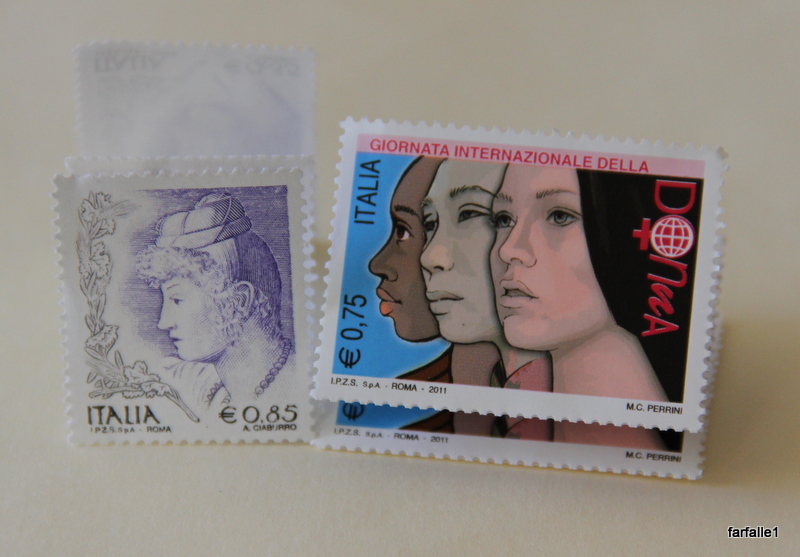
Last November when we left Italy it was possible to put one of these on an envelope and know that sometime in the next five to ten days the letter would arrive in the U.S. of A.

Last week the nice tabaccaio (the man in the cigarette, salt and stamp store) told me I would have to put this on a similar letter to the same destination:

That’s right.  Postage to zone 2, which includes the United States, increased from .85 to 1.60 in December (the patient tabaccaio had to show me the official notice before I was able to believe him).  Factor in the exchange rate and that’s about $2.25.  Can you imagine what would happen if the U.S. Postal Service almost doubled rates from one day to the next?  There would be Congressional hearings at the very least, and quite possibly the streets would be filled with rioting junk-mailers.

So to all dear friends and family who are accustomed to receiving snail mail from me, you’ll be getting only half as much in the future.  Which will still be pretty much the ‘none’ you’re already used to.

Hi, Jay!

Citizen Salamone

04 Wednesday May 2011

Posted by farfalle1 in Italian bureaucracy, Italian habits and customs, Italy, Law and order, Uncategorized

≈ 11 Comments

Tags

Italian bureaucracy, Italian citizenship, Trattoria del Sole

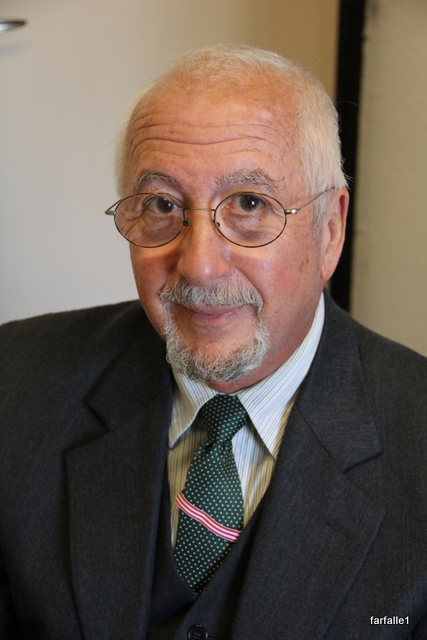
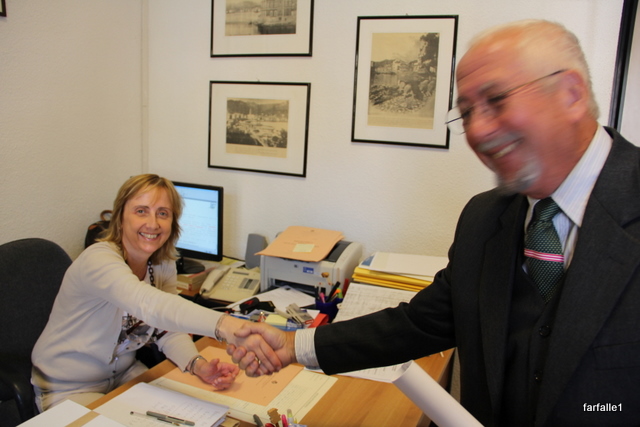
Meet Italy’s newest citizen, The Captain, aka Louis Philip Salamone.


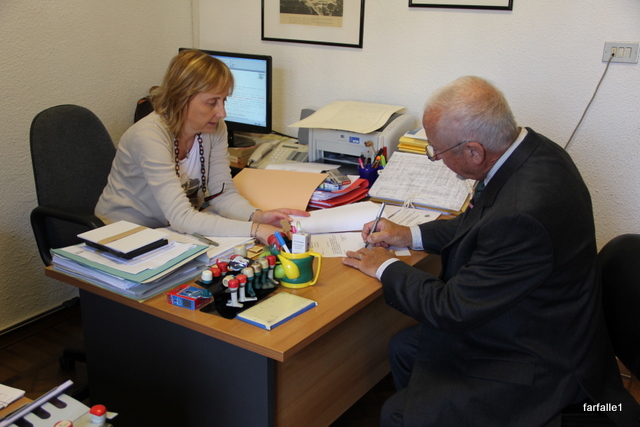
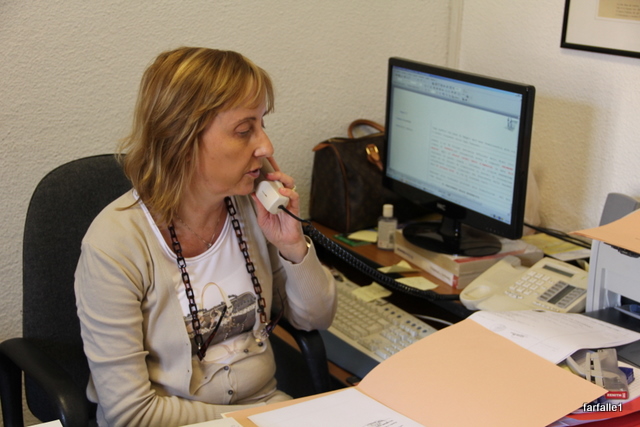
The procedure, I can’t call it a ‘ceremony,’ took place in the office of the head of the Ufficio Stato Civile, Dotoressa De Filippi this morning and was more casual than solemn (I would have liked a bit more ceremony, myself). Nonetheless, for us it was the culmination of several years of work and waiting, and we were both thrilled with the outcome and moved by the Captain’s new status.

At first we were afraid we were headed for a problem, one which has reared its ugly head in past administrative wrestling matches.  Whenever one gets a document, carta d’identita, permesso di sogiorno, etc.,  one must put place of birth on a form.  By place of birth Italian bureaucracy means town or city.  The Captain’s U.S. passport lists place of birth as ‘Wisconsin.’  This led to no end of trouble early in our stay here, but for some reason the good Dotoressa merely shook her head and commenced redoing the various declarations (they had to be further altered to correct the Captain’s misspelled middle name).  Then began the ritual ‘signing of the many forms,’ which occurred no fewer than four times.


Somewhere in the midst of the signing the Captain took an oath to uphold the Constitution and the Laws of Italy.  There was  no hand on heart, no holy book, no blood asked for or given, just a verbal promise to be a good citizen.

In the midst of all this the phone rang, and our proceedings were interrupted by a long discussion of what the caller’s daughter had to do to get her passport. 
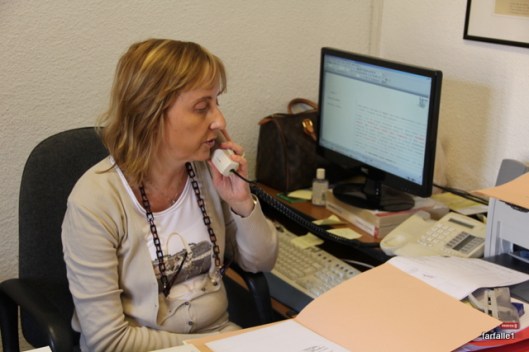

It certainly detracted from the feeling that ours was a special moment, but we quickly got over it.
  Then the Dotoressa read a lengthy declaration to the effect that the President of the Republic had accepted the Captain as a citizen and showed us the Presidential decree, a photocopy of which was given to us later.
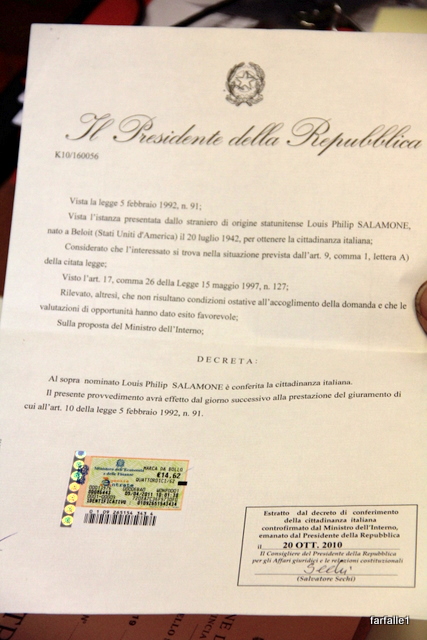

A quick handshake, and the deed was done.
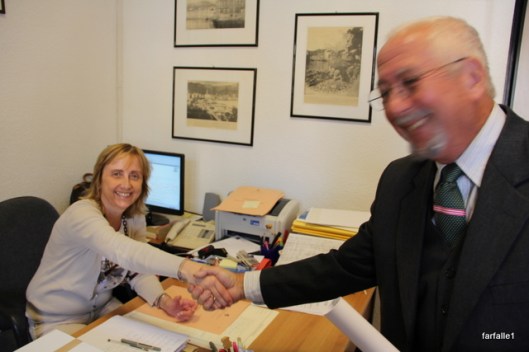
I thought my Captain looked so handsome in his suit – it’s perhaps only the second time he’s worn it in the ten years we’ve been here.  I wish I could fit into clothes I had ten years ago!  He did not have a red, green and white tie, so he chose a green and white tie which we decorated with a bit of red and white ribbon, a not entirely unItalian thing to do. 

Today was the end of a long road that we began in 2005.  The quest began in the office of the very knowledgable and always helpful Anna Maria Saiano, the head of the Genova branch of the U.S. Consulate.  She led us to Signore Bevilacqua (Mr. Drinkwater!) who sent us to Dotoressa De Filippi in Rapallo.  She was disinclined to give the quantity of help we needed, so we returned to Sig. Bevilacqua in Genova, and he got things going for us.

There are many ways to become a citizen, one of the most common being ‘lineage.’  We had assumed this would be our route as both the Captain’s parents were Sicilian, one by birth, one by blood.  However, because the Captain’s father became an American citizen before the Captain’s birth, in effect renouncing his Italian citizenship, it became more complex.  We would have to go back to the grandparents, born in Sicily not all that long after the unification of the country.  Two world wars have had their way with that island – the odds of finding all the requisite birth certificates were low. 

We resorted to a ‘naturalized’ Citizenship, possible after five years of residence if either of the parents were born in Italy.  There are  other routes to citizenship, which you can read about here.  Gathering all the requisite data took some time, but was not especially difficult: 1) the application 2) Marca di Bollo (stamp) for E14.62  3) Income tax returns for three years  4) Father’s birth certificate  5) Captain’s birth certificate  6) FBI certificate / arrest record (done through fingerprints taken in Genova and sent to the US) 7) our marriage certificate 8) residency certificate proving length of residence in Italy  9) Permesso di Sogiorno  10) notarized copy of passport.  All documents in English required  certified translation, which we were able to procure from an office in nearby Chiavari.  The Captain did the translation himself; the certifying administrator didn’t speak English.

What the Captain didn’t have to do, which aspiring U.S. citizens must, is learn a lot of history and take a difficult test.  I’m happy to tell you that the Captain has read the history of Italy many times over, because it interests him, and I’m sure he could pass tests in both language and history.  But isn’t it interesting that in the U.S. there is a test to prove you are worthy, and in Italy it is simply a question of having the correct papers and forms?  Bureaucracy!  Having watched Craig Ferguson’s (The Late Late Show) citizenship swearing-in on TV I was surprised there was not a bit more pomp and circumstance, and at least an upraised hand when giving the oath. 

Once we filed the application and all the attendant paperwork we simply had to wait.  The State had  two years (actually seven hundred thirty days) in which to process the application and render a decision; they didn’t go too many weeks over.  News of our success reached us when we were in the U.S., and a visit to Dottoressa De Filippi was the first order of business when we got back to Rapallo. We were surprised to learn that the Captain was the twenty-seventh new citizen she had processed already this year.

So it was an exciting and momentous morning for us.  The Captain pursued citizenship for several reasons.  In a way it closes a circle that was opened when his father left Sicily for Ellis Island in 1921.  It makes life here much less complicated: no need to be traipsing off to Genova every few years for permission to remain.  Mostly it just gives official confirmation to something the Captain has known all his life: he is Italian.

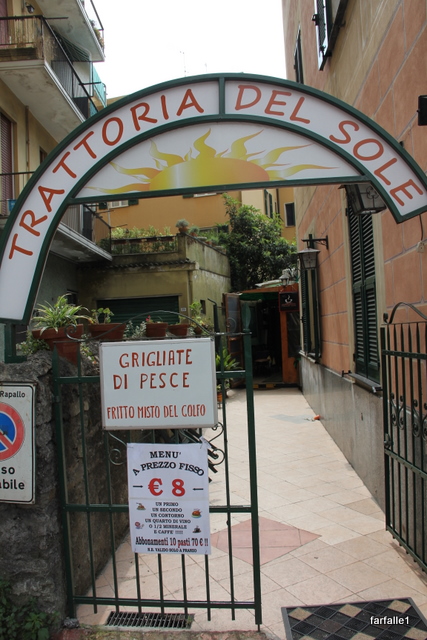
All that remained for us was a quick celebratory lunch at the delightful Trattoria del Sole across from the petrol stations on Via Mamelli where we took advantage of the daily special: penne with funghi; fried achiuge (sardine-like fish), carrots, potatoes, wine, water and coffee, all for the princely sum of E 8 each (Ligurians have the reputation of being tightfisted with their money – who are we to go against type?).


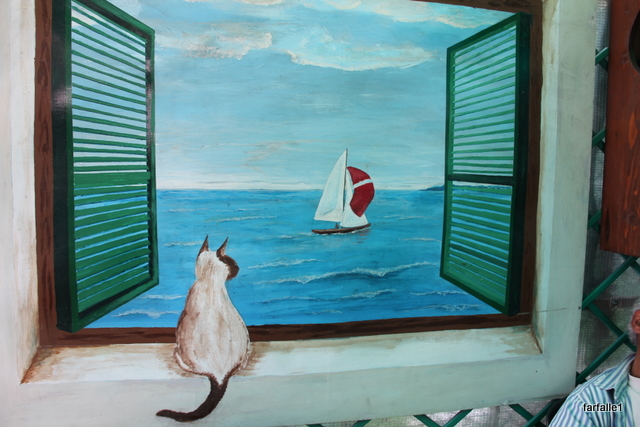
We hadn’t eaten here before, though the place has been beckoning to the Captain for some time, and were charmed to find examples of the owner’s art and crafts on the walls.

So came to a close a festive (for us) and memorable morning. Viva Italia!
Scorpio Rising

05 Saturday Mar 2011

Posted by farfalle1 in Animals in the U.S., Arizona, Desert, Italy, Liguria, Rapallo

≈ 14 Comments

Tags

Arachnids, Scorpions

Up my pant leg, that is…

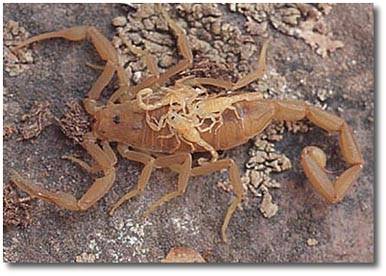
Mother scorpion and babies, courtesy of phoenix.about.com

I went out to the garage to get something, and after a few minutes back in the house I felt a sharp sting – the unmistakable feeling of something small defending its territory in my trousers.  Ouch!
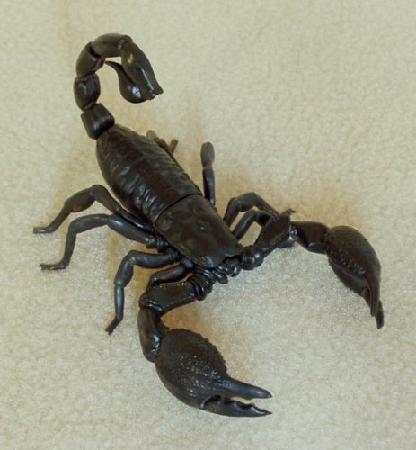
Pants quickly off and shaken, a teeny sandy, orangey scorpion trembled, terrified in the pile of the carpet.  It was literally a half inch long, or less.  Which is lucky for me.  There are many varieties of scorpion inhabiting the southwestern desert.  The Arizona Bark Scorpion, seen above, is venomous and can, in certain individuals, cause seizures.  My little guy was either a baby or an altogether different species; we didn’t keep him around long enough to ask him.  My heroic Captain whisked him away on a paper towel and set him free outside, where he belongs.  The sting site got a little red, a little puffy, and was off and on sore for the rest of the night, but by the next morning I had forgotten I’d been stung.

photo courtesy of dimackey.com

There are scorpions in Italy as well.  We frequently find small black ones in various parts of the house.  Sometimes they are dead and dessicated, sometimes they are quite lively.  For well over a year a little fellow lived under the baseboard next to Luciano‘s supper dish; we assume he came out at night to scarf down kitty scraps.  During the day he hid in the safety of his baseboard with only his larger claw partly visible, like a child who thinks he’s hiding because he can’t see you.  We got pretty fond of Blackie, especially after we checked with the vet and learned that in the off chance that he stung Luciano, there would not be any major trouble.  Little Blackie stayed with us even after Luciano was gone, and in memory of our funny cat I sometimes put down a crumb of something for his baseboard buddy to eat.  Then we had an infestation of ants, as sometimes happens in spring.  Without thinking we spread poison along the ant trail which happened to lead along Blackie’s baseboard.  That was the end of him.  We felt pretty bad about that.

So, are scorpions dangerous?  Clearly the Arizona Bark Scorpion can be, though Dr. Trisha McNair reports that of the 1,400 scorpion species worldwide, only about 25 have venom that can kill a person.  European scorpions in general are a nuisance at worst, their sting being like that of a bee or wasp.  There’s more on scorpions here from Dr. McNair.  But toxic or not, I can tell you from experience you don’t really want them crawling around in your pants!

Parli Italiano?

28 Friday Jan 2011

Posted by farfalle1 in Customs, Italian bureaucracy, Italian habits and customs, Italy, Law and order, Uncategorized

≈ 14 Comments

Tags

Assimilation, Cultural assimilation, Italian language law

Illustration courtesy of Tile Hill Wood School

Italy has passed a new law that requires immigrants to offer proof of proficiency in the Italian language and to have a basic understanding of Italian culture.  Wow!  Can you imagine that happening in the U.S.?  Here are the details as set out by Baker and McKenzie in their website:

On June 10, 2010, the Italian Government enacted a new decree… that introduces substantial new developments for what concerns immigration permits. Once fully enforced, these new provisions will apply to all non-EU citizens who enter Italy for the first time with a stay permit having a duration of at least 1 year or more. Purpose of the new law is to guarantee that foreigners, who will be living in Italy for a long period of time, integrate in the community where they live and conditions the renewal of the stay permit to a series of new obligations that must be fulfilled by the foreigner.

The main aspects of this new law may be summarized as follows:

a) upon presenting an application for a stay permit, for whatever reason this may be (work; study; humanitarian reasons, etc.), the foreigner will be required to execute an agreement according to which he/she undertakes, in the following 2 years, to acquire sufficient knowledge of the Italian language (lev. A2) as well as Italian civic culture and lifestyle.

b) in order to help the foreigner acquire the knowledge mentioned above, the Italian Republic will sponsor adequate projects and in any case will hold courses of civic culture free of charge.

c) upon execution of the agreement mentioned above in a, the foreigner will be granted 16 credits. If he/she does not participate in the courses of Italian civic culture, mentioned above in b, he/she automatically looses 15 credits.

d) credits may be increased (to a maximum of 30 credits) if the foreigner participates in courses or acquires certificates, diplomas or degrees. Instead, credits may be lost if the foreigner incurs in criminal sanctions or even serious breach of administrative and tax laws.

e) the Immigration Office (Sportello Unico per l’Immigrazione), via the documentation that must be provided by the foreigner him/herself, will verify if he/she has acquired the 30 credits necessary to sustain a test, organized by the Immigration Office, to ascertain knowledge of the Italian language and Italian culture.

f) if the foreigner acquires 30 credits and passes the test mentioned above, his/her stay permit is renewed. An extension of one year, for the fulfillment of obligations deriving from the agreement, may be granted in the event that the foreigner has not acquired 30 credits at the end of the first 2-year period. Instead, with 0 or less credits, the foreigner will not receive renewal of his/her stay permit and will be forced to leave the country.

Leave it to Italy to make the process incredibly complicated.  Credits?  Pluses and minuses?  Why not just give the exam and then issue a card proving successful completion?  I know why!  It would require only a testing room at the Questura, instead of numerous teachers, classes, etc.  I can’t help but think that Italy herself is in love with all the layers of bureaucracy that make the rest of us wring our hands.  Surely it could have been designed more simply.

Two things strike me particularly about this law:  The first is that it applies only to non-EU immigrants.  I suspect it had to be written that way to appease Brussels, but it does rather favor those immigrants coming from the new eastern members of the Union (Bulgaria, Cyprus, Estonia, Greece, Latvia, Lithuania, Poland, Romania, Slovakia and Slovenia) over those from the Middle East and Africa, to say nothing of those coming from the U.S., Canada and South America.  Fair?  Not really, but then perhaps that isn’t the point.

The second is that while the government will sponsor courses in civic culture, it is up to the immigrant to keep track of all those pesky credits and present himself at the Immigration Office in a timely fashion – another example of people being given responsibility for their own record-keeping (as discussed in this old post). Come to think of it, maybe this is a good introduction for the new arrival to this do-it-yourself feature of Italian life.

What would happen if a similar law were passed in the U.S?  Well, first of all, such a law never would be passed because it would be deemed discriminatory.  But if through some strange course of events it were, what a hue and cry there would be!  There are whole pockets of immigrant populations scattered about the country who have maintained a strong ‘foreign’ cultural identity.  The Captain’s own grandmother lived in Illinois for 60 years and never learned to speak English.  No one came after her waving a language law.

What it boils down to for an immigrant is the conflict between assimilation into a new culture, and maintaining one’s own, often very different, cultural identity.  Personally I think it’s an excellent idea to learn the language, geography and history of the country to which one moves.  I’m just not sure passing a law to make it mandatory (for some) is the best way to go about getting it done.  And I’m quite unclear on what the actual motivation behind this particular Italian law might be, though I have some suspicions, based on no clear evidence at all.

← Older posts
Newer posts →

Enter your email address to follow this blog and receive notifications of new posts by email.

Join 114 other subscribers

rss

Subscribe in a reader

Search the Blog

A. Useful Links

  • bab.la language dictionary
  • Bus schedules for Tigullio
  • Conversions
  • English-Italian, Italian-English Dictionary
  • Expats Moving and Relocation Guide
  • Ferry Schedule Rapallo, Santa Margherita, Portofino, San Frutuoso
  • Italian Verbs Conjugated
  • Piazza Cavour
  • Rapallo's Home Page – With Link to the Month's Events
  • Slow Travel
  • The Informer – The Online Guide to Living in Italy
  • Transportation Planner for Liguria
  • Trenitalia – trains! Still the most fun way to travel.

C. Elaborations

  • A Policeman’s View
  • Driving School Diary
  • IVA refunds due for past Rifiuti tax payements
  • Nana
  • Old trains and old weekends
  • The peasant, the Virgin, the spring and the ikon
  • Will Someone Please, Please Take Me to Scotland?

D. Good Recipes - Best of the Week winners are starred

  • 'Mbriulata
  • *Baked Barley and Mushroom Casserole*
  • *Captain’s Boston Baked Beans*
  • *Crimson Pie*
  • *Louise’s Birthday Cake*
  • *Melanzane alla Parmigiana*
  • *Penne with Cabbage and Cream
  • *Pizzoccheri della Valtellina*
  • *Pumpkin Ice Cream*
  • *Risotto alla Bolognese*
  • *Rolled Stuffed Pork Roast*
  • *Spezzatini di Vitello*
  • *Stuffed Grape Leaves*
  • *Stuffed Peaches (Pesche Ripiene)*
  • *Swordfish with Salsa Cruda*
  • *Tagliarini with Porcini Mushrooms*
  • *Tagliatelli al Frutti di Mare*
  • *Three P's Pasta*
  • *Tzatziki*
  • 10th Tee Oatmeal Apricot Bars
  • Adriana’s Fruit Torta
  • Aspic
  • Bagna-calda
  • Best Brownies in the World
  • Clafoutis
  • Cold cucumber soup
  • Crispy Tortillas with Pork and Beans
  • Easy spring or summer pasta
  • Fish in the Ligurian Style
  • Hilary's Spicy Rain Forest Chop
  • Insalata Caprese
  • Lasagna al forno
  • Lasagna al Forno con Sugo Rosato e Formaggi
  • Lemon Meringue Pie
  • Leo’s Bagna Cauda
  • Leo’s Mother’s Stuffed Eggs
  • Louis’s apricot chutney
  • Mom's Sicilian Bruschetta
  • No-Knead (almost) Bread
  • Nonna Salamone's Christmas Cookies
  • Pan Fried Noodles with Duck, Ginger, Garlic and Scallions
  • Pesto, the classic and original method
  • Pesto, the modern, less authentic method
  • Pickle Relish
  • Poached pears
  • Poached Pears
  • Polenta Cuncia
  • Recipes from Paradise by Fred Plotkin
  • Rustic Hearth Bread
  • Shrimp and Crayfish Tail Soup
  • Sicilian salad
  • Slow Food Liguria
  • Slow Food Piemonte and Val d'Aosta
  • Spinach with Garlic, Pine Nuts and Raisins
  • Stuffed Eggs, Piemontese Style
  • The Captain’s Salsa Cruda
  • Tomato Aspic
  • Zucchini Raita

E. Blogroll

  • 2 Baci in a Pinon Tree
  • Aglio, Olio & Peperoncino
  • An American in Rome
  • Bella Baita View
  • Debra & Liz's Bagni di Lucca Blog
  • Expat Blog
  • Food Lovers Odyssey
  • Italian Food Forever
  • L’Orto Orgolioso
  • La Avventura – La Mia Vita Sarda
  • La Cucina
  • La Tavola Marche
  • Rubber Slippers in Italy
  • Southern Fried French
  • Status Viatoris
  • Tour del Gelato
  • Weeds and Wisdom

Photographs

  • A Day on the Phoenix Light Rail Metro
  • Apache Trail in the Snow
  • Aquileia and Croatia
  • Birds on the Golf Course
  • Bridge Art
  • Canadair Fire Fighters
  • Cats of Italy
  • Cloudy day walk from Nozarego to Portofino
  • Fiera del Bestiame e Agricultura
  • Football Finds a Home in San Maurizio
  • Hiking Dogs
  • Mercatino dei Sapori – Food Fair!
  • Moto Models
  • Olive pressing
  • Rapallo Gardens
  • Rapallo's Festa Patronale
  • Ricaldone and the Rinaldi Winery
  • Rice Fields
  • Sardegna ~ Arbatax and Tortoli
  • Sardegna ~ San Pietro above Baunei
  • Sardegna ~ The Festa in Baunei
  • Scotland, including Isle of Skye
  • Slow Food 2008 Salone del Gusto
  • The Cat Show and the Light Rail Fair
  • The desert in bloom
  • Trip to Bavaria

Pages

  • Fagioli all’ucelleto

Archives

Recent Posts

  • A Superior Visit
  • Fun at the Ranch Market
  • The MAC
  • Welcome Tai Chi
  • Bingo Fun for Ferals
December 2025
M T W T F S S
1234567
891011121314
15161718192021
22232425262728
293031  
« Jul    

Member of The Internet Defense League

Blog at WordPress.com.

  • Subscribe Subscribed
    • An Ex-Expatriate
    • Join 114 other subscribers
    • Already have a WordPress.com account? Log in now.
    • An Ex-Expatriate
    • Subscribe Subscribed
    • Sign up
    • Log in
    • Report this content
    • View site in Reader
    • Manage subscriptions
    • Collapse this bar
 

Loading Comments...