

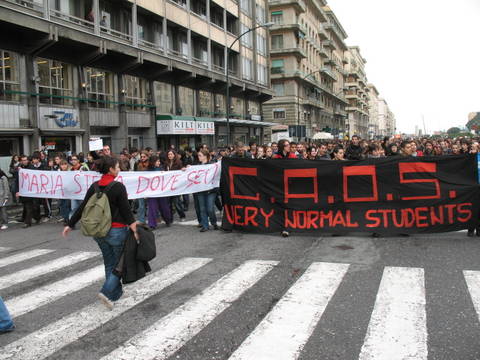
Illustration courtesy of Tile Hill Wood School
Italy has passed a new law that requires immigrants to offer proof of proficiency in the Italian language and to have a basic understanding of Italian culture. Wow! Can you imagine that happening in the U.S.? Here are the details as set out by Baker and McKenzie in their website:
On June 10, 2010, the Italian Government enacted a new decree… that introduces substantial new developments for what concerns immigration permits. Once fully enforced, these new provisions will apply to all non-EU citizens who enter Italy for the first time with a stay permit having a duration of at least 1 year or more. Purpose of the new law is to guarantee that foreigners, who will be living in Italy for a long period of time, integrate in the community where they live and conditions the renewal of the stay permit to a series of new obligations that must be fulfilled by the foreigner.
The main aspects of this new law may be summarized as follows:
a) upon presenting an application for a stay permit, for whatever reason this may be (work; study; humanitarian reasons, etc.), the foreigner will be required to execute an agreement according to which he/she undertakes, in the following 2 years, to acquire sufficient knowledge of the Italian language (lev. A2) as well as Italian civic culture and lifestyle.
b) in order to help the foreigner acquire the knowledge mentioned above, the Italian Republic will sponsor adequate projects and in any case will hold courses of civic culture free of charge.
c) upon execution of the agreement mentioned above in a, the foreigner will be granted 16 credits. If he/she does not participate in the courses of Italian civic culture, mentioned above in b, he/she automatically looses 15 credits.
d) credits may be increased (to a maximum of 30 credits) if the foreigner participates in courses or acquires certificates, diplomas or degrees. Instead, credits may be lost if the foreigner incurs in criminal sanctions or even serious breach of administrative and tax laws.
e) the Immigration Office (Sportello Unico per l’Immigrazione), via the documentation that must be provided by the foreigner him/herself, will verify if he/she has acquired the 30 credits necessary to sustain a test, organized by the Immigration Office, to ascertain knowledge of the Italian language and Italian culture.
f) if the foreigner acquires 30 credits and passes the test mentioned above, his/her stay permit is renewed. An extension of one year, for the fulfillment of obligations deriving from the agreement, may be granted in the event that the foreigner has not acquired 30 credits at the end of the first 2-year period. Instead, with 0 or less credits, the foreigner will not receive renewal of his/her stay permit and will be forced to leave the country.
Leave it to Italy to make the process incredibly complicated. Credits? Pluses and minuses? Why not just give the exam and then issue a card proving successful completion? I know why! It would require only a testing room at the Questura, instead of numerous teachers, classes, etc. I can’t help but think that Italy herself is in love with all the layers of bureaucracy that make the rest of us wring our hands. Surely it could have been designed more simply.
Two things strike me particularly about this law: The first is that it applies only to non-EU immigrants. I suspect it had to be written that way to appease Brussels, but it does rather favor those immigrants coming from the new eastern members of the Union (Bulgaria, Cyprus, Estonia, Greece, Latvia, Lithuania, Poland, Romania, Slovakia and Slovenia) over those from the Middle East and Africa, to say nothing of those coming from the U.S., Canada and South America. Fair? Not really, but then perhaps that isn’t the point.
The second is that while the government will sponsor courses in civic culture, it is up to the immigrant to keep track of all those pesky credits and present himself at the Immigration Office in a timely fashion – another example of people being given responsibility for their own record-keeping (as discussed in this old post). Come to think of it, maybe this is a good introduction for the new arrival to this do-it-yourself feature of Italian life.
What would happen if a similar law were passed in the U.S? Well, first of all, such a law never would be passed because it would be deemed discriminatory. But if through some strange course of events it were, what a hue and cry there would be! There are whole pockets of immigrant populations scattered about the country who have maintained a strong ‘foreign’ cultural identity. The Captain’s own grandmother lived in Illinois for 60 years and never learned to speak English. No one came after her waving a language law.
What it boils down to for an immigrant is the conflict between assimilation into a new culture, and maintaining one’s own, often very different, cultural identity. Personally I think it’s an excellent idea to learn the language, geography and history of the country to which one moves. I’m just not sure passing a law to make it mandatory (for some) is the best way to go about getting it done. And I’m quite unclear on what the actual motivation behind this particular Italian law might be, though I have some suspicions, based on no clear evidence at all.












 was up alone, and they made a big flash of light and then a loud bang when they landed on the front terrace. And there were 17 of them, which seems excessive, and that doesn’t count the dozen that were set off in our mailbox. I finally woke up the Captain who went outside and shook his fist and shouted at the departing figures, lads from a nearby settlement we surmise. That was harmless, all in all, but it was unsettling because they were not throwing the flash booms anywhere except at our house.
 Nonetheless, I’m feeling paranoid. It’s always such a shock to see or suffer from an act that is just purely mean. It happens the world over, I guess. The firecrackers were probably just kids goofing around. But the car and the rock are on a different order – those were done with intent to damage. And I’m thinking about surveillance cameras… what a way to live. Or maybe… maybe we’ll call Cugino Rino in Genova. He has a menacing laugh that would scare the devil – we’ll just get him to come over here and laugh around the neighborhood a little, and then no one will dare harm us or our property again!
 o the gate at the Questura, thrust our passports under the glass and were issued with two little slips of paper with the day (April 21), the time (10:00 a.m.) and the numbers of our appointments. Then we jogged back to the train station and just caught a train which, 40 minutes later, dropped us in Rapallo.
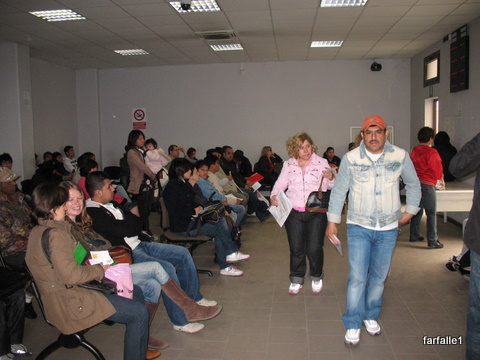 It’s a stuffy room at the best of times, so we prefer to wait outside where we can also keep an eye on the room to which we will eventually be summoned. That’s it on the right behind all the glass: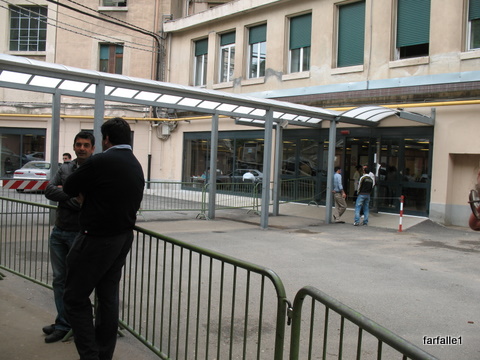


 An Ex-Expatriate