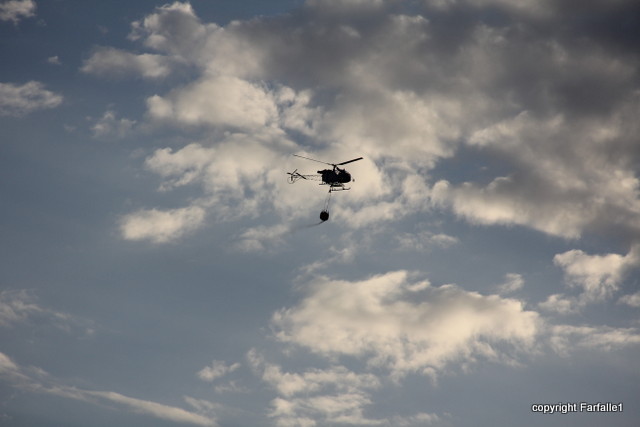
• Contact
  • Elaborations
    • A Policeman’s View
    • Driving School Diary
    • Great Danes
    • IVA charged on Tassa Rifiuti
    • Nana
    • Old trains and Old weekends
    • The peasant, the virgin, the spring and the ikon
    • Will Someone Please, Please Take Me to Scotland??
  • Recipes
    • ‘Mbriulata
    • *Baked Barley and Mushroom Casserole*
    • *Captain’s Boston Baked Beans*
    • *Cherry Tart*
    • *Crimson Pie*
    • *Louise’s Birthday Cake*
    • *Melanzane alla Parmigiana* – Eggplant Parmesan
    • *Penne with Cabbage and Cream
    • *Pizzoccheri della Valtellina*
    • *Pumpkin Ice Cream*
    • *Risotto alla Bolognese*
    • *Rolled Stuffed Pork Roast* on the rotisserie
    • *Shrimp and Crayfish Tail Soup*
    • *Spezzatino di Vitello*
    • *Stuffed Grape Leaves*
    • *Swordfish with Salsa Cruda*
    • *Tagliarini with Porcini Mushrooms*
    • *Tagliatelli al Frutti di Mare*
    • *Tzatziki*
    • 10th Tee Apricot Bars
    • Adriana’s Fruit Torta
    • Artichoke Parmigiano Dip
    • Best Brownies in the World
    • Clafoutis
    • Cod the Way Sniven Likes It
    • Cold Cucumber Soup
    • Crispy Tortillas with Pork and Beans
    • Easy spring or summer pasta
    • Fagioli all’ucelleto
    • Fish in the Ligurian Style
    • Hilary’s Spicy Rain Forest Chop
    • Insalata Caprese
    • Kumquat and Cherry Upside Down Cake
    • Lasagna Al Forno con Sugo Rosato e Formaggi
    • Lemon Meringue Pie
    • Leo’s Bagna Cauda
    • Leo’s Mother’s Stuffed Eggs
    • Louis’s Apricot Chutney
    • Mom’s Sicilian Bruschetta
    • No-Knead Bread (almost)
    • Nonna Salamone’s Famous Christmas Cookies
    • Pan-fried Noodles, with Duck, Ginger, Garlic and Scallions
    • Pesto
    • Pesto
    • Pickle Relish
    • Poached Pears
    • Polenta Cuncia
    • Pumpkin Sformato with Fonduta and Frisee
    • Rustic Hearth Bread
    • Sicilian Salad
    • Soused Hog’s Face
    • Spotted Dick
    • Swedish Tea Wreaths
    • The Captain’s Salsa Cruda
    • Tomato Aspic
    • Vongerichten’s Spice-Rubbed Chicken with Kumquat-Lemongrass Dressing
    • Winter Squash or Pumpkin Gratin
    • Zucchini Raita

An Ex-Expatriate

~ and what she saw

An Ex-Expatriate

Category Archives: Liguria

Learning to say goodbye…

04 Monday May 2015

Posted by farfalle1 in Italy, Liguria, Rapallo, Uncategorized

≈ 27 Comments

Tags

Goodbye, Moving

This old blog has been pretty quiet lately, but for a good reason. Speedy and I are selling our house here in Rapallo and moving back full-time to the States.

It’s hard to say goodbye. We’ve been here about 14 years, 4 of them as full-time residents. Rapallo feels as much like home as Arizona (both feel a little other-worldly, to tell you the truth).

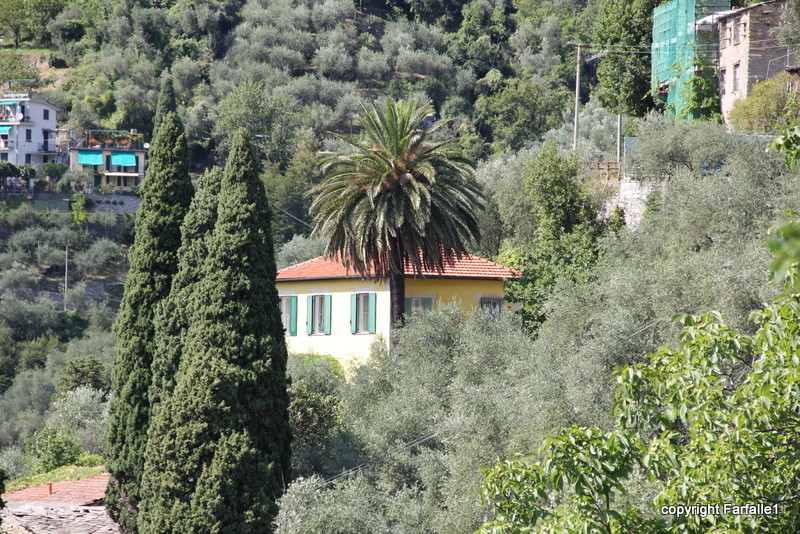
House from Rosa's

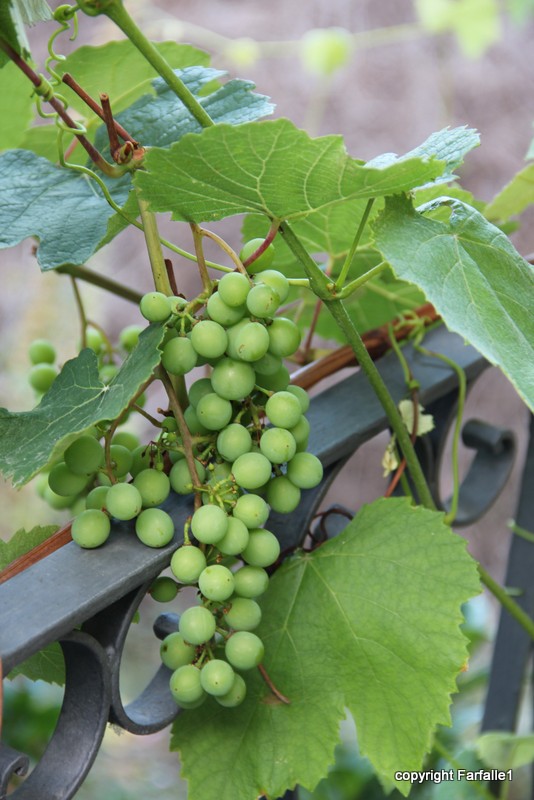
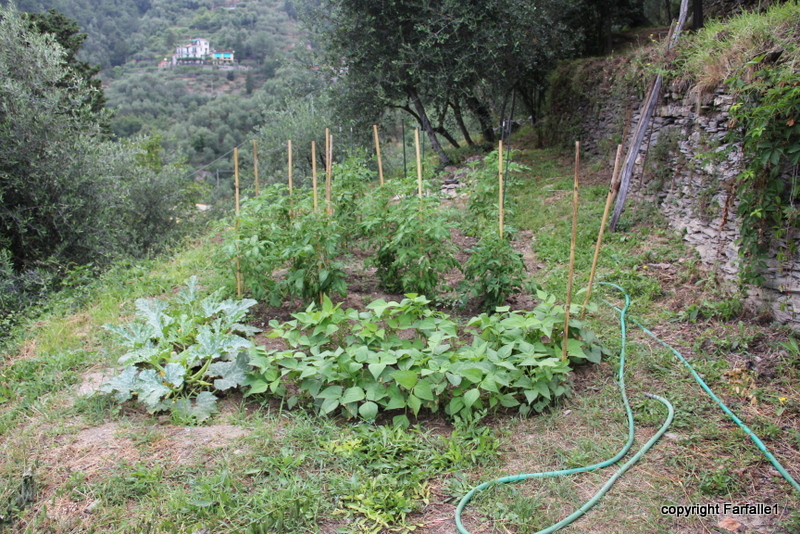
We leave behind a house into which we’ve poured our hearts and souls. We leave behind the gardens which were non-existent when we started, but which now produce oranges, cherries, apricots, pomegranates, grapes, plums and persimmons, in addition to basil, parsley, sage, thyme, rosemary, more basil, and any veggies we feel like growing. Sometimes there’s even a good olive crop.

grapes our garden

But a house is just stones, stucco and paint, and a garden is just dirt and plants. Either can be replaced in another location. What can’t be replaced is the friendships we’ve made over so many years. From our first visit in nearby Camogli, when we met a friend of a friend, to a meeting just a few days ago, people have been welcoming, kind and – always! – helpful. The community here helps one another when necessary in ways that are humbling and heartwarming. We’ve been befriended by people from all over Europe, from Asia, from America, some through introductions, some simply by chance.

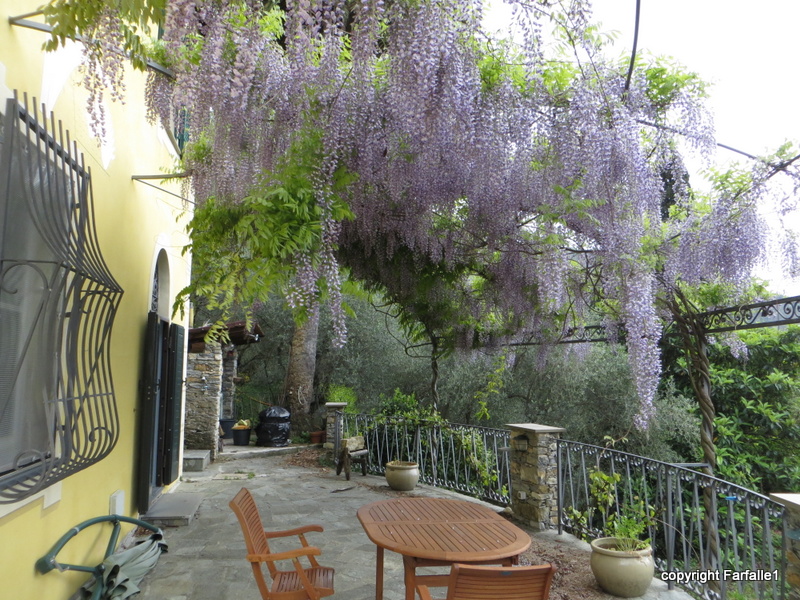
We’ve had adventures in Rapallo and beyond, many described in the pages of this blog. We’ve entertained under the wisteria which, just last year began to provide the shade we planned for.

glicine-001

We’ve had guests visit from near and far, some old friends, some family, and some new friends too.

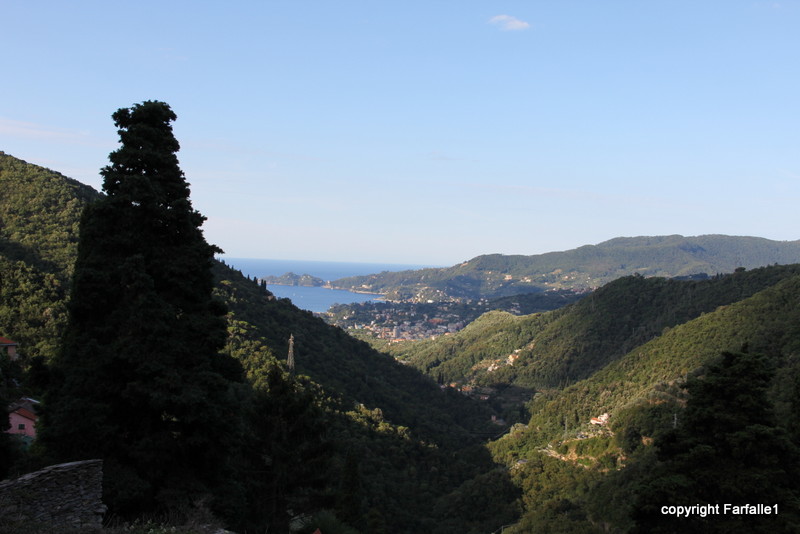
View from the guest room

View from the guest room

Speedy has cooked fantastic meals in the kitchen, on the outdoor BBQ and, beginning a couple of years ago, in the tandoor that he built himself.

There are so many stories I could tell you! Some of them I have, but many not. And now I won’t. Most likely this will be the last post from Expatriate in Rapallo, but I hope you’ll return for a visit now and then when you want a dose of beautiful Italy, or want to rustle up one of Speedy’s amazing dishes.

Thank you for reading and commenting on Expatriate. Your presence has kept my eyes open and my mind interested. It wouldn’t have been any fun without you.

I have an idea for a new blog – but not quite yet, as we’re very busy trying to move.

And busier still learning to say goodbye…

It’s All About the Weather

11 Saturday Oct 2014

Posted by farfalle1 in Genova, Italy, Liguria, Uncategorized, Weather

≈ 7 Comments

Tags

Floods in Genova, Genova floods, Heavy rain in Rapallo

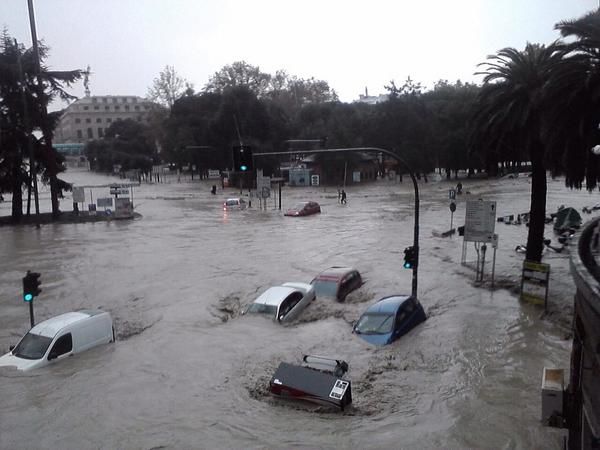
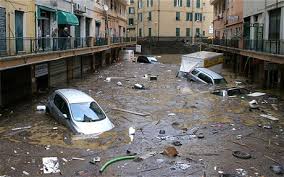
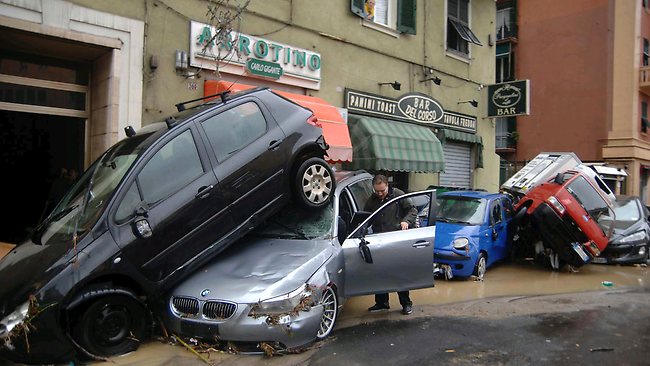
You may have heard about the terrible flooding that killed six people in Genova three years ago. Poor Genova! Again the Bisagno River overflowed and went crashing through the city’s streets, tossing cars around like matchsticks, leaving a trail of mud, debris, ruined businesses and homes, and at least one person dead.

flood genoa_italy

Press photo

Photo courtesy of The Telegraph

Photo courtesy of The Telegraph

Photo courtesy of The Herald Sun

Photo courtesy of The Herald Sun

Other parts of Liguria were hard hit by the fierce electrical storms, which went on for hours and knocked out power to many zones of Genova. In our own small area of Rapallo we received some damage. Above us a landslide closed the road that leads to the Valley behind us. Below us trees fell down into the road, damaging a guard rail. Enough were quickly removed to open up one narrow lane for traffic. Seems like very small patooties compared to what’s happened in Genova.

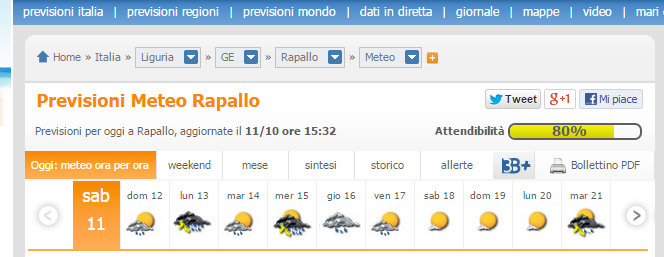
More rain fell this morning (Saturday, Oct. 11) with more forecast for this afternoon and tomorrow.

Liguria is a narrow bean-shaped region that hugs the Mediterranean, with high mountains that tumble right down to the sea. The mountains all drain into stream beds which, for most of the year hold only a trickle of water. Workers were mowing the weeds from our own San Francesco torrente just a couple of months ago. This is what it looked like today:

cascade

San Francesco near autostrada

It always amazes us when we open our windows or go outside after a big storm and hear the roar of falling water that fills the valley. We were lucky because the water stayed within its banks. Genova, which is also built on the thin strip of land between mountains and sea, had worse luck.

“It’s a mass of problems together. You have houses built in the wrong places, inadequate water channelling systems, poor planning and administration,” Carlo Malgarotto, president of the council in the region of Liguria, told Reuters.

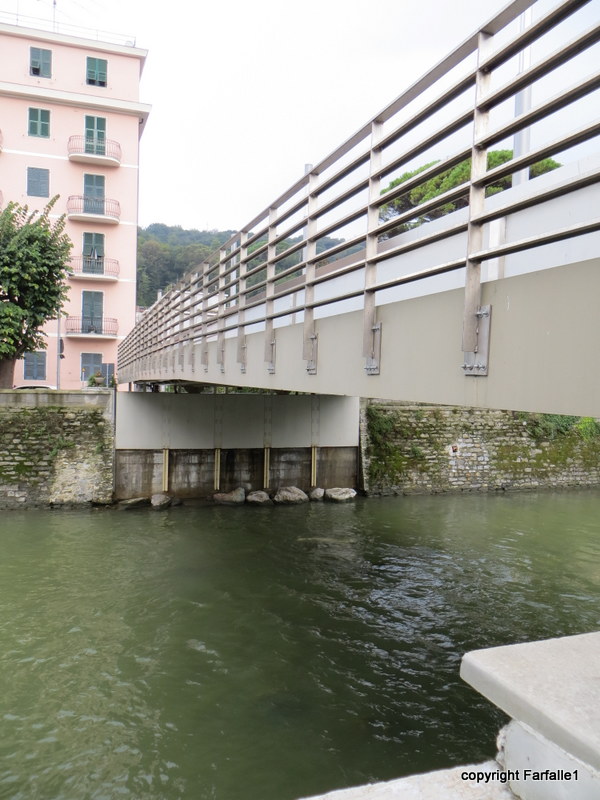
Rapallo did a bit of planning a few years ago. To prevent debris from catching on a bridge that might then back up the Boate River, they decided to rebuild it so that it could be raised in times of flood. Why? There is a new cathedral being finished upstream and a large underground parking area is part of the project. The goal was to keep the parking safe and dry. They were able to raise it yesterday, no doubt to the satisfaction of all involved in the project.

raised bridge-001

It’s a bit of an inconvenience for people who would like to use that bridge. As you can see below, the water was not really high enough to reach the bridge at all – but better safe than sorry.

water under bridge

Unfortunately Genova has not had as good luck with the plans they made after the 2011 flood. According to Reuters:  “Environment Minister Gian Luca Galletti said in a statement that 35 million euros ($44 million) had been earmarked to reinforce flood defences around the Bisagno but the funds had been blocked by a legal dispute.”

Sadly that sounds exactly like Italy. It doesn’t seem to be a country that has embraced the idea of citizens co-operating for the common good. Rather, people are much more likely to be watching out for their own interests and trying to see what they can gain personally from any project. I guess that makes Italy like a lot of other places.

Meanwhile, more rain is forecast. Fingers crossed for Genova, because they already have their hands full.

Courtesy of 3B Meteo

Courtesy of 3B Meteo

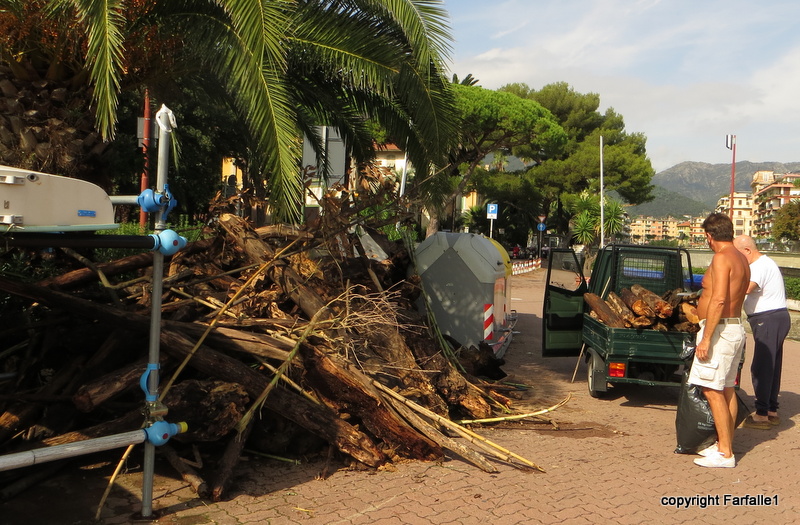
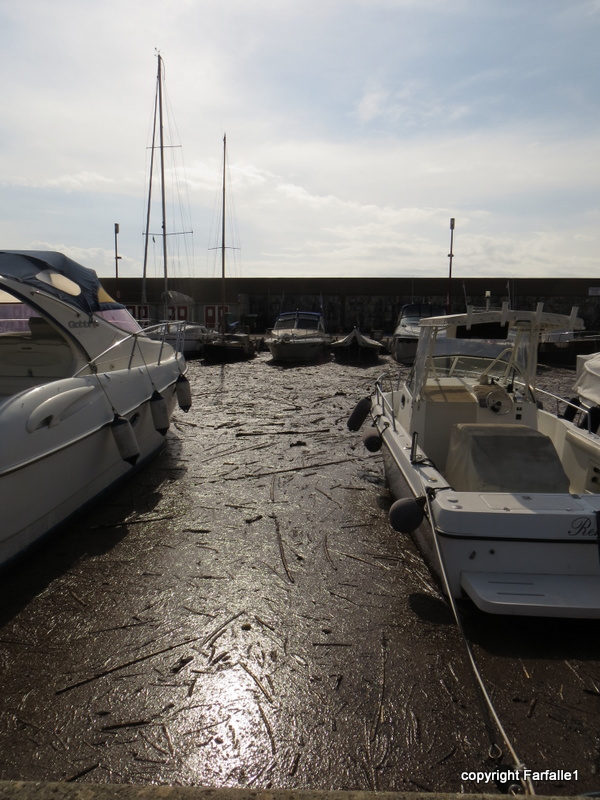
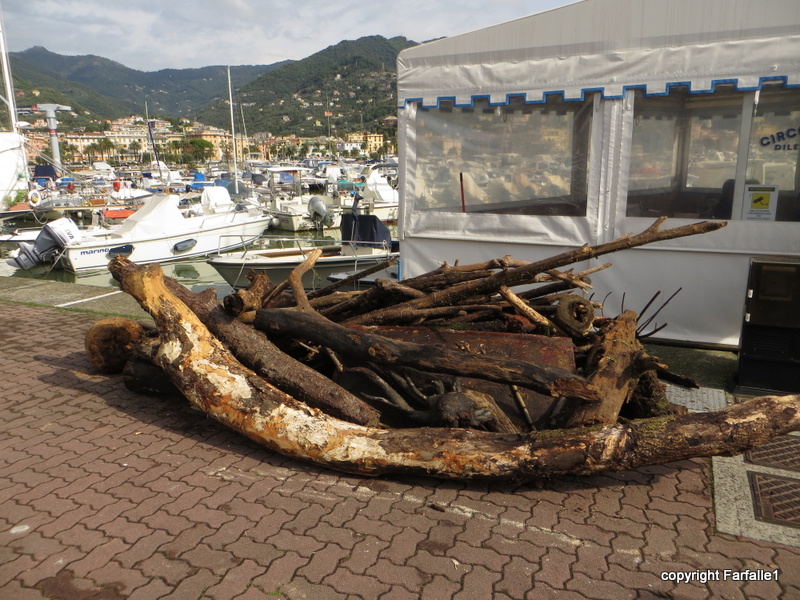
Addendum: We visited the Port on Sunday and found the aftermath of the storm: flotsam, jetsam and a lot of driftwood that had already been pulled out of the water. There was so much rubbish among the boats that the water was invisible.

driftwood in port flotsam and jetsam in port-001 driftwood


Porchetta

05 Tuesday Aug 2014

Posted by farfalle1 in Customs, Food, Italian festas, Italian food, Italian recipes, Liguria, Rapallo, San Maurizio di Monti, Uncategorized

≈ 12 Comments

Tags

Comitato Fuochi, Festa di San Maurizio

Festa at San Maurizio porchetto-002San Maurizio’s wonderful Comitato Fuochi put on a weekend-long shindig a couple of weeks ago, their Summer Festival. This doughty group of volunteers was first formed in 1903. In the early days the Committee divided our frazione into three districts.   In the 1940’s the three districts became two, and in the 1980’s the two became one; since 2006 the group has been particularly active. Working with the town of Rapallo they helped organize the construction of the soccer field where they now hold their events. In the intervening years they have added several permanent and temporary structures so events can be held in all weather.

The main purpose of the group is to have a Festa in honor of our frazione’s patron saint, San Maurizio each September. One of the highlights of the annual Festa Patronale is the fireworks display; this, of course, costs money, and part of the reason for the other four annual Festas (Carnivale, Spring, Summer, Chestnuts) is to raise money for the main event.

The weekend festa is comprised of food and entertainment. Being old farts we didn’t make it down to the soccer field to enjoy the entertainment.

Festa at San Maurizio the talent

In fact, sadly the Friday night show was rained out. We did, however, stop in for lunch on Sunday, not knowing what we would find on the menu. To our delight we found trofie al pesto (a traditional Ligurian pasta), totani (small fried squid) and porchetta, seen above, amongst other things.

Wikipedia describes porchetta as “a savoury, fatty, and moist boneless pork roast of Italian culinary tradition. The body of the pig is gutted, deboned, arranged carefully with layers of stuffing, meat, fat, and skin, then rolled, spitted, and roasted, traditionally over wood. Porchetta is usually heavily salted in addition to being stuffed with garlic, rosemary, fennel, or other herbs, often wild. Porchetta has been selected by the Italian Ministero delle Politiche Agricole, Alimentari e Forestali as a prodotto agroalimentare tradizionale (“traditional agricultural-alimentary product”, one of a list of traditional Italian foods held to have cultural relevance).” The dish originated in central Italy, but is now popular throughout the country. You can frequently find it at weekly markets at a special truck, and it turns up often at festas like ours as well. This particular porchetta came from Tuscany, from Montepulciano to be exact. And it was delicious, according to Speedy (I ate the totani, which was also really, really good).

Festa at San Maurizio where pork was fromI asked Speedy to write down the story of his introduction to porchetta to share with you. This is what he said, “I first learned about Porchetta and its charms back in the 1970’s when I was flying cargo from New York to Rome.  Without flight attendants and the access to First Class fare which was available to crews on passenger flights, the guys and I would arrive in Rome famished–and with the usual thirst that follows long flights.  One day I asked one of the agents meeting the flight where was the best place to stop to take care of this problem on the way to the crew hotel in central Rome.  He suggested telling the taxi driver to take the Via del Mare where we would find one of those open-sided trucks that are, in fact, full kitchens that serve the food out on paper from a high counter that runs the length of the vehicle–this is the Italian version of a Truck Stop.  And, the ground in front would, in fact, be crawling with huffing trucks.  Anyway, we would get slabs of steaming porchetta on thick slices of crusty, chewy bread and a small glass of frascati for about a dollar.  For a couple more glasses of frascati one had to put out another quarter or so.” It is a very happy memory for him!

Image courtesy of Charcouterie Ltd.

A porchetta-like dish is not hard to make at home. You can find many recipes on the internet, for example this one from Epicurious or this one from Bon Appetit. My own favorite, natch, is Speedy’s own recipe for rolled, stuffed pork roast, which is very porchetta-like. But for the true porchetta experience you have to come to Italy and visit one of the many stands or festas where it is served. I recommend the ones at San Maurizio. You won’t find a harder-working group of volunteers any where and the food is always great. Here are a few more photos of our visit to the tent and there are more over here if you are interested.

One of my favorite poems from the book Unleashed: Poems by Writers’ Dogs (1999) is this one by a yellow lab, whose writer companion I don’t remember. The poem goes something like this:

Ya gonna eat that?
Ya gonna eat that?
Ya gonna eat that?
I’ll eat that!

Festa at San Maurizio

I love how they keep the porchetta swaddled up in a sheet – keeps the flies off.

Festa at San Maurizio the gang

These girls are run off their feet when things get busy, but they never mess up an order.Festa at San Maurizio the waitresses

La Transumanza (Till the cows come home…)

04 Monday Nov 2013

Posted by farfalle1 in Italian festas, Italian habits and customs, Italian holidays, Italian men, Liguria, Photographs, Uncategorized

≈ 12 Comments

Tags

Festival of Cows, Santo Stefano, Santo Stefano d'Aveto, Transumanza

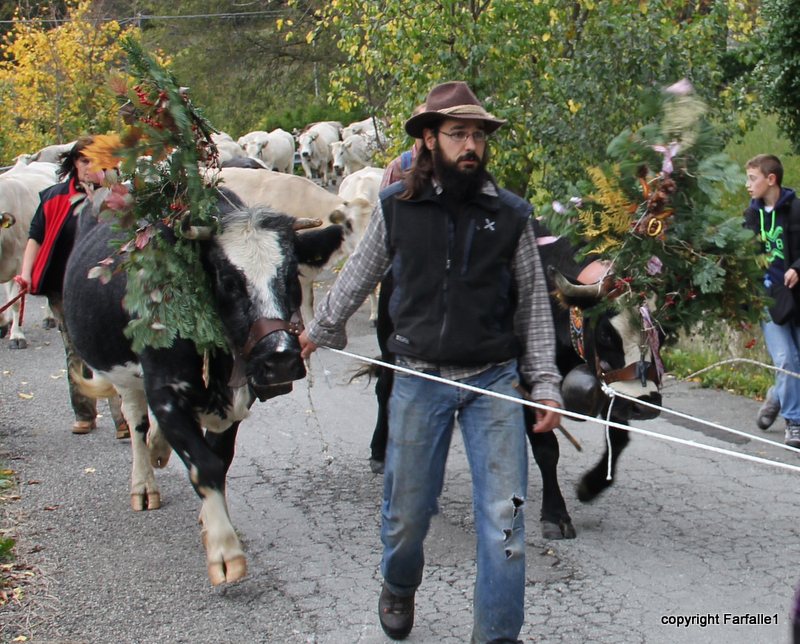
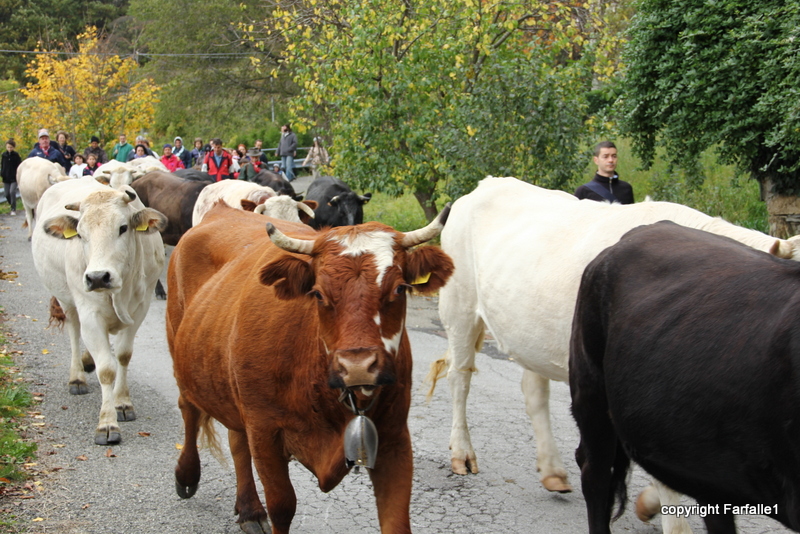
Il Secolo XIX calls the transumanza ‘the most spectacular event of the year in the val d’Aveto.’  Not having seen other events there I can’t say if I agree, but this festa, held when the cows are brought down from the high pastures where they’ve spent the summer to the barns and lower land of the valley is charming and fun.

Friends took me with them to Santo Stefano d’Aveto to see the transumanza on a rainy Sunday.  The arrow on the map below points to Santo Stefano; at an elevation of about 3200 feet, ‘low land’ is a relative term.

map of Santa StefanoArrow

We arrived in plenty of time to walk through the small village (population about 1200, probably double that the day we were there) and savor the anticipation. When would the cows arrive??

Not being able to stand the suspense we started walking up the street down which they would come, a walk which provided a sweet view of the town from above.

Santo Stefano from above

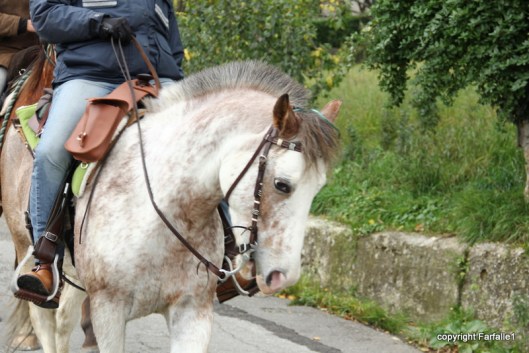
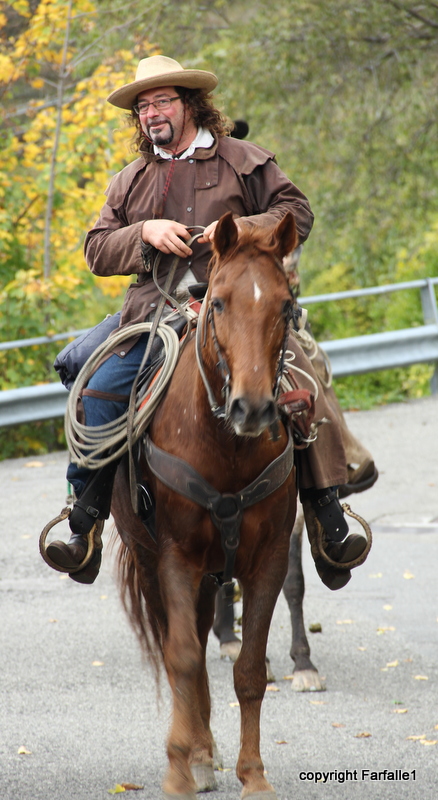
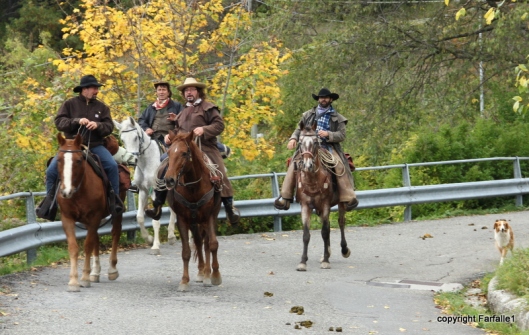
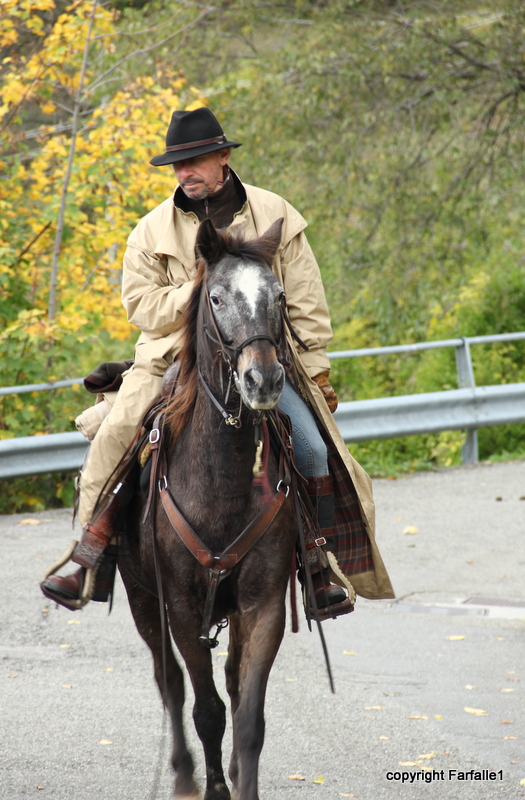
We met and chatted with others whose level of excitement matched our own. When would they arrive? When would they arrive? Finally the first outriders appeared, and it quickly became evident that this had as much to do with costume and play-acting as it did with herd movement. All to the good! The horses were buffed, fluffed and bedecked:

be-ribboned horse

well-trimmed horse

The riders, dressed as gauchos, gave the impression they had spent the summer keeping order among the vast herds on the mountain side:

gaucho

more advance riders

a real gaucho

rider

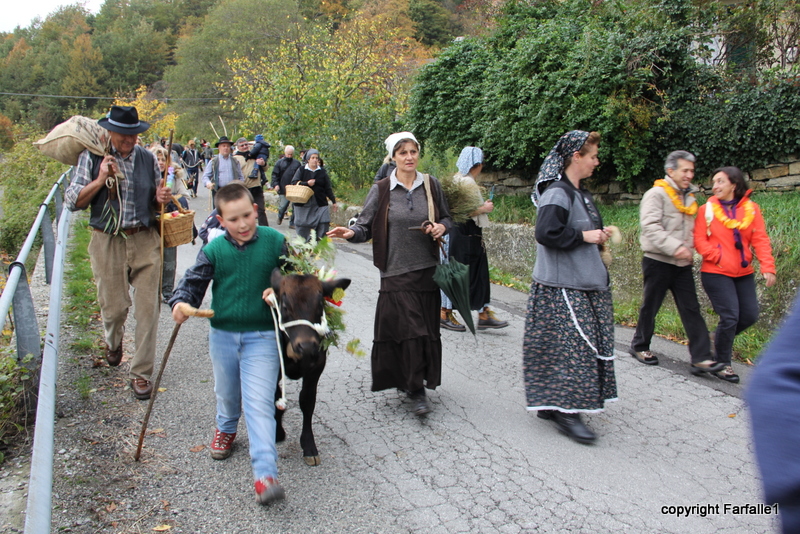
Then the first cows arrived, festooned with flowers and accompanied by a pair of flowery goats.  Many of them moved to the music of their cowbells, a sound we associate much more with Switzerland than with Italy.  Each bell has a slightly different pitch, making the herd an orchestra of happy random dissonance. With them was a group of people dressed as old-timey farmers, brandishing the antique tools of high meadow agriculture.

cows festooned

people in peasant dress

the cows arrive

cows-001

longhorn

And then it was over:

cows-003

The fact that there were perhaps 50 head of cattle made me suspect that those handsome gauchos had not, in fact, been tending the herd all summer.

The cows continued their procession through the village and disappeared up a winding road on the other side of town.  We did what all sensible people do after so much excitement and activity:

Locanda dei Doria menu

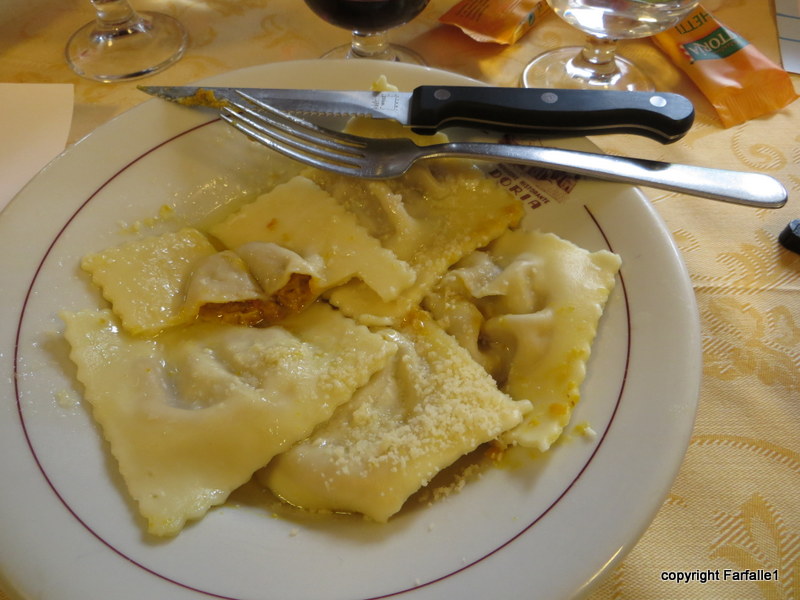
At E18 this huge mid-day meal was a real bargain.  I enjoyed the anti-pasti, followed by the squash stuffed ravioli, veal scallopini with fresh porcini mushrooms and a killer plum tart.

ravioli with pumpkin

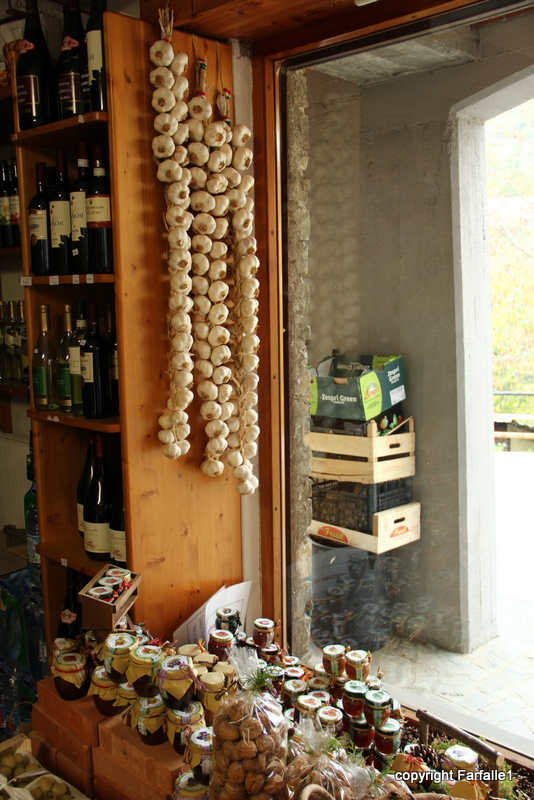
Such a large meal calls for a post-prandial stroll, which we took, admiring the shops (closed at that time of day) along the narrow streets of the old part of town. (Santo Stefano, with a rich history, has been inhabited for centuries. Its first written mention is from the 2nd century BCE at the time of a battle between the Romans and the Ligurians. The castello in the center of town dates from 1164.)  At a time when many small towns are dying for lack of occupation, Santo Stefano has cast itself as a center of ‘bio’ food – what we would call organic.  People from a wide radius make the long windy drive up the mountain to buy fresh locally produced cheese (San Sté cheese has been made in the same way by the same families for several centuries), yogurt, eggs, vegetables and at this time of year chestnuts.  My friends staggered out of a small food shop we found open with bags of locally ground flour, fresh ricotta and other delectables.  I brought Speedy a small basket of ricotta, and I have to say, it is the best either of us has ever eaten.

other chestnuts

garlic in market

You can’t have a good festa without some live music.  A trio of musicians was performing (and clearly enjoying themselves) under the covered arcade in front of the shops on the main street.  If you want to see and hear them you can do so here and here.

Is life in a mountain all fun and games?  I would say not. Farming in what is one of the wettest parts of Italy comes with its own particular set of problems, exacerbated by long cold winters.  But we saw plenty of indication that people still farm there, in spite of the influx of holiday homes.

he took goats up the mountain
Maybe you could call this man ‘before.’  He’s clearly serious about his farming – he was just returning from taking the festive goats up the hill to march with the procession of cows.

Then you could call this man ‘after.’  Giorgio Carpanese has lived all of his 84 years in Santo Stefano d’Aveto.  When I asked him if he had seen an awful lot of changes there in his life he just shook his head with a whimsical look and said, ‘Si.  Si.’

Giorgio Carpanese

Smellavision

21 Monday Oct 2013

Posted by farfalle1 in Liguria, San Maurizio di Monti, Uncategorized

≈ 6 Comments

Tags

Odors, Rapallo, Scents, Smellavision, Smells

“We believe, with Rudyard Kipling, that smells are surer than sounds or sights to make the heartstrings crack.” ~ Charles Weiss, 1959 interview on CBS’s To Tell the Truth.

My friend Taffy and I used to fantasize about ‘smellavison’ when we were young – wouldn’t it be great if we could smell all the things we were watching on that small flickering box?  Actually, I fantasized about television, period, because we didn’t have one, but Taffy was nice enough to let me come over and watch with her pretty frequently.

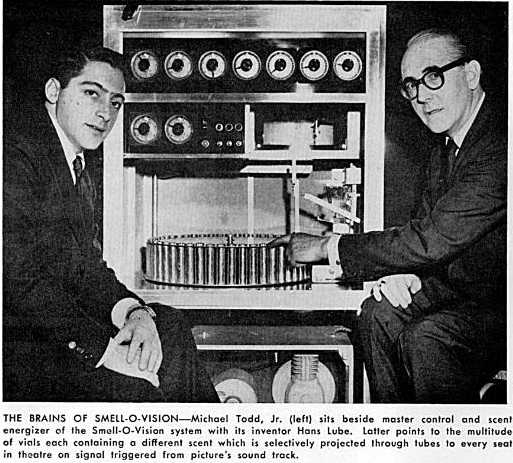
Well ha, ha!  It turns out that we weren’t the only ones with such an idea. 1959’s Battle of the Smellies pitted Mike Todd, Jr.’s film ‘The Scent of Mystery’ against Walter Reade, Jr.’s ‘Behind the Great Wall.’  The former featured Hans Laube’s technique, called ‘Smell-O-Vision,’ of releasing scents from tubes connected to the movie theatre seats. The projectionist could control the timing and release of the various aromas.

courtesy of www.extremetech.com

courtesy of http://www.extremetech.com

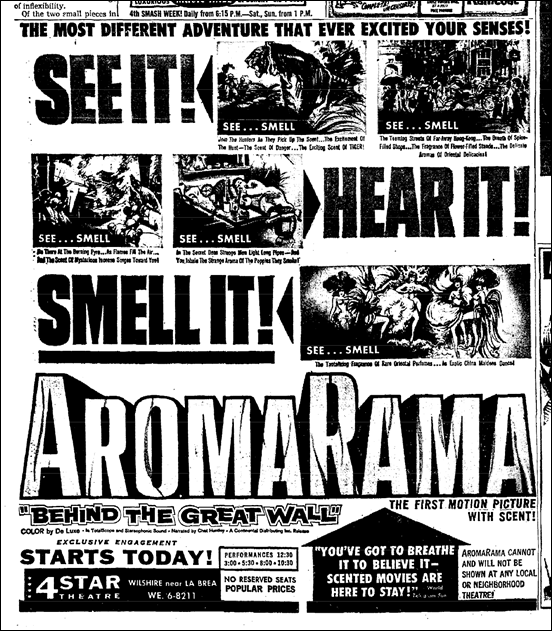
‘Behind the Great Wall’ used Charles Wesiss’s process, called AromaRama, to broadcast smells through the theatre’s air conditioning system.

From the L.A. Times

From the L.A. Times

Both systems had drawbacks, and these were the only two films released with scent dispersal systems. Later efforts included the use of scratch-and-sniff cards to add the sense of smell to film. (You can learn more about this movie history and some of the amusing problems it encountered, in this article.)

What does this have to do with Rapallo?  Only that so many times as I ride my scooter from San Maurizio into town I wish that I could record the scents for this blog.  Invariably the first smell is something delicious that Rosa is cooking up at the Trattoria across the street – rabbit stew? roasted veal?  Rarely it is a very unpleasant smell: stoccafisso (which I’m sure smells divine to people who like stoccafisso, of which I am not one.  We have a friend, a stock-fish lover, who declares it smells like a baby’s breath.  I beg to differ. Fortunately it is a seasonal dish, served only in the cold winter months).

Farther along the road our old neighbors have fired up the wood stove which still provides their heat and their means of cooking.  The smell of a late-fall woodfire is enough to make me want to go right home and curl up with a good book and a cup of tea. Farther down someone else is burning a brush pile. This smells slightly different that the wood fire, more punky, no doubt because a lot of what’s burning is green.  When we first moved here there was a lot of plastic burning, but I’m happy to report that there is very little of that any more.  That is a truly distressing aroma – you can feel your cells dividing in misery.

One of our neighbors hasn’t harvested his grapes yet; they hang, deep purple and slightly withered, from the wires running between rustic wooden posts.  The smell of over-ripe grapes is sweet with an almost, but not quite, overlay of decay.  It’s no wonder I can hear the hum of bees over the scooter’s engine (well, not really – but I can sure see the bees) – they love the sugar produced by grapes beginning to ferment on the vine.

About half way down the hill there’s a house with a superb garden.  I’ve never seen the whole thing, but what’s visible from, and hanging over, the road is gorgeous.  Flowers, figs, fruit trees – there is always something in bloom at that house, and as often as not I pick up a sweet floral scent, sometimes lavender, sometimes lemon, sometimes something unidentifiable.  It lifts the heart.

Via Betti, the famous Via Betti – about as wide as a U.S. single-lane road, it is the Rapallo end of the road we live on, and it serves as a major access road over the mountain to the valley on the other side.  Traffic adventures are a daily occurrence, but it is something one gets used to.  Something I will never get used to or take for granted is the gorgeous smell of baking bread that wafts over the street from Panificio Schenone Giorgio. Warm and yeasty, it makes me instantly starving.

Now in the heart of Rapallo I take a left and continue along the river towards the Castello.  Ah yes, the waste treatment plant.  That smells like old wet newspapers that have sat overlong in a cellar.  It’s not a garbagey smell, but it’s definitely nothing you would confuse with the smells from the bakery.  Then on to the sea with all its inherent smells: a little salty, a little fishy, a little like a fresh breeze.  Our part of the Mediterranean does not have the astringent salt smell I associate with the Atlantic off New England, but if your eyes were closed you would still know you were next to the sea.

And that is why I wish this blog could be brought to you with smellavision.  The scents of Liguria are as evocative as the sights and sounds, and yet they cannot be shared in the same way.  Maybe someday they will, though – according to a Scientific American article in 2011, scientists have developed a programmable odor-emitting device capable of reproducing 10,000 scents. How I would love to program this short article to give you the smells that define where we live.  And I’d be interested to hear what are the smells that say ‘home’ to you.

And you think it’s a big deal to paint your house??

13 Sunday Oct 2013

Posted by farfalle1 in Building, Building in Italy, Liguria, Rapallo, Uncategorized

≈ 2 Comments

Tags

Building restructuring in Italy, Decorated houses in Liguria, Decorative building painting, Exterior painting Liguria, Re-doing a building in Italy

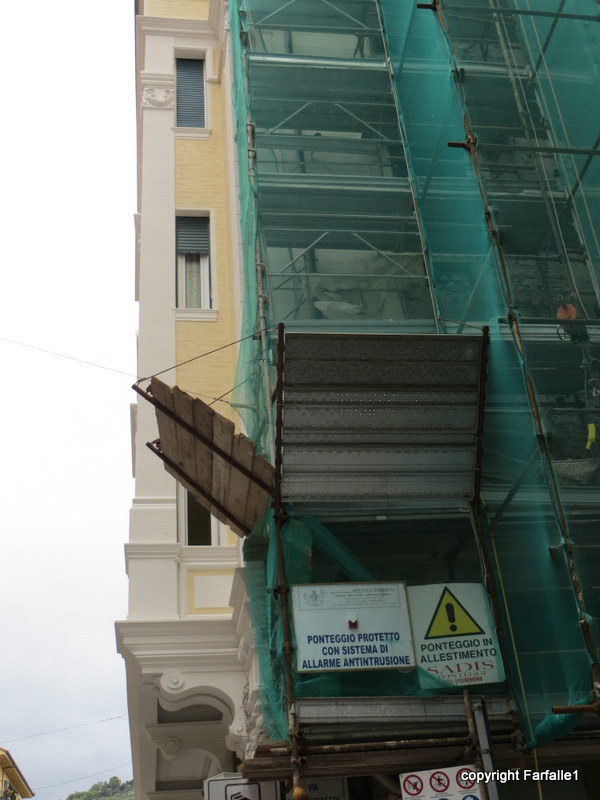
One of the big condominium/bank buildings in Rapallo has been undergoing a face-lift since March of this year.  What a job!  It’s not just a question of applying a fresh coat of paint.  All the old stucco is being removed from the stone building underneath, new stucco applied and, finally, painted.

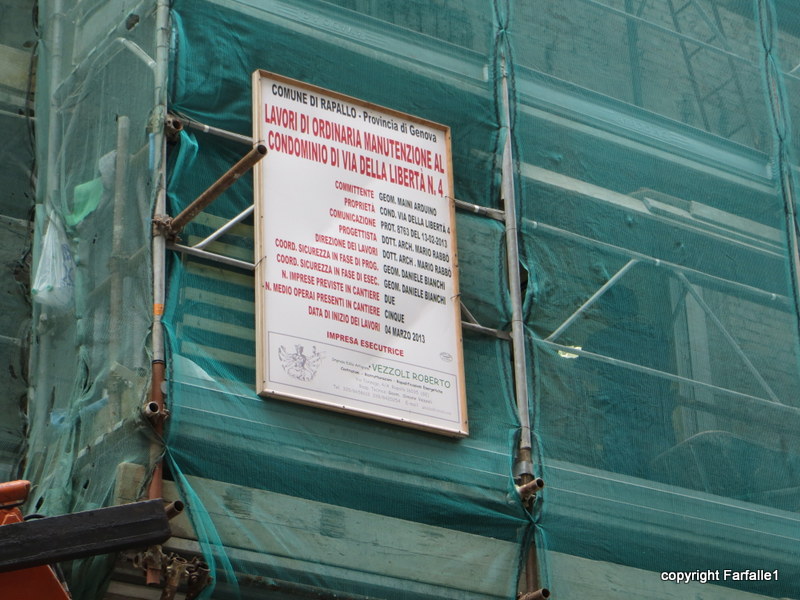
work permit sign-001

One of the fun things about building repair and restructuring in Italy is that the work permit must be prominently placed for all to enjoy.  It details the ownership of the property, the people responsible for the job, when the work commenced and, often, when it will be finished – which is always, always a joke.  They were clever enough to leave the last off the sign for this project, seen above. Even so, they are moving right along.

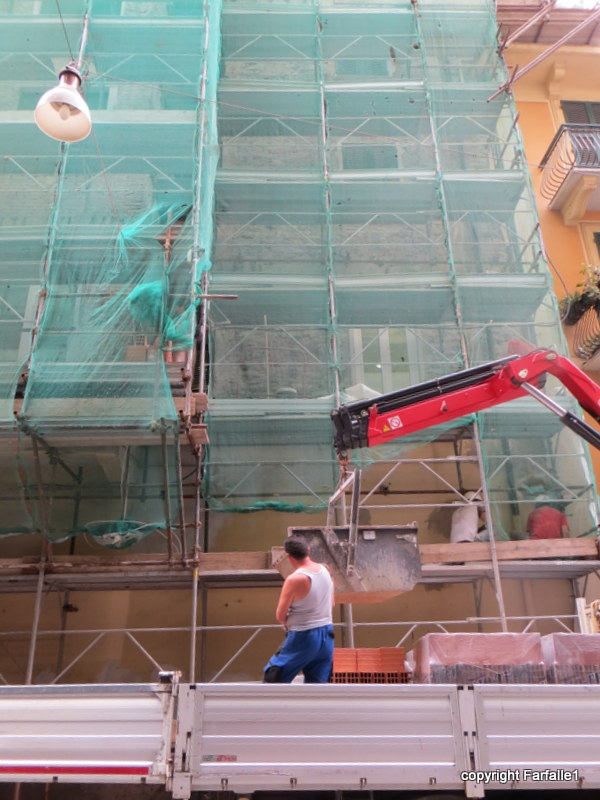
delivering bricks andmortar

A delivery of brick blocks is being made above. It’s hard to see through the protective netting placed around the work, but if you squint you can make out the stucco still on the building at the bottom,  and the stone under-facade up above. The lower floor is made from huge cut granite blocks; the upper floors, which will be covered by the stucco, are made of the smaller stones that are so abundant here, and of which most older buildings are made. The new blocks will probably be used to repair gaps that have occurred in the stonework during the removal of the stucco, and perhaps for some window work, or perhaps some interior walls. (Clearly I don’t know!)

Interestingly the scaffolding is required for any work done on a building over 10 meters in height – that’s 32.8 feet, not all that tall.  It’s not cheap; the scaffolding company has to be licensed and insured, and has to have gotten approval for the ‘project’ of installing the scaffolding for each particular job.  Additionally they have to install at least one copper cable lightening rod.  So there’s no scampering up a tall ladder to do the work yourself if your house is over 10 meters tall.

finished job on left

The completed work is visible on the left, work still in progress on the right.

Here is the south side of the building, all finished (note the large stones on the lower level):

finished job on side

It’s rather plain, isn’t it? There are very strict rules about changing any aspect of the exterior of buildings in Liguria.  For instance, when we restructured our house we wanted to put two small balconies on the south side, one outside of each bedroom.  Permission denied: it would alter the appearance of the structure too much.  Likewise above, even if they had wanted to do some fanciful painting on the new stucco, they would not have been permitted to.  It has to be made to look the way it looked before the work began, in materials, color and design. While this adds enormously to the expense of a project,  it means that old buildings retain their original character – which we think is an excellent idea.

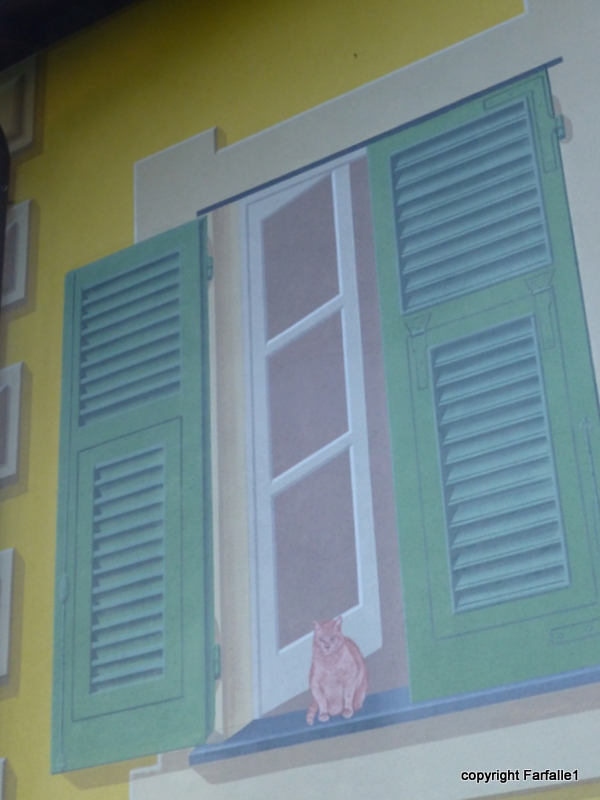
We were fortunate when we did our house – there was no original color left on the exterior, though some of the original designs could still be made out.  A neighbor recalled that it had once been yellow, so Speedy chose a pleasing shade of yellow and went to see the town architect.  “Yes,” she opined, “that house looks like it might have been yellow.”  So we got the color we wanted; wasn’t it lucky we wanted yellow?  We did sneak in one little addition that wasn’t part of the original exterior painting:

The false window is original, the false Luciano is not.  Photo by Hilary Hatch.

The false window is original, the false Luciano is not. Photo by Hilary Hatch.

By the way, the bank that occupies the ground floor of the office building described above has one of the greatest names ever for a bank: Banco di Chiavari e della Riviera Ligure (Bank of Chiavari and of the Ligurian Riviera).  Once upon a time they put out a quite beautiful annual calendar, a real work of art.  In fact, that is one of the reasons why we chose them to be our bank.  Alas, the calendar has gone the way of so many ‘extras’ in the last years, but the great name remains on all their buildings, in spite of the bank having become a part of a very dull sounding much larger bank: Banco Popolare.

So, the next time you have to touch up the trim around your windows, or even paint your whole house, thank your lucky stars you don’t live in Ligura, where painting your house can be an enormous undertaking – unless of course you do. (Then thank your lucky stars that you live in a little piece of paradise.)  Thank you to our friends who are surviving a house-painting as I type , complete with scaffolding and lightening rod; they provided the details on legal requirements for this kind of work.

Construction on a Steep Slope

26 Friday Jul 2013

Posted by farfalle1 in Building, Construction, Liguria, San Maurizio di Monti, Uncategorized

≈ 7 Comments

Tags

Construction using helicopters

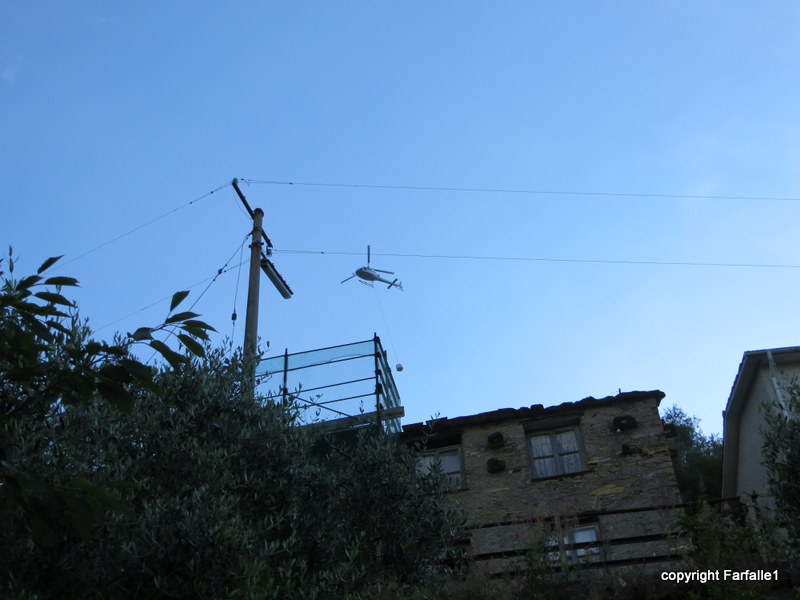
The hills above Rapallo leap quickly to a height of about 600 meters (about 2,000 feet) at La Crocetta, the pass above Rapallo, this in the space of perhaps 2.5 miles as the crow flies (a lot longer as the car drives). In the olden days when there were no cars people navigated between points on ancient roads or paths that connected all the little towns. Many houses were built in what, after the birth of the auto, became completely remote and inaccessible locations. So, if you buy a rustico and want to restore it, how do you get your materials in place, given that you’re perched on a steep slope and there is no road to your rustico?

Easy!

construction helicopter

We were enjoying a calm breakfast when the peace was shattered by nearby rotors. They got very loud, then they got slightly softer, then they got very loud again. It turned out the helicopter was ferrying construction materials to a worksite on the hillside across from us.

construction helicopter-003

construction helicopter-004

It sounds like an expensive and impractical way to move material, but in about six trips over the course of half an hour the helicopter brought in mysterious supplies encased in large white plastic bags, as well as some steel. Someone will soon have a beautifully restored rustico. But will they need to use a helicopter to reach it??

Viva Rapallo!

16 Thursday May 2013

Posted by farfalle1 in Italian history, Italian holidays, Liguria, Rapallo, Uncategorized

≈ 11 Comments

Tags

Capitaneato di Rapallo

Depiction of Genoa from the Nuremberg Chronicles, 1498

Depiction of Genoa from the Nuremberg Chronicles, 1498

The Most Serene Republic of Genoa was an independent state from 1005 until Napoleon put an end to so much in 1797.  During its heyday it claimed territory as distant as Syria (most of these far-flung territories were conquered by the Ottoman Empire in the 15th century). On May 17, 1229, Rapallo swore absolute fidelity to the Genoese Republic and by an act effected in the Palazzo dei Fornari di Genova, became a Podesteria.   A Podesteria is a district administered by an official called a Podesta, usually of the noble class, which we would today call a Mayor.  Until 1608 the Rapallo Podesteria was under the aegis of the Chiavari Captaincy.   In 1608, owing to its increased historical and strategic importance, Rapallo was elevated to its own Captaincy which included the towns of Santa Margherita Ligure, Portofino, Zoagli and parts of the Val Fontanabuona.

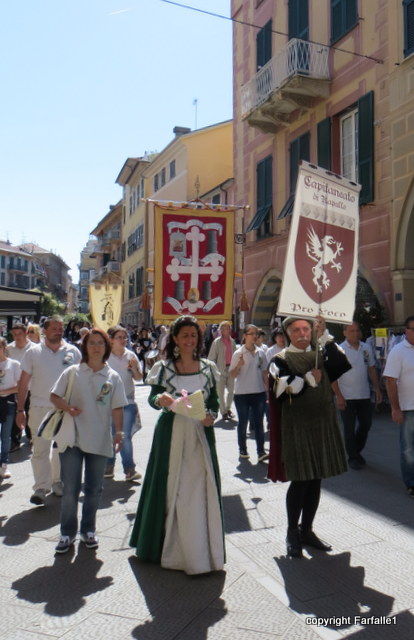
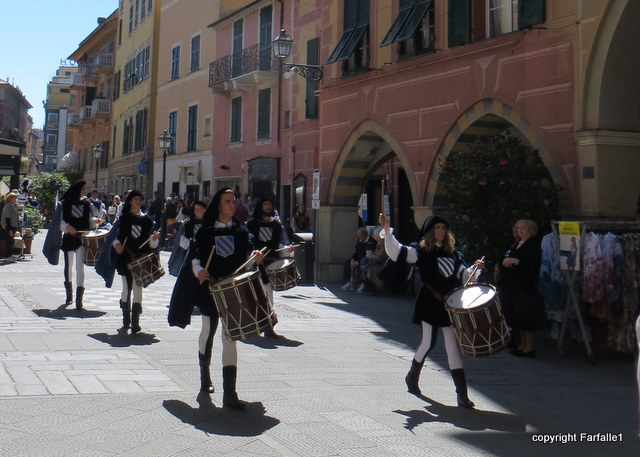
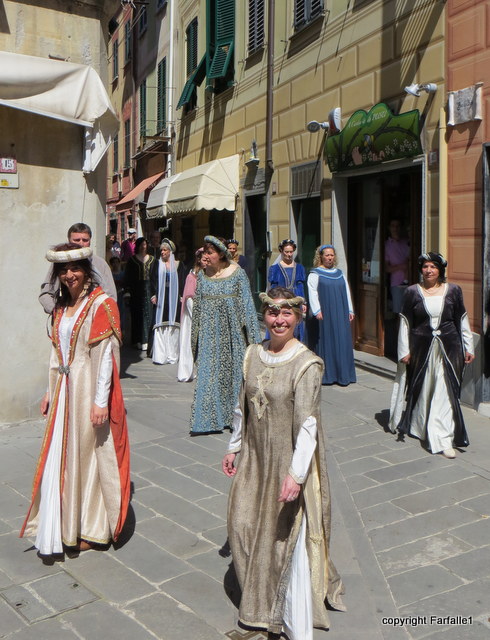
On Sunday (May 12) about thirty Rapallesi in marvelous costumes re-enacted the celebration of the constitution of the city as a Captaincy.  After the parade there was a program at the town Bandstand. which recreated the presentation of the city to the Capitaneato,

Here are some photos of the re-enactment (all I could think as I was watching it was how much more colorful, peaceful and fun it was than an American Civil War re-enactment.

Flag on left is, amusingly, of the Fireworks Committee of  San Maurizio di Monti; flag on right is for the Capitaneato di Rapallo Pro Loco

Flag on left is, amusingly, of the Fireworks Committee of San Maurizio di Monti; flag on right is for the Capitaneato di Rapallo Pro Loco

The drummers played very medieval sounding cadences.

The drummers played very medieval sounding cadences.

I thought this was the most medieval-looking character of all.

I thought this was the most medieval-looking character of all.

Capitano del Popolo-011

They never missed, even though they threw them very high.

They never missed, even though they threw them very high.

I thought perhaps this regal couple had elevated standing, but my policeman source said no.

I thought perhaps this regal couple had elevated standing, but my policeman source said no.

It was by the luckiest of chances that we happened upon this re-enactment.  We had gone to town to meet someone, and just stumbled on what should have been the main planned event of the week.  What I loved most were the costumes – there’s a part of me that wishes we still dressed like this – maybe not the hats, though a good veil is always an excellent accessory.  I love the long dresses that fall from an empire waist, with slit sleeves – it’s all impossibly wonderful.

Capitano del Popolo-016

Revisione

26 Friday Oct 2012

Posted by farfalle1 in Driving in Italy, Italian bureaucracy, Liguria

≈ 9 Comments

Tags

Car inspection in Italy, Vehicle inspection in Italy

For all the ways that life in Italy seems different, there is one thing that is absolutely familiar – vehicle inspection.  That’s kind of surprising, given how many layers of administration there usually are to the simplest of tasks in this bureaucratic nation.  But getting the scooter inspected proved to be very simple.

The first step, of course, was to stop in at our mechanic Simone’s shop so he could give my bike the once-over for any glaring deficiencies.  He felt everything was okay, but encouraged us to tell the examiner that he was our mechanic if there were a problem – we presume that would have eased whatever might have followed.

In the event, it wasn’t necessary as the scoots passed with flying colors.

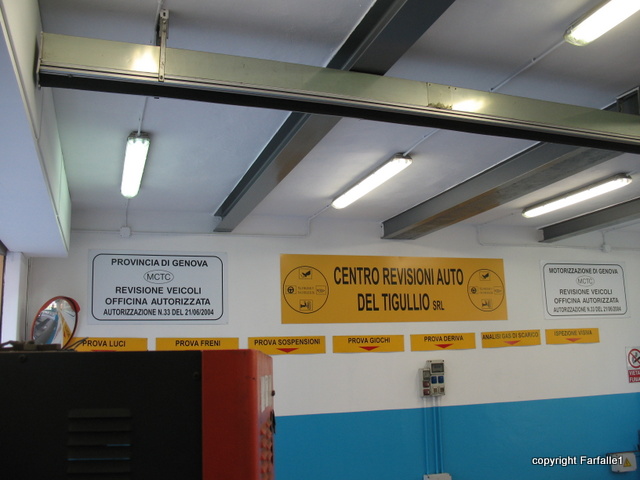
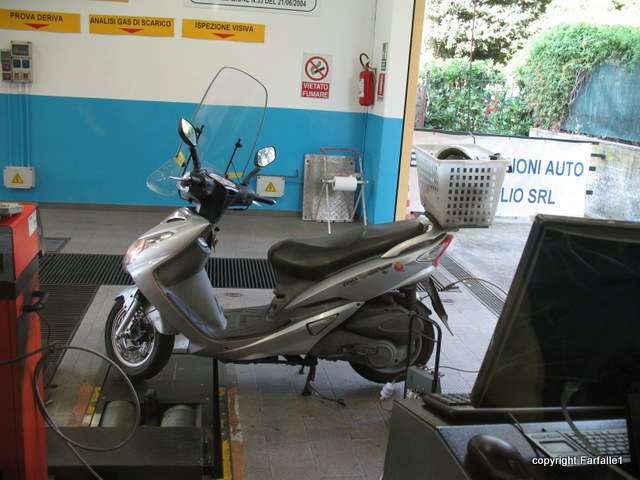
They check all the same things here that they check in the U.S.: lights (luci), brakes (freni), suspension (sospensioni), play in the steering mechanism and the chassis (prova gioca and prova deriva), emissions test (analisi gas di scarico) and finally a visual inspection (ispezione visiva) and in pretty much the same ways: there’s the spinning doodad for testing brakes:

and the pokey thing that goes in the tail pipe:

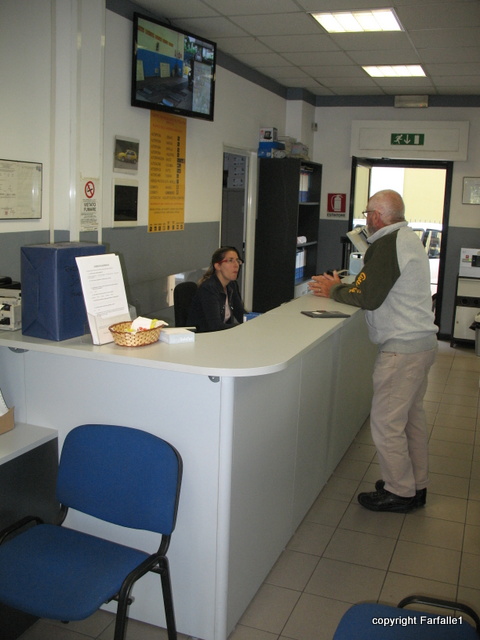
So all in all, it turned out to be not terribly interesting in terms of being ‘different’ – but it’s always fun to visit any Italian office and jaw with the people there.  Here is Speedy discussing this and that with the very cheerful and helpful Francesca:

And wait – there are a few differences.  In Arizona we simply drive up to one of the Testing Stations (after first looking online to see how long the wait might be – always short where we live).  Here we had to call about a week ahead to make an appointment.  To our great satisfaction we didn’t have to wait at all; they were expecting us.

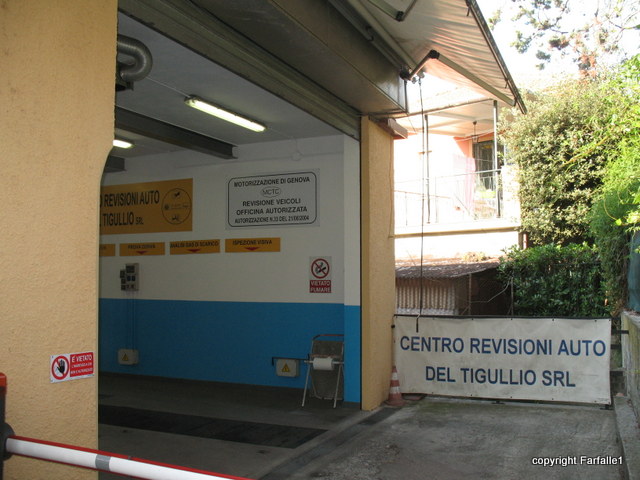
The testing stations in Arizona are rather large; they have to be to accommodate some of the giant trucks that come through.  It’s a tight squeeze for a car to get into the entrance of the Rapallo site (top photo), two 90-degree turns are required.  No 4 X 4’s here, please (although presumably there are other testing stations for all the trucks we see on the roads).

Here’s another difference: cost.  In Arizona we pay $27.75.  Emissions testing there is tied to auto registration: both have to be done every two years.  Everything but the actual emissions test itself can be done online.  It cost us €65.50 (about $85 given the present exchange rate) for the revisione of my scooter, which is also good for two years.

But all in all, it’s one of the simplest of bureaucratic tasks that we undertake here, and the people at the testing center (Francesca and Paolo) are kind and efficient. Here’s a strange fact of automotive life in Italy: you have to be a legal resident here to own a vehicle of any sort.  As a resident of another country you can own a house, but you can’t own a vehicle.  Isn’t that odd?

Bucket or Bellyful?

27 Monday Aug 2012

Posted by farfalle1 in Italy, Law and order, Liguria, Photographs, San Maurizio di Monti, Uncategorized

≈ 11 Comments

Tags

Canadair, Corpo Forestale, Fighting forest fires in Italy, Fire Fighting planes, Forest fire in San Maurizio

(Click on photos to get larger, clearer images)

It’s been a fiery summer in both Europe and the U.S.  We’ve had our own little bit of excitement here in San Maurizio, although nothing on the scale of the tragic fires in Spain or the numerous fires in western U.S.

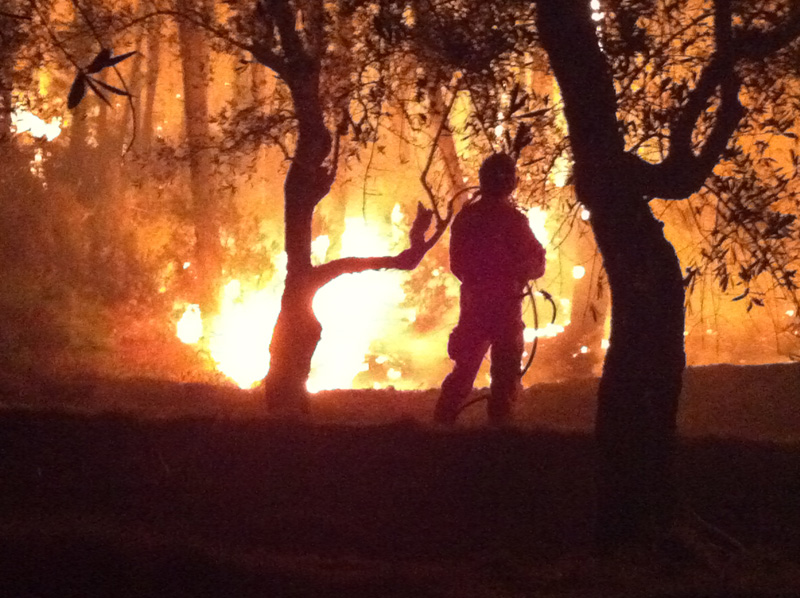
It began Thursday.  Speedy was home reading in the afternoon, and noticed there seemed to be a lot of helicopter traffic.  He had a look around, and this is what he saw on the hillside behind us:
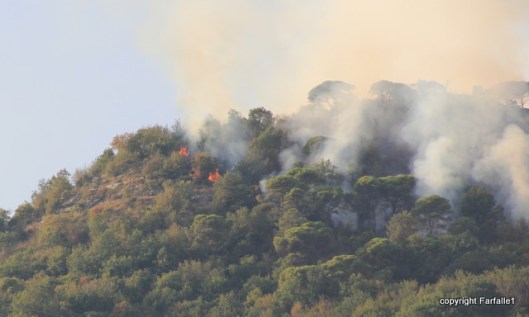
Photo by Speedy

He kept track of the action all afternoon. First the wind blew to the east, then it swapped around and blew to the west. Two helicopters carried countless buckets of water to dump on the stubborn fires which, instead of going out, seemed to simply move on to another shrub or tree.  With so many individual fires we wondered if this were arson.  We don’t know, but we have been told the cause of the blazes is under investigation.

The ‘copter pilots are real sharp-shooters with their water buckets.  I wondered, though: as they move slowly to a position above their target fire, do the rotors fan the blaze and undo some of the good the water is doing? In any event, they do some demanding and amazing flying and, more often than not, their bucketful of water lands right on the selected target.
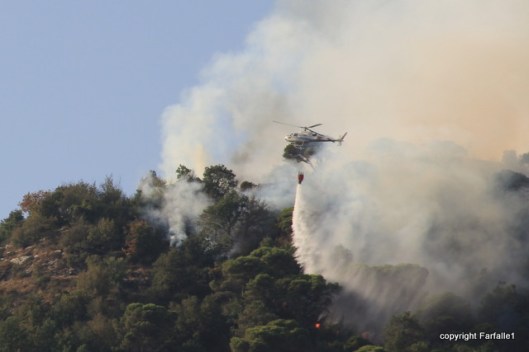
Photo by Speedy

The thing is, it looks like such a teeny amount of water – and so much effort is required to get it to the fire. It’s hard to imagine that it’s effective, but it is. By the end of the afternoon it looked like the fire was largely under control. The helicopters don’t fly at night, so it was good to see that the flames were out.

Or so we thought. I woke up at 3 a.m. and looked at the mountain to see it all ablaze again. This was disconcerting, and instead of going back to sleep I spent the rest of the night tossing, turning, and making a mental list of things to put into a box to carry away should it become necessary. Speedy spent his wakeful hour using GoogleEarth to compute how far the fire was from us. According to his calculations it was about 750 meters from our house as the cinder flies. It was less than 300 meters from the restored rustico of some friends. That’s too close!

Fortunately my list of what to pack was unnecessary. And the reason why is because, unbeknownst to us, there was a legion of volunteer firefighters  (Vigilanza Antincendi Boschivi) on the ground, not only that night but during both days of the fire. It turned out that one of our acquaintances, who is too modest to allow me to use his name, is one of these volunteers, and he was able to give me some useful information.

Photo courtesy of vab-arcetri.org

The Corpo Forestale is in charge of organizing the fighting of fires outside of cities and towns. They decide which aircraft will be used (if needed) for each fire, and where and when the volunteers will go. There are two sizes of helicopter (ours was the smaller one) and the famous bright yellow Canadair airplanes (about which more shortly). The small helicopters carry what look like rather small buckets of water, though our friends says that when the water is mistakenly dumped on the volunteers it does not feel like a small bucket. The Canadairs carry a belly full of water, much more than the small buckets. We were told that the larger helicopter carries even more water than the plane, but we’ve never seen one. There are fires that don’t require aircraft, but forests in Italy tend to be on steep mountainsides; more often than not a plane or helicopter is the only way to get water to the fire.

The volunteers often work more on fire containment than actual fire-fighting; our friend said, however, that they did both with this particular fire. They hump in some heavy equipment and somehow manage to keep the fire from spreading. That is why, on Thursday night, the fire burned up the mountain instead of coming down towards the houses below and why, even though I watched, and heard, tree after tree go up in flames, the fire slowly abated so there was less of it as the sun came up. Thank you, VAB volunteers!

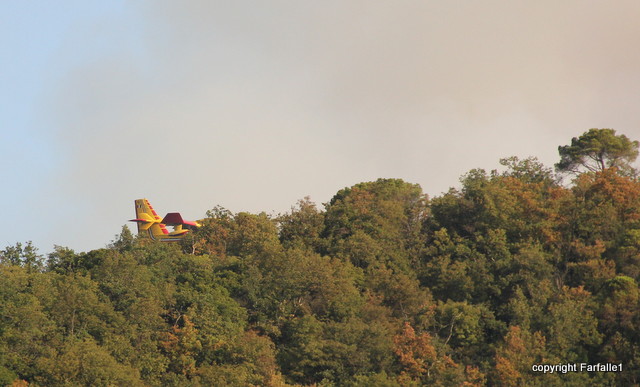
Daylight brought us a Canadair.

It is so exciting to watch these planes fly. They swoop down over the sea and fill up the plane’s belly with water, which they they carry back to the fire and release. There are moments, watching them, when it seems certain there is going to be a terrible mishap.

They use the plane’s inertia to propel the water where they want it to go. The pilot might, for instance, fly right at the side of the mountain, nosing up abruptly just before hitting, and releasing his water at the same time. The water goes straight into the mountain, and the plane, thank goodness, does not. Other times the pilot is able simply to drop his water as he goes (watch out, volunteers below!). Retired old pilot Speedy says it is no doubt very scientific, that the pilots are able to compute when to release the water based on air speed and altitude above target.
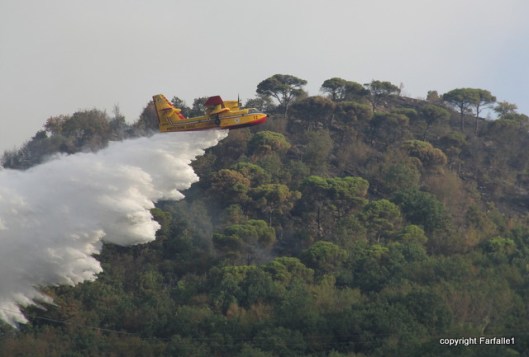
The Canadair, joined briefly by a second, grey plane, flew back and forth all morning. After lunch one small helicopter came back, and by the end of Friday it seemed the excitement was over. Our friend said he had been called to go back Saturday, but we saw no activity at ‘our’ fire. Perhaps he was out putting out other fires. Sadly, there’s no shortage of them at this time of year.

There are some more photos of the fire here, and I tried, for the first time, to make a video, which you can see here. (Sorry that it’s a little wobbly – next time I’ll use a tripod.) The most exciting part of the video is that you can hear the cock who can’t tell time (1 a.m., dawn, sunset: all the same to him), you can hear the loud sound that water meeting fire makes, and you can hear a short conversation between Speedy and myself. Very exciting. Unfortunately you won’t see the plane actually dumping water as that happened behind the mountain – but you can hear it (as well as the lovely low grumble of the twin engined plane).

The systems the Corpo Forestale have developed for fighting the numerous fires in Italy are admirable. The timely arrival and expertise of all the firefighters has surely saved millions of euros over the years (although the cost of fire-fighting with aircraft is extraordinary.  The small helicopter, the 412, costs E 2,200/hour; the larger, the Ericson S64, costs E 7,000/hour and the Canadair costs E 10,000/hour.)  What did they do before airplanes were invented? I suppose lots more forest burned. How lucky we are that we have helicopters with their little buckets and planes with their great big bellies. Given the choice, I guess I’d always choose the plane, just for the drama. But there’s an elegance to the helicopters, and a delicacy of approach which is also very appealing. Actually, I guess if my house/land were on fire I wouldn’t care who came, as long as he brought a lot of water with him!

← Older posts

Enter your email address to follow this blog and receive notifications of new posts by email.

Join 114 other subscribers

rss

Subscribe in a reader

Search the Blog

A. Useful Links

  • bab.la language dictionary
  • Bus schedules for Tigullio
  • Conversions
  • English-Italian, Italian-English Dictionary
  • Expats Moving and Relocation Guide
  • Ferry Schedule Rapallo, Santa Margherita, Portofino, San Frutuoso
  • Italian Verbs Conjugated
  • Piazza Cavour
  • Rapallo's Home Page – With Link to the Month's Events
  • Slow Travel
  • The Informer – The Online Guide to Living in Italy
  • Transportation Planner for Liguria
  • Trenitalia – trains! Still the most fun way to travel.
C. Elaborations

  • A Policeman’s View
  • Driving School Diary
  • IVA refunds due for past Rifiuti tax payements
  • Nana
  • Old trains and old weekends
  • The peasant, the Virgin, the spring and the ikon
  • Will Someone Please, Please Take Me to Scotland?

D. Good Recipes - Best of the Week winners are starred

  • 'Mbriulata
  • *Baked Barley and Mushroom Casserole*
  • *Captain’s Boston Baked Beans*
  • *Crimson Pie*
  • *Louise’s Birthday Cake*
  • *Melanzane alla Parmigiana*
  • *Penne with Cabbage and Cream
  • *Pizzoccheri della Valtellina*
  • *Pumpkin Ice Cream*
  • *Risotto alla Bolognese*
  • *Rolled Stuffed Pork Roast*
  • *Spezzatini di Vitello*
  • *Stuffed Grape Leaves*
  • *Stuffed Peaches (Pesche Ripiene)*
  • *Swordfish with Salsa Cruda*
  • *Tagliarini with Porcini Mushrooms*
  • *Tagliatelli al Frutti di Mare*
  • *Three P's Pasta*
  • *Tzatziki*
  • 10th Tee Oatmeal Apricot Bars
  • Adriana’s Fruit Torta
  • Aspic
  • Bagna-calda
  • Best Brownies in the World
  • Clafoutis
  • Cold cucumber soup
  • Crispy Tortillas with Pork and Beans
  • Easy spring or summer pasta
  • Fish in the Ligurian Style
  • Hilary's Spicy Rain Forest Chop
  • Insalata Caprese
  • Lasagna al forno
  • Lasagna al Forno con Sugo Rosato e Formaggi
  • Lemon Meringue Pie
  • Leo’s Bagna Cauda
  • Leo’s Mother’s Stuffed Eggs
  • Louis’s apricot chutney
  • Mom's Sicilian Bruschetta
  • No-Knead (almost) Bread
  • Nonna Salamone's Christmas Cookies
  • Pan Fried Noodles with Duck, Ginger, Garlic and Scallions
  • Pesto, the classic and original method
  • Pesto, the modern, less authentic method
  • Pickle Relish
  • Poached pears
  • Poached Pears
  • Polenta Cuncia
  • Recipes from Paradise by Fred Plotkin
  • Rustic Hearth Bread
  • Shrimp and Crayfish Tail Soup
  • Sicilian salad
  • Slow Food Liguria
  • Slow Food Piemonte and Val d'Aosta
  • Spinach with Garlic, Pine Nuts and Raisins
  • Stuffed Eggs, Piemontese Style
  • The Captain’s Salsa Cruda
  • Tomato Aspic
  • Zucchini Raita

E. Blogroll

  • 2 Baci in a Pinon Tree
  • Aglio, Olio & Peperoncino
  • An American in Rome
  • Bella Baita View
  • Debra & Liz's Bagni di Lucca Blog
  • Expat Blog
  • Food Lovers Odyssey
  • Italian Food Forever
  • L’Orto Orgolioso
  • La Avventura – La Mia Vita Sarda
  • La Cucina
  • La Tavola Marche
  • Rubber Slippers in Italy
  • Southern Fried French
  • Status Viatoris
  • Tour del Gelato
  • Weeds and Wisdom

Photographs

  • A Day on the Phoenix Light Rail Metro
  • Apache Trail in the Snow
  • Aquileia and Croatia
  • Birds on the Golf Course
  • Bridge Art
  • Canadair Fire Fighters
  • Cats of Italy
  • Cloudy day walk from Nozarego to Portofino
  • Fiera del Bestiame e Agricultura
  • Football Finds a Home in San Maurizio
  • Hiking Dogs
  • Mercatino dei Sapori – Food Fair!
  • Moto Models
  • Olive pressing
  • Rapallo Gardens
  • Rapallo's Festa Patronale
  • Ricaldone and the Rinaldi Winery
  • Rice Fields
  • Sardegna ~ Arbatax and Tortoli
  • Sardegna ~ San Pietro above Baunei
  • Sardegna ~ The Festa in Baunei
  • Scotland, including Isle of Skye
  • Slow Food 2008 Salone del Gusto
  • The Cat Show and the Light Rail Fair
  • The desert in bloom
  • Trip to Bavaria

Pages

  • Fagioli all’ucelleto

Archives

Recent Posts

  • A Superior Visit
  • Fun at the Ranch Market
  • The MAC
  • Welcome Tai Chi
  • Bingo Fun for Ferals
December 2025
M T W T F S S
1234567
891011121314
15161718192021
22232425262728
293031  
« Jul    

Member of The Internet Defense League

Blog at WordPress.com.

  • Subscribe Subscribed
    • An Ex-Expatriate
    • Join 114 other subscribers
    • Already have a WordPress.com account? Log in now.
    • An Ex-Expatriate
    • Subscribe Subscribed
    • Sign up
    • Log in
    • Report this content
    • View site in Reader
    • Manage subscriptions
    • Collapse this bar
 

Loading Comments...