• Contact
  • Elaborations
    • A Policeman’s View
    • Driving School Diary
    • Great Danes
    • IVA charged on Tassa Rifiuti
    • Nana
    • Old trains and Old weekends
    • The peasant, the virgin, the spring and the ikon
    • Will Someone Please, Please Take Me to Scotland??
  • Recipes
    • ‘Mbriulata
    • *Baked Barley and Mushroom Casserole*
    • *Captain’s Boston Baked Beans*
    • *Cherry Tart*
    • *Crimson Pie*
    • *Louise’s Birthday Cake*
    • *Melanzane alla Parmigiana* – Eggplant Parmesan
    • *Penne with Cabbage and Cream
    • *Pizzoccheri della Valtellina*
    • *Pumpkin Ice Cream*
    • *Risotto alla Bolognese*
    • *Rolled Stuffed Pork Roast* on the rotisserie
    • *Shrimp and Crayfish Tail Soup*
    • *Spezzatino di Vitello*
    • *Stuffed Grape Leaves*
    • *Swordfish with Salsa Cruda*
    • *Tagliarini with Porcini Mushrooms*
    • *Tagliatelli al Frutti di Mare*
    • *Tzatziki*
    • 10th Tee Apricot Bars
    • Adriana’s Fruit Torta
    • Artichoke Parmigiano Dip
    • Best Brownies in the World
    • Clafoutis
    • Cod the Way Sniven Likes It
    • Cold Cucumber Soup
    • Crispy Tortillas with Pork and Beans
    • Easy spring or summer pasta
    • Fagioli all’ucelleto
    • Fish in the Ligurian Style
    • Hilary’s Spicy Rain Forest Chop
    • Insalata Caprese
    • Kumquat and Cherry Upside Down Cake
    • Lasagna Al Forno con Sugo Rosato e Formaggi
    • Lemon Meringue Pie
    • Leo’s Bagna Cauda
    • Leo’s Mother’s Stuffed Eggs
    • Louis’s Apricot Chutney
    • Mom’s Sicilian Bruschetta
    • No-Knead Bread (almost)
    • Nonna Salamone’s Famous Christmas Cookies
    • Pan-fried Noodles, with Duck, Ginger, Garlic and Scallions
    • Pesto
    • Pesto
    • Pickle Relish
    • Poached Pears
    • Polenta Cuncia
    • Pumpkin Sformato with Fonduta and Frisee
    • Rustic Hearth Bread
    • Sicilian Salad
    • Soused Hog’s Face
    • Spotted Dick
    • Swedish Tea Wreaths
    • The Captain’s Salsa Cruda
    • Tomato Aspic
    • Vongerichten’s Spice-Rubbed Chicken with Kumquat-Lemongrass Dressing
    • Winter Squash or Pumpkin Gratin
    • Zucchini Raita

An Ex-Expatriate

~ and what she saw

An Ex-Expatriate

Category Archives: Photographs

Things That Fly

21 Thursday Mar 2013

Posted by farfalle1 in Animals in the U.S., Birds in the U.S., Golf, Photographs, Uncategorized

≈ 7 Comments

Tags

Birds on golf courses, Painted Mountain Golf Course, SNJ Trainer

egrets around pond-001

First hole at Painted Mountain Golf Course

When I was growing up we didn’t think much about golf in our family – it was a rich man’s sport and we weren’t rich.  We knew some people who played golf, and some of the boys in my circle of friends caddied on weekends (which made me very envious, because they got $5.00 a round, much better than baby-sitting paid in those days) (girls couldn’t caddy).  There was a lovely golf course in our town, the property of the small liberal arts college there, but we were not members.

Later, when I was a young adult and well into adulthood, I thought golf was the stupidest game in the world.  For starters, you didn’t hit a moving ball – what fun could that be?  Then there was the enormous waste of space – think of all the people who could live on those lovely greenswards.  Criminal!  Later still I reviled the game for the waste of water and energy to maintain the courses, and for the chemicals that are liberally applied to keep the grass so thick and green.  On a much more superficial level I found the clothing worn by golfers hilarious.  White shoes and belts, men in pink trousers (Sheriff Joe would love it) – definitely all fashion ‘don’ts.’

Now I’m an old fart and a seasoned golfer of some three years and I’ve changed my tune.  Speedy, the cause of my descent into the world of golf, and I usually walk when we play; after all, it is meant to be exercise, and a round of golf gives us a good four mile hike.  The game is much more challenging than I ever imagined, and much more fun (on the days when it’s not infuriating). Here in Arizona all the golf courses are watered with ‘reclaimed’ water – not stuff you want to drink.

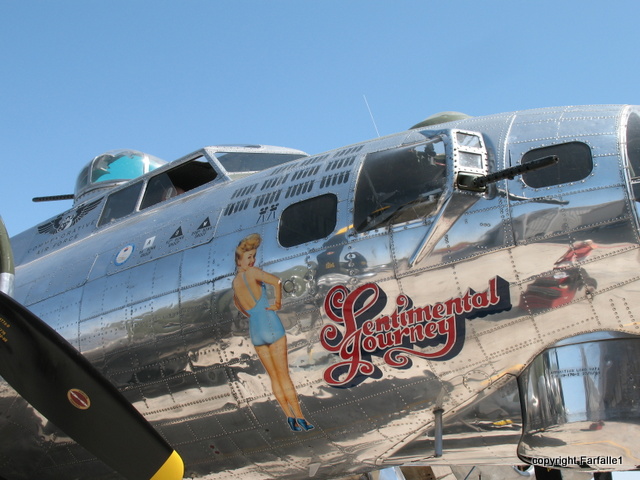
But best of all, for me, is being outdoors for a four-hour stretch, looking at the flowers, the trees, the water (as long as I’m not looking for my ball in the water) and most of all, the things that fly over and around our golf course.  I won’t even bore you with the jets landing at Phoenix Sky Harbor Airport – they are a near constant, though still high enough that their noise is not intrusive; or with the numerous helicopters that fly around – MD Helicopters and Boeing both manufacture whirly-birds, which are frequently given test runs above Mesa.  Of more interest are the historic planes that fly from nearby Falcon Field where there is a museum operated by the Commemorative Air Force.

B-17 Flying Fortress (Sentimental Journey)

Here she is on the ground at the Air Museum:
IMG_2353

bi-plane

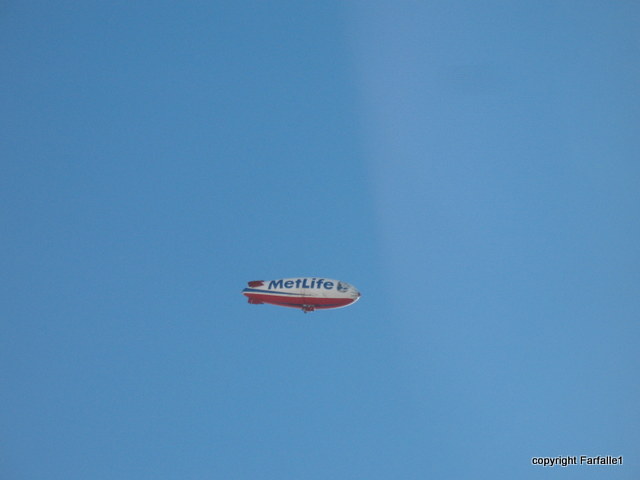
MetLive blimp over golf course-001
This last is not housed at Falcon Field.  The Metlife blimps don’t have permanent homes, but rather stay near the events they are covering. (You can read all about them here.)

But I love the birds we see around the golf course even more than the flyers with engines.  As I began to prepare this post I realized that I’ve got far too many photos of golf course birds to put here, so I’ve made an album which you can see by clicking here (then click ‘slide show’).  I’m not even remotely confident about my bird ID’s, so feel free to correct me.

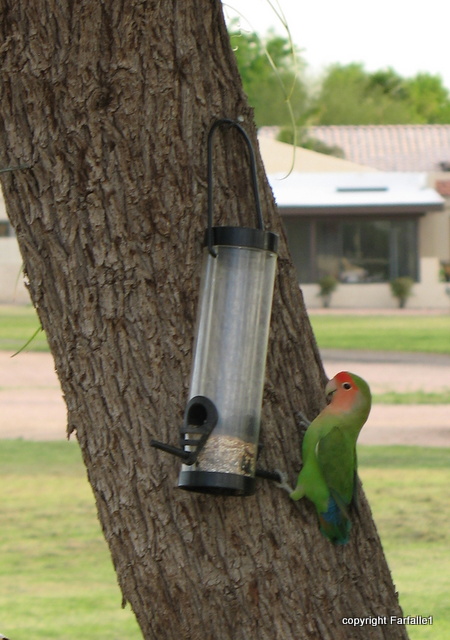
The two birds I love seeing the most are the peach-faced lovebirds which are native to arid regions of Africa and the Phoenix area.  They are popular pet birds, and some most have escaped around here; clearly they’ve been successful in adapting to Arizona life.  They are colorful and congregate in groups; they are tremendously chatty.  It’s not at all unusual to be lining up your golf shot and have a lovebird zoom in front of you about three feet away. Doesn’t this guy have an impish expression??
lovebirds on feeder-008

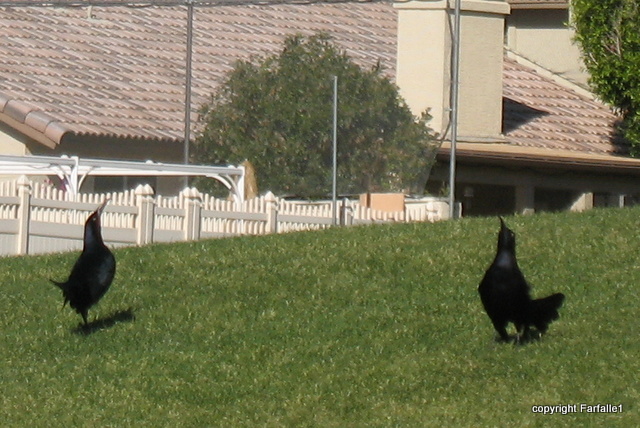
My other favorite to watch is the Great-tailed (or Boat-tailed) Grackle. The female is a rather dull brown-black in color, but the male is glossy black and proud of it.  They stalk around in a show-offy kind of way, and frequently stop and put their heads up in the air as if they were smelling something (if it’s Painted Mountain and 5 p.m. they’re smelling BBQ).
boat tailed grackles-001

This week I got to see what I take to be the mating display of the male. He sat on a tree branch as normal as could be.  Then he ruffled out all his breast feathers, as if he were taking a deep breath, which he then held for a moment as he opened his beak.  At last he spoke – or rather sqawked, because that is the sound they make.  He alternated between the usual squawk and a sort of whistle.  The Cornell Ornithology Lab has a terrific web site where you can hear a lot of different birds, including the grackle – but I have to say, I think the ones on our golf course have a lot more raucaus call than those the lab recorded.

Here are a couple of other bird pictures which I hope will encourage you to look at the rest in the web album.

coots graze-002

The coots are very entertaining as well, mostly because they are called coots, and when they get in your way you can say, “Watch out, you coots!”

ducklings-10

Is there any place in the world where mallards are not at home?

Things that fly – the sky is full of them, and so are the golf-course ponds.  There is always something wonderful to look at to distract you from actually playing the game.
That Special Light

26 Saturday Jan 2013

Posted by farfalle1 in Arizona, Italy, Photographs, Rapallo, Uncategorized

≈ 14 Comments

Tags

Magic of light

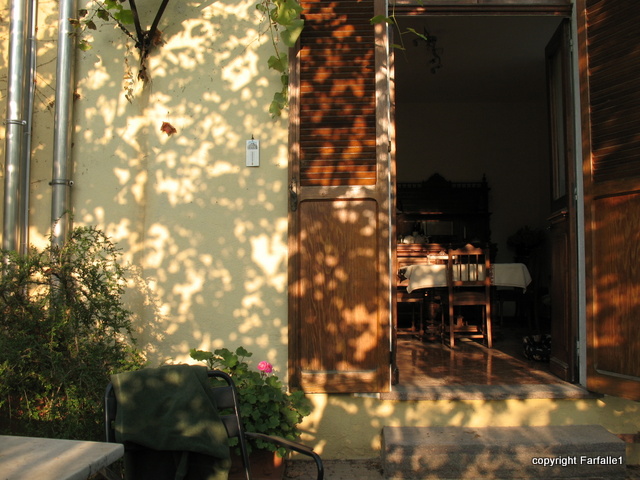
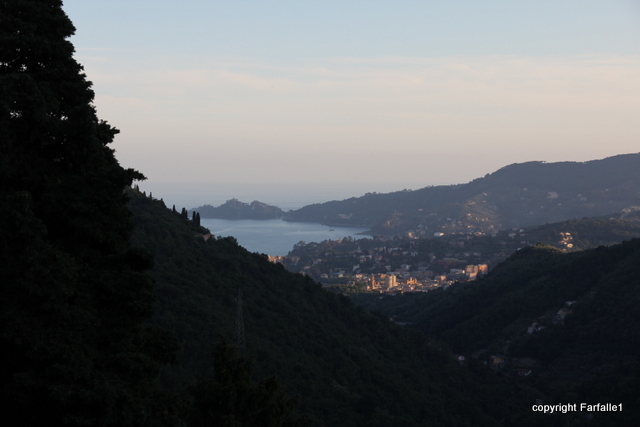
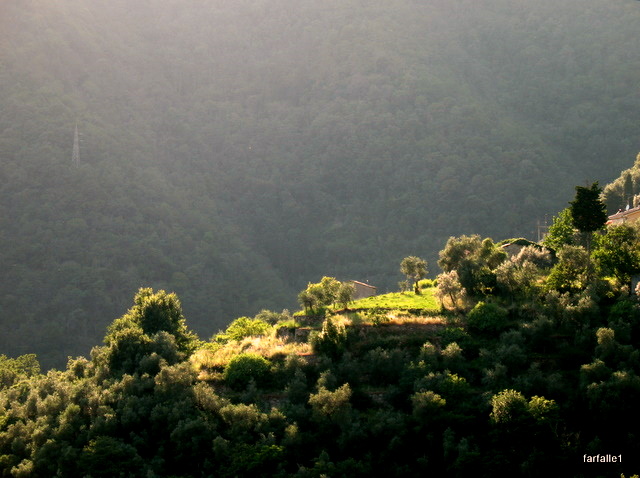
There’s something almost tangible about the light in Italy sometimes.  It’s hard to capture in photographs, but here are four examples:

gorgeous light 001C

magic light on fall golf course path

late light in Sostegno

last light on Rapallo-002

It’s as if you could actually slice through the light and, if you were very careful and lucky, bring it home with you.  There must be something in the atmosphere – smoke? magic? – that makes whatever you are looking at absolutely delicious.  Yellow light in Italy becomes golden; clouds are silver; roads seem to be bronze ribbons.

Arizona specializes in light too, but it’s a completely different kind of light, hard and hot.  The best time to see light in Arizona (or anywhere, I suppose) is early in the morning and in the evening; during those hours, even here, everything one looks at becomes softer.

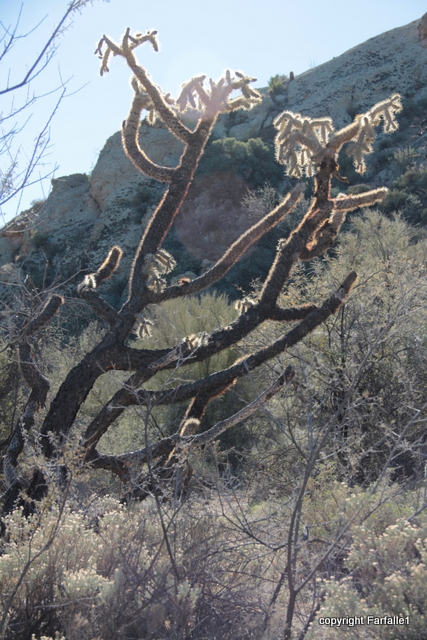
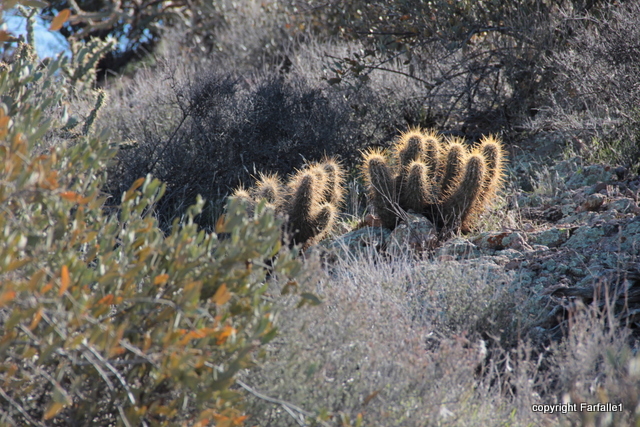
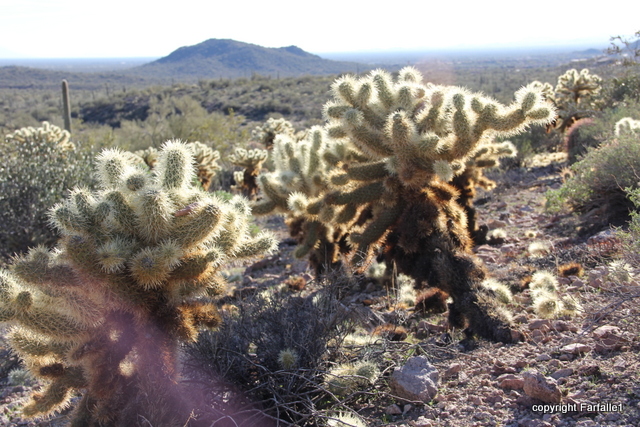
It seems to me that the cacti catch the light very dramatically.  It’s not the soft light of Italy we see here, but the sharp western light, held for a moment, reflected in the many spines of the plants and transformed into something more benign and gentle.  They seem to glow:

cholla light

Cholla

Hackberry Trail light in cholla

Hedgehog

Teddy Bear Cholla

Teddy Bear Cholla

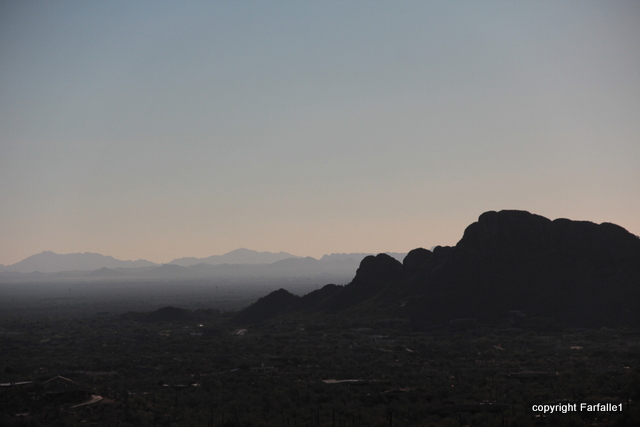
As evening falls in the desert the air above gets very clear, but down below the smog from the nearby city is evident.  It’s almost the same effect as a smoky evening after a field has been burned as happens all over Italy in the autumn. But, lovely as it is, knowing it is the result of smog and construction dust makes it so much less romantic.

view from Peralta Trail dinosaur

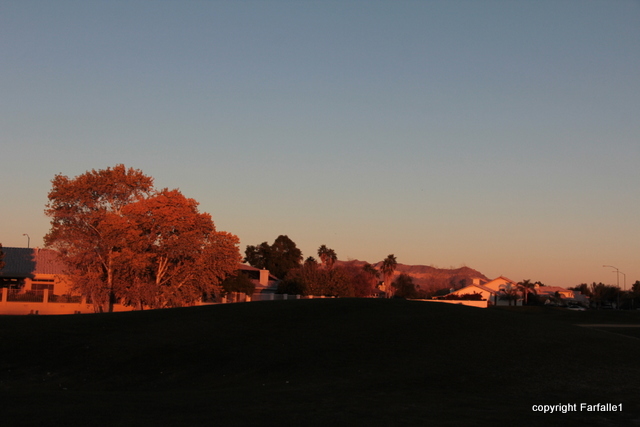
In the built-up areas and neighborhoods around the Valley of the Sun there are plenty of non-native trees, and they can be pretty spectacular in the waning light.

sunset over course - too red it was yellower

You can almost imagine yourself in New England in October, can’t you?  But no, this is Arizona, land of sharp things (about which more in the next post).

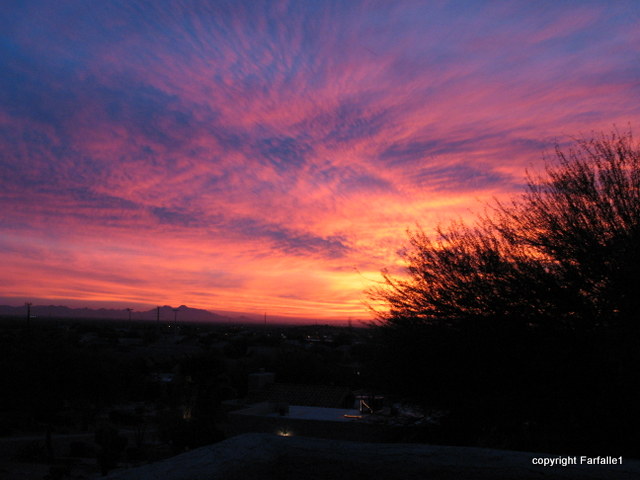
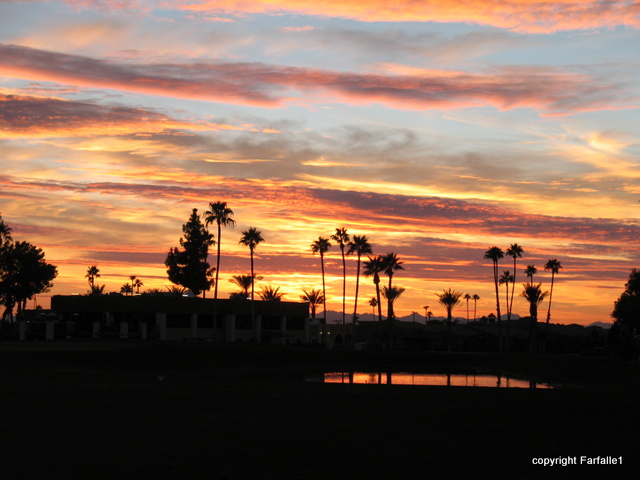
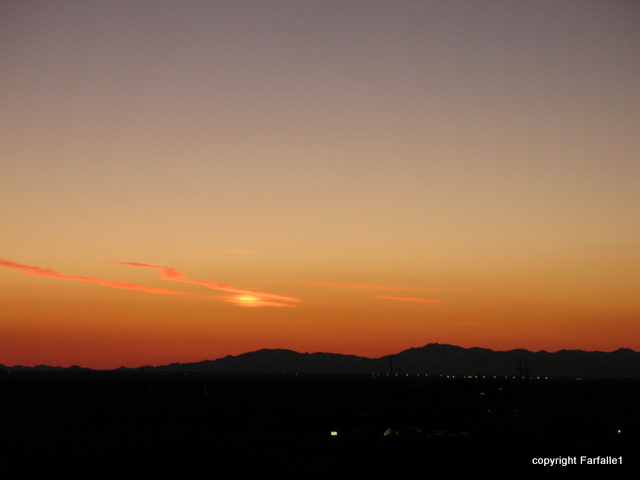
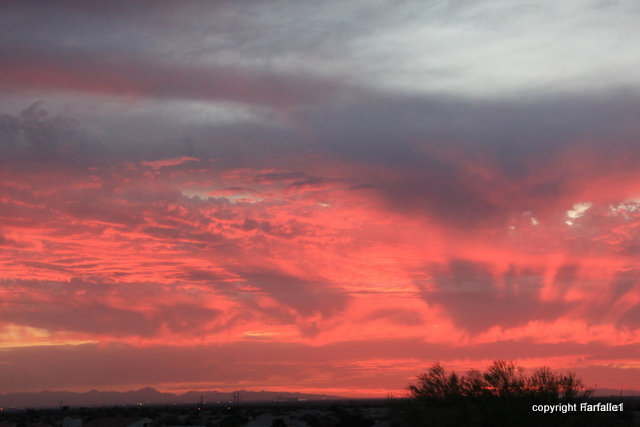
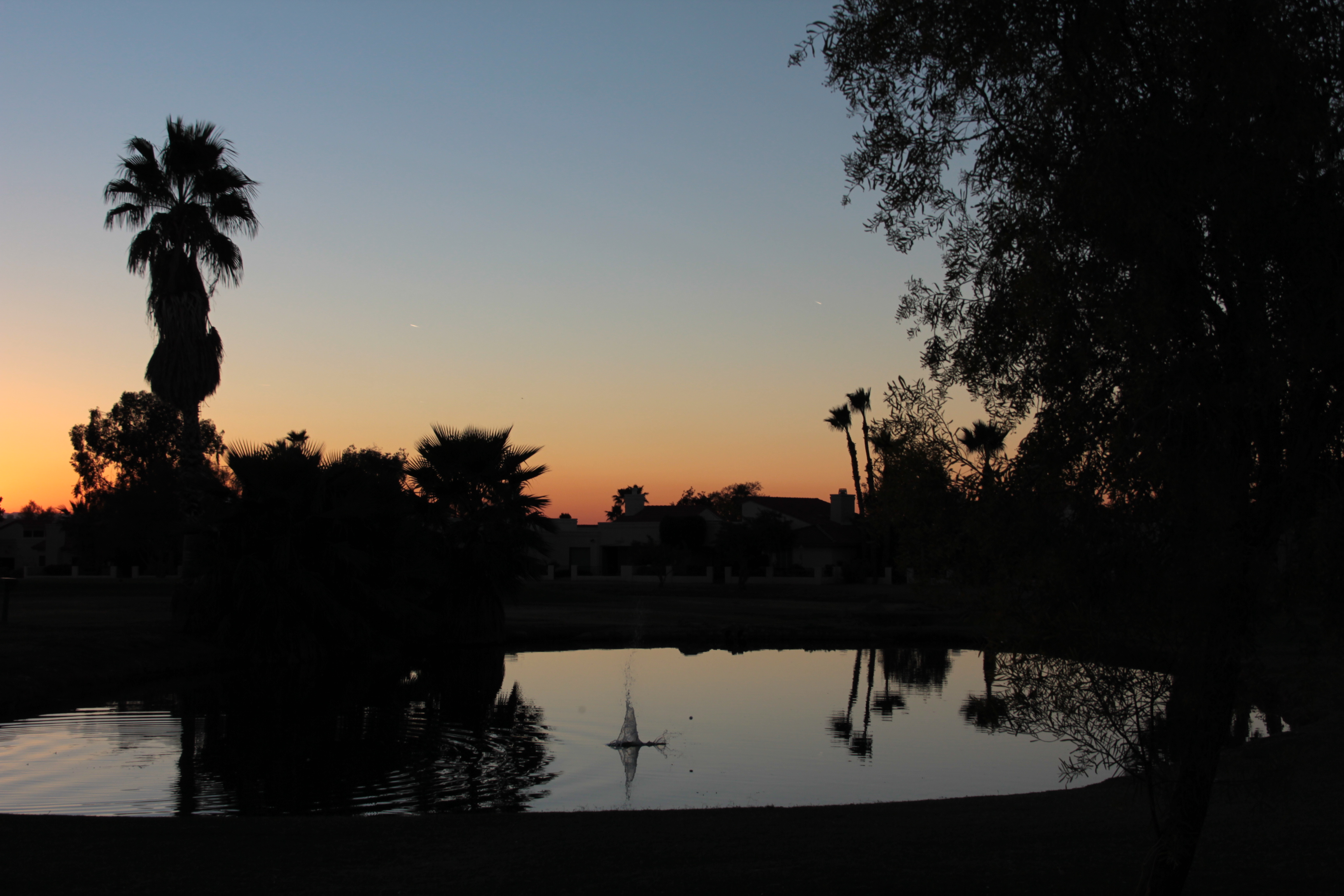
One thing Arizona has that we don’t have in our little corner of Italy is Big Sky. And with Big Sky come Dramatic Sunsets – we never get such violent skies in Rapallo, maybe because we’re on the wrong side of the Monte di Portofino.  But here in Gold Canyon, if there are any clouds in the sky we are in for a treat at sunset:

beautiful sunset

sunset over painted mountain golf course

Sunset at Painted Mountain Golf Course

sunset

Gold Canyon with the first glimmers of city lights in the distance

sunset-1

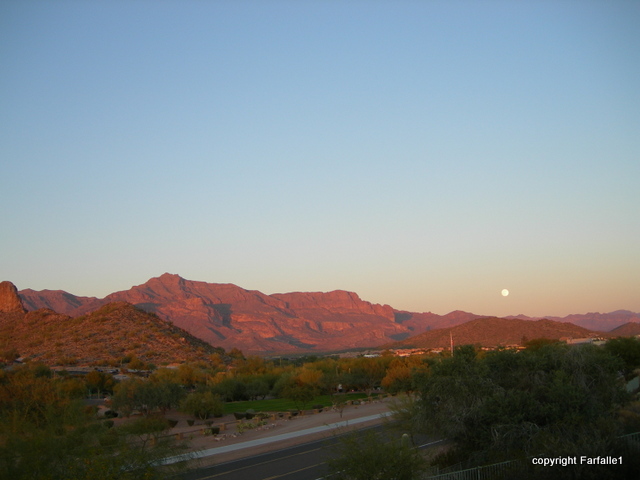
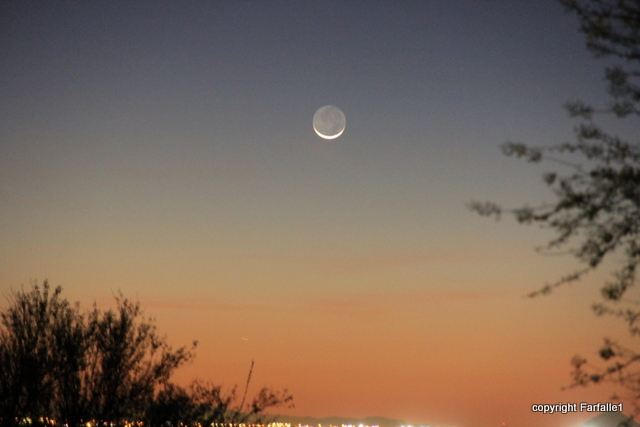
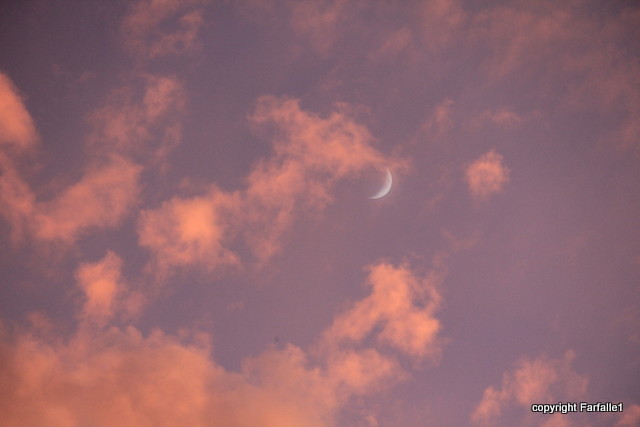
And even if there are no clouds, the midnight blue night sky is a perfect backdrop for stars, planets and especially the moon, sights that we often don’t notice when we’re in Italy.

sunset moon

MoonRise12-1-09 by Laura

Photo taken by my friend Laura

moon and city lights


moon setting over Phoenix

sunset moon-002

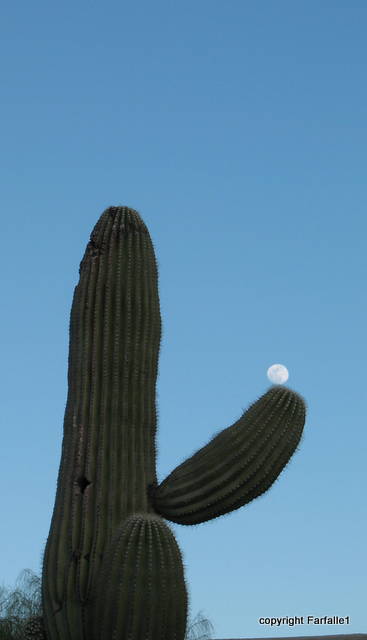
And I just couldn’t resist this one because it’s fun:

moon over cactus-1

Light: it’s around us all the time, but we seldom notice it.  Physicists may tell us that “light is simply a name for a range of electromagnetic radiation that can be detected by the human eye.”  But it can be so much more than that: all it takes is a special moment, a special angle, an unusual tableau for us to stop and say, ‘Oh.  It is so beautiful!’

My favorite picture of the week

06 Sunday Jan 2013

Posted by farfalle1 in Golf, Photographs, Uncategorized

≈ 8 Comments

Tags

Golf ball in pond, Painted Mountain Golf Resort

Bob's least favorite shot of the day

I apologize that this has taken a bit longer than usual to load.  I left the photo in its large format because I hope you will click on it to see the amusing detail in the center.  This was our golfing friend Bob’s least favorite shot of the week.  It was just by chance I caught it when I did.  It is a spot where I’ve lost many a ball myself, the devilishly placed water hazard that guards the green on the par-4 #13 hole at Painted Mountain in Mesa, Arizona.

Bucket or Bellyful?

27 Monday Aug 2012

Posted by farfalle1 in Italy, Law and order, Liguria, Photographs, San Maurizio di Monti, Uncategorized

≈ 11 Comments

Tags

Canadair, Corpo Forestale, Fighting forest fires in Italy, Fire Fighting planes, Forest fire in San Maurizio

(Click on photos to get larger, clearer images)

It’s been a fiery summer in both Europe and the U.S.  We’ve had our own little bit of excitement here in San Maurizio, although nothing on the scale of the tragic fires in Spain or the numerous fires in western U.S.

It began Thursday.  Speedy was home reading in the afternoon, and noticed there seemed to be a lot of helicopter traffic.  He had a look around, and this is what he saw on the hillside behind us:

Photo by Speedy

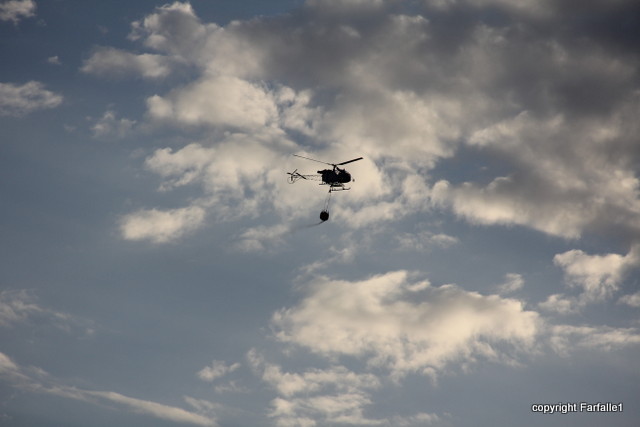
He kept track of the action all afternoon. First the wind blew to the east, then it swapped around and blew to the west. Two helicopters carried countless buckets of water to dump on the stubborn fires which, instead of going out, seemed to simply move on to another shrub or tree.  With so many individual fires we wondered if this were arson.  We don’t know, but we have been told the cause of the blazes is under investigation.

The ‘copter pilots are real sharp-shooters with their water buckets.  I wondered, though: as they move slowly to a position above their target fire, do the rotors fan the blaze and undo some of the good the water is doing? In any event, they do some demanding and amazing flying and, more often than not, their bucketful of water lands right on the selected target.

Photo by Speedy

The thing is, it looks like such a teeny amount of water – and so much effort is required to get it to the fire. It’s hard to imagine that it’s effective, but it is. By the end of the afternoon it looked like the fire was largely under control. The helicopters don’t fly at night, so it was good to see that the flames were out.

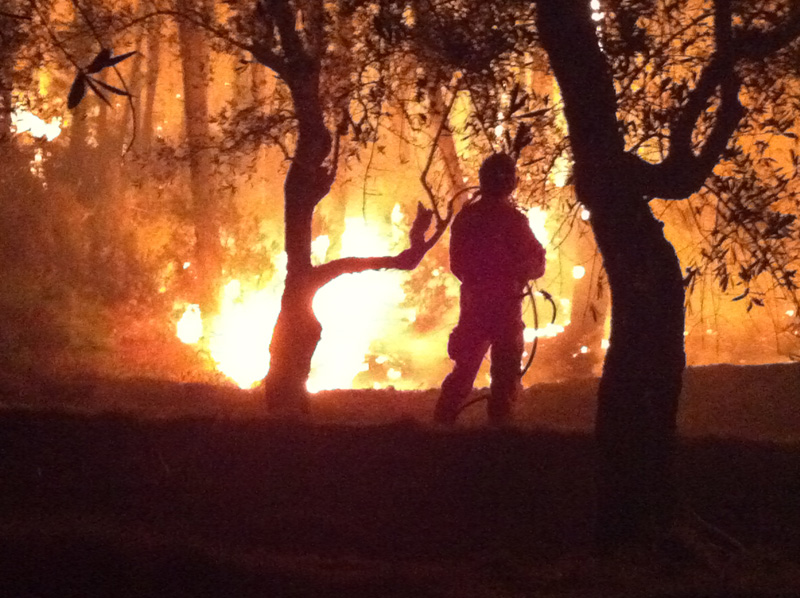
Or so we thought. I woke up at 3 a.m. and looked at the mountain to see it all ablaze again. This was disconcerting, and instead of going back to sleep I spent the rest of the night tossing, turning, and making a mental list of things to put into a box to carry away should it become necessary. Speedy spent his wakeful hour using GoogleEarth to compute how far the fire was from us. According to his calculations it was about 750 meters from our house as the cinder flies. It was less than 300 meters from the restored rustico of some friends. That’s too close!

Fortunately my list of what to pack was unnecessary. And the reason why is because, unbeknownst to us, there was a legion of volunteer firefighters  (Vigilanza Antincendi Boschivi) on the ground, not only that night but during both days of the fire. It turned out that one of our acquaintances, who is too modest to allow me to use his name, is one of these volunteers, and he was able to give me some useful information.

Photo courtesy of vab-arcetri.org

The Corpo Forestale is in charge of organizing the fighting of fires outside of cities and towns. They decide which aircraft will be used (if needed) for each fire, and where and when the volunteers will go. There are two sizes of helicopter (ours was the smaller one) and the famous bright yellow Canadair airplanes (about which more shortly). The small helicopters carry what look like rather small buckets of water, though our friends says that when the water is mistakenly dumped on the volunteers it does not feel like a small bucket. The Canadairs carry a belly full of water, much more than the small buckets. We were told that the larger helicopter carries even more water than the plane, but we’ve never seen one. There are fires that don’t require aircraft, but forests in Italy tend to be on steep mountainsides; more often than not a plane or helicopter is the only way to get water to the fire.

The volunteers often work more on fire containment than actual fire-fighting; our friend said, however, that they did both with this particular fire. They hump in some heavy equipment and somehow manage to keep the fire from spreading. That is why, on Thursday night, the fire burned up the mountain instead of coming down towards the houses below and why, even though I watched, and heard, tree after tree go up in flames, the fire slowly abated so there was less of it as the sun came up. Thank you, VAB volunteers!

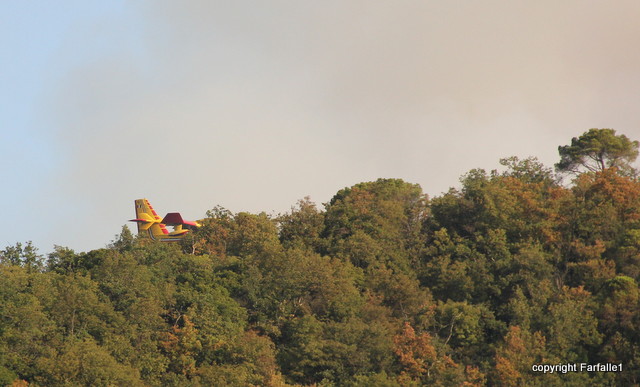
Daylight brought us a Canadair.

It is so exciting to watch these planes fly. They swoop down over the sea and fill up the plane’s belly with water, which they they carry back to the fire and release. There are moments, watching them, when it seems certain there is going to be a terrible mishap.

They use the plane’s inertia to propel the water where they want it to go. The pilot might, for instance, fly right at the side of the mountain, nosing up abruptly just before hitting, and releasing his water at the same time. The water goes straight into the mountain, and the plane, thank goodness, does not. Other times the pilot is able simply to drop his water as he goes (watch out, volunteers below!). Retired old pilot Speedy says it is no doubt very scientific, that the pilots are able to compute when to release the water based on air speed and altitude above target.

The Canadair, joined briefly by a second, grey plane, flew back and forth all morning. After lunch one small helicopter came back, and by the end of Friday it seemed the excitement was over. Our friend said he had been called to go back Saturday, but we saw no activity at ‘our’ fire. Perhaps he was out putting out other fires. Sadly, there’s no shortage of them at this time of year.

There are some more photos of the fire here, and I tried, for the first time, to make a video, which you can see here. (Sorry that it’s a little wobbly – next time I’ll use a tripod.) The most exciting part of the video is that you can hear the cock who can’t tell time (1 a.m., dawn, sunset: all the same to him), you can hear the loud sound that water meeting fire makes, and you can hear a short conversation between Speedy and myself. Very exciting. Unfortunately you won’t see the plane actually dumping water as that happened behind the mountain – but you can hear it (as well as the lovely low grumble of the twin engined plane).

The systems the Corpo Forestale have developed for fighting the numerous fires in Italy are admirable. The timely arrival and expertise of all the firefighters has surely saved millions of euros over the years (although the cost of fire-fighting with aircraft is extraordinary.  The small helicopter, the 412, costs E 2,200/hour; the larger, the Ericson S64, costs E 7,000/hour and the Canadair costs E 10,000/hour.)  What did they do before airplanes were invented? I suppose lots more forest burned. How lucky we are that we have helicopters with their little buckets and planes with their great big bellies. Given the choice, I guess I’d always choose the plane, just for the drama. But there’s an elegance to the helicopters, and a delicacy of approach which is also very appealing. Actually, I guess if my house/land were on fire I wouldn’t care who came, as long as he brought a lot of water with him!

Not Your Nana’s Quilt

31 Saturday Mar 2012

Posted by farfalle1 in Arizona, Arts and crafts, Photographs, Uncategorized

≈ 16 Comments

Tags

Arizona Quilters Guild Show, Quilting, Quilts

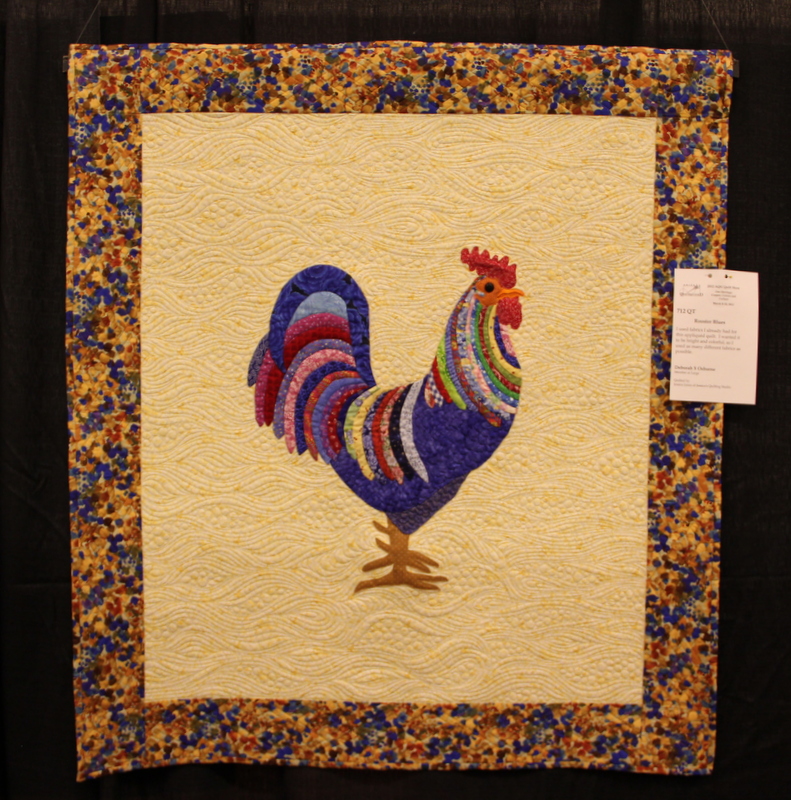
Rooster Blues by Deobrah Osborne

I don’t know about you, but when I think of a quilt I think of a very cozy bedcover, perhaps blocks of colored fabric stitched together and then attached to a bottom with some fluffy  filling between.  I think of cups of hot chocolate and snuggling on cold nights. I think of a bed.  I think wrong.

Havasu Stitchers Truck Quilt, 2003

A couple of weeks ago my friend Mrs. S, about whom you’ve read in these pages, and her friend M invited me to accompany them to a quilt show.  Not just any show, this was the annual exhibit of the Arizona Quilters Guild, this year titled “Our Heritage 2012: Copper, Cotton and Culture.”  I learned more about quilting and quilters in one day than I had in my entire previous life; and I learned that what I learned  is but a drop in the bucket of what there is to know.

My notion that quilting was a crafty sometimes occupation, something to while away a snowy afternoon, for instance, was laid to rest in the parking lot, before we ever went into the show itself.


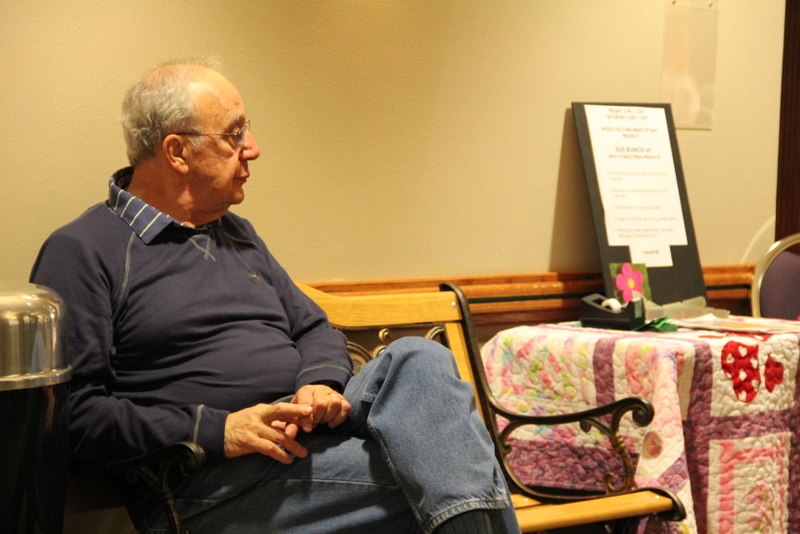
These ladies are serious; and yes, they are mostly ladies.  I did see one gentleman at the exhibit:

My gut instinct is that he was not a quilter himself.

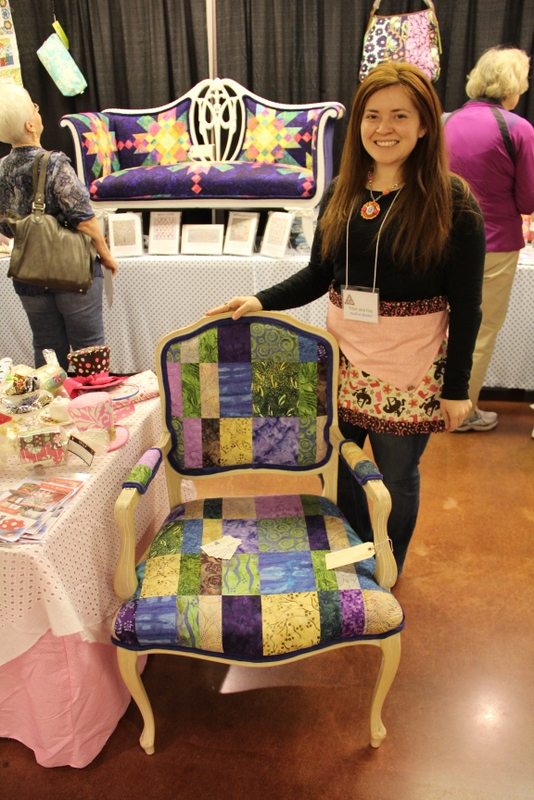
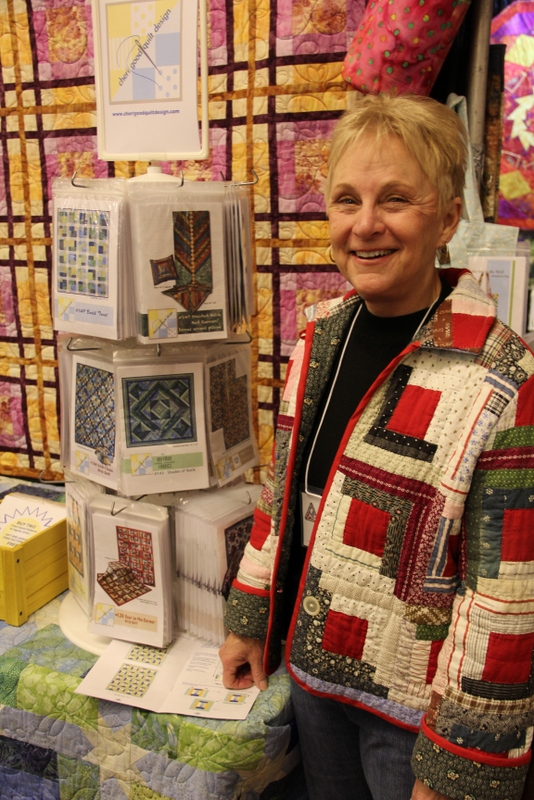
Anyway, the exhibit took up several very large rooms of the Mesa Convention Center.  Three hundred and twenty quilts were exhibited in seventeen different categories and thirty-five vendors were eager to sell  us  items from  $  .10 to $10,000.  Actually I didn’t see anything for $.10, but there must have been something.  A short length of thread, perhaps.

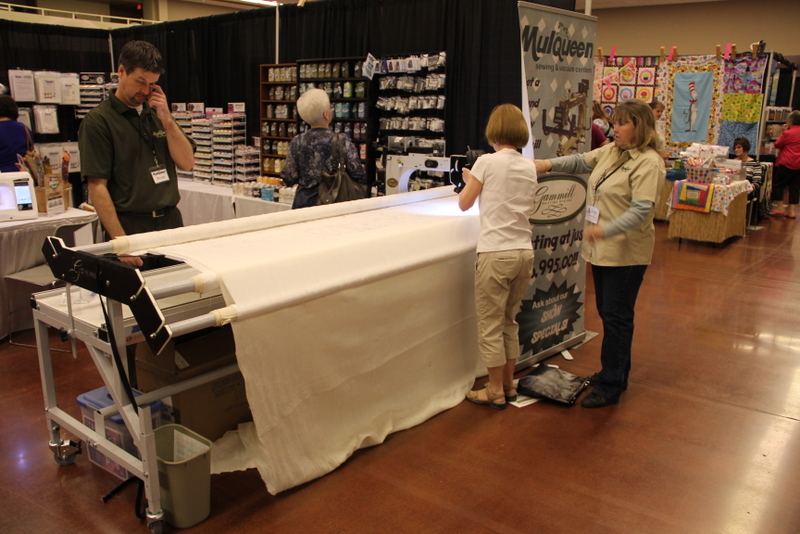
In my innocent universe, quilts are made by people with some leftover fabric, batting for the filling, and a needle and thread.  In essence this is still true, but of the quilts we saw, only thirty-seven were hand-quilted.  Most quilting is done by machine these days, either by an item that looks like a home sewing machine and will sit comfortably on your home work-table , or by what’s called a long-arm machine, which will set you back a minimum of $7,000 and requires  about fifteen feet of arm room:

These computer-driven machines can take a particular quilting stitch design and scale it up or down to fit the specific quilt’s spacing, and they can do quilting that would give the hand-quilter nightmares.

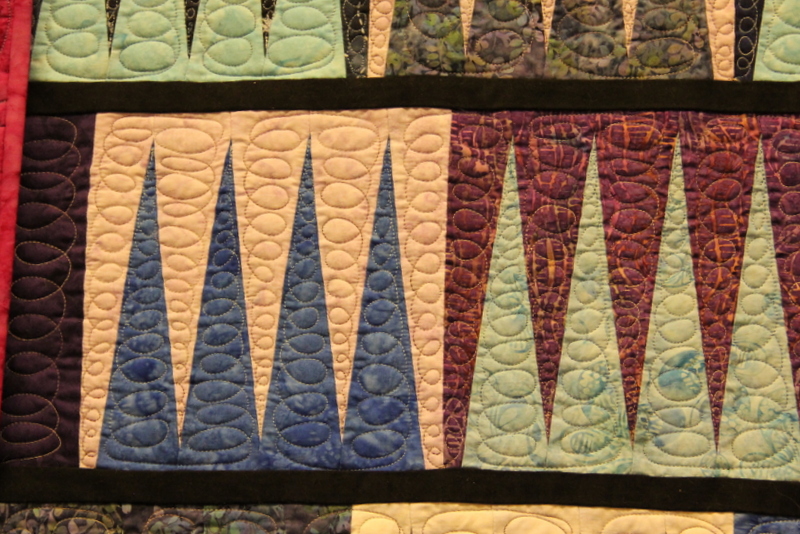
Look at the density of stitches in this close-up:

Jerome I by Margot McDonnell

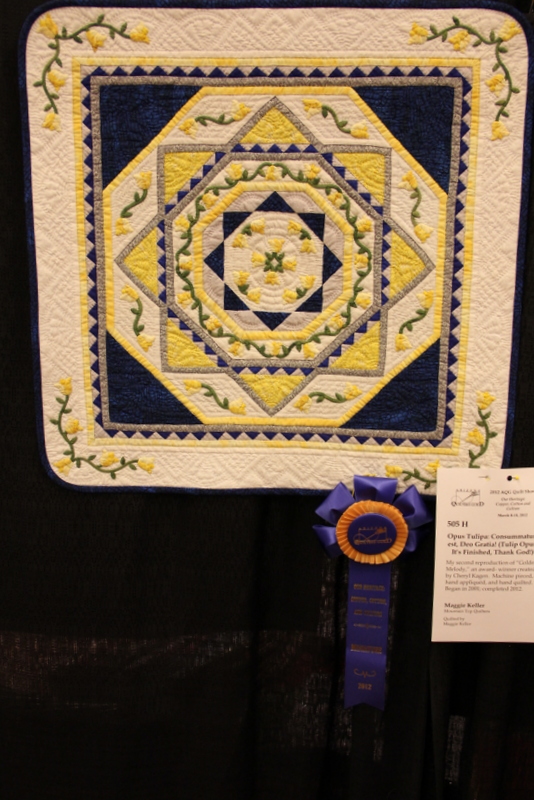
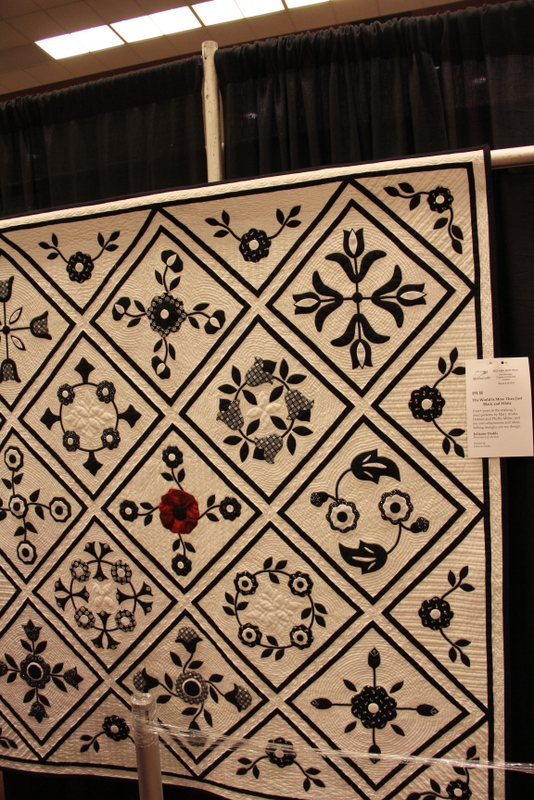
The hand-quilted pieces look different; to my eye they are gentler and softer, a bit plumper.  But the quilting is every bit as complex and dense as some of the machine work.  The difference is how long it takes to do it by hand – several years compared to several days or weeks.  Here are two quilts that are hand-stitched:

Opus Tulipa: Consummatum est, Deo Gratia! (Tulip Opus: It's Finished, Thank God!) by Maggie Keller

The World is More than Just Black and White, by Julianne Dodds

This one took Julianne Dodds more than four years to make.  I’m surprised it took less than forty.

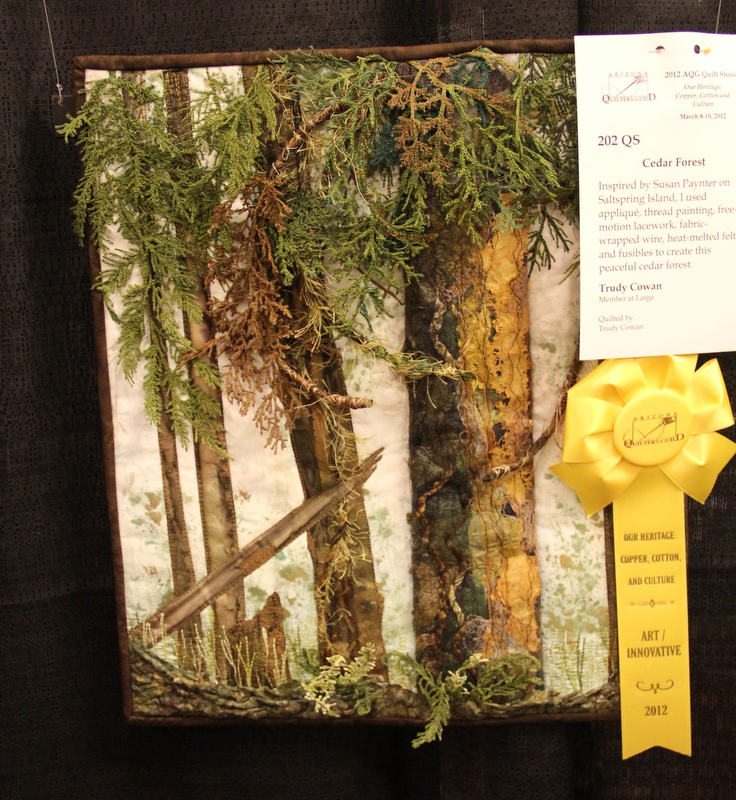
So much more than mere stitchery goes into making a quilt.  Each begins with the design or concept which will dictate the fabric chosen.  Nowadays quilts are not cloth alone; buttons, sequins and all manner of things are added.

Cedar Forest by Trudy Cowan

Trudy Cowan used applique, thread painting, free-motion lacework, fabric-wrapped wire, heat-melted felt and fusibles to create her Cedar Forest. (I can’t even tell you what some of those things are!)

There were two ‘challenges’ that really illustrated for me the amount of creativity that goes into modern quilt-making.  One challenge was called Quilting  Makes the Quilt; entrants had to make the same quilt from the same fabric. The creativity came only through how they quilted it.

American Eagle, by Amy Monahan

Can you see the eagle in the center of the quilt above?

Quilting Makes the Quilt - Susie, by Susie Seckel

They look quite different, considering they’re made from the same cloth and are pieced into the same design.

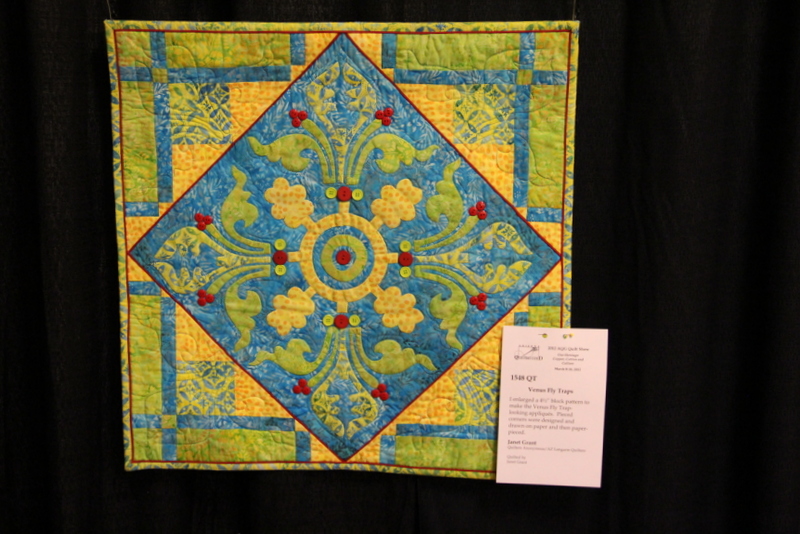
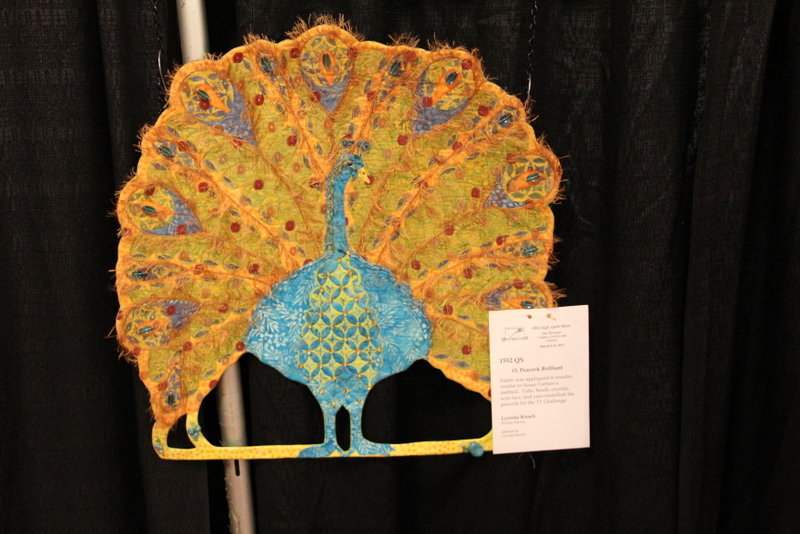
In another challenge, which I particularly liked, the quilters were given the same fabric and could make whatever they wished.  Here are a few of the results:

Venus Fly Traps by Janet Grant

Life is a Beach, by Fran Pritzl

O, Peacock Brilliant, by Lynnita Knoch

Hard to imagine curling up with a cup of tea and a good mystery with this last one, but isn’t it fun??!

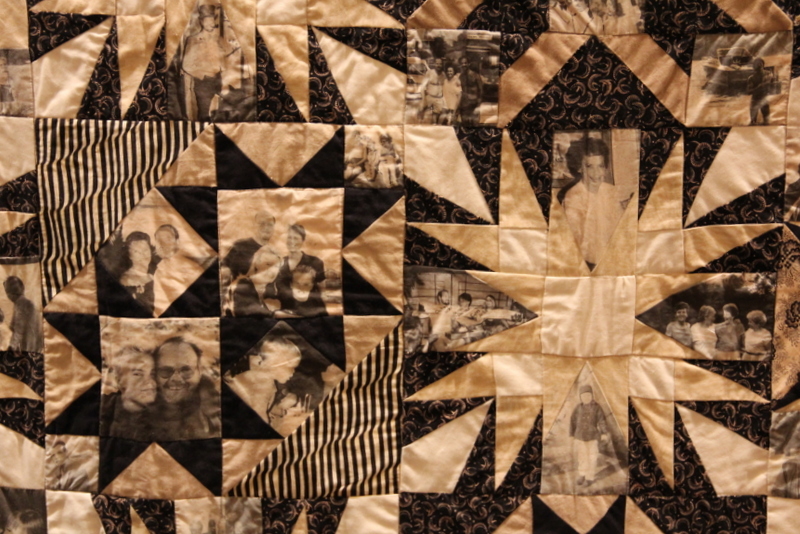
There were so many quilts I fell in love with, I can’t possibly show them all to you.  There were four that especially caught my imagination, though.    The first I liked because the sentiment is so dear.  Danielle Mariani transferred photographs and hand-written messages from paper to fabric (the magic of technology!) and pieced a memory quilt for her father’s 60th birthday.

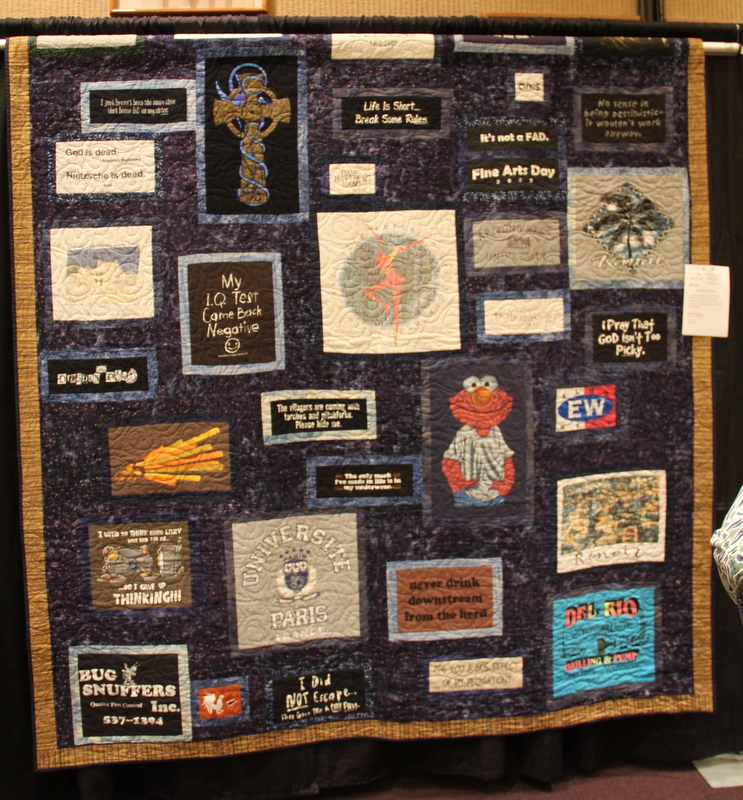
Linda Marley used a bunch of her son’s old tee-shirts to make him an amusing  quilt:

His Early Years by Linda Marley

I loved the tranquility of the egret, and the way the colors moved from one to another. There are also some other fun pond animals to be found in the details here.

Sanctuary by Dennie Sullivan

Arizona celebrated her centennial this year, and this did not go unnoticed by the state’s quilters, many of whom paid tribute to the youngest continental state in the union.

Arizona Valentine by Vicki Bohnhoff

This amusing quilt features Betty Boop driving across the Arizona map.  There are quilted flaps that lift up with information about the location underneath.

All Roads Lead to a Quilt Show, by Alicia French

There are some more photos of quilts in this web-album (but I promise, all three hundred and twenty are not there).

The exhibit opened my eyes to modern quilt-making – it is definitely not what it used to be.  It also made me realize that I will never, ever, in a million years have the patience to be any kind of quilter. My non-quilted hat is off to the ladies who are.

Birds of a Feather

05 Monday Mar 2012

Posted by farfalle1 in Arizona, Photographs, Uncategorized

≈ 12 Comments

Tags

Bird Watching, Birding, Ramsay Canyon, San Pedro Riparian Conservation Area, Sierra Vista

Cartoon by Artanuk

Mam and I met each other over 35 years ago and have been great friends ever since.  We may not see each other as often as we did when we lived in the same little Connecticut town, but we’re always able to pick up where we left off, as if we’d seen each other only the day before.

I was delighted when Mam said she could come to Arizona for a week.  It’s been a year and a half since our last meeting, and we had much to catch up on.  Of course I wanted her to have a special time, so we planned many activities.

The thing about Mam is that she’s a birdwatcher.  It’s a hobby I’ve never cottoned too, being both too impatient and too poorly-sighted to make a success of it.  Oh look!  another little brown and yellow bird.  It must be a… God only knows what!

But putting aside fears of my limitations, we boldly charted a course for Sierra Vista, about three and a half hours southeast of where we live.  It’s an odd, meandering kind of town, not quite city, not quite town.  Incorporated only in 1956,we surmised it sprang to life around the big military base there, Fort Huachuca.  It has three main advantages: many places to stay overnight; many places to eat; proximity to many A-1 birding sights, including the two we visited.

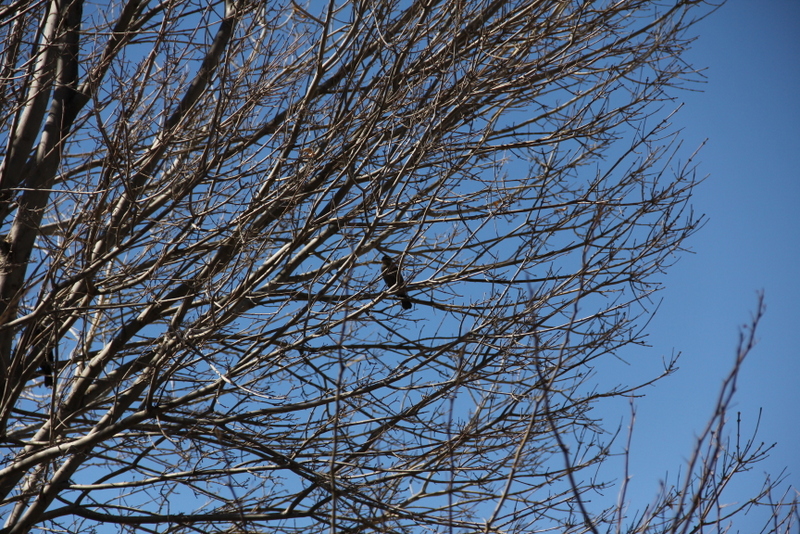
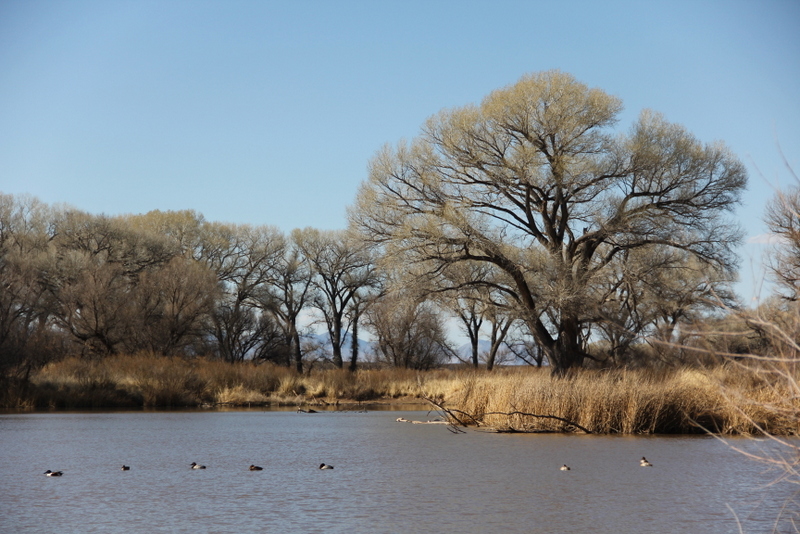
First we went to San Pedro Riparian Conservation Area.  Here is what I saw:

But THIS is what Mam saw!

Oh well.

Undaunted we stumped off in the peculiar gait of birdwatchers: step, step, step, pause, cock head and listen, make slight swishing noise between teeth to encourage invisible bird, decide it was the wind we heard, step, step, step.

There was something strange going on with the light and the gray/white trees around the San Pedro River.  I haven’t fiddled with this picture at all, this really is what it looked like that day (better if you click on it to enlarge).

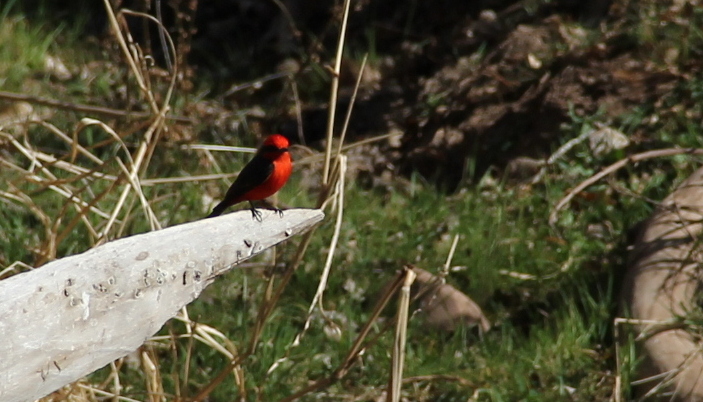
Not too far along in our walk we were both rewarded with a vermilion flycatcher.  Mam had seen one before, but as far as I know I never had, so it was quite exciting.  Well, it was quite interesting.  Well, it was very pretty.

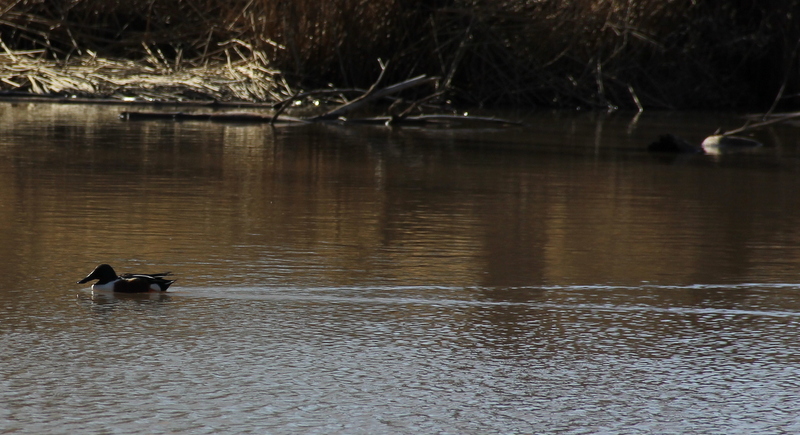
Mam, however, continued to put me to shame.  When I saw this:
She saw this:

and when she continued to see this:

my attention was completely diverted by this:

The most humiliating of all was when we returned to our starting point.  While Mam got to glory in the sight of this:

all I got to see was this:

The next day, fed and rested, we took ourselves off to nearby Ramsay Canyon which is lovingly maintained by the Nature Conservancy.  The docents, Mr. and Mrs. Sandy, were informative and delightful.  It was a chilly, very windy day, and we were a bit early for the birds, both for the day and the season.   The much vaunted hummingbirds were still hanging out in warmer climes.  We also learned from Mr. and Mrs. S that a deadly trifecta of fire, flood and freezing temperatures the year before had reduced the food for the birds, and hence reduced the number of birds themselves.

As we step, step, stepped through the morning we heard more and more twittering in the forest around us.  Alas for us, there were also more and more visitors, which meant more noise and disruption along the trail and less opportunity to see the few birds that were there.  Mam did catch sight of one she’d never seen before, though: an orange crowned warbler.  I didn’t see that one.

Mam also saw the showy  acorn woodpecker:

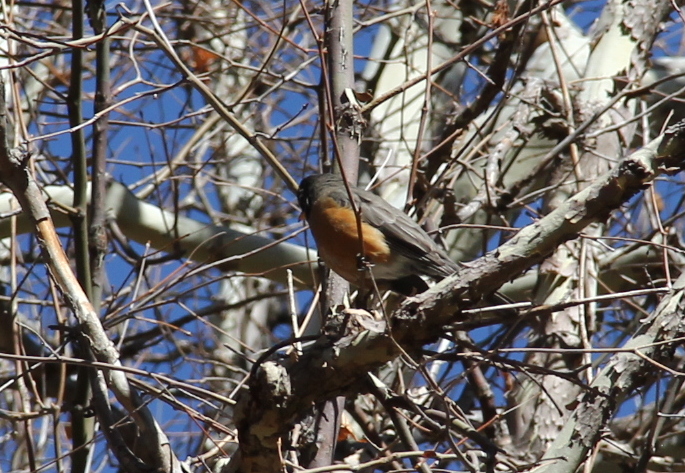
“Oh look!” I countered:

“Isn’t that a robin??!”

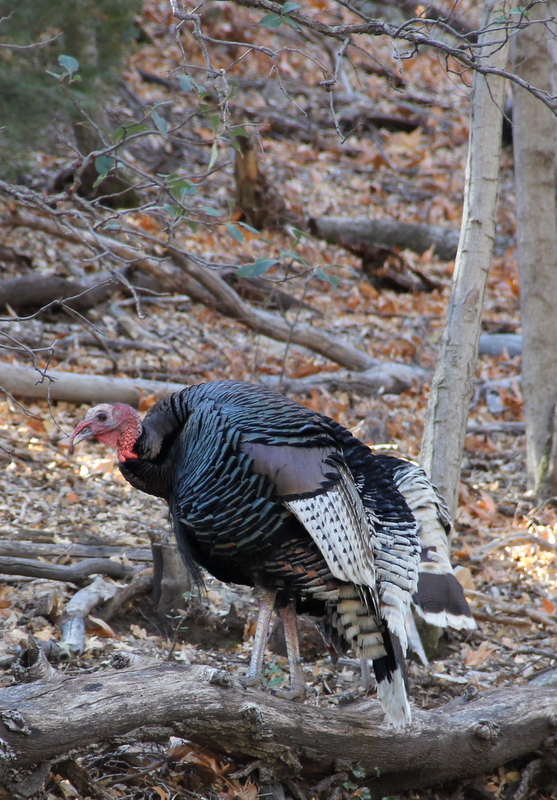
We saw some big birds that look every bit as gorgeous in the woods as they do on the dinner table:

Even I could see this fellow!

As we headed back to the entrance we were entranced to see a pair of deer browsing in the undergrowth.

We might not have seen a great many birds at either birding ‘hot spot,’ but we had a wonderful time being a couple of old friends together enjoying walks in the outdoors in lovely weather.

And I got my revenge on Mam.  When I saw this:

and this:

she didn’t see anything at all, because she doesn’t like lizzards and ran away into the house!

Cluck!

11 Sunday Dec 2011

Posted by farfalle1 in Animals in the U.S., Arizona, Photographs, Uncategorized

≈ 8 Comments

Tags

Chicken coops, chickens, hens, Raising hens, Tour de Coops, Valley Permaculture Alliance

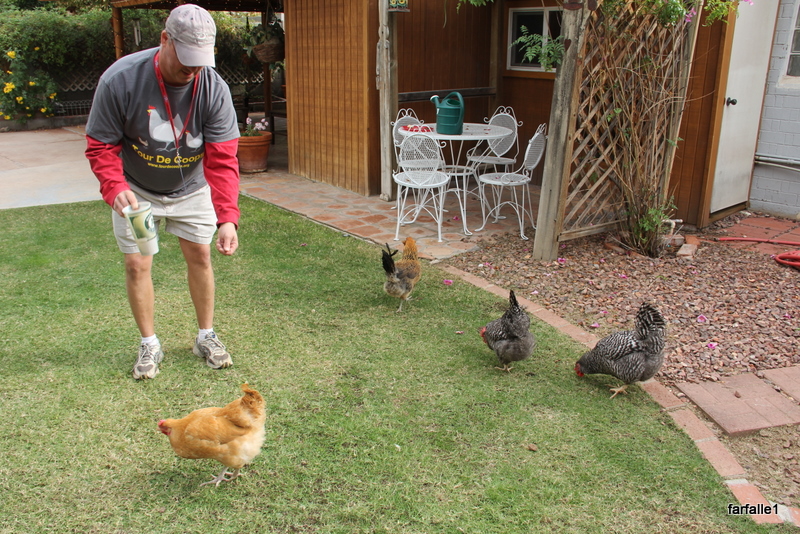
Chicken people are happy people.  My intrepid friend Mrs. H and I learned this when we went to downtown Phoenix last weekend for the third annual Tour de Coops. That’s right, downtown Phoenix! Urban agriculture is alive and well in the Valley of the Sun, in part due to the efforts of the Valley Permaculture Alliance, under whose auspices the Tour is sponsored.

Twenty-one generous chicken farmers opened their coops to several hundred visitors, all of whom probably asked the same tiresome questions. How many chickens do you have? (anywhere from three to a dozen or so); how old are your chickens? (anywhere from six months to eleven years); do you eat your chickens? (yes. no.);  how many eggs do you get a day? (in general about two eggs for every three chickens);  what are the names of your chickens? (way too many to list; some of my favorites were  Itchy, Lafawndut, St. Alfonso’s Pancake Breakfast, Waffles, Tika, Roti and Catchatori); is it really fun to have chickens in the back yard? (YES!)


The Tour was meticulously organized. Tourists registered at one of two starting points where they were given a muslin shopping bag containing water and chick feed (thank you Fresh Foods and Nutrena) and a thirty-two page directory of the Coops on the tour which was a model of clarity. Each coop location had its own page with a map indicating its location and a brief description of the coop and its inhabitants.

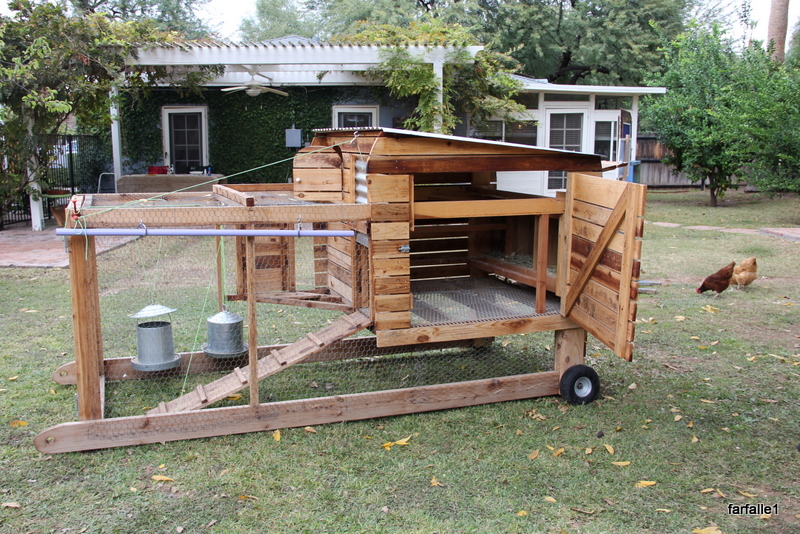
Mrs. H and I did not have time or energy (mostly energy) to visit all twenty-one coops, but were mightily impressed by the ones we did see. Coops come in all sizes and shapes, and are as diverse as the people who devise them. The first coop we visited was belonged to Maggie and Bjorn Olson. It was the only portable coop we saw:

The Van Slyke coop is renowned for its chandelier:

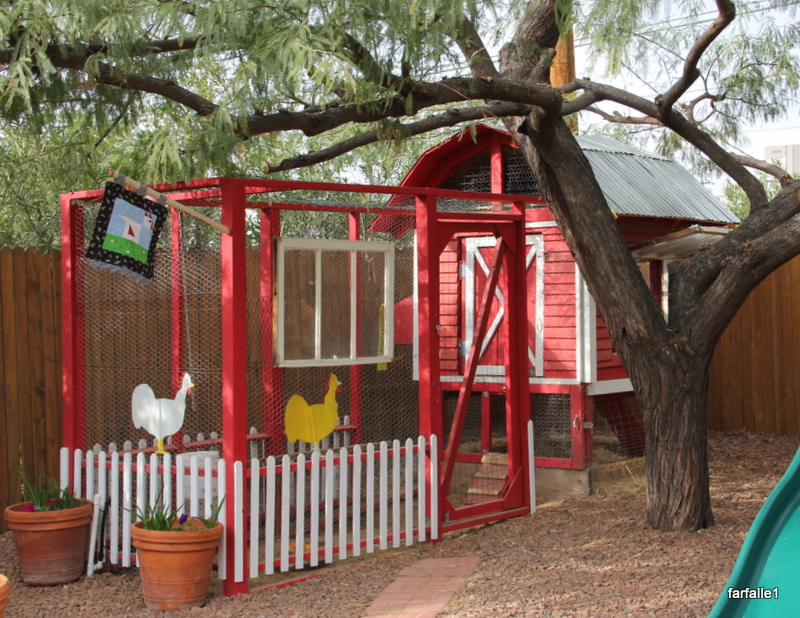
The Poulins pay homage to their roots in Vermont and New York with their barn-like coop:


As diverse as the Chicken People are, they all share an interest in sustainable living and in gardening (what else are you going to do with the chicken poop?). Whether on the ground or in raised beds, the veggies these families are growing are uniformly robust and appetizing.

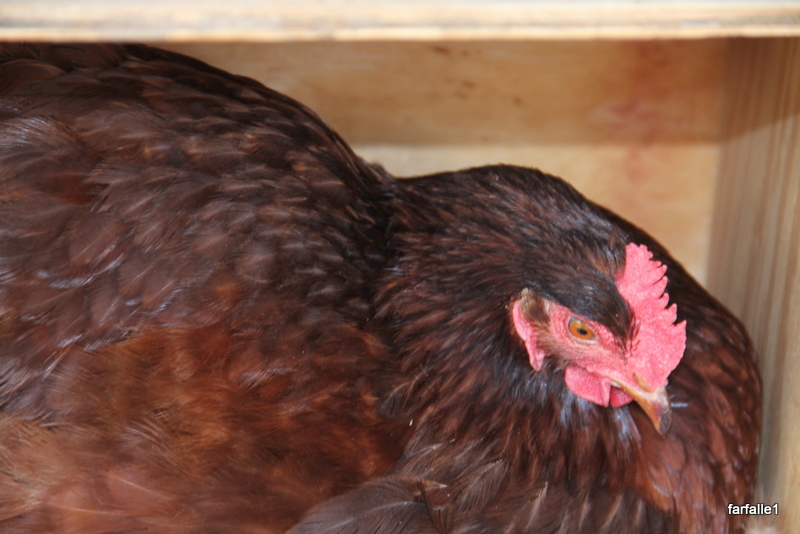
But I digress. Let’s get back to the hens and their houses. Each coop we saw had several nesting boxes where the girls take turns laying their eggs. By the way, egg production is the impetus for a huge amount of self-congratulatory clucking. The Taylors were dealing with a broody hen in one of their boxes:


Every now and then a hen just decides that she must sit on her egg(s) and will peck at anyone who tries to remove them. Fortunately hens are not the smartest birds in the world, and a plastic egg or even a golf ball will satisfy a broody bird. (This is, in fact, the genesis of all those plastic eggs that children receive at Easter. They are hatched from other plastic eggs by broody hens. The chocolate inside them, as we all know, is from the bunnies. But again, I digress.)

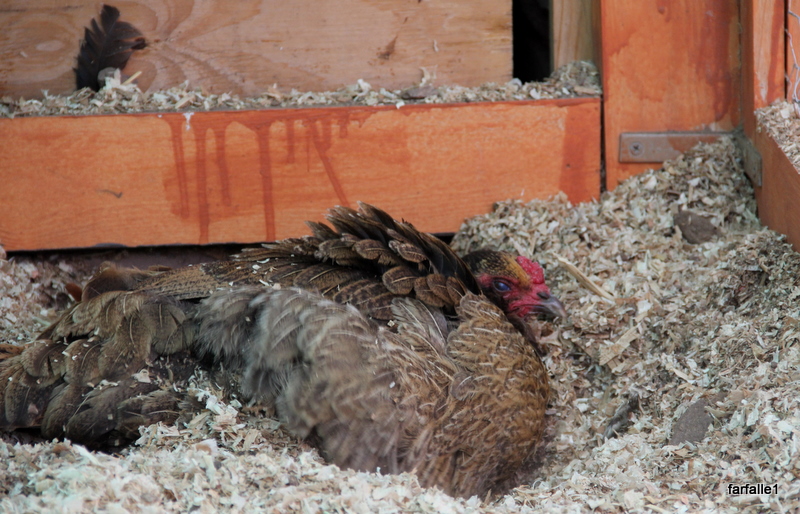
Each coop has an integral yard outside the structure itself. Like all of us, hens like to move around and need a little space in which to do so. They like to take dirt, dust, or sawdust baths to clean themselves – they fluff around in the dirt, the what-ever-it-is they want to get rid of sticks to the dirt, and then they groom out the whole business from their feathers.

Most of the owners let their hens out to ‘free-range’ for at least part of the day. Depending on the neighborhood they may or may not need supervision. Watchful chicken parents are not worried about gangs or drugs; those close to the city worry about the peregrine falcons that now hunt from the tall buildings.

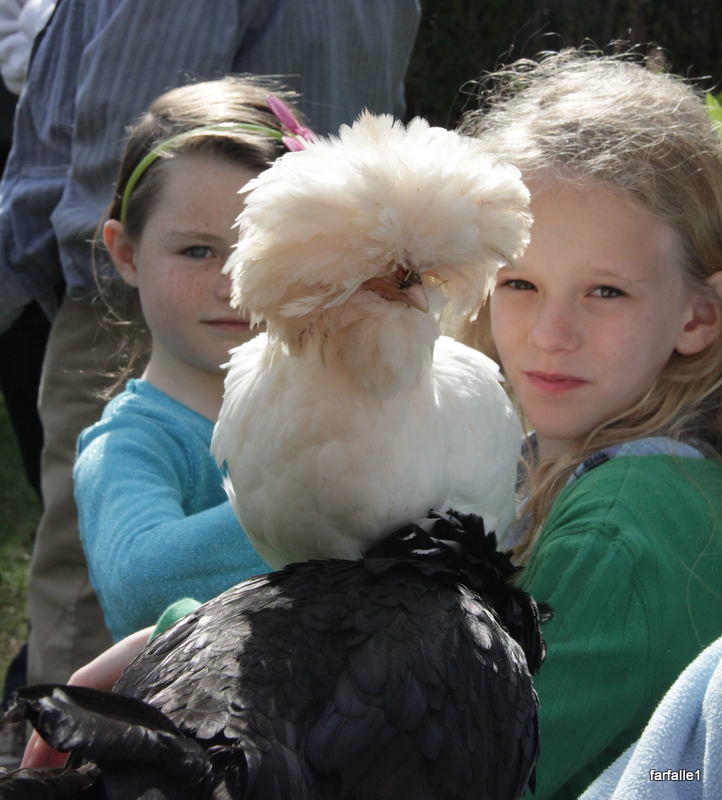
We saw quite a variety of chicken breeds. The most common were probably the Barred Rocks, the Ameraucana, and the Buff Orpingtons. At the Perry house we saw exotic and silly looking polish hens:

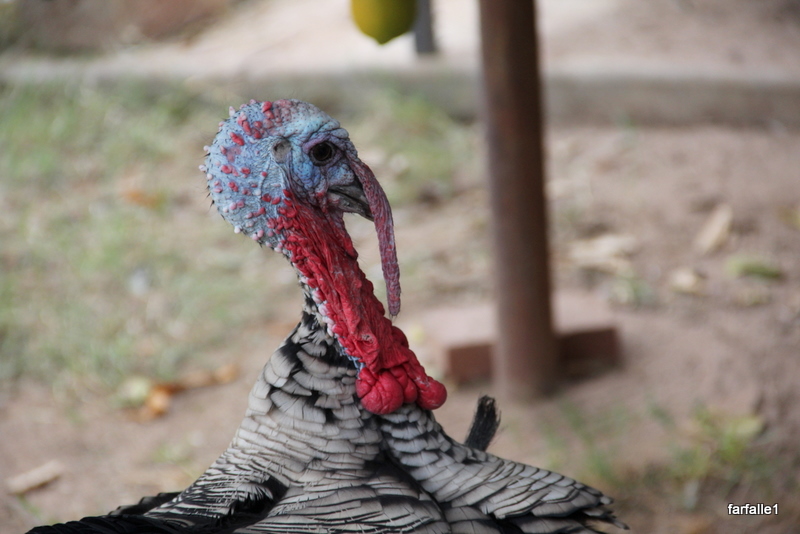
And at the Olesen house we admired a pair of turkeys. They turn blue when they’re upset or uneasy. Probably the combination of all the guests and the proximity to both Thanksgiving and Christmas ruffled their feathers.

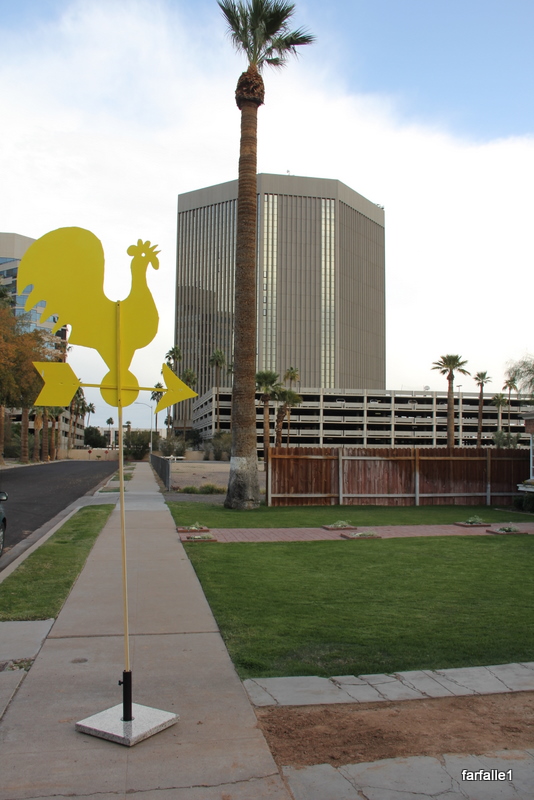
I’d like to say a few more words about the organization of the Tour, because it really impressed us. Each house was identified by a large yellow chicken cut-out sign, which was very helpful as we drove down unknown streets hunting for house numbers.

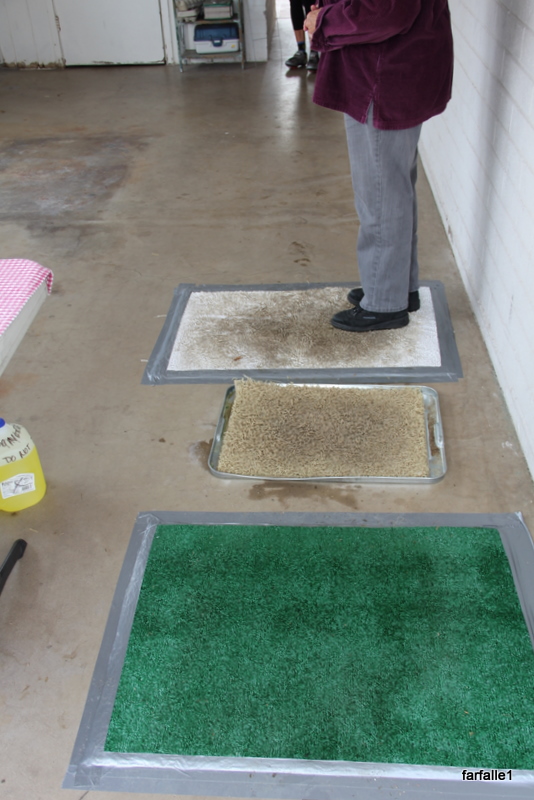
Volunteers staffed a table in front of every house to check visitor bracelets and to ensure that every visitor stepped through the foot bath and used the hand sanitizer.

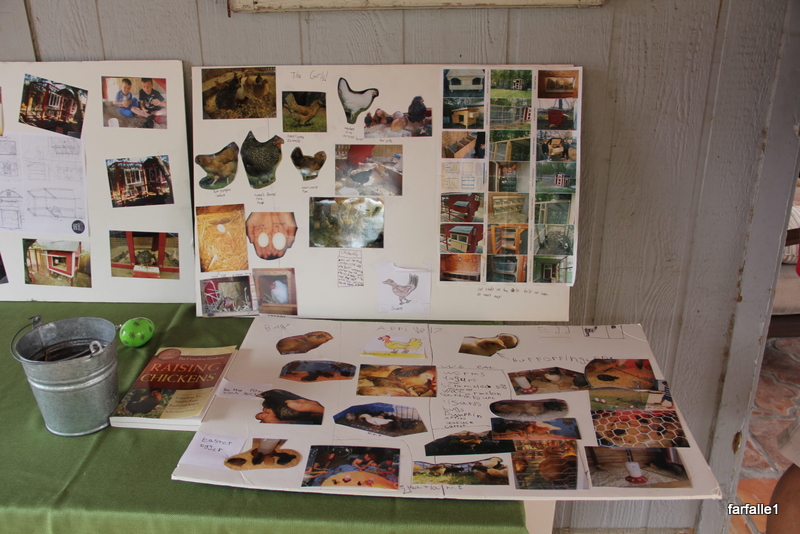
All the owners were on hand to talk about their hens, and many had posters describing the various chicken breeds present. Some of these posters were made by grown-ups, some by children, and at the Williams house the hens did all the work.


If you are interested in more photographs from the Tour de Coops, pop on over here and select the slide show option.

If you are interested in more information on the Valley Permaculture Alliance (“committed to promoting the conscious design of cultivated urban ecosystems to include diversity, stability and resilience”), visit their web-site here, where you can find out more about their mission and the many classes they offer in its service.

Golf in Bavaria

22 Thursday Sep 2011

Posted by farfalle1 in Bavaria, Golf, Holidays, Photographs, Uncategorized

≈ 10 Comments

Tags

Golf in Bavaria, Golf in Germany, Maxlrainer Beer

(Click any photo for a larger, clearer image)

Hi everyone, we’re back.  I may as well ‘fess up right away that our brief toot in Bavaria was primarily a golf/beer vacation.  We had two days of driving, one up, one back; and three days of golf for the Captain (one for me; I decided walking with a camera was more fun).

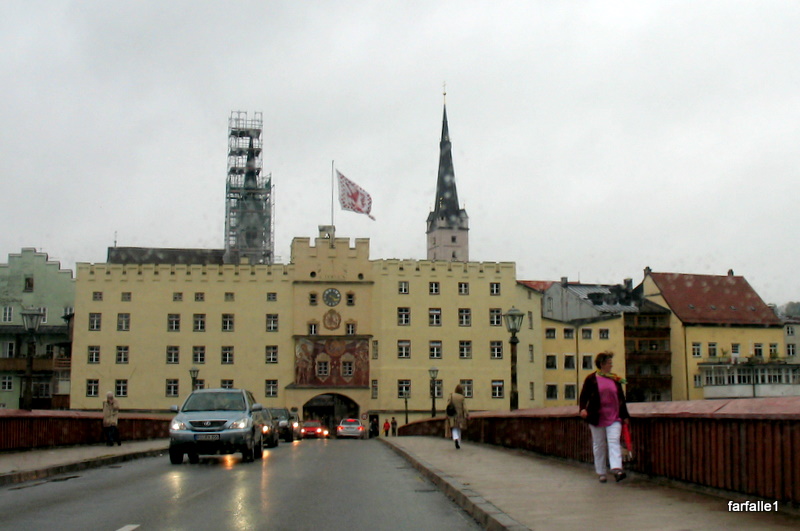
It came about this way:  last year we were in the same general area and stopped in a town called Wasserburg where we enjoyed Maxlrainer Beer for the first time.  In fact we enjoyed it so much that the Captain did a lot of research on it when we got home and discovered – oh joy! – that there is a golf course right next to the brewery.  That pretty much solved the question of how to spend this year’s vacation.  Wasserburg, by the way, is gorgeous in its own right, and has one of the most imposing bridge entries we’ve ever seen to a town.


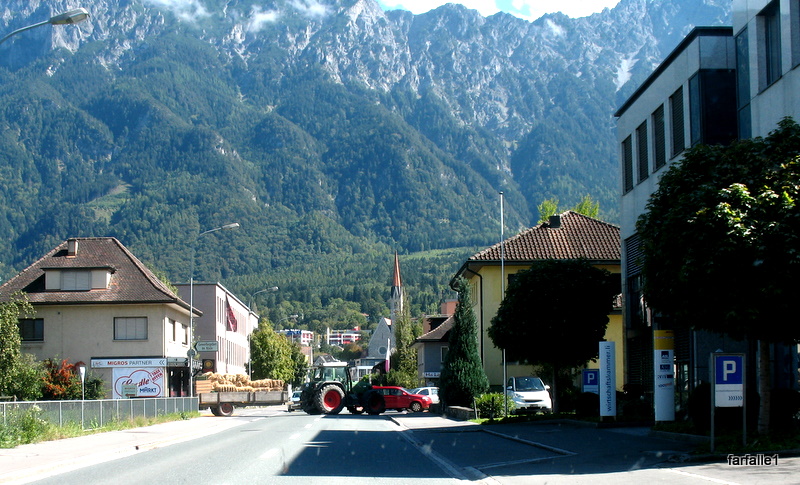
The Captain followed up his research with some emails and further searches on places to stay.  Thus armed we set off, opting to take the long route through Switzerland.  It added an hour or two to the drive but added unbelievably gorgeous scenery, as well as giving us the opportunity to boast about having been in five countries on the one day drive (Italy, Switzerland, Liechtenstein (!), Austria, Germany).  Try doing that from the U.S.A.

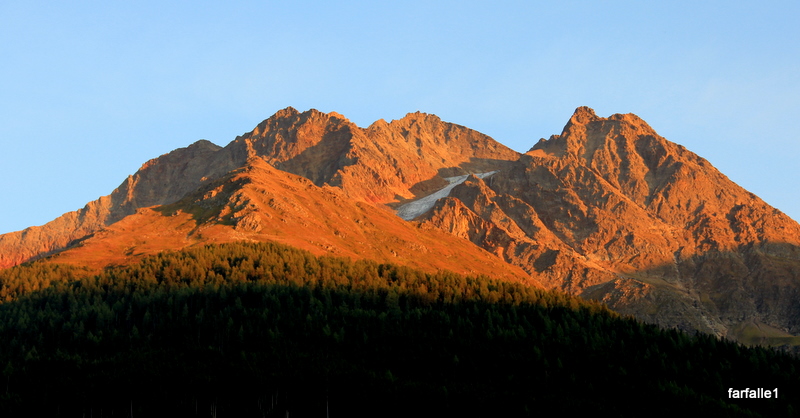
Switzerland is beautiful and ridiculously expensive.  They can’t help it; it’s their franc.  If only they’d joined the European Union they too could be enjoying the financial crisis.  But no, they decided to keep their own strong currency, and boy, does the Euro or American traveler feel it.  A very simple lunch set us back over E 30, and we had to pay E1 to pee.  It’s also mandatory to buy a road sticker for the car (E 40).  It’s good for a year, which is fine if you live near Switzerland or go there frequently, but not of great use to us.  On the other hand, it seems a very reasonable fee when compared to what the Italian Autostrada charges each time we set tires on their macadam.  The Swiss sticker is worth every penny; there are simply not words enough to describe the grandeur, the beauty and the sheer visual pleasure of the Alps.
Liechtenstein is an interesting country.  Double landlocked (a landlocked country completely surrounded by other landlocked countries) it has an area of just over 160 square kilometers, a population of 35,000, and over 73,000 holding companies.  Tax haven, anyone?  Unsurprisingly it has one of the highest standards of living in the world.

Busy city scene in Schaan, Liechtenstein

Austria also requires a road sticker in lieu of tolls.  It cost E 7.90 for a 10-day pass.  And Austria, too, has beautiful alpine scenery.   In fact, the whole drive there and back was pretty spectacular.

Sunset in Pettnau, Austria

The highlights of our three days in the region were 1: Playing golf on gorgeous farm country courses (Schloss Maxlrain, Schloss Elkofen and Gut Thailing).  They all seem to be pretty new and all are beautifully maintained.

Typical view from a golf course fairway

It wasn’t THAT hard!

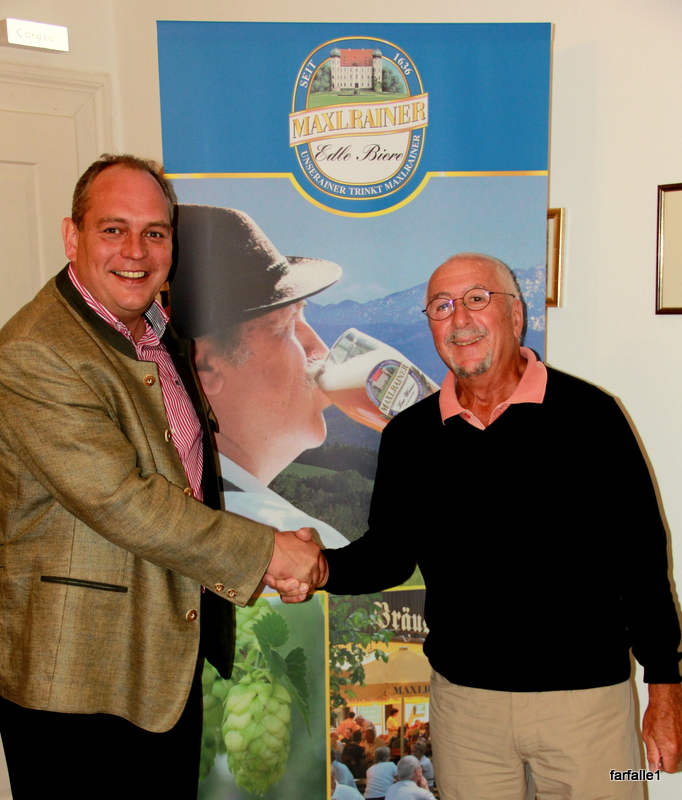
2.  Meeting Herr Braeger, former brewmeister and now CEO of Maxlrainer Beer, who gave us over a half hour of his time and many glasses to take home.  He gave us some history of the area and the brewery as well (brewery, golf course, castle, town – it’s all owned by a Prince and Princess!  Really!!)
Herr Braeger and the Captain

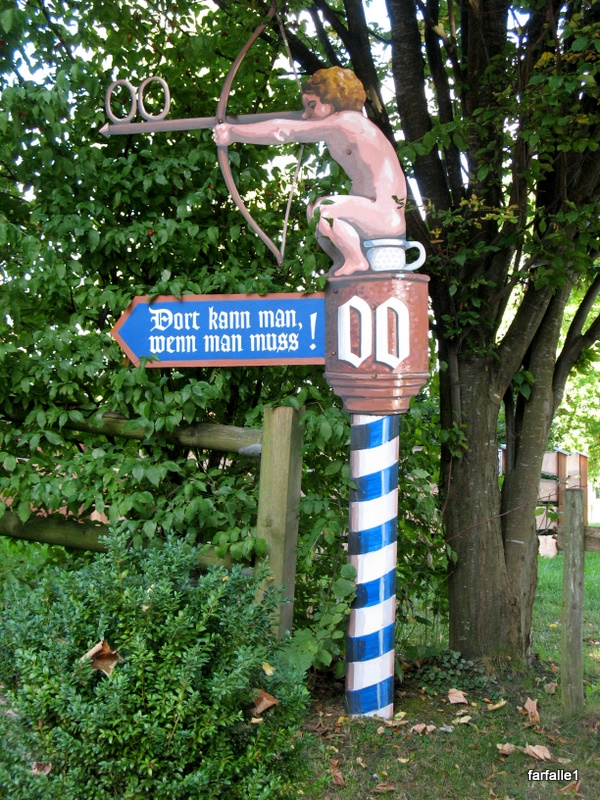
Silly sign at Maxlrainer BrewPub points the way to the loo: “If you must, here you can.”

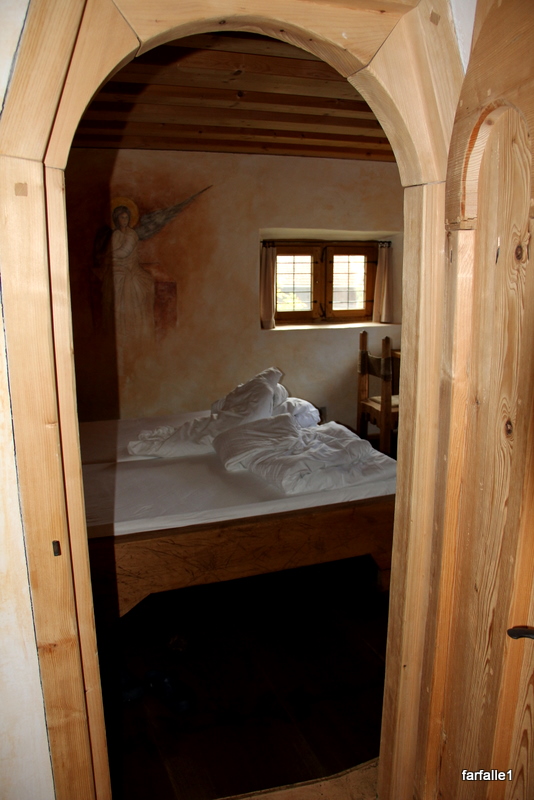
3.  Staying one night at the Pension Egglhof, one of the most understatedly elegant places we’ve ever stayed. It was built five years ago as part of a larger farm operation.  If a nail was used in construction, we couldn’t see it. It gave every appearance of having been built in the old-fashioned way to resemble an old-fashioned structure.  But it had every modern convenience, including a fantastic glass sink and Wi-Fi.
Door to room at Pension Egglhof; note fresco of angel on wall

Behind the Pension…

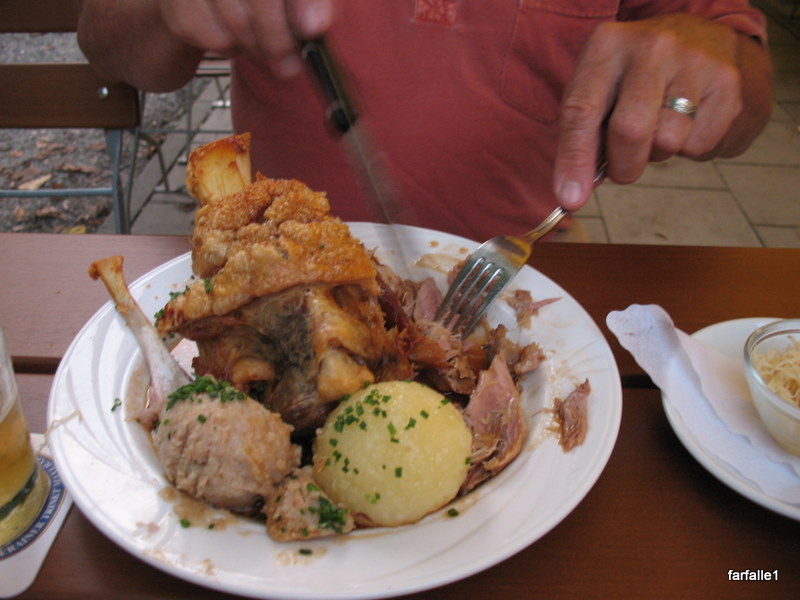
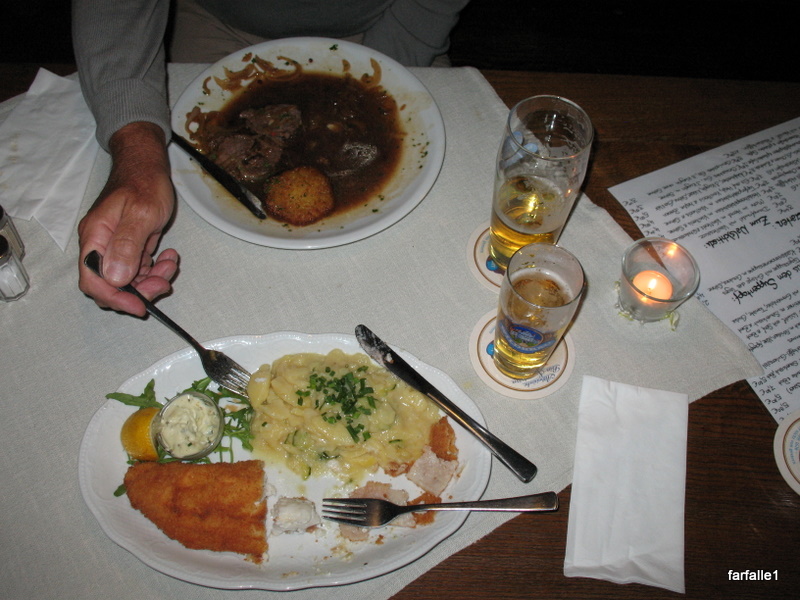
4.  Eating and drinking traditional Bavarian fare.

Schweinshaxe! Out of focus due to excitement.

Fish and… not chips. Brown meat in brown sauce (ox, actually)

5. Asking for directions to a well-hidden gas station and having a map drawn for us on a piece of pine board.

I ended up taking a lot of pictures of the animals and flowers we encountered on the various golf courses.  If you’d like to see some of them, as well as some more shots of the lovely scenery, click here  (click on ‘slide show’ for best viewing).

Much of Bavaria is rural, with hills, farms, lakes and mountain and offers many opportunities for outdoor recreation.  If that’s what you like to do, I can guarantee that you, too, can have an excellent vacation in Bavaria.

Rapallo Castello Attacked and Burned!

04 Monday Jul 2011

Posted by farfalle1 in Holidays, Italian Churches, Italian festas, Italian holidays, Photographs, Uncategorized

≈ 12 Comments

Tags

fireworks, Madonna di Montallegro, Rapallo's Festa Patronale

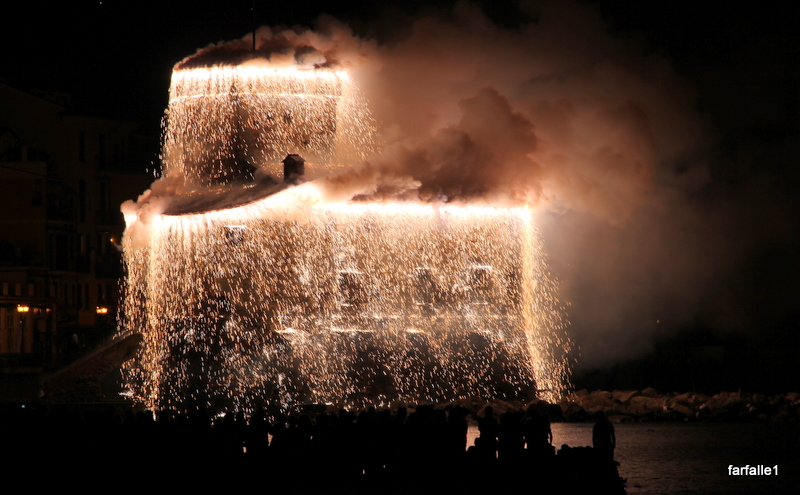
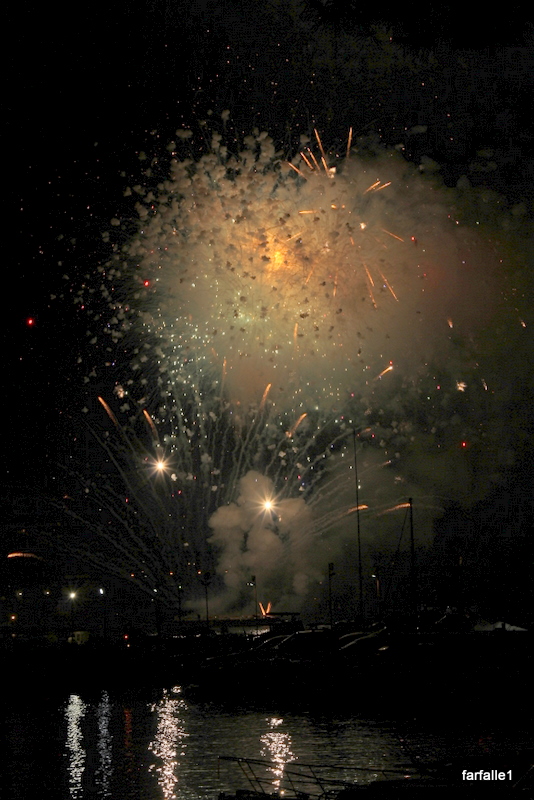
Not really – it’s simply the culmination of three days of pyrotechnic excess at the hands of Rapallo’s Sestieri, all in honor of the Madonna of Montallegro, patron saint of our city.  (The ‘sestieri’ are the six districts of the town – they have no administrative function, but rather are historic and traditional divisions, and serve to provide lively rivalry in the fireworks arena.)

It began at 8 a.m. on Friday morning (July 1) with a half hour of ka-booms provided by all the Sestieri  in honor of the Madonna.  Subsequent fireworks took place at 10:15 p.m. with another Salute to the Madonna (these are a great many very loud explosions, without the fanciful colors and light of fireworks) and at 10:30 p.m. two separate fireworks displays, each provided by one of the Sestieri.

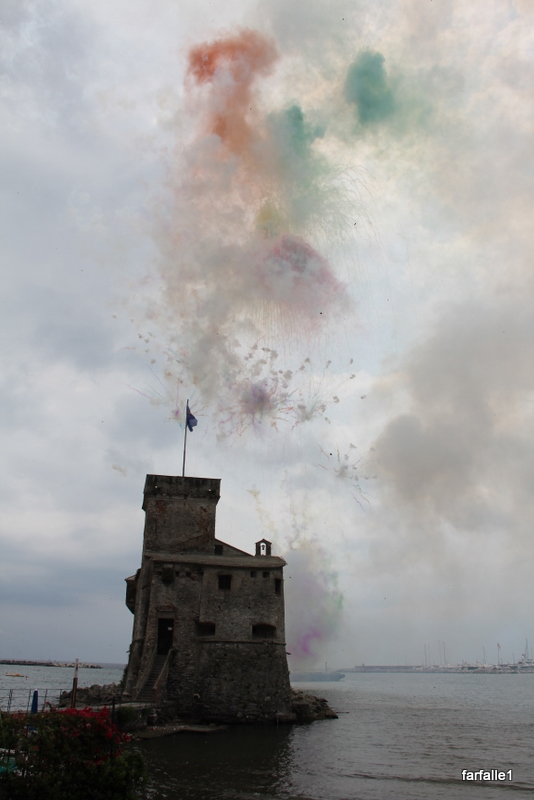
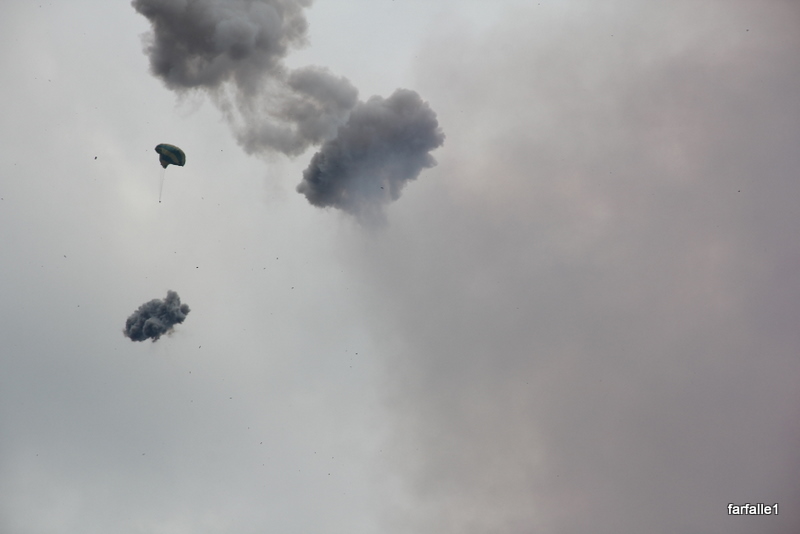
I never thought much of daytime firework shows, but we happened to be in town at mid-day on Saturday when there was a short ‘Sparata del Panegirico”, that is, ‘Praise with Noise.’  The show turned out to be rather pretty and amusing:


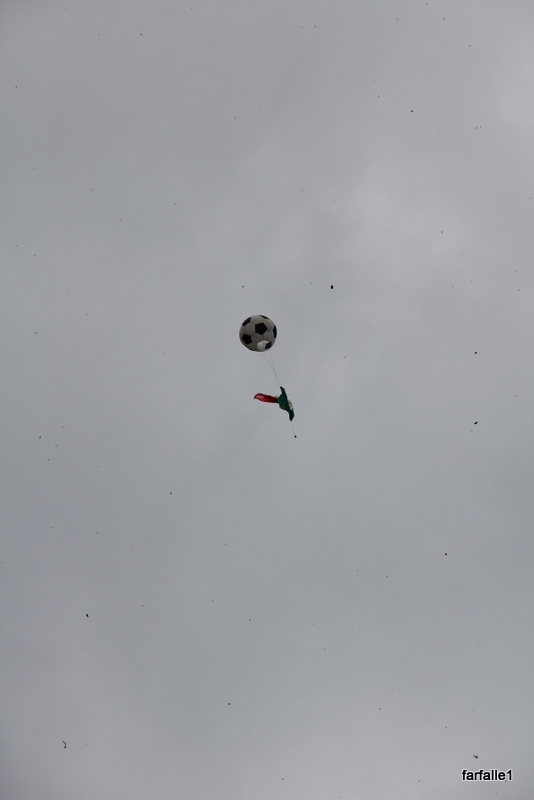
In addition to colorful smoke, the onshore breeze showered us all with bits of cardboard debris, flag-bearing soccer balls and parachutes delivering who-knows-what:


That evening there was another mortar Salute to the Madonna followed by another two fireworks shows, again each the work of two other of the sestieri.

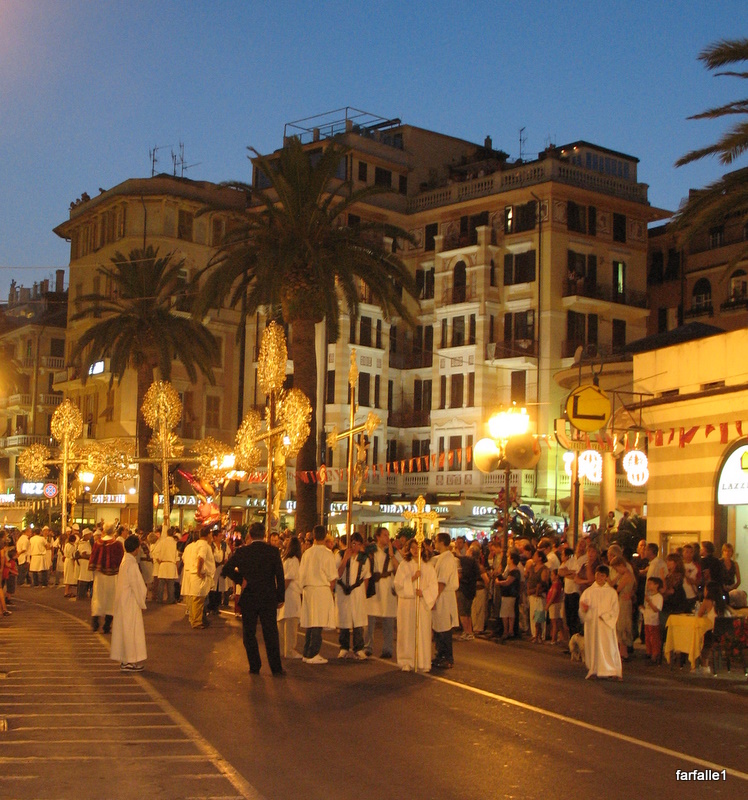
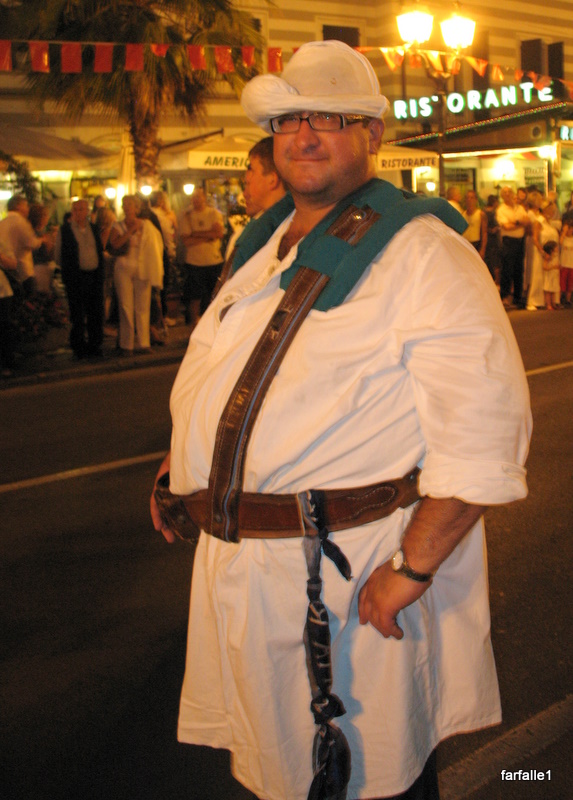
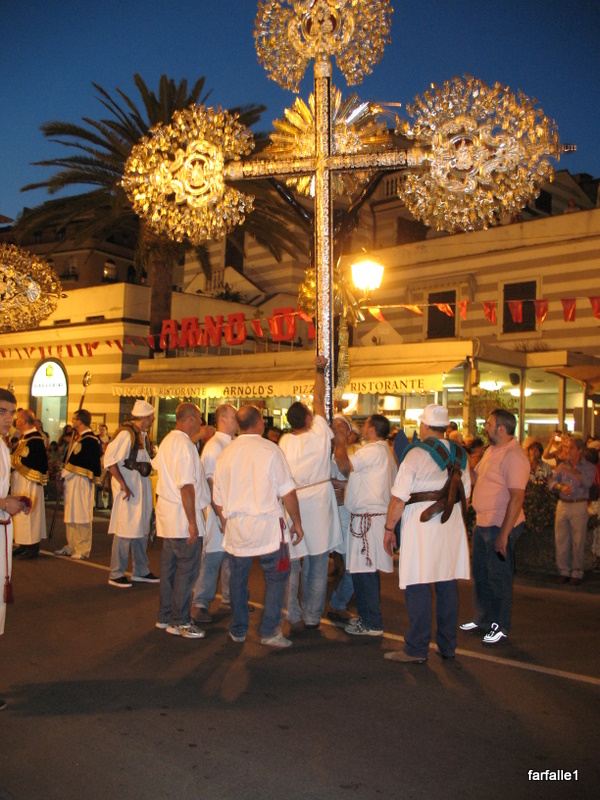
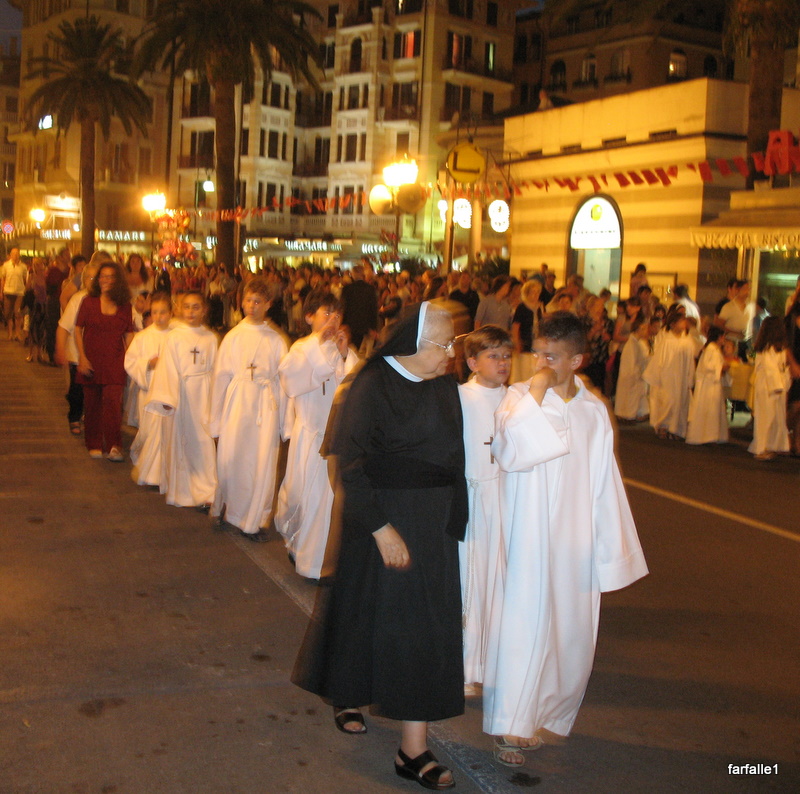
Sunday, the final day of the Festa, gave us a Salute at 10 p.m. followed by the famous Procession of the crosses and the icon from Montallegro. Sadly we arrived too late to see the Procession this year, but here are a few photos from 2009:

Just a few of the many crosses on parade

A very strong man, one of the cross-bearers

The famous icon, barely visible amidst all the silver

Change of porter

The Archbishop

That year’s crop of confirmands

At 10:15 or thereabouts there was another Sparata and short fireworks with the annual Burning of the Castello which you’ve seen in the first photo above.  After an interminable wait there was a lengthy series of Saluti alla Madonna issuing from various public parks around the city, all very loud and exciting.  I have not a doubt in the world that the Madonna heard them and came to watch the last two of the annual fireworks shows that followed.


There are many other activities associated with the annual ‘Solenni Festeggiamenti in Onore di N.S. di Montallegro, Patrona di Rapallo e del Suo Antico Capitaneato,’ principally masses and musical offerings.  It’s a full three days – and it happens every year.  It’s proximity to the 4th of July is a happy coincidence for Americans like us… fireworks and the 4th go together like, well,  hotdogs and beer.  Happy Festa della Madonna!  Happy Fourth of July!

Beigua Park and Campo Ligure

20 Monday Jun 2011

Posted by farfalle1 in Hiking in Italy, Photographs, Uncategorized

≈ 4 Comments

Tags

Beigua Park, Campo Ligure

In my last post I told you about the Abby at Tiglieto.  Following our visit there Elena, Michela and I took a ring hike through the adjacent Beigua Regional Park. Beigua is the largest park in Liguria and covers a variety of terrain from high mountains to streams to woodlands.  We saw just the teeniest corner, but it was enough of a taste to make us want to return for more.  Elena’s guidebook suggested it would take us two hours to complete our walk, but it took us four!  I guess that’s what happens when two of the three hikers are toting cameras.

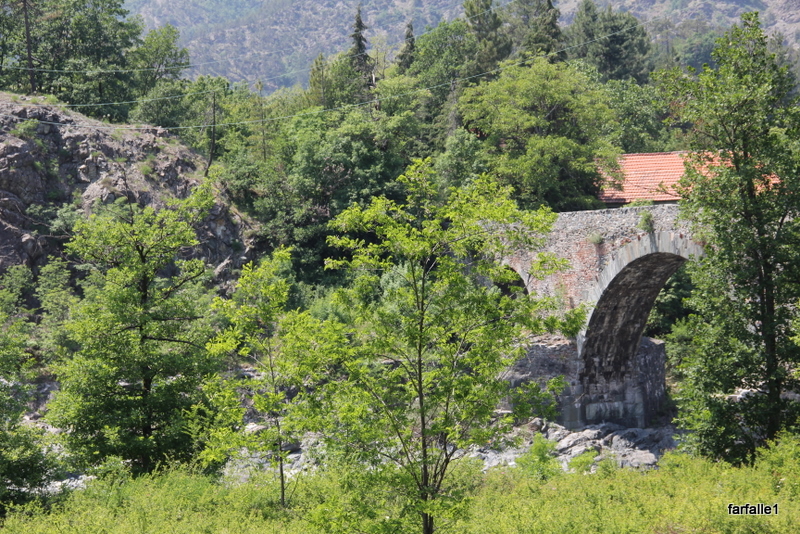
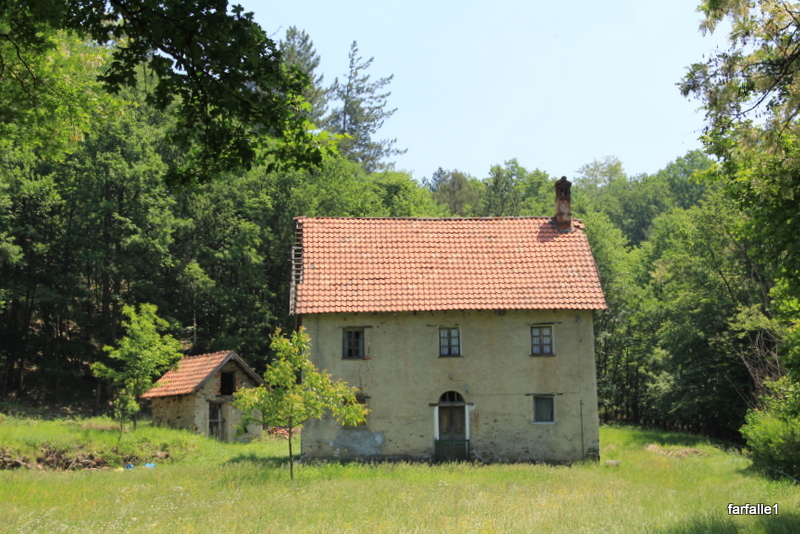
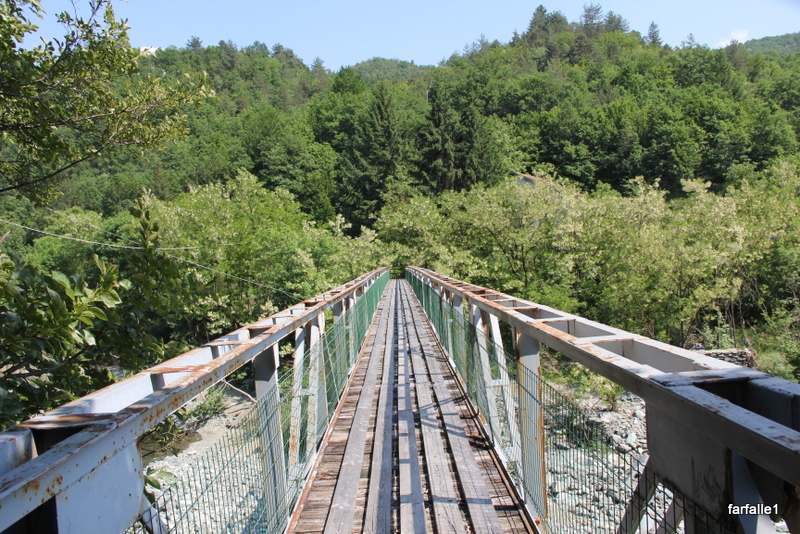
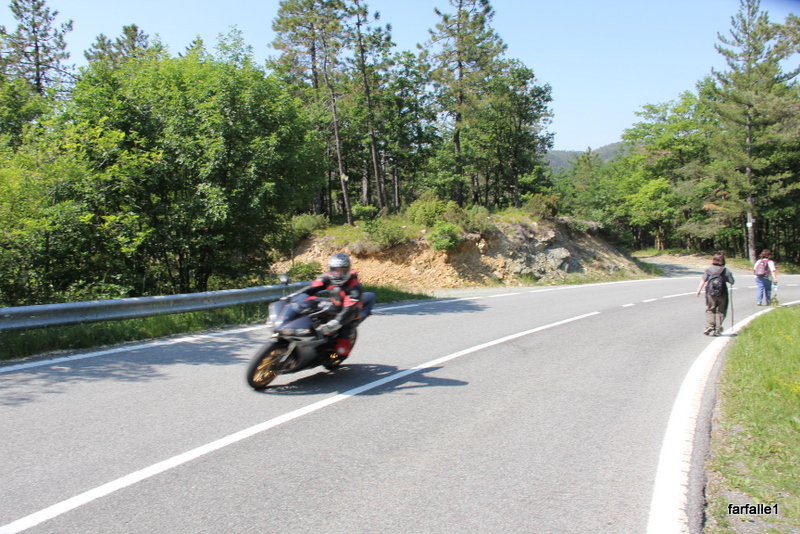
We crossed a number of bridges on our hike, some more rickety than others.  One had enough missing boards to be downright worrisome, but most were in fine repair.   The curvy, hilly roads in the park are a mecca for bicyclists and motorcyclists, of which we saw many on the occasions when our path crossed the road.  Here, in no particular order, are a few photos taken on our hike.

Roman bridge

Beigua's Grand Canyon

An old oven

Old shrine


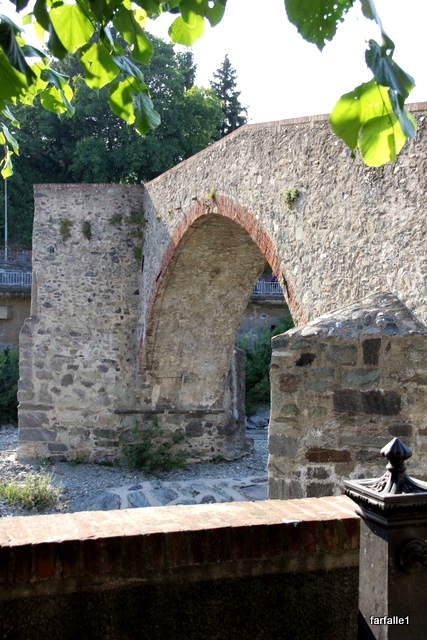
On the way home we stopped in the pretty town of Campo Ligure which features a castle built by Genova’s Spinola family in 1309 (closed by the time we arrived), a spacious central piazza with a 14th century palazzo (also Spinola) and a medieval bridge which has been much restored.

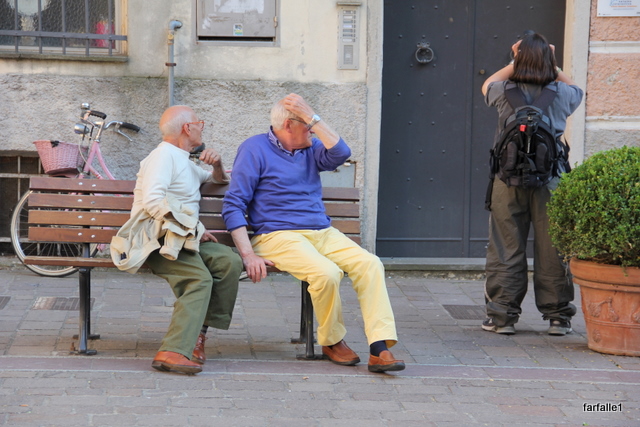
Here are some photos of that brief visit.  An amusing event while we were there: a pair of old gents on a bench in the piazza kept staring at Michela as she took pictures – I couldn’t figure out why.  It turned out they just wanted to be sure she knew about the medieval bridge and would go there to take photos.  In fact, the man in the yellow pants followed us to make sure we did just that!


The highly touted  bridge was built over the River Stura in the 9th century and rebuilt several times from the 18th century onwards:

In spite of the rebuilds it still has a pleasingly romanesque shape.

The old center of the town is laced with narrow medieval alleys:


The castle sits atop the hill behind the town:


I’m not sure what purpose this chimney serves, or why it is so deliciously turned.  If you know, please tell me:

This nonna and her tow-headed grandson were having excellent fun diverting the water from the lion’s mouth to make their own fountain:


Campo Ligure is a perfect example of what makes Italy such a delightful country to explore.  Without be ‘important’ it offers a brief and interesting history lesson, as well as many beautiful little corners to discover.


← Older posts
Newer posts →

Enter your email address to follow this blog and receive notifications of new posts by email.

Join 114 other subscribers

rss

Subscribe in a reader

Search the Blog

A. Useful Links

  • bab.la language dictionary
  • Bus schedules for Tigullio
  • Conversions
  • English-Italian, Italian-English Dictionary
  • Expats Moving and Relocation Guide
  • Ferry Schedule Rapallo, Santa Margherita, Portofino, San Frutuoso
  • Italian Verbs Conjugated
  • Piazza Cavour
  • Rapallo's Home Page – With Link to the Month's Events
  • Slow Travel
  • The Informer – The Online Guide to Living in Italy
  • Transportation Planner for Liguria
  • Trenitalia – trains! Still the most fun way to travel.

C. Elaborations

  • A Policeman’s View
  • Driving School Diary
  • IVA refunds due for past Rifiuti tax payements
  • Nana
  • Old trains and old weekends
  • The peasant, the Virgin, the spring and the ikon
  • Will Someone Please, Please Take Me to Scotland?

D. Good Recipes - Best of the Week winners are starred

  • 'Mbriulata
  • *Baked Barley and Mushroom Casserole*
  • *Captain’s Boston Baked Beans*
  • *Crimson Pie*
  • *Louise’s Birthday Cake*
  • *Melanzane alla Parmigiana*
  • *Penne with Cabbage and Cream
  • *Pizzoccheri della Valtellina*
  • *Pumpkin Ice Cream*
  • *Risotto alla Bolognese*
  • *Rolled Stuffed Pork Roast*
  • *Spezzatini di Vitello*
  • *Stuffed Grape Leaves*
  • *Stuffed Peaches (Pesche Ripiene)*
  • *Swordfish with Salsa Cruda*
  • *Tagliarini with Porcini Mushrooms*
  • *Tagliatelli al Frutti di Mare*
  • *Three P's Pasta*
  • *Tzatziki*
  • 10th Tee Oatmeal Apricot Bars
  • Adriana’s Fruit Torta
  • Aspic
  • Bagna-calda
  • Best Brownies in the World
  • Clafoutis
  • Cold cucumber soup
  • Crispy Tortillas with Pork and Beans
  • Easy spring or summer pasta
  • Fish in the Ligurian Style
  • Hilary's Spicy Rain Forest Chop
  • Insalata Caprese
  • Lasagna al forno
  • Lasagna al Forno con Sugo Rosato e Formaggi
  • Lemon Meringue Pie
  • Leo’s Bagna Cauda
  • Leo’s Mother’s Stuffed Eggs
  • Louis’s apricot chutney
  • Mom's Sicilian Bruschetta
  • No-Knead (almost) Bread
  • Nonna Salamone's Christmas Cookies
  • Pan Fried Noodles with Duck, Ginger, Garlic and Scallions
  • Pesto, the classic and original method
  • Pesto, the modern, less authentic method
  • Pickle Relish
  • Poached pears
  • Poached Pears
  • Polenta Cuncia
  • Recipes from Paradise by Fred Plotkin
  • Rustic Hearth Bread
  • Shrimp and Crayfish Tail Soup
  • Sicilian salad
  • Slow Food Liguria
  • Slow Food Piemonte and Val d'Aosta
  • Spinach with Garlic, Pine Nuts and Raisins
  • Stuffed Eggs, Piemontese Style
  • The Captain’s Salsa Cruda
  • Tomato Aspic
  • Zucchini Raita

E. Blogroll

  • 2 Baci in a Pinon Tree
  • Aglio, Olio & Peperoncino
  • An American in Rome
  • Bella Baita View
  • Debra & Liz's Bagni di Lucca Blog
  • Expat Blog
  • Food Lovers Odyssey
  • Italian Food Forever
  • L’Orto Orgolioso
  • La Avventura – La Mia Vita Sarda
  • La Cucina
  • La Tavola Marche
  • Rubber Slippers in Italy
  • Southern Fried French
  • Status Viatoris
  • Tour del Gelato
  • Weeds and Wisdom

Photographs

  • A Day on the Phoenix Light Rail Metro
  • Apache Trail in the Snow
  • Aquileia and Croatia
  • Birds on the Golf Course
  • Bridge Art
  • Canadair Fire Fighters
  • Cats of Italy
  • Cloudy day walk from Nozarego to Portofino
  • Fiera del Bestiame e Agricultura
  • Football Finds a Home in San Maurizio
  • Hiking Dogs
  • Mercatino dei Sapori – Food Fair!
  • Moto Models
  • Olive pressing
  • Rapallo Gardens
  • Rapallo's Festa Patronale
  • Ricaldone and the Rinaldi Winery
  • Rice Fields
  • Sardegna ~ Arbatax and Tortoli
  • Sardegna ~ San Pietro above Baunei
  • Sardegna ~ The Festa in Baunei
  • Scotland, including Isle of Skye
  • Slow Food 2008 Salone del Gusto
  • The Cat Show and the Light Rail Fair
  • The desert in bloom
  • Trip to Bavaria

Pages

  • Fagioli all’ucelleto

Archives

Recent Posts

  • A Superior Visit
  • Fun at the Ranch Market
  • The MAC
  • Welcome Tai Chi
  • Bingo Fun for Ferals
January 2026
M T W T F S S
 1234
567891011
12131415161718
19202122232425
262728293031  
« Jul    

Member of The Internet Defense League

Blog at WordPress.com.

  • Subscribe Subscribed
    • An Ex-Expatriate
    • Join 114 other subscribers
    • Already have a WordPress.com account? Log in now.
    • An Ex-Expatriate
    • Subscribe Subscribed
    • Sign up
    • Log in
    • Report this content
    • View site in Reader
    • Manage subscriptions
    • Collapse this bar
 

Loading Comments...