• Contact
  • Elaborations
    • A Policeman’s View
    • Driving School Diary
    • Great Danes
    • IVA charged on Tassa Rifiuti
    • Nana
    • Old trains and Old weekends
    • The peasant, the virgin, the spring and the ikon
    • Will Someone Please, Please Take Me to Scotland??
  • Recipes
    • ‘Mbriulata
    • *Baked Barley and Mushroom Casserole*
    • *Captain’s Boston Baked Beans*
    • *Cherry Tart*
    • *Crimson Pie*
    • *Louise’s Birthday Cake*
    • *Melanzane alla Parmigiana* – Eggplant Parmesan
    • *Penne with Cabbage and Cream
    • *Pizzoccheri della Valtellina*
    • *Pumpkin Ice Cream*
    • *Risotto alla Bolognese*
    • *Rolled Stuffed Pork Roast* on the rotisserie
    • *Shrimp and Crayfish Tail Soup*
    • *Spezzatino di Vitello*
    • *Stuffed Grape Leaves*
    • *Swordfish with Salsa Cruda*
    • *Tagliarini with Porcini Mushrooms*
    • *Tagliatelli al Frutti di Mare*
    • *Tzatziki*
    • 10th Tee Apricot Bars
    • Adriana’s Fruit Torta
    • Artichoke Parmigiano Dip
    • Best Brownies in the World
    • Clafoutis
    • Cod the Way Sniven Likes It
    • Cold Cucumber Soup
    • Crispy Tortillas with Pork and Beans
    • Easy spring or summer pasta
    • Fagioli all’ucelleto
    • Fish in the Ligurian Style
    • Hilary’s Spicy Rain Forest Chop
    • Insalata Caprese
    • Kumquat and Cherry Upside Down Cake
    • Lasagna Al Forno con Sugo Rosato e Formaggi
    • Lemon Meringue Pie
    • Leo’s Bagna Cauda
    • Leo’s Mother’s Stuffed Eggs
    • Louis’s Apricot Chutney
    • Mom’s Sicilian Bruschetta
    • No-Knead Bread (almost)
    • Nonna Salamone’s Famous Christmas Cookies
    • Pan-fried Noodles, with Duck, Ginger, Garlic and Scallions
    • Pesto
    • Pesto
    • Pickle Relish
    • Poached Pears
    • Polenta Cuncia
    • Pumpkin Sformato with Fonduta and Frisee
    • Rustic Hearth Bread
    • Sicilian Salad
    • Soused Hog’s Face
    • Spotted Dick
    • Swedish Tea Wreaths
    • The Captain’s Salsa Cruda
    • Tomato Aspic
    • Vongerichten’s Spice-Rubbed Chicken with Kumquat-Lemongrass Dressing
    • Winter Squash or Pumpkin Gratin
    • Zucchini Raita

An Ex-Expatriate

~ and what she saw

An Ex-Expatriate

Category Archives: Piemonte

Cows Come Home… Again!

20 Saturday Sep 2014

Posted by farfalle1 in Alps, Animals in Italy, Italian festas, Italian food, Italian men, Italy, Piemonte, Portraits of people, Uncategorized

≈ 4 Comments

Tags

Antique tractors, Cowherding, Cows, Fera 'd San Bartrame', Oropa, Tractors


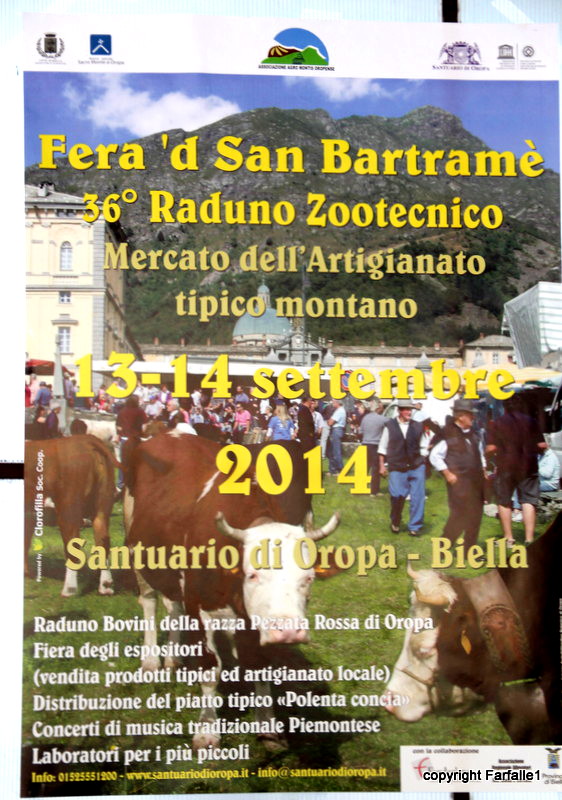
fair poster

Those who are faithful readers of this blog know there are few things that give us more pleasure than a day spent with the cows (read about last years outing here). Last weekend we enjoyed just such a day, made even better by being with dear friends.

The Santuario di Oropa sits high in the pre-Alps of Piemonte (region of Biella) at an altitude of some 1,100 meters (3,610 + feet). Its long history dates back in lore to the 4th century AD. In fact the first mention of simple churches in Oropa, dedicated to the Saints Mary and Bartholomew, occurred in the 13th century. (San Bartrame’ is Piemontese dialect for St. Bartholmew.) The present series of buildings were begun in the first years of the 17th century, with work continuing to this day. The most recent basilica was consecrated in 1960.  Our friends told us there is a saying in Piemonte to describe something that is never finished – ‘it’s another Oropa.’ There is a good, brief history of the Sanctuary, which is an important pilgrim destination here (in English).

However, it was not as pilgrims that we visited the sacred site – it was as cow fanciers, in particular to get to know the Pezzata Rossa di Oropa, one of sixteen minor cattle breeds recognized by the Italian Ministry of Agriculture. The standard for the breed calls for a ‘red’ coat with white spots. In fact, there have been breeding changes over the years and, in addition to the standard, there are now all white Pezzate and black and white Pezzate.

During the summer months the cows live with their herders on the high fields of the pre-Alps; it is too cold for them to remain there through the winter, and the Festa we attended was held to celebrate their return to civilization. The herds are brought down a very narrow road and driven into a large field where they are tied by chains to a flimsy wire fence.

pretty cowherd

That’s not a cane in the young woman’s hand, that’s the rather delicate shepherd’s crook that all the herders carry. Every now and then when a cow goes in the wrong direction she receives a little whack on the fanny with the crook along with a shout telling her what to do. Getting the cows to approach the fences in the field sometimes took a bit of effort. The crook was freely employed, as was simple strength.
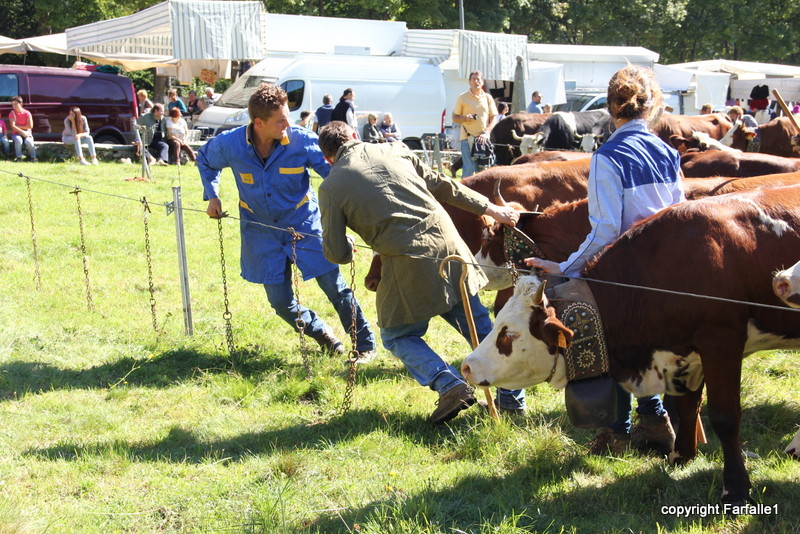
pezzata rossa di oropa chaining them up-003There was a delightful amount of confusion while the herds were being organized – some of the cows simply did not want to stand still in a row and would try to wander off.
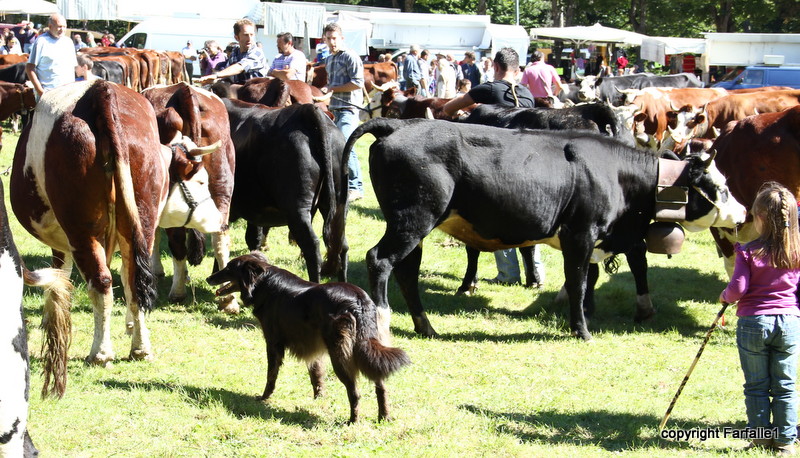
watchful dog and young cowherd

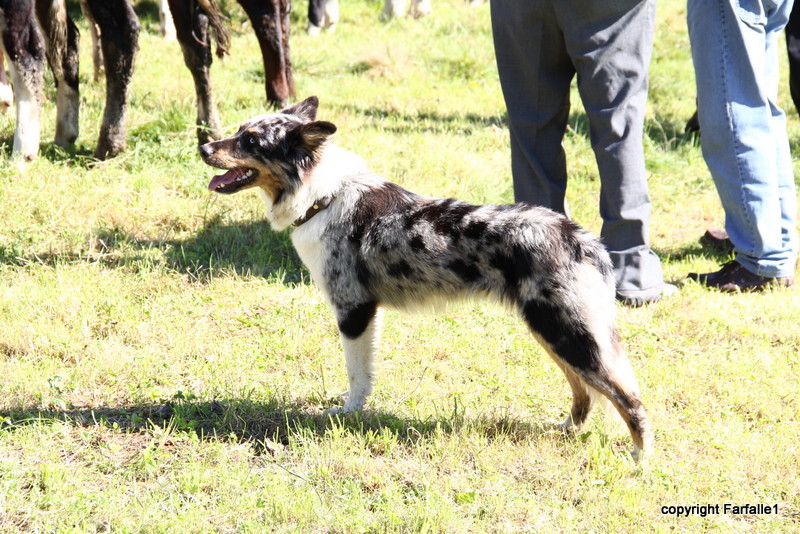
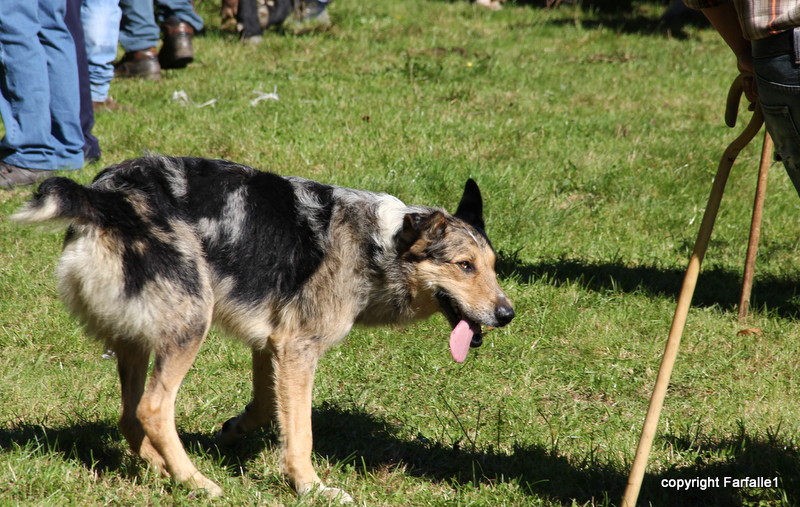
As in Scotland, dogs are central to controlling the herds, though the dogs at Oropa were very different than the border collies we have seen demonstrating herding techniques (sheep! geese!!). We asked one of the herders what the breed is and the succinct answer was, ‘bastardi.’ They certainly were bright and attentive to their work, though sometimes they looked a little goofy.
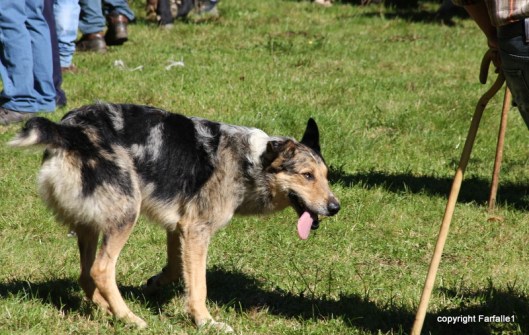
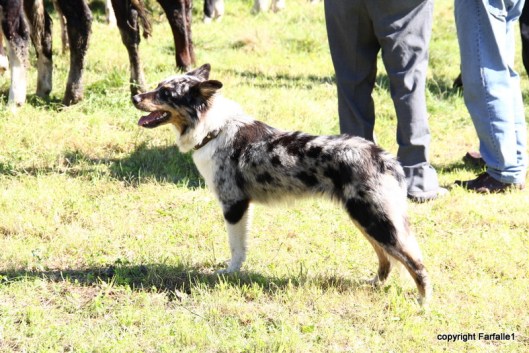
brindle dog with tongue out

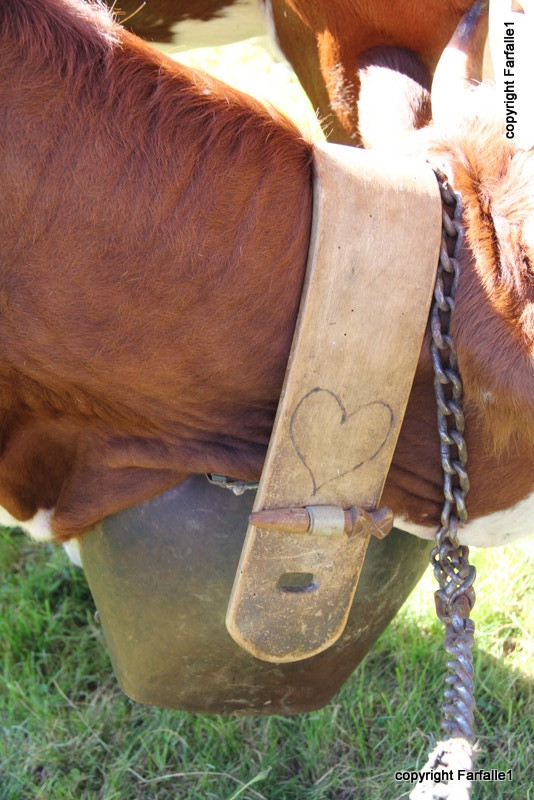
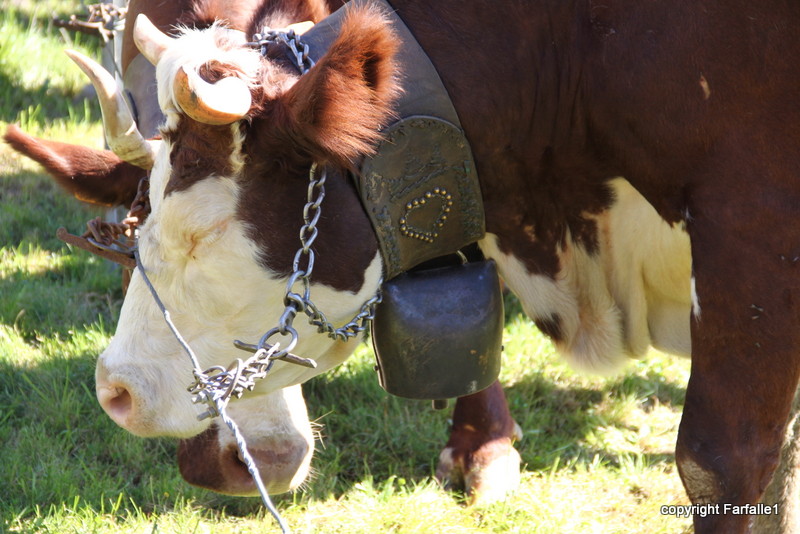
brindle cow dog-001Each herd wears its own identifying collar for the occasion. The old collars are made of wood, new ones of leather, and many are ornately decorated.

pezzata rossa di oropa leather collar pezzata rossa di oropa old wooden collar-001pezzata rossa di oropaMost of the cows were cows, but there was the occasional bull. This one was pretty randy, but he was wearing a home-made prophylactic device. Inelegant, perhaps, but effective

pezzata rossa di oropa finding shade

Cows weren’t the only beasts being brought down from the hills. There was a fine collection of sheep, interspersed with goats, that were put in a field across the road from the cows. I should mention that almost every single animal was wearing a bell – what with the shouting of the herders, the clanging of the bells and the bellowing and bleating of the animals there was a fine cacophony.
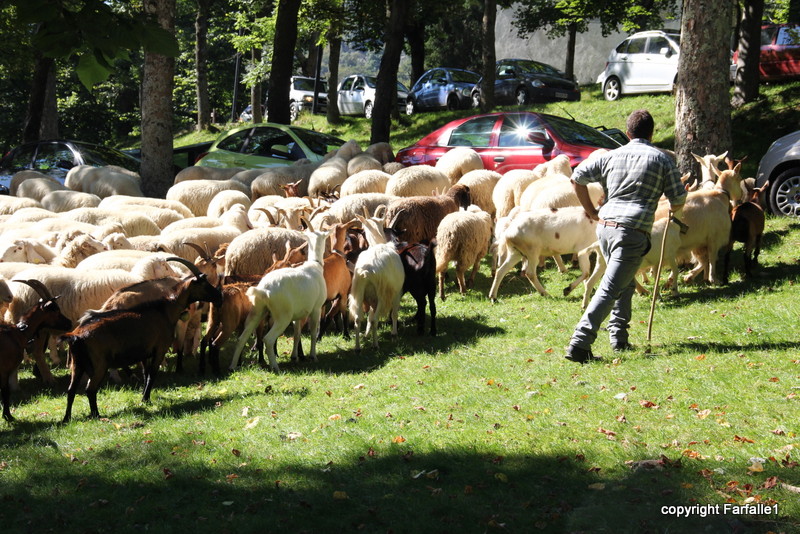
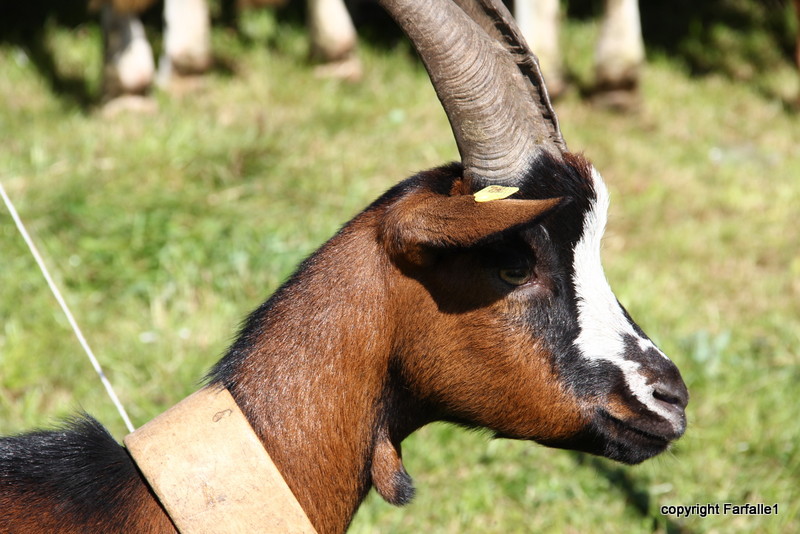
corraling the sheep and goats sheep and babygoatHaving been to Egypt in the last post here I couldn’t help but think that this pair was from that ancient land – such fine profiles.
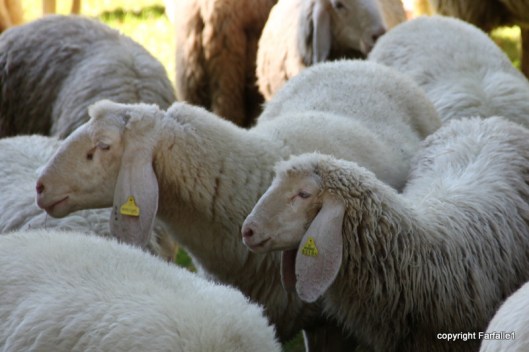
sheep egyptian profileYou may be wondering why the cows were all tied up in that big field. The reason is that each herd was judged, and a prize awarded to the herd deemed to be in the best condition after a summer spent up on the mountain. I’m ashamed to say I was thinking about lunch and missed the prize presentation, but I did get to the stand in time to catch a glimpse of the winners. It seemed to be a rather low-key part of the event.

prize winners

There was ample opportunity for the many photographers present to take pictures of cows – and you can’t tell me the cows weren’t posing.
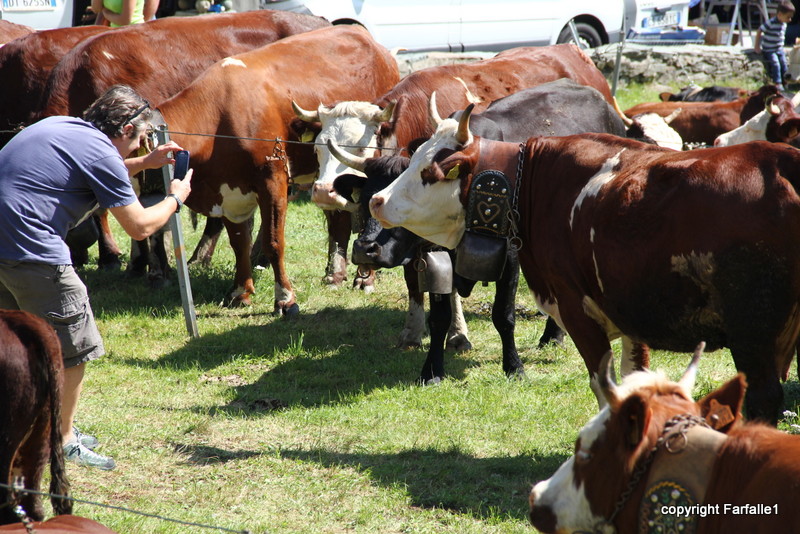
pezzata rossa di oropa posing for photographer

Did someone mention lunch?? It wouldn’t be an Italian festa without a good meal. The featured specialty was polenta cuncia, one of the world’s great comfort foods (you can find a recipe for it here). Basically it is a fairly finely ground corn meal cooked with either water or stock with the local cheese, toma, stirred in at the end. It is rich, hearty and extremely satisfying. The Oropa iteration was dressed with a couple of tablespoons of melted butter, a fine improvement. It took three ladies to serve the polenta – one to glop it in a bowl, one to add the butter, and one to stick in a spoon and hand it to the hungry pilgrim, along with a napkin.
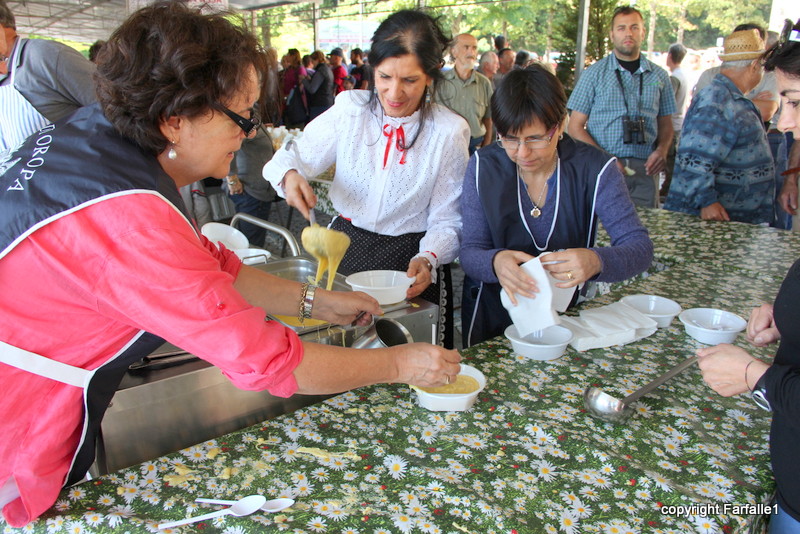
serving polenta-007polenta cuncia with black butter-001It was fabulous, and after a morning of chasing cows and sheep it was most welcome, especially washed down with the earthy local red wine.

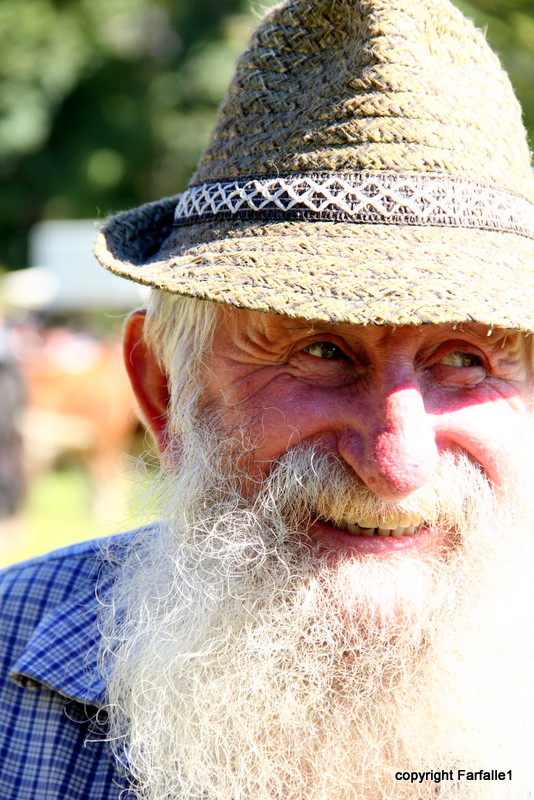
For me one of the best parts of an event like this is looking at the people. The cowherds were extremely kind in letting me take their pictures. These are men whose families have probably lived in Piemonte for centuries.
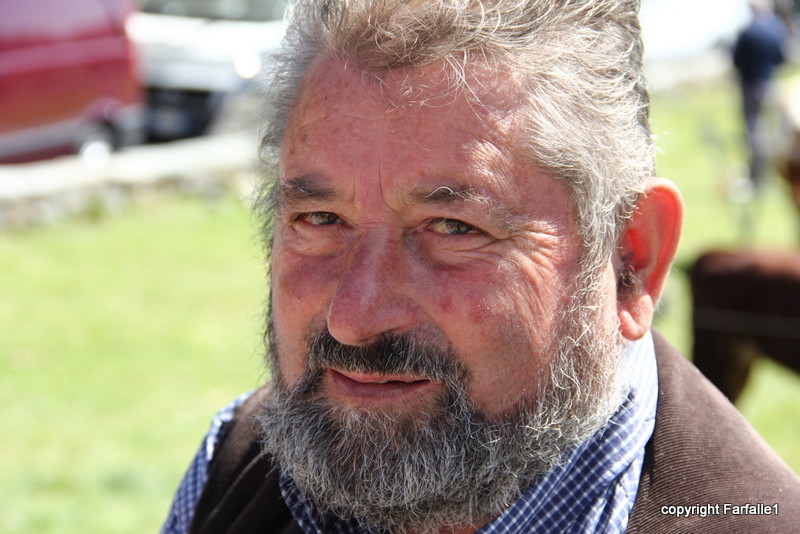
cowherd-001

cowherds cowherdThere was a lot more going on during the festa – a large array of vendors had local (and some not so local) crafts for sale; there was an excellent exhibit of tractors, old and new; there was a photo exhibit in a tram car that for decades carried sick people from Biella to Oropa for blessings and cures; in the church there was a display of preseppe (creche scenes) from all around the world (my favorite: the one from a nearby village made from marzipan); there was music. If you would like to see some pictures of these things, in addition to more pictures of the animals, please click here (for a slide show click the icon in the upper right that looks like a couple of small rectangles).

The weather was glorious, one of the few sunny days Oropa enjoys each year; it was warm, the crowd was happy, and the animals seemed to be too. It was just so much fun – and exhausting – for everyone.
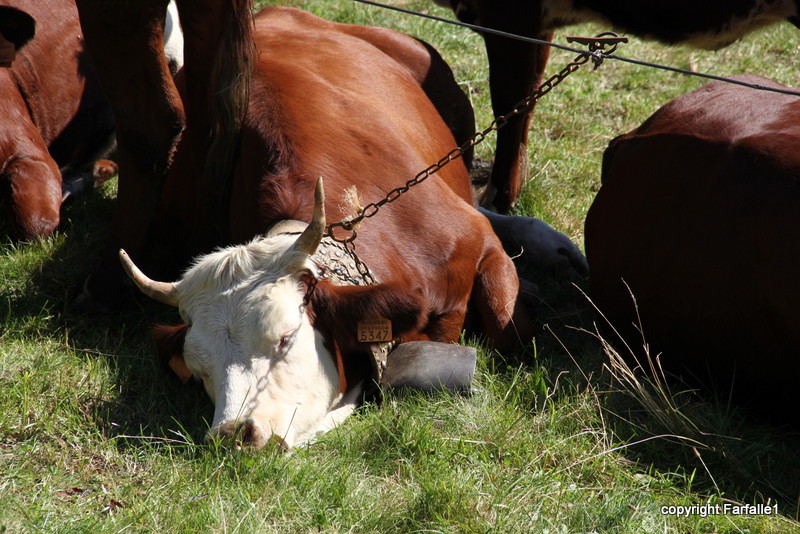
pezzata rossa di oropa tired

THE END

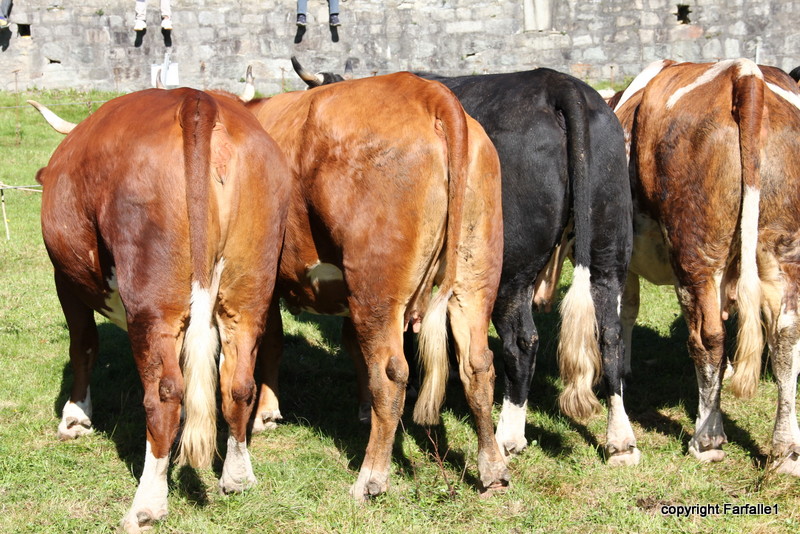
cow backsides

Il Giro

01 Sunday Jun 2014

Posted by farfalle1 in Alps, Piemonte, Sports in Italy, Uncategorized

≈ 6 Comments

Tags

Bicycle racing, Giro d'Italia

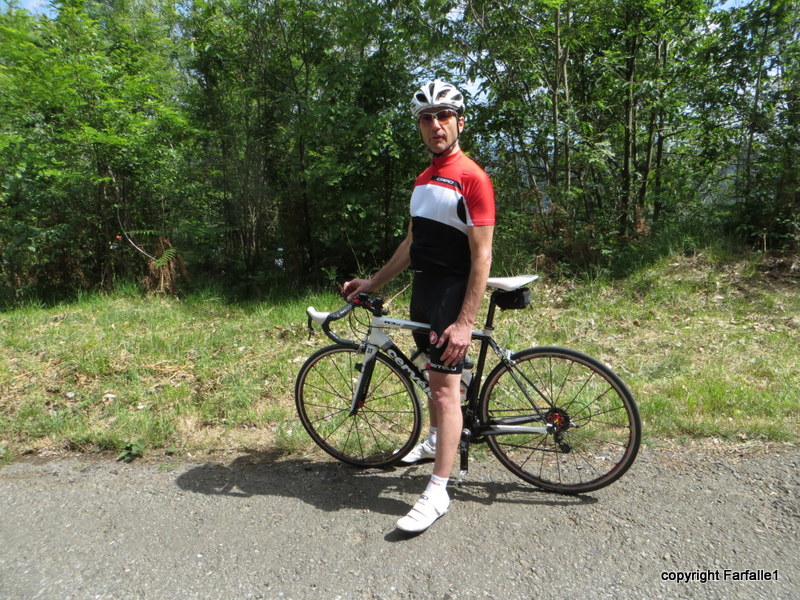
richard and his bike-002Meet Richard, a friend from the U.S. who is passionate about bike riding – to the point that he brought his bike to Italy from the States to ride some of the routes the professionals would be riding only days later in the Giro d’Italia. The Giro is a staged bike race that takes place over, usually, 21 days, across plains and over Alps. It is a part of the Grand Tour of Bicycle Racing, along with the Tour de France and the Vuelta a’ Espana. The race has a long and interesting history; the first race was run in 1909, and was started by the Gazzatta dello Sport, a newspaper printed on pink paper, which accounts for pink being the official color of the race. There are various classifications within the race: General, Mountain (for climbing experts, blue jersey), Points (for sprinters, red jersey), Young Rider (under 25 years, white jersey) and Team (covered with logos jerseys).  Points are awarded each day in each classification. The cyclist who wins the General classification each day (that is, with the lowest aggregate time) gets to wear the famous Pink Jersey the next day. The overall winner of the race is the person who wins the total General classification.

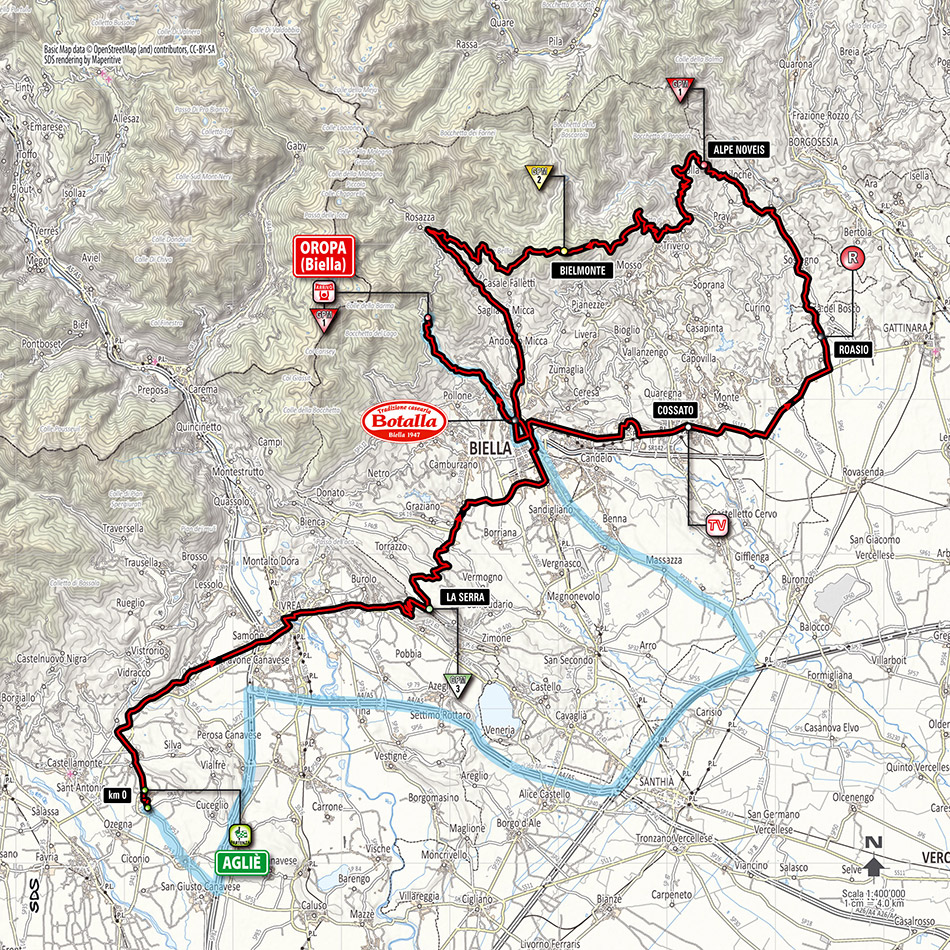
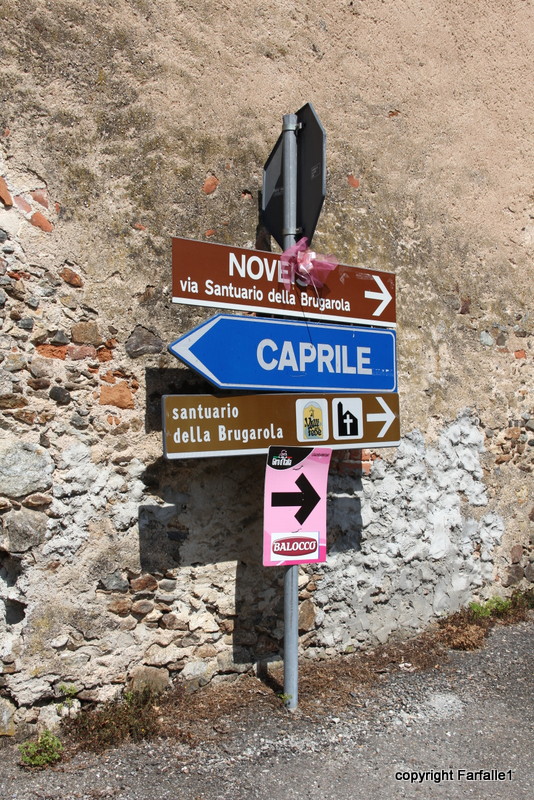
As luck would have it, the 14th day of the Giro passed through the town where our friend Leo lives in Piemonte (frequent readers of this blog will have met Leo through his recipe for Bagna Cauda and his mother’s stuffed eggs. He was also instrumental in procuring the materials for Speedy’s tandoor.)  Anyway… Leo knows people, and he was able to get a pass that allowed us to drive up one of the steep mountain roads to the little town of Caprile whence we could watch the Giro pass by at speeds where you can actually see the athletes. On the flats, as in Rapallo several years ago, they tend to be a blur. Here’s the route of day 14:

giro 14th day

Rated amongst the most difficult stages of the race this year, it’s a grinding 164 Kilometers (102 miles), beginning at an altitude of 315 meters (1,033 feet) in Aglie, climbing to Alpe Noveis at 1110 meters (3,642 feet), descending back down to Biella at 420 meters (1,378 feet) and finishing at Oropa, a large Catholic devotional complex, at 1110 meters (3,937 feet). Alpe Noveis has figured prominently in the outcomes of several Giri as it presents riders with some very difficult climbing challenges. Richard rode up there from Leo’s house in Sostegno (!) – we drove and parked in Caprile, then walked about 2 km up the road to a good vantage point.

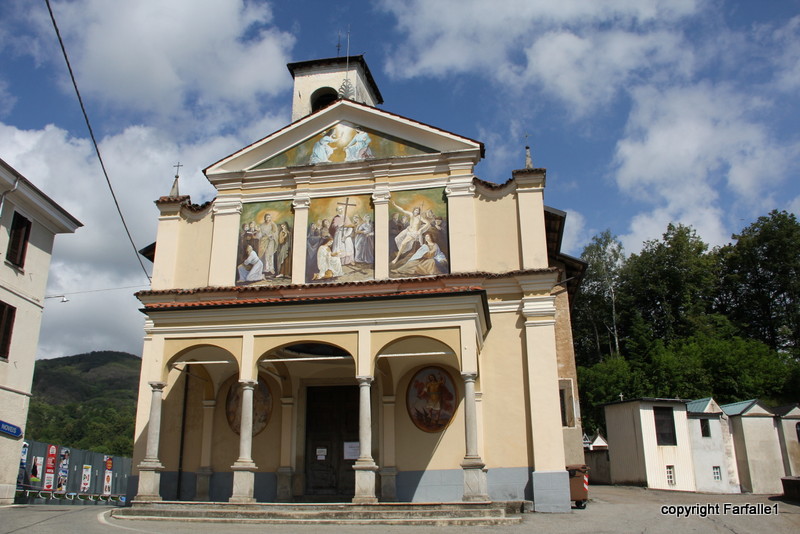
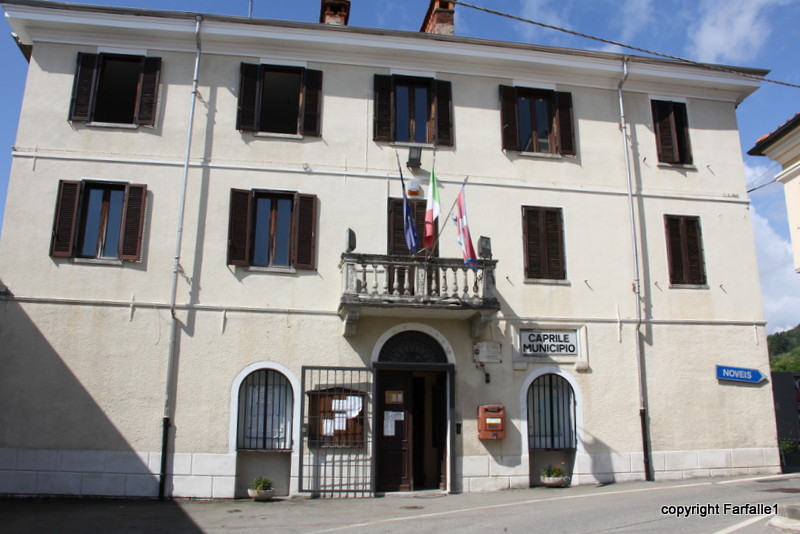
Here’s the pretty church in Caprile where we parked. The Municipal building, source of our all-important pass, is on the left.caprile church-001 caprile municipio-001

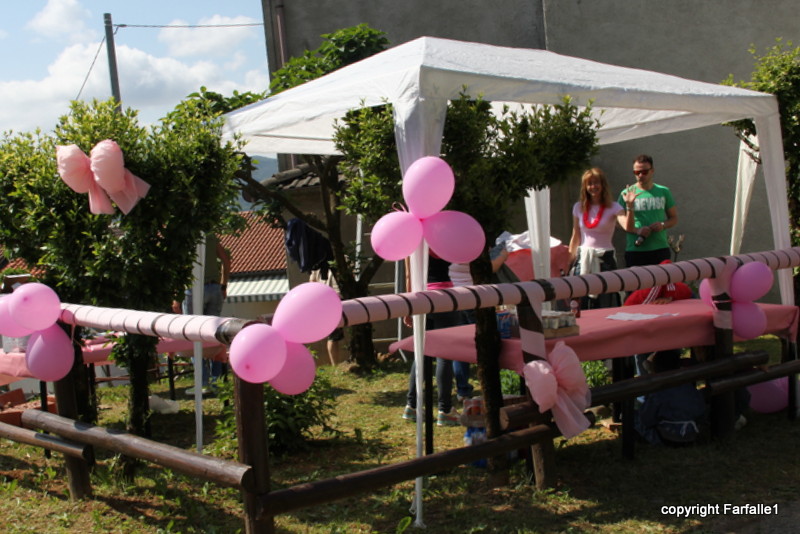
All along the race route there were pink balloons, pink signs, pink bows.

signs It wouldn’t be an event in Italy without a food stand. On our short walk we passed two, of which this was the smaller and better decorated.food stand A sign on the church roof?  Yes! There were two helicopters in constant attendance on the race providing real-time non-stop television coverage. They flew quite low, and I’m sure Caprile’s cheerful welcome was quite legible to those on board. The sign reads, Caprile greets (welcomes) The Giro.welcome banner for the helicopters

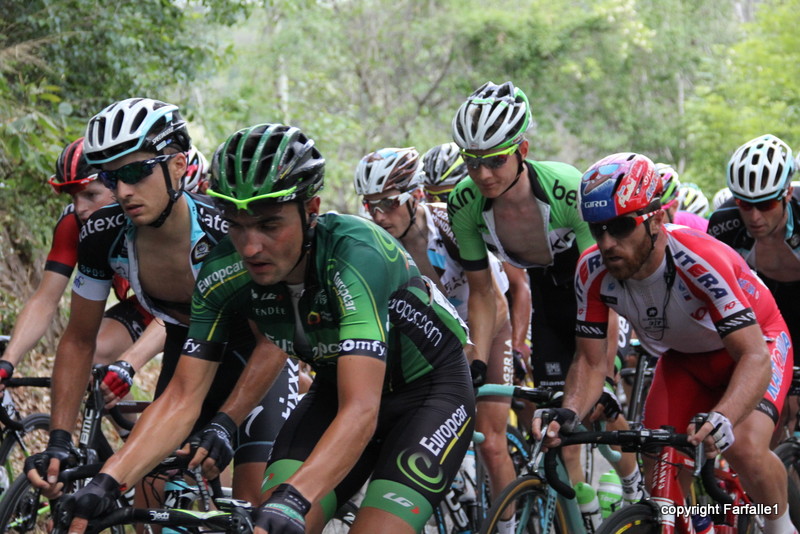
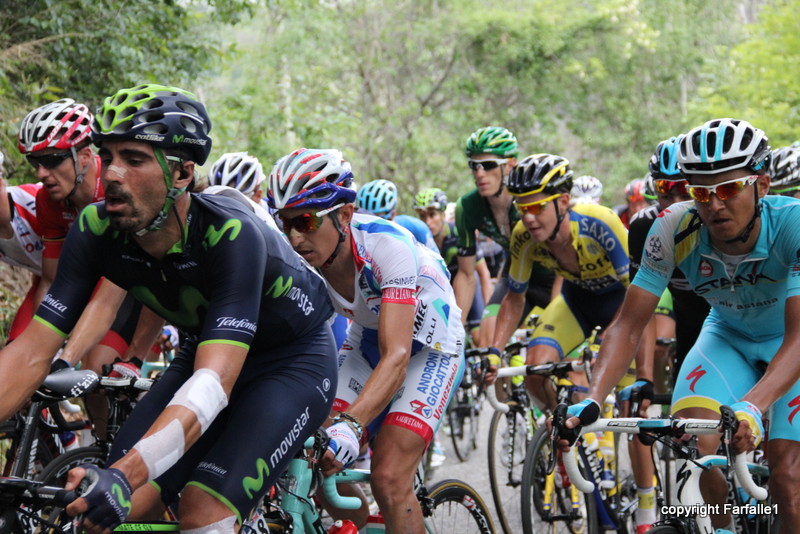
We got to our viewing spot about 11 a.m.; the race was due to pass at about 1:30. Somehow, with a picnic and lots of other race viewers, the time passed quickly. Bike riding is wildly popular in Italy. We frequently see cyclists pumping up the steep hill outside our house, all dressed in spandex so they look like bees, chatting away comfortably, as if a steep ascent were the easiest thing in the world to do.  Many cyclists, like our friend Richard, like to ride sections of the Giro before the actual race. Here are just a few of the literally hundreds that rode past us:

more bikersYou might notice they’re using the whole road. It’s not just because it’s race day and the road is closed to traffic. Here in Italy bicycle riders take whatever part of the road they need, and if it happens to be your whole lane, then you just have to trail behind them until there’s a place to pass. Can you imagine what would happen in the U.S. to bicyclists with habits like that? Honk!! Splat!!!
As the hour approached the excitement level grew. We could hear the blades of the helicopters thumping in the distance, and suddenly there were no more amateur riders, only official seeming cars and motorbikes.

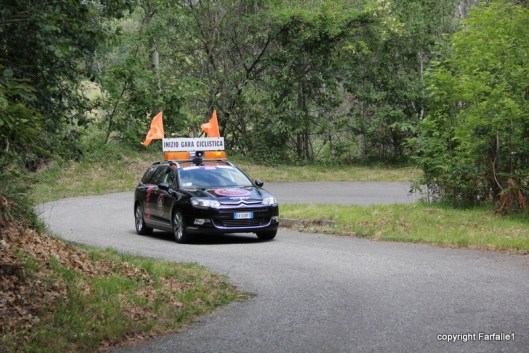
At Last! The car that announced the beginning of the race!

Inizio gara ciclistica

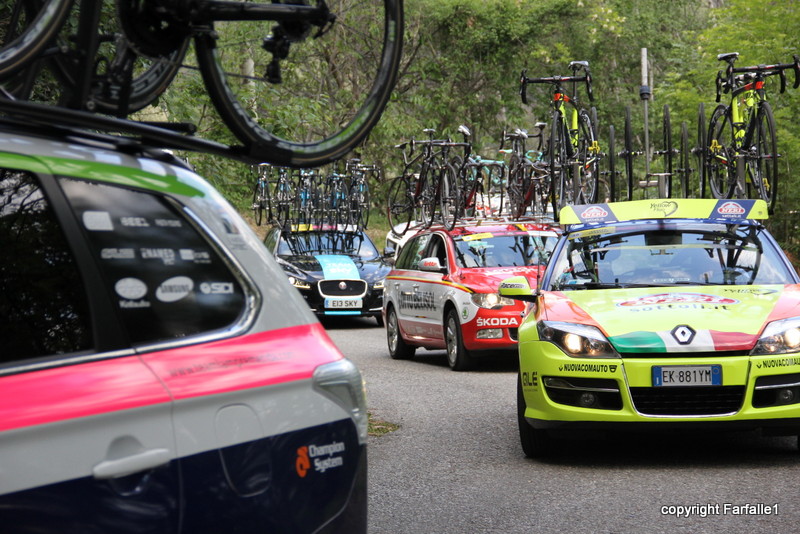
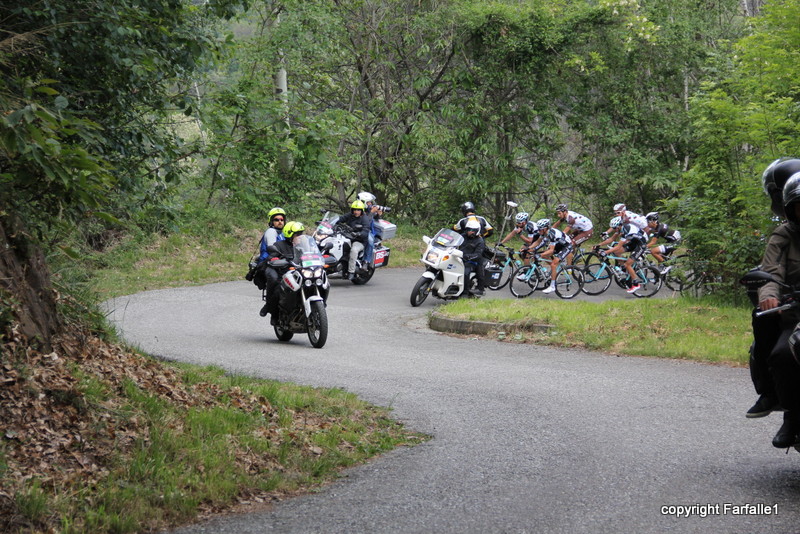
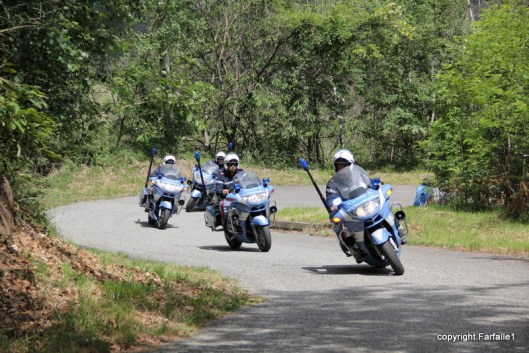
But they were just kidding. In fact, they really did make an announcement over the loud-speaker to say the race would be along in 9 minutes. In the meantime we were entertained by a continuing parade of support vehicles, an ambulance, police in cars and on motorcycles and other officials on motorcycles.

police-001

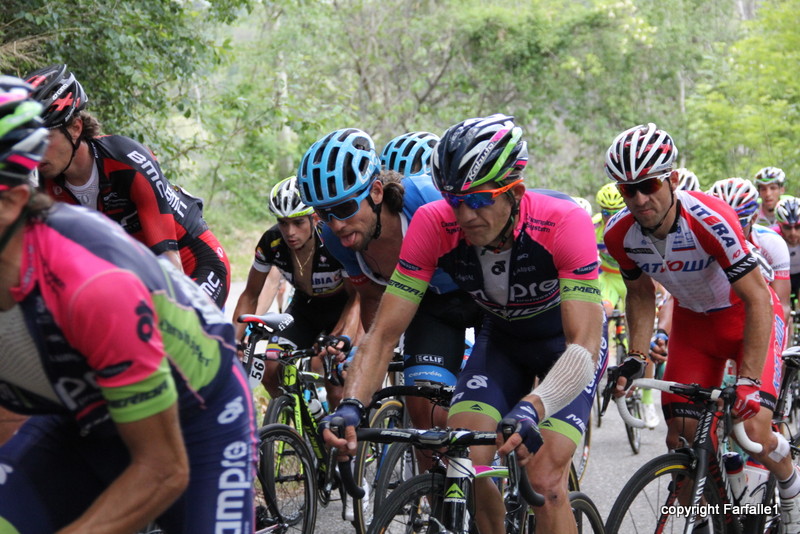
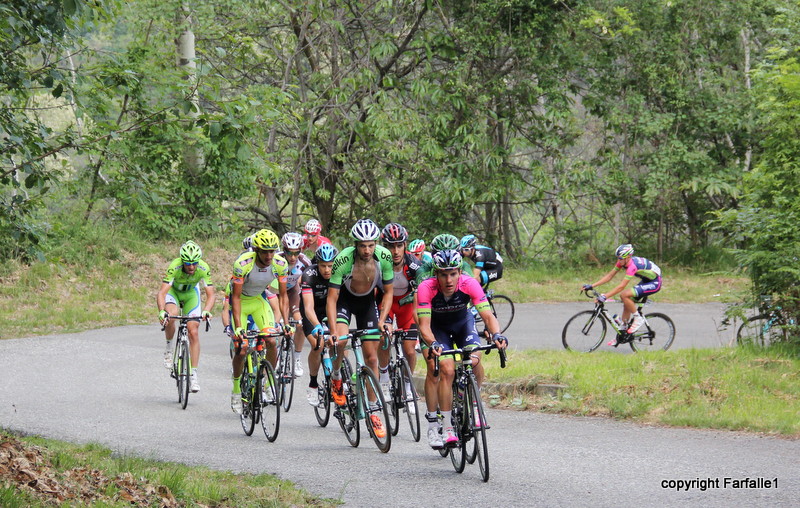
And then, suddenly, there they were:

the first group of cyclists-002

Notice the guy standing up on the back of the last motorcycle?  He’s one of the cameramen from RAI, the state TV broadcaster. Now we understand how they get such amazing coverage of the riders.the first group of cyclists-006
the first group of cyclists-012

the first group of cyclists-016 the first group of cyclists-025

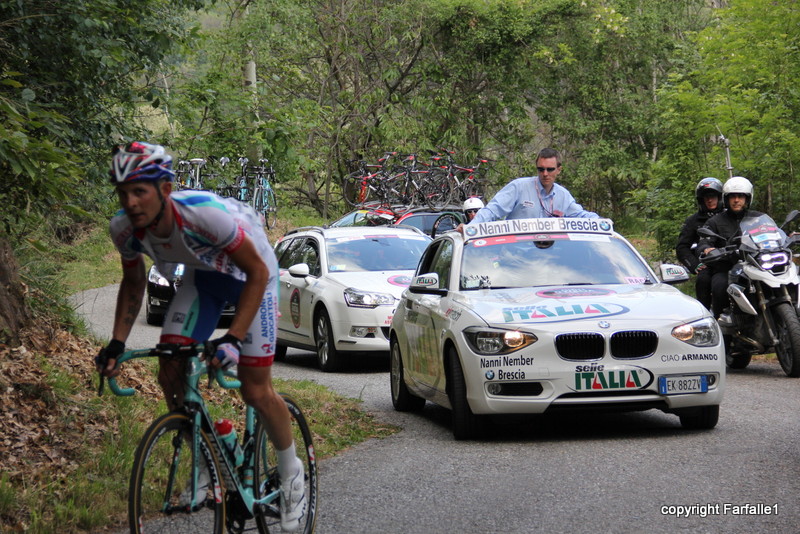
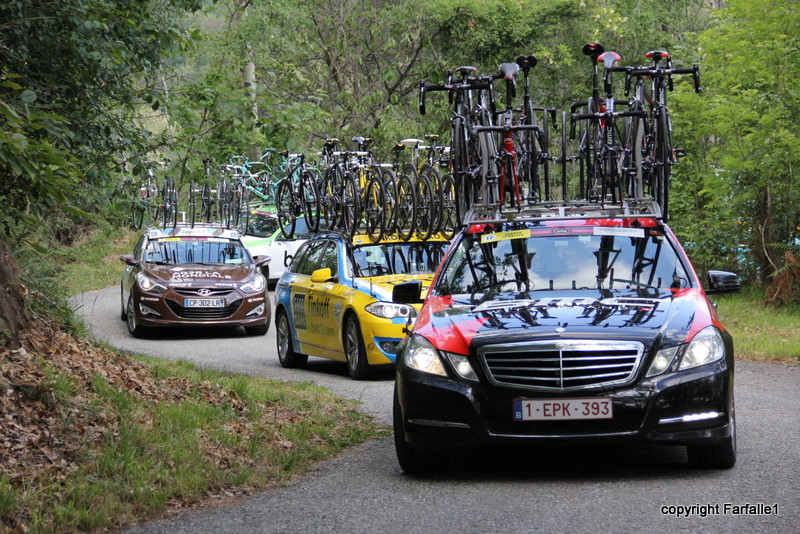
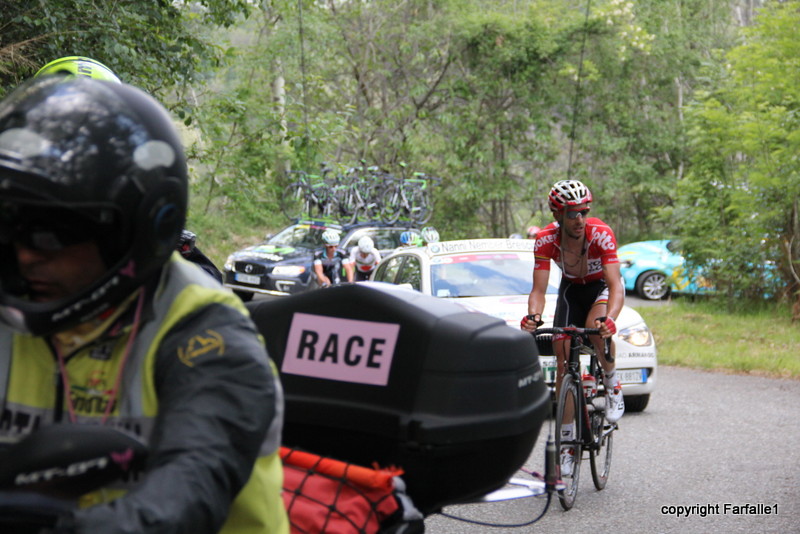
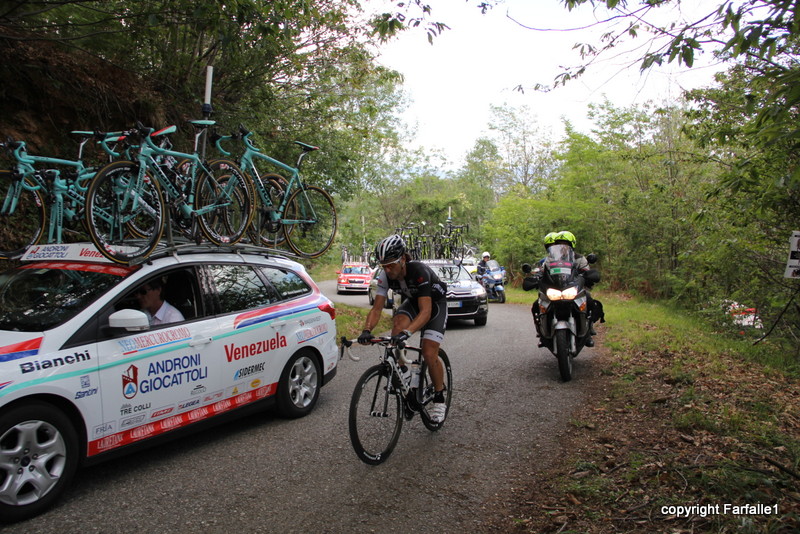
the first group of cyclists-021 the first group of cyclists-030 And then they were past, followed by a huge number of support vehicles, another ambulance, medical support, bikes, tires – what a lot of stuff and personnel it takes to keep the race going. Just the number of spare bikes is mind boggling.spare bikes between groups belgium spare bikes between groups a jungle of bikes

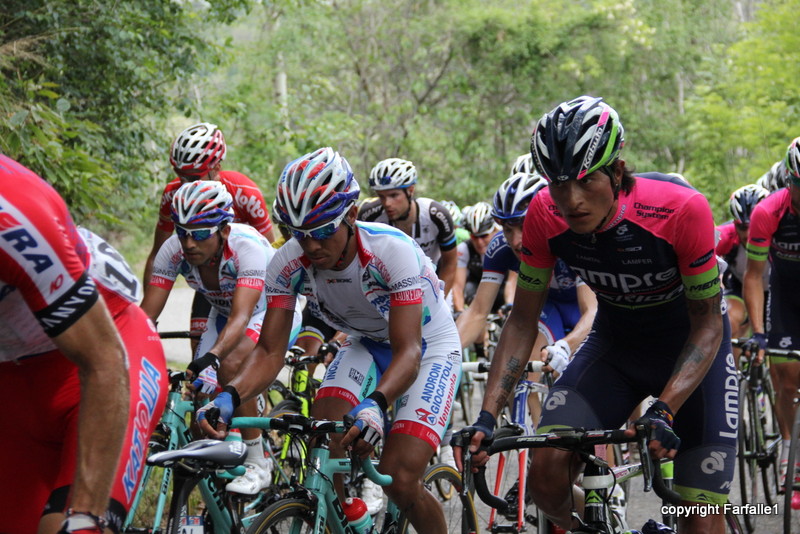
Turns out that wasn’t the end of the race by any means, though. That was just the first group of riders, the leaders. In all the hub-bub of support vehicles there was another car with a loud-speaker that announced the rest of the race would arrive in 4 minutes. Great excitement! More police cars, more officials on motorcycles, more cars carrying bikes and tires. Then here they came, a much larger group this time:

Second group arrives second group a lot of them-001 second group-006 second group-011 second group-016 second group-018 Here are two things that really struck me. One was how very close we could get to the race participants. We could have reached out and touched them; that gave an immediacy and a thrill to the undertaking that one would never experience from, say, the bleachers at a baseball game. The other thing that amazed me was that support cars, police and all manner of other traffic came along well before the last racer had passed. Those near the end of the race (and I won’t call them ‘stragglers’ because no one who can ride up those mountains is a straggler) really had to negotiate motorized traffic. Seems a bit hard on them. Or on most of them; this man looked like he was out for a Saturday afternoon pleasure ride.this guy looks pretty relaxed IMG_1049 Then, all at once, it really was the end of the race. The sound of the helicopters faded, the same people we had watched trudging up the hill began to reappear on their way down. At last - Fine gara ciclisticaAt dinner at Leo’s that evening we were all recounting the day’s adventures to Isa, who had a quiet day at home. She suddenly remembered something, a drawing hanging on the their wall-of-a-hundred drawings in the hall:

winner of the first giro d'italia

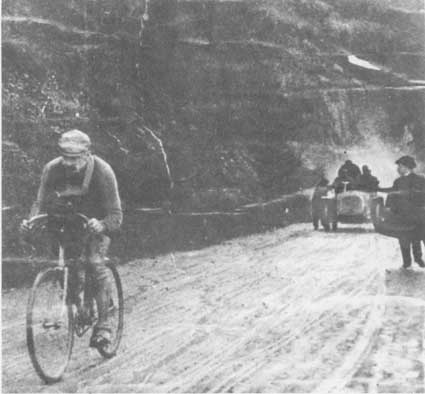
It is a portrait of Luigi Ganna, the winner of the first Giro d’Italia in 1909, drawn by an artist who lived in Sostegno. That year there were 127 cyclists in the race, and, I’m guessing, a lot fewer support vehicles, though this photo of Ganna suggests there was at least one:

Photo courtese of velovelovelo.com

Photo courtesy of velovelovelo.com                           –

This year there were 22 teams of 9 each, 198 racers and they all wore helmets instead of snap-brimmed hats. When I see photos like the one above I always wonder: in a hundred years will we all look as quaint and old-fashioned to our great-great-grandchildren as these people do to us today?

(If you want to see way too many more photographs of the racers and the general environs, click here.)

Moving Picture

19 Wednesday Jun 2013

Posted by farfalle1 in Moving pictures, Photographs, Photographs Piemonte, Piemonte, Snow, Uncategorized

≈ 9 Comments

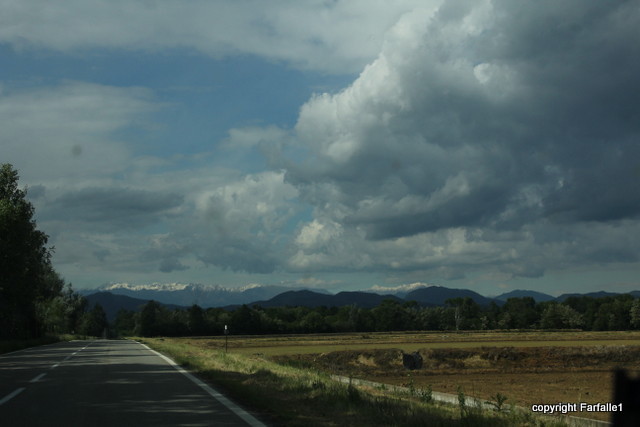
big clouds over Alps

Big clouds over the distant Alps, snow-covered even in May (taken from a speeding car).

Stuffed Eggs Piemontese Style

28 Thursday Oct 2010

Posted by farfalle1 in Food, Italian recipes, Piemonte, Uncategorized

≈ 4 Comments

Tags

Deviled Eggs, Egg recipes, stuffed eggs

A stuffed egg is a wonderful thing. Eggs in general have suffered a lot of bad press from the cholesterol police, but for some of us they remain irresistible. I’ve always been a passionate enjoyer of stuffed eggs. My recipe is simple – it calls for the boiled eggs, mayo, a bit of mustard, and a parsley sprig on top for decoration.

On a recent visit to Piemonte our friend Leo taught me his recipe for stuffed eggs. It is a different animal altogether, not nearly as cloying as my recipe; no doubt it is healthier.

Here’s what you’ll need:

Eggs, as many as you want
A big handful of fresh Italian (flat) parsley, leaves only
2 or 3 anchovies
a piece of bread, broken into pieces and soaked in milk
olive oil
vinegar

The first step is to hard-boil the eggs, of course, then peel them, slice in half and remove the yolks.  Put half the yolks in a bowl, and save the other half for some other use (or salt and pepper them and eat them in the kitchen when no one is looking).

Next finely chop the parsley together with the anchovies and the bread, from which you’ve squeezed the excess milk.  Your mixture will look something like this:
Note the mezaluna – if you haven’t got one in your kitchen you may want to consider getting one and learning how to use it – it can really cut down chopping time.  Plus it’s loads of fun to use.

Smush the egg yolks with a fork and add to them the parsley mixture.

Mix in enough oil to make a nice clumpy filling for the eggs, and add just a dash of vinegar to brighten the flavor.  Nibble a bit and add salt and pepper to taste.

The rest you know.  Fill the eggs, arrange on a plate and serve.  My plate above was rather plain; Leo later decorated it with sage leaves and it looked a lot prettier.

Like all ‘deviled’ eggs these have mysterious evaporative properties; just look away for a moment and you’ll discover half of them are gone!

Rice!

30 Sunday May 2010

Posted by farfalle1 in Italy, Piemonte, Rice, Uncategorized

≈ 13 Comments

Tags

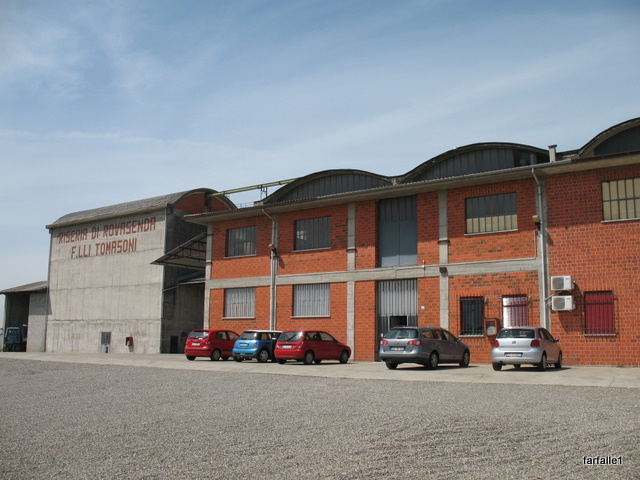
Riseria Tomasoni


You’ve got to love any food that can be served for every course of a meal.  Rice is just such a one.  You can have your cheese ‘befores’ on rice crackers, eat risotto for a first course, serve rice with the main course, and enjoy rice pudding for dessert.  And of course it is all washed down with delicious sake (rice wine).

Unless you live in a rice-growing region you may think, as I used to, that rice grows in grocery stores in bags labeled “Carolina”.  But of course it doesn’t; it grows in rice fields which, in this season in Italy, are exquisitely flooded with water.  Those of you who read this blog regularly know that I’m a huge fan of Piemonte, not least because the scenery around the rice fields is so exotic.

The land, flat as a rice cake, suddenly rears up into snow-capped Alps.  Add the acres of flooded fields reflecting the surrounding trees and mountains and, well, it’s just something that can’t be done justice with a photo.

Illustration courtesy of Botanical.com

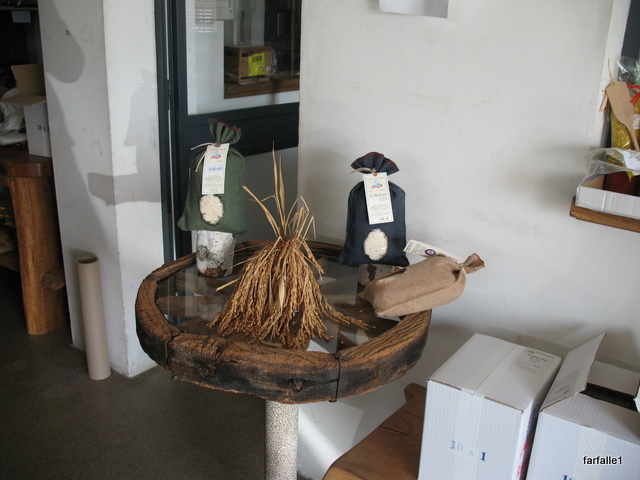
But how does the rice get from lake to table?  Ha.  That’s where Tomasoni Brothers Riseria (and countless other small  processors) come in.  The rice, which is a tall slim grain, is harvested and when dried looks like the brown bouquet in the center of the photo at the top of this post.  The illustration on the left shows all the bits and pieces of the plant. The rice kernels are the seeds, which are produced at the top of the grassy stalks.

When ripe, the rice kernels are threshed from the chaff (and I’m not exactly sure where or how this happens) and the resulting ‘seeds’ are brought to Tomasoni to be turned into salable product.

Here are some of the machines that accomplish this miracle:

The rice is carried into the riseria in huge sacks – we’ve seen this happen in the late summer.  Then it is fed into the wonderful old  machine above from another room.

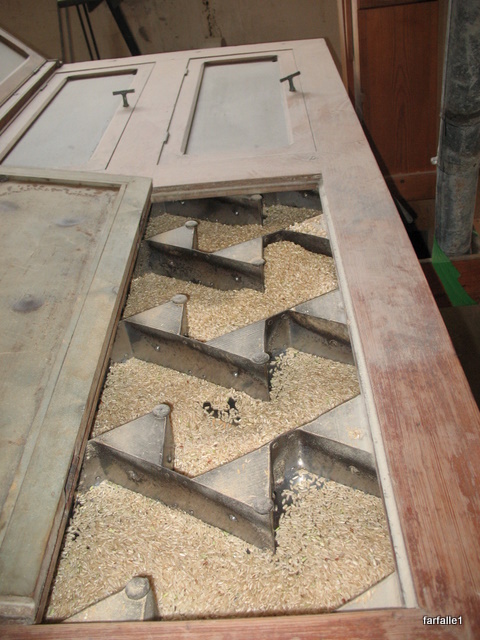
This is the inside of the machine – it engages in some kind of swishy motion evidently.  As you can see, the rice is still brown, that is, it still has its husk.  After it has been swished around a good bit, the kernels fly through some other machines and lose that husk, becoming the white rice we are accustomed to buying to make risotto.

This is the most amazing machine of all and, I suspect, one of the newest.  Each and every grain of rice is scanned by this gleaming device, and if a black speck is detected, that kernel is shot off to another place to become animal food.  Only the unblemished best for us humans!


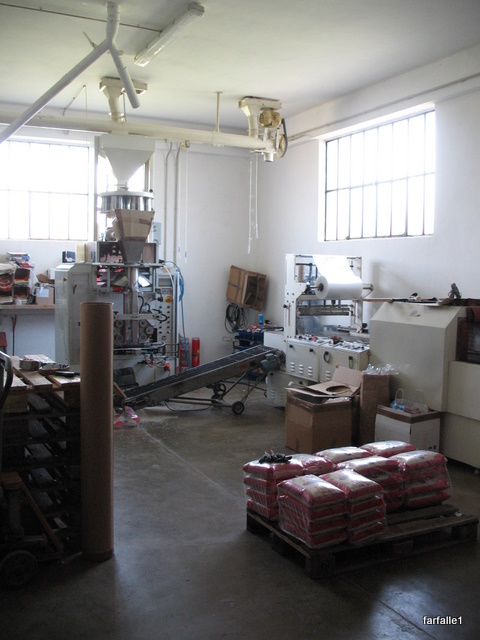
Then all that remains is to package and label the rice. That happens in another room, seen above.  I have no idea where the fabric for the bags comes from, but it is all cheerful and silly.


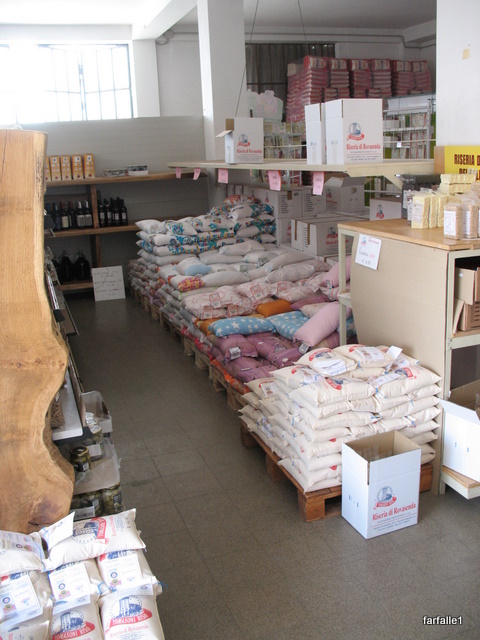
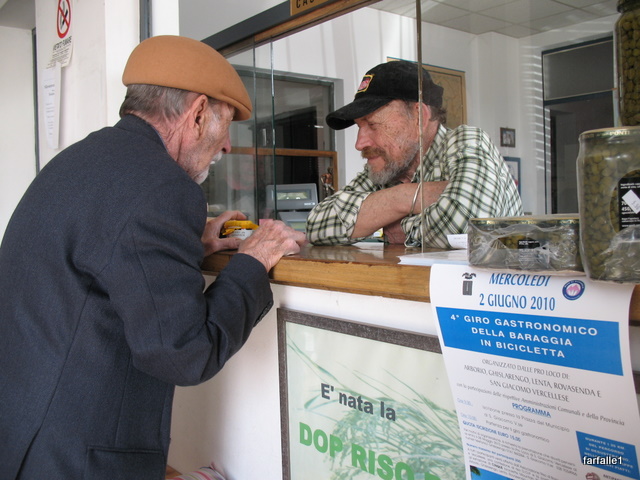
After all the cleaning and packaging is done, one needs only customers to buy the rice.  As is so often and so charmingly the case in Italy, selling has more to do with socializing than with actually taking money and handing over goods in exchange.

And finally, here are the cheerful and helpful brothers Tomasoni, Virgilio and Luigi.  They are always willing to discuss rice, to tell you which is the best variety for Risotto (Carnaroli) or to find a particularly happy print bag of whatever it is you want.  You can find them at their Riseria, which is in Rovasenda, just past Arborio.

The Best Thing We Ate Last Week – Baked Stuffed Peaches

15 Thursday Oct 2009

Posted by farfalle1 in Desserts, Food, Italian men, Italian recipes, Piemonte

≈ 6 Comments

Tags

Leo, pesche ripiene, Stuffed pea, stuffed peaches

pesche ripiene - stuffed peaches

Our friend Leo made Pesche Ripiene (stuffed peaches) for dessert when we visited in Piemonte last week.  They are amongst the best things I’ve eaten, ever, in my whole life.  And they are easy to make.  In fact, they are so easy I will give you the recipe here rather than send you off to another page for it.

Here’s what you’ll need:  peaches, amaretto (or amaretti) cookies (about 3 per peach half, depending on size of cookies and size of peaches), marsalla, sugar, butter

Cut firm but ripe free-stone yellow peaches in half – Leo recommends Elberta. (They are widely available here but nowadays are not as common in the U.S. as they once were).  Chop up the cookies, add some sugar (+/-  1/2 tsp per peach half), and add enough marsala wine to make the cookie stuffing hold its shape.  Overfill each peach half with the cookie mixture and top with a dab of butter.  Put in a preheated (350) oven and bake until done.  The peaches are delicious with this stuffing, and somehow there is a by-product of excellent caramel sauce that can be drizzled over the top (Leo says it comes from the moisture the peaches throw off mixing with the sugar).

Next time you need an easy dessert and peaches are in season, try making stuffed peaches, and then when everyone tells you how fantastic they are, send a silent thank-you to Leo.

leo

Stop, look and listen

10 Saturday Oct 2009

Posted by farfalle1 in Driving in Italy, Italy, Law and order, Piemonte, Uncategorized

≈ 4 Comments

Tags

crosswalks, Pedestrian safety, zebra stripes

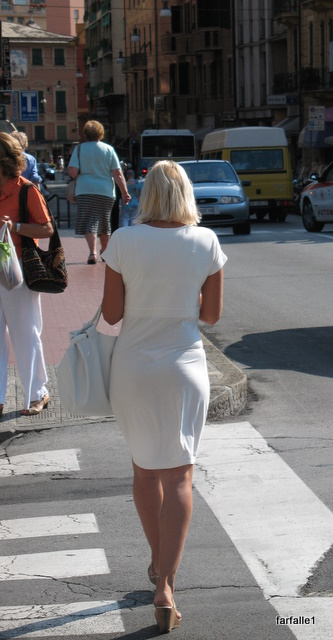
We are very dull here in Rapallo, I am beginning to think.  Granted, there’s lots of traffic and hubbub downtown, scooters darting in and out of traffic, pedestrians crossing outside the zebra stripes.  But it is the stripes themselves that makes me think we are dull.  Our stripes are the plain old white stripes depicted in the driving manual.  Here’s an example:

rapallo beauty nice ass

(This is an old photo so it shows more of the crosser and less of the crosswalk, but you get the idea…)

This past week we were, once again, in Piemonte (about which you’ll hear more in an upcoming post).  Now there’s a region that knows how to make its crosswalks attractive  and eye-catching.  How about this snappy blue?

crosswalk blue

Red has ever been the color of caution, and this red crosswalk would make any pedestrian feel safe.

crosswalk red-2

But my very favorite is, granted, a variation on the white theme, but done with such artistry.  Nothing says class, whether it’s in the foyer, the bath, or inlaid in the street, more than marble.

crosswalk white

Say… isn’t that the captain crossing outside the stripes?  I bet he didn’t stay in the lines when he colored as a kid, either.

In the spirit of fairness I have to say that just in the last year Rapallo has added some very sparkly little lights that blink feverishly at night along the boundaries of some of the zebra crossings.  But only some of them, which makes me wonder if the others aren’t more easily overlooked by speeding motorists expecting the twinkling visual cue?  In any event, they look quite modern and marvelous… when it’s dark outside.

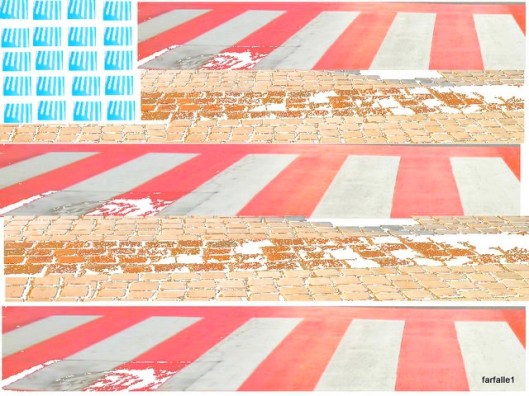
I’m feeling pretty good about Obama winning the Nobel Peace Prize, so I’ve come up with my own design for a crosswalk, using all the others for inspiration:

flag of crosswalksb

Vendemia!

10 Thursday Sep 2009

Posted by farfalle1 in Italian habits and customs, Italy, Piemonte, Uncategorized

≈ 14 Comments

Tags

grape harvest, vendemia, Wine, wine grapes

dump 'em

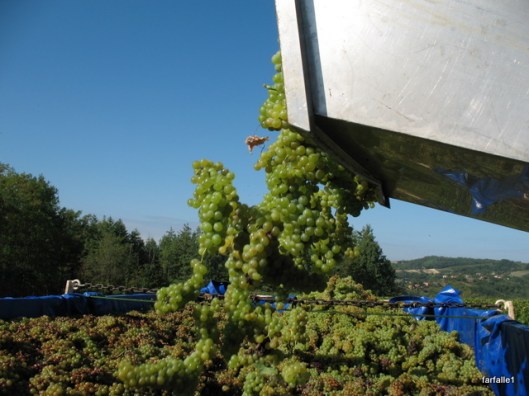
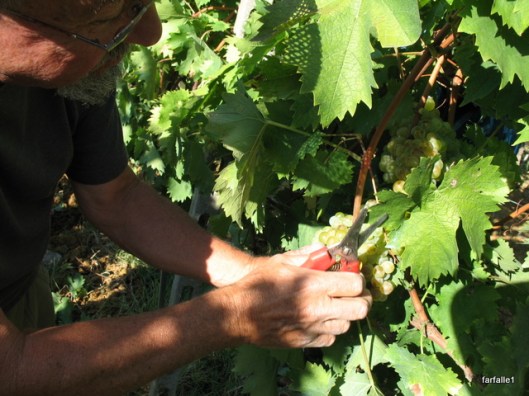
Our cousins invited us to help out at their Vendemia in Piemonte this past weekend, an invitation we eagerly await every year.  The vendemia is the annual grape harvest, and from all reports this is one of the best years ever, in terms of both quantity and quality.  There was lots of rain early in the season, and then it was dry for a couple of weeks, which made the fruit very sweet.

It’s a family affair in a big way.  Our cousins’ extended family includes three generations ranging in age from 17 months to I’m-not-telling (but I would guess early 80’s), probably about 35 people including the children who are too young to pick.

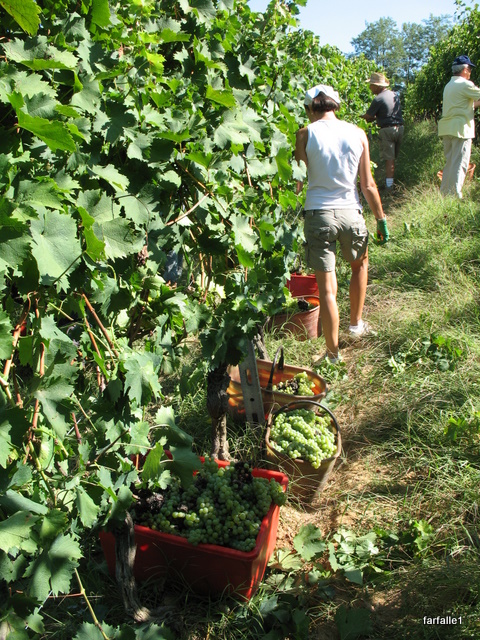
All the grapes are cut from the vine by hand.  Fortunately the vines are well managed, and most of the grapes seem to grow between knee and shoulder height.

cutting grapes

grapes (2)

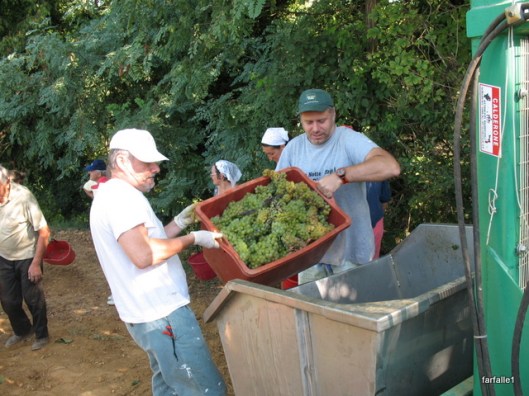
We put the bunches of grapes in plastic buckets which are then emptied into the bucket loader of a small tractor.

grape ferry (2)

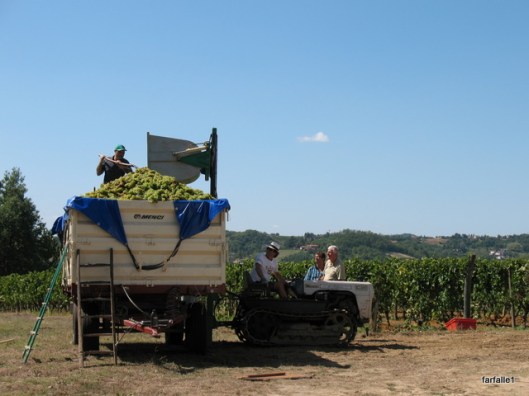
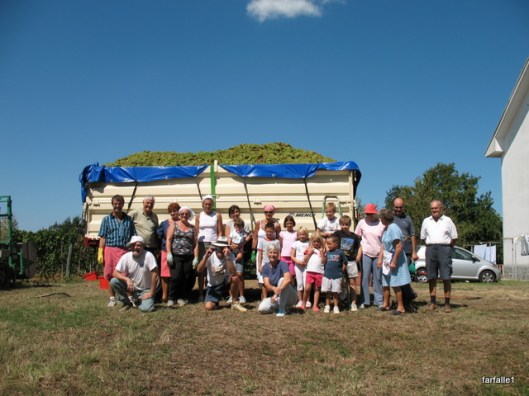
This in turn is dumped into the trailer. With so many willing workers, their vineyard is harvested in about a day and a half. Usually, one of the uncles told me, they collect two medium trailers full of grapes. This year there was a small load, a medium load, and a huge load:

dump 'em (4)

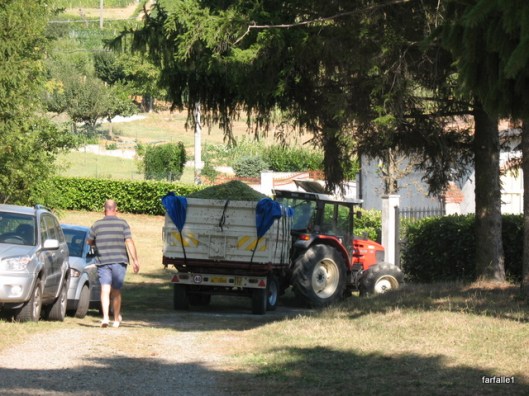
Later in the afternoon the vineyard manager, who takes care of several vineyards in the area, appears with his big tractor and hauls the grapes to the place where they are pressed (in this case Cascina Orsola, some 38 km distant).

tractor (12)

It’s a LOT of work (my estimate is about 250 person-hours) and while everyone loves doing it, they are also very  happy when it’s finished for another year.

Finished! (3)

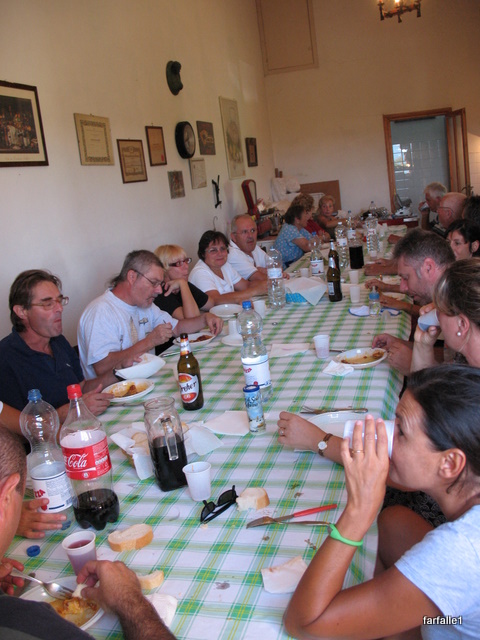
Then comes one of the highlights of the weekend: the communal meal!  The older generation used to have a fish restaurant in Genova, so the cooking is outstanding.  This year they served us the world’s most delicate and light lasagna, roast beef with drippings, french fries, eggplant  that was lemony and garlicky, fruit, cheese and home-baked cake.

adults eat (2)

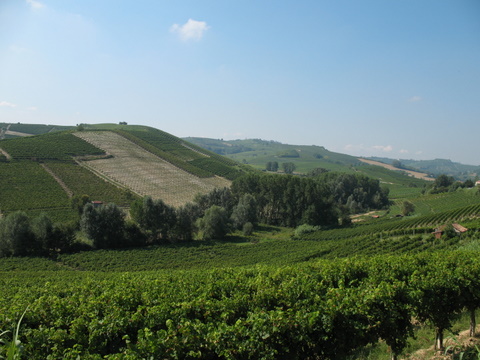
There are small and medium-sized family owned vineyards all through this part of Piemonte.  I imagine the scenes above are repeated a hundred-fold at this season, each with a different cast of characters and a slightly different view.  This must have been what farming was like back in the days before agri-business took over, both in the US and here.  It’s refreshing that it still exists.

If what ‘they’ say is true, there will be some superb wines coming from this years’ grapes.  So  Salute!  Cincin!  Bottoms up!

Another fun way to find wine

13 Saturday Sep 2008

Posted by farfalle1 in Italy, Piemonte, Travel, Uncategorized

≈ Leave a comment

Tags

Ricaldone, Rinaldi Wine, vineyards, Wine, wine tasting

In an earlier post I mentioned the filling-station style of wine procurement.

An even more satisfying way to get your wine is to go to the vineyard where the grapes are grown and the wine produced.  This is a popular pastime in Tuscany, which is famous for its red wines, especially Chianti and Brunello, and where many of the vineyards are large and have impressive tasting rooms.

It’s no less a pleasure in Piemonte, which in fact boasts more grape varieties and wines than our neighbors to the south in Tuscany. (As the Italianmade website says,  “For craftsmenship, respect for tradition and devotion to native vines in their historical habitats, the Piedmontese have no rivals in Italy.”)

I don’t want you to think I’m working for the Region of Piemonte… it’s just that because of family and friends it is a frequent destination when we travel.  It is, in my opinion, every bit as beautiful a landscape as La Toscana; however it is much less touristic.  Here is a photo of some rolling hills of vines.

I also really don’t want you to think I’m in the employ of the Rinaldi family. They are one of many Piemontese wine producers; it’s just that we’ve happened to visit their vineyard twice now,

The Rinaldis are a small producer of wine.  They live, grow grapes and make wine in Ricaldone, a tiny town (population +/- 750) famous in Piemonte for the high quality of its wine.

We first discovered them  a year ago, on the Monday after Easter, which is a holiday here.  We were driving through the countryside after a visit with our cousins near Aqui Terme, and their sign looked welcoming.  The gate was open, so holiday or not, we drove in and threw ourselves on their mercy.  We had providently brought our 20-liter plastic jug.  The young Signor Rinaldi, who is both knowledgeable and extremely enthusiastic, was nice enough to interrupt his holiday, give us a tour and a private tasting, and fill our container with his delicious dolcetto.

We arrived unannounced again this year with our jug (never travel without your camera, your trowel and your wine jug!), on a Saturday afternoon not too long ago.  To our amazement Andrea Rinaldi and his mother both remembered us and gave us a very warm welcome.  After giving us a tour of all her pretty gardens, La Signora dug a bunch of her portulaca for us to bring home and put in our own garden. Her son was, once again, as lively and enthusiastic as could be.  Carrying a wine glass, he took us right down to the cellar where he pulled tastes for us from the spigots at the bottom of the huge stainless tanks in which the grape juice becomes wine.

The wine stays in the big tanks for a while, and later is put in casks if required.  This year we fell in love with his moscato, a sweet wine that is perfect with dessert.  It turns out that 55% of his production is moscato, something we didn’t realize last year.  A small producer, he makes 1,200 quintale a year.  A quintale is 100 kilograms and one Kilogram = 1 liter, so that’s 120,000 liters of wine.  Sounds like a lot to me, but as wine production goes it’s on the small side.

The Rinaldi wine is prize-winning; near the office there is a wall of plaques and certificates to prove it.  Can you get the wine in the U.S.?  As a matter of fact, you can; at least you can get the moscato.  It is marketed there under the somewhat dubious name of Bug Juice.  Did we fill our containers with Moscato?  We did not.  It is not sold in bulk.  We bought a half case and for the princely sum of E 1.55 per liter filled our 20-liter jug with Rinaldi’s wonderful cortese, a crisp, light white wine.

There are some photographs of Ricaldone and the Rinaldi Winery in Photographs on the right.  If you have the chance, visit a winery some day.  You don’t have to be in Tuscany or California to do so; there are wineries all over the US as well as Italy.  It is great fun, and an economical way to buy your wine.

The Best Thing We Ate This Week – Tagliarini with Porcini Mushrooms

24 Sunday Aug 2008

Posted by farfalle1 in Italian recipes, Italy, Piemonte, Uncategorized

≈ 11 Comments

Tags

clafoutis, pesche ripiene, porcini mushrooms, stuffed peaches, Tagliarini ai Funghi

We think our cousins want to kill us.  No kidding!  They are lovely people, but look at what they made us eat on Thursday.

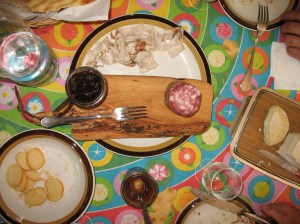
We started with hot little red peppers, some stuffed with anchovies, others with tuna or cheese; these are among my favorite things to eat in the world.  They also served olives with the same variety of stuffings.  In the picture you can see the salami and the lardo they forced us to eat. Lardo‘s name tells you exactly what it is. It sounds disgusting, but it is one of the most sublime things you will ever put in your mouth – rich, creamy, salty – it is sinful (and also deadly, I suspect).  It’s an interesting food with a long history and is so good it is impossible to resist.
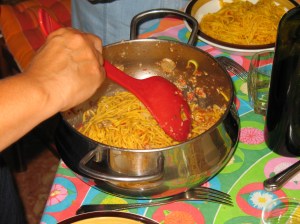
In case we were feeling cholesterol-deprivation we were also given three kinds of cheese, two goat and one cow, all Piemontese, that were to be eaten on little crackers and topped with mostarda, either grape and wine, or pear and pinoli (these mostarde  were just like jam).  I had to keep trying them as I couldn’t decide which was better. Cousin Gino served the Cortese wine that the Captain and I had just picked up at the Rinaldi winery – about which more soon (stay tuned).

Following this group of light antipasti we moved on to this week’s Best Thing That We Ate: Tagliarini ai Porcini.  The mushrooms are beginning to appear in the woods to the north now, and this is a dish that wants fresh funghi.  You can find the recipe over on the right under Recipes; it is starred as a Best. This dish is also served frequently in Liguria, but according to Fred Plotkin it is made with olive oil instead of butter, and there are neither tomatoes nor pinoli in it.  We loved the Piemontese version.
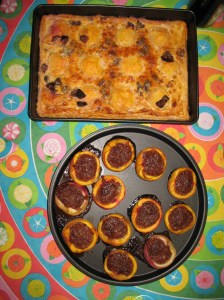
Thank goodness there was no meat course; we would have croaked for sure.  We had offered to bring a clafoutis of peaches which we did.  But perhaps Cousin Giovanni was afraid her family wouldn’t care for our dessert, so just in case she served Stuffed Peaches (pesche ripiene) and Gino popped the cork on a crisp prosecco.  Both desserts are pictured on the left.  Giovanna’s dessert was almost selected as this week’s best – it had a very surprising ingredient.

As a quick bonus, here’s how she made it:  Take most of the pulp out of the peaches, leaving sturdy little peach boats with skins still on.  Chop up the pulp with amaretto cookies and add some unsweetened cocoa powder.  Stuff the peach halves with the filling and bake in a moderate oven for a while.  Couldn’t be easier or more delicious.  The mixture of chocolate and peaches was both startling and pleasing.

By the way… this was lunch.

Buon appetito!

← Older posts

Enter your email address to follow this blog and receive notifications of new posts by email.

Join 114 other subscribers

rss

Subscribe in a reader

Search the Blog

A. Useful Links

  • bab.la language dictionary
  • Bus schedules for Tigullio
  • Conversions
  • English-Italian, Italian-English Dictionary
  • Expats Moving and Relocation Guide
  • Ferry Schedule Rapallo, Santa Margherita, Portofino, San Frutuoso
  • Italian Verbs Conjugated
  • Piazza Cavour
  • Rapallo's Home Page – With Link to the Month's Events
  • Slow Travel
  • The Informer – The Online Guide to Living in Italy
  • Transportation Planner for Liguria
  • Trenitalia – trains! Still the most fun way to travel.

C. Elaborations

  • A Policeman’s View
  • Driving School Diary
  • IVA refunds due for past Rifiuti tax payements
  • Nana
  • Old trains and old weekends
  • The peasant, the Virgin, the spring and the ikon
  • Will Someone Please, Please Take Me to Scotland?

D. Good Recipes - Best of the Week winners are starred

  • 'Mbriulata
  • *Baked Barley and Mushroom Casserole*
  • *Captain’s Boston Baked Beans*
  • *Crimson Pie*
  • *Louise’s Birthday Cake*
  • *Melanzane alla Parmigiana*
  • *Penne with Cabbage and Cream
  • *Pizzoccheri della Valtellina*
  • *Pumpkin Ice Cream*
  • *Risotto alla Bolognese*
  • *Rolled Stuffed Pork Roast*
  • *Spezzatini di Vitello*
  • *Stuffed Grape Leaves*
  • *Stuffed Peaches (Pesche Ripiene)*
  • *Swordfish with Salsa Cruda*
  • *Tagliarini with Porcini Mushrooms*
  • *Tagliatelli al Frutti di Mare*
  • *Three P's Pasta*
  • *Tzatziki*
  • 10th Tee Oatmeal Apricot Bars
  • Adriana’s Fruit Torta
  • Aspic
  • Bagna-calda
  • Best Brownies in the World
  • Clafoutis
  • Cold cucumber soup
  • Crispy Tortillas with Pork and Beans
  • Easy spring or summer pasta
  • Fish in the Ligurian Style
  • Hilary's Spicy Rain Forest Chop
  • Insalata Caprese
  • Lasagna al forno
  • Lasagna al Forno con Sugo Rosato e Formaggi
  • Lemon Meringue Pie
  • Leo’s Bagna Cauda
  • Leo’s Mother’s Stuffed Eggs
  • Louis’s apricot chutney
  • Mom's Sicilian Bruschetta
  • No-Knead (almost) Bread
  • Nonna Salamone's Christmas Cookies
  • Pan Fried Noodles with Duck, Ginger, Garlic and Scallions
  • Pesto, the classic and original method
  • Pesto, the modern, less authentic method
  • Pickle Relish
  • Poached pears
  • Poached Pears
  • Polenta Cuncia
  • Recipes from Paradise by Fred Plotkin
  • Rustic Hearth Bread
  • Shrimp and Crayfish Tail Soup
  • Sicilian salad
  • Slow Food Liguria
  • Slow Food Piemonte and Val d'Aosta
  • Spinach with Garlic, Pine Nuts and Raisins
  • Stuffed Eggs, Piemontese Style
  • The Captain’s Salsa Cruda
  • Tomato Aspic
  • Zucchini Raita

E. Blogroll

  • 2 Baci in a Pinon Tree
  • Aglio, Olio & Peperoncino
  • An American in Rome
  • Bella Baita View
  • Debra & Liz's Bagni di Lucca Blog
  • Expat Blog
  • Food Lovers Odyssey
  • Italian Food Forever
  • L’Orto Orgolioso
  • La Avventura – La Mia Vita Sarda
  • La Cucina
  • La Tavola Marche
  • Rubber Slippers in Italy
  • Southern Fried French
  • Status Viatoris
  • Tour del Gelato
  • Weeds and Wisdom

Photographs

  • A Day on the Phoenix Light Rail Metro
  • Apache Trail in the Snow
  • Aquileia and Croatia
  • Birds on the Golf Course
  • Bridge Art
  • Canadair Fire Fighters
  • Cats of Italy
  • Cloudy day walk from Nozarego to Portofino
  • Fiera del Bestiame e Agricultura
  • Football Finds a Home in San Maurizio
  • Hiking Dogs
  • Mercatino dei Sapori – Food Fair!
  • Moto Models
  • Olive pressing
  • Rapallo Gardens
  • Rapallo's Festa Patronale
  • Ricaldone and the Rinaldi Winery
  • Rice Fields
  • Sardegna ~ Arbatax and Tortoli
  • Sardegna ~ San Pietro above Baunei
  • Sardegna ~ The Festa in Baunei
  • Scotland, including Isle of Skye
  • Slow Food 2008 Salone del Gusto
  • The Cat Show and the Light Rail Fair
  • The desert in bloom
  • Trip to Bavaria

Pages

  • Fagioli all’ucelleto

Archives

Recent Posts

  • A Superior Visit
  • Fun at the Ranch Market
  • The MAC
  • Welcome Tai Chi
  • Bingo Fun for Ferals
December 2025
M T W T F S S
1234567
891011121314
15161718192021
22232425262728
293031  
« Jul    

Member of The Internet Defense League

Blog at WordPress.com.

  • Subscribe Subscribed
    • An Ex-Expatriate
    • Join 114 other subscribers
    • Already have a WordPress.com account? Log in now.
    • An Ex-Expatriate
    • Subscribe Subscribed
    • Sign up
    • Log in
    • Report this content
    • View site in Reader
    • Manage subscriptions
    • Collapse this bar
 

Loading Comments...