• Contact
  • Elaborations
    • A Policeman’s View
    • Driving School Diary
    • Great Danes
    • IVA charged on Tassa Rifiuti
    • Nana
    • Old trains and Old weekends
    • The peasant, the virgin, the spring and the ikon
    • Will Someone Please, Please Take Me to Scotland??
  • Recipes
    • ‘Mbriulata
    • *Baked Barley and Mushroom Casserole*
    • *Captain’s Boston Baked Beans*
    • *Cherry Tart*
    • *Crimson Pie*
    • *Louise’s Birthday Cake*
    • *Melanzane alla Parmigiana* – Eggplant Parmesan
    • *Penne with Cabbage and Cream
    • *Pizzoccheri della Valtellina*
    • *Pumpkin Ice Cream*
    • *Risotto alla Bolognese*
    • *Rolled Stuffed Pork Roast* on the rotisserie
    • *Shrimp and Crayfish Tail Soup*
    • *Spezzatino di Vitello*
    • *Stuffed Grape Leaves*
    • *Swordfish with Salsa Cruda*
    • *Tagliarini with Porcini Mushrooms*
    • *Tagliatelli al Frutti di Mare*
    • *Tzatziki*
    • 10th Tee Apricot Bars
    • Adriana’s Fruit Torta
    • Artichoke Parmigiano Dip
    • Best Brownies in the World
    • Clafoutis
    • Cod the Way Sniven Likes It
    • Cold Cucumber Soup
    • Crispy Tortillas with Pork and Beans
    • Easy spring or summer pasta
    • Fagioli all’ucelleto
    • Fish in the Ligurian Style
    • Hilary’s Spicy Rain Forest Chop
    • Insalata Caprese
    • Kumquat and Cherry Upside Down Cake
    • Lasagna Al Forno con Sugo Rosato e Formaggi
    • Lemon Meringue Pie
    • Leo’s Bagna Cauda
    • Leo’s Mother’s Stuffed Eggs
    • Louis’s Apricot Chutney
    • Mom’s Sicilian Bruschetta
    • No-Knead Bread (almost)
    • Nonna Salamone’s Famous Christmas Cookies
    • Pan-fried Noodles, with Duck, Ginger, Garlic and Scallions
    • Pesto
    • Pesto
    • Pickle Relish
    • Poached Pears
    • Polenta Cuncia
    • Pumpkin Sformato with Fonduta and Frisee
    • Rustic Hearth Bread
    • Sicilian Salad
    • Soused Hog’s Face
    • Spotted Dick
    • Swedish Tea Wreaths
    • The Captain’s Salsa Cruda
    • Tomato Aspic
    • Vongerichten’s Spice-Rubbed Chicken with Kumquat-Lemongrass Dressing
    • Winter Squash or Pumpkin Gratin
    • Zucchini Raita

An Ex-Expatriate

~ and what she saw

An Ex-Expatriate

Category Archives: Rapallo

Il Molino Vecchio – The Old Mill

26 Sunday Sep 2010

Posted by farfalle1 in Italian folk tales, Italian habits and customs, Italy, Liguria, Photographs, Rapallo, San Maurizio di Monti, Uncategorized

≈ 20 Comments

Tags

Chestnut mill, Chestnuts, Giovanni Pendola, Italian frantoio, Italian molino, N.S. della Cipressa, Old Italian mill, Olive mill, Wheat mill

Sometimes it happens in Italy that you’re walking down a street, a lane, or a path in the country, and you come upon something that sends you back, in your mind’s eye, a few hundred years. “I can just imagine,” you say to yourself, “what it would have been like to be alive when this place was new and bustling with life.”

It happened to me not long ago when I took a walk with a friend. We came to the old and interesting Complesso Molitorio (Mill complex), which lies on a sentiero (walking path) that connects San Maurizio di Monti to Rapallo along the San Francesco torrente (fast flowing stream), on the opposite side of the narrow valley from the paved road.  The sentiero is not particularly well known, and does not appear on the trails map for this area. To reach it from San Maurizio you walk down what begins as an ever more narrow residential street, which finally turns itself into a path. From Rapallo the route begins on a paved street but soon takes the form of an old mule path which climbs and winds through the forest. According to the website lacipresse.it, the path is known as “Strada Antica di Monti,” a part of the “Antica Via del Sale” (The Old Salt Road – why there was a Salt Road here I have not been able to learn).

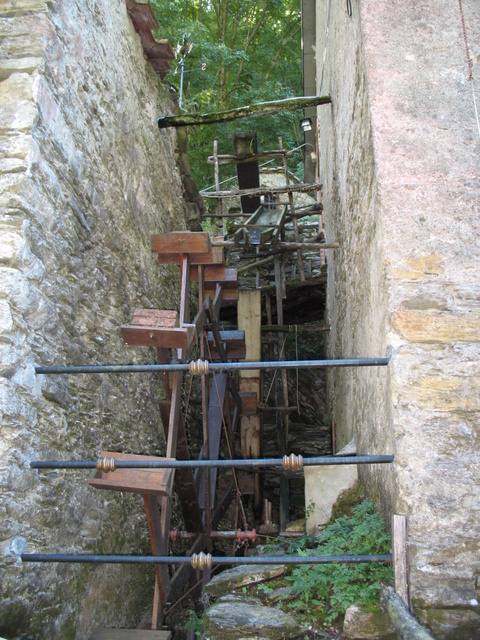
The Mill complex is comprised of four buildings, three of which you can see in the photo above. The large building in front was constructed in the 17th century and was an olive mill. A wheat mill was housed in the smaller building on the left; and the small building up above the others was a chestnut mill. The fourth building, not much more than a room really, is behind the large main building, and was used for collecting the refuse of the olive pressing.

The San Francesco feeds a mill pond above the highest building:
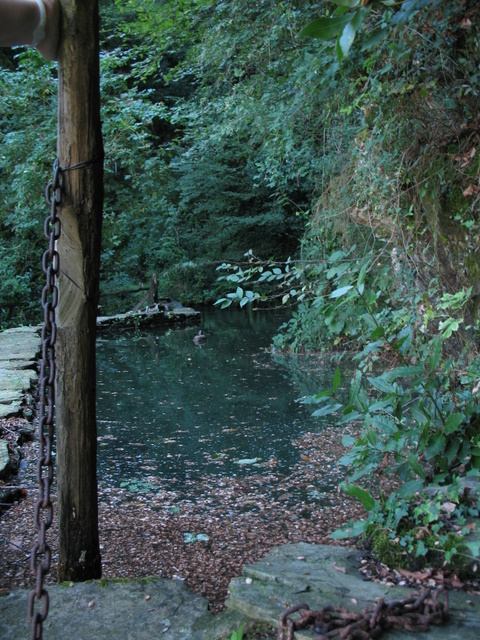
The water can be directed down an earth and stone canal to tumble into the waterwheels that powered the various milling operations:
The oldest structure in the complex is the old stone bridge that crosses the San Francesco, built in the Roman style, quite possibly during Roman days.
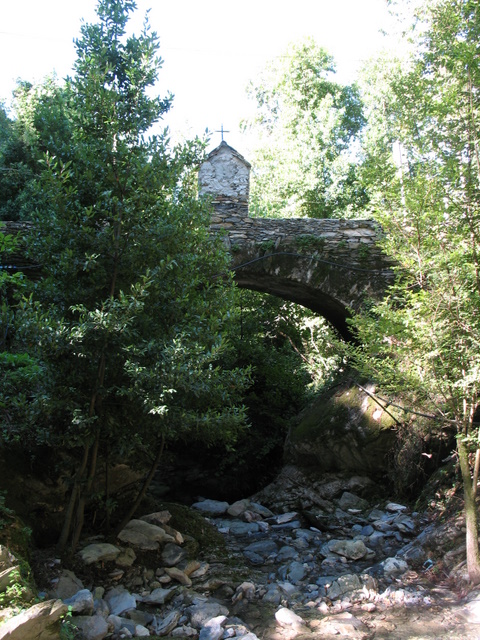
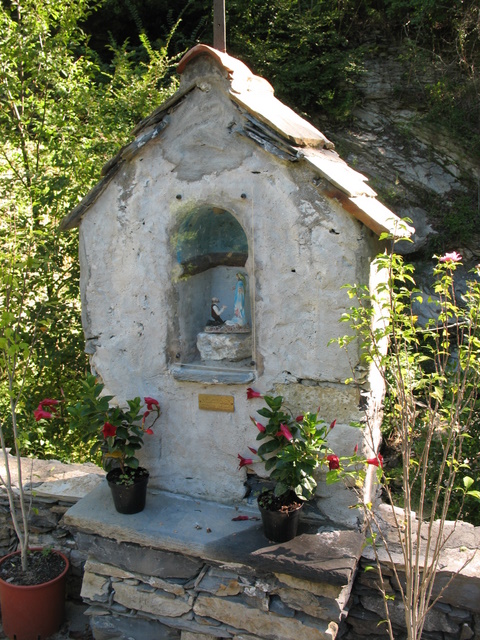
The little chapel on the bridge, a recent addition, honors the Madonna of Montallegro and is called Nostra Signora della Cipressa.   According to the story, there was a chestnut tree that stood nearby. One day, during the plague years, the tree suddenly died – in just the one day! The belief is that the tree, through the intercession of the Madonna, absorbed the deadly disease and rendered it harmless, thereby saving the citizens of San Maurizio di Monti. (For more about the Madonna of Montallegro and the plague, see here).
There have been several re-structurings of various elements of the complex, including one in the early 18th century, one in the 1920’s, and another in the early years of this century . During the recent renovations the large building was turned into a museum, Il Museo della Civilta’ Contadina “Cap. G. Pendola” – the Museum of Rural Culture (named in honor of Giovanni Pendola, a heroic Captain in Garibaldi‘s Army). In it you will find old implements that farmers employed to wrest a livelihood from these steep hills, as well as accouterments of the mills themselves. It is open on the third Sunday of each month from 3 – 5 p.m., at which time a very well informed docent can explain the uses of the various tools, and tell about each of the buildings. (The renovations in 2001 won Second Prize in the 2003 Concorso  “Ama il nostro paese” – love our country – sponsored by the City of Rapallo and the Rapallo Lions Club.  In 2006 the Complex was designated a National Monument.)
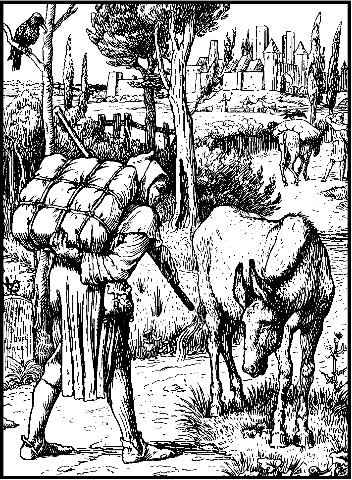
Some centuries before our mill, but I like the image!

Although the mill was still functioning as late as 1940, it is much more fun to imagine what it would have been like in, say, 1750. You’ve gathered all the chestnuts in your part of the woods, have dried them over a smoky fire and have thrashed them out of their husks.


Now you put them in barrels that are firmly strapped, one on each side, to your mule. Slowly and carefully the two of you make your way up the path, your mule finding a careful foothold between the upturned stones on the steep parts of the road. You hear the mill before you see it; the water is rushing down the canal and the big wheel is squeaking a little as it turns. When you get a little closer you can hear the big gears groaning and clicking as they engage. There are a lot of other people there with their chestnuts, too. Chestnut flour is a staple, and a good crop might form the basis of your family’s diet for much of the year. (For an interesting article on historical food uses of chestnuts, look here.) While at the mill you have a chance to exchange gossip with neighbors you haven’t seen for a while and to catch up on the news of the town below. After you’ve left your chestnuts to be ground into flour, you might continue up on the mountain to give thanks at Montallegro for a good harvest, and to ask the Madonna to protect you through the short winter ahead.

There’s another great story associated with the mills. The present owner’s grandfather, the  Giovanni Pendola for whom the Museum is named,  was the owner of the mill in 1907 when he went to Genova to take aid to the victims of a cholera epidemic there. He contracted the disease himself, and died soon afterwards. His true love, a lady named Caterina who was, they say, still beautiful, lost her will to leave her house when she received the news of his death. Then, taken by an irresistible urge for freedom, she became a wild creature of the woods.
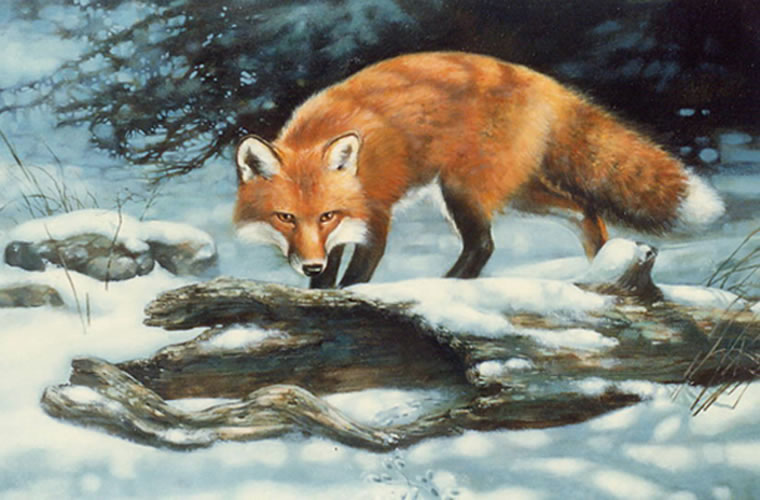
Painting by Patrick Soper, soperstudio.com

Still today, disguised as a fox with a soft tawny tail, she wanders during the coldest days, “those of winter when the cold north wind blows, or when windy gusts blow the last dry leaves, and the bare, rattling branches of  trees reach to the sky like imploring arms.” The tradition says that if you meet this fox and look into her eyes, you may lose your memory or be swallowed up by the woods.

If you’d like to see some more pictures of the mill, click here.  Click on ‘slideshow.’

Many thanks to the website lacipresse.it, from which I learned the content of this post.

Bells and Dogs

30 Monday Aug 2010

Posted by farfalle1 in Animals in Italy, Dogs, Italian Churches, Rapallo, San Maurizio di Monti, Uncategorized

≈ 8 Comments

Tags

Campanile, Church Bells, Howling Dogs

We’re bell-proud here in San Maurizio.  The church which serves this village of 500 people has six bells in the campanile.  Day and night the bells toll the hour in the usual fashion; or almost the usual fashion.   After ringing the appropriate number of times for the hour, the whole thing is repeated again three minutes later; maybe we’re particularly inattentive up here on the hill.

In addition to the hours, the bell rings once on the half hour.  This is fine for most of the day, but it leaves us unsure in the middle of the day and the middle of the night: 12:30, 1:00 and 1:30 all sound exactly the same, both a.m. and p.m.

Twice a day there is some bonus bonging.  At 7 a.m. and again at 8 p.m. a slightly deeper bell rings  50-60 times between the two soundings of the hour.  The reasoning for this, I’ve always imagined, is to say, in the first instance, “Hey, it’s time to go outside and start your work.  Get going!”  and in the second, “Okay, quittin’ time; dinner’s ready, home you go.”  Then on Saturdays and Sundays, and sometimes on Thursday afternoons the bells play a short selection of tunes, most quite jazzy.  Of course there is also extra ringing for weddings (few and far between) and funerals.

There is something awful about this for dogs.  The normal ringing of the bells doesn’t elicit any canine response, but the sonic frequency of the extra long, low peals as well as the songs must hurt their ears.  North, south, east and west, they all start to bark, howl, squeal and moan.  Every dog in town weighs in saying, “ow, ow, ow – stoooop!”  Finally the bells stop and so do the dogs.

There’s a sound clip of one of the regular tunes our bells play here. If you listen carefully you may hear some canine dissent.  Apologies for the quality of the video – my camera isn’t really designed for it, and I’m a bit jiggly at the start.
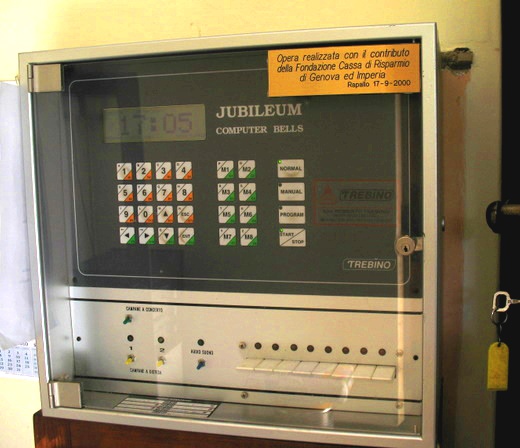
Don’t you have an image of a monk, robes flying, racing from one bell pull to the next to play so fast?  Or perhaps several, trying not to trip over each other?   Or maybe a Quasimodo figure up amongst the bells themselves, ringing them with a big mallet, as if they were a xylophone?  Alas, those days are over.  The bell ringing is done by computer.  There’s a control box under the bell tower, and the priest can select the music he wants to play.

The dogs don’t care how it’s done.  They just don’t care for it.

Gara di Pesto

08 Sunday Aug 2010

Posted by farfalle1 in Food, Italian recipes, Liguria, Rapallo, Uncategorized

≈ 13 Comments

Tags

Fred Plotkin, Giancarlo Dughera, Latte Tigullio, Marcello Ghizzo, Pesto, RapalloExpo, Recipes from Paradise, Roberto Ciccarelli

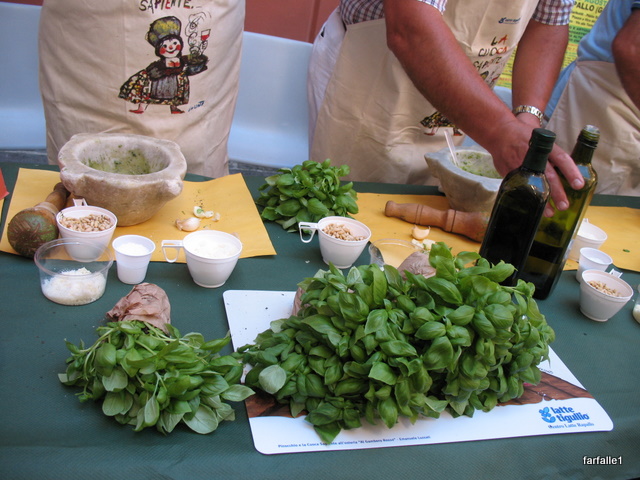
6 contestants, each with mortar and pestle; 7 ingredients; 20 minutes; and 2 judges:  that’s all that was required for the 3rd annual Gara di Pesto al Mortaio which took place Saturday afternoon as part of RapalloExpo 2010.

This four-day event featured a street market with more stalls than usual, conferences on various aspects of food production (bees and honey!), entertainment, and my favorite: the pesto cook-off.  It’s not really a cook-off, of course, because pesto isn’t cooked; so perhaps ‘competition’ would be a better word, though that hardly conveys the sense of excitement as a small crowed watched the very physical preparation of Liguria’s signature sauce.

Fred Plotkin, in his wonderful book Recipes from Paradise (Little, Brown and Company, 1997) gives 16  pesto recipes, including one for tourists, and one for people who are physically impaired and must use a food processor.  (Impairment is the only excuse for using a processor, according to Mr. Plotkin, because the delicate perfumes and flavors of the ingredients will be compromised by the harsh treatment of the metal blades.)

No, mortar and pestle is the only way to make pesto.  And there are only 7 ingredients in the classic Ligurian pesto (since Liguria is the home of pesto, it goes without saying that Ligurian pesto is the only one worthy of consideration).    The 7 ingredients needed are coarse sea salt, basil leaves (preferably small), garlic, pinoli, Pecorino Romano cheese, Parmigiano-Reggiano cheese and olive oil.  (Mr. Plotkin’s rendition of the classic dish can be found here.)

Chef Mario (pictured below), president of the Association of Chefs for the Genova region and Chef of Ristorante Da Mario in Rapallo was joined in the judging duties by a gentleman from Genova who is, if I understood correctly, somehow involved in the oversight of Pesto making in the region.

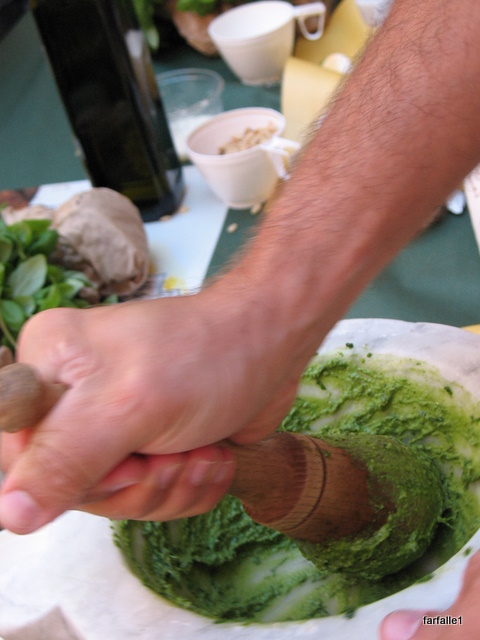
Pesto is made by putting a little bit of sea salt in the mortar, and carefully but enthusiastically adding the other ingredients and grinding it all into a thick paste.  The finished product looks like this:

The contestants made only a small amount of pesto, enough for the judges to taste to reach their decision.

The first to finish was this lady, though sadly she did not win first place:

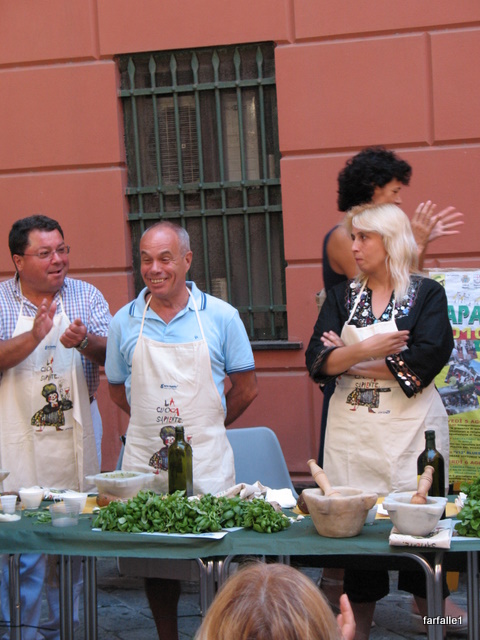
So who did win?  Well, third place went to Marcello Ghizzo, center below:

and the second prize was awarded to Giancarlo Dughera:

The grand 1st place finisher was Roberto Ciccarelli:

What were the prizes?  There was something that looked like a large gym bag, an apron, and various condiments from Latte Tugullio, the local company that generously sponsors many civic events.  Oddly, included in the prizes were jars of… pesto!

The carton pictured above is a milk product called  Prescinsêua (pronounced pray-zhun-sieu), also called Quagliata Genovese.  It is a basic Ligurian ingredient made of fermented milk, not too different from clabbered cream or, perhaps, sour cream.  Some people use Prescinsêua in their pesto-making.

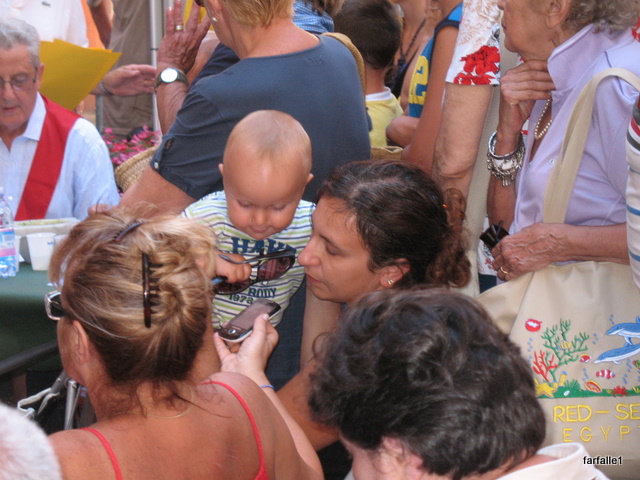
It was a lovely event.  Everyone from participants to audience to judges were good-humored.  Finally, here are a couple of pictures of the audience, because what’s a Gara without a crowd?

Too Beautiful Not To Share…

22 Tuesday Jun 2010

Posted by farfalle1 in Photographs, Rapallo

≈ 13 Comments

Tags

Case di Noe, Long light

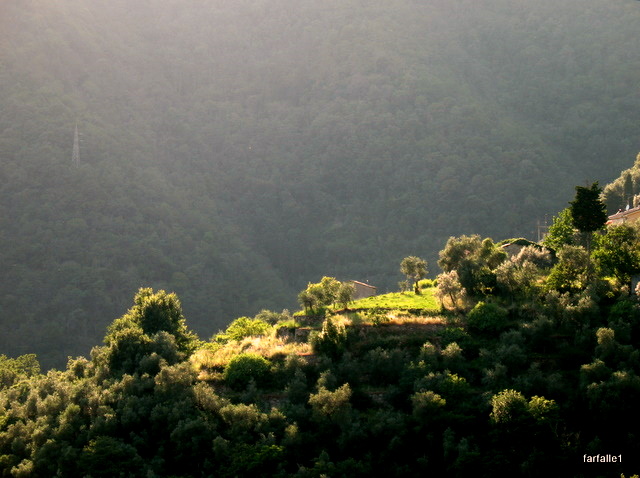
Long light on the almost-longest day of the year fell on a field below Case di Noe this evening.  That + a little bit of humidity +a little bit of smoke = pure magic…

Old Dogs, New Gardening Tricks

19 Saturday Jun 2010

Posted by farfalle1 in gardening, Italian habits and customs, Italy, Liguria, Rapallo, Uncategorized

≈ 6 Comments

Tags

Fascie gardening, Gardening in Narrow Strips

When in Rome, do as the Romans – how many zillions of times have we heard that expression?  Enough to be thoroughly sick of it, for sure.  Wouldn’t you think that after all the repetition the meaning of that irritating nostrum would’ve sunk in?  Well, in terms of the garden, this year it finally did for us… after a mere eight years.

We’ve served our time trying to pry vegetables from the rocky New England soil, and were more or less successful, depending upon how early in the season our enthusiasm flagged.  But New England has nothing on Italy when it comes to rocky soil.  Here it might be more appropriate to call it soily rocks, at least in our mountainous zone.  Doesn’t matter.  Make a cutting of something, anything, drop it in the ground here and it will probably grow very happily.

Which reminds me of a funny digression.  We lived for years in the Icebox of Connecticut, not far from the much larger Torrington, a manufacturing town with a large Italian population.  One day my husband brought a client from Torrington over to see our garden.  This gent, a gnarly, deeply tanned gardening pro took one look at our efforts and said, “You’ve got too many stones in your garden.”  “Well, how should we get them out,” my husband asked.  “That’s easy,” the old fellow replied.  “Every evening send your wife out and tell her to take all the stones out of one row.  Soon enough she will have done the whole garden. Then she can start over.”  I took a dim view of this plan, and it was never put into effect.

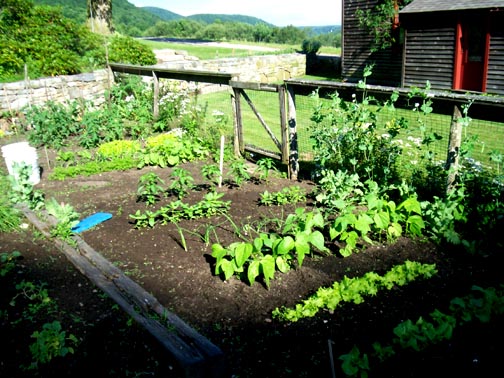
Anyway, it was not difficult to adjust to the soil conditions here, and we blithely chose our largest fascia (terrace) for our vegetable garden, and for eight years planted much as we were accustomed to in New England: in rows like this

(This is a photo Hatsy Taylor took of her veggie garden in East Canaan, Conn, which she has kindly allowed me to use.)

The problem was that our largest fascia is too shady. (We have six fascie, measuring anywhere from 3′ – 20′ in width; most are about 9′.)  For starters there is a large palm tree that takes a lot of the morning light.  Then we planted an orange tree right in the middle of the space because it is pretty there – more shade.  The house blocks the sun from mid-afternoon on, so all in all our poor veggie garden got about 3 hours of sun a day.  Nonetheless we were able to grow enough tomatoes to make all the sauce we need for a year, as well as a pumpkin or two, some cukes, beans,  lots of herbs, some roses and flowers for cutting.  We were never successful with zucchini, oddly – probably due to the amount of shade.

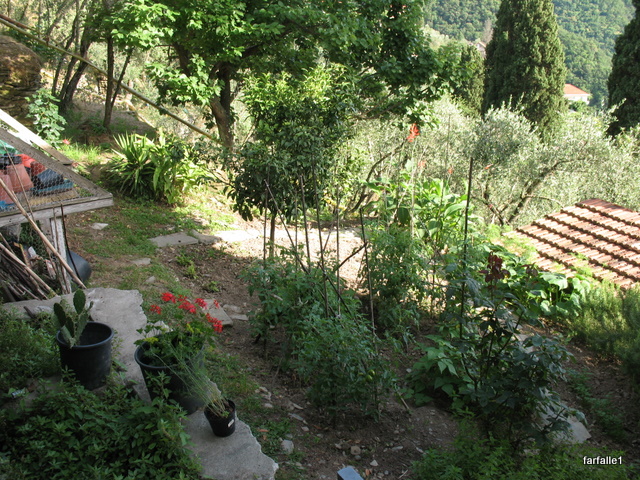
Our neighbors here on the steep slopes of Montallegro use their limited fascia space so intelligently.  They plant narrow strip gardens facing the sun, just in front of the stone wall that supports the fascia above, sometimes even under their olive trees, which make only dappled shade.  It makes so much sense!  The wall behind offers support and holds and reflects the sun’s warmth.  Weeding is ever so much easier (should one actually decide to do it) because every ‘garden’ is one, or at most two, rows deep.

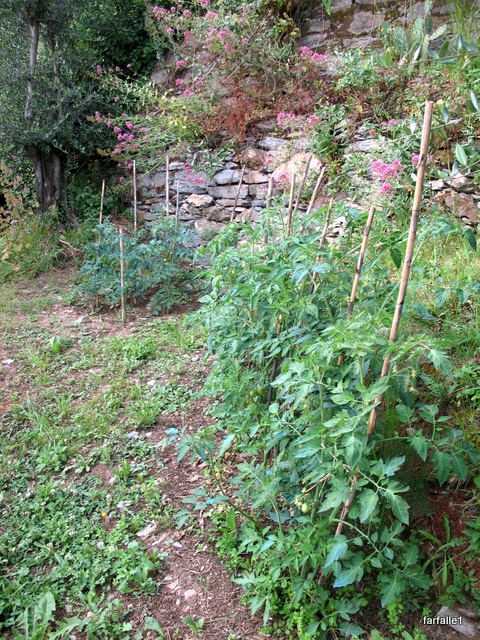
This spring the Captain took a pickax to the land in front of our sunny walls, and we now have four new strip gardens.  On the top level we have two plots of tomatoes.

They are growing like crazy  – partly because of all the rain we’ve been getting, but also because they love the warm soil in front of the wall.

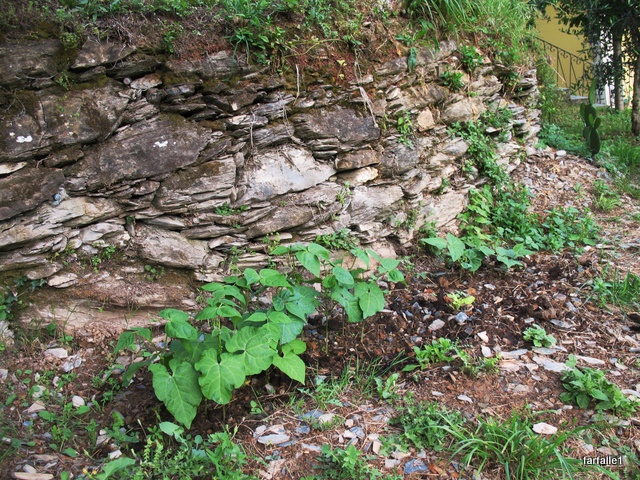
The next level down is not so satisfactory.  The ground was stonier than normal, so it was hard to make a good bean bed.  The ones that came up (both bush and pole) are doing fine, but probably only 30% germinated, in spite of a healthy dose of bagged manure. (moo pooh?)

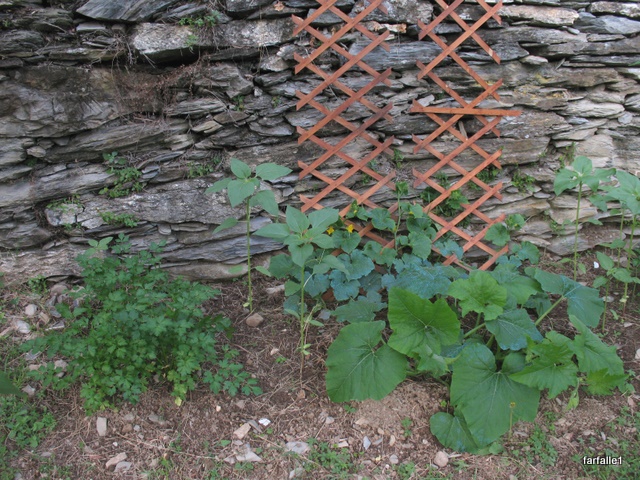
The next level down is my favorite because it is so mixed.  In one spot are three leftover tomato plants.  Then there is a small strip with cucumbers climbing the trellis that used to keep Luciano from wandering off our terrace, with some bushy pumpkins in front.  Parsley flanks these climbers, with some giant sunflowers thrown in just for fun.

None of it looks like much now, but it’s all growing by leaps and bounds.  Already  teeny tomatoes and cucumbers have formed, and every day each plant looks about 6″ taller.

So, what’s happening with the old garden?  The Captain planted a lot of ground-cover, but the seeds all washed away in the two weeks of rain that followed; we’ll replant, probably in the fall.  He also has constructed an elegant new compost area, and has almost finished a new potting table.  It will be a cool and shady area in which to relax on all those hot summer days we’re waiting for.  Thyme, marjoram, mint, sage and rosemary are still happily ensconced there.  Dill, cilantro and basil like it hot, hot, hot, so they are growing in pots on the terrace.

By the way, there’s another family that’s doing some interesting gardening this summer, but I see that with their luxury of flat space they are using the more traditional layout:

I’m guessing Michelle and Barack have a bit more help with their garden than we do with ours.  Yes, our new garden strips are working really well, but yes, it’s a lot more work to get water to four places instead of just one.  But you know what they say… when in Rome…

Bersalgieri Visit Rapallo

23 Friday Oct 2009

Posted by farfalle1 in Italian men, Italy, Law and order, Photographs, Rapallo, Uncategorized

≈ 6 Comments

Tags

Bersaglieri, Bersaglieri parade, Italian Army, Italian Military

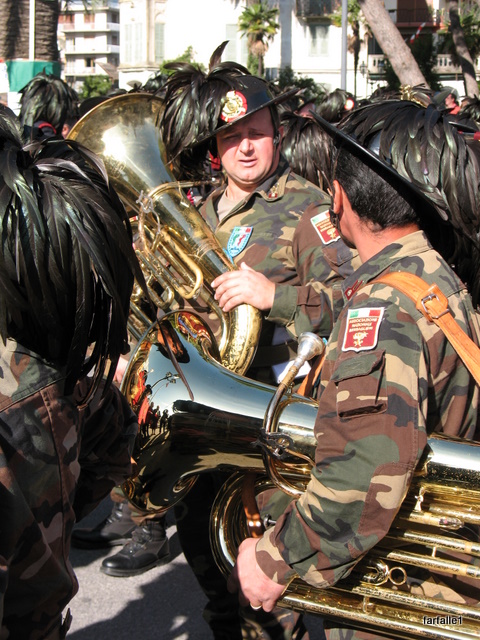
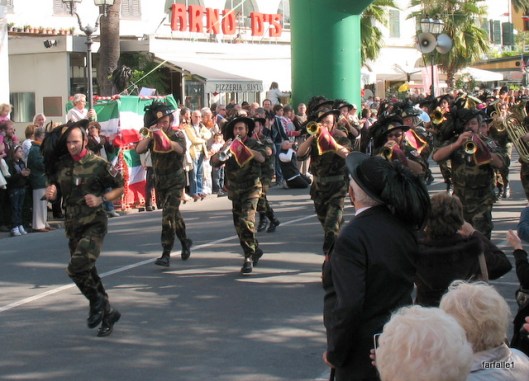
For a couple of weeks the main streets of Rapallo have been criss-crossed with hundreds of little Italian flags.  Why? we wondered.  This weekend we found out: the Bersaglieri visted Rapallo and some neighboring towns for a gathering of the Corps from central and northern Italy.  There were many events around their visit, including a concert on Saturday evening and a parade on Sunday morning.  We were able to go to the parade for a few hours, which made us  swell with pride, if not for being Italian, at least for living here.

pre-parade (10)

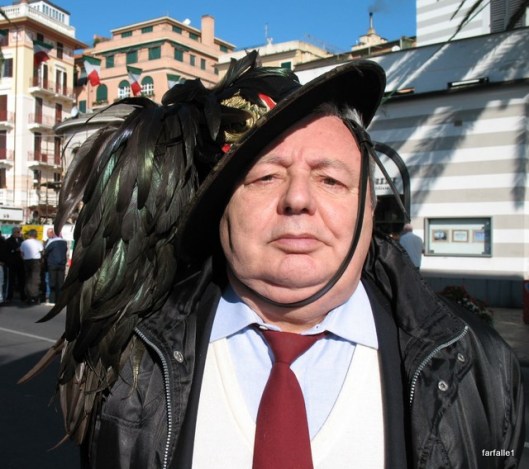
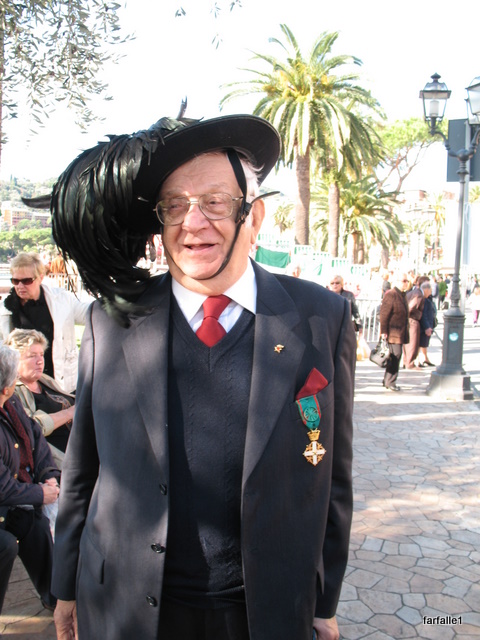
There’s something about a uniform – or at least there always has been for me – and the signature feathers of the Bersaglieri hat are so over the top (oh excuse the pun) that they are divine.  Where did that idea ever come from?  Was it a type of ill-thought-out camouflage?  Perhaps it was to suggest the speed of flight (though wood grouse, the source of the feathers, have never been noted for speed)?  Me?  I think it was simply a Style Statement, and a very fine one, too.

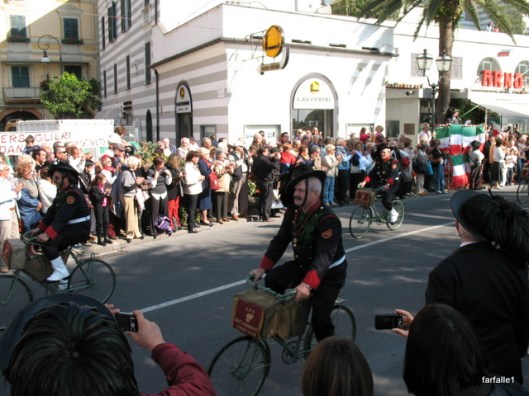
The Bersaglieri were founded in 1836 to serve as high-speed infantry in the Piemontese Army (this was before Italy was unified). Piemonte could not afford a large, expensive horse-mounted cavalry, so instead developed a superb corps of sharp-shooters that featured quick movement, either on foot or bicycles, and later on motorcycles.  The Bersaglieri never walk – they run everywhere, whether in training, in the field, or in a parade. Their demanding physical training made them useful as mountain troops, too; the Alpini, the elite mountain troops, were founded in 1872, and there is still a friendly rivalry between the two groups (there were several groups of Alpini in the parade and some proud veterans watching).  While there have been as many as 12 regiments of Bersaglieri in the past, today there are six, and they are all now mechanized.

pre-parade (15)

In addition to unique headgear and running everywhere, the Bersaglieri are famous for their fanfara, the brass bands that accompany every regiment.  The musicians must be adept not only at playing, but at playing as they run, because they, too, are obliged to run everywhere they go.  The Fanfara from northern and central Italy formed the major part of Sunday’s parade, and they certainly impressed with their musical skill and physical stamina!

parade (18)

During World War II there were both bicycle and motorized troops:

parade (41)

parade (59)-1

There was a huge ovation for the oldest gent on a bicycle – 92 years old and still going strong:

parade (40)-1

And how about the fellow who has to ride a bike AND play the trumpet??

parade (55)-1

I find it very moving to see old Vets watching a parade, and Sunday was no exception.  There were scores of former Bersaglieri watching the parade; it wasn’t always easy to read their expressions.

veteran

veteran (2)

veteran (3)a

veteran (5)

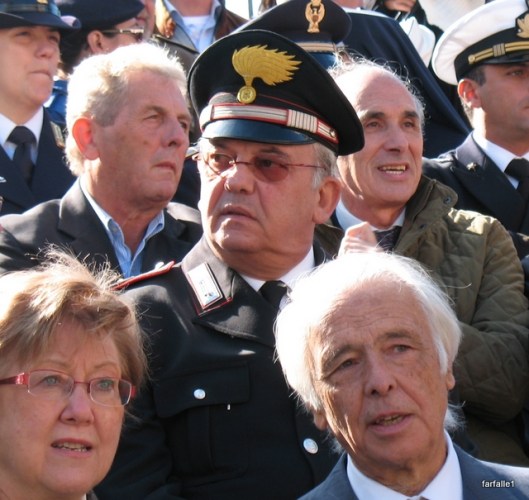
And of course there was a viewing stand full of dignitaries:

dignitaries (2)b

A parade is always fun, and a military parade particularly stirring.  But only in Italy, I think, will you find a military parade that showcases such stamina, showmanship and style in one package: The Bersaglieri.

If you’re interested in some more photos of the parade, you may see them at a web album here.  I recommend a slide show, F11 for full screen.

L’ICI

17 Monday Aug 2009

Posted by farfalle1 in Italian bureaucracy, Italy, Law and order, Rapallo, Uncategorized

≈ 4 Comments

Tags

Ici, Italian taxes, L'ici, taxes

So, what did you think when you read the title ‘L’ICI?  Lice?  Itch?  Well, in a way both are correct, since  L’ICI (pronounced leach’-eee) has been a pesky little problem that’s been driving us nuts.

Rapallo coat of arms

The ICI (eetchy!) is Italy’s real estate tax.  We’ve always been thrilled at how small it is compared to what we’re accustomed to paying in the U.S., where such taxes generally pay for public education.  I’m not sure what the ICI pays for here – it is a tax imposed by the commune (the town), and is used for ‘services.’  It seems to me that we are already taxed for just about every service we receive (garbage, TV, etc.), but I digress.

When we first bought our house we went to the Tribute Office where such things are paid, and asked how much we owed.  Perish the thought that a taxing body should actually prepare and send a bill!  No.  It is up to the tax-payer to a) know that there is a tax due, b) know how much it is and c) know where, when and how to pay it.  Okay.  We can and have learned this stuff, and keep a careful calendar so we won’t miss any payments.  The trick we never mastered was knowing how much to pay, so each year we went to the office and they were nice enough to tell us.  Sort of.

Last year we received a certified letter that we had to pick up an important document at the Tribute.  It turned out that since 2002 we had been paying an incorrect amount, on two counts.  First, we were paying as if our house were still a rustico instead of a restructured habitation (in spite of the fact that our geometra filed the correct forms informing the commune of the change) and second, only the Captain’s share of the tax had been paid, and that was only half of what was owed.  So we owed in excess of E 800.  They were nice enough to understand that these were honest mistakes (and not just ours), so the accrued penalties and interest were set aside.  Grudgingly we paid – yet another unexpected and large expense.  We still don’t understand why the office didn’t give us the correct amounts due each year when we trudged in to ask.

L’ICI for primary homes was abolished beginning last year (thank you, Mr. Berlusconi), which means we no longer pay.  Only businesses and those who own more than one home now have to pay.  But the ICI wasn’t finished with us, not yet.  We received a note this year telling us that we had not paid for 2002.  We hauled out the many forms and receipts left over from last year’s adventure and discovered that in fact we had nothing to show we’d paid more than the original incorrect amount in 2002.  So back the Captain went to the Tribute Office, gathered all the materials and, once again, we will be making an unexpected tax payment.

We shouldn’t complain, I suppose.  It is still way, way less than Americans pay annually in property taxes.  It’s just the inefficiency of it all that drives us crazy.  They probably never would have cottoned to the errors if the tax on primary residence hadn’t been abolished, but now I guess the workers in the Tribute office have time on their hands.

This should be the end of our ICI Adventure, but you just never know in Italy.  These things have a strange way of being resurrected at the most inopportune times.

Chivalry – still alive and well in Rapallo

13 Thursday Aug 2009

Posted by farfalle1 in Italian men, Rapallo

≈ 8 Comments

Tags

Chivalry, Flavio

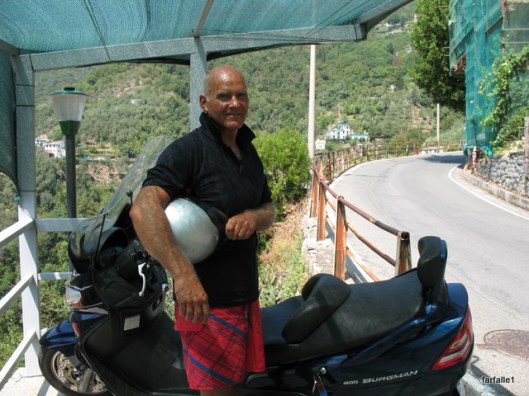
On Tuesday Flavio restored my flagging faith in mankind:

Flavio

I had just done a great big shopping at one of the local supermarkets.  It seemed like the day to buy everything heavy: 20 lbs of kitty litter, 6 liters of water, a dozen cans of beer, plus the usual foodstuffs.  Having gotten it all stowed in my trusty scooter, I started her up and motored about 50 feet.  Cough, cough, splutter, ominous silence.  Poor old scooter just flat out quit.  Flavio and one of his friends were across the street and watched as I fruitlessly tried to get the darn thing started again.  An old gent in a stylish fedora sporting bermuda shorts and an ace-bandaged ankle walked by and advised in passing, “spegna le luce, signora” – turn off the lights, which I did.

In frustration I parked the scoots and began weighing my options.  The Captain was engaged and I didn’t want to disrupt what he was doing.  It was, by this time, almost 1 p.m., and our scooter guy, Simone, would have gone home for lunch.  I was just about to head off to my friend Madelena’s paneficio to throw myself on her mercy when Flavio and his friend crossed the street and started tinkering.  They spent half an hour working on the scooter, to no avail.  They opined, and were later proved right, that I needed a new spark plug (‘candele’ in Italian – lovely word).

I was feverishly re-weighing options (by now Madelena would’ve gone home for mid-day) when Flavio asked where I lived.  I told him San Maurizio di Monti, and without a moment’s hesitation he offered to take me home.  “Oh no,” I replied, “It’s too far – 8 or 10 kilometers.”  He answered with a shrug and some words which I took to mean, “No problem.”

So he stowed all the groceries under his seat, and I hopped on the back of the big Burgman 400 and enjoyed a smooth and stately ride home.  It was such a nice thing to do!   How to say thanks?  I offered lunch at Rosa’s across the street, but he declined, got on his scooter and drove back down the mountain.

I don’t know anything about this man except that he’s one of Rapallo’s gentlemen, and he did me a truly nice turn that day.  I hope I can find him – we’ve got a bottle of wine with his name on it.  Thank you, Flavio!

Pigeons on the grass, alas…

16 Thursday Jul 2009

Posted by farfalle1 in Animals in Italy, Birds in Italy, Rapallo

≈ 4 Comments

Tags

city pigeons, pigeons

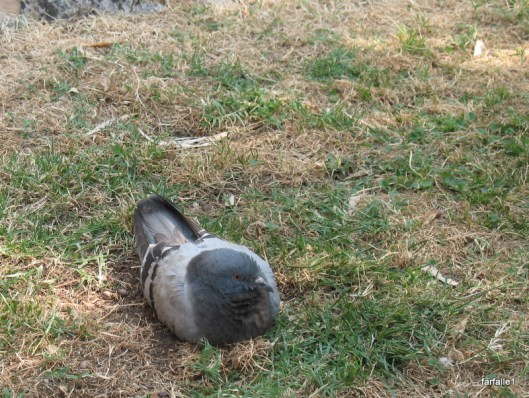
I don’t know for sure, but I suspect ‘they’ give the pigeons something to eat here that makes them infertile and stupid.  There are not nearly as many pigeons around as you would expect in a town that has one outdoor cafe after another, and the ones that are here are sluggish.  Often they can’t get out of the road in time and end up being squashed.  Look at this poor guy – he didn’t have the oom-pah-pah to fly away when I approached to take his picture.  If he can’t escape from a prying camera it’s a good bet he’s not going to be helping to make any baby pigeons…

pigeon

ETs?

11 Saturday Jul 2009

Posted by farfalle1 in gardening, Rapallo, Uncategorized

≈ 4 Comments

Tags

mowing the river, river maintenance, Torrente San Francesco

mowing the river
No, extra-terrestrials have not landed in Rapallo.  Instead it is time to mow the river.    The Torrente San Francesco is fed by all the little streams and rivulets that start in the folds of our high mountain and head towards the sea.  By the time they arrive on the plain of Rapallo they have become the Torrente.  For most of the year that is a misnomer, as you can see in the photo below.  Not only is it not a torrent, you can see hardly any water at all in some places.  What you can see is a lot of greenery, including the dreaded bamboo on the right in the picture above.  To give you an idea of how much water there can be after heavy rains, in 2002 I saw the top of the river almost breach the high retaining walls that you see below.  The mowers tackle not only the river bed itself, but also the walls which sprout quantities of viney, clingy weeds in all seasons.

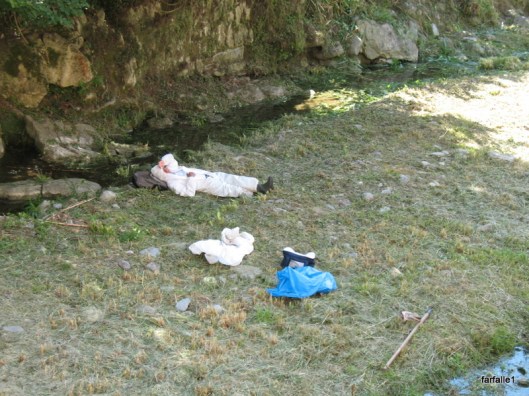
Why the haz-mat suits?  I’m not sure.  Just to be safe, I guess.  I can tell you what they wear under them.  Not much.  Sometimes a wife-beater tee-shirt, sometimes no shirt at all, and, I suppose, trousers, although I didn’t  verify that.   The river is home to many, many ducks and geese as well as the occasional cat.

mowing the river4

I asked mower Luis how often they have to mow the river. They last did it two months ago, he said. How long does it take to finish the river? A week or more, it’s hard work after two months of heavy growth. When I asked him what was the most interesting or amusing thing they found in the river his face clouded for a minute. “We find a lot of dead animals,” he said. But then he smiled sweetly and continued, “but we also find the birds’ nests, and we always mow around them.”

Everybody’s happy when the river has been mowed.  Something minty grows down there, and the perfume fills Via Bette from the Autostrada Bridge all the way down to Giorgio’s bakery, where the mouth-watering smell of freshly baked bread prevails.  Also you can see what’s going on so much better after the mowing.  Something delicious must be hiding in that hole; this cat was so intent that even loud shouts of ‘hey, kitty!’ didn’t get his attention.

bees 022
mowing the river resting

Uh oh!  Looks like Luis found some hazardous material after all… but no.  He’s just having a little ‘pisolino’ (nap) after his picnic lunch.

← Older posts
Newer posts →

Enter your email address to follow this blog and receive notifications of new posts by email.

Join 114 other subscribers

rss

Subscribe in a reader

Search the Blog

A. Useful Links

  • bab.la language dictionary
  • Bus schedules for Tigullio
  • Conversions
  • English-Italian, Italian-English Dictionary
  • Expats Moving and Relocation Guide
  • Ferry Schedule Rapallo, Santa Margherita, Portofino, San Frutuoso
  • Italian Verbs Conjugated
  • Piazza Cavour
  • Rapallo's Home Page – With Link to the Month's Events
  • Slow Travel
  • The Informer – The Online Guide to Living in Italy
  • Transportation Planner for Liguria
  • Trenitalia – trains! Still the most fun way to travel.

C. Elaborations

  • A Policeman’s View
  • Driving School Diary
  • IVA refunds due for past Rifiuti tax payements
  • Nana
  • Old trains and old weekends
  • The peasant, the Virgin, the spring and the ikon
  • Will Someone Please, Please Take Me to Scotland?

D. Good Recipes - Best of the Week winners are starred

  • 'Mbriulata
  • *Baked Barley and Mushroom Casserole*
  • *Captain’s Boston Baked Beans*
  • *Crimson Pie*
  • *Louise’s Birthday Cake*
  • *Melanzane alla Parmigiana*
  • *Penne with Cabbage and Cream
  • *Pizzoccheri della Valtellina*
  • *Pumpkin Ice Cream*
  • *Risotto alla Bolognese*
  • *Rolled Stuffed Pork Roast*
  • *Spezzatini di Vitello*
  • *Stuffed Grape Leaves*
  • *Stuffed Peaches (Pesche Ripiene)*
  • *Swordfish with Salsa Cruda*
  • *Tagliarini with Porcini Mushrooms*
  • *Tagliatelli al Frutti di Mare*
  • *Three P's Pasta*
  • *Tzatziki*
  • 10th Tee Oatmeal Apricot Bars
  • Adriana’s Fruit Torta
  • Aspic
  • Bagna-calda
  • Best Brownies in the World
  • Clafoutis
  • Cold cucumber soup
  • Crispy Tortillas with Pork and Beans
  • Easy spring or summer pasta
  • Fish in the Ligurian Style
  • Hilary's Spicy Rain Forest Chop
  • Insalata Caprese
  • Lasagna al forno
  • Lasagna al Forno con Sugo Rosato e Formaggi
  • Lemon Meringue Pie
  • Leo’s Bagna Cauda
  • Leo’s Mother’s Stuffed Eggs
  • Louis’s apricot chutney
  • Mom's Sicilian Bruschetta
  • No-Knead (almost) Bread
  • Nonna Salamone's Christmas Cookies
  • Pan Fried Noodles with Duck, Ginger, Garlic and Scallions
  • Pesto, the classic and original method
  • Pesto, the modern, less authentic method
  • Pickle Relish
  • Poached pears
  • Poached Pears
  • Polenta Cuncia
  • Recipes from Paradise by Fred Plotkin
  • Rustic Hearth Bread
  • Shrimp and Crayfish Tail Soup
  • Sicilian salad
  • Slow Food Liguria
  • Slow Food Piemonte and Val d'Aosta
  • Spinach with Garlic, Pine Nuts and Raisins
  • Stuffed Eggs, Piemontese Style
  • The Captain’s Salsa Cruda
  • Tomato Aspic
  • Zucchini Raita

E. Blogroll

  • 2 Baci in a Pinon Tree
  • Aglio, Olio & Peperoncino
  • An American in Rome
  • Bella Baita View
  • Debra & Liz's Bagni di Lucca Blog
  • Expat Blog
  • Food Lovers Odyssey
  • Italian Food Forever
  • L’Orto Orgolioso
  • La Avventura – La Mia Vita Sarda
  • La Cucina
  • La Tavola Marche
  • Rubber Slippers in Italy
  • Southern Fried French
  • Status Viatoris
  • Tour del Gelato
  • Weeds and Wisdom

Photographs

  • A Day on the Phoenix Light Rail Metro
  • Apache Trail in the Snow
  • Aquileia and Croatia
  • Birds on the Golf Course
  • Bridge Art
  • Canadair Fire Fighters
  • Cats of Italy
  • Cloudy day walk from Nozarego to Portofino
  • Fiera del Bestiame e Agricultura
  • Football Finds a Home in San Maurizio
  • Hiking Dogs
  • Mercatino dei Sapori – Food Fair!
  • Moto Models
  • Olive pressing
  • Rapallo Gardens
  • Rapallo's Festa Patronale
  • Ricaldone and the Rinaldi Winery
  • Rice Fields
  • Sardegna ~ Arbatax and Tortoli
  • Sardegna ~ San Pietro above Baunei
  • Sardegna ~ The Festa in Baunei
  • Scotland, including Isle of Skye
  • Slow Food 2008 Salone del Gusto
  • The Cat Show and the Light Rail Fair
  • The desert in bloom
  • Trip to Bavaria

Pages

  • Fagioli all’ucelleto

Archives

Recent Posts

  • A Superior Visit
  • Fun at the Ranch Market
  • The MAC
  • Welcome Tai Chi
  • Bingo Fun for Ferals
December 2025
M T W T F S S
1234567
891011121314
15161718192021
22232425262728
293031  
« Jul    

Member of The Internet Defense League

Blog at WordPress.com.

  • Subscribe Subscribed
    • An Ex-Expatriate
    • Join 114 other subscribers
    • Already have a WordPress.com account? Log in now.
    • An Ex-Expatriate
    • Subscribe Subscribed
    • Sign up
    • Log in
    • Report this content
    • View site in Reader
    • Manage subscriptions
    • Collapse this bar
 

Loading Comments...