Do-It-Yourself Wine

Tags

, ,

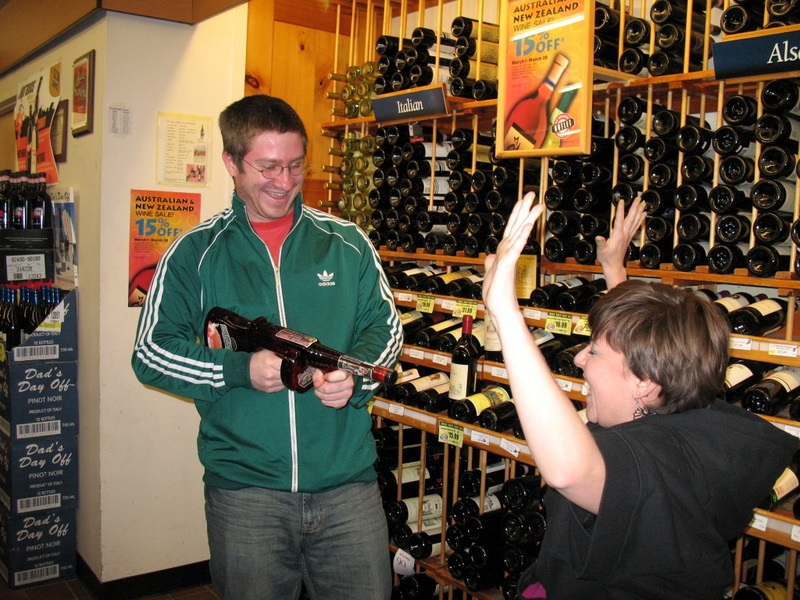
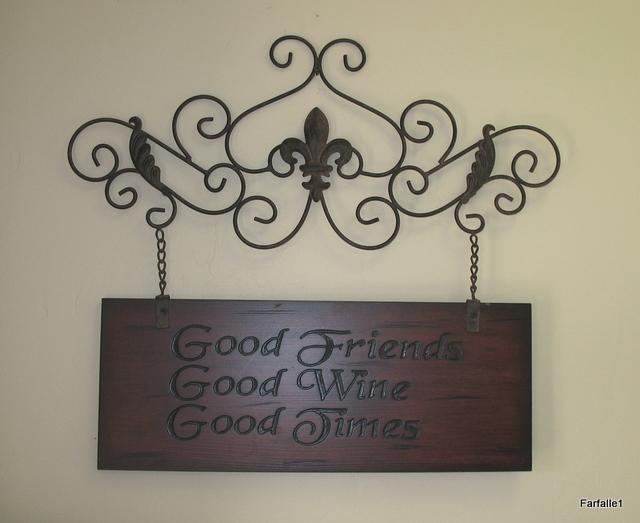
Truer words were never scratched into wood.  And is there not a little old wine-maker hidden inside each of us who enjoys drinking the fermented grape?  The Captain and I think of it sometimes, and we enjoy watching our friends up the hill in San Maurizio labor and worry over first their grapes, then their juice, then their fermentation, and finally their bottling.  But having watched the intensity of the labor that goes into producing wine (and, co-incidentally, not having any grapes) we limit our ‘wine-making’ to either helping our cousins pick their grapes, or bottling wine we’ve bought in bulk.

We are wine spoiled living in Italy much of the year.  It’s no secret that Italy is the source of some of the finest wines in the world.  And if your taste runs to the more prosaic vintages, you can satisfy your thirst for a pittance.  We are accustomed to paying +/- E2 a liter ($2.60) for our table plonk.

It’s always a rude awakening to price wine in the U.S., to the point that it kind of takes the fun out of shopping for it.  What a pleasant surprise, then, to discover Wine Canyon, one of Gold Canyon’s newest stores.  No, Wine Canyon is not a liquor or wine store, per se.  Rather, it is a place where you can buy wine ‘juice’ and make your own wine.  I know!  We’d never heard of such a thing either.

According to proprietor Loren Kensrud, the idea started up in Canada, a country definitely not famous for its fine wines, but full, evidently, of frustrated vintners.  It’s pretty simple, really, and looks like loads of fun.

You buy a box of grape juice, which has been tested for appropriate sugar and acid content before being packaged.  Your box will produce 6 gallons (30 bottles) of wine, as a rule. The ‘wine juice’ comes from vineyards all over the world – Australia, France, Germany, South Africa, New Zealand, California and, of course, Italy.
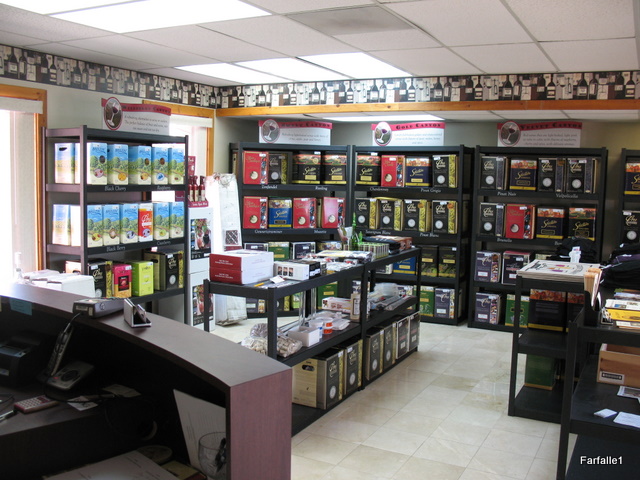
Each of these boxes is a different wine – there’s no shortage of choices, no matter what your taste. Calling it ‘grape juice’ makes it sound like the wine will taste home-made in the worst sense of the phrase (I’m thinking of the dandelion ‘wine’ my father and I once made – undrinkable!).  But these juices are the true varietals from their regions and make ‘real’ wines, such as Cabernet, Merlot, Shiraz, Barolo, Chianti, etc., etc.

You mix your juice with the provided agents (yeast, benonite, potassium sorbate and potassium metabisulphite) and let it stew in a bucket for a while.  Then you put it into big glass bottle and let it ferment for four to eight weeks, depending on the wine. The kits contain only one-third to one-fifth the amount of sulfites that are present in commercial wine, which is good news for the headache-prone.
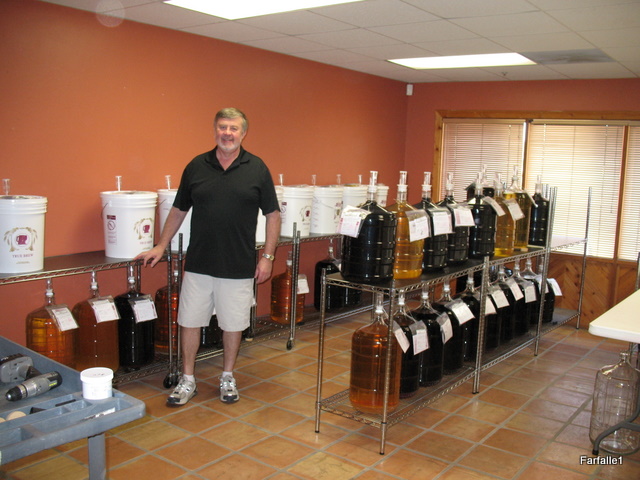
Loren Kensrud in his fermenting room

After that you make an appointment to come back and bottle your wine.  The hardest part for most people, according to Mr. Kensrud, is that you must let your wine sit for anywhere from one to six months or more after you take home the bottles.  That’s all there is to it.

Then there’s the fun of designing your own label which will surely impress your friends.

What does it cost?  Probably somewhere in the $4 – $8 range per bottle, depending on the kind of wine you make.  Mr. Kensrud gave us a taste of a couple of wines, including a delicious Brunello, a wine that is available at Liquor Land for $35 – $100 a bottle, and  we thought it was excellent.  Making your wine this way may not have quite the charm of a visit to a vineyard in Piemonte, but it’s certainly more interesting and a lot more fun than going to Liquor Land.  Maybe next year?  Stay tuned.

The Best Thing We Ate – Shrimp and Crayfish Tail Soup

Tags

, , ,

Some years ago the Captain found a restaurant (Indonesian? Malaysian?) not far from his London layover hotel, The Kensington Hilton (located in Hammersmith, not Kensington at all).  He has never forgotten the soup he enjoyed that night at dinner.  Recently he found a package of frozen crayfish tails and he thought, Aha! Now is the time to try to recreate that magical soup.

It was initially scheduled for a few weeks ago, but to his horror he found that the cans of tomato pieces he had bought contained oregano.  That flavor was definitely not part of his taste memory of this particular soup, so a quick menu change ensued.

Finally, though, the perfect opportunity presented itself, and on a recent Friday he produced the divine soup pictured above.  With a bit of piquancy, a bit of cream and a bit of heat it is easy to see why he never forgot this particular dish.

The crayfish tails tasted to me of lobster, so I think they could easily be substituted if crayfish tails are not available.  You can find the recipe here or over on the right under recipes.

Full Nest

Tags

,

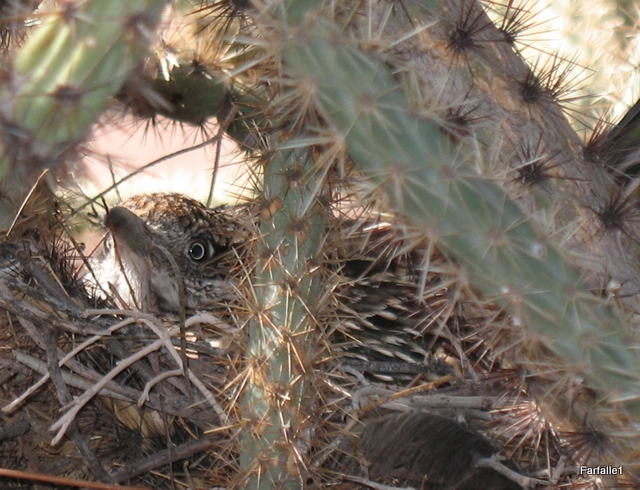
We last met the goofy roadrunner in this post about desert camouflage.  When does a roadrunner stop being goofy?  When it’s a female sitting on her nest; then a roadrunner becomes sweet and vulnerable (for probably the only time in her life).  She remains, however, well camouflaged.

These photos are thanks to the Captain, who has the eaglest of eyes.  He heard a cardinal singing, and when he looked for it his eye fell on the roadrunner in her nest, well and truly hidden in a protective cactus.
Still difficult to see, isn’t she?  It’s hard to imagine being a baby anything and having to find your way out of such a prickly nest; on the other hand, no doubt those nasty spines will keep predators from the sitting bird and the new hatchlings when they arrive.

At the Table

Tags

, , ,

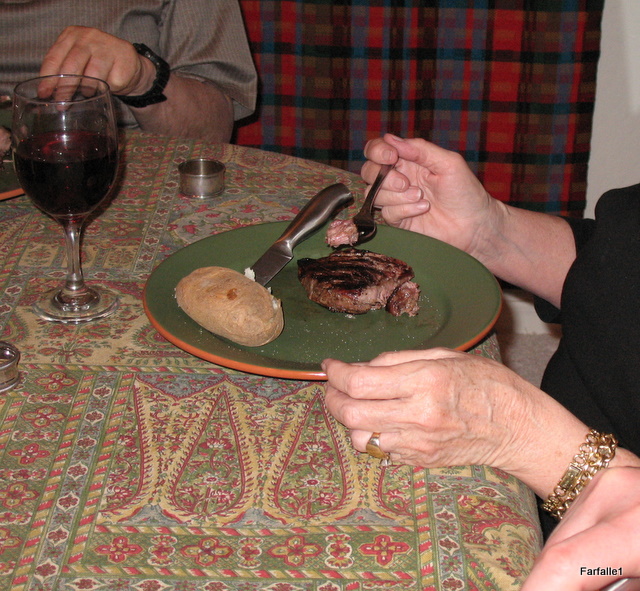
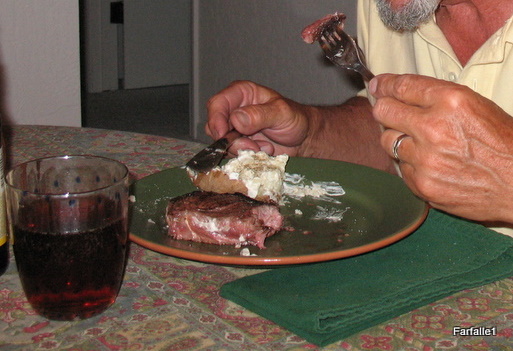
There are many dining differences between the U.S. and Italy, but some of them are rather subtle.  The food is the first and most obvious, with the dining hour a close second. Holding the fork in the left hand to eat after cutting food is also the common Italian practice, as it is in much of Europe… much more efficient than the American practice of shifting the fork from right hand to left to cut meat, say, then shifting it back again to the right to eat politely.

How much more sensible to just spear it with that fork, saw off a hunk, and ahhhhhhh.

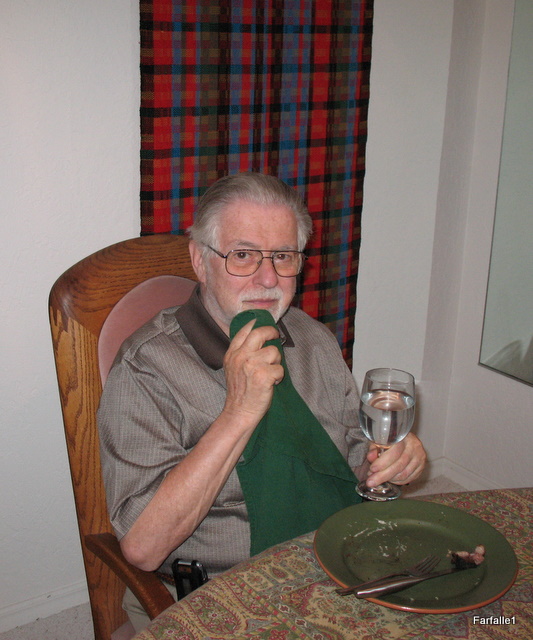
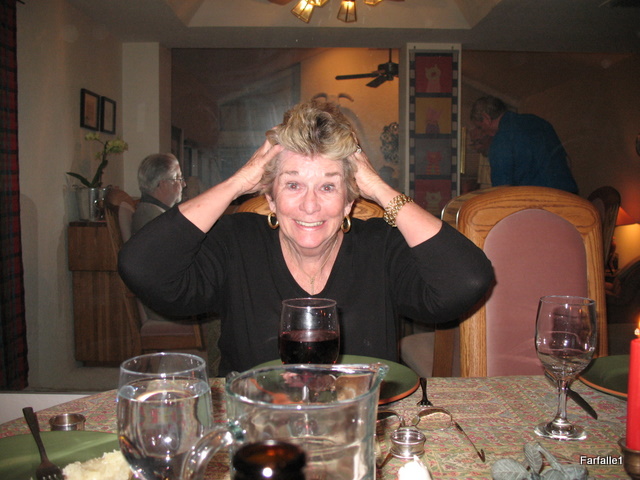
There are otherItalian dining customs that we have learned about only slowly.  The hands on the table for instance; in the U.S. it is considered polite to keep your non-working hand in your lap and your elbows off the table.  In Italy this is highly suspect – just what do you have in your hand that you don’t want your fellow diners to see?  No.  The unoccupied hand should rest, fist gently closed on the edge of the table, where everyone can see what you’re up to.  It’s not unusual to see people rest the whole arm on the table, from near elbow to fist.  Our hand model in the first photo above is illustrating a hybrid of the two practices, eating with her fork in her right hand (American) but resting her left paw on the table (Italian).

Thirsty?  Hang on a second.  Don’t just pick up your glass and drink; you’ll get food residue on your glass.  Instead you want to wipe your mouth with your napkin, then take a sip.  Then wipe your mouth again.


Perish the thought you should get an itchy scalp during a meal.  In Italy it is considered bad manners to touch the hair while eating.  I’m not exactly sure why this is so.  It’s not like you’re running your fingers through your hair and then sticking out your hand to shake with someone else (we see golfers do this all the time at the end of matches – ick!). But then, I’m not sure manners always make a great deal of sense.


(It’s no wonder our patient model wants to pull her hair out – this is about the 6th time I’ve said to her, “Wait! Wait!  Let me take a picture of that!”  Makes it hard to enjoy the food…)

Dinner’s done and it’s time to clear the table.  In the U.S. it is not unusual to make multiple trips to the kitchen carrying two items at a time – it’s not polite to stack plates, we were taught.  I’m happy to say that this work-inducing custom does not exist in Italy.  Everyone, from the very talented waiters in restaurants to the maid serving a fancy private dinner, will stack the plates before staggering out to the kitchen with them: another triumph of common sense!

Time for fruit.  Wait!  Don’t pick up that fruit with your hands!  In Italy we cut our fruit with knives and forks, and eat it with forks.  And it’s best not to eat the skin – just cut that off as well.  You never know what might be on it, even if it has been well washed.  It is a joy to watch an Italian delicately separate the skin from, say, a pear, and tidily eat – it’s an art form. This is a skill I have not yet mastered.  I still like to eat my apples the American way, cut in quarters and enjoyed from the hand.

Care for a cafe?  Well, okay.  I won’t join you, because I don’t care for it myself, but I’d be happy to make you some.  Just remember that in Italy, coffee after dinner means espresso.  Period.  It does not mean cappuccino, which typically is drunk only in the morning, or any of the other myriad Italian coffee styles.  It means a short, dark and very strong espresso.

I’m grateful to the students in my adult ESL classes of a few years ago for teaching me these niceties. There are probably a lot of other customs of Italian dining I’ve omitted – any additions, fellow bloggistas?

Picture Rocks Fire Department Rocks!

Tags

,


Our friends Elena and Michela, sisters, arrived from Italy for a visit a couple of weeks ago.  It was their first ever plane ride and, obviously, their first visit to the USA.  We ran ourselves ragged seeing the sights the Phoenix-Tucson area offers, and each day I asked them what had impressed/amused/irritated them the most.

The answers were pretty much the same each day – everything is bigger here than in Italy (cars, roads, even the host at communion); everything is so clean. Elena was fascinated by the Adopt-a-Highway program, something which does not (yet) exist in Italy.

But the thing that amazed them the most, over and over, was how friendly and welcoming people here are.  (Interestingly, when we moved to Italy we were struck by how very welcoming people there were to us.)   Elena and Michela both enjoy meeting new people in new situations.  Michela has a special gift for drawing people out.  Her secret?  She just walks up to people and starts speaking to them in Italian; they are completely charmed.  Then it’s my turn to insinuate myself as translator, and before you know it, we all have some new friends.

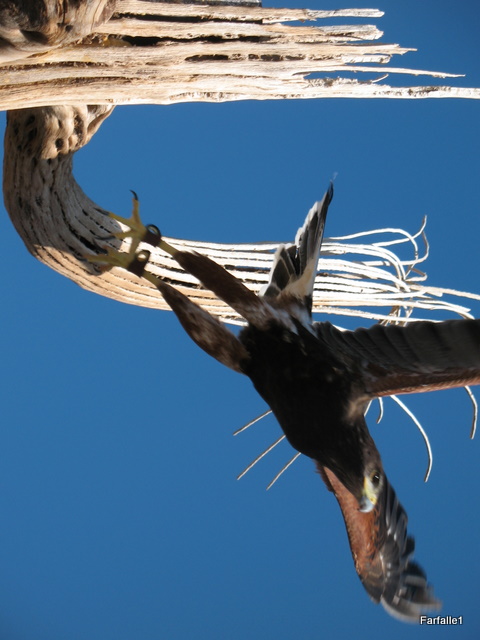
Nowhere was this better illustrated than in Picture Rocks, north of Tucson.  The famous Mrs. Harris took Elena, Michela and me to the fascinating and beautiful Arizona-Senora Desert Museum.  If you’re ever in Arizona this is so worth a visit –  you can learn about all the Sonora Desert plants and see all the animals that are residents, including (among many others) the Harris Hawk

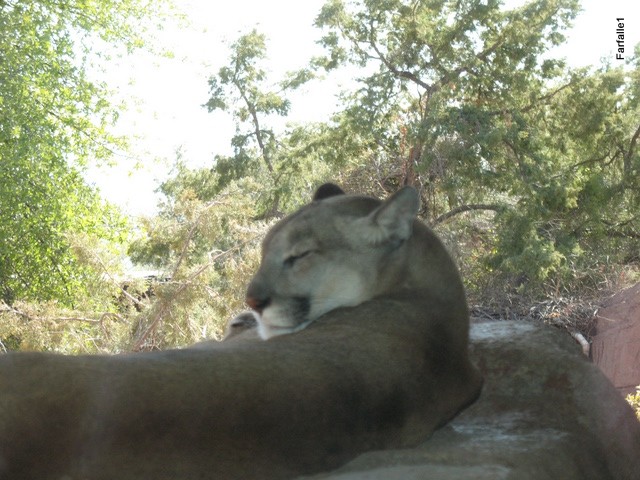
and the dozy mountain lion.

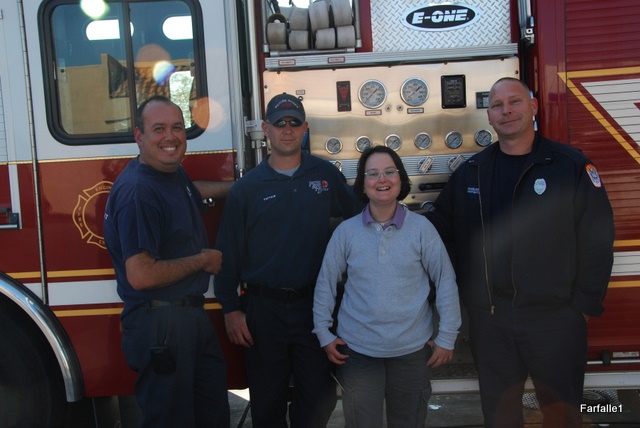
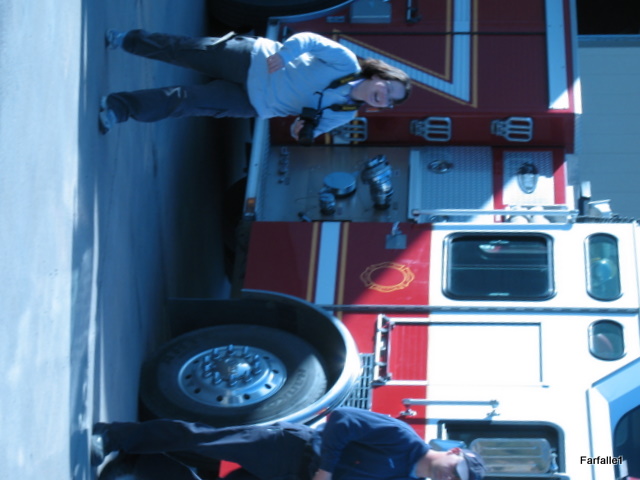
But the really exciting part of the day happened as we were on our way home.  A big red fire engine pulled in to the gas station where we stopped to tank up.  As Michela is an avid amateur photographer, Mrs. H marched up to the firemen and asked if it would be alright if Michela photographed the truck.

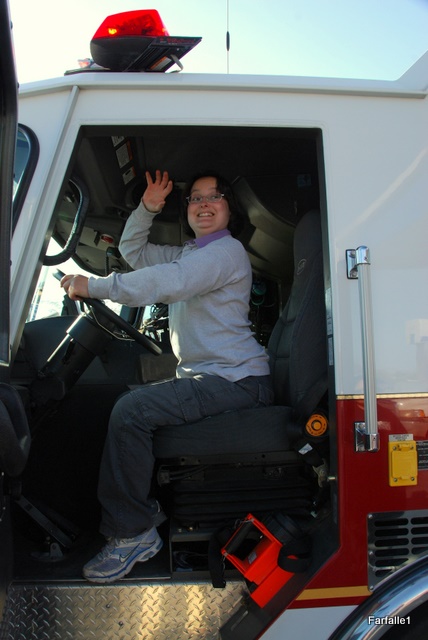
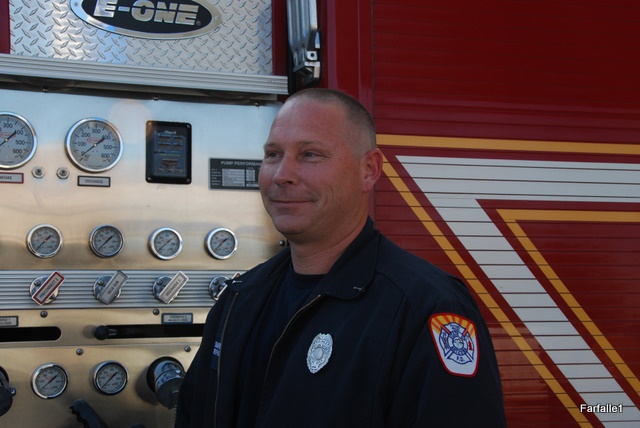
Of course! was the answer.  They couldn’t have been nicer.  They opened up all the doors and secret compartments of the engine so she could photograph them, and explained what all the different tools were and how they are used.  Then they got permission from the Fire Chief to give Michela a ride to the fire station in the truck.

(Not the best picture ever taken of Michela, but one that shows her glee.)

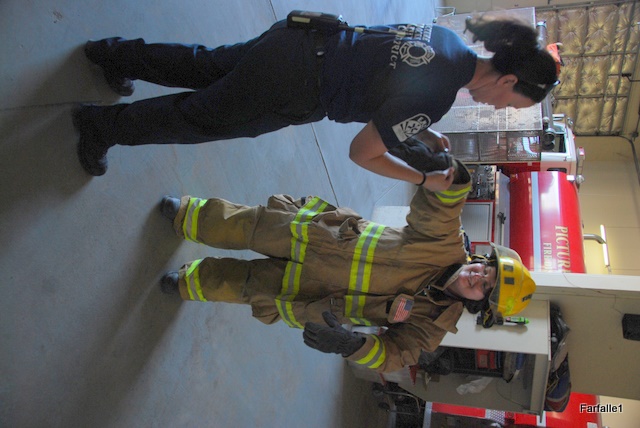
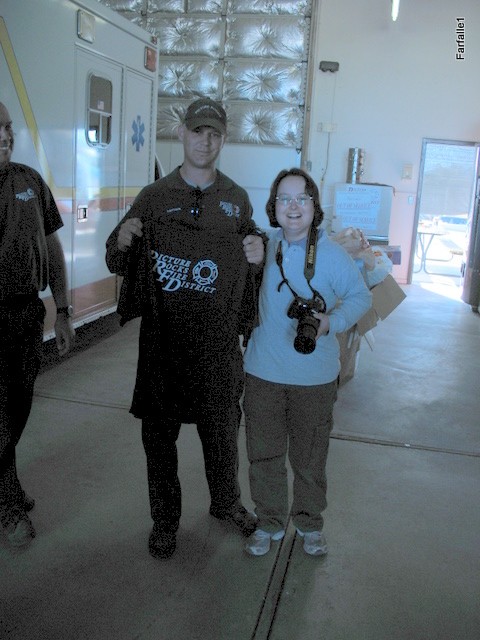
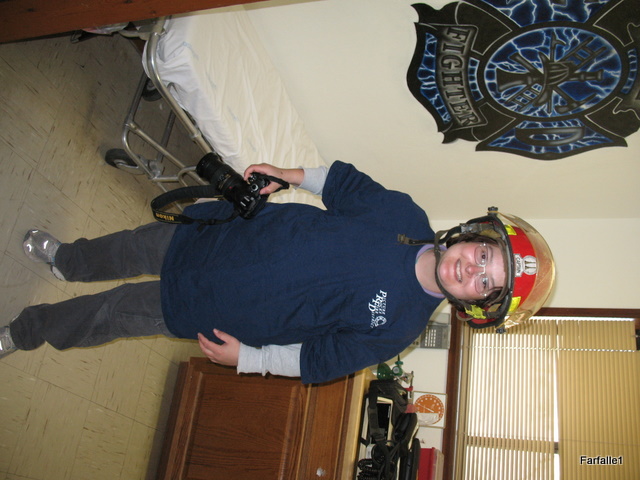
Back at the fire station the kindness escalated.  We were all given Fire Department tee shirts – deep blue, my color!  Then they found a helmet for Michela to try on, and before we knew it, she was all kitted out in complete fire-fighting regalia.

We were given a tour of the whole building – including the kitchen where the smell of cooking brisket got our appetites revved up.

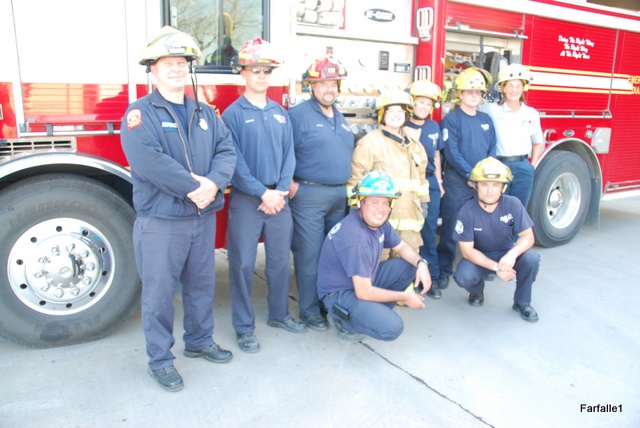
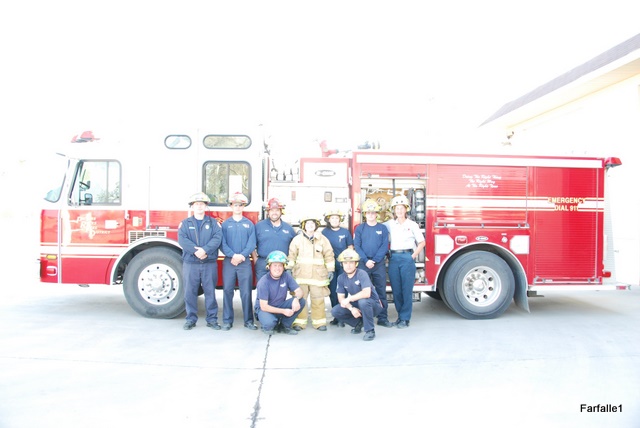
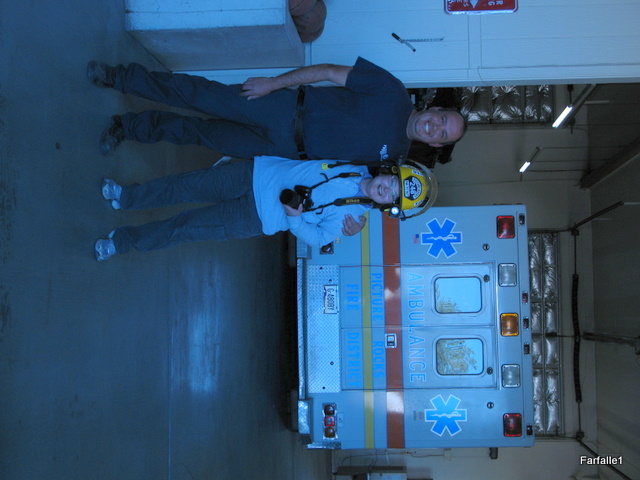
Some of the firemen who weren’t present at the moment were summoned, and we took pictures of the whole  group in front of the beautiful fire engine.

They showed us the small plastic name tags that they each have attached to the inside of their helmets with velcro.  Anyone who goes into a burning building removes his name tag and leaves it with those remaining outside.  That way, as one of the firemen told us, “they’ll know whose mother to call.”  It was a reminder that much of their work is hot, dirty, hard, dangerous and unhappy.  They each removed their name tags and velcroed them to a strip of cloth for Michela to take back to Italy, a symbol of a new friendship – it was a real hands across the ocean moment.

Picture Rocks Fire Department employs about 64 people, men and women, and covers an area of about 64 square miles.  They are very likely to be called out numerous times daily, because in addition to fighting fires, they are the emergency response team.

All in all we spent about an hour and a half at the fire station – it was the highlight of the sisters’ visit to Arizona, and certainly one of the most interesting and moving experiences I’ve ever had here. Every member of the team was generous and kind to us, for no reason other than that that’s how they are. It was humbling.

And oh yeah – they gave Michela the helmet to take home, too – a real helmet that had been damaged and can no longer be used.  Our friends left on Thursday evening, and they had an interesting time packing around that helmet.  But they, and the helmet, have arrived safely back in Rapallo with some memories which we hope they will never forget; we know we won’t.

Here are a few more photos from our visit to the Picture Rocks Fire Department which, I have to imagine, is the best Fire Department in the world.

Fire Chief:  Kathy Duff-Stewart - 27 years service with the department!

Fire Chief Kathy Duff-Stewart, 27 years service with the department!

Home Away from Home

Tags

,

Though I don’t do it often, I love to shop; the words ‘retail therapy’ resonate with me in same way ‘comfort food’ does. Both can offer a brief vacation from whatever ails your spirits.

It was therefore with a light heart that I set out with my Light Rail buddy for a little bit of therapy.

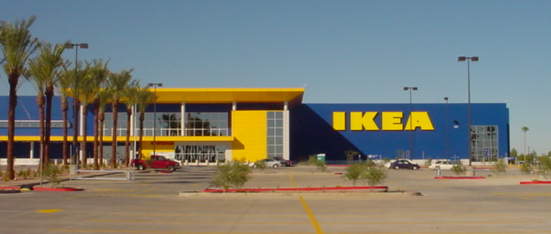
photo courtesy of evliving.com

Look familiar? Do they ALL look like this? My friend A. and I visit Ikea in Genova when we need furnishings or other items for the house, and they seldom disappoint. For clean design and reasonable workmanship, materials and price, it’s hard to beat Ikea. (Note – in Italy we call it Ee-kay-ah, here in the US it is called Eye-key-ah.)

Once inside I was transported immediately back to the familiar territory of the Genova store – it was all identical, except for the language of the signs.


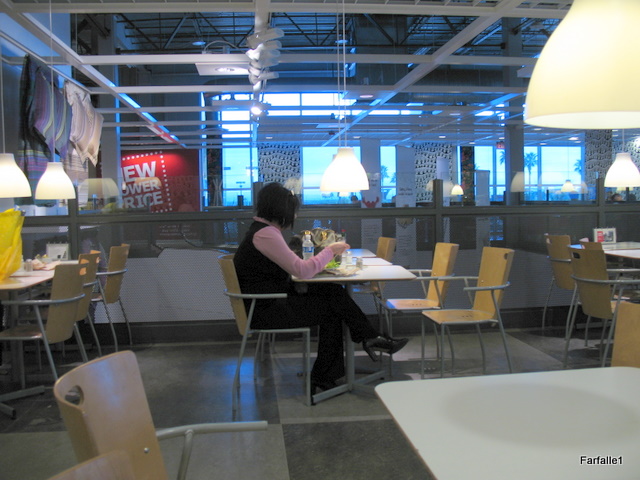
Our first stop, because we got a late start, was the cafeteria, which serves the same Swedishy dishes we eat in Italy – smoked salmon, shrimps on a boiled egg with mayo, meatballs. We opted for the shrimp salad and something that I’ve not seen in Italy, a thick cream of mushroom soup – all yummy, as usual, and a good lunch for just over $5.

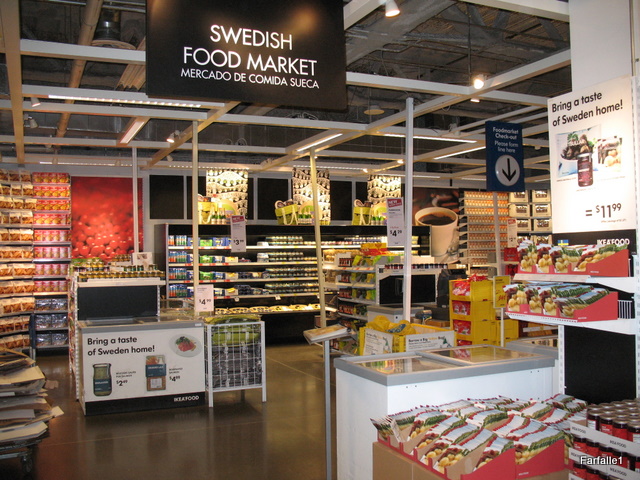
After we picked up the few odds and ends we ‘needed’ we made a stop at the food store, which looked almost identical to the one in Genova, though perhaps not quite as large.

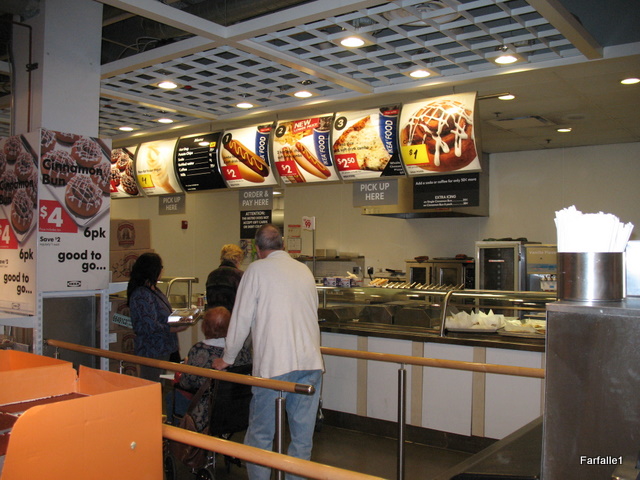
But wait – there’s something missing!  Where’s the coffee bar??  It’s not there!  Instead there is this:

No doubt you can get coffee there, perhaps not cappucino though.  And I dare you to try to find the hot dog at the coffee bar in Genova!

So they do make some accommodation to location, evidently.  But the stores are enough alike that I suffered a moment’s complete disorientation when we emerged into the bright Arizona sun.  Where was our car?  We always park underneath the store… and why does the parking lot look so different?  Oh yeah, that’s right, we’re not in Italy, are we.  But it’s nice to know that whenever I get really homesick for ‘over there’ I can just drive down the I-10, walk into the Phoenix Ikea and become confused enough to think I’m a continent away.

Luciano

Tags

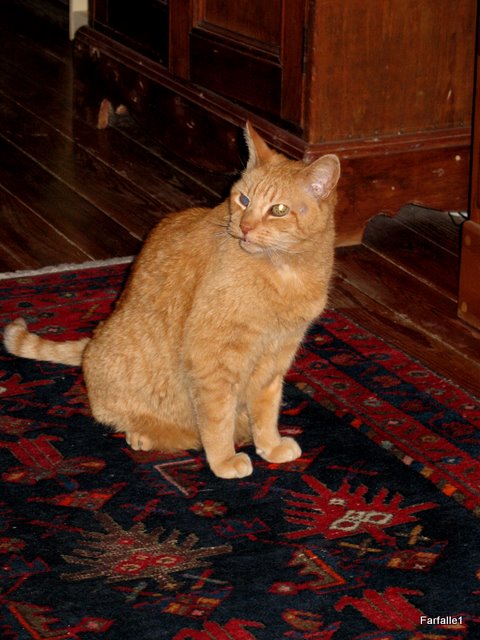
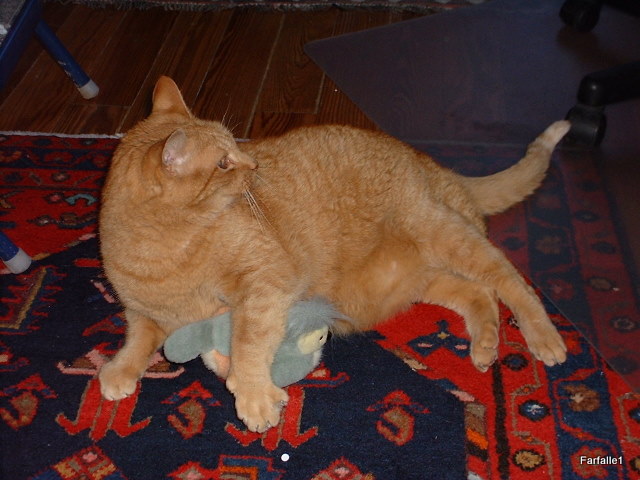
He was an expatriate cat. Born somewhere in about 1990, he was abandoned in a state park in Norfolk, Connecticut. Friends who lived adjacent to the park were able to lure him into a cat carrier with food – he was such a scrawny adolescent boy – and they gave him to us because the Captain had a hankering for a marmalade kitty.

He lived in our bathroom for a week; I spent several hours daily just sitting on the floor, talking to him softly, coaxing him to come for a treat, a little scritch, and finally to sit in my lap. Turns out he was a lover. And a talker. That’s how he got his name. He used to walk down our long driveway with me every morning when I went for the paper, and he sang the whole way down. So we named him after Pavarotti.

When we moved permanently to Italy he moved too, becoming a very cosmopolitan cat. He never let it go to his head, though. He stayed his usual lovable, talkative self, and he grew hugely fat, like his namesake.

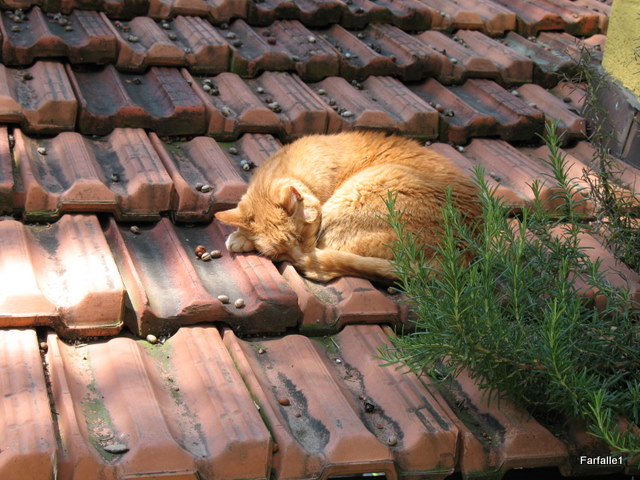
He used to love to sleep on the roof of the rustico below our house. There was just one problem – while he could get up on the roof, he couldn’t get down, so his penchant for going there always ended up with me at one end of a long board and him delicately tiptoeing down towards me from the other.

He was such a well behaved and lovable gentlemen that friends were always willing to take him in for several months when we began to return to the States for annual visits. That was lucky for us, and even luckier for him. This year he was with two young women who adored him and cared for him beautifully. They asked to watch over him, knowing that he had renal failure and that it was likely he would die while we were away.

That’s just what happened today. He slipped away in his sleep at the age of 18 or 19, and has been buried next to the dog Balto, who probably would’ve eaten him in life, but who will guard him in death. He had a pretty interesting life for a cat and I think it was a good life. I know he made our life much better just by being the cat he was, and we will miss him so much.

Hiking Dogs

Tags

Lucy

It’s great fun to see dogs out hiking the Arizona trails with their people friends.  Whether large or small, one thing they all have in common is a great big doggy smile; they all seem to love being out in the desert.

Most of the dogs we meet are family pets and have the usual background story. Every now and then, though, we meet a special dog, like Josie.

Josie

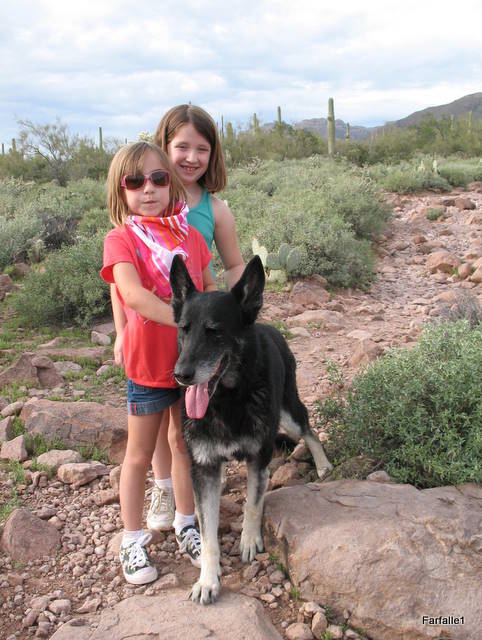
Evidently there are packs of dogs roaming wild in the parks.  They have either gotten lost or have been taken to the desert and abandoned by people who no longer want them.  It is natural for dogs to form packs, and that’s what these solitary dogs do.  Josie had been a pack dog, but had been injured, become infected, and was near death when a ranger came upon her and carried her out.  Her owner, a friend of the ranger, quickly volunteered to adopt Josie.  Friendly and affectionate, it seems that Josie knows what a lucky dog she is.  “She’s the best dog I’ve ever known,” says her owner, who feels pretty lucky too.

Sometimes we see pack dogs of a different type, and these I don’t photograph.  These dogs ride in a pack on their owners’ backs or chests.  Somehow, cute as they are, they just don’t belong in a group called “Hiking Dogs.”

I began photographing dogs on the trail a year or so ago, and at the beginning I didn’t keep track of where we were or what the dogs’ names were.  I’ve tried to be more careful about that recently, but sadly, some of the dogs I’ve captured are unidentified. Here’s a web album where you will find some more portraits of hiking dogs – select ‘slide show’, F11 for full screen (I’ll continue adding photos as I take them on future hikes, so check back again sometime).

Most of the people we encounter with their pets are delighted to be photographed, and almost to a one they tell their dogs, “You’re going to be famous!” when I explain the project is for a blog. Well, the dogs will never know that’s not true, will they!

Sage