A Disturbing Sight

Tags

, ,

There’s a big curve on our road where the pavement widens and there’s a pull-off. When we first moved here it was a favorite dumping spot for all manner of junk – construction detritus, old appliances, anything big, clunky and inconvenient. More recently, though, it has become a place where cars mysteriously appear, and then disappear. We’ve long thought that they were stolen cars that were left on the curve and which the police then hauled away.

Then this summer a blue Fiat wagon appeared regularly, most frequently on weekends  Why?  We surmised that someone who came and went from Rapallo felt he found a good temporary parking spot.  If so, he will have changed his mind.

burned car

This is what the car looks like now.  Someone, or more likely several someones, had a little fun with matches.  I find this terribly disturbing on two counts.  First, the wanton destruction of valuable property is so wasteful.  It is also a violent expression of… of what? of something very distressing.  Anger?  Antipathy? Boredom? Insanity?  Who knows?  I can’t imagine burning up a car for pleasure, for vendetta or for any other reason.  It has stood on the corner for about a month now, a mute testament to the destructive urges of some Rapallini.  Why it hasn’t yet been towed I can’t imagine.

burned car front seat

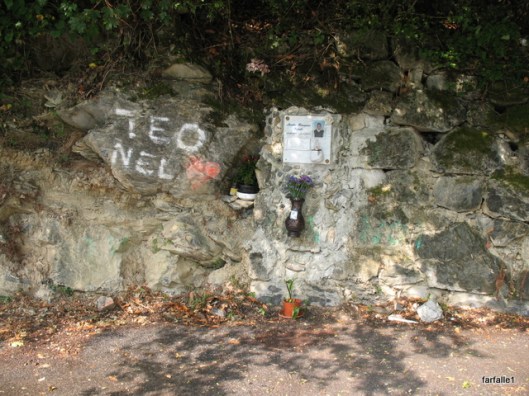
The second reason it is all so distressing is that this particular curve has become a memorial site.  About two years ago an 18 year old boy named Matteo Vincenzo Vitale had a bit too much to drink and drove his motorcycle smack into the stone wall at the side of the curve.  His friends and family have created, and still maintain, a little shrine to him there.

Teo's memorial

The paint is fading and his sports shirt is the worse from being out in the elements, but someone replaces the flowers regularly.  To see the burnt hulk of the Fiat adjacent to where Teo met his own violent end is just overwhelmingly sad.  It shows an ugly lack of respect, not only for the property destroyed, but for the meaning that the place has to others.  It’s just a pity.

L’ICI

Tags

, , ,

So, what did you think when you read the title ‘L’ICI?  Lice?  Itch?  Well, in a way both are correct, since  L’ICI (pronounced leach’-eee) has been a pesky little problem that’s been driving us nuts.

Rapallo coat of arms

The ICI (eetchy!) is Italy’s real estate tax.  We’ve always been thrilled at how small it is compared to what we’re accustomed to paying in the U.S., where such taxes generally pay for public education.  I’m not sure what the ICI pays for here – it is a tax imposed by the commune (the town), and is used for ‘services.’  It seems to me that we are already taxed for just about every service we receive (garbage, TV, etc.), but I digress.

When we first bought our house we went to the Tribute Office where such things are paid, and asked how much we owed.  Perish the thought that a taxing body should actually prepare and send a bill!  No.  It is up to the tax-payer to a) know that there is a tax due, b) know how much it is and c) know where, when and how to pay it.  Okay.  We can and have learned this stuff, and keep a careful calendar so we won’t miss any payments.  The trick we never mastered was knowing how much to pay, so each year we went to the office and they were nice enough to tell us.  Sort of.

Last year we received a certified letter that we had to pick up an important document at the Tribute.  It turned out that since 2002 we had been paying an incorrect amount, on two counts.  First, we were paying as if our house were still a rustico instead of a restructured habitation (in spite of the fact that our geometra filed the correct forms informing the commune of the change) and second, only the Captain’s share of the tax had been paid, and that was only half of what was owed.  So we owed in excess of E 800.  They were nice enough to understand that these were honest mistakes (and not just ours), so the accrued penalties and interest were set aside.  Grudgingly we paid – yet another unexpected and large expense.  We still don’t understand why the office didn’t give us the correct amounts due each year when we trudged in to ask.

L’ICI for primary homes was abolished beginning last year (thank you, Mr. Berlusconi), which means we no longer pay.  Only businesses and those who own more than one home now have to pay.  But the ICI wasn’t finished with us, not yet.  We received a note this year telling us that we had not paid for 2002.  We hauled out the many forms and receipts left over from last year’s adventure and discovered that in fact we had nothing to show we’d paid more than the original incorrect amount in 2002.  So back the Captain went to the Tribute Office, gathered all the materials and, once again, we will be making an unexpected tax payment.

We shouldn’t complain, I suppose.  It is still way, way less than Americans pay annually in property taxes.  It’s just the inefficiency of it all that drives us crazy.  They probably never would have cottoned to the errors if the tax on primary residence hadn’t been abolished, but now I guess the workers in the Tribute office have time on their hands.

This should be the end of our ICI Adventure, but you just never know in Italy.  These things have a strange way of being resurrected at the most inopportune times.

Chivalry – still alive and well in Rapallo

Tags

,

On Tuesday Flavio restored my flagging faith in mankind:

Flavio

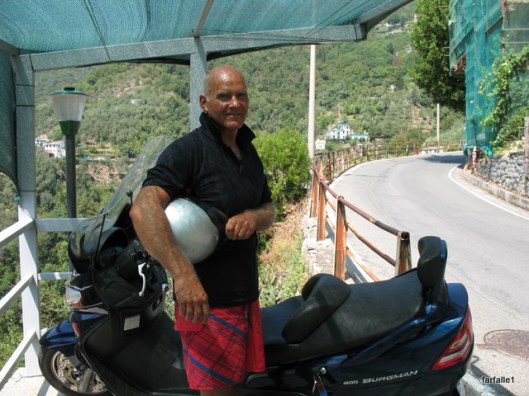
I had just done a great big shopping at one of the local supermarkets.  It seemed like the day to buy everything heavy: 20 lbs of kitty litter, 6 liters of water, a dozen cans of beer, plus the usual foodstuffs.  Having gotten it all stowed in my trusty scooter, I started her up and motored about 50 feet.  Cough, cough, splutter, ominous silence.  Poor old scooter just flat out quit.  Flavio and one of his friends were across the street and watched as I fruitlessly tried to get the darn thing started again.  An old gent in a stylish fedora sporting bermuda shorts and an ace-bandaged ankle walked by and advised in passing, “spegna le luce, signora” – turn off the lights, which I did.

In frustration I parked the scoots and began weighing my options.  The Captain was engaged and I didn’t want to disrupt what he was doing.  It was, by this time, almost 1 p.m., and our scooter guy, Simone, would have gone home for lunch.  I was just about to head off to my friend Madelena’s paneficio to throw myself on her mercy when Flavio and his friend crossed the street and started tinkering.  They spent half an hour working on the scooter, to no avail.  They opined, and were later proved right, that I needed a new spark plug (‘candele’ in Italian – lovely word).

I was feverishly re-weighing options (by now Madelena would’ve gone home for mid-day) when Flavio asked where I lived.  I told him San Maurizio di Monti, and without a moment’s hesitation he offered to take me home.  “Oh no,” I replied, “It’s too far – 8 or 10 kilometers.”  He answered with a shrug and some words which I took to mean, “No problem.”

So he stowed all the groceries under his seat, and I hopped on the back of the big Burgman 400 and enjoyed a smooth and stately ride home.  It was such a nice thing to do!   How to say thanks?  I offered lunch at Rosa’s across the street, but he declined, got on his scooter and drove back down the mountain.

I don’t know anything about this man except that he’s one of Rapallo’s gentlemen, and he did me a truly nice turn that day.  I hope I can find him – we’ve got a bottle of wine with his name on it.  Thank you, Flavio!

Tom-Toms

Tags

, , ,

No, jungle drums aren’t talking – it’s the tomatoes out in the garden and they’re yelling to be picked.  The ripening started a few weeks ago, one here, one there, then a few more; now we have the full chorus, fortissimo, and we can barely keep up.  The Captain has already started canning what we can’t eat.

In addition to his delicious canned sauce, he makes a couple of things with fresh tomatoes that are quick, easy and a joy to eat: insalata caprese:

insalata caprese

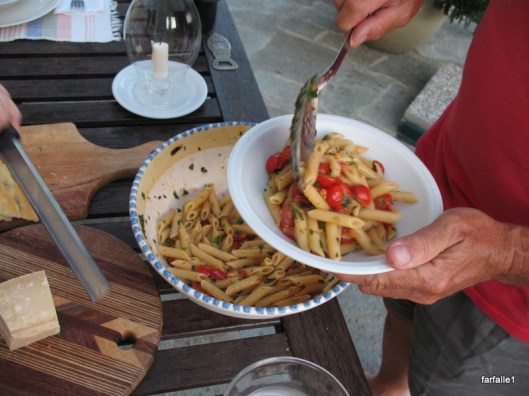
and pasta with a fabulous fresh tomato and herb sauce, about which I wrote a year ago:

pasta fresh tom sauce

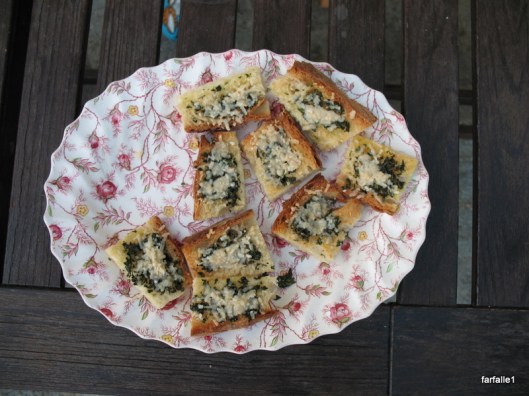
The Caprese makes great use of fresh basil, which has also been growing like mad in pots on the terrace (much happier in pots than in the garden).  Which brings to mind another of the Captain’s quick and easy summer treats: the bruschetta that he learned to make from his Sicilian mother:

bruchetti

Recipes for the three dishes above can be found here, here and here and over on the right under ‘Good Recipes’.

Here’s one of my very favorite summer treatments for tomatoes:  go out to the garden with a paring knife and a salt shaker.  Find the plumpest, ripest tomato you can and pick it.  Cut it in half, salt liberally, and eat it right there in the garden.  This is best done on a hot day when the tomato has been gently heated by the sun.  Yum.  Summer tomatoes and basil.  What could be more delicious?

Surf’s Up – Ligurian Style

Tags

, ,

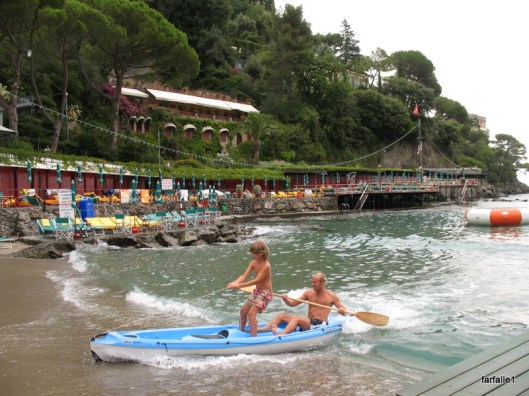
Surf's up Paraggi-1

Some stormy weather brushed past Liguria a few days ago giving us what passes for big surf here.  This pair of hearty souls got out the surfing kayak and rode the big ones.

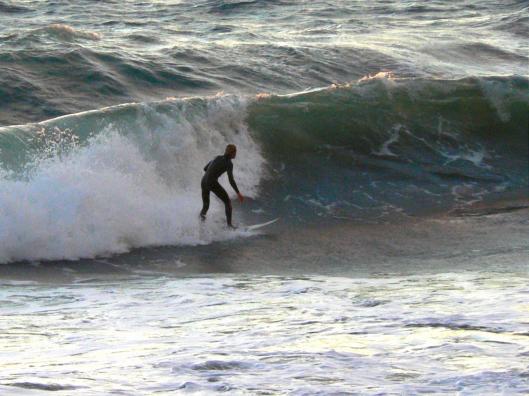
In fairness I have to say that  in fine weather there are bigger waves in the open sea. The photo above was taken in the protected bay at Paraggi where of course the waves are smaller.  Here’s a photo that a man named Elio from near Torino took of a surfer down at Levanto:

levanto surfer (Elio from near Torino)

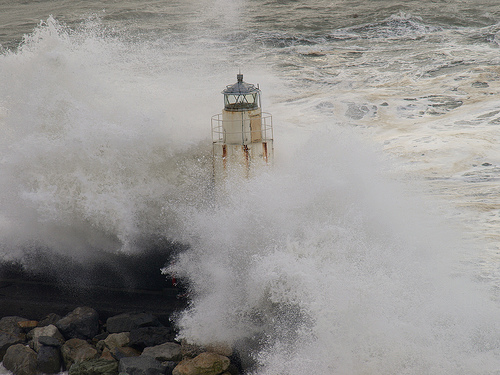
And when there’s a storm, watch out!  Camogli, on the other side of the peninsula from Paraggi, gets hit hard from time to time, as you can see in this photo by G. Ron:

Camogli storm by G Ron

So, laugh at the little waves in Paraggi if you must (I do)… but respect what they become when they’re all grown up and angry!

Fire!

Tags

, , , , , ,

4 a.m.  Not the hour at which you want to wake up smelling smoke.

Two nights ago that’s exactly what happened though.  At first I thought, Oh, those wild and crazy neighbors have decided to burn in the middle of the night.  A cursory check, though, suggested that this was not true.  There’s not a lot of light at 4 a.m., but there was enough to see that there was a large cloud of smoke trapped by the still air hanging over our whole valley and that it wasn’t coming either from our neighbors’ houses or from ours.

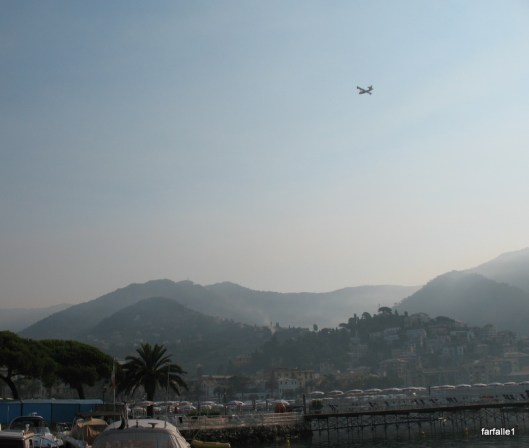
The next morning all of Rapallo was under a blanket of smoke and we had scratchy throats:

Rapallo in smoke

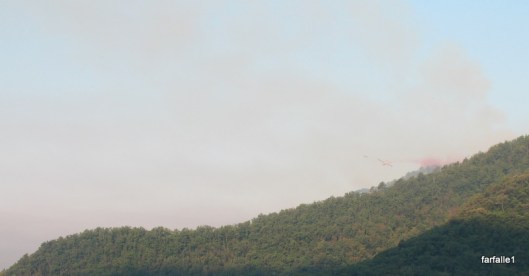
The beautiful yellow Canadair fire fighting plane arrived first thing, and spent the entire morning flying from the fire to the sea and back again to dump a load of water.  It’s hard to see the plane in this photo, but you can see the reddish spray of the water it has just released.  The water isn’t red – that’s a trick the morning light played on my camera:

Canadair

(Here’s a video of a Canadair dumping water on a fire at the Istanbul Airport.)

To fight this particular fire, which was on the next hill over from our valley, the planes approached from the north,

Canadair-4

made a steep bank, and disappeared behind the hill.  Very fancy flying.  This looks like it couldn’t possibly end well:

Canadair-8

but in fact there were no big crashes.  It is mesmerizing to watch the planes coming and going, a round trip they were making in about six minutes for this fire.  And it’s hard to imagine what skill it must require to fly like this.

I went down to the Port later in the morning to see what it all looked like from there.  There was smoke everywhere:

Canadair in smoky Rapallo

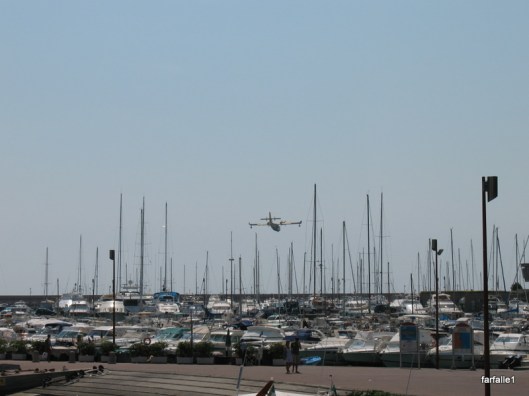
And yes!  There’s the brave little plane flying back to the fire.  They wasted no time getting to the water, dropping down right over the port and then scooping it up.

Canadair flying low over port-3

Anita, of GPL fame, lives in Zoagli and took this terrific photograph of the plane picking up the water (thanks for letting me use this, Anita!):

DSCN1769[1]

Someone should write a children’s book about these adorable planes – The Little Plane that Could (move over, Little Engine)!  I know there’s nothing cute about what they’re doing, or why they have to do it, but the size, shape and color of the planes is just plain appealing.

Il Secolo XIX reported the next day that there were ten fires set on Montepegli behind Rapallo; boys on motor scooters were seen in the area at the time, and the police are investigating with great seriousness.  We were all lucky.  There was no wind, so though the fires burned 8 hectares (24 acres), the nearby homes on Montepegli were not threatened and residents didn’t have to evacuate.

And you know what’s really crazy?  At least two people in Rapallo woke up that morning and said to themselves, ‘Hey! Great day for a fire!’

Smokey Rapallo 2 firesA

Go figure.

J-E-L-L-Oooooooo

Tags

, , ,

Usually here in Italy we’ve been able to find any foodstuff that we want.  We might not recognize the name, or the packaging, but by asking friends we’ve been able to find almost everything culinary that we’ve wanted.  And usually when we find it, it looks about the way we’d expect it to. I can imagine being in some really exotic country and buying something that you think is soup, say, only to open it up and find goats’ eyes.  That doesn’t happen here.
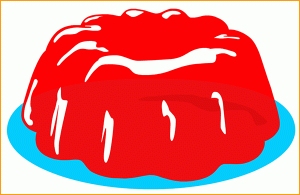
virtual-jelloOne thing I’ve never seen here, though, is Jello, the kind of wobbly, luridly colored Jello that we have in the States.  There are ‘budino’ (pudding) mixes – chocolate, lemon and so forth.  But not jello, per se, which is too bad, because it is a really silly, fun food.  (If you want to read a fairly cantankerous and thoroughly amusing history of non-commercial and commercial gelatin, which may or may not have been written by S.R. Brubaker, click here.)  Is there anything more cheerful, than a bowl of cubed up jewel-toned Jello, quaking and shaking?  No, I don’t think so either.  But you won’t be eating it in Rapallo.

Of course one can make one’s own jello with fruit, sugar and unflavored gelatin.  But it’s a little hard to come by red dye #14 or any other of the poisonous dyes that give Jello its unique colors (colors never found in nature!), so the likelihood of achieving true jello-hood at home is remote… it just isn’t jello if it doesn’t look like a false gemstone that’s got the vapors.

For some reason I got a bee in my bonnet about making tomato aspic the other day.  To my shock, many of the recipes I found call for lemon Jello.  Yuck.  Fortunately I found plenty of suggestions for ingredients in other recipes that did not include anything quite so yellow and all of which, of course, call for unflavored gelatin.

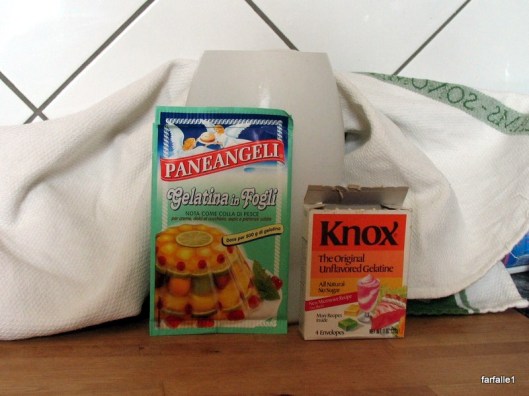
We still had some in the cupboard that moved over from the States with us in ’02 (that’s how often I make aspic), but there wasn’t really enough.  So I went a-hunting for same in the supermarket.  It is plentiful, but the package didn’t look anything like what I’m used to:
tart, beans, gelatina 020

That’s it on the left – Gelatina in Fogli.  Huh?  What are Fogli?  Well, it turns out that in Italy gelatin is one of the foods that looks completely different than it does in the U.S.  Whereas we are accustomed to a grainy powder, here the gelatin comes in thin sheets (‘fogli’ means ‘leaves’ or ‘sheets’):

tart, beans, gelatina 024

In fact, it’s really pretty.  That’s our Knox powder in the saucer, and resting behind it is one of the six fogli that come in an Italian package of gelatin.  Looks like a kind of magical quilt for an elf, doesn’t it?  It’s flexible and doesn’t feel sticky.  Fortunately the directions for using it are very simple.  You put all six sheets in a bowl of cold water and let them soften for 10 minutes.  They get slippery and feel a little slimy, but they hold their shape; it’s kind of fun to play with them a little before using them. Then you add them to a hot mixture and they simply melt away. After that, things go along just as they do with the powdered form of gelatin.  After a while in the fridge you’ve got a nice, firm, gelled whatever-you’ve-made.  One of the fun things about molded food is choosing the shape you want to make it.  Fish is a fish mold?  Certainly!  But how about a little sensory displacement: dessert in a fish mold?  Why not?  Fooling around with shapes is half the fun of the whole endeavor.

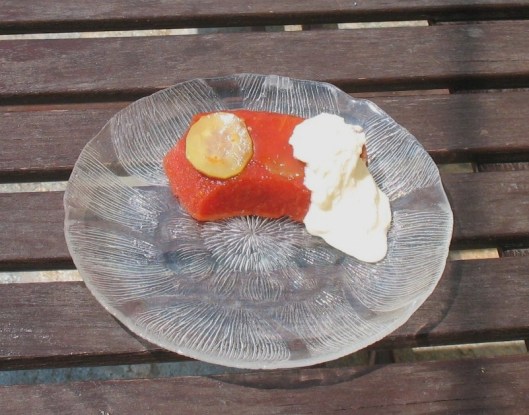
So how did the aspic turn out?  Really well!  In fact, to my utter surprise, our Italian friends loved it.  They called it tomato salad, which was generous, and they enjoyed it very much.  We served it with a sauce made of cheese, horseradish, mayonnaise and a little milk.  That thing on the left that looks like a happy face is a slice of cucumber; another is barely visible between the first one and the sauce.  The cucumber as decoration plan did not work out quite as I’d hoped.
aspic 001a

Gelatin makes food that’s playful, and that’s good.  I don’t agree with S.R. Brubaker who says, gelatin is ‘fake food,’ (just one of his salvos against this church social favorite).  It’s no more fake than bread is ‘fake wheat’ after the addition of yeast and heat.  It’s just a process.  The great thing about gelatin is you can put whatever you want in it and it will probably work out pretty well.  It is the amber of the food world, trapping and holding ingredients (let’s hope it’s not, like amber, holding flies).  If you want a rather vague tomato aspic recipe, click here.  In any event, have some jello and have some fun.
The Lavender Mob

Tags

, , , , , , , ,

It’s got all the ingredients of a summer blockbuster: violence, pathos, beauty, love, and finally the triumph of good hard work.  And where can you see this great show?  At our house, in the lavender plant on the entry terrace. There’s more action in an hour there than there is at your Cineplex on any given evening.

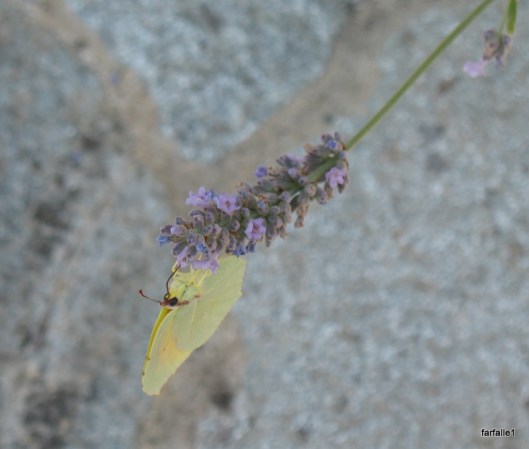
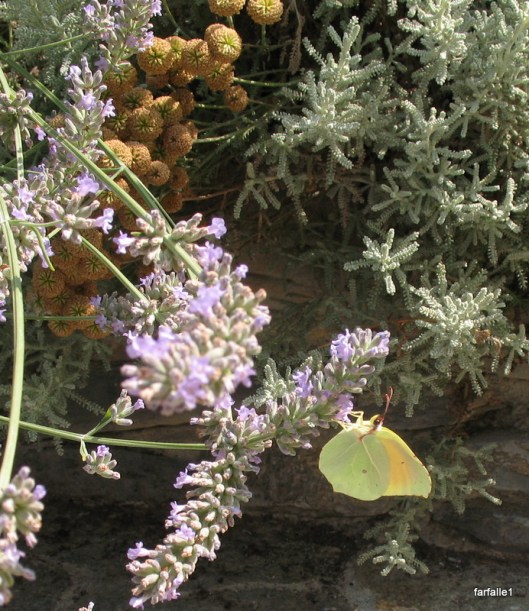
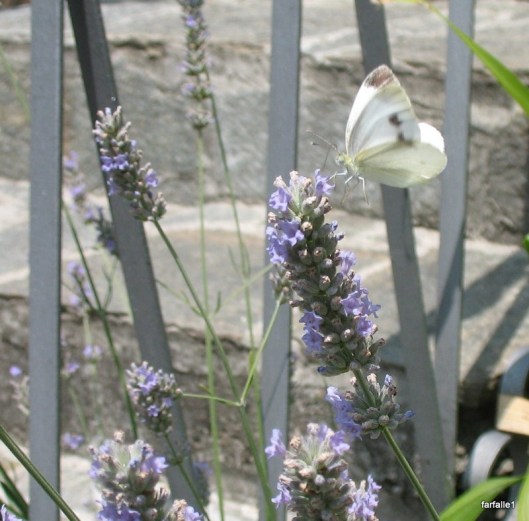
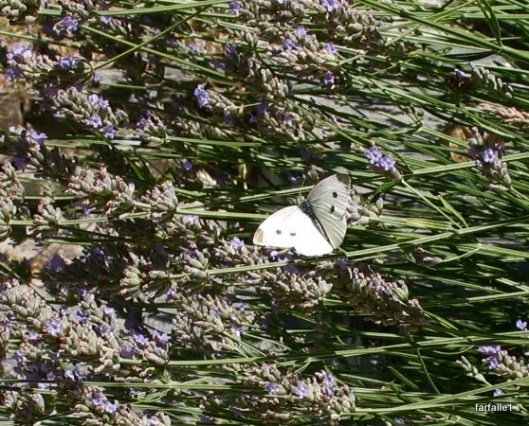
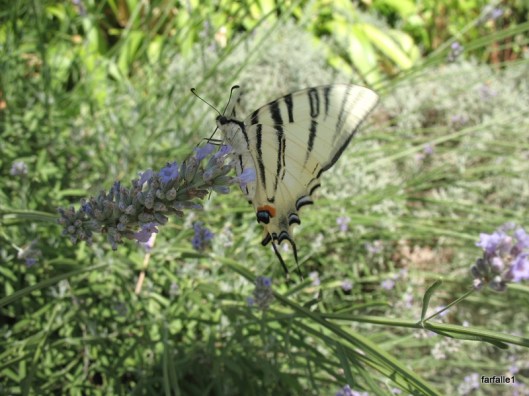
First the beauty:  the butterflies.  They come in a series as summer progresses.  Last week the pale greeny yellow ones that look like leaves were everywhere:

bees 019

butterfly on lavender

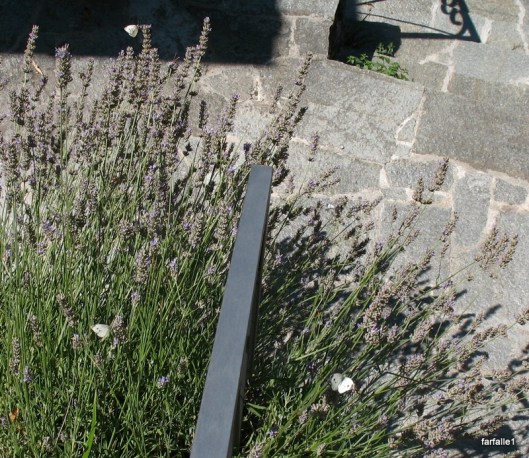
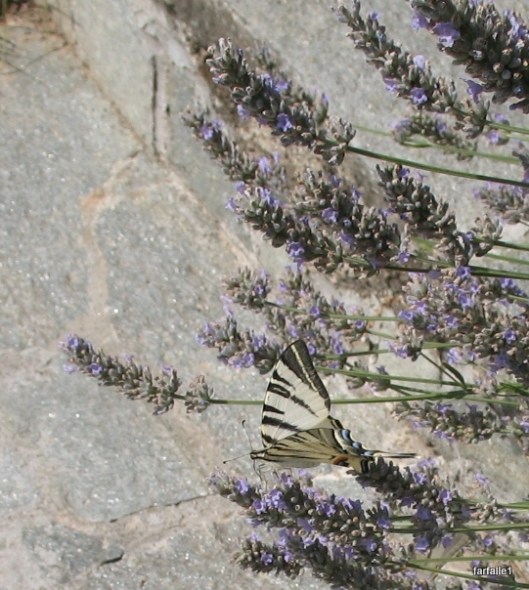
This week it is the swallowtails and the smaller white ones with dark wing smudges which travel in small herds:

tart, beans, gelatina 019

019a

023a

swallowtail butterflya

swallowtail butterfly (5)a

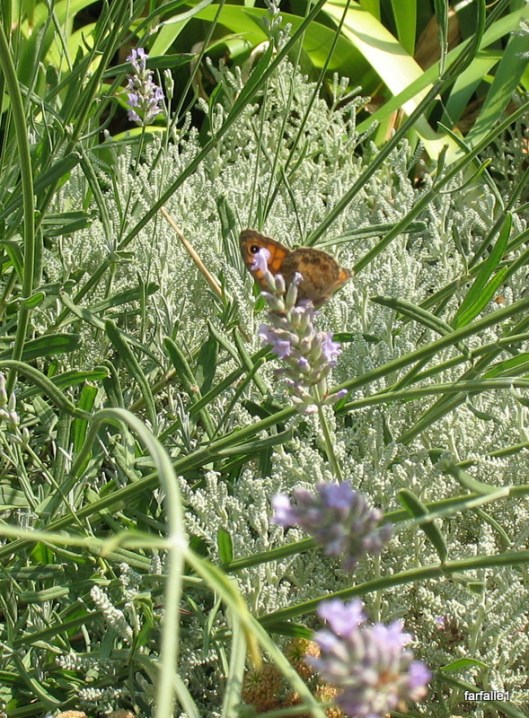
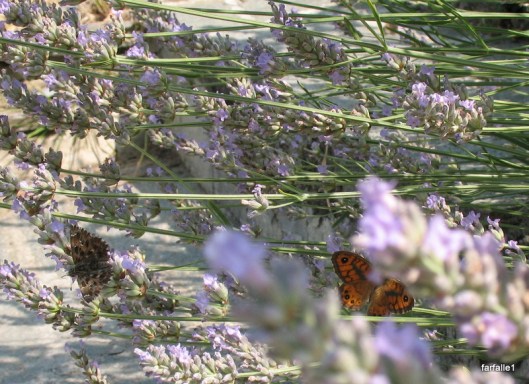
Our friend Tay calls swallowtails the upside-down butterfly, because they really do look like they’re upside down when they’re perched on a flower.  There are a host of other butterflies that come and go, from teeny little brownish ones to the lovely orange ones accented with circles.

butterfly on lavender-2

butterflies on lavender-4

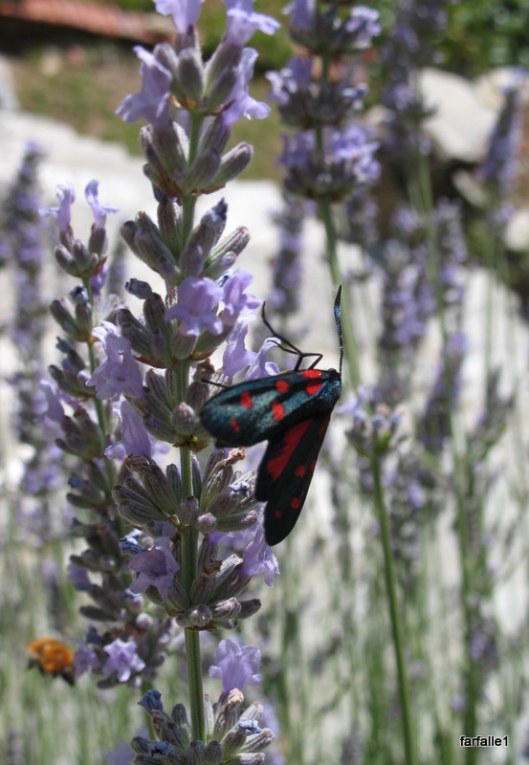
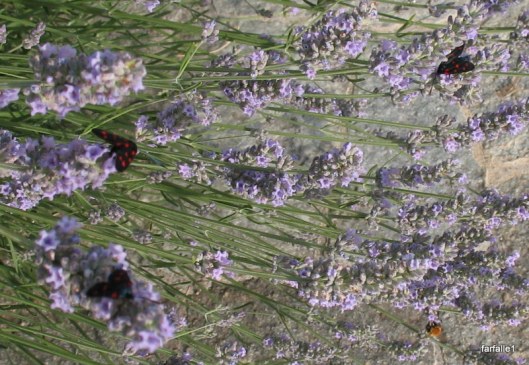
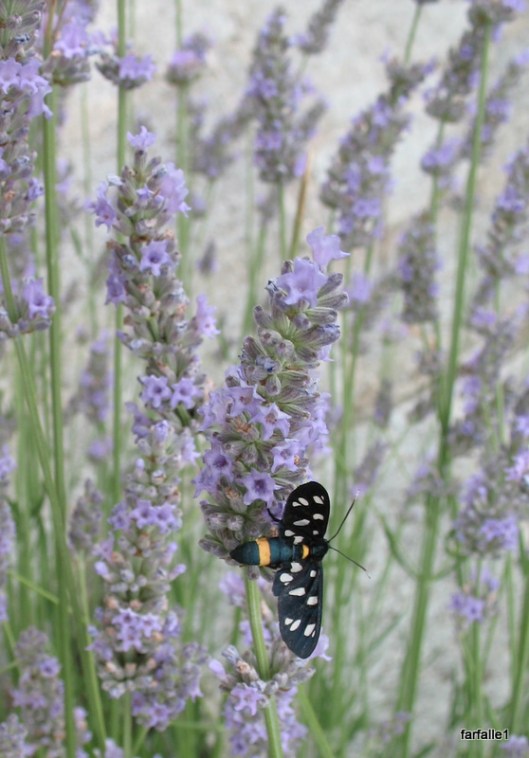
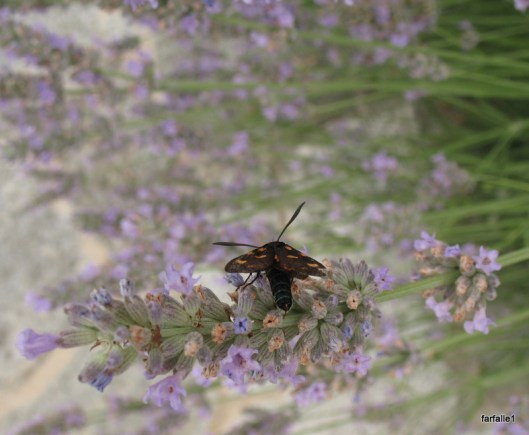
Two weeks ago I saw one butterfly of a type I’ve never seen before, or since: small and cobalt blue.  Then there are the not-quite-butterflies not-quite bugs, with their dramatic red, white or yellow spots, as well as the good old bugs.

bees on lavender 001

garden tour 031

Pestle Revised + Insects 015

bees 007

Pestle Revised + Insects 012

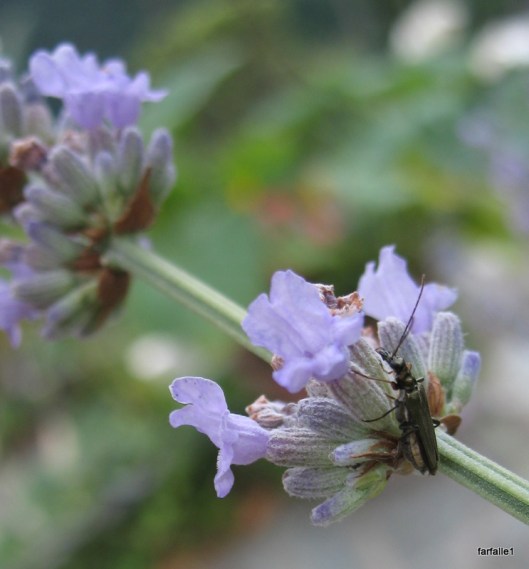
The pathos and violence go hand in hand.  There are nasty little beetles that hide deep inside some of the lavender flowers.  When a careless bee sticks his head in to drink from that flower, the beetle kills him with a swift swipe of his serrated razor-like arm.  We tried, but couldn’t get a picture of these little bastards. The poor dead bees just hang on the flower, giving every appearance of being drunk.  But no, not drunk. Dead.

bees 002

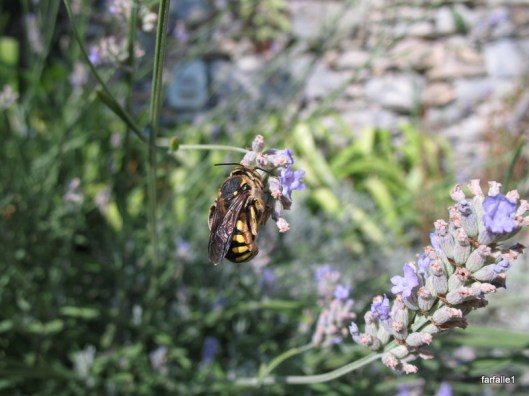
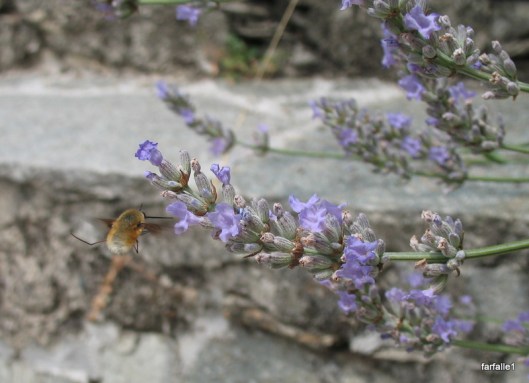
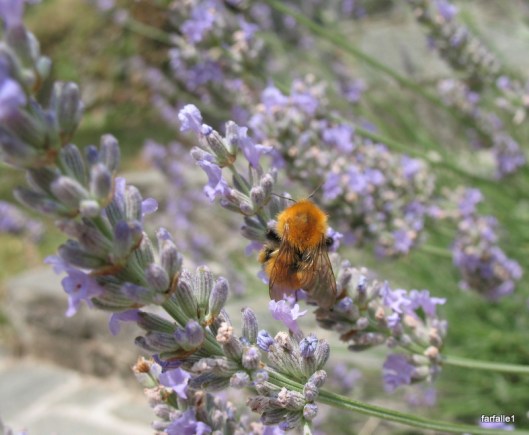
The triumph of good hard work?  The bees, of course.  There are more bees than you can shake a stick at.  My favorites are the small fuzzy yellow bombers that never even bother to retract their proboscis as they move from flower to flower.  They’re quick, and hard to catch with the camera.

bees 014

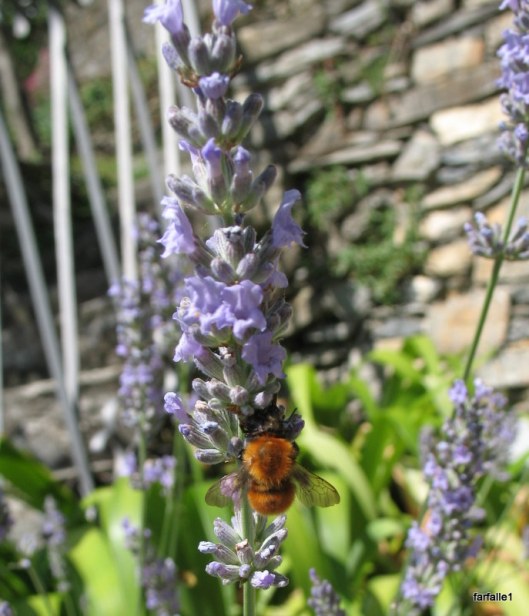
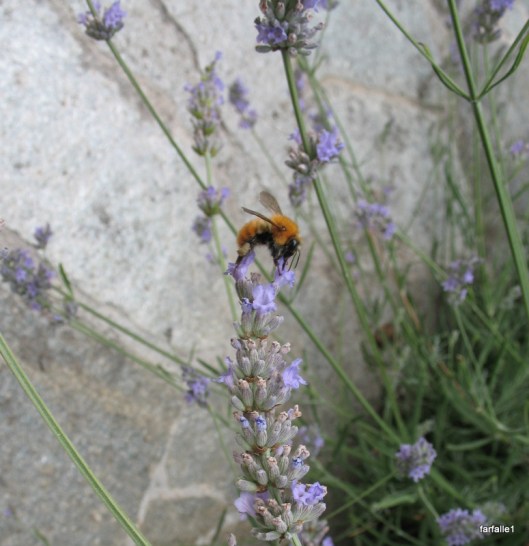
Next in size is the medium-sized fuzzy orange drudge who methodically moves from flower to flower, taking his time but being thorough.

bees on lavender 002

bees 001 (2)

bees 011

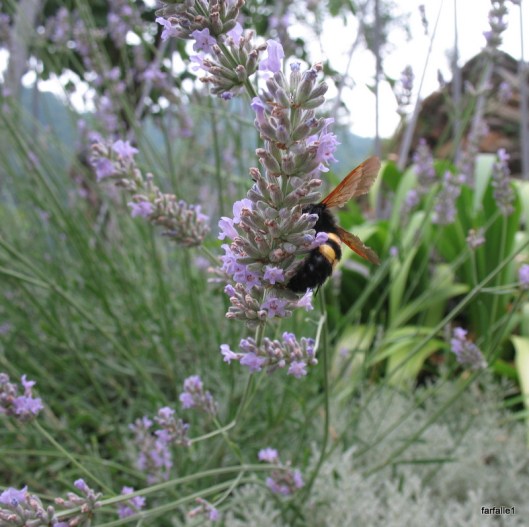
There are three very large bees, two with bright yellow stripes on their backs, and one who dresses entirely in black and refuses to be photographed.

bees 005

bees on lavender 015

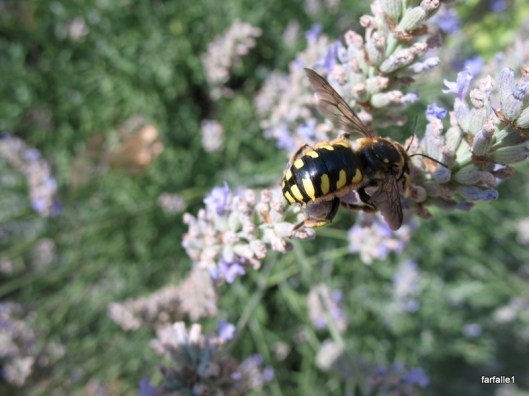
Towards the end of the lavender’s bloom a bee that looks like a Mini Cooper with racing stripes arrives in great number.

bees 012

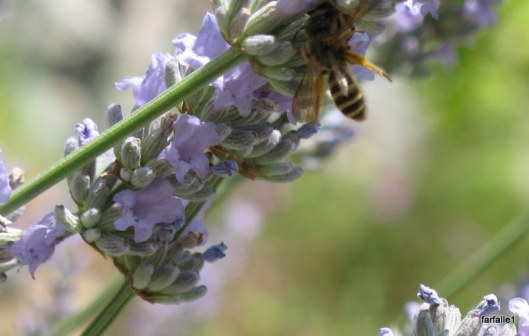
Italian honey bees are reputed to have a gentle temperament and be excellent honey producers. I can’t vouch for the honey production because I haven’t found any, but the bees certainly are gentle.  We brush by their lavender bush a dozen times a day, and while they buzz around and complain, neither of us has ever been stung.

There’s a downside to being so hospitable to the bees.  Some of them nest in the ground, and we have a resident badger.  In his efforts to find bee grubs to eat he has dug numerous holes under our trees, especially the olive trees.

badger hold under olive

The odd thing is there is never enough dirt left outside the hole to fill it in completely again.  Where does he take the excess dirt, and what does he do with it?

You’re wondering about the love part of the equation?  It’s just that I love to watch the action around the lavender bush.  If you’ve got one, sit down sometime and watch it for an hour; it’s worth way more than the price of admission.

Pigeons on the grass, alas…

Tags

,

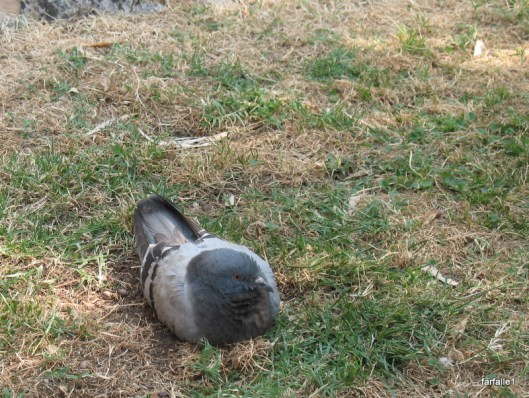
I don’t know for sure, but I suspect ‘they’ give the pigeons something to eat here that makes them infertile and stupid.  There are not nearly as many pigeons around as you would expect in a town that has one outdoor cafe after another, and the ones that are here are sluggish.  Often they can’t get out of the road in time and end up being squashed.  Look at this poor guy – he didn’t have the oom-pah-pah to fly away when I approached to take his picture.  If he can’t escape from a prying camera it’s a good bet he’s not going to be helping to make any baby pigeons…

pigeon

ETs?

Tags

, ,

mowing the river
No, extra-terrestrials have not landed in Rapallo.  Instead it is time to mow the river.    The Torrente San Francesco is fed by all the little streams and rivulets that start in the folds of our high mountain and head towards the sea.  By the time they arrive on the plain of Rapallo they have become the Torrente.  For most of the year that is a misnomer, as you can see in the photo below.  Not only is it not a torrent, you can see hardly any water at all in some places.  What you can see is a lot of greenery, including the dreaded bamboo on the right in the picture above.  To give you an idea of how much water there can be after heavy rains, in 2002 I saw the top of the river almost breach the high retaining walls that you see below.  The mowers tackle not only the river bed itself, but also the walls which sprout quantities of viney, clingy weeds in all seasons.

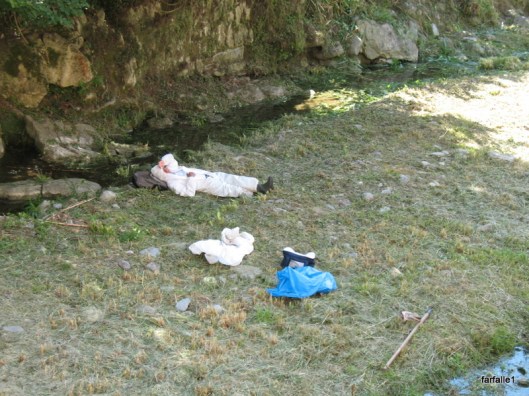
Why the haz-mat suits?  I’m not sure.  Just to be safe, I guess.  I can tell you what they wear under them.  Not much.  Sometimes a wife-beater tee-shirt, sometimes no shirt at all, and, I suppose, trousers, although I didn’t  verify that.   The river is home to many, many ducks and geese as well as the occasional cat.

mowing the river4

I asked mower Luis how often they have to mow the river. They last did it two months ago, he said. How long does it take to finish the river? A week or more, it’s hard work after two months of heavy growth. When I asked him what was the most interesting or amusing thing they found in the river his face clouded for a minute. “We find a lot of dead animals,” he said. But then he smiled sweetly and continued, “but we also find the birds’ nests, and we always mow around them.”

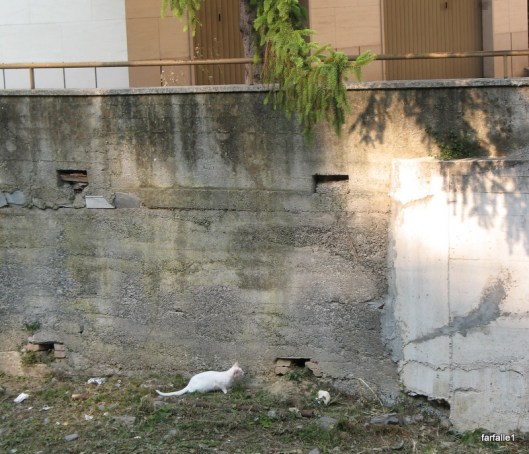
Everybody’s happy when the river has been mowed.  Something minty grows down there, and the perfume fills Via Bette from the Autostrada Bridge all the way down to Giorgio’s bakery, where the mouth-watering smell of freshly baked bread prevails.  Also you can see what’s going on so much better after the mowing.  Something delicious must be hiding in that hole; this cat was so intent that even loud shouts of ‘hey, kitty!’ didn’t get his attention.

bees 022
mowing the river resting

Uh oh!  Looks like Luis found some hazardous material after all… but no.  He’s just having a little ‘pisolino’ (nap) after his picnic lunch.