A Pretty Good Thing We Ate This Week – Lemon Meringue Pie

Tags

, ,

img_9909

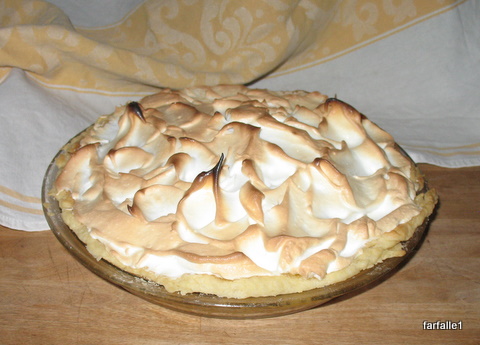
In all honesty the Best Thing We Ate This Week was Louis’s osso buco, served with risotto; I hope to put that recipe up soon.  Meanwhile, we served a lemon meringue pie for dessert to Italian guests, and they seemed to like it (asked for the recipe in fact).  So, though it’s not the Best of the week, it’s one-of-the-better of the week.  If it has any downside it is that it’s very sweet.  But then, that’s what dessert is for, no?

Betty Crocker taught me how to make this pie and I still follow her recipe almost to the letter.  You can find the recipe here.  I like to make my own crusts, but there’s no reason not to buy one if you’re short of time.  It won’t be as good, but it certainly won’t be bad.  Likewise, freshly squeezed lemon juice and freshly grated lemon peel are best, though you can buy bottled juice and dried zest.

By the way, if you haven’t yet made aquaintance with the new breed of microplaners, do so.  They are fantastic tools for grating cheese, zest – whatever you need grated.  We use ours almost daily.  They come in several sizes for different jobs.

Back in the Saddle Again

louis-gil-rose

The saddle of my scooter, that is…  and what a great way to travel it is.  It’s economical and efficient – scooters here routinely pass a standing (or slower moving) line of cars, and move to the head of the class at any red light. (That’s my scooter… but that’s not me!)

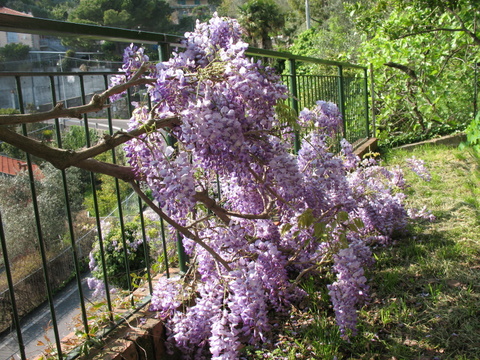
One of the unsung pleasures of scootering is that you get an ever-changing panoply of scents.  It’s true, they’re not always pleasant, but at this time of year they tend to be floral and heavenly.  The wisteria (glicine, pronounced glee-chee-nay) is in bloom and is draped over numerous walls along the highways and byways.

wisteria

It puts out a delicious aroma.  The jasmine (gelsomino, prounounced jell-zo-mee-n0) is just beginning to flower.  It’s a thug (that’s a technical horticultural term for anything that spreads rapidly and is hardy), but is so pretty and has such a sweet smell that we forgive it its pushy habits.

jasmine-4-14-2009-12-31-14-pm

About the time this finishes blooming the ‘false jasmine,’ the pitosfero, will appear, and it’s perfume is a match for the true jasmine.

Riding in a car one tends to miss most smells except the most overstated (I’m thinking about a skunk, aren’t you?).  But riding on a scooter in the Riviera can be like inhaling a dictionary of different odors, and this time of year they’re more likely than not to be extremely pleasant.  Just riding up Via Betti at about 9:30 a.m. one enjoys first  the garbage plant (not so nice), some glicine over a wall (gorgeous), and fianlly the smell of freshly baked bread from our local bakery (scrumptuous)… and it’s only been half a kilometer.

We were glad to see more scooters in the US than in previous visits.  No, it’s not the safest mode of transport – for that I suppose you’d want a Hummer.  But for ease, economy and pure gioia di viaggiare, nothing beats a scooter.  We were both really glad to climb back aboard ours.

Familiarity

Tags

, ,

Familiarity can breed contempt, as the old saying has it, but more frequently it breeds something worse, a sort of lazy eye.  One stops looking at what one sees daily.  It (or, sadly, sometimes he or she) is simply there.  It also breeds a taking-for-granted of the condition life as it is, laziness of a related sort.

When we are in Italy, where we now live, almost everything seems new and strange to me, even after 8 years.  There is so much to learn about a new country and culture – one can barely scratch the surface.  There will always be subtleties that we simply don’t understand, both in language and practice.

When we returned to the States for an extended stay this year, everything here seemed strange and huge – big roads, big stores, big cars, big people.  After about two weeks, though, it became the norm because, as Americans, it is the life that is most familiar to us.  How quickly we took for granted that stores were open in the middle of the day, though they might close earlier than we’d like (or weirdly, they might be open all night!).  How quickly and happily we adapted to gas for the car that costs less than the equivalent of $5/gallon; and (*yawn*) the fact that we can get any book, cd, dvd, or magazine we want for free at the public library.  We joined an inexpensive service that sent us the movies we requested through the mail, and we received them only two days after the request… amazing!  To be honest, we very quickly did get used to all the readily available services and goods here.

Back in January I was musing about why we (people in general) move around as much as we do.  One reason I overlooked back then was simply the joy in giving our mental eyes a good bath, seeing things from a different perspective, jolting ourselves out of the rut of our familiar lives.  They say people always return from a vacation refreshed and that they work much more efficiently.  It makes sense.  When we come back with new eyes we actually see our work, rather than seeing the one-dimensional ‘work’ that we’ve grown so accustomed to.

We’re traveling again next week, returning to Italy.  We’ve grown used to life back here in the good old U.S., and yes! we like it here.  But we’re excited to be going home.  Everything will be, for a time, unfamiliar.  What fun!

Desert Reptiles and Other Critters

Tags

,

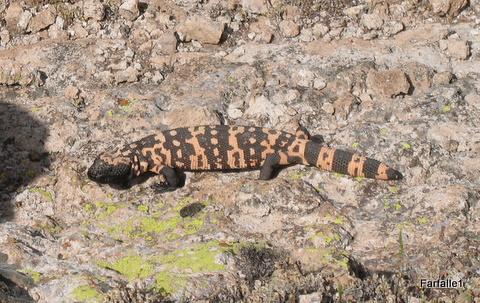
They say there are rattlesnakes in Arizona.  HB can tell you I’ve gone out of my way to find one, but have been unsuccessful so far.  It’s one thing to see a snake in a nature center or zoo, but I think it would be quite thrilling to see one in its natural habitat; my friends here think I’m nuts.  HB and I did see a gorgeous gila monster on one of our hikes.  He was about  15 inches long and, HB tells me, very healthy, his chubby tail being the measure of his well-being. Gila monsters are venomous, and while they are sluggish, if you were to step on one by myself he would probably bite you.  And he wouldn’t let go.  You would have to get yourself to the hospital quickly, with the animal still attached.  That story would not have a very good end for either of you, especially the gila monster.

gila

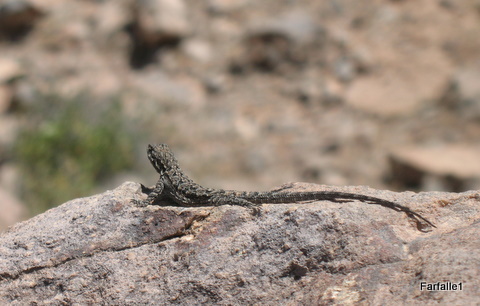
There are several varieties of small lizard resident in this desert.  This one was sent over by central casting – he posed fearlessly as I stalked him with my camera.

img_9597

One of the best things I’ve come upon in the desert was this egg.  It’s about 2 inches long, and I have no idea whose it is.  I was stalking another, larger lizard when I found it.  Maybe it’s full of hundreds of wee snakes; or maybe a lizard will pop out one day soon.

egg1

We have seen javelinas (Arizona’s answer to cinghiale, though of a different family) and deer, but only on golf courses, which somehow doesn’t seem to count.  We’ve also seen countless rabbits on the fairways; golfing bunnies are very bold, much more so than their cousins who are still living in the desert, like this fellow:

find-the-bunny-1 It’s hard even to find him, isn’t it?

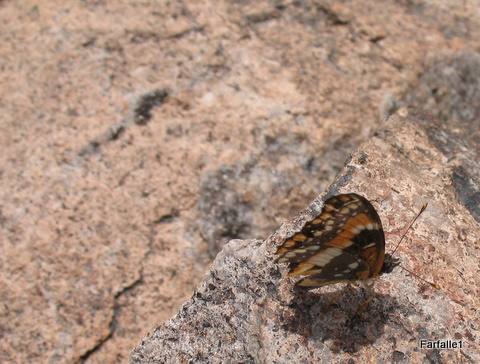
I’ve mentioned the birds and bees in an earlier post, but now that there are so many flowers in bloom there are also a great many butterflies.  Have you ever tried to take a picture of one?  They are fast!  No sooner do you get your camera turned on than they zip off to a distant flower.

butterfly

A beautiful swallow-tail visited our citrus tree at home the other day, alit briefly on a glossy green leaf and then raced off.  It’s hard to know how something that looks so frail and delicate (and in fact is frail and delicate) can move so fast (between 5 and 30mph, according to The Children’s Butterfly Site.

The desert sometimes seems dry and lifeless, but there’s a lot happening out there, and it’s really fun to go hiking and look for the action.  Just be careful not to step on a snake or a big lizard!

Desert in Bloom

Tags

, ,

Watching the desert bloom is like reading a long book.  There’s a plot, but the action unfolds really slowly.  Desert plants are tenacious; they have to be to survive the extremes this climate throws at them.  And the flowers they produce seem to be pretty tough too.  They may look delicate, but they hang on, day after day, in temperatures that seem high to this sissy.

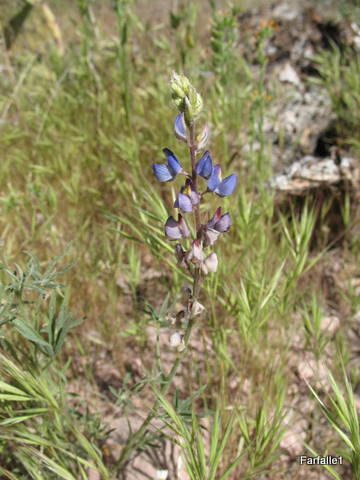
The story begins with the lupines, which are strong enough to break through the road pavement and flower on the highway’s verge.last-lupine

This was one of the last, but they bloomed in an understated carpet along Route 60 for most of February.  The cheerful yellow California poppies bloom in broad swaths at about the same time.

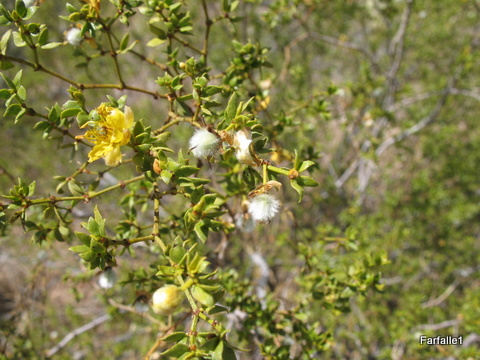
Chapter two is the ubiquitous brittle bush which has tons of small yellow flowers.  The creosote plant, which smells like its name when the air is humid, also puts out a small yellow flower.  It makes a very amusing seed that looks like something an elf might use for a powder puff.

creosote-flower-and-seed

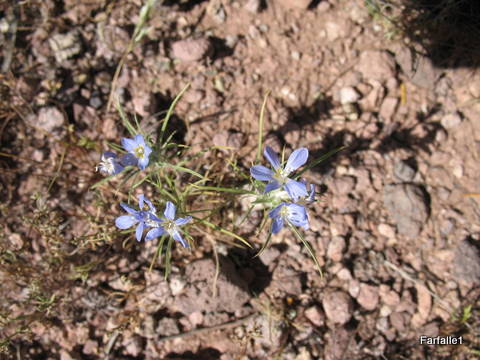
Chapters three through ten are all the small little plants that bloom on the desert floor.  They are so small that it would be easy to miss them unless, like me, you are sure you’re going to trip and fall, so you always are looking down.

little-blue-flowers

small-flowers

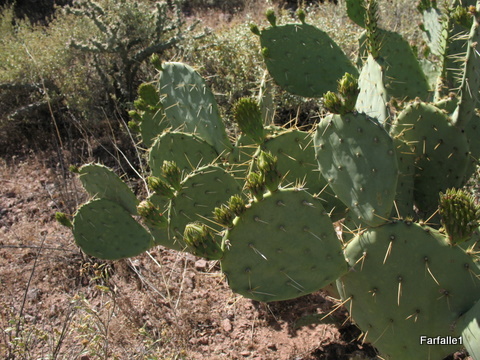
The climax has to be the flowering of the various cacti.  The desert here boasts several varieties of cholla (pronounced choy-yah), hedgehog, pincushions, barrels, prickly pear, teddy bears, ocatillo, the enormous suguaro and others I don’t know or have forgotten.  A month ago the cacti had big fat buds, and waiting for them to open has been an exercise in patience.

desert-prickly-pear
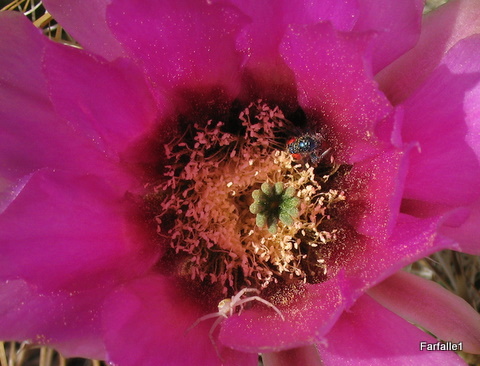
Finally they have started and it has been worth the wait. The hedgehogs are the early show-offs.

hedgehog-with-bug-and-spider

There is a world of action in that flower.  Just before I took the photo a bee buried itself completely in the stamen, wiggled around for a few seconds, and then took off.  I think it was drunk. Meanwhile the little black and red beetle seems to be napping.  The white spider didn’t like the camera and scuttled away right after this shot.

It’s almost impossible to take a bad picture of these flowers; they make the most considerate subjects.  If you would like to see some more pictures of the desert in bloom, click here, or over on the right under Photographs (choose the slide show option).

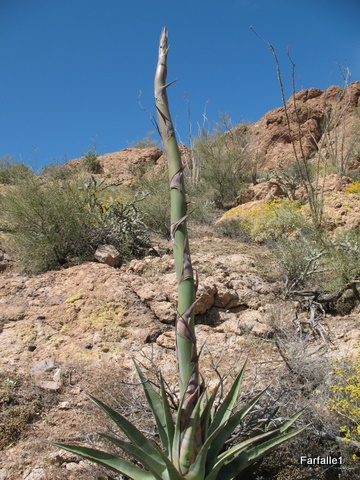
The desert in bloom is not as wildly showy as, say, an English cottage garden at its peak.  And it’s different in another really important way.  Almost every plant in the desert will happily impale you with something sharp and unpleasant.  The dastardly cholla, whose segments stick like glue and work their way through hiking boots and jeans, the fishhook barrels with their barbed spikes, and all the others too, seem to be carrying some kind of huge grudge.  Even the century plant (agave), familiar to us in Italy, is a stinker.

img_9598

I foolishly wandered over to stroke its smooth asparagus-like stalk, and one of the spines which reside at the end of each leaf went right into my leg.

No matter where you go in the desert, and no matter how lovely the flowers are, you are always going to find yourself between a rock and a sharp place.

The Best Thing We Ate This Week – Smoked Salmon

Tags

, ,

img_9608

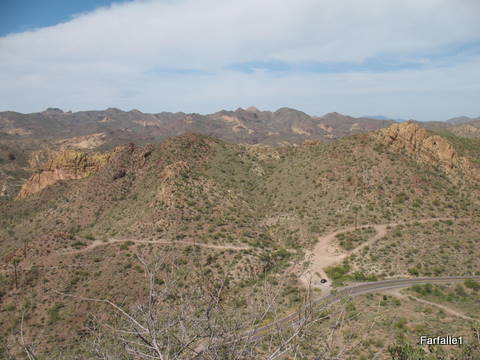
Sometimes it’s not the food – it’s where you are and the person you’re eating with that makes a meal special and memorable.  My hiking buddy and I had our last hike together for many months on Sunday.  We returned to the Goldfield Mountains to search for an elusive trail that will now have to wait til November to meet my boots.  In lieu of the missing trail we opted to scramble up several rocky hills.  Lest you think these were gentle little mounds, here is the view of our car from our picnic spot:

img_9592

Can you even see that little dot down there?

In any event, after our exertions we had a fancier than usual mountaintop meal.  HB (hiking buddy) brought smoked salmon, caviar and those wafer thin crackers that want to be Wasa bread but aren’t rough and tough enough.  I brought smoked gouda cheese (which come to think of it was a gift from HB), grapes and salted pecans.  Accustomed as we are to wolfing down sandwiches, this was a meal fit for royalty, and we enjoyed every bite.

The company was superlative, the views in all directions were breath-taking and the day was warm without being hot.  There is no accompanying recipe to this post; here’s what you do:  buy some great smoked salmon and a little jar of caviar, pack that with some crackers, fruit and nuts in your pack, remember to take plenty of water, and don’t forget a lemon (HB didn’t), find a high place, climb to the top with a good friend, and eat.  Buon Appetito!

Expatriate in California

Tags

, , , ,

Years ago a friend offered me a plane ticket to California, but I had other Big Plans and turned him down.  What a mistake.  Recently we spent a week in and around San Francisco, and I fell in love – not in San Francisco, but with San Francisco.

Here’s what’s right about San Francisco: almost everything. It’s a big city without a huge population (+/- 808,000 in 2008, according to Wikipedia), conveniently contained in only 47 square miles (for comparison, Manhattan has a population of +/- 1,621,000 on 23 square miles; Chicagoland, 9.5 million, 81 square miles).

Ocean.  Bays.  There’s lots of water in and around San Francisco.img_9247

Where there is water there will be bridges, and San Francisco has two that are magnificent: the famous Golden Gate Bridge:
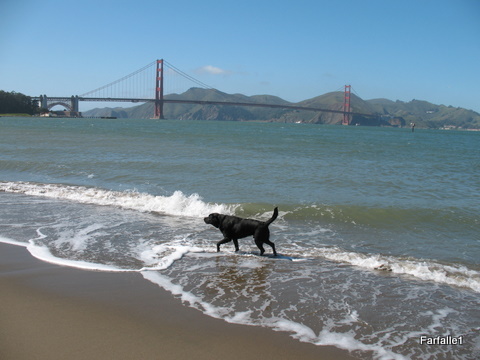
golden-gate-and-dog

and the graceful Bay Bridge (which is in the process of being rebuilt):
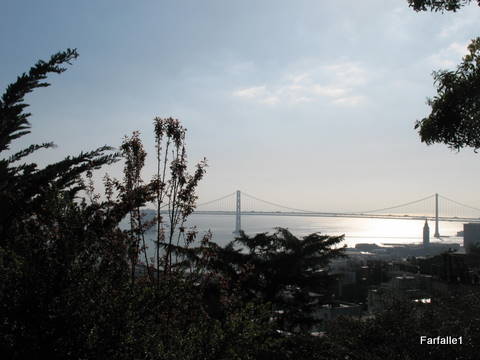
sf-bay-bridge

Crossing the Bay Bridge from Berkeley to San Francisco gives one a lovely view of the latter:
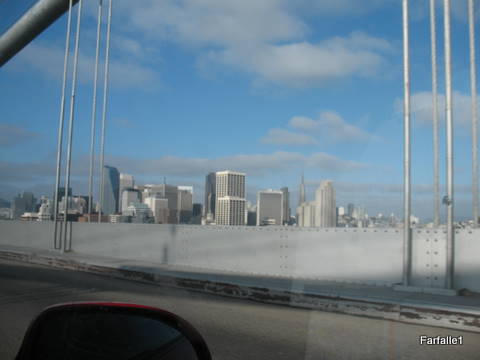
view-from-bay-bridge

Most of San Francisco was destroyed by a post-earthquake fire in April, 1906.  Here’s what the downtown looked like in the aftermath of that catastrophe (photo taken by H.D. Chadwick and housed in the National Archives):

san-francisco-fire

Much of the city was rebuilt, obviously, but there are still some lovely juxtapositions of old and new:

san-francisco-old-and-new

San Francisco has a terrific public transportation system. The BART (Bay Area Rapid Transit) trains run all over the place, and buses will take you wherever the Bart won’t. The most famous form of public transportation is the cable cars but we fell in love with the trolley buses – in addition to hundreds of modern trolleys, there are retired trolley cars from around the world. Our hearts leapt when we saw the familiar yellow of a Milano car. It made us wonder for a moment where we were.
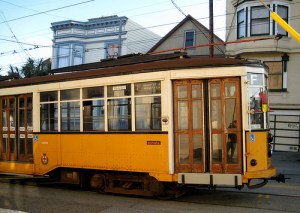
milano-trolley-car-in-sf(photo by Paul Fisk)

Food is famously important to Californians, and especially to San Franciscans. We ate out three nights in a row, and each meal was prepared perfectly. The Slanted Door in the restored Ferry Building on the old pier serves fusion Vietnamese food. Our only complaint was that the noise level was so high we left with our ears ringing. If you enjoy shopping, the Ferry Building is worth a daytime visit as well. Dosa, on famous Filmore in San Francisco, serves South Indian cuisine that is out of this world. The Wood Tavern, in Berkeley, serves chops, steaks and so forth in a small building with an intimate feel. All three of these restaurants were packed; reservations are a good idea. It was hard to leave the area knowing we had sampled only three of the hundreds of wonderful restaurants available… guess we’ll have to go back some day.

Cultural activities abound in the Bay area – we were not there long enough to scratch the surface of what’s available, but both the California Academy of Sciences in Golden Gate Park and the Asian Art Museum were so engaging that a half-day visit to each lasted all day, and we did not see half of either (you do the math!).  For a guide to such things, click here. The Academy of Sciences, for instance, is one of at least three science museums in the area.  Music, theater, film, art – it’s all widely available.  Because of the diversity of the population there are countless cultural experiences to be discovered.

Visiting California itself is a bit like going to another country. We had to make a stop at an Agricultural Inspection station so our car could be examined for unwanted pests. We understood why when we drove through the vast San Joaquin Valley, 27,280 square miles of mostly agricultural land with a few cities here and there. That’s equal to about 20% of the whole of Italy (116,345 square miles). The area is sometimes justifiably referred to as “the salad bowl of America.”

s-j-valley-canal-and-trees-swee
In the photo above, what looks like a carpet of wildflowers is actually a quilt of blooming fruit and nut trees. What looks like a river is the California Canal, part of a vast irrigation system that brings the water of California’s rivers and mountains  to the valley. In addition to fruit and nut trees there is vast acreage in cotton and vegetables (the J.G. Boswell cotton farm is the largest in the world at 150,000 acres).

In addition to agriculture, there is a thriving oil business in the San Joachin valley; there are six fields with reserves in excess of 100,000,000 barrels.

oil-diggers

We saw enormous herds of cattle and fewer, but equally large, flocks of sheep. The drive through the Valley was long and bucolic, if, perhaps, a bit dull.

And lest you think Californians are not serious about the environment:
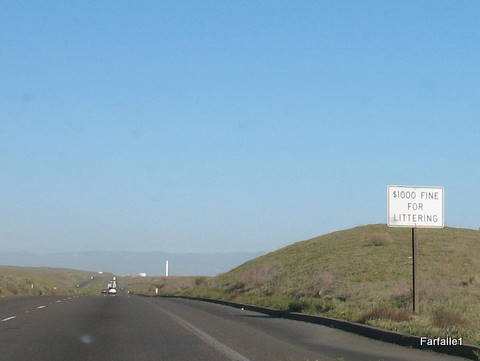
litter-fine2

How this might be enforced I’m not quite sure…

California is also really serious about alternative energy. Near Palm Springs we drove through a huge wind farm. I couldn’t stop taking pictures, so please bear with me if I show you three of them instead of just one:
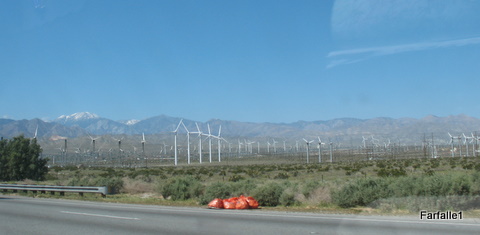
huge-windfarm2

windmills-and-bridge

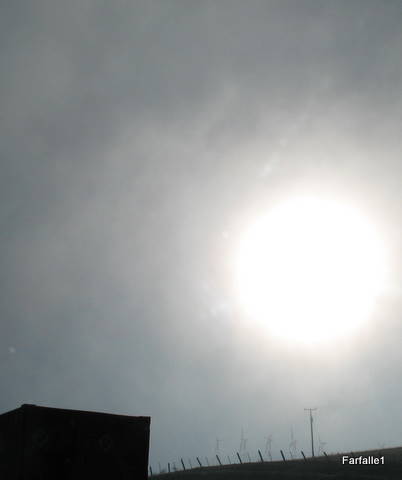
windmills-in-fog

In 1995 California’s three main wind farms produced 30% of the world’s wind-generated energy.

Here’s what’s bad about California: the roads and the drivers.
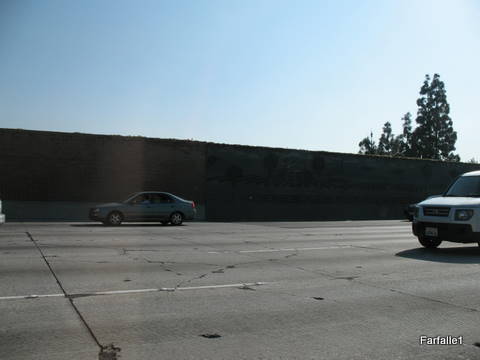
california-road-surface

A lot of the roads looked like the one above, with broken or uneven pavement. It made for a noisy and bumpy ride. The drivers, though, are worse than the roads. It seems to be a matter of pride never to drive less than 20 miles over the speed limit. The fellow driving the truck below passed us on the right, cut in front of us about 2 car lengths ahead, and jammed on his brakes. We hit him, but fortunately damage to our car was minimal (nil to his truck) and no one was hurt.
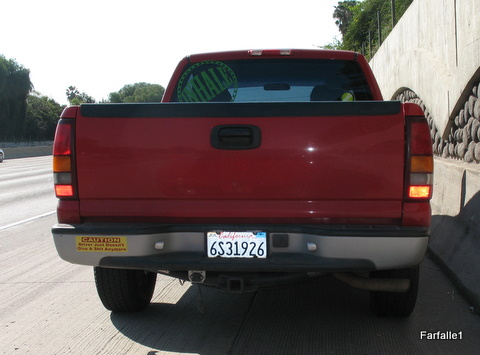
red-truck
The advice on the rear window (‘Inhale’) might perfect for a party, but maybe not for the highway. Curious about that bumper sticker? It says, ‘Caution, driver no longer gives a shit.’ Evidently.

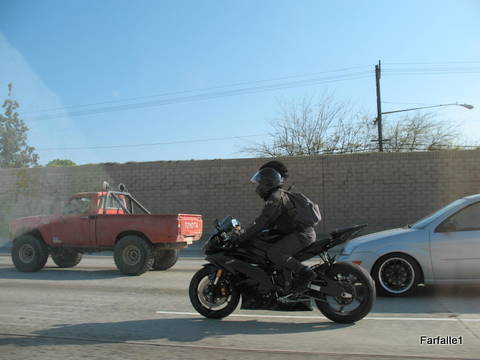
Not everyone on California roads is irritating though.  This Gladiator cyclist gave us a cheerful wave when he saw my camera:
cal-cycle-gladiator

We had two unusual wildlife sightings as we drove along, one reptilian and one ursine:
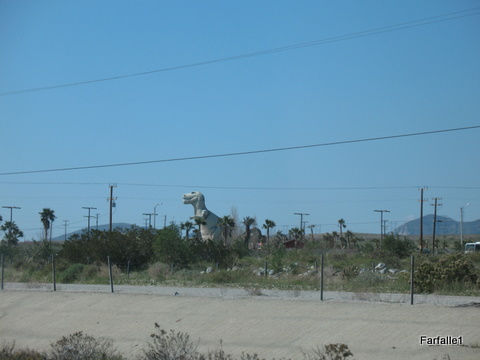
dinosaur

honda-bear

This has been a long post, and I apologize for the large number of photos. It was hard to choose which of the 300+ I took to share with you. As you can tell, we had a terrific trip to California; I now understand why it is always one of three destinations on the itinerary of visiting Italians. It will be on mine again.
Expatriate in a noisy place

Tags

, ,

The desert is a place of quiet cacophony in the spring.  I stopped on the Lost Dutchman Trail the other day to listen, and this is what I heard.

love

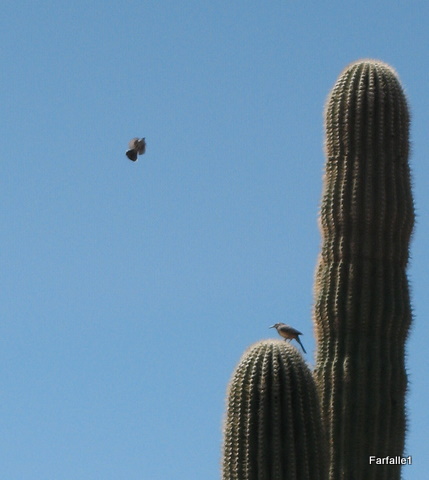
First ~ the bird song.  The birds (and the bees) are doing what they’re meant to do at this time of year, and they’re being none too quiet about it.  The cactus wren perched on the saguaro above has a hideous call for such a sweet bird.  It’s a grating electronic trill/buzz, as if the bird had had a laryngectomy and needs to use an electrolarynx.  Not pretty.  But judging from the dancing in the photo above, it is effective. Other bird songs I heard included a high trill, a pee-weep, a medium trill,  a chip-chip, and a whistle. The gila woodpecker thinks it’s all hilarious, and has a call that sounds like a chiding laugh. Every now and then a Gambel’s Quail took flight to the sound of beating wings.

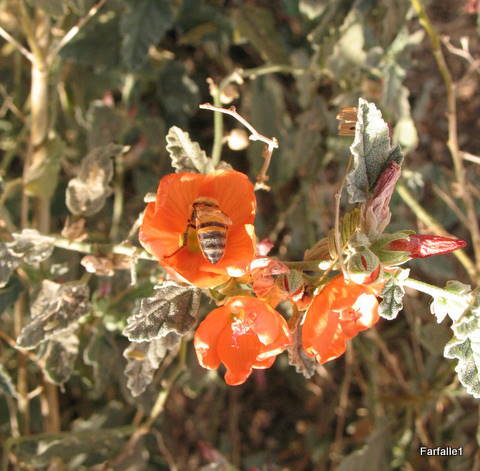
aguila-orange-flower-bee

The insect world provided the basso continuo for all the bird chatter. With flowers just beginning to open and the temperature rising, the flies, bees and wasps are out in great numbers. The bee above is hard at work in a desert mallow. He buzzed off with yellow pantaloons shortly after this photo was taken.  The bees who aren’t working flowers at the moment make a lot more noise as they commute to their next job, a sort of en-yeow zooming sound, like a teeny race car going by on an oval track.  The flies content themselves with a higher-pitched steady whine; they are irritating as they like to land on people, probably only minutes after having landed on some animal’s poop.  Bah.

It was very breezy, and that added to the concert.  The palo verde  and mesquite trees are leafy, and the wind makes a lovely whispering sigh as it passes through them.

The last sounds are the chatter of other hikers.  It was spring break week, and there were lots of young people out, probably thinking about the birds and bees, though in a slightly different way than I was.  I overheard conversations on the economy (the end of capitalism as we know it!), weight loss (drink lots of water before eating!), and cookery (tomatoes!).  We courted a little differently in my day, but, as the cactus wren proves (in the words of the old Stones song), it’s the singer, not the song…

Near and South of the Border, part two

Tags

, , , , ,

Expatriate in Mexico

One day while we were visiting our friends in Yuma we all crossed the border into Los Algodones (the cotton plants), Mexico, so the Captain and I could buy new spectacles.  Why?  Because they (as well as prescription drugs and dentistry) cost about one-third what they do in the U.S., which is a puzzle and a pity.

Do you know how easy it is to get into Mexico?  You walk in.  Some people drive, but we parked on the American side in an immense parking lot, and simply walked in without being stopped or queried by anyone, and without having to show a shred of identification.

Let me back up a bit to tell you that the area around this part of the border with Mexico is one trailer park after another.  I never knew there were so many RV’s in the world, especially since I thought most of them were already planted around Phoenix.  Wrong.  The number of trailers in the south is uncountable – green-camperit’s infinite, they’re probably multiplying as you read.  It’s hard for the Captain and me to imagine the pleasure anyone would take from living in a metal box in the desert, but there must be a lot to it we don’t understand, as many seem happy to be doing it.  Most of the license plates were from cold northern climes, and perhaps that is all the explanation that’s required.  It was interesting to see that quite a few of these mobile homes are now generating their own power with solar panels and small windmills mounted on the roofs.

los-algodones-street1The streets of Los Algodones are nothing but shops for the aforementioned services.  This is the street we entered just after crossing the border.  How to choose which oculist to visit?  We opted for one that was a little deeper in the town, seemed very clean and professional, and didn’t have someone outside exhorting us to come in.  It looked to us like the best choice… is it coincidence that it is called Best Optical?

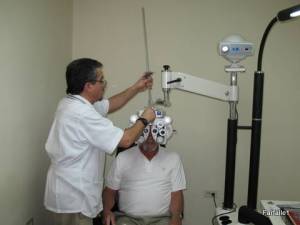
Dr. Manuel Robles and his staff amazed us with their professiolos-algodones-ls-test-2-27-2009-19-35-19nal manner.  We each received a very thorough eye exam, including the test for glaucoma.  Several space-age looking machines stared deeply into our eyes and provided the rough corrections we each needed.  Then we were ushered into a different room where our prescriptions were fine-tuned.  Dr. Robles spent a very long time with the Captain who required two different kinds of glasses – one pair for regular life, and another with different focal lengths for working at the computer.
After the exams and the not-so-difficult chore of picking frames (“which ones are least expensive?”) we were shooed away and told to return in two hours.  This gave us a fine opportunity to visit some of the highlights of Los Algodones:

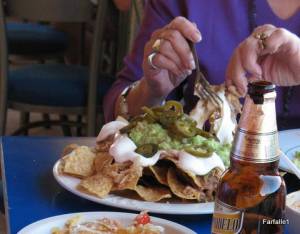
los-algodones-our-food2-2-27-2009-21-00-19The restaurant where we sat on a second-floor balcony and ate some of the best nachos that have ever been constructed.  Yes!  That’s pulled beef under the guacamole and sour cream – yum!

los-algodones-strawberry-man2-2-27-2009-21-20-30This man, seen from our luncheon eyrie, was selling fresh strawberries.  We bought some, forgetting that we probably couldn’t carry them back across the border. We later gave them to a passer-by.
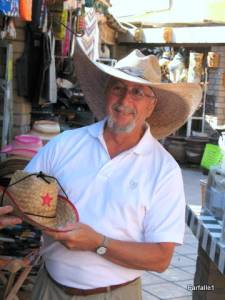
los-algodones-louis-in-big-hat-2-27-2009-20-08-351You can’t visit Mexico without trying on a great big hat…
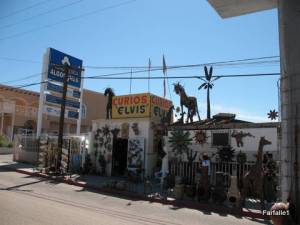
los-algodones-curios-shop-2-27-2009-21-51-321We didn’t buy anything from Elvis, but it’s kind of reassuring to know that the King still lives… in Los Algodones…
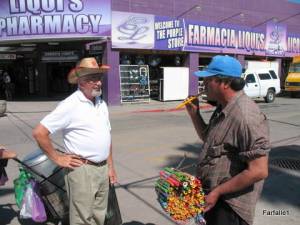
los-algodones-louis-and-flute-man-2-27-2009-22-03-11No, we didn’t buy a whistle, either, though it was extremely tempting.
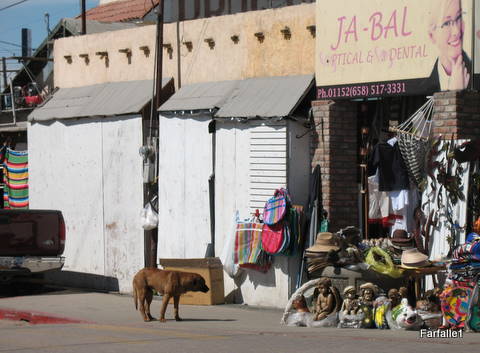
Local fauna.  The first was considering either a purchase or a leg-lift; the second was hiding behind some furniture that was for sale.  We were told if we bought the furniture the kitten could come too – now how would we get her across the border?

los-algodones-dog-and-shop-2-27-2009-22-00-44

los-algodones-hiding-kitten2-2-27-2009-21-37-11

The two hours was up and, having amused ourselves pretty well, we went back to Best Optical and picked up three pairs of beautiful new glasses.  All three were bifocals, and mine get darker as the light gets brighter.  For the three pairs of glasses and the eye exams we payed the princely sum of $125 American.  And that is why so many people cross into Mexico every day.

Then it was time to join the loooong line to re-enter the U.S.

los-algodones-line-for-us-2-27-2009-23-30-07

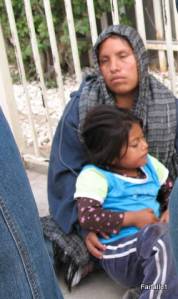
Eventually we arrived within sight of the customs shed (where one is not allowed to take pictures – when I asked the customs official said, “Don’t photograph anything having to do with this border.  If you do someone will yell at you and take away your camera.”  Evidently he mistook me for a toddler.)  Along the end of the route there were three Indian women with children who were begging, and from our observation doing rather well – it’s impossible not to put something in the cup of a woman who looks so sad.

los-algodones-line-for-us-beggars-2-28-2009-00-04-47Because there were only three beggars and because, sad expressions aside, they looked reasonably healthy, we assumed that it was some kind of controlled concession.  But we still couldn’t walk by and do nothing… could you?

After scolding me, the Customs Officer instructed me to take off my dark glasses, riffled my passport and asked a lot of questions about why I had crossed and what I had done whilst in Mexico.  He was cranky.  He was probably tired and sick of cheapskate Americans.

At last we were released back into the United States.  It’s hard to imagine how hard it must be to go anywhere without a passport; it’s something we take for granted, but it bestows great advantages to us.

The drive back took us past several common Yuma-area sights:

date-palms3There are many date farms in the area, specializing in Medjool dates.  We stopped at the Imperial Date Farm where Raul prepared their famous date shake for those of us who like that kind of thing (I don’t):
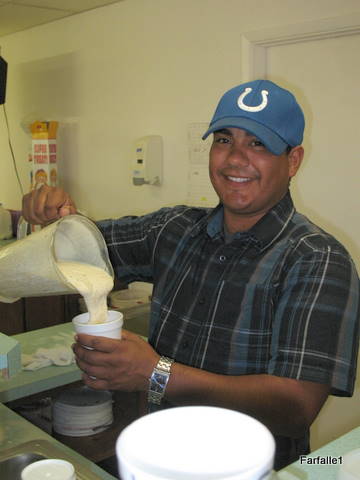
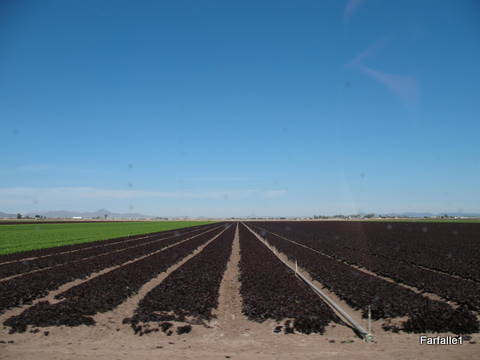
raul-pours-a-date-shakeThen it was back past the miles of lettuce farms.  I bet half the lettuce eaten in the US comes from this part of the world.  Our friends from Tennessee say they eat the lettuce shipped by these growers.  Here is what a really BIG red and green lettuce garden looks like:
lettuce-red-and-greenWe were pretty tired out after our day’s exertions.  After a delicious dinner with our friends we crossed one last seamless border, and tumbled into bed in the Cocopah Indian Nation – at the Cocopah Casino and Hotel.
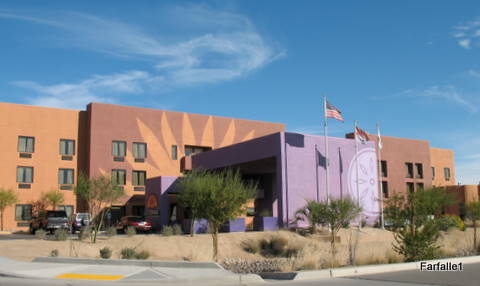
cocopah-hotel-2-28-2009-01-16-23

It was an interesting trip in many ways – and it raised more questions than it answered, about immigration, agri-business, but especially about health care in the U.S. (yes, I count eyes and teeth as part of the equation). Why does a pair of new glasses cost around $200 in one place, and only $30 a few miles away? What kind of sense does that make?