
GPL in Italy is what we call LPG in the U.S.: liquid propane gas, and cars fit to take it are widely available here (Chevrolet, Fiat, Mazda, Opel, Peugeot, Renault).
Quick disclaimer: I’m not a gear-head or an engineer. My understanding of internal combustion engines is on a par with that of my sister, who once described the reason her car was in the shop as “a loose screw in an oil place.”
Unfortunately, a visit to fueleconomy.gov, a U.S. site, informs us that one of the disadvantages of LPG as an auto fuel in the U.S. is that no new passenger cars fitted for its use are commercially available (though kits to retrofit are). It is more commonly used there for fleets, taxis, and forklifts (there are about 600,000 LPG vehicles in operation in the U.S. today out of 240,000,000 total vehicles (+/- 2.5%). As a corollary to this, the fuel itself is not widely available at ordinary filling stations. And I have to ask, why??
The U.S. is one of the largest producers of LPG, which is a petroleum product (learn all about it here). It was first developed by Dr. Walter Snelling in 1910 (the first automobiles that ran on propane appeared in 1913). Though it is a petroleum product, it burns up to 40% cleaner than gasoline, emitting far fewer hydrocarbons, and it is less costly than gas.
Look at this happy woman:
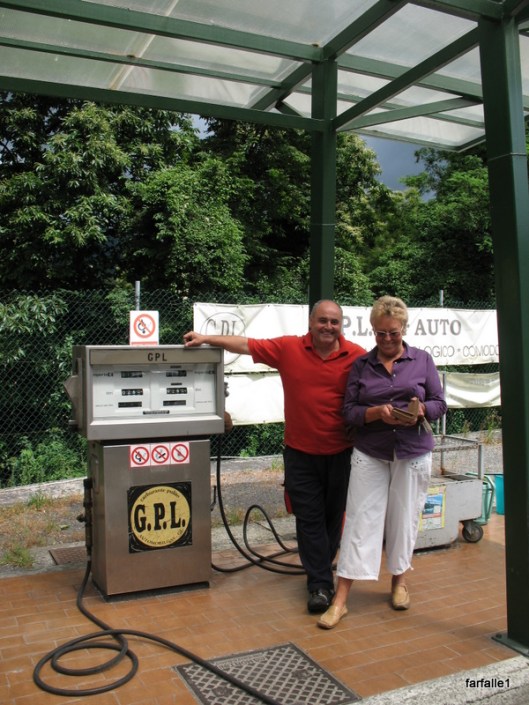
She is my friend Anita, and she is happy because she has just filled her bi-fuel Chevy Matis with GPL. Bi-fuel? It means her new car runs on either conventional gas or, with the flip of a switch, GPL. She is happy because there is still money in her wallet after filling her car. One reason is because her GPL costs about E .57 per liter instead of the E 1.39 for gasoline. (The man who pumped the GPL is smiling because he likes having his picture taken.)
Here are two more reasons she’s smiling. When she took her old Volvo wagon off the road the Italian government said Thank You For Taking That Big Polluting Monster Off Our Roads by giving her E 1,500. Then she was rewarded with about another E 3,500 when she chose to buy her bi-fuel Chevrolet Matis. (Other car manufacturers in Italy also offer ‘ecocentives’ to those who purchase bi-fuel cars.)
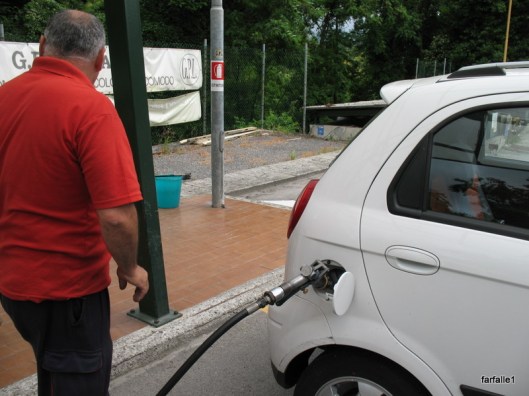
The only trick is to find a station that sells GPL – it’s easier to do here, where there are at least 19 dealers in Liguria, than in the U.S., where you seldom see it sold. But if you can’t find a station, no worries – you can still drive on conventional fuel.
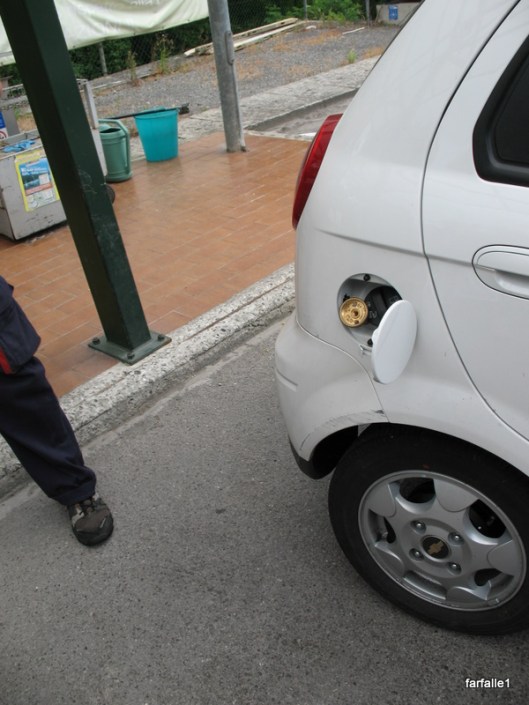
There’s a special adaptor that couples with the GPL fuel receiver of the car – brass! Very pretty. And after the car has been fueled, very cold. The smiling man simply took the adapter, screwed it in, and then attached the pump nozzle to the adapter. It didn’t take any longer to fuel with GPL than with regular fuel.
I’m surprised more is not done with this fuel in the U.S., where efforts seem to be going instead to ethanol blends and bio-diesel. I learned here that if you purchase a hybrid, diesel or dedicated alternative fuel vehicle (what a mouthful), you may be eligible for a tax credit of up to $4,000, which is nothing to sneeze at. There is no reward in the U.S. for purchasing a bi-fuel car. Nor is there a reward that I could find for removing a heavily polluting, inefficient vehicle from American roads. An alternative in the U.S. to LPG is compressed natural gas, or CNG, which burns even cleaner than LPG, but takes up much more room. (Again, new cars are not available with CNG, but retro-fit kits are.) Isn’t it odd that American auto manufacturers haven’t paid more attention to a cleaner technology that’s been around since the beginning of car time? Oh, wait a minute. Thinking about those yo-yo’s, maybe it isn’t so surprising after all.
 An Ex-Expatriate
I am a legal immigrant in the usa
I started to install propane equipment in 1965 in Belgium. Until 2000.
In Europe we have the most advanced equipment for gpl. LPG. Fuel multiport injection
The only problem we facing after 60000 miles theis valve seat wich doesn’t resist to the higher temp in the combustion chamber of the engine wich can be modified to.
Other Thant that the vehicle runs fine .
Any question other than the none government help to improve the Lpg development in the us please call me vincent
Several years ago, Arizona had a program for alternative fuel vehicles that almost bankrupted the state. It was a knee-jerk respons to fuel economy, paying large bonuses to people buying AFV (alternative fuel vehicles) but was not specific enough to be worthwhile. You gotta love politicians who want to be all things to all people!
The wording was not specific about the alternative fuel, it did not specify that the AF must be used (only that the car had the capability for AF) and, worst of all, was passed by the legislature before enough fueling stations were in place.
There is a provision mandating 75% of government vehicles must be AF if there is a fueling station within 10 miles of the vehicle’s base location. This includes school busses and many other state, county and city vehicles.
The distinctive blue license plate allows drivers of ALV to use the HOV (carpool) lanes regardless of the number of occupants or time of day.
Unfortunately, many many people took advantage of this poorly written law, bought cars/trucks, received huge bonus cheques and immediately turned off the AF feature of their vehicles because fueling was a hassle.
Lesson learned:
1. we need more fueling places to make this a reality.
2. we need a better definition of “alternate fuel”
PS – the gasoline lobby mounted a very effective “anti” campaign citing the high costs of maintaining two fuel systems for these vehicles.
That is so interesting – I had no idea! I don’t think I’ve ever noticed the blue plates – will look harder next time. Maybe the third lesson could be that AFV’s be more available? I still think the answer is individual jet-packs, but no one’s come up with one for me yet…
PS – you have to know that the possibility of bankrupting the country wouldn’t stop Italy! Interestingly, it is the car manufacturers who are giving the major portion of the ‘rewards,’ though.
Oh how I wish the good ol’ USA would wake up!
When my husband had his mind set on a 4wd suv, I thought ‘oh-oh, there goes our budget’. And then he explained how a gpl/lpg installation will actually save us some money so I trusted in his words. You know what? It amazes me how fractional our auto fuel bill is per month. We spend thrice as much on food!
It makes sense to have 4wd where you live, what with having actual winter, snow and ice. My friend says it costs her half to drive her gpl car than her former regular gas behemoth.