
Tags
Usually here in Italy we’ve been able to find any foodstuff that we want. We might not recognize the name, or the packaging, but by asking friends we’ve been able to find almost everything culinary that we’ve wanted. And usually when we find it, it looks about the way we’d expect it to. I can imagine being in some really exotic country and buying something that you think is soup, say, only to open it up and find goats’ eyes. That doesn’t happen here.
 One thing I’ve never seen here, though, is Jello, the kind of wobbly, luridly colored Jello that we have in the States. There are ‘budino’ (pudding) mixes – chocolate, lemon and so forth. But not jello, per se, which is too bad, because it is a really silly, fun food. (If you want to read a fairly cantankerous and thoroughly amusing history of non-commercial and commercial gelatin, which may or may not have been written by S.R. Brubaker, click here.) Is there anything more cheerful, than a bowl of cubed up jewel-toned Jello, quaking and shaking? No, I don’t think so either. But you won’t be eating it in Rapallo.
Of course one can make one’s own jello with fruit, sugar and unflavored gelatin. But it’s a little hard to come by red dye #14 or any other of the poisonous dyes that give Jello its unique colors (colors never found in nature!), so the likelihood of achieving true jello-hood at home is remote… it just isn’t jello if it doesn’t look like a false gemstone that’s got the vapors.
For some reason I got a bee in my bonnet about making tomato aspic the other day. To my shock, many of the recipes I found call for lemon Jello. Yuck. Fortunately I found plenty of suggestions for ingredients in other recipes that did not include anything quite so yellow and all of which, of course, call for unflavored gelatin.
We still had some in the cupboard that moved over from the States with us in ’02 (that’s how often I make aspic), but there wasn’t really enough. So I went a-hunting for same in the supermarket. It is plentiful, but the package didn’t look anything like what I’m used to:
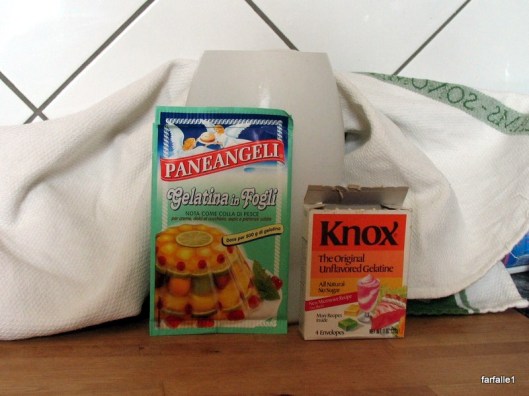
That’s it on the left – Gelatina in Fogli. Huh? What are Fogli? Well, it turns out that in Italy gelatin is one of the foods that looks completely different than it does in the U.S. Whereas we are accustomed to a grainy powder, here the gelatin comes in thin sheets (‘fogli’ means ‘leaves’ or ‘sheets’):

In fact, it’s really pretty. That’s our Knox powder in the saucer, and resting behind it is one of the six fogli that come in an Italian package of gelatin. Looks like a kind of magical quilt for an elf, doesn’t it? It’s flexible and doesn’t feel sticky. Fortunately the directions for using it are very simple. You put all six sheets in a bowl of cold water and let them soften for 10 minutes. They get slippery and feel a little slimy, but they hold their shape; it’s kind of fun to play with them a little before using them. Then you add them to a hot mixture and they simply melt away. After that, things go along just as they do with the powdered form of gelatin. After a while in the fridge you’ve got a nice, firm, gelled whatever-you’ve-made. One of the fun things about molded food is choosing the shape you want to make it. Fish is a fish mold? Certainly! But how about a little sensory displacement: dessert in a fish mold? Why not? Fooling around with shapes is half the fun of the whole endeavor.
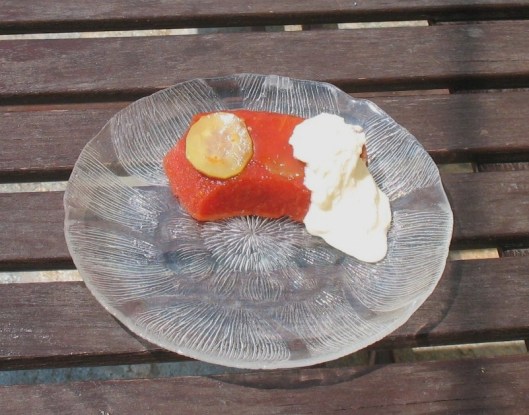
So how did the aspic turn out? Really well! In fact, to my utter surprise, our Italian friends loved it. They called it tomato salad, which was generous, and they enjoyed it very much. We served it with a sauce made of cheese, horseradish, mayonnaise and a little milk. That thing on the left that looks like a happy face is a slice of cucumber; another is barely visible between the first one and the sauce. The cucumber as decoration plan did not work out quite as I’d hoped.
Gelatin makes food that’s playful, and that’s good. I don’t agree with S.R. Brubaker who says, gelatin is ‘fake food,’ (just one of his salvos against this church social favorite). It’s no more fake than bread is ‘fake wheat’ after the addition of yeast and heat. It’s just a process. The great thing about gelatin is you can put whatever you want in it and it will probably work out pretty well. It is the amber of the food world, trapping and holding ingredients (let’s hope it’s not, like amber, holding flies). If you want a rather vague tomato aspic recipe, click here. In any event, have some jello and have some fun.
 An Ex-Expatriate
Even though the post is quite old, i still felt like replying to bring up an information I hope may prove itself useful.
In recent years, most larger Italian cities have been hosting growing Southern American (namely Peruvian and Ecuadorian) communities; Genova is no exception.
Apparently, said Southern Americans did import some culinary habits from the gringos, including Jello.
This to say that, provided you live up to the fact that you’ll be the only Caucasian and the only non-Spanish speaker in the store, a trip to a Southern American-owned convenience store may be a good way to get hold of Jello, and other American foodstuff hard to be found in Italy, such as salad dressing, pancake mix, shortening, and many more.
Thank you so much – excellent advice. We had a Latin store in Rapallo, but alas, it closed a couple of months ago. There is still a middle-Eastern grocery where we can get a fair amount of exotic fare. On the other hand, part of the fun of being in a ‘new’ place is learning the food stuffs and how they are used (like gelatin in sheets!). Still, we sent up Hosannahs when Billa began to carry peanut butter!
Funny that I happened upon your ode to Jello and magical “gelatina” discoveries in Italy, today, the very day I bought and used the stuff here for the first time, after a decade of never having had the desire or thought to do so.
Then, behold, another person found out to the same interesting difference!
Synchronicity!
“Is there anything more cheerful, than a bowl of cubed up jewel-toned Jello, quaking and shaking?” Yes, the same made with vodka instead of water….
Now that’s a very good idea… does jello set when made with vodka? Could you make it in a bottle-shaped mold??
Now wait a minute…you’ll down aspic but not nervetti! You’ve just given me the idea that perhaps next time, if I make my own nervetti, I’ll plop it all into a fish mold. To be honest I’ve never eaten tomato aspic, but I would certainly have a go at it at your table!
Nervetti in a fish mold would be amusing for sure. Aspic can be really good, especially if it’s not too thick. Sherri’s suggestion of shrimp and avocado sounds great. I think Jello is hilarious – but then I crack up when I see a banana peel on the sidewalk, too.
Tomato Aspic is not just for church socials anymore, not that it was ever solely theirs. According to my official handbook “Being Dead Is No Excuse (for using store-bought mayonnaise), The Official Southern Ladies Guide to Hosting the Perfect Funeral” serving tomato aspic is mandatory. Period. The authors write: “Can you be buried without tomato aspic? Not in the Mississippi Delta, you can’t”.
Some shrimp and avocado stirred in to the setting aspic is not a bad idea and great improvement on the plain canned business; horseradish cream cheese sauce would make ALPO taste good, so that is a must.
Thanks for the smiles this brought. We’ve been in the midst of a funeral this past week ……… but they’re Yankees, so no aspic!
Oh, Sherri ~ what a great name for a cookbook. And I’m glad to have my sudden need for aspic validated. Next time (2012?) I’ll try the shrimp and avocado additions – yum. Sorry that you’ve been having a mourning week. boo.