
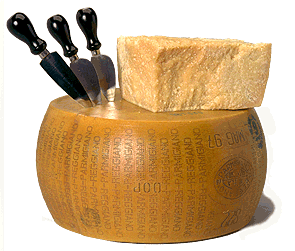
This photo belongs to Parma Shop.It
Before leaving on our trip we stopped at Rapallo’s very popular Ekom market to pick up some Parmigiano Reggiano cheese to bring as gifts to the U.S. (Yes! It’s legal to carry it in – just be sure to declare it on your entry form and go through the quick Dept. of Agriculture scan at customs). When I grew up this comestible was known as Parmesan Cheese, or, more simply, grated cheese, and was consumed only on those infrequent occassions when we ate spaghetti for dinner (never called ‘pasta’ then).
Ekom was out of Parmigiano, but were expecting it early the next morning, so I left an order for 6 pieces, vacuum-sealed, for mid-day. I showed up at the appointed hour, but alas! Roberto had not had time yet to cut the cheese. Which worked out well, because I had never seen how a Parmigiano is opened before, and it is quite amazing and labor intensive.
The purloined photo above shows the main tools used to crack the beast. It is never cut, either with knife or wire, but rather is split, much as cord wood is split for fuel.
An aside: the Wikipedia link above to Parmigiano Reggiano has some great photos of the cheese being made, and gives the history and details of this delicacy, so I won’t repeat them here, other than to mention the average wheel of Parmigiano weighs about 80 pounds. Just so you know. It’s very heavy.
The first step is to score the thick, tough rind of the cheese. This is done using a short knife with a short little hook at the end where you would expect to find a point. Roberto went across the middle of the top of the cheese, down the two sides, and across the bottom. He wiped all the cuts, and then recut, a little deeper.

Excuse mis-focus, please. But you have to admit, good shot of the yellow sign.
He then used one of the triangular shaped knives that you can see best in the very top photo, and, using his mean tenderizer as a hammer, pounded it into the marks he had made with his hook. He did this all around this cut. Then he used a longer knife and pounded that it, and finally he was able to separate the cheese into two halves.

All of the cutting is accompanied by a great deal of wiping with a cloth. The exterior of the cheese is extremely oily, which makes it slippery and all the more difficult to work with.
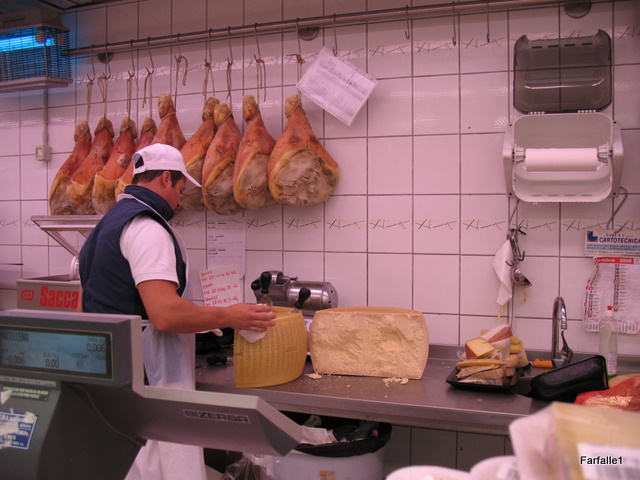
This scoring, wedging and splitting process is repeated a number of times until usable pieces of cheese begin to emerge from the block. It’s a bit like sculpture, I guess; the cheese wedges are in there, you just have to cut away until you find them. Roberto did resort to an ordinary knife to cut off one edge of rind as I requested. It’s much easier to use Parmigiano in the home kitchen if it has only a side rind and is all cheese at top and bottom. By the way, cooking the rind in a minestrone or other soup can add great flavor, and if your teeth are good it’s even fun to chew the rubbery thing, assuming it has cooked long enough.
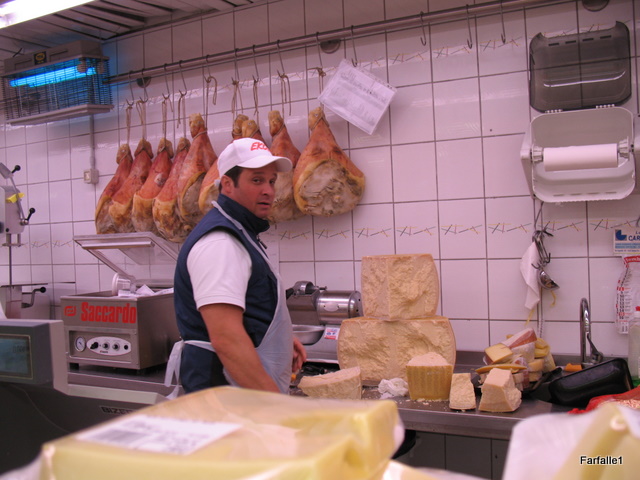
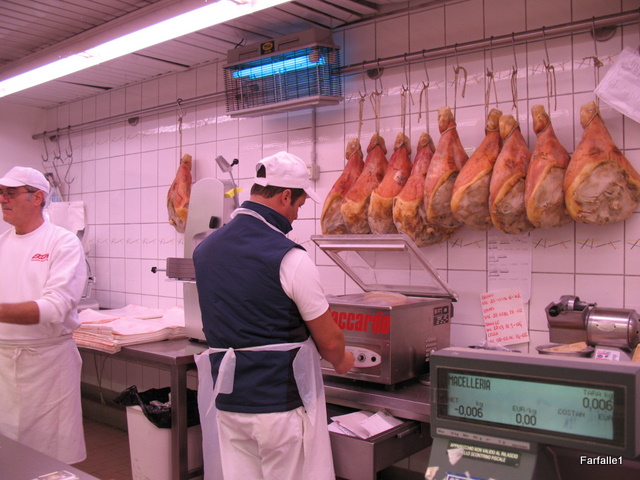
The final step was putting each wedge in the vacuum machine and sealing it up so none of its goodness would escape on its long trip to the US. It took over 30 minutes to pull my 6 pieces of cheese from the giant wheel, and it looked like Roberto had at least another hour or so of work ahead to finish the job.
All the cheeses we carried over arrived undamaged, and people seem to like them. We did keep one for ourselves. Of course. We’ll eat it on spaghetti.
 An Ex-Expatriate
hi!
welcome back, I read some of your posts. I like them, hope this is the first step of a friendship collaboration.
See you soon
Anna 🙂
As a lucky recipient of your generosity, I can say only “GRAZIE”! The cheese is still perfectly wrapped and I admire it every chance I get (I hope that cheese fondling is still legal ….). First chance, I will make some fresh egg pasta and we’ll enjoy a simple supper of Farmers’ Market baby greens and your delicious gift along with a sip or seven of some pretty decent red wine that I’ve chanced upon.
Grazie te, e buon appetito!
Glad to see you back! And that your cheese made it safe and sound across the pond. I didn’t know that little tip about declaring it on customs and going through Dept of Ag, but it’s been awhile since I brought cheese over to the states.
So will you be staying on through xmas and easter? (btw, the photos are great…love it when you can see the real thing being accomplished in action).
Yes, we’re here for a few months now. I think it’s much more complicated going in and out of Hawaii – I know Ag Dept is much more fussy. I forgot I’d bought some seeds to bring back to a friend, and their scanner found them – I was scolded! Or perhaps it ws because I was going to California? They’re fussy too, stop you on the highway between AZ and CA to look in the car. Glad you liked the photos – obviously the auto-focus played some tricks on me…