
Tags
Brandon CSA, Community Supported Agriculture, Community Sustainable Agriculture, CSA, Woods Farm, Woods Market
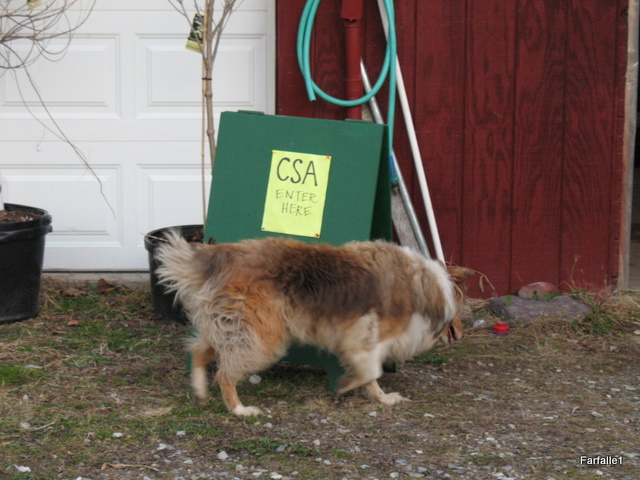 Community Supported Agriculture. Community Sustainable Agriculture. Take your pick or make up something else. Whatever you call it, it is big in the U.S. My sister in Tennessee and my dear friend in Vermont have both joined their local CSA’s. Even in Arizona, where one thinks more of desert or agri-business than vegetable farms, there are a number of CSA’s.
Here’s how it works. At the beginning of the growing season community members pay a fee to a local farmer. The farmer can use the money that’s been paid up front to buy seeds, fertilizer, whatever he needs, without having to take out a bank loan.
Whatever the farmer harvests, or some portion of it, is then divided by the number of members who joined, and they, the members, can come once (or sometimes twice) a week and pick up their share of produce. In the case of my friend in Vermont the fee to join was $200 which entitled her to 10 weeks of harvest pick-ups..
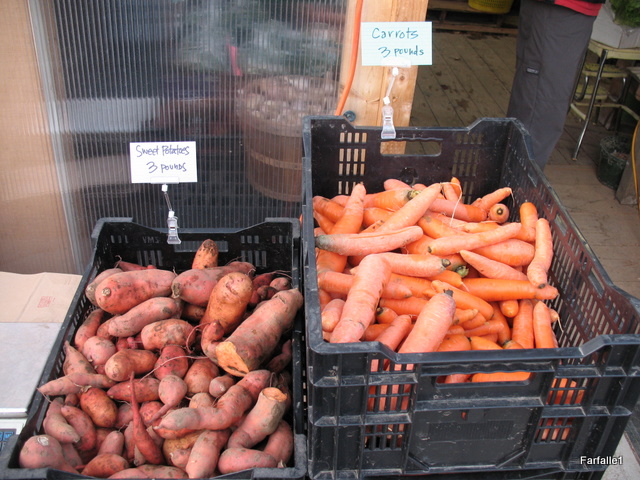
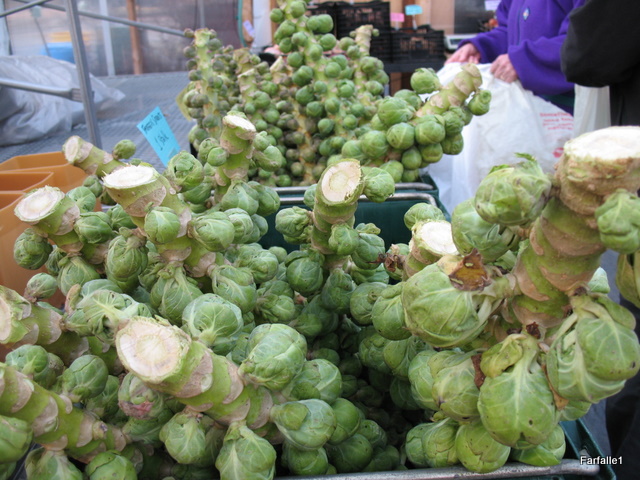
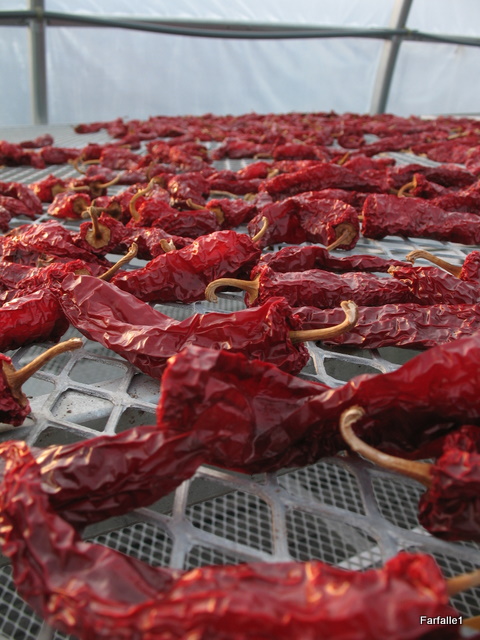
Obviously these are fall crops. My friend’s CSA was organized for autumn vegetables; the people who own the farm also offered a summer CSA for use at their farm stand. Members could buy summer vegetables and everything else the stand sells (meats, cheeses, plants, honey, eggs) during the four summer months at a 10% discount.
There are probably as many organizational charts and methods of distribution as there are CSA’s. Mrs. H, here in Arizona, belonged to a CSA for one year; when she went for pick-ups the produce had already been divied up and put in boxes. She was given a box, over whose contents she had no real say. My sister in Tennessee went to her pick-up and could tell the farmer what she wanted of the available offerings. The farmer picked out individual pieces – better, but still not perfect. The Vermont system seemed best to me; the farmer put a sign above each box of produce announcing the weight of each share. For instance, each share-holder was entitled to 3 pounds of carrots in the photo above. She could also take less, or decide not to have carrots at all that week.
There was a large amount of autumn produce on hand the week that I went with my friend; she staggered out with two full bags of locally grown organic vegetables, including onions, carrots, potatoes, sweet potatoes, kale, brussels sprouts and more.
I was able to speak to the owners/farmers of my Vermont friend’s CSA, Jon and Courtney of Woods Farm in Brandon.
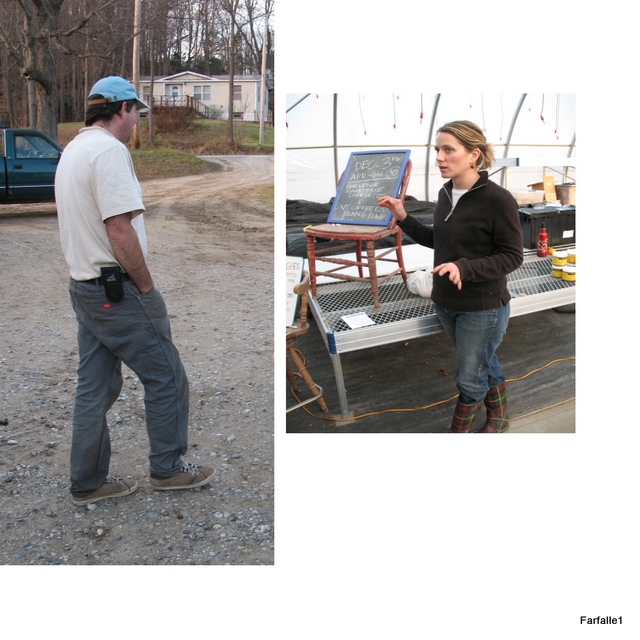
Jon moved to Vermont from Massachusetts in 2000 to farm the fertile river valley; Courtney came for a job on the farm and ta-da, partners in the fields and partners for life. They have 25 of their own acres of light, productive soil. In addition they lease 35 acres, 15 of which they put in alfalfa and 5 of which they put into sunflowers (a less than successful operation this year because of excessive rain). This was the first year they offered the summer CSA program at their farm stand – it was more successful than the sunflower crop; they had more subscribers than their goal.
CSA’s appeal to people who are interested in knowing where their food comes from. There’s been a huge growth of the ‘localvore’ culture in the US, and CSA’s both feed and profit from this movement. I haven’t seen anything like this in Italy, although there is such a strong tradition of local markets be begin with, there may be no need for such a thing. But for Americans, who are accustomed to buying veggies that have been trucked in from hundreds, or even thousands, of miles away, the CSA’s offer a winning formula for everyone.
 An Ex-Expatriate
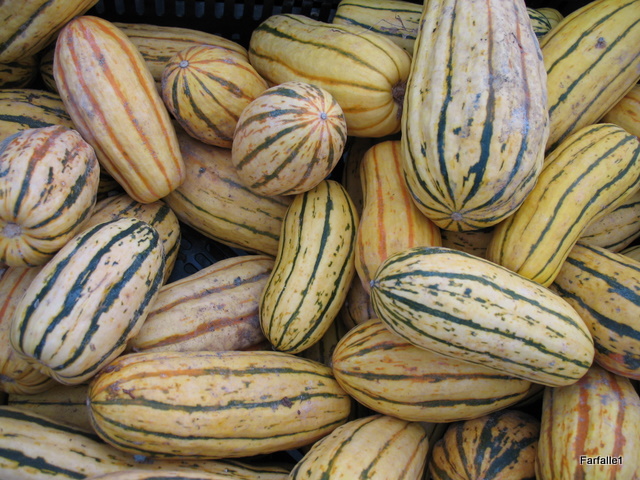
Never have vegetables looked so seductive! That they are also delicious and nutritious is important, but the pictures are worth….well, you know.
Thanks for giving Jon and Courtney their due. Honest labor and wonderful produce deserve attenti0n.
They won’t get much from this poor ole blog… but I did think the farm was amazing. And the work! It made me tired just to think of everything they have to do to keep the place running.
Let’s hope more folks get interested in this! An impetus might be to go see “Food Inc.” It moved us to add local meat providers to our local CSA.
I see both advantages and disadvantages to trying to eat locally. One disadvantage occurs in New England in January and is self-evident. Of course there’s always canning. Very interesting letters in NYer recently in response to J Franzen article about eating locally, vegetarianism, etc. The need for humane slaughter was a recurring theme.
You have TWO friends in Vermont who belong to CSA’s as we decided to join one this summer so we wouldn’t have to continue our discouraging battle with Mr. Woodchuck, who was using us as a CSA, except he never paid his due… And yes we are interested in supporting local organic farmers. It was the best investment we have ever made — and much of the time we couldn’t eat every single vegetable. When we went away, I offered my shares to the local food shelf. If folks want to know more about where their food is coming from, and want to support agriculture that uses sustainable practices, this is the way to do it.
What a nice twist to give your uneaten shares to the food pantry – that is brilliant. Everyone seems to win with CSA’s. One must still contend with the need for fresh veggies in New England in January, as I mentioned to Pidge…