
Tags
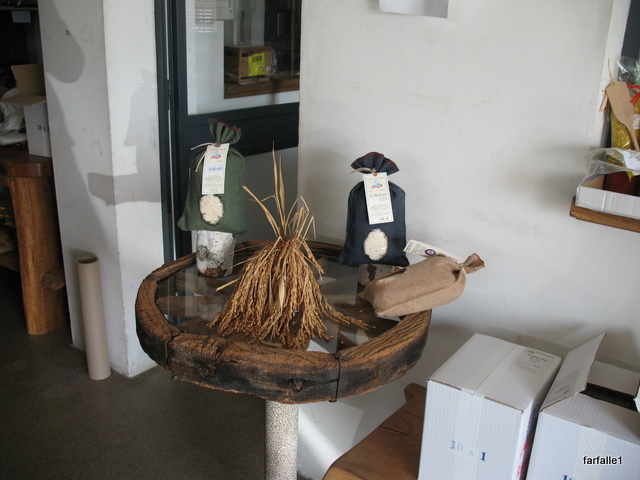
You’ve got to love any food that can be served for every course of a meal. Rice is just such a one. You can have your cheese ‘befores’ on rice crackers, eat risotto for a first course, serve rice with the main course, and enjoy rice pudding for dessert. And of course it is all washed down with delicious sake (rice wine).
Unless you live in a rice-growing region you may think, as I used to, that rice grows in grocery stores in bags labeled “Carolina”. But of course it doesn’t; it grows in rice fields which, in this season in Italy, are exquisitely flooded with water. Those of you who read this blog regularly know that I’m a huge fan of Piemonte, not least because the scenery around the rice fields is so exotic.

The land, flat as a rice cake, suddenly rears up into snow-capped Alps. Add the acres of flooded fields reflecting the surrounding trees and mountains and, well, it’s just something that can’t be done justice with a photo.

Illustration courtesy of Botanical.com
But how does the rice get from lake to table? Ha. That’s where Tomasoni Brothers Riseria (and countless other small processors) come in. The rice, which is a tall slim grain, is harvested and when dried looks like the brown bouquet in the center of the photo at the top of this post. The illustration on the left shows all the bits and pieces of the plant. The rice kernels are the seeds, which are produced at the top of the grassy stalks.
When ripe, the rice kernels are threshed from the chaff (and I’m not exactly sure where or how this happens) and the resulting ‘seeds’ are brought to Tomasoni to be turned into salable product.
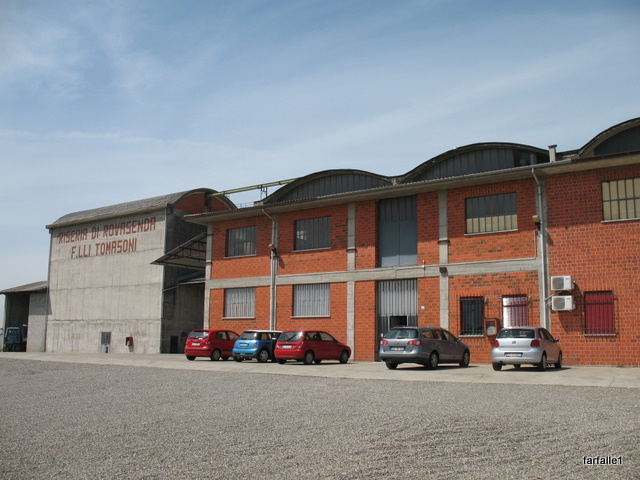
Here are some of the machines that accomplish this miracle:

The rice is carried into the riseria in huge sacks – we’ve seen this happen in the late summer. Then it is fed into the wonderful old machine above from another room.
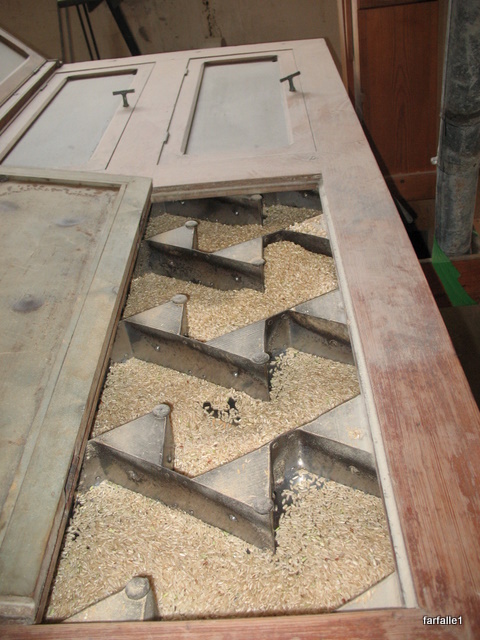
This is the inside of the machine – it engages in some kind of swishy motion evidently. As you can see, the rice is still brown, that is, it still has its husk. After it has been swished around a good bit, the kernels fly through some other machines and lose that husk, becoming the white rice we are accustomed to buying to make risotto.

This is the most amazing machine of all and, I suspect, one of the newest. Each and every grain of rice is scanned by this gleaming device, and if a black speck is detected, that kernel is shot off to another place to become animal food. Only the unblemished best for us humans!
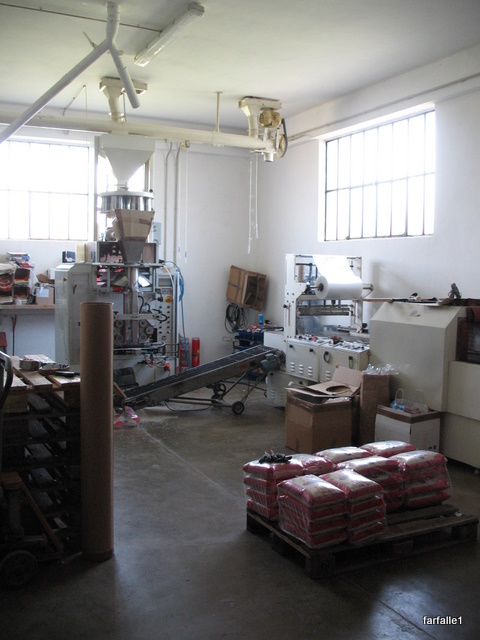
Then all that remains is to package and label the rice. That happens in another room, seen above. I have no idea where the fabric for the bags comes from, but it is all cheerful and silly.
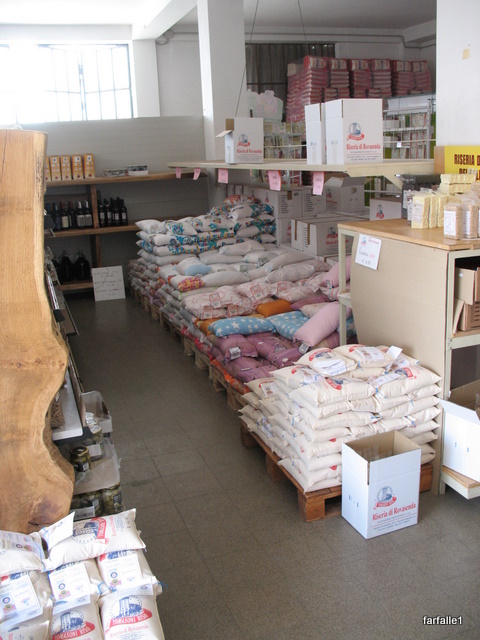
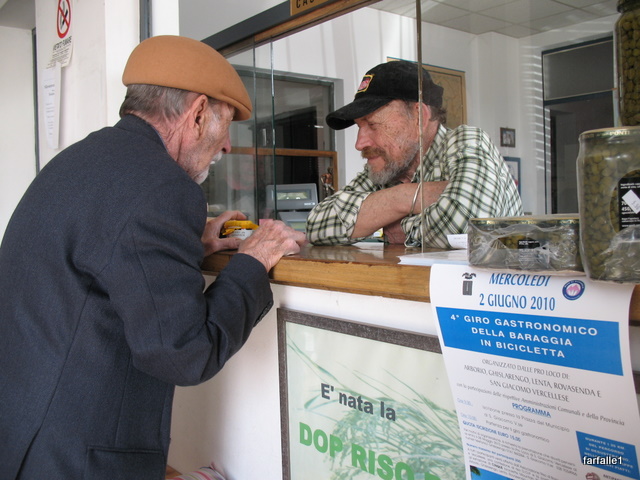
After all the cleaning and packaging is done, one needs only customers to buy the rice. As is so often and so charmingly the case in Italy, selling has more to do with socializing than with actually taking money and handing over goods in exchange.
And finally, here are the cheerful and helpful brothers Tomasoni, Virgilio and Luigi. They are always willing to discuss rice, to tell you which is the best variety for Risotto (Carnaroli) or to find a particularly happy print bag of whatever it is you want. You can find them at their Riseria, which is in Rovasenda, just past Arborio.

 An Ex-Expatriate
Great effort to post such a story – and fabulous photos too!
Thanks, Candleglow…
I didn’t think rice came just from the supermarket, but did think it was from places like Bali and India where I have seen paddy fields. I never imagined you could grow rice in Piemonte.
Oh a crisp (chips for you) factory. I would be in heaven, especially with a glass of red in hand.
A very interesting tale – such an experience. I suppose most grains go through the same basic processing. Except for corn which comes with all the seeds conveniently stuck to a cob.
Well, oats go through a bit of work, don’t they? I have no idea what they look like before they’re flattend out. Good old corn – no wonder it’s in everything we eat in one form or another… I’ve got a great photo of you standing before a rice field with the Alps in the background – do you remember?
From another Piemonte fan: we have rice ice cream in Rome! I don’t think it is my favorite, and don’t quite see the point, but there you are! I LOVE risotto….
Rice ice cream – imagine! I never heard of it, and am not sure I’d much care for it. And I agree with you – risotto is one of the great comfort foods, isn’t it?
Hi,
Thanks for the story. I love Piedmonte and I love rice, especially when it is turned into risotto. We drove through the area recently but obviously we were too early to see the magic happen.
Deb
The rice fields are beautiful at almost all seasons (winter a little dull, perhaps), but especially so when they are flooded. There’s never a bad time to go to Piemonte! What’s your favorite risotto treatment? We’re big on dried porcini…
Closest I’ve ever come to a tour like this was visiting a potato chip factory in Norwalk CT USA when I was in elementary school. The smell was divine!
In later years I went to the wellspring of American chocolate in Hershey, PA, (the smell was divine, once again) and much later to the factory in VT USA that packages Ben & Jerry’s ice cream. The last places I went were with you, Louise – a couple of vineyards in Napa/Sonoma CA USA. I don’t think we remember as much of those visits as we should…
I would love to visit a potato chip factory. In fact, it seems to me you’ve visited production for almost all the major food groups (potatoes, chocolate, ice cream and wine) – you’re lacking only the cheese component, and maybe that could be done easily in Vermont?
Your weekend activities look much more interesting than mine! Fascinating post. I’ve always wanted to know how rice was harvested, but always lacked the courage to ask in case it was one of those things that everyone knew except me!
Now we both know more than we used to! I’m still really fuzzy on how it goes from the field to the riseria – that’s for another visit, I guess…