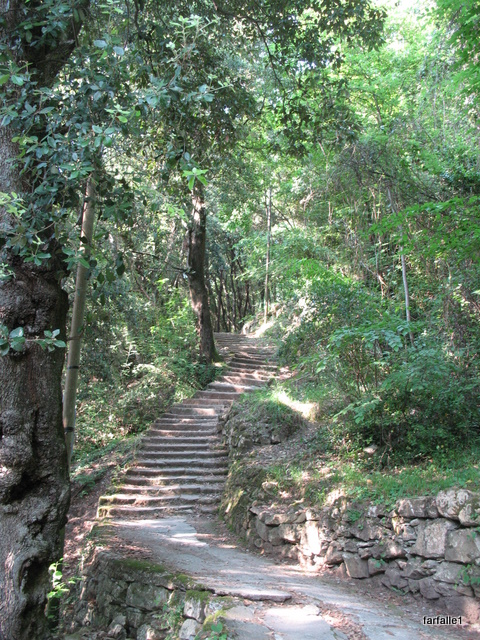
How many steps from San Rocco to Punta Chiappa? I meant to count, but of course lost track somewhere along the way. I can tell you this: the change in elevation is from sea level to 210 meters above sea level; and the last little staircase on the return back up to San Rocco has 206 steps.
But I’m getting ahead of myself…
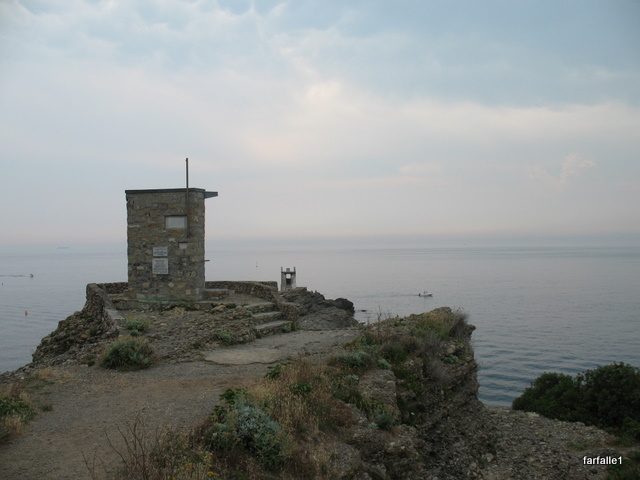
Punta Chiappa is the rocky tip of one side of the Portofino Peninsula. Like San Fruttuoso, which is not far distant, you can get there only by boat or on foot. The difference is that to reach San Fruttuoso by foot takes several hours from either Camogli or Portofino. You can reach Punta Chiappa in about half an hour from San Rocco, the lovely community above Camogli on a delicious woodsy path that has long paved sections and, by someone else’s estimate, 900 steps.
From Punta Chiappa there is a fine view back towards Camogli and the big hills behind it; down the coast to Genova and perhaps, on a clear day, the French Riviera; and to the southeast the continuation of the Portofino peninsula.
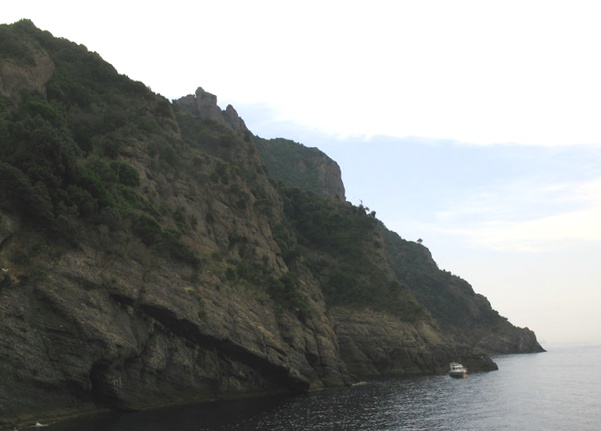
The point itself is made of rock, and plenty of it, although some brave plants have found a foothold there.
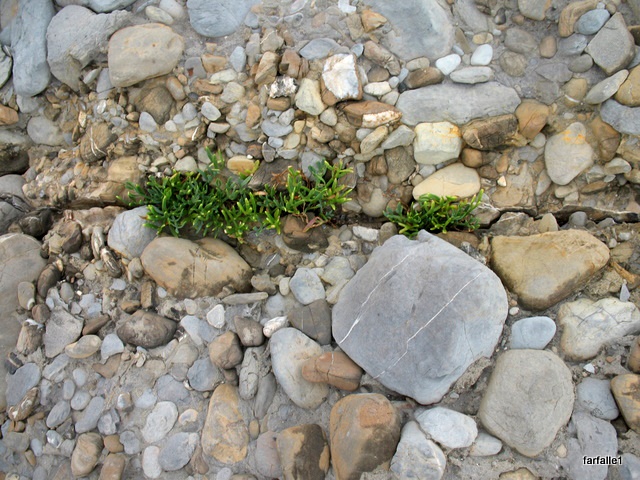
All the beaches on the peninsula feature these beautiful gray rocks with white lines in them.
The day we walked down was hot and steamy, but in the early afternoon the clouds rolled in and thunder began sounding its alarm over the mountains. Nonetheless we set out on our adventure. In fact the storms never materialized, but the cloud cover made the hike down and the looong hike back much more bearable.
There is not a lot of commercial activity at Punta Chiappa. Once upon a time a lot of ship related iron work was done there, but no more. You can still see the small cranes that moved heavy anchors and so forth, mounted on the side of the path. There are several great looking restaurants there. I’ve never eaten at one, but it’s now on my list of things to do. There is also, a bit further on, a restaurant for cats.
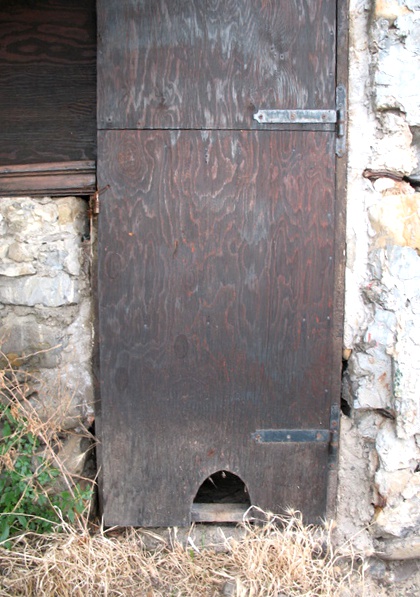 The door is well locked, but the kitties can come and go through the mouse hole below. Inside are several trays full of kuckies – which is what we call cat kibble, because when the cats chew it it sounds like kuckie kuckie kuckie. We saw one of the generous women who keep the restaurant stocked, as well as several satisfied customers who were just leaving.

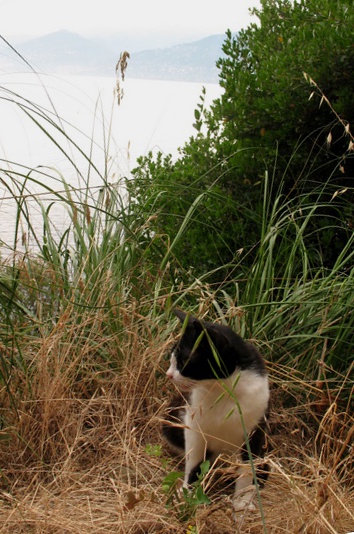
(By the way, if you like pictures of cats, check out the web album Cats of Italy; click the button for a slideshow.)
|
|
| Cats of Italy |

It felt a bit like stepping into a child’s story book when we arrived. There were not many people and there was a magical haze over the sea; boats drifted in and out of visibility, and it was not hard to imagine there were some great pirate adventures happening out there (if you squint you will see a 4-masted sailing ship in the photo below).

We swam a little, and read our books as the ferry and fishing boats trolled back and forth. A sudden movement caught our eyes: a school of sardines skimming across the top of the sea, with a dark shadow not quite breaking the surface behind. A second school appeared and skimmed, followed immediately by the graceful black arc of the back of a dolphin in search of supper. It all happened so fast we weren’t sure we had actually seen it. But we had, and it was wonderful.
Wonderful too was the walk back up to San Rocco. We took a much steeper, but shorter path which brought us in no time to San Nicolo’ di Capodimonte. I know! another San Nicolo’. Am I fated ever to find San Nicolo’ when I am with this particular friend? Evidently so!
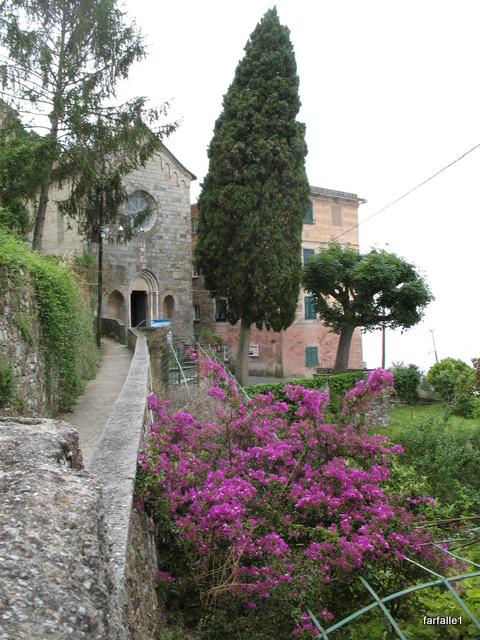
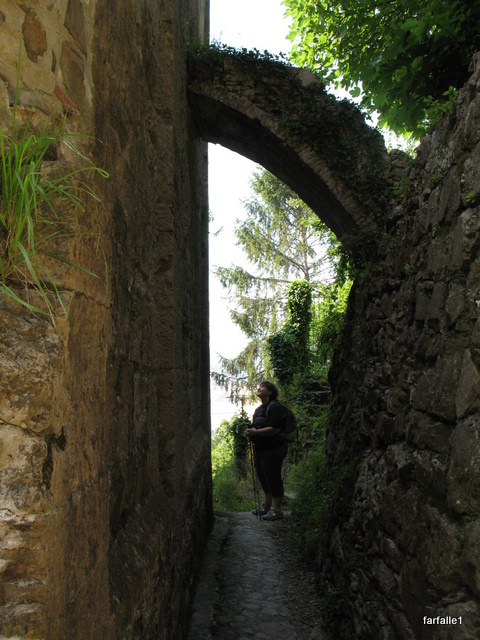
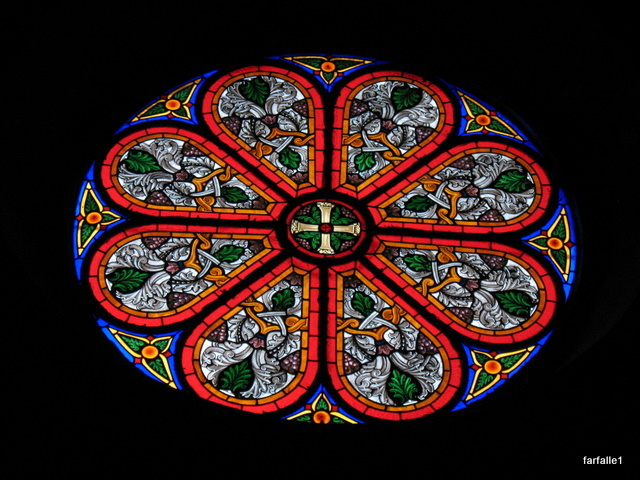
This church, however, is in much better condition than its namesake near Genova. And there is another restoration underway. We saved our visit to the interior for the walk back, and were rewarded with a cool and peaceful respite. This church also is very simple inside, though it boasts a particularly beautiful rose window.
San Nicolo’ di Capodimonte is reputed to have been consecrated in 345 CE, although of course there are no written records to confirm this. The present Romanesque church is supposed to have been built around the year 1000. Like its poor brother church, this San Nicolo’ too passed into private hands in 1860 during the suppression of the churches, which accounts for its lack of interior decoration. In 1865 Cav. Andrea Bozzo bought the church, restored it and built the neighboring residential houses. The church reopened for worship in 1870. After the death of Cav. Bozzo’s son in 1910 the church again became ecclesiastical property.
I can tell you two more items of interest. Although the church is called ‘Capodimonte’ it is nowhere near the top – more like halfway down. The second thing is this, heed my hard-earned advice: if you take this hike, and I hope some day you will, don’t wear sandals!
 An Ex-Expatriate
Interested in visiting Punta Chiappa because my maiden name is Chapa and we originally are from nearby, Albisola. Wondering if there is any relation to the original name for both–Schiappapria?
Hi, Marta – I will have to ask one of my Italian friends. This is beyond my scope. I’ll forward your query and let you know if I learn anything. Thanks for writing.
My friend got right back to me, and this is what she wrote: “As you know the name Chapa in Italian doesn’t exist, possibly the person meant Chiappa (unlikely) or Chiappe. Chiappa in Italian means large, usually flat or semi flat stone.
Schiappapria, is typical genoese, like Schiappacasse, or Sciaccaluga.”
I don’t know if you’re writing from the U.S. or elsewhere. So many names were changed at Ellis Island when Italian immigrants arrived – the agents just gave whatever spelling they could from what they were told by the arrivals. “Ciapa” in Italian would be spelled as “Chapa” in English. “Ci” in Italian is pronounced “Chi” in English and “Ch” in Italian is hard, as in ‘chianti.’ Hope this is at least interesting. 🙂
Yes, very interesting; thank you. I am writing from Texas. I know quite a bit about the Schiappapria name and ancestral history. Actually, the one brother sailed to
Veracruz, México and became a scribe for a military officer, and he documented a lot of his family history, which I have. And yes, indeed he shortened the name to Chapa. So when I saw Punta Chiappa, I thought it would be interesting to add another chapter to my search. But maybe the name is just a coincidence and nothing to do with the original Schiappaprias. Thank you so very much!
Martie
And now for yet another trip down memory lane… we used to always find friends who had a “Gozzo” the local fisihing boat used mainly by affluent people to hang out in the Tigullio instead of going to the beach. Our preferred destination was always Punta Chiappa just because it was so quiet and peaceful (although we contributed to making it not so peaceful ;)) we would bring tramezzini and a few beers or wine and would end up spending the day. We would always take time to go to San Fruttuoso and one of my perosnal favorite things to do was to try and touch the “Cristo degli Abissi” a statue of Jesus which is placed underwater in the gulf of San Fruttuoso (If you can call it a gulf) needless to say never was able to reach it
I’m so glad you commented, Marco. When we were there a small boat (not a Gozzo, alas) pulled into the little bay there, and a gang of boys jumped in the water. And I thought to myself, I wonder if Marco used to come here? And you did! I’m glad you mentioned the Cristo degli Abissi – I think I’ll do a post on them – there’s one in Zoagli, too (that one may be a Madonna?) and a waggish friend did a temporary ‘installation’ in Rapallo. I bet there are lots more, too!
What a wonderful post, and how I wish I were able to go on these jaunts with you! One of your cats looks as though he needs to spend a little more time in the kitty restaurant, no?
I do love your latest St. Nick’s church and the history you provide with it. A stone flying buttress? Every time I see all the ancient treasures that are strewn all over the country I am amazed at how absent vandalism seems to be. Am I correct in this belief?
Hilary, in general I think there is less vandalism here than in the US. Don’t know why. There is certainly plenty of spray paint, and every now and then it gets put in really inappropriate places. There just doesn’t seem to be the anger (rage?) here that exists in the US… not on the roads, not in the treatment of others or of monuments. There is also a great deal less crime against persons here – yes, lots of theft, but not so much assault, battery and murder. There is a lot more littering here, however!
Thanks, Louise. I suppose it may help to be a healthy mountain goat getting around all those steep hills, but I enjoy visualizing the beauty and the serenity your photos and descriptions capture. And I appreciate the special effort it takes for you to continue to enlighten those of us from far away.
What great fun to read of your travels, Louise, and to imagine actually doing some variation on your theme some day. It is easy to fathom the charm of a Punta Chiappa or a San Fruttuoso but hard to understand what supports the local economy… so few people, such limited access, so little commercial activity. Are all the locals older, retired, well-to-do former something-or-others? Is there sufficient tourism to keep the smaller places vibrant and clean? Do Italian taxes suffice to maintain the infrastructure — electricity, water, trash removal, fuel for boats, police and municipal employees? Fascinating about the history, too. And yet another Saint Nick. Who knew? Very few…
David, San Fruttuoso and Punta Chiappa are both so-called localities of San Rocco, which is itself a part of the town of Camogli. Camogli has a population of +/- 5,500; San Rocco and all its various localities has a population of only 233… which is a roundabout way of saying that very, very few people actually live in either San Fruttuoso or Punta Chiappa. I suspect most of the people who work at the few restaurants and tourist places commute from Camogli, or Rapallo, or… The whole of the Portofino peninsula is a tourist destination with Rapallo being the largest city (about 30,000) of the actual peninsula. There are many, many retired people living in all the towns, and lots of people have vacation homes here too (we’re only 2 hours from Milano) – but there are also many people who have lived here their whole lives. Italians seem to be much more likely to live and work near where they grew up than we are in America. Yes, the small places are both vibrant and clean (usually very clean), though everyone’s hurting with the present economy of course. The topic of Italian taxes is huge and complicated – we are told tax rates for businesses are very high. The infrastructure is pretty well maintained, though there are plenty of bumpy roads. The water is excellent, plentiful and safe to drink – Italy is justifiably proud of the post-war water supply system. Oddly, we have far fewer power outages here than we had when we lived in New England. It just rarely happens. Having said that, all utilities are much more expensive here than in the States. I could go on and on…
Thanks for the great information. I have been to Camogli, but not beyond. It is amazing that there is a place so quiet in such a busy, popular area. How special! I will wear walking shoes.
Debra
Debra, if you have time take the ferry from Punta Chiappa to San Fruttuoso – very, very worth seeing. Then you can take a ferry back to Camogli and not have to walk UP all those steps again. Of course you’ll have to get from Camogli to your car… but there are buses… and feet…
Thank you for that. It sounds like an excellent suggestion.
Debra