Tags
Cattedrale San Lorenzo, Chiesa del Gesu e Sant'Ambrogio, Chiostro di Sant'Andrea, Genoa, Palazzo Ducale, Piazza de Ferrari, Porto Soprano
 Here’s what you never hear prospective visitors to Italy say: “We’re going first to Florence, then Rome and Venice, and then Genova.” Genova? Doesn’t seem to be on too many tourist’s maps, and it’s a pity, because it’s a terrific city, well worth a visit.
Genova, long and narrow, is spread out on the strip of land between the mountains and the sea around her generous harbor. She is the capital of Liguria and boasts a metropolitan area population of some 1.4 million. Known as ‘La Superba’ for her ancient and glorious history, she is now an important economic center of Italy and was, in 2004, the European Union’s Capital of Culture. The Bank of St. George, one of the oldest known banks, was founded in Genova in 1407.
Ancient remains suggest that the city was inhabited (by Greeks?) as early as the 6th or 5th century BC, perhaps even earlier. It was destroyed by Carthaginians in 209 BC, later rebuilt and later still invaded by Ostrogoths and Lombards. Wikipedia has a very brief history of Genova here if you’d like a quick study.
If Americans think of Genova at all, it may be as the purported home of Christopher Columbus. The wee little house where he may have lived, just outside the city walls, is a must-see.
I have an idea: let me take you on ‘The Tour’ of Genova that I give guests when I can lure them away from the delights of Rapallo for a day. It is a train ride of about 40 minutes to the more eastern of Genova’s two train stations, Brignole. From there it is easy to find Via XX Settembre, the broad and well-traveled street with many famous shops.
At the top of Via XX Settembre is Piazza de Ferrari, newly reconstructed after being torn up for years to accommodate construction of the new metro subway.
 If you had taken this photo the Carlo Felice opera house would be on your left, the Palazzo Ducale behind you, and behind that the tumble jumble of medieval Genova’s streets.
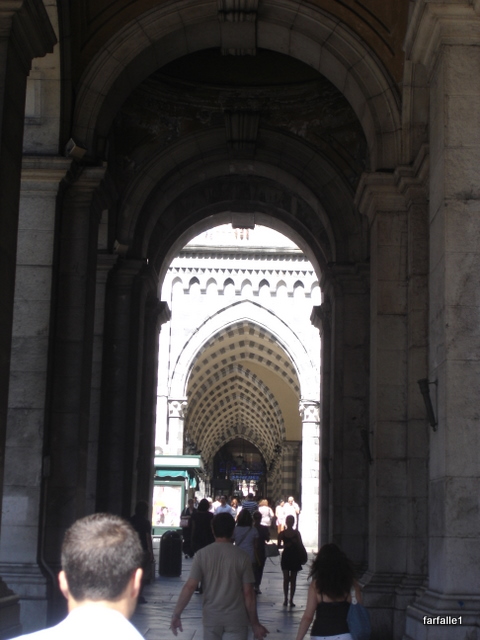
From here let’s take a stroll through the atrium of the magnificent Palazzo Ducale, turn left, and walk down the timeworn steps to Piazza Matteoti, home of the Chiesa del Gesu e Sant’Ambrogio.
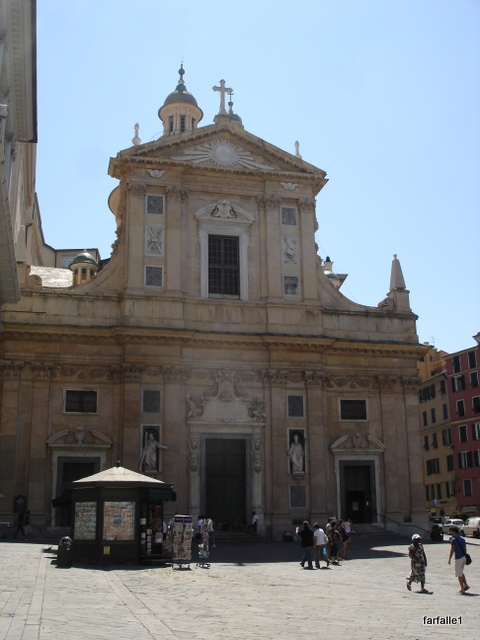 We’ll nip in to take a peek at the The Circumcision (link is to a probable study from the Gemäldegalerie der Akademie der bildenden Künste in Vienna) painted by Peter Paul Rubens in 1605, one of two paintings he made for the church during his stay in the city. After we leave the church we’ll turn left and walk up to and through the tall city gate.
Hey! Who’s that?
 Who knew that The King hung out at the Cafe Barbarossa to serenade unsuspecting tourists? Enough of this nonsense. On to Columbus’s house:
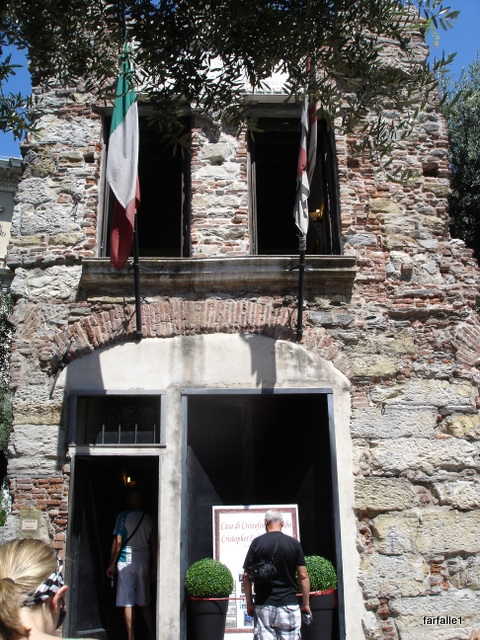
Very teeny indeed. For €4 you can go in and look, but perhaps we don’t need to do that today. Of more interest, to me anyway, are the beautiful remains of the Chiostro di Sant’Andrea, moved to its present location just next door to the house in 1922. The cloister dates from the XII century and is a little island of calm amidst the bustle of the city that has grown around it.
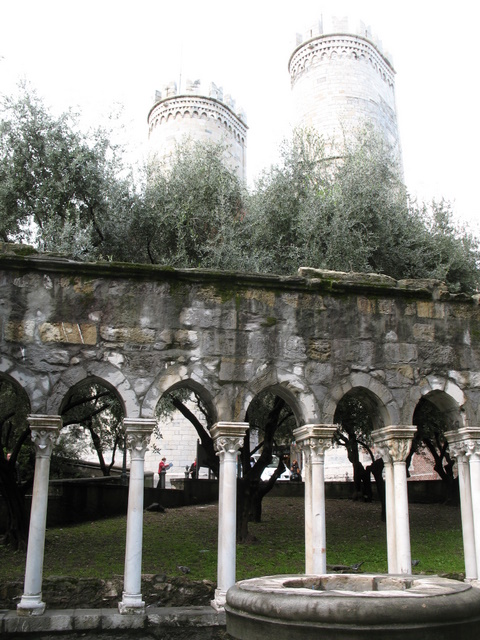
In the background you can see an X-Files rendition of the Porto Soprano, one of the gates in the city walls which were constructed in the XII century. Here are a couple of details from the top of the cloister columns.
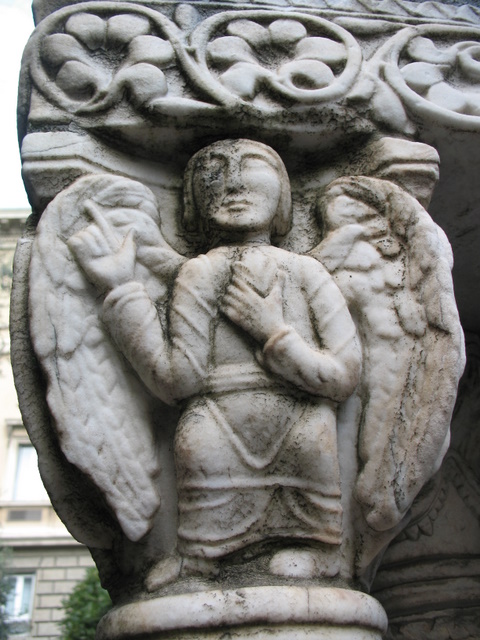
I love this angel’s calm demeanor.
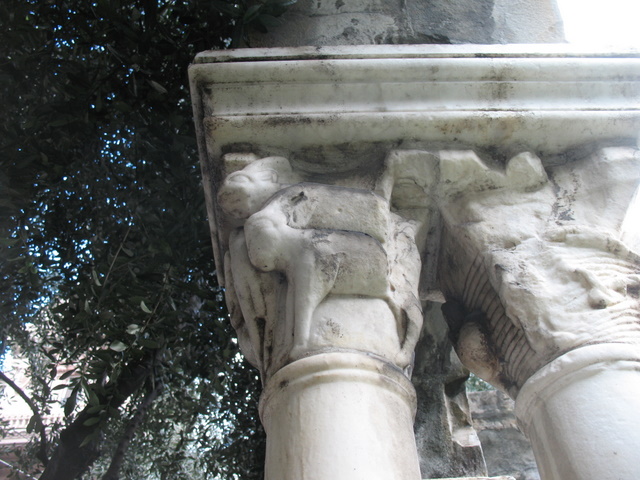
Why is there a rabbit on top of that donkey?
From this peaceful corner we will go back through the Porto Soprano,
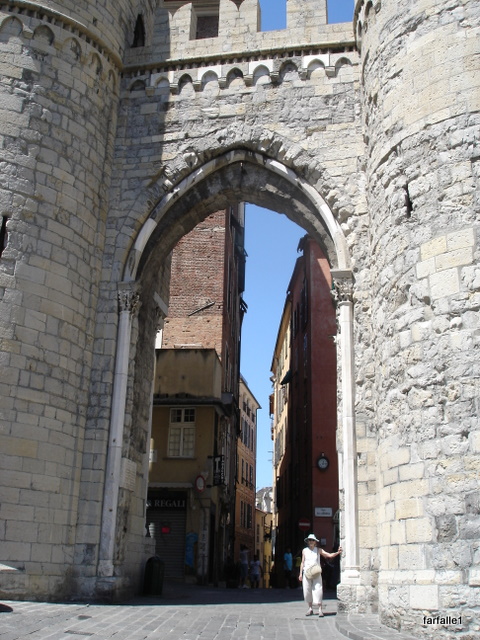
walk by the Palazzo Ducale again,
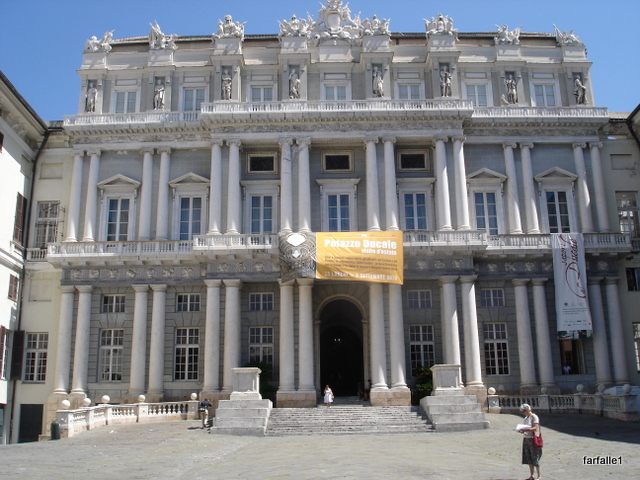
Phot courtesy of Pidge Cash
and continue down to the magnificent Cattedrale di San Lorenzo, which was consecrated in 1118. The black and white stripes are a medieval symbol of nobility.

You can stare at the facade of this church for hours, and you will continue to find new details.
 As well as many beautiful paintings and some 13th century frescoes, the church contains a most unusual artifact, a grenade that struck the church on February 9, 1941, during a bombardment by the British. The grenade went through the roof of the cathedral without exploding and can still be seen in the right aisle.
Now it’s time to launch ourselves into the warren of narrow streets in the medieval part of the city. How narrow, you ask? Well, narrow enough that a small truck has to make a complicated back and turn maneuver to make a simple 90 degree turn.
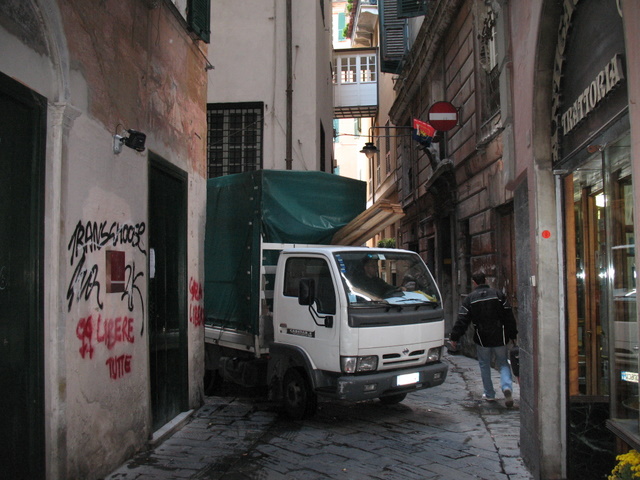

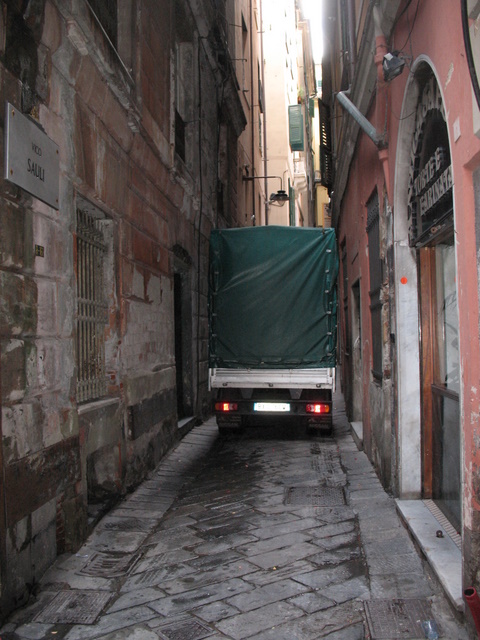 And it’s not even a big truck!
Many of the streets are too narrow to accommodate even a car, never mind a small truck.

Time for lunch! We’ll stop at one of the many restaurants and trattorie in the old section and partake of a bit of Genova’s signature dish: farinata, a very flat pancake made from chickpea flour.
 Note the wood-burning oven in the background; that is the only way to cook farinata correctly. This photo was taken through the window of Antica Sa Pesta, a restaurant on an old salt-trading site.
Maybe we’ve done enough for one day. Let’s take our full bellies home and have a nap before tucking into whatever the Captain has cooked up for us in our absence. We’ll come back very soon to finish the tour of beautiful Genova.


Thankyou for the tour of Genova, like so many Italian cities hidden gems and not too overcrowded with tourists, just the sort of towns we enjoy visiting.
There’s so much to see – every time I rave about the city I learn about something else that is a ‘must’ – the list just keeps getting longer…
Who was the model holding up the wall in your photo of Porto Soprano? Too far away to tell. I don’t actually remember meeting Elvis there, but I loved walking the streets with you again! Need any pics of the interior of the aquarium?
Pidge is holding up the Porto Soprano. I actually have some interior shots of aquarium (figured out how to set camera finally!) – though if you have a good one of the sea horses I’d love to use it – they changed the display since we were there. Aquarium visit coming up soon in part two… stay tuned!
Bologna is one of my favourite Italian cities. The portici are incredible and the city centre is a jumble of all things Italian. The 2 market streets are fabulous, Via Pescheria and Via Drapperie. I always stay at the Hotel Drapperie which looks over the markets. You have to go! If you do, you must do the walking tour. I did a couple of posts on Bologna.
Okay! It has officially moved up to the top of my list – and I’ll check out your posts for further guidance. Thanks! (It won’t be til next year, though…)
I love being there again with you!
Fabulous picture of the beautiful woman with Elvis – who could that possibly be?!
Can you send me the reference for black and white stripes being a sign of nobility?
See you this side of the Big Water very soon!
Ha – I thought you might recognize Elvis’s girlfriend. The Wikipedia article about San Lorenzo is where I found the nobility reference to black and white stripes. The footnote elaborates: Tra le famiglie della nobiltà genovese, solo quelle più in vista avevano diritto alle fasce bianche e nere come rivestimento dei loro edifici, e cioè i Doria e gli Spinola, ghibellini, e i Fieschi e i Grimaldi, guelfi. La Chiesa di San Matteo, nell’omonima piazza, mostra il rivestimento bianco e nero in quanto edificio dei Doria. Which is to say, amongst the noble Genovese families, only the highest had the right to put black and white striped facing on their houses; that would be the Ghibelline familes Doria and Spinola, and the Guelf families the Fieschi and the Grimaldi. There are several books cited in the article… hope this helps.
Thanks so much. I LOVE Genova, and I miss it. The museums are wonderful, and the medieval center is so interesting. Heaven for draw-ers. And then there is the food….
I haven’t even seen most of the museums yet – definitely on my list of things to do asap. It truly is a wonderful, wonderful city.
As a Genoese born and bed, I thank you for this lovely review of my city. It’s nice to see it get a little recognition.
I wish I knew it better. I plan to spend a lot more time exploring – so far I’ve only learned about the most famous places. I’ll bet there are lots of hidden corners that are marvelous.
Genova is on my list. I have heard that it is worth a visit and now you have confirmed this. Bologna and Torino are also cities that don’t attract many tourists – and they should.
Amen to the comment about Torino – a fascinating place. I haven’t visited Bologna yet – another place of The List of Things Which Must Be Done!