
Tags
Citrus-picking, Fruit-picking, Grapefruit, Lori Wegner, Terry Parsons, United Food Bank, Volunteering, Volunteerism
My last post was hard to write because it was about a very disturbing subject. What better antidote than to tell you about something really positive?
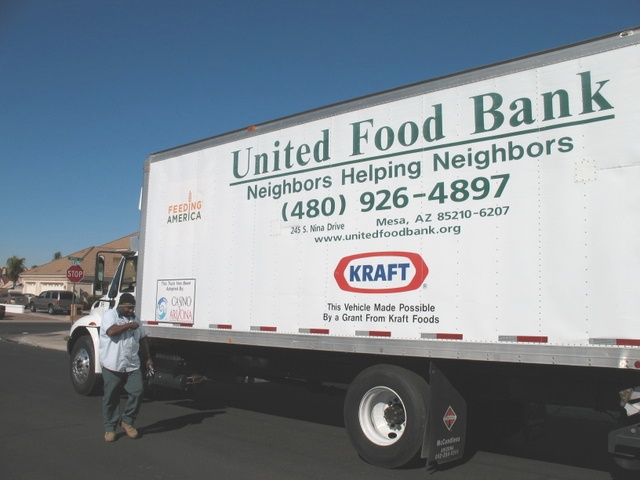 Are you sick of hearing me say, “We’re in Arizona?” (Will it make you feel any better if I tell you the temperature was 27 F a few mornings ago (-2 C)?) One of the things the Phoenix valley is famous for is its citrus orchards. There are far fewer now than there once were, as many have been ripped out to make room for housing developments, but some of the developments saved as many trees as possible and built the houses among them.
Such is the case in a lovely development in Mesa where I was recently fortunate enough to join a bunch of volunteers who were picking citrus for the United Food Bank, which acquires, stores and distributes food through partner social service agencies. Many of the houses in this development have ten or more fruit trees in their yards. I guess there’s only so much grapefruit a family can eat. And yes – it’s mostly grapefruit. Why? Grapefruit is faster-growing and more productive than the other citruses, so more grapefruit trees were planted than orange or lemon (or tangerine, or tangelo, or…)
 Here’s how it works. The United Food Bank coordinator has teams of people who gather at a staging area and then carpool to wherever we’re picking. Our team leader is the indefatigable Terry Parsons, who happens to be a neighbor.
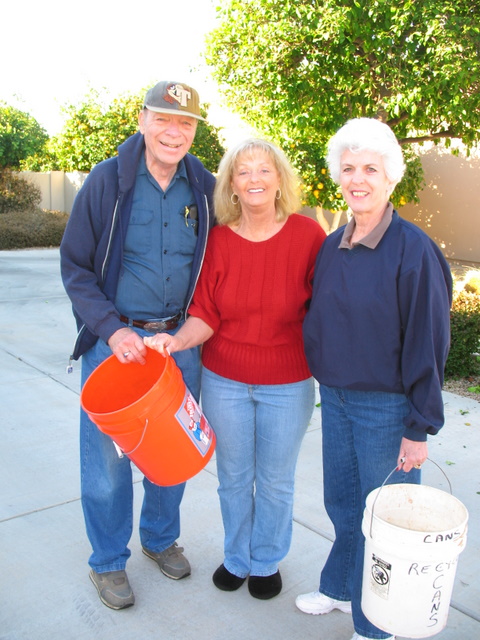
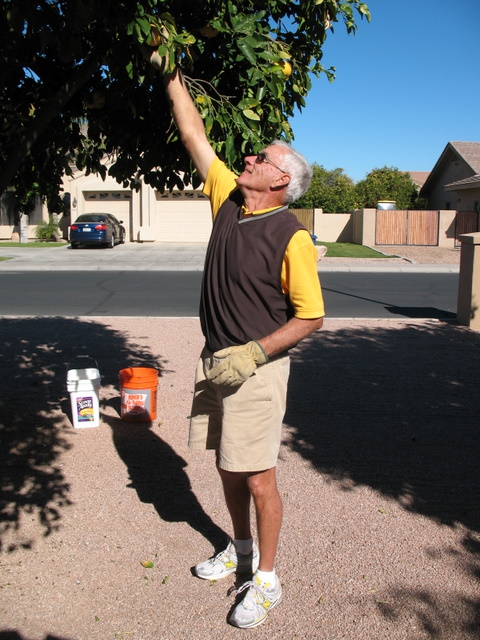 On this particular day we began picking at the home of Lori Wegner (seen below with a couple of hardy pickers). That was a good thing, because she puts out great goodies. It turns out that most of the homeowners put out great goodies; at a subsequent house we were invited to take whatever we wanted from an outdoor fridge, which included soft drinks, water and beer.
 Picking is not especially easy work. In fact I can’t imagine doing it all day long; I’m pooped after two and a half or three hours. There are three basic jobs in the picking operation. The first is just to hand-pick whatever is easily accessible, and that is what I try to do because it is the least back-breaking approach. But one must be sly and quick to be successful, because others also want to do this work, and most of the fruit is not low-hanging.
The higher-up fruit is reached with long poles with a curved prong at the end. You put the prong around the stem of the fruit and drag or jerk down; then you duck because the fruit may well land on your head. In any event it will eventually land on the ground where the third kind of work is required: stooping down to pick the fruit up and put it in pails. The pails fill up pretty fast, and they are heavy.
Someone who is not me (my aching back!) then carries the pails and dumps the fruit into huge cardboard bins that other volunteers have assembled on palettes.
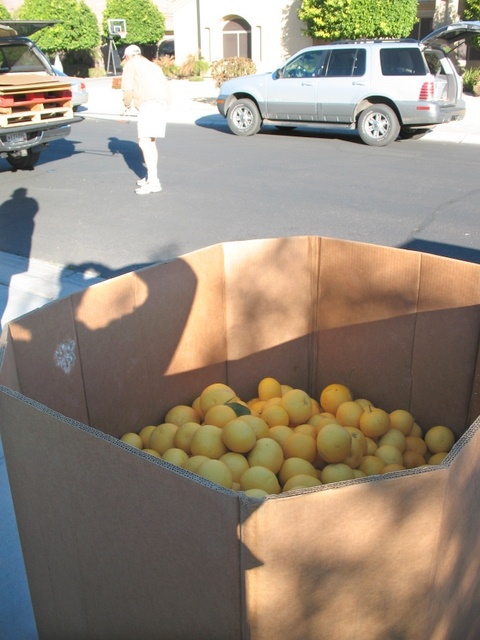 At the end of the morning the Food Bank truck miraculously appears and a man with a small fork lift picks up the bins and puts them into the truck.
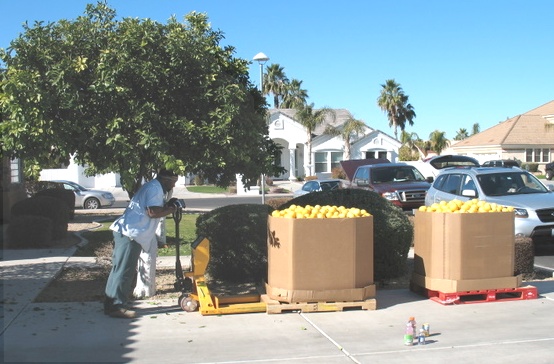
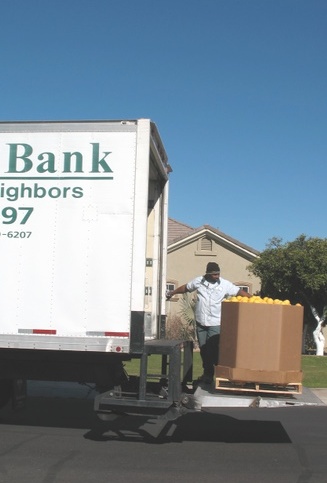 Once they arrive at the food bank there are other volunteers who sort the fruit; that which is not suitable for consumption is sent to the squeezing station where it is turned into juice.
Terry told me that there is an even larger food bank in the area that sends semi-trucks of citrus up to Oregon where they have no citrus, and comes back full of surplus Oregon apples. How clever that is! (It got me thinking about all the untended olive trees in Liguria – could volunteers pick the olives for oil which could be sold to benefit the food banks? Or the oil given to hospitals or to the food banks themselves?)
So – who wins the citrus lottery? First the homeowner. She has more fruit than she knows what to do with and has to pay someone to come and remove it from her trees if the volunteers don’t do it. She also will get a small tax write-off for the value of the fruit, if she wants one. The second winner is the Food Bank and by extension the hungry people whom it feeds. (I wonder if some of them say, “Oh no, not more grapefruit!”) The third, and biggest, winners are the volunteers. They get to be outdoors in the lovely weather with a group of jolly others, to see parts of town and lovely homes they otherwise might not see, to eat delicious snacks, and they get to feel really good about doing something helpful for others. And no one at all loses.
 An Ex-Expatriate
United Food Bank has many wonderful programs, several specifically targeted to children. Some of your citrus may be included in the weekend food bags given to those children who qualify for free breakfasts & lunches and may not have sufficient food over the weekends at home. They are expanding this program to include as many vulnerable children as possible.
A slightly different aspect of citrus harvesting — several cities in Spain have paid for social service programs for many years by having the recipients harvest Seville oranges which are sold to make marmalade in the UK. Talk about a win-win! I was unable to sell this program in Phoenix in the 1980s; might be time to try again ……….. God knows, our sour oranges don’t do anything except create a waste problem.
What a great idea THAT is!! What is the marmalade capital of the US? We could ship them there… I love the idea of otherwise wasted food going to some good use. Now if only we could find a way to make use of food after the ‘use by’ date…
Oh What Fun! and for such a good cause.
I’m forwarding to my friend who is on the Food Bank Board here –
perhaps we can get somehting of this sort going around here!
XO-
P
With all the unpicked citrus in Tennessee?? Just kidding… When we lived in New England we sometimes drove by huge pumpkin fields. After the harvest there were still plenty of pumpkins out there, it seemed to me. Maybe they weren’t perfect, or – I don’t know. But there was a lot of pumpkin pie, squash soup and pumpkin ravioli sitting out in those fields!
Ah, synchronicity! Last night I had the great pleasure of participating in a performance of the Mendelssohn Octet by the Burlington Ensemble (www.burlingtonensemble.com ) as part of a benefit concert for KidSafe Collaborative ( http://www.kidsafevt.org ), one of several worthy non-profits for which benefit concerts are scheduled. The musicians got the chance to play a wonderful and too-rarely performed work, the audience got to hear same plus a Mendelssohn string quintet for the princely sum of $5, and children got a better chance of a brighter future as a result. Win, win, win. At some point in time the musicians might even be making a buck or two but right now the BE 1o% of the take goes to operating costs. (“Operating costs” sounds more professional than “food and drink for musicians between long rehearsals”.)
After all your descriptions of the bureaucracy in Italy, I just can’t imagine that something so simple and sensible could happen with unharvested olives. First, the Department of Olive Oil would have to be formed, and then a Bureau to oversee the actual methods of gathering and producing said oil, followed by the formation of a commission to delegate responsibility to yet another commission to make decisions about who delivers the oil and finally the designation of an agency to decide who would receive this olive oil. In the end, after the creation of such a hierarchy and the eventual choice of participants after a series of elections and run-off elections, the owners of the olive trees would insist on meeting personally all the recipients of their gift to decide whether or not this part of the family’s agricultural potential should find its way to the palates of these non-family members. Or have I gotten the wrong impression of how things work in Italy?
Complimenti on the benefit concert – what a great thing to do. And yes, I would say that you have a pretty fair grasp of how things seem to work in Italy (at least to this foreign observer). I’m not sure about elections and run-off elections, though – I rather think that participants might be appointed, thus allowing for pay-back (in both the positive and negative sense of the word). ha ha.
Great post. Giving doesn’t have to be complicated, and it always feels good.
Absolutely!
What a great idea! We have food banks in Australia too. Are Italians community spirited enough to get together to do something for strangers? I haven’t seen much evidence of this. Perhaps I am not looking in the right direction, but I can see lots of things that need doing around here, but nobody seems willing to do it. I planted the flowers on the bridge last year, because it wasn’t going to happen. I’m pretty sure the only people who watered them when I wasn’t here were other foreigners.
Oh I think there’s a fair amount of community spirit in Italy. Some of my friends do volunteer work, but it tends to be less visible from the outside – and I think often it’s done from/through the church. Good for you for the flowers – I bet everyone enjoyed them.