Tags
Catch of the day, Eating locally, Fresh fish, Italian fishing fleet, Locavore, Santa Margherita Ligure
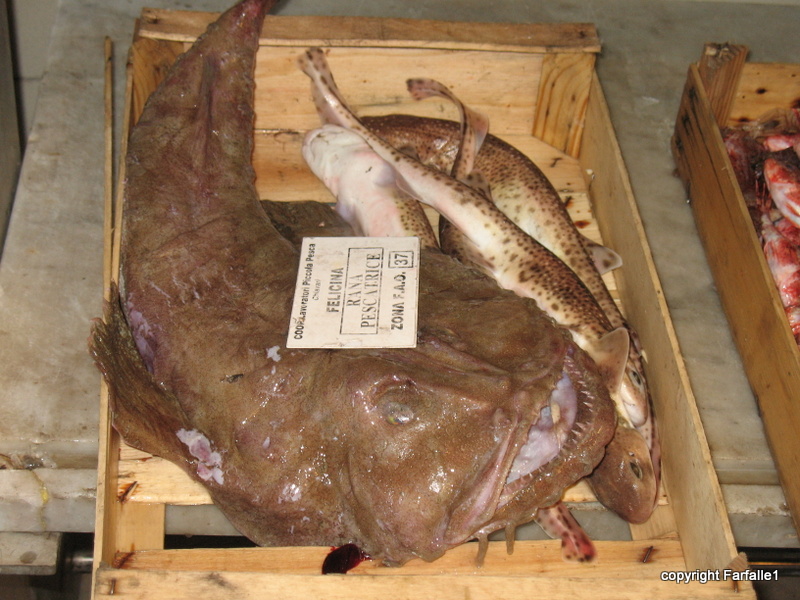
Possibly the world’s ugliest fish?
‘Locavore’ is a word I abhor. Oh I know, it’s a perfectly good word and absolutely descriptive. But, to me, it carries moral overtones that I don’t like – the idea that if I eat food that is all grown/produced within, let us say, fifty miles of where I live, I am somehow a better person than the poor sod who has to eat out-of-season apples from Argentina and whose beef comes from the mid-west and which enjoyed a last supper of who knows what.
We lived in New England when I first heard the term. I thought it was laughable. What would we, in Connecticut, eat in January if all our food had to be grown nearby? Frozen food? But think of the energy costs associated with that. Food that was grown in our own gardens that we lovingly canned. While it’s true that canned fruits and veggies seem to retain most of their nutritional value, they likely give up a great deal in texture and crispness. Wouldn’t you rather eat a fresh green bean than a canned one?

Then I thought about the long arc of the history of what we eat. In the Middle Ages people were restricted to a diet of food produced nearby because the means to move it any great distance simply did not exist. Their teeth turned black and fell out. They had diseases associated with vitamin deficiencies: rickets, scurvy and beriberi. How wonderful it was when trade began to bring spices and food from the East, the Caribbean and South America, and eating changed forever. Sugar! Coffee and tea! Sublime. Lemons and limes. Pineapple! Poi. No, forget about poi. Chocolate!! (never forget chocolate…) Empires grew and food moved ever more freely from point A to point B, and it was all good (and from more than just a culinary point-of-view, but that’s another subject altogether).
Then, about a decade or so ago, the specter of eating locally reared its head. Farm markets (of which I am a huge fan, incidentally) sprouted on every village green. Calves seen cavorting in a neighbor’s pasture one day were in his freezer the next day. Everyone had a chicken. And that was good too. But the idea that that’s all we should eat seems to me to be nonsense.
So, having said all that, let me recant just a bit. I think it’s really important to know where our food comes from, and to make intelligent choices about what we eat using that information as one criterion. I have a personal preference against eating a fish from China – God only knows what that fish ate, so I don’t want to eat him. I also think it’s really important for everyone, especially children, to know that food doesn’t ‘come’ from supermarkets. Milk comes from cows and goats, and cheese comes from milk – these are really good things to know. Jellies and jams are not born that way, and spaghetti doesn’t grow on trees, despite what you see about Switzerland on Youtube.
People in Italy take food very seriously. The fresh fods we buy here are marked with a quality grade and geographical source. There are plenty of Italians who won’t eat food not grown in Italy (or, maybe, France and Switzerland) – but there are plenty who will. The important thing is that the information is available and one can make a choice.

Fish is a topic of often spirited discussion: wild caught or farm raised? As ocean stocks grow ever smaller, there’s much to be said for farm-raised fish, as long as the farmer is responsible about the fish food he uses (I suppose the same thing could be said for chickens – but when was the last time you ate a wild-caught chicken? I digress.) There is a large fish-farm off the coast in nearby Chiavari; you can see the pens as you drive down the hill into the city. But in neighboring Santa Margherita Ligure you can do one better – you can go to the port at about 3:30 or 4:00 p.m. and watch the day’s catch as it is delivered to the fish stalls in the arcade across the street. Then, if you’ve seen something that whets your appetite, you can go over and buy it immediately, sometimes still squirming.
 Many of the small Rivieras communities no longer have fishing fleets, but Santa and several others still do. The boats are all business, as you can see above. They usually moor a short distance from the port, and the catch is ferried in by skiff.
 The fish are all neatly sorted and put in flats. The person taking the box will trot through a gauntlet of curious onlookers, cross the street, and deliver the goods to the vendors. Sometimes the fellow who transports the fish is the vendor. Who goes to see the fish come in? Some are tourists who have just happened by, some are buyers for the local restaurants, and some are consumers looking for a good fish for dinner.

Yum! Someone’s having octopus tonight.
 This guy was so pleased with his fishies he had to share the good news with his friends.
This is the kind of ‘locavore’ I adore. It’s just people doing what they’ve done their whole lives, and what’s been done in their town for centuries. It has nothing to do with a Philosophy, or a Point of View, and there’s certainly no sense that if you go buy your fish from Supermercato Billa you’re less of a person than if you go to the port to buy it. It’s just the way things are. As a matter of fact, with the whole sea at their door, one of the great winter treats for Ligurians is, surprisingly, stoccafisso, dried cod. I think it is odious, but people here love it cooked with tomatoes, potatoes, carrots, onions and garlic. That’s the Ligurian style. In Milan it is cooked with cream, which is even worse. Why would you eat that when you can have fresh fish? I don’t know, but it is highly regarded here, and eaten with great gusto. Cod, by the way, doesn’t live in the warm Tigullio Sea – it comes from New England or Scandinavia.
So yes, please grow your own veggies in your garden, or buy them from your local farm market or CSA, but please, oh please, don’t make me feel guilty when I buy a peach from Israel. Don’t turn eating fresh local food into a Cause or a Movement. Good food is good food no matter where it comes from. I understand the arguments about the cost of transport, but transporting goods is something that has gone on for centuries. Let’s not go back to the Middle Ages.
 An Ex-Expatriate
Local food is unfortunately a city-driven tribal thing. E sempre cosi. Today we had a fabulous Fettucini con Pescatrice e Zucchini at Autedo near La Spezia. To paraphrase Calvin Trilling: It was so good, I almost forgot how ugly it is.
Sounds absolutely delicious. I like your phrase ‘city-driven tribal thing.’ I’d not thought of it that way, but that’s exactly what it is – right up there with having the right label on the outside of your clothing. Bah.
Aaargh. I get so conflicted about this whole food thing. Should I buy local/organic/cage-free/fair trade/farmed vs. wild etc.? For me and so many others, it’s not really a choice. No matter how you slice it, to eat well you have to first be able to afford the kind of food you know is good for you and that means whatever is on special at the supermarket. I liken it to having to buy clothes off the rack as opposed to designer duds. I was a member of the nearby CSA but it has become too pricey for me. One other thought – who knows what kind of contaminants are lurking in those locally-caught fish? It’s all too much to think about. Pass the chocolate, please.
I’m not sure where my loyalties lie either; or rather, I think they shift depending on mood and the check-book. Which is another thing that makes me grumpy about the ‘locavore’ movement. As it becomes ‘the thing to do,’ it becomes more expensive. By the way, I have a pretty fair idea about some of the contamination in our own little bay – it doesn’t bear thinking about (and it’s why I rarely swim in the sea any more). But I think you’ve hit on the perfect solution with your last sentence. I’ll have what you don’t finish.
You are so right about this! People are becoming fanatical about stuff. I try to shop at farmers’s markets when I can. I don’t buy food from supermarkets because I don’t like the way they deal with growers and their fresh food is often not that great. I try to buy free range eggs and I hate to think of battery chickens. There are just too many things to think about.
I guess the industrialization of food production is a double-edged sword. On the one hand, it allows us all to have food for less money than ever in history. On the other, though, its practices are sometimes (often?) questionable, and the quality of the ‘product’ is not reliably good. We had chickens once – nothing better than an egg right out of the nest.
Ah Santa Margherita, I even recognised the stones on the quay, in your photograph.
There’s no place in the world quite like it. It’s choked with tourists now, but for good reason – it’s so lovely. And it is a treat to see the fresh catch come in (as long as they’re not still jerking around and/or wiggling).
That fish is unbelievably ugly isn’t it.
yes, it is!
Makes me long for Guido’s!
Get thee to a Trader Joe’s – it’s not exactly Guido’s, but it’s not exactly not Guido’s either…