
Food Bank. What pops into your head when you hear those words? For me it’s an image of a small room, probably part of a church or social agency, shelves lining the walls laden with boxes and tins of food, some dusty, some out-of-date. In my imagination it’s open a few days a month, and a stream of hungry people trudge in and out, arriving empty-handed and leaving with a brown paper bag of food. Other more fortunate people have bought extra when they did their own marketing and dropped it off, or a local group had a food drive and donated the gleanings to the Food Bank, or someone cleaned out her cupboards and got rid of unwanted items.
Well no, Expatriate. That’s not quite how it is. You may remember reading about the great fun we have picking fruit for the food bank on winter Fridays. It was the subject of a post here at just about this time last year. This year a group of us pickers had the great good fortune to be given a tour of the United Food Bank (for whom we pick), an operation that is almost the exact opposite of my imagined picture.
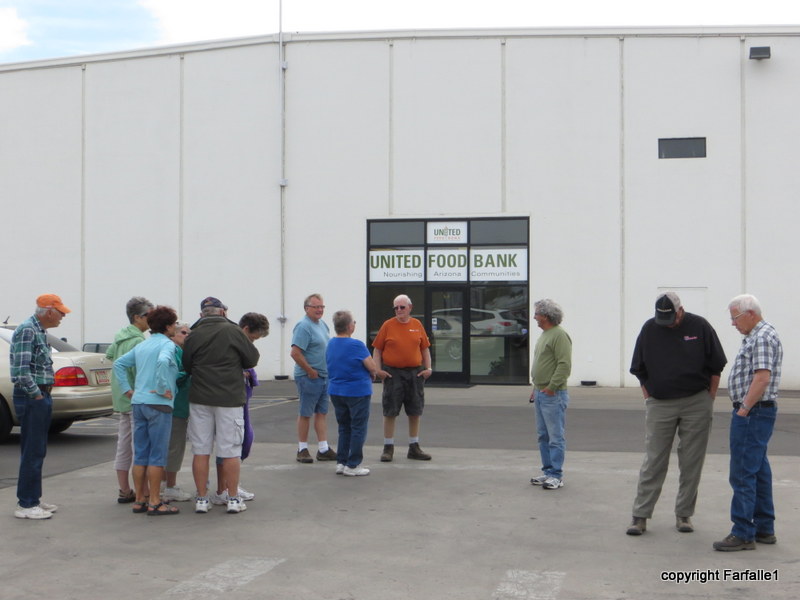
Here we are outside the United Food Bank warehouse. Yes, you read that correctly, warehouse.
The United Food Bank serves almost one-quarter of the state of Arizona:
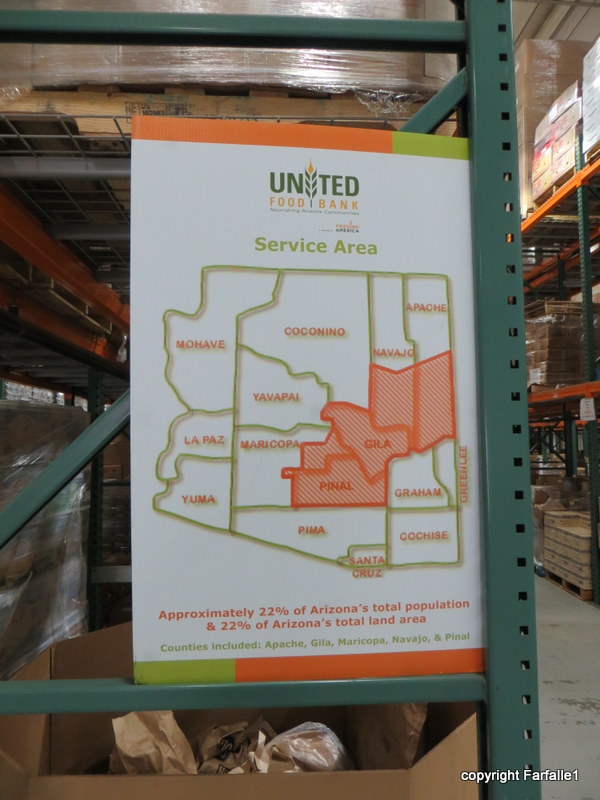
It was organized in 1983 as a joint venture among East Valley cities and their respective United Ways to gather and distribute food to organizations; today they serve upwards of 200 food banks in the region. They do not distribute food to individuals from this warehouse, but instead organize and ship it to those who do.
Here is Melissa, one of only about twenty-four paid employees who handle this large business. She is explaining to us why our fruit-picking operation is in jeopardy (I’ll tell you later).
 Some of the astonishing facts she told us are:
1. 1 in 5 Arizona residents lives in poverty, 1 in every 4 children under the age of 18 lives in poverty (Arizona is tied as the worst state in the union when when it comes to child hunger, and the 5th worst for overall food insecurity rates).
2. 1 in 4 children, 1 in 5 adults, and 1 in 7 seniors in Arizona struggle with hunger.
3. More than 888,000 individual Arizonans receive emergency food assistance every year.
4. United Food Bank distributes over 51,100 meals every single day of the year through its affiliated food banks.
5. That works out to almost 1.5 million pounds of food every month, which are some 500,000 pounds fewer than the need.
6. The greatest influx of assistance to the Food Bank comes in November and December. The greatest need occurs in the summer, when the children do not receive a daily meal at school.
Speaking of school, the Food Bank has a terrific program called the Backpack Program. It was developed when the FB discovered that many children had nothing to eat between school meals on Friday and Monday. Each backpack is filled with nutritional food that is child-friendly, non-perishable, and easily prepared. The schools identify the children at greatest risk of weekend hunger, and invite them to take home a full backpack on Friday and return it empty when they come back to school on Monday.

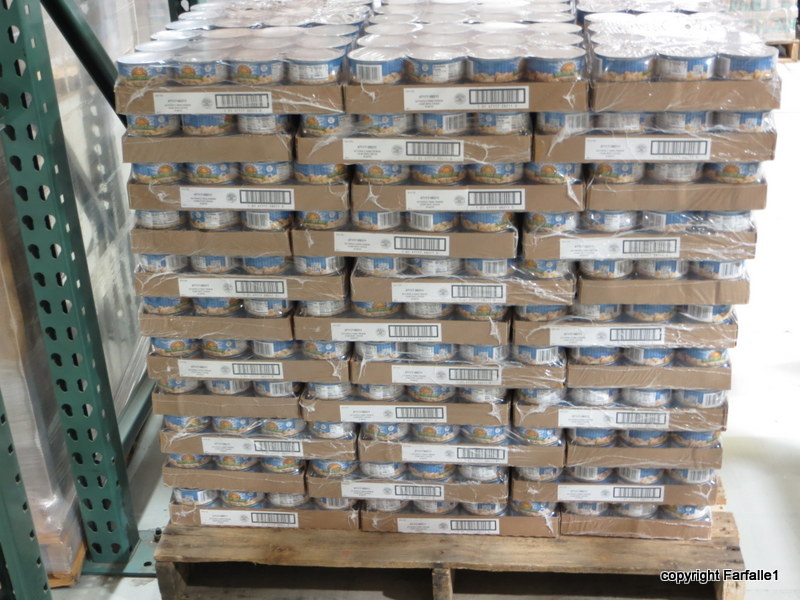
Where does the food come from, I hear you ask. A variety of sources. Some is donated by food companies and stores:
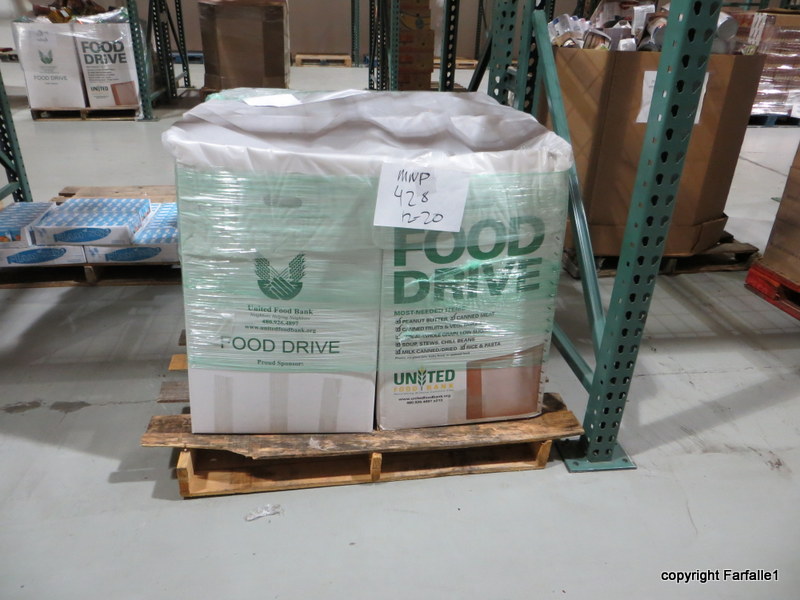
Some comes from food drives run by Scouts, Churches and so forth:
And a lot is flat-out purchased by the Food Bank. United Food Bank is a member of Feeding America, a national organization. Using the leverage of large purchasing, Feeding America and its affiliates are able to buy large quantities of food from producers at greatly reduced prices. In fact, this poster illustrates a startling fact:
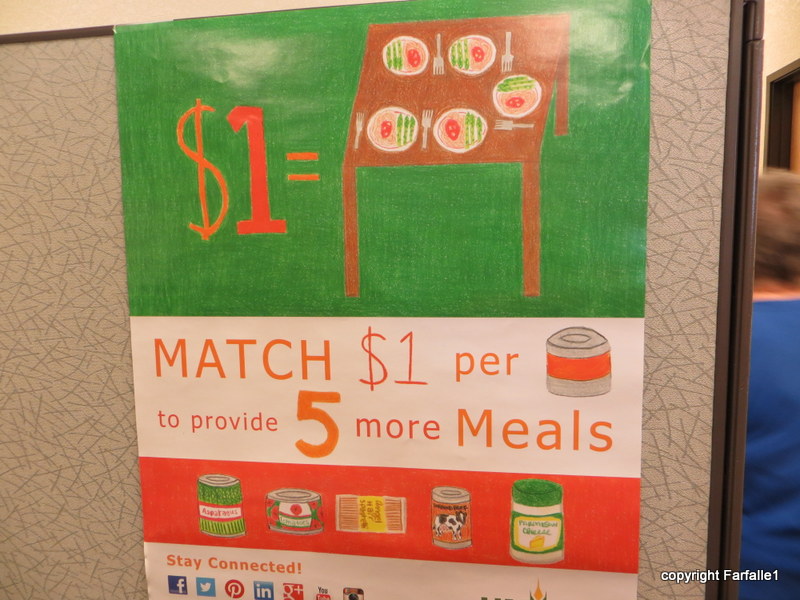
That’s right! The Food Banks are able to cobble together 5 meals from a $1 donation. Amazing, especially when you consider that you and I pay .79 for just a liter of water at the supermarket.
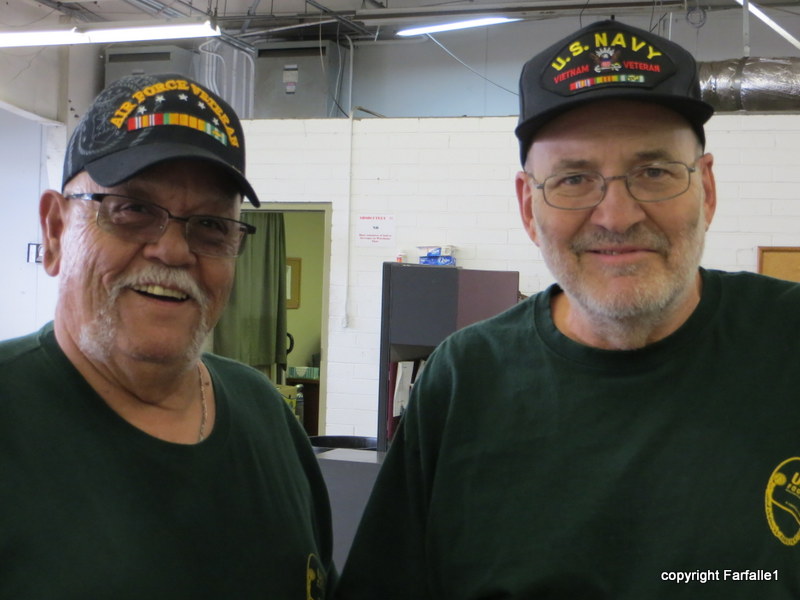
You might be wondering how a mere 20 or so employees can move such a vast quantity of food over such a large area. The anwer: volunteers. Here are two, who scampered off before I could get their names:
Other volunteers come courtesy of Sheriff Joe Arpaio and his infamous Tent City (not all reviews of Tent City are as negative as the one I’ve linked to). We saw several inmates in their signature pink skivvies and striped suits, but I was asked not to photograph them (I really wanted to). Last year volunteers provided over 51,000 hours of work, equivalent of another 25 full-time employees.
When the food comes in it is stored in either the regular warehouse:
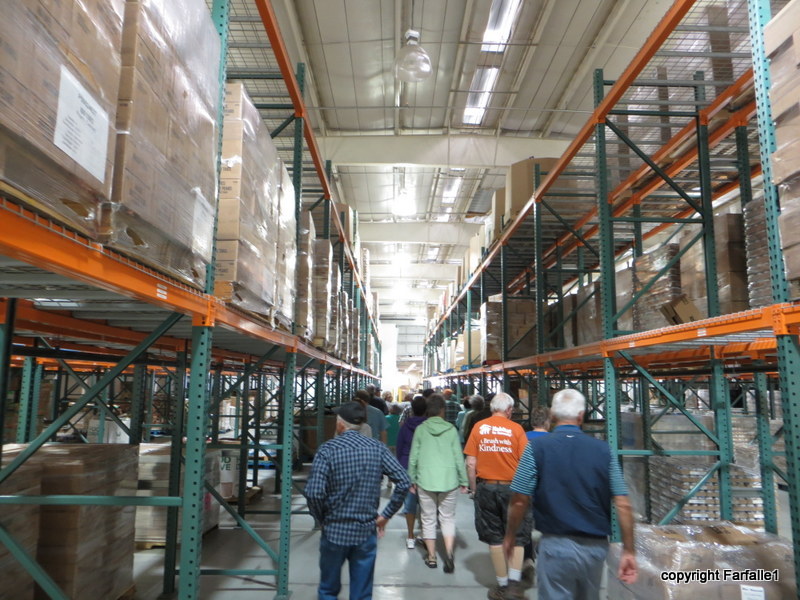
or in the cold storage room:
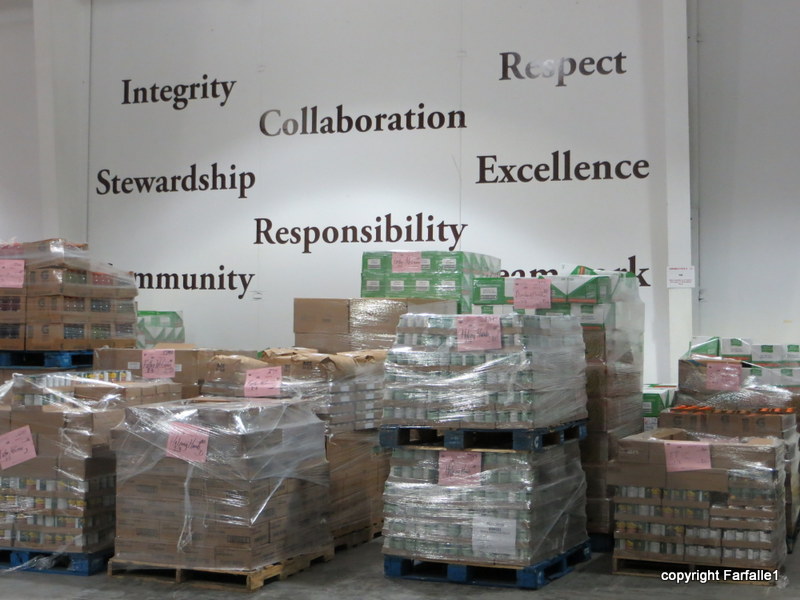
 Then ‘orders’ from the various food banks are put together on palettes ready to be delivered (the pink slips identify the food bank recipient):
The trucks that pick up food from large suppliers reload and take the palettes off to the local food banks:
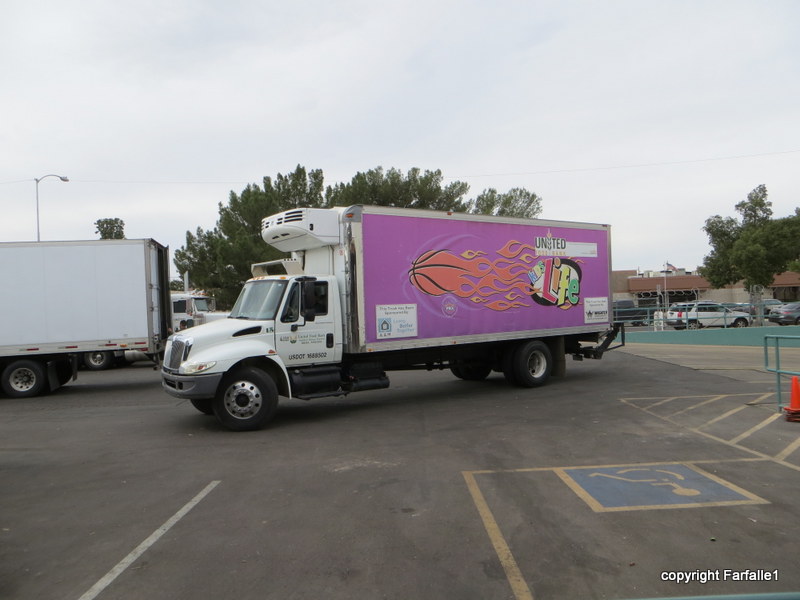
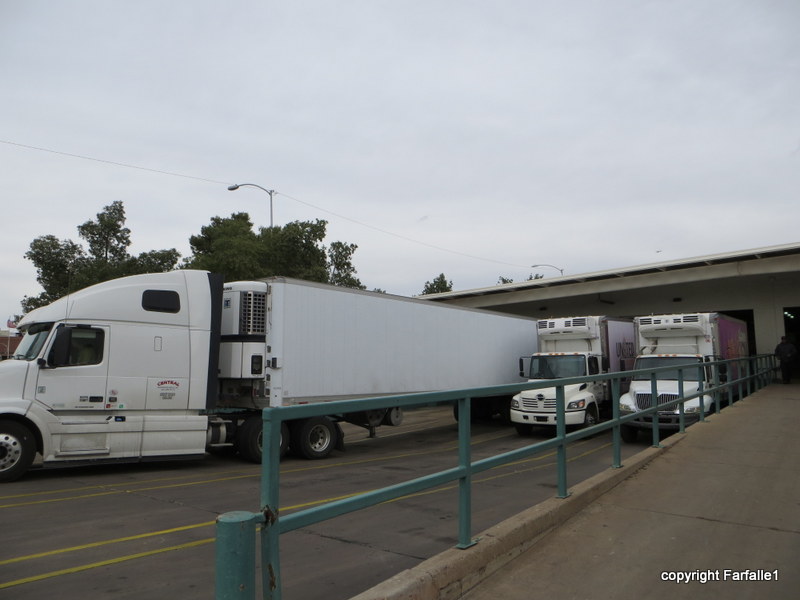
Remember up above I mentioned that the fruit-picking program is in jeopardy? Here’s the reason:

Bad fruit! That’s right, just as the old saw says, one bad apple, or in this case grapefruit, spoils the whole carton. Our group is extremely careful to put only perfect fruit into the boxes. One little puncture and the fruit is useless. Our pickers look at each piece, and a team of checkers stays at the bins and re-examines every piece. That is why one of our team leaders, Bev, is so proud of the boxes of fruit we pick, which do NOT look like the fruit above. Here she is with one of the six bins of fruit we picked.
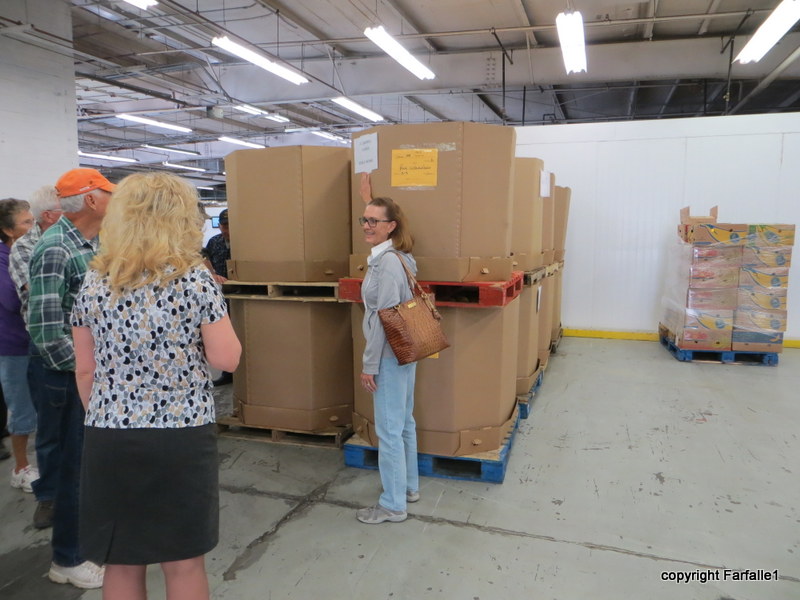
You might imagine that having a bad carton of fruit is a pity and a waste, but not such a big deal. Magnify it by many cartons and it becomes a big deal. The cartons alone cost about $25, and if there’s rotten wet fruit in them, they are ruined and have to be discarded. Then there’s the problem of the bad fruit. Last year it cost the food bank $18,000 to have the bad fruit trucked away and discarded. That is money they would have far preferred to put into meals.
There’s also the question of quantity. There is simply a lot more grapefruit in the Valley than the food banks here can use. Another food bank is working with a local juicer to turn excess fruit into delicious juice. The drawback is that the juicer will work only with professional gleaners, not with volunteers (I imagine it might have something to do with quality control). So far United Food Bank is working only with volunteer pickers.
Up until last year our United Food Bank, through Feeding America, was able to send our excess fruit north to Washington and Oregon in exchange for their excess apples and potatoes. Unfortunately the Arizona citrus has been attacked by a scale disease which is not yet present in the northern states – and they don’t want it. As a precaution they are no longer accepting our excess fruit.
So you can see, the whole thing is very complex. As a casual observer it seems to me that United Food Bank is doing a superb job at getting as much food as possible out to the people who need it the most. The sad fact of the matter is that there are more hungry people in Arizona (and in the rest of America, too) than there is food to feed them. Here, in pie charts (what could be more appropriate?) is a breakdown of income and expenses for UFB:

I asked Melissa what was the more useful contribution, food or money. Both, she said, although the money is more flexible. Some of each is certainly a winning combination. The most needed items in food banks (in addition to cash) are: peanut butter, canned meat, canned fruit and veggies, cereal (whole grain and low sugar preferred), soups, stews, chili, beans, pasta and rice, and milk, either canned or dried.
So it turns out my preconceptions of what a food bank is and does were pretty wrong. There’s nothing sad about it – it’s positive for the people who work and volunteer at food banks, it’s positive for the people who donate food and money, and most of all, it’s positive for the food recipients. Often it is the catalyst that helps them get back on their feet after a run of bad luck. For a hungry child it might provide the zip to do better in school and, therefore, in life itself. If you want to find a food bank near you (if you’re in the U.S.) where you can either volunteer or drop off a bag of food or a check, you can find one here.
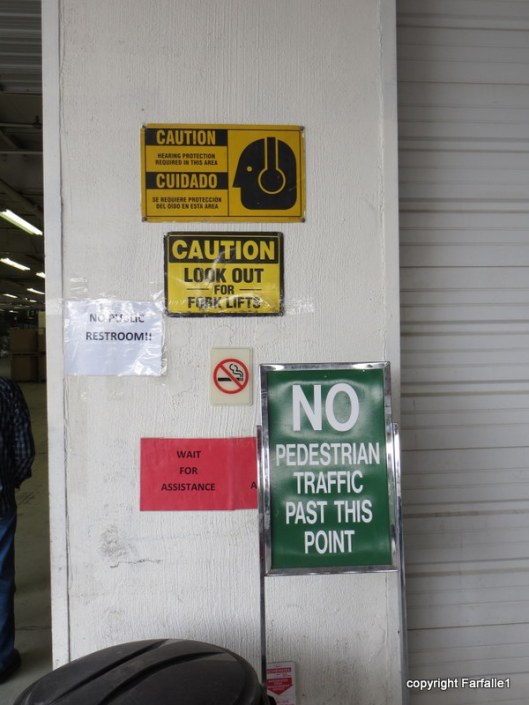
Just a humorous note to end. Like every large organization, United Food Bank has Rules and Regulations, especially in the warehouse area where forklifts are zipping back and forth. As in other matters, they are very organized, posting all the rules on a Wall of Don’ts. I don’t know why it amused me so, but it did. Do not pass go! Do not collect $200!
PS – thanks to the United Food Bank brochures for facts, figures and concise language describing their programs, which I have shamelessly copied.
 An Ex-Expatriate
There is simply no excuse for this country to have people within its borders going to bed hungry. There are many places in the world with accessibility and distribution issues which make just reaching people with the food they need to survive a true hardship.. Here, the problem is one of the great failures of the “trickle-down” theory of distribution of assets and should be a source of national shame. Everyone can do something to help. There are always opportunities to share – even my orchestra, the Vermont Symphony, organizes a food drive each March requesting that attendees bring bags of non-perishable foods to each of our concerts in three different cities for donation to the Vermont Foodbank. It seems that there’s a pernicious case of “out of sight, out of mind” when it comes to this inexcusable failure of conscience to drive wealth towards meeting basic human needs.
Amen. And good for the VSO. Of course it’s hardly surprising that musicians would be so generous – they are just plain good folks.
oops…forgot to add my name.
Loved the story and you tell it so well. Thank you for being one of those wonderful volunteers!
Thanks. It’s great fun to pick – plus, all the grapefruit you can eat as a perk.
Wondeful description. Couldn’t help but notice how much less it costs for the warehouse to provide the food than for the clients to accept money and try to purchase the items at stores.
Well there is that. On the other hand, the food banks cannot provide enough food for everyone. Seems crazy in the U.S. that there is so much of everything and so many hungry people.
We have Second Harvest Food Bank in TN that works the same way, distributing to small, local food banks. Also the same statistics for children: 1 of 4 children in the state is “food insecure” and in Perry County nearly 50 percent of all kids are classified food insecure. Add in the elderly who must choose amongst food, heat or AC and medications… Doesn’t reflect well on our society! (or government…).
I know. It’s odd.
Somehow I started getting two emails on each of your new posts. Will you please remove one. Thanks!
Gil, I think I know what the problem is and I’ll try to take care of it – sorry for the duplication.
PS – please let me know if you continue getting two (although I don’t really know what I’ll do in that case…) Thanks.