• Contact
  • Elaborations
    • A Policeman’s View
    • Driving School Diary
    • Great Danes
    • IVA charged on Tassa Rifiuti
    • Nana
    • Old trains and Old weekends
    • The peasant, the virgin, the spring and the ikon
    • Will Someone Please, Please Take Me to Scotland??
  • Recipes
    • ‘Mbriulata
    • *Baked Barley and Mushroom Casserole*
    • *Captain’s Boston Baked Beans*
    • *Cherry Tart*
    • *Crimson Pie*
    • *Louise’s Birthday Cake*
    • *Melanzane alla Parmigiana* – Eggplant Parmesan
    • *Penne with Cabbage and Cream
    • *Pizzoccheri della Valtellina*
    • *Pumpkin Ice Cream*
    • *Risotto alla Bolognese*
    • *Rolled Stuffed Pork Roast* on the rotisserie
    • *Shrimp and Crayfish Tail Soup*
    • *Spezzatino di Vitello*
    • *Stuffed Grape Leaves*
    • *Swordfish with Salsa Cruda*
    • *Tagliarini with Porcini Mushrooms*
    • *Tagliatelli al Frutti di Mare*
    • *Tzatziki*
    • 10th Tee Apricot Bars
    • Adriana’s Fruit Torta
    • Artichoke Parmigiano Dip
    • Best Brownies in the World
    • Clafoutis
    • Cod the Way Sniven Likes It
    • Cold Cucumber Soup
    • Crispy Tortillas with Pork and Beans
    • Easy spring or summer pasta
    • Fagioli all’ucelleto
    • Fish in the Ligurian Style
    • Hilary’s Spicy Rain Forest Chop
    • Insalata Caprese
    • Kumquat and Cherry Upside Down Cake
    • Lasagna Al Forno con Sugo Rosato e Formaggi
    • Lemon Meringue Pie
    • Leo’s Bagna Cauda
    • Leo’s Mother’s Stuffed Eggs
    • Louis’s Apricot Chutney
    • Mom’s Sicilian Bruschetta
    • No-Knead Bread (almost)
    • Nonna Salamone’s Famous Christmas Cookies
    • Pan-fried Noodles, with Duck, Ginger, Garlic and Scallions
    • Pesto
    • Pesto
    • Pickle Relish
    • Poached Pears
    • Polenta Cuncia
    • Pumpkin Sformato with Fonduta and Frisee
    • Rustic Hearth Bread
    • Sicilian Salad
    • Soused Hog’s Face
    • Spotted Dick
    • Swedish Tea Wreaths
    • The Captain’s Salsa Cruda
    • Tomato Aspic
    • Vongerichten’s Spice-Rubbed Chicken with Kumquat-Lemongrass Dressing
    • Winter Squash or Pumpkin Gratin
    • Zucchini Raita

An Ex-Expatriate

~ and what she saw

An Ex-Expatriate

Category Archives: Italian Churches

The Two Faces of San Maurizio

27 Friday Sep 2013

Posted by farfalle1 in History, Holidays, Italian Churches, Italian festas, Italy, San Maurizio di Monti, Uncategorized

≈ 8 Comments

Tags

Procession San Maurizio di Monti, Saint Morris

September 22 is San Maurizio’s Saint Day, so of course there is a procession here in San Maurizio di Monti, and lots of other celebration too.  But who was he?  According to Wikipedia there is some disagreement about the veracity of the tale.  However, it is said that he was a general at the head of the legendary Theban Legion, which operated in Mesopotamia during the third century CE.  Later Emperor Diocletian sent the legion to Gaul to subdue both barbarians arriving from the north and a rebellious local population.

Diocletian’s successor, Emperor Maximian ordered the legion to persecute and kill the local population of Valais, whom he felt were not being loyal to Rome.  Many of this population had converted to Christianity, and the Legion was also Christian; they refused to murder their fellow believers.  Now it gets really bloody.  Maximian, angered by this  mutinous behahavior, ordered a decimation of the Legion, that is, one of every ten soldiers was to be beheaded.  After this gruesome punishment he again ordered the killing of the Valais population.  Again the Legion demurred and a second decimation ensued.  Still they refused to kill their fellow Christians.  This time the furious Maximian ordered that the entire remaining Legion be killed.  This extreme punishment was carried out in what is now Saint-Maurice-en-Valais, in Switzerland (by whom I couldn’t discover).  As general of this steadfastly Christian legion Maurice, or Maurizio here in Italy, is the one who became a saint.

He is usually depicted with a sword and, here in Italy, with a red cross.  He is the patron saint of the Alpini, the incredibly brave and strong Italian Alpine military group.  And he is depicted as either black or white.  He is assumed to have been born in Egypt, and was perhaps Nubian.

Nubian San Maurizio, painted between 1517 and 1523 by Matthias Gruenewald
Nubian San Maurizio, painted between 1517 and 1523 by Matthias Gruenewald

White San Maurizio

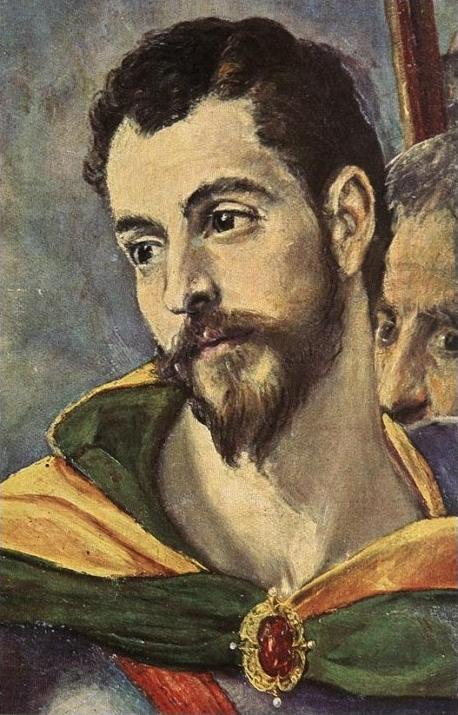
White San Maurizio painted in 1580 by El Greco

The celebrations in San Maurizio di Monti included the usual food stand, music and dancing for two evenings.  As well we had our very own fireworks display.  The serious part of the celebration took place in the late afternoon on September 22.

The Rapallo Band gave a short band concert before the celebratory mass, including some pretty snappy numbers.  Here are a couple of shots of the piazza in front of the church during the concert:
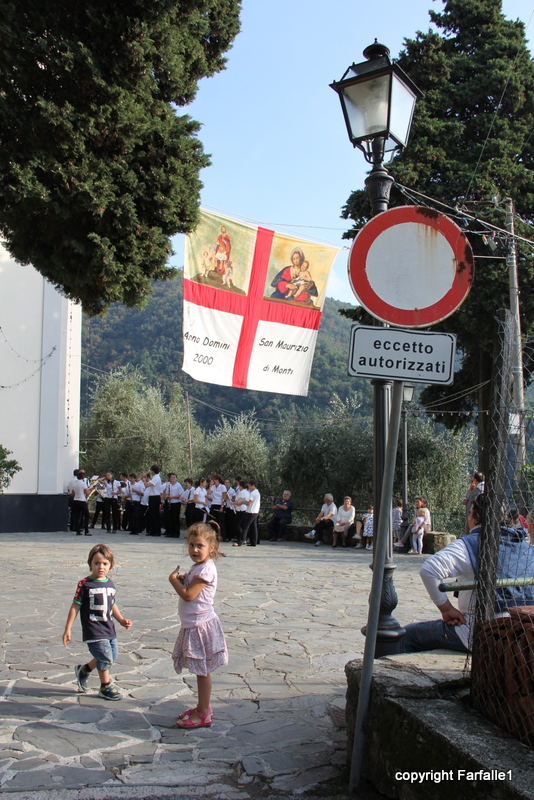
Note the red cross on the flag.

Note the red cross on the flag.

The band plays

The band plays

Red motorcycle in front of tablets commemorating war dead.

Red motorcycle in front of tablets commemorating war dead.

When the church was gussied up for the second millenium the portrait of San Maurizio over the door was repainted.

Goofy San Maurizio

Is it just me, or does he look kind of goofy? At the very least he looks like he has a very good secret.  That’s one of his faces in San Maurizio.  The other is much more serious, and can be seen on the statue that is the central part of the procession through town (‘through town’ is a grand way of saying the procession leaves the church, marches up the road about 400 meters to a fork in the road, turns around and marches back to the church for the conclusion of the mass).
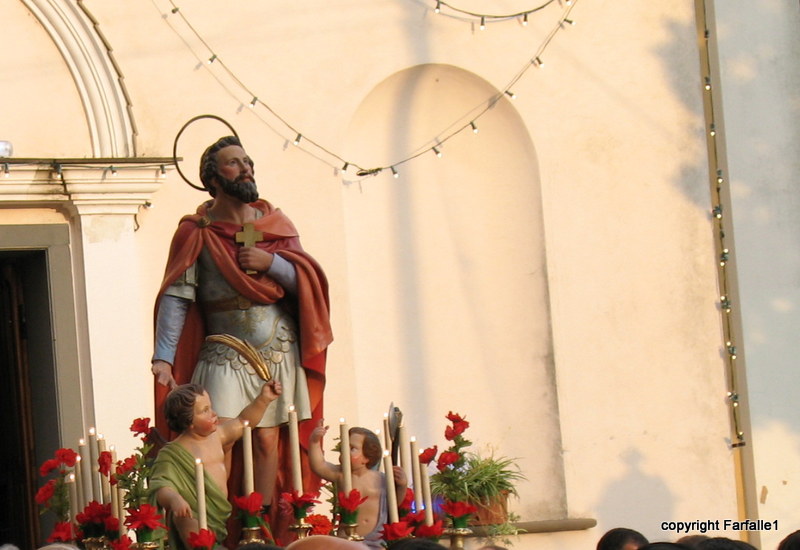
Older photo taken in 2007.

Older photo taken in 2007.

On the statue Maurzio’s expression seems wistful – perhaps he would like to get out in the air more than once a year.  You can see a short video of the procession going from the church (with prayer) here, and another of it returning (with music) here.

He is our mystery saint, black or white, goofy or sad – like the rest of us, he’s… complicated.
Where there’s smoke

04 Thursday Jul 2013

Posted by farfalle1 in Holidays, Italian Churches, Italian habits and customs, Italian holidays, Italy, Rapallo, Uncategorized

≈ 6 Comments

Tags

Festa patronale di Rapallo

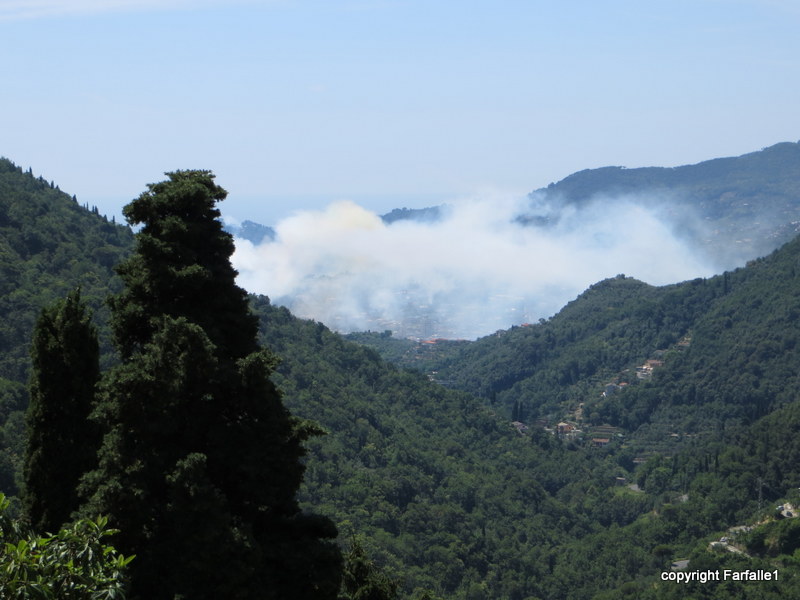
Rapallo just celebrated her Festa Patronale in honor of the Virgin Mary. It is three days of madness in town (you can see some photos of various elements of the celebration, including the parade of crucifixes here) beginning with a huge volley of mortar fire at 8 a.m. on July 1st. This is followed by fireworks presented by the Sestiere at mid-day and evening on the 1st, 2nd and 3rd. Why anyone wants to fire off huge noisy mortars first thing in the morning is beyond me (they do it to greet and salute the Virgin, to let her know the Festa has begun; it closes with another cannonade last thing on the 3rd). But fire them off they do. We were congratulating ourselves for living up above the chaos and thus missing most of the smoke:

fireworks smoke

We were smug too soon, as it turned out. Half an hour later most of the smoke had drifted up our way, but by then it was dissipated enough not to matter.

During the Festa the cathedral in town is brightly lit:

Rapallo cathedral alight

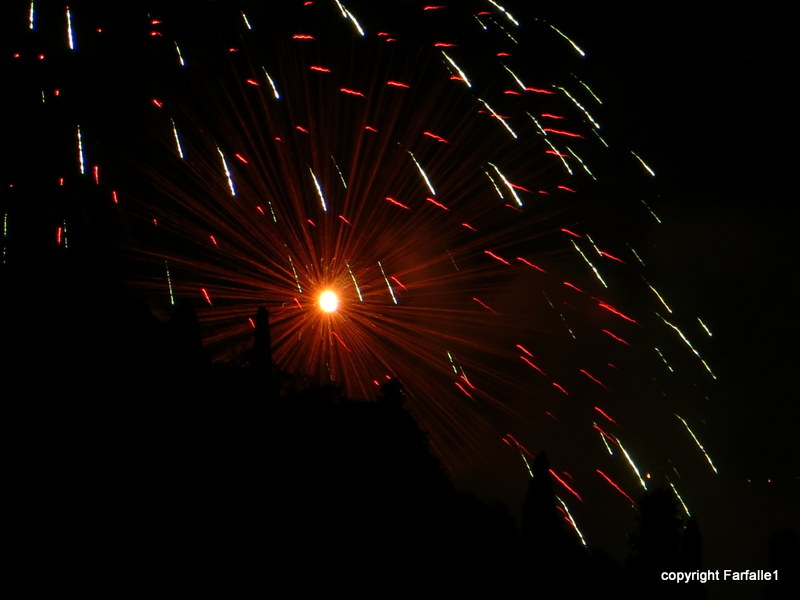
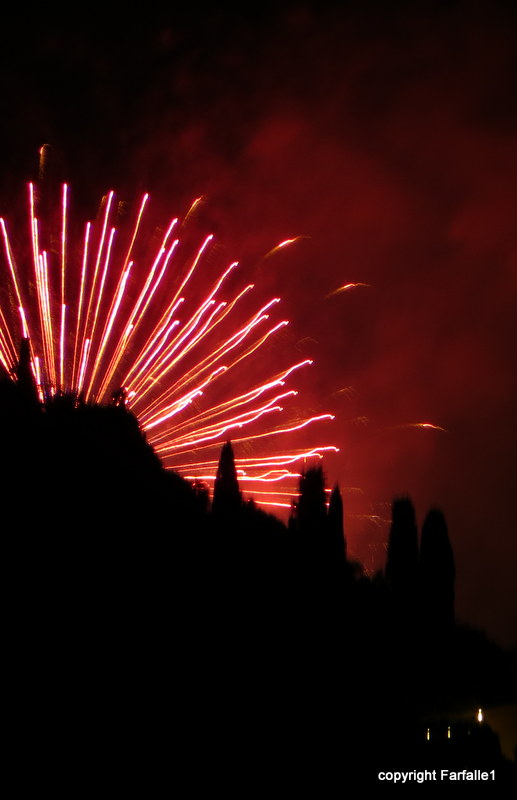
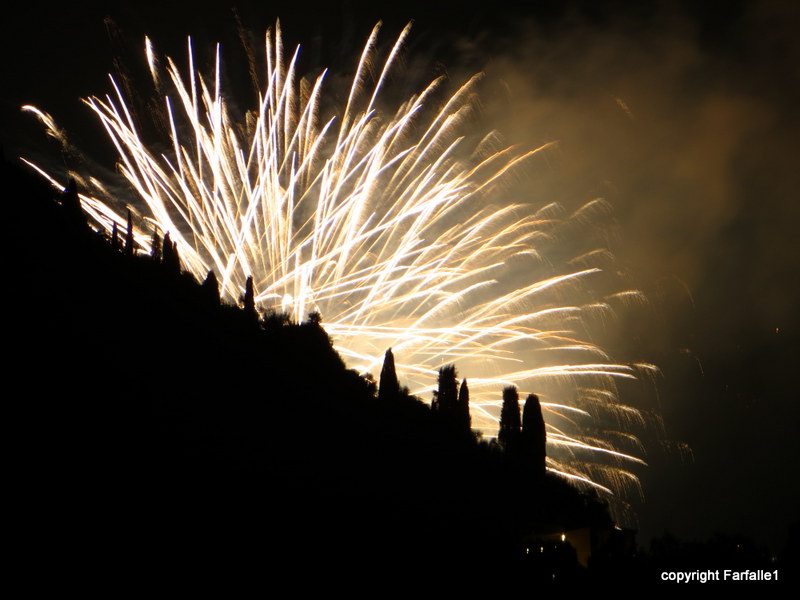
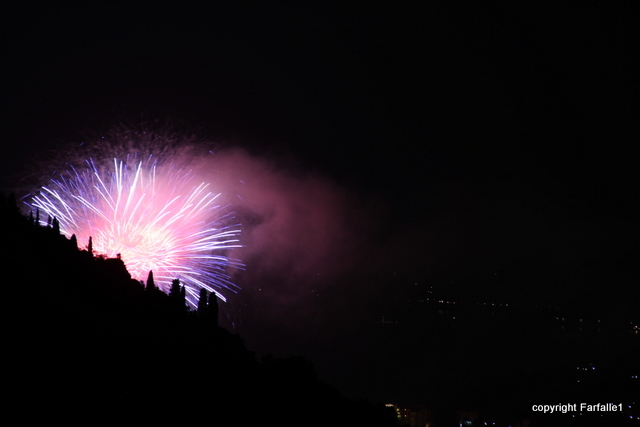
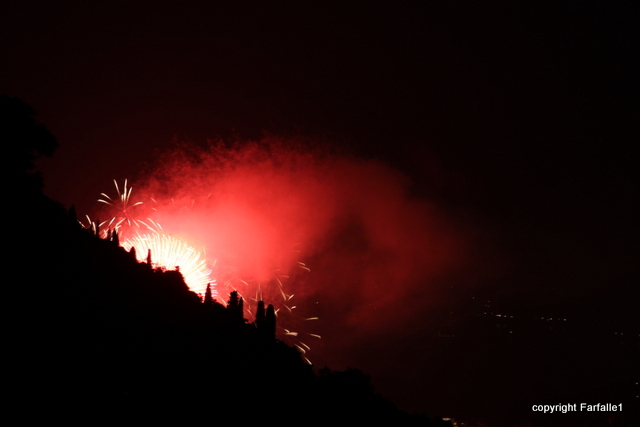
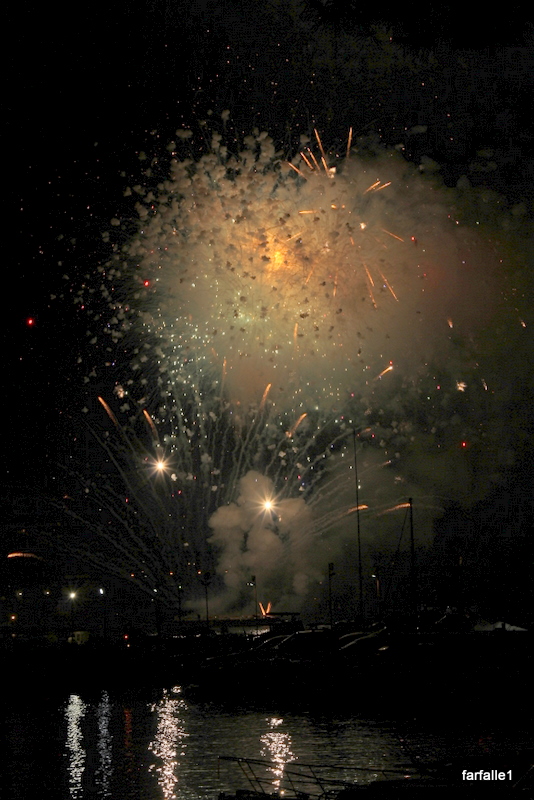
Here are a few shots of the fireworks from rather far away on the night of the 3rd (our house – I just didn’t have the om-pah-pah to join the fray this year) . I like to think of them as our own private 4th of July.

fireworks-004

fireworks-005

fireworks-006

fireworks-008

fireworks-010

If you’re interested in Rapallo’s long relationship with the Virgin you can read about it here.

Happy 4th of July, everyone!

La Cervara

13 Monday Aug 2012

Posted by farfalle1 in American recipes, Italian Churches, Italian gardens, Italy, Uncategorized

≈ 6 Comments

Tags

Monasteries in Italy

Photo from helicopter courtesy of http://www.parks.it

Monasteries in Italy have had a tough time of it.  La Cervara, a monastery constructed in 1361 which sits above the road between Santa Margherita and Portofino, is no exception. When France invaded at the end of the 18th century the monastic orders here were suppressed and the resident Benedictines had to abandon La Cervara.

The monastery has been in a state of loving rehabilitation since 1990; the present owners report that the work is 50% complete.  It’s hard to believe there’s as much to do as has already been done.  It looks perfect to the casual visitor.  In fact, when a friend and I recently took the tour I was reminded of nothing so much as the exquisitet restorations that one sees all through Tuscany, and which are not as common here in Liguria.

The first building was erected by Ottone Lanfranco, a Genovese priest, on land owned by the Carthusians.  Around 1420 ownership was transferred to the Benedictine order, who stayed until the above mentioned troubles.

As was the case for Montallegro, bad weather played a role in La Cervara’s history.  Pope Gregory XI was returning the papacy from Avignon to Rome in 1377 when a tempest arose, and his ship took shelter in the harbor near La Cervara.  The Pope rested with the monks there for a while, and got to know and respect them.  Upon his return to Rome he showed favor to the monastery, eventually elevating it to the status of Abbey.

The monks at La Cervara were not uneducated simple men; rather they were cosmopolitan, well-traveled and worldly wise.  La Cervara was a prestigious abbey and its inhabitants, usually about twenty in number, were frequently looked to for counsel in the great houses of Genova and throughout Europe.

The 15th and 16th centuries were the high points of La Cervara’s history. More buildings were added to the complex, including, in the 16th century, a tower from which to watch for the raiding pirates from Africa, those pesky Saracens.

In 1525 poor  King Francis I of France was defeated by the Holy Roman Emperor Charles V at nearby Pavia.  He was brought to La Cervara where he was imprisoned in a different tower, one with a lovely view looking out to sea.

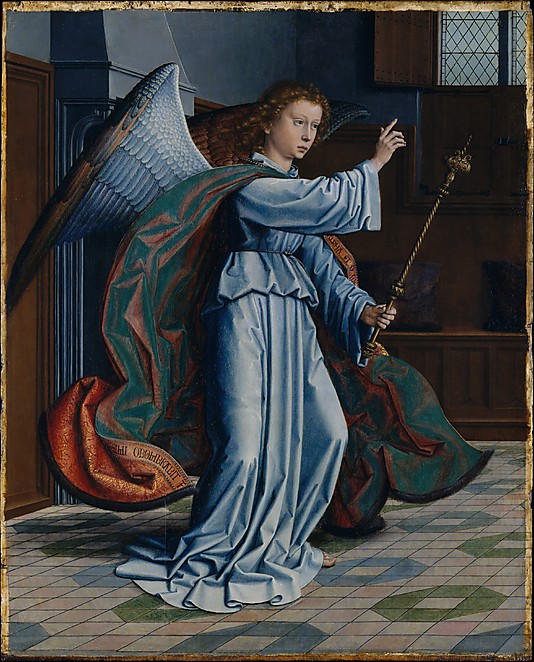
During the suppression, most of La Cervara’s beautiful artifacts and art works were removed.  The Polyptych, painted by Gerard David was separated.  Four panels are now in Palazzo Bianco in Genova, and the other three are in the Metropolitan Museum in New York and the Louvre in Paris.
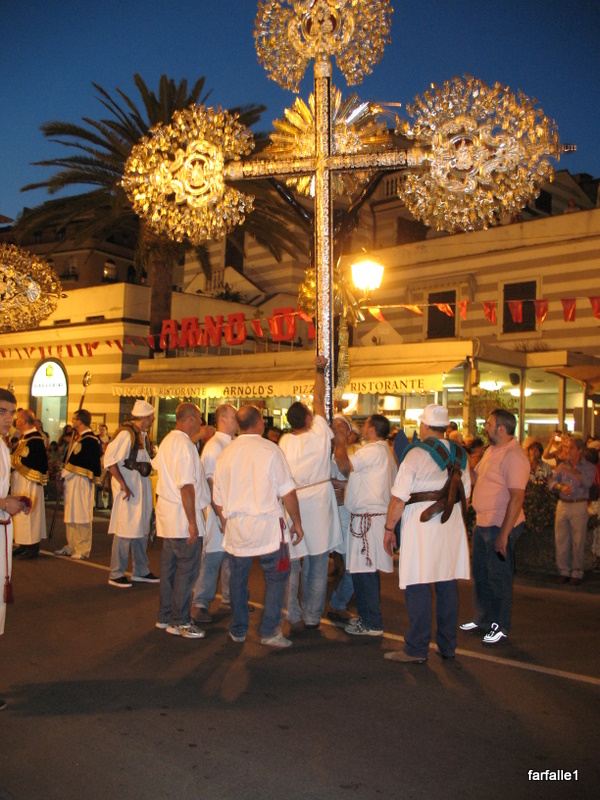
Image courtesy of the Metropolitan Museum of Art

In the beginning of the 19th century La Cervara again became a religious house, passing through the hands of several orders (Trappists, Somaschi, Carthusians) and eventually it was placed under the Diocese of Chiavari.  Finally in 1937 it passed into private hands.  The first private owner added a long hall and built a grand double stairway and a very large room.  More interested in sport and socializing, he did little to preserve or augment the chapel (but neither did he do any damage).

The present owners have been painstaking in their restoration of La Cervara.  The work has been under the direction of architect Mide Osculati and the art restoration has been overseen by Pinin Brambilla Barcilon, who restored the famous painting of The Last Supper in Milano. A private home, La Cervara is also available to rent for conferences, weddings, parties and the like.  A fortunate friend has been to several evening events there and describes how  the soft candlelight inside echoes the twinkling lights on the coast across the bay.  No electric lights – only candles; it is, she says, ‘magical.’  Her favorite place, she says,  “is the cloister at night with only one single shiny jet of water ….not a big splashy fountain, one single jet is all it takes to create beauty.”  You can see the fountain, elegant and eloquent in its simplicity in two of the photos above. Thank you for sharing that lovely image, fortunate friend!

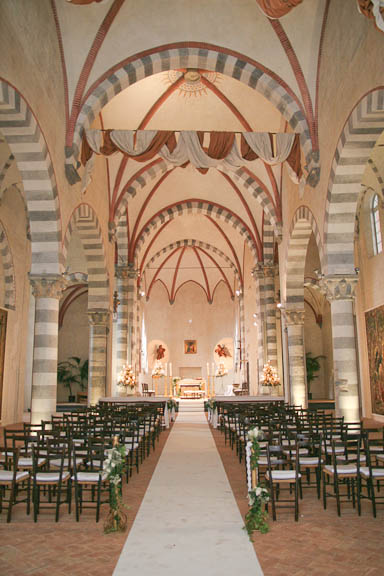
An example of the care taken in the restoration:  it was thought the original floor of the chapel was ardesia, the dark slate indigenous to this area, because that’s what was there, albeit in deplorable condition.  The architect was reluctant to use that material again because it is so dark.  Further digging  revealed, though, that before the ardesia was put down, the floor had been brick.  Unable to find hand-made bricks that matched the light original color, the architect procured the new bricks from Spain.  They look just right, too.

Photo by Roberto Bozzo, courtesy of http://www.fotografi-matrimonio.com

Instead of trying to recreate the missing sacred art in the chapel the owners have installed four enormous tapestries – not religious in theme, but somehow absolutely appropriate for the setting.  You can see just a wee bit of one in the photo above.

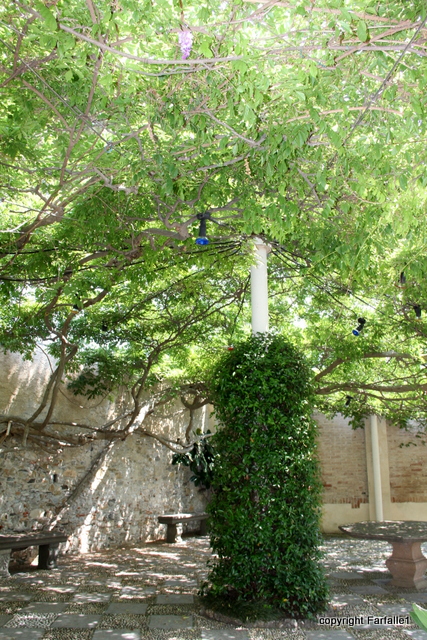
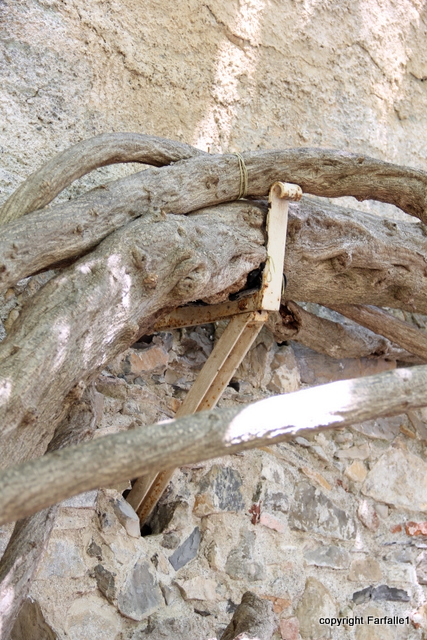
In an extraordinary and successful attempt to save a 150-year old wisteria, the owners used a crane to life the ancient branches from where they had fallen on the ground, one or two inches every week.  It took over a year to get the vine into position, but the wisteria survived and is splendid.

Center pole supports some of the branches, which also grow along the wall on the left.

Ancient branch, now well supported

Unfortunately one is not allowed to take photographs inside the buildings, but the gardens (formerly the monks’ orchard) are fair game.


La Cervara is open to the public on the first and third Sunday of each month  from March through October; guided tours are run at 10, 11 and 12 o’clock.

Happy 4th of July!

04 Wednesday Jul 2012

Posted by farfalle1 in Holidays, Italian Churches, Italian festas, Italian habits and customs, Italian holidays, Rapallo, Uncategorized

≈ 4 Comments

Tags

Festa della Madonna di Montallegro, fireworks

(Click on any photo for a slightly sharper image.)

July 3rd, a quiet night in Rapallo:

Then suddenly all hell broke loose!

July 1, 2 and 3 are the special days Rapallo has set aside to honor the Madonna of Montallegro. It’s crazy in town – huge crowds; lots of noise; a wonderful procession with crosses, bishops and mayors, and children; all culminating in the tradional ‘attack and burning’ of the ancient castello. To give you an idea of the scope and the noise, over the course of the day on Monday, the middle day of the Festa, some 6,000 mortars were fired off.  These are the bright flashes accompanied by an ear-splitting and echoing BOOM that can be heard all through the area.

This year we did not go down into the hub-bub. Instead we stayed ‘quietly’ home and enjoyed a partial show of fireworks. (‘Quiet’ does not exist here on July 1, 2 or 3.)  I love that this happens right before our own traditional Fireworks Day, the 4th of July.  If you’d like to see some photos and read more about the doings in town, read this post from last year.  And if you’re interested in knowing why Rapallo has chosen the Madonna as her patron saint you can read about it here (spoiler: The Blessed Virgin was an early tourist).

Happy Independence Day to one and all!

Rapallo Castello Attacked and Burned!

04 Monday Jul 2011

Posted by farfalle1 in Holidays, Italian Churches, Italian festas, Italian holidays, Photographs, Uncategorized

≈ 12 Comments

Tags

fireworks, Madonna di Montallegro, Rapallo's Festa Patronale

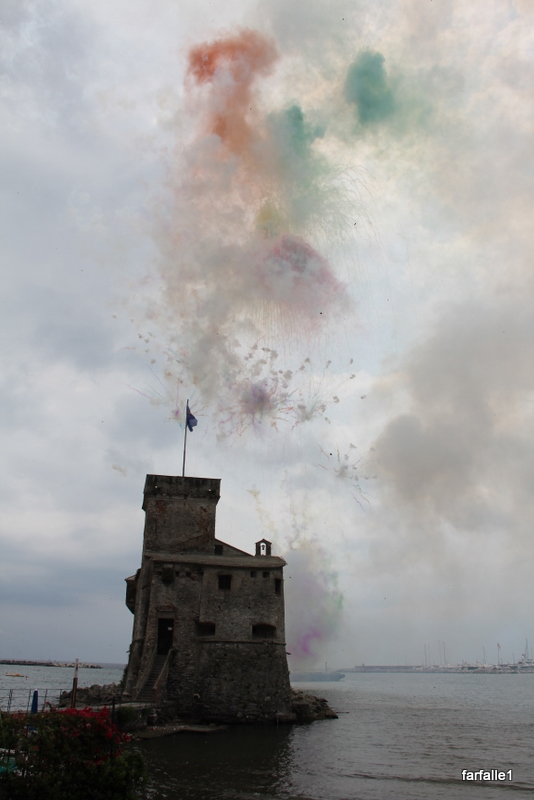
Not really – it’s simply the culmination of three days of pyrotechnic excess at the hands of Rapallo’s Sestieri, all in honor of the Madonna of Montallegro, patron saint of our city.  (The ‘sestieri’ are the six districts of the town – they have no administrative function, but rather are historic and traditional divisions, and serve to provide lively rivalry in the fireworks arena.)

It began at 8 a.m. on Friday morning (July 1) with a half hour of ka-booms provided by all the Sestieri  in honor of the Madonna.  Subsequent fireworks took place at 10:15 p.m. with another Salute to the Madonna (these are a great many very loud explosions, without the fanciful colors and light of fireworks) and at 10:30 p.m. two separate fireworks displays, each provided by one of the Sestieri.

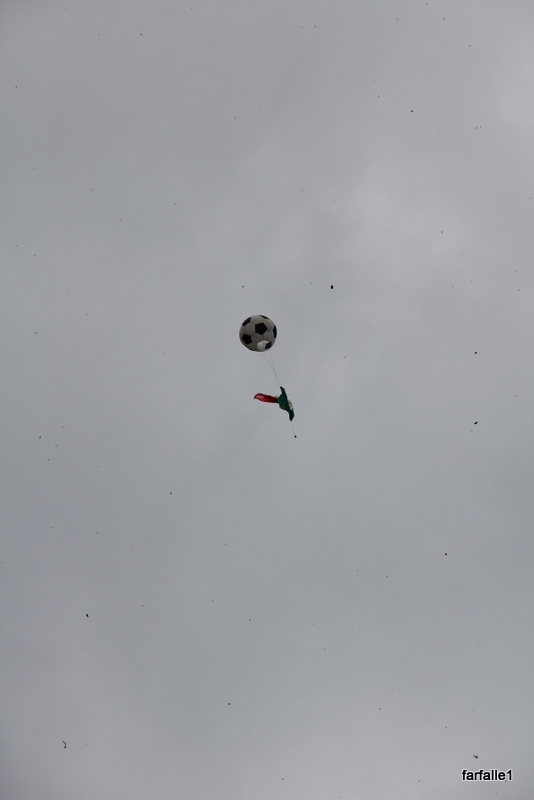
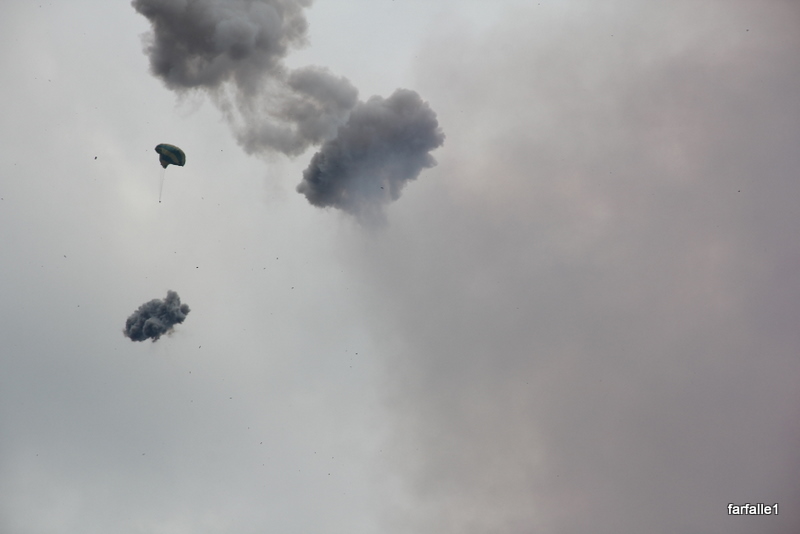
I never thought much of daytime firework shows, but we happened to be in town at mid-day on Saturday when there was a short ‘Sparata del Panegirico”, that is, ‘Praise with Noise.’  The show turned out to be rather pretty and amusing:


In addition to colorful smoke, the onshore breeze showered us all with bits of cardboard debris, flag-bearing soccer balls and parachutes delivering who-knows-what:


That evening there was another mortar Salute to the Madonna followed by another two fireworks shows, again each the work of two other of the sestieri.

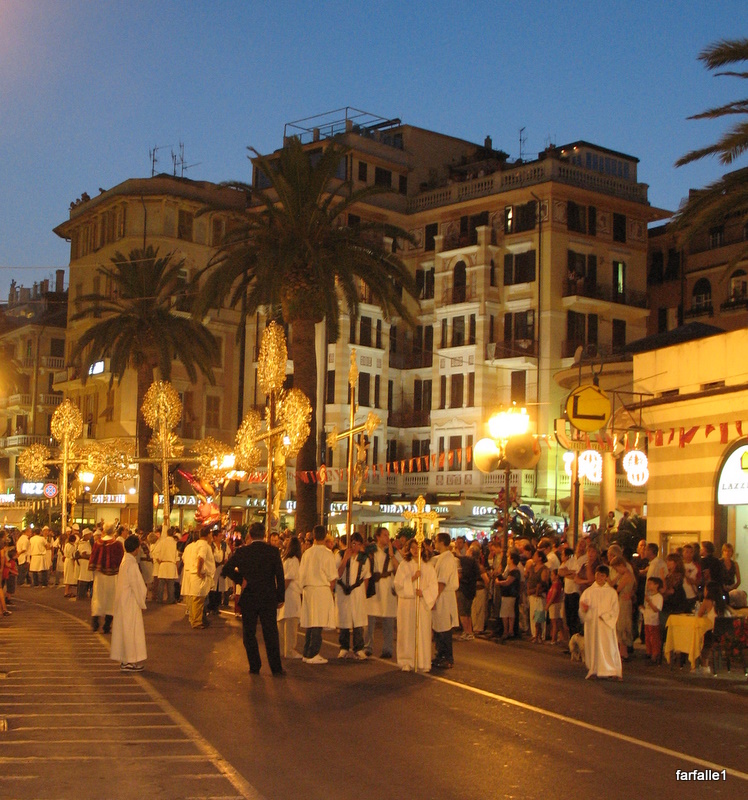
Sunday, the final day of the Festa, gave us a Salute at 10 p.m. followed by the famous Procession of the crosses and the icon from Montallegro. Sadly we arrived too late to see the Procession this year, but here are a few photos from 2009:

Just a few of the many crosses on parade

A very strong man, one of the cross-bearers

The famous icon, barely visible amidst all the silver

Change of porter

The Archbishop

That year’s crop of confirmands

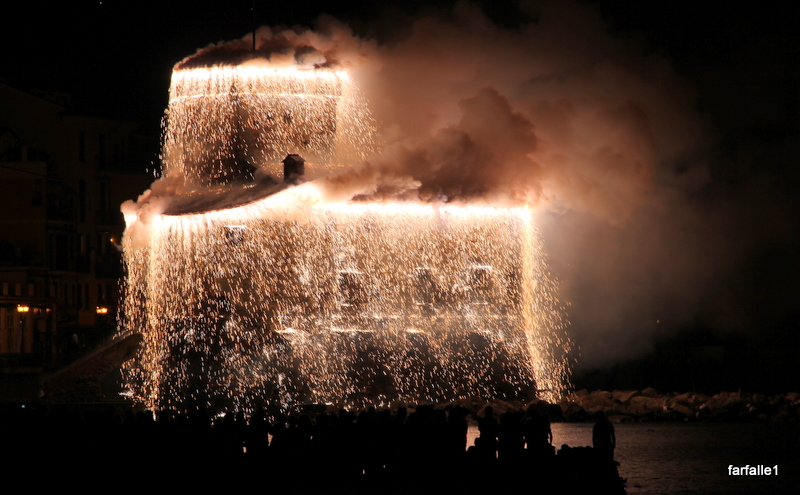
At 10:15 or thereabouts there was another Sparata and short fireworks with the annual Burning of the Castello which you’ve seen in the first photo above.  After an interminable wait there was a lengthy series of Saluti alla Madonna issuing from various public parks around the city, all very loud and exciting.  I have not a doubt in the world that the Madonna heard them and came to watch the last two of the annual fireworks shows that followed.


There are many other activities associated with the annual ‘Solenni Festeggiamenti in Onore di N.S. di Montallegro, Patrona di Rapallo e del Suo Antico Capitaneato,’ principally masses and musical offerings.  It’s a full three days – and it happens every year.  It’s proximity to the 4th of July is a happy coincidence for Americans like us… fireworks and the 4th go together like, well,  hotdogs and beer.  Happy Festa della Madonna!  Happy Fourth of July!

Badia di Tiglieto

17 Friday Jun 2011

Posted by farfalle1 in Italian Churches, Uncategorized

≈ 2 Comments

Tags

Abby of Tiglieto, Badia di Tiglieto, Cistercian Order, Santa Maria e Santa Croce

Not long ago our friends Elena and Michela took me to see the Badia di Tiglieto, also known as the Abbazia Santa Maria e Santa Croce, located in the town of Tiglieto  in the hills to the northwest of Genova.  Founded in 1120, Santa Maria was the first Italian monastery of the Cistercian Order; in fact it was the first monastery founded outside of Burgundy, France where Saint Robert founded the order in 1098.

Nestled against the hills it lies on the plain of the Orba River and is surrounded by the Beigua Regional Park.  It’s a full day’s outing to visit the monastery and take the ring hike in the adjacent park.

The Abby has had its ups and downs over the centuries.  For the first century or two of its existence it grew and prospered.  Farming and agriculture are hallmarks of the Cistercian Order, and the monks at Santa Maria were no exception.  Their holdings grew to be quite large over the years, and because of excellent relations with both the nobility and the ordinary people of the region they were able to get seasonal help for their agricultural pursuits.  They raised corn, wheat, rye, hay and veggies, made flour from chestnuts, and harvested the plentiful wood from the surrounding forests.  They reclaimed boggy areas in the lowlands, turning them into productive fields.
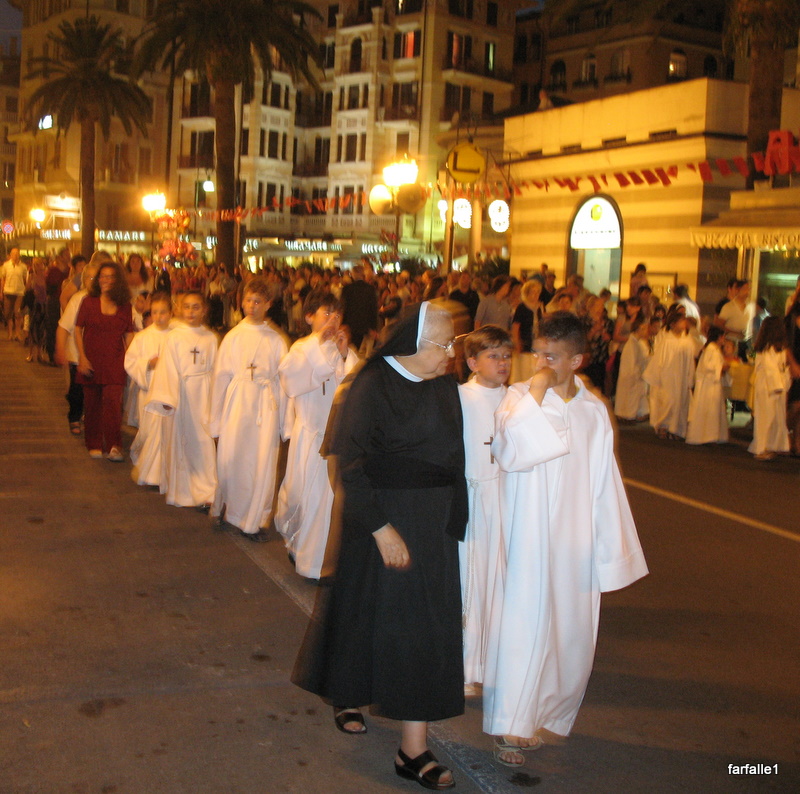
In addition to their physical pursuits the monks had a lively spiritual life.  They were renowned for their even-handedness, neutrality and their attentiveness to local problems.  Frequently they were called upon to adjudicate disputes among the region’s inhabitants.  An indication of their value and importance in this area is that they helped negotiate the peace between Genova and Pisa.

The booklet available in the monastery store presents an image of an idyllic country existence, a life well balanced between hard physical labor and intense spiritual meditation and practice.  It was not always perfect, however; the records indicate numerous cases of disagreements about boundaries, water usage and the like between the brothers and others.

The decline of Santa Maria began somewhere along the middle of the 1200’s.  Unlike the mendicant orders based in cities, the agrarian Cistercians had a hard time finding novices to join the order; there simply was not an ample enough population to provide the needed monks.  As their numbers lessened they were less able to look after their holdings and had either to sell or to lease them.  As their holdings and prosperity declined, so did their prestige, and by the middle of the 14th century they were in a total economic, moral and spiritual decline.

Pope Eugenio IV delivered the death blow when, in 1442, he gave the abby to Cardinal Giorgio Fieschi as Commendatory Abbot.  (A commendatory abbot is one who draws the revenues of the Abby but has no jurisdiction over its spiritual life and practice; he is not obliged to live at the Abby.)  Cardinal Fieschi was not frequently at Santa Maria.  What happened to the remaining monks is unknown.  Perhaps attrition finished them off, or perhaps they moved to other orders; in any event, they were no longer at Santa Maria.

The local populace was not happy about this state of affairs, and did not accept it willingly, being obstructive and even destructive to Fieschi and successive  commendatory abbots whenever possible.  This was the case until 1635 when Pope Innocent X gave the title to Cardinal Lorenzo Raggi who immediately began to improve the premises.  In 1648 Cardinal Raggi recieved the Abby for his family in perpetuity.  He moved to Santa Maria, which has been in the Raggi (now Salvago-Raggi) family ever since.

The Abby underwent major restorations in 1953, 1977, and 1999, with efforts made to restore the structures to their medieval forms.  Unfortunately the cloisters are irretrievably lost, but several rooms have been beautifully restored, notably the chapel and the chapter room.

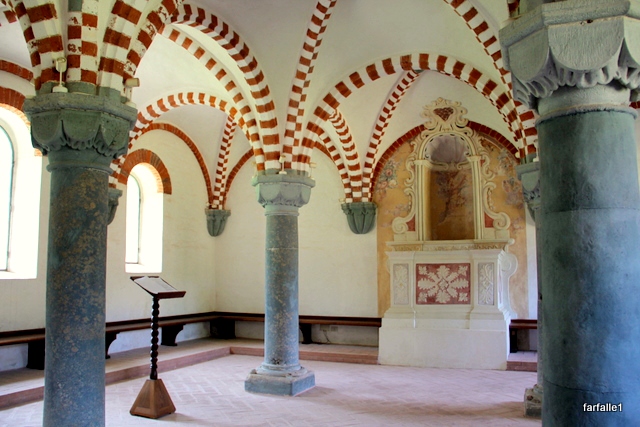
This is the Chapter Room, the Sala Capitolare. The lovely white and red stripes are not medieval; probably they date from the 16th century.

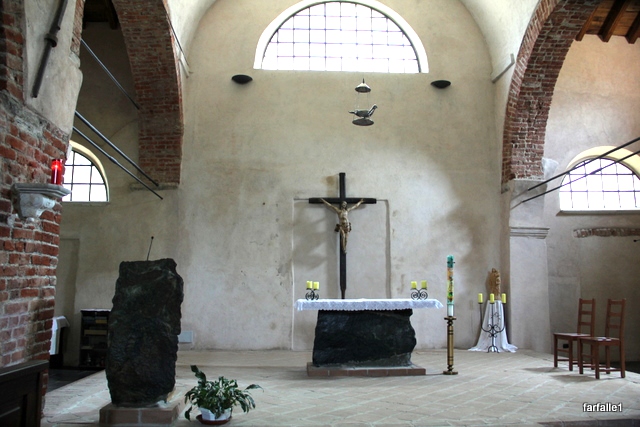
The Chapel is beautiful in both its proportions and its simplicity.

Above the altar there is a silver dove with a golden feather in its wing. The silver represents Christ’s humanity, the golden feather his divinity.

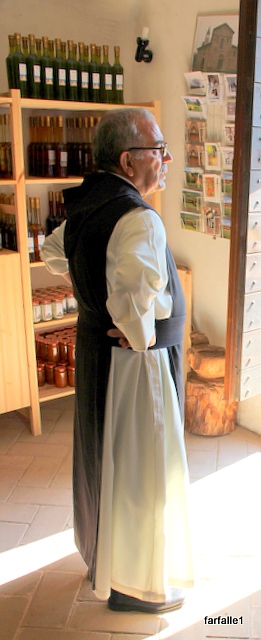
In 2001 the Cistercian monks returned to Santa Maria, through the cooperation of marchesa Camilla Salvago Raggi, the owner of the property, and the Cistercian Congregation of San Bernardo in Italy.  There are now four monks in residence; three are in rather poor health, but one, Brother Walter, is still able to work and, with help from a local family, tends an enormous garden, makes honey and soap, and minds the monastery shop.

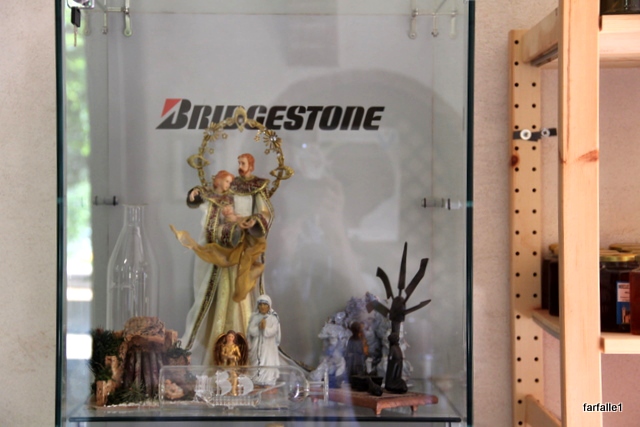
I was amused in the shop to see this display:


Apparently someone amongst the brothers has an interest in things automotive.

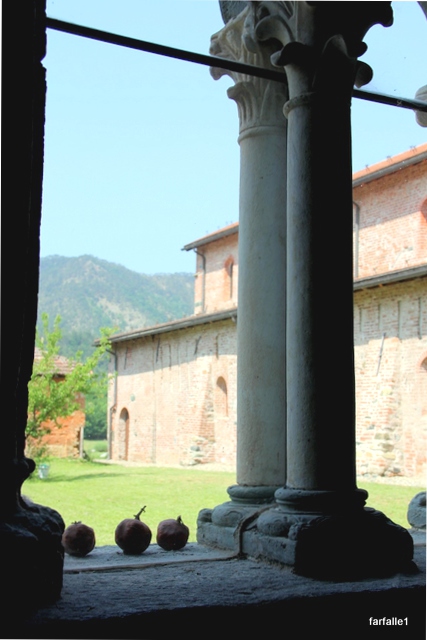
Three pomegranates, symbols of hope and transformation, were drying on the window ledge – one for each of us.  Of course we left the fruit there, but we took the hope with us when we left the peaceful Badia di Tiglieto.


Church!

03 Monday Jan 2011

Posted by farfalle1 in American habits and customs, Italian Churches, Italian women, Italy

≈ 6 Comments

Tags

Catholic church, Catholic mass, Church services in Italy, Church services in the U.S.

Here’s a switch.  usually I write about my experiences as an expatriate, either in Italy, where I truly am one, or in Arizona, where I mostly just feel like one.  Our friends Elena and Michela arrived from Italy yesterday, and now I get to see our country through their expatriated eyes.

Being practicing Catholics they went to mass this morning at the closest appropriate church, the Church of the Holy Cross in Mesa which is a half hour’s drive away.  Now if only they were Mormons, Methodists, Baptists or Lutherans I could have accommodated them in a matter of a few minutes.  Don’t let the photo above fool you – the place was mobbed for 10 a.m. mass.  I had to go to a nearby shopping center to find a parking place while I waited for my friends.  There are two churches, and there was standing room only.

How was it different? I asked.  In lots of ways, it turns out.  First, in Italy going to church is mostly women’s work.  If you see a solitary man in church he is very likely a recent widower, according to Elena.  Here you see many couples and families worshipping together; it is more the rule than the exception.  And it is beyond rare in Italy to see the church packed to the gills and overflowing for Sunday mass.

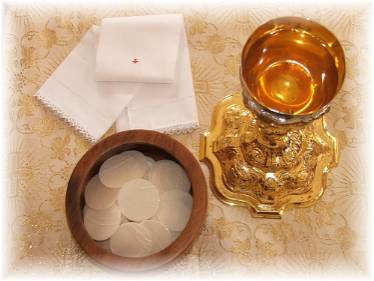
In Italy the congregants are offered only the host.  Here they are offered both host and wine, either for sipping or dipping.

The wafers are thinner and yellower than those in Italy, but Elena opined the caloric value was probably about the same.

Going to the altar for communion can be very disorderly in Italy with everyone getting as close as they can as fast as they can.  Likewise, people come and go at will, frequently not remaining for the whole mass.  At the service today Elena observed that everyone formed a line to take communion, and each person patiently awaited his turn.  No one left early.

She was enthusiastic about the music, which was almost like a concert.  Everyone sang!  In Italy only a few wurbley-voiced matrons participate, but here the singing was hearty and heart-felt.

So what were the impressions she came away with in general?  She was impressed by the number of people and the active and orderly participation in all parts of the service.  But she found herself wondering if there was the same spirit of joy in today’s mannerly congregation as she frequently sees in the smaller masses of her home church in Italy.  She couldn’t say yes, or no, but it was an interesting question for all of us.

Genova the Unsung

11 Thursday Nov 2010

Posted by farfalle1 in Genova, Italian Churches, Italy, Liguria, Photographs, Uncategorized

≈ 14 Comments

Tags

Cattedrale San Lorenzo, Chiesa del Gesu e Sant'Ambrogio, Chiostro di Sant'Andrea, Genoa, Palazzo Ducale, Piazza de Ferrari, Porto Soprano

Here’s what you never hear prospective visitors to Italy say: “We’re going first to Florence, then Rome and Venice, and then Genova.”  Genova?  Doesn’t seem to be on too many tourist’s maps, and it’s a pity, because it’s a terrific city, well worth a visit.

Genova, long and narrow, is spread out on the strip of land between the mountains and the sea around her generous harbor.  She is the capital of  Liguria and boasts a metropolitan area population of some 1.4 million.  Known as ‘La Superba’ for her ancient and glorious history, she is now an important economic center of Italy and was, in 2004, the European Union’s Capital of Culture.  The Bank of St. George, one of the oldest known banks, was founded in Genova in 1407.

Ancient remains suggest that the city was inhabited (by Greeks?) as early as the 6th or 5th century BC, perhaps even earlier.  It was destroyed by Carthaginians in 209 BC, later rebuilt and later still invaded by Ostrogoths  and Lombards.  Wikipedia has a very brief history of Genova here if you’d like a quick study.

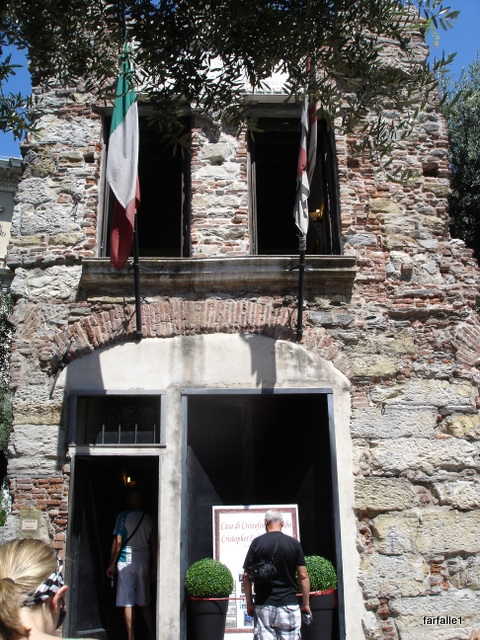
If Americans think of Genova at all, it may be as the purported home of Christopher Columbus.  The wee little house where he may have lived, just outside the city walls, is a must-see.

I have an idea:  let me take you on ‘The Tour’ of Genova that I give guests when I can lure them away from the delights of Rapallo for a day.  It is a train ride of about 40 minutes to the more eastern of Genova’s two train stations, Brignole.  From there it is easy to find Via XX Settembre, the broad and well-traveled street with many famous shops.

At the top of Via XX Settembre is Piazza de Ferrari, newly reconstructed after being torn up for years to accommodate construction of the new metro subway.

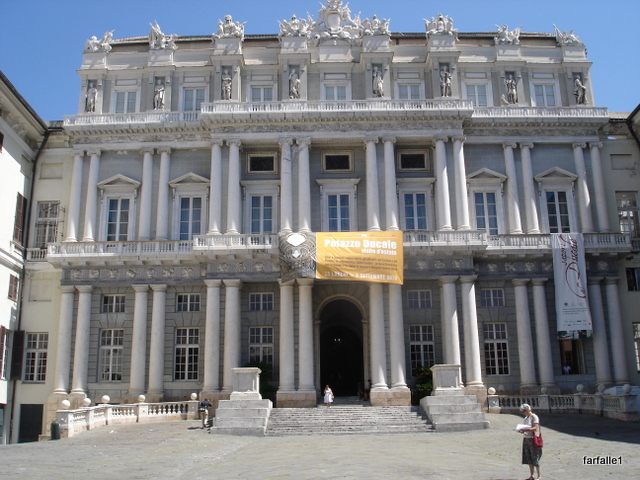
If you had taken this photo the Carlo Felice opera house would be on your left, the Palazzo Ducale behind you, and behind that the tumble jumble of medieval Genova’s streets.

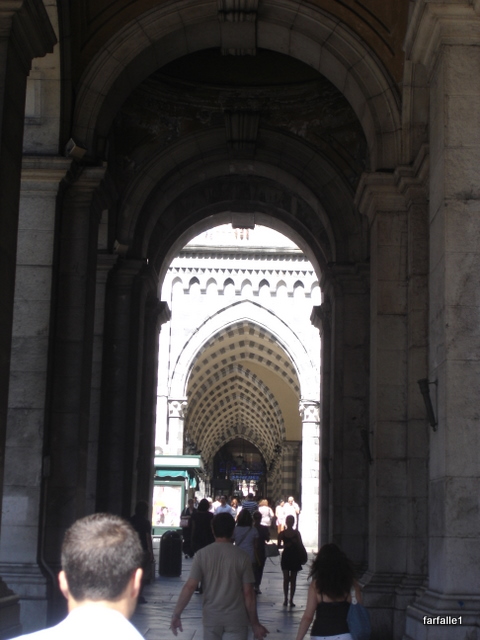
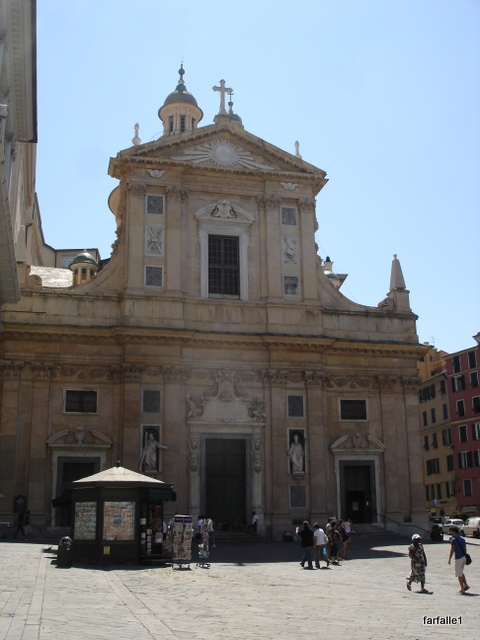
From here let’s take a stroll through the atrium of the magnificent Palazzo Ducale, turn left, and walk down the timeworn steps to  Piazza Matteoti, home of the Chiesa del Gesu e Sant’Ambrogio.

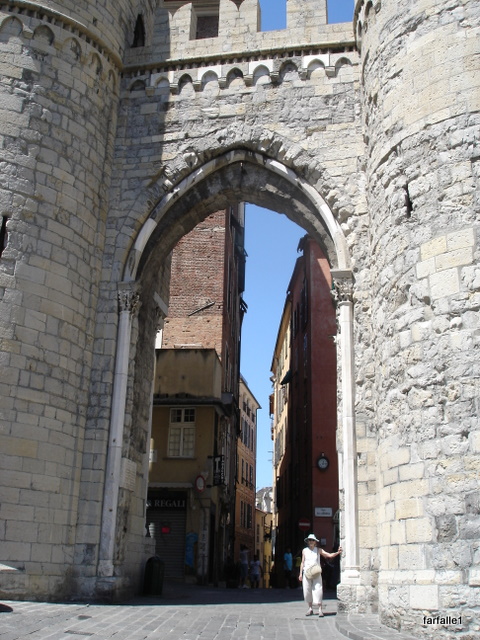
We’ll nip in to take a peek at the The Circumcision (link is to a probable study  from the Gemäldegalerie der Akademie der bildenden Künste in Vienna) painted by Peter Paul Rubens in 1605, one of two paintings he made for the church during his stay in the city.  After we leave the church we’ll turn left and walk up to and through the tall city gate.

Hey!  Who’s that?

Who knew that The King hung out at the Cafe Barbarossa to serenade unsuspecting tourists?  Enough of this nonsense.  On to Columbus’s house:

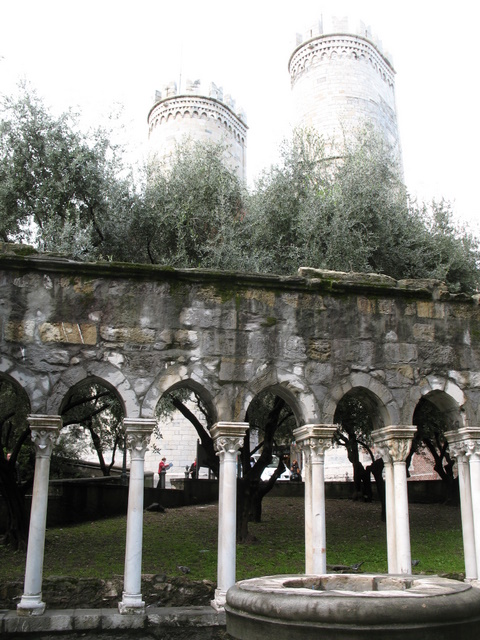
Very teeny indeed. For €4 you can go in and look, but perhaps we don’t need to do that today.  Of more interest, to me anyway, are the beautiful remains of the Chiostro di Sant’Andrea, moved to its present location just next door  to the house in 1922.  The cloister dates from the XII century and is a little island of calm amidst the bustle of the city that has grown around it.

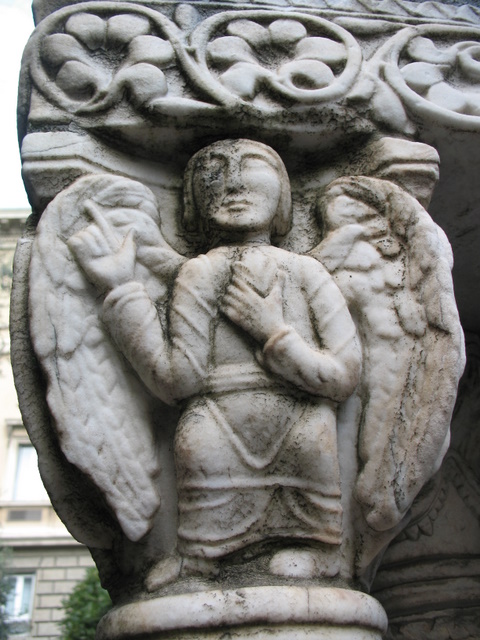
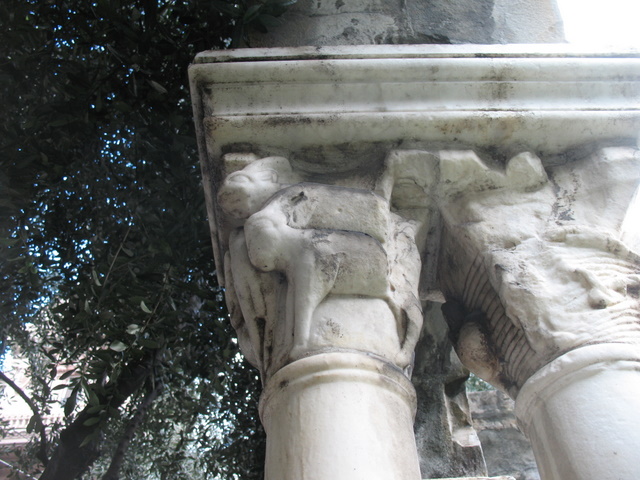
In the background you can see an X-Files rendition of the Porto Soprano, one of the gates in the city walls which were constructed in the XII century.  Here are a couple of details from the top of the cloister columns.


I love this angel’s calm demeanor.

Why is there a rabbit on top of that donkey?

From this peaceful corner we will go back through the Porto Soprano,


walk by the Palazzo Ducale again,

Phot courtesy of Pidge Cash

and continue down to the magnificent  Cattedrale di San Lorenzo, which was consecrated in 1118.  The black and white stripes are a medieval symbol of nobility.


You can stare at the facade of this church for hours, and you will continue to find new details.

As well as many beautiful paintings and some 13th century frescoes, the church contains a most unusual artifact,  a grenade that struck the church on February 9, 1941, during a bombardment by the British.  The grenade went through the roof of the cathedral without exploding and can still be seen in the right aisle.

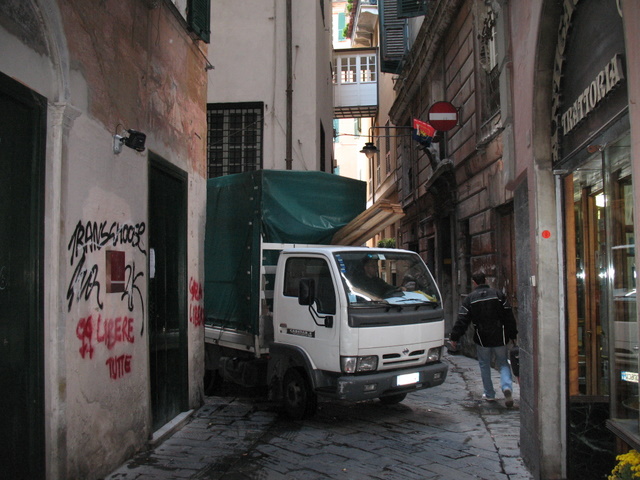
Now it’s time to launch ourselves into the warren of narrow streets in the medieval part of the city.  How narrow, you ask?  Well, narrow enough that a small truck has to make a complicated back and turn maneuver to make a simple 90 degree turn.

And it’s not even a big truck!

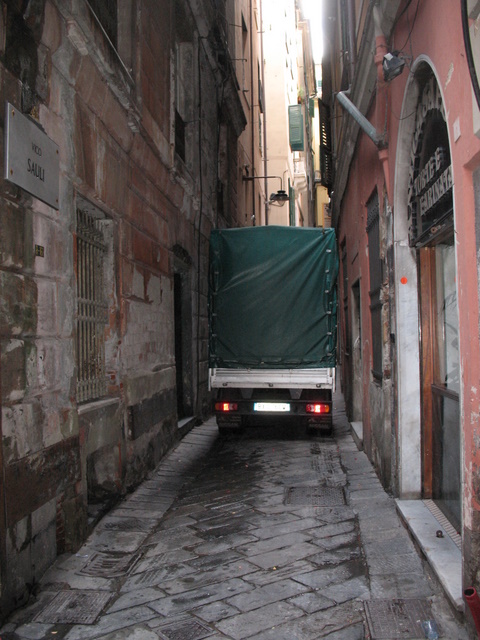
Many of the streets are too narrow to accommodate even a car, never mind a small truck.


Time for lunch!  We’ll stop at one of the many restaurants and trattorie in the old section and partake of a bit of Genova’s signature dish: farinata, a very flat pancake made from chickpea flour.

Note the wood-burning oven in the background; that is the only way to cook farinata correctly.  This photo was taken through the window of Antica Sa Pesta, a restaurant on an old salt-trading site.

Maybe we’ve done enough for one day.  Let’s take our full bellies home and have a nap before tucking into whatever the Captain has cooked up for us in our absence.  We’ll come back very soon to finish the tour of beautiful Genova.

Bells and Dogs

30 Monday Aug 2010

Posted by farfalle1 in Animals in Italy, Dogs, Italian Churches, Rapallo, San Maurizio di Monti, Uncategorized

≈ 8 Comments

Tags

Campanile, Church Bells, Howling Dogs

We’re bell-proud here in San Maurizio.  The church which serves this village of 500 people has six bells in the campanile.  Day and night the bells toll the hour in the usual fashion; or almost the usual fashion.   After ringing the appropriate number of times for the hour, the whole thing is repeated again three minutes later; maybe we’re particularly inattentive up here on the hill.

In addition to the hours, the bell rings once on the half hour.  This is fine for most of the day, but it leaves us unsure in the middle of the day and the middle of the night: 12:30, 1:00 and 1:30 all sound exactly the same, both a.m. and p.m.

Twice a day there is some bonus bonging.  At 7 a.m. and again at 8 p.m. a slightly deeper bell rings  50-60 times between the two soundings of the hour.  The reasoning for this, I’ve always imagined, is to say, in the first instance, “Hey, it’s time to go outside and start your work.  Get going!”  and in the second, “Okay, quittin’ time; dinner’s ready, home you go.”  Then on Saturdays and Sundays, and sometimes on Thursday afternoons the bells play a short selection of tunes, most quite jazzy.  Of course there is also extra ringing for weddings (few and far between) and funerals.

There is something awful about this for dogs.  The normal ringing of the bells doesn’t elicit any canine response, but the sonic frequency of the extra long, low peals as well as the songs must hurt their ears.  North, south, east and west, they all start to bark, howl, squeal and moan.  Every dog in town weighs in saying, “ow, ow, ow – stoooop!”  Finally the bells stop and so do the dogs.

There’s a sound clip of one of the regular tunes our bells play here. If you listen carefully you may hear some canine dissent.  Apologies for the quality of the video – my camera isn’t really designed for it, and I’m a bit jiggly at the start.

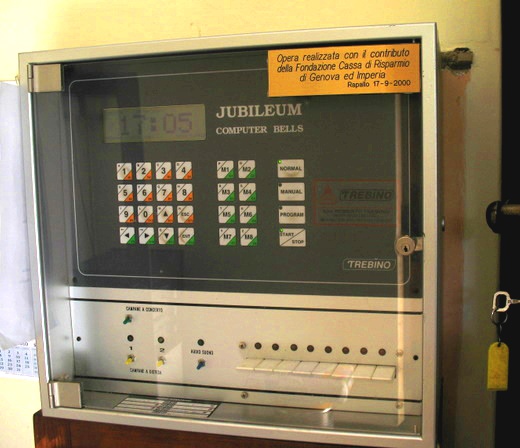
Don’t you have an image of a monk, robes flying, racing from one bell pull to the next to play so fast?  Or perhaps several, trying not to trip over each other?   Or maybe a Quasimodo figure up amongst the bells themselves, ringing them with a big mallet, as if they were a xylophone?  Alas, those days are over.  The bell ringing is done by computer.  There’s a control box under the bell tower, and the priest can select the music he wants to play.

The dogs don’t care how it’s done.  They just don’t care for it.

Tile Town

15 Sunday Aug 2010

Posted by farfalle1 in Italian Churches, Italy, Photographs, Uncategorized

≈ 9 Comments

Tags

mosaics, Ravenna, Theodoric

Nothing gets us stirring and away from our hillside like the arrival of curious company.  My sister, planning her visit, had requested a trip to Ravenna to see the incomparable mosaics there.  Fresh from a visit to Turkey she was eager to compare Italian Gothic and Byzantine art to that of the Ottoman Empire.  The Captain and I visited Ravenna a few years ago and enjoyed it immensely, so it took no arm-twisting at all to get me tapping away for reservations on Venere.

Although the city is across the boot, just a few miles from the Adriatic, it is a pretty and easy drive of only about 3.5 hours to get there from Rapallo.  In fact, years ago Ravenna was on the Adriatic.  Silt buildup since the year dot has now stranded the town some four miles from the sea.

We spent two nights in a lovely hotel, the Palazzo Galletti Abbiosi, which is centrally located, comfortable and has a terrific staff.  It was simplicity itself to walk from our digs to all the major sights in the city.

Ravenna offers tourists free bicycles!  We didn’t stumble on this great opportunity ’til our last day, but it is definitely the best way to get around this flat town.  Leave some identification and fill out a form at the Information Bureau and you will be given the key to your very own bike.

Happy sister with free bicycle

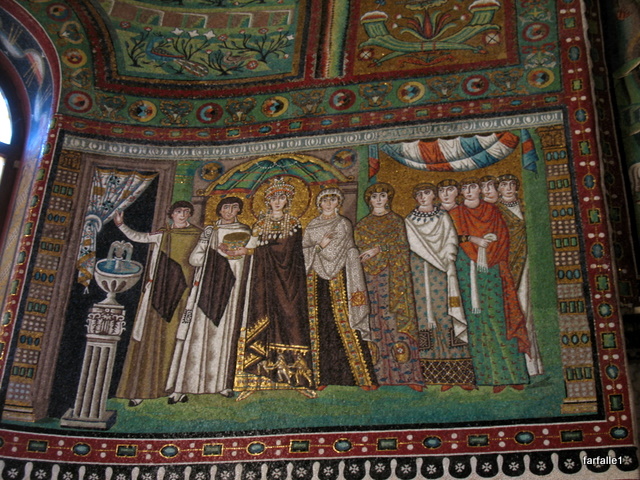
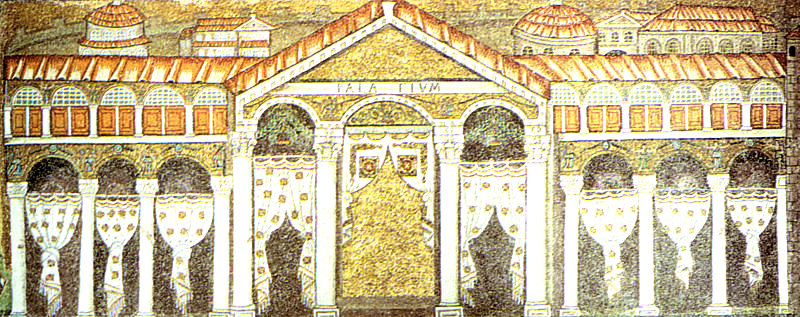
Ravenna is most famous for her mosaics, some of which date from  the early 5th century CE.  Theodoric,  leading an army of Ostrogoths, conquered the city in 493, beginning an enlightened and wise 33-year reign which saw extensive land reclamation and an enormous amount of construction.  Amongst his projects was his residence, The Palatium (now gone, but we know what it looks like from a mosaic):

(Interesting fact: after the death of Theodoric and a 9-year reign by his daughter, the Byzantines under Belasarius wrested control of the city from the Ostrogoths.  They removed what they could of Gothic images from the mosaics; in the photo above, for instance, figures have been replaced by curtains.)

Others of Theodoric’s grand buildings include the Anastasis Gothorum, now the Church of Spirito Santo; and the incredible Basilica Sant’Apollinare Nuovo. (Theodoric was an Arian, that is he followed the teaching of Arius which had been condemned by the Council of Nicea in 325).

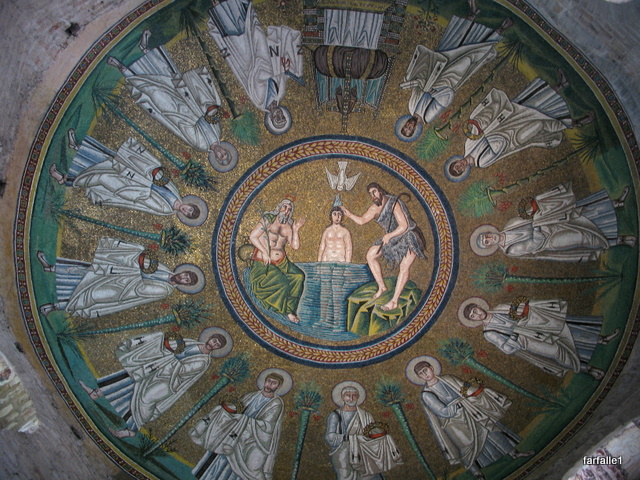
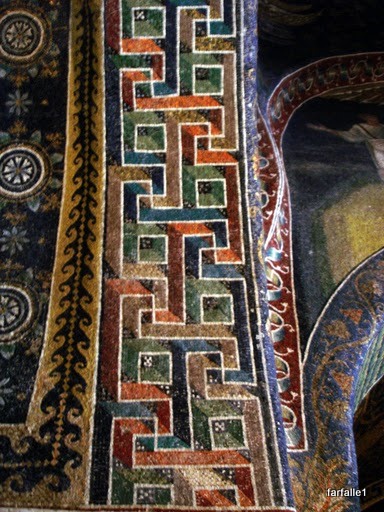
Ravenna’s concentration of Gothic and Byzantine mosaics is astonishing – and breath-taking.  There are several different ways to make mosaics; the ones in Ravenna are done in the most difficult way: the stones are placed directly into the wet cement on the wall or floor.  A special fast-drying cement was used,  so only a small section could be tiled at one time.  It’s hard (impossible?) to imagine how the artists could get such subtle variation in color tones, express such personality, and make such complicated geometric patterns when they could do only a little bit at a time and were using only small chips of colored stone, glass or gems for their medium.  I suppose they laid everything out ahead of time, but still…  it is all amazing and very beautiful.

Baptism of Christ, Arian Baptistry

Perhaps altered and renamed portrait of Theodoric, photo by Pidge Cash

Galla Placidia, photo by P. Cash

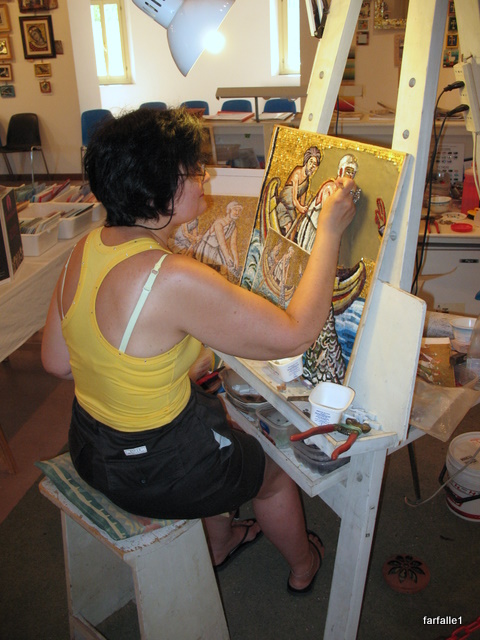
Other mosaic methods include sticking paper to the right side of the tiles with a soluble glue, mounting the tiles bottom side in the cement and then soaking off the paper and glue when the cement has dried; or sticking the tiles right-side up into wax and applying the cement afterwards, then mounting the whole on the wall or floor.  This very kind woman explained it all to us as she worked away on her own replica of an ancient mosaic:

The thing that is so difficult to fathom is the teeny size of the tiles used in the mosaics, and the snugness with which they fit together.  It’s enough to make one blind just watching a demonstration like the one above, never mind trying to make a mosaic oneself.

There is so much to see in Ravenna, and we saw almost all of it.  At the bottom of this post there is a list of monuments (eight in Ravenna are World Heritage Sites) with links for history and photographs.  Here is a link to my own web album from our trip.

But traveling in Italy is not just about seeing the beautiful art and learning some of the long and varied history of the country.  There is always Food (and it does have a capital ‘F’ in this country).  And there are always, and for me most interestingly, the people.  We had an experience in Ravenna which I’ve had once or twice before in Italy, but never in the US.

Our map-reading skills are not especially stellar, and at one point we found ourselves – or rather we lost ourselves – not knowing exactly where we were or how to get to the church we wanted to visit.  We were next to a shady park where two elderly gents were having a natter under the trees.  I brazenly interrupted them to ask directions; there ensued a long conversation between them about the best way to direct us, having quite a bit to do with a fruit store.  Finally they bid each other farewell, and one of them said, “Come with me.”  He then walked with us for ten minutes, depositing us on the threshold of our destination.  Evidently that was a lot simpler, or perhaps  more interesting, than just giving directions.  What a doll.

Salvatore and dog Willy, photo by P. Cash

Here is a linked list of the principal sites in Ravenna:

Mauseleum of Galla Placidia**
San Vitale**
Church of the Spirito Santo and the Arian Baptistry**
San Giovanni Evangelista
Sant’Apollinare Nuovo**
Sant’Apollinare in Classe *    **
Cathedral
San Francesco
Neonian Baptistry**
Archepiscoal Chapel**
Mauseleum of Theodoric**

* This beautiful Sant’Apollinare is in the town of Classe (which was a port city), located about 5 km from Ravenna proper.

** World Heritage Sites, built in 5th and 6th centuries

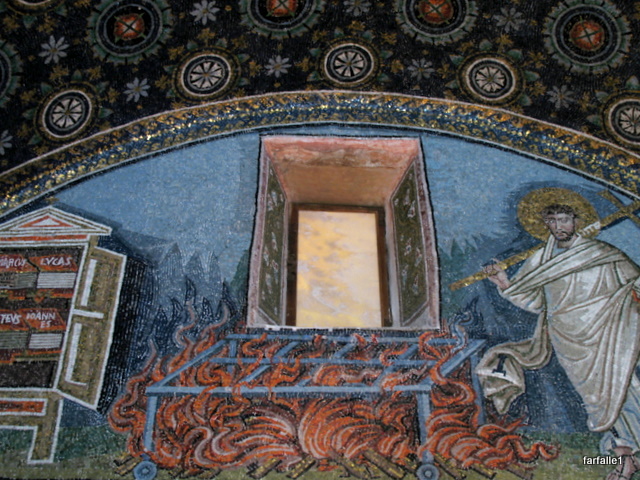
And finally – one of my favorite mosaics:

Hellfire in the Mausaleum of Galla Placidia

PS – Pat Smith has written here, in the Italian Notebook, about Orsoni, the company that makes the glass tiles that are used by many mosaicists.

PPS – Debra and Liz of the blog Debra and Liz’s Bagni di Lucca visited Ravenna in April. You can read their account and see their photos here, here, here, here, here and here.

← Older posts

Enter your email address to follow this blog and receive notifications of new posts by email.

Join 114 other subscribers

rss

Subscribe in a reader

Search the Blog

A. Useful Links

  • bab.la language dictionary
  • Bus schedules for Tigullio
  • Conversions
  • English-Italian, Italian-English Dictionary
  • Expats Moving and Relocation Guide
  • Ferry Schedule Rapallo, Santa Margherita, Portofino, San Frutuoso
  • Italian Verbs Conjugated
  • Piazza Cavour
  • Rapallo's Home Page – With Link to the Month's Events
  • Slow Travel
  • The Informer – The Online Guide to Living in Italy
  • Transportation Planner for Liguria
  • Trenitalia – trains! Still the most fun way to travel.

C. Elaborations

  • A Policeman’s View
  • Driving School Diary
  • IVA refunds due for past Rifiuti tax payements
  • Nana
  • Old trains and old weekends
  • The peasant, the Virgin, the spring and the ikon
  • Will Someone Please, Please Take Me to Scotland?

D. Good Recipes - Best of the Week winners are starred

  • 'Mbriulata
  • *Baked Barley and Mushroom Casserole*
  • *Captain’s Boston Baked Beans*
  • *Crimson Pie*
  • *Louise’s Birthday Cake*
  • *Melanzane alla Parmigiana*
  • *Penne with Cabbage and Cream
  • *Pizzoccheri della Valtellina*
  • *Pumpkin Ice Cream*
  • *Risotto alla Bolognese*
  • *Rolled Stuffed Pork Roast*
  • *Spezzatini di Vitello*
  • *Stuffed Grape Leaves*
  • *Stuffed Peaches (Pesche Ripiene)*
  • *Swordfish with Salsa Cruda*
  • *Tagliarini with Porcini Mushrooms*
  • *Tagliatelli al Frutti di Mare*
  • *Three P's Pasta*
  • *Tzatziki*
  • 10th Tee Oatmeal Apricot Bars
  • Adriana’s Fruit Torta
  • Aspic
  • Bagna-calda
  • Best Brownies in the World
  • Clafoutis
  • Cold cucumber soup
  • Crispy Tortillas with Pork and Beans
  • Easy spring or summer pasta
  • Fish in the Ligurian Style
  • Hilary's Spicy Rain Forest Chop
  • Insalata Caprese
  • Lasagna al forno
  • Lasagna al Forno con Sugo Rosato e Formaggi
  • Lemon Meringue Pie
  • Leo’s Bagna Cauda
  • Leo’s Mother’s Stuffed Eggs
  • Louis’s apricot chutney
  • Mom's Sicilian Bruschetta
  • No-Knead (almost) Bread
  • Nonna Salamone's Christmas Cookies
  • Pan Fried Noodles with Duck, Ginger, Garlic and Scallions
  • Pesto, the classic and original method
  • Pesto, the modern, less authentic method
  • Pickle Relish
  • Poached pears
  • Poached Pears
  • Polenta Cuncia
  • Recipes from Paradise by Fred Plotkin
  • Rustic Hearth Bread
  • Shrimp and Crayfish Tail Soup
  • Sicilian salad
  • Slow Food Liguria
  • Slow Food Piemonte and Val d'Aosta
  • Spinach with Garlic, Pine Nuts and Raisins
  • Stuffed Eggs, Piemontese Style
  • The Captain’s Salsa Cruda
  • Tomato Aspic
  • Zucchini Raita

E. Blogroll

  • 2 Baci in a Pinon Tree
  • Aglio, Olio & Peperoncino
  • An American in Rome
  • Bella Baita View
  • Debra & Liz's Bagni di Lucca Blog
  • Expat Blog
  • Food Lovers Odyssey
  • Italian Food Forever
  • L’Orto Orgolioso
  • La Avventura – La Mia Vita Sarda
  • La Cucina
  • La Tavola Marche
  • Rubber Slippers in Italy
  • Southern Fried French
  • Status Viatoris
  • Tour del Gelato
  • Weeds and Wisdom

Photographs

  • A Day on the Phoenix Light Rail Metro
  • Apache Trail in the Snow
  • Aquileia and Croatia
  • Birds on the Golf Course
  • Bridge Art
  • Canadair Fire Fighters
  • Cats of Italy
  • Cloudy day walk from Nozarego to Portofino
  • Fiera del Bestiame e Agricultura
  • Football Finds a Home in San Maurizio
  • Hiking Dogs
  • Mercatino dei Sapori – Food Fair!
  • Moto Models
  • Olive pressing
  • Rapallo Gardens
  • Rapallo's Festa Patronale
  • Ricaldone and the Rinaldi Winery
  • Rice Fields
  • Sardegna ~ Arbatax and Tortoli
  • Sardegna ~ San Pietro above Baunei
  • Sardegna ~ The Festa in Baunei
  • Scotland, including Isle of Skye
  • Slow Food 2008 Salone del Gusto
  • The Cat Show and the Light Rail Fair
  • The desert in bloom
  • Trip to Bavaria

Pages

  • Fagioli all’ucelleto

Archives

Recent Posts

  • A Superior Visit
  • Fun at the Ranch Market
  • The MAC
  • Welcome Tai Chi
  • Bingo Fun for Ferals
December 2025
M T W T F S S
1234567
891011121314
15161718192021
22232425262728
293031  
« Jul    

Member of The Internet Defense League

Blog at WordPress.com.

  • Subscribe Subscribed
    • An Ex-Expatriate
    • Join 114 other subscribers
    • Already have a WordPress.com account? Log in now.
    • An Ex-Expatriate
    • Subscribe Subscribed
    • Sign up
    • Log in
    • Report this content
    • View site in Reader
    • Manage subscriptions
    • Collapse this bar
 

Loading Comments...