
• Contact
  • Elaborations
    • A Policeman’s View
    • Driving School Diary
    • Great Danes
    • IVA charged on Tassa Rifiuti
    • Nana
    • Old trains and Old weekends
    • The peasant, the virgin, the spring and the ikon
    • Will Someone Please, Please Take Me to Scotland??
  • Recipes
    • ‘Mbriulata
    • *Baked Barley and Mushroom Casserole*
    • *Captain’s Boston Baked Beans*
    • *Cherry Tart*
    • *Crimson Pie*
    • *Louise’s Birthday Cake*
    • *Melanzane alla Parmigiana* – Eggplant Parmesan
    • *Penne with Cabbage and Cream
    • *Pizzoccheri della Valtellina*
    • *Pumpkin Ice Cream*
    • *Risotto alla Bolognese*
    • *Rolled Stuffed Pork Roast* on the rotisserie
    • *Shrimp and Crayfish Tail Soup*
    • *Spezzatino di Vitello*
    • *Stuffed Grape Leaves*
    • *Swordfish with Salsa Cruda*
    • *Tagliarini with Porcini Mushrooms*
    • *Tagliatelli al Frutti di Mare*
    • *Tzatziki*
    • 10th Tee Apricot Bars
    • Adriana’s Fruit Torta
    • Artichoke Parmigiano Dip
    • Best Brownies in the World
    • Clafoutis
    • Cod the Way Sniven Likes It
    • Cold Cucumber Soup
    • Crispy Tortillas with Pork and Beans
    • Easy spring or summer pasta
    • Fagioli all’ucelleto
    • Fish in the Ligurian Style
    • Hilary’s Spicy Rain Forest Chop
    • Insalata Caprese
    • Kumquat and Cherry Upside Down Cake
    • Lasagna Al Forno con Sugo Rosato e Formaggi
    • Lemon Meringue Pie
    • Leo’s Bagna Cauda
    • Leo’s Mother’s Stuffed Eggs
    • Louis’s Apricot Chutney
    • Mom’s Sicilian Bruschetta
    • No-Knead Bread (almost)
    • Nonna Salamone’s Famous Christmas Cookies
    • Pan-fried Noodles, with Duck, Ginger, Garlic and Scallions
    • Pesto
    • Pesto
    • Pickle Relish
    • Poached Pears
    • Polenta Cuncia
    • Pumpkin Sformato with Fonduta and Frisee
    • Rustic Hearth Bread
    • Sicilian Salad
    • Soused Hog’s Face
    • Spotted Dick
    • Swedish Tea Wreaths
    • The Captain’s Salsa Cruda
    • Tomato Aspic
    • Vongerichten’s Spice-Rubbed Chicken with Kumquat-Lemongrass Dressing
    • Winter Squash or Pumpkin Gratin
    • Zucchini Raita

An Ex-Expatriate

~ and what she saw

An Ex-Expatriate

Category Archives: Italian habits and customs

Hidden Charges – Part 1 of Daring Exposé of Italian Banking Practices

09 Saturday Oct 2010

Posted by farfalle1 in Italian banks, Italian bureaucracy, Italian habits and customs, Uncategorized

≈ 8 Comments

Tags

Bank charges in Italy

We have gotten so accustomed in the U.S. to banks being very open about the charges they make – not because they necessarily want to be, but because they are obliged to by law.  We’re spoiled in the U.S.!  We get free checking accounts, free credit cards, and if we go on the right day, free donuts and coffee.

It’s not as simple here (and I don’t mean just the donuts and coffee, which I have never, ever seen in an Italian bank lobby, never mind finding a bank branch in a super market or even a donut shop as you can in the U.S.). Every service the bank provides carries a charge.  It’s not that they’re hidden, exactly; we do receive a long list annually of bank services and their attendant fees.  It’s just that they are so unexpected.  We see them on the quarterly statement (quarterly!) that the bank provides… for a fee of E 5.70 every two months (actually, this fee is for the stamp that attests that the account is… what?  is something!  Correct? Still there?).

There’s a mysterious fee on each statement which is called ‘interessi e competenze’, usually about E5 or 6.  I can’t figure out exactly what it’s for; as it’s levied only once a quarter, perhaps this is the fee for the statement.  Anyway.  To my mind ‘interest’ is something the bank pays us for being kind enough to let them use our money.  To the Italian banker’s mind, ‘interest’ is something to be charged on a checking account.

One gets Telepass, the Italian equivalent of E-Z Pass  for automated payment of highway tolls, at the bank (I know!  Why??!) and it’s easy to arrange to have your tolls deducted right from your account.  Back when we first started with Telepass we had to pay a monthly fee for that convenience.  Fortunately in the last few years that fee has been dropped.  However, the bank gets a commission on your Telepass charges; not a lot (about 1.50 on our last statement), but still.

My favorite charge is the one we pay every month for the privilege of accessing our account online.  That’s E2.  Each month.  However, if we make two bill payments in one month  through online banking, the fee is waived for that month.  We’re not always able to do that, as not many places are set up for automated payment in this manner.  Recharging the cell phone credit is one good way to accomplish this mission, though.

Things are better than they were.  Of the 61 activities listed for a checking account for which the bank could charge, the 2007  list of applicable charges      reports 30 have been repealed and another 13 are listed with a charge of 0.  That leaves a mere 18 activities which carry charges.  It just happens that they are the very things many people do on a regular basis – use Telepass, access the bank online, carry a debit card.  To give them credit though (ha ha), they do not charge a per-use for the debit card.

I guess we shouldn’t complain.  The banks are open Monday-Friday from 8:30 to 12:15 and again from 3:45-4:30 – that’s real convenience!  The ATM’s, which we use to transfer US money to Italy (the easiest way to do it, and what we recommend to all traveling friends), frequently work, which is handy. That’s an improvement from ‘sometimes,’ which was the best they could do a few years ago.  In fact, I’ll give a little free advertising here to Deutsche Bank – their ATM’s always work (well, almost always), even when every other bank in town is spitting our card back with a suggestion to call our bank.

Bottom line?  Banks do very well in Italy.  You might want to invest in one!

Il Molino Vecchio – The Old Mill

26 Sunday Sep 2010

Posted by farfalle1 in Italian folk tales, Italian habits and customs, Italy, Liguria, Photographs, Rapallo, San Maurizio di Monti, Uncategorized

≈ 20 Comments

Tags

Chestnut mill, Chestnuts, Giovanni Pendola, Italian frantoio, Italian molino, N.S. della Cipressa, Old Italian mill, Olive mill, Wheat mill

Sometimes it happens in Italy that you’re walking down a street, a lane, or a path in the country, and you come upon something that sends you back, in your mind’s eye, a few hundred years. “I can just imagine,” you say to yourself, “what it would have been like to be alive when this place was new and bustling with life.”

It happened to me not long ago when I took a walk with a friend. We came to the old and interesting Complesso Molitorio (Mill complex), which lies on a sentiero (walking path) that connects San Maurizio di Monti to Rapallo along the San Francesco torrente (fast flowing stream), on the opposite side of the narrow valley from the paved road.  The sentiero is not particularly well known, and does not appear on the trails map for this area. To reach it from San Maurizio you walk down what begins as an ever more narrow residential street, which finally turns itself into a path. From Rapallo the route begins on a paved street but soon takes the form of an old mule path which climbs and winds through the forest. According to the website lacipresse.it, the path is known as “Strada Antica di Monti,” a part of the “Antica Via del Sale” (The Old Salt Road – why there was a Salt Road here I have not been able to learn).

The Mill complex is comprised of four buildings, three of which you can see in the photo above. The large building in front was constructed in the 17th century and was an olive mill. A wheat mill was housed in the smaller building on the left; and the small building up above the others was a chestnut mill. The fourth building, not much more than a room really, is behind the large main building, and was used for collecting the refuse of the olive pressing.

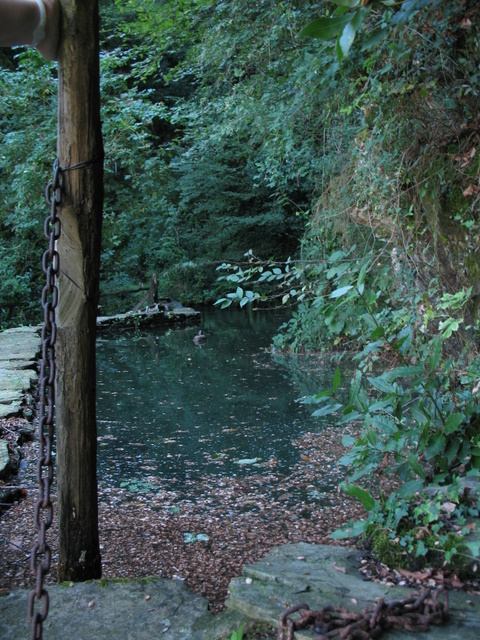
The San Francesco feeds a mill pond above the highest building:

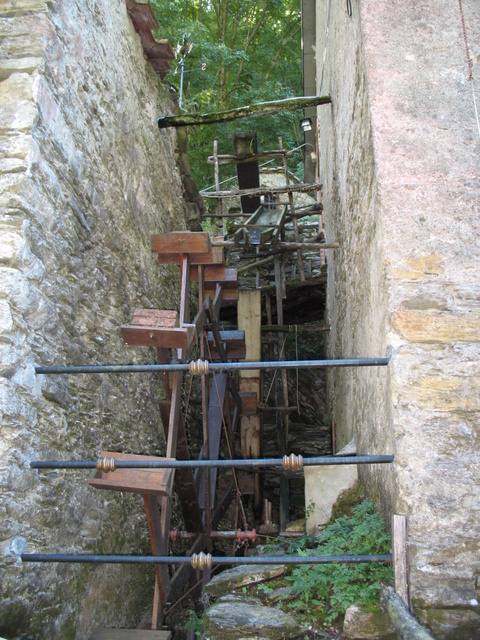
The water can be directed down an earth and stone canal to tumble into the waterwheels that powered the various milling operations:

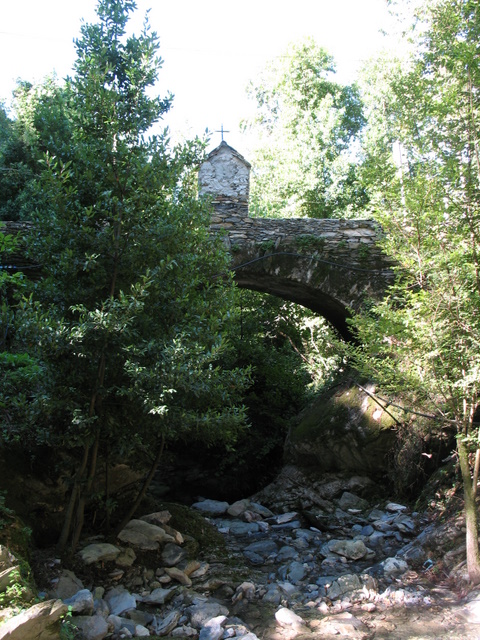
The oldest structure in the complex is the old stone bridge that crosses the San Francesco, built in the Roman style, quite possibly during Roman days.

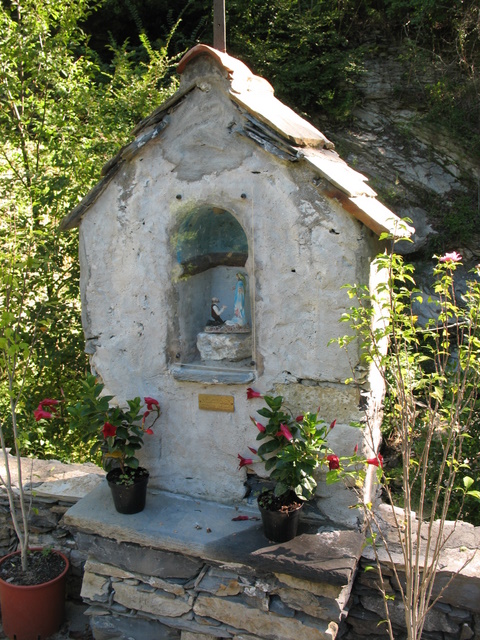
The little chapel on the bridge, a recent addition, honors the Madonna of Montallegro and is called Nostra Signora della Cipressa.   According to the story, there was a chestnut tree that stood nearby. One day, during the plague years, the tree suddenly died – in just the one day! The belief is that the tree, through the intercession of the Madonna, absorbed the deadly disease and rendered it harmless, thereby saving the citizens of San Maurizio di Monti. (For more about the Madonna of Montallegro and the plague, see here).

There have been several re-structurings of various elements of the complex, including one in the early 18th century, one in the 1920’s, and another in the early years of this century . During the recent renovations the large building was turned into a museum, Il Museo della Civilta’ Contadina “Cap. G. Pendola” – the Museum of Rural Culture (named in honor of Giovanni Pendola, a heroic Captain in Garibaldi‘s Army). In it you will find old implements that farmers employed to wrest a livelihood from these steep hills, as well as accouterments of the mills themselves. It is open on the third Sunday of each month from 3 – 5 p.m., at which time a very well informed docent can explain the uses of the various tools, and tell about each of the buildings. (The renovations in 2001 won Second Prize in the 2003 Concorso  “Ama il nostro paese” – love our country – sponsored by the City of Rapallo and the Rapallo Lions Club.  In 2006 the Complex was designated a National Monument.)

Some centuries before our mill, but I like the image!

Although the mill was still functioning as late as 1940, it is much more fun to imagine what it would have been like in, say, 1750. You’ve gathered all the chestnuts in your part of the woods, have dried them over a smoky fire and have thrashed them out of their husks.


Now you put them in barrels that are firmly strapped, one on each side, to your mule. Slowly and carefully the two of you make your way up the path, your mule finding a careful foothold between the upturned stones on the steep parts of the road. You hear the mill before you see it; the water is rushing down the canal and the big wheel is squeaking a little as it turns. When you get a little closer you can hear the big gears groaning and clicking as they engage. There are a lot of other people there with their chestnuts, too. Chestnut flour is a staple, and a good crop might form the basis of your family’s diet for much of the year. (For an interesting article on historical food uses of chestnuts, look here.) While at the mill you have a chance to exchange gossip with neighbors you haven’t seen for a while and to catch up on the news of the town below. After you’ve left your chestnuts to be ground into flour, you might continue up on the mountain to give thanks at Montallegro for a good harvest, and to ask the Madonna to protect you through the short winter ahead.

There’s another great story associated with the mills. The present owner’s grandfather, the  Giovanni Pendola for whom the Museum is named,  was the owner of the mill in 1907 when he went to Genova to take aid to the victims of a cholera epidemic there. He contracted the disease himself, and died soon afterwards. His true love, a lady named Caterina who was, they say, still beautiful, lost her will to leave her house when she received the news of his death. Then, taken by an irresistible urge for freedom, she became a wild creature of the woods.

Painting by Patrick Soper, soperstudio.com

Still today, disguised as a fox with a soft tawny tail, she wanders during the coldest days, “those of winter when the cold north wind blows, or when windy gusts blow the last dry leaves, and the bare, rattling branches of  trees reach to the sky like imploring arms.” The tradition says that if you meet this fox and look into her eyes, you may lose your memory or be swallowed up by the woods.

If you’d like to see some more pictures of the mill, click here.  Click on ‘slideshow.’

Many thanks to the website lacipresse.it, from which I learned the content of this post.

Patience

06 Monday Sep 2010

Posted by farfalle1 in Italian habits and customs, Uncategorized

≈ 16 Comments

Tags

Lines in Italy, Waiting, Waiting in Italy

Patience is a virtue,
Posess it if you can.
It’s always found in woman
And seldom found in man.

My aged granny taught me that little bit of doggerel about a hundred years ago.

Patience.  If you are dreaming about moving to Italy, or even just having a visit here, it is a virtue you might want to cultivate.  One must wait in lines for everything here, from the Post Office to the Train Station Ticket Counter (allow extra time if you need to purchase train tickets at the station) to, always and ever, the food stores.  I’m always amazed at how patient everyone is as they shuffle slowly forward in whatever line they’re in.  Once a friend came late for tea, telling us that she had had to wait an hour at the Post Office.  An hour.

This is something that’s hard for Americans to wrap their heads around.  If there are more than three or four people ahead of us at the supermarket we become restive – quick! Open another register!

But with a slight attitude shift the lines and the waiting become rather fun.  First, they give a great opportunity for people watching.  Second, they give you the chance to remember the thing you forgot to get (if you’re at the market).  Third, they give the time to practice what you need to say in Italian (at the Post Office).  If you’re into meditation, the line is a great place to zone out and ommm for a while.

Also, the take-a-number system employed by many stores, offices and (hallelujah!) the Post Office now ensures that people are served in the order in which they arrived… or at least in the order in which they thought to take a ticket.  There’s something demoralizing, however, in taking a ticket at the deli counter and realizing that there are 18 people ahead of you.  But it’s better than the unchecked chaos that used to reign.

At the top is a photo of all the people waiting to check out at a nearby Ipercoop.  Granted it was a Sunday, so the store was quite crowded.  Che casino! as they say here – what a mess.  There were trolleys every which way, people with hand baskets and strollers trying to navigate through the lines, other people trying to sneak into the middle of a line.  What an adventure.  The postures of the women in the foreground tell the whole story: these are not people who are moving smartly along; these are people who are waiting.  What I said above about the waiting being fun?  I lied.  It really isn’t all that much fun, especially if it drags on for 20 minutes, as in the picture above.

Old Dogs, New Gardening Tricks

19 Saturday Jun 2010

Posted by farfalle1 in gardening, Italian habits and customs, Italy, Liguria, Rapallo, Uncategorized

≈ 6 Comments

Tags

Fascie gardening, Gardening in Narrow Strips

When in Rome, do as the Romans – how many zillions of times have we heard that expression?  Enough to be thoroughly sick of it, for sure.  Wouldn’t you think that after all the repetition the meaning of that irritating nostrum would’ve sunk in?  Well, in terms of the garden, this year it finally did for us… after a mere eight years.

We’ve served our time trying to pry vegetables from the rocky New England soil, and were more or less successful, depending upon how early in the season our enthusiasm flagged.  But New England has nothing on Italy when it comes to rocky soil.  Here it might be more appropriate to call it soily rocks, at least in our mountainous zone.  Doesn’t matter.  Make a cutting of something, anything, drop it in the ground here and it will probably grow very happily.

Which reminds me of a funny digression.  We lived for years in the Icebox of Connecticut, not far from the much larger Torrington, a manufacturing town with a large Italian population.  One day my husband brought a client from Torrington over to see our garden.  This gent, a gnarly, deeply tanned gardening pro took one look at our efforts and said, “You’ve got too many stones in your garden.”  “Well, how should we get them out,” my husband asked.  “That’s easy,” the old fellow replied.  “Every evening send your wife out and tell her to take all the stones out of one row.  Soon enough she will have done the whole garden. Then she can start over.”  I took a dim view of this plan, and it was never put into effect.

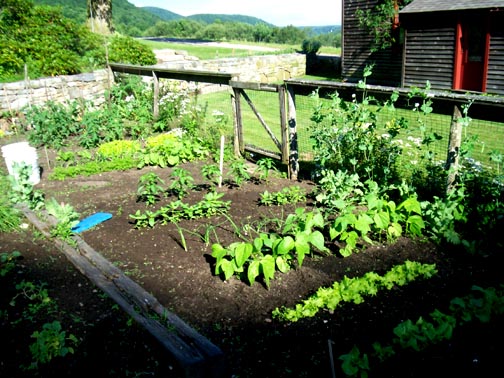
Anyway, it was not difficult to adjust to the soil conditions here, and we blithely chose our largest fascia (terrace) for our vegetable garden, and for eight years planted much as we were accustomed to in New England: in rows like this

(This is a photo Hatsy Taylor took of her veggie garden in East Canaan, Conn, which she has kindly allowed me to use.)

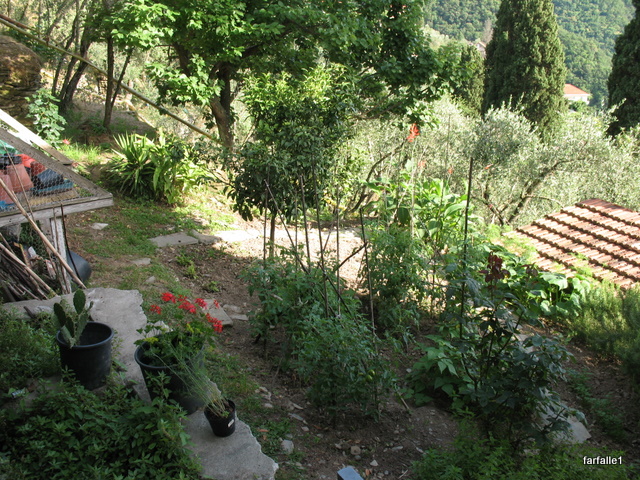
The problem was that our largest fascia is too shady. (We have six fascie, measuring anywhere from 3′ – 20′ in width; most are about 9′.)  For starters there is a large palm tree that takes a lot of the morning light.  Then we planted an orange tree right in the middle of the space because it is pretty there – more shade.  The house blocks the sun from mid-afternoon on, so all in all our poor veggie garden got about 3 hours of sun a day.  Nonetheless we were able to grow enough tomatoes to make all the sauce we need for a year, as well as a pumpkin or two, some cukes, beans,  lots of herbs, some roses and flowers for cutting.  We were never successful with zucchini, oddly – probably due to the amount of shade.

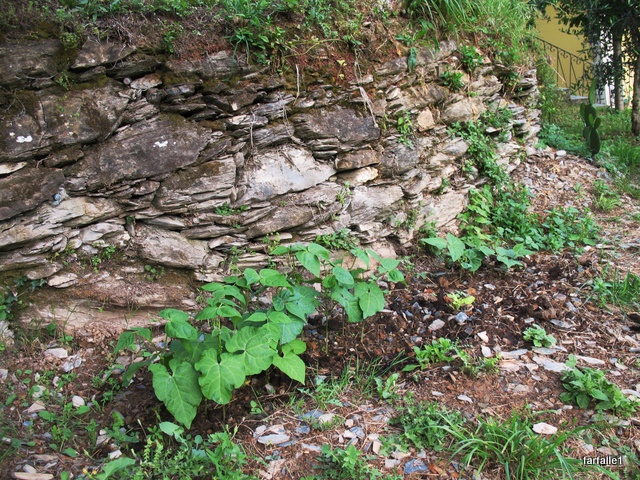
Our neighbors here on the steep slopes of Montallegro use their limited fascia space so intelligently.  They plant narrow strip gardens facing the sun, just in front of the stone wall that supports the fascia above, sometimes even under their olive trees, which make only dappled shade.  It makes so much sense!  The wall behind offers support and holds and reflects the sun’s warmth.  Weeding is ever so much easier (should one actually decide to do it) because every ‘garden’ is one, or at most two, rows deep.

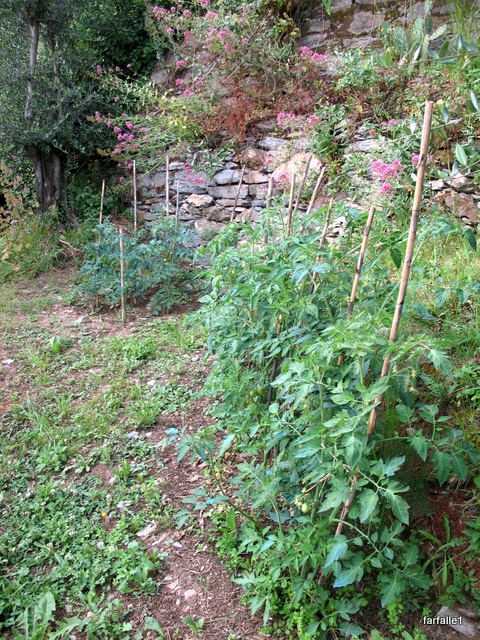
This spring the Captain took a pickax to the land in front of our sunny walls, and we now have four new strip gardens.  On the top level we have two plots of tomatoes.

They are growing like crazy  – partly because of all the rain we’ve been getting, but also because they love the warm soil in front of the wall.

The next level down is not so satisfactory.  The ground was stonier than normal, so it was hard to make a good bean bed.  The ones that came up (both bush and pole) are doing fine, but probably only 30% germinated, in spite of a healthy dose of bagged manure. (moo pooh?)

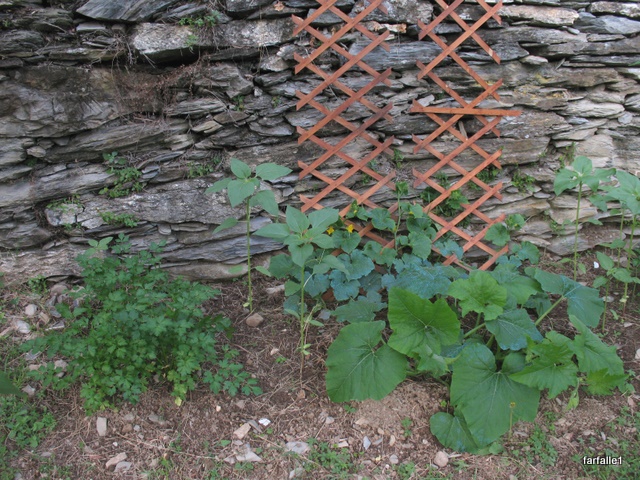
The next level down is my favorite because it is so mixed.  In one spot are three leftover tomato plants.  Then there is a small strip with cucumbers climbing the trellis that used to keep Luciano from wandering off our terrace, with some bushy pumpkins in front.  Parsley flanks these climbers, with some giant sunflowers thrown in just for fun.

None of it looks like much now, but it’s all growing by leaps and bounds.  Already  teeny tomatoes and cucumbers have formed, and every day each plant looks about 6″ taller.

So, what’s happening with the old garden?  The Captain planted a lot of ground-cover, but the seeds all washed away in the two weeks of rain that followed; we’ll replant, probably in the fall.  He also has constructed an elegant new compost area, and has almost finished a new potting table.  It will be a cool and shady area in which to relax on all those hot summer days we’re waiting for.  Thyme, marjoram, mint, sage and rosemary are still happily ensconced there.  Dill, cilantro and basil like it hot, hot, hot, so they are growing in pots on the terrace.

By the way, there’s another family that’s doing some interesting gardening this summer, but I see that with their luxury of flat space they are using the more traditional layout:

I’m guessing Michelle and Barack have a bit more help with their garden than we do with ours.  Yes, our new garden strips are working really well, but yes, it’s a lot more work to get water to four places instead of just one.  But you know what they say… when in Rome…

Where there’s fire, there’s smoke…

04 Friday Jun 2010

Posted by farfalle1 in Customs, Italian bureaucracy, Italian habits and customs, Uncategorized

≈ 7 Comments

Tags

agricultural burning

At least that seems to be the case in Italy.  And there are plenty of fires. About a year ago I wrote about our neighbors’ smoke and how distressing it was.  Things have not improved.

The other day the Captain returned from a day at his labors to find a very unhappy Expatriate.  Our neighbors below began burning about 7 in the morning, and continued non-stop until 8 that evening.  We wouldn’t mind a bit if they would move their burn pile, but they persist in burning immediately below our terrace… to the point that we suspect they are doing it on purpose (oh how suspicious we are!).  The smoke envelops and seeps into the house and soon everything smells smoky and some of us get sore throats.

The Captain, after barking down at the neighbor and receiving some barking in return, decided that Enough was Enough.  The next day he visited a friend at the Police Station and was given the supposed rules for burning.  They are strict to say the least: one may burn between midnight and 6 a.m.  One may not burn less than 50 meters from another building.  One may not burn at all in July and August.  And my favorite: one may not produce any smoke from one’s fire.  Amen to that impossible rule!

Photo courtesy of http://www.skyblu.wordpress.com

Regulation in hand the Captain sought out our neighbor S.  It is his land that surrounds us, and his cuttings that are burned under our noses, though it is not he who does the actual burning.  That is done by his brother-in-law and sister.  The Captain waggled the rules under Sandro’s nose and said, “Listen.   We don’t care if you burn from dawn to dusk, but please just move your pile so that our house is not engulfed in smoke for days at a time.”  “I’m not the one burning,” replied S helpfully.  “I know,” said the Captain, “but you are the family’s representative aren’t you?”  Bingo.

Photo courtesy of http://www.lucanianews24.it

S took a look at the regulations and said, “Ah, but these don’t apply to us because we have an ulivetto, and we are allowed to burn whenever we want to maintain the orchard.  And it’s not the police, but the Forestale (forest rangers) who regulate this kind of burning.”  We’ll see about that, thought the Captain, and the next day marched down to the office of the Forestale in Rapallo, only to find that they receive the public only on Fridays from 9 to 11 a.m.

Except they don’t.  He returned on Friday, and the office was locked up tight as a drum.  Numbers for the Chief are posted, both cell and fax, and the Captain tried to send messages to both, but thus far we have heard nothing in response.

So we find ourselves in the midst of another Italian conundrum.  Who does regulate the burning?  What are our rights and responsibilities as neighbors and as burners ourselves?  A friend has suggested that it may be even more complicated than we think: there may be European Union regulations that come into play.  How exciting!  Maybe we can start an international incident.  In the meantime, there has been less burning down below since the great kerfuffle, and we have been able to enjoy the early summer breezes wafting through open windows.

Polizia Stradale

21 Friday May 2010

Posted by farfalle1 in Driving in Italy, Italian habits and customs, Law and order, Uncategorized

≈ 12 Comments

Tags

Carabinieri, Highway safety in Italy, Polizia Stradale, Speed traps in Italy

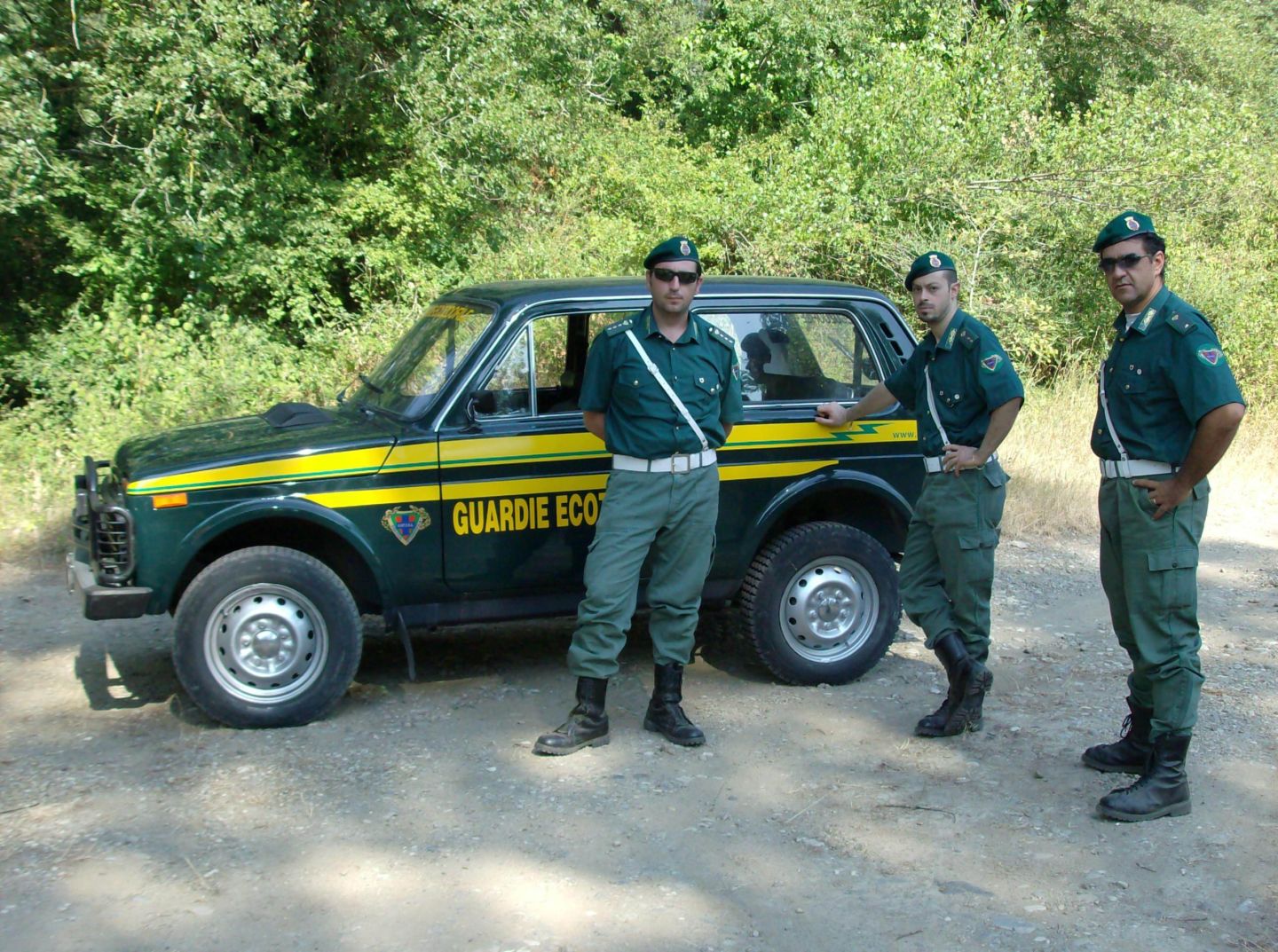
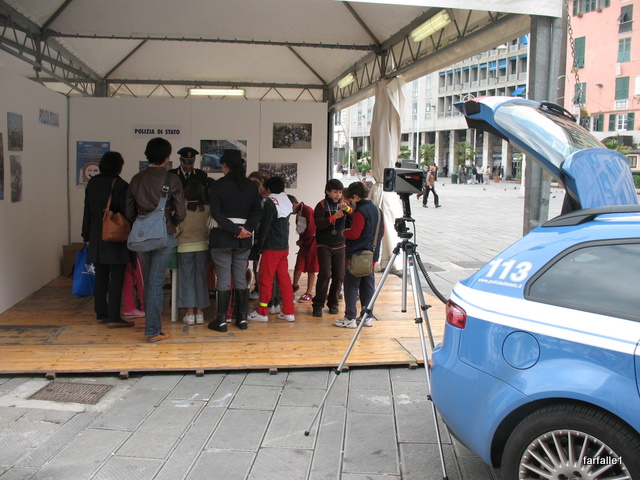
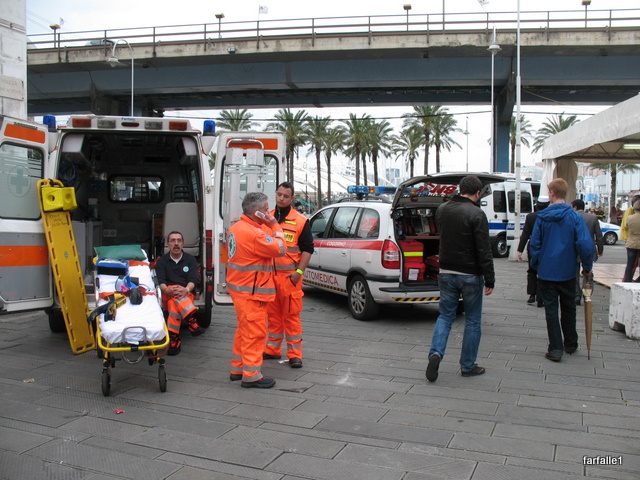
While we’re on the subject of police, which we were very briefly in April, it seems the Italian police are making a huge public relations effort just now.  Our guest and I made a day trip to Genova last week, and among the many delights that city offers we stumbled upon a Road Safety Exhibition at the seaside near the Palazzo San Giorgio.  The Carabinieri and the Polizia  Stradale were there in numbers, including this gentlemen entertaining a group of youngsters.  Behind the auto’s open hatch is a radar speed gun which can be used either from a stationary position or from a moving police car.  Bah!  The autostradas now have a nasty thing called Tutor, which is a fixed speed gun mounted to various bridges, etc.  But this little item below is really mean – it can get you coming or going.

Part of road safety, alas, is the ambulance service.  Finally the young fellow on the right below was able to answer our confusion about all the different colored Crosses – Croce Rossa, Croce Bianca, Croce Verde (Red, White, Green)- all of which seem to operate ambulance services in and around Rapallo.  The Red Cross is affiliated with the International Red Cross and is a professional outfit; some of the participants are paid.  The Croce Verde and Croce Biancha instead are all-volunteer organizations.  Just to make things more complicated, there is also a Croce Rosa (Pink Cross), also volunteer; I don’t believe they operate in our area (please tell me if you know otherwise!).  A few years back I needed a quick trip to a hospital.  I can’t tell you which color cross came to cart me off, but whoever they were, they were fantastic.

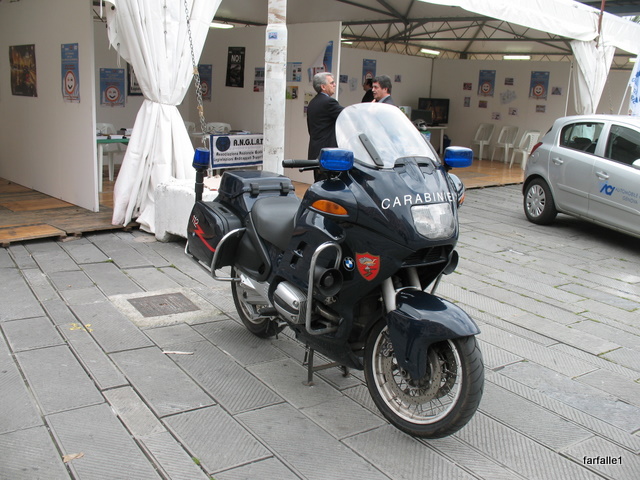
Just a cotton-pickin’ minute…  Why are the Carabiniere on BMW’s?  Can’t Ducati or Bimota or Cagiva or Moto Guzzi make a good enough cycle for our national police??

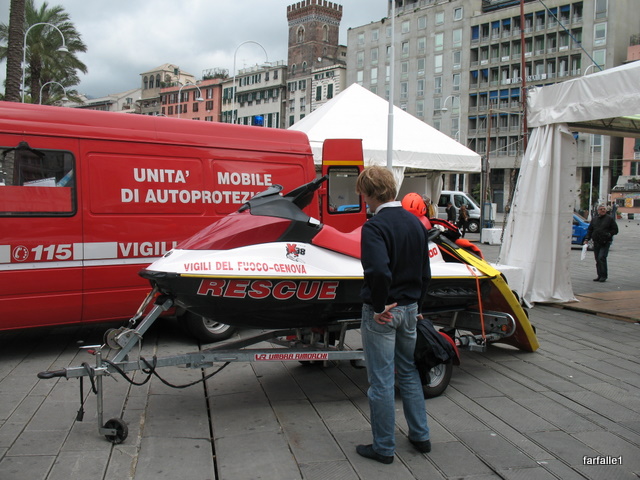
Only by the sea will you find fast floating rescue vehicles like the jet ski below, this one under the auspices of the Fire Department. Personally I never think of boats catching fire, but evidently they do.  There were 42 serious fires/explosions on boats in 2006, just in the U.K!

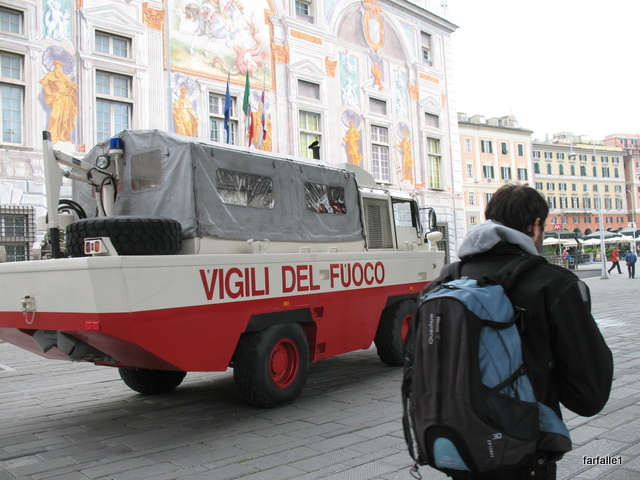
This was my favorite exhibit, though.  It’s another fire department truck that is also a boat!  Wouldn’t that be fun?  (I want one, after I get my car that turns into an airplane…).  When the baby below blew her horn we jumped out of our skins – think of standing inside a foghorn and you’ll have the general idea.

We arrived at the Expo at about 12:30 p.m., which by sacred decree is part of Italy’s lunch hours, so there were not many people visiting the Expo.  That was good for us, because we got to speak with the people in the booths.  It’s great to see the Police of all stripes making an effort to educate and to be friendly and helpful.  Even if they do have those @#$! speed guns.

Such a good idea…

13 Thursday May 2010

Posted by farfalle1 in Italian habits and customs, Italy, Uncategorized

≈ 16 Comments

Tags

Cleaning products, Clothes washing soap, Dish washing soap, Neutral, Packaging, Plastic recycling

Do you cringe every time you toss a huge plastic soap container into the trash or the recycle bin? I do, a bit, because I think how much plastic is discarded every day and what a problem it is to dispose of it all, even with good recycling in place. (According to the Clean Air Council, 2.5 million plastic bottles are thrown away every hour… just in America! One-third of American waste is packaging.)

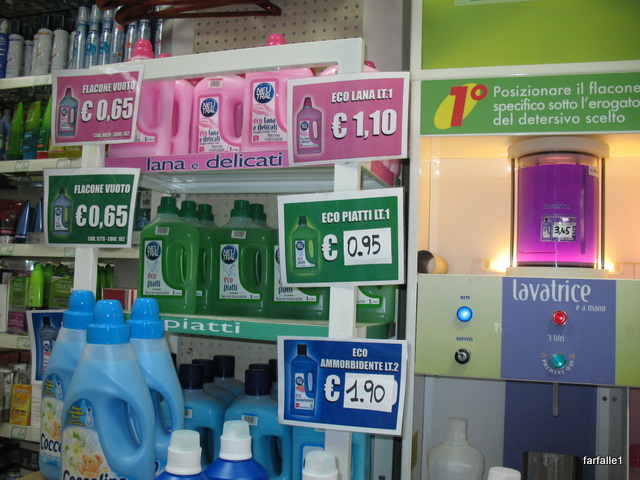
What a pleasure it was to walk into the local IperSoap store (where you can find the elusive dusting wands I crave) and see a new display for something called Neutral:

What a great idea! You buy the plastic bottle one time, and then take it back to the store to be refilled with your cleaning product. I bought the hand dish-washing soap, and while it’s not the best I ever used, it’s better than the inexpensive stuff I usually settle for. So far they seem to sell just dish and clothes washing products, but that’s a great start, since those products usually come in really big plastic bottles.  As you can see, the product itself is not very expensive.

I hope there will be more of this in the future. There are so many things that could be sold without fresh packaging every time.  Here in Italy we use about a thousand different cleaning products (and spend a lot of time cleaning)… so it would be great to see more products sold this way.  We’d be doing old Mother Earth a great big favor.

Passo Carrabile

05 Wednesday May 2010

Posted by farfalle1 in Italian bureaucracy, Italian habits and customs, Italy, Uncategorized

≈ 20 Comments

Tags

Garbage tax, Italian taxes, IVA on Rifiuti, Passo Carrabile, Rifiuti tax, taxes, Taxes in Italy

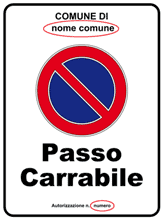
photo courtesy of areablog.net

It’s silly season for Italian taxes.  In the last couple of weeks we’ve received the Rifiuti tax and the Passo Carrabile tax.  I don’t know why paying for garbage removal is a tax and not a service fee, but that’s what it is. (There’s been a nice lawsuit on this subject; it has resulted in eligibility for an IVA refund for rifiuti tax payers.  Read more about that here or in Elaborations on the right). The rifiuti tax costs about the same here as it used to cost us for a year of garbage pick-up at our home in Connecticut, roughly E350.  The difference, of course, is that in Connecticut the garbage man came to us; here we walk to the Cassonetto di Spazzatura (which, by the way, the Captain thinks is the most sonorous of Italian phrases).  This one we have no problem with because we are getting good service for our money (and yes, we do get good garbage pick-up service).

No, the one we have trouble with is the tax for our Passo Carrabile. It’s an Italian concept, handled as only the Italians would handle it.  ‘Passo Carrabile’, according to the Oxford web translator means ‘driveway,’ but it actually means any alley, drive or portal that must left accessible for the owners.  In other words, don’t park here, buster.

In the U.S. it seems common sense applies more often than not – if there’s a driveway, one knows not to park across its access to the road.  If there’s a store that needs access to get goods in and out, a simple ‘No Parking’ sign, available for not much money at any hardware store will do the trick.  Easy!

Well, you won’t be surprised to learn it’s a little more complicated here.

About three years ago we built, at no small expense, a small parcheggio on the side of the road above our house.  It was a complex project involving many permits, an engineered plan, checks by various officials during construction, new walls, etc.  In fact, the file I have for “Parcheggio” is three times thicker than the file called “House Reconstruction.”  Why the added fuss?  Because we were building something attached to a public road.  In our innocence we thought that The State would be thrilled with one less car parked on a narrow, crowded road.  And insofar as permits were forthcoming without much delay, evidently they were.

But, as the saying goes, No good deed goes unpunished; and we are punished every year for our parcheggio.  Because it opens directly on the road we are obliged to post Passo Carribile signs so that no one will park in the middle of the road.  Seems obvious to us that no one would, especially since cars park on the other side of the street, making it impossible for more than one vehicle to pass through at a time.  A car parked adjacent to our parcheggio might completely block the road.  However, we have access to the street, so we must pay the tax.  Apparently it is based on how many feet of opening you have on the street.  Because of the steep terrain here, our parcheggio runs horizontally along the road, not perpendicular to it.  We have a lot of street frontage, and we pay accordingly.  Last year the Captain went to the appropriate office and said, “We don’t want a Passo Carrabile,” but he was told that because we’re on a public way we are required to have one.  And what does it cost, you may ask?  About the same as it costs to have garbage service.

So every year we pay for making the street we live on incrementally safer and easier to transit.  Oh well.  Italy is a taxing kind of country, and this is the season of silly taxes; probably the tax collector is laughing all the way to the bank.

At the Table

10 Wednesday Mar 2010

Posted by farfalle1 in Customs, Food, Italian habits and customs, Uncategorized

≈ 11 Comments

Tags

American Table Manners, Eating in Italy, Italian Eating Customs, Italian Table Manners

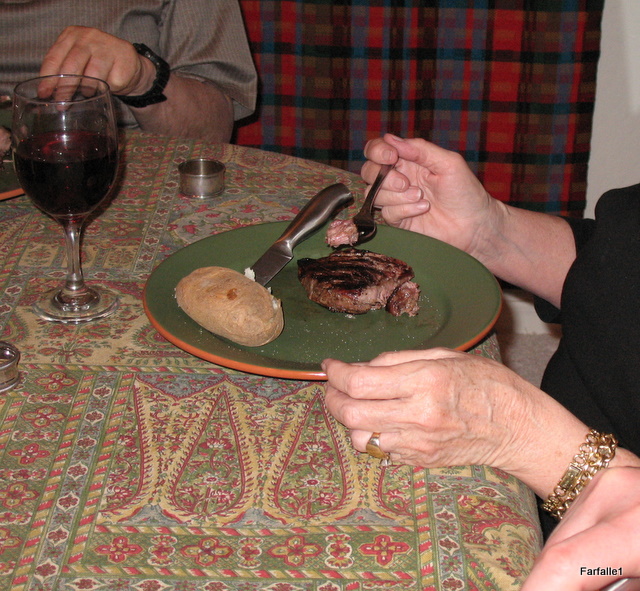
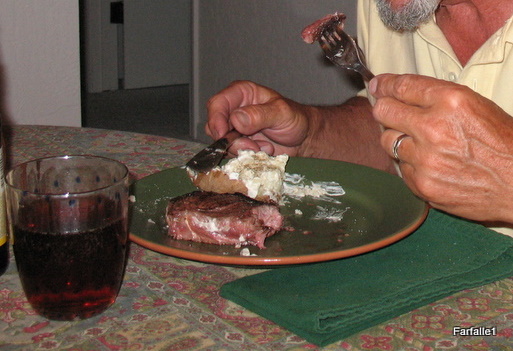
There are many dining differences between the U.S. and Italy, but some of them are rather subtle.  The food is the first and most obvious, with the dining hour a close second. Holding the fork in the left hand to eat after cutting food is also the common Italian practice, as it is in much of Europe… much more efficient than the American practice of shifting the fork from right hand to left to cut meat, say, then shifting it back again to the right to eat politely.

How much more sensible to just spear it with that fork, saw off a hunk, and ahhhhhhh.

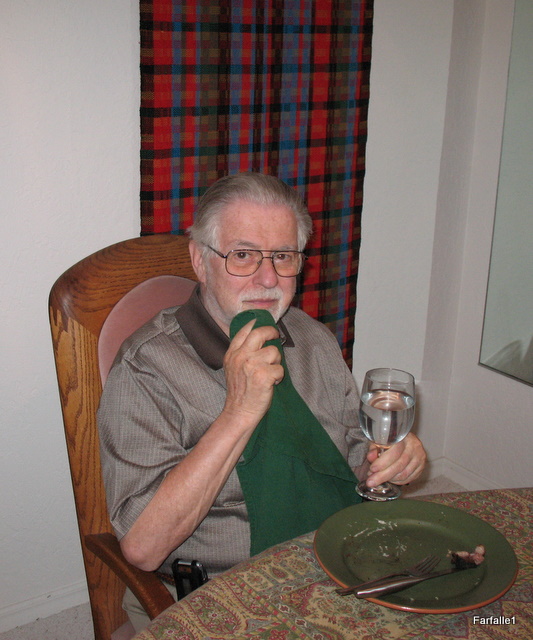
There are otherItalian dining customs that we have learned about only slowly.  The hands on the table for instance; in the U.S. it is considered polite to keep your non-working hand in your lap and your elbows off the table.  In Italy this is highly suspect – just what do you have in your hand that you don’t want your fellow diners to see?  No.  The unoccupied hand should rest, fist gently closed on the edge of the table, where everyone can see what you’re up to.  It’s not unusual to see people rest the whole arm on the table, from near elbow to fist.  Our hand model in the first photo above is illustrating a hybrid of the two practices, eating with her fork in her right hand (American) but resting her left paw on the table (Italian).

Thirsty?  Hang on a second.  Don’t just pick up your glass and drink; you’ll get food residue on your glass.  Instead you want to wipe your mouth with your napkin, then take a sip.  Then wipe your mouth again.


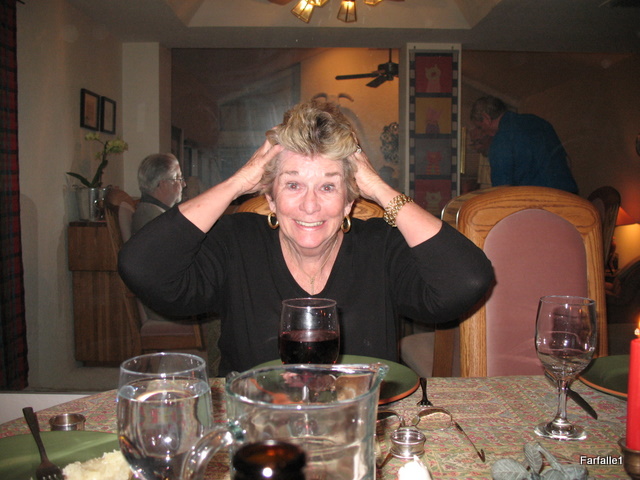
Perish the thought you should get an itchy scalp during a meal.  In Italy it is considered bad manners to touch the hair while eating.  I’m not exactly sure why this is so.  It’s not like you’re running your fingers through your hair and then sticking out your hand to shake with someone else (we see golfers do this all the time at the end of matches – ick!). But then, I’m not sure manners always make a great deal of sense.


(It’s no wonder our patient model wants to pull her hair out – this is about the 6th time I’ve said to her, “Wait! Wait!  Let me take a picture of that!”  Makes it hard to enjoy the food…)

Dinner’s done and it’s time to clear the table.  In the U.S. it is not unusual to make multiple trips to the kitchen carrying two items at a time – it’s not polite to stack plates, we were taught.  I’m happy to say that this work-inducing custom does not exist in Italy.  Everyone, from the very talented waiters in restaurants to the maid serving a fancy private dinner, will stack the plates before staggering out to the kitchen with them: another triumph of common sense!

Time for fruit.  Wait!  Don’t pick up that fruit with your hands!  In Italy we cut our fruit with knives and forks, and eat it with forks.  And it’s best not to eat the skin – just cut that off as well.  You never know what might be on it, even if it has been well washed.  It is a joy to watch an Italian delicately separate the skin from, say, a pear, and tidily eat – it’s an art form. This is a skill I have not yet mastered.  I still like to eat my apples the American way, cut in quarters and enjoyed from the hand.

Care for a cafe?  Well, okay.  I won’t join you, because I don’t care for it myself, but I’d be happy to make you some.  Just remember that in Italy, coffee after dinner means espresso.  Period.  It does not mean cappuccino, which typically is drunk only in the morning, or any of the other myriad Italian coffee styles.  It means a short, dark and very strong espresso.

I’m grateful to the students in my adult ESL classes of a few years ago for teaching me these niceties. There are probably a lot of other customs of Italian dining I’ve omitted – any additions, fellow bloggistas?

Dinner at Eight

17 Sunday Jan 2010

Posted by farfalle1 in American habits and customs, Customs, Italian habits and customs, Italy, Uncategorized

≈ 9 Comments

Tags

American dinner hour, Eating in Italy, Italian dinner hour

There are some differences in living habits between the US and Italy that are just plain hard to get used to. For us, coming back to the States for a while, it is very hard to get used to the fact that most people eat dinner at 6 o’clock, or earlier. There’s a restaurant down the street from us here, and when I drove by at 4:45 yesterday evening the parking lot was jammed with cars. Everyone was there for a 5 o’clock dinner (All You Can Eat Fish Fry on Wednesdays and Fridays – another concept that would be foreign and bizarre to an Italian restaurateur).

For us, 5 o’clock is the Hour of Tea, 6 o’clock is the Hour of Drink-n-Snack, 7 o’clock is the Hour of Dinner Preparation and 8 o’clock is the Dinner Hour. We’ve just gotten used to it that way, because that’s the dinner hour in Italy. In fact, away from the main tourist cities you would be hard pressed to find a restaurant that opens its doors before 8 p.m., or perhaps 7:30.

This eating schedule has a ripple effect. Last weekend my friend Margaret and I went to a play at the ASU Gammage Hall – the ‘darkly comic’ ‘August: Osage County‘ by Tracy Letts (it was great – we laughed and groaned). What time did it start? 7 p.m.! The week before the Captain and I went to a delightful John O’Conor piano recital down the street (glorious); it started at 7:30. That would never happen in Italy! When would one eat??!  Typically in Italy the cultural events are before dinner, starting at 4, 5, or even 6 p.m., or after dinner, starting at 9 or 9:30 p.m.

Why the difference?  I think (and this is pure conjecture on my part) that the early eating habits in Arizona are due to the fact that there are so many mid-western transplants here.  On a big mid-western farm you might get up with the sun and have a cup of coffee and a snack.  Then you might work for a few hours and stop mid-morning for an enormous breakfast.  Then you would work again until the sun got low (5 o’clock?) when it would be time for a hearty dinner.  Even though fewer and fewer people work on farms, I think the early eating habit has persisted.

In Italy the large meal was typically eaten mid-day with an hour or two of rest following.  Then work continued until the evening, when a much smaller meal (minestrone?) was eaten.  That is changing somewhat, especially in the large cities, as Italy becomes more an Office Culture.  But most stores and businesses are still closed mid-day and then are open again from 3:30 or 4 until 7:30 or 8, at which point it is time for dinner.

I don’t much care for the late night events any more, but it is delightful to go to a wonderful concert at 5 p.m., come out at 6:30 or 7, take a stroll through the town, find a good restaurant and sit down for a fine meal at 8 or so, a pleasure we miss when we’re in the U.S.

So, why the Dinner at Eight video above?  Well, the title is appropriate, and as a librarian I just couldn’t resist sharing Jean Harlow’s book review.  I bet everyone would like to be a member of her book club!

← Older posts
Newer posts →

Enter your email address to follow this blog and receive notifications of new posts by email.

Join 114 other subscribers

rss

Subscribe in a reader

Search the Blog

A. Useful Links

  • bab.la language dictionary
  • Bus schedules for Tigullio
  • Conversions
  • English-Italian, Italian-English Dictionary
  • Expats Moving and Relocation Guide
  • Ferry Schedule Rapallo, Santa Margherita, Portofino, San Frutuoso
  • Italian Verbs Conjugated
  • Piazza Cavour
  • Rapallo's Home Page – With Link to the Month's Events
  • Slow Travel
  • The Informer – The Online Guide to Living in Italy
  • Transportation Planner for Liguria
  • Trenitalia – trains! Still the most fun way to travel.

C. Elaborations

  • A Policeman’s View
  • Driving School Diary
  • IVA refunds due for past Rifiuti tax payements
  • Nana
  • Old trains and old weekends
  • The peasant, the Virgin, the spring and the ikon
  • Will Someone Please, Please Take Me to Scotland?

D. Good Recipes - Best of the Week winners are starred

  • 'Mbriulata
  • *Baked Barley and Mushroom Casserole*
  • *Captain’s Boston Baked Beans*
  • *Crimson Pie*
  • *Louise’s Birthday Cake*
  • *Melanzane alla Parmigiana*
  • *Penne with Cabbage and Cream
  • *Pizzoccheri della Valtellina*
  • *Pumpkin Ice Cream*
  • *Risotto alla Bolognese*
  • *Rolled Stuffed Pork Roast*
  • *Spezzatini di Vitello*
  • *Stuffed Grape Leaves*
  • *Stuffed Peaches (Pesche Ripiene)*
  • *Swordfish with Salsa Cruda*
  • *Tagliarini with Porcini Mushrooms*
  • *Tagliatelli al Frutti di Mare*
  • *Three P's Pasta*
  • *Tzatziki*
  • 10th Tee Oatmeal Apricot Bars
  • Adriana’s Fruit Torta
  • Aspic
  • Bagna-calda
  • Best Brownies in the World
  • Clafoutis
  • Cold cucumber soup
  • Crispy Tortillas with Pork and Beans
  • Easy spring or summer pasta
  • Fish in the Ligurian Style
  • Hilary's Spicy Rain Forest Chop
  • Insalata Caprese
  • Lasagna al forno
  • Lasagna al Forno con Sugo Rosato e Formaggi
  • Lemon Meringue Pie
  • Leo’s Bagna Cauda
  • Leo’s Mother’s Stuffed Eggs
  • Louis’s apricot chutney
  • Mom's Sicilian Bruschetta
  • No-Knead (almost) Bread
  • Nonna Salamone's Christmas Cookies
  • Pan Fried Noodles with Duck, Ginger, Garlic and Scallions
  • Pesto, the classic and original method
  • Pesto, the modern, less authentic method
  • Pickle Relish
  • Poached pears
  • Poached Pears
  • Polenta Cuncia
  • Recipes from Paradise by Fred Plotkin
  • Rustic Hearth Bread
  • Shrimp and Crayfish Tail Soup
  • Sicilian salad
  • Slow Food Liguria
  • Slow Food Piemonte and Val d'Aosta
  • Spinach with Garlic, Pine Nuts and Raisins
  • Stuffed Eggs, Piemontese Style
  • The Captain’s Salsa Cruda
  • Tomato Aspic
  • Zucchini Raita

E. Blogroll

  • 2 Baci in a Pinon Tree
  • Aglio, Olio & Peperoncino
  • An American in Rome
  • Bella Baita View
  • Debra & Liz's Bagni di Lucca Blog
  • Expat Blog
  • Food Lovers Odyssey
  • Italian Food Forever
  • L’Orto Orgolioso
  • La Avventura – La Mia Vita Sarda
  • La Cucina
  • La Tavola Marche
  • Rubber Slippers in Italy
  • Southern Fried French
  • Status Viatoris
  • Tour del Gelato
  • Weeds and Wisdom

Photographs

  • A Day on the Phoenix Light Rail Metro
  • Apache Trail in the Snow
  • Aquileia and Croatia
  • Birds on the Golf Course
  • Bridge Art
  • Canadair Fire Fighters
  • Cats of Italy
  • Cloudy day walk from Nozarego to Portofino
  • Fiera del Bestiame e Agricultura
  • Football Finds a Home in San Maurizio
  • Hiking Dogs
  • Mercatino dei Sapori – Food Fair!
  • Moto Models
  • Olive pressing
  • Rapallo Gardens
  • Rapallo's Festa Patronale
  • Ricaldone and the Rinaldi Winery
  • Rice Fields
  • Sardegna ~ Arbatax and Tortoli
  • Sardegna ~ San Pietro above Baunei
  • Sardegna ~ The Festa in Baunei
  • Scotland, including Isle of Skye
  • Slow Food 2008 Salone del Gusto
  • The Cat Show and the Light Rail Fair
  • The desert in bloom
  • Trip to Bavaria

Pages

  • Fagioli all’ucelleto

Archives

Recent Posts

  • A Superior Visit
  • Fun at the Ranch Market
  • The MAC
  • Welcome Tai Chi
  • Bingo Fun for Ferals
December 2025
M T W T F S S
1234567
891011121314
15161718192021
22232425262728
293031  
« Jul    

Member of The Internet Defense League

Blog at WordPress.com.

  • Subscribe Subscribed
    • An Ex-Expatriate
    • Join 114 other subscribers
    • Already have a WordPress.com account? Log in now.
    • An Ex-Expatriate
    • Subscribe Subscribed
    • Sign up
    • Log in
    • Report this content
    • View site in Reader
    • Manage subscriptions
    • Collapse this bar
 

Loading Comments...