• Contact
  • Elaborations
    • A Policeman’s View
    • Driving School Diary
    • Great Danes
    • IVA charged on Tassa Rifiuti
    • Nana
    • Old trains and Old weekends
    • The peasant, the virgin, the spring and the ikon
    • Will Someone Please, Please Take Me to Scotland??
  • Recipes
    • ‘Mbriulata
    • *Baked Barley and Mushroom Casserole*
    • *Captain’s Boston Baked Beans*
    • *Cherry Tart*
    • *Crimson Pie*
    • *Louise’s Birthday Cake*
    • *Melanzane alla Parmigiana* – Eggplant Parmesan
    • *Penne with Cabbage and Cream
    • *Pizzoccheri della Valtellina*
    • *Pumpkin Ice Cream*
    • *Risotto alla Bolognese*
    • *Rolled Stuffed Pork Roast* on the rotisserie
    • *Shrimp and Crayfish Tail Soup*
    • *Spezzatino di Vitello*
    • *Stuffed Grape Leaves*
    • *Swordfish with Salsa Cruda*
    • *Tagliarini with Porcini Mushrooms*
    • *Tagliatelli al Frutti di Mare*
    • *Tzatziki*
    • 10th Tee Apricot Bars
    • Adriana’s Fruit Torta
    • Artichoke Parmigiano Dip
    • Best Brownies in the World
    • Clafoutis
    • Cod the Way Sniven Likes It
    • Cold Cucumber Soup
    • Crispy Tortillas with Pork and Beans
    • Easy spring or summer pasta
    • Fagioli all’ucelleto
    • Fish in the Ligurian Style
    • Hilary’s Spicy Rain Forest Chop
    • Insalata Caprese
    • Kumquat and Cherry Upside Down Cake
    • Lasagna Al Forno con Sugo Rosato e Formaggi
    • Lemon Meringue Pie
    • Leo’s Bagna Cauda
    • Leo’s Mother’s Stuffed Eggs
    • Louis’s Apricot Chutney
    • Mom’s Sicilian Bruschetta
    • No-Knead Bread (almost)
    • Nonna Salamone’s Famous Christmas Cookies
    • Pan-fried Noodles, with Duck, Ginger, Garlic and Scallions
    • Pesto
    • Pesto
    • Pickle Relish
    • Poached Pears
    • Polenta Cuncia
    • Pumpkin Sformato with Fonduta and Frisee
    • Rustic Hearth Bread
    • Sicilian Salad
    • Soused Hog’s Face
    • Spotted Dick
    • Swedish Tea Wreaths
    • The Captain’s Salsa Cruda
    • Tomato Aspic
    • Vongerichten’s Spice-Rubbed Chicken with Kumquat-Lemongrass Dressing
    • Winter Squash or Pumpkin Gratin
    • Zucchini Raita

An Ex-Expatriate

~ and what she saw

An Ex-Expatriate

Category Archives: Italy

Church!

03 Monday Jan 2011

Posted by farfalle1 in American habits and customs, Italian Churches, Italian women, Italy

≈ 6 Comments

Tags

Catholic church, Catholic mass, Church services in Italy, Church services in the U.S.

Here’s a switch.  usually I write about my experiences as an expatriate, either in Italy, where I truly am one, or in Arizona, where I mostly just feel like one.  Our friends Elena and Michela arrived from Italy yesterday, and now I get to see our country through their expatriated eyes.

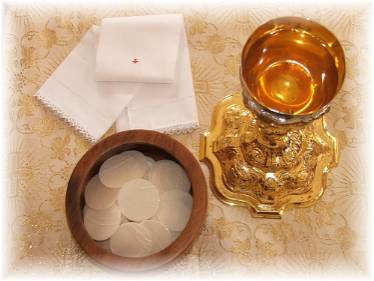
Being practicing Catholics they went to mass this morning at the closest appropriate church, the Church of the Holy Cross in Mesa which is a half hour’s drive away.  Now if only they were Mormons, Methodists, Baptists or Lutherans I could have accommodated them in a matter of a few minutes.  Don’t let the photo above fool you – the place was mobbed for 10 a.m. mass.  I had to go to a nearby shopping center to find a parking place while I waited for my friends.  There are two churches, and there was standing room only.

How was it different? I asked.  In lots of ways, it turns out.  First, in Italy going to church is mostly women’s work.  If you see a solitary man in church he is very likely a recent widower, according to Elena.  Here you see many couples and families worshipping together; it is more the rule than the exception.  And it is beyond rare in Italy to see the church packed to the gills and overflowing for Sunday mass.

In Italy the congregants are offered only the host.  Here they are offered both host and wine, either for sipping or dipping.

The wafers are thinner and yellower than those in Italy, but Elena opined the caloric value was probably about the same.

Going to the altar for communion can be very disorderly in Italy with everyone getting as close as they can as fast as they can.  Likewise, people come and go at will, frequently not remaining for the whole mass.  At the service today Elena observed that everyone formed a line to take communion, and each person patiently awaited his turn.  No one left early.

She was enthusiastic about the music, which was almost like a concert.  Everyone sang!  In Italy only a few wurbley-voiced matrons participate, but here the singing was hearty and heart-felt.

So what were the impressions she came away with in general?  She was impressed by the number of people and the active and orderly participation in all parts of the service.  But she found herself wondering if there was the same spirit of joy in today’s mannerly congregation as she frequently sees in the smaller masses of her home church in Italy.  She couldn’t say yes, or no, but it was an interesting question for all of us.

It’s Your Responsibility

03 Friday Dec 2010

Posted by farfalle1 in Health and health care, Italian bureaucracy, Italian habits and customs, Italy, Medical care in Italy, Medical care in the U.S., Uncategorized

≈ 4 Comments

Tags

Health care in Italy, Health records in Italy, Health records in the U.S.

In Italy people tend to take much greater responsibility for the little details in life than we do in the United States.

Take bills, for instance.  Certainly we receive many, too many we often think!  But actually, we receive too few in Italy.  There are many obligations which we must remember we owe, track down the amount due, and then pay in a timely fashion.  These include automotive taxes, health insurance (which we pay for because we are not citizens), automotive insurance, other taxes (income and property – of course! – though the property tax on primary residence has been repealed), and various inspections – motor vehicles, gas heater and so forth. Helpful reminders are not forthcoming, and penalties apply for late payment.  We forgot to pay the car tax a couple of years ago and the penalty was substantial – about E 100 if memory serves.  Auto registration and driving licenses  are also on the list of things we must remember to renew without benefit of a reminder.  The Captain has created a great month-by-month calendar on the computer so that we won’t forget what to pay when.

It’s not consistent, though.  For example, we receive bills for the TV tax, the Road Access tax (don’t ask), and the Garbage tax, but not for the various taxes noted above.  Who decides these things?  How do they decide??

And even when help is available its isn’t always, well… helpful.  When we bought our tumbling down house in the hills above Rapallo we were stunned to discover that property tax bills were not forthcoming.  The Captain went right away to the appropriate office for help in figuring out what we should pay for the ICI (property tax, pronounced ‘eetchie’) each year.  They were  helpful, and we were thrilled because it was about € 35 a year – a real bargain!  When the reconstruction of our house was finished our geometra registered the change of house category with the regional property office, which should, one would think, have triggered a change in taxes owed. (A geometra is a cross between an engineer and an architect, in our case the man who designed the reconstruction and oversaw its realization)

We have always asked a ‘commercialista’ (an accountant) to prepare our Italian taxes, and after a couple of years the man who does them was able to calculate our ICI due from information on record about our house, saving us our annual jaunt to the nice lady in the ICI office.  Years passed.  The ICI was repealed for primary residences.  The very year the repeal went into effect we were summoned to the ICI office; we were in arrears.  To make a terribly long story shorter, the ICI office had never updated the valuation of our house, in spite of the category change being registered, so we paid years of taxes on an uninhabited rustico instead of an occupied house.  In addition, the house is in both our names (which are different).  Each year when the Captain went to the office to ask what we owed and later, when the commercialista took over, the figuring was done on the Captain’s share of the tax.  No one realized Farfalle owed tax too.

We were able to negotiate the dismissal of the huge penalties and interest on unpaid taxes since the proper forms had been filed after the work was done.  But still, we owed some six years of taxes at a higher rate for the Captain, and all taxes for Farfalle – it was well over € 1,000, a truly horrid surprise.

Another responsibility people in Italy carry is keeping track of their own health records.  Certainly doctors will have records but if, for instance, you get an X-ray, the film is given to you to carry home, not filed at the doctor’s office or in the hospital or lab where it was made (do they have copies I wonder?  Surely they must).  In fact, all lab results are given to the patient, not sent to the doctor. This is very convenient if you decide to visit another doctor for a second opinion.  But it’s really inconvenient if you go to the doctor and forget to take your files with you!

Vets do the same thing.  Each patient has a ‘libretto’ – a record book of visits, treatments, procedures.  I recently disposed of the late Luciano‘s records (with a bit of a cry) which included some mysterious X-rays I couldn’t recognize.  A paw, perhaps, or maybe a bit of tail. It was easy to keep track of his records – I simply left them all in his cat carrier.  If only I could come up with such a reliable system to keep track of our own records!

We’re in the U.S. now.  The Captain had some blood tests done over a week ago.  They have not been forwarded to his doctor yet, and the lab absolutely refuses to release the results to him.  They treat us like incompetents here.  Inconsistent as things are in Italy, at least we are generally treated like adults.  And while I may not have brought the results of the Captain’s previous blood tests over here with us, I know where I’ve filed them in Italy.  Take that, LabCorp, who can’t manage to get them to an office in the same building within a week!  Why not allow us just a little responsibility… but maybe not quite as much as in Italy?

Focaccia col Formaggio

23 Tuesday Nov 2010

Posted by farfalle1 in Food, Italy, Liguria, Photographs, Uncategorized

≈ 14 Comments

Tags

Cheese focaccia, Focaccia, Focaccia col Formaggio, Recco, Ristorante Vitturin

In all of Italy it is the province of Liguria that is most famous for focaccia, the exquisitely delicious flat, oily bread.  In all of Liguria, the town of Recco is most famous for its focaccia.  And in Recco, one of the most famous places to find focaccia col formaggio is Ristorante Vitturin 1860.  Yes, the date at the end of the name is the date the restaurant was established.  As they proudly state on their business cards: ” ‘Il piu antico di Recco’, 150 anni e non sentirli” (the oldest in Recco, 150 years and we don’t feel it).

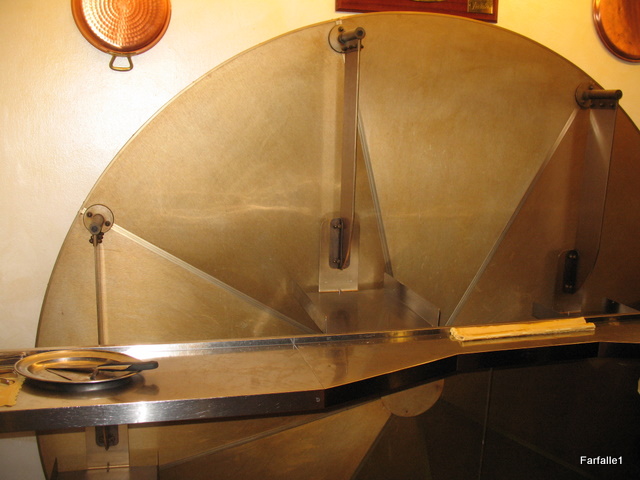
Before leaving  for the States we met our Genovese cousins at Vitturin to enjoy some seafood and some of the restaurant’s well-known focaccia col formaggio (quite unlike the more usual bready styles of focaccia).  Once inside the restaurant we were amazed to see the enormous paddle-wheel apparatus that delivers meals from the kitchens below to the diners above.

There are about eight of these trays mounted on the wheel; obviously they must stay horizontal as the wheel turns – it is a most ingenious system and must save a million steps a day for the wait staff.

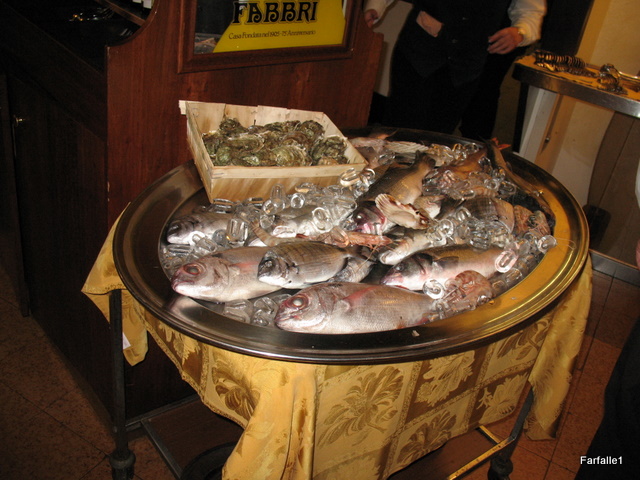
Fish and focaccia are the main events at Vitturin; they give the merest nod in the direction of meat.  This big platter of fish would entice any diner.

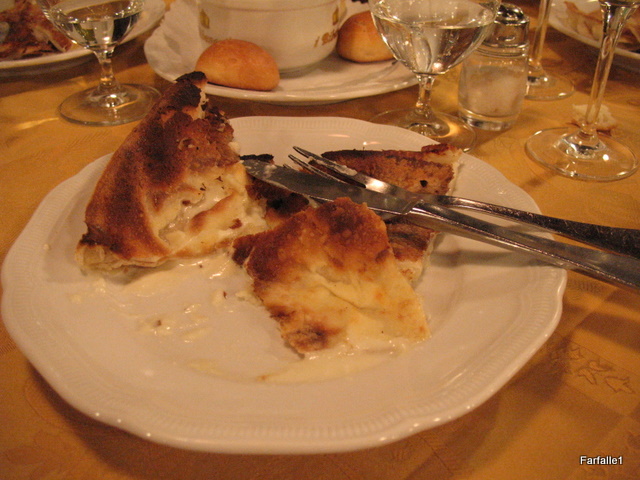
Here is a close-up of my partly devoured focaccia col formaggio:

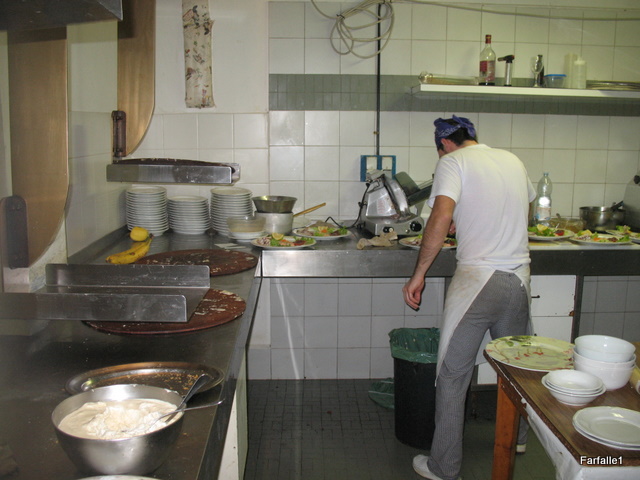
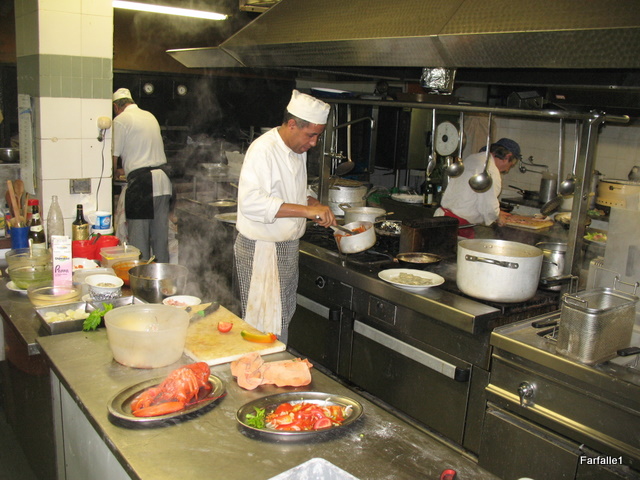
What was the highlight of the evening?  It was a long visit to the kitchens below the restaurant proper.  The Captain asked the Maitre D’ if we could see what the delivery wheel looked like down below, and he immediately escorted us to the nether regions.  There we saw the wheel looking much as it did above – plates of steaming food going up, empty plates coming down.

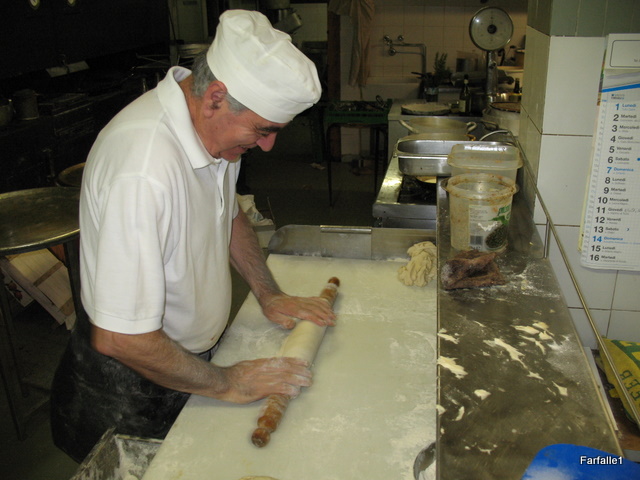
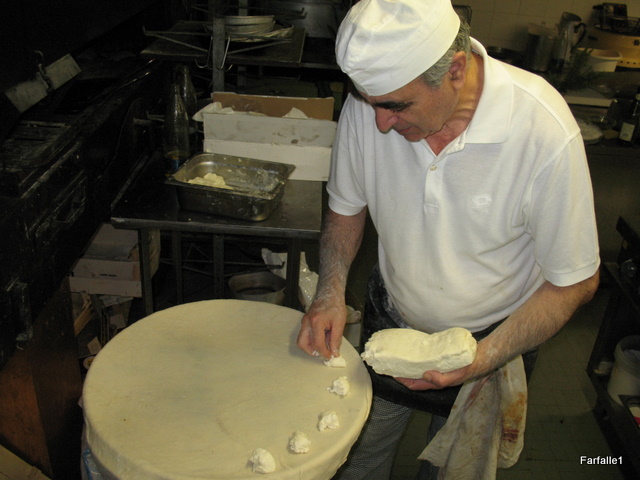
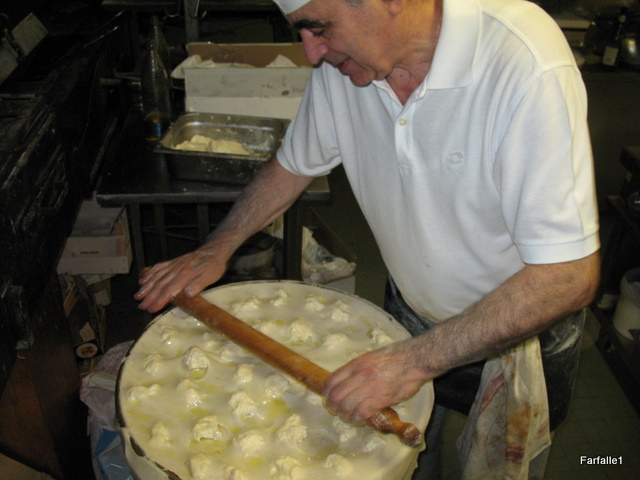
Over on one side of the kitchen we met Filippo, who makes, he proudly told us, about 120 focaccia col formaggio every evening.  He begins by mixing his dough in the early afternoon and letting it rest.  When he’s ready to make a focaccia he takes a big knob of dough and rolls it out.

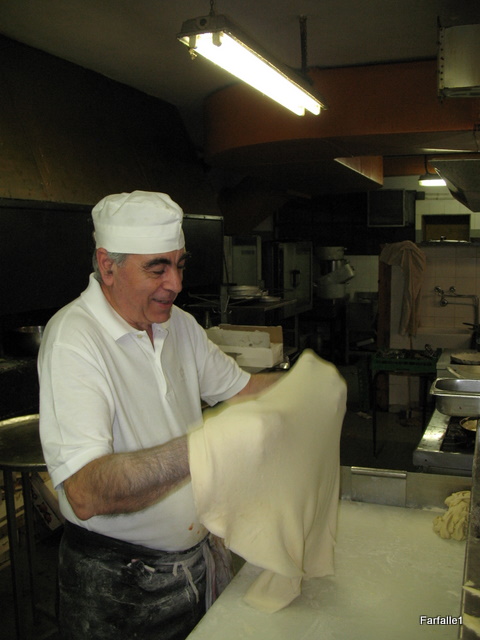
When the dough is thin enough he picks it up in his hands and does the stretching maneuver we associate with pizza-makers.

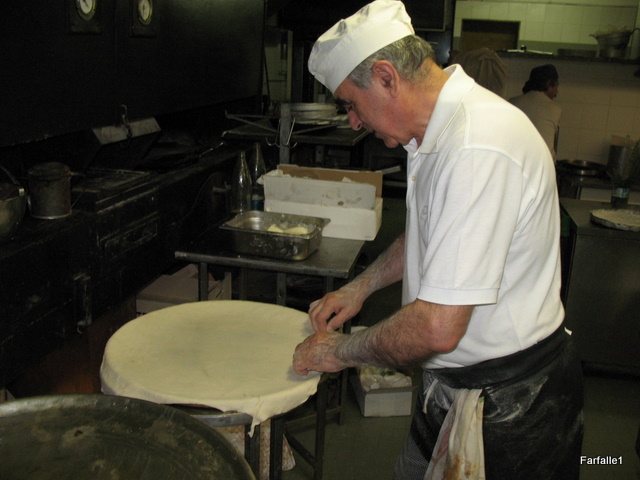
He puts it on the large round focaccia pan and puts dabs of stracchino cheese on top, about 750 grams for a regular focaccia, up to 1500 grams for a large size (that’s more than a pound for the regular, and about 3 pounds for a large). (!)

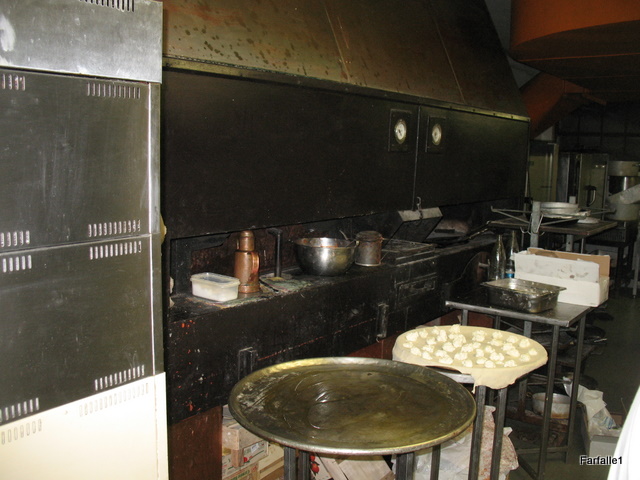
(It’s pretty hard to see in the photo, but that’s the old wood-fired stove in the background.  The restaurant now uses an electric oven.)

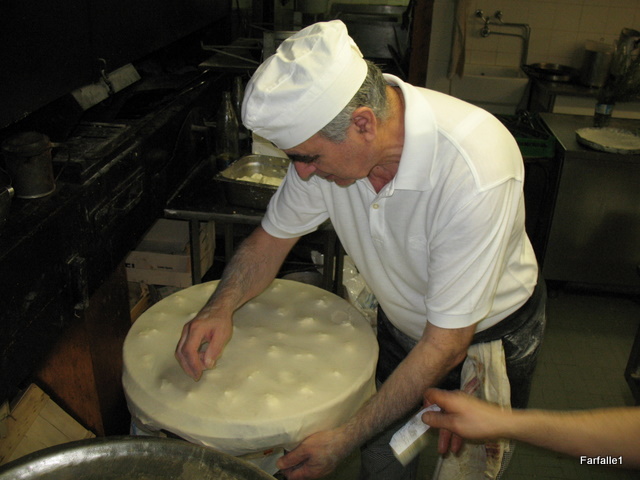
Then Filippo rolls out another sheet of dough, just the way he did for the bottom of the focaccia, and puts it over the cheese.  With a quick, nipping movement he tears some holes in the top layer of dough over some of the cheese knobs.

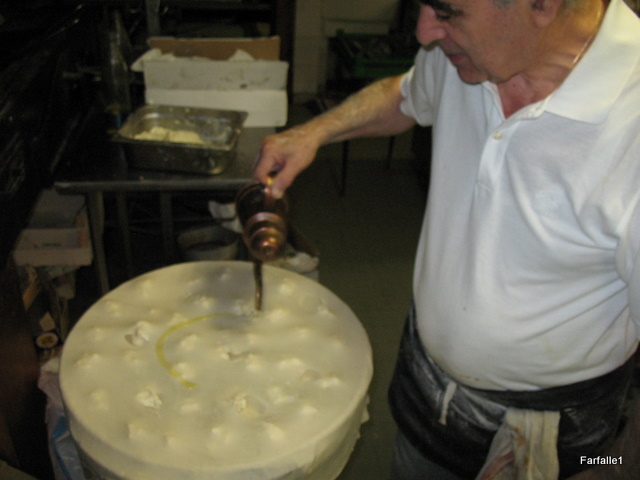
The final ingredients are put on top – a sprinkling of salt and a nice drizzle of olive oil.

All that remains is to trim the excess dough and pop the whole thing in a very hot oven.

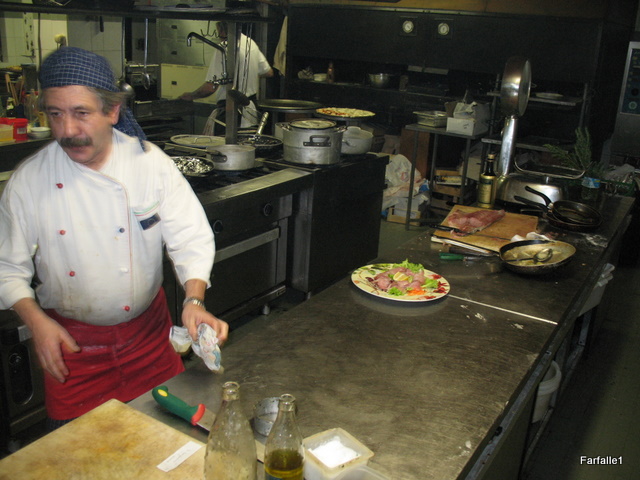
It was such a treat to be able to nose around the kitchen.  Everyone was clearly proud of the operation, and with good reason.  It was all orderly, clean and efficient.

Oh yum – a lobster!

They all move so fast; there were not a great many people down there, and they were putting out well over a hundred dinners.

As we were leaving the kitchen the dish-washer called us over and presented us with a little bowl of appetizers, and gave me a hearty handshake and a Buona Notte.  She was so cheerful, and so happy to see us.  We felt very welcome at Vitturin, both upstairs and down.

Genova the Unsung

11 Thursday Nov 2010

Posted by farfalle1 in Genova, Italian Churches, Italy, Liguria, Photographs, Uncategorized

≈ 14 Comments

Tags

Cattedrale San Lorenzo, Chiesa del Gesu e Sant'Ambrogio, Chiostro di Sant'Andrea, Genoa, Palazzo Ducale, Piazza de Ferrari, Porto Soprano

Here’s what you never hear prospective visitors to Italy say: “We’re going first to Florence, then Rome and Venice, and then Genova.”  Genova?  Doesn’t seem to be on too many tourist’s maps, and it’s a pity, because it’s a terrific city, well worth a visit.

Genova, long and narrow, is spread out on the strip of land between the mountains and the sea around her generous harbor.  She is the capital of  Liguria and boasts a metropolitan area population of some 1.4 million.  Known as ‘La Superba’ for her ancient and glorious history, she is now an important economic center of Italy and was, in 2004, the European Union’s Capital of Culture.  The Bank of St. George, one of the oldest known banks, was founded in Genova in 1407.

Ancient remains suggest that the city was inhabited (by Greeks?) as early as the 6th or 5th century BC, perhaps even earlier.  It was destroyed by Carthaginians in 209 BC, later rebuilt and later still invaded by Ostrogoths  and Lombards.  Wikipedia has a very brief history of Genova here if you’d like a quick study.

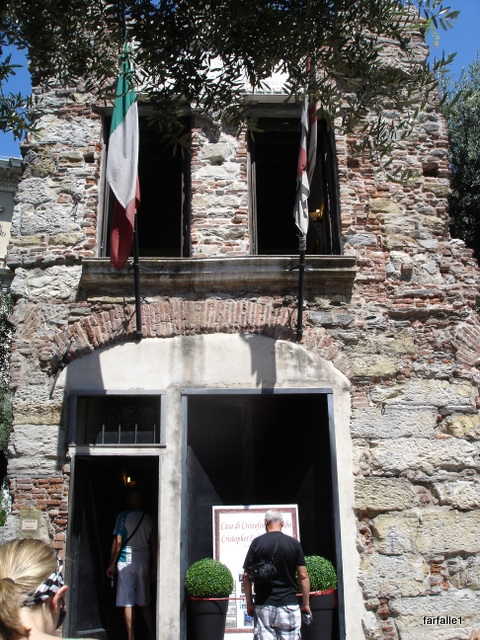
If Americans think of Genova at all, it may be as the purported home of Christopher Columbus.  The wee little house where he may have lived, just outside the city walls, is a must-see.

I have an idea:  let me take you on ‘The Tour’ of Genova that I give guests when I can lure them away from the delights of Rapallo for a day.  It is a train ride of about 40 minutes to the more eastern of Genova’s two train stations, Brignole.  From there it is easy to find Via XX Settembre, the broad and well-traveled street with many famous shops.

At the top of Via XX Settembre is Piazza de Ferrari, newly reconstructed after being torn up for years to accommodate construction of the new metro subway.

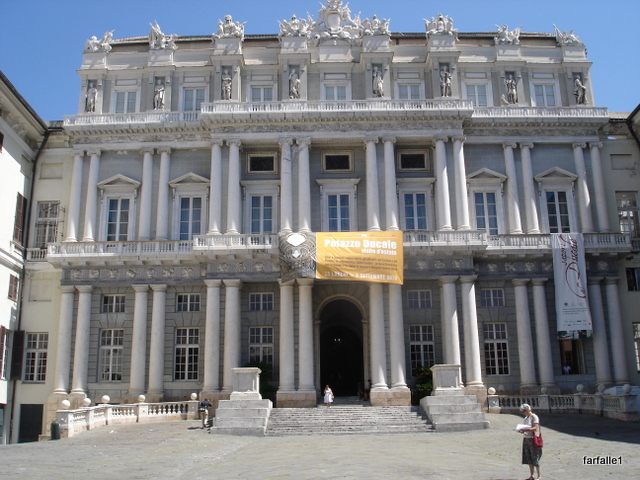
If you had taken this photo the Carlo Felice opera house would be on your left, the Palazzo Ducale behind you, and behind that the tumble jumble of medieval Genova’s streets.

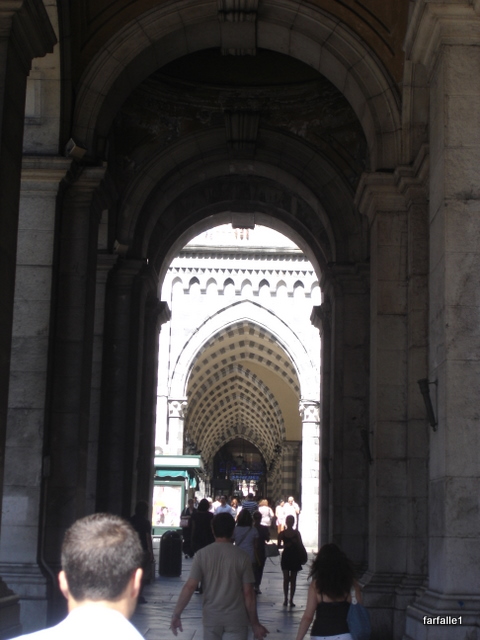
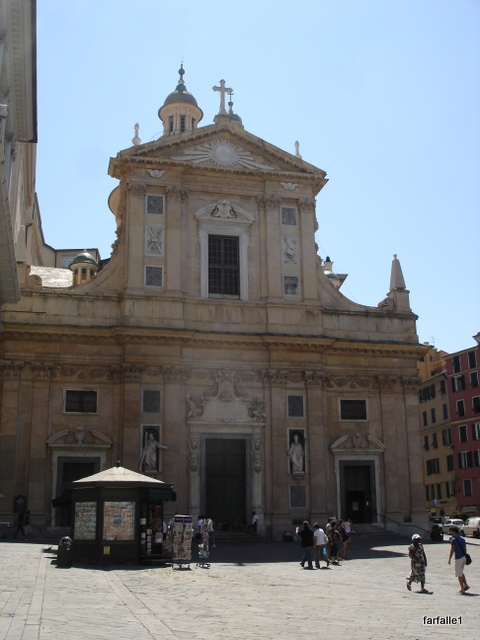
From here let’s take a stroll through the atrium of the magnificent Palazzo Ducale, turn left, and walk down the timeworn steps to  Piazza Matteoti, home of the Chiesa del Gesu e Sant’Ambrogio.

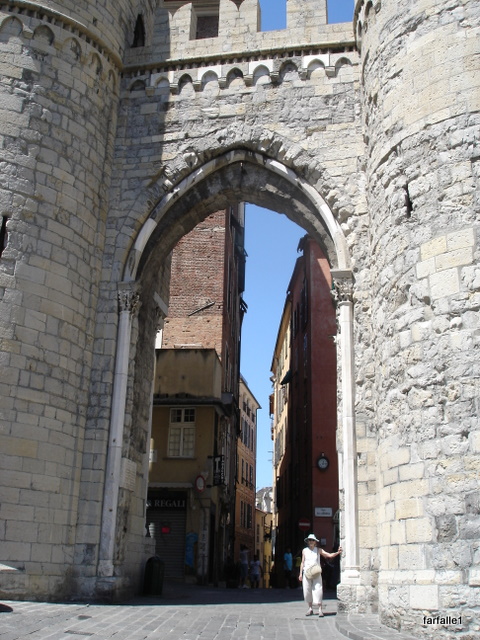
We’ll nip in to take a peek at the The Circumcision (link is to a probable study  from the Gemäldegalerie der Akademie der bildenden Künste in Vienna) painted by Peter Paul Rubens in 1605, one of two paintings he made for the church during his stay in the city.  After we leave the church we’ll turn left and walk up to and through the tall city gate.

Hey!  Who’s that?

Who knew that The King hung out at the Cafe Barbarossa to serenade unsuspecting tourists?  Enough of this nonsense.  On to Columbus’s house:

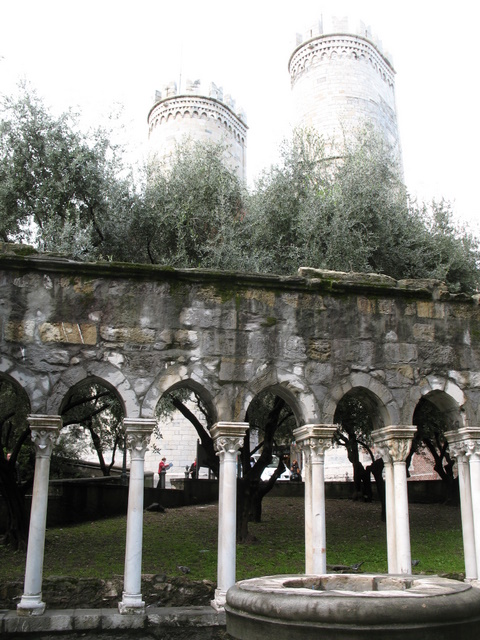
Very teeny indeed. For €4 you can go in and look, but perhaps we don’t need to do that today.  Of more interest, to me anyway, are the beautiful remains of the Chiostro di Sant’Andrea, moved to its present location just next door  to the house in 1922.  The cloister dates from the XII century and is a little island of calm amidst the bustle of the city that has grown around it.

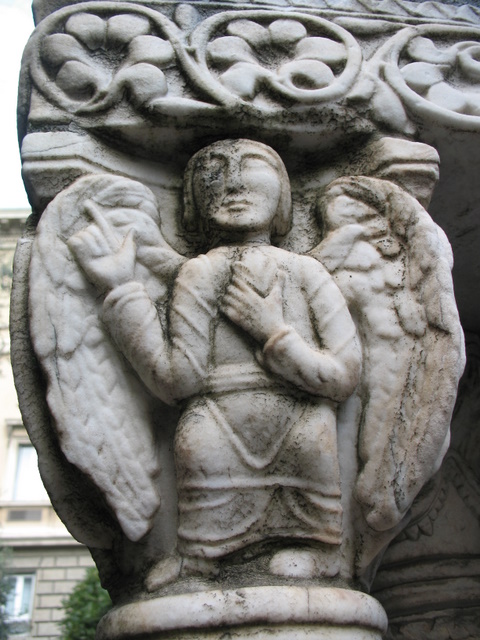
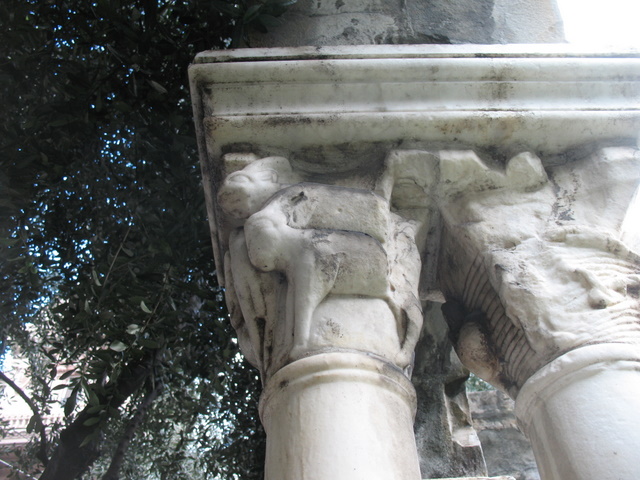
In the background you can see an X-Files rendition of the Porto Soprano, one of the gates in the city walls which were constructed in the XII century.  Here are a couple of details from the top of the cloister columns.


I love this angel’s calm demeanor.

Why is there a rabbit on top of that donkey?

From this peaceful corner we will go back through the Porto Soprano,


walk by the Palazzo Ducale again,

Phot courtesy of Pidge Cash

and continue down to the magnificent  Cattedrale di San Lorenzo, which was consecrated in 1118.  The black and white stripes are a medieval symbol of nobility.


You can stare at the facade of this church for hours, and you will continue to find new details.

As well as many beautiful paintings and some 13th century frescoes, the church contains a most unusual artifact,  a grenade that struck the church on February 9, 1941, during a bombardment by the British.  The grenade went through the roof of the cathedral without exploding and can still be seen in the right aisle.

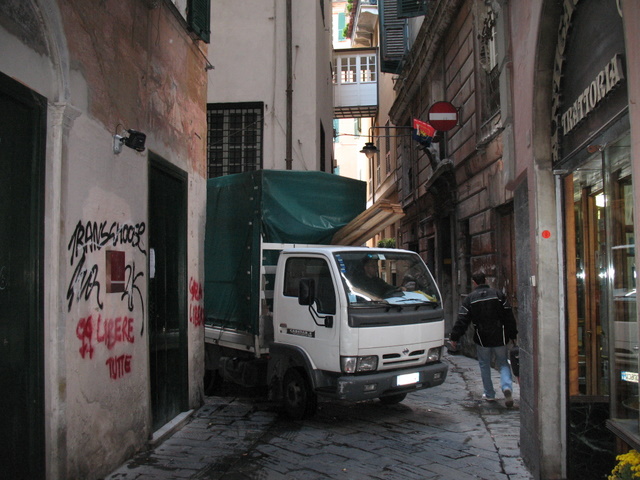
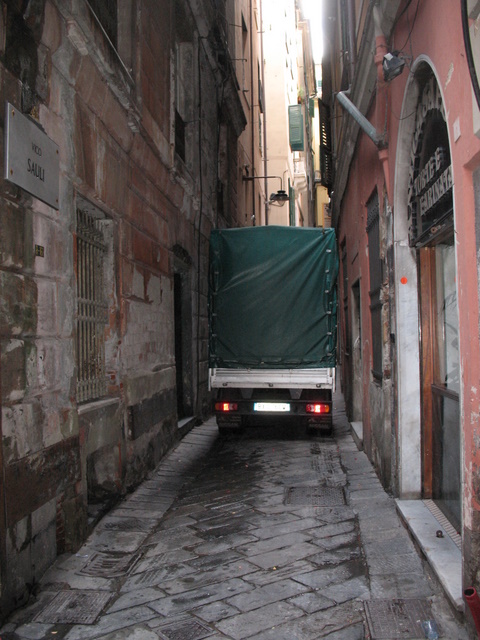
Now it’s time to launch ourselves into the warren of narrow streets in the medieval part of the city.  How narrow, you ask?  Well, narrow enough that a small truck has to make a complicated back and turn maneuver to make a simple 90 degree turn.

And it’s not even a big truck!

Many of the streets are too narrow to accommodate even a car, never mind a small truck.


Time for lunch!  We’ll stop at one of the many restaurants and trattorie in the old section and partake of a bit of Genova’s signature dish: farinata, a very flat pancake made from chickpea flour.

Note the wood-burning oven in the background; that is the only way to cook farinata correctly.  This photo was taken through the window of Antica Sa Pesta, a restaurant on an old salt-trading site.

Maybe we’ve done enough for one day.  Let’s take our full bellies home and have a nap before tucking into whatever the Captain has cooked up for us in our absence.  We’ll come back very soon to finish the tour of beautiful Genova.

A Slice of Humble Pie

24 Sunday Oct 2010

Posted by farfalle1 in Golf, Italy, Rapallo, Uncategorized

≈ 4 Comments

Tags

Comitato Italiano Paralimpico, golf carts, Golf in Italy, Handicapped golf in Italy, Italian golf, Sports for the handicapped

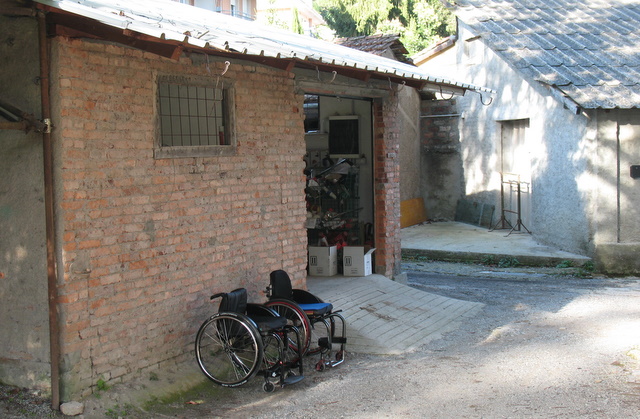
Every golfer begins each round with a handicap, but some golfers wake up every morning with a handicap.  Recently at Rapallo we were privileged to watch a tournament for people who may not be able to jump out of bed and walk down to breakfast, but are still motivated to get out and play golf.

The Comitato Italiano Paralimpico sponsored a two-day golf tournament at the Rapallo Golf and Tennis Club, and they had a full roster of entrants. (If you’re handicapped and want to participate in a sport, take a look at the Paralimpico website – you will be amazed, I think, at the scope of activities available.)

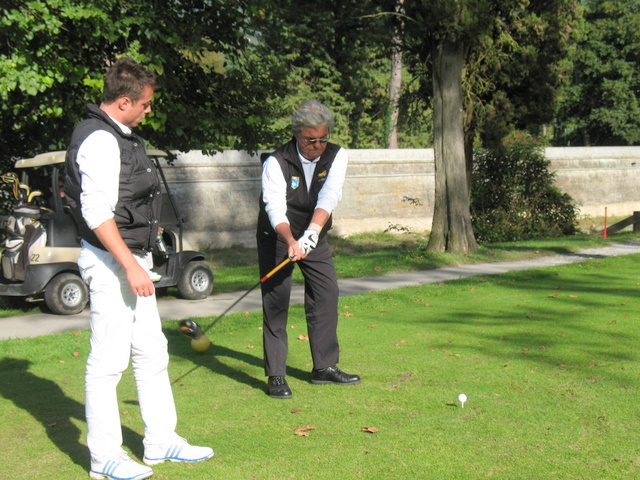
The Captain and I visited briefly on the first afternoon, and were truly humbled by the spirit – and skill! – of the golfers we watched.  We weren’t there long enough to get too many photos, but this Italian man was kind enough to allow me to take his picture.

His shot?  It was was straight and true, and went about half the distance to the little flag you can barely see at the end of the fairway.


Isn’t that an amazing vehicle? It’s the Parabasetec by Paragolfer.  If you want to see it in action, click here for a Youtube demo.  A similar vehicle is made by Powergolfer; we saw a number of those on the course.

Paraplegics were not the only golfers present.  Some people were missing a leg or two and played with prostheses; others had muscular dystrophy.  Several, like this man, were blind.  I know!  But you should have seen his shot – it was excellent.

Of course many of these sportspeople (yes, there were some women playing too) needed some assistance to play.  For instance, in the case of the man above the volunteer placed the ball on the tee, and held the head of the driver on the ball so the player could position himself appropriately.  A legion of wonderful volunteers from the Golf Club gave their time to make the event a great success, and happily the weather co-operated as well.  Golfers came from all over Europe as well as the United States.

There was a gala dinner at the end of the second day of the competition.  Rapallo’s Sindaco (the mayor), Avvocato  Campodonico, was present, as were a number of gents in very impressive uniforms.

So… if either one of us ever feels cast down because we didn’t hit the ball well, all we have to do is remember the golfers we met on a late October day in Rapallo.  We truly were humbled by the spirit, sense of fun, good sportsmanship and excellent play that we witnessed that day.

GONE GOLFIN'


Il Molino Vecchio – The Old Mill

26 Sunday Sep 2010

Posted by farfalle1 in Italian folk tales, Italian habits and customs, Italy, Liguria, Photographs, Rapallo, San Maurizio di Monti, Uncategorized

≈ 20 Comments

Tags

Chestnut mill, Chestnuts, Giovanni Pendola, Italian frantoio, Italian molino, N.S. della Cipressa, Old Italian mill, Olive mill, Wheat mill

Sometimes it happens in Italy that you’re walking down a street, a lane, or a path in the country, and you come upon something that sends you back, in your mind’s eye, a few hundred years. “I can just imagine,” you say to yourself, “what it would have been like to be alive when this place was new and bustling with life.”

It happened to me not long ago when I took a walk with a friend. We came to the old and interesting Complesso Molitorio (Mill complex), which lies on a sentiero (walking path) that connects San Maurizio di Monti to Rapallo along the San Francesco torrente (fast flowing stream), on the opposite side of the narrow valley from the paved road.  The sentiero is not particularly well known, and does not appear on the trails map for this area. To reach it from San Maurizio you walk down what begins as an ever more narrow residential street, which finally turns itself into a path. From Rapallo the route begins on a paved street but soon takes the form of an old mule path which climbs and winds through the forest. According to the website lacipresse.it, the path is known as “Strada Antica di Monti,” a part of the “Antica Via del Sale” (The Old Salt Road – why there was a Salt Road here I have not been able to learn).

The Mill complex is comprised of four buildings, three of which you can see in the photo above. The large building in front was constructed in the 17th century and was an olive mill. A wheat mill was housed in the smaller building on the left; and the small building up above the others was a chestnut mill. The fourth building, not much more than a room really, is behind the large main building, and was used for collecting the refuse of the olive pressing.

The San Francesco feeds a mill pond above the highest building:

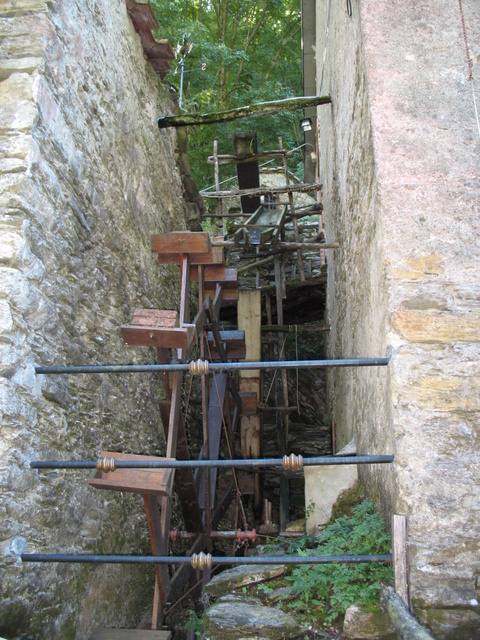
The water can be directed down an earth and stone canal to tumble into the waterwheels that powered the various milling operations:

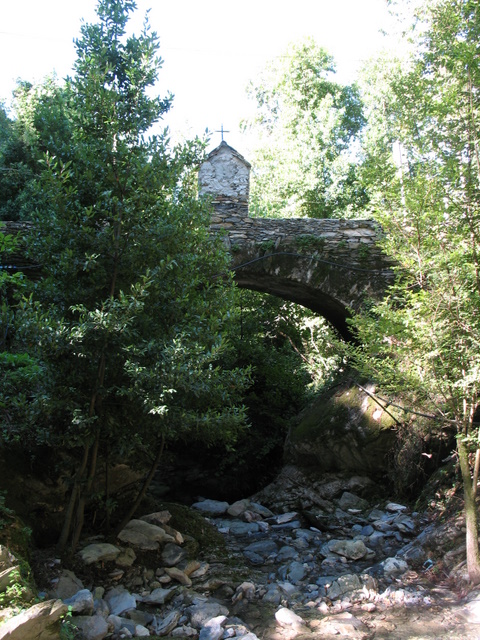
The oldest structure in the complex is the old stone bridge that crosses the San Francesco, built in the Roman style, quite possibly during Roman days.

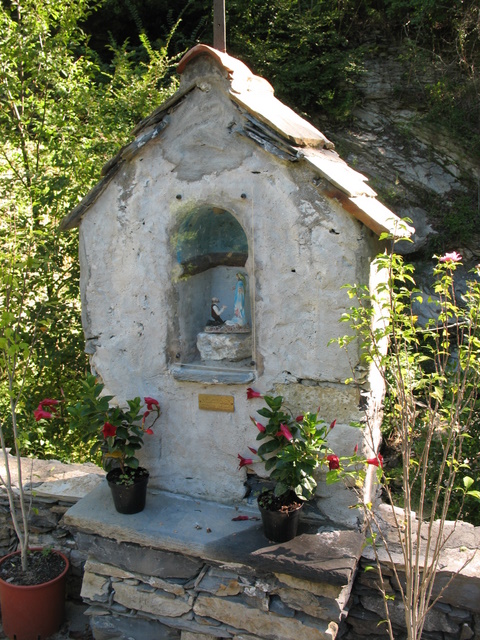
The little chapel on the bridge, a recent addition, honors the Madonna of Montallegro and is called Nostra Signora della Cipressa.   According to the story, there was a chestnut tree that stood nearby. One day, during the plague years, the tree suddenly died – in just the one day! The belief is that the tree, through the intercession of the Madonna, absorbed the deadly disease and rendered it harmless, thereby saving the citizens of San Maurizio di Monti. (For more about the Madonna of Montallegro and the plague, see here).

There have been several re-structurings of various elements of the complex, including one in the early 18th century, one in the 1920’s, and another in the early years of this century . During the recent renovations the large building was turned into a museum, Il Museo della Civilta’ Contadina “Cap. G. Pendola” – the Museum of Rural Culture (named in honor of Giovanni Pendola, a heroic Captain in Garibaldi‘s Army). In it you will find old implements that farmers employed to wrest a livelihood from these steep hills, as well as accouterments of the mills themselves. It is open on the third Sunday of each month from 3 – 5 p.m., at which time a very well informed docent can explain the uses of the various tools, and tell about each of the buildings. (The renovations in 2001 won Second Prize in the 2003 Concorso  “Ama il nostro paese” – love our country – sponsored by the City of Rapallo and the Rapallo Lions Club.  In 2006 the Complex was designated a National Monument.)

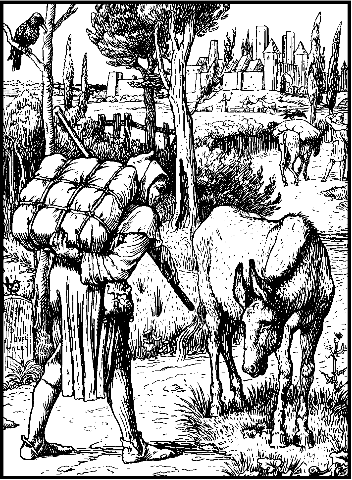
Some centuries before our mill, but I like the image!

Although the mill was still functioning as late as 1940, it is much more fun to imagine what it would have been like in, say, 1750. You’ve gathered all the chestnuts in your part of the woods, have dried them over a smoky fire and have thrashed them out of their husks.


Now you put them in barrels that are firmly strapped, one on each side, to your mule. Slowly and carefully the two of you make your way up the path, your mule finding a careful foothold between the upturned stones on the steep parts of the road. You hear the mill before you see it; the water is rushing down the canal and the big wheel is squeaking a little as it turns. When you get a little closer you can hear the big gears groaning and clicking as they engage. There are a lot of other people there with their chestnuts, too. Chestnut flour is a staple, and a good crop might form the basis of your family’s diet for much of the year. (For an interesting article on historical food uses of chestnuts, look here.) While at the mill you have a chance to exchange gossip with neighbors you haven’t seen for a while and to catch up on the news of the town below. After you’ve left your chestnuts to be ground into flour, you might continue up on the mountain to give thanks at Montallegro for a good harvest, and to ask the Madonna to protect you through the short winter ahead.

There’s another great story associated with the mills. The present owner’s grandfather, the  Giovanni Pendola for whom the Museum is named,  was the owner of the mill in 1907 when he went to Genova to take aid to the victims of a cholera epidemic there. He contracted the disease himself, and died soon afterwards. His true love, a lady named Caterina who was, they say, still beautiful, lost her will to leave her house when she received the news of his death. Then, taken by an irresistible urge for freedom, she became a wild creature of the woods.

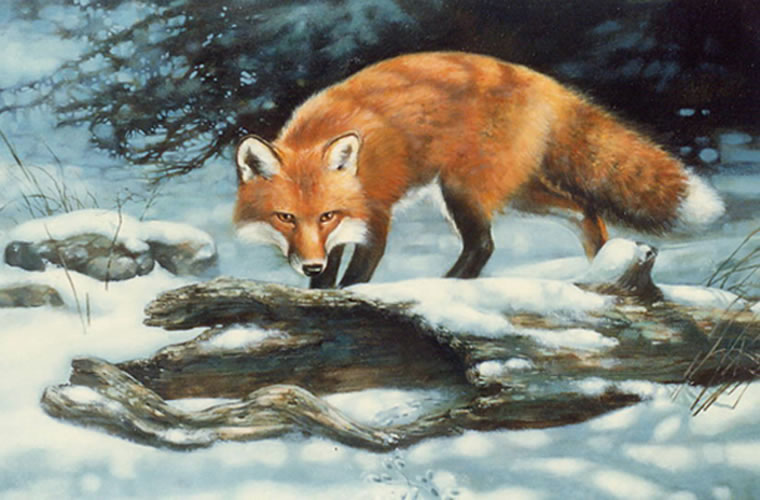
Painting by Patrick Soper, soperstudio.com

Still today, disguised as a fox with a soft tawny tail, she wanders during the coldest days, “those of winter when the cold north wind blows, or when windy gusts blow the last dry leaves, and the bare, rattling branches of  trees reach to the sky like imploring arms.” The tradition says that if you meet this fox and look into her eyes, you may lose your memory or be swallowed up by the woods.

If you’d like to see some more pictures of the mill, click here.  Click on ‘slideshow.’

Many thanks to the website lacipresse.it, from which I learned the content of this post.

Marcus of Umbria

26 Thursday Aug 2010

Posted by farfalle1 in Animals in Italy, Dogs, Italian men, Italian women, Italy, Uncategorized

≈ 15 Comments

Tags

Books, Books about Italy, Collelungo, Dogs, Justine van der Leun, Marcus of Umbria

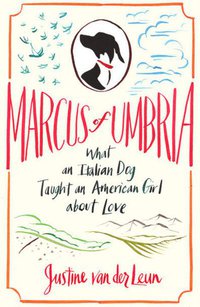
Book Jacket by Andre Mora

Seldom do I receive an offer to review a book; this was certainly a title I couldn’t resist accepting.  If you love Italy, dogs or both, you won’t want to resist reading it yourself.

Justine van der Leun is a young woman who knows what she wants, whether it’s walking on two feet or four.  Sometimes when she gets what she wants it turns out that she doesn’t want it after all (handsome Italian lover, horse), but sometimes when she gets what she wants it turns out to be life-altering (Marcus).

Justine moves to Italy to live with a man she’s known all of three weeks in the small Umbrian town of Collelungo, population hovering around 200.  There she quickly learns that she has not taken on just the man, but his entire family as well, and they have taken her on, too.  Without a strong extended family background of her own, the realities of an Italian family are a shock to our heroine, and one to which she can never entirely adapt. (There’s a lot here about the strength of the matriarch in the Italian family.)  Also shocking is for Justine to see Italy as it really is, not as we imagine it from movies and other move-to-Italian-paradise books.  Justine may have come to Italy, but it was no paradise.

She remains in Collelungo a year, during which time she adopts a darling but challenging canine whom she christens Marcus. (You’ll learn quite a bit about the rather unfortunate circumstances of Italy’s hunting dogs.)  Despite the doggy title, Justine ends up learning a terrific amount, not just about love but about life, from the family and from the town.  Even more, she learns to know herself a lot better.  That journey is the heart of book, and it is a delight.  Strong-willed, intelligent and, perhaps, a bit privileged and naive, Justine is thrown into a situation where people still kill their own food, where self-sufficiency is a way of life and a point of honor.  She has the grit , humor and humility to absorb the lessons that are offered by the experience.  She’s a modern, witty young woman, and she’s a terrific writer.

What I enjoyed most about the book is that it shows Italy as it truly is in a great many places.  She lived in the ‘real’ Italy, not the Italy of the touristic centers of  Venice, Rome, Florence, not the Italy of ‘Chiantishire’ in Tuscany, or the sun-drenched Riviera.  People in Collelungo are patient, they are sometimes slow, they work incredibly hard, they probably know how to hold a grudge.  Because they live in a town of only 200,  there is nothing they do not know about their neighbors, whom they are very likely to accept just as they are, and they have no secrets of their own. They are not sophisticated, traveled, particularly well-schooled (though some of the young now are); they remember what it was like to be impoverished.  But they know how to laugh, cook, eat, fight, and laugh some more.  As Justine says, they have tailored their expectations to what they have; they are happy.

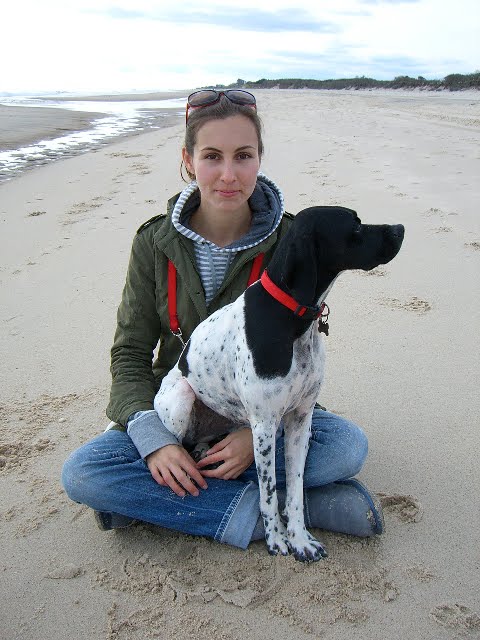
Photo by ?

And what about Marcus?  She (yes, she) is the agent of Justine’s greatest lesson: responsibility for our actions.  As she herself says, “I had willfully shifted another being’s course, and that meant that I was technically morally bounded to ensure her well-being for a lifetime”.  That doesn’t stop her from making a few more blunders, but one of the most refreshing aspects of this book is the humor with which Justine is able to admit her own shortcomings.

No, she’s not perfect; and neither is Italy or Umbria or her boyfriend and his family, or Marcus (bit of a chicken issue there).  But they all have something wonderful to offer and Justine is smart enough to take it all in.  Her boyfriend’s family, the Crucianis, are as warmly and honestly drawn as is Italy.   And always there’s the sense of humor.

There’s nothing pretentious about Justine van der Leun or her book.  I don’t know her, but having read the book I feel like she’s a friend.  I think you’ll like her too.

No Bad Dogs

22 Sunday Aug 2010

Posted by farfalle1 in Animals in Italy, Dogs, Italian festas, Italy, Liguria, Photographs, Uncategorized

≈ 16 Comments

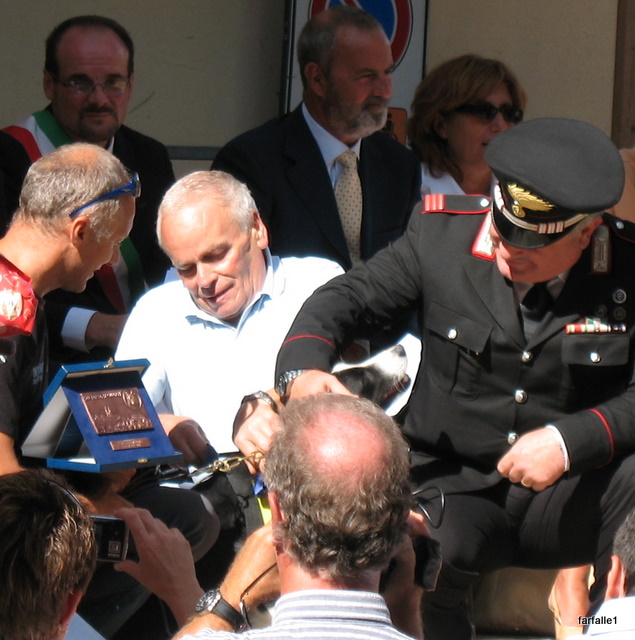
Photo taken by by Pier Luigi Baglioni

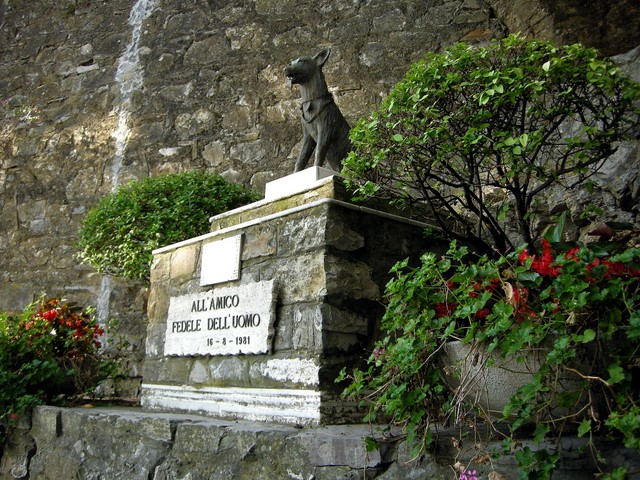
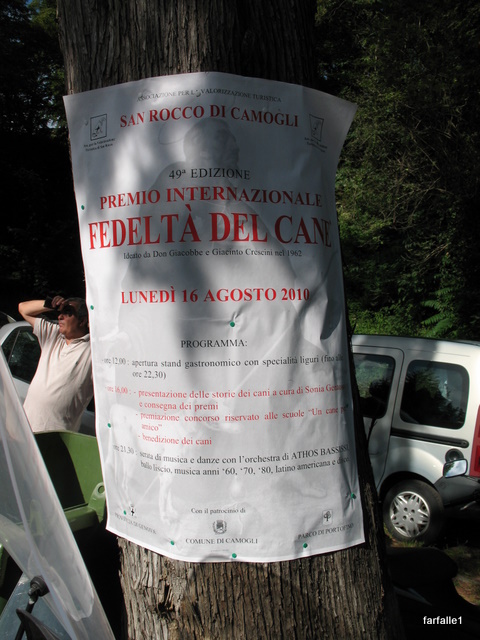
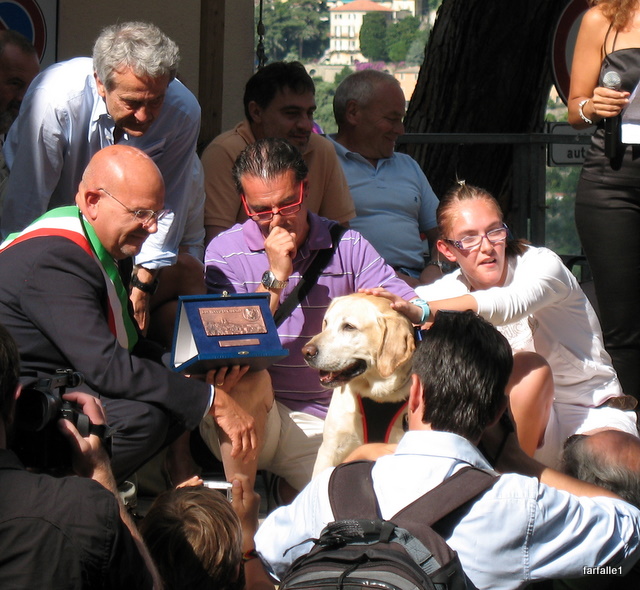
San Rocco di Camogli is a lovely frazione high on the hill overlooking its mother town.  The Saint for whom it is named is, rather alarmingly, the patron saint of contagious diseases.  He lived in the 1300’s and helped plague victims during his travels from his native France through Italy.  At one time he himself contracted the plague, and was saved in part by a dear dog who brought him crusts of bread in a cave where he’d taken shelter.

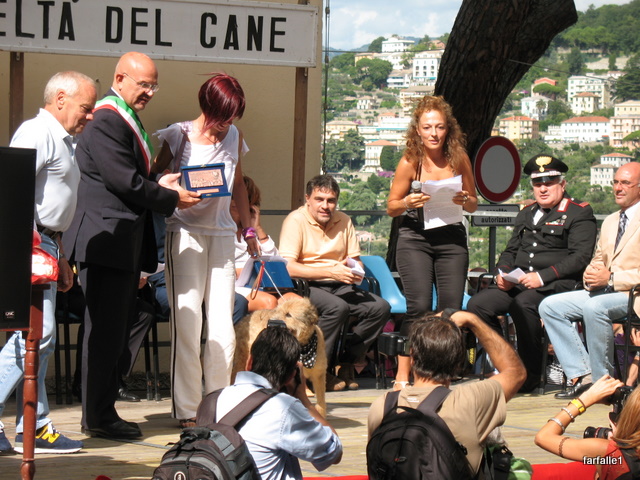
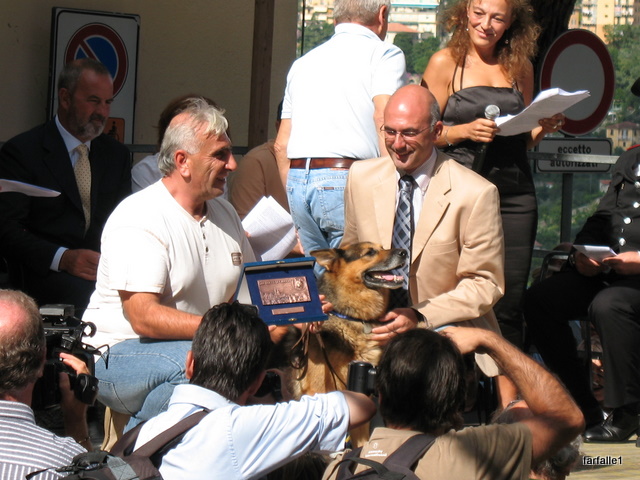
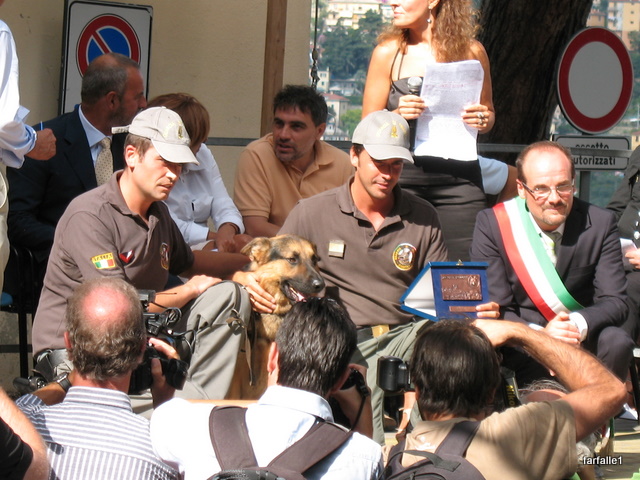
San Rocco’s day is August 16, and for 49 years now the eponymous town has given prizes to reward acts of bravery and courage by our four-footed friends, and to bless the species.As you can see from the photo above, it is exhausting!  But if you are a dog-lover it is a wonderful event to attend.  This year the weather smiled on the many dogs and even more people who came to meet the prize-winners and receive a blessing for the year ahead.  Sonia Gentoso was an excellent Mistress of Ceremonies; without leaving out any important information she managed to keep things moving in as orderly a fashion as possible, given the number of dogs present.  There were a number of important people on the dais for the ceremony, one in an impressive uniform and one with a very handsome ribbon across his chest (probably the sindaco – mayor – but I’m not sure).

The prize-winners were:

Antares.  Antares was not present to receive her prize, although one of the women in her story was there to accept it for her.  Antares usually spends her mornings with her ‘Nona’ while her mistress is at work.  She goes to the second floor and barks outside Nona’s door until she is let in.  One day a neighbor, familiar with this practice, heard Antares barking in the middle of the morning.  Strange, she thought – why is the dog barking now?  So she called the Nona and found that she was very ill from a hemorrhage.  The neighbor called the ambulance, and thanks to the early notice of trouble from Antares, the Nona did not suffer long-term consequences.

Bimba

Bimba saved her family in Genova from a fire.  Awakened in the garage where she sleeps by the smell of smoke, she made her way to the upstairs of the house and barked and scratched on the door until her master awoke and was able to get his wife and 4-year old daughter safely out of the house. But poor Bimba!  She was pregnant at the time, and because of the stress she gave birth later that night to a dead puppy.  The vet was able to safely deliver her of two healthy pups soon afterwards though, so the story has a happy ending for all.

Cody

Cody works with the Scuola Provinciale Cani da Ricerca di Trento and is an ace at finding people who have gone missing.  She did some very unhappy work in Abruzzo after the terrible earthquake.  She won her prize for an event with a happier outcome: an old gent wandered off from the rest home where he lives and was missing overnight.  Cody found him in the woods the next day.  Thanks to her, he did not come to any great harm.

Fado

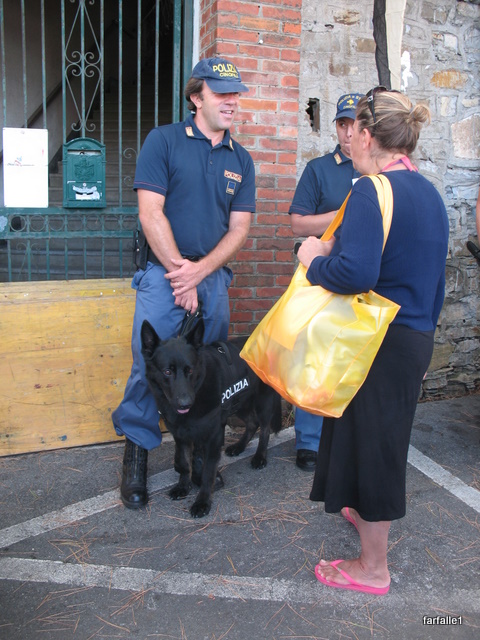
Clever Fado works with the Polizia di Stato in Genova as a drug-sniffer.  He recently found 5 kilograms of cocaine.

Ioda

You’ll have to look hard to find Ioda, but she’s there.  She won her prize for dragging her master away from the path where they were walking in Monza moments before a huge plane tree fell right where he had been standing.  Because of her, he suffered only some minor cuts instead of being completely crushed.

Lily.  Alas, my photo of Lily did not come out, a pity.  Lily is a 2-year old border collie from Belluno.  Lily works with her master, a volunteer of Soccorso Alpino di Agordo.  A Polish skier was caught in an avalanche and buried under a half-meter of snow for 35 minutes.  Lily found the skier and he was rescued, not long before his supply of air would have run out.

Rocky

Rocky made an incredible journey.  He was abducted from the beach while his master was bathing near Carrara three years ago.  Eventually he ended up in Salerno where he was abandoned by the nomads who had stolen him, and adopted by a kind family there.  But he kept running away, always heading north.  Eventually he left them a final time and made his way to Pisa, where a woman found him.  His collar gave the number of the family in Salerno and she called them.  They said, he is a lovely dog and we love him but he has never adapted to living with us, you keep him.  So she took him to a vet, who found the tattoo identifying his original owner.  They were reunited after 3 years.  It took Rocky 2 months to travel the 625 kilometers from Salerno to Pisa.

Talon

Talon works with the Guardia di Finanza in Genova and is another drug-sniffer.  He recently discovered 7 kilograms of marajuana and 3.5 kilograms of cocaine.

Zoe

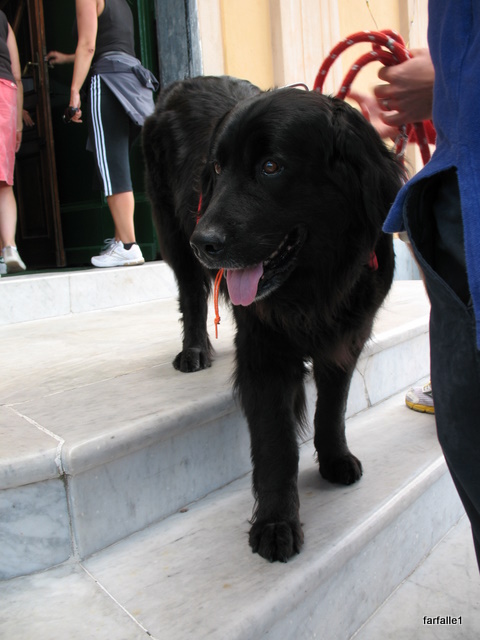
Zoe, a 7 year-old Newfoundland, saved three swimmers near Pisa.  Two women were swimming with the 11-month old child of one of them when they were carried away by the swift current.  They shouted for help, and were some 80 meters from the shore when the life-savers and Zoe reached them and brought them to safety.

First Prize winner was Pongo

Pongo was walking with her master near their home in Settimo Milanese when they heard the cries of a 67-year old man who had slipped on the edge of a canal and fallen several meters into the water and mud below.  Though the water was not deep (40 cm – a bit more than 3 feet) the man was too stunned to extricate himself from the mud, and could only moan for help as he commenced drowning.  Pongo’s insistance on dragging his master to the edge of the canal undoubtedly saved the life of the poor man below.

There was the 4th Annual edition of an art contest for young people in conjunction with the event.  This year’s theme was -Un Cane per un Amico – a dog for a friend.  The art was charming, of course.

If you’d like to see some more photos of the event, click here for a web album.  As usual I recommend a slide show.

A dog’s life in Italy can be pretty comfortable; Italians dote on and respect their dogs, although they do not always train them well, and they almost never castrate or neuter them.  In America if you are a mixed breed dog, you are a mutt; in Italy, you are a ‘fantasia.’ I know which one I’d rather be!

Tile Town

15 Sunday Aug 2010

Posted by farfalle1 in Italian Churches, Italy, Photographs, Uncategorized

≈ 9 Comments

Tags

mosaics, Ravenna, Theodoric

Nothing gets us stirring and away from our hillside like the arrival of curious company.  My sister, planning her visit, had requested a trip to Ravenna to see the incomparable mosaics there.  Fresh from a visit to Turkey she was eager to compare Italian Gothic and Byzantine art to that of the Ottoman Empire.  The Captain and I visited Ravenna a few years ago and enjoyed it immensely, so it took no arm-twisting at all to get me tapping away for reservations on Venere.

Although the city is across the boot, just a few miles from the Adriatic, it is a pretty and easy drive of only about 3.5 hours to get there from Rapallo.  In fact, years ago Ravenna was on the Adriatic.  Silt buildup since the year dot has now stranded the town some four miles from the sea.

We spent two nights in a lovely hotel, the Palazzo Galletti Abbiosi, which is centrally located, comfortable and has a terrific staff.  It was simplicity itself to walk from our digs to all the major sights in the city.

Ravenna offers tourists free bicycles!  We didn’t stumble on this great opportunity ’til our last day, but it is definitely the best way to get around this flat town.  Leave some identification and fill out a form at the Information Bureau and you will be given the key to your very own bike.
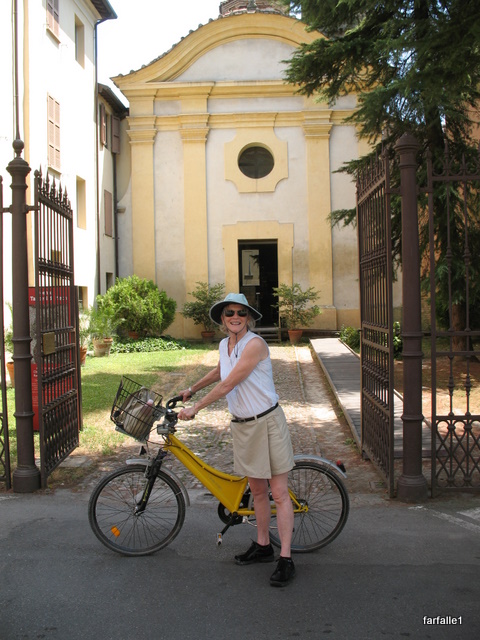
Happy sister with free bicycle

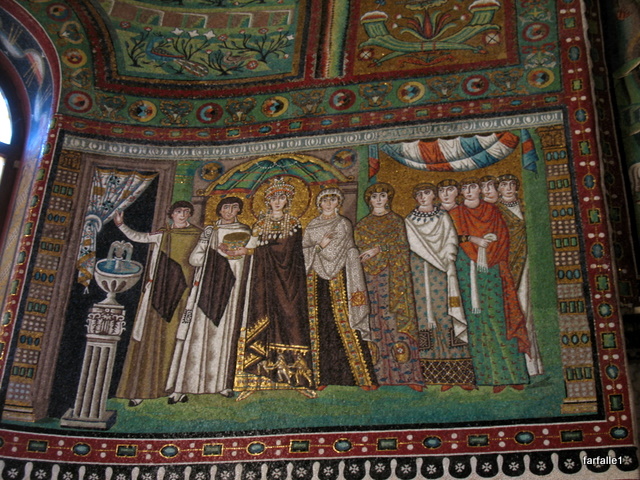
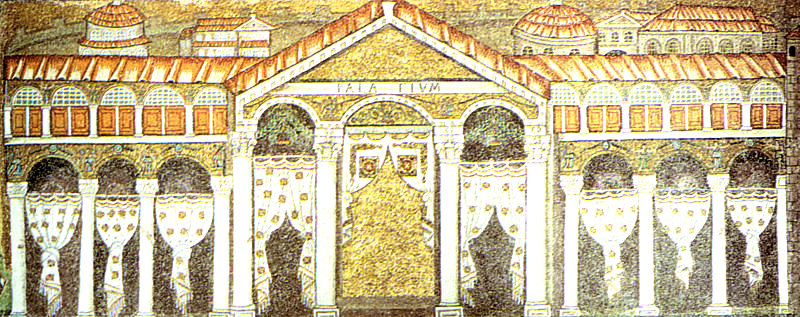
Ravenna is most famous for her mosaics, some of which date from  the early 5th century CE.  Theodoric,  leading an army of Ostrogoths, conquered the city in 493, beginning an enlightened and wise 33-year reign which saw extensive land reclamation and an enormous amount of construction.  Amongst his projects was his residence, The Palatium (now gone, but we know what it looks like from a mosaic):
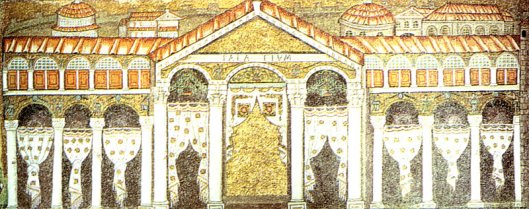
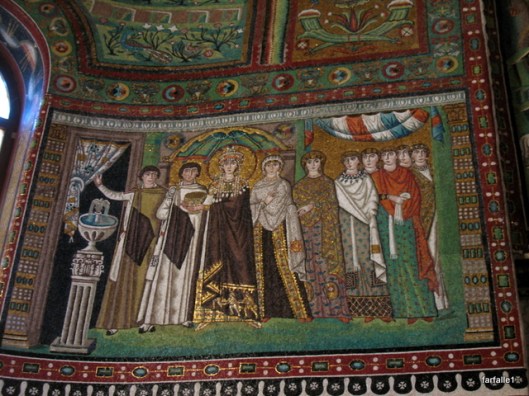
(Interesting fact: after the death of Theodoric and a 9-year reign by his daughter, the Byzantines under Belasarius wrested control of the city from the Ostrogoths.  They removed what they could of Gothic images from the mosaics; in the photo above, for instance, figures have been replaced by curtains.)

Others of Theodoric’s grand buildings include the Anastasis Gothorum, now the Church of Spirito Santo; and the incredible Basilica Sant’Apollinare Nuovo. (Theodoric was an Arian, that is he followed the teaching of Arius which had been condemned by the Council of Nicea in 325).

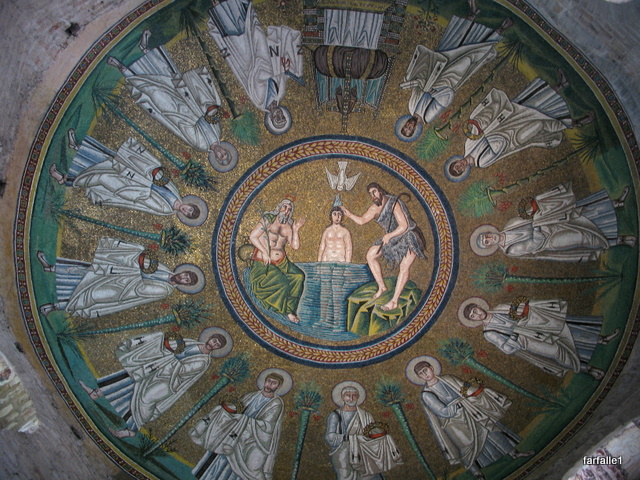
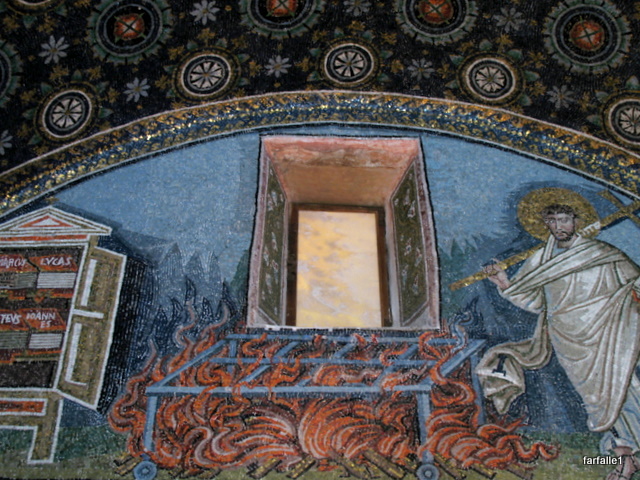
Ravenna’s concentration of Gothic and Byzantine mosaics is astonishing – and breath-taking.  There are several different ways to make mosaics; the ones in Ravenna are done in the most difficult way: the stones are placed directly into the wet cement on the wall or floor.  A special fast-drying cement was used,  so only a small section could be tiled at one time.  It’s hard (impossible?) to imagine how the artists could get such subtle variation in color tones, express such personality, and make such complicated geometric patterns when they could do only a little bit at a time and were using only small chips of colored stone, glass or gems for their medium.  I suppose they laid everything out ahead of time, but still…  it is all amazing and very beautiful.
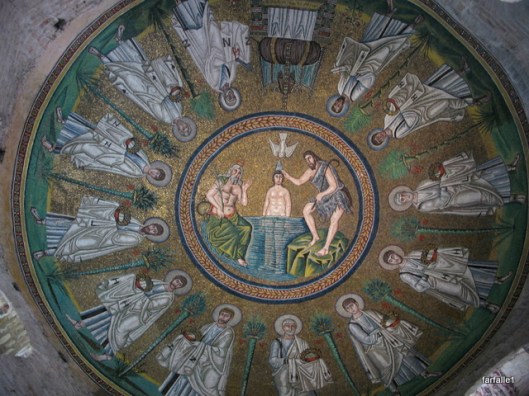
Baptism of Christ, Arian Baptistry
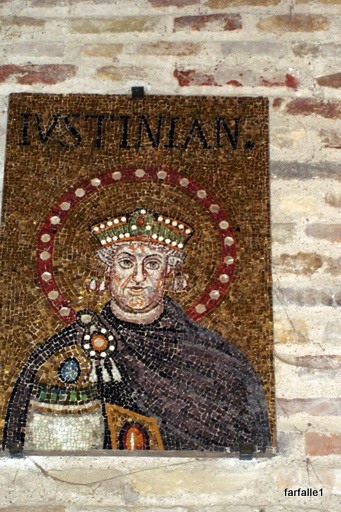
Perhaps altered and renamed portrait of Theodoric, photo by Pidge Cash
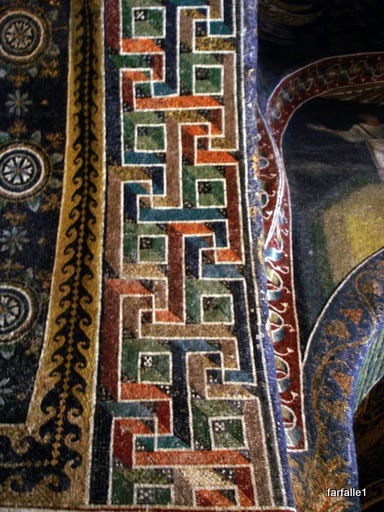
Galla Placidia, photo by P. Cash

Other mosaic methods include sticking paper to the right side of the tiles with a soluble glue, mounting the tiles bottom side in the cement and then soaking off the paper and glue when the cement has dried; or sticking the tiles right-side up into wax and applying the cement afterwards, then mounting the whole on the wall or floor.  This very kind woman explained it all to us as she worked away on her own replica of an ancient mosaic:
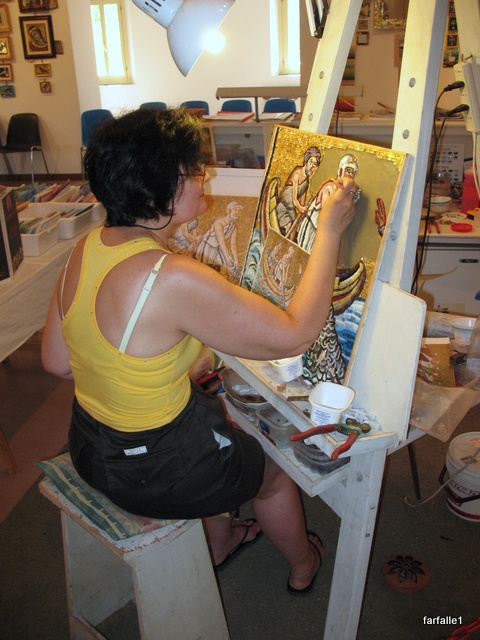
The thing that is so difficult to fathom is the teeny size of the tiles used in the mosaics, and the snugness with which they fit together.  It’s enough to make one blind just watching a demonstration like the one above, never mind trying to make a mosaic oneself.

There is so much to see in Ravenna, and we saw almost all of it.  At the bottom of this post there is a list of monuments (eight in Ravenna are World Heritage Sites) with links for history and photographs.  Here is a link to my own web album from our trip.

But traveling in Italy is not just about seeing the beautiful art and learning some of the long and varied history of the country.  There is always Food (and it does have a capital ‘F’ in this country).  And there are always, and for me most interestingly, the people.  We had an experience in Ravenna which I’ve had once or twice before in Italy, but never in the US.

Our map-reading skills are not especially stellar, and at one point we found ourselves – or rather we lost ourselves – not knowing exactly where we were or how to get to the church we wanted to visit.  We were next to a shady park where two elderly gents were having a natter under the trees.  I brazenly interrupted them to ask directions; there ensued a long conversation between them about the best way to direct us, having quite a bit to do with a fruit store.  Finally they bid each other farewell, and one of them said, “Come with me.”  He then walked with us for ten minutes, depositing us on the threshold of our destination.  Evidently that was a lot simpler, or perhaps  more interesting, than just giving directions.  What a doll.
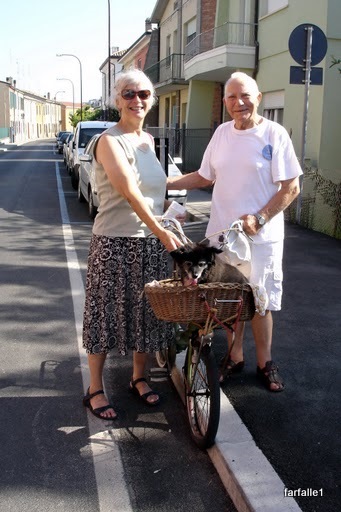
Salvatore and dog Willy, photo by P. Cash

Here is a linked list of the principal sites in Ravenna:

Mauseleum of Galla Placidia**
San Vitale**
Church of the Spirito Santo and the Arian Baptistry**
San Giovanni Evangelista
Sant’Apollinare Nuovo**
Sant’Apollinare in Classe *    **
Cathedral
San Francesco
Neonian Baptistry**
Archepiscoal Chapel**
Mauseleum of Theodoric**

* This beautiful Sant’Apollinare is in the town of Classe (which was a port city), located about 5 km from Ravenna proper.

** World Heritage Sites, built in 5th and 6th centuries

And finally – one of my favorite mosaics:
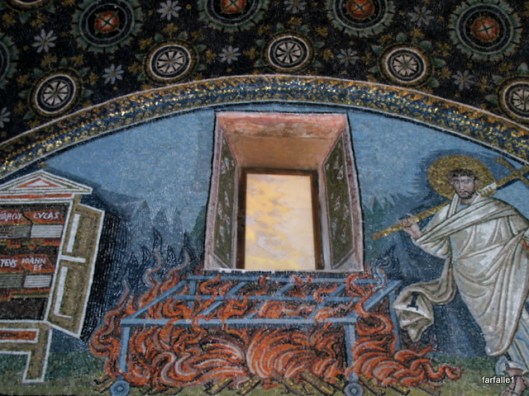
Hellfire in the Mausaleum of Galla Placidia

PS – Pat Smith has written here, in the Italian Notebook, about Orsoni, the company that makes the glass tiles that are used by many mosaicists.

PPS – Debra and Liz of the blog Debra and Liz’s Bagni di Lucca visited Ravenna in April. You can read their account and see their photos here, here, here, here, here and here.
Sad Day for Some

25 Friday Jun 2010

Posted by farfalle1 in Italy, Sports, Uncategorized

≈ 7 Comments

Tags

Italian Football, Italian Soccer, World Cup

Rapallo, and all of Italy for that matter,  is draped in crepe after Italy’s upset loss to Slovakia in yesterday’s World Cup game.  Well actually, Rapallo is draped in sun and beach towels, but there is an air of resigned sadness amongst soccer fans of all stripes.
Here’s what’s really good about an Italy World Cup game – you can drive through Rapallo and the streets are eerily deserted and navigation is a snap. We visited a car mechanic’s shop and had to tear him away from his buzzing, humming radio – the radio was fine, it was those plastic horns the fans blow, the vuvuzelas.  Then I stopped with the Captain at his golf course, also deserted.  Inside the club house, though, we saw no fewer than 4 big-screen TV’s, each with a crowd of men (only men!) watching and offering unsolicited and unheard advice to the players and coaches.  Then I went to the local AgriTech to buy some plant food – the radio was on very, very loudly – more swarms of bees.

It seemed there would be no one at exercise class, either – I arrived about 10 minutes before it was due to start.  2 minutes later the game ended and 5 minutes after that about 15 other exercisers streamed in.

Following football is a national pastime in both the U.S. and Italy, though the games followed are completely different.  Here’s another difference between the two countries.  We were in Arizona when the Phoenix Cardinals won a berth in the Super Bowl XLIII (2009).  It was absolutely quiet all around the town immediately after the game.  Here, if Italy so much as scores a goal in a world cup match the town erupts in noise – shouts, car horns, cheers.  The enthusiasm is infectious and very, very loud.  Kind of like vuvuzelas but without the plastic.
So now we will all be sad for a few days because we’re out of the Cup race; then we can begin watching and waiting for 2014, when surely Italy will once again be a contender.

← Older posts
Newer posts →

Enter your email address to follow this blog and receive notifications of new posts by email.

Join 114 other subscribers

rss

Subscribe in a reader

Search the Blog

A. Useful Links

  • bab.la language dictionary
  • Bus schedules for Tigullio
  • Conversions
  • English-Italian, Italian-English Dictionary
  • Expats Moving and Relocation Guide
  • Ferry Schedule Rapallo, Santa Margherita, Portofino, San Frutuoso
  • Italian Verbs Conjugated
  • Piazza Cavour
  • Rapallo's Home Page – With Link to the Month's Events
  • Slow Travel
  • The Informer – The Online Guide to Living in Italy
  • Transportation Planner for Liguria
  • Trenitalia – trains! Still the most fun way to travel.

C. Elaborations

  • A Policeman’s View
  • Driving School Diary
  • IVA refunds due for past Rifiuti tax payements
  • Nana
  • Old trains and old weekends
  • The peasant, the Virgin, the spring and the ikon
  • Will Someone Please, Please Take Me to Scotland?

D. Good Recipes - Best of the Week winners are starred

  • 'Mbriulata
  • *Baked Barley and Mushroom Casserole*
  • *Captain’s Boston Baked Beans*
  • *Crimson Pie*
  • *Louise’s Birthday Cake*
  • *Melanzane alla Parmigiana*
  • *Penne with Cabbage and Cream
  • *Pizzoccheri della Valtellina*
  • *Pumpkin Ice Cream*
  • *Risotto alla Bolognese*
  • *Rolled Stuffed Pork Roast*
  • *Spezzatini di Vitello*
  • *Stuffed Grape Leaves*
  • *Stuffed Peaches (Pesche Ripiene)*
  • *Swordfish with Salsa Cruda*
  • *Tagliarini with Porcini Mushrooms*
  • *Tagliatelli al Frutti di Mare*
  • *Three P's Pasta*
  • *Tzatziki*
  • 10th Tee Oatmeal Apricot Bars
  • Adriana’s Fruit Torta
  • Aspic
  • Bagna-calda
  • Best Brownies in the World
  • Clafoutis
  • Cold cucumber soup
  • Crispy Tortillas with Pork and Beans
  • Easy spring or summer pasta
  • Fish in the Ligurian Style
  • Hilary's Spicy Rain Forest Chop
  • Insalata Caprese
  • Lasagna al forno
  • Lasagna al Forno con Sugo Rosato e Formaggi
  • Lemon Meringue Pie
  • Leo’s Bagna Cauda
  • Leo’s Mother’s Stuffed Eggs
  • Louis’s apricot chutney
  • Mom's Sicilian Bruschetta
  • No-Knead (almost) Bread
  • Nonna Salamone's Christmas Cookies
  • Pan Fried Noodles with Duck, Ginger, Garlic and Scallions
  • Pesto, the classic and original method
  • Pesto, the modern, less authentic method
  • Pickle Relish
  • Poached pears
  • Poached Pears
  • Polenta Cuncia
  • Recipes from Paradise by Fred Plotkin
  • Rustic Hearth Bread
  • Shrimp and Crayfish Tail Soup
  • Sicilian salad
  • Slow Food Liguria
  • Slow Food Piemonte and Val d'Aosta
  • Spinach with Garlic, Pine Nuts and Raisins
  • Stuffed Eggs, Piemontese Style
  • The Captain’s Salsa Cruda
  • Tomato Aspic
  • Zucchini Raita

E. Blogroll

  • 2 Baci in a Pinon Tree
  • Aglio, Olio & Peperoncino
  • An American in Rome
  • Bella Baita View
  • Debra & Liz's Bagni di Lucca Blog
  • Expat Blog
  • Food Lovers Odyssey
  • Italian Food Forever
  • L’Orto Orgolioso
  • La Avventura – La Mia Vita Sarda
  • La Cucina
  • La Tavola Marche
  • Rubber Slippers in Italy
  • Southern Fried French
  • Status Viatoris
  • Tour del Gelato
  • Weeds and Wisdom

Photographs

  • A Day on the Phoenix Light Rail Metro
  • Apache Trail in the Snow
  • Aquileia and Croatia
  • Birds on the Golf Course
  • Bridge Art
  • Canadair Fire Fighters
  • Cats of Italy
  • Cloudy day walk from Nozarego to Portofino
  • Fiera del Bestiame e Agricultura
  • Football Finds a Home in San Maurizio
  • Hiking Dogs
  • Mercatino dei Sapori – Food Fair!
  • Moto Models
  • Olive pressing
  • Rapallo Gardens
  • Rapallo's Festa Patronale
  • Ricaldone and the Rinaldi Winery
  • Rice Fields
  • Sardegna ~ Arbatax and Tortoli
  • Sardegna ~ San Pietro above Baunei
  • Sardegna ~ The Festa in Baunei
  • Scotland, including Isle of Skye
  • Slow Food 2008 Salone del Gusto
  • The Cat Show and the Light Rail Fair
  • The desert in bloom
  • Trip to Bavaria

Pages

  • Fagioli all’ucelleto

Archives

Recent Posts

  • A Superior Visit
  • Fun at the Ranch Market
  • The MAC
  • Welcome Tai Chi
  • Bingo Fun for Ferals
December 2025
M T W T F S S
1234567
891011121314
15161718192021
22232425262728
293031  
« Jul    

Member of The Internet Defense League

Blog at WordPress.com.

  • Subscribe Subscribed
    • An Ex-Expatriate
    • Join 114 other subscribers
    • Already have a WordPress.com account? Log in now.
    • An Ex-Expatriate
    • Subscribe Subscribed
    • Sign up
    • Log in
    • Report this content
    • View site in Reader
    • Manage subscriptions
    • Collapse this bar
 

Loading Comments...