• Contact
  • Elaborations
    • A Policeman’s View
    • Driving School Diary
    • Great Danes
    • IVA charged on Tassa Rifiuti
    • Nana
    • Old trains and Old weekends
    • The peasant, the virgin, the spring and the ikon
    • Will Someone Please, Please Take Me to Scotland??
  • Recipes
    • ‘Mbriulata
    • *Baked Barley and Mushroom Casserole*
    • *Captain’s Boston Baked Beans*
    • *Cherry Tart*
    • *Crimson Pie*
    • *Louise’s Birthday Cake*
    • *Melanzane alla Parmigiana* – Eggplant Parmesan
    • *Penne with Cabbage and Cream
    • *Pizzoccheri della Valtellina*
    • *Pumpkin Ice Cream*
    • *Risotto alla Bolognese*
    • *Rolled Stuffed Pork Roast* on the rotisserie
    • *Shrimp and Crayfish Tail Soup*
    • *Spezzatino di Vitello*
    • *Stuffed Grape Leaves*
    • *Swordfish with Salsa Cruda*
    • *Tagliarini with Porcini Mushrooms*
    • *Tagliatelli al Frutti di Mare*
    • *Tzatziki*
    • 10th Tee Apricot Bars
    • Adriana’s Fruit Torta
    • Artichoke Parmigiano Dip
    • Best Brownies in the World
    • Clafoutis
    • Cod the Way Sniven Likes It
    • Cold Cucumber Soup
    • Crispy Tortillas with Pork and Beans
    • Easy spring or summer pasta
    • Fagioli all’ucelleto
    • Fish in the Ligurian Style
    • Hilary’s Spicy Rain Forest Chop
    • Insalata Caprese
    • Kumquat and Cherry Upside Down Cake
    • Lasagna Al Forno con Sugo Rosato e Formaggi
    • Lemon Meringue Pie
    • Leo’s Bagna Cauda
    • Leo’s Mother’s Stuffed Eggs
    • Louis’s Apricot Chutney
    • Mom’s Sicilian Bruschetta
    • No-Knead Bread (almost)
    • Nonna Salamone’s Famous Christmas Cookies
    • Pan-fried Noodles, with Duck, Ginger, Garlic and Scallions
    • Pesto
    • Pesto
    • Pickle Relish
    • Poached Pears
    • Polenta Cuncia
    • Pumpkin Sformato with Fonduta and Frisee
    • Rustic Hearth Bread
    • Sicilian Salad
    • Soused Hog’s Face
    • Spotted Dick
    • Swedish Tea Wreaths
    • The Captain’s Salsa Cruda
    • Tomato Aspic
    • Vongerichten’s Spice-Rubbed Chicken with Kumquat-Lemongrass Dressing
    • Winter Squash or Pumpkin Gratin
    • Zucchini Raita

An Ex-Expatriate

~ and what she saw

An Ex-Expatriate

Category Archives: Liguria

Pizzo Tombolo

30 Monday Jul 2012

Posted by farfalle1 in Arts and crafts, Italian arts and crafts, Liguria, Rapallo, Uncategorized

≈ 14 Comments

Tags

Lace-making

Photo courtesy of piazzacavour.it

Ah, the old ladies of Italy.  They are in a class of their own.  Once one reaches ‘a certain age,’ it seems, one can go to the front of any line.

We were in a very crowded ice cream shop a while back in Santa Margherita, and a lady of just that age came through and scusami-ed her way to the very front.  Two seconds another lady appeared and announced to one and all, ‘that’s my friend,’ which of course entitled her to move up to the front.  Then came another, then another and another – all with the same excuse – ‘those are my friends.’  Finally Speedy asked, in very good humor, ‘how many of you sisters are there?’  Everyone got a chuckle, the ladies (there were six finally) got their ice-creams and the line began a more organized movement.

When we went outside we were so happy we had not been grumpy.  All the ice-cream ladies were demonstrating Pizzo Tombolo, an incomprehensible cross between crochet, embroidery and knot-tying.  If you’re like me a bobbin always makes you laugh (that and banana peels on the side walk, sorry, I just can’t help it, they are hilarious).  So I was chuckling away when I approached the group and asked about their work.
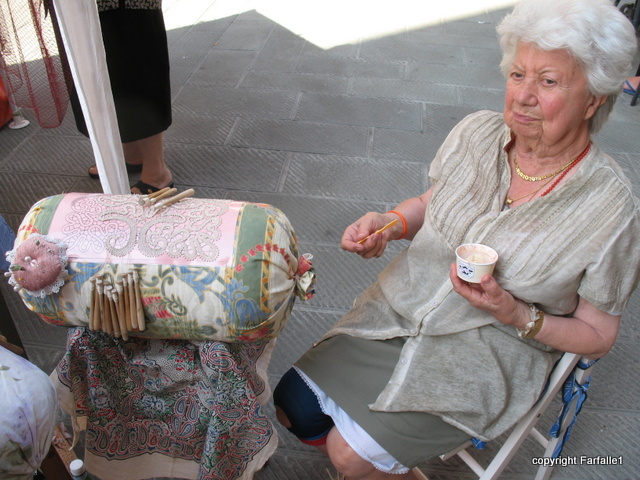
Meet Giuseppina (note the ice cream).  Why she is not blind I can’t imagine.  She doesn’t even seem to need glasses. She is working on a pizzo, also known as ‘merletto.’ The Tombolo is the pillow on which the work is done.

The ancient art of making a delicate and lacy adornment for clothing and furnishings has existed in Rapallo for centuries.   Archaeologists have discovered bits and pieces from as early as the 13th century.  A shop inventory from Genoa in 1600 mentions articles made from ‘filo di Rapallo’ (thread of Rapallo), suggesting that the ornate handwork was well known and appreciated outside the town.

There is a lovely story about how one of the styles of lace-making in Rapallo, known as Bella Nina, got its name.  In the 1500’s the dreaded pirate Dragut made a raid on Rapallo.  All the townspeople fled in terror.  But upon entering the home of a fisherman, one of the pirates who had stayed behind found two women poorly hidden behind a pile of nets.  One was very old and couldn’t move; one was young and beautiful, and was working lace on a pillow.

‘Why didn’t you leave with the others?’ he asked.  The young woman replied that her grandmother was paralyzed and she did not wish to abandon her. When asked their names, the young woman replied they were both called Nina, as women’s names were handed down from mother to daughter.

The pirate asked what the young woman was doing, and she showed him her delicate handwork.  When asked what it was called, Nina said that it had no name, it was just the work that women of Rapallo did.  The pirate was so impressed with Nina’s beauty and fidelity that he said he would not harm either of the women and that henceforth the work she was doing should be known as ‘Bella Nina.’

How is the work done?  I can’t begin to tell you!
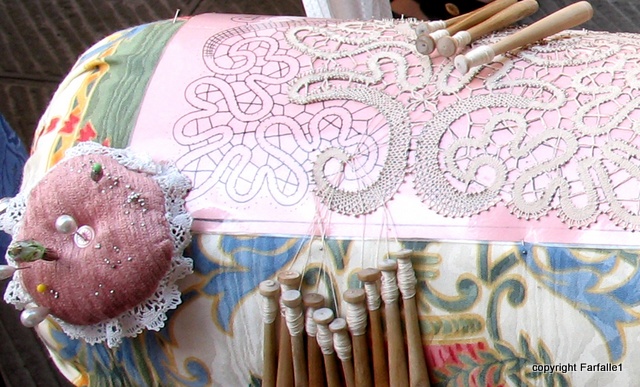
As you can see in the enlarged photo above, Giuseppina attaches a pattern to her tombolo, then uses a million straight pins as anchors for her weaving and knotting.  Now you know as much as I do, which isn’t nearly enough to undertake the craft.  However, if you do want to learn how to do this, you can sign up at the Scuola di Tombolo “Le amiche del ‘Merletto’ in Santa, or, come winter, at the Accademia Culturale in Rapallo.

If you’d like to know more about Pizzo Tombolo, there is a lot of information here and here.

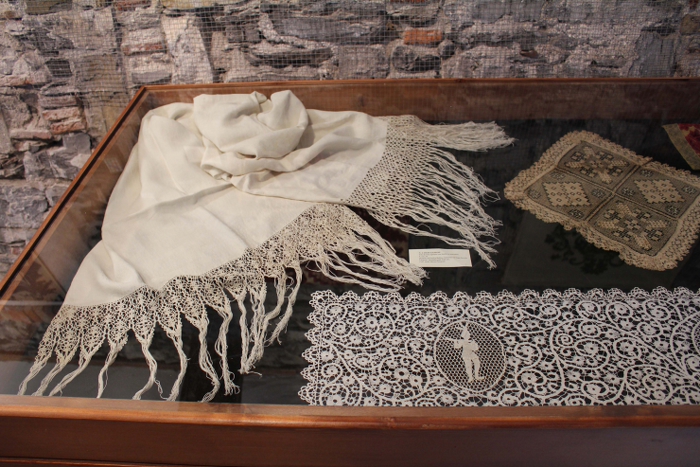
And if you’re in Rapallo and you’d like to see a panoply of examples of Pizzo Tombolo, you can visit the Museo del Merletto.  I’m embarrassed to say I haven’t been there yet, but writing this has aroused my curiosity and I think a visit is order.  I wonder… am I old enough now to go to the front of the line?
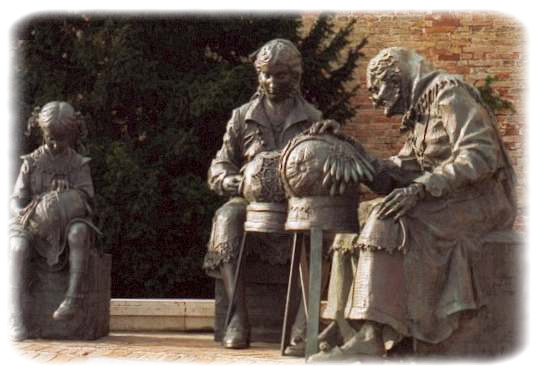
Italian at Bronze statue of woman doing Pizzo Tombolo courtesy of merlettoitaliano.it


Damn Pigs

10 Tuesday Jul 2012

Posted by farfalle1 in Animals in Italy, Liguria, Uncategorized

≈ 26 Comments

Tags

Cinghiale, Wild boar, Wild pigs

Photo courtesy of /www.atripaldanews.it
Oh sure, they look kind of cute and fuzzy when you see a photo like the one above.

You want to know how they look even better? Like THIS:

Photo of Cinghiale alle Cacciatore courtesy of maremmaguide.com

I’m as soft as the next person, and if I had to kill my own meat I’d definitely be a vegetarian. But what we really need around here is a ‘cacciatore’ – a hunter. After ten years with nary a sign we’ve been invaded by the wild boars, known here as ‘cinghiale’ (pronounced ching-ghee-ah’-lay).  They have visited and torn up each of our six fascie though, through some miracle, they have so far left the vegetable garden untouched.

Wikipedia has a great deal of information about this widely-dispersed ungulate.  Some of the more interesting data are: height, averages 22-43″ (that last is almost 4′ tall at shoulder – yikes!); weight, 110-210 pounds, though in Tuscany and Liguria they tend to be larger, perhaps 180-220 pounds.  They have four tusks which they keep sharp for defense and for rooting around.

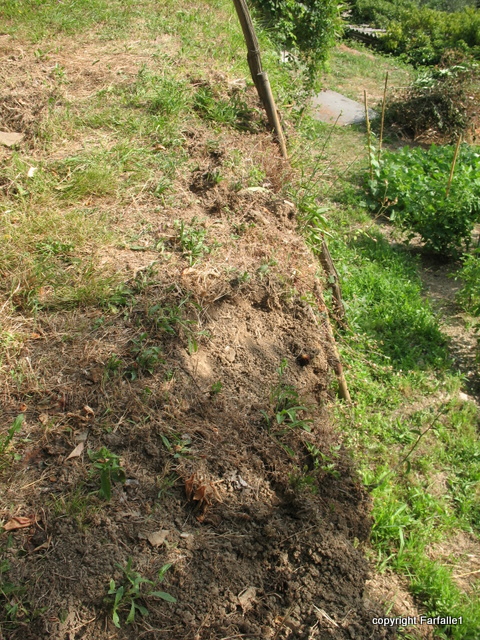
And that’s the crux of our problem with the pigs – they root around like crazy, and do an amazing amount of damage to ground and crops in a short period of time.

Looks like a roto-tiller went through, doesn’t it?

They tend to be crepuscular or nocturnal, so we don’t see them that often.  But we know when they’ve been here.  Plants are uprooted, there are big dirt holes where there used to be none, and there is a wild and pungent smell that is unmistakable (and not very pleasant).

They are more nimble than you’d imagine.  The photo above shows the chewed up edge of a wall where the pigs have scrabbled up from the fascia below.

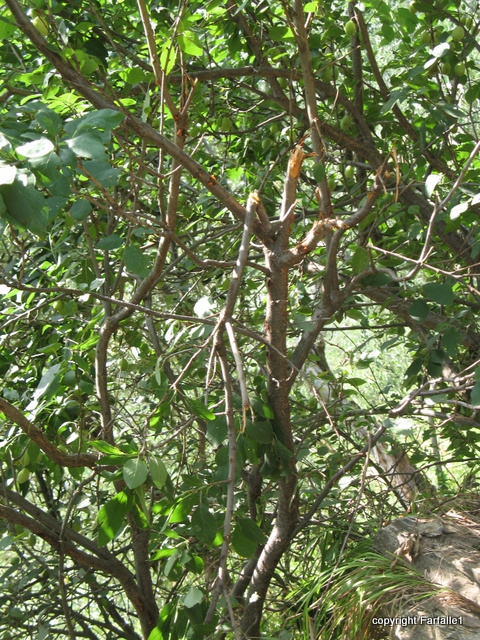
As far as I know they don’t actually climb trees, but they will certainly stand up tall and break branches if there is something there they want (in the case above, it was some plums – see previous post).
This year brought us a banner crop of apricots, most of which we harvested.  A lot of spoiled ones fell on the ground, and there were a lot left at the top of the tree which we couldn’t reach.  We were surprised that the cinghiale didn’t eat the groundfalls on the their early visits, choosing instead to dig trenches around other trees.  Then one day last week Speedy went out to the apricot tree to get some fruit for lunch.  There was no sign of an apricot anywhere.  Everything on the ground had been vacuumed up, and the tree, which had been madly speckled yellow with fruit the night before showed nothing but green leaves, not a fruit to be seen.  Turns out these rascals know how to butt the trees to get the very ripe fruit to fall.  And they’re smart enough to wait until the fruit is very ripe to do it.  Speedy couldn’t believe his eyes; he just stood there staring, wondering if he was looking at the wrong tree.  But no.  The thieves had come and taken everything.
We asked a lot of people what could be done.  The obvious solution is to fence the property.  But this is Italy!  In order to put up a permanent fence, we are told, we would have to do a ‘project’, complete with geometra, plans, town approval and so forth.  It seems a daunting prospect, in addition to sounding very expensive.  Introducing natural predators might be a solution, but somehow I think the town fathers would take a dim view if we imported tigers, wolves and, for the piglets, pythons.

Simone, who keeps our motorini running smoothly, said he had heard that the pigs don’t like shade cloth and olive nets, and that if we were to build a not terribly high fence of one or the other of these, the pigs would not come in.  Worth a try, we thought.

We did this on the two points where we surmised the pigs were gaining access, and for three nights we had no visitors.  Then they came back and tore up two upper fascie.  My theory is they simply walked down the steps from the street above our house to get there, but we don’t really know.

There is a hunting season in the fall, and we hear a lot of gunshots, but I don’t think there’s any way the hunters can keep up with the exploding population of cinghiale.  They are well adapted to suburban and country life, and the sows produce two litters a year of from anywhere between three and fourteen piglets.  They are, in short, a nuisance.

I’m sure there is a solution to our problem (see ‘fence’ above) and no doubt we’ll resign ourselves to it one of these days.  In the meantime our property is beginning to look like a Christo exhibition.  And I just know that those damn pigs are watching the garden and waiting for the tomatoes to ripen.

Sea Sculpture

24 Sunday Jun 2012

Posted by farfalle1 in Arts and crafts, Liguria, Rapallo

≈ 5 Comments

Tags

Cairns in the Sea, Rick Gush, Sculpture in the Sea, Sea Cairns, Underwater sculpture

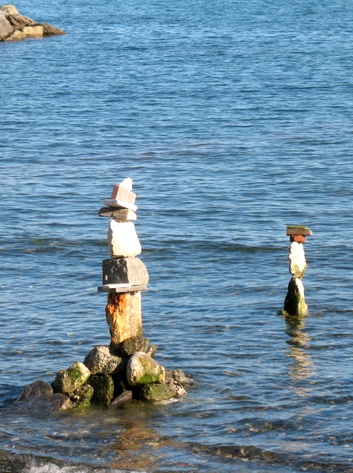
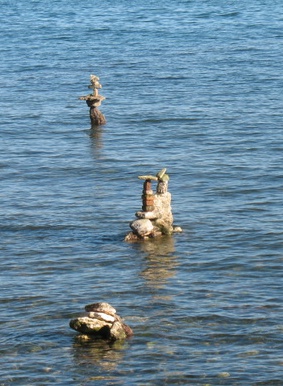
In the bay along the Lungomare, next to the Castello, an informal grouping of stone sculptures has sprung up.  They add zest to a visit to town because the display changes with every tide.

I asked who was responsible, but my sources would only say, ‘un marinaio,’ that is, a seaman.  There is a club of such who hang out right near the exhibit, so I expect it’s one (or more?) of them.

The sculptures are delicate, amusing and temporary – performance art at its best.  Thank you, Il Marinaio, for livening up greater downtown Rapallo.  Here are some more shots of the sculptures as they were several days ago:

(This one I found particularly amusing for its obvious reference to fishing.)

I’m not sure how these two remained upright for as long as they did.  Superb balance, I guess.

While art above the waves is accessible to all, that below the waves is harder to visit.  Underwater sculpture, mostly of a religious nature, is a common theme along the Riviera.  At San Frutuoso you can find (if you’re lucky) the submerged Cristo degli Abissi:

Photo courtesy of Francesca at scubakix.blogspot.com

In Zoagli, a bit to the south, the 1997 sculpture Madonna del Mare, made by artist Marian Hastianatte, is resting nine meters down:

Photo courtesy of http://www.commune.zoagli,ge.it

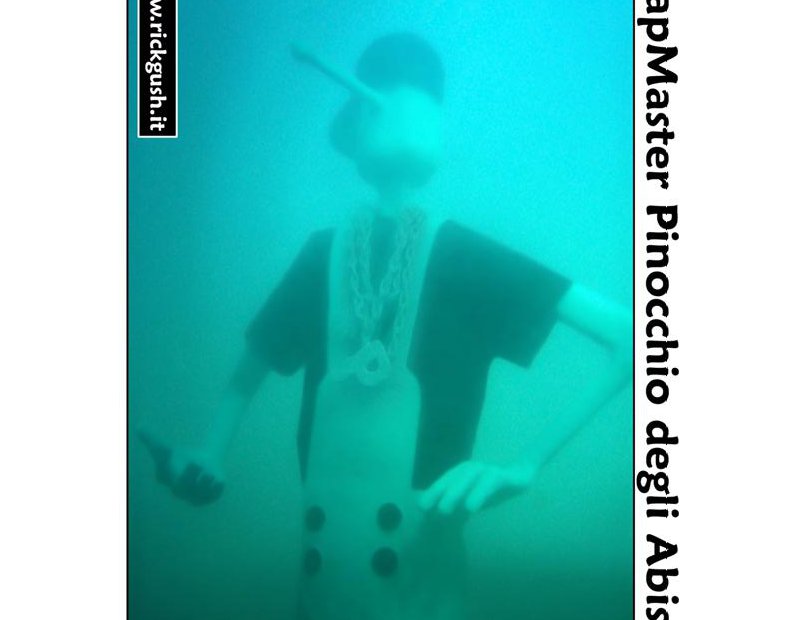
Not all the underwater art here is, or has been, sacred. On the first day of summer, 2008, local artist Rick Gush submerged  Rapmaster Pinocchio in the waters off San Michele, between Rapallo and Santa Margherita. Because the sculpture was an outlaw, it did not remain long; like the cairns of Il Maranaio, it was fleeting, and all the more interesting for that.

Photo courtesy of rickgush.it

If you are particularly interested in underwater sculpture, you can see some more of it here and here. If not, I’ll meet you on the Lungomare, we can get an ice cream at Fridgedarium, and admire the evolving work of Il Maranaio.

Mare Nostrum

02 Friday Dec 2011

Posted by farfalle1 in History, Liguria, Rapallo, Uncategorized

≈ 14 Comments

Tags

"Garibaldi un Uomo di Mare", Italian unification, Mare Nostrum, Ship models

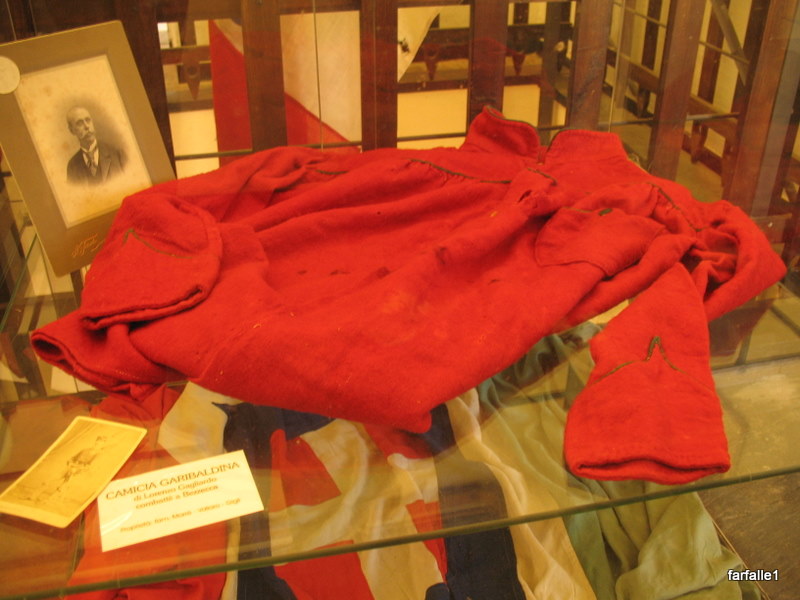
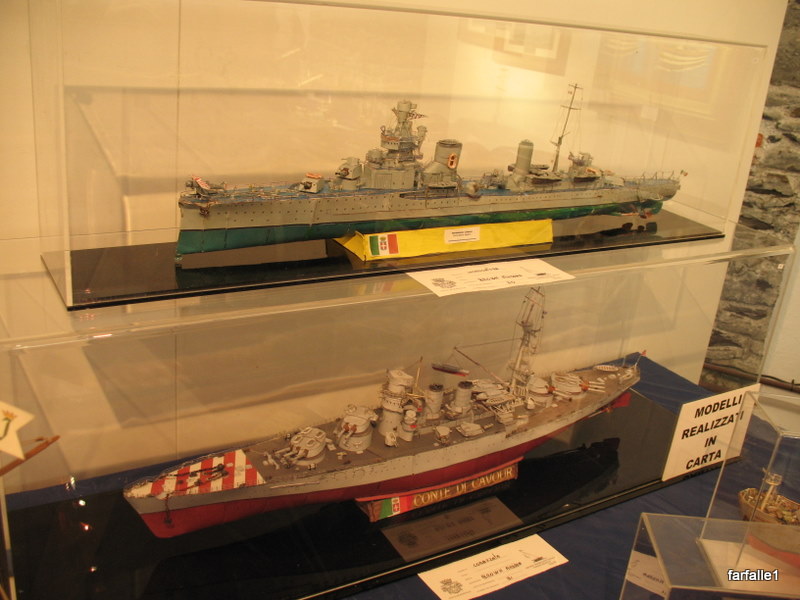
From November 4 – 20 the Castello in Rapallo hosted a terrific annual exhibit called “Mare Nostrum” (“Our Sea”) which included history, art and most specially, many ship models.  This year’s exhibit focused on the 150th anniversary of Italy’s unification, and included a special exhibit outlining the sea-faring highlights of that very complex and violent undertaking.  Called ‘Garibaldi, un Uomo di Mare’ it was curated by Maurizio Brescia, Emilio Carta and Carlo Gatti (who has one of my favorite last names).  Fascinating.  In one glass case there was an actual ‘Red Shirt’ worn by one of Garibaldi’s thousand (six of whom hailed from Rapallo, according to the exhibit catalog), a little the worse for wear, but definitely red.

Both the exhibit and the catalog,a handsome 64-page booklet chock full of photos, describe the preparations and outfitting for the voyage from Genova Quarto down to Sicilia, with special attention paid to the ships, models of which could be seen in other rooms.

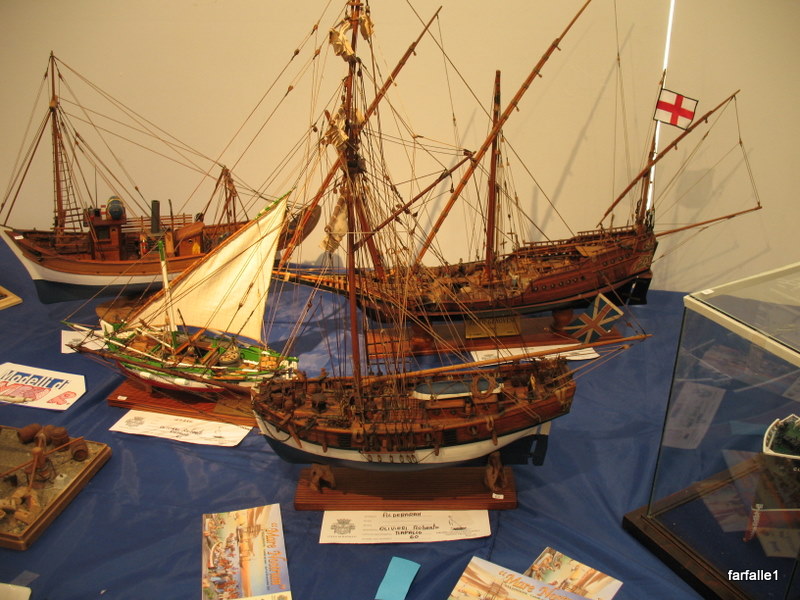
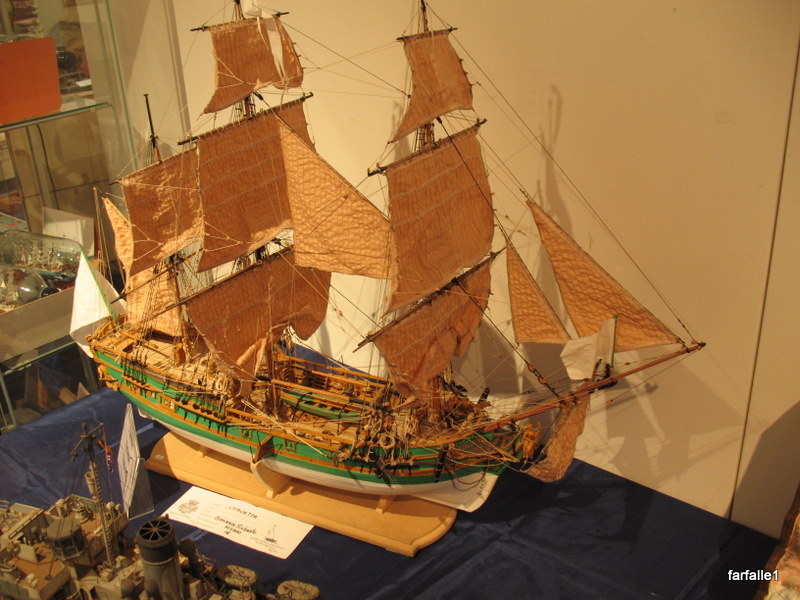
The models are remarkable. Most are made from what we usually assume models will be made of: wood, bits of string and fabric, like the “Aldebaran” below by Roberto Oliveri.

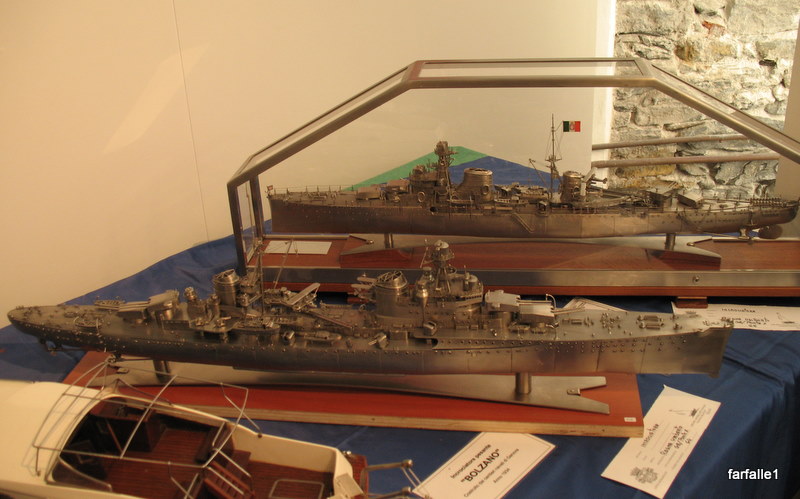
But several of the boats were made from more unexpected raw material. Umberto Rogma made his models from riveted steel:


He must have a rather sophisticated work shop.  I doubt Mrs. Rogma would welcome riveting on the kitchen table.

Andrean Brown chose paper for his model medium:


In addition to being very compliant in the bending department, paper has the added advantage of being a quiet material – no pesky sawing or riveting.  But really, look at the detail – can you believe that’s all made from… paper?!

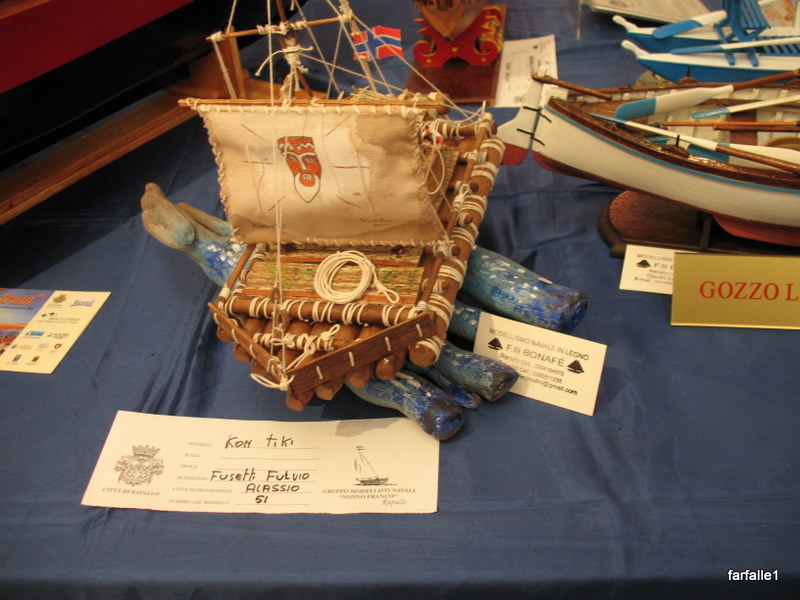
Many of the models are of particular vessels, like the famous Kon Tiki by Fulvio Fusetti:

and others are of a particular class of ship, such as this Corvette by Roberto Boniardi:

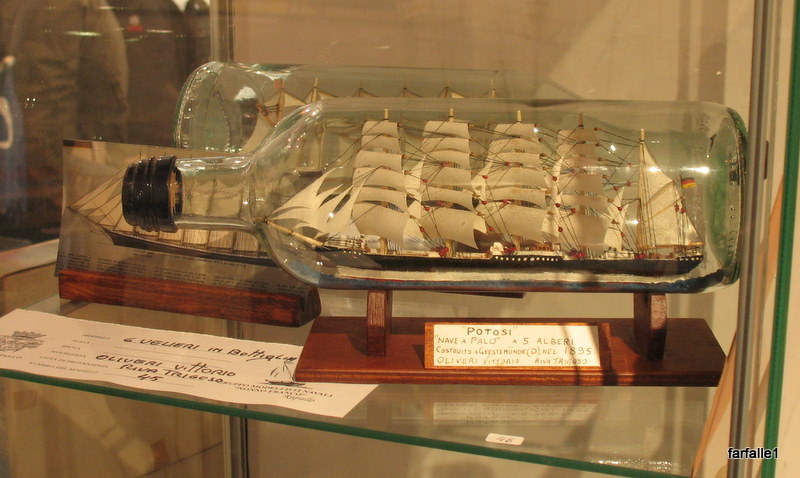
What would a model ship exhibit be without a ship in a bottle? The complexity of this construction takes my breath away. This is the ship Potosi, by Vittorio Oliveri:

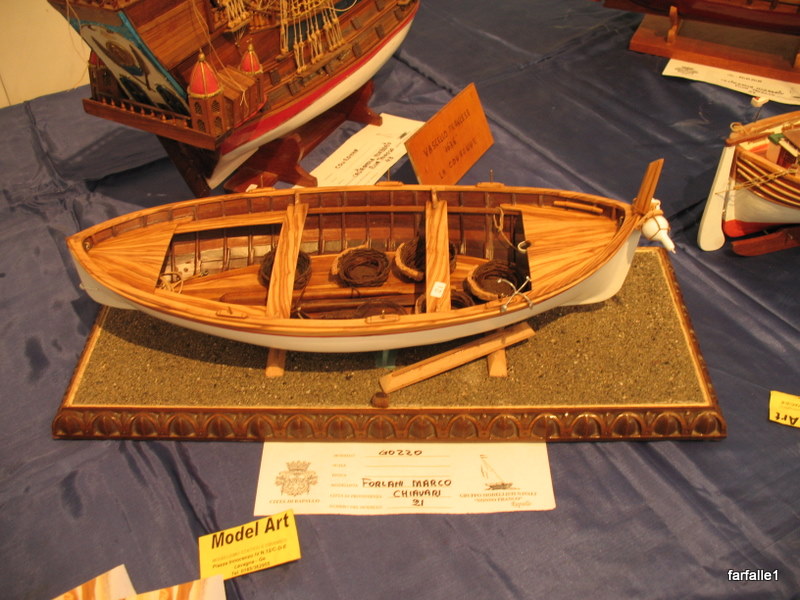
Three of the models particularly captivated me. The Gozzo is the typical Ligurian fishing boat of yore. How brave the sailors were who set out  in these small boats with no Loran, radar, GPS, etc. You will still see many Gozzi in the harbors around Rapallo, but they are now used as daytime pleasure craft; the fishermen have moved on to more elaborate boats, thank goodness. This model was made by Marco Forlani.

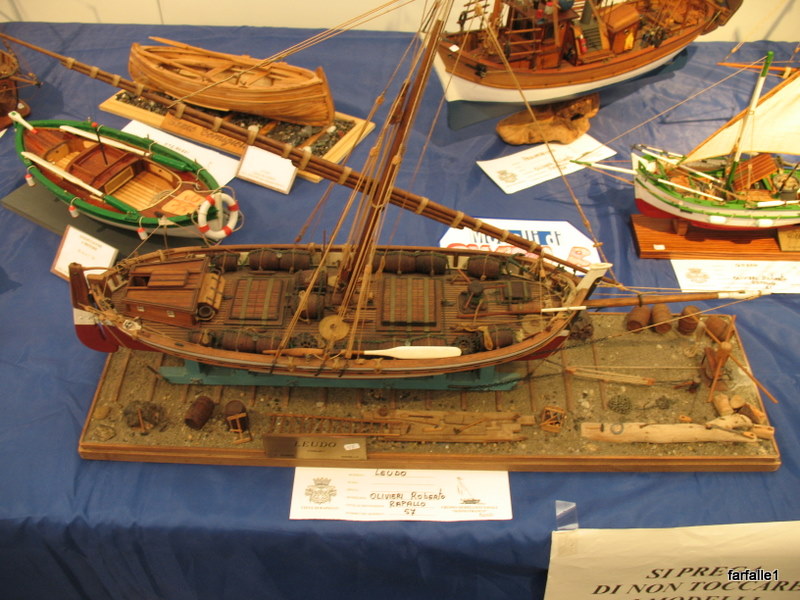
Some of the models recreate the ships’ on-shore environs. I loved this one for all the on and off-board detail, the tools, casks and ladder lying on the beach next to the boat. Roberto Oliveri fashioned each element himself.

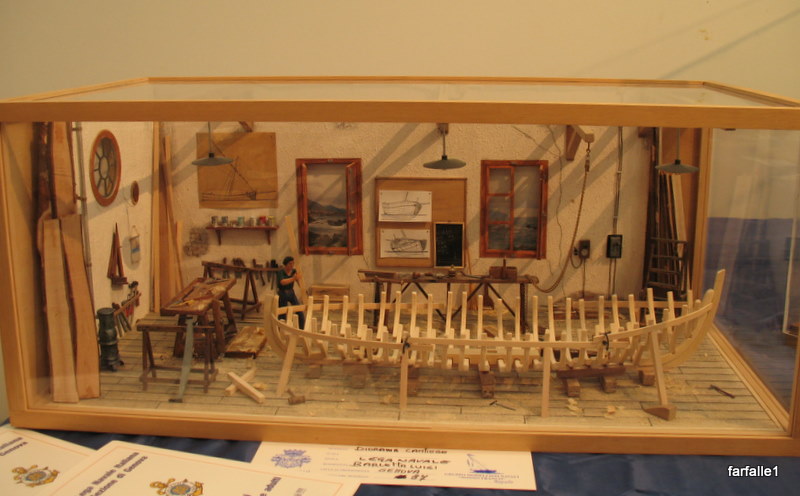
Luigi Barletta has shown us what the old ‘cantiere’ (ship-building works) looked like:

Could that be a Gozzo under construction?

These are just a few of the many, many models that were on exhibit. The show is over for this year but it will almost certainly return next year. If you’re in the neighborhood of the Castello at the right time, do go see it. It’s free and it’s wonderful.

Who Knew – Cold Breakfast

24 Wednesday Aug 2011

Posted by farfalle1 in Italian bureaucracy, Italian food, Italian habits and customs, Liguria, Uncategorized

≈ 2 Comments

Tags

B&B's Italy, Breakfast at an Italian B&B, Italian B&Bs, Ligurian regulations

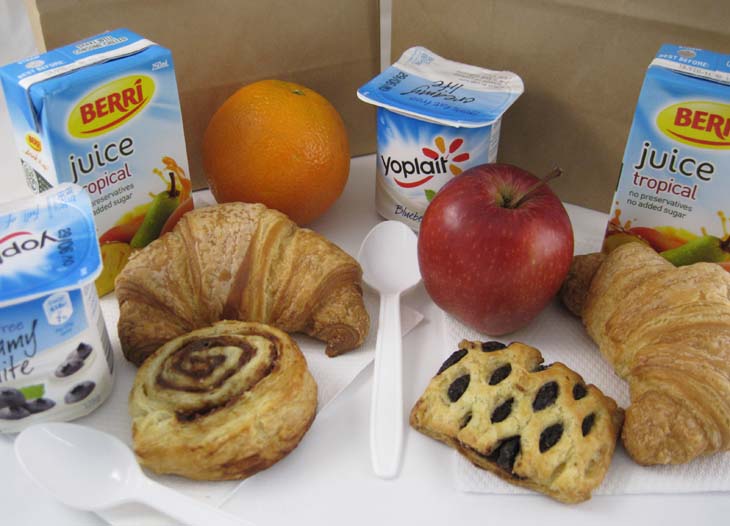
Photo courtesy of mintfoods.com.au

One of the joys, arguably the principal joy, of staying at a B&B is the breakfast part of the equation. We almost always seek out small B&B’s when we travel. Sometimes the decor is plain, sometimes fussy, the beds sometimes too small or not terribly comfortable. We almost always find a level of cleanliness Expatriate could only hope to emulate in her own home. And of course, the best part: breakfast! In Germany and Austria the array of cold sliced meats and cheeses is mouth-watering. In England the FEB (full English breakfast) with fried tomatoes, mushrooms and cold toast in that silly toast-holder is a good reason to get up early.

If you visit Liguria I encourage you to stay at a B&B if that is your preference (and I can even supply the names of a few superb ones), but I must warn you, don’t come anticipating a full cooked breakfast. It’s not that the hosts are lazy or unimaginative; they are simply not permitted to serve anything other than packaged foods for breakfast.  Isn’t that crazy?

There’s a good reason for this sorry state of affairs.  B&B’s are regulated on the regional level in Italy, and there is no inspecting agency to check hygiene and food preparation standards at B&B’s in Liguria.  It’s hard to believe there is a place in Italy where the bureaucracy has declined to put out another tendril, but so it is.  So to protect guests the Ligurian regulations decree that only packaged food can be served.  Ick.  Some (not all) other provinces have such an inspecting agency – and that’s why you can get a ‘real’ breakfast in, say, Tuscany.

So the next time you’re at a B&B and you wonder why your highly anticipated breakfast has turned out to be only buns in a plastic bag, some cookies in a plastic sleeve, cereal in a small box and that’s it… it’s possible that those are the only available permitted foods.  Who knew?

I asked the friend who explained all this to me if eggs were allowed – after all, they come in their own rather elegant packaging.  But one would have to eat the egg raw since cooking is not permitted, and that carries its own risks.  Besides, no self-respecting Italian would eat, or serve, an egg for breakfast. Benvenuto a Rapallo and enjoy your cereal!

Who Knew: Basil

16 Saturday Jul 2011

Posted by farfalle1 in gardening, Italian recipes, Liguria, Uncategorized

≈ 10 Comments

Tags

Basil, Growing Basil, Pesto


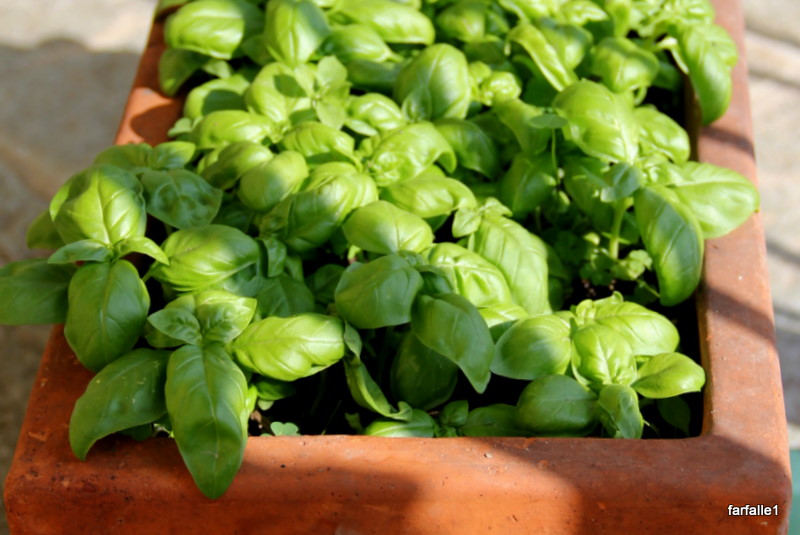
I always thought that basil wanted to grow in full, hot sun, and certainly we’ve always had good luck growing it that way.  But two unimpeachable sources (gnarled old Italian gardeners) have told us in the last week that full, hot sun is only for growing basil for minestra, the vegetable soup many still eat for supper here.  If you want to  make pesto with your basil, you must grow it in partial sun; it will be more tender and better suited to pesto (recipe here).  Who knew?

Scorpio Rising

05 Saturday Mar 2011

Posted by farfalle1 in Animals in the U.S., Arizona, Desert, Italy, Liguria, Rapallo

≈ 14 Comments

Tags

Arachnids, Scorpions

Up my pant leg, that is…

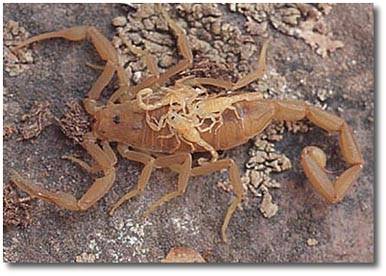
Mother scorpion and babies, courtesy of phoenix.about.com

I went out to the garage to get something, and after a few minutes back in the house I felt a sharp sting – the unmistakable feeling of something small defending its territory in my trousers.  Ouch!

Pants quickly off and shaken, a teeny sandy, orangey scorpion trembled, terrified in the pile of the carpet.  It was literally a half inch long, or less.  Which is lucky for me.  There are many varieties of scorpion inhabiting the southwestern desert.  The Arizona Bark Scorpion, seen above, is venomous and can, in certain individuals, cause seizures.  My little guy was either a baby or an altogether different species; we didn’t keep him around long enough to ask him.  My heroic Captain whisked him away on a paper towel and set him free outside, where he belongs.  The sting site got a little red, a little puffy, and was off and on sore for the rest of the night, but by the next morning I had forgotten I’d been stung.

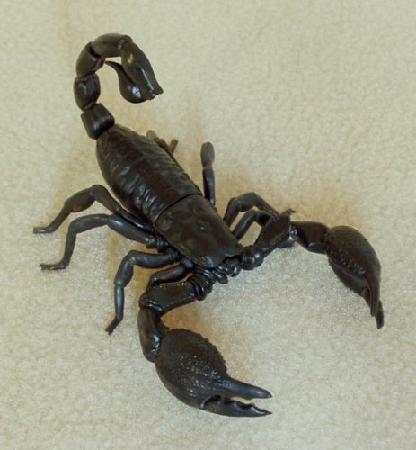
photo courtesy of dimackey.com

There are scorpions in Italy as well.  We frequently find small black ones in various parts of the house.  Sometimes they are dead and dessicated, sometimes they are quite lively.  For well over a year a little fellow lived under the baseboard next to Luciano‘s supper dish; we assume he came out at night to scarf down kitty scraps.  During the day he hid in the safety of his baseboard with only his larger claw partly visible, like a child who thinks he’s hiding because he can’t see you.  We got pretty fond of Blackie, especially after we checked with the vet and learned that in the off chance that he stung Luciano, there would not be any major trouble.  Little Blackie stayed with us even after Luciano was gone, and in memory of our funny cat I sometimes put down a crumb of something for his baseboard buddy to eat.  Then we had an infestation of ants, as sometimes happens in spring.  Without thinking we spread poison along the ant trail which happened to lead along Blackie’s baseboard.  That was the end of him.  We felt pretty bad about that.

So, are scorpions dangerous?  Clearly the Arizona Bark Scorpion can be, though Dr. Trisha McNair reports that of the 1,400 scorpion species worldwide, only about 25 have venom that can kill a person.  European scorpions in general are a nuisance at worst, their sting being like that of a bee or wasp.  There’s more on scorpions here from Dr. McNair.  But toxic or not, I can tell you from experience you don’t really want them crawling around in your pants!

Focaccia col Formaggio

23 Tuesday Nov 2010

Posted by farfalle1 in Food, Italy, Liguria, Photographs, Uncategorized

≈ 14 Comments

Tags

Cheese focaccia, Focaccia, Focaccia col Formaggio, Recco, Ristorante Vitturin

In all of Italy it is the province of Liguria that is most famous for focaccia, the exquisitely delicious flat, oily bread.  In all of Liguria, the town of Recco is most famous for its focaccia.  And in Recco, one of the most famous places to find focaccia col formaggio is Ristorante Vitturin 1860.  Yes, the date at the end of the name is the date the restaurant was established.  As they proudly state on their business cards: ” ‘Il piu antico di Recco’, 150 anni e non sentirli” (the oldest in Recco, 150 years and we don’t feel it).

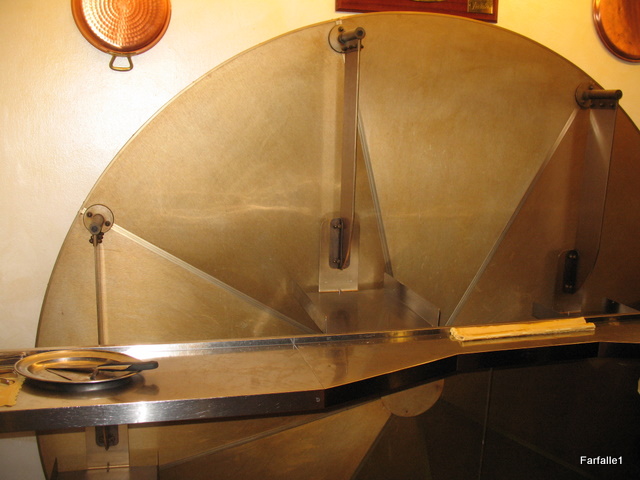
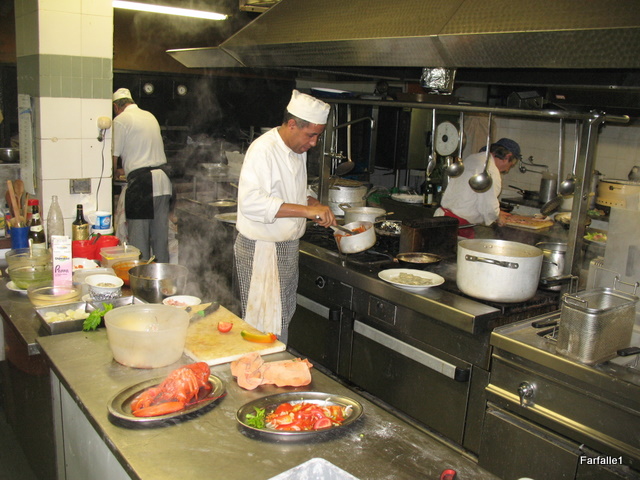
Before leaving  for the States we met our Genovese cousins at Vitturin to enjoy some seafood and some of the restaurant’s well-known focaccia col formaggio (quite unlike the more usual bready styles of focaccia).  Once inside the restaurant we were amazed to see the enormous paddle-wheel apparatus that delivers meals from the kitchens below to the diners above.

There are about eight of these trays mounted on the wheel; obviously they must stay horizontal as the wheel turns – it is a most ingenious system and must save a million steps a day for the wait staff.

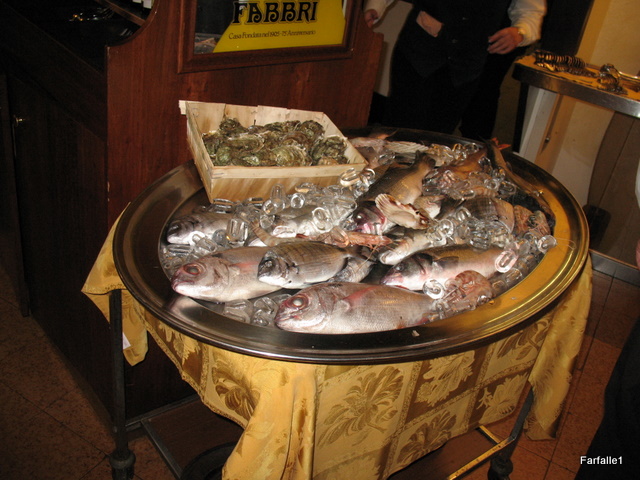
Fish and focaccia are the main events at Vitturin; they give the merest nod in the direction of meat.  This big platter of fish would entice any diner.

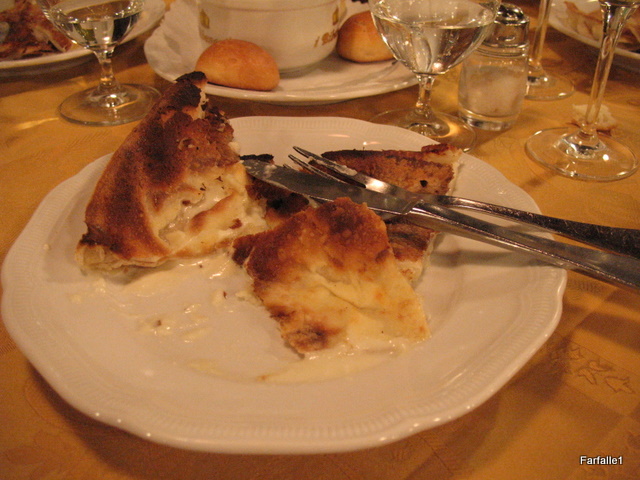
Here is a close-up of my partly devoured focaccia col formaggio:

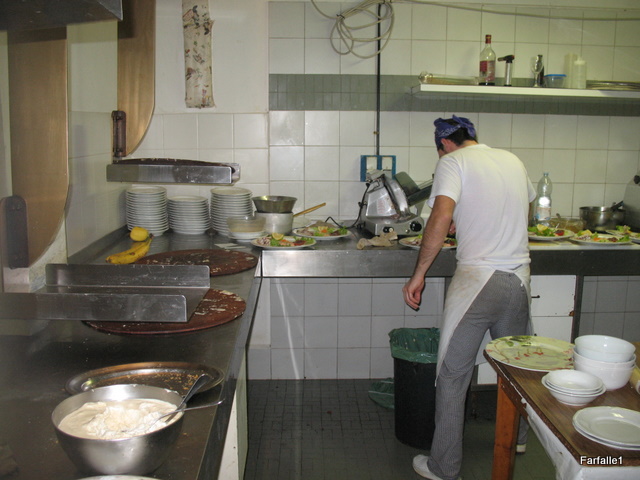
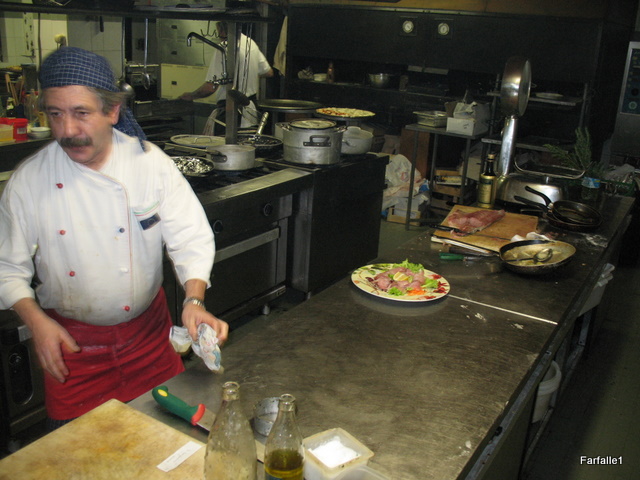
What was the highlight of the evening?  It was a long visit to the kitchens below the restaurant proper.  The Captain asked the Maitre D’ if we could see what the delivery wheel looked like down below, and he immediately escorted us to the nether regions.  There we saw the wheel looking much as it did above – plates of steaming food going up, empty plates coming down.

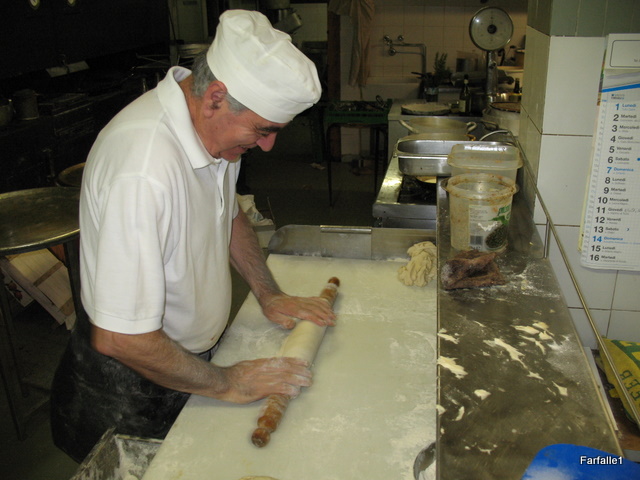
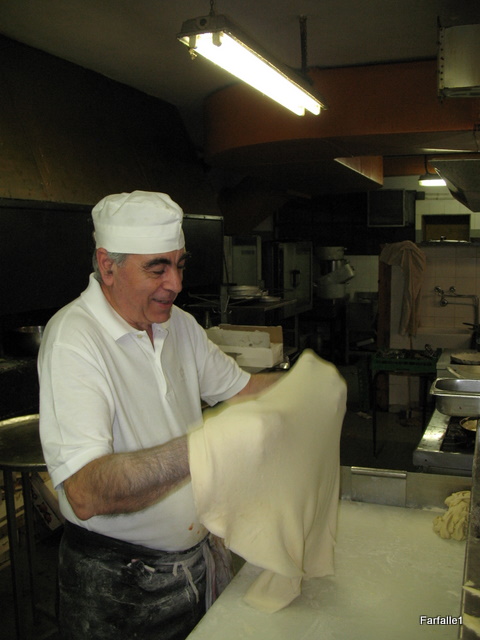
Over on one side of the kitchen we met Filippo, who makes, he proudly told us, about 120 focaccia col formaggio every evening.  He begins by mixing his dough in the early afternoon and letting it rest.  When he’s ready to make a focaccia he takes a big knob of dough and rolls it out.

When the dough is thin enough he picks it up in his hands and does the stretching maneuver we associate with pizza-makers.

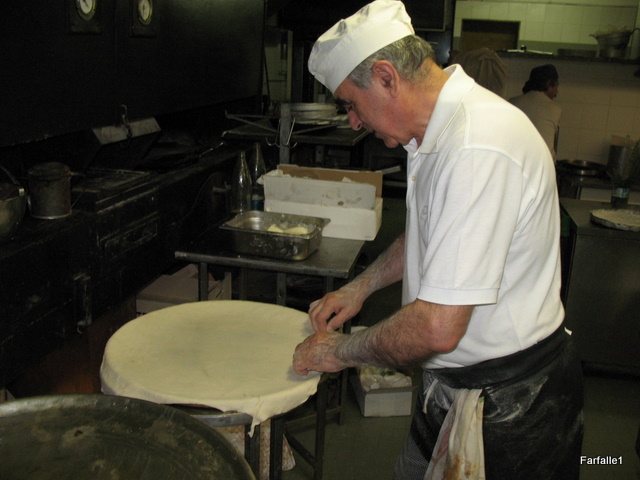
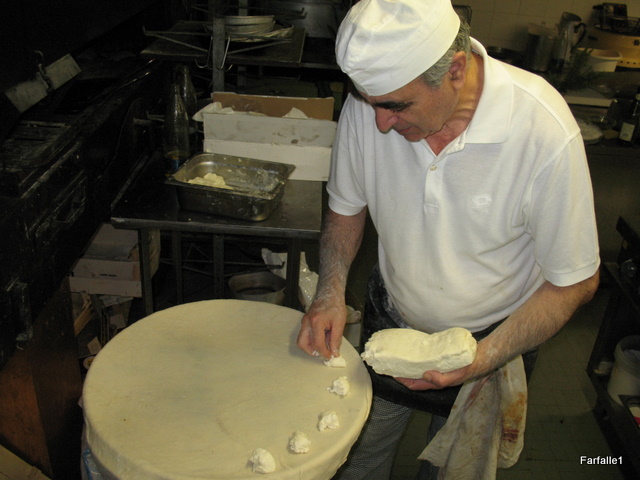
He puts it on the large round focaccia pan and puts dabs of stracchino cheese on top, about 750 grams for a regular focaccia, up to 1500 grams for a large size (that’s more than a pound for the regular, and about 3 pounds for a large). (!)

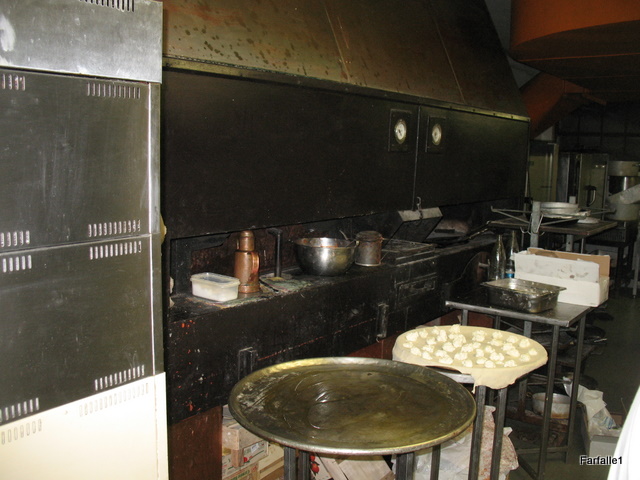
(It’s pretty hard to see in the photo, but that’s the old wood-fired stove in the background.  The restaurant now uses an electric oven.)

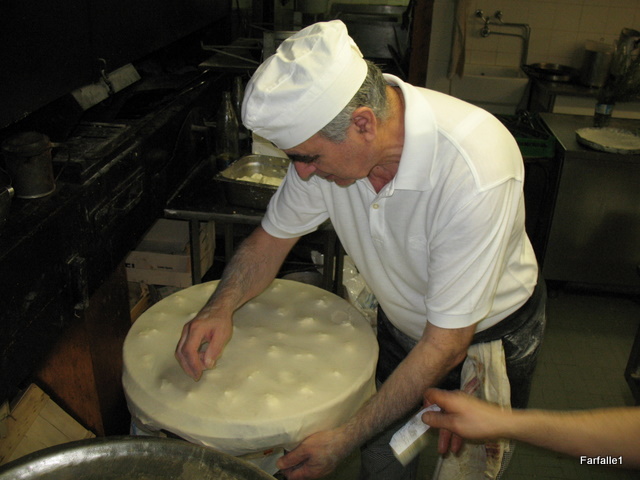
Then Filippo rolls out another sheet of dough, just the way he did for the bottom of the focaccia, and puts it over the cheese.  With a quick, nipping movement he tears some holes in the top layer of dough over some of the cheese knobs.

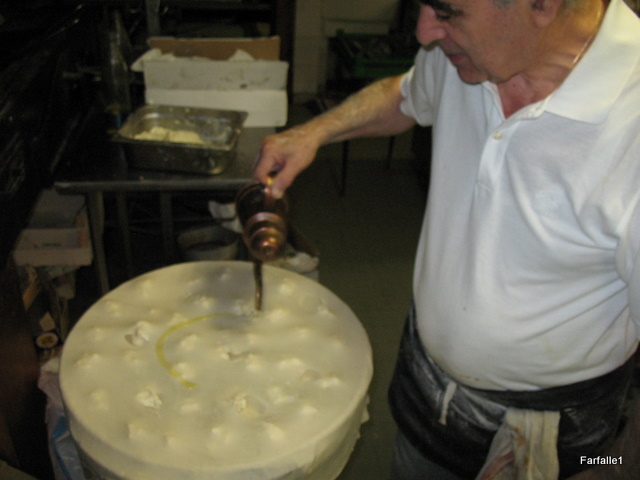
The final ingredients are put on top – a sprinkling of salt and a nice drizzle of olive oil.

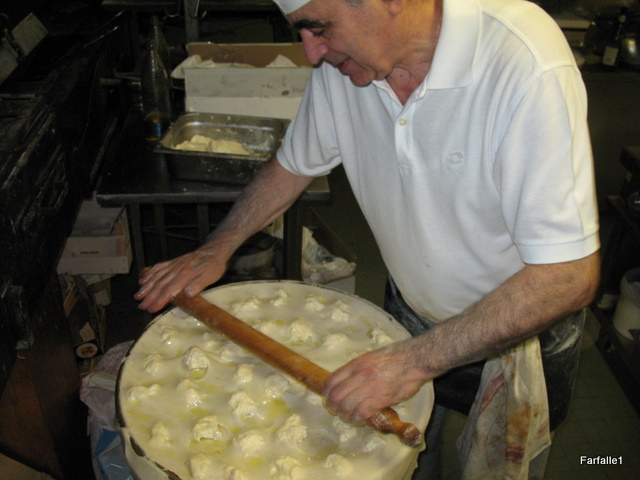
All that remains is to trim the excess dough and pop the whole thing in a very hot oven.

It was such a treat to be able to nose around the kitchen.  Everyone was clearly proud of the operation, and with good reason.  It was all orderly, clean and efficient.

Oh yum – a lobster!

They all move so fast; there were not a great many people down there, and they were putting out well over a hundred dinners.

As we were leaving the kitchen the dish-washer called us over and presented us with a little bowl of appetizers, and gave me a hearty handshake and a Buona Notte.  She was so cheerful, and so happy to see us.  We felt very welcome at Vitturin, both upstairs and down.

Genova, part 2

15 Monday Nov 2010

Posted by farfalle1 in Genova, Liguria, Photographs, Uncategorized

≈ 10 Comments

Tags

Aquario Genova, Galata Museum Genova, Genoa

When we left our first Genova tour we had just eaten our fill of farinata at the Antica Sa Pasto.  Now that we’ve eaten so much we can barely walk, let’s roll down the hill to the port area.  While Genova still has an extremely active port (it’s the place to bring little boys who want to see really big boats), a large section of it, the Porto Antica,  has been refashioned as a cultural and tourist center.  On the city side of the busy street you can see Palazzo San Giorgio, constructed in 1260, and obviously tarted up in the centuries since.  It was the home to one of the world’s first banks.

Photo courtesy of cepolina.com

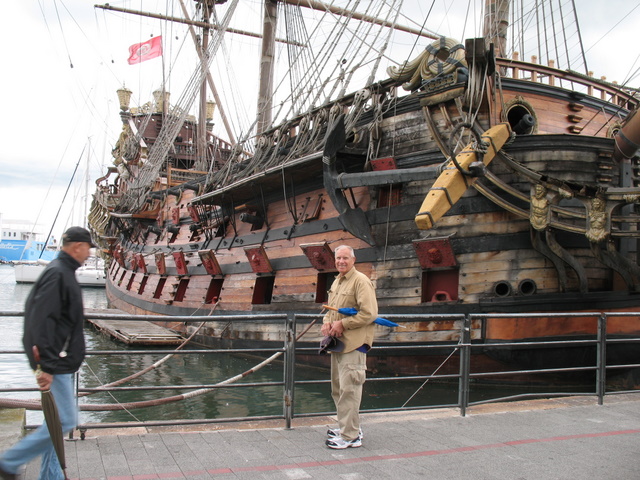
From about 1900 it served as the Port Authority; it now has several rooms that have been turned into exhibit space.  Cross the busy street and you will come to the Pirate Ship, one of the silliest of Genova’s offerings, maybe even sillier than Elvis.

Yo Yo Ho!  Arrrrrgh, let’s all talk like pirates!  Called Il Galleone Neptune (would you have guessed??), this replica of a 17th century pirate ship was built for the filming of Roman Polanski’s movie Pirates in 1986 (starring Walter Matthau as Cap’n Red).  You can go aboard for a fee, and it turns out to be rather fun.

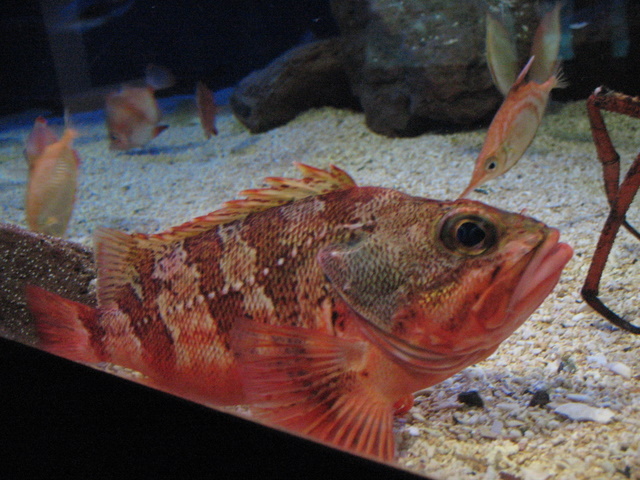
A little bit farther along the road we come to Genova’s famous Aquarium, built in 1992 and justifiably known as the finest in Europe.  It is immense; you can easily spend a whole day, and you may want to – it’s not cheap to enter.  The displays are imaginative, interesting and clean; the whole thing is a delight.

In addition to all the usual fishy displays you would expect, you will also find a hummingbird house, and a glass biosphere designed by Renzo Piano at the time of the G8 meeting in Genova in 2001 (in fact Piano had a hand in the whole refashioning of the Port area).

The Aquarium is just a part of the so-called AquarioVillage which also includes the gigantic (5 floors) and fascinating Galata Museo del Mare (Museum of the Sea).  This museum is particularly appropriate to Genova, which was one of the four Maritime Republics in the Middle Ages (the others were Venezia, Amalfi and Pisa – yes! Pisa, which was once on the sea). Here you can see a full size model of a galley, numerous models of all kinds of ships,

reproductions of early globes,

and a letter written by Christopher Columbus.

There are tools of the sea-faring life, life-size models of shipwrights at work, a studio where model-builders work their magic, a part size model of a Vessel and of a much later Steam ship, and a reproduction of a submarine.  Attached nearby is a submarine, the Nazario Sauro, which is part of the museum and which guests can visit.  At present the Museum has an exhibit called “La Merica” about Italian emigration to the U.S.  I found it particularly interesting as the Captain’s father made the trip from Sicily to America in the early years of the 20th century, the period covered in the exhibit.  In addition to being informative it’s just plain fun.  Visitors are issued reproduction Italian passports, circa 1920, as well as an entry document.

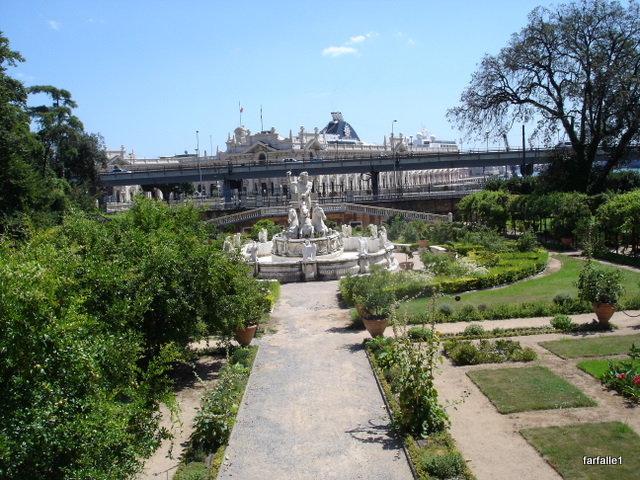
Leaving the Port complex we’ll take a not-very-long walk to the Palazzo Principe, built by Andrea Doria around 1530 and now a museum.  iPods with tons of information about the exhibits are issued when you buy your ticket. Picture-taking is not allowed inside, but you can snap away to your heart’s content in the gardens.

See the cruise ship in the background?  No doubt Doria liked to keep an eye on his own ships at anchor beyond his Palazzo.

Well, that ends my extremely superficial tour of part of the beautiful city of Genova.  From here it’s a short walk to the other main rail station, Principe, where you can catch a train to wherever you’re going.

There are huge portions of the city that I haven’t mentioned (because I’ve never seen them), and many sites worth visiting (which are still on my own to-do list), including The Palazzo Bianco, The Palazzo Rosso, Palazzo Reale and the fabulous Staglieno Cemetery among many others.  There’s even a cog railway from Principe to Granarolo – sadly not operating the day I was there.  I can’t wait to go back!

Genova the Unsung

11 Thursday Nov 2010

Posted by farfalle1 in Genova, Italian Churches, Italy, Liguria, Photographs, Uncategorized

≈ 14 Comments

Tags

Cattedrale San Lorenzo, Chiesa del Gesu e Sant'Ambrogio, Chiostro di Sant'Andrea, Genoa, Palazzo Ducale, Piazza de Ferrari, Porto Soprano

Here’s what you never hear prospective visitors to Italy say: “We’re going first to Florence, then Rome and Venice, and then Genova.”  Genova?  Doesn’t seem to be on too many tourist’s maps, and it’s a pity, because it’s a terrific city, well worth a visit.

Genova, long and narrow, is spread out on the strip of land between the mountains and the sea around her generous harbor.  She is the capital of  Liguria and boasts a metropolitan area population of some 1.4 million.  Known as ‘La Superba’ for her ancient and glorious history, she is now an important economic center of Italy and was, in 2004, the European Union’s Capital of Culture.  The Bank of St. George, one of the oldest known banks, was founded in Genova in 1407.

Ancient remains suggest that the city was inhabited (by Greeks?) as early as the 6th or 5th century BC, perhaps even earlier.  It was destroyed by Carthaginians in 209 BC, later rebuilt and later still invaded by Ostrogoths  and Lombards.  Wikipedia has a very brief history of Genova here if you’d like a quick study.

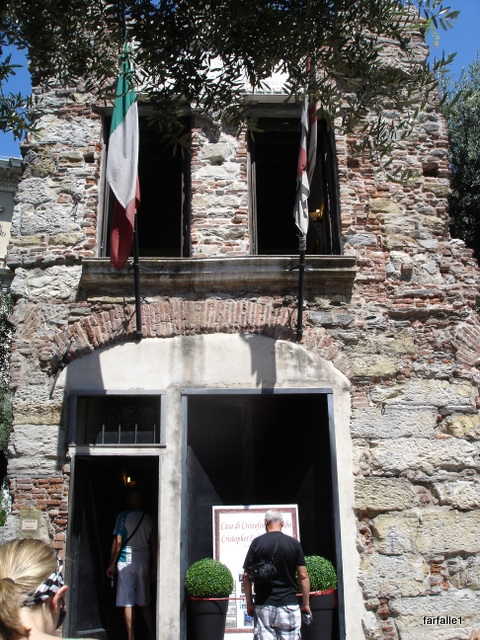
If Americans think of Genova at all, it may be as the purported home of Christopher Columbus.  The wee little house where he may have lived, just outside the city walls, is a must-see.

I have an idea:  let me take you on ‘The Tour’ of Genova that I give guests when I can lure them away from the delights of Rapallo for a day.  It is a train ride of about 40 minutes to the more eastern of Genova’s two train stations, Brignole.  From there it is easy to find Via XX Settembre, the broad and well-traveled street with many famous shops.

At the top of Via XX Settembre is Piazza de Ferrari, newly reconstructed after being torn up for years to accommodate construction of the new metro subway.

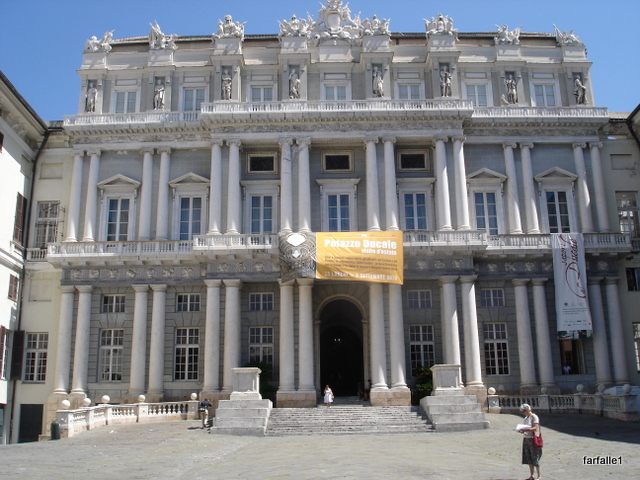
If you had taken this photo the Carlo Felice opera house would be on your left, the Palazzo Ducale behind you, and behind that the tumble jumble of medieval Genova’s streets.

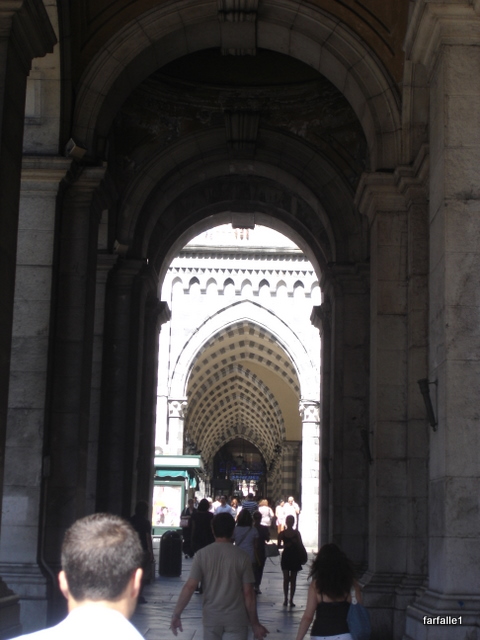
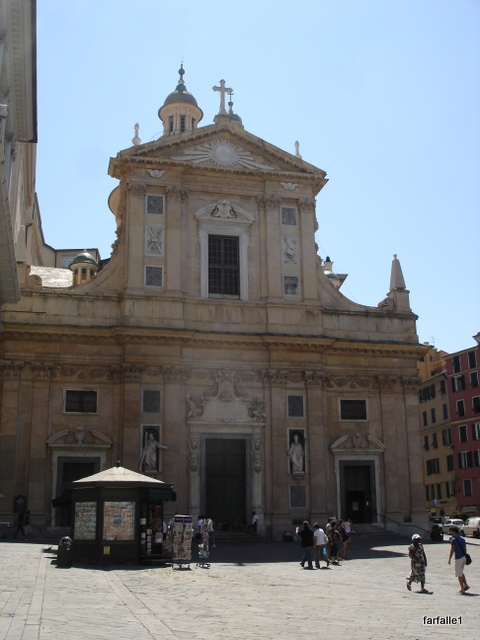
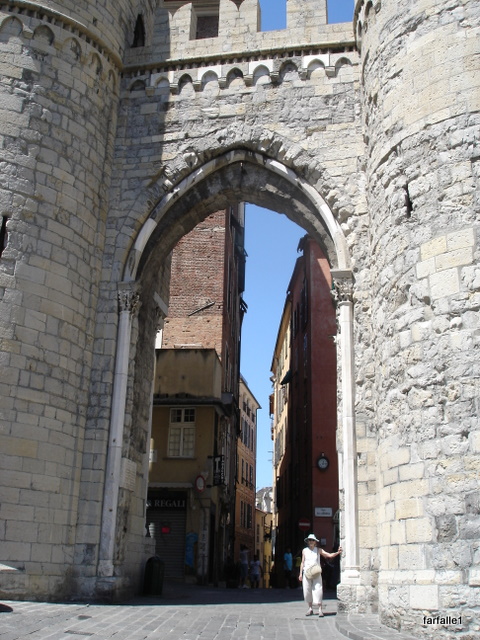
From here let’s take a stroll through the atrium of the magnificent Palazzo Ducale, turn left, and walk down the timeworn steps to  Piazza Matteoti, home of the Chiesa del Gesu e Sant’Ambrogio.

We’ll nip in to take a peek at the The Circumcision (link is to a probable study  from the Gemäldegalerie der Akademie der bildenden Künste in Vienna) painted by Peter Paul Rubens in 1605, one of two paintings he made for the church during his stay in the city.  After we leave the church we’ll turn left and walk up to and through the tall city gate.

Hey!  Who’s that?

Who knew that The King hung out at the Cafe Barbarossa to serenade unsuspecting tourists?  Enough of this nonsense.  On to Columbus’s house:

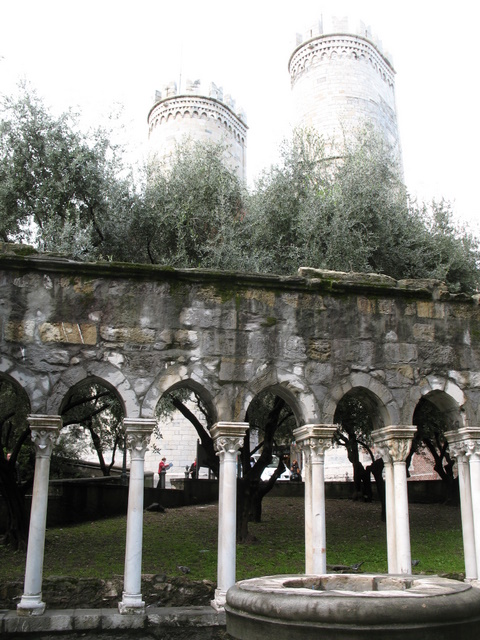
Very teeny indeed. For €4 you can go in and look, but perhaps we don’t need to do that today.  Of more interest, to me anyway, are the beautiful remains of the Chiostro di Sant’Andrea, moved to its present location just next door  to the house in 1922.  The cloister dates from the XII century and is a little island of calm amidst the bustle of the city that has grown around it.

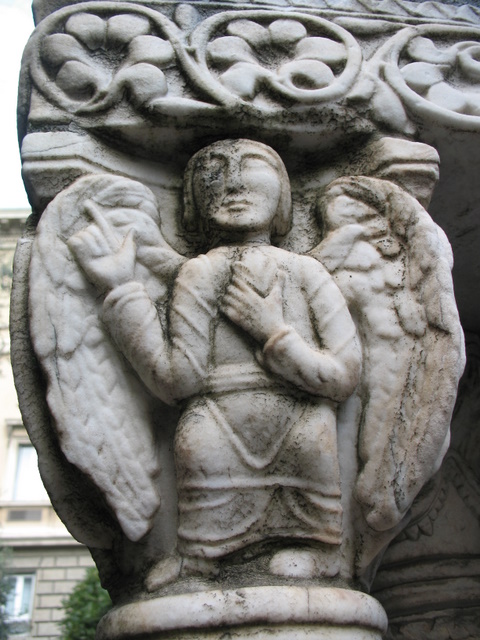
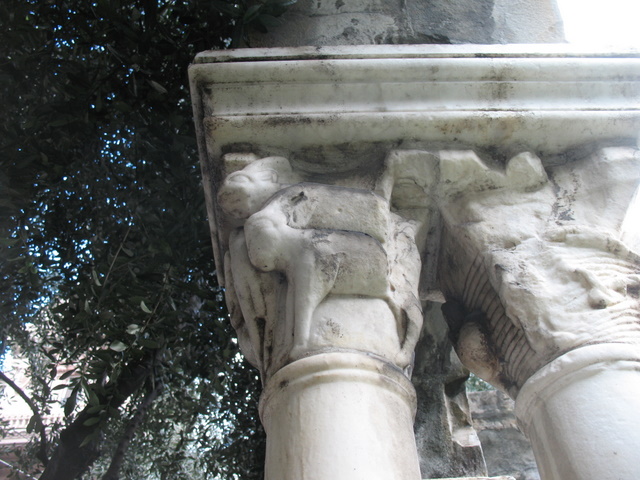
In the background you can see an X-Files rendition of the Porto Soprano, one of the gates in the city walls which were constructed in the XII century.  Here are a couple of details from the top of the cloister columns.


I love this angel’s calm demeanor.

Why is there a rabbit on top of that donkey?

From this peaceful corner we will go back through the Porto Soprano,


walk by the Palazzo Ducale again,

Phot courtesy of Pidge Cash

and continue down to the magnificent  Cattedrale di San Lorenzo, which was consecrated in 1118.  The black and white stripes are a medieval symbol of nobility.


You can stare at the facade of this church for hours, and you will continue to find new details.

As well as many beautiful paintings and some 13th century frescoes, the church contains a most unusual artifact,  a grenade that struck the church on February 9, 1941, during a bombardment by the British.  The grenade went through the roof of the cathedral without exploding and can still be seen in the right aisle.

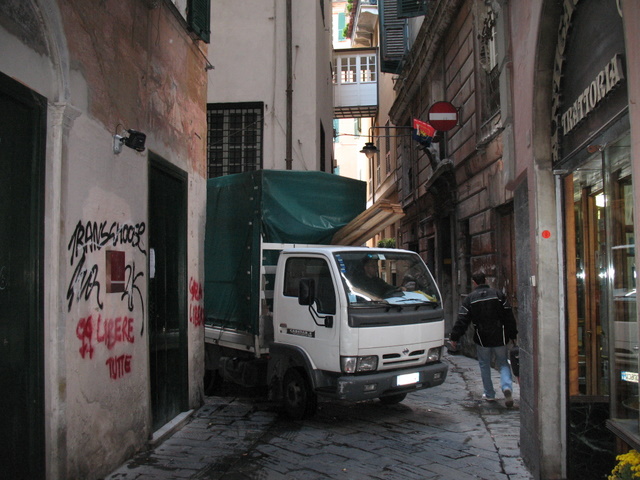
Now it’s time to launch ourselves into the warren of narrow streets in the medieval part of the city.  How narrow, you ask?  Well, narrow enough that a small truck has to make a complicated back and turn maneuver to make a simple 90 degree turn.

And it’s not even a big truck!

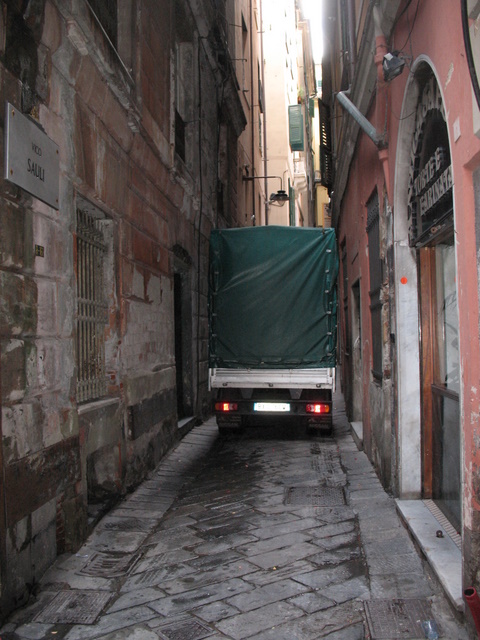
Many of the streets are too narrow to accommodate even a car, never mind a small truck.


Time for lunch!  We’ll stop at one of the many restaurants and trattorie in the old section and partake of a bit of Genova’s signature dish: farinata, a very flat pancake made from chickpea flour.

Note the wood-burning oven in the background; that is the only way to cook farinata correctly.  This photo was taken through the window of Antica Sa Pesta, a restaurant on an old salt-trading site.

Maybe we’ve done enough for one day.  Let’s take our full bellies home and have a nap before tucking into whatever the Captain has cooked up for us in our absence.  We’ll come back very soon to finish the tour of beautiful Genova.

← Older posts
Newer posts →

Enter your email address to follow this blog and receive notifications of new posts by email.

Join 114 other subscribers

rss

Subscribe in a reader

Search the Blog

A. Useful Links

  • bab.la language dictionary
  • Bus schedules for Tigullio
  • Conversions
  • English-Italian, Italian-English Dictionary
  • Expats Moving and Relocation Guide
  • Ferry Schedule Rapallo, Santa Margherita, Portofino, San Frutuoso
  • Italian Verbs Conjugated
  • Piazza Cavour
  • Rapallo's Home Page – With Link to the Month's Events
  • Slow Travel
  • The Informer – The Online Guide to Living in Italy
  • Transportation Planner for Liguria
  • Trenitalia – trains! Still the most fun way to travel.

C. Elaborations

  • A Policeman’s View
  • Driving School Diary
  • IVA refunds due for past Rifiuti tax payements
  • Nana
  • Old trains and old weekends
  • The peasant, the Virgin, the spring and the ikon
  • Will Someone Please, Please Take Me to Scotland?

D. Good Recipes - Best of the Week winners are starred

  • 'Mbriulata
  • *Baked Barley and Mushroom Casserole*
  • *Captain’s Boston Baked Beans*
  • *Crimson Pie*
  • *Louise’s Birthday Cake*
  • *Melanzane alla Parmigiana*
  • *Penne with Cabbage and Cream
  • *Pizzoccheri della Valtellina*
  • *Pumpkin Ice Cream*
  • *Risotto alla Bolognese*
  • *Rolled Stuffed Pork Roast*
  • *Spezzatini di Vitello*
  • *Stuffed Grape Leaves*
  • *Stuffed Peaches (Pesche Ripiene)*
  • *Swordfish with Salsa Cruda*
  • *Tagliarini with Porcini Mushrooms*
  • *Tagliatelli al Frutti di Mare*
  • *Three P's Pasta*
  • *Tzatziki*
  • 10th Tee Oatmeal Apricot Bars
  • Adriana’s Fruit Torta
  • Aspic
  • Bagna-calda
  • Best Brownies in the World
  • Clafoutis
  • Cold cucumber soup
  • Crispy Tortillas with Pork and Beans
  • Easy spring or summer pasta
  • Fish in the Ligurian Style
  • Hilary's Spicy Rain Forest Chop
  • Insalata Caprese
  • Lasagna al forno
  • Lasagna al Forno con Sugo Rosato e Formaggi
  • Lemon Meringue Pie
  • Leo’s Bagna Cauda
  • Leo’s Mother’s Stuffed Eggs
  • Louis’s apricot chutney
  • Mom's Sicilian Bruschetta
  • No-Knead (almost) Bread
  • Nonna Salamone's Christmas Cookies
  • Pan Fried Noodles with Duck, Ginger, Garlic and Scallions
  • Pesto, the classic and original method
  • Pesto, the modern, less authentic method
  • Pickle Relish
  • Poached pears
  • Poached Pears
  • Polenta Cuncia
  • Recipes from Paradise by Fred Plotkin
  • Rustic Hearth Bread
  • Shrimp and Crayfish Tail Soup
  • Sicilian salad
  • Slow Food Liguria
  • Slow Food Piemonte and Val d'Aosta
  • Spinach with Garlic, Pine Nuts and Raisins
  • Stuffed Eggs, Piemontese Style
  • The Captain’s Salsa Cruda
  • Tomato Aspic
  • Zucchini Raita

E. Blogroll

  • 2 Baci in a Pinon Tree
  • Aglio, Olio & Peperoncino
  • An American in Rome
  • Bella Baita View
  • Debra & Liz's Bagni di Lucca Blog
  • Expat Blog
  • Food Lovers Odyssey
  • Italian Food Forever
  • L’Orto Orgolioso
  • La Avventura – La Mia Vita Sarda
  • La Cucina
  • La Tavola Marche
  • Rubber Slippers in Italy
  • Southern Fried French
  • Status Viatoris
  • Tour del Gelato
  • Weeds and Wisdom

Photographs

  • A Day on the Phoenix Light Rail Metro
  • Apache Trail in the Snow
  • Aquileia and Croatia
  • Birds on the Golf Course
  • Bridge Art
  • Canadair Fire Fighters
  • Cats of Italy
  • Cloudy day walk from Nozarego to Portofino
  • Fiera del Bestiame e Agricultura
  • Football Finds a Home in San Maurizio
  • Hiking Dogs
  • Mercatino dei Sapori – Food Fair!
  • Moto Models
  • Olive pressing
  • Rapallo Gardens
  • Rapallo's Festa Patronale
  • Ricaldone and the Rinaldi Winery
  • Rice Fields
  • Sardegna ~ Arbatax and Tortoli
  • Sardegna ~ San Pietro above Baunei
  • Sardegna ~ The Festa in Baunei
  • Scotland, including Isle of Skye
  • Slow Food 2008 Salone del Gusto
  • The Cat Show and the Light Rail Fair
  • The desert in bloom
  • Trip to Bavaria

Pages

  • Fagioli all’ucelleto

Archives

Recent Posts

  • A Superior Visit
  • Fun at the Ranch Market
  • The MAC
  • Welcome Tai Chi
  • Bingo Fun for Ferals
December 2025
M T W T F S S
1234567
891011121314
15161718192021
22232425262728
293031  
« Jul    

Member of The Internet Defense League

Blog at WordPress.com.

  • Subscribe Subscribed
    • An Ex-Expatriate
    • Join 114 other subscribers
    • Already have a WordPress.com account? Log in now.
    • An Ex-Expatriate
    • Subscribe Subscribed
    • Sign up
    • Log in
    • Report this content
    • View site in Reader
    • Manage subscriptions
    • Collapse this bar
 

Loading Comments...